























Key Takeaways
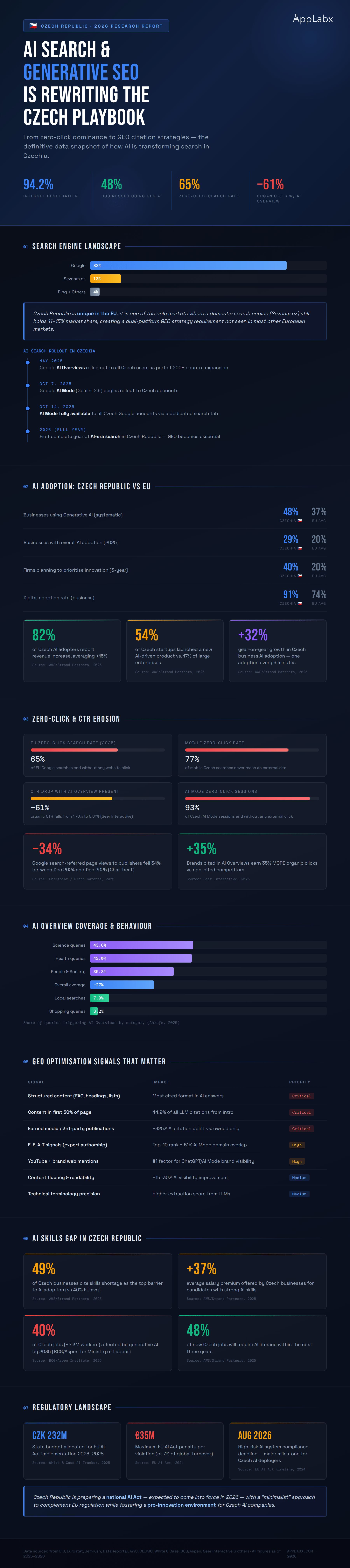
- Czechia is rapidly embracing AI search, with 48% of companies systematically using generative AI and 94.2% of the population connected to the internet.
- Google AI Overviews, AI Mode, ChatGPT and other generative search platforms are reshaping Czech SEO as zero-click searches rise and traditional organic CTR declines.
- Generative Engine Optimisation (GEO) is becoming essential for Czech brands seeking stronger AI citations, brand mentions, entity recognition and visibility across AI-generated answers.
The Czech Republic is entering a new era of online discovery, with AI search changing how consumers find information and how businesses gain digital visibility. In 2026, strong internet penetration, growing generative AI adoption, rising zero-click searches, and evolving search behaviour make Generative Engine Optimisation increasingly important for Czech brands.
The AI search landscape in the Czech Republic is entering a decisive stage in 2026. Generative AI is no longer simply an emerging technology used by a small group of early adopters. It is increasingly influencing how Czech consumers search for information, how businesses create and distribute content, how marketers measure online visibility, and how brands compete to appear inside AI-generated answers.
Also, read our article on the top SEO and GEO agencies here:
Top 10 Best SEO Agencies in the Czech Republic
Top 10 Best GEO Agencies in Czech Republic
The underlying digital environment makes the Czech Republic particularly well positioned for this transition. By late 2025, the country had approximately 9.96 million internet users, representing an internet penetration rate of 94.2%. Czechia also recorded approximately 14.7 million cellular mobile connections, equivalent to 139% of its population, while 97.6% of mobile connections were broadband-enabled. These figures provide the connectivity foundation required for widespread adoption of conversational search, AI assistants, Google AI features, and other generative search experiences.
At the same time, artificial intelligence is becoming deeply embedded in the Czech business economy. According to the statistics compiled in this report, 48% of Czech companies report systematic use of generative AI tools, compared with a European Union average of 37%. Among Czech organisations already using AI, 67% deploy it for internal processes, 45% for marketing and sales, and 41% for customer service. Another dataset indicates that approximately 29% of all Czech businesses, or roughly 370,000 firms, consistently use AI, representing substantial year-over-year growth.
These developments have major implications for Generative Engine Optimisation (GEO) in the Czech Republic. GEO is increasingly becoming the AI-search counterpart to traditional Search Engine Optimisation (SEO). Instead of focusing exclusively on ranking webpages in conventional search results, GEO focuses on improving the likelihood that a company, product, expert, statistic, webpage, or other entity is discovered, understood, referenced, recommended, or cited by generative AI systems.
This distinction matters because the Czech search experience itself is changing. Google continues to dominate the Czech search market, holding approximately 82–85% market share, while domestic search engine Seznam retains an estimated 11–15% share. However, traditional search results are increasingly being supplemented by generative answers. The dataset records the arrival of Google AI Overviews in Czechia in May 2025, followed by the rollout of Google AI Mode in October 2025. As a result, 2026 represents the first full year in which many Czech organisations must think seriously about competing for visibility across conventional rankings and AI-generated search experiences simultaneously.
This evolution is particularly important because search visibility and website traffic are becoming increasingly disconnected. The statistics examined in this report show that approximately 60% of Google searches in the European Union now end without an external website click. Mobile zero-click behaviour reaches approximately 77%, while AI Mode can produce substantially higher zero-click behaviour. The dataset also cites research showing that organic click-through rates can decline sharply when AI Overviews appear on a search results page.
For Czech businesses, this means that simply achieving a high Google ranking may no longer tell the complete story of search performance. A company could maintain strong organic rankings while receiving fewer visits because users obtain the information they need directly from an AI-generated answer. Conversely, a brand that is repeatedly mentioned or cited by ChatGPT, Google AI Mode, Google AI Overviews, Perplexity, and other answer engines may gain substantial visibility even when users do not immediately click through to its website.
The scale of consumer adoption makes this shift difficult to ignore. 72% of Czech internet users are aware of ChatGPT, while more than 60% have reportedly tried the platform at least once. Among Czech ChatGPT users, 83% found the tool useful. These figures suggest that conversational AI has already moved well beyond a niche technology audience and is becoming part of mainstream information discovery behaviour.
Globally, the trend is moving even faster. The dataset highlights estimates showing AI search traffic growing 527% in a single year, while LLM referral traffic across monitored analytics properties increased approximately 529% between January–May 2024 and the equivalent period in 2025. Perplexity was processing approximately 780 million monthly queries by May 2025, while ChatGPT had reached billions of queries per day. These figures illustrate why AI-generated discovery is increasingly being treated as a distinct search channel rather than simply another feature layered onto traditional SEO.
The implications extend beyond traffic. AI systems can increasingly influence which businesses enter a consumer’s consideration set. According to one statistic included in this report, 88% of AI Mode users accepted an AI-recommended shortlist without external verification, compared with 56% of users who constructed their own shortlist through classic search. If this behaviour continues, appearing in generative recommendations could influence purchasing decisions considerably earlier in the customer journey.
This creates an important strategic question for Czech companies in 2026: when potential customers ask an AI assistant about the best companies, products, services, software, employers, destinations, financial providers, or professional solutions in their market, will their brand appear in the answer?
Answering that question requires marketers to look beyond traditional keyword rankings.
Emerging GEO research suggests that AI visibility can depend on a combination of content authority, topical depth, structured information, brand mentions, third-party references, earned media, technical terminology, readable content, stable URLs, and machine-understandable page architecture. The statistics compiled here indicate that 44.2% of LLM citations originate from the first 30% of webpage text, while distributing content through multiple external publications can generate substantially greater AI citation visibility than relying exclusively on owned media.
The volatility of generative search makes the challenge even more complex. The dataset reports that AI Overview content can change 70% of the time when the same query is repeated, with 45.5% of citations replaced when a new answer is generated. Separate research cited in the dataset found only 9.2% overlap between repeated AI Mode results for identical queries. This means GEO cannot realistically be approached as a one-time optimisation exercise. AI visibility needs to be measured across repeated prompts, platforms, citations, entities, topics, and time periods.
Czechia also has economic characteristics that could accelerate this transition. The country has more than 3,000 active startups, with more than 700 startups in Prague alone. Czech businesses reportedly achieve a 91% digital adoption rate, while 40% of firms plan to prioritise innovation investments during the next three years. Czech startups are particularly aggressive adopters of advanced AI, creating an environment in which AI-native marketing and search practices can spread relatively quickly.
Yet significant challenges remain. 49% of Czech businesses identify skills shortages as their primary barrier to deeper AI adoption, while 53% say insufficient qualified AI talent is hindering innovation. Czech companies are reportedly willing to offer an average 37% salary premium for candidates with strong AI capabilities, illustrating how quickly demand for practical AI expertise is outpacing supply. GEO specialists, AI content strategists, AI visibility analysts, technical SEO professionals, and marketers capable of understanding both conventional search and LLM discovery may consequently become increasingly valuable.
Regulation will shape the market as well. Czech organisations must navigate the broader EU AI Act, national AI policy and an evolving compliance environment while increasing their use of generative systems. The Czech government has allocated CZK 232 million for EU AI Act implementation during 2026–2028, while Czechia’s National AI Strategy 2030 spans areas including education, industry, labour, ethics, security, business development and public administration.
Taken together, these trends point toward a significant restructuring of search marketing in the Czech Republic. SEO is not disappearing, but search success is expanding beyond rankings, clicks and conventional organic traffic. Businesses increasingly need to understand whether AI systems recognise their entities, trust their information, cite their content, mention their brands and recommend them when users ask commercially important questions.
The following 105 AI Search and GEO statistics for the Czech Republic in 2026 explore this transformation through data covering internet penetration, Google and Seznam market share, AI adoption among Czech businesses, ChatGPT usage, AI skills and employment, zero-click searches, Google AI Overviews, Google AI Mode, LLM traffic, GEO optimisation signals, generative AI investment, Czech digital infrastructure and the EU regulatory environment. Together, they provide a data-driven picture of how AI search and Generative Engine Optimisation in the Czech Republic are evolving in 2026 — and what these changes could mean for businesses, marketers, publishers, SEO professionals and digital agencies preparing for the next era of online discovery.
But, before we venture further, we like to share who we are and what we do.
About AppLabx
From developing a solid marketing plan to creating compelling content, optimizing for search engines, leveraging social media, and utilizing paid advertising, AppLabx offers a comprehensive suite of digital marketing services designed to drive growth and profitability for your business.
At AppLabx, we understand that no two businesses are alike. That’s why we take a personalized approach to every project, working closely with our clients to understand their unique needs and goals, and developing customized strategies to help them achieve success.
If you need a digital consultation, then send in an inquiry here.
Or, send an email to hello@applabx.com to get started.
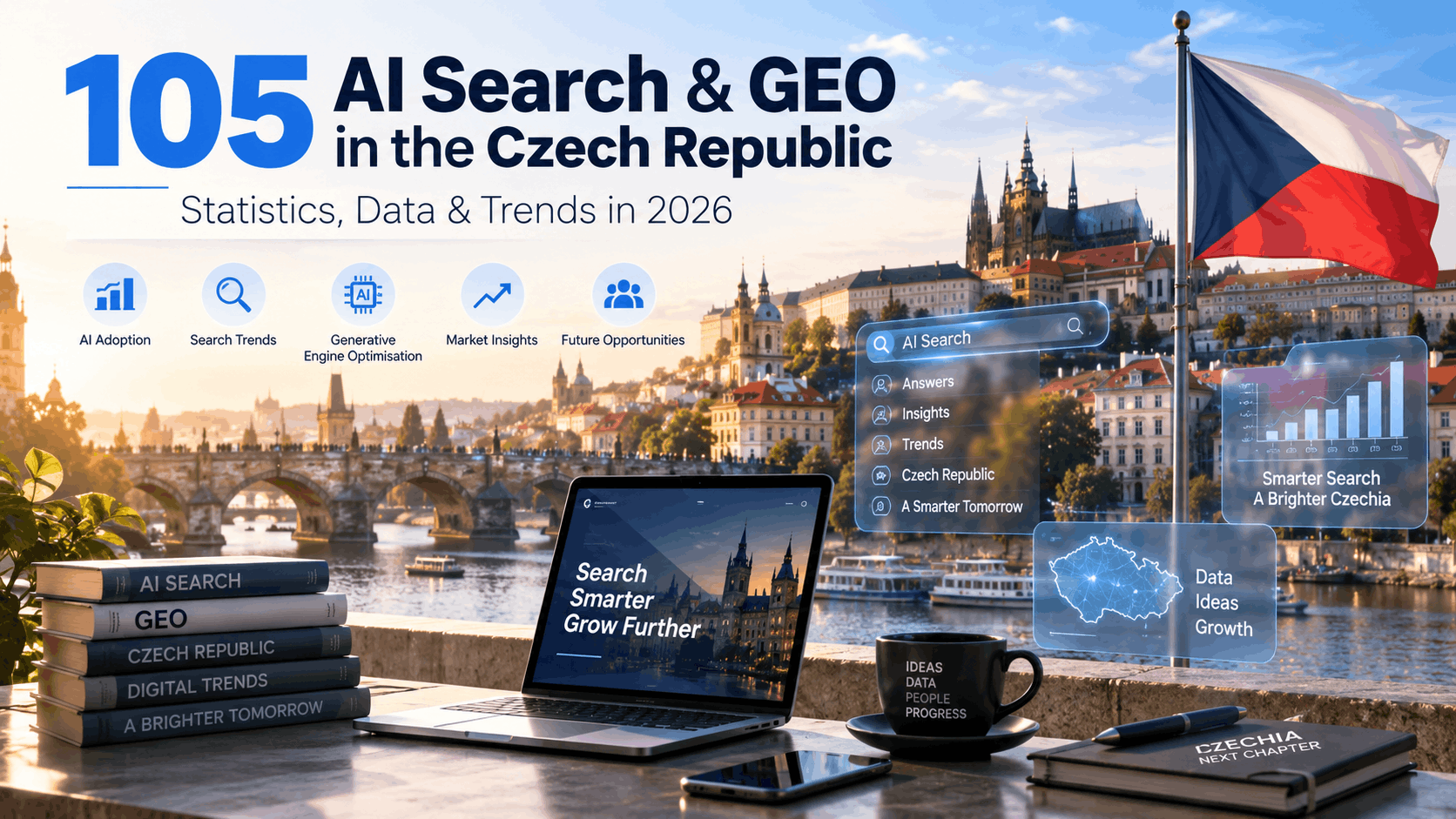
105 AI Search & GEO in the Czech Republic Statistics, Data & Trends in 2026
100+ Quantitative Statistics
A. Digital Infrastructure & Internet Penetration
1. There were 9.96 million internet users in the Czech Republic as of late 2025, representing a penetration rate of 94.2% of the total population.
Czech Republic’s near-universal internet access creates a highly fertile environment for AI-powered search tools to reach virtually the entire adult population, making GEO strategies immediately relevant at scale.
2. Total cellular mobile connections in Czechia stood at 14.7 million in late 2025 — equivalent to 139% of the total population — reflecting widespread multi-device usage.
The multi-SIM reality of Czech mobile users signals that AI search tools must be optimised for multi-device, multi-session behaviour rather than assumed single-platform journeys.
3. 97.6% of mobile connections in Czechia are classified as broadband (3G/4G/5G), providing the speed infrastructure needed to support generative AI search experiences.
Near-total broadband mobile penetration removes a critical barrier to AI search adoption, meaning Czech users can access conversational AI tools and AI Overviews from virtually anywhere.
4. Czechia was home to 8.08 million social media user identities in October 2025, equating to 76.4% of the total population — a key discovery surface for AI-cited content.
Social media reach at this scale means that AI models drawing on social signals (especially Reddit and LinkedIn mentions) have a rich Czech content pool to index, relevant for GEO brand mention strategies.
5. The Czech Republic ICT market is expected to reach USD 22.5 billion in 2025 and grow at a CAGR of 7.60% to reach USD 32.4 billion by 2030.
This robust ICT growth trajectory provides the enterprise investment backdrop against which AI search optimisation tools and GEO services will see sustained demand from Czech businesses.
6. The Czech digital transition budget totals EUR 2.26 billion, equivalent to 0.71% of Czechia’s GDP in 2024, spanning 58 strategic measures.
A government-backed digital budget of this magnitude provides structured incentive for Czech organisations to invest in AI readiness — including the SEO-to-GEO transition — as a funded strategic priority.
7. Czechia allocates 23% of its total National Recovery and Resilience Plan (EUR 1.9 billion) to digital transformation initiatives.
Nearly a quarter of Czechia’s recovery funds directed at digital signals that AI-powered search capabilities will receive structural public-sector support, likely accelerating enterprise GEO readiness.
8. Czechia has over 3,000 active startups representing approximately 5% of national GDP, with around 100 venture capital funds operating domestically.
A startup ecosystem of this density creates a natural demand pool for cutting-edge GEO tools, as founder-led companies are typically faster to adopt AI-native search optimisation practices.
9. More than 700 startups operate in Prague alone, collectively valued at approximately EUR 23 billion, having raised EUR 264.5 million in 2024.
Prague’s concentrated startup density positions it as the epicentre of Czech AI search innovation, with well-funded founders disproportionately likely to prioritise AI visibility over traditional SEO metrics.
10. Czechia’s total venture capital investment in startups reached EUR 456 million in 2024, sustaining AI product development and adoption cycles.
This capital deployment into the startup ecosystem funds the very companies most likely to be building and deploying GEO tools, creating a positive feedback loop for AI search maturity in the market.
B. Search Engine Market Share in Czech Republic
11. Google holds approximately 82–85% of the search engine market share in Czech Republic as of 2025, up from roughly 75% in 2015.
Google’s dominant and growing market share makes it the primary arena for AI search disruption in Czechia — meaning that the rollout of Google AI Overviews and AI Mode has an outsized effect on Czech organic search visibility.
12. Seznam.cz, the country’s homegrown search engine, commands 11–15% of the local search market as of 2025.
Seznam’s continued relevance — particularly for Czech-language and local search queries — means that Czech GEO strategies must account for a dual-platform reality not present in most other EU markets.
13. Bing accounts for the bulk of remaining Czech search market share, though it remains a distant third to Google and Seznam in local query relevance.
For Czech SEO professionals, the prioritisation order remains Google → Seznam → Bing, though Bing Copilot’s AI integration may accelerate its relevance for AI-native search queries.
14. Google AI Mode was rolled out to Czech users beginning 7 October 2025, with full account coverage completed by 14 October 2025.
The Czech market received Google’s most advanced AI search mode in Q4 2025, making 2026 the first full year in which Czech publishers and brands must compete for AI Mode citation placements.
15. Google AI Overviews were first deployed in Czechia in May 2025, coinciding with Google I/O announcements rolling out the feature to over 200 countries.
The May 2025 Czech launch of AI Overviews marks the inflection point after which traditional Czech SEO benchmarks began to diverge from AI-era visibility metrics.
16. Google’s AI Mode in Czechia operates on the Gemini 2.5 model, generating contextual answers using a Query Fan-Out technique that breaks a single query into dozens to hundreds of sub-queries.
The Query Fan-Out architecture means Czech content must demonstrate topical authority across an entire subject cluster — not just rank for individual keywords — to secure AI Mode citation placements.
17. Google’s premium AI Ultra plan is priced at CZK 6,890 per month in the Czech Republic, offering deep AI search integration across Workspace products.
At roughly €270/month, the AI Ultra tier positions advanced AI search features as an enterprise-grade investment in Czechia, though the more accessible base tier makes AI Overviews universally available to all Czech users.
18. In AI Mode sessions in the Czech Republic, 92% of AI responses include a sidebar of links, on average citing 7 unique domains per answer.
The 7-domain citation norm in Czech AI Mode responses creates an oligopoly of referenced sources per query — underscoring why only authoritative, well-structured Czech content is likely to earn consistent AI citation.
19. A 2025 Semrush study found that AI Mode answers overlapped with Google’s Top 10 organic results in 51% of domains and 32% of URLs.
The 51% domain overlap between AI Mode citations and Top 10 organic rankings confirms that traditional SEO authority remains the strongest predictor of AI search visibility — a finding directly applicable to Czech publishers.
20. Top-cited domains in AI Mode results in the Czech Republic skew towards high-authority, structured-content publishers and Wikipedia — following the global pattern in which the top 50 brands capture a disproportionate share of AI citations.
Czech brands that have invested in long-form, structured, E-E-A-T-optimised content are already positioned to dominate the AI citation landscape, while smaller publishers face an uphill battle for AI-era visibility.
C. AI Adoption Among Czech Businesses
21. 48% of Czech companies report systematic use of generative AI tools, compared to a European Union average of 37% — placing Czechia as the leader among Central, Eastern, and Southeastern European (CESEE) countries.
Czech businesses outperforming the EU average in generative AI adoption by 11 percentage points signals that AI-powered content production and search optimisation are rapidly becoming standard practice rather than competitive differentiators.
22. Among Czech firms using AI, 67% deploy it in internal processes, 45% in marketing and sales, and 41% in customer service.
The fact that nearly half of Czech AI adopters deploy AI in marketing and sales directly elevates demand for GEO tools that can measure and optimise brand visibility in AI-generated search results.
23. 29% of all Czech businesses (approximately 370,000 firms) consistently use AI as of 2025, up from 22% the previous year — a 32% year-on-year growth rate.
A business-level AI adoption rate growing at 32% annually means Czech organisations are progressing through AI literacy stages quickly enough that GEO will likely become a standard digital marketing discipline within 18–24 months.
24. 90,000 Czech businesses adopted AI for the first time within a single 12-month period — approximately one business adopting AI every six minutes.
The accelerating pace of first-time AI adoption in Czechia creates a massive wave of new users who will need education on AI-era search visibility, presenting a significant opportunity for Czech digital marketing agencies.
25. 82% of Czech businesses that have adopted AI report an increase in revenue, with an average revenue uplift of 15% attributable to AI adoption.
The demonstrated 15% average revenue increase from AI adoption provides a compelling business case for Czech marketers to invest in GEO as part of their AI-augmented growth strategy.
26. 54% of Czech startups have launched a new AI-driven product, compared to only 17% of large Czech enterprises.
Startups’ disproportionate AI product innovation signals that the Czech GEO tool landscape will be populated by agile, startup-built solutions, with legacy enterprise tools adapting more slowly to AI search realities.
27. 52% of Czech AI-adopting startups are using AI in the most advanced ways — combining multiple models for complex tasks — compared to just 26% across European startups.
Czech startups outperform European peers in advanced AI use by double the rate, indicating a technically sophisticated local ecosystem capable of building and deploying complex AI search visibility architectures.
28. Large Czech enterprises report 41% AI adoption, but only 12% have a comprehensive AI strategy — revealing a significant gap between adoption and strategic maturity.
The strategy gap in large Czech enterprises represents a clear commercial opportunity: organisations with broad AI adoption but no cohesive AI visibility strategy are ideal clients for structured GEO consulting and implementation services.
29. Czech businesses with 91% digital adoption rate lead EU peers significantly (EU average: 74%) according to the EIB Group Investment Survey.
Czech firms’ 91% digital adoption rate confirms a highly digitally mature business environment in which AI search tools find a receptive, infrastructure-ready audience — accelerating GEO uptake versus markets with lower digital maturity.
30. 40% of Czech firms plan to prioritise investments in innovation over the next three years — roughly double the EU average of 20%.
Czech business innovation intent at twice the EU average means AI search infrastructure — including GEO frameworks, AI content tools, and structured data optimisation — will see sustained investment pressure from demand-side pull.
D. AI Skills, Talent & Workforce Impact
31. 49% of Czech businesses identify skills shortage as the primary barrier to deeper AI adoption, compared to 40% across Europe.
The AI skills gap is measurably more acute in Czechia than in the broader EU — creating a pressing need for structured GEO education programs targeting Czech digital marketing and SEO professionals.
32. 53% of Czech businesses say the lack of qualified AI talent is hindering innovation, while 41% say it is constraining growth.
With over half of Czech businesses citing AI skill gaps as an innovation blocker, the ability to credibly demonstrate GEO expertise will be a meaningful differentiator for Czech digital agencies and consultants.
33. Czech companies are willing to offer an average 37% salary premium to candidates with strong AI skills — one of the highest in Central Europe.
A 37% wage premium for AI talent in Czechia reflects the genuine scarcity of practitioners who can bridge AI literacy with practical outputs like GEO-optimised content and AI search visibility tracking.
34. AI literacy is expected to be required in 48% of new jobs created in the Czech Republic within the next three years.
With AI literacy becoming a requirement in nearly half of Czech new jobs within three years, GEO fluency will transition from a niche capability to a core digital marketing competency in the Czech labour market.
35. The Czech tech market is expected to create around 15,000 new jobs in 2025 alone, with strong demand for AI/ML engineers and data analysts.
Czechia’s tech job creation trajectory amplifies demand for AI search specialisation roles, including new positions like AI Content Strategist, GEO Analyst, and AI Visibility Consultant that are emerging globally.
36. 63% of Czech companies in IT and business services struggle to find qualified personnel with AI and machine learning skills.
The intensity of AI talent competition in Czech IT services means that organisations capable of attracting GEO-literate talent gain a structural advantage in an environment where AI search expertise is acutely scarce.
37. A BCG/Aspen Institute study for the Czech Ministry of Labour projects that more than 40% of Czech jobs — affecting approximately 2.3 million workers — will be impacted by generative AI by 2035.
The breadth of generative AI’s projected labour impact in Czechia underscores that AI search transformation is not a niche concern but a structural economic shift demanding proactive response from every sector’s marketing function.
38. Approximately 600,000 Czech roles are expected to undergo major changes requiring extensive retraining due to generative AI by 2035.
The scale of Czech workforce retraining needs creates a substantial market for AI search literacy courses, GEO certification programmes, and practical upskilling pathways for marketing professionals.
39. One in four Czech business leaders (PwC survey) expects to reduce headcount due to AI-driven automation in 2025.
As Czech businesses automate content and search processes, the premium on strategic GEO competence — the human judgment layer above AI execution — rises, making GEO expertise a career-resilient skill.
40. Data analysts in Czech Republic earn CZK 60,000–120,000 per month, reflecting the high demand for data-literate professionals who can navigate AI-era search analytics.
Czech data professionals’ salary premium reflects the market’s recognition that AI search success requires measurement infrastructure — including AI citation tracking, share-of-voice dashboards, and zero-click visibility metrics — beyond traditional rank tracking.
E. ChatGPT & AI Chatbot Adoption in Czech Republic
41. 72% of Czech internet users are aware of ChatGPT, per the CEDMO Tracking (V4+5) survey covering Central and Eastern Europe.
Although Czech ChatGPT awareness (72%) trails Hungary (81%), the majority of Czech online adults are already familiar with AI-generated answers — meaning AI-derived search behaviour is no longer a fringe phenomenon in this market.
42. More than 60% of Czech internet users have tried ChatGPT at least once, joining a pan-European trend where experimentation with generative AI tools has become mainstream.
The more-than-60% trial rate for ChatGPT among Czech users signals that a significant and growing proportion of Czech consumers are comfortable obtaining search-style answers from LLM interfaces — a direct driver of GEO’s strategic urgency.
43. 83% of Czech ChatGPT users found the tool useful, in line with the European average, though awareness remains lower than in Estonia, Germany, and Slovenia.
The high utility perception of ChatGPT among Czech users confirms sustained engagement beyond first-trial, meaning AI-sourced answers will increasingly displace traditional search clicks for Czech information-seeking journeys.
44. Globally, ChatGPT processes over 2.5 billion queries per day as of mid-2025, with Czech users representing a fraction of a market that reaches 900 million weekly active users worldwide.
The scale of ChatGPT’s global query volume contextualises why Czech brands must treat ChatGPT citation as a meaningful discovery channel — even Czech-language queries are being processed within this enormous AI search infrastructure.
45. ChatGPT holds approximately 80.49% of the global AI chatbot market share as of January 2026, making it the dominant AI answer engine whose citation patterns most determine AI search brand visibility.
ChatGPT’s near-monopoly share of AI chatbot usage means Czech GEO strategies must prioritise content structures and authoritative citation signals that are legible to GPT-family models above all other AI platforms.
46. AI chatbots are now the fourth most visited category of websites globally (per Semrush data on ChatGPT), with the platform surpassing 5 billion monthly visits.
The transition of AI chatbots into a top-4 global web category illustrates that AI search is no longer a supplementary discovery channel — it is a primary digital touchpoint that Czech brands cannot afford to ignore.
F. Zero-Click Search & CTR Erosion
47. In the European Union, approximately 60% of Google searches now end without a click to any external website — driven by featured snippets, AI Overviews, and direct answers.
Six in ten Czech Google searches now statistically end without a website visit, fundamentally altering the metric by which Czech marketers should judge content performance — from traffic to AI citation share.
48. When a Google AI Overview is present, CTR drops from 15% to 8% — an absolute decline of nearly half, according to Pew Research Center data from July 2025.
For Czech marketers, the arrival of AI Overviews means that ranking #1 on Google now delivers roughly half the click value it did before AI summaries appeared — making GEO citation placement the new #1.
49. Organic CTR plummeted 61% (from 1.76% to 0.61%) for queries where AI Overviews are present, per Seer Interactive’s analysis of 25.1 million impressions across 42 organisations.
The severity of the 61% organic CTR collapse from AI Overviews should alarm Czech SEO practitioners who have historically optimised for rank position without accounting for AI-induced CTR compression.
50. Paid search CTR crashed 68% (from 19.7% to 6.34%) when AI Overviews appear alongside paid results, per the same Seer Interactive study.
The paid CTR collapse is arguably more alarming for Czech PPC advertisers than the organic decline, as it strikes at direct revenue return on ad spend rather than the longer-horizon impacts of organic traffic erosion.
51. However, brands cited within an AI Overview earn 35% more organic clicks and 91% more paid clicks compared to brands not cited at all.
The citation premium — 35% more organic clicks, 91% more paid clicks — provides the single most compelling quantitative business case for Czech brands to invest in GEO: being cited in AI Overviews is more valuable than simply ranking.
52. Only 1% of searches lead to users clicking a link within the AI Overview itself (Pew Research Center, July 2025).
Despite generating awareness, AI Overview citations drive almost no direct click-through — reinforcing that Czech brands must optimise for citation to build brand recognition rather than expecting AI placements to directly replace organic traffic.
53. Around 93% of AI Mode sessions end without a click — more than twice the zero-click rate of AI Overviews (43%), per Semrush September 2025 data.
AI Mode’s 93% zero-click rate confirms that Czech search behaviour within this interface is fundamentally exploratory and answer-terminal, meaning brand visibility in AI Mode responses depends entirely on being named, not linked.
54. Users spend an average of 49 seconds in AI Mode compared to 21 seconds in AI Overviews, suggesting deeper engagement with AI-generated content.
Czech users engaging nearly 2.5× longer with AI Mode responses represent an opportunity: extended engagement with AI content that cites a Czech brand creates deeper impression value than a traditional ranked result the user scrolls past.
55. In 75% of AI Mode sessions, users never leave the search interface at all — representing a near-complete traffic diversion for informational queries.
Three-quarters of all AI Mode sessions resulting in zero external visits signals that Czech publishers relying on informational content for traffic must urgently develop direct audience channels to offset structural AI-driven traffic diversion.
56. Zero-click searches have grown from approximately 50% in 2020 to 65% in 2025, with projections reaching 72% by end of 2026.
The accelerating zero-click trajectory towards 72% by year-end 2026 means Czech marketers who delay GEO investment will face progressively steeper organic traffic declines with each passing quarter.
57. Mobile zero-click behaviour reaches 77% — meaning that for Czech users on smartphones, more than three-quarters of searches never result in a website visit.
Given Czech mobile penetration above 139% of population, the 77% mobile zero-click rate is particularly acute and demands that Czech GEO strategies prioritise mobile-first AI answer presence.
58. 26% of searches with AI Overviews end with no engagement at all — compared to just 16% for traditional results pages (Pew Research Center).
The jump from 16% to 26% total-disengagement rate when AI Overviews appear confirms a fundamental behavioural shift in Czech user search satisfaction, as AI answers complete the information journey before any publisher receives engagement.
59. Google Search page views to publishers fell 34% between December 2024 and December 2025 (Chartbeat/Press Gazette), reflecting the full-year structural impact of AI-driven search changes.
Czech publishers who depend on Google-referred page views for advertising revenue face a 34% structural decline — not a cyclical fluctuation — requiring a rapid pivot to direct audience development and AI-cited authority strategies.
60. AI Overviews appear in 99.9% of informational keyword searches, with 46% being long-tail queries (7+ words) and 57.9% being question-format queries.
The near-universal AI Overview presence for informational and question queries in Czech Google search confirms that virtually every how-to, what-is, and why-does query in Czech language will now be answered by AI before any organic link is clicked.
G. AI Overview & AI Mode Impact on SEO Metrics
61. AI Overview content changes 70% of the time for the same query re-run — and when it generates a new answer, 45.5% of citations are replaced with new sources (Ahrefs, November 2025).
The extreme volatility of AI Overview citations means Czech brands cannot achieve a “set-and-forget” GEO strategy — continuous content freshness, authority signals, and structured data updates are required to sustain citation presence.
62. AI Overviews appeared in up to 27% of Czech Google search results by 2025 — seven times the rate of the previous year.
The sevenfold year-on-year expansion of AI Overview coverage on Czech SERPs represents the fastest transformation of search result composition in the modern Czech digital marketing era.
63. A 34.5% drop in CTR for position-one organic results is observed when AI Overviews appear, per Ahrefs’ analysis of 300,000 keywords.
The 34.5% first-position CTR erosion is a material threat to Czech brands that have built content moats around top organic rankings — their traffic is declining even as their rankings remain stable.
64. AI Overviews now reduce total clicks by 58% (Ahrefs, February 2026) across the full range of queries on which they appear.
A 58% click reduction from AI Overviews is not a marginal efficiency loss — it represents a structural halving of organic traffic potential for Czech content that triggers AI Overview generation.
65. Search impressions jumped 49% year-over-year while CTR dropped 30% — users are encountering more Czech content in search but clicking through less often (BrightEdge).
The paradox of rising impressions alongside falling CTR reveals the new Czech search reality: visibility and traffic have decoupled, and AI citation share is now the metric that bridges impression value back to brand impact.
66. AI Mode has extremely high volatility: when running three tests for the same query, AI Mode results overlapped with themselves only 9.2% of the time (SE Ranking, August 2025).
The near-total inconsistency of AI Mode responses across repeated identical queries demands that Czech SEO professionals reframe success from “appearing in AI” to “being consistently in the citation pool that AI draws from.”
67. In AI Mode, 90.8% of cited links appear in a separate sidebar block, while only 8.9% are embedded directly within the AI-generated answer text.
Czech marketers must understand that AI Mode citation placement is typically sidebar-based, meaning brand value from AI Mode comes from sidebar link recognition rather than in-text endorsement — a different UX than traditional featured snippets.
68. Only 10.7% of URLs and 16% of domains overlap between Google AI Overviews and Google AI Mode citations (SE Ranking, August 2025).
The minimal overlap between AI Overviews and AI Mode citation sources confirms that Czech brands must build multi-pathway AI visibility strategies rather than assuming that AIO success automatically translates to AI Mode presence.
69. 44.2% of all LLM citations come from the first 30% of a webpage’s text — making the introduction and early content sections the highest-priority GEO real estate on any Czech page.
Czech content teams must restructure editorial workflows so that the most citation-worthy statistics, definitions, and expert conclusions appear in the opening paragraphs — not buried in content bodies as traditional editorial practice often dictates.
70. Distributing content to a wide range of external publications can increase AI citations by up to 325% compared to publishing exclusively on a brand’s own site (Stacker, December 2025).
The 325% AI citation uplift from earned media distribution should fundamentally reshape Czech content strategy: securing placements in high-authority Czech and European publications is now a GEO tactic as much as a brand awareness exercise.
H. AI Search Market & GEO Landscape
71. AI-powered tools currently account for approximately 6% of global search traffic, with projections suggesting this could surpass 10–14% by 2028.
As AI tools grow from 6% to a projected 10–14% of global search traffic, Czech brands that establish GEO authority in 2026 will have a structural advantage in an AI-search market that will be measurably larger within 24 months.
72. AI search traffic grew 527% in just one year globally — representing the fastest expansion of any new search channel in the history of digital marketing (Semrush).
The 527% growth rate of AI search traffic has no historical precedent in search engine history — for Czech digital marketers, this rate of change demands a strategic response in 2026, not a wait-and-see approach for 2027.
73. Perplexity AI processed approximately 780 million monthly queries by May 2025 — growing 524% from the prior year.
Perplexity’s explosive growth makes it a meaningful secondary AI search platform for Czech professionals and researchers, with brand mentions in Perplexity responses providing incremental AI visibility beyond Google’s ecosystem.
74. LLM traffic to monitored GA4 properties rose from approximately 17,000 to 107,000 sessions, comparing January–May 2024 to the same period in 2025 — a 529% increase (Previsible AI Traffic Report, 2025).
The verifiable 529% LLM referral traffic increase in measured properties confirms that AI platforms are already sending meaningful (if small) volumes of qualified Czech traffic — and this channel will only grow.
75. A study by Semrush (2025) projects that AI search may surpass traditional organic traffic by 2028 — with informational queries transitioning first, followed by commercial queries.
The 2028 AI search tipping point projection sets a clear countdown for Czech brands: the window to build authoritative GEO positioning before AI search exceeds traditional organic volume is approximately 18–24 months.
76. As of Q2 2025, LLMs like ChatGPT and Perplexity account for over 5.6% of all U.S. desktop search traffic — more than double the 2.48% reported in June 2024.
The doubling of LLM search traffic share within 12 months in the U.S. previews the trajectory Czech LLM search adoption will follow — roughly 12–18 months behind the American market in AI search maturation.
77. Google averaged over 101 billion monthly visits in 2025, up from 84 billion in 2024 — confirming that AI Overviews are expanding Google’s engagement even as they divert traffic from publishers.
Czech marketers should not interpret Google’s growth as evidence that the search ecosystem is healthy for publishers — the data shows Google absorbing session time through AI-generated answers that previously transferred to external sites.
78. The global generative AI market was valued at USD 103.58 billion in 2025 and is projected to grow to USD 161 billion in 2026 — a CAGR of ~39.6% through 2034.
The global generative AI investment context confirms that the infrastructure underpinning Czech AI search experiences will become dramatically more capable and pervasive across the GEO planning horizon.
79. The European generative AI market is expected to grow to USD 20.78 billion with a CAGR of 36.98% through 2031, sustaining investment in the AI search tools Czech marketers will depend on.
Europe’s sustained generative AI investment trajectory ensures that Czech-language AI capabilities will improve throughout the planning horizon, making early GEO investment even more valuable as these tools become more sophisticated.
80. Czech Republic has the second or third largest AI market in the Central and Eastern European (CEE) region (behind Russia and Poland) and is projected to see substantial growth through 2030.
Czechia’s regional AI market leadership reinforces why Czech brands that invest in GEO positioning now are securing first-mover advantage in a market that will attract growing global AI platform investment.
I. GEO Optimisation Signals & Content Strategy
81. Content that improves fluency and sentence readability for AI processing can achieve a 15–30% improvement in AI search visibility.
For Czech content teams, investing in clear, machine-parseable editorial structure — beyond keyword optimisation — delivers a measurable and quantifiable uplift in AI citation probability.
82. Structured content formats (headings, lists, FAQs, numbered steps, tables) are the most effective format for securing AI search citations across all major LLM platforms.
Czech content producers must systematically audit their existing content libraries for structural clarity — retrofitting legacy editorial content with FAQ schema, H2/H3 question headers, and summarised key points will immediately improve GEO eligibility.
83. Bottom-funnel content such as case studies and pricing pages receives the highest AI referral traffic, while top-funnel “what-is” and “how-to” content saw significant traffic drops.
Czech content strategists should deprioritise generic informational content creation and redirect effort toward case-study-rich, specific, authoritative content that AI models use to respond to high-intent commercial queries.
84. Earned media content distributed to multiple external publications achieves up to 325% more AI citations than content published exclusively on owned channels.
Czech brands with media relations capabilities now have a quantifiable GEO argument for sustained PR investment: every third-party publication placement exponentially increases AI citation probability relative to owned-site publishing alone.
85. Content that includes industry-standard technical terminology and demonstrates subject-matter expertise signals a higher extraction score to AI models, improving GEO performance.
Czech content teams producing technically accurate, expert-authored content in verticals like fintech, manufacturing, and healthcare are structurally advantaged in AI citation competition versus generic content farms.
86. AI models use information from sources without explicit citation in approximately 40% of responses — meaning Czech brands providing AI training material often receive no visible credit despite informing AI answers.
The 40% attribution loss rate from AI-sourced but uncredited content underscores the risk of passive content publishing for Czech brands: without proactive GEO citation strategies, up to two-fifths of AI answer value created by Czech content accrues to AI platforms rather than brand recognition.
87. YouTube mentions and branded web mentions are the top factors correlating with AI brand visibility across ChatGPT, AI Mode, and AI Overviews (Ahrefs, December 2025).
Czech brands that have invested in YouTube presence and earned broad web mention coverage are already structurally advantaged in AI citation models, suggesting video content and brand PR should be core GEO investment pillars.
88. There is less than a 1-in-100 chance that ChatGPT or Google AI, asked the same question 100 times, will produce the same brand list in any two responses.
The extreme inconsistency of AI brand recommendations — less than 1% response-to-response consistency — means Czech GEO success must be measured at the aggregate level of citation frequency, not individual response monitoring.
89. AI hallucinate links nearly 3× more often than Google Search, with ChatGPT returning 2.38% 404 errors for cited URLs (Ahrefs, September 2025).
Czech publishers must ensure that cited pages return accurate, stable 200 responses and that canonical URL structures are clean — AI hallucination amplifies the cost of broken or redirected links compared to traditional search.
90. In AI Mode, 88% of users accepted the AI’s recommended shortlist without external verification — versus 56% who built their own shortlist from multiple sources in classic search.
Czech consumers’ dramatically higher AI-recommendation compliance in AI Mode versus classic search means that AI Mode brand placement shapes purchase consideration with unprecedented authority — Czech e-commerce and service brands must treat AI Mode citations as the new “top-of-funnel” ranking.
J. Regulatory Environment & EU AI Act
91. The Czech government has allocated CZK 232 million from the state budget for EU AI Act implementation covering the 2026–2028 period.
Czechia’s dedicated AI Act implementation budget confirms that the regulatory environment for AI — including AI-generated search outputs — will be formally governed and monitored starting in 2026, creating compliance imperatives for Czech AI search tool providers.
92. The Czech national AI Act (Draft Act) is expected to come into force in 2026, with the Czech Telecommunications Office (CTO) set to become the primary market surveillance authority.
The imminent Czech national AI law will create formal compliance obligations for AI-powered search tools operating in the Czech market, meaning GEO practitioners must monitor regulatory developments that could shape how AI models are permitted to cite and attribute Czech content.
93. EU AI Act high-risk system compliance requirements take effect for most applications on 2 August 2026 — including AI-based HR and content recommendation systems used by Czech publishers.
The August 2026 EU AI Act compliance deadline is the dominant regulatory event shaping Czech AI adoption timelines in 2026, adding structured governance requirements to the same organisations deploying AI search tools.
94. EU AI Act violations carry penalties of up to €35 million or 7% of global annual turnover — the highest regulatory fine tier in EU digital law history.
The severity of EU AI Act penalty structures creates meaningful legal risk for Czech organisations deploying AI search tools without appropriate governance, elevating the importance of AI strategy maturity across the Czech market.
95. Czechia’s AI National Strategy 2030, updated in July 2024, spans seven pillars including Education, Industry, Labour Market, Ethics, Security, Business Development, and Public Administration.
The breadth of Czechia’s 2030 AI strategy confirms that AI search capabilities are not siloed in the tech sector but are expected to permeate all economic sectors — providing policy tailwinds for GEO adoption across Czech marketing verticals.
96. Czechia is contributing to the OpenEuroLLM project — coordinated by Charles University and funded by the EU’s Digital Europe Programme (EUR 37.4 million) — to develop multilingual, open-source large language models.
Czechia’s participation in building open-source European LLMs has direct GEO implications: Czech-language content optimised for European LLM citation standards will benefit from greater indexing fidelity in domestically-aware models than in U.S.-centric AI search platforms.
97. Czech businesses estimate that €37 of every €100 spent on technology goes toward compliance-related requirements — and 71% report compliance costs increasing over the past three years.
The high compliance cost burden on Czech tech spending — 37% of every €100 — means GEO solutions that integrate regulatory compliance (GDPR-safe content auditing, transparent AI attribution) alongside optimisation value will be more commercially viable in the Czech market.
98. Czech Republic’s Digital Decade Roadmap targets ICT specialists at 7% of the employed population by 2030 — below the EU target of 10% — signalling a persistent structural talent gap.
The deliberately conservative Czech ICT talent target compared to EU ambitions reveals a realistic assessment of the Czech skills gap, underscoring why AI search tools that augment small teams (rather than requiring dedicated specialists) will see the strongest Czech market adoption.
K. Czech Digital Economy & Broader AI Context
99. Czech Republic’s internet penetration of 94.2% places it among the top performers in the EU — with only 610,000 people (5.8% of the population) remaining offline.
With only 5.8% of Czechia offline, the addressable audience for AI search experiences is effectively the full adult internet-using population — there is no meaningful “digital divide” moderating AI search’s reach in this market.
100. Czech SMEs represent 71.1% of businesses reporting at least a basic level of digital transformation — outpacing the EU average — but advanced AI and VR deployments remain limited.
The gap between Czech SMEs’ basic digital maturity and advanced AI adoption represents both a challenge and a commercial opportunity: the digital foundation exists for GEO tool deployment, but the knowledge and implementation layer is still being built.
101. 5G network coverage in Czechia reached 93% of the population by late 2024 (Vodafone, O2, T-Mobile combined), providing low-latency AI search response infrastructure nationally.
Near-complete 5G coverage ensures that AI-powered search interfaces — including voice-activated and camera-based queries — deliver the response speeds that sustain engagement, removing network latency as a barrier to Czech AI search adoption.
102. Czech Republic’s median population age of 43.8 years means that the primary workforce and consumer decision-making cohort are in the 35–54 age bracket — a demographic showing increasing AI tool adoption.
The Czech workforce’s demographic profile — predominantly experienced professionals rather than digital natives — suggests that AI search adoption will be professionally motivated (efficiency, productivity) rather than purely social, creating demand for well-sourced, authoritative AI answers that GEO-optimised content delivers.
103. Czech Republic had an estimated 21 edge nodes as of 2024 with 4 tech unicorns, positioning it as a mid-tier digital infrastructure market within the EU.
Czechia’s growing but not yet dominant edge node infrastructure means that AI search response latency will continue to improve as EU-level edge computing investment accelerates — further enhancing the Czech AI search user experience.
104. Total digital economy investment in Czech Republic reached approximately EUR 2.26 billion (0.71% of GDP in 2024) through the Digital Decade Roadmap.
At 0.71% of GDP directed toward digital infrastructure, Czechia is making a consistent public investment in the backbone on which AI search experiences run — a structural commitment that will compound AI search adoption growth over the planning horizon.
105. The Czech Republic ranked 35th globally in the Startup Blink 2023 Global Startup Ecosystem Ranking — maintaining a vibrant innovation base relative to its population size of 10.6 million.
A globally competitive startup ecosystem, relative to Czechia’s modest population, confirms that the country punches above its weight in digital innovation — and will generate a disproportionate share of AI search tool innovation for Central European markets.
Conclusion
The 105 AI Search and GEO statistics for the Czech Republic in 2026 reveal a digital market moving rapidly from traditional search toward an ecosystem where conventional SEO, generative AI, answer engines, and Generative Engine Optimisation (GEO) increasingly operate together. With 9.96 million internet users and 94.2% internet penetration, Czechia already has the digital infrastructure required for AI-powered discovery to reach almost its entire connected population.
Business adoption provides another strong indicator of where the market is heading. 48% of Czech companies report systematic use of generative AI, exceeding the 37% EU average, while 45% of Czech AI adopters use the technology in marketing and sales. Approximately 29% of all Czech businesses, or 370,000 firms, consistently use AI, with adoption growing 32% year over year. These figures suggest that AI is progressing from experimentation toward an increasingly important component of Czech business operations and digital marketing.
Search itself is undergoing an equally important transformation. Google retains approximately 82–85% of the Czech search market, but the introduction of Google AI Overviews in May 2025 and AI Mode in October 2025 means that 2026 is the first full year in which Czech businesses must consider visibility inside generative search experiences alongside conventional organic rankings. Seznam’s estimated 11–15% share also gives Czechia a distinctive local search environment in which marketers cannot rely exclusively on a single discovery platform.
Perhaps the clearest reason for businesses to take GEO seriously is the changing relationship between search visibility and website traffic. Approximately 60% of EU Google searches now end without an external click, while mobile zero-click behaviour reaches 77%. The dataset also highlights research showing significant CTR declines when AI Overviews appear. At the same time, brands cited within AI-generated results can gain additional visibility and click advantages compared with brands that are absent from those answers.
This means that traditional metrics such as keyword rankings, organic sessions and click-through rates are no longer sufficient on their own. Czech marketers increasingly need to consider AI citation frequency, brand mentions, share of AI visibility, entity recognition, source authority and recommendation presence when evaluating search performance. A brand can potentially influence a buying decision without receiving the traditional website visit that marketers historically used to measure search success.
The statistics also demonstrate why GEO should not be reduced to simply writing content for ChatGPT. Research included in the dataset indicates that structured content, readable language, technical expertise, authoritative references, earned media and broader branded web mentions can all contribute to AI visibility. 44.2% of LLM citations reportedly originate from the first 30% of a webpage’s text, while external content distribution can produce substantially greater AI citation exposure than publishing solely through owned channels.
AI search is also highly volatile. AI Overview content can change 70% of the time when the same query is rerun, while repeated AI Mode results showed only 9.2% overlap in one cited study. For businesses, this reinforces the importance of treating GEO as an ongoing discipline involving content freshness, technical optimisation, authority building, citation monitoring and repeated AI visibility measurement rather than a one-time optimisation project.
Czechia appears particularly well positioned for this transition. The country combines high internet penetration with more than 3,000 active startups, strong business digitalisation, substantial public investment in digital transformation and comparatively high generative AI adoption. However, its AI skills shortage remains an important constraint: 49% of Czech businesses identify skills shortages as their primary barrier to deeper AI adoption, while 53% report that insufficient qualified AI talent is hindering innovation.
For Czech businesses, publishers, e-commerce companies, SaaS providers, professional services firms and digital marketers, the strategic direction is therefore becoming clearer. Traditional SEO remains important, but SEO alone may no longer be enough. Organisations need content that can rank in conventional search while also being easily interpreted, trusted, extracted and referenced by generative AI systems.
Ultimately, AI Search and GEO in the Czech Republic in 2026 represent a shift from competing only for rankings to competing for recognition inside machine-generated answers. As ChatGPT, Google AI Overviews, AI Mode, Perplexity and future AI search platforms become more influential in how people research companies and make decisions, being discoverable by search engines will increasingly need to be accompanied by being understandable and recommendable by AI.
The Czech organisations that begin building authoritative content, strong entity signals, structured information, credible third-party mentions and measurable AI visibility today will be better positioned for a search environment where rankings, citations, recommendations and generative answers coexist. The statistics in this report suggest that this transition is already underway, making Generative Engine Optimisation in the Czech Republic a practical digital visibility priority for 2026 and beyond.
If you are looking for a top-class digital marketer, then book a free consultation slot here.
If you find this article useful, why not share it with your friends and business partners, and also leave a nice comment below?
We, at the AppLabx Research Team, strive to bring the latest and most meaningful data, guides, and statistics to your doorstep.
To get access to top-quality guides, click over to the AppLabx Blog.
People also ask
What is AI search in the Czech Republic?
AI search uses generative artificial intelligence to produce direct answers to user queries. In Czechia, its importance is growing through platforms and features such as ChatGPT, Google AI Overviews, Google AI Mode and Perplexity.
What is Generative Engine Optimisation in the Czech Republic?
Generative Engine Optimisation (GEO) focuses on making brands and content easier for AI systems to understand, reference and cite when generating answers, recommendations and search summaries for users.
How many people use the internet in the Czech Republic?
The Czech Republic had approximately 9.96 million internet users in late 2025, representing an internet penetration rate of 94.2% and creating a large potential audience for AI-powered search.
How popular is generative AI among Czech businesses?
About 48% of Czech companies report systematically using generative AI tools, compared with an EU average of 37%, placing Czechia among the stronger adopters in its region.
How many Czech businesses consistently use AI?
Approximately 29% of Czech businesses, or around 370,000 firms, consistently used AI as of 2025. This was up from 22% a year earlier, representing approximately 32% year-over-year growth.
How are Czech companies using artificial intelligence?
Among Czech companies using AI, 67% apply it to internal processes, 45% to marketing and sales, and 41% to customer service, demonstrating its expanding role across business operations.
What is Google’s search engine market share in the Czech Republic?
Google accounted for approximately 82–85% of the Czech search engine market in 2025, making changes such as AI Overviews and AI Mode particularly important for Czech SEO and GEO strategies.
What is Seznam’s search market share in the Czech Republic?
Seznam holds approximately 11–15% of the Czech search market. Its continued strength in Czech-language and local searches makes it an important consideration alongside Google.
When did Google AI Overviews launch in the Czech Republic?
Google AI Overviews were introduced in Czechia in May 2025. Their arrival marked an important shift toward AI-generated answers appearing directly within Czech Google search experiences.
When did Google AI Mode launch in the Czech Republic?
Google AI Mode began rolling out to Czech users on 7 October 2025, with full account coverage completed by 14 October 2025, making 2026 its first full year in the Czech market.
How does Google AI Mode affect SEO in the Czech Republic?
AI Mode changes SEO by generating comprehensive answers from multiple sources. Its Query Fan-Out approach makes topical authority and broad subject coverage increasingly important for earning citations.
How common are zero-click searches in the Czech Republic?
The dataset cites an EU-wide estimate that approximately 60% of Google searches end without an external website click, illustrating the broader zero-click environment affecting Czech search marketers.
How high is mobile zero-click search behaviour?
Mobile zero-click behaviour reaches approximately 77%, meaning more than three-quarters of mobile searches may end without users visiting an external website.
How do Google AI Overviews affect organic CTR?
The dataset cites research showing organic CTR falling 61%, from 1.76% to 0.61%, for queries containing AI Overviews, demonstrating how AI-generated answers can reduce traditional organic traffic opportunities.
Do AI Overview citations help brands receive more clicks?
Yes. The dataset reports that brands cited within AI Overviews can receive 35% more organic clicks and 91% more paid clicks than brands that are not cited.
How many AI Mode searches end without a click?
Around 93% of AI Mode sessions reportedly end without a click, highlighting why brand mentions and citations inside generated answers are becoming important measures of search visibility.
How popular is ChatGPT in the Czech Republic?
About 72% of Czech internet users are aware of ChatGPT, while more than 60% have tried it at least once, indicating substantial consumer exposure to conversational AI.
Do Czech users find ChatGPT useful?
Yes. According to the statistics compiled in the report, 83% of Czech ChatGPT users found the platform useful, suggesting that adoption extends beyond simple awareness or experimentation.
How fast is AI search traffic growing?
The dataset cites global research showing AI search traffic growing 527% in one year, illustrating the rapid expansion of generative search as a digital discovery channel.
Could AI search overtake traditional organic search?
Research cited in the dataset projects that AI search could surpass traditional organic traffic by 2028, with informational queries expected to transition before commercial searches.
What content formats work well for GEO?
Structured content using clear headings, lists, FAQs, numbered steps and tables is identified as particularly effective for AI extraction and citation across major generative search platforms.
Where should GEO-optimised pages place important information?
Important facts should appear early. The dataset reports that 44.2% of LLM citations originate from the first 30% of a webpage’s text, making introductions especially valuable GEO real estate.
Does digital PR help Generative Engine Optimisation?
Yes. The report cites research indicating that distributing content across external publications can increase AI citations by up to 325% compared with publishing exclusively on a company’s own website.
Do brand mentions influence AI search visibility?
The dataset identifies YouTube mentions and branded web mentions as leading factors correlated with brand visibility across ChatGPT, Google AI Mode and Google AI Overviews.
Are AI search citations stable over time?
Not necessarily. AI Overview content reportedly changes 70% of the time when identical queries are rerun, while 45.5% of citations can be replaced when a new answer is generated.
Is AI Mode visibility consistent for the same search query?
AI Mode can be highly volatile. Research included in the dataset found only 9.2% overlap when results for the same query were tested three times.
What is the biggest barrier to AI adoption for Czech businesses?
Skills shortages are a major obstacle. About 49% of Czech businesses identify skills shortages as their primary barrier to deeper AI adoption, compared with 40% across Europe.
How much more will Czech companies pay for AI skills?
Czech companies are reportedly willing to offer an average salary premium of 37% to candidates possessing strong AI skills, reflecting growing competition for qualified AI talent.
How will the EU AI Act affect Czech businesses in 2026?
Most EU AI Act high-risk system compliance requirements take effect on 2 August 2026. Czech organisations adopting relevant AI systems will therefore face expanding governance and compliance responsibilities.
Why is GEO important for Czech businesses in 2026?
GEO is becoming important because search discovery increasingly occurs within AI-generated answers rather than through traditional website clicks alone. Czech brands need visibility across AI citations, recommendations and conventional search results.
Sources
DataReportal European Investment Bank Amazon Web Services Keypers Expats.cz Masaryk University Statista CEDMO Hub Eurostat Semrush Position Digital Seer Interactive SparkToro Seenos.ai RedSEO Mordor Intelligence White & Case Czech Ministry of Industry and Trade CMS Law European Commission OECD Prosek Partners Digital Bloom Backlinko DemandSage SearchEngineWorld Fortune Business Insights MarketDataForecast DataSlayer Infront Webworks Marketing LTB