
























Key Takeaways
- Kazakhstan is emerging as Central Asia’s AI search leader, supported by 92.9% internet penetration, rising generative AI adoption and major national AI investments.
- Google holds 69.87% of Kazakhstan’s search market while Yandex commands 28.31%, making multilingual SEO, GEO and AI search optimisation increasingly essential for digital visibility.
- Generative Engine Optimisation is becoming critical as zero-click search, AI Overviews, LLM citations and AI-powered discovery reshape how Kazakhstan’s consumers find, evaluate and trust brands online.
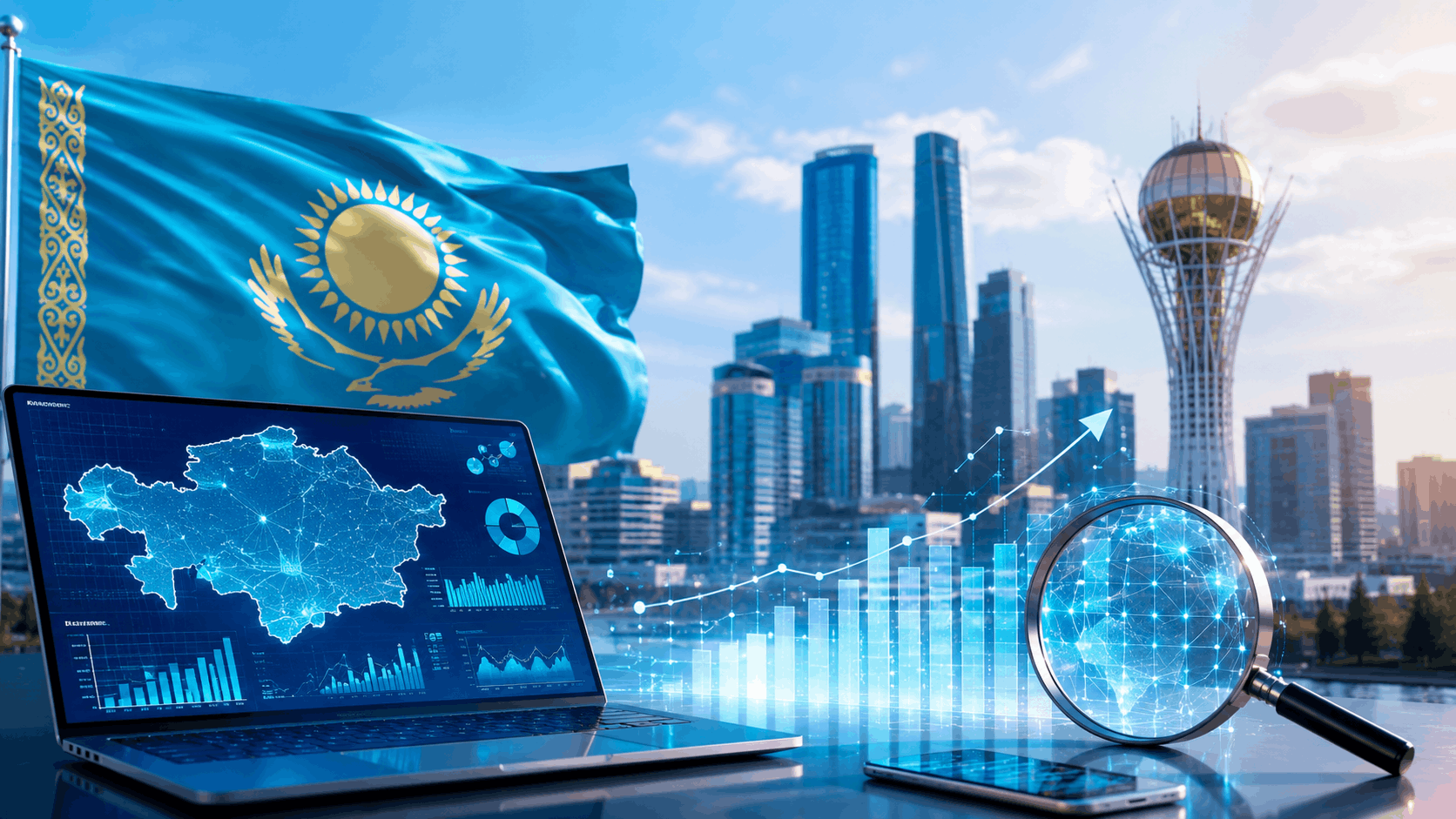
Kazakhstan is transforming into Central Asia’s leading AI search and Generative Engine Optimisation (GEO) market in 2026, driven by 92.9% internet penetration, growing generative AI adoption, sovereign language models, expanding AI infrastructure, and a competitive Google-Yandex search landscape that is changing how consumers discover information, products, services, and brands online.
Kazakhstan is emerging as one of Central Asia’s most important markets for artificial intelligence, AI-powered search, and Generative Engine Optimisation (GEO). With 19.2 million internet users, 92.9% internet penetration, more than 100 AI startups, rapidly expanding sovereign AI infrastructure, and millions of people already using generative AI platforms, the country is entering a new phase in how consumers discover information, evaluate businesses, and make decisions online.
Also, read our article on the Top 10 Best GEO Agencies in Kazakhstan in 2026.
The transformation goes far beyond conventional search engine optimisation (SEO). Kazakhstan ranked first among Central Asian and Eurasian Economic Union countries for generative AI adoption by the end of 2025, while adoption among its working-age population increased another 1.1 percentage points within six months. At the same time, approximately one million Kazakhstanis had already received AI-related training, and the government aims to train five million citizens in AI skills by 2030. These developments are creating a population that is increasingly comfortable asking AI systems questions rather than relying exclusively on traditional search engines and websites.
Government policy is accelerating this transition. Kazakhstan ranked 60th out of 195 countries in the 2025 Oxford Insights Government AI Readiness Index with a score of 55.86, climbing 16 positions in a single year. Its Public Sector Adoption score reached 73.59 out of 100, while the country established a dedicated Ministry of Artificial Intelligence and Digital Development in September 2025. Kazakhstan also enacted its comprehensive AI law, Law No. 230-VIII, which came into force on 18 January 2026, introducing risk classifications, transparency requirements, and mandatory labelling for AI-generated and synthetic content.
Kazakhstan Is Building the Infrastructure for an AI-First Search Economy
Kazakhstan already has the digital foundation required for AI search to scale rapidly. At the beginning of 2025, the country had approximately 19.2 million internet users, representing 92.9% of the population. Government statistics separately estimated that 96.2% of people aged 16–74 used the internet in 2024. Kazakhstan also recorded 26.6 million cellular mobile connections, equivalent to approximately 128% of its population, while the number of mobile internet users reached 18.8 million by April 2025.
Connectivity is improving alongside adoption. Median mobile download speeds were reported at 53.69 Mbps at the start of 2025, while January 2026 Ookla data placed Kazakhstan’s mobile internet speed at 100.20 Mbps, ranking it 50th globally. More than 2,500 5G base stations had been deployed by the end of 2025, with 5G available across 20 cities. Kazakhstan is ultimately targeting 100% nationwide high-speed internet coverage by 2027.
This infrastructure matters for AI search because the next generation of information discovery is increasingly conversational, mobile, multimodal, and computationally intensive. Kazakhstan’s highly connected population can access ChatGPT-style assistants, generative search engines, voice interfaces, AI-generated summaries, and other answer-first experiences with relatively little technical friction.
The country’s public sector provides another indication of how established digital behaviour has become. Approximately 92% of Kazakhstan’s public services are available online, while the eGov Mobile application reached 11 million active users in 2025 and processed more than 54 million public-service transactions during the year. Kazakhstan also ranked 24th among 193 countries in the 2024 UN E-Government Development Index.
AI Investment and Sovereign Models Are Accelerating the Shift
Kazakhstan is simultaneously investing heavily in the supply side of its AI economy.
Venture investment in Kazakhstan’s AI projects increased from approximately $14 million in 2023 to $73 million in 2025, representing growth of more than fivefold in two years. AI now accounts for more than half of venture investment in the country, while more than 100 AI startups were operating by early 2026. Higgsfield AI also became Kazakhstan’s first technology unicorn in 2025 with a valuation exceeding $1 billion.
The government has complemented this private-sector growth with major computing investments. Kazakhstan launched Alem.Cloud in July 2025, described in the dataset as Central Asia’s most powerful supercomputer cluster, delivering approximately 2 exaflops of FP8 AI computing performance. It subsequently launched the NVIDIA H200-powered Al-Farabium cluster, with the country’s national computing infrastructure being made available to startups, universities, and businesses.
Perhaps even more important for the future of AI Search and GEO in Kazakhstan is the development of domestic language models.
AlemLLM, publicly released in August 2025, contains 246 billion parameters, while KazLLM was developed using more than 150 billion tokens of Kazakh, Russian, English, and Turkish data. KazLLM reportedly attracted approximately 600,000 users, compared with around 2.6 million ChatGPT users in Kazakhstan.
These numbers illustrate an increasingly fragmented search environment. Businesses are no longer optimising content solely for a single Google results page. Information can potentially be discovered through Google, Yandex, ChatGPT, sovereign LLMs, AI assistants, marketplaces, social platforms, and other generative interfaces.
Google Still Dominates Search, but Kazakhstan Is Not a Google-Only Market
Traditional search remains enormously important in Kazakhstan. According to the dataset, Google controlled approximately 69.87% of Kazakhstan’s search engine market in March 2026, while Yandex accounted for another 28.31%. Bing represented just 1.36%, with DuckDuckGo at approximately 0.20%.
That roughly 70/28 Google-Yandex split makes Kazakhstan particularly interesting for search marketers.
Unlike markets where Google effectively monopolises discovery, Kazakhstan requires businesses to think about multiple search ecosystems, multiple languages, and increasingly multiple AI answer engines. Russian also remains particularly important online: the dataset reports that 94.1% of websites in Kazakhstan use Russian, compared with 4.5% using Kazakh and 1.4% using English.
For SEO and GEO strategies, this means multilingual optimisation is not simply a translation exercise. Businesses need to understand how entities, questions, products, services, and authoritative sources are interpreted across Russian, Kazakh, and potentially English-language retrieval systems.
Zero-Click Search Is Changing What It Means to “Rank”
The larger disruption comes from the transition from search results to generated answers.
The dataset reports that approximately 65% of Google searches globally now end without a click to a website, while zero-click searches increased from 56% to 69% during the year following the launch of Google AI Overviews. AI Overviews themselves are estimated in the dataset to appear across 35–45% of Google searches by early 2026, rising beyond 60% for informational queries.
The impact on conventional organic traffic can be substantial. When an AI Overview appears, the dataset reports CTR falling from approximately 15% to 8%, while another cited study found the CTR of position-one content falling sharply when AI Overviews were present. Only around 1% of searches reportedly result in users clicking a link contained directly within an AI Overview.
This changes the fundamental objective of search optimisation.
Traditional SEO asks:
“How can my page rank higher?”
Generative Engine Optimisation adds another question:
“How can my brand, content, data, products, and expertise become sources that AI systems retrieve, understand, trust, cite, and recommend?”
That distinction is becoming increasingly important because an AI system can influence a buying decision without generating a conventional website visit.
GEO Is Becoming a New Layer of Digital Visibility
The emerging statistics around AI referrals demonstrate why businesses are paying attention. According to the dataset, AI-referred website sessions grew 527% year over year during the first five months of 2025, while 63% of websites globally were already receiving traffic from AI search platforms. AI search traffic still represents only a small fraction of overall web traffic, but the dataset describes it as growing 165 times faster than organic search.
The commercial implications may be even more significant than raw traffic volumes. The source material reports studies finding substantially greater economic or conversion value among AI-referred visitors than traditional organic search visitors. If these patterns persist, measuring GEO purely through sessions and clicks may substantially underestimate its contribution to discovery, brand authority, consideration, and conversions.
Content structure matters as well. One of the most consequential GEO statistics in the dataset is that 44.2% of LLM citations originate from the first 30% of a page’s text. Another reports that 80% of LLM citations come from pages that do not rank within Google’s top 100 organic results.
The implication is significant: SEO visibility and AI visibility are related, but they are not necessarily the same thing.
A website that performs poorly in conventional rankings may still become a useful source for generative systems if its information is authoritative, specific, clearly structured, semantically relevant, and easy for retrieval systems to extract and contextualise.
Why AI Search and GEO Matter for Kazakhstan in 2026
Kazakhstan combines several conditions that make it an especially important AI Search and GEO market: 92.9% internet penetration, 26.6 million mobile connections, millions of generative AI users, more than 100 AI startups, rapidly expanding sovereign computing capacity, domestic large language models, strong government support, and a competitive Google-Yandex search landscape.
At the same time, Kazakhstan’s digital economy continues to expand. Retail e-commerce reached approximately KZT 3.439 trillion ($6.5 billion) in 2024, increasing 42% year over year, while online transactions surged 87% to 162 million. E-commerce represented 14.1% of total retail trade, and marketplaces accounted for approximately 91% of e-commerce activity. Kazakhstan’s social media audience had also reached 15.7 million users, equivalent to roughly 75.7% of the population, by January 2025.
For brands, publishers, e-commerce companies, SaaS businesses, agencies, startups, and international companies entering Kazakhstan, the competitive question is therefore expanding beyond conventional Google rankings.
The businesses that win Kazakhstan’s next generation of digital discovery may be those that can achieve visibility simultaneously across traditional SEO, AI Search, Generative Engine Optimisation (GEO), answer engines, LLM citations, Google AI Overviews, Yandex, sovereign AI models, marketplaces, and other AI-mediated discovery channels.
This collection of 100 AI Search & GEO in Kazakhstan statistics, data points, and trends for 2026 examines that transition quantitatively. It explores Kazakhstan’s AI adoption, internet infrastructure, government AI readiness, sovereign computing capacity, domestic language models, search engine market share, zero-click behaviour, AI Overviews, e-commerce growth, generative AI traffic, and GEO trends to provide a data-driven picture of how search and digital discovery are evolving in Kazakhstan in 2026.
But, before we venture further, we like to share who we are and what we do.
About AppLabx
From developing a solid marketing plan to creating compelling content, optimizing for search engines, leveraging social media, and utilizing paid advertising, AppLabx offers a comprehensive suite of digital marketing services designed to drive growth and profitability for your business.
At AppLabx, we understand that no two businesses are alike. That’s why we take a personalized approach to every project, working closely with our clients to understand their unique needs and goals, and developing customized strategies to help them achieve success.
If you need a digital consultation, then send in an inquiry here.
Or, send an email to hello@applabx.com to get started.
100 AI Search & GEO in Kazakhstan Statistics, Data & Trends in 2026
Part I: AI Adoption & Usage
1. Kazakhstan leads Central Asia in generative AI adoption.
As of the end of 2025, Kazakhstan ranked first among all Central Asian and Eurasian Economic Union countries in generative AI adoption, a distinction that reflects both its superior digital infrastructure and the government’s proactive push to embed AI into public and private life ahead of regional peers.
2. Kazakhstan’s generative AI adoption rose 1.1% within just six months in 2025.
Between the first and second halves of 2025, Kazakhstan’s working-age population using generative AI grew by 1.1 percentage points — the strongest momentum of any country in the Central Asia and Eurasian Economic Union bloc, according to the Microsoft AI Economy Institute, signalling accelerating rather than plateauing uptake.
3. Roughly one in six people worldwide uses generative AI, setting the baseline against which Kazakhstan competes.
Global generative AI adoption rose 1.2% in the second half of 2025, with approximately 16–17% of the world’s population now using such tools — a benchmark that contextualises Kazakhstan’s regional leadership while also showing how much headroom remains for expansion even in fast-moving markets.
4. The UAE’s 64% adoption rate represents the aspirational ceiling Kazakhstan is benchmarking against.
The United Arab Emirates leads the world with 64% of working-age residents using generative AI, a figure that positions it as the global reference point for AI-first economies and one that Kazakhstan’s policymakers have explicitly cited as a long-term target when framing their AI strategy documents.
5. Approximately one million Kazakhstanis had received AI-related training by 2025.
By the close of 2025, around one million people in Kazakhstan had completed some form of AI training under national programmes, a figure that confirms the country’s human-capital agenda is progressing at scale even before the government’s broader 2030 targets are due.
6. Kazakhstan plans to train five million citizens in AI skills by 2030.
The Ministry of AI and Digital Development has set a target of equipping five million Kazakhstani citizens with basic and advanced AI skills by 2030, covering school students, university students, government officials, entrepreneurs, and other professionals — one of the most ambitious national AI literacy programmes in the developing world.
7. The AI-Sana programme has been designed to deliver free AI training across multiple societal segments.
The government-backed AI-Sana initiative provides free online training in AI fundamentals, data skills, and practical digital tools to a target audience of 500,000 school students, 300,000 university students, 90,000 government officials, and 80,000 entrepreneurs — a segmented approach that acknowledges each group needs tailored content rather than a one-size-fits-all curriculum.
8. Over 2,500 civil servants completed AI training in the first half of 2025 alone.
Since early 2025, more than 2,500 government employees across Kazakhstan’s agencies have completed AI upskilling programmes, and six separate government agencies have already created their own AI bots — demonstrating that transformation is happening at the institutional level, not just through aspirational strategy documents.
9. Kazakhstan’s AI-Sana programme was developed in collaboration with Stanford, Imperial College, King’s College, and the Royal Academy of Engineering.
The academic pedigree behind the AI-Sana curriculum, which involves leading Western universities and engineering bodies, strengthens the credibility of Kazakhstan’s mass-training initiative and may accelerate the quality of AI literacy outcomes, though translating certificate completion into workplace productivity remains the harder challenge.
10. 21% of Kazakhstan’s 2025 graduates chose engineering and ICT disciplines.
More than one in five university graduates in Kazakhstan in 2025 selected engineering or information and communications technology as their field of study — a structural talent pipeline that provides the ecosystem with a growing domestic pool of technically capable individuals who can work on AI-related projects.
Part II: Government AI Readiness & Policy
11. Kazakhstan ranked 60th out of 195 countries in the Oxford Insights Government AI Readiness Index 2025.
According to the Government AI Readiness Index compiled by Oxford Insights, Kazakhstan placed 60th globally with a score of 55.86, making it the leading nation in Central Asia for governmental capacity to adopt, manage, and regulate artificial intelligence — a result that positions it above Russia, Turkey, and Malaysia.
12. Kazakhstan climbed 16 positions in the Government AI Readiness Index in a single year.
Rising from 76th place in the previous edition to 60th in 2025 represents one of the steepest single-year improvements globally and reflects the tangible impact of Kazakhstan’s institutional investments in AI infrastructure, regulation, and public-sector deployment rather than just policy declarations.
13. Kazakhstan improved from 72nd globally in 2023 to 60th in 2025 in AI readiness.
Over a two-year window from 2023 to 2025, Kazakhstan moved up twelve positions in the Oxford Insights index, suggesting a consistent and sustained reform trajectory rather than a one-off statistical anomaly, which is significant for foreign investors evaluating long-term market stability.
14. Kazakhstan scored 73.59 out of 100 in the Government AI Readiness Index’s Public Sector Adoption category.
The country’s strongest showing in the index came in the Public Sector Adoption pillar, where it scored 73.59 points — an indicator of how deeply digital services, e-government platforms, and AI tools have been woven into the fabric of how Kazakhstani institutions interact with citizens and businesses.
15. Kazakhstan’s AI law (Law No. 230-VIII) was signed on 17 November 2025 and came into force on 18 January 2026.
The signing of Kazakhstan’s Law on Artificial Intelligence marked a historic shift from voluntary AI guidelines to binding legal obligations, making Kazakhstan the first country in Central Asia to enact a comprehensive, enforceable AI statute — a milestone that affects developers, owners, and users of AI systems across the economy.
16. Kazakhstan’s AI law adopts a risk-based classification structure modelled partly on the EU AI Act.
The law classifies AI systems into minimal, medium, and high-risk tiers, with regulatory obligations escalating according to the potential for harm — a risk-proportionate approach that offers businesses a clearer compliance path while concentrating oversight on the most sensitive applications in areas such as healthcare, finance, and public administration.
17. Kazakhstan’s AI law explicitly prohibits manipulative AI practices, social scoring, and certain emotion recognition uses.
Among the law’s notable provisions are bans on AI systems designed to manipulate citizen behaviour, exploit vulnerable groups, or deploy unconsented emotion recognition — provisions that align Kazakhstan with a human-centric governance philosophy and signal to the international community that the country is serious about responsible AI deployment.
18. Kazakhstan’s AI law requires labelling of all AI-generated and synthetic content.
Both user-visible warnings and machine-readable markers must accompany AI-generated or synthetic content under the new law — a transparency requirement that directly addresses deepfake risks and has meaningful implications for digital marketing, publishing, and search content strategies operating in the Kazakhstani market.
19. The Ministry of Artificial Intelligence and Digital Development was established by presidential decree in September 2025.
Kazakhstan created a dedicated ministry for AI and digital development under Presidential Decree No. 997, becoming one of only a handful of countries globally to have elevated AI governance to a standalone cabinet-level portfolio — a structural commitment that signals AI is considered a matter of national strategy, not merely a technology trend.
20. Kazakhstan’s AI Development Concept covers the period 2024–2029.
The government-approved AI concept provides a five-year strategic roadmap for developing computing infrastructure, data policy, talent pipelines, and international partnerships, pairing it with the new binding AI law to create a more complete policy architecture than the majority of Central Asian and many emerging-market economies currently possess.
21. Kazakhstan was declared the Year of Digitalization and Artificial Intelligence in 2026.
President Tokayev’s declaration of 2026 as the Year of Artificial Intelligence signals a shift from isolated digital initiatives to systemic national AI development, with implications for public procurement, regulatory enforcement, and the budget allocations available to agencies integrating AI into service delivery.
22. 2026 is declared the Year of Digitalization and AI, with government targeting AI deployment across all economic sectors.
The government’s 2026 plan includes expanding AI in public services, building national AI infrastructure, training skilled professionals, and supporting innovative projects — an agenda that in practice will create demand for AI-optimised content and digital communication strategies from both public institutions and the private businesses that work with them.
Part III: Digital Infrastructure & Internet Landscape
23. Kazakhstan had 19.2 million internet users as of January 2025, representing 92.9% penetration.
With more than 92% of its population online, Kazakhstan sits well above the global average internet penetration rate of roughly 72%, providing a digitally accessible audience for AI-powered search and content platforms that is broad enough to sustain a meaningful domestic AI search ecosystem.
24. Internet users in Kazakhstan grew by 238,000 (+1.3%) between January 2024 and January 2025.
Although growth has moderated from earlier double-digit rates — as is typical when penetration exceeds 90% — the absolute increase of nearly a quarter of a million new users still adds a steady stream of first-time digital consumers who will encounter AI-assisted search as a default rather than a novelty.
25. Kazakhstan’s Bureau of National Statistics reported that 96.2% of those aged 16–74 were internet users in 2024.
This survey-based figure, drawn from 21,000 households, suggests that real-world internet usage may slightly exceed the headline 92.9% penetration figure, and that digital services — including AI-powered search tools — have reached a level of ubiquity comparable to basic utilities in the country.
26. 26.6 million cellular mobile connections were active in Kazakhstan in early 2025, equivalent to 128% of the population.
A mobile connection density exceeding 100% of the population confirms that many Kazakhstanis hold multiple SIM cards, and the consequent depth of mobile-first digital habits means that AI search and GEO optimisation strategies must be designed with a mobile-first user journey in mind.
27. As of April 2025, Kazakhstan had 26.3 million mobile users, a 3.5 million year-on-year increase.
The growth of 3.5 million mobile connections year-on-year points to continued expansion of the addressable mobile search audience, which is particularly significant for AI-driven search platforms given that mobile queries tend to be more conversational in nature and thus more likely to trigger generative AI responses.
28. Mobile internet users in Kazakhstan numbered 18.8 million in April 2025, up 4.8% annually.
Growth in active mobile internet users, rather than mere connections, is the more meaningful demand signal for AI search tools, and the 4.8% annual increase confirms that Kazakhstanis are not just carrying phones — they are actively using them to access digital information and services.
29. Median mobile internet download speed in Kazakhstan was 53.69 Mbps at the start of 2025.
A median mobile download speed of over 50 Mbps provides a comfortable technical foundation for AI-powered search experiences, which often involve richer, multi-modal responses compared to plain text search results, and reduces latency-related friction in generative AI chatbot interactions.
30. Fixed internet download speed in Kazakhstan averaged 66.38 Mbps at the start of 2025.
Fixed-line download speeds of 66 Mbps represent a 29% year-on-year improvement and create a broadband environment in which content-rich AI search pages, interactive AI overviews, and generative chatbots can render quickly — an important condition for user adoption and session depth on AI platforms.
31. Kazakhstan’s mobile internet download speed ranks 50th globally at 100.20 Mbps based on January 2026 Ookla data.
Kazakhstan’s top-50 global mobile speed ranking, derived from millions of individual measurements, confirms that its connectivity infrastructure is broadly adequate for modern AI search experiences and compares favourably to many markets in Asia and Eastern Europe.
32. 5G is available in 20 cities in Kazakhstan, with a target to expand coverage to 75% of megacity territories.
The government has committed to expanding 5G coverage across major urban centres, and the deployment of over 2,500 5G base stations already completed by end-2025 creates a higher-bandwidth environment that will support more demanding AI applications, including real-time voice-based search and multimodal AI interactions.
33. Kazakhstan aims to achieve 100% high-speed internet coverage nationwide by 2027.
The national Accessible Internet initiative has a firm 2027 deadline for universal high-speed connectivity, and if achieved, it will close the digital divide that currently limits AI search adoption in rural and remote regions — expanding the total addressable audience for AI-driven discovery platforms.
34. Kazakhstan accounted for 1.5% of Europe–Asia internet traffic transit and aims to reach 5%.
Increasing its share of transcontinental internet traffic is a strategic infrastructure goal that positions Kazakhstan not merely as a consumer of global AI services but as a potential regional data routing hub — a distinction that may influence where international AI platforms choose to locate their data processing infrastructure.
35. 92% of Kazakhstan’s public services are available online.
With 92% of government services accessible digitally through eGov.kz and the eGov Mobile app, Kazakhstan has created a high-volume, government-endorsed environment for AI-assisted user interactions — including AI-powered service navigation, document filing, and query resolution that parallels the GEO use case in the private sector.
36. The eGov Mobile app reached 11 million active users in 2025, growing by 1.1 million in the year.
An active user base of 11 million on a government mobile platform is significant for AI search practitioners because it demonstrates that Kazakhstani citizens are habituated to receiving answers and completing tasks through AI-mediated digital interfaces, lowering the behavioural barrier to adopting generative AI search tools in their commercial and informational searches.
37. More than 54 million public services were provided through eGov Mobile in 2025.
The volume of 54 million digital service transactions in a single year — across a population of roughly 20 million — confirms that mobile-first AI-assisted government interaction has become a mainstream behaviour in Kazakhstan, which reinforces the broader cultural readiness for AI-driven search experiences.
38. Kazakhstan ranked 24th out of 193 countries in the 2024 UN E-Government Development Index.
Placing among the top 25 nations globally for e-government development puts Kazakhstan alongside South Korea, Estonia, and Denmark — a positioning that validates the quality of its digital public-sector infrastructure and creates favourable conditions for AI-powered services to scale through established citizen trust in digital channels.
39. Kazakhstan ranked 34th in the IMD World Digital Competitiveness Ranking 2025 out of 67 countries.
A 34th-place ranking in the IMD index — which evaluates knowledge, technology, and future readiness — provides independent confirmation that Kazakhstan’s digital economy has genuine structural depth, not just headline-friendly policy announcements, and that it constitutes a credible market for AI search product investment.
40. IT exports from Kazakhstan reached approximately USD 1 billion by the end of 2025.
Achieving the USD 1 billion IT export milestone represents a roughly 35-fold increase over five years, illustrating the pace at which Kazakhstan is building an internationally competitive technology sector whose output, digital presence, and need for AI-optimised content will continue to grow.
Part IV: AI Investment, Startups & Economic Impact
41. Venture investment in AI projects in Kazakhstan grew more than fivefold between 2023 and 2025, from ~$14 million to $73 million.
The surge in AI-specific venture capital — representing a 421% increase in just two years — positions AI as the dominant category in Kazakhstan’s startup investment landscape and signals that the country is experiencing a genuine commercial AI transition, not merely a government-funded technology experiment.
42. AI now accounts for more than half of all venture investment in Kazakhstan.
When a single technology vertical commands the majority of all venture capital deployed in a country, it fundamentally reshapes the digital marketing, content, and search landscape, as AI-native businesses will increasingly use AI-first discovery strategies to reach their customers.
43. Kazakhstan had more than 100 AI startups operating as of early 2026.
A startup ecosystem of over 100 active AI companies creates a growing domestic demand for AI search visibility, generative engine optimisation services, and AI-optimised content strategies, as these businesses compete for attention in both local and international markets.
44. Higgsfield AI became Kazakhstan’s first technology unicorn in 2025, valued at over $1 billion.
The emergence of Higgsfield AI — a platform for generating images and short videos — as the country’s first billion-dollar startup confirms that Kazakhstani entrepreneurs can attract significant international capital and validates the ecosystem’s capacity to produce globally competitive AI products.
45. AI adoption could add between 0.5% and 2% to Kazakhstan’s annual GDP growth in the medium term.
According to estimates in the Kazakhstan AI Country Report, widespread AI adoption is projected to boost annual GDP growth by 0.5–2 percentage points through productivity gains affecting more than half of all jobs — a macroeconomic incentive that gives the government strong fiscal reasons to accelerate AI infrastructure investment.
46. Digital technologies and AI are projected to ensure annual GDP growth of 2–3% in Kazakhstan.
Broader digital economy estimates suggest that combined digitalisation and AI adoption could contribute 2–3% to annual GDP growth, a figure that underlines why Kazakhstan has chosen to treat AI not as an optional modernisation effort but as a core driver of its national competitiveness strategy.
47. Approximately 5% of current jobs in Kazakhstan are estimated to be at risk of elimination through AI.
A Google-cited study referenced in Kazakhstan’s AI Country Report estimates that successful AI execution could eliminate roughly 5% of current jobs — a figure lower than many Western market projections — while a more significant 54% of the workforce would have their roles augmented by generative AI tools.
48. 54% of Kazakhstan’s workforce would be augmented by generative AI under widespread adoption.
The projection that more than half of all jobs in Kazakhstan will be augmented rather than replaced by AI underscores the importance of AI literacy programmes and creates a broad, skills-driven demand for AI tools, AI search interfaces, and AI-assisted work platforms among the general working population.
49. Kazakhstan launched the $1 billion Qazaqstan Venture Group fund in 2025 to support AI-driven startups.
A dedicated $1 billion venture fund focused on AI startups — launched alongside the existing Astana Hub Ventures — provides late-stage capital that the AI Country Report identified as a key structural constraint, and should deepen the pipeline of commercially viable AI companies seeking digital marketing and search visibility strategies.
50. Private investment in AI globally is expected to grow by 29% annually through 2028.
The global private AI investment trajectory of 29% annual growth provides the external tailwind that will bring more AI products, platforms, and competition to Kazakhstan’s market — accelerating the urgency for businesses operating in the country to build GEO and AI search visibility strategies now rather than later.
Part V: Sovereign AI Infrastructure
51. Kazakhstan launched Central Asia’s most powerful supercomputer cluster, Alem.Cloud, in July 2025.
The launch of the Alem.Cloud supercomputing centre in Astana marked a transformative moment in Kazakhstan’s AI infrastructure, providing the raw computational power needed to train and run large-scale AI models domestically rather than relying on foreign cloud providers — a move with direct implications for data sovereignty and the viability of Kazakh-language AI search tools.
52. The Alem.Cloud supercomputer delivers approximately 2 exaflops (FP8) of AI computing performance.
With roughly 2 exaflops of computing capacity — two quintillion floating-point operations per second — Alem.Cloud is purpose-built for training complex neural networks and running AI inference workloads at a scale sufficient to support national AI platforms, sovereign language models, and AI-powered government services simultaneously.
53. The Alem.Cloud supercomputer ranked 86th in the global TOP500 list of most powerful computing systems in 2025.
An 86th-place global ranking for its supercomputer validates that Kazakhstan’s computing infrastructure is not merely a domestic showpiece but a globally recognised technical asset, lending credibility to claims that Kazakhstani AI models can compete with international alternatives on raw computational grounds.
54. About half of Alem.Cloud’s computing capacity has been allocated to government agency tasks.
Devoting roughly 50% of the national supercomputer’s capacity to government operations reflects both the scale of Kazakhstan’s public sector digitalisation ambitions and the risk that commercial access to compute — a prerequisite for vibrant private AI search and content innovation — may be constrained by state demand.
55. The Al-Farabium computing cluster was launched in October 2025 using NVIDIA H200 GPU technology.
The second national supercomputing cluster, Al-Farabium, built on Kazakhtelecom infrastructure and powered by NVIDIA H200 chips, provides tens of petaflops of additional AI computing capacity — and together with Alem.Cloud, these two systems form the compute backbone that powers Kazakhstan’s sovereign LLMs and national AI platform.
56. Both Alem.Cloud and Al-Farabium are integrated into a single national platform accessible to startups, universities, and companies.
By opening the combined computing infrastructure through a unified national platform, Kazakhstan is attempting to democratise AI development access across its ecosystem — giving smaller companies and researchers the ability to train models and run AI applications without the prohibitive upfront cost of building their own compute infrastructure.
57. Kazakhstan intends to expand its IT rack count from 4,000 in 2025 to 20,000 by 2030.
The government’s ambition to increase data centre capacity fivefold within five years — alongside a target of operating 10 Tier III–IV data centres — confirms that compute infrastructure is viewed as strategic national asset, creating long-term hosting capacity for AI search engines, LLMs, and AI-powered platforms at scale.
58. Two new data centres were commissioned in Almaty and Astana in 2025, adding 7.4 MW of combined capacity.
The commissioning of two new data centres in 2025, followed by plans for three more totalling 12.9 MW in 2026, demonstrates a steady infrastructure build-out that will support the growing AI compute and data storage demands of both government services and private AI applications.
Part VI: Language Models & AI Search Infrastructure
59. AlemLLM, Kazakhstan’s largest domestic Kazakh-language model, was publicly released in August 2025.
The open release of AlemLLM through Hugging Face marked a significant milestone for Kazakh-language AI search, making a powerful language model freely available to startups, universities, and international platforms — and potentially reducing the cost and complexity of building Kazakh-language AI search and generative content tools.
60. AlemLLM was developed with 246 billion parameters and reportedly outperforms ChatGPT and Gemini on Kazakh-language tasks.
With 246 billion parameters and claimed superiority over ChatGPT and Gemini in Kazakh-language benchmarks, AlemLLM sets a competitive baseline for sovereign AI in Kazakhstan — though independent third-party evaluations remain important for validating such performance claims in real-world search and retrieval contexts.
61. KazLLM was built on 150 billion+ tokens of Kazakh, Russian, English, and Turkish training data.
The scale of the KazLLM training corpus — 150 billion tokens spanning four languages — reflects the multilingual reality of Kazakhstan’s digital population and means the model can support search and generative AI applications across the country’s linguistically diverse internet audience.
62. KazLLM was developed by ISSAI at Nazarbayev University and received the GSMA Foundry Excellence Award in March 2025.
International recognition for KazLLM at Mobile World Congress in Barcelona validates Kazakhstan’s sovereign AI research capacity and demonstrates that domestic language models can meet global quality standards — a necessary precondition for those models to be trusted as the basis for AI search and GEO-optimised content platforms.
63. KazLLM garnered 600,000 users, compared to ChatGPT’s 2.6 million in Kazakhstan.
The gap between KazLLM’s 600,000 users and ChatGPT’s 2.6 million local users reveals that while sovereign models attract meaningful adoption, the incumbency advantage of internationally scaled AI tools remains substantial — suggesting that GEO optimisation strategies in Kazakhstan must account for both Western and domestic generative AI platforms simultaneously.
64. AlemLLM is built in partnership with 01.ai (founded by Dr. Kai-Fu Lee) and was developed on the YuAI Lightning platform.
The international co-development of AlemLLM with a globally recognised AI firm brings external expertise and credibility to Kazakhstan’s sovereign model — while also raising questions about the degree to which a co-developed model represents genuinely independent AI capability versus technological dependency under a different label.
65. More than 10 AI agents have already been piloted in Kazakhstani government operations by 2025.
Live government AI agents including eGov AI, e-Otinish AI, QQazaq Law, Tax Helper, and AI Therapist represent real-world generative AI deployments at population scale — creating feedback loops of real user data that will improve model performance and gradually normalise AI-mediated information retrieval as a standard experience for Kazakhstani citizens.
66. Kazakh-language AI content labelling is now required by law.
The requirement under Kazakhstan’s AI law to label AI-generated content with both human-visible and machine-readable markers will affect how AI-generated web content is treated by search crawlers and AI systems — with potentially significant downstream effects on how GEO practitioners structure and tag their content for the Kazakhstani market.
67. Russian is the dominant internet language in Kazakhstan, used on 94.1% of websites.
Despite Kazakh being an official state language, Russian accounts for the overwhelming majority of online content, with Kazakh at 4.5% and English at 1.4% — a language distribution that SEO and GEO practitioners targeting the Kazakhstani market must account for, as AI models trained predominantly on Russian-language data will dominate most search interactions.
Part VII: Search Engine Market Share & Behaviour
68. Google held a 69.87% share of Kazakhstan’s search engine market in March 2026.
Google commands approximately 70% of all searches in Kazakhstan as of March 2026, making it the dominant platform for any SEO or GEO strategy — but its share is significantly lower than its global average of around 90%, signalling that Kazakhstan is one of the more competitive search markets worldwide due to Yandex’s strong presence.
69. Yandex holds 28.31% of Kazakhstan’s search engine market as of March 2026.
Yandex’s nearly 30% market share in Kazakhstan is exceptional by global standards and reflects the country’s historical linguistic and cultural ties with Russia — making it essential for any GEO or AI search strategy in Kazakhstan to optimise not only for Google’s AI Overviews but also for Yandex’s own evolving AI-assisted search features.
70. Bing commands just 1.36% of Kazakhstan’s search market, followed by DuckDuckGo at 0.20%.
The negligible share held by Bing and privacy-focused alternatives in Kazakhstan reflects the strength of the Google–Yandex duopoly and means that Microsoft’s Copilot-powered AI search features — though growing globally — remain a secondary consideration for GEO practitioners focusing on the Kazakhstani market in 2026.
71. Google held approximately 78% of Kazakhstan’s desktop search market in 2024–2025.
Desktop search data shows an even stronger Google preference — around 78% — suggesting that professional, research-oriented, and longer-session searches are more strongly dominated by Google than the blended all-device figures, which has implications for content strategies targeting high-intent queries.
72. Google.com accounted for over 70% of all search queries in Kazakhstan throughout 2023.
Historical consistency in Google’s dominance of Kazakhstan’s search market provides useful baseline data against which the current 69.87% figure can be understood — indicating a slight but meaningful erosion in Google’s share, likely attributable to the growth of direct AI tool usage (ChatGPT, Perplexity) that bypasses search engines entirely.
73. Yandex.kz held approximately 11% of Kazakhstan’s search market as recently as 2023.
Yandex’s market share has grown from approximately 11% in 2023 to over 28% by March 2026, suggesting that Russian-language AI features within Yandex’s search ecosystem may be driving increased engagement among Russian-speaking Kazakhstani users — a shift with direct relevance for multilingual GEO strategies in the country.
Part VIII: Zero-Click Search, AI Overviews & GEO Implications
74. Globally, 65% of Google searches now end without a click to any website.
The zero-click search rate — with nearly two-thirds of all queries resolved by features like AI Overviews, knowledge panels, and direct answers — fundamentally changes the value proposition of traditional SEO for businesses in Kazakhstan and globally, elevating GEO (Generative Engine Optimisation) as the method through which brands must maintain discoverability.
75. Zero-click searches grew from 56% to 69% within one year of Google AI Overviews’ launch.
Similarweb data shows that within just twelve months of Google rolling out AI Overviews in May 2024, the share of searches ending without a website click grew by 13 percentage points — one of the fastest structural shifts in search behaviour ever recorded, with implications that will affect Kazakhstani digital marketers as Google AI Overviews become more prevalent in Russian and Kazakh language queries.
76. AI Overviews appear on an estimated 35–45% of all Google searches as of early 2026.
Google AI Overviews now trigger for more than a third of all queries globally, and for informational queries that proportion exceeds 60% — a saturation level that makes AI-influenced search a mainstream phenomenon rather than a niche feature, even in non-English language markets including Kazakhstan.
77. When an AI Overview is present, click-through rate drops from 15% to 8% — a 47% reduction.
A halving of click-through rates when AI Overviews appear has been documented in multiple independent studies, including Pew Research Center data, and represents the single most important quantitative argument for why businesses in Kazakhstan must invest in earning citations within AI responses, not just ranking in traditional organic results.
78. AI Overviews reduce CTR for position-one content by 58% as of December 2025.
Ahrefs research found that the average CTR for top-ranking pages dropped from 7.3% to just 1.6% when an AI Overview was present in December 2025 — a 58% reduction that is worse than the 34.5% impact measured in April 2025, confirming the trend is deteriorating rather than stabilising for websites that are not being cited within AI answers.
79. Only 1% of searches lead to users clicking a link within an AI Overview.
Pew Research Center analysis found that virtually no users click on the links embedded inside AI Overview responses — meaning that appearing as a cited source inside an AI Overview generates brand exposure and credibility but very little direct referral traffic, which has direct implications for how ROI should be measured in GEO campaigns.
80. Brands cited inside AI Overviews earn 35% more organic clicks and 91% more paid clicks than uncited competitors.
The citation premium documented by Seer Interactive is one of the most compelling commercial arguments for GEO investment — being named inside an AI Overview effectively functions as an implicit endorsement that influences user behaviour downstream, even on the traditional SERP links that exist below the AI summary.
81. AI-referred website sessions grew 527% year-over-year in the first five months of 2025.
According to Previsible’s AI Traffic Report, sessions originating from AI search platforms grew more than five times faster than any other traffic source in the first half of 2025 — a growth rate that, while starting from a low base, signals the emergence of AI referral traffic as a meaningful and increasingly strategic channel for businesses in all markets, including Kazakhstan.
82. AI traffic converts at 4.4x the economic value of traditional organic search traffic.
Despite representing a small share of total web visits, AI-referred visitors exhibit dramatically higher conversion intent and economic value — a finding consistent with the hypothesis that users who receive an AI recommendation or citation before visiting a site arrive with higher pre-existing trust than users who click a generic blue link.
83. AI search traffic represents only 0.1% of total web traffic, but is growing 165x faster than organic search.
The contrast between the current tiny scale of AI referral traffic and its extraordinary growth velocity is the defining tension for GEO strategy in 2026 — businesses must decide whether to invest now for a channel that is still small but compounding rapidly, or wait until the channel is large but competition for citations is far more intense.
84. 58% of global consumers have replaced traditional search engines with AI-driven tools for product and service discovery.
Capgemini’s 2025 data showing that a majority of consumers now turn to AI tools for product discovery represents a structural shift in how purchase journeys begin — with profound implications for Kazakhstani e-commerce and digital marketing strategies that have historically relied on Google ranking as their primary acquisition channel.
85. 63% of websites globally report receiving traffic from AI search platforms as of 2025.
With nearly two-thirds of websites already receiving measurable AI-referred traffic, according to Ahrefs data, AI search has crossed the threshold from experimental to mainstream as a traffic source — making it increasingly difficult to justify ignoring GEO as part of a digital marketing strategy in any market, including Kazakhstan.
Part IX: E-Commerce, Digital Marketing & AI in Business
86. Kazakhstan’s e-commerce market is projected to reach USD 3.56 billion in revenue in 2025.
Statista’s e-commerce market forecast positions Kazakhstan’s online retail sector at roughly $3.56 billion in 2025, growing at a CAGR of approximately 10% through 2029 — a market of sufficient scale to make AI-powered product discovery and generative AI-optimised content commercially significant for retail brands operating in the country.
87. Kazakhstan’s retail e-commerce reached KZT 3,439 billion ($6.5 billion) in 2024, a 42% year-on-year increase.
PwC data showing 42% year-on-year growth in Kazakhstan’s e-commerce market in 2024 confirms that online retail is expanding rapidly, creating intensifying competition for consumer attention in digital channels and making AI-search visibility — including AI Overviews and chatbot recommendations — increasingly consequential for retailers.
88. Online transactions in Kazakhstan reached 162 million in 2024, an 87% year-on-year increase.
An 87% surge in the number of individual online transactions in 2024 — even as average order values declined — confirms that e-commerce is becoming a habitual, high-frequency behaviour among Kazakhstani consumers, which in turn increases the volume of product-related search queries that AI tools will be asked to answer.
89. E-commerce accounted for 14.1% of Kazakhstan’s total retail trade in 2024, exceeding the global average of 7.7%.
Kazakhstan’s e-commerce share of retail trade at 14.1% is nearly double the global average, positioning it as a digitally mature retail market where the shift toward AI-assisted product research and generative AI recommendations will accelerate faster than in less digitally penetrated economies.
90. Marketplaces account for 91% of all e-commerce activity in Kazakhstan.
The extreme concentration of e-commerce through marketplace platforms — particularly Kaspi.kz and Wildberries — means that for most Kazakhstani businesses, GEO strategy must extend beyond website optimisation to ensuring that product listings, reviews, and category pages on dominant marketplace platforms are structured to be retrievable by AI models that index these sources.
91. Kazakhstan’s social media user base reached 15.7 million (75.7% of the population) in January 2025, growing 11.2% year-on-year.
Social media growth of 11.2% in a single year reflects an expanding audience for social-based search and AI-assisted discovery, as platforms like TikTok and Instagram increasingly function as search engines — and as LLMs cite social content as a reference source, social presence becomes an indirect GEO signal.
92. Telegram covers 60% of Kazakhstan’s population and has introduced new search-based ad formats.
With Telegram reaching three in five Kazakhstanis and launching new in-channel and search-based advertising formats, it has emerged as a quasi-search platform in the Kazakhstani market — creating a distinct discovery channel that sits outside traditional SEO and GEO frameworks but draws on similar principles of trust, relevance, and structured content.
93. More than 86% of advertising traffic in Kazakhstan is mobile.
The overwhelmingly mobile nature of Kazakhstan’s digital advertising landscape means that AI search experiences — which on mobile tend to be more conversational and likely to trigger generative AI responses — are the dominant context within which Kazakhstani users encounter brand content, making mobile-first GEO optimisation non-negotiable.
94. Wildberries launched an AI-powered analytics service (Jam) for sellers in Kazakhstan in May 2025.
The launch of Jam — an AI tool offering search trend insights, audience targeting, sales funnel analytics, and AI-generated product descriptions — on Kazakhstan’s major marketplace platform demonstrates that AI is already being operationalised at the seller level, creating competitive pressure for all businesses to adopt AI-assisted content and optimisation strategies.
95. The digital commerce market in Kazakhstan is projected to grow at a CAGR of 22.3% from 2025 to 2029, reaching $24.72 billion.
Statista’s digital commerce forecast at a 22.3% compound annual growth rate is one of the highest growth projections in the broader digital economy, and implies that the volume of online purchase journeys — and the AI-assisted searches that initiate them — will grow dramatically over the medium term.
Part X: GEO & AI Search Optimisation Trends
96. GEO (Generative Engine Optimisation) as a search term grew 121% quarter-on-quarter by late 2025.
Research published in Search Engine Land found that GEO-related search queries grew 121% in quarter-on-quarter acceleration by Q3/Q4 2025, and 84% of digital marketing professionals now recognise the term — confirming that GEO has transitioned from industry jargon to mainstream marketing vocabulary with genuine budget implications.
97. AI-referred sessions globally convert 23x better than traditional organic search sessions.
Onely’s analysis showing that AI-referred visitors convert at 23 times the rate of standard organic traffic provides the key economic justification for GEO investment, reframing the discussion from traffic volume — where AI search currently underperforms — to revenue quality, where it dramatically overperforms.
98. 44.2% of all LLM citations come from the first 30% of text (the introduction).
Research showing that nearly half of all AI citations are drawn from the opening section of content has direct practical implications for GEO content structuring in the Kazakhstani market — key statistics, claims, and brand differentiators must be front-loaded in the first few hundred words rather than buried deep in long-form articles.
99. 80% of LLM citations come from pages that do not rank in Google’s top 100 organic results.
The disconnect between traditional Google rankings and LLM citation behaviour — documented by Ahrefs — fundamentally challenges the assumption that strong SEO automatically confers AI search visibility, and suggests that Kazakhstani businesses with modest Google rankings can still compete for meaningful GEO citations if their content is structured, authoritative, and properly optimised.
100. Gartner predicts organic search traffic will decline by 50% or more by 2028.
Gartner’s projection of a 50%+ decline in organic search traffic within two years of 2026 is the single most stark forecast in the search industry and provides the long-range context within which every SEO and content strategy in Kazakhstan must be re-evaluated — with GEO and AI search visibility becoming not supplementary but foundational to sustainable digital discoverability.
Conclusion
The 100 AI Search and GEO statistics for Kazakhstan in 2026 point to a market undergoing a fundamental transformation in how people discover information, evaluate brands, research products, and interact with digital services. Kazakhstan is no longer simply experiencing gradual digitalisation. It is building the infrastructure, policy framework, talent base, domestic AI models, and commercial ecosystem required for an increasingly AI-first search economy.
The foundations are already substantial. Kazakhstan had approximately 19.2 million internet users and 92.9% internet penetration at the beginning of 2025, while official statistics estimated internet usage among people aged 16–74 at 96.2%. The country also recorded 26.6 million cellular connections, equivalent to 128% of its population, and 18.8 million mobile internet users by April 2025. With 5G expanding across major cities and Kazakhstan targeting universal high-speed internet coverage by 2027, the technical barriers to widespread AI-assisted search are continuing to fall.
AI adoption is advancing alongside connectivity. Kazakhstan ranked first in generative AI adoption among Central Asian and Eurasian Economic Union countries by the end of 2025, while adoption among its working-age population increased another 1.1 percentage points in just six months. Approximately one million Kazakhstanis had already received AI-related training, and the national target is to train five million citizens by 2030. This combination of connectivity and AI literacy could substantially expand the number of consumers and professionals who use conversational AI as a normal method of finding information.
Government support further distinguishes Kazakhstan from many emerging AI markets. The country climbed to 60th out of 195 countries in the Oxford Insights Government AI Readiness Index 2025, with a score of 55.86 and a particularly strong 73.59 Public Sector Adoption score. Kazakhstan has also established a dedicated Ministry of Artificial Intelligence and Digital Development, introduced comprehensive AI legislation, designated 2026 as the Year of Digitalization and Artificial Intelligence, and committed to deploying AI across economic sectors.
The commercial AI ecosystem is developing quickly as well. AI venture investment increased from approximately $14 million in 2023 to $73 million in 2025, a more than fivefold increase. AI accounts for more than half of Kazakhstan’s venture investment, more than 100 AI startups were operating by early 2026, and Higgsfield AI became the country’s first technology unicorn with a valuation exceeding $1 billion. The launch of the $1 billion Qazaqstan Venture Group fund could provide another significant source of capital for AI-driven companies.
Kazakhstan is also attempting to reduce its dependence on foreign AI infrastructure. The Alem.Cloud supercomputer, launched in July 2025, provides approximately 2 exaflops of FP8 AI computing performance, while Al-Farabium adds NVIDIA H200-powered computing capacity. Domestic models such as AlemLLM and KazLLM provide another layer of sovereign AI capability, with KazLLM trained using more than 150 billion tokens across Kazakh, Russian, English, and Turkish.
For search marketers, however, one of the most important conclusions from the data is that Kazakhstan cannot be treated as a Google-only search market.
Google controlled approximately 69.87% of Kazakhstan’s search engine market in March 2026, but Yandex held another 28.31%. Combined with the strong presence of Russian-language online content and the emergence of domestic AI models, this creates a fragmented discovery environment where businesses may need to optimise for Google, Yandex, LLMs, AI assistants, marketplaces, social platforms, and sovereign AI systems simultaneously.
This fragmentation is occurring while generative AI is changing the economics of traditional search.
The dataset reports that approximately 65% of Google searches globally end without an external website click, while zero-click searches increased from 56% to 69% following the introduction of Google AI Overviews. AI Overviews are estimated to appear across 35–45% of searches by early 2026, with significantly greater prevalence for informational queries. When an AI Overview appears, conventional organic click-through rates can decline substantially.
For businesses, this means achieving the number-one organic ranking may no longer guarantee the visibility, traffic, or influence it once did.
The strategic objective is expanding from ranking to retrieval, citation, recommendation, and brand inclusion inside generated answers.
That is the central role of Generative Engine Optimisation (GEO).
GEO does not make conventional SEO irrelevant. Technical SEO, crawlability, authority, original research, backlinks, structured information, topical relevance, entity clarity, and high-quality content remain valuable foundations. But businesses increasingly need to consider whether AI systems can accurately identify what they do, associate them with relevant entities and topics, retrieve their information, verify their claims, and confidently cite or recommend them when answering user questions.
Several statistics in the dataset demonstrate how different this emerging environment can be. Approximately 44.2% of LLM citations reportedly originate within the first 30% of page content, highlighting the potential importance of answer-first content structures. More strikingly, the dataset reports that 80% of LLM citations come from pages that do not rank within Google’s top 100 organic results.
If this pattern continues, AI visibility and Google ranking will increasingly need to be measured as related but distinct dimensions of search performance.
The economic opportunity makes this particularly relevant for Kazakhstan. Retail e-commerce reached approximately KZT 3.439 trillion, or $6.5 billion, in 2024, increasing 42% year over year. Online transactions increased 87% to 162 million, while e-commerce accounted for 14.1% of retail trade and marketplaces captured approximately 91% of e-commerce activity. Meanwhile, Kazakhstan had 15.7 million social media users, representing roughly 75.7% of its population.
Search visibility therefore increasingly extends beyond a company’s own website. Product listings, marketplace pages, reviews, social content, third-party mentions, authoritative publications, structured datasets, expert commentary, and other machine-readable sources can collectively shape how AI systems understand and represent a brand.
The opportunity is especially significant because AI referral traffic remains relatively small but is expanding rapidly. The dataset reports 527% year-over-year growth in AI-referred sessions during the first five months of 2025, while approximately 63% of websites globally were already receiving some traffic from AI search platforms. Several studies included in the dataset also indicate that AI-referred visitors can produce considerably greater conversion or economic value than conventional organic visitors.
For businesses operating in Kazakhstan, the practical implication is clear: SEO should remain a foundation, but GEO, AI Search optimisation, Answer Engine Optimisation (AEO), entity optimisation, multilingual content, structured data, digital authority, and AI citation visibility increasingly need to become part of the same search strategy.
The strongest strategies will not optimise exclusively for today’s search engine rankings. They will build an information ecosystem that can be discovered and understood across Google, Yandex, ChatGPT-style assistants, AI Overviews, domestic LLMs, marketplaces, social platforms, and whatever new generative interfaces emerge next.
Kazakhstan is particularly well positioned for this transition because the necessary ingredients are converging simultaneously: high internet penetration, widespread mobile connectivity, growing generative AI adoption, government-backed AI education, more than 100 AI startups, billion-dollar AI investment initiatives, sovereign computing infrastructure, domestic language models, a rapidly expanding digital economy, and strong public-sector digitalisation.
The broader message from these 100 AI Search & GEO in Kazakhstan statistics, data points, and trends for 2026 is therefore not that traditional search is disappearing overnight. It is that the definition of search itself is expanding.
Users are moving from searching for links to asking for answers. Search engines are moving from ranking documents to synthesising information. AI assistants are moving from answering questions to recommending products, businesses, services, and actions. And digital visibility is consequently moving from simply being ranked to being understood, retrieved, cited, trusted, and recommended by machines.
For organisations targeting Kazakhstan in 2026 and beyond, adapting to that transition early could become a significant competitive advantage. SEO determines whether search engines can find and rank a business; GEO increasingly determines whether generative AI systems can understand, cite, and recommend it.
In Kazakhstan’s rapidly developing AI economy, businesses will increasingly need to succeed at both.
If you are looking for a top-class digital marketer, then book a free consultation slot here.
If you find this article useful, why not share it with your friends and business partners, and also leave a nice comment below?
We, at the AppLabx Research Team, strive to bring the latest and most meaningful data, guides, and statistics to your doorstep.
To get access to top-quality guides, click over to the AppLabx Blog.
People also ask
What is AI Search in Kazakhstan in 2026?
AI Search in Kazakhstan uses generative AI and large language models to answer questions, summarize information, and recommend sources. Its growth is supported by high internet penetration, expanding AI adoption, and domestic AI infrastructure.
What is Generative Engine Optimisation (GEO) in Kazakhstan?
Generative Engine Optimisation (GEO) improves content so AI systems can understand, retrieve, cite, and recommend it. In Kazakhstan, GEO complements traditional SEO across Google, Yandex, AI assistants, and emerging domestic AI models.
Why is GEO important for businesses in Kazakhstan?
GEO matters because users increasingly receive answers directly from AI systems instead of visiting websites. Businesses that become trusted AI sources can gain brand visibility and influence even when a traditional search click never occurs.
How popular is generative AI in Kazakhstan?
Kazakhstan ranked first among Central Asian and Eurasian Economic Union countries for generative AI adoption by the end of 2025. Adoption among the working-age population also increased by 1.1 percentage points within six months.
How many people in Kazakhstan use ChatGPT?
The statistics compiled for this report indicate that ChatGPT had approximately 2.6 million users in Kazakhstan, compared with around 600,000 users for the domestic KazLLM platform.
How many internet users are there in Kazakhstan?
Kazakhstan had approximately 19.2 million internet users in January 2025, representing 92.9% internet penetration. Official statistics separately reported that 96.2% of people aged 16–74 used the internet in 2024.
What is Kazakhstan’s internet penetration rate?
Kazakhstan’s internet penetration stood at approximately 92.9% in early 2025. This high connectivity provides a strong foundation for AI search, generative assistants, digital commerce, and other AI-powered discovery experiences.
What is Google’s search engine market share in Kazakhstan?
Google held approximately 69.87% of Kazakhstan’s search engine market in March 2026. It remains the country’s dominant search engine, making Google SEO and visibility within AI-powered Google experiences important priorities.
What is Yandex’s search market share in Kazakhstan?
Yandex accounted for approximately 28.31% of Kazakhstan’s search market in March 2026. Its large share means businesses targeting Kazakhstan should consider Yandex alongside Google when developing search visibility strategies.
Is Google or Yandex more popular in Kazakhstan?
Google is more popular, with approximately 69.87% market share versus Yandex’s 28.31% in March 2026. However, Yandex remains large enough that Kazakhstan should not be treated as a Google-only search market.
What languages are important for SEO and GEO in Kazakhstan?
Russian and Kazakh are particularly important for Kazakhstan-focused SEO and GEO. The dataset reports Russian on 94.1% of websites, Kazakh on 4.5%, and English on 1.4%, highlighting the market’s multilingual requirements.
What is KazLLM?
KazLLM is a Kazakhstan-developed large language model created by ISSAI at Nazarbayev University. It was trained on more than 150 billion tokens spanning Kazakh, Russian, English, and Turkish.
What is AlemLLM?
AlemLLM is a domestic Kazakh-language AI model publicly released in August 2025. The dataset describes it as a 246-billion-parameter model designed to strengthen Kazakhstan’s sovereign AI and Kazakh-language capabilities.
How many AI startups are there in Kazakhstan?
More than 100 AI startups were operating in Kazakhstan by early 2026. The expanding startup ecosystem is increasing demand for AI infrastructure, digital visibility, AI Search optimisation, and GEO strategies.
How much is Kazakhstan investing in AI startups?
AI venture investment in Kazakhstan increased from about $14 million in 2023 to $73 million in 2025. Kazakhstan also launched the $1 billion Qazaqstan Venture Group fund in 2025 to support AI-driven startups.
What is Kazakhstan’s AI readiness ranking?
Kazakhstan ranked 60th among 195 countries in the Oxford Insights Government AI Readiness Index 2025, scoring 55.86. It climbed 16 positions in one year and ranked as Central Asia’s leading country in the index.
Does Kazakhstan have an artificial intelligence law?
Yes. Kazakhstan’s Law No. 230-VIII on Artificial Intelligence was signed on November 17, 2025 and came into force on January 18, 2026. It establishes requirements for developing and using AI systems.
Does Kazakhstan require AI-generated content to be labelled?
Yes. Kazakhstan’s AI law requires AI-generated and synthetic content to carry user-visible warnings and machine-readable markers, creating important transparency requirements for publishers, marketers, and AI developers.
How many people will Kazakhstan train in AI skills?
Kazakhstan aims to train five million citizens in AI skills by 2030. Around one million people had already received AI-related training by the end of 2025 through national education and skills initiatives.
What is the AI-Sana programme in Kazakhstan?
AI-Sana is a government-backed AI education initiative providing free training in AI fundamentals, data skills, and digital tools to school students, university students, civil servants, entrepreneurs, and other groups.
What is Alem.Cloud in Kazakhstan?
Alem.Cloud is Kazakhstan’s national supercomputing centre launched in July 2025. The dataset reports approximately 2 exaflops of FP8 AI computing performance, supporting domestic AI models, research, government services, and startups.
How is AI changing SEO in Kazakhstan?
AI is expanding SEO beyond conventional rankings and website clicks. Businesses increasingly need content that search engines and generative AI systems can crawl, understand, retrieve, verify, cite, and recommend in generated answers.
What is the difference between SEO and GEO in Kazakhstan?
SEO focuses primarily on visibility within traditional search results. GEO focuses on increasing the likelihood that generative AI systems understand, retrieve, cite, or recommend a brand or its content when producing answers.
Will GEO replace SEO in Kazakhstan?
GEO is better viewed as an expansion of SEO rather than a complete replacement. Technical SEO, authority, crawlability, useful content, and structured information remain valuable foundations for both search rankings and AI visibility.
What is zero-click search and why does it matter in Kazakhstan?
Zero-click search occurs when users receive an answer without visiting another website. The dataset reports about 65% of Google searches globally ending without a click, increasing the importance of visibility within generated answers.
How do Google AI Overviews affect website traffic?
AI Overviews can answer queries directly on Google, reducing the need to visit websites. The dataset cites research showing substantial CTR declines when an AI Overview appears, especially for informational searches.
Can websites rank in AI search without ranking highly on Google?
Yes. The dataset reports that 80% of LLM citations come from pages outside Google’s top 100 organic results, suggesting strong traditional rankings are not always necessary for a page to become a source in generated answers.
Where do LLMs commonly find information to cite?
The dataset reports that 44.2% of LLM citations come from the first 30% of a page’s text. This supports placing concise answers, important statistics, definitions, and original insights prominently near the beginning of content.
How large is Kazakhstan’s e-commerce market?
Kazakhstan’s retail e-commerce reached approximately KZT 3.439 trillion, or $6.5 billion, in 2024, increasing 42% year over year. E-commerce represented 14.1% of total retail trade.
What is the future of AI Search and GEO in Kazakhstan?
Kazakhstan is positioned for continued AI search growth due to high internet penetration, AI investment, domestic LLMs, expanding compute infrastructure, government support, and rising AI literacy. GEO is likely to become increasingly important for digital visibility.
Sources
The Astana Times Astana Hub Euronews Caspian Post Times of Central Asia Qazinform Eurasianet Statcounter Global Stats Statista Statbase DataReportal Digital Rights Asia WorldData EY Kazakhstan Mondaq CWB UN Department of Economic and Social Affairs El.kz ISSAI GlobeNewswire GSMA Foundry MySummit School Kazakhstan Prime Minister’s Office US International Trade Administration BYYD IMARC Group World Financial Review Global CIO Frase Search Engine Land Insightland Omnius Ahrefs Dataslayer Search Engine Roundtable The Digital Bloom Position Digital Onely DKNews Enbekshi Qazaq Wikipedia