






















Key Takeaways
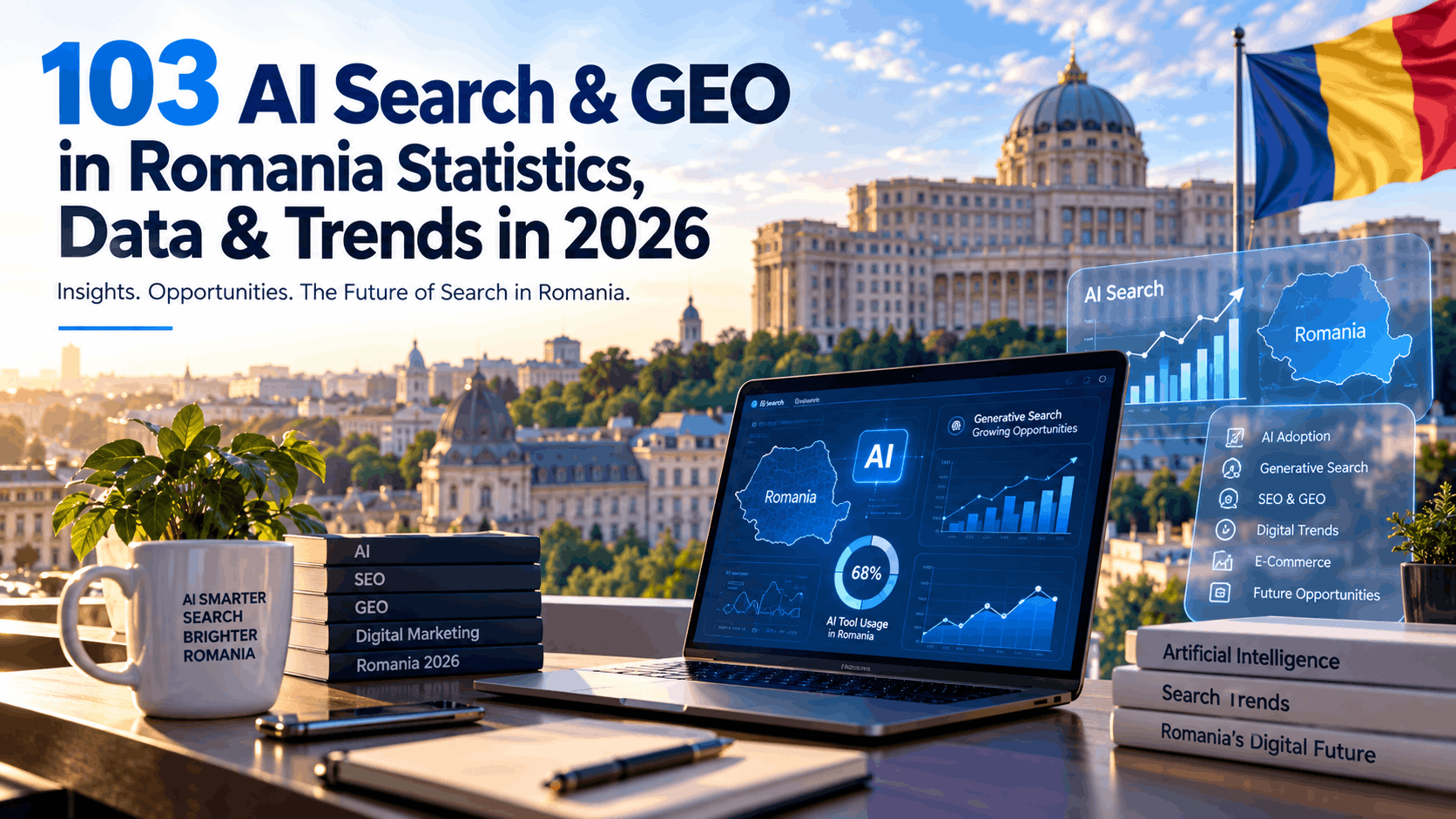
- AI adoption in Romania is accelerating, with 68% of Romanians using AI tools and ChatGPT dominating AI-powered information discovery in 2026.
- Generative Engine Optimisation (GEO) is becoming essential as AI Overviews, zero-click searches, and conversational platforms reshape how Romanian consumers discover brands and information.
- Romanian businesses need an integrated SEO and GEO strategy combining strong rankings, structured content, credible third-party authority, and AI citation visibility.
Romania is experiencing a rapid shift toward AI-powered search in 2026, with 68% of Romanians having used AI tools and 83% of AI users relying on them for general information. Generative Engine Optimisation (GEO) helps businesses adapt their digital visibility for this changing search landscape.
Artificial intelligence is rapidly changing how people in Romania search for information, research products, evaluate businesses, learn new topics, and complete everyday digital tasks. In 2026, the shift is no longer limited to technology enthusiasts. AI-powered search platforms such as ChatGPT, Google Gemini, and Microsoft Copilot are becoming increasingly embedded in the digital behaviour of Romanian consumers, professionals, students, and decision-makers.
Also, read our article on the top SEO and GEO agencies here:
Top 10 Best SEO Agencies in Romania
Top 10 GEO Agencies in Romania
The scale of this transformation is particularly striking. According to the statistics compiled for this report, 68% of Romanians have used AI tools at least occasionally in early 2026, compared with 47% in 2025. Among Romanian AI users, 83% use AI primarily to search for general information, making search the country’s leading AI use case. ChatGPT is also the dominant platform, used by 83% of Romanian AI users, while its usage reaches 92% among people aged 25–34.
These figures point to an important development for businesses: online visibility in Romania can no longer be measured exclusively through conventional Google rankings. Nearly 60% of Romanian AI chat users report using AI chats more frequently than traditional search engines. At the same time, younger generations, particularly Gen Z and Millennials aged 20–39, are among the country’s most active users of AI chat tools. As these audiences increasingly ask conversational systems for recommendations, explanations, comparisons, and purchasing information, brands need to consider whether their businesses are actually being mentioned, cited, and recommended in generative answers.

This transition is driving greater interest in Generative Engine Optimisation (GEO). While traditional search engine optimisation focuses heavily on improving visibility within conventional search results, GEO expands the objective to visibility within answers generated by platforms such as ChatGPT, Gemini, Google AI Overviews, Perplexity, and other AI-powered discovery systems. The goal is increasingly not only to rank, but also to become a trusted entity and source that generative engines can understand, retrieve, cite, and recommend.
Traditional SEO nevertheless remains critically important. The data shows that 76.1% of URLs cited by Google AI Overviews also rank within Google’s traditional top 10 results. This suggests that SEO and GEO should not be treated as competing disciplines. Instead, strong technical SEO, authoritative content, structured information, entity clarity, credible external references, and traditional organic rankings can provide the foundation upon which AI search visibility is built.
The urgency becomes clearer when examining broader search behaviour. Approximately 60% of searches globally now end without an external click, while the figure reaches 77% on mobile devices. Google AI Overviews expanded from appearing on just 3.93% of queries in January 2025 to 27.43% by November 2025. The compiled data also indicates that AI Overviews can substantially reduce organic click-through rates, demonstrating how search visibility and website traffic are becoming increasingly disconnected.
For Romania, this development is especially relevant because the country’s digital infrastructure is already extensive. Romania had approximately 17.7 million internet users at the end of 2025, representing around 94% internet penetration, alongside 25.5 million cellular mobile connections. Nearly all mobile connections were broadband capable. This means the infrastructure required for widespread mobile AI search already exists, even though Romania continues to lag behind several other European Union countries on some formal measures of generative AI and enterprise technology adoption.
That apparent contradiction is one of the most interesting AI search trends in Romania in 2026. Romania recorded only 17.8% generative AI usage among individuals aged 16–74 in the EU’s 2025 measurement, compared with an EU average of 32.7%. Enterprise adoption was even lower, with only 5.21% of Romanian enterprises using AI technologies in 2025. Yet other Romanian consumer research in the dataset indicates rapidly accelerating AI adoption and significant ChatGPT usage. Together, these statistics depict a market where adoption can vary considerably depending on population, methodology, timeframe, and definition, but where the overall direction toward greater AI use is unmistakable.
AI is also beginning to influence commercial discovery. 19% of Romanians frequently use ChatGPT or other AI tools to compare products and support purchasing decisions, while Romania’s e-commerce market is projected to reach approximately €8.5 billion in 2026. As AI assistants increasingly participate in product research, comparisons, recommendations, and vendor selection, the commercial importance of appearing accurately within generative answers is likely to grow alongside their adoption.
For marketers, another significant trend is the rise of AI-generated referral traffic. The statistics collected for this report show that referral visits from platforms including ChatGPT, Gemini, and Perplexity increased 357% year over year as of June 2025, with ChatGPT responsible for 87.4% of AI referral traffic in one dataset. AI referrals remain much smaller than conventional organic search traffic overall, but their rapid growth illustrates why organisations should begin measuring AI visibility before the channel reaches greater maturity.
Content structure is becoming important as well. The dataset highlights research suggesting that comparison pages containing three tables can receive 25.7% more citations, while content containing five to seven statistics can achieve a 20% higher likelihood of AI citation in certain ChatGPT discovery contexts. It also reports that brands can be 6.5 times more likely to receive AI citations through third-party sources than through their own websites, reinforcing the growing importance of digital PR, authoritative mentions, independent references, and broader entity authority alongside owned content.
Romania therefore enters 2026 at an important point in the evolution of online discovery. Traditional search remains highly valuable, but users are gaining alternative ways to find answers without navigating conventional search results. Brands now have to consider rankings, AI citations, entity recognition, zero-click visibility, structured content, third-party authority, AI referrals, multilingual discoverability, and the credibility of the information generative systems associate with them.
This collection of 103 AI Search and GEO statistics for Romania in 2026 examines that transformation from multiple angles, including Romanian AI adoption, ChatGPT usage, generative AI penetration, internet and mobile infrastructure, zero-click search behaviour, Google AI Overviews, Generative Engine Optimisation, AI-driven e-commerce, EU AI regulation, Romania’s technology ecosystem, and global AI search trends. Together, the data provides a detailed picture of where AI search in Romania stands in 2026, how quickly consumer discovery behaviour is changing, and why GEO is becoming an increasingly important component of modern SEO and digital marketing strategy.
But, before we venture further, we like to share who we are and what we do.
About AppLabx
From developing a solid marketing plan to creating compelling content, optimizing for search engines, leveraging social media, and utilizing paid advertising, AppLabx offers a comprehensive suite of digital marketing services designed to drive growth and profitability for your business.
At AppLabx, we understand that no two businesses are alike. That’s why we take a personalized approach to every project, working closely with our clients to understand their unique needs and goals, and developing customized strategies to help them achieve success.
If you need a digital consultation, then send in an inquiry here.
Or, send an email to hello@applabx.com to get started.
103 AI Search & GEO in Romania Statistics, Data & Trends in 2026
SECTION 1: AI ADOPTION & USAGE — ROMANIANS & AI TOOLS
1. 68% of Romanians have used AI tools at least occasionally as of early 2026, up from 47% in 2025.
Romania’s AI adoption has surged by 21 percentage points in a single year, signalling a rapid mainstreaming of artificial intelligence in everyday Romanian life that brands and marketers cannot afford to ignore.
2. 44% of Romanians already rely on AI tools for work-related tasks such as administrative support, analysis, and content creation (2026).
Nearly half of Romania’s working population has integrated AI into professional workflows, fundamentally altering how productivity is defined and how digital content strategies must account for AI-mediated tasks.
3. 83% of Romanian AI users primarily use these tools for searching for general information — the top use case nationally.
AI-powered information retrieval has effectively become a primary search behaviour for the majority of Romanian AI users, directly competing with and partially displacing traditional search engines.
4. 44% of Romanian AI users employ these tools for workplace support — up from 31% in 2025, a 13-percentage-point year-on-year increase.
The sharp rise in workplace AI use in Romania reflects a structural shift in how labour-intensive knowledge tasks are performed, with direct implications for productivity, content workflows, and the competitive landscape for digital agencies.
5. 39% of Romanian AI users apply these tools for education and learning.
Educational use of AI is entrenched among Romanian users, and as students become habitual AI search users, educational content publishers and institutions face an urgent need to adapt their SEO and GEO strategies.
6. 30% of Romanian AI users now use AI for personal planning and organisation — up from 19% in 2025.
Personal productivity has become a meaningful secondary use case, growing by 11 percentage points year-on-year, indicating that AI is expanding from professional-first to lifestyle-integrated in Romania.
7. ChatGPT is the most widely used AI platform in Romania, with 83% of AI users reporting they rely on it.
ChatGPT’s commanding hold on the Romanian AI market underlines the urgency for brands to optimise their content for ChatGPT’s citation and recommendation logic, as it is the primary AI through which Romanians seek information.
8. Google Gemini is used by 35% of Romanian AI users, ranking second nationally.
Gemini’s growing presence — particularly strong among users aged 35–44 — means Romania’s AI search ecosystem is not a monoculture, and GEO strategies must account for multiple generative platforms simultaneously.
9. Microsoft Copilot is used by 15% of Romanian AI users, primarily concentrated among corporate Microsoft 365 users.
Copilot’s stability signals that enterprise Romania is cautiously but consistently integrating AI into established productivity stacks, creating a B2B-specific AI search landscape that differs from consumer patterns.
10. ChatGPT’s platform-specific user share in Romania was 92% among users aged 25–34 in 2026.
The dominance of ChatGPT among Romania’s most digitally active working-age cohort means that brands targeting young urban professionals must prioritise being cited in ChatGPT’s answers above all other channels.
11. ChatGPT maintained a market share of over 85% among AI chat tools in Romania throughout 2025, recording approximately 4 million monthly searches in November 2025.
Four million monthly search interactions with ChatGPT alone in a single month demonstrates the scale at which Romanians are redirecting informational queries away from traditional search engines.
12. Nearly 60% of Romanian AI chat users report they now use AI chats more often than traditional search engines.
A majority of Romanian AI users have already crossed the threshold of preferring generative AI over Google for information discovery, an inflection point with profound consequences for organic search strategies.
13. Generation Z and Millennials aged 20–39 are the most active users of AI chat tools in Romania.
Romania’s AI search revolution is overwhelmingly youth-driven, and strategies targeting these cohorts must be built around AI citation, conversational content, and GEO-first principles rather than traditional keyword ranking.
14. 77% of Romanian AI users prefer text-based interaction with AI tools, up 11 percentage points year-on-year.
The overwhelming preference for text-based AI interaction in Romania suggests that voice-first AI optimisation remains a secondary priority, whereas structured, readable, AI-citable text content should be the primary focus.
15. 17% of Romanian AI users interact with AI tools using both text and voice, while 7% interact predominantly through voice.
While voice AI usage remains a small minority in Romania today, its 7% exclusive voice-use rate establishes a foundation that brands should monitor as voice AI capabilities expand.
16. High or very high trust in AI-generated information among Romanians declined from 65% in 2025 to 55% in 2026.
Falling trust in AI outputs does not translate to reduced usage — it signals a maturing user base that is becoming more selective and critical, which rewards authoritative, well-sourced, and accurate AI-cited content.
17. 53% of Romanians view AI as useful but with certain risks — up from 49% in 2025.
Romania’s increasingly nuanced relationship with AI reflects a population that embraces innovation while demanding responsible deployment, raising the stakes for brands whose AI-generated or AI-cited content must meet higher credibility standards.
18. 19% of urban Romanians consider AI to be very useful, rising to 30% among those aged 18–34.
Enthusiasm for AI is strongly concentrated among younger urban Romanians, reinforcing that AI-native content and discovery strategies will progressively become the default as this cohort grows in purchasing power.
19. Those with monthly incomes above RON 8,000 show the highest awareness of AI risks — 63% of this group.
Romania’s high-income segment approaches AI with the greatest scepticism, suggesting that premium brands and financial service providers targeting this cohort must maintain rigorous accuracy and source attribution in any AI-cited content.
20. ChatGPT is particularly popular among Romanians earning over RON 8,000 per month, with an 89% usage rate in this income bracket.
Despite their scepticism, high-earning Romanians are the most intense ChatGPT users, creating a paradox where the most critical segment is also the most AI-search-dependent — making GEO especially relevant for premium brands.
SECTION 2: GENERATIVE AI IN EU CONTEXT — ROMANIA’S RELATIVE POSITION
21. Romania recorded the lowest share of generative AI tool usage among all EU member states in 2025, at just 17.8%.
Sitting at the bottom of the EU ranking, Romania’s comparatively low formal generative AI usage rate — measured in the three months prior to the survey — masks a rapidly accelerating adoption curve that is already transforming search behaviour.
22. The EU average for generative AI tool usage among individuals aged 16–74 was 32.7% in 2025.
Romania’s 17.8% figure stands nearly 15 percentage points below the EU average, illustrating both the current adoption gap and the significant headroom for accelerated growth in AI-driven search behaviours.
23. Denmark led the EU in generative AI usage at 48.4% in 2025, nearly 3x Romania’s rate.
The gap between Romania and EU leaders like Denmark signals that as infrastructure, digital literacy, and platform access improve, Romania’s AI search adoption could follow a similarly steep trajectory.
24. Only 44.1% of Romanians aged 16–24 used generative AI tools in 2025 — the lowest youth adoption rate in the EU.
Romania’s young adults lag significantly behind EU peers such as Greece (83.5%) and Estonia (82.8%) in generative AI tool adoption, indicating that digital skills gaps remain a structural challenge for Romania’s AI economy.
25. Romania’s enterprise AI adoption rate was just 5.21% in 2025 — the lowest in the EU.
With fewer than 1 in 20 Romanian enterprises using AI technologies, the country faces a stark competitive disadvantage relative to EU peers, even as individual consumer AI use accelerates independently.
26. Romania’s enterprise AI adoption increased by only 1.6 percentage points year-on-year in the 2024–2025 survey cycle — one of the smallest growth increments in the EU.
The sluggish pace of business AI adoption in Romania contrasts with rapid individual uptake, suggesting that the enterprise AI transformation will take longer to materialise than consumer-facing AI search shifts.
27. Only 24.94% of Romanian enterprises use paid cloud computing services — the third-lowest rate in the EU after Bulgaria and Greece.
Romania’s comparatively low cloud adoption is a foundational constraint on enterprise AI deployment, as most modern AI search tools and content management platforms depend on cloud infrastructure.
28. Only 25% of Romania’s population used e-government digital services in 2024 — the lowest rate in the EU, vs. an EU average of 75%.
Romania’s digital public services gap underlines systemic digital literacy and infrastructure challenges that shape the broader environment in which AI search tools are being adopted.
29. Romania ranked last among EU member states in the Digital Economy and Society Index (DESI) for the adoption of digital public services in 2024.
Last place in DESI digital public services underlines that Romania’s AI search growth is occurring despite — not because of — a strong institutional digital foundation, making grassroots and market-led adoption all the more notable.
30. Nearly 7% of Romanian university graduates specialise in ICT — ranking Romania 6th in the EU on this indicator.
Romania’s strong STEM pipeline creates the human capital base to support AI development and AI-literacy growth over time, even as current enterprise adoption remains subdued.
SECTION 3: INTERNET & DIGITAL INFRASTRUCTURE
31. Romania had 17.7 million internet users at the end of 2025, representing an online penetration rate of 94.0%.
With more than 9 in 10 Romanians now online, digital reach is no longer a barrier — the battle for visibility has shifted entirely to the algorithmic layer, making AI search optimisation the defining competitive frontier.
32. Romania’s internet penetration rate was 92.43% as of December 2025, according to Eurostat.
Consistent Eurostat and DataReportal data confirm Romania has entered the high-penetration phase of internet adoption, where incremental user growth is less significant than changes in how existing users search and discover content.
33. 6.0% of Romania’s population — approximately 1.14 million people — remained offline at the end of 2025.
While 1.14 million Romanians remain unconnected, this relatively small offline population will shrink further, and the digital divide is increasingly characterised by quality of access and digital skills rather than connectivity alone.
34. Romania had 25.5 million cellular mobile connections active in late 2025 — equivalent to 135% of the total population.
Multiple SIM ownership drives Romania’s 135% mobile connection rate, and the ubiquity of mobile devices makes mobile-first AI search behaviour a structural reality rather than an emerging trend.
35. 98.6% of mobile connections in Romania are considered broadband, connecting via 3G, 4G, or 5G networks.
Near-universal broadband mobile connectivity means Romanian users can access AI search tools from virtually anywhere, eliminating the infrastructure constraints that historically limited AI search engagement.
36. Romania had 12.9 million social media user identities in October 2025, equating to 68.3% of the total population.
With more than two-thirds of Romania’s population active on social media, social platforms represent a significant parallel discovery layer to AI search — and increasingly, both are converging as AI integrates into social feeds.
37. Facebook had 13,028,000 users in Romania in February 2026, accounting for 68.8% of the total population.
Facebook remains Romania’s dominant social platform, and its integration with Meta’s AI tools means that AI-driven content recommendation is already deeply embedded in Romania’s primary social discovery channel.
38. Instagram had 6,542,500 users in Romania in February 2026, representing 34.5% of the population.
Instagram’s significant reach, particularly among women aged 25–34, creates an important visual discovery layer that increasingly interfaces with AI-powered recommendation algorithms.
39. LinkedIn had 5,480,000 users in Romania in February 2026, representing 28.9% of the population.
LinkedIn’s substantial Romanian user base highlights that AI search and GEO strategies must extend to professional content platforms, where B2B buyers increasingly use AI-assisted research before supplier engagement.
40. Facebook commanded 92.3% of social media market share in Romania in early 2026, followed by Instagram at 49.6% and X at 31.1%.
Facebook’s outsized social media dominance in Romania shapes how brands must structure their AI-compatible content strategies, as Meta’s AI tools are deeply integrated into its platform ecosystem.
SECTION 4: AI SEARCH BEHAVIOUR & ZERO-CLICK TRENDS (GLOBAL/EU, APPLICABLE TO ROMANIA)
41. Approximately 60% of all global searches now end without an external click — zero-click searches have become the default behaviour.
As the zero-click majority becomes entrenched globally, Romanian businesses relying on organic search traffic must urgently recalibrate their KPIs from page visits to brand citations in AI-generated answers.
42. On mobile devices, 77% of searches end without visiting an external website — compared to 46.5% on desktop.
Romania’s near-universal mobile broadband adoption makes the 77% mobile zero-click rate especially relevant, as most Romanian users encounter AI-resolved search results before ever reaching an external website.
43. Google’s AI Overviews now appear on 27.43% of search queries as of November 2025 — up from just 3.93% in January 2025.
The near-7x expansion of Google AI Overviews in 2025 means that a rapidly growing proportion of queries — including those from Romanian users — now return AI-generated answers before organic links.
44. AI Overviews reduce organic click-through rates by 58% (Ahrefs, February 2026).
A 58% CTR reduction for queries with AI Overviews is among the most consequential statistics in modern SEO, and for Romanian brands still investing exclusively in traditional ranking, this represents an existential traffic risk.
45. When a brand is cited in the AI Overview, organic CTR is 35% higher than for non-cited competitors.
Citation in AI Overviews does not eliminate traffic — it concentrates it. Romanian brands that earn AI citations can expect a meaningful CTR premium, incentivising a strategic shift from keyword ranking to authority building.
46. 76.1% of URLs cited in Google AI Overviews also rank in the top 10 of traditional Google search results.
Strong traditional SEO remains a prerequisite for AI Overview citation, meaning Romanian brands should not abandon conventional rankings but rather integrate them within a broader GEO framework.
47. AI Overviews appear in 99.9% of informational keywords — 57.9% of which are question-based queries.
Informational and question-format content is the primary battleground for AI citation in Romania, reinforcing that FAQ-structured, entity-rich, and E-E-A-T-compliant content is now the most strategically valuable content type.
48. 88.1% of queries triggering AI Overviews are informational in nature.
The near-exclusive dominance of informational queries in AI Overview triggers means that the vast majority of Romanian B2B content strategies — historically centred on informational top-of-funnel content — are the most vulnerable to zero-click displacement.
49. Only 7.9% of local searches trigger an AI Overview.
Local search remains largely insulated from AI Overview disruption, giving Romanian businesses with a local focus a comparative advantage in traditional organic CTR while informational content faces the steepest traffic headwinds.
50. 73% of B2B websites experienced significant organic traffic loss between 2024 and 2025 despite maintaining search rankings.
The decoupling of ranking position from traffic volume — affecting the majority of B2B websites globally — is already a reality that Romanian B2B brands must confront in their 2026 digital strategies.
51. Organic CTR has dropped 61% for queries where an AI Overview is present.
A 61% click reduction for AI Overview-triggered queries underlines that ranking first in an AI Overview-dominated SERP delivers far fewer visits than the same position did two years ago, requiring a fundamental rethink of Romanian content ROI models.
52. Organic search still drives 53% of all website traffic globally — making it 5x more cost-effective than paid advertising on a long-term value basis.
Despite AI disruption, organic search remains the dominant traffic channel globally and for Romanian sites, reinforcing that SEO investment should continue but must evolve to incorporate GEO principles.
53. Zero-click searches increased from 56% in 2024 to approximately 69% by May 2025 (Similarweb).
The 13-percentage-point jump in zero-click rates in a single year is one of the fastest behavioural shifts in search history, and Romanian digital marketers who have not yet updated their attribution models are operating on outdated assumptions.
54. AI referral traffic from platforms like ChatGPT, Gemini, and Perplexity increased by 357% year-over-year as of June 2025.
The explosive growth in AI-referred traffic represents an entirely new discovery channel that did not exist at meaningful scale two years ago — one that Romanian brands must now consciously optimise for.
55. Traditional organic traffic accounted for 25% of all website traffic on average in late 2025, while AI referral traffic accounted for just 1.08%.
Despite its rapid growth, AI referral traffic is still a small fraction of total traffic, meaning Romanian brands need a dual-track strategy: maintaining strong traditional SEO while building AI citation presence for long-term positioning.
56. 87.4% of all AI referral traffic comes from ChatGPT.
ChatGPT’s overwhelming dominance of AI-referred traffic makes it the highest-priority platform for Romanian GEO strategies — appearing in ChatGPT’s answers should be the first and most critical GEO objective.
57. AI-referred traffic converts at a rate approximately 23 times better than traditional organic traffic in some studies.
The extreme conversion premium of AI-referred visitors — who arrive with specific, high-intent queries — means that even modest AI citation gains can deliver disproportionate business outcomes for Romanian brands.
58. 75% of AI Mode sessions end without an external visit.
Google’s AI Mode, which consolidates AI Overviews and conversational search into a single interface, generates even more pronounced zero-click behaviour than standard search, foreshadowing the next phase of traffic disruption for Romanian publishers.
SECTION 5: GEO — GENERATIVE ENGINE OPTIMISATION MARKET
59. The GEO (Generative Engine Optimization) services market was valued at $886 million in 2024 and is projected to reach $7.318 billion by 2031 — a CAGR of approximately 34%.
GEO is not a niche discipline — it is a rapidly institutionalising market category growing at 34% annually, and Romanian digital agencies that do not develop GEO capabilities risk ceding premium positioning to Western competitors.
60. 86% of enterprise SEO teams globally have already integrated AI into their search strategies.
With 86% of large-brand SEO teams already AI-enabled, the gap between enterprises and SMEs in Romania’s AI search optimisation landscape will widen further unless local agencies accelerate their GEO service offerings.
61. 83% of global CMOs expressed optimism about generative AI in 2025 — up from 74% in 2023.
Rising CMO confidence in generative AI signals sustained investment in AI-powered marketing across the board, and Romanian brands with international parent companies will increasingly be expected to align local strategies with global AI-first priorities.
62. 58% of users globally have already replaced traditional search engines with AI-driven tools for product and service discovery (Capgemini, 2025).
More than half of consumers globally now discover products and services through AI rather than traditional search, a behavioural shift that directly affects how Romanian brands must structure their product visibility strategies.
63. 63% of websites globally receive traffic from AI search tools (Ahrefs, 2025).
A majority of the world’s websites are already receiving some measurable AI-referral traffic, meaning Romanian webmasters who do not monitor AI traffic sources are missing a growing and strategically significant data stream.
64. 64% of global consumers express readiness to purchase products suggested by AI (Master of Code, 2024).
The willingness of nearly two-thirds of global consumers to act on AI purchase recommendations makes AI citation in product and service recommendation contexts an increasingly direct revenue driver for Romanian e-commerce businesses.
65. 80% of B2B technology buyers globally trust generative AI as much as traditional search when researching suppliers (Responsive, 2025).
In B2B contexts — which are particularly relevant for Romania’s growing tech and outsourcing sectors — AI-recommended vendors carry as much weight as those discovered through traditional Google searches.
66. Brands are 6.5 times more likely to be cited through third-party sources than through their own domains in AI-generated answers.
For Romanian brands, this statistic reframes the entire content strategy calculus — investing in third-party PR, industry reports, and external mentions may deliver far greater AI citation returns than on-site content alone.
67. Structured content improves ChatGPT visibility: comparison pages with 3 tables earn 25.7% more citations, and shortlist pages with sentences averaging 10 words or fewer earn 18.8% more citations (AirOps, 2026).
Highly specific structural content guidelines are emerging for ChatGPT citation optimisation — Romanian content teams should treat these as actionable formatting standards rather than general principles.
68. Content with 5–7 statistics earns a 20% higher AI citation likelihood in ChatGPT’s early-discovery responses (AirOps, 2026).
Data-rich content is disproportionately favoured by ChatGPT’s citation logic, giving Romanian publishers who invest in original research and quantitative content a meaningful advantage over competitors producing opinion-driven content.
69. Translated sites gain 327% more visibility in AI Overviews compared to untranslated sites.
For Romanian brands targeting European markets, the case for multilingual content has never been stronger — translated pages are dramatically more likely to earn AI Overview citations, representing a high-ROI GEO investment.
70. 26% of brands had zero mentions in AI Overviews in one industry snapshot — AI visibility is highly uneven.
With more than a quarter of brands receiving zero AI mentions, the distribution of AI search visibility is heavily skewed toward authority domains, creating both urgency and opportunity for Romanian brands to claim AI citation share before it consolidates.
SECTION 6: ROMANIA’S ECOMMERCE & AI COMMERCE LANDSCAPE
71. Romania’s e-commerce market is projected to reach €8.5 billion in 2026, with a 5% growth rate expected — down from 6% in 2025.
Romania’s slowing e-commerce growth rate, combined with the accelerating role of AI in product discovery, means that competitive advantage in 2026 will increasingly shift to AI-optimised product visibility rather than volume-based marketing.
72. eMAG’s AI generated 1.2 million product recommendations in January 2025 alone.
Romania’s dominant e-commerce platform is already deploying AI at scale in product discovery, establishing a competitive benchmark that smaller Romanian merchants must either match through their own AI tools or work within as a distribution channel.
73. 19% of Romanians frequently use ChatGPT or other AI tools to compare products and make purchasing decisions (easySales eCommerce study, 2025).
While still a minority behaviour, 1 in 5 Romanians using AI for product comparison represents a material and growing segment of the consumer market that e-commerce brands cannot optimise for without a dedicated GEO strategy.
74. Only 16% of Romanians trust AI for product purchase recommendations, compared to 77%+ who trust family and friends.
The relatively low trust Romanian consumers place in AI product recommendations — versus human social proof — underlines that AI works best as a discovery tool rather than a final purchase influencer in this market.
75. Personalising the e-commerce experience with integrated AI solutions can generate conversion rates more than 4 times higher, according to case studies on MerchantPro platform stores.
A 4x conversion uplift from AI personalisation — validated on Romanian e-commerce stores — makes a compelling financial case for investing in AI-driven product recommendation and discovery tools on local retail sites.
76. 65% of users globally say AI influences their purchasing decisions as these technologies are integrated into search engines, product recommendations, and virtual assistants.
The majority of global consumers are already experiencing AI-influenced purchasing journeys, and as Romanian consumers increase their AI usage rates, the share influenced by AI product discovery will rise proportionally.
77. 55% of Romanians bought online at least once in 2024 — while rural buyers are growing as a higher-adoption rate segment.
The ongoing expansion of Romanian e-commerce into rural areas creates a new segment of digital shoppers who may encounter AI-assisted product discovery from their very first online shopping experiences.
78. Romania’s e-commerce market growth rate was 7% year-on-year in transaction volume in 2025 — significantly lower than the 16.6% annual growth rate recorded earlier in the decade.
Romania’s maturing e-commerce market is entering a phase where AI-driven personalisation and discovery will become more important than market expansion alone in driving transaction growth.
79. Romania’s internet penetration rate for e-commerce was 95.1% according to the National Institute of Statistics — the highest recorded.
With near-universal internet access, Romania’s e-commerce growth ceiling is no longer infrastructure-limited, making AI-driven discoverability and personalisation the primary levers for future competitive differentiation.
80. The average annual online spending per Romanian e-commerce user was approximately €857 in 2024, expected to grow toward €900 per user by 2027.
Rising per-user e-commerce spend in Romania signals growing comfort with online purchasing, creating an expanding market for AI-driven product recommendation tools that can capture a share of each user’s growing digital wallet.
SECTION 7: AI REGULATION & NATIONAL AI STRATEGY IN ROMANIA
81. Romania adopted its National Artificial Intelligence Strategy 2024–2027 in July 2024, structured around six core objectives including education, R&D infrastructure, and governance.
Romania’s formal AI strategy provides a policy roadmap that, if implemented effectively, could accelerate enterprise AI adoption and digital skills development — directly influencing the pace at which AI search tools become mainstream for Romanian businesses.
82. As of November 2025, Romania had not officially designated a competent national authority for enforcing the EU AI Act, despite the EU deadline of August 2, 2025.
Romania’s regulatory delay creates short-term compliance uncertainty for businesses operating in AI search and content generation, though the EU framework will eventually apply regardless of national institutional gaps.
83. The EU AI Act’s core high-risk AI provisions take full effect on August 2, 2026 — including transparency obligations relevant to AI-generated search content.
The August 2026 AI Act milestone will directly affect how AI-generated content is labelled and disclosed in Romania, creating new compliance requirements for AI search tools and generative content platforms operating in the Romanian market.
84. Non-compliance with prohibited AI practices under the EU AI Act can result in fines of up to €35 million or 7% of global annual turnover, whichever is higher.
The scale of EU AI Act penalties means that Romanian businesses integrating AI into their search and content strategies face material legal exposure if they deploy non-compliant systems, raising the stakes for responsible AI content governance.
85. The EU AI Act’s general-purpose AI model obligations became applicable on August 2, 2025 — already affecting ChatGPT, Gemini, and other tools widely used in Romania.
The general-purpose AI model obligations are already in effect, meaning the AI tools Romanians use for search are subject to EU regulatory oversight — a foundational shift in the governance of Romania’s AI search environment.
86. Romania’s draft AI law Pl-x nr. 184/2025 on responsible AI use was registered in the Senate on March 31, 2025, but remained unapproved as of early 2026 amid political uncertainty.
Romania’s inability to pass national AI legislation so far leaves a governance gap that businesses operating in AI-driven search and marketing must fill through their own compliance frameworks aligned to the EU AI Act.
87. EU member states must each establish at least one AI regulatory sandbox at the national level by August 2, 2026, under the AI Act.
Romania’s obligation to launch a national AI sandbox by August 2026 provides a formal testing ground that Romanian AI and digital marketing startups should engage with to develop GEO tools and AI search solutions under regulatory oversight.
SECTION 8: ROMANIA’S TECH ECOSYSTEM & AI TALENT
88. Romania employs an estimated 250,000+ tech specialists, ranking 3rd in Europe for ICT talent behind Poland and Ukraine.
Romania’s large and skilled tech talent base is a structural asset for AI adoption — it provides the human capital to develop, deploy, and optimise AI search tools at a competitive cost relative to Western European alternatives.
89. Romania’s ICT sector is projected to generate approximately €1.2 billion in turnover by 2025.
The size of Romania’s ICT sector creates an economically significant domestic market for AI tools, platforms, and GEO services, as Romanian tech companies are themselves sophisticated consumers of AI search technologies.
90. Romania ranks 6th globally in the number of certified IT specialists per 1,000 residents, surpassing the US and Russia.
A world-class certified IT specialist density gives Romania a competitive advantage in technology delivery, and as AI skills become the premium specialisation, Romania’s existing tech ecosystem is well-positioned to build this capability rapidly.
91. Romania adds over 10,000 STEM graduates annually, drawing from 59 specialised institutions and 5 top technical universities.
With 10,000+ STEM graduates entering the workforce each year, Romania has the pipeline to develop the AI literacy and GEO expertise needed to close the adoption gap with EU leaders over the coming years.
92. Over 1,600+ startups operate in Romania, including unicorns like UiPath and eMAG — companies that have helped establish Romania as a credible AI innovation hub.
Romania’s unicorn startups — particularly UiPath, a global leader in AI-driven process automation — signal that Romania can produce world-class AI products, not just consume them, adding credibility to its AI search ecosystem potential.
93. Romania houses R&D offices of Google, Amazon, Microsoft, Samsung, Oracle, and Intel, among other global tech firms.
The presence of major global tech companies’ R&D operations in Romania means that cutting-edge AI search technologies are being developed locally — creating a spillover effect on local talent, knowledge, and adoption.
94. Romania ranked 6th in the EU for ICT graduates as a share of all university graduates (nearly 7% of total graduates).
A top-6 EU ranking for ICT graduate share ensures Romania has a steady and growing supply of technically literate professionals who will accelerate AI tool adoption across the economy.
95. Romania ranks 5th in the Global Talent Competitiveness Index and 8th in the Global Startup Ecosystem Index for 2024.
Strong global rankings in talent competitiveness and startup ecosystems position Romania as an increasingly attractive base for AI companies building search and GEO tools for the Eastern European market.
SECTION 9: GLOBAL AI SEARCH MARKET CONTEXT
96. The global AI search engine market was valued at $18.5 billion in 2025 and is forecasted to reach $66.2 billion by 2035, growing at a CAGR of 14%.
The global AI search market is entering a decade of sustained growth, and Romania — as one of the fastest-growing AI adoption markets in Eastern Europe — will increasingly attract AI search platform investment and localisation efforts.
97. The global AI market is estimated to reach $757.58 billion in 2026, growing at 19.20% year-on-year from $638.23 billion in 2025.
The near-$760 billion scale of the global AI market in 2026 provides the financial context for why AI search is reshaping every industry simultaneously — and why Romanian businesses that adopt AI-first strategies now are positioned ahead of the curve.
98. Referral visits from AI platforms (ChatGPT, Gemini, Perplexity, etc.) increased by 357% year-over-year as of June 2025.
A 357% growth in AI platform referral traffic in a single year is one of the fastest channel growth rates ever recorded in digital marketing, validating the urgency of treating AI search as a first-tier acquisition channel.
99. 19% of Bucharest students used ChatGPT at least once in academic settings, with 24% expressing a positive or open attitude toward it in a 2025–2026 Romanian university study.
Romanian university students are actively integrating AI into academic workflows, creating a cohort of future professionals and consumers who will approach information discovery through AI as a default behaviour from an early age.
100. Searches with 4 or more words trigger Google AI Overviews 60% of the time globally.
The strong correlation between query length and AI Overview activation means that Romanian users’ naturally conversational and long-tail search queries — a pattern strengthening as voice and AI assistant use grows — will increasingly encounter AI-mediated search results.
101. AI industry analysts predict AI search visitors will surpass traditional search visitors by early 2028.
If analysts’ projections hold, Romanian digital marketers have fewer than two years to establish strong AI citation presence before AI-referred visitors become the majority traffic source — a remarkably compressed strategic window.
102. The #1 organic search result now enjoys a 39.8% CTR — but only for queries without AI Overviews.
Position 1 still delivers strong click rates when AI Overviews are absent, which is the case for local, commercial, and transactional queries — giving Romanian businesses in those verticals a continuing incentive to pursue traditional top-of-page rankings.
103. 19.95% of EU enterprises (10+ employees) used AI technologies in 2025 — up 6.47 percentage points from the previous year, the largest annual jump recorded.
The EU’s fastest-ever annual increase in enterprise AI adoption means the competitive landscape will shift significantly over the next 12–24 months, and Romanian businesses that delay adoption now face a compounding disadvantage.
Conclusion
The 103 AI Search and GEO statistics for Romania in 2026 reveal a digital market undergoing a significant transformation. Artificial intelligence is no longer simply an emerging technology for Romanian consumers and businesses. It is increasingly becoming part of how people search for information, complete workplace tasks, learn, compare products, evaluate companies, and make purchasing decisions.
One of the clearest signals is the rapid growth of consumer adoption. 68% of Romanians have used AI tools at least occasionally in early 2026, compared with 47% in 2025, while 83% of Romanian AI users use AI to search for general information. ChatGPT dominates this emerging behaviour, reaching 83% of Romanian AI users overall and 92% among users aged 25–34. Nearly 60% of Romanian AI chat users also report using AI chats more frequently than traditional search engines.
At the same time, Romania presents an unusual contrast. The country recorded only 17.8% generative AI usage among people aged 16–74 in the EU’s 2025 measurement, the lowest rate among EU member states, while enterprise AI adoption stood at only 5.21%. Romania therefore combines relatively weak institutional and enterprise adoption indicators with rapidly developing consumer AI behaviour, creating considerable room for further growth as digital literacy, business adoption, and AI accessibility improve.
These changes have major implications for SEO and digital marketing. Search visibility can no longer be measured entirely by rankings and organic clicks. Approximately 60% of global searches now end without an external click, while AI Overviews and conversational search experiences increasingly provide answers directly within the search interface. Meanwhile, AI referral visits from platforms such as ChatGPT, Gemini, and Perplexity increased 357% year over year, demonstrating that AI search is simultaneously reducing some traditional clicks while creating a new source of highly intentional referral traffic.
This is where Generative Engine Optimisation (GEO) in Romania becomes increasingly important. Businesses need to consider whether AI systems can clearly understand their brands, products, expertise, services, and authority, and whether those systems are likely to cite or recommend them when relevant questions are asked. Structured content, statistics, authoritative references, third-party mentions, multilingual information, strong technical SEO, and clearly established entities are becoming important components of this new visibility landscape.
Traditional SEO, however, remains fundamental. The data shows that 76.1% of URLs appearing as citations in Google AI Overviews also rank within the traditional Google top 10. Rather than replacing SEO, GEO should therefore be viewed as an expansion of search optimisation: businesses need to compete for conventional rankings while simultaneously increasing their likelihood of appearing within AI-generated answers.
Romania has strong foundations for this transition. With approximately 17.7 million internet users, 94% internet penetration, 25.5 million mobile connections, a substantial technology workforce, and thousands of startups, the country already possesses much of the infrastructure and talent required for faster AI adoption. Its projected €8.5 billion e-commerce market in 2026 further increases the commercial importance of AI-assisted product and business discovery.
For Romanian businesses, marketers, publishers, e-commerce companies, SaaS providers, and digital agencies, the strategic direction is becoming clearer. Winning search visibility in 2026 means thinking beyond blue links and keyword rankings. Brands need to build authority that works across Google Search, Google AI Overviews, ChatGPT, Gemini, Perplexity, Copilot, and the next generation of AI-powered discovery platforms.
The broader message from these 103 Romania AI Search and GEO statistics, data, and trends is therefore not that traditional search is disappearing. Instead, search itself is expanding. The organisations best positioned for this transition will be those that combine strong SEO foundations with GEO, credible third-party authority, structured and data-rich content, accurate entity information, and continuous measurement of their visibility across both traditional and generative search.
As AI adoption continues to accelerate, 2026 could represent a critical transition year for AI Search and Generative Engine Optimisation in Romania. Businesses that begin building AI visibility now have an opportunity to establish authority before generative search becomes an even more deeply embedded part of how Romanian consumers and business buyers discover, compare, and choose brands online.
If you are looking for a top-class digital marketer, then book a free consultation slot here.
If you find this article useful, why not share it with your friends and business partners, and also leave a nice comment below?
We, at the AppLabx Research Team, strive to bring the latest and most meaningful data, guides, and statistics to your doorstep.
To get access to top-quality guides, click over to the AppLabx Blog.
People also ask
What is AI search in Romania in 2026?
AI search refers to using generative AI tools to find and understand information. In 2026, 68% of Romanians have used AI tools at least occasionally, showing how quickly AI-assisted discovery is expanding.
What is Generative Engine Optimisation in Romania?
Generative Engine Optimisation, or GEO, improves how brands and content appear, get cited, and are recommended in answers generated by platforms such as ChatGPT, Gemini, Perplexity, and Google AI search experiences.
How many Romanians use AI tools in 2026?
About 68% of Romanians have used AI tools at least occasionally in early 2026, up significantly from 47% in 2025.
What is the most popular AI tool in Romania?
ChatGPT is the most widely used AI platform among Romanian AI users, with 83% reporting that they use it. Google Gemini ranks second at 35%, followed by Microsoft Copilot at 15%.
How popular is ChatGPT in Romania in 2026?
ChatGPT is used by 83% of Romanian AI users. Its usage is particularly high among people aged 25–34, reaching 92% within this group.
What do Romanians use AI tools for most often?
Searching for general information is the leading use case, reported by 83% of Romanian AI users. Workplace support, education, learning, and personal planning are other significant uses.
Are Romanians replacing Google with AI search?
Nearly 60% of Romanian AI chat users report using AI chats more often than traditional search engines, indicating a substantial shift toward conversational information discovery.
Which age groups use AI search most in Romania?
Generation Z and Millennials aged 20–39 are the most active Romanian users of AI chat tools. ChatGPT usage is especially strong among the 25–34 age group.
How many Romanians use AI for work?
Around 44% of Romanians rely on AI for work-related activities such as administrative support, analysis, and content creation in 2026.
How many Romanian AI users use AI for education?
About 39% of Romanian AI users use artificial intelligence for education and learning, making education one of the country’s major AI use cases.
Do Romanians trust AI-generated information?
High or very high trust in AI-generated information fell from 65% in 2025 to 55% in 2026, suggesting Romanian users are becoming more critical of AI answers even as adoption grows.
How does Romania compare with the EU for generative AI adoption?
Romania recorded 17.8% generative AI usage among people aged 16–74 in 2025, compared with an EU average of 32.7%, placing Romania at the bottom of the EU ranking in that measurement.
What is Romania’s enterprise AI adoption rate?
Only 5.21% of Romanian enterprises used AI technologies in 2025, the lowest rate recorded among EU member states in the dataset.
How many internet users are there in Romania?
Romania had approximately 17.7 million internet users at the end of 2025, equivalent to an internet penetration rate of around 94%.
How important is mobile internet for AI search in Romania?
Romania had 25.5 million cellular mobile connections in late 2025, with 98.6% classified as broadband connections using 3G, 4G, or 5G networks.
What are zero-click searches?
Zero-click searches occur when users receive the information they need directly from a search interface without visiting another website. Approximately 60% of global searches now end without an external click.
How common are zero-click searches on mobile devices?
Around 77% of mobile searches globally end without an external website visit, compared with 46.5% on desktop. This trend is important for Romania’s highly connected mobile population.
How common are Google AI Overviews in 2026?
Google AI Overviews appeared on 27.43% of search queries by November 2025, up sharply from 3.93% in January 2025, according to the statistics compiled in the report.
Do Google AI Overviews reduce organic website clicks?
Yes. The dataset reports substantial organic CTR declines when AI Overviews appear, including research indicating a 58% reduction in organic click-through rates.
Does traditional SEO still matter for AI search?
Yes. About 76.1% of URLs cited in Google AI Overviews also rank within the traditional Google top 10, demonstrating a strong connection between conventional SEO performance and AI visibility.
Why is GEO important for Romanian businesses?
GEO helps Romanian businesses adapt to a search environment where consumers increasingly obtain information and recommendations directly from generative AI systems instead of relying exclusively on traditional search results.
What content is more likely to receive AI citations?
The dataset reports that structured, concise, and data-rich content can improve AI citation visibility. Content containing five to seven statistics showed a 20% higher citation likelihood in certain ChatGPT discovery responses.
Do third-party mentions improve AI search visibility?
Yes. Brands can be 6.5 times more likely to receive AI citations through third-party sources than through their own domains, highlighting the potential importance of digital PR and independent authority signals.
Is AI referral traffic growing?
Yes. Referral visits from AI platforms such as ChatGPT, Gemini, and Perplexity increased by 357% year over year as of June 2025.
Which platform generates the most AI referral traffic?
ChatGPT accounts for 87.4% of AI referral traffic in the dataset, making it an especially important platform for businesses developing GEO and AI search visibility strategies.
Are Romanians using AI to compare products?
Yes. About 19% of Romanians frequently use ChatGPT or other AI tools to compare products and support purchasing decisions, according to a 2025 e-commerce study cited in the dataset.
How large is Romania’s e-commerce market in 2026?
Romania’s e-commerce market is projected to reach approximately €8.5 billion in 2026, with expected growth of around 5%.
How does the EU AI Act affect Romania in 2026?
Romania is subject to the EU AI Act. The dataset identifies August 2, 2026 as an important implementation milestone for core high-risk AI provisions and related regulatory requirements.
What is the future of AI search and GEO in Romania?
Romania has significant room for AI adoption growth. Rising consumer usage, widespread internet access, growing AI referrals, and changing search behaviour suggest GEO could become increasingly important for digital visibility.
Should Romanian businesses invest in both SEO and GEO?
Yes. SEO supports rankings and organic discoverability, while GEO extends visibility into generative answers and AI recommendations. The statistics suggest businesses should integrate both rather than treat GEO as a replacement for traditional SEO.
Sources
ING Think Reveal Marketing Research Eurostat MerchantPro Romania Insider The Romania Journal Mixtazure DataReportal Data Intelligence Romania Publicis Groupe Click-Vision The Digital Bloom Onely Position Digital Insightland Marketing LTB Brosch Digital Superprompt McKinsey EU Digital Strategy Mararu Law EuroCloud Europe CMS Law OECD NapoleonCat WMTips Statista StatCounter Resourcera Future Market Insights Aqurate AI easySales ClubITC PRescu DevsData PBS Worldwide Alcor BPO nCube Euronews Writesonic AirOps Regulations.ai ScienceDirect PMC