





















Key Takeaways
- Portugal leads European generative AI adoption at 62%, highlighting the rapid shift toward AI-powered search and digital discovery.
- AI search and Google AI Overviews are accelerating zero-click behaviour, making GEO visibility, citations and brand mentions increasingly important.
- SEO and GEO work best together, helping Portuguese brands strengthen traditional rankings while gaining visibility across ChatGPT, Perplexity and AI-generated search results.
Portugal leads Europe in generative AI adoption, with 62% of respondents regularly using GenAI tools in 2026. This shift transforms how consumers discover information, compare brands, and make decisions, making AI Search and Generative Engine Optimisation increasingly important for businesses seeking visibility beyond traditional Google search.
Portugal is rapidly emerging as one of Europe’s most important markets for artificial intelligence adoption, AI-powered search, and Generative Engine Optimisation (GEO). In 2026, the way Portuguese consumers and businesses discover information online is evolving beyond conventional search engine results toward AI-generated answers, conversational search experiences, Google AI Overviews, ChatGPT, Perplexity, and other generative AI platforms. The 123 AI Search & GEO in Portugal statistics, data and trends in this report provide a detailed picture of how significant that transformation has become.
Also, read our article on the top SEO and GEO agencies here:
Top 10 Best SEO agencies in Portugal
Top 10 GEO Agencies in Portugal
One of the strongest indicators is consumer adoption. According to the statistics compiled in this report, 62% of Portuguese respondents regularly use generative AI tools, placing Portugal 10 percentage points above the stated European average of 52%. At the same time, 54% of Portuguese internet users say they trust AI-generated content. These figures suggest that generative AI is no longer simply an experimental technology for Portugal’s digitally advanced users; it is increasingly becoming part of mainstream information discovery and decision-making behaviour.
The implications for search marketing are particularly significant. The dataset reports that six in ten Portuguese users who receive AI-generated summaries do not subsequently click through to the original source website. Meanwhile, 38% of Portuguese people still prefer conventional search engines over AI tools. Together, these statistics illustrate why businesses should not view SEO and GEO as competing strategies. In 2026, Portuguese brands increasingly need both: traditional Search Engine Optimisation to maintain visibility across conventional search results and Generative Engine Optimisation to improve their chances of being discovered, referenced, cited, or recommended within AI-generated answers.
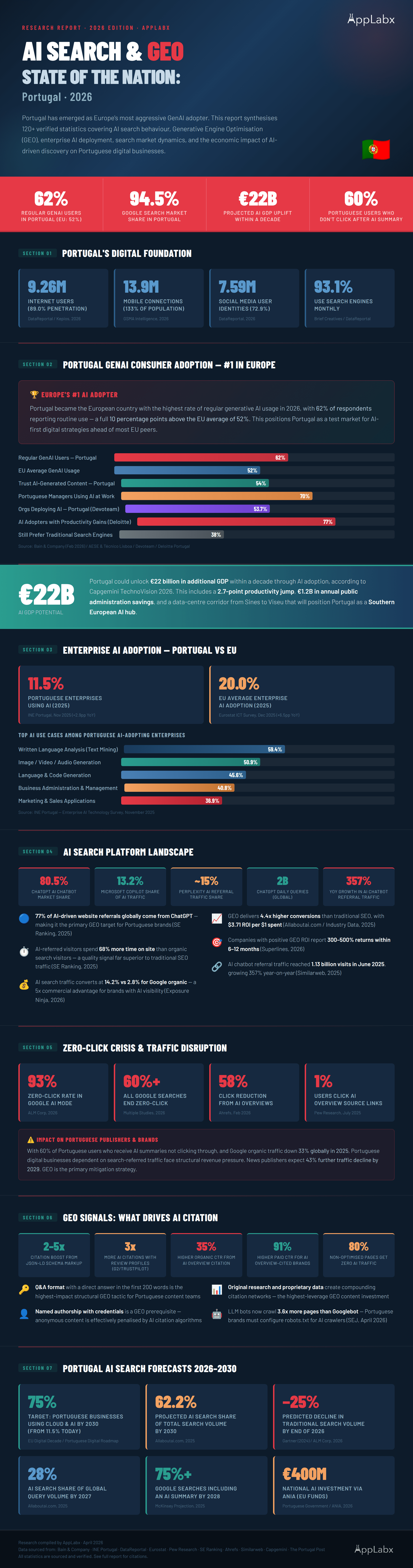
Portugal also has the digital infrastructure required to accelerate this transition. The report records approximately 9.26 million internet users in Portugal in late 2025, representing 89% internet penetration, alongside 13.9 million active mobile connections. It also reports 7.59 million social media user identities, equivalent to 72.9% of the population. Another dataset cited in the report places internet penetration at 90.92%. With the overwhelming majority of the population connected and mobile broadband widely available, AI-powered discovery can increasingly become part of everyday consumer behaviour rather than remaining confined to desktop research or technology professionals.
Traditional search nevertheless remains enormously important. According to the compiled figures, 93.1% of Portuguese internet users search online each month, while Google holds a reported 94.5% share of Portugal’s search engine market. This makes changes within Google itself especially consequential. As AI-generated summaries and conversational search capabilities become more prominent within Google Search, Portuguese companies must compete not only for conventional organic rankings but also for visibility within the generated answers appearing around those rankings.
This changing environment is closely connected with the rise of Google AI Overviews and zero-click search. The statistics collected in this report include estimates that AI Overviews can substantially reduce website clicks, while research cited in the dataset found that only 8% of users clicked conventional search links when an AI summary appeared, compared with 15% when one did not. The dataset also reports that just 1% clicked source links directly within AI Overview summaries in the referenced study. These developments challenge the traditional assumption that search marketing success can be measured primarily through rankings, impressions and organic clicks.
For businesses operating in Portugal, AI search visibility therefore introduces a broader set of potential performance indicators. Brand mentions inside generated responses, inclusion in AI-generated recommendations, citation frequency, AI Share of Voice, branded search demand and AI referral conversions may increasingly complement conventional metrics such as keyword rankings, organic sessions and click-through rates. In a zero-click environment, being recognised as a trusted source or recommended entity can have value even when the user never visits the cited website.
Enterprise AI adoption provides another important dimension to Portugal’s GEO landscape. The report states that 11.5% of Portuguese enterprises used AI technologies in 2025, an increase of 2.9 percentage points from the previous year. Among Portuguese enterprises already using AI, 59.4% applied it to written-language analysis, 50.9% to image, video or audio generation, and 45.6% to generating written or spoken language or code. Furthermore, 36.9% of AI-using enterprises applied artificial intelligence specifically to marketing and sales activities.
AI adoption appears even stronger among some professional groups. The dataset reports that 70% of Portuguese managers use AI tools at work, while 53.7% of Portuguese organisations use AI technology in some form. This matters for B2B marketing because potential customers may increasingly use conversational AI systems to research vendors, compare solutions, understand unfamiliar technologies and build supplier shortlists before contacting a company directly.
This transition could be especially consequential for high-consideration purchases. The global benchmarks included in the Portugal dataset indicate that visitors arriving through AI platforms can demonstrate substantially different conversion behaviour from conventional organic visitors. The report cites a 14.2% conversion rate for AI search traffic compared with 2.8% for Google organic traffic in one dataset, while another benchmark states that LLM-referred visitors convert 4.4 times better than organic visitors on average. For B2B software specifically, another cited analysis recorded a 15.9% conversion rate among ChatGPT-referred visitors compared with 1.76% from Google organic traffic.
These figures help explain why Generative Engine Optimisation is becoming commercially relevant rather than merely another marketing acronym. GEO focuses on improving how clearly AI systems can discover, understand, retrieve, contextualise and potentially cite a brand’s information when generating answers. In practice, this can involve authoritative long-form content, direct answers to important questions, strong entity signals, structured information, original research, credible authorship, digital PR, third-party mentions and technically accessible websites.
The dataset highlights several signals associated with stronger AI visibility. It reports relationships between AI citations and established domain authority, organic traffic, third-party review profiles, branded web mentions, YouTube mentions, content depth and structured data. It also identifies question-and-answer formatting as particularly suitable for AI extraction and recommends answering the primary query directly near the beginning of an article.
This represents an important evolution from keyword-centric SEO. Traditional keyword optimisation remains valuable, but AI systems increasingly need passages that can function as self-contained answers. A page may therefore need to explain entities clearly, provide factual statements with context, address related questions comprehensively and demonstrate why its information deserves to be trusted. Original statistics, surveys, expert commentary and proprietary datasets can become particularly valuable because they give other websites and AI systems something distinctive to reference.
Portugal’s wider economic and policy environment could accelerate these trends further. The statistics in this report cite estimates that AI could unlock €22 billion in additional Portuguese GDP over a decade and generate a 2.7-point productivity increase. Portugal has also allocated more than €400 million, largely through European Union funding, to AI innovation, infrastructure and talent through its national AI agenda. Meanwhile, the country’s broader digital roadmap comprises 157 measures backed by a reported €2.15 billion budget.
The longer-term direction is equally significant. Portugal is targeting 75% business adoption of cloud and AI services by 2030, compared with the 11.5% enterprise AI usage figure reported for 2025. If adoption progresses toward that target, AI will increasingly influence not only how Portuguese consumers search but also how employees research markets, procurement teams compare suppliers, marketers discover tools and executives evaluate potential business partners.
Portugal also has a distinctive linguistic and technological dimension. The dataset highlights AMÁLIA, a Portuguese-language large language model being expanded into areas including legal technology and digital public services. Alongside international platforms such as ChatGPT, Google and Perplexity, the development of Portuguese-language AI infrastructure could increase the strategic importance of authoritative Portuguese content and locally relevant entities in the years ahead.
The broader message from these 123 AI Search & GEO in Portugal statistics is clear: search is not disappearing, but the interface between users and online information is changing. Consumers increasingly expect answers rather than lists of links. AI systems increasingly mediate which companies, publishers, products and experts enter those answers. Traditional organic rankings remain valuable, but they now operate alongside AI citations, generated recommendations, conversational discovery and zero-click experiences.
For Portuguese businesses, publishers, e-commerce companies, SaaS providers, professional services firms and digital marketers, 2026 therefore represents an important transition point. The strongest search strategies will not abandon SEO in favour of GEO. Instead, they will combine technical SEO, authoritative content, entity optimisation, structured information, digital PR, original research and AI-focused content architecture to maximise visibility across both traditional and generative search.
The following 123 AI Search & GEO in Portugal statistics, data and trends for 2026 examine that transformation in detail, covering generative AI adoption, Portuguese consumer behaviour, enterprise AI usage, digital infrastructure, ChatGPT and AI search platforms, Google AI Overviews, zero-click searches, GEO ranking and citation signals, conversion performance, AI policy, content optimisation practices and the forecasts shaping Portugal’s search landscape through 2030.
But, before we venture further, we like to share who we are and what we do.
About AppLabx
From developing a solid marketing plan to creating compelling content, optimizing for search engines, leveraging social media, and utilizing paid advertising, AppLabx offers a comprehensive suite of digital marketing services designed to drive growth and profitability for your business.
At AppLabx, we understand that no two businesses are alike. That’s why we take a personalized approach to every project, working closely with our clients to understand their unique needs and goals, and developing customized strategies to help them achieve success.
If you need a digital consultation, then send in an inquiry here.
Or, send an email to hello@applabx.com to get started.
123 AI Search & GEO in Portugal Statistics, Data & Trends in 2026
SECTION A: Portugal’s Generative AI Adoption & Consumer Behaviour
1. 62% of Portuguese respondents use generative AI tools regularly (Bain & Company, Feb 2026)
Portugal’s 62% regular generative AI usage rate makes it the highest adopter in Europe, signalling that brands and publishers in the country must treat AI-native search as a primary discovery channel—not an emerging one.
2. Portugal’s GenAI adoption rate sits 10 percentage points above the European average of 52% (Bain & Company, Feb 2026)
The double-digit gap between Portugal and the EU mean confirms that Lisbon-based marketers are operating in one of the continent’s most AI-literate consumer markets, requiring content strategies optimised for AI citation from day one.
3. 54% of Portuguese internet users say they trust AI-generated content (Bain & Company, Feb 2026)
Portugal’s AI trust rate of 54% is among the highest in the Iberian market and above many Northern European peers, indicating that AI Overviews and chatbot answers will carry significant authority over purchase decisions.
4. 6 in 10 Portuguese users who receive AI-generated summaries do not click through to the source website (Bain & Company, Feb 2026)
The 60% no-click rate from AI summaries in Portugal is a direct threat to organic referral traffic for publishers, retailers, and service brands that have historically relied on Google search as their primary acquisition channel.
5. 38% of Portuguese people still prefer conventional search engines over AI tools (Bain & Company, Feb 2026)
While a majority of the population has migrated to AI-first information retrieval, nearly four in ten Portuguese consumers remain traditionalists—making a dual SEO + GEO strategy non-negotiable for full market coverage.
6. 70% of Portuguese managers report using AI tools at work (AESE / Técnico Lisboa Survey, 2026)
The high managerial adoption rate confirms that B2B content teams targeting Portuguese decision-makers must optimise for AI-driven research workflows, including being cited in Perplexity and ChatGPT enterprise responses.
7. 53.7% of Portuguese organisations already use AI technology in some form (Devoteam Portugal, 2025)
Just over half of Portuguese organisations have crossed the threshold from experimentation to active AI deployment, yet deep integration across entire corporate structures remains limited—creating a significant GEO first-mover opportunity.
8. 77% of Portuguese AI adopters reported measurable productivity gains (Deloitte Portugal Survey, 2025)
The strong majority reporting productivity improvements from AI adoption provides a commercial rationale for businesses to invest in GEO as a means of capturing high-intent, AI-referred traffic that converts at superior rates.
9. Only 42% of Portuguese companies perceive a direct financial return from their AI investments (Portuguese Government Digital Transition Report, 2025)
Despite high deployment rates, less than half of Portuguese companies have mapped AI investment to measurable revenue—a gap that makes GEO ROI tracking and AI visibility measurement a key differentiator for digitally mature brands.
10. 71% of Portuguese citizens believe digitalisation of public and private services makes their lives easier (Eurobarometer Digital Decade Survey, 2025)
The widespread public acceptance of digital transformation in Portugal creates fertile ground for AI-driven information discovery, making GEO optimisation a practical necessity for any public-facing brand or service provider.
SECTION B: Portugal’s Enterprise AI Technology Adoption (INE / Eurostat)
11. 11.5% of Portuguese enterprises used AI technologies in 2025, up 2.9 percentage points from 2024 (INE Portugal, Nov 2025)
Portugal’s enterprise AI adoption rate doubled its year-on-year growth to 11.5%, though this still sits well below the EU average of 20%, indicating a large untapped competitive advantage for early-adopter businesses in the country.
12. 59.4% of Portuguese AI-adopting enterprises use AI for written language analysis (INE Portugal, 2025)
Textual AI is the dominant use case among Portuguese businesses, confirming that natural language content quality, schema markup, and structured data are the highest-priority GEO signals for Portuguese digital properties.
13. 50.9% of Portuguese AI-adopting enterprises use AI for image, video, and audio generation (INE Portugal, 2025)
The rapid uptake of generative media in Portuguese businesses signals that multimodal GEO—optimising images, video transcripts, and audio metadata for AI citation—is a growing requirement, not a future consideration.
14. 45.6% of Portuguese AI-adopting enterprises use AI for written/spoken language or code generation (INE Portugal, 2025)
Nearly half of AI-using Portuguese companies are leveraging language generation tools, making AI-assisted content production a mainstream activity that amplifies both SEO output volume and GEO citation opportunities.
15. 40.8% of Portuguese AI-using enterprises apply AI to business administration and management processes (INE Portugal, 2025)
Operational AI use cases dominate the Portuguese enterprise landscape, meaning B2B software vendors and consultants who rank well in AI-generated answers for management queries will capture a disproportionate share of commercial search intent.
16. 36.9% of Portuguese AI-using enterprises apply AI specifically to marketing and sales (INE Portugal, 2025)
Over one-third of AI-adopting Portuguese enterprises are applying the technology directly to marketing workflows—signalling accelerating demand for GEO expertise and AI-visibility measurement tools in the local agency ecosystem.
17. Portuguese telecoms sector leads enterprise AI adoption at 52.8% (INE Sectoral Report, 2026)
The telecoms sector’s outsized AI adoption rate in Portugal means that brands competing for digital visibility in communications, infrastructure, or B2B tech must apply GEO practices to rank against sophisticated, AI-equipped competitors.
18. Portuguese transport sector AI adoption stands at 14.8% (INE Sectoral Report, 2026)
Transport and logistics companies in Portugal lag behind the overall enterprise AI average, representing an open GEO window for suppliers and service providers to dominate AI-generated answers in this sector with minimal competition.
19. 98.8% of Portuguese enterprises have internet access for business purposes (INE Portugal, 2025)
Near-universal business internet connectivity in Portugal removes infrastructure as a barrier to AI search adoption, confirming that GEO is a viable and necessary strategy across all sectors and company sizes.
20. 51.1% of Portuguese employees have internet access for business purposes (INE Portugal, 2025)
A majority of the Portuguese workforce has digital access for professional use, reinforcing that enterprise AI search usage is a mainstream behaviour affecting how employees conduct research, evaluate vendors, and make buying decisions.
SECTION C: Portugal’s Digital Infrastructure (DataReportal / Eurostat)
21. 9.26 million internet users in Portugal as of late 2025, representing 89.0% internet penetration (DataReportal / Kepios, 2026)
With 89% of the population online, Portugal’s digital audience is large, mature, and increasingly AI-dependent—making GEO optimisation critical for reaching almost the entire addressable consumer base through AI search channels.
22. 13.9 million mobile connections active in Portugal, equivalent to 133% of the total population (GSMA Intelligence / DataReportal, 2026)
Portugal’s mobile connections exceed its population count, confirming a mobile-first digital environment where AI-powered voice and conversational search commands a growing share of discovery intent.
23. 98.6% of mobile connections in Portugal are broadband-capable (3G/4G/5G) (GSMA Intelligence, 2026)
Near-complete mobile broadband coverage means Portuguese consumers can access AI chatbots and generative search engines anywhere, at any time, accelerating the velocity of AI query behaviour across all demographics.
24. 7.59 million social media user identities in Portugal, equal to 72.9% of the population (DataReportal, 2026)
Social media reach at nearly three-quarters of the Portuguese population means that brand mentions on social platforms—a key GEO citation signal—have massive reach and should be treated as an integral part of any AI visibility strategy.
25. Portugal’s internet penetration rate is 90.92% (Eurostat, December 2025)
Portugal’s internet penetration, corroborated by Eurostat at 90.92%, places it above the EU average and confirms the country as a high-engagement digital market where AI search behaviours mirror or exceed those of more established tech economies.
26. 93.1% of Portuguese internet users search online each month (DataReportal / Brief Creatives, 2026)
Monthly active search usage by 93.1% of Portuguese internet users underscores the continued primacy of the search channel—and, by extension, the growing importance of being cited in AI Overviews that sit atop those search results.
27. Google holds a dominant 94.5% search engine market share in Portugal (Brief Creatives / DataReportal, 2026)
Google’s near-monopoly search share in Portugal means that AI Overviews—the most critical GEO battleground—are the highest-impact feature to optimise for in the country’s digital marketing landscape.
28. Portugal’s population median age is 46.9 years (United Nations / DataReportal, 2025)
Portugal’s older median age creates an interesting AI search dynamic where younger segments are early AI-search adopters while the older majority still relies heavily on traditional Google—demanding age-segmented content and visibility strategies.
29. 69.1% of Portugal’s population lives in urban centres (United Nations, 2025)
Portugal’s high urbanisation rate concentrates AI search consumption in Lisbon, Porto, and coastal cities, meaning local GEO strategies targeting these urban clusters will deliver the majority of Portuguese AI search traffic at scale.
30. Portugal’s digital advertising market has 79% of revenue generated through programmatic advertising (Statista, 2025)
The near-dominance of programmatic advertising in Portugal’s digital market underscores a demand for precise audience targeting—an area where AI search visibility and GEO citation will increasingly feed first-party intent signals.
SECTION D: AI Search Platforms & Chatbot Market Share (Global, Relevant to Portugal)
31. ChatGPT commands approximately 80.49% of the global AI chatbot market share (SE Ranking / Multiple Sources, 2025–2026)
ChatGPT’s dominant share of the global AI chatbot market means that Portuguese brands seeking AI visibility must prioritise ChatGPT citation strategies above all other platforms in their GEO programmes.
32. ChatGPT processes over 2 billion queries daily globally (OpenAI / Multiple Sources, 2026)
With 2 billion daily queries, ChatGPT has become a bona fide search engine by volume—a reality that Portuguese SEO professionals must internalise when designing content structures and authority-building programmes.
33. ChatGPT accounts for over 77% of all AI-driven website referral traffic globally (SE Ranking, 2025)
ChatGPT’s referral traffic dominance means that being cited by this platform represents the single highest-value GEO outcome for Portuguese brands seeking to drive incremental AI-sourced visitors to their websites.
34. Perplexity accounts for approximately 15% of all AI referral traffic globally (SE Ranking, 2025)
Perplexity’s 15% share of AI referral traffic—built on a citations-first model—makes it the second most important GEO target for Portuguese brands, particularly those operating in research-heavy verticals like fintech, legal, and healthcare.
35. AI chatbot referral traffic reached 1.13 billion global visits in June 2025, growing 357% year-on-year (Similarweb, 2025)
The 357% year-on-year growth in AI chatbot referral traffic signals that even a marginal Portuguese brand appearing consistently in chatbot answers can generate meaningful incremental traffic at a fraction of traditional SEO cost-per-click.
36. Visitors referred by AI platforms spend 68% more time on websites than those from organic search (SE Ranking, 2025)
The superior session quality of AI-referred visitors to Portuguese websites—68% longer average sessions than organic traffic—positions GEO as one of the highest-ROI digital acquisition strategies available to brands today.
37. AI search traffic converts at 14.2% compared to Google organic’s 2.8% (Exposure Ninja, 2026)
AI search traffic converts at five times the rate of Google organic traffic, making GEO visibility in ChatGPT and Perplexity answers dramatically more commercially valuable than equivalent rankings in traditional Portuguese SERPs.
38. GEO delivers up to 4.4x higher conversions than traditional SEO, with a $3.71 ROI per $1 spent (Allaboutai.com / Industry Data, 2025)
The superior conversion economics of GEO over traditional SEO make AI visibility investment one of the most defensible digital budget allocations for Portuguese brands entering 2026 planning cycles.
39. Companies seeing positive GEO ROI report 300–500% returns within 6–12 months (Superlines, 2026)
GEO early adopters are reporting payback periods of under a year with triple-digit returns, creating a compelling case for Portuguese marketing teams to move GEO from experimentation to core budget allocation.
40. Content optimised for GEO sees 30–40% visibility increase in AI search results (Superlines, 2026)
A structural 30–40% visibility uplift from proper GEO optimisation provides Portuguese marketers with a measurable, predictable performance improvement—something rare in a digital landscape where algorithm changes create unpredictable volatility.
SECTION E: Google AI Overviews & Zero-Click Impact
41. Google AI Overviews appear in an estimated 50%+ of all Google searches globally as of Q1 2026 (BrightEdge / Multiple Sources, 2026)
With AI Overviews now appearing in more than half of all Google queries, Portuguese content that lacks proper GEO structure risks losing visibility in the dominant search interface for 94.5% of the local market.
42. AI Overviews have reduced clicks to websites by 58% on average (Ahrefs, Feb 2026)
The 58% click reduction driven by Google AI Overviews represents a structural revenue threat for Portugal’s publisher and media ecosystem, demanding immediate adoption of GEO strategies that monetise zero-click awareness.
43. Zero-click searches now make up over 60% of all Google searches globally (Anuragology / Multiple Sources, 2026)
Portugal’s Google-dominant search market means the global zero-click rate applies directly to local digital businesses, confirming that brand visibility within AI Overviews is now more commercially valuable than blue-link ranking.
44. In Google’s AI Mode, 93% of searches end in zero-click (ALM Corp, 2026)
The near-total zero-click rate in Google’s AI Mode represents the most extreme version of the traffic disruption facing Portuguese publishers and should be treated as the default assumption for informational content strategy.
45. 26% of AI Mode users leave Google entirely after reading an AI Overview (Pew Research, 2025)
More than one in four Portuguese users who engage with AI Overviews exit the search session without returning to Google results—highlighting that brand impression within the AI answer itself is the new conversion event.
46. Only 8% of users click on blue links appearing beneath an AI Overview, vs. 15% without an AI Overview (Pew Research, July 2025)
The 47% relative decline in organic CTR below AI Overviews is a direct revenue threat to Portuguese e-commerce and content brands that rank in positions 1–10 but lack AI Overview citation.
47. Only 1% of users click the source links cited within AI Overview summaries (Pew Research, July 2025)
With a 1% citation link CTR, being named inside an AI Overview provides brand awareness value with negligible incremental traffic—meaning GEO success must be measured through brand search volume and AI Share of Voice, not just referral clicks.
48. Zero-click rates for news searches climbed from 56% in May 2024 to 69% by May 2025 (Similarweb, 2025)
The 13-percentage-point jump in news zero-click rates within a single year provides Portuguese journalists and editorial teams with a direct data point on the pace of traffic erosion from AI-powered search interfaces.
49. Google’s organic global click-through dropped 5.92% between 2024 and 2025 (StatCounter / BrightEdge, 2025)
The near-universal decline in organic CTR signals that Portuguese brands relying solely on page-one Google rankings are experiencing a structural, not cyclical, decline in search-referred traffic—one that GEO cannot fully offset but can mitigate.
50. AI Overviews appear for 13% of all Google queries and reduce CTR by 47% when triggered (Semrush / Thedigitalbloom, 2025)
The asymmetric impact of AI Overviews—appearing for 13% of queries but cutting clicks by nearly half when present—creates an outsize commercial risk for Portuguese businesses that operate in informational or research-heavy verticals.
SECTION F: AI Overviews by Query Type & Sector
51. Informational queries carry the highest AI Overview trigger rate—reaching 40%+ in health and science categories (Conductor, Nov 2025)
Health, science, and how-to content in Portuguese—one of the highest-volume query types on Google.pt—faces the sharpest exposure to AI Overviews, demanding that medical, wellness, and educational brands in Portugal lead GEO adoption.
52. Only 3.2% of Shopping queries trigger AI Overviews (Ahrefs, Nov 2025)
The very low AI Overview trigger rate for Portuguese e-commerce and shopping queries confirms that transactional search remains a strong traditional SEO and paid search channel—protecting retail brands from the worst zero-click disruption.
53. Only 7.9% of local searches trigger an AI Overview (Ahrefs, Nov 2025)
Local intent queries—highly relevant for Portuguese tourism, hospitality, and retail brands—remain largely insulated from AI Overview suppression, making local SEO a durable investment strategy alongside GEO for geographically anchored businesses.
54. Health and medical AI Overview coverage reached 40%+ in certain categories (Conductor, Nov 2025)
Portuguese health professionals and pharmaceutical brands face some of the highest AI Overview exposure rates in the market, making structured data, E-E-A-T signals, and verified authorship the top three GEO priorities for the sector.
55. AI Overviews are now appearing for 18% of commercial queries—up from 8% in late 2024 (Exposure Ninja, 2026)
The more-than-doubling of AI Overview frequency in commercial intent queries means that Portuguese brands in categories like insurance, finance, and software can no longer treat GEO as a future concern—it is an active revenue protection imperative.
56. In AI Mode, 88% of users accepted the AI’s shortlist without further external research (Growth Memo, April 2026)
The near-total user reliance on AI-curated shortlists in Google’s AI Mode redefines competitive positioning in Portugal: being absent from the AI’s recommendation set is functionally equivalent to not existing in that buyer’s consideration set.
57. The AI’s top recommended brand becomes the user’s chosen brand 74% of the time in AI Mode (Growth Memo, April 2026)
A 74% alignment between AI top-pick and user purchase decision makes first-position GEO citation—the equivalent of “AI rank 1″—the single most commercially impactful digital marketing metric for Portuguese brands in 2026.
58. Only 10% of AI Mode users chose an option ranked third or lower (Growth Memo, April 2026)
The extreme top-heaviness of AI Mode user behaviour mirrors the dominance of position one in traditional SEO but with less organic recirculation—making GEO investment in sustainable citation authority more critical than chasing AI top-picks on individual queries.
SECTION G: AI Economic Impact on Portugal
59. AI could unlock €22 billion in additional GDP for Portugal within a decade (Capgemini TechnoVision 2026)
The €22 billion GDP opportunity from AI adoption identified by Capgemini establishes a national economic imperative: Portuguese businesses that fail to integrate AI into their operations—including search visibility strategy—risk ceding that value to competitors.
60. Portugal’s AI adoption could generate a 2.7-point productivity increase (Capgemini TechnoVision 2026)
A 2.7 percentage point productivity uplift from AI adoption underscores the systemic business case for AI integration in Portugal, including GEO-driven content operations that reduce manual research and publishing costs.
61. Portuguese State adoption of AI could add €1.2 billion annually to GDP through public administration productivity gains (Google / Implement Consulting Group / CATÓLICA-LISBON Study, 2025)
The government’s own modelling confirms that AI productivity gains in public administration alone could generate €1.2 billion in annual economic value—creating a supportive policy environment for AI-first digital practices across the Portuguese economy.
62. Two-thirds of Portugal’s public sector workforce could benefit from AI integration (Google / Implement Consulting Group Study, 2025)
The massive potential AI beneficiary base within Portuguese public administration signals significant demand for AI-search-compatible government digital services—a GEO optimisation opportunity for civic tech and public sector vendors.
63. Portugal’s government has allocated over €400 million—mostly from EU funds—to AI innovation, talent, and infrastructure through ANIA (Portuguese Government / Agenda Nacional de Inteligência Artificial, 2026)
The €400 million national AI investment programme signals a structural commitment to AI-readiness in Portugal, providing a favourable ecosystem for AI-native businesses and GEO-forward digital agencies to scale commercial operations.
64. Portugal’s digital roadmap comprises 157 measures with a budget of €2.15 billion (0.75% of GDP) (European Commission Digital Decade Report, 2025)
Portugal’s digital transformation roadmap is among the most comprehensive in Southern Europe, channelling nearly 1% of GDP into digital measures that directly affect the commercial AI landscape—including infrastructure, skills, and governance.
65. Portugal is targeting 75% of businesses using cloud and AI services by 2030 (EU Digital Decade Targets / Portuguese Digital Strategy, 2025)
The national 2030 target for AI and cloud adoption—still far from the current 11.5%—reveals a large and predictable growth wave in enterprise AI search usage that forward-looking GEO practitioners can position for today.
66. The €8.5 billion Start Campus project in Sines targets 1.2 GW of renewable-powered data centre capacity (Start Campus Project Prospectus, 2025)
The largest data centre infrastructure project in Portuguese history positions the country as a key European AI compute hub, reducing cloud latency for AI search services and reinforcing Portugal as a structurally credible AI market.
SECTION H: AI Search Behavioural Statistics (Global, Applied to Portugal)
67. ChatGPT prompts average around 60 words compared to Google’s typical 3.4-word queries (Similarweb, 2025)
The 17x difference in query length between ChatGPT and Google inputs means that Portuguese content optimised for AI search must answer nuanced, multi-part questions—not just target short-tail keywords.
68. LLM bots (including GPTBot, ClaudeBot, Perplexity Bot) now crawl 3.6x more pages than Googlebot (Search Engine Journal, April 2026)
The dramatic increase in AI crawler activity means that Portuguese websites’ robots.txt configurations and crawl budgets must now accommodate AI-specific bot directives alongside traditional search engine optimisation.
69. OS-level AI search will ship on 89% of new devices globally by 2026 (Allaboutai.com, 2025)
With AI search becoming the default mode on nearly 9 in 10 new devices, Portuguese consumers purchasing smartphones and computers in 2026 will increasingly interact with AI-first search interfaces as their primary information discovery channel.
70. AI search engine usage is projected to grow to over 28% of total global search traffic by 2027 (Allaboutai.com / Multiple Forecasts, 2025)
If AI search reaches 28% of global query volume by 2027—consistent with Portugal’s outsized AI adoption—Portuguese digital businesses that have not built GEO into their content architecture by 2026 will be structurally disadvantaged.
71. 31% of Gen Z respondents globally begin searches using AI platforms rather than search engines (Pew Research / Marketing Dive, 2025)
Portugal’s Gen Z population—which exhibits some of the highest AI adoption rates in the country—is already conducting initial discovery through AI chatbots, making GEO a prerequisite for brands targeting youth audiences in the Portuguese market.
72. 58% of US adults under 30 have used ChatGPT—nearly double the rate of adults 30 and older (Pew Research, 2025)
Although measured in the US, this generational AI adoption gap has a direct parallel in Portugal, where younger urban consumers are significantly more AI-search-native than older demographics, requiring age-segmented content visibility strategies.
73. 35% of US consumers now use AI at the product discovery stage compared to 13.6% who use search (Similarweb 2026 Generative AI Brand Visibility Index)
The rapid shift in product discovery from traditional search to AI tools—documented in English-speaking markets—is already being replicated in Portugal given the country’s above-average GenAI adoption rates.
74. By 2028, 50% of all searches will be generative (Incremys, 2026 Forecast)
Generative search is on track to capture half of all global query volume within two years, making GEO not merely a competitive advantage in Portugal but the foundational architecture of a future-proof search marketing programme.
SECTION I: GEO & AEO Signals — What Drives AI Citation
75. Sites with more than 350,000 referring domains average 8.4 ChatGPT citations per response (SE Ranking, 2025)
The strong correlation between referring domain authority and ChatGPT citation frequency confirms that traditional link-building remains the bedrock of GEO—meaning Portuguese brands must maintain robust backlink programmes as part of any AI visibility strategy.
76. Brands cited in AI Overviews earn 35% higher organic CTR and 91% higher paid CTR (Seer Interactive, 2025)
Being cited in AI Overviews produces a compounding performance benefit for Portuguese brands across both organic and paid channels, making GEO investment a multiplier on existing SEO and PPC spend rather than a competing budget line.
77. Domains active on Trustpilot, G2, and Capterra earn 3x more AI citations than those without profiles (SE Ranking, 2025)
Third-party review platform presence—highly manageable for Portuguese SMEs—delivers a 3x AI citation uplift that is within reach for businesses of any size and represents one of the lowest-cost, highest-impact GEO tactics available.
78. Websites with more organic traffic tend to get more mentions in AI Overviews and Perplexity (Ahrefs, June 2025)
The positive correlation between Portuguese website traffic volumes and AI citation frequency creates a virtuous cycle where strong SEO foundations directly amplify GEO outcomes—confirming that these disciplines are complementary, not competing.
79. Structured data (JSON-LD schema) on service pages delivers 2–5x higher citation rates in Google AI Overviews (Spicy Margarita, 2025)
Implementing FAQ, Article, and Organisation schema markup on Portuguese websites—a relatively low-cost technical task—can deliver citation rates two to five times higher than unstructured equivalent pages.
80. 80% of non-optimised pages get zero traffic from AI-driven search features (Spicy Margarita, 2025)
Four in five Portuguese web pages that have not been optimised for AI search visibility receive no AI-sourced traffic whatsoever—establishing GEO optimisation as an urgent operational priority for any digital business in the country.
81. YouTube mentions and branded web mentions have the strongest correlation with AI visibility (SEOmator, 2026)
YouTube presence and branded online mentions are among the highest-value AI visibility signals available to Portuguese brands, making video content strategy and digital PR integral components of any comprehensive GEO programme.
82. Content depth—measured by word count and sentence count—matters significantly for AI citation rates (SEOmator, 2026)
Portuguese content teams must prioritise depth over brevity in editorial production: longer, more authoritative articles consistently earn higher AI citation rates than short-form equivalents covering the same topic.
83. Q&A format is the optimal content structure for AI extraction and citation (SEOmator / Multiple Sources, 2026)
Structuring Portuguese-language content in explicit question-and-answer formats—with direct answers in the first 200 words—is the single most impactful content tactic for earning AI citation across Google Overviews, ChatGPT, and Perplexity.
84. In classic search, 56% of users built their own shortlist from multiple sources; in AI Mode, 88% accepted the AI shortlist (Growth Memo, April 2026)
The shift from user-led research to AI-curated shortlisting represents the most profound change in digital buyer behaviour—and for Portuguese marketers, it means that brand authority within AI training data is now more valuable than ranking for individual keyword terms.
SECTION J: Global AI Search Market Data (Benchmarks for Portugal)
85. Global AI search market was valued at $43.6 billion in 2024 and is projected to reach $379 billion by 2030 (Allaboutai.com, 2025)
The AI search market’s nearly 9x projected growth over six years provides Portuguese digital marketing professionals with a clear signal: resources allocated to GEO now will compound against a rapidly expanding total addressable market.
86. The AI market exceeded $244 billion in 2025 and is expected to pass $1 trillion by 2031 (Statista, 2025)
The overall AI market trajectory—from $244 billion to over $1 trillion in six years—creates a macro tailwind for Portuguese AI adoption that will expand both the supply of AI search tools and the volume of AI-mediated queries reaching local businesses.
87. AI-powered SEO sector reached approximately $67 billion in 2025 (SEO Agency Reports, 2025)
The $67 billion AI-powered SEO sector signals that GEO service providers, tools, and consulting firms are scaling rapidly globally—Portuguese agencies that develop GEO competencies in 2026 are positioned to capture a growing share of this budget.
88. 86% of SEO professionals globally have integrated AI tools into their workflows (SeoClarity / Position Digital, 2025)
The near-universal integration of AI into global SEO workflows confirms that Portuguese digital marketing teams that have not yet adopted AI-assisted content creation, optimisation, and monitoring are operating at a significant competitive disadvantage.
89. 65% of companies globally report improved SEO outcomes after adopting AI (Position Digital, 2025)
The clear majority reporting SEO improvements after AI adoption provides a direct business case for Portuguese marketing directors investing in AI-powered content operations—both for traditional ranking signals and AI citation optimisation.
90. 25.7% of marketers globally plan to develop content specifically for AI citations (Multiple Sources, 2026)
Only one in four global marketers are currently creating content with AI citation as the primary objective—meaning Portuguese brands that move early into GEO content production gain a substantial first-mover window before the discipline becomes commoditised.
91. Google AI Overviews now reach 2 billion monthly users across 200 countries in 40 languages (TechCrunch, 2025)
Google AI Overviews’ 2 billion monthly user base includes Portuguese-language users across Portugal, Brazil, and the Lusophone world—establishing a massive cross-market GEO opportunity for Portuguese brands with international content strategies.
92. Google processes an estimated 5.9 trillion searches in 2025, up from 5 trillion in 2024 (StatCounter / Colorlib, 2026)
The continued growth in Google’s raw query volume confirms that search demand—including in Portugal—is expanding even as AI search absorbs a growing share, meaning that total search visibility (traditional + AI) delivers incrementally more value each year.
93. AI-driven search surged from under 10% of search interactions in 2023 to 30% by 2026 (Sedestral, Feb 2026)
The tripling of AI search’s share of total interactions within three years maps directly onto Portugal’s GenAI adoption curve—both confirming the urgency and explaining the scale of structural change facing Portuguese digital businesses.
SECTION K: Publisher & Traffic Impact in Portugal’s Context
94. Global organic Google search traffic declined 33% from November 2024 to November 2025 (Chartbeat Data / Reuters Institute, 2026)
A 33% decline in Google organic referral traffic in a single year is a watershed data point for Portuguese publishers and content-dependent brands who must now treat AI visibility as a direct replacement for lost search-driven traffic.
95. News publishers globally expect search traffic to decline by 43% on average over the next three years (Reuters Institute, 2026)
The expectation of a 43% search traffic decline within three years should prompt Portuguese editorial teams to immediately build GEO programmes—not as a defence against future losses, but as the primary traffic growth engine for the medium term.
96. DMG Media reported AI Overviews led to click-through rate drops of up to 89% for certain search queries (DMG Media / SmartFrame, 2025)
Near-total CTR destruction for some query types serves as a worst-case scenario benchmark for Portuguese publishers—particularly those operating in lifestyle, utility, and how-to categories where AI Overview trigger rates are highest.
97. Business Insider lost 55% of its organic search traffic between April 2022 and April 2025 (Similarweb / WSJ, 2025)
The multi-year organic decline at major publishers mirrors the trajectory facing Portuguese media brands that have not diversified beyond Google search referrals—and signals that GEO is not a recovery tactic but a structural reinvention imperative.
98. AI chatbot referral traffic accounts for just 1% of all publisher traffic globally despite 357% year-on-year growth (Conductor / Digiday, 2025)
The 1% current contribution of AI referral traffic to publisher totals should be read alongside its 357% growth rate: for Portuguese media brands, GEO is an emerging channel that will matter enormously before it becomes large enough to measure easily.
99. ChatGPT sent 1.2 billion outgoing referrals to publisher sites between September and November 2025, a 52% year-on-year increase (Similarweb, 2025)
The 52% annual growth in ChatGPT referral traffic establishes AI chatbots as a fast-growing, commercially significant referral channel that Portuguese publishers and brand content teams can begin to exploit through structured GEO programming today.
100. The travel blog The Planet D shut down after its traffic dropped 90% following Google’s AI Overviews rollout (NPR, 2025)
The 90% traffic destruction experienced by specialist travel publishers provides a cautionary benchmark for Portuguese tourism, travel, and hospitality content creators who have not yet developed zero-click monetisation or AI citation strategies.
SECTION L: Portugal AI Strategy & Policy Context
101. Portugal’s AI strategy “AI Portugal 2030” was adopted in 2019 and is structured around five pillars: Inclusion, Qualification, R&I, Public Administration, and International Cooperation (OECD, 2025)
Portugal’s eight-year-old national AI strategy—structured around five concrete pillars—provides a predictable policy environment that reduces regulatory uncertainty for Portuguese businesses investing in AI-native digital marketing practices.
102. Portugal’s Center for Responsible AI was launched in 2023 and is dedicated to advancing ethical AI development (OECD, 2025)
The existence of a dedicated responsible AI centre signals Portugal’s commitment to governance frameworks that will shape how AI search tools are regulated and audited—directly impacting what content can be surfaced in AI-generated answers.
103. The EU AI Act will take full effect in August 2026, introducing strict checks on high-risk AI systems (European Commission, 2026)
The EU AI Act’s August 2026 enforcement deadline creates a compliance imperative for all AI tools operating in Portugal—including AI Overviews and chatbot platforms—that may affect what content is cited and how AI search results are generated.
104. Portugal is home to one tech unicorn and an estimated 27 edge compute nodes as of 2024 (European Commission Digital Decade Report, 2025)
Portugal’s nascent unicorn ecosystem and emerging edge compute infrastructure signal a technology market in early acceleration—one in which GEO-forward digital brands can establish citation authority before competition intensifies.
105. Portugal’s native LLM “AMÁLIA” is being expanded into sectors including legal tech and digital public services (Portuguese Government / ANIA, 2025)
The existence of a Portuguese-language LLM being deployed in legal and public services creates a unique GEO target platform specific to Portugal—one where Portuguese-language content, legal terminology, and public sector keywords will require dedicated optimisation.
106. Portugal has 89% of citizens who consider it important for public authorities to mitigate fake news and disinformation online (Eurobarometer Digital Decade Survey, 2025)
The high public concern about AI-generated misinformation in Portugal means that E-E-A-T signals—expertise, authoritativeness, and trustworthiness—carry exceptional weight in the local AI citation ecosystem and should be treated as non-negotiable GEO priorities.
SECTION M: Conversion, ROI & Commercial AI Search Data
107. AI Search traffic converts at 14.2% compared to Google organic’s 2.8% (Exposure Ninja, 2026)
The five-fold conversion rate advantage of AI search traffic over Google organic traffic makes the case for Portuguese GEO investment on commercial grounds alone—not just as a brand awareness or defensive traffic play.
108. B2B software ChatGPT-referred visitors converted at 15.9%, vs. Google organic at 1.76% (Seer Interactive, Oct 2024–Apr 2025)
The extraordinary B2B conversion differential for ChatGPT-referred visitors confirms that Portuguese technology, software, and professional services brands should treat GEO citation as a premium demand generation channel.
109. LLM visitors convert 4.4x better than organic visitors on average (Semrush, July 2025)
A 4.4x conversion advantage from LLM-referred visitors means that even a small share of AI-referred traffic can generate outsized commercial returns for Portuguese e-commerce and lead generation businesses.
110. Ahrefs reported AI traffic drove 12.1% of all signups from just 0.5% of visits—a 23x conversion rate advantage (Ahrefs Internal Data, 2025)
The 23x conversion rate advantage observed at Ahrefs for AI-referred traffic is the most compelling single statistic for Portuguese marketing directors evaluating GEO budget allocation against traditional demand generation channels.
111. The effect of AI search conversion advantage is strongest for B2B and high-consideration purchases (Semrush, 2025)
Portugal’s growing B2B technology and professional services sector—concentrated in Lisbon’s tech hub—stands to benefit most from the superior conversion economics of AI-referred traffic, making GEO investment especially urgent for B2B brands.
112. Brands cited in Google AI Overviews earn 91% higher paid CTR than brands not cited (Seer Interactive, 2025)
The near-doubling of paid ad CTR for brands with AI Overview citations confirms that GEO visibility generates a positive spillover on paid search performance—reducing effective CPC for Portuguese brands running Google Ads campaigns alongside GEO programmes.
SECTION N: Content Structure & Technical GEO Requirements
113. The first 200 words of any article should directly and completely answer the primary query for maximum GEO performance (Enrich Labs, Feb 2026)
Portuguese content teams must restructure editorial templates to front-load direct answers in the opening paragraph—a discipline that benefits both AI citation extraction and traditional featured snippet eligibility.
114. Each major AI search platform has distinct crawling and citation behaviours (Enrich Labs, Feb 2026)
ChatGPT, Perplexity, and Google AI Overviews each use different retrieval architectures—RAG versus training data versus real-time indexing—meaning Portuguese GEO strategies must be multi-platform and cannot rely on a single optimisation playbook.
115. RAG (Retrieval-Augmented Generation) systems are now used by most enterprise AI search platforms, meaning well-structured content is pulled directly into AI context windows before generating a response (Softmarketsolution, 2026)
The shift to RAG-powered AI search means that Portuguese content that is technically well-structured, densely factual, and schema-marked is literally ingested into the AI’s answer-generation process—making technical content quality the highest-leverage GEO investment.
116. AI systems increasingly weight author credentials and named authorship as citation quality signals (Enrich Labs, Feb 2026)
Anonymous or “content team” bylines are effectively GEO penalties in 2026—Portuguese brands must attach verifiable author profiles with credentials, social profiles, and publication history to every piece of content intended for AI citation.
117. Publishing original research, surveys, or proprietary data creates a compounding citation network that benefits every piece of content on the domain (Enrich Labs / Multiple Sources, 2026)
For Portuguese brands, investing in original market research—such as this report—is the highest-leverage GEO content activity, as data that becomes widely cited by other sources generates recursive AI citation amplification.
118. 13.08% of top-performing Google content is now AI-generated, up from just 2.3% before GPT-2 (Influencer Marketing Hub, 2025)
The growing share of AI-generated content competing for Google rankings and AI citations in the Portuguese market means that human-verified, expert-authored content now commands a scarcity premium in AI citation algorithms.
SECTION O: Looking Ahead — Portugal AI Search Forecasts 2026–2030
119. Portugal is targeting 75% of businesses using AI services by 2030—up from 11.5% in 2025 (EU Digital Decade / Portuguese Digital Roadmap, 2025)
The official target of moving Portuguese enterprise AI adoption from 11.5% to 75% by 2030 implies a 6.5x increase in business AI usage over five years—a market expansion that will dramatically accelerate AI search query volume and GEO competition.
120. Gartner predicted in 2024 that traditional search engine volume would drop 25% by 2026 due to AI chatbots—and 2025 data suggests the trajectory is on course (Gartner, 2024 / ALM Corp, 2026)
Gartner’s 25% search volume decline forecast—now corroborated by real-world traffic data—confirms the structural nature of the AI search transition in Portugal and establishes GEO as a required operating competency for any brand that intends to remain digitally visible by the decade’s midpoint.
121. AI search is projected to capture 62.2% of total search volume by 2030 (Allaboutai.com, 2025)
If AI search reaches 62% of global query volume by 2030—consistent with adoption trends observable in Portugal today—the Portuguese brands that have built GEO authority throughout 2026–2028 will hold structural competitive moats that are extremely difficult for late entrants to overcome.
122. The AI search engine market will grow at 30%+ annually through 2028 (Web2AI / Multiple Sources, 2026)
A sustained 30%+ annual growth rate in the AI search market means that Portuguese digital marketing budgets allocated to GEO in 2026 will operate against a dramatically larger total addressable market by 2028—compounding both visibility and commercial returns.
123. By 2028, McKinsey projects that 75%+ of all Google searches will include an AI summary of some kind (McKinsey, 2025)
McKinsey’s forecast that three-quarters of all searches will include an AI summary by 2028 is the most consequential single data point for Portuguese digital strategy: zero-click is becoming the norm, not the exception, and GEO is the only viable long-term search marketing discipline.
Conclusion
Conclusion
The 123 AI Search & GEO in Portugal statistics, data and trends for 2026 reveal a search landscape undergoing a fundamental transformation. Portugal’s reported 62% regular generative AI usage rate, compared with a 52% European average, places the country at the forefront of consumer AI adoption. With 54% of Portuguese internet users trusting AI-generated content and six in ten users reportedly not clicking through after receiving an AI-generated summary, the traditional relationship between search visibility and website traffic is changing rapidly.
Traditional search remains essential. Portugal has approximately 9.26 million internet users, 93.1% of internet users reportedly search online each month, and Google maintains a dominant 94.5% share of the Portuguese search engine market according to the sources compiled in this report. However, the growth of Google AI Overviews, ChatGPT, Perplexity and other generative search experiences means ranking prominently in conventional search results is increasingly only one part of achieving digital visibility.
The commercial implications are particularly important. Global benchmarks included in the dataset report AI search traffic converting at 14.2% compared with 2.8% for Google organic traffic, while another benchmark suggests LLM visitors can convert 4.4 times better than organic visitors. For B2B software, the report cites a 15.9% conversion rate for ChatGPT-referred visitors versus 1.76% for Google organic traffic. Although these are global rather than Portugal-specific conversion figures, they illustrate why AI visibility is becoming increasingly relevant to Portuguese businesses focused on measurable customer acquisition.
Portugal’s enterprise market is moving in the same direction. The dataset reports that 11.5% of Portuguese enterprises used AI technologies in 2025, while 36.9% of AI-using enterprises already applied AI to marketing and sales. Portugal is ultimately targeting 75% business adoption of cloud and AI services by 2030, suggesting that AI-assisted research, procurement, marketing and decision-making could become considerably more widespread over the remainder of the decade.
For marketers, publishers and businesses, these trends strengthen the case for combining Search Engine Optimisation (SEO) with Generative Engine Optimisation (GEO) rather than treating them as competing disciplines. Strong organic authority, original research, credible authorship, structured information, question-and-answer content, third-party mentions, digital PR and technically accessible websites can support visibility across both conventional search engines and emerging AI discovery environments.
The definition of search success is consequently expanding. Rankings, organic sessions and click-through rates remain important, but businesses increasingly need to understand AI citations, brand mentions, AI Share of Voice, generative recommendations, zero-click visibility and AI-referred conversions as well. When an AI system becomes responsible for researching alternatives and producing a shortlist, simply ranking somewhere within ten traditional search results may no longer guarantee that a brand enters the consideration process.
Portugal’s broader AI trajectory reinforces this shift. The statistics compiled in this report cite a potential €22 billion contribution to Portuguese GDP from AI over the coming decade, more than €400 million allocated to AI innovation, infrastructure and talent, and continued development of Portugal’s native-language AMÁLIA model. These developments suggest that AI will become increasingly embedded across Portugal’s economy, public services and digital ecosystem.
Ultimately, the biggest lesson from the 123 AI Search & GEO in Portugal statistics for 2026 is that online discovery is moving from a world dominated by links toward one increasingly mediated by generated answers and recommendations. Businesses do not need to abandon SEO, but they do need to prepare for a search environment in which visibility increasingly means becoming a source that AI systems can understand, trust, cite and recommend.
For organisations operating in Portugal, 2026 represents an important window to build GEO authority before generative search becomes even more competitive. Brands that strengthen their traditional SEO foundations while investing in authoritative content, original data, entity signals, structured information and AI-search visibility today will be better positioned to remain discoverable as Portugal moves toward a more AI-driven search economy through 2030.
If you are looking for a top-class digital marketer, then book a free consultation slot here.
If you find this article useful, why not share it with your friends and business partners, and also leave a nice comment below?
We, at the AppLabx Research Team, strive to bring the latest and most meaningful data, guides, and statistics to your doorstep.
To get access to top-quality guides, click over to the AppLabx Blog.
People also ask
What is AI Search in Portugal in 2026?
AI Search uses artificial intelligence to generate direct answers instead of only displaying traditional search links. In Portugal, growing generative AI adoption is making platforms such as ChatGPT and AI-powered search increasingly important for online discovery.
What is Generative Engine Optimisation in Portugal?
Generative Engine Optimisation, or GEO, focuses on making digital content easier for generative AI systems to understand, retrieve, cite and recommend when answering users’ questions.
How popular is generative AI in Portugal in 2026?
The dataset reports that 62% of Portuguese respondents regularly use generative AI tools, compared with a European average of 52%. This places Portugal among Europe’s strongest GenAI adoption markets.
How does Portugal’s generative AI adoption compare with Europe?
Portugal’s reported 62% regular generative AI usage rate is 10 percentage points above the stated European average of 52%, highlighting the country’s relatively advanced adoption of GenAI tools.
Do Portuguese consumers trust AI-generated content?
Yes. The dataset reports that 54% of Portuguese internet users trust AI-generated content, indicating that AI answers can increasingly influence how consumers research information, brands, products and services.
How does AI Search affect website clicks in Portugal?
The report states that six in ten Portuguese users who receive AI-generated summaries do not click through to the source website, demonstrating the growing importance of zero-click visibility.
Is traditional Google Search still important in Portugal?
Yes. The dataset reports that 93.1% of Portuguese internet users search online monthly and Google holds a 94.5% search engine market share, making conventional SEO highly relevant alongside GEO.
Should Portuguese businesses invest in both SEO and GEO?
Yes. SEO supports visibility in conventional search results, while GEO targets AI-generated answers and recommendations. Using both helps businesses maintain visibility as consumers divide their searches between traditional and generative platforms.
How many internet users are there in Portugal?
Portugal had approximately 9.26 million internet users in late 2025, representing about 89% internet penetration according to DataReportal and Kepios figures included in the dataset.
How many people use social media in Portugal?
The dataset reports 7.59 million social media user identities in Portugal, equivalent to 72.9% of the population. Social visibility and branded mentions can complement broader GEO authority-building strategies.
How widely do Portuguese companies use AI?
According to the dataset, 11.5% of Portuguese enterprises used AI technologies in 2025, an increase of 2.9 percentage points from 2024. Enterprise AI adoption is expected to expand further.
How are Portuguese companies using AI for marketing?
Among Portuguese enterprises already using AI, 36.9% apply the technology to marketing and sales, demonstrating that AI is becoming part of commercial and customer-acquisition workflows.
How many Portuguese managers use AI at work?
The dataset reports that 70% of Portuguese managers use AI tools at work, suggesting that AI-assisted research and decision-making are becoming increasingly relevant in the country’s B2B environment.
What percentage of Portuguese organisations use AI?
The report states that 53.7% of Portuguese organisations use AI technology in some form, although the depth and maturity of implementation can vary significantly between organisations.
What is Google AI Overviews and why does it matter in Portugal?
Google AI Overviews generates AI-powered summaries directly within search results. It matters particularly in Portugal because Google holds a reported 94.5% share of the country’s search engine market.
What is zero-click search?
Zero-click search occurs when users obtain the information they need directly from a search engine or AI-generated answer without visiting another website. AI Overviews and conversational AI can increase this behaviour.
Do Google AI Overviews reduce organic click-through rates?
The dataset cites research finding that 8% of users clicked traditional links when an AI Overview appeared, compared with 15% without one, demonstrating the potential impact of AI-generated answers on organic traffic.
How often do users click sources inside Google AI Overviews?
Research included in the dataset found that only 1% of users clicked source links cited directly within AI Overview summaries, reinforcing the need to measure AI visibility beyond referral traffic alone.
What GEO metrics should Portuguese businesses track?
Useful GEO metrics can include AI citations, brand mentions, AI Share of Voice, referral traffic, AI-generated recommendations, branded search demand and conversions originating from generative search platforms.
Does AI Search traffic convert better than organic search traffic?
The dataset cites a global benchmark showing AI Search traffic converting at 14.2% versus 2.8% for Google organic traffic. These figures are global benchmarks rather than Portugal-specific conversion rates.
How valuable is AI Search for B2B companies?
The report cites B2B software data showing ChatGPT-referred visitors converting at 15.9%, compared with 1.76% for Google organic visitors, indicating potentially strong value for high-consideration B2B journeys.
What content structure works well for GEO?
The dataset highlights direct answers, question-and-answer formats, comprehensive content, structured information and clear factual passages as important characteristics for content intended for AI retrieval and citation.
Does structured data help Generative Engine Optimisation?
The dataset identifies structured data such as JSON-LD schema as a potential GEO signal and cites a source reporting higher Google AI Overview citation rates for structured service pages.
Are backlinks still important for GEO in 2026?
Yes. The dataset reports a relationship between referring-domain authority and ChatGPT citation frequency, suggesting that traditional authority and backlink-building remain relevant to generative search visibility.
Do brand mentions improve AI Search visibility?
The report identifies branded web mentions and YouTube mentions as signals strongly correlated with AI visibility, making digital PR and broader brand authority potentially valuable components of GEO.
Why is original research important for GEO?
Original research gives publishers distinctive facts, statistics and insights that other websites can reference. The dataset highlights proprietary research as a way to create a broader citation network that may strengthen domain authority.
How could AI affect Portugal’s economy?
The report cites an estimate that AI could unlock €22 billion in additional Portuguese GDP within a decade and contribute a 2.7-point productivity increase.
What is Portugal’s AI adoption target for 2030?
Portugal is targeting 75% of businesses using cloud and AI services by 2030, compared with the dataset’s reported 11.5% enterprise AI adoption rate in 2025.
What is AMÁLIA in Portugal’s AI ecosystem?
AMÁLIA is Portugal’s native large language model referenced in the dataset. It is being expanded into areas including legal technology and digital public services, strengthening Portugal’s Portuguese-language AI ecosystem.
What is the future of AI Search and GEO in Portugal?
AI Search is likely to become increasingly important as consumer and enterprise AI adoption expands. Portuguese businesses that combine strong SEO foundations with authoritative, structured and AI-accessible content will be better positioned for generative discovery.
Sources
Bain & Company Tomorrow’s Publisher INE Portugal The Portugal Post Eurostat DataReportal Brief Creatives Google Implement Consulting Group CATÓLICA-LISBON European Commission OECD SE Ranking Exposure Ninja Position Digital SEOmator Similarweb All About AI ALM Corp Colorlib Sedestral Ahrefs Pew Research Center Growth Memo Enrich Labs Reuters Institute Press Gazette Chartbeat Search Engine Land Gartner McKinsey Seer Interactive Semrush Capgemini Devoteam Portugal Deloitte Portugal Eurobarometer Incremys Trading Economics Superlines Spicy Margarita Conductor GSMA Intelligence Statista