



















Key Takeaways
- Belgium is accelerating into AI-first search, with 61% of Belgians using AI chatbots and 34.54% of businesses actively deploying AI technologies.
- Zero-click search and AI Overviews are reshaping SEO in Belgium, making GEO, AEO, AI citations and brand visibility increasingly important alongside traditional organic rankings.
- AI search presents significant commercial potential, with AI-referred sessions converting up to 4.4x higher than organic search and Belgium’s generative AI market projected for rapid growth.
Belgium demonstrates how quickly AI search is reshaping online discovery in 2026, with 61% of Belgians already using AI chatbots and 34.54% of businesses deploying AI. These trends make Generative Engine Optimisation increasingly important for brands seeking visibility as users move from traditional search results toward AI-generated answers and recommendations.
Belgium is entering a decisive new phase of digital discovery in 2026 as artificial intelligence reshapes how consumers, professionals, and businesses search for information online. Traditional search engines remain important, but platforms such as ChatGPT, Google Gemini, Microsoft Copilot, Perplexity, and Google AI Overviews are creating an increasingly conversational search environment in which users can obtain direct answers without navigating through conventional search engine results pages.
Also, read our article on the top SEO and GEO agencies here:
Top 10 SEO Agencies in Belgium
Top 10 GEO Agencies in Belgium
The foundations for this transition are already firmly established. Belgium had approximately 11.3 million internet users by late 2025, representing an internet penetration rate of 96.3%. The country also recorded around 12 million active cellular mobile connections and 9.08 million social media user identities. With such extensive digital connectivity, most Belgian consumers and businesses already have the infrastructure required to adopt AI-powered search, conversational assistants, and other generative discovery tools at scale.
AI adoption statistics demonstrate just how quickly this transformation is occurring. According to the data compiled for this report, 56% of Belgian consumers have already used generative AI tools, while 61% of Belgians used an AI chatbot in 2025. Among Belgian workers, regular generative AI usage increased from just 13% in 2024 to 34% in 2025, representing a 161% increase within a single year. Belgium also ranked 13th globally for generative AI adoption, with 36% of its working-age population using generative AI during the second half of 2025.
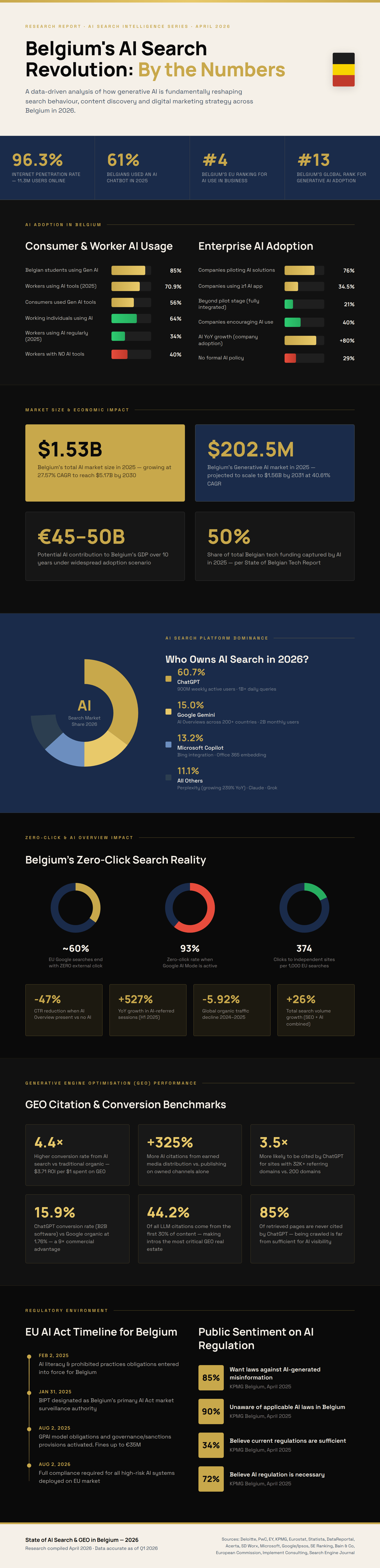
Belgian businesses are moving rapidly in the same direction. Around 34.54% of companies with at least 10 employees actively deploy AI, placing Belgium fourth in Europe behind Denmark, Finland, and Sweden and substantially above the EU average of 19.95%. Meanwhile, 76% of Belgian companies are experimenting with or piloting AI solutions, although only 21% have progressed beyond pilots into full operational integration. These figures illustrate both the scale of current adoption and the considerable room for further growth during 2026 and beyond.
The implications extend directly into search behaviour. Among Belgian AI users, 68% use AI to understand and learn about new subjects, 67% use it to communicate better or draft text, and 60% of AI chatbot users employ the technology for work-related activities. For younger audiences, the shift is becoming even more pronounced: 17% of Belgian Gen Z already relies on generative AI chatbots or web summaries for news, while 33% of Belgian consumers who use AI-generated news summaries are satisfied with the summary alone and do not visit or verify the original source.
This behavioural transformation is one reason Generative Engine Optimisation, or GEO, is becoming increasingly important for Belgian businesses. Traditional Search Engine Optimisation focuses primarily on improving rankings and attracting clicks from search engine results. GEO expands that objective by helping brands, websites, products, experts, and information become understandable, trustworthy, retrievable, and potentially citable within answers produced by generative AI systems.
The transition also coincides with the rise of zero-click search. The statistics compiled in this report indicate that approximately 59.7% of European Google searches end without an external click. When Google AI Overviews appear, overall user click rates can fall from 15% to 8%, while top-ranking organic results can experience a 34.5% reduction in click-through rates. AI Mode represents an even more significant change, with the dataset reporting a 93% zero-click rate for AI Mode searches.
For Belgian marketers, this means measuring search performance purely through rankings, impressions, and organic website traffic may provide an increasingly incomplete picture. A company could receive substantial exposure when its information is referenced or synthesised inside an AI-generated response even when the user never clicks through to its website. Consequently, AI citations, brand mentions, entity visibility, source inclusion, AI referral traffic, and visibility across multiple answer engines are becoming important additions to conventional SEO measurement.
The commercial opportunity surrounding this transformation is substantial. Belgium’s overall AI market was projected to reach approximately US$1.53 billion in 2025 and grow to US$5.17 billion by 2030 at a compound annual growth rate of 27.57%. The country’s generative AI market was projected at US$202.5 million in 2025 and could reach US$1.56 billion by 2031, representing a CAGR of 40.61%. Broader adoption of generative AI could potentially contribute between €45 billion and €50 billion to Belgium’s GDP over ten years.
The economics of AI-generated discovery are equally noteworthy for businesses. The dataset reports that AI-referred sessions can convert at 4.4 times the rate of conventional organic search sessions on average, while AI-generated referral traffic has expanded rapidly. AI-referred sessions increased 527% year over year during the first five months of 2025, and AI traffic to websites grew approximately sevenfold between early 2024 and mid-2025. At the same time, 64% of customers indicate that they are ready to purchase products recommended by AI.
Achieving visibility in these systems, however, requires more than simply producing additional content. The GEO statistics examined in this report reveal several emerging optimisation patterns. Approximately 44.2% of LLM citations originate from the first 30% of a text, while pages using shorter sentences can receive more citations. Content distribution across external publications can increase AI citations by as much as 325%, and websites with more than 32,000 referring domains are reported to be 3.5 times more likely to receive ChatGPT citations than websites with 200 or fewer referring domains.
Third-party authority is becoming important as well. Domains maintaining profiles on platforms such as Trustpilot, G2, and Capterra are reported to receive three times more AI citations than domains without such profiles. Wikipedia is also identified as the most frequently cited source within ChatGPT responses in the dataset. Together, these findings suggest that GEO increasingly depends on an interconnected digital reputation encompassing owned content, earned media, backlinks, structured information, reviews, authoritative third-party references, and consistent brand entities across the web.
Belgium presents an especially interesting market because AI adoption is advancing alongside significant concerns about trust, misinformation, privacy, and regulation. Some 84% of Belgians are concerned about AI’s potential negative consequences, 73% are concerned about misinformation, and 85% want laws designed to combat AI-generated misinformation. At the same time, Belgium operates within the EU AI Act framework, introducing increasingly important requirements concerning AI literacy, transparency, governance, and high-risk AI systems.
Belgium’s multilingual environment adds another dimension. Dutch, French, and German audiences can exhibit different search patterns and require different content strategies, while Google AI Overviews were initially available in Belgium only in English according to the dataset. For companies pursuing AI search visibility nationally, successful GEO strategies therefore need to consider language, localisation, entity consistency, regional relevance, and the ways different generative platforms retrieve and synthesise multilingual information.
The competitive landscape is also becoming fragmented. The report’s statistics put ChatGPT at 60.7% of the AI search market as of January 2026, followed by Google Gemini at 15% and Microsoft Copilot at 13.2%. Yet only 7.2% of domains reportedly appear in both Google AI Overviews and LLM results. This limited overlap suggests that ranking successfully in traditional Google Search, appearing in an AI Overview, and being cited by ChatGPT or another generative engine should increasingly be viewed as related but distinct visibility objectives.
The following 105 AI Search and GEO statistics for Belgium in 2026 examine this transformation from multiple angles, including internet connectivity, consumer AI adoption, workplace usage, AI search behaviour, zero-click searches, AI Overviews, ChatGPT and Perplexity adoption, generative AI market growth, GEO and AEO optimisation signals, AI referral traffic, conversion benchmarks, consumer trust, digital advertising, the EU AI Act, and Belgium’s evolving AI regulatory environment.
Together, these statistics provide a data-driven picture of how AI search and Generative Engine Optimisation in Belgium are evolving in 2026. For marketers, SEO professionals, publishers, SaaS companies, e-commerce businesses, agencies, and corporate decision-makers, the central trend is increasingly difficult to ignore: search is evolving from a competition for rankings and clicks into a broader competition to become a trusted source that AI systems can understand, retrieve, reference, and recommend.
But, before we venture further, we like to share who we are and what we do.
About AppLabx
From developing a solid marketing plan to creating compelling content, optimizing for search engines, leveraging social media, and utilizing paid advertising, AppLabx offers a comprehensive suite of digital marketing services designed to drive growth and profitability for your business.
At AppLabx, we understand that no two businesses are alike. That’s why we take a personalized approach to every project, working closely with our clients to understand their unique needs and goals, and developing customized strategies to help them achieve success.
If you need a digital consultation, then send in an inquiry here.
Or, send an email to hello@applabx.com to get started.
105 AI Search & GEO in Belgium Statistics, Data & Trends in 2026
SECTION 1: DIGITAL INFRASTRUCTURE & INTERNET CONNECTIVITY
1. Belgium has 11.3 million internet users as of late 2025, representing a 96.3% internet penetration rate.
Belgium’s near-universal internet connectivity creates a uniquely fertile digital environment for AI search adoption, as virtually the entire addressable population is already online and reachable through digital channels.
2. Belgium’s internet access rate stood at 93.10% of households as of December 2025, according to Eurostat.
With household connectivity among the highest in the EU, Belgian consumers and businesses are well-positioned to experience the full impact of AI-augmented search, where access speed and device availability are baseline requirements.
3. Belgium has 12.0 million active cellular mobile connections, equivalent to 102% of the total population.
Mobile network saturation means Belgian users frequently initiate searches on the go, accelerating the relevance of AI-powered voice and conversational search — channels where zero-click behaviour is especially pronounced.
4. Belgium’s average mobile download speed was 88.7 Mbps and fixed broadband reached 107 Mbps at the start of 2025.
These download speeds well above EU average thresholds ensure that AI-powered search interfaces — including latency-sensitive features like AI Overviews and real-time generative responses — render smoothly for Belgian end users.
5. Belgium has 9.08 million social media user identities, equating to 77.2% of the total population as of October 2025.
Social media’s dominant reach in Belgium reinforces why platforms like Facebook, Instagram and LinkedIn are increasingly becoming search surfaces in their own right, competing with traditional search engines for discovery intent.
SECTION 2: AI ADOPTION — CONSUMERS & WORKERS
6. 56% of Belgian consumers report having already used generative AI tools, more than doubling from two years prior.
This dramatic doubling in just two years confirms that generative AI has crossed the mainstream adoption threshold in Belgium, making AI-influenced search a mass-market phenomenon rather than a tech-enthusiast niche.
7. 61% of Belgians used an AI chatbot in 2025, according to Google’s “Our Life with AI” report based on Ipsos research.
Majority chatbot usage is a pivotal milestone for Belgian digital marketers, as it signals that AI-mediated information retrieval — bypassing traditional SERPs — is now the default for more than half of the country’s population.
8. Regular use of generative AI tools among Belgian workers rose from 13% in 2024 to 34% in 2025, a 161% increase in one year.
The acceleration in workplace AI adoption in Belgium is unprecedented, implying that B2B search queries, supplier discovery and competitor research are increasingly being conducted through AI tools rather than conventional Google searches.
9. 40% of Belgian workers who use a computer daily do not use any AI tools at all.
The substantial non-adopter segment represents a near-term conversion opportunity for AI search platforms, but also suggests that Belgian businesses must invest heavily in AI literacy to avoid a growing internal productivity gap.
10. 24% of Belgian workers regularly use AI at work, a 50% increase on the 16% recorded in 2024.
One in four Belgian workers now integrating AI into daily workflows signals a structural shift in professional information-seeking behaviour, with implications for B2B content strategies and enterprise search intent mapping.
11. 15% of Belgian workers use generic AI tools daily; 19% use them at least once a week.
These frequency metrics indicate that daily active AI users in Belgium are a substantial and growing cohort, making consistent AI visibility — through GEO and AEO strategies — an urgent priority for brand-building campaigns.
12. Belgium ranks 13th globally for generative AI adoption, with 36% of the working-age population (15–64 years) using generative AI in the second half of 2025, ahead of Canada (35%) and the USA (28.3%).
Belgium’s top-15 global ranking for generative AI adoption is a striking finding, demonstrating that this small, multilingual country punches well above its weight in AI-driven digital behaviour — a critical context for any GEO strategy targeting Belgian audiences.
13. Belgium ranks 4th in Europe for AI use in business, with 34.54% of companies (10+ employees) actively deploying AI — behind Denmark (42.03%), Finland (37.82%) and Sweden (35.04%); the EU average is 19.95%.
Belgium’s fourth-place European ranking for enterprise AI adoption, nearly double the EU average, demonstrates that AI is already deeply embedded in the commercial fabric — and that AI search queries from business users are a high-value, high-frequency channel.
14. 70.9% of Belgian respondents have used or are actively using AI applications like ChatGPT, slightly below the Western European average of 72.1%.
Despite being marginally below Western European peers, nearly three in four Belgians are already engaged with AI applications, underscoring the urgency for Belgian brands to establish visibility in AI-generated search outputs.
15. 85% of Belgian students report using generative AI tools, while 64% of working individuals have already used them.
The overwhelmingly high AI adoption among students points to a generation that will default to AI-first search behaviours across their entire working lives, making today’s GEO investments in Belgium yield compounding long-term returns.
16. 77% of Belgian men and 73% of Belgian women are aware of generative AI tools in 2025, with the gender adoption gap nearly eliminated.
The convergence in male and female AI awareness and usage erases a prior demographic blind spot for marketers, meaning GEO content strategies in Belgium can and should be developed for a broadly inclusive audience rather than a skewed demographic profile.
SECTION 3: AI SEARCH BEHAVIOUR & QUERY PATTERNS
17. 68% of Belgian AI users report using AI to understand and learn about new topics — the most frequently cited use case.
Learning-oriented queries dominate Belgian AI tool usage, suggesting that authoritative, educational content optimised for AI citation will outperform transactional content in AI-driven visibility contests.
18. 67% of Belgian AI users rely on AI to communicate better or draft texts.
AI-assisted text creation is almost as prevalent as knowledge-seeking in Belgium, meaning content authenticity and human authorship signals will become increasingly important GEO differentiators as AI-generated content saturates search inputs.
19. 60% of Belgian AI chatbot users employ the technology for work-related tasks.
The majority of Belgian AI chatbot users are applying the tools professionally, establishing enterprise-grade search intent as a core Belgian AI search segment that warrants dedicated content and GEO optimisation investment.
20. 47% of Belgians hold a positive attitude towards AI, rising to 63% among those who have used it and 89% among frequent users.
The positive-attitude premium among Belgian AI users demonstrates a virtuous adoption cycle — the more Belgians use AI search, the more favourably they view it, which accelerates usage and deepens reliance on AI as a primary information channel.
21. 17% of Belgian Gen Z already relies on generative AI chatbots or web summaries for news updates.
One in six Belgian Gen Z consumers is substituting AI-generated content summaries for traditional news browsing — a direct analogue to how young audiences will increasingly bypass SERPs in favour of AI-synthesised answers for all information needs.
22. 44% of Belgian Gen Z uses social media as their preferred news source, compared to just 31% who favour television.
Social-first Gen Z news discovery patterns in Belgium foreshadow a generation that will apply the same platform-agnostic, AI-assisted approach to commercial search, demanding GEO strategies that extend beyond Google into social and conversational AI channels.
23. 33% of Belgian AI news summary consumers are satisfied with the AI summary alone and do not click through to the original article or cross-check the source.
One in three AI summary readers in Belgium completes their information journey without visiting a single publisher website — a direct Belgian-market data point illustrating the zero-click challenge facing publishers and content marketers.
24. Google AI Overviews are initially available in Belgium in English only, with bilingual and multilingual support not included in the initial rollout.
The English-only limitation of Google AI Overviews in Belgium — unlike Germany, which received both German and English — creates a structural gap in AI-assisted search for French and Dutch-speaking Belgian audiences, opening competitive opportunities for localised AI content strategies.
25. 73% of Belgian consumers are concerned about misinformation, and 52% say they have recently encountered information they believed to be false.
Belgium’s high misinformation anxiety is a dual signal for GEO practitioners: it creates both a higher bar for content credibility in AI citation eligibility and a market opportunity for brands that establish robust E-E-A-T signals to earn AI-sourced trust authority.
SECTION 4: AI MARKET SIZE & ECONOMIC IMPACT IN BELGIUM
26. Belgium’s total AI market is projected to reach USD $1.53 billion in 2025, growing at a CAGR of 27.57% to reach USD $5.17 billion by 2030.
At a 27.57% CAGR, Belgium’s AI market is expanding nearly four times faster than overall GDP growth, confirming that AI investment is a structural economic force rather than a cyclical tech trend — with search infrastructure attracting a significant share of that capital.
27. Belgium’s Generative AI market is projected to reach USD $202.50 million in 2025, scaling to USD $1.56 billion by 2031 at a CAGR of 40.61%.
The 40%+ CAGR for generative AI in Belgium is exceptional even within the broader AI landscape, reflecting how rapidly LLM-based tools — including AI search interfaces — are being monetised and scaled across Belgian commercial applications.
28. Widespread adoption of generative AI could add between €45 and €50 billion to Belgium’s GDP over ten years; delayed adoption scenarios could reduce this potential to as little as €10–12 billion.
The €35–38 billion gap between adoption scenarios quantifies the economic stakes of Belgium’s AI transition, providing CFOs and digital strategy leaders with a compelling business case for accelerating AI-forward investments, including GEO.
29. AI attracted over 50% of total tech funding in Belgium in 2025, according to the State of Belgian Tech Report.
AI’s dominance of the Belgian tech funding landscape ensures continued acceleration of AI infrastructure, talent and tooling — all of which directly improve the quality and availability of AI search platforms accessed by Belgian users and businesses.
30. A quarter of Belgian companies with more than 10 employees use at least one AI application — an 80% year-on-year increase.
The 80% year-on-year increase in enterprise AI application usage among Belgian SMEs and mid-sized firms is the clearest evidence that AI has moved from pilot stage to operational reality, transforming how businesses conduct market research through search.
SECTION 5: AI BUSINESS ADOPTION & WORKFORCE
31. 76% of Belgian companies are currently experimenting with or piloting AI solutions.
Three in four Belgian companies are actively testing AI, yet the vast majority remain pre-scale — creating an urgent window for first-mover advantage in AI-visible content strategies before competitive saturation occurs.
32. Only 21% of Belgian organisations have progressed beyond the AI pilot stage to full operational integration.
The sharp drop-off from 76% piloting to only 21% full integration reveals a widespread AI “pilot trap” in Belgian organisations, where the gap between experimentation and enterprise-wide deployment remains a significant strategic and capability challenge.
33. 57% of Belgian workers are permitted to use AI applications at work, though often with restrictions.
Majority employer permission for AI tool usage creates an established framework for professional AI search behaviour in Belgium, but the prevalence of restrictions signals that compliant, GDPR-aligned AI search tools will command a premium among regulated-sector users.
34. 27% of Belgian employees are allowed to use AI tools at work without any restrictions — significantly higher than Germany (13%) and the Netherlands (18%).
Belgium’s notably liberal workplace AI policy compared to its immediate neighbours creates a competitive context where Belgian businesses can move faster on AI-assisted research and search integration than their regional counterparts.
35. Nearly half of Belgian managerial employees state that AI has already led to cost savings, increased profits, or both.
Management-level acknowledgement of tangible AI ROI in Belgian organisations confirms that the transition from AI tool novelty to measurable business value has occurred — providing budget justification for investing in GEO programmes with measurable AI visibility metrics.
36. Only 43% of Belgian companies are investing in digital literacy training for their employees.
The training investment gap in Belgium is a systemic risk to effective AI search adoption; without foundational AI literacy, Belgian workers are less likely to evaluate AI-generated search results critically or leverage AI tools for high-quality research outputs.
37. 39% of Belgians have received AI training, compared to 61% globally — a 22-point gap below the worldwide average.
Belgium’s 22-percentage-point deficit in AI training relative to global peers represents a structural skill gap that will constrain both the sophistication of AI search usage and the ability of Belgian content teams to produce AI-optimised material at scale.
38. Only 46% of Belgians report having even a limited knowledge of AI.
The majority of Belgians lack substantive AI knowledge, which suggests that AI search behaviours in Belgium are largely driven by intuition and passive feature exposure rather than deliberate strategy — underscoring why user-friendly, accessible AI answers from trusted Belgian brands will command outsized engagement.
SECTION 6: ZERO-CLICK SEARCH & AI OVERVIEWS IMPACT
39. Approximately 59.7% of European Google searches end without a single external click, closely tracking the global zero-click rate of approximately 60%.
Belgium, as an EU member state, operates in a European search environment where nearly 60% of all queries are resolved on the SERP itself — meaning the majority of search interactions in Belgium now occur without any publisher or brand website receiving a visit.
40. For every 1,000 searches performed in the EU, roughly 374 clicks reach independent websites, compared to 360 in the US.
The EU’s Digital Markets Act marginally improves click-through rates to independent websites compared to the US, suggesting Belgium-based publishers have a slight structural advantage over American peers in capturing organic clicks — though the picture remains fundamentally zero-click dominated.
41. Google AI Overviews appear in approximately 18% of all Google searches globally, rising to 57% of long-tail, high-intent queries.
For Belgian businesses targeting long-tail informational keywords — common in B2B and professional services sectors that dominate the Belgian economy — AI Overview appearances now affect the majority of their target query landscape, making AIO citation a critical ranking objective.
42. Across all Google searches, 43% end without any external click; when Google’s full AI Mode is active, this figure rises to 93%.
The near-total elimination of outbound clicks when AI Mode is engaged represents the most acute zero-click scenario Belgian webmasters will face, making AI citation visibility — not traffic — the primary measurable success metric for search presence.
43. Overall user click rates fall from 15% (without AI Overviews) to just 8% when an AI Overview is present — a 47% reduction.
The 47% click reduction attributable to AI Overviews in Belgium-accessible Google results is a commercial inflection point: brands whose organic rankings are displaced by AI Overviews may see nearly half their expected organic traffic evaporate without any change in their own content quality.
44. AI-referred sessions jumped 527% year-over-year in the first five months of 2025.
The 527% surge in AI referral traffic globally within a single year represents the fastest-ever adoption curve of a new digital traffic source — and Belgian marketers who have already mapped and optimised their AI referral pathways are positioned to capture a disproportionate share of this emerging channel.
45. AI Overviews carry an 80% zero-click rate in triggered query sessions; traditional queries without AIOs hover near 60%.
The 20-percentage-point increase in zero-click rate between standard and AIO-triggered queries provides a precise benchmark for Belgian SEO teams to quantify the traffic cannibalisation risk posed by AI Overviews in their specific keyword portfolios.
46. Top-ranking Google results see a 34.5% reduction in click-through rates when an AI Overview is present.
A 34.5% CTR reduction for Belgium’s position-one rankings in AIO-active queries means that traditional SEO victories are worth substantially less than in prior years, demanding a strategic rebalancing toward AI citation inclusion alongside ranking ambitions.
47. Google processes an estimated 9.1 to 13.6 billion searches per day globally in 2025 — up from 8.5 billion in 2024 — even as zero-click rates rise.
Paradoxically, total search volume is growing despite the zero-click surge, which means Belgian brands can maintain or even grow absolute click volumes if they optimise for the right intent clusters while accepting higher zero-click exposure on informational queries.
SECTION 7: AI SEARCH MARKET SHARE & COMPETITIVE LANDSCAPE
48. As of March 2026, Google holds 90.01% of worldwide search traffic; Bing holds 4.98%, Yahoo 1.39%, DuckDuckGo 0.76% and Baidu 0.55%.
Google’s dominance in Belgium mirrors this global distribution, making Google AI Overviews and Google Gemini the primary AI search surfaces that Belgian content teams must optimise for — while maintaining awareness of Bing Copilot as the most relevant secondary target.
49. Google’s global market share dipped below 90% for the first time in over a decade during Q4 2024 and February 2026, before recovering to 90.01% in March 2026.
The breach of the 90% threshold, even temporarily, is historically significant and signals a structural erosion of Google’s search monopoly — a trend with direct relevance to Belgian digital strategy teams who should begin hedging their AI search visibility investment across multiple platforms.
50. As of January 2026, ChatGPT leads the AI search market with 60.7% share, followed by Google Gemini at 15.0% and Microsoft Copilot at 13.2% — together commanding 88.9% of AI search.
ChatGPT’s 60% AI search market dominance means it is the single most important platform for Belgian brands to appear in when targeting AI-driven discovery — yet its 60.7% share still leaves 39.3% distributed across competitors that warrant strategic attention.
51. ChatGPT has reached 900 million weekly active users globally as of late February 2026, up from 800 million in October 2025.
ChatGPT’s continued weekly active user growth confirms its trajectory as a dominant search alternative, and with Belgian AI chatbot adoption at 61%, a substantial portion of these global users are Belgian consumers conducting product, service and informational searches.
52. ChatGPT processes more than 1 billion queries per day globally.
At 1 billion daily queries, ChatGPT’s query volume is substantial enough to make it a material commercial traffic source — and for Belgian businesses appearing in ChatGPT responses, each citation represents direct brand exposure at a scale comparable to mainstream paid media.
53. Perplexity processed 780 million search queries in May 2025, up from 230 million less than a year earlier — a 239% increase.
Perplexity’s explosive query growth makes it the fastest-scaling AI search platform globally, and its academic and research-focused user base has strong alignment with Belgium’s professional and knowledge-worker segments, making it a high-value GEO target for Belgian B2B brands.
54. Combined traffic to ChatGPT and Perplexity surged 225% from 2024 to 2025 — a near-fourfold increase in one year.
The 225% combined growth of the two leading independent AI search platforms dwarfs the growth rate of any traditional digital channel in the same period, establishing AI search as the highest-growth discovery channel for Belgian digital strategy planning.
55. AI search holds 12–15% of global search market share as of 2025, while traditional search retains 65–85% depending on region and use case.
AI search’s 12–15% global market share, while still minority, represents a disproportionately high-value segment — particularly in Belgium where above-average AI adoption rates suggest local AI search share likely exceeds the global benchmark.
56. ChatGPT accounts for over 77% of all AI-driven website referral traffic globally, and holds approximately 81% market share within the AI chatbot sector.
ChatGPT’s near-monopoly on AI referral traffic means that for Belgian brands measuring GEO performance through GA4 attribution, ChatGPT-sourced sessions are the single most measurable and high-value AI channel to track and optimise.
57. Perplexity accounts for approximately 15% of all AI referral traffic, making it the second-largest source of AI-driven website visits.
Perplexity’s 15% AI referral share earns it a mandatory place in any Belgian brand’s GEO targeting framework, particularly given the platform’s growing user base in European professional markets where Belgium’s knowledge economy operates.
58. AI referral traffic accounts for 1.08% of total web traffic across industries, with ChatGPT driving 87.4% of that AI referral traffic.
While 1.08% may appear modest in absolute terms, its concentration in high-intent, conversion-ready sessions — converting at up to 4.4x higher than organic — makes it disproportionately valuable for Belgian e-commerce, SaaS and professional services brands.
SECTION 8: GEO / AEO — CONTENT & OPTIMISATION SIGNALS
59. 44.2% of all LLM citations come from the first 30% of a text (the introduction); 31.1% from the middle; 24.7% from the conclusion.
The front-loading of LLM citation patterns has direct structural implications for Belgian content teams: the most important information for AI visibility must appear in the opening paragraphs, not buried in conclusions — reversing traditional long-form content architecture assumptions.
60. Distributing content to a wide range of publications can increase AI citations by up to 325% compared to publishing on owned channels alone.
The 325% citation multiplier from earned media distribution is the most compelling argument for Belgian brands to invest in PR, thought leadership placements and media partnerships as core GEO infrastructure — not supplementary brand activities.
61. Sites with over 32,000 referring domains are 3.5x more likely to be cited by ChatGPT than those with up to 200 referring domains.
Domain authority, measured by referring domain count, remains the strongest ChatGPT citation predictor — confirming that Belgian companies with established link equity have a structural GEO advantage that pure content quality alone cannot override.
62. Comparison pages with 3 tables earn 25.7% more AI citations; validation pages with 8 list sections earn up to 26.9% more citations.
Structured content formats — tables, ordered lists, comparison matrices — that are common in Belgian B2B and product content earn measurably more AI citations, validating the investment in content restructuring for GEO purposes.
63. Pages averaging 10 words or fewer per sentence earn 18.8% more AI citations from ChatGPT.
Sentence-level brevity is a measurable GEO performance lever: Belgian content that is written concisely and in plain language is significantly more likely to be extracted and cited by AI search engines than dense, long-sentence academic or corporate prose.
64. ChatGPT only cites 15% of the pages it retrieves; 85% of source pages retrieved during a search are never cited.
The 85% non-citation rate among retrieved pages is a critical GEO benchmark for Belgian content teams: being crawled and indexed by ChatGPT is necessary but far from sufficient — passage-level relevance, authority and structure determine citation selection.
65. AI-referred sessions convert at 4.4x the rate of organic search sessions on average, with individual platform data showing ChatGPT converting at 15.9% versus Google organic at 1.76%.
ChatGPT’s 15.9% conversion rate versus organic search’s 1.76% — a 9x advantage — is the strongest economic argument for Belgian brands to prioritise AI citation optimisation: each AI-sourced visitor is worth nearly nine times more than a conventional organic visitor.
66. Wikipedia is the most cited source in ChatGPT responses (7.8%), followed by Reddit (1.8%), Forbes (1.1%) and G2 (1.1%).
Wikipedia’s citation dominance in ChatGPT outputs confirms that entity accuracy and knowledge graph coverage — not just owned-site optimisation — are foundational GEO requirements for Belgian brands seeking AI search visibility.
67. Domains active on Trustpilot, G2 and Capterra earn 3x more AI citations than those without profiles on these platforms.
Review platform presence is a direct GEO performance multiplier — a highly actionable finding for Belgian B2B and SaaS brands that have neglected third-party review ecosystems, which now function as de facto AI citation credibility signals.
68. 58% of users have already replaced classic search engines with AI tools when searching for products or services.
The majority of AI users globally have already made AI their primary product discovery channel, and with Belgium’s above-average AI adoption rates, this behavioural shift is likely occurring at an even higher frequency in the Belgian consumer market.
69. 63% of websites report traffic originating from AI-based search engines.
The majority of websites globally already receive measurable AI referral traffic, confirming that this is no longer an emerging channel to monitor but an operational reality that Belgian analytics teams should be tracking, attributing and optimising in real time.
70. Generative queries average approximately 23 words versus approximately 4 words for traditional search queries.
The roughly 6x increase in query length for AI search compared to traditional search has profound content strategy implications for Belgian marketers: AI-optimised content must be written to match long, conversational, multi-intent queries rather than short keyword strings.
SECTION 9: CONSUMER TRUST, ATTITUDES & CONCERNS IN BELGIUM
71. 84% of Belgians are concerned about the potential negative consequences of AI.
Near-universal concern about AI’s societal implications creates a trust-first imperative for Belgian brands: AI search visibility strategies that are built on credible, balanced, expert-authored content will earn stronger long-term citation authority than those optimised purely for algorithmic signals.
72. 39% of Belgians believe the risks of AI outweigh the benefits; only 34% believe benefits outweigh risks.
Belgium’s risk-skewed public perception of AI contrasts with its high adoption rates, suggesting a pragmatic rather than enthusiastic relationship with the technology — Belgian audiences respond best to AI-generated or AI-cited content that is grounded in evidence and transparency.
73. 81% of Belgians expect positive results from AI, even as 84% express concern about its negative impact.
The simultaneous optimism and concern among Belgian AI users describes a nuanced digital consumer who holds both hopes and fears — a psychological profile that content creators optimising for Belgian AI search audiences must navigate with balanced, credible messaging.
74. 85% of Belgians would like to see laws to combat AI-generated misinformation.
Belgium’s overwhelming public demand for AI misinformation regulation provides strong political tailwinds for the EU AI Act’s transparency provisions and for content standards that prioritise source attribution — both of which align with GEO best practices.
75. 90% of Belgians are unaware of any laws or regulations applicable to AI in Belgium.
The near-total lack of AI regulatory awareness among Belgian citizens is both a digital literacy challenge and a brand opportunity: companies that proactively communicate their AI governance practices in public-facing content will stand out as trustworthy in AI-generated search responses.
76. Only 34% of Belgians believe that current regulations are sufficient to guarantee safe AI use.
Low confidence in AI regulatory adequacy drives Belgian consumers toward trusted sources when encountering AI-generated answers, making E-E-A-T (Experience, Expertise, Authoritativeness, Trustworthiness) signals a decisive factor in Belgian GEO content performance.
77. 74% of Belgian employees believe AI will lead to fewer jobs, above the EU average but below Portugal (80%) and Spain (78%).
Belgium’s high job displacement anxiety is a persistent workforce concern that shapes the framing of AI-related content: Belgian professionals searching for AI-related information are more likely to engage with content that acknowledges disruption alongside opportunity.
78. 66% of Belgians are concerned about deepfakes, 65% about misinformation, 65% about data privacy and 63% about security risks related to AI.
The clustering of Belgium’s top AI concerns around data integrity and privacy reinforces the importance of GDPR-compliant, privacy-first AI search tools and GEO content that explicitly addresses data security — particularly for Belgian financial services, healthcare and legal sectors.
SECTION 10: DIGITAL ADVERTISING & SEARCH BUDGET IN BELGIUM
79. Search (organic and paid) takes up 41.2% of Belgium’s national digital advertising budget.
Search’s 41.2% share of Belgium’s digital advertising budget reflects advertisers’ enduring confidence in intent-based discovery channels — but as AI Overviews displace organic clicks, this budget allocation must increasingly be justified through AI visibility metrics rather than traditional SERP position rankings.
80. Social media advertising accounts for 30.3% of Belgium’s digital ad budget, up 14.5% in one year.
Social media’s 14.5% year-on-year budget growth in Belgium is partly attributable to the zero-click displacement of organic search traffic, as marketers redirect investment toward social platforms where reach and engagement are less vulnerable to AI Overview cannibalisation.
81. The average CPC for Google Ads campaigns in Belgium is approximately €0.88 in 2025, with peaks exceeding €2 in finance and insurance.
Belgium’s relatively affordable average CPC compared to Western European peers creates a favourable paid search environment — but as AI Overviews consume organic real estate, paid traffic will increasingly need to compensate for lost organic clicks, putting upward pressure on Belgian CPCs.
82. Ads appearing alongside Google AI Overviews grew from approximately 3% of AI Overview appearances in January 2025 to roughly 40% by November 2025.
The rapid commercialisation of Google AI Overview inventory represents a structural shift in how advertising revenue is generated within AI search, and Belgian brands must prepare for a search landscape where paid and AI-cited positions coexist in the same high-visibility SERP zone.
83. One in two local searches in Belgium results in a store visit within 24 hours.
Belgium’s strong local search-to-store conversion rate underscores the commercial urgency of maintaining accurate, structured local data — which is also a key input for AI search systems that synthesise local business information for conversational query responses.
SECTION 11: BELGIAN AI REGULATORY ENVIRONMENT
84. Belgium designated the Belgian Institute for Postal Services and Telecommunications (BIPT) as the main regulator for the EU AI Act, as announced in the Government Declaration of January 31, 2025.
BIPT’s appointment as Belgium’s primary AI Act regulator marks the start of structured national AI oversight, with direct implications for how Belgian AI search tools and content recommendation systems must be designed, documented and audited for compliance.
85. The EU AI Act’s first obligations — including AI literacy and prohibited practices — came into force on February 2, 2025, with GPAI model obligations applying from August 2, 2025.
The phased implementation of the EU AI Act means that Belgian organisations deploying AI-powered search tools or content recommendation systems are already legally obligated to meet transparency, literacy and prohibited-use standards.
86. Non-compliance with the EU AI Act can result in fines of up to €35 million or 7% of global annual turnover from August 2, 2025.
The severity of EU AI Act penalties — comparable to GDPR enforcement levels — transforms AI search governance from a best-practice recommendation to a legal compliance obligation for Belgian organisations deploying AI systems in search and content distribution contexts.
87. Belgium missed the August 2025 governance deadline for complete institutional designation under the EU AI Act, though work continues on establishing the full national competent authority structure.
Belgium’s institutional lag in AI Act implementation means there is a transitional period of regulatory uncertainty for Belgian businesses, during which proactive compliance based on the letter and spirit of the Act is more advisable than waiting for definitive national guidance.
88. Belgium’s trilingual structure (Dutch, French, German) creates significant documentation complexity for EU AI Act compliance.
Belgium’s unique linguistic structure adds an additional compliance layer for AI Act documentation requirements, and for GEO practitioners, it underscores the importance of multilingual content strategies that serve AI search systems responding to queries in all three national languages.
89. High-risk AI systems placed on the EU market must fully comply with all EU AI Act requirements from August 2, 2026.
The August 2026 compliance deadline for high-risk AI systems creates a near-term calendar pressure for Belgian organisations in healthcare, HR, finance and legal sectors — industries that also happen to be among the heaviest users of AI-assisted search tools.
90. Belgium has published a list of 21 specific bodies empowered to supervise high-risk AI systems under Article 77 of the EU AI Act.
The designation of 21 sector-specific supervisory bodies in Belgium reflects the country’s horizontal exposure to high-risk AI deployment across regulated industries, ensuring that AI search and recommendation systems operating in those sectors face structured oversight from 2026.
SECTION 12: GEO/AEO STRATEGY & PERFORMANCE BENCHMARKS
91. Gartner predicts that overall search engine query volume will decline by 25% by 2026 as answer engines gain popularity.
Gartner’s 25% query volume decline projection provides a strategic planning anchor for Belgian SEOs and digital marketers: absolute traffic from traditional search will shrink, making the quality and AI-citation rate of remaining traffic more commercially valuable than its volume.
92. GEO delivers up to 4.4x higher conversion rates than traditional SEO, with an ROI of $3.71 per $1 spent.
GEO’s superior conversion economics versus traditional SEO create a compelling case for rebalancing Belgian digital marketing investment — particularly for performance-oriented Belgian e-commerce and SaaS businesses where conversion efficiency is the primary budget justification metric.
93. Only 7.2% of domains appear in both Google AI Overviews and LLM results — meaning the vast majority of AI search visibility is non-overlapping across platforms.
The minimal overlap between Google AI Overview citations and LLM citations means Belgian brands cannot rely on a single optimisation effort to achieve multi-platform AI visibility; a platform-specific GEO strategy covering at least Google AIOs, ChatGPT and Perplexity is required.
94. Organic traffic experienced a 5.92% global decline between 2024 and 2025, with the US experiencing a 4.50% drop and the UK managing a slight 0.57% rebound.
The global organic traffic decline validates the urgency of developing AI-visible content strategies in Belgium before the traffic erosion reaches levels that threaten revenue-generating organic channels — a risk already materialising in US and UK markets.
95. AI Mode searches generate a 93% zero-click rate — more than double the 43% zero-click rate of AI Overviews — representing a 61% decline in organic CTR for included pages.
AI Mode’s near-total elimination of outbound clicks represents the most disruptive scenario for Belgian publishers and brands, establishing the business case for prioritising AI citation within Google’s AI Mode as a brand-building and indirect conversion channel rather than a direct traffic driver.
96. Users spend an average of 49 seconds in AI Mode compared to 21 seconds in AI Overviews — a 133% increase in per-session engagement time.
The deeper engagement time in AI Mode indicates that Belgian users interacting with this feature are conducting more thorough, multi-intent research sessions — making AI Mode a high-value visibility context for brands targeting high-consideration purchase decisions.
97. 51% of AI search citation sources are blog posts; 19% are “best-of” list pages.
The dominance of blog posts and listicles as AI citation sources confirms that these format investments remain strategically sound for Belgian content teams, provided they are structured for AI parseability with direct answers, clear headings and fact-dense passages.
98. 71% of CMOs globally are reallocating budgets toward Generative AI as a marketing channel.
The majority of global CMOs are already actively redirecting budget toward GenAI marketing, and Belgian marketing leaders who have not begun this reallocation risk widening a competitive disadvantage as AI-visible competitors capture AI-sourced brand share in the Belgian market.
99. The AI search engine market was valued at USD $43.6 billion globally in 2024 and is projected to capture 62.2% of the total search market by 2030 — reaching revenues of nearly $379 billion.
At $43.6 billion already and a trajectory toward $379 billion, the global AI search market represents a commercial opportunity of extraordinary scale — one in which Belgian brands that establish early citation authority will disproportionately benefit as AI search’s market share accelerates.
100. 64% of customers express readiness to purchase products suggested by AI.
Nearly two in three customers globally — including Belgian consumers — are willing to act on AI purchase recommendations, transforming AI citation from a brand awareness metric into a direct commercial transaction driver that warrants investment comparable to performance paid media.
101. AI traffic to websites grew roughly sevenfold between early 2024 and mid-2025.
A 7x increase in AI-sourced website traffic within approximately 18 months represents one of the fastest-ever channel growth trajectories in digital marketing history, and Belgian digital teams that are measuring and acting on this channel today are building an AI referral advantage that latecomers will struggle to replicate.
102. Bain & Company reports that nearly 80% of consumers now utilise AI-generated abstracts for at least 40% of their searches, triggering a 15–25% decline in organic traffic for many websites.
Bain’s research quantifies the practical traffic impact of AI abstraction: Belgian publishers and brands that rely on organic search as a primary traffic channel should expect a 15–25% structural traffic headwind as AI abstract consumption becomes the default behaviour for four in five users.
103. Total search volume combining traditional search engines and LLMs has increased by 26% worldwide, demonstrating the AI search “additive” effect.
The 26% total search growth confirms that AI search is expanding the overall search pie rather than simply redistributing it — meaning Belgian brands optimising for AI search are targeting incremental query volume, not merely competing for a shrinking share of fixed demand.
104. Belgium’s Flemish Action Plan allocates EUR 32 million annually for AI, including EUR 15 million for company implementation, EUR 12 million for research and EUR 5 million for training and ethical AI.
The Flemish regional government’s EUR 32 million annual AI investment provides sustained institutional support for AI adoption in Dutch-speaking Belgium — creating an enabling environment for AI search infrastructure, talent development and business capability that will accelerate GEO adoption in the Flanders commercial ecosystem.
105. The Walloon ARIAC programme invests EUR 32 million (2021–2026) in AI research, funding 50 PhD positions across Human-AI, Trusted AI, AI Model Hybridisation and Embedded AI.
The Walloon AI research investment deepens Belgium’s AI talent pipeline and applied research capacity — directly benefiting the development of Belgian-language AI models and search systems that reflect the linguistic and cultural context of French-speaking Belgian users and content.
Conclusion
The 105 AI Search and GEO statistics for Belgium in 2026 point to a fundamental transformation in how Belgian consumers, employees, and businesses discover, evaluate, and act on information. With internet penetration reaching 96.3%, 61% of Belgians using an AI chatbot in 2025, and Belgium ranking 13th globally for generative AI adoption among the working-age population, the foundations for widespread AI-powered search are already firmly established.
The shift is equally significant within Belgian businesses. Around 34.54% of companies with at least 10 employees actively deploy AI, placing Belgium fourth in Europe and well above the EU average of 19.95%. Meanwhile, 76% of Belgian companies are experimenting with or piloting AI solutions. As these organisations integrate generative AI more deeply into research, procurement, marketing, customer service, and everyday workflows, conversational AI is likely to become an increasingly important gateway between businesses and information.
For marketers and SEO professionals, one of the most important developments is the continuing rise of zero-click search. Approximately 59.7% of European Google searches already end without an external click, while AI Overviews can reduce overall click rates from 15% to 8%. The dataset reports an even more dramatic 93% zero-click rate for AI Mode searches. Traditional organic rankings therefore remain valuable, but rankings alone can no longer represent the complete picture of search visibility.
This changing environment makes Generative Engine Optimisation (GEO) and Answer Engine Optimisation (AEO) increasingly relevant for businesses targeting Belgian audiences. Search visibility is expanding beyond ranking webpages toward ensuring that brands and their information can be understood, retrieved, cited, and recommended by systems such as ChatGPT, Google Gemini, Google AI Overviews, Microsoft Copilot, and Perplexity.
The data also suggests that GEO requires a broader approach than simply inserting keywords into existing SEO content. Around 44.2% of LLM citations come from the opening 30% of a text, distributing content across multiple publications can increase AI citations by up to 325%, and websites with more than 32,000 referring domains are 3.5 times more likely to receive ChatGPT citations than sites with 200 or fewer. Domains active on Trustpilot, G2, and Capterra are also reported to earn three times more AI citations.
These trends reinforce the importance of authoritative content, concise answers, strong entity signals, reputable backlinks, third-party validation, structured information, earned media, and consistent brand references across the wider web. GEO in Belgium should therefore be treated as an extension of a company’s overall digital authority rather than as an isolated technical optimisation exercise.
The potential commercial value is substantial. Belgium’s generative AI market was projected to grow from US$202.5 million in 2025 to US$1.56 billion by 2031 at a CAGR of 40.61%. AI-referred sessions have also been reported to convert at 4.4 times the rate of organic search sessions on average, while AI traffic to websites increased approximately sevenfold between early 2024 and mid-2025. These figures suggest that AI search visibility is developing into a measurable acquisition and revenue opportunity rather than merely another brand-awareness channel.
At the same time, Belgian companies must approach AI search with credibility and trust at the centre of their strategies. The dataset shows that 84% of Belgians are concerned about AI’s potential negative consequences, 73% are concerned about misinformation, and 85% want laws designed to combat AI-generated misinformation. Combined with Belgium’s obligations under the EU AI Act and its multilingual Dutch, French, and German environment, these concerns make accuracy, transparency, localisation, and trustworthy sourcing particularly important.
Ultimately, the state of AI Search and Generative Engine Optimisation in Belgium in 2026 shows that search is not disappearing; it is evolving. Users are increasingly moving between conventional search engines, AI-generated summaries, conversational assistants, social platforms, and other discovery channels. The dataset even indicates that total worldwide search volume across traditional search engines and LLMs has increased by 26%, suggesting that generative AI can expand overall information-seeking activity rather than simply replace traditional search.
For Belgian businesses, the strategic objective is therefore becoming broader: rank where people search, become a trusted source where AI systems retrieve information, and earn visibility where generative engines formulate the final answer. Organisations that begin building this authority now will be better positioned for a Belgian search ecosystem in which SEO, GEO, AEO, digital PR, entity optimisation, and AI visibility increasingly operate as interconnected parts of the same discovery strategy.
If you are looking for a top-class digital marketer, then book a free consultation slot here.
If you find this article useful, why not share it with your friends and business partners, and also leave a nice comment below?
We, at the AppLabx Research Team, strive to bring the latest and most meaningful data, guides, and statistics to your doorstep.
To get access to top-quality guides, click over to the AppLabx Blog.
People also ask
What is AI search in Belgium in 2026?
AI search in Belgium refers to using generative AI and answer engines to find information through conversational queries and generated answers rather than relying only on traditional search result pages.
How popular is AI search in Belgium?
AI search adoption is growing rapidly. The dataset reports that 61% of Belgians used an AI chatbot in 2025, showing that conversational AI has already reached a majority of the population.
What percentage of Belgians use generative AI?
The dataset reports that 56% of Belgian consumers have used generative AI tools. Among the working-age population, 36% used generative AI in the second half of 2025.
How does Belgium rank globally for generative AI adoption?
Belgium ranked 13th globally for generative AI adoption, with 36% of people aged 15–64 using generative AI during the second half of 2025.
What is Generative Engine Optimisation in Belgium?
Generative Engine Optimisation, or GEO, focuses on improving the likelihood that a brand, website or content source can be understood, retrieved, cited or recommended by AI-powered search and answer engines.
Why is GEO important for Belgian businesses in 2026?
GEO is increasingly important because Belgian consumers and workers are adopting AI rapidly, while AI-generated answers can reduce traditional website clicks and create new opportunities for brand citations and recommendations.
How many Belgian businesses are using AI?
Around 34.54% of Belgian companies with at least 10 employees actively deploy AI, placing Belgium fourth in Europe and significantly above the EU average of 19.95%.
How many Belgian companies are experimenting with AI?
Approximately 76% of Belgian companies are experimenting with or piloting AI solutions, although only 21% have moved beyond pilots into full operational integration.
How quickly is workplace AI adoption growing in Belgium?
Regular generative AI usage among Belgian workers increased from 13% in 2024 to 34% in 2025, representing a 161% year-over-year increase.
What do Belgians use AI for most often?
Among Belgian AI users, 68% use AI to understand and learn about new topics, while 67% use it to communicate better or draft text.
Do Belgians use AI chatbots for work?
Yes. The dataset reports that 60% of Belgian AI chatbot users employ the technology for work-related tasks, highlighting the importance of AI search for B2B discovery.
What is zero-click search in Belgium?
Zero-click search occurs when users obtain the information they need directly from search results or AI-generated answers without visiting an external website. Around 59.7% of European Google searches reportedly end without an external click.
How do Google AI Overviews affect click-through rates?
The dataset reports that overall click rates fall from 15% without AI Overviews to 8% when an AI Overview appears, representing a 47% reduction.
How do AI Overviews affect top-ranking Google results?
Top-ranking Google results can experience a 34.5% reduction in click-through rate when an AI Overview appears, reducing the traffic value of a traditional number-one organic ranking.
What is the zero-click rate for Google AI Mode?
The dataset reports that AI Mode searches can produce a 93% zero-click rate, making visibility inside generated answers increasingly important alongside conventional organic traffic.
How large is Belgium’s AI market?
Belgium’s AI market was projected to reach US$1.53 billion in 2025 and grow to US$5.17 billion by 2030, representing a compound annual growth rate of 27.57%.
How large is Belgium’s generative AI market?
Belgium’s generative AI market was projected at US$202.5 million in 2025 and is forecast to reach US$1.56 billion by 2031, with a CAGR of 40.61%.
How much could generative AI contribute to Belgium’s economy?
Widespread generative AI adoption could contribute an estimated €45 billion to €50 billion to Belgium’s GDP over ten years, according to the dataset.
Does AI referral traffic convert better than organic search?
The dataset reports that AI-referred sessions convert at an average of 4.4 times the rate of organic search sessions, making AI visibility potentially valuable for customer acquisition.
How fast is AI referral traffic growing?
AI-referred sessions increased 527% year over year during the first five months of 2025, while AI traffic to websites grew roughly sevenfold between early 2024 and mid-2025.
Which AI search platform has the largest market share?
According to the dataset, ChatGPT led the AI search market with a 60.7% share in January 2026, followed by Google Gemini at 15% and Microsoft Copilot at 13.2%.
How important is ChatGPT for GEO in Belgium?
ChatGPT is an important GEO platform because the dataset identifies it as the AI search market leader and reports that it generates more than 77% of global AI-driven website referral traffic.
Is Perplexity important for AI search optimisation?
Yes. Perplexity reportedly accounts for approximately 15% of AI referral traffic, making it an important secondary platform for brands pursuing visibility across multiple generative search engines.
What content is most likely to receive AI citations?
The dataset reports that 51% of AI search citation sources are blog posts and 19% are best-of list pages, highlighting the importance of clear, information-rich content formats.
Where in an article do most LLM citations come from?
Around 44.2% of LLM citations come from the first 30% of a text, compared with 31.1% from the middle and 24.7% from the conclusion.
Do backlinks and domain authority matter for GEO?
Yes. Sites with more than 32,000 referring domains are reportedly 3.5 times more likely to receive ChatGPT citations than sites with 200 or fewer referring domains.
Do online reviews help with AI search visibility?
The dataset reports that domains active on Trustpilot, G2 and Capterra receive three times more AI citations than domains without profiles on these third-party review platforms.
How important is trust for GEO in Belgium?
Trust is particularly important because 73% of Belgian consumers are concerned about misinformation, while 52% say they recently encountered information they believed was false.
How does Belgium’s multilingual market affect GEO?
Belgium’s Dutch, French and German linguistic environment makes localisation important for GEO. Businesses need clear, consistent and locally relevant information that AI systems can interpret across different Belgian audiences.
What is the future of AI search and GEO in Belgium?
AI search is likely to become an increasingly important part of Belgian digital discovery as consumer and business AI adoption grows. SEO, GEO, AEO, digital authority, third-party citations and trusted content will increasingly work together to determine online visibility.
Sources
Le Cercle AI PwC Belgium Deloitte Belgium EY Belgium SD Worx Acerta Consult Eurostat Microsoft KPMG Belgium Google Ipsos ITdaily DataReportal Trading Economics Statista Implement Consulting Group International Business Times D-Asset CMS Law GLACIS Agoria Act Legal Umbau Marketing Fizz ClickForest Position Digital Sedestral Search Engine Journal SociallyIn Frase Insightland Evergreen Media FirstMotion All About AI Goodie ALM Corp ClickVision Search Engine Land Reboot Online BOL Agency European Commission AI Watch