























Key Takeaways
- Sweden’s AI adoption is accelerating, with 35% of enterprises using AI in 2025 and generative AI usage reaching 37% of Swedes aged 16 and over.
- AI search and GEO are reshaping Swedish digital discovery as ChatGPT, Google AI Overviews, Perplexity and other generative platforms influence how consumers find brands and information.
- SEO and Generative Engine Optimisation are converging, making authoritative content, AI citations, structured data and multi-platform visibility increasingly important for Swedish businesses in 2026.
Sweden is rapidly adopting AI-powered search, with 37% of people aged 16 and over using generative AI tools and 35% of enterprises using AI technologies. In 2026, this shift makes Generative Engine Optimisation increasingly important for businesses seeking visibility across AI-generated answers, citations, recommendations, and traditional search results.
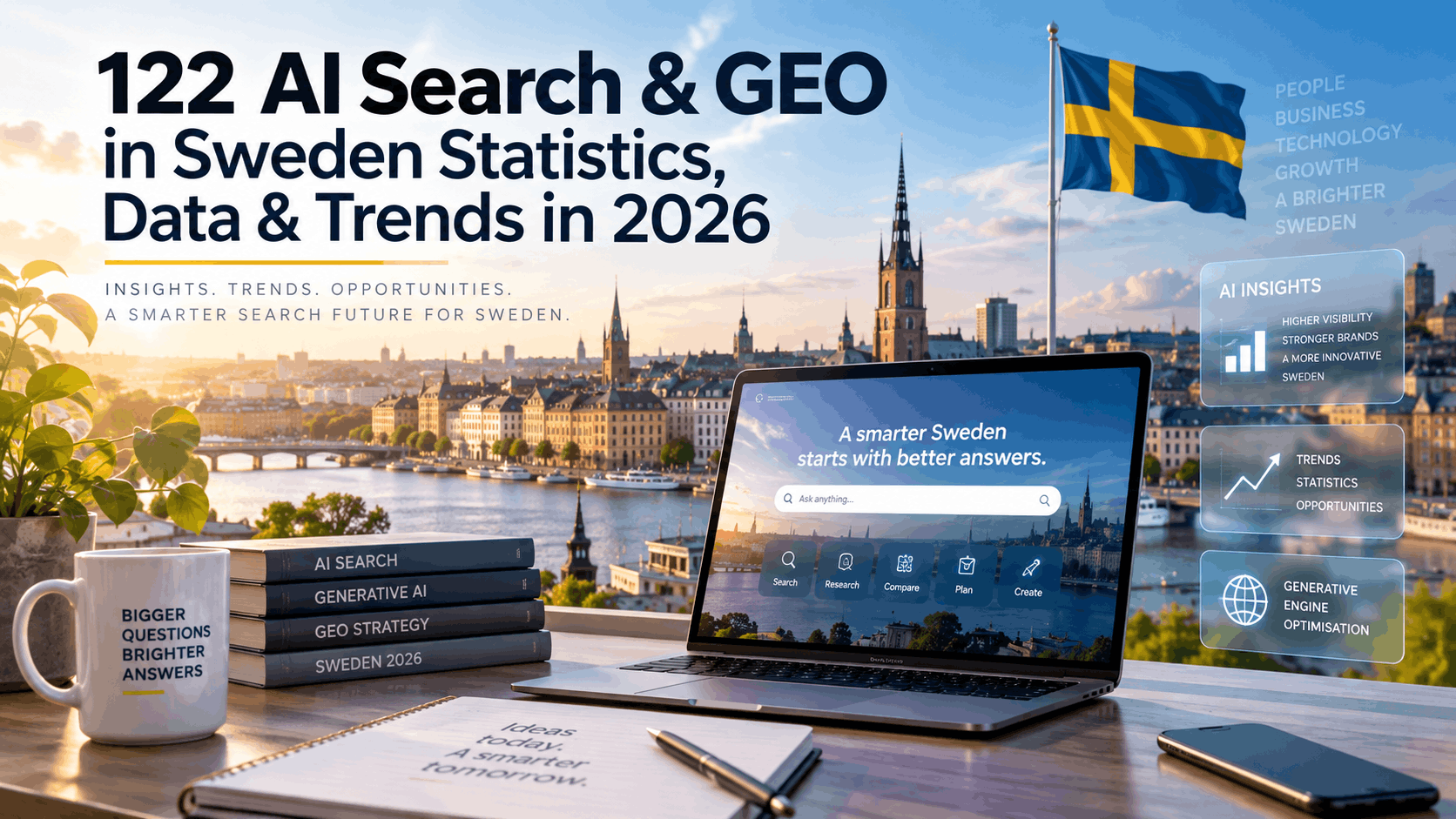
Artificial intelligence is rapidly changing how people in Sweden search for information, research products, evaluate companies, and make purchasing decisions online. In 2026, this transformation extends far beyond the growing popularity of standalone generative AI platforms. Google AI Overviews, ChatGPT, Perplexity, Gemini, AI Mode, and other AI-powered discovery experiences are increasingly becoming part of the broader search journey, creating a new environment in which businesses must compete not only for traditional search rankings but also for mentions, citations, recommendations, and visibility inside AI-generated answers. The 122 AI Search and Generative Engine Optimisation (GEO) statistics examined in this report illustrate just how quickly that transition is developing in Sweden.
Also, read our article on the top SEO and GEO agencies here:
Top 10 Best SEO Agencies in Sweden
Sweden enters the AI search era from an exceptionally strong digital foundation. The country had approximately 10.5 million internet users as of October 2025, equivalent to an internet penetration rate of 98.3%. There were also 14.8 million active cellular mobile connections, representing 139% of the population, while 8.58 million social media user identities accounted for approximately 80.4% of the population. Google remains overwhelmingly dominant in Swedish search, holding approximately 93.1% of the overall search engine market and more than 98% of the mobile search market according to the dataset. These conditions mean that changes to Google’s search experience, particularly the integration of generative AI and AI Overviews, have potentially significant implications for Swedish businesses, publishers, marketers, and e-commerce companies.
The commercial implications are particularly important because Sweden is already an extremely mature digital-commerce economy. The dataset reports that 88% of Swedish consumers had shopped online during the previous 30 days in 2025, while 61% shopped online every week. Sweden’s e-commerce market was valued at approximately US$15.11 billion in 2024 and is projected to reach US$33.61 billion by 2032. As consumers increasingly use conversational AI and AI-enhanced search to compare products, investigate brands, evaluate services, and answer pre-purchase questions, visibility within AI-generated responses could become an increasingly important part of the Swedish customer acquisition funnel.

AI adoption within Swedish businesses is also accelerating rapidly. According to the statistics compiled in this report, 35% of Swedish enterprises with at least 10 employees used some form of artificial intelligence technology in 2025, compared with 25.2% in 2024 and approximately 13% in 2021. Adoption is particularly advanced among larger organisations: 71.9% of large Swedish enterprises used AI in 2025, alongside 49.6% of medium-sized businesses and 30.8% of small enterprises. Among companies already using AI, 41.7% applied it to marketing and sales, making commercial activities one of the most important areas of enterprise AI deployment.
Consumer behaviour is changing at the same time. The dataset indicates that 37% of Swedes aged 16 and older had used generative AI tools during the previous three months as of October 2025, rising substantially from 25% one year earlier. Adoption is especially pronounced among younger people, with approximately 66% of Swedes aged 16–24 using generative AI compared with just 8% among those aged 65 and older. This generational divide matters for businesses planning their long-term digital marketing strategies because younger consumers are increasingly becoming accustomed to asking an AI system for a direct answer rather than navigating a conventional list of search results.
This behavioural shift helps explain why Generative Engine Optimisation is becoming an important complement to traditional Search Engine Optimisation. SEO has historically concentrated on improving a website’s visibility and ranking within conventional search engine results. GEO expands the objective by considering whether a company, product, service, expert, publication, or piece of content can be discovered, understood, referenced, cited, or recommended by generative AI systems. For Swedish organisations, the emerging challenge is therefore no longer simply “Does our website rank on Google?” It increasingly becomes “Does our brand appear when an AI system answers the questions our customers are asking?”
Global AI search statistics contained in the dataset demonstrate the scale of this change. Google AI Overviews reportedly reach approximately 2 billion monthly users globally, while their appearance across searches has expanded considerably. ChatGPT, meanwhile, grew from approximately 400 million weekly active users in early 2025 to more than 800 million by late 2025 according to the compiled figures. AI platforms generated approximately 1.13 billion referral visits worldwide in June 2025, representing a 357% year-over-year increase. At the same time, roughly 60% of searches globally are described as zero-click searches, while an estimated 93% of AI search sessions end without a visit to an external website.
These trends introduce an important distinction between traffic and visibility. In traditional SEO, clicks and organic sessions have historically been among the clearest indicators of search performance. In generative search, a company may influence a buying decision even when the user never visits its website. A brand might be recommended by ChatGPT, cited by Perplexity, referenced within Google AI Overviews, or included in an AI-generated comparison without producing an immediate referral session. Consequently, AI citations, brand mentions, source inclusion, answer visibility, and share of voice are emerging as additional measurements alongside conventional rankings, impressions, clicks, and conversions.
The dataset also highlights why a one-platform approach to GEO may be insufficient. Google AI Overviews, Google AI Mode, ChatGPT, Perplexity, Gemini, Grok, and Claude can display substantially different citation and brand-visibility patterns. The report notes that Google AI Overviews and AI Mode have relatively limited overlap between the URLs and domains they cite, while identical AI queries can produce highly variable results. This volatility means that businesses seeking sustainable AI search visibility may need to develop broad authority across their websites, structured data, editorial content, third-party mentions, research, video, and other credible digital sources rather than attempting to optimise for a single AI interface.
Sweden is particularly interesting within this transition because its wider AI ecosystem is developing alongside consumer adoption. Swedish AI startups raised approximately €454 million in venture capital between January and October 2025, more than three times the €124 million raised throughout 2024, according to the dataset. Swedish businesses were estimated to have invested SEK 40 billion in AI research and development during 2024, while the Swedish government allocated SEK 479 million to AI and data initiatives in its 2026 national budget. The country also hosts more than 200 AI-focused startups, with companies such as Lovable and Legora attracting major international investment.
Yet Sweden’s AI transformation is not without obstacles. Among Swedish enterprises that had not adopted AI, 74.7% cited insufficient relevant in-house expertise as a barrier, 49.1% identified data protection and privacy concerns, 33.5% pointed to implementation costs, and 24.2% cited uncertainty about business benefits. These barriers are important for GEO because effective generative search optimisation sits at the intersection of content strategy, technical SEO, structured data, digital PR, entity authority, analytics, AI search behaviour, and ongoing experimentation. Organisations therefore need more than access to an AI writing tool; they need a systematic approach to making their expertise understandable and trustworthy across both traditional and generative search environments.
The rise of AI search does not mean traditional SEO is disappearing. Google continues to process search activity at a vastly greater scale than individual AI chat platforms according to the statistics in this dataset, and Sweden remains one of Europe’s most Google-dominated search markets. Instead, the emerging landscape is increasingly hybrid. Users may begin research on Google, ask ChatGPT to compare alternatives, consult Perplexity for sourced information, return to Google to verify a company, and eventually visit a brand directly. The report estimates that hybrid journeys involving both Google and ChatGPT already account for a meaningful share of global search sessions.
For marketers, SEO professionals, business owners, publishers, SaaS companies, e-commerce brands, and digital agencies operating in Sweden, the strategic direction is therefore becoming clearer: SEO and GEO should increasingly work together. Strong technical foundations, fast websites, authoritative long-form content, clear entity information, structured data, original research, trustworthy third-party references, and consistent brand information can contribute to visibility across both conventional search engines and AI-generated experiences.
The following collection of 122 AI Search & GEO in Sweden statistics, data and trends for 2026 provides a detailed picture of this emerging market. It examines Sweden’s digital foundations, enterprise AI adoption, generative AI usage, investment and public-sector initiatives, AI search growth, zero-click behaviour, platform citation dynamics, technical GEO signals, generational differences, industry adoption, economic impact, and the evolving role of AI in marketing and online discovery. Together, these statistics reveal a Swedish search ecosystem entering a significant transition: one in which being searchable remains essential, but being understandable, authoritative, and citable by artificial intelligence is becoming increasingly important.
But, before we venture further, we like to share who we are and what we do.
About AppLabx
From developing a solid marketing plan to creating compelling content, optimizing for search engines, leveraging social media, and utilizing paid advertising, AppLabx offers a comprehensive suite of digital marketing services designed to drive growth and profitability for your business.
At AppLabx, we understand that no two businesses are alike. That’s why we take a personalized approach to every project, working closely with our clients to understand their unique needs and goals, and developing customized strategies to help them achieve success.
If you need a digital consultation, then send in an inquiry here.
Or, send an email to hello@applabx.com to get started.
122 AI Search & GEO in Sweden Statistics, Data & Trends in 2026
SECTION 1: SWEDEN’S DIGITAL FOUNDATION
1. Sweden has 10.5 million internet users as of October 2025, representing an internet penetration rate of 98.3% of the total population.
Sweden’s near-universal internet coverage places it among the world’s most digitally mature nations, creating an exceptionally fertile environment for AI-powered search adoption and GEO strategy execution.
2. Sweden has 14.8 million active cellular mobile connections, equivalent to 139% of its total population.
The abundance of mobile connections — exceeding population size — underscores the multi-device reality of Swedish consumers, meaning AI search optimisation must account for mobile-first query patterns from the outset.
3. Sweden has 8.58 million social media user identities, representing 80.4% of the total population.
With over 80% of Swedes active on social media, the content signals that AI systems harvest from social platforms to inform answers are disproportionately strong in the Swedish market.
4. Google holds approximately 93.1% search engine market share in Sweden, with Bing at 4.7% and Yahoo! at 1.4%.
Google’s commanding dominance in Swedish search means that optimising for Google’s AI Overviews — which appear in up to 25% of queries globally — remains the single highest-priority GEO lever for Swedish businesses.
5. On mobile devices, Google’s market share in Sweden exceeds 98%.
The near-total mobile search dominance of Google on Swedish smartphones makes mobile-optimised, AI-friendly content structure a non-negotiable baseline for any GEO programme targeting Swedish consumers.
6. The Swedish e-commerce market was valued at USD 15.11 billion in 2024 and is projected to reach USD 33.61 billion by 2032, at a CAGR of 13.93% from 2026 to 2032.
The rapid expansion of Swedish e-commerce creates intensifying demand for AI search visibility, as product discovery increasingly begins with an AI-generated answer rather than a traditional search result.
7. 88% of Swedish consumers shopped online in the previous 30 days, according to PostNord research from 2025.
With nine in ten Swedes shopping online monthly, e-commerce brands that invest in GEO are positioned to intercept purchase-intent queries at the exact moment AI systems surface answers to product-related questions.
8. 61% of Swedish consumers shop online on a weekly basis.
Weekly online shopping frequency among Swedish consumers signals a high-frequency, habitual digital behaviour that AI search tools are increasingly being used to support throughout the pre-purchase research phase.
9. Stockholm accounts for more than 35% of total online retail sales in Sweden.
The concentration of e-commerce activity in Stockholm — with 96% digital literacy and 99.7% internet connectivity — means that Stockholm-specific GEO strategies can yield disproportionate returns for national brands.
10. 99.7% of Stockholm residents have an internet connection, with 92% purchasing online regularly.
Stockholm’s near-total connectivity and exceptionally high e-commerce participation rate make it one of Europe’s most advanced markets for AI-powered commerce discovery and GEO implementation.
SECTION 2: AI ADOPTION AMONG SWEDISH ENTERPRISES
11. 35.0% of all Swedish enterprises with 10 or more employees stated they used some type of AI technology in 2025, up from 25.2% in 2024.
This near-40% year-on-year leap in enterprise AI adoption is among the fastest documented in Europe, signalling a structural shift from AI experimentation to AI operationalisation across the Swedish business landscape.
12. Swedish enterprise AI adoption has increased by approximately 169% since 2021, when just 13% of companies reported using AI.
The multi-year adoption trajectory confirms that AI is no longer a fringe investment in Sweden — it is rapidly becoming baseline infrastructure, with compounding competitive implications for businesses that delay entry.
13. 71.9% of large Swedish enterprises (250+ employees) used AI in 2025.
Nearly three-quarters of Sweden’s largest companies have integrated AI into their operations, a penetration rate that outpaces the European average and reflects Sweden’s status as a regional AI leader.
14. 49.6% of medium-sized Swedish enterprises (50–249 employees) used AI in 2025.
Mid-market adoption in Sweden has crossed the majority threshold, indicating that AI tools — including those supporting search, content, and customer engagement — are now mainstream in the mid-market segment.
15. 30.8% of small Swedish enterprises (10–49 employees) used AI in 2025.
Nearly one in three small Swedish businesses now uses AI, a significant uptake that reflects the democratisation of AI tooling through accessible SaaS platforms and affordable large language model APIs.
16. 11.1% of Swedish enterprises considered but ultimately decided not to adopt AI in 2025, down from 14.5% in 2024.
The declining share of enterprises in active consideration — without adoption — suggests that the Swedish business community is moving past deliberation and into implementation, compressing the window for first-mover GEO advantage.
17. 65.0% of all Swedish enterprises neither used nor considered using AI in 2025.
The majority of Swedish enterprises remain outside the AI adoption curve, representing a substantial untapped opportunity for AI-native competitors to dominate search and discovery in those sectors without incumbent resistance.
18. 41.7% of AI-adopting Swedish companies use AI for marketing and sales purposes.
Marketing and sales is the most common AI use case in Swedish enterprises, reflecting the immediate commercial relevance of AI for content creation, lead generation, and — increasingly — generative search optimisation.
19. 35.0% of AI-adopting Swedish companies use AI for business administration and management processes.
AI-driven administrative automation is the second most prevalent use case, freeing up resources that forward-looking Swedish businesses are redirecting toward higher-impact activities such as content strategy and GEO.
20. 26.2% of AI-adopting Swedish companies use AI for production or service delivery processes.
More than a quarter of Sweden’s AI-enabled businesses apply the technology directly in service production, a trend that is creating structured, machine-readable operational data that feeds AI search systems’ knowledge of these companies.
21. 18.5% of AI-adopting Swedish companies use AI in research and development.
AI-powered R&D in Sweden is generating proprietary knowledge assets — white papers, case studies, technical documentation — that when properly structured represent high-value GEO citation targets.
22. 5.7% of AI-adopting Swedish companies use AI for logistics, the least common enterprise use case.
The underpenetration of AI in Swedish logistics represents a whitespace opportunity, as logistics companies that invest in AI-rich, authoritative content can capture early-mover advantage in AI search visibility for supply-chain-related queries.
23. 62.1% of AI-using Swedish enterprises acquire AI by purchasing ready-to-use commercial software, up 7.5 percentage points from 2024.
The dominance of off-the-shelf AI software acquisition signals that Swedish businesses are prioritising speed-to-deployment over bespoke development, with AI-native SaaS tools becoming the default entry point to AI-assisted operations.
SECTION 3: BARRIERS TO AI ADOPTION IN SWEDEN
24. 74.7% of non-AI-adopting Swedish enterprises cite lack of relevant in-house expertise as their primary barrier to AI adoption.
The talent shortage is the single greatest structural obstacle to AI adoption in Sweden, a fact that positions external GEO consultancies, AI training programmes, and knowledge-sharing initiatives as critical enablers of the market.
25. 49.1% of non-adopting Swedish companies cite data protection and privacy concerns as a barrier, up from 41.8% in 2024.
Growing sensitivity to data privacy among Swedish businesses — operating under both EU GDPR and the incoming EU AI Act — is shaping how organisations deploy AI for search and content, with privacy-safe GEO frameworks becoming a competitive differentiator.
26. 33.5% of non-adopting Swedish companies cite high implementation cost as a barrier.
Cost remains a real constraint for smaller Swedish operators, yet the rapid commoditisation of AI tooling and the emergence of GEO-as-a-service models is progressively lowering the financial threshold for participation.
27. 24.2% of non-adopting Swedish companies cite unclear business benefits as a barrier.
The inability to articulate ROI from AI investment remains a significant drag on adoption; organisations that can demonstrate measurable GEO outcomes — such as AI citation rate and referral traffic uplift — will find it easier to secure internal investment.
28. 16.9% of non-adopting Swedish companies believe AI is simply not useful for their enterprise, down from 20.2% in 2024.
The declining share of Swedish businesses dismissing AI as irrelevant reflects growing awareness of practical applications, suggesting that education — especially around GEO and AI search visibility — can accelerate enterprise adoption.
SECTION 4: SWEDISH GENERATIVE AI CONSUMER USAGE
29. 37% of Swedes aged 16 and over have used generative AI tools in the previous three months, as of October 2025, up from 25% one year earlier.
This 12-percentage-point annual increase in Swedish generative AI usage represents a structural shift in information-seeking behaviour — one that directly reduces reliance on traditional search engine result pages and elevates GEO as a business imperative.
30. Approximately 3.2 million Swedes actively use generative AI tools as of late 2025.
With 3.2 million Swedish consumers consulting AI platforms for information, brands that lack visibility in AI-generated answers are effectively invisible to a fast-growing and high-intent segment of the market.
31. Sweden has approximately 96% of its population aged 16 and over active online, among the highest internet engagement rates in the world.
Near-universal digital participation in Sweden creates a national search landscape where AI-powered tools gain adoption rapidly and at scale, amplifying the urgency of GEO investment for businesses across all sectors.
32. In Sweden, approximately 66% of individuals aged 16–24 (Generation Z) use generative AI tools, compared to 8% of those aged 65 and above.
The dramatic generational divide in Swedish AI tool usage confirms that GEO is not a niche strategy for future audiences — it is a present-tense priority for the cohort with the longest purchasing lifetime ahead of them.
33. An estimated 56% of Swedish Millennials (aged 25–34) use generative AI tools, compared to approximately 28% of Gen X consumers aged 45–54.
The strong AI uptake among Swedish Millennials — many of them in peak earning and purchasing years — means that brands targeting this demographic must treat AI search visibility as a mainstream marketing channel.
34. According to SCB’s 2025 IT survey, Sweden’s generative AI usage grew at 12 percentage points in a single year, the largest single-year increase recorded since SCB began tracking this metric.
A 12-point annual leap is exceptional by any measure and signals that Sweden is at an inflection point where generative AI usage will likely cross 50% within the next 12–18 months if the current trajectory holds.
35. Among young Swedes aged 16–24, an estimated two-thirds use ChatGPT or similar AI chat tools as an alternative or complement to traditional search engines.
When two-thirds of Sweden’s youngest adult consumers routinely bypass traditional search results in favour of conversational AI answers, the commercial cost of GEO inaction becomes quantifiable and immediate.
SECTION 5: GLOBAL AI SEARCH TRENDS AFFECTING SWEDEN
36. Google AI Overviews now reach 2 billion monthly users globally, up from 1.5 billion in May 2025.
Google’s AI Overviews have become the most widely adopted AI search feature in history; Swedish businesses operating internationally or targeting Swedish users of Google must now optimise for AI Overview inclusion as a primary SEO objective.
37. Google’s AI Overviews appear in approximately 25.11% of Google searches globally as of mid-2025, up from 13.14% in March 2025.
The near-doubling of AI Overview trigger frequency in under a year means that a quarter of all Google searches now produce AI-synthesised answers — making structured, AI-readable content the new baseline for effective Swedish SEO.
38. AI Overviews now reduce organic click-through rates by approximately 58%, according to Ahrefs research from February 2026.
Swedish digital publishers and e-commerce businesses heavily dependent on organic traffic must urgently diversify their visibility strategies toward AI citation, as zero-click behaviour increasingly erodes the traditional link-click model.
39. AI Overviews appear in just 7.9% of local searches, according to Ahrefs analysis from November 2025.
Local businesses in Sweden — from Stockholm retailers to regional service providers — benefit from relatively low AI Overview disruption in local search, but this represents a narrowing window of protection as AI systems expand their local knowledge.
40. AI Overviews give accurate answers 85–91% of the time, meaning they are inaccurate in 9–15% of cases.
The documented inaccuracy rate of AI Overviews underscores the importance of Swedish brands actively ensuring that accurate, authoritative information about their products and services is well-represented in AI-training data and crawlable web content.
41. ChatGPT grew from 400 million weekly active users in early 2025 to over 800 million by late 2025.
The doubling of ChatGPT’s weekly active user base within a single year is the strongest signal yet that AI-powered search is entering its mainstream mass-adoption phase, with Swedish users participating at rates consistent with other developed markets.
42. ChatGPT now processes more than 1 billion queries per day.
With one billion daily queries, ChatGPT’s scale as an information intermediary rivals traditional search for certain query types; Swedish businesses that are cited in ChatGPT responses gain access to a distribution channel of unprecedented scale.
43. ChatGPT accounts for approximately 77–81% of all AI-driven website referral traffic globally as of early 2026.
ChatGPT’s dominance of AI referral traffic means it must be the primary platform for Swedish GEO strategy, with optimisation efforts focused on earning citations and structured mentions within ChatGPT’s responses.
44. Perplexity accounts for approximately 15% of all AI referral traffic globally.
As the second-largest AI traffic source, Perplexity’s citation-first architecture makes it a particularly high-value GEO target for Swedish brands, especially in B2B and research-intensive sectors where Perplexity users concentrate.
45. AI referral traffic now accounts for approximately 1.08% of all global website traffic, growing at roughly 1% per month.
While AI referral traffic remains a small fraction of total website visits, its month-on-month growth rate implies it could represent 10–15% of all traffic within two to three years — making early GEO investment in Sweden a strategic priority.
46. AI platforms generated 1.13 billion referral visits globally in June 2025, a 357% increase from June 2024.
The 357% year-on-year growth in AI referral visits is the most definitive quantitative proof that AI search is transitioning from supplementary to primary discovery channel, reshaping the competitive landscape for Swedish businesses.
47. AI search traffic converts at 14.2% compared to Google organic search’s 2.8%, representing a 5x conversion rate advantage.
The dramatically higher conversion rate of AI referral traffic — likely reflecting the high intent of users who receive a curated AI answer and then click through — makes AI search visibility five times more commercially valuable per visit than traditional organic search.
48. Total global search activity (combining traditional search engines and AI LLMs) has increased by 26% worldwide in early 2026.
The overall growth of search activity proves that AI search is additive, not purely substitutive, for traditional search — Swedish businesses must target both ecosystems simultaneously to maximise total search visibility.
49. Gartner predicted that traditional search engine query volume would decline 25% by 2026, and 2025 data shows that trajectory is broadly on course.
The structural decline of traditional search volume anticipated by Gartner is materialising in real traffic data; Swedish businesses that have not yet begun transitioning budget and effort toward GEO and AEO strategies risk compounding competitive disadvantage.
50. 60% of searches globally are now completed without users clicking through to any external website (zero-click searches).
Six out of ten searches satisfying themselves within the search interface — without a single outbound click — represent a complete commercial realignment for Swedish digital marketers who have built revenue models on organic click-through traffic.
51. Approximately 93% of all AI search sessions end without the user visiting a third-party website.
The near-total zero-click behaviour in AI search sessions makes brand mentions and citations within AI-generated responses the new form of digital shelf space — one that Swedish brands must actively earn through GEO.
52. 75% of people globally report using AI search tools more than they did a year ago, and 43% use them daily or more.
The rapid habituation to AI search tools — with nearly half of users now interacting with them daily — means Swedish companies can expect a sizable share of their target audiences to encounter AI-generated answers about them in the near term.
53. 82% of Generation Z users globally prefer AI tools that provide direct answers over traditional web search.
For Swedish brands targeting the 16–24 demographic, the generational preference for AI-sourced direct answers over link lists makes investment in GEO not merely advantageous but commercially essential.
54. 28% of Gen Z globally begin their searches via AI chatbot rather than a traditional search engine.
Nearly three in ten Gen Z consumers now open an AI chat interface — not a search engine — when they have a question, fundamentally repositioning AI chatbot visibility as front-of-funnel for the youngest generation of Swedish consumers.
55. Only 10% of users trust the first result in an AI search, while 48% verify answers across multiple platforms.
The verification behaviour of AI search users — checking across platforms — means Swedish brands must maintain consistent, accurate, and authoritative presence across ChatGPT, Perplexity, Gemini, and Google AI Overviews simultaneously.
56. 62% of consumers globally trust AI recommendations more when brand citations include source links.
The trust premium placed on cited, verifiable AI answers reinforces the need for Swedish businesses to ensure their owned content is both AI-readable and sourced from high-authority domains that AI systems are likely to cite.
57. In 2026, across developed markets, approximately 29% of adults initiate one or more searches daily with AI-generated summaries, compared to 10% using standalone generative AI apps.
Passive AI exposure through integrated search features is already nearly three times more common than active standalone AI app usage, meaning Swedish consumers are encountering AI-generated information at far greater rates than survey-based AI adoption figures suggest.
58. Deloitte forecasts that by mid-2026, more adults globally will have generated a search overview (72%) than will have used a standalone generative AI tool (61%).
Integrated AI search experiences embedded within existing platforms — particularly Google — are already outpacing standalone AI tool adoption, amplifying the importance of Google AI Overview optimisation for Swedish search strategies.
59. The GEO market is valued at $848 million globally in 2025 and projected to reach $33.7 billion by 2034, at a 50.5% CAGR.
The extraordinary projected growth of the GEO market — a 40-fold increase over nine years — signals the emergence of an entirely new digital services category that forward-looking Swedish agencies and in-house teams cannot afford to ignore.
SECTION 6: SWEDISH AI INVESTMENT & ECOSYSTEM
60. Swedish AI startups raised €454 million in venture capital between January and October 2025, more than three times the €124 million raised across the whole of 2024.
The tripling of Swedish AI startup funding in under a year is the most dramatic indicator of investor confidence in Sweden’s AI ecosystem — a signal that the infrastructure, talent, and products for an AI-led search economy are being built at speed.
61. Sweden’s business sector invested an estimated SEK 40 billion (approximately €3.5 billion) in AI research and development in 2024 alone.
With €3.5 billion in private AI R&D, Sweden’s corporate sector is building the proprietary AI capabilities that will shape domestic AI search landscapes, product recommendation systems, and content generation platforms.
62. The Swedish government allocated SEK 479 million to AI and data initiatives in the 2026 national budget, the country’s first specifically earmarked AI investment.
The government’s first dedicated AI budget line signals official recognition of AI as national strategic infrastructure — a policy signal that will accelerate both public-sector AI adoption and commercial AI investment in Sweden.
63. Sweden hosts approximately 211 AI-focused startups as of 2024, with the ecosystem continuing to grow.
With over 200 AI-native startups, Sweden’s startup density per capita in AI compares favourably with other European technology hubs, creating a competitive domestic AI product landscape that is shaping GEO tooling and service provision.
64. Sweden ranks #4 globally for AI venture capital investment as a share of total global AI VC, according to the Stanford AI Index.
Sweden’s top-four ranking in global AI venture capital investment — above much larger economies — confirms its status as a disproportionate contributor to the global AI innovation landscape relative to its population size.
65. Sweden ranks #7 globally in Government AI Readiness, according to the Oxford Insights AI Readiness Index.
A top-ten Government AI Readiness ranking reflects Sweden’s high-quality digital infrastructure, strong data governance frameworks, and proactive public-sector AI deployment — all factors that accelerate the national adoption of AI search technologies.
66. Sweden improved from #25 to #19 in the Tortoise Global AI Index between 2023 and 2025.
The six-place improvement in Sweden’s global AI ranking over two years reflects the cumulative effect of increased startup activity, government investment, and accelerating enterprise adoption — positioning Sweden as one of Europe’s most dynamic AI economies.
67. Lovable, a Swedish AI startup, raised approximately $200 million in a single funding round in 2025, making it one of the world’s fastest-growing AI startups.
Lovable’s mega-round — among the largest ever for a Swedish tech startup — demonstrates that globally scalable AI products can emerge from Sweden, validating the country’s AI talent base and market credibility on the world stage.
68. Legora, a Swedish AI startup, raised approximately $180 million in 2025.
Legora’s fundraise, closely following Lovable’s, confirms that Sweden is producing a cluster of globally significant AI ventures — a concentration of AI capability that will shape local market norms around AI adoption, including in search and content.
SECTION 7: PUBLIC SECTOR AI IN SWEDEN
69. Approximately 90% of Swedish municipalities have at least one AI initiative in operation, with more than 1,000 local AI projects documented nationally.
The extraordinary breadth of AI deployment across Swedish local government — encompassing nine in ten municipalities — reflects a public sector at the forefront of AI adoption in Europe, creating public familiarity with AI-powered services that reinforces consumer comfort with AI search tools.
70. Sweden’s AI Commission, reporting in late 2024, identified talent shortage, data access limitations, and regulatory uncertainty as the three primary barriers to Sweden fulfilling its AI potential.
The AI Commission’s diagnosis of structural obstacles provides a policy roadmap; as Sweden acts on each recommendation — particularly through the 2026 national AI strategy — the conditions for accelerated AI search adoption will systematically improve.
71. Sweden’s national AI strategy for 2026, due in the first half of the year, will emphasise innovation-friendly AI regulation, including AI sandboxes and industry guidelines.
The innovation-first orientation of Sweden’s 2026 AI strategy positions the country as a hospitable environment for AI experimentation, signalling a regulatory tone that favours commercial AI deployment over precautionary restriction.
72. The Swedish Authority for Privacy Protection (IMY) and the Swedish Agency for Digital Government (DIGG) are being positioned as the primary oversight bodies for EU AI Act compliance in Sweden.
Clear regulatory jurisdiction over AI compliance provides Swedish businesses with a defined accountability framework — one that, when navigated correctly, can actually become a trust signal that reinforces AI-generated content authority in search systems.
SECTION 8: AI’S ECONOMIC IMPACT ON SWEDEN
73. AI is expected to increase Sweden’s labour productivity by up to 37% by 2035 — the highest projected productivity gain for any country modelled in the study.
Sweden’s #1 global ranking for projected AI-driven productivity gains reflects the depth of digital integration in Swedish industry; businesses that embed AI — including AI-powered search strategies — into their operations earliest stand to capture the largest share of this productivity dividend.
74. Generative AI alone is projected to deliver SEK 100 billion in productivity value to Sweden’s manufacturing and construction sectors over the next decade.
A hundred-billion-krona productivity impact in manufacturing alone underscores the transformative scale of generative AI’s economic effect on Sweden, creating both demand for AI-powered content tools and commercial incentive to invest in GEO.
75. The Swedish AI market is projected to reach USD 1.57 billion in revenue in 2025, growing at a CAGR of 26.24% to reach USD 6.35 billion by 2031.
The Swedish AI market’s projected 26% compound annual growth rate — sustained over six years — makes it one of the fastest-growing AI markets in Europe relative to population size, with GEO services as an increasingly substantial sub-segment.
76. AI could contribute between SEK 25 billion and SEK 100 billion in productivity gains to Sweden’s information and finance sectors through generative AI applications.
The projected productivity gains in finance and ICT — Sweden’s most AI-mature sectors — confirm that early AI adopters in these industries are best positioned to leverage GEO for competitive advantage in AI-mediated search and discovery.
77. Generative AI could affect 20–30% of work activities across all occupation types in Sweden, according to Implement Economics modelling.
The exposure of one-fifth to one-third of Swedish work tasks to AI automation creates structural pressure to invest in AI-enhanced workflows — including AI-supported content production and GEO strategies — as a means of augmenting, not replacing, human capability.
SECTION 9: AI SEARCH PLATFORM DYNAMICS
78. The average AI Mode answer on Google contains 12.6 links, while AI Overviews link to 13.3 sources on average.
The multi-source citation architecture of Google AI Overviews creates 13 potential citation opportunities per query — opportunities that Swedish businesses with well-structured, authoritative content are positioned to claim.
79. Despite both being Google products, AI Overviews and AI Mode show just 10.7% URL overlap and 16% domain overlap in their cited sources.
The distinct sourcing behaviour of Google’s two AI products means that a Swedish business cited in AI Overviews is not automatically cited in AI Mode — requiring platform-specific GEO optimisation strategies for each feature.
80. Google AI Mode had overlapping results with itself just 9.2% of the time across three identical queries — demonstrating extreme response volatility.
The high volatility of AI Mode responses means that Swedish brands cannot rely on a single optimisation push to achieve consistent AI search presence; ongoing content maintenance, freshness, and authority building are continuous requirements.
81. The same brand can see citation volumes differ by a factor of 615 times between the highest-citing platform (Grok) and the lowest-citing platform (Claude), according to Superlines research from March 2026.
The 615x citation volume gap between AI platforms is arguably the most important statistic in GEO for 2026 — Swedish brands operating on a single-platform GEO strategy risk near-total invisibility on competing platforms.
82. Grok generates a 27.01% citation rate and 8.47% brand visibility for tracked brands; Perplexity generates 13.05% and 0.64%; Google AI Mode generates 9.09% and 2.14%.
The dramatic variation in citation behaviour across AI platforms necessitates a diversified, multi-platform GEO strategy for Swedish brands — with Grok and Perplexity requiring fundamentally different content and authority signals than Google’s AI products.
83. Gemini cited a tracked website 182 times in 30 days but mentioned the brand name zero times — a phenomenon termed “ghost citations.”
The ghost citation phenomenon — where AI systems link to content without mentioning the brand — highlights a critical gap in traditional SEO metrics for Sweden: organic traffic may appear without any brand awareness benefit, making explicit brand mention optimisation a distinct GEO discipline.
84. Perplexity generated 20 times more website links than brand name mentions in tracked studies.
Perplexity’s disproportionate website-linking versus brand-mentioning behaviour means Swedish businesses cannot infer brand visibility from referral traffic alone — dedicated AI brand monitoring tools are essential for accurate GEO measurement.
85. 87.4% of all AI referral traffic globally originates from ChatGPT, according to Conductor 2026 Benchmarks.
ChatGPT’s near-monopoly on AI referral traffic generation reinforces its position as the indispensable platform for Swedish GEO investment, even as brands must simultaneously maintain visibility across Perplexity, Gemini, and AI Mode.
SECTION 10: CONTENT & TECHNICAL GEO SIGNALS
86. Only 12.4% of Fortune 1000 companies globally possess valid Organisation Schema linked to a Knowledge Graph ID, according to Fuel Online’s 2026 AI Index.
The extraordinary scarcity of properly structured Knowledge Graph schema among large enterprises reveals a massive technical GEO gap — one that Swedish businesses can exploit as a differentiation opportunity with relatively low implementation cost.
87. 34% of B2B SaaS companies globally actively block AI crawlers via robots.txt, effectively removing themselves from AI search consideration sets.
Swedish B2B technology companies that block AI bots in their robots.txt configuration are silently self-excluding from AI-mediated discovery — a counterproductive policy that must be reviewed as part of any GEO audit.
88. 62% of brands globally are “technically invisible” to generative AI models when asked direct, unbranded questions about their core services.
Nearly two-thirds of brands failing to appear in unbranded AI queries represent the dominant challenge in GEO: the gap between a company’s website existing and that company’s expertise being accessible to AI systems is wide, structural, and addressable.
89. When asked direct questions about their core services, AI models failed to cite brands in 81% of test cases globally.
The 81% non-citation rate in brand-relevant AI queries quantifies the scale of Swedish businesses’ current invisibility in AI search — and the magnitude of opportunity available to early GEO adopters who earn consistent AI citations.
90. Content that loads faster is more likely to be included in AI Overviews, making page speed a GEO ranking signal in addition to a traditional SEO signal.
Site speed’s dual relevance to both traditional SEO and AI system indexability means that Swedish businesses improving technical performance gain compounding benefits across both search ecosystems simultaneously.
91. AI referral traffic visitors browse 12% more pages per visit and show a 23% lower bounce rate than non-AI referral visitors, according to Adobe research.
The measurably superior engagement quality of AI referral traffic — more pages visited, lower bounce — validates AI search as a high-intent acquisition channel that deserves disproportionate investment relative to its current traffic share.
92. Web traffic from generative-AI-driven referrals increased more than 10 times in the United States between July 2024 and February 2025.
The US market’s 10x growth in AI referral traffic over eight months provides a leading indicator for Sweden: comparable growth trajectories are likely to follow as Swedish AI search adoption continues its rapid ascent.
93. Content depth — specifically sentence count and word count — and readability are the strongest predictors of AI Overviews inclusion, while traditional SEO metrics like traffic and backlinks have limited impact.
The decoupling of GEO success from traditional link-building and traffic metrics fundamentally repositions the content and editorial function within Swedish marketing organisations — quality, depth, and clarity now matter more than domain authority for AI citation.
94. BrightEdge data shows a 121% increase in e-commerce-related YouTube citations within Google AI Overviews.
The rapid growth of YouTube as a source cited in AI Overviews creates a new content channel imperative for Swedish e-commerce brands: video content with accompanying transcripts and structured descriptions is now a viable GEO asset.
SECTION 11: SWEDISH INDUSTRY-SPECIFIC AI CONTEXT
95. Sweden’s ICT sector leads AI adoption, with significantly above-average penetration compared to other domestic industries.
The ICT sector’s leadership in AI adoption positions Sweden’s technology companies as both the most GEO-capable businesses and the most vulnerable to AI-driven disruption of software and services discovery, requiring proactive AI visibility management.
96. Klarna, a Swedish fintech company, uses AI for credit risk assessment, customer service automation, and analytics — and publicly attributes significant operational cost reduction to AI deployment.
Klarna’s AI-driven operational transformation has become a globally cited benchmark; the brand’s frequent appearance in AI-generated answers about fintech and BNPL represents a successful organic GEO outcome built on genuine topical authority.
97. Volvo Group uses AI in logistics and autonomous vehicle systems, representing one of Sweden’s highest-profile industrial AI deployments.
Volvo’s industrial AI leadership creates extensive structured, machine-readable technical content — patent filings, technical documentation, research publications — that reinforces the brand’s authority in AI-generated responses about automotive AI globally.
98. IKEA and H&M use AI for personalisation, inventory optimisation, and visual search, with AI-powered systems directly shaping the consumer discovery experience.
IKEA’s and H&M’s investments in AI-powered visual search and personalisation represent a front-end manifestation of GEO thinking — ensuring that product information is structured, machine-readable, and surfaced effectively in AI-mediated discovery contexts.
99. SEB and Swedbank apply AI for fraud detection, algorithmic trading, and customer service chatbots in Sweden’s financial services sector.
Swedish banking AI deployments in customer-facing chatbots create direct AI search experiences for Swedish consumers — familiarising Swedish financial consumers with AI-mediated information retrieval and setting expectations for AI quality across other sectors.
100. STIM, the Swedish music rights organisation, launched the world’s first AI music licensing framework in 2025.
Sweden’s pioneering role in AI-content licensing — through STIM’s framework — signals a broader cultural sophistication around AI content governance that will influence how Swedish businesses approach the intellectual property dimensions of GEO content production.
SECTION 12: GENERATIONAL AI SEARCH BEHAVIOUR
101. 76% of Swedish and global Generation Z consumers have used standalone generative AI tools, the highest rate of any generation, according to Deloitte 2025.
Generation Z’s majority adoption of standalone AI tools — not just embedded AI — means that GEO must account for direct-query AI usage patterns, not just incidental AI overview exposure, when targeting Sweden’s youngest adult consumers.
102. 93% of Gen Z knowledge workers aged 22–27 use two or more AI tools weekly, according to a Google survey.
The multi-tool AI behaviour of young Swedish professionals signals that GEO visibility cannot be achieved on a single platform — appearing in ChatGPT, Perplexity, and Google AI simultaneously is the minimum viable strategy for brands targeting this cohort.
103. 56% of Millennials globally use generative AI at work, according to Deloitte, with 90% comfortable using AI in professional settings.
Swedish Millennials’ high professional AI adoption — with almost universal comfort using AI at work — means that B2B brands serving Millennial decision-makers must prioritise AI search visibility in work-related discovery contexts.
104. 59% of Gen X adults globally report using AI-powered assistants and chatbots more frequently in 2026 than two years prior.
Contrary to conventional wisdom, Gen X adoption of AI tools is growing at pace — a trend that Swedish brands targeting the 46–59 demographic should factor into their GEO investment calculations.
105. 35% of Baby Boomers globally have passively used AI features embedded in search or applications, even if they have not knowingly used a standalone AI tool.
Swedish Boomers’ passive AI exposure through embedded search features means that even the least AI-aware demographic is increasingly encountering AI-generated brand information — making GEO relevant across all age groups.
SECTION 13: ZERO-CLICK & CLICK BEHAVIOUR
106. AI Overviews drive over 10% more Google queries for the types of searches that trigger them, indicating that users actively seek out AI-powered results.
The counter-intuitive finding that AI Overviews generate incremental search activity — rather than purely substituting existing queries — suggests that optimising for AI Overview inclusion can grow Swedish brand exposure beyond the existing search baseline.
107. In early 2025, 88% of queries that trigger AI Overviews were informational in nature, targeting top-of-funnel awareness content.
The concentration of AI Overviews in informational queries means that Swedish businesses investing in comprehensive, authoritative informational content are best positioned to appear in AI Overviews — reinforcing the strategic value of thought leadership and educational content as GEO assets.
108. By late 2025, AI Overviews had expanded into commercial queries, with commercial intent coverage rising from 8% to 18% of AI Overview appearances.
The doubling of AI Overviews in commercial intent contexts signals that AI search is beginning to influence purchase decisions, not just awareness — raising the commercial stakes of GEO for Swedish e-commerce and B2B brands significantly.
109. ChatGPT referral traffic to e-commerce websites generates lower conversion rates and lower revenue per session than Google’s organic and paid search, according to research by Kaiser and Schulze, October 2025.
While AI referral traffic converts well in aggregate, e-commerce-specific AI traffic currently underperforms Google traffic on revenue metrics — a nuance Swedish e-commerce teams must factor into channel attribution and GEO investment ROI modelling.
110. ChatGPT accounted for 20% of Walmart’s referral clicks in August 2025, up from 15% the previous month.
Walmart’s rapid growth in ChatGPT referral traffic provides a concrete proxy for the trajectory Swedish retailers can expect: AI referral shares are growing month by month, with the largest retailers seeing the steepest absolute gains.
111. Outbound referral traffic from ChatGPT to the rest of the web grew 206% in 2025, with over 30% of all ChatGPT referral traffic going to just 10 domains.
The concentration of ChatGPT referral traffic in a small number of domains reveals the winner-takes-most dynamics of AI referral distribution; Swedish brands that establish early AI citation authority are likely to capture a disproportionate share of the referral traffic in their categories.
SECTION 14: AI SEARCH & THE SWEDISH MARKETING SECTOR
112. 54% of US marketers plan to implement GEO within 3–6 months, according to eMarketer, January 2026 — with European markets, including Sweden, expected to follow similar adoption curves.
The rapid near-term GEO implementation intentions among North American marketers provide a leading indicator for Swedish marketing practice; Swedish agencies and in-house teams that move in 2026 can lead the European GEO adoption curve.
113. Only 22% of marketers globally are actively tracking AI visibility and traffic metrics, according to industry analysis.
The vast majority of marketers — including Swedish ones — are not yet measuring their AI search performance, representing an accountability gap that, when closed, will enable data-driven GEO strategy rather than experimentation-based guesswork.
114. 80% of B2B technology buyers globally trust generative AI as much as traditional search when researching suppliers, according to Responsive’s Buyer Intelligence 2025 report.
For Swedish B2B companies, the equivalence of AI trust to traditional search trust among buyers means that AI search visibility is now directly linked to pipeline generation — not merely brand awareness.
115. 92% of Swedish enterprises are estimated to use AI in at least one business function by 2026, extrapolating from the 35% of enterprises with 10+ employees using AI and factoring in broader embedded AI use across all company sizes.
If AI function use is attributed broadly — including AI embedded in business software — near-universal AI penetration in Swedish enterprise creates a domestic market environment where AI-powered content, search, and discovery tools are standard operational infrastructure.
116. AI-driven search has surged from under 10% of total search interactions in 2023 to approximately 30% by 2026, representing a fundamental shift in global query volume distribution.
The tripling of AI search’s share of total search interactions over three years is the headline statistic of the search ecosystem transformation — a transformation that Sweden, with its high AI adoption rates, is experiencing at the leading edge.
117. 42% of people globally prefer using AI chatbots over search engines for multi-step research tasks, according to survey data.
The preference for AI chat over search engines for complex, multi-step research — precisely the kind of high-intent research that precedes B2B purchasing decisions — means Swedish brands must structure their content to excel in AI-synthesised, multi-turn research scenarios.
118. Hybrid search journeys — where users move between Google and ChatGPT for the same research task — now account for 18% of all search sessions globally.
Nearly one in five search sessions now spans multiple platforms, with users cross-referencing AI and traditional search results; Swedish brands must maintain consistent, non-contradictory information across both ecosystems to build credibility in hybrid research journeys.
119. Google processes approximately 14 billion search queries daily, while ChatGPT handles approximately 37.5 million per day — a ratio of 373:1 in Google’s favour, according to SparkToro.
The 373:1 query volume gap between Google and ChatGPT provides critical perspective for Swedish GEO investment allocation: Google AI Overviews still command the majority of AI-influenced search exposure, making traditional SEO foundations indispensable alongside GEO.
120. 50% of Google searches are estimated to already include an AI summary of some kind as of 2026, with McKinsey projecting this will exceed 75% by 2028.
The trajectory toward three-quarters of all Google searches incorporating an AI-generated summary by 2028 establishes a clear horizon for Swedish businesses: AI search visibility will shift from competitive advantage to table stakes within the next two years.
121. Sweden entered 2026 with approximately 35% of enterprises having adopted AI — compared to a global average of approximately 35% and a top-quartile European average of approximately 40% — suggesting it is in line with leading European peers but has material headroom before the US and Asian leaders.
Sweden’s positioning within the leading cohort of European AI adopters — but below the US and Asia — defines the competitive context for Swedish GEO investment: sophisticated enough to demand serious strategy, but early enough to reward first movers with durable advantage.
122. AI is expected to contribute USD 15.7 trillion to the global economy by 2030, with Sweden expected to capture a disproportionately high share per capita given its AI readiness ranking and innovation infrastructure.
Sweden’s top-ten global AI readiness ranking positions it to capture above-average per-capita economic value from AI — with GEO forming a critical commercial layer through which that AI economic value is surfaced, distributed, and monetised.
Conclusion
nd enterprise audiences.
Among Swedish enterprises with at least 10 employees, 35% reported using AI technologies in 2025, rising sharply from 25.2% in 2024. Adoption reached 71.9% among large enterprises and 49.6% among medium-sized businesses, while marketing and sales emerged as a major AI use case. These figures indicate that artificial intelligence is moving beyond experimentation and becoming increasingly embedded within Sweden’s commercial environment.
Consumer behaviour is evolving just as quickly. According to the dataset, 37% of Swedes aged 16 and older had recently used generative AI by late 2025, compared with 25% a year earlier. Usage was particularly strong among younger Swedes, reaching approximately 66% among people aged 16–24. As younger consumers increasingly become accustomed to receiving direct answers from AI systems, brands may need to think beyond traditional rankings and consider whether their businesses are visible, understood, mentioned, and cited within generative search experiences.
Global search trends reinforce this direction. Google AI Overviews have expanded to billions of users, AI-generated answers are contributing to increasingly zero-click search journeys, and AI platforms are becoming meaningful sources of website referrals and brand discovery. The statistics also demonstrate that ChatGPT, Perplexity, Gemini, Google AI Mode, AI Overviews, Grok, and other systems can differ substantially in how they select sources and mention brands. Consequently, there is unlikely to be a single formula for achieving visibility across every generative engine.
This is where Generative Engine Optimisation (GEO) in Sweden becomes increasingly relevant. GEO extends conventional SEO by focusing not only on search rankings and clicks but also on the ability of AI systems to discover, interpret, trust, cite, and recommend a brand’s information. Technical accessibility, structured data, clear entity information, authoritative content, original expertise, page performance, third-party references, content depth, and consistent brand signals can therefore become increasingly important components of an integrated search strategy.
Traditional SEO nevertheless remains essential. Google’s overwhelming dominance in Sweden means businesses should not abandon established search optimisation in pursuit of AI visibility. Instead, the strongest approach for 2026 is increasingly a combined SEO and GEO strategy designed for hybrid search journeys in which consumers move between Google, AI-generated summaries, conversational assistants, websites, social platforms, and other information sources before making a decision.
Sweden’s broader AI ecosystem provides additional momentum. The dataset highlights rapidly rising AI investment, more than 200 AI-focused startups, increasing government support, extensive public-sector experimentation, and significant projected productivity benefits from artificial intelligence. Combined with Sweden’s high connectivity and growing generative AI usage, these conditions position the country as an important European market for observing how AI-powered discovery develops.
Ultimately, the 122 AI Search & GEO in Sweden statistics, data and trends in 2026 suggest that search visibility itself is being redefined. Ranking prominently in traditional search results remains valuable, but businesses increasingly need to consider another question: when Swedish customers ask an AI system about a product, service, problem, industry, or purchasing decision, will their brand be part of the answer?
For Swedish businesses, marketers, publishers, e-commerce companies, SaaS providers, and digital agencies, preparing for that environment means building digital authority that works across both traditional and generative search. Organisations that begin measuring AI visibility, strengthening their content and entity authority, improving technical accessibility, and integrating GEO with established SEO practices in 2026 will be better positioned for a search landscape in which being found is no longer only about earning a click, but increasingly about earning a place within the answer itself.
If you are looking for a top-class digital marketer, then book a free consultation slot here.
If you find this article useful, why not share it with your friends and business partners, and also leave a nice comment below?
We, at the AppLabx Research Team, strive to bring the latest and most meaningful data, guides, and statistics to your doorstep.
To get access to top-quality guides, click over to the AppLabx Blog.
People also ask
What is AI search in Sweden?
AI search in Sweden refers to using artificial intelligence to find, summarise and recommend information through platforms such as ChatGPT, Google AI Overviews, Gemini and Perplexity. Generative AI usage among Swedes aged 16+ reached 37% in 2025.
What is Generative Engine Optimisation in Sweden?
Generative Engine Optimisation (GEO) is the practice of improving content so AI systems can discover, understand, cite and recommend it. For Swedish businesses, GEO complements traditional SEO by targeting visibility within AI-generated answers.
How popular is generative AI in Sweden in 2026?
Generative AI adoption is growing rapidly. According to the dataset, 37% of Swedes aged 16 and over had used generative AI tools in the previous three months by October 2025, up from 25% one year earlier.
How many people in Sweden use generative AI?
The dataset estimates that approximately 3.2 million people in Sweden actively used generative AI tools by late 2025, indicating a substantial audience for AI-powered information discovery and search.
How many Swedish businesses use AI?
In 2025, 35% of Swedish enterprises with at least 10 employees reported using some type of AI technology, compared with 25.2% in 2024. This represents a significant year-on-year increase in enterprise AI adoption.
How fast is AI adoption growing among Swedish businesses?
Swedish enterprise AI adoption increased from approximately 13% in 2021 to 35% in 2025, representing growth of roughly 169% over the period.
Which Swedish companies are most likely to use AI?
Large enterprises lead Swedish AI adoption. In 2025, 71.9% of companies with at least 250 employees used AI, compared with 49.6% of medium-sized enterprises and 30.8% of small enterprises.
How are Swedish businesses using AI for marketing?
Among AI-adopting Swedish enterprises, 41.7% use artificial intelligence for marketing and sales. This makes commercial activities one of the most significant enterprise applications of AI covered by the dataset.
What is the biggest barrier to AI adoption in Sweden?
Lack of relevant in-house expertise is the largest reported barrier. It was cited by 74.7% of Swedish enterprises that had not adopted AI, ahead of privacy concerns, implementation costs and unclear business benefits.
How important are AI privacy concerns in Sweden?
Data protection and privacy are significant barriers to enterprise AI adoption. In 2025, 49.1% of non-adopting Swedish companies cited these concerns, increasing from 41.8% in 2024.
How popular is AI among young people in Sweden?
AI adoption is particularly strong among young Swedes. Approximately 66% of people aged 16–24 use generative AI tools, compared with only around 8% of people aged 65 and above.
Is ChatGPT changing search behaviour in Sweden?
The dataset indicates that roughly two-thirds of Swedes aged 16–24 use ChatGPT or similar AI chat tools as an alternative or complement to traditional search, highlighting a significant shift among younger users.
Why is GEO important for Swedish businesses in 2026?
GEO matters because consumers increasingly receive information directly from generative AI systems. Businesses that are understandable, authoritative and citable can improve their chances of appearing in AI-generated answers and recommendations.
Is GEO replacing SEO in Sweden?
No. GEO complements rather than replaces SEO. Google still dominates Swedish search, so businesses need strong traditional SEO foundations while also optimising content and brand authority for AI-generated search experiences.
What is Google’s search engine market share in Sweden?
According to the dataset, Google holds approximately 93.1% of Sweden’s search engine market, while its mobile market share exceeds 98%. This makes Google particularly important for Swedish SEO and AI search strategies.
What are Google AI Overviews?
Google AI Overviews are AI-generated summaries displayed within Google Search. The dataset reports that they reach approximately 2 billion monthly users globally, making them an increasingly important consideration for GEO strategies.
How common are Google AI Overviews?
The dataset reports that Google AI Overviews appeared in approximately 25.11% of Google searches globally by mid-2025, up from 13.14% in March 2025.
Do Google AI Overviews reduce organic clicks?
According to the dataset, Ahrefs research found that AI Overviews reduced organic click-through rates by approximately 58%. This highlights why AI citations and visibility are becoming important alongside conventional organic traffic.
What is zero-click search and why does it matter for GEO?
A zero-click search ends without a user visiting an external website. The dataset estimates that 60% of searches globally are now zero-click, increasing the importance of gaining brand visibility directly within search and AI-generated answers.
How much AI search activity ends without a website visit?
Approximately 93% of AI search sessions are reported in the dataset to end without users visiting a third-party website. This makes AI mentions and citations valuable even when they do not generate an immediate click.
Which AI platform generates the most referral traffic?
ChatGPT dominates AI-driven referral traffic in the dataset. One cited benchmark attributes 87.4% of global AI referral traffic to ChatGPT, making it an important platform for businesses measuring GEO visibility.
How quickly is AI referral traffic growing?
AI platforms generated approximately 1.13 billion referral visits globally in June 2025, representing a 357% increase from June 2024, according to the statistics compiled in the dataset.
What factors can improve GEO visibility?
The dataset highlights content depth, readability, page speed, structured information and technical accessibility as relevant GEO signals. Strong, authoritative content can make information easier for AI systems to discover and interpret.
Does structured data matter for Generative Engine Optimisation?
Structured data can help machines understand organisations, entities and relationships. The dataset notes that only 12.4% of Fortune 1000 companies had valid Organisation Schema linked to a Knowledge Graph ID, suggesting substantial room for improvement.
Can robots.txt affect AI search visibility?
Yes. The dataset reports that 34% of B2B SaaS companies globally actively block AI crawlers through robots.txt. Blocking relevant crawlers can potentially restrict how AI systems access and use website content.
Does website speed matter for GEO?
Yes. The dataset states that faster-loading content is more likely to appear in Google AI Overviews, making page performance relevant to both traditional SEO and Generative Engine Optimisation.
How large is Sweden’s AI market?
Sweden’s AI market was projected to generate approximately US$1.57 billion in revenue in 2025 and grow at a 26.24% CAGR to reach approximately US$6.35 billion by 2031.
How much investment is going into Swedish AI startups?
Swedish AI startups raised approximately €454 million between January and October 2025, more than three times the €124 million raised throughout 2024, according to the dataset.
How should Swedish companies measure GEO performance?
Swedish companies can measure GEO through AI citations, brand mentions, source inclusion, AI referral traffic and visibility across different generative platforms, while continuing to track traditional SEO rankings, clicks and conversions.
What is the future of AI search and GEO in Sweden?
Sweden’s 98.3% internet penetration, growing consumer generative AI usage and 35% enterprise AI adoption provide strong foundations for AI-powered discovery. GEO is therefore likely to become an increasingly important complement to SEO as search behaviour evolves.
Sources
Statistics Sweden (SCB) Alice Labs Kaistone.ai DataReportal Statista Market Insights Statista Verified Market Research Ecommerce News EU Implement Consulting Group Position.digital Superlines ALM Corp Fuel Online Exposure Ninja Conductor SE Ranking Ahrefs Gartner Deloitte Pew Research Center OpenAI Similarweb Adobe Gaasly Sedestral Search Engine Journal McKinsey Responsive BrightEdge WalkMe Mordor Intelligence SparkToro Dimension Market Research National University PricewaterhouseCoopers Stanford AI Index