






















Key Takeaways
- Greece leads the EU in youth GenAI adoption, with 83.5% of 16–24-year-olds using generative AI tools, signalling rapid growth in AI-powered search behaviour.
- Only 8.9% of Greek enterprises use AI, creating a major opportunity for businesses investing early in AI Search, Generative Engine Optimisation (GEO) and digital visibility.
- SEO remains essential for GEO in Greece, as 76.1% of Google AI Overview citations come from top-10 organic results, making search rankings and AI visibility increasingly interconnected.
Greece leads Europe in consumer generative AI adoption while AI Search and Generative Engine Optimisation (GEO) reshape how people discover information online. In 2026, businesses targeting Greek audiences should strengthen SEO, authoritative content, citations, brand mentions and content freshness to improve visibility across Google AI Overviews, ChatGPT and other AI-powered search platforms.
Artificial intelligence is rapidly changing how people in Greece search for information, discover businesses, evaluate products, consume content, and interact with digital services. In 2026, this transformation is no longer limited to traditional search engines. Platforms such as ChatGPT, Google AI Overviews, Google AI Mode, Perplexity, Microsoft Copilot, and other generative AI systems are creating an increasingly important discovery layer alongside conventional Google Search.
Also, read our article on the top SEO and GEO agencies here:
Top 10 SEO Agencies in Greece
Top 10 Best GEO Agencies in Greece
The statistics reveal that Greece enters this transition from an unusual position. The country combines exceptionally high consumer adoption of generative AI with comparatively low adoption among businesses. In 2025, 83.5% of people aged 16–24 in Greece used generative AI tools, giving Greece the highest youth GenAI adoption rate in the European Union. Across the wider Greek population aged 16–74, 44% used generative AI, compared with an EU average of 32.7%.
This makes Greece an especially interesting market for understanding the future of AI search and Generative Engine Optimisation (GEO). A generation of Greek consumers is becoming comfortable asking AI systems questions, requesting recommendations, comparing alternatives, researching topics, and receiving synthesised answers instead of navigating traditional lists of search results.

However, Greece’s business sector tells a very different story. According to the statistics compiled in this report, only 8.9% of Greek enterprises with at least 10 employees used AI technologies in 2025, compared with an EU average of 20%. Only 43.3% of Greek SMEs had achieved at least a basic level of digital intensity in 2023, while Greece’s share of ICT specialists remains approximately 3% of employment compared with an EU average of around 5%.
This creates one of the defining AI trends in Greece in 2026: AI adoption among consumers, particularly younger Greeks, is advancing much faster than organisational AI adoption. For businesses, publishers, marketers and digital agencies, that gap represents both a challenge and an opportunity. Their audiences may increasingly use AI-assisted discovery before many organisations have developed strategies for appearing within those answers.
The economic trajectory reinforces the significance of this transition. Greece’s overall AI market is projected to expand at a 28.54% compound annual growth rate between 2024 and 2030, reaching approximately US$1.853 billion by 2030. Even more strikingly, the country’s generative AI market is projected to grow at a 46.47% CAGR, reaching approximately US$845.9 million by 2030.
At the same time, Greece already possesses a substantial digital audience. Approximately 8.66 million people were internet users at the beginning of 2025, equivalent to 87% of the population, while the country had 13.8 million active cellular mobile connections and 7.32 million social media user identities. These figures establish the digital foundation upon which AI-assisted search and discovery can expand.
Why AI Search and GEO Matter in Greece in 2026
The rise of AI search has significant implications for traditional search engine optimisation. Instead of competing exclusively for a position among Google’s familiar organic results, organisations increasingly need to consider whether their brands, products, research and content are mentioned, cited or recommended inside AI-generated answers.
The global statistics demonstrate how quickly this environment is developing. The dataset reports that Google AI Overviews reach approximately 1.5 billion monthly users and appeared in 25.11% of Google searches by early 2026. Meanwhile, ChatGPT is reported to have reached 883 million monthly users as of January 2026, while processing around 2 billion queries per day.
These developments have contributed to the emergence of Generative Engine Optimisation, commonly abbreviated as GEO. GEO focuses on increasing the likelihood that information about a company, organisation, product, service or subject will be understood and surfaced by generative AI systems.
For Greek organisations, GEO does not mean abandoning SEO. The data suggests the opposite. 76.1% of URLs cited by Google AI Overviews come from Google’s top 10 organic results, while Perplexity reportedly has a 91% domain overlap with Google’s top 10. Traditional search visibility therefore remains closely connected with visibility in generative search.
What changes is the scope of optimisation. Organisations increasingly need to think beyond rankings and clicks toward citations, entity recognition, authoritative mentions, factual consistency, content freshness, structured information and visibility across multiple AI platforms.
The statistics also highlight why content quality and authority are becoming particularly important. Content containing statistics, citations and quotations can achieve 30%–40% greater visibility in AI responses, while pages updated within two months reportedly receive 28% more AI citations than older content. Half of AI-cited content was less than 13 weeks old at the time it was cited, reinforcing the growing importance of maintaining accurate and frequently refreshed information.
Off-site authority matters as well. Distribution across a broader range of publications is associated with increases in AI citations of as much as 325% compared with relying exclusively on owned channels, while YouTube mentions and branded web mentions are identified among the strongest factors correlated with AI brand visibility. This expands GEO beyond on-page optimisation into digital PR, brand authority, multimedia content and third-party validation.
Greece Is Building the Infrastructure for Its Next AI Growth Phase
Greece’s emerging AI-search economy is also supported by substantial national digital investment. The country is home to the Pharos AI Factory, one of the first AI Factories selected under the European Union’s EuroHPC initiative. Pharos has a €30 million budget and is supported by the DAEDALUS supercomputer, which is expected to provide 89 petaflops of computing power using more than 2,000 NVIDIA Grace Hopper GH200 superchips.
Digital transformation is occurring across government services as well. Greece’s gov.gr platform has expanded to 1,820 digital public services and has been accessed by 8.5 million citizens, while approximately 290 million documents have been issued through the platform. According to the dataset, digitisation has generated annual savings of approximately €312 million and eliminated 19.1 million administrative trips.
Together with investments in data centres, broadband infrastructure, SME digitalisation and digital skills, these initiatives provide a stronger foundation for Greece’s AI ecosystem between 2026 and 2030.
The result is a market defined by contrasts: world-leading youth GenAI adoption but relatively weak enterprise AI penetration; rapidly improving digital infrastructure but persistent digital-skills shortages; strong consumer enthusiasm for AI alongside growing concerns about misinformation, privacy and digital rights.
These competing forces will determine how quickly AI search becomes embedded in Greece’s commercial and information ecosystem.
For marketers, SEO professionals, publishers, technology companies, e-commerce businesses, tourism operators and B2B organisations, understanding these developments is increasingly important. Search visibility in Greece is evolving from a question of “Where does my website rank?” toward a broader question: “When someone asks an AI system about my market, does my organisation become part of the answer?”
The following 120 AI Search and GEO in Greece statistics, data points and trends for 2026 examine that transformation in detail, covering generative AI adoption, Greece’s AI market, enterprise adoption, internet behaviour, AI-search platforms, Google AI Overviews, Generative Engine Optimisation, AI referral traffic, digital infrastructure, the EU AI Act, the Pharos AI Factory and the forces shaping the future of search and digital discovery in Greece.
But, before we venture further, we like to share who we are and what we do.
About AppLabx
From developing a solid marketing plan to creating compelling content, optimizing for search engines, leveraging social media, and utilizing paid advertising, AppLabx offers a comprehensive suite of digital marketing services designed to drive growth and profitability for your business.
At AppLabx, we understand that no two businesses are alike. That’s why we take a personalized approach to every project, working closely with our clients to understand their unique needs and goals, and developing customized strategies to help them achieve success.
If you need a digital consultation, then send in an inquiry here.
Or, send an email to hello@applabx.com to get started.
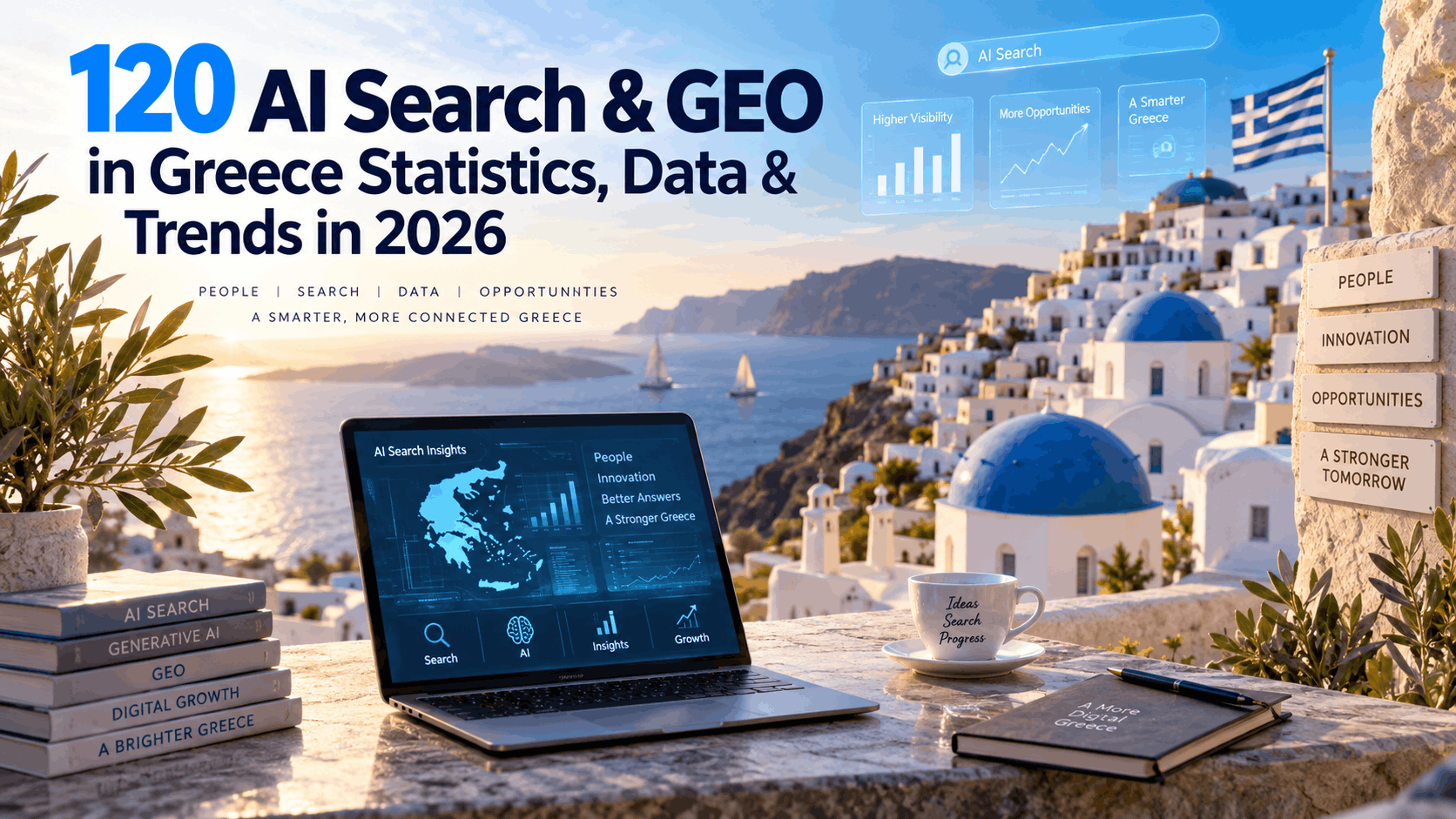
120 AI Search & GEO in Greece Statistics, Data & Trends in 2026
SECTION 1: GENERATIVE AI ADOPTION — GREECE & EU OVERVIEW
1. 83.5% of people aged 16–24 in Greece used generative AI tools in 2025 — ranking Greece #1 in the EU for youth GenAI adoption, a remarkable signal that Greek digital natives are embedding AI into their daily academic and personal routines far ahead of their European peers.
2. Greece ranks #1 in the entire EU for generative AI use among 16–24-year-olds — surpassing Estonia (82.8%) and Czechia (78.5%), which confirms that Greece’s youth population represents one of the most digitally forward cohorts on the continent.
3. 44% of the Greek general population (aged 16–74) used generative AI tools in 2025 — placing Greece among the top 8 EU countries for overall adult adoption and well above the EU average of 32.7%.
4. The EU average for generative AI usage among the general population (16–74) was 32.7% in 2025 — meaning Greece’s 44% adult adoption rate outperforms the bloc average by more than 11 percentage points.
5. 63.8% of young people aged 16–24 across the EU used generative AI tools in 2025 — yet Greece significantly outpaced this EU youth average by nearly 20 percentage points, reinforcing the country’s structural generational advantage in AI fluency.
6. 41% of the Greek general population used generative AI for personal purposes in 2025 — compared to only 25.1% across the EU, indicating that Greek users are significantly more likely to integrate AI into their private daily lives.
7. 16% of the Greek general population used generative AI for work purposes in 2025 — closely tracking the EU average of 15.1%, suggesting that professional AI adoption in Greece is broadly in line with the wider bloc despite the country’s lower enterprise AI maturity.
8. Greece shows a wide gap between personal (41%) and work (16%) generative AI use — a pattern that diverges sharply from the Netherlands, where personal (28%) and work (27%) usage are nearly equal, illustrating that Greek AI use is currently driven more by individual curiosity than by structured business deployment.
9. Only 9% of Greeks used generative AI for formal education in 2025 — below the EU average of 9.4%, suggesting that despite world-leading youth adoption, the formal education system has yet to fully integrate generative AI as an instructional tool at scale.
10. Denmark (48.4%), Estonia (46.6%), and Malta (46.5%) recorded the highest overall EU generative AI usage among adults — with Greece at 44% positioned just behind these top three and well above laggard countries like Romania (17.8%) and Italy (19.9%).
SECTION 2: GREECE AI MARKET SIZE & GROWTH
11. The overall AI market in Greece is projected to grow at a 28.54% CAGR from 2024 to 2030 — reaching a market volume of USD $1.853 billion by 2030, reflecting one of the fastest rates of AI market expansion in Southeast Europe.
12. The Generative AI market in Greece is projected to grow at a 46.47% CAGR from 2024 to 2030 — the steepest growth rate of any AI sub-segment in the country, reaching USD $845.9 million by 2030.
13. The Machine Learning market in Greece is projected to grow at a 17.07% CAGR from 2024 to 2030 — reaching a market volume of USD $837.4 million by 2030, driven by demand for predictive analytics across financial services and tourism.
14. The Greek ICT market was valued at approximately USD $8.76 billion in 2025 — and is projected to grow at a 12.5% CAGR from 2025 to 2033, underpinned by accelerating digitalisation across healthcare, government, and enterprise services.
15. Greece’s IT Services market is projected to reach USD $1.86 billion in revenue in 2025 — with a CAGR of 2.49% through 2030, with business process outsourcing dominating at USD $868 million.
16. Greece’s Autonomous & Sensor Technology AI market is projected to reach USD $94.99 million by 2030 — growing at a 15.2% CAGR, driven by demand in smart transport, maritime applications, and smart city infrastructure.
17. The global AI market reached USD $244 billion in 2025 and is projected to reach USD $827 billion by 2030 — growing at a 27.7% CAGR, providing Greece’s domestic market a massive international tailwind to leverage through talent exports and research commercialisation.
18. The global Generative AI market was valued at USD $66.89 billion in 2025 — and is expected to account for 33% of all AI software spending by 2027, up from just 8% in 2023, creating strong demand-pull for Greek startups and researchers entering the GenAI space.
19. The global AI market is projected to reach USD $312 billion in 2026 — a 27.7% increase from 2025, representing a year of accelerating growth that Greek firms must position to capture through AI Factory Pharos and targeted sector deployments.
20. Europe’s AI market was valued at approximately €42.6 billion (USD $46.7 billion) in 2025 — placing Greece’s AI market as a small but structurally strategic component of the broader European AI ecosystem.
SECTION 3: GREECE DIGITAL INFRASTRUCTURE
21. Greece’s ICT market was valued at €7.75 billion in 2025 — and is forecast to expand at a 12.5% CAGR through 2033, positioning the country as a mid-tier but rapidly growing digital economy within the EU.
22. Greece invested USD $176 million in 5G deployment and Very High-Capacity Networks — through its National Broadband Plan 2021–2027, aiming to build the backbone infrastructure that underpins AI-powered services and applications.
23. Greece committed USD $1.43 billion to e-government applications as part of its Digital Transformation Programme — making digital public services one of the country’s single largest AI-adjacent technology investments.
24. Greece allocated USD $467 million to SME digitalisation under the Greece 2.0 recovery plan — recognising that small and medium enterprises represent the primary structural bottleneck to enterprise AI adoption in the economy.
25. The Hellenic government invested EUR 976 million in a new national data centre complex — providing the critical cloud infrastructure needed to support AI model training, data governance, and sovereign computing capacity.
26. Greece’s gov.gr digital services platform has been accessed by 8.5 million citizens to date — issuing approximately 290 million documents across 1,820 public services, representing one of Europe’s most rapid e-government transformations.
27. Greece’s gov.gr platform achieved annual savings of €312 million — while reducing government processing times by 97% and cutting 19.1 million administrative trips, demonstrating AI-adjacent digital efficiency at national scale.
28. 76% of gov.gr users in Greece reported being very or completely satisfied with digital public services — a high satisfaction rate that signals strong baseline digital trust, which is a foundational prerequisite for AI service adoption.
29. Greece’s gov.gr processing times decreased by 88% for individuals and legal entities — following full digitisation, demonstrating the transformative operational efficiency possible when AI-adjacent automation is applied to public sector workflows.
30. 13.8 million cellular mobile connections were active in Greece in early 2025 — equivalent to 139% of the total population, reflecting near-total mobile saturation and a foundation for mobile-first AI search behaviour.
SECTION 4: INTERNET & SEARCH LANDSCAPE IN GREECE
31. 8.66 million individuals used the internet in Greece at the start of 2025 — representing an internet penetration rate of 87.0% of the total population, providing a large and connected audience base for AI-powered search.
32. 7.32 million social media user identities were active in Greece in January 2025 — equating to 73.5% of the total population, with social platforms playing an increasingly critical role in AI training data and generative search citation sourcing.
33. Greece’s median mobile internet download speed increased by 16.15 Mbps (+23.4%) in the twelve months to January 2025 — significantly improving the user experience for AI-powered voice and conversational search applications.
34. Google holds approximately 90% of global search market share in 2025 — and similarly dominates the Greek search market, making Google’s AI Overviews and AI Mode the most critical AI search surfaces for Greek brands to optimise for.
35. Greece’s share of ICT specialists as a percentage of employment stands at approximately 3% — compared to the EU average of 5%, representing a structural talent shortage that constrains both AI adoption velocity and GEO implementation at scale.
36. Only 52.4% of the Greek population had at least basic digital skills in 2023 — below the EU average of 55.5%, indicating that alongside world-leading AI adoption in youth, broad digital literacy gaps still exist across the wider population.
37. 78% of Greek citizens consider that the digitalisation of public and private services is making their lives easier — according to the 2025 Special Eurobarometer on the Digital Decade, demonstrating high public confidence in digital transformation.
38. 92% of Greek citizens consider it important that public authorities mitigate the issue of fake news and disinformation online — the highest level of concern among surveyed EU countries, making content credibility and E-E-A-T signals especially important for AI-cited content in Greece.
39. 83% of Greek citizens consider it important to ensure that European companies can grow and become “European Champions” able to compete globally — a sentiment that aligns with national AI strategy goals and creates fertile ground for domestic AI search tools and GEO services.
40. Only 33% of Greeks believe that the EU protects their digital rights well — significantly below the EU average of 47%, suggesting that privacy-centric AI search alternatives and transparent AI citation practices may find receptive audiences in Greece.
SECTION 5: ENTERPRISE AI ADOPTION IN GREECE
41. Only 8.9% of Greek enterprises with 10+ employees used AI technologies in 2025 — placing Greece among the bottom four EU countries for enterprise AI adoption, alongside Romania (5.2%), Poland (8.4%), and Bulgaria (8.6%).
42. The EU average for enterprise AI adoption reached 20% in 2025 — meaning Greek enterprises adopt AI at less than half the EU average rate, presenting a significant policy challenge but also a substantial commercial opportunity for AI service providers.
43. Only 43.3% of Greek SMEs had at least a basic level of digital intensity in 2023 — compared to the EU average of 57.7%, revealing a structural digital maturity gap that is the single largest drag on enterprise AI uptake across the country.
44. Only 33.5% of Greek enterprises had adopted AI, cloud, or data analytics by 2023 — versus an EU average of 54.6%, illustrating a 21-percentage-point gap that represents the primary target area for public and private AI investment programmes.
45. EU large enterprises adopted AI at 55.03% in 2025 compared to 17% for small enterprises — a gap that is even more pronounced in Greece, where smaller firm size, lower capital, and limited IT capacity create compounding barriers to AI deployment.
46. Greece registered only a modest increase in enterprise AI adoption compared to Denmark’s +14.5 percentage point jump in 2025 — highlighting the uneven pace of business AI transformation across the EU and Greece’s need for targeted adoption incentive schemes.
47. The most common AI use by EU enterprises in 2025 was text mining (11.75%) — followed by image/video generation (9.55%) and natural language generation (8.76%), use cases increasingly relevant to Greek tourism, media, and marketing sectors.
48. Greece’s e-sales share of total business turnover stands at just 8% — equal to Bulgaria and far below Denmark’s 30%, indicating that Greek businesses have yet to fully leverage digital and AI-driven channels for revenue generation.
49. Only 53% of Greek SMEs had basic digital intensity by 2025 — placing Greece near the bottom of the EU, according to Eurostat’s Digitalisation in Europe 2025 report, which contrasts sharply with 90%+ rates in Denmark and Finland.
50. Greece’s ICT specialist employment share is approximately 3% — compared to Sweden’s 9%, the lowest in the EU alongside Romania, creating a talent bottleneck that directly limits the pace of AI and GEO strategy implementation at the firm level.
SECTION 6: PHAROS AI FACTORY & NATIONAL AI STRATEGY
51. Greece is one of the first seven AI Factories in the EU — selected by the EuroHPC Joint Undertaking to host the Pharos AI Factory, alongside Germany, Spain, Italy, Luxembourg, Sweden, and Finland, placing Greece at the core of Europe’s AI infrastructure strategy.
52. The Pharos AI Factory has a total budget of €30 million — funded 50% by the EuroHPC Joint Undertaking and 50% by national Greek resources, with a 36-month implementation period running from April 2025 to March 2028.
53. The DAEDALUS supercomputer powering Pharos will deliver 89 petaflops of computing power — integrating over 2,000 NVIDIA Grace Hopper GH200 superchips, making it one of the most powerful AI-dedicated computing systems in Southeast Europe.
54. DAEDALUS has a total acquisition cost of EUR 36 million — with 35% funded by the EuroHPC JU and 65% by Greece’s National Recovery and Resilience Plan “Greece 2.0,” making it one of the most significant sovereign AI computing investments in the country’s history.
55. Greece’s Pharos AI Factory is expected to become a regional AI hub for Southeast Europe — connected to GRNET and RE-Cloud with speeds of up to 400 Gbps by 2026, amplifying its role as a connectivity and innovation node for the broader Mediterranean region.
56. Pharos focuses on three priority sectors: Health, Greek Language & Culture, and Sustainability — a deliberate focus that differentiates Greece’s AI strategy from Nordic and Central European approaches, leveraging unique national assets in language, heritage, and environmental data.
57. Microsoft’s “GR for Growth” initiative committed to training 100,000 Greek citizens in digital technologies — alongside establishing three Azure data centres in the Attica region, making Greece a target market for enterprise cloud and AI services at scale.
58. Greece published the “Blueprint for Greece’s AI Transformation” in 2024 — a foundational national AI strategy document guiding six flagship programmes to make Greece a model nation in data governance, AI readiness, and responsible AI deployment.
59. The first phase of Europe’s AI Factories network involves a total investment of €1.5 billion — combining national and EU funding, making Greece a direct beneficiary of this landmark continental AI infrastructure commitment.
60. Greece’s Digital Transformation Programme 2021–2027 is co-funded by the EU — encompassing 450 projects across six strategic axes including Connectivity, Digital Skills, Digital State, and Digital Business, forming the regulatory and operational framework within which AI search tools and GEO services will evolve.
SECTION 7: GLOBAL AI SEARCH TRENDS (CONTEXT FOR GREECE)
61. ChatGPT has 883 million monthly users as of January 2026 — with 810 million daily active users, making it the dominant AI search and conversational platform that Greek brands, publishers, and marketers must optimise for citation visibility.
62. ChatGPT holds an 80.49% share of the global AI chatbot market — dominating Perplexity, Microsoft Copilot, Google Gemini, Claude, and DeepSeek, meaning that for Greek organisations pursuing GEO, ChatGPT citation strategy is the single highest-leverage activity.
63. ChatGPT is the 5th most visited website globally as of January 2026 — surpassing Bing with 5.4 billion global monthly visits, confirming that AI-powered search has entered the mainstream and represents a mandatory channel for Greek digital visibility strategies.
64. Google AI Overviews reach 1.5 billion monthly users globally — appearing in 25.11% of all Google searches as of early 2026, up from 13.14% in March 2025, a near doubling that dramatically amplifies the GEO imperative for Greek content producers.
65. AI Overviews now appear in 200+ countries and 40+ languages — following Google’s May 2025 I/O announcement, meaning Greek-language queries are increasingly subject to AI-generated answer summaries that can displace traditional organic traffic.
66. AI Overviews reduce clicks to the top-ranking page by 58% — according to Ahrefs February 2026 data, meaning Greek websites that rank #1 but are not cited within AI Overviews may lose more than half their expected organic click-through rate.
67. When a Google AI Overview is shown, only 8% of users click on organic results below it — compared to 15% without an AI Overview, a near doubling of zero-click behaviour that directly affects Greek content strategies relying on organic traffic.
68. Zero-click search rates reach 93% in Google’s AI Mode — versus 43% with standard AI Overviews and 34% without them, underscoring the existential challenge facing Greek SEO practitioners as Google rolls out its most aggressive AI search formats.
69. 65% of Google searches now end without a click to any website — according to multiple industry sources, a structural shift that makes AI citation visibility (GEO) more commercially important than traditional ranking position for informational and navigational queries.
70. AI search traffic converts at 14.2% compared to Google’s organic conversion rate of 2.8% — making AI-referred visitors approximately 5x more valuable per session, a compelling ROI argument for Greek businesses to invest in GEO alongside traditional SEO.
SECTION 8: GEO (GENERATIVE ENGINE OPTIMISATION) LANDSCAPE
71. The global GEO market is valued at USD $848 million in 2025 and projected to reach $33.7 billion by 2034 — at a 50.5% CAGR, making it one of the fastest-growing digital marketing disciplines and a major new service opportunity for Greek digital agencies.
72. GEO content optimisation strategies can increase AI visibility by up to 40% — according to the foundational Princeton/IIT Delhi/Georgia Tech study (GEO-bench), with statistics addition and quotation addition being the two highest-impact tactics.
73. Only 22% of marketers globally are actively tracking AI search visibility and traffic — meaning the vast majority of Greek digital marketing practitioners have yet to implement GEO measurement frameworks, creating a first-mover advantage window.
74. Only 16% of brands globally were systematically tracking AI search performance as of September 2025 — an even narrower group than those tracking AI visibility, indicating that Greek brands establishing GEO monitoring capabilities now will have a significant measurement advantage.
75. AI referral traffic now accounts for 1.08% of all website traffic — growing at approximately 1% month-over-month, with ChatGPT driving 87.4% of all AI referral traffic, according to Conductor’s 2026 benchmarks.
76. AI platforms generated 1.13 billion referral visits in June 2025 — a 357% increase from June 2024, demonstrating exponential trajectory growth that will directly impact Greek publisher, e-commerce, and brand websites over the coming 12–18 months.
77. AI-referred sessions jumped 527% year-over-year in the first five months of 2025 — according to Previsible’s 2025 AI Traffic Report, which tracked 19 GA4 properties, confirming that Greek websites are now receiving measurable and growing AI-referred visits.
78. Domain authority is the #1 predictor of AI citations — with high-traffic sites earning 3x more AI citations than low-traffic ones, according to SE Ranking’s study of 2.3 million pages, meaning Greece’s established media brands hold a structural GEO advantage over newer entrants.
79. Content with statistics, citations, and quotations achieves 30–40% higher visibility in AI responses — according to Princeton GEO-bench research, making data-rich Greek-language content a primary GEO asset for publishers and agencies targeting local AI search queries.
80. Pages updated within 2 months earn 28% more AI citations than older content — confirming that content freshness is a critical GEO signal and that Greek publishers must adopt editorial refresh programmes to maintain AI citation visibility.
81. 50% of content cited by AI platforms was less than 13 weeks old at the time of citation — according to Amsive 2025 research, placing a premium on continuous content production cycles that Greek media organisations and brands must build into their editorial workflows.
82. 76.1% of AI Overview-cited URLs come from Google’s top 10 organic results — meaning that traditional SEO ranking remains the foundational prerequisite for Greek websites seeking AI Overview citations, and GEO cannot replace conventional search optimisation.
83. Perplexity shows 91% domain overlap with Google’s top 10 — according to a Semrush study from July 2025, reinforcing that improving organic rankings in Greece will simultaneously improve Perplexity citation probability.
84. Citation volumes for the same brand can differ by up to 615x across AI platforms — between Grok and Claude, according to Superlines March 2026 data, making multi-platform AI visibility monitoring essential for Greek brands operating at scale.
85. Distributing content to a wide range of publications can increase AI citations by up to 325% — compared to publishing only on owned channels, underscoring the value of Greek digital PR and media coverage strategies for GEO.
86. YouTube mentions and branded web mentions are the top factors correlating with AI brand visibility — in ChatGPT, AI Mode, and AI Overviews, according to Ahrefs December 2025 data, making video content and off-site brand presence key GEO signals for Greek businesses.
87. Google AI Overviews content changes 70% of the time for the same query — and when regenerated, 45.5% of citations are replaced, according to Ahrefs November 2025, indicating that Greek brands must monitor AI citation status continuously rather than treating it as a static ranking.
88. AI assistants hallucinate links nearly 3x more often than Google Search — a fact that creates a reputational risk for Greek brands incorrectly cited or misrepresented in AI-generated answers, and a compliance challenge for regulated industries.
89. Fewer than one-third of SEO influencers maintained consistent GEO terminology throughout 2025 — according to an EMARKETER April 2026 FAQ, reflecting the definitional immaturity of the field and an opportunity for Greek practitioners to establish authoritative local GEO guidance.
90. Digital4u became the first known Greek digital agency to formally launch a GEO service — as of September 2025, offering brands the ability to appear in ChatGPT, Bing AI, Google AI Overviews, and Perplexity, marking the beginning of a nascent GEO services market in Greece.
SECTION 9: AI SEARCH BEHAVIOUR & IMPACT ON SEO
91. 88.7% of queries triggering Google AI Overviews have informational intent — meaning that informational Greek-language content (explainers, guides, definitions) faces the highest risk of zero-click displacement from AI summaries.
92. Commercial queries account for 8.69% of terms that trigger AI Overviews — with transactional (1.76%) and navigational (1.43%) queries far less commonly triggering AI summaries, giving Greek e-commerce sites relative protection compared to editorial publishers.
93. Queries of 8 words or longer have a 57% chance of triggering AI Overviews — meaning long-tail and conversational search queries, which are increasingly common in Greek digital behaviour, carry the highest AI Overview probability.
94. Almost 80% of keywords triggering AI Overviews fall in the 0%–40% keyword difficulty range — indicating that niche, low-competition Greek-language content is disproportionately at risk of AI Overview displacement compared to highly competitive head terms.
95. Only 7.9% of local searches trigger an AI Overview — according to Ahrefs November 2025, providing some relief for Greek local businesses, restaurants, tourism operators, and service providers whose local intent queries remain more click-dependent.
96. AI Overviews give accurate answers 85%–91% of the time — meaning 9%–15% of the time they may deliver inaccurate information about Greek topics, brands, and services, creating both a credibility risk and a citation opportunity for authoritative Greek sources to correct AI narratives.
97. Google still sends 345x more traffic than all AI tools combined — according to whitehat-seo.co.uk March 2026 analysis, confirming that Greek SEO practitioners should treat GEO as a complementary layer rather than a replacement for core organic search investment.
98. AI-referred visitors generated 12.1% of Ahrefs’ signups despite representing only 0.5% of total traffic — demonstrating that AI-referred users are significantly more qualified and purchase-ready, a dynamic Greek B2B and SaaS companies should prioritise capturing.
99. Traditional organic traffic accounted for 25% of all website traffic on average — while AI referral traffic stood at 1.08%, according to Conductor November 2025, meaning that Greek digital teams must still allocate the majority of resources to conventional SEO while building GEO capabilities.
100. McKinsey reported in October 2025 that 50% of consumers globally were using AI-powered search intentionally — not as an experiment but as their primary information discovery method, a behavioural threshold that will reshape how Greek consumers research products, services, and brands.
SECTION 10: EU AI ACT & REGULATORY CONTEXT
101. The EU AI Act came into force in August 2024 — making the EU the first jurisdiction globally to adopt a comprehensive binding AI regulatory framework, directly affecting all Greek businesses that develop, deploy, or procure AI systems, including AI-powered search tools.
102. Greece’s national AI Blueprint explicitly commits to aligning with the EU AI Act — through a national AI supervisory authority, ensuring that Greek AI search tools and GEO services must comply with transparency, explainability, and human oversight requirements.
103. 78% of EU citizens think it is important for public authorities to shape AI development to respect rights and values — according to the 2024 Eurobarometer, and 36% considered this “very important,” creating a regulatory and consumer expectation environment that shapes how Greek AI search services must be positioned.
104. 86% of Greek respondents in the 2024 Eurobarometer said ensuring digital technologies serve the green transition should be an important action — above the 81% EU average, suggesting that AI search services in Greece will face growing expectations around sustainability credentials.
105. Nearly 80% of top news publishers globally now block at least one AI training crawler via robots.txt — according to Press Gazette research, creating a content scarcity dynamic where Greek publishers that make their content AI-accessible gain disproportionate citation advantage.
SECTION 11: AI SEARCH GLOBAL PLATFORM METRICS
106. ChatGPT processes 2 billion queries daily as of early 2026 — establishing it as a search infrastructure comparable to mid-tier traditional search engines and a mandatory platform for Greek brand visibility strategies.
107. Perplexity AI reached 45 million active users and 780 million monthly queries by mid-2025 — backed by over USD $1.5 billion in total funding, making it a growing citation source relevant to Greek academic, research, and professional content producers.
108. The GEO market grew from essentially zero in 2023 to USD $848 million in 2025 — at a 50.5% CAGR trajectory toward USD $33.7 billion by 2034, representing one of the fastest service-market expansions in digital marketing history.
109. AI search referral traffic grows at approximately 1% month-over-month across all industries — according to Conductor 2026 benchmarks, implying that Greek websites not tracking this channel today are potentially missing 12% incremental traffic growth annually.
110. 25.7% of marketers globally plan to develop content specifically for AI citations — in 2026, according to industry surveys, meaning Greek content and SEO teams that delay GEO strategy will face increasing competitive citation pressure from international players.
SECTION 12: GREECE-SPECIFIC DIGITAL BEHAVIOUR & AI OUTLOOK
111. Greece’s gov.gr portal now offers 1,820 digital public services — up from 503 when launched in March 2020, demonstrating a 262% expansion that creates extensive AI-searchable structured public data relevant for government-focused AI Overviews.
112. 3.8 million Greek citizens have installed the government’s digital wallet app — allowing AI-adjacent identity and document authentication at scale, building digital infrastructure that will progressively enable AI-personalised public service delivery.
113. Greece’s gov.gr captured 65% user preference over traditional in-person channels — according to EKT’s December 2025 study, signalling that Greeks have fundamentally shifted to digital-first service interaction, increasing the relevance of AI-enhanced digital service discovery.
114. Greece’s Digital Transformation Bible 2020–2025 encompasses 450 projects — spanning Connectivity, Digital Skills, Digital State, Digital Business, Digital Innovation, and Technology Integration, creating the broadest policy framework for AI search-relevant infrastructure development in the country’s history.
115. Greece targets private investment of approximately EUR 6.9 billion in data centres and gigabit connectivity — through its National Digital Decade Roadmap, which will dramatically increase the compute and network infrastructure available for AI applications and search services.
116. Greece hosts one of the 13 AI Factories in the EU — an elite designation that positions the country as a European AI Centre of Excellence, attracting international research partnerships and commercial AI investment that will elevate Greek AI capabilities over the next decade.
117. Microsoft, Google, Amazon, META, IBM, HPE, Starlink, and Digital Realty have all expanded their presence in Greece — attracted by digital opportunity and strategic Mediterranean positioning, creating a dense hyperscaler ecosystem that will accelerate enterprise AI and cloud adoption.
118. Less than 10% of Greek enterprises currently use AI technologies — despite world-leading youth AI fluency, creating a structural gap that D-ONE.AI and others have identified as Greece’s defining AI transition challenge and opportunity for the 2026–2030 period.
119. Greece’s youth digital behaviour and enterprise digital maturity represent two divergent trend lines — with 83.5% youth GenAI adoption sitting alongside under-9% enterprise AI adoption, a divergence that uniquely defines Greece’s AI landscape and creates a generational talent pipeline that is not yet being captured by the business sector.
120. The EU AI Act’s compliance requirements, the Pharos AI Factory infrastructure, and Greece’s #1 EU ranking for youth GenAI adoption collectively position Greece for a structural AI acceleration phase from 2026 to 2030 — provided that enterprise AI adoption gap, digital skills shortage, and SME digitisation challenges are systematically addressed through the initiatives already funded under Greece 2.0 and the Digital Transformation Programme 2021–2027.
Conclusion
The 120 AI Search and GEO statistics for Greece reveal a digital market entering a particularly important stage of its artificial intelligence transformation. Greece combines exceptionally strong consumer interest in generative AI with expanding digital infrastructure, substantial public investment and a rapidly growing AI economy. At the same time, relatively low enterprise AI adoption means much of the commercial opportunity created by this shift has yet to be fully captured.
Perhaps the clearest illustration of this divide is the contrast between 83.5% generative AI adoption among Greeks aged 16–24 and just 8.9% AI adoption among Greek enterprises with 10 or more employees. Greece ranked first in the EU for youth GenAI adoption, while its enterprise adoption rate remained less than half the 20% EU average in 2025. This creates a significant gap between how quickly consumers are embracing AI and how quickly businesses are adapting their digital strategies.
That gap is particularly relevant to the future of AI search and Generative Engine Optimisation in Greece. As consumers increasingly turn to ChatGPT, Google AI Overviews, Perplexity and other AI-powered discovery platforms, businesses can no longer measure search visibility exclusively through conventional rankings and organic clicks. Being accurately represented, mentioned and cited within generative answers is becoming another important dimension of digital visibility.
The global search statistics contained in this report reinforce that change. Google AI Overviews are reported to reach approximately 1.5 billion monthly users, while ChatGPT reached an estimated 883 million monthly users by January 2026. At the same time, AI Overviews can substantially reduce clicks to traditional organic results, while AI-referred visitors can demonstrate significantly stronger conversion behaviour than conventional organic visitors.
However, the evidence also shows that GEO should complement SEO rather than replace it. Approximately 76.1% of URLs cited in Google AI Overviews come from Google’s top 10 organic results, while Perplexity has a reported 91% domain overlap with Google’s top 10. Strong technical SEO, authoritative content, backlinks, topical relevance and organic rankings therefore remain important foundations for generative search visibility.
The difference in 2026 is that organisations increasingly need to build on those foundations with content designed for an AI-mediated discovery environment. The statistics indicate that content containing credible statistics, citations and quotations can achieve 30%–40% higher visibility in AI responses, while recently updated pages can receive 28% more AI citations. Wider publication distribution, branded mentions, authoritative third-party coverage and multimedia visibility can further strengthen an organisation’s chances of appearing in generative answers.
Greece also has significant structural support for continued AI growth. The Pharos AI Factory, DAEDALUS supercomputer, Greece 2.0 investments, national digital transformation programmes and expansion of gov.gr demonstrate that AI development is becoming part of the country’s wider economic and technological strategy. Greece’s overall AI market is projected to grow at a 28.54% CAGR between 2024 and 2030, while its generative AI market is projected to expand even faster at 46.47% annually.
Challenges nevertheless remain. Greece continues to face comparatively low SME digital intensity, a shortage of ICT specialists and an enterprise AI adoption rate below the European average. Concerns around misinformation, digital rights, AI accuracy and regulatory compliance under the EU AI Act will also influence how organisations deploy AI and communicate information through generative platforms.
For Greek companies, publishers, e-commerce businesses, tourism operators, technology firms and marketing teams, the strategic implication is increasingly clear: traditional search visibility and AI visibility are becoming interconnected parts of the same discovery ecosystem. Organisations that continue investing in SEO while developing strong GEO capabilities around authoritative content, factual accuracy, freshness, structured information, brand mentions and third-party credibility will be better positioned as generative search expands.
Ultimately, the defining AI trend in Greece in 2026 is not simply increasing AI usage. It is the transition from a digital economy built primarily around websites, search rankings and clicks toward one where AI systems increasingly mediate how information is discovered, summarised and recommended.
With 83.5% of young Greeks already using generative AI, an AI market expanding rapidly toward 2030, and major national investments strengthening the country’s computing and digital infrastructure, Greece has many of the ingredients required for accelerated AI adoption. The next challenge is for Greek businesses to close the gap with consumers. Those that begin building credible, searchable and AI-citable digital authority now could be best positioned to compete as AI Search and Generative Engine Optimisation become increasingly important components of digital discovery in Greece.
If you are looking for a top-class digital marketer, then book a free consultation slot here.
If you find this article useful, why not share it with your friends and business partners, and also leave a nice comment below?
We, at the AppLabx Research Team, strive to bring the latest and most meaningful data, guides, and statistics to your doorstep.
To get access to top-quality guides, click over to the AppLabx Blog.
People also ask
What is AI Search in Greece in 2026?
AI Search in Greece refers to using generative AI platforms and AI-powered search features to find, summarise and compare information. ChatGPT, Google AI Overviews and Perplexity are helping shift discovery beyond traditional search results.
How popular is generative AI in Greece?
Generative AI adoption is high in Greece. In 2025, 44% of Greeks aged 16–74 used generative AI tools, compared with the EU average of 32.7%, placing Greece among Europe’s stronger consumer AI markets.
What percentage of young Greeks use generative AI?
In 2025, 83.5% of people aged 16–24 in Greece used generative AI tools. This was the highest youth GenAI adoption rate in the EU and significantly exceeded the EU youth average of 63.8%.
Does Greece lead Europe in generative AI adoption?
Greece ranked first in the EU for generative AI usage among people aged 16–24 in 2025, with an adoption rate of 83.5%, ahead of Estonia at 82.8% and Czechia at 78.5%.
What is Generative Engine Optimisation in Greece?
Generative Engine Optimisation, or GEO, involves improving digital content and brand authority so information has a better chance of being discovered, understood and cited by AI-powered search and generative answer platforms.
Why is GEO important for Greek businesses in 2026?
GEO matters because consumers increasingly use AI-generated answers for discovery and research. Greek businesses that build authoritative, accurate and well-cited content can strengthen their visibility as AI Search adoption expands.
Is GEO replacing SEO in Greece?
No. GEO complements SEO rather than replacing it. The dataset shows that 76.1% of URLs cited by Google AI Overviews come from Google’s top 10 organic results, demonstrating the continued importance of traditional SEO.
How many Greek businesses use AI in 2026?
The dataset reports that 8.9% of Greek enterprises with at least 10 employees used AI technologies in 2025. This was substantially below the EU enterprise average of 20%.
Why is enterprise AI adoption low in Greece?
Greek businesses face challenges including relatively low SME digital intensity, limited ICT talent and slower adoption of cloud, data analytics and AI technologies. These factors can constrain enterprise AI implementation.
What is the biggest AI trend in Greece in 2026?
One defining trend is the consumer-enterprise AI gap. Youth GenAI adoption reached 83.5%, while enterprise AI adoption was only 8.9%, showing that consumer behaviour is advancing much faster than business adoption.
How large is the AI market in Greece?
Greece’s overall AI market is projected to grow at a 28.54% CAGR from 2024 to 2030 and reach approximately US$1.853 billion by 2030.
How fast is Greece’s generative AI market growing?
Greece’s generative AI market is projected to grow at a 46.47% CAGR between 2024 and 2030, reaching approximately US$845.9 million by 2030.
How many people use the internet in Greece?
Greece had approximately 8.66 million internet users at the beginning of 2025, representing 87% of the country’s population and providing a substantial audience for digital and AI-powered discovery.
How is ChatGPT changing search behaviour in Greece?
ChatGPT enables users to ask conversational questions and receive synthesised answers instead of navigating conventional search results. Greece’s high GenAI adoption suggests conversational discovery will become increasingly relevant to Greek brands.
How do Google AI Overviews affect SEO in Greece?
Google AI Overviews can answer queries directly above traditional results. The dataset reports that AI Overviews can reduce clicks to the top-ranking page by 58%, increasing the importance of earning visibility within AI-generated answers.
How common are Google AI Overviews in 2026?
The dataset reports that Google AI Overviews appeared in 25.11% of Google searches by early 2026 and reached approximately 1.5 billion monthly users globally.
What types of searches trigger Google AI Overviews most often?
Informational searches dominate, accounting for 88.7% of queries triggering Google AI Overviews. This makes guides, explainers and educational content particularly exposed to AI-generated search experiences.
Do long-tail searches trigger AI Overviews more frequently?
Yes. Queries containing eight words or more have a reported 57% chance of triggering AI Overviews, making conversational and long-tail search optimisation increasingly important for GEO strategies.
How does content freshness affect GEO performance?
Fresh content can improve AI visibility. Pages updated within two months reportedly receive 28% more AI citations, while 50% of AI-cited content was less than 13 weeks old when cited.
Do statistics and citations improve AI Search visibility?
Yes. Research cited in the dataset indicates that content containing statistics, citations and quotations can achieve 30%–40% greater visibility in AI-generated responses.
What factors improve GEO visibility in Greece?
Strong organic rankings, credible statistics, citations, fresh content, authoritative third-party mentions, digital PR, brand mentions and multimedia visibility can all contribute to stronger generative search visibility.
Does digital PR help Generative Engine Optimisation?
Yes. The dataset reports that distributing content across a wider range of publications can increase AI citations by up to 325% compared with publishing only through owned channels.
Why are brand mentions important for AI Search?
AI systems use signals from across the web when generating answers. The dataset identifies branded web mentions and YouTube mentions among the strongest factors correlated with AI brand visibility.
What is the Pharos AI Factory in Greece?
Pharos is Greece’s AI Factory under the EuroHPC initiative. It has a €30 million budget and focuses on Health, Greek Language and Culture, and Sustainability while strengthening Greece’s AI research ecosystem.
What is the DAEDALUS supercomputer in Greece?
DAEDALUS is the supercomputer supporting the Pharos AI Factory. It is expected to deliver 89 petaflops of computing power and integrate more than 2,000 NVIDIA Grace Hopper GH200 superchips.
How digitally advanced is Greece in 2026?
Greece has made substantial progress in public digital services and infrastructure. Gov.gr offers 1,820 digital public services, while 87% internet penetration provides a strong foundation for further AI adoption.
How does the EU AI Act affect AI in Greece?
As an EU member, Greece operates within the EU AI Act framework. Greek organisations developing or deploying covered AI systems must account for applicable requirements involving transparency, governance and human oversight.
What is the future of SEO and GEO in Greece?
SEO and GEO are likely to become increasingly interconnected. Organic rankings remain important, while brands must also improve their authority, factual accuracy, citations and content structure for AI-generated discovery.
Should Greek companies invest in GEO in 2026?
Businesses dependent on digital discovery should consider GEO alongside SEO. Greece’s strong consumer GenAI adoption creates an early opportunity to establish authority before enterprise AI and GEO adoption become more widespread.
What are the key AI Search and GEO trends in Greece for 2026?
Key trends include high youth GenAI adoption, rapid AI market growth, expanding AI Search, Google AI Overviews, stronger demand for authoritative content, rising GEO importance and a significant gap between consumer and enterprise AI adoption.
Sources
Eurostat Greek Reporter Euronews Statista U.S. International Trade Administration European Commission Digital Strategy Pharos AI Factory EuroHPC Joint Undertaking CORDIS National Documentation Centre OECD DataReportal Athens Times Enterprise Greece Superlines Exposure Ninja Position Digital Semrush DOJO AI Frase EMARKETER Enrich Labs Roar Digital Digital4u Whitehat SEO Cargoson Grand View Research EU Tech Loop D-ONE.AI Medium IndexBox