
























Key Takeaways
- Azerbaijan’s 89% internet penetration, expanding broadband infrastructure, and growing digital economy are creating strong foundations for AI search and GEO adoption in 2026.
- Google’s 81.28% search market share and Azerbaijani-language Gemini support are accelerating the shift from traditional search toward conversational, AI-generated answers.
- Generative Engine Optimisation in Azerbaijan is becoming essential as brands compete for visibility, citations, and recommendations across Google AI, ChatGPT, Gemini, Perplexity, and other AI platforms.
Azerbaijan is accelerating toward AI-powered search in 2026, supported by 89% internet penetration, rapidly improving broadband, Azerbaijani-language AI capabilities, and expanding digital services. As search behavior shifts toward generated answers, businesses increasingly need Generative Engine Optimisation (GEO) to strengthen their visibility, authority, and citations across AI-driven discovery.
Artificial intelligence is rapidly changing how people discover information, compare products, research businesses, access public services, and make purchasing decisions online. In Azerbaijan, this transformation is arriving alongside major improvements in digital infrastructure, expanding government digitalisation, growing e-commerce activity, and the localisation of leading artificial intelligence platforms. The result is an increasingly important new digital discipline: Generative Engine Optimisation (GEO), the practice of improving a brand, website, or content source so that it can be discovered, understood, referenced, and cited by AI-powered search engines and generative answer platforms.
Also, read our articles on the top SEO and GEO agencies here:
Top 10 Best SEO Agencies in Azerbaijan
Top 10 GEO Agencies in Azerbaijan
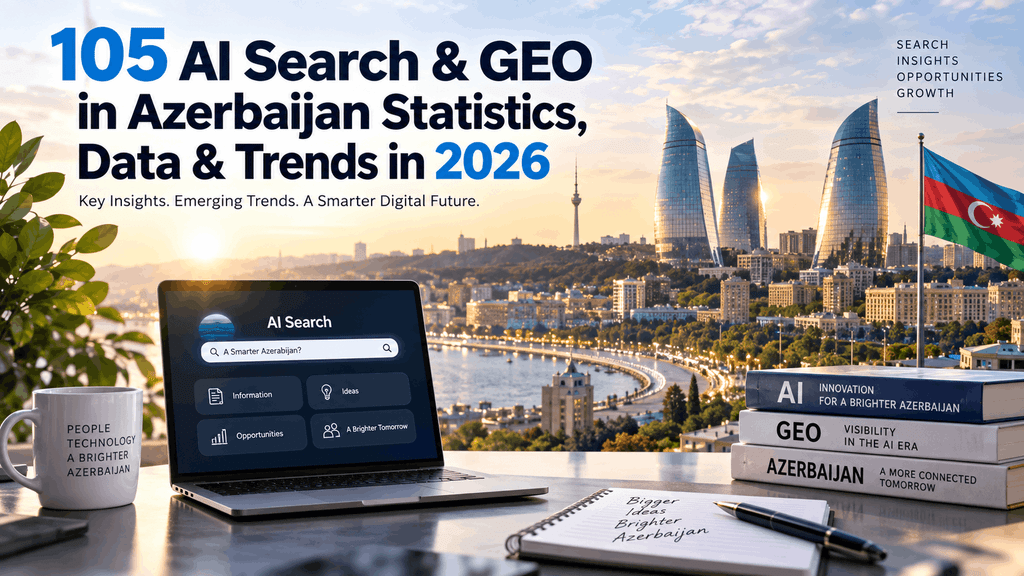
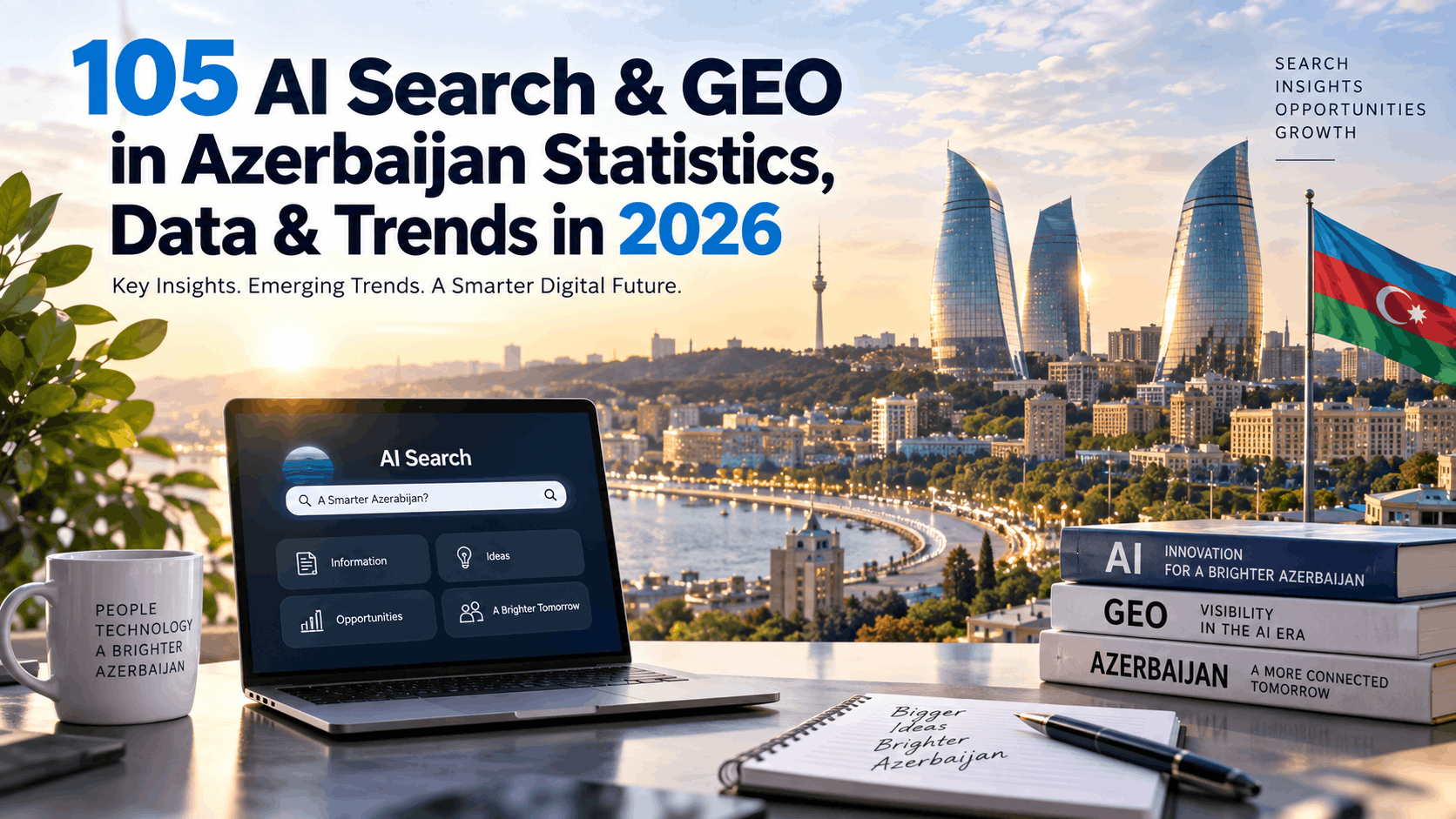
The 105 AI Search & GEO in Azerbaijan Statistics, Data & Trends in 2026 presented in this report provide a quantitative look at how prepared Azerbaijan is for this transition. The country’s digital foundations are already substantial. Azerbaijan had 9.27 million internet users by the end of 2025, representing an internet penetration rate of 89.0%. The country also recorded 12.2 million cellular mobile connections, equivalent to 118% of its population, while 96.5% of mobile connections were broadband-enabled through 3G, 4G, or 5G technologies.
Connectivity is improving particularly quickly. Azerbaijan’s average fixed broadband speed reached 79.25 Mbps by May 2025, almost doubling from 39.48 Mbps in early 2024. The country consequently climbed to 87th globally for fixed broadband speed, improving by 29 positions in less than 18 months. Azerbaijan also emerged as a regional broadband leader, outperforming Kazakhstan, Uzbekistan, Armenia, and Georgia according to the statistics compiled in this dataset. Meanwhile, approximately 1.7 million of the country’s 2.2 million fixed broadband subscribers were using GPON technology, providing the high-speed connectivity required for increasingly sophisticated digital and AI experiences.
This infrastructure matters because the future of search is becoming increasingly computational, conversational, multimodal, and personalised. Traditional keyword searches are being supplemented by questions asked directly to AI assistants, voice conversations, AI-generated summaries, multimodal searches, and generative recommendations. Faster broadband and widespread mobile connectivity therefore provide Azerbaijan with the technical foundation required for broader adoption of tools such as Google Gemini, Google AI Mode, ChatGPT, Microsoft Copilot, Perplexity, and future Azerbaijani-language AI systems.
Google remains particularly important to the evolution of AI search in Azerbaijan. The dataset reports that Google controlled 81.28% of Azerbaijan’s search engine market in July 2025, compared with 16.4% for Yandex and 1.23% for Microsoft Bing. This dominance means changes to Google’s search experience can potentially affect the overwhelming majority of conventional search activity in the country. As Google increasingly integrates generative answers and AI-powered discovery into Search, Azerbaijani businesses that previously focused exclusively on conventional rankings may need to think beyond traditional SEO.
One of the most consequential developments for Generative Engine Optimisation in Azerbaijan in 2026 is the growing localisation of artificial intelligence. According to the dataset, Google’s Gemini became officially available in the Azerbaijani language on 12 February 2026, with Azerbaijani included among 23 languages added through the Gemini expansion. Azerbaijani-language access spans web, Android, iOS, and Gemini Live voice interactions. This dramatically lowers the language barrier to conversational AI and creates new opportunities for users to ask complex questions naturally rather than translating queries or relying primarily on conventional keyword-based search.
Azerbaijan is simultaneously investing in its own AI capabilities. Its National AI Strategy for 2025–2028, AI Innovation Hub, AI Academy, Digital Development Council, and Digital Economy Development Strategy for 2026–2029 indicate that artificial intelligence is becoming part of the country’s broader economic and technological agenda. Particularly significant for the future of local AI search is the proposed development of a sovereign Azerbaijani-language AI model, alongside high-performance computing infrastructure, an Economic Data Analytics Platform, and a Digital Twin initiative.
Government digitalisation provides another powerful foundation for AI adoption. Azerbaijan’s myGov platform surpassed 5 million registered users in 2025, adding more than one million users during the year, while approximately 800,000 users regularly accessed its services. The platform provides hundreds of government services and includes AI chatbot functionality. Azerbaijan has also entered the “Very High” category of the UN E-Government Development Index, while the country aims to raise the digitalisation rate of public services to 80% by the end of 2026.
Consumer behaviour is changing at the same time. Azerbaijan recorded 7.61 million social media user identities in October 2025, equivalent to 73.1% of its population. TikTok’s potential advertising audience among adults reached 7.61 million, while LinkedIn had approximately 1.20 million members. Instagram, Facebook, YouTube, TikTok, LinkedIn, and other platforms increasingly function not merely as social networks but as discovery environments where consumers research companies, products, careers, news, and recommendations.
Commercial incentives for mastering this changing discovery landscape are also becoming stronger. Azerbaijan’s e-commerce market was projected to generate US$1.94 billion in revenue in 2025 and reach approximately US$2.59 billion by 2030. Digital commerce was separately projected to reach US$5.66 billion by 2028, while 76% of total advertising expenditure is expected to come from digital sources by 2029. As more commercial activity moves online, visibility inside AI-generated recommendations, comparisons, summaries, and answers could become increasingly valuable for Azerbaijani companies.
The international statistics included in this report illustrate why the shift deserves attention now. Google’s AI Overviews have expanded to billions of users, while the dataset cites research indicating that AI Overviews can substantially reduce organic click-through rates for affected searches. It also reports that approximately 92.36% of AI Overview citations come from domains already ranking within Google’s top 10 organic results, reinforcing an important point for businesses developing their GEO strategies: SEO and GEO are complementary rather than competing disciplines. Strong technical SEO, authoritative content, clear entity signals, credible sourcing, structured information, and organic search visibility can all contribute to stronger visibility within generative search environments.
Content structure is becoming equally important. The dataset reports that 44.2% of LLM citations originate from the first 30% of a text, while long-form content exceeding 2,900 words is reported to have a substantially higher likelihood of receiving ChatGPT citations than short-form pages. Structured comparison tables and clearly organised list sections are also associated with increased AI visibility. These trends suggest that content created for AI search needs to do more than contain keywords: it should answer questions directly, establish entities clearly, provide verifiable facts, demonstrate topical depth, and make important information easy for both humans and machines to extract.
For businesses, publishers, government organisations, e-commerce companies, startups, universities, tourism operators, financial institutions, professional-service firms, and digital marketers operating in Azerbaijan, the implications are substantial. Search visibility in 2026 is increasingly about more than securing a first-page Google ranking. Organisations must consider whether their brands and information appear when users ask an AI assistant questions such as which company to choose, which product is best, how a service works, where to invest, what an organisation is known for, or which sources can be trusted.
The transition also creates an early-mover opportunity. Azerbaijan combines high internet penetration, rapidly improving broadband infrastructure, extensive mobile connectivity, strong social-media adoption, expanding digital commerce, ambitious government digitalisation, and growing Azerbaijani-language AI support. These conditions provide fertile ground for AI-powered information discovery to expand quickly, even if the precise adoption trajectory differs from larger international markets.
The following 105 AI Search & GEO in Azerbaijan statistics, data points, and trends for 2026 examine this transformation from multiple perspectives, covering internet connectivity, search engine market share, social media behaviour, AI tools and localisation, e-government, digital advertising, e-commerce, startup investment, AI talent, and global generative-search trends relevant to Azerbaijan. Together, they provide a data-driven picture of how AI search and Generative Engine Optimisation in Azerbaijan are developing, why traditional search behaviour is changing, and what businesses should understand as visibility increasingly moves from conventional search results toward AI-generated answers and recommendations.
But, before we venture further, we like to share who we are and what we do.
About AppLabx
From developing a solid marketing plan to creating compelling content, optimizing for search engines, leveraging social media, and utilizing paid advertising, AppLabx offers a comprehensive suite of digital marketing services designed to drive growth and profitability for your business.
At AppLabx, we understand that no two businesses are alike. That’s why we take a personalized approach to every project, working closely with our clients to understand their unique needs and goals, and developing customized strategies to help them achieve success.
If you need a digital consultation, then send in an inquiry here.
Or, send an email to hello@applabx.com to get started.
105 AI Search & GEO in Azerbaijan Statistics, Data & Trends in 2026
SECTION 1: Digital Infrastructure & Internet Connectivity
1. 9.27 million internet users in Azerbaijan as of end-2025, with online penetration at 89.0% of the population.
Azerbaijan’s near-universal internet adoption positions the country as one of the most digitally connected markets in the South Caucasus, providing a robust foundation for the deployment and uptake of AI-powered search tools.
2. Azerbaijan’s internet user base grew by 57,000 (+0.6%) between January 2024 and January 2025.
While growth has moderated, reflecting an already-mature penetration rate, the incremental base of new users represents a growing audience for AI search platforms and GEO-optimised content.
3. 12.2 million cellular mobile connections were active in Azerbaijan in early 2025, equivalent to 118% of the total population.
The saturation of mobile connections — exceeding the actual headcount — signals a mature mobile market where AI-driven mobile search experiences and voice-activated queries are structurally embedded in everyday digital life.
4. 96.5% of all mobile connections in Azerbaijan are classified as broadband (3G, 4G, or 5G).
The near-total broadband readiness of Azerbaijan’s mobile network means AI search interfaces and generative answer engines can be accessed without connectivity barriers by the overwhelming majority of users.
5. Azerbaijan’s average fixed broadband speed reached 79.25 Mbps by May 2025, ranking 87th globally out of 153 countries — up from 116th in November 2023.
The dramatic speed improvement, representing a near-doubling in under 18 months, creates a favourable environment for data-intensive AI search features including multimodal queries, video responses, and real-time AI-generated answers.
6. Azerbaijan’s average fixed broadband speed doubled from 39.48 Mbps (early 2024) to 79.25 Mbps (May 2025).
This rate of improvement is atypical at this stage of market development and demonstrates the impact of targeted public investment in GPON and fibre-optic infrastructure under the Online Azerbaijan programme.
7. Baku ranked 84th among 148 cities globally for mobile internet speed in May 2025.
Baku’s strong mobile speed ranking places it in the top tier of regional cities for AI search performance, making it a credible testbed for GEO strategies targeting urban Azerbaijani audiences.
8. Azerbaijan is the undisputed broadband speed leader among Central Asia and South Caucasus nations in 2025, outpacing Kazakhstan (71.97 Mbps), Uzbekistan (66.77 Mbps), Armenia (58.5 Mbps), and Georgia (42.07 Mbps).
Regional leadership in broadband speed positions Azerbaijan as a natural entry point for global technology firms looking to deploy AI search solutions across the broader Caucasus and Central Asian markets.
9. 2.2 million fixed broadband subscribers exist in Azerbaijan, of whom 1.7 million (78%) use GPON technology capable of speeds up to 1 Gbps.
The high share of fibre-grade GPON subscribers underlines not merely adequate but premium connectivity, removing latency as a barrier to the heavy compute demands of generative AI search engines.
10. The Online Azerbaijan programme has connected 2.29 million households, achieving 78% national broadband coverage in 2025.
Expanding rural broadband access directly extends the potential reach of AI search and GEO-optimised content to populations beyond Baku’s metropolitan core, unlocking new audience segments for digital marketers.
11. Azerbaijan’s ICT sector revenues totalled AZN 3.989 billion in 2025, growing 8.7% year-on-year.
The sustained double-digit-adjacent growth of the ICT sector reinforces the structural importance of digital services within Azerbaijan’s non-oil economic model, elevating the strategic relevance of search visibility and GEO.
12. Mobile service revenues in Azerbaijan’s ICT sector reached AZN 1.291 billion in 2025, up 4.5% year-on-year.
Mobile revenue growth, though measured, continues to reflect rising data consumption — a direct correlate of AI-powered mobile search, AI chatbot usage, and voice search adoption.
13. ICT is the fastest-evolving sector of Azerbaijan’s economy, with 18% annual growth in IT service income.
Rapid sectoral growth is attracting both domestic talent and international investment, creating a more sophisticated buyer and user base that drives demand for AI-first content strategies.
14. Azerbaijan’s average internet speed target is 200 Mbps by the end of 2026, according to the Ministry of Digital Development and Transport.
If achieved, this target would place Azerbaijan in the top 50 globally for fixed broadband and dramatically enhance the feasibility of AI-intensive applications including real-time generative search and agentic web experiences.
15. Azerbaijan’s 3G network covers 100% of the population, providing a universal baseline for mobile internet access.
Full 3G coverage eliminates the last barrier to internet access for rural populations, ensuring that AI-driven content reaches all segments of the Azerbaijani market, not only urban concentrations.
SECTION 2: Search Engine Landscape in Azerbaijan
16. Google held an 81.28% share of Azerbaijan’s search engine market in July 2025 — up 1.39 percentage points from June.
Google’s dominant and growing position in Azerbaijan means that AI Overviews, AI Mode, and related generative features within Google Search will shape the search experience for four out of every five Azerbaijani queries.
17. Yandex held a 16.4% search market share in Azerbaijan in July 2025 — down 1.47 percentage points month-on-month.
The declining share of Yandex, the Russian-origin platform historically prominent in post-Soviet markets, signals a structural reorientation of Azerbaijani search behaviour toward Google and its integrated AI features.
18. Microsoft Bing held a 1.23% search market share in Azerbaijan in July 2025.
Bing’s marginal but growing footprint matters in the GEO context because Microsoft Copilot — built on OpenAI’s models — uses Bing as its retrieval backbone, meaning even low-volume Bing presence amplifies AI citation potential.
19. Yahoo! held a 0.47% search market share in Azerbaijan in July 2025.
Yahoo’s negligible market presence confirms that Azerbaijan’s search landscape is effectively a two-horse race between Google and Yandex, with Google accelerating its lead through AI-enhanced features.
20. Azerbaijan’s search advertising market is projected to grow from its 2023 base to a volume of US$98.85 million by 2027, representing an 8.48% CAGR.
The expanding search advertising market reflects rising commercial investment in search visibility — a trend that AI Overviews and zero-click search will complicate, pushing advertisers to also invest in GEO and answer engine positioning.
21. The average search advertising spend per capita in Azerbaijan was US$7.74 in 2024.
Per-capita search ad spend remains low by regional standards, presenting both a market development opportunity and a structural risk: businesses that rely on organic search traffic face disproportionate disruption from AI-driven zero-click results.
SECTION 3: Social Media & Platform Usage
22. 7.61 million social media user identities were recorded in Azerbaijan in October 2025, equating to 73.1% of the total population.
Social media penetration crossed the 73% threshold in late 2025, reflecting an audience where AI-powered content discovery, social search, and influencer-driven GEO strategies are increasingly viable at scale.
23. TikTok had 7.61 million users aged 18 and above in Azerbaijan in late 2025, representing 98.7% of all adults in the country.
TikTok’s near-total adult reach in Azerbaijan — an exceptionally high figure even by global standards — underlines the platform’s centrality to any content strategy targeting younger Azerbaijani users seeking AI-summarised information.
24. TikTok’s potential ad reach in Azerbaijan increased by 1.23 million (+19.2%) between end-2024 and late 2025.
TikTok’s accelerating growth trajectory in Azerbaijan signals its emergence as a primary channel for AI-adjacent content discovery, particularly for product-oriented and lifestyle queries that traditionally flowed through Google.
25. In August 2025, Instagram held a 42.7% share of Azerbaijan’s social media market — up 8.69 percentage points from July 2025.
Instagram’s sudden leap to the top of Azerbaijan’s social media landscape marks a tipping point for content strategy: AI search optimisation must now account for social-platform discovery signals, as these shape how generative AI models assess brand authority.
26. Facebook held a 30.76% social media market share in Azerbaijan in August 2025, ceding the top spot to Instagram for the first time since 2015.
Facebook’s loss of social media primacy in Azerbaijan illustrates the ongoing platform diversification that complicates both traditional SEO and GEO strategies, requiring brands to build authority signals across multiple channels.
27. YouTube held a 15.31% social media share in Azerbaijan in October 2025, though this fell sharply from 20.57% in June — a 5.26 percentage point monthly decline.
YouTube’s decline, partly attributed to monetisation restrictions, signals an opportunity for brands to fill search and information-access gaps on other platforms — including AI-powered answer engines that increasingly index video content.
28. X (formerly Twitter) held a 7.1% social media market share in Azerbaijan in late 2025.
X’s niche but stable audience — concentrated among journalists, policymakers, and tech-literate users — makes it a valuable signal source for AI systems that weight topic authority and real-time information, particularly for news-adjacent GEO.
29. LinkedIn had 1.20 million members in Azerbaijan in late 2025, equivalent to 11.5% of the total population.
LinkedIn’s growing professional user base in Azerbaijan is significant for B2B-focused GEO strategies, as LinkedIn pages are increasingly cited by ChatGPT and Perplexity when surfacing professional and business-related information.
30. The average Azerbaijani internet user spent approximately 3 hours and 14 minutes per day on social media in August 2025.
This level of daily social engagement means that AI chatbots and social search features compete for a share of time users would previously have spent on traditional Google queries — a direct driver of AI search adoption growth.
31. 72% of Azerbaijanis aged 18–25 trust information on Instagram more than in traditional media, per Global Digital 2025 report data.
This trust dynamic has profound GEO implications: AI systems that draw authority signals from social engagement data will increasingly weight Instagram-originated content when generating responses for young Azerbaijani users.
32. Independent surveys place TikTok’s actual audience share in Azerbaijan at 11–13% in August 2025, higher than what appears in official search-referred reports due to VPN access.
The gap between reported and actual TikTok usage highlights the limitations of standard analytics in Azerbaijan’s market — a caution for GEO practitioners building audience models based solely on declared platform data.
SECTION 4: AI Tools, Models & Localisation in Azerbaijan
33. Google’s Gemini AI model was officially launched in the Azerbaijani language on 12 February 2026, as part of the global rollout of Gemini 3.
The Azerbaijani-language Gemini launch marks a watershed moment: AI search is now natively accessible to Azerbaijani speakers, dramatically lowering the barrier for AI-driven query resolution in the local language.
34. Azerbaijani was selected as one of 23 new languages added in Gemini’s global strategic expansion.
Being included in a strategic language expansion alongside major global languages signals that Azerbaijan’s digital ecosystem has reached sufficient scale and commercial interest to attract investment from leading AI platforms.
35. Gemini’s Azerbaijani-language interface is available across web, Android, iOS, and via Gemini Live for real-time voice conversations.
Full multimodal and voice access to Gemini in Azerbaijani transforms how local users formulate queries — shifting from typed keywords toward conversational, long-form questions that are the native input format of generative AI search.
36. The Azerbaijani launch of Gemini was described by the US Embassy as reflecting the bilateral US-Azerbaijan AI cooperation agreement signed in August 2025.
The geopolitical dimension of the Gemini launch underscores that AI platform access in Azerbaijan is now partly a diplomatic and strategic matter — not purely a commercial one — which may accelerate future AI infrastructure investment.
37. Azerbaijan’s AI Innovation Hub under AzInTelecom was established with a projected budget of 7.1 million manats.
The creation of a state-funded AI lab signals government intent to build domestic AI capability rather than relying entirely on imported platforms, creating future demand for locally trained models in GEO applications.
38. Azerbaijan’s AI Academy, opened under the 2025–2028 AI Strategy, partners with MIT, Stanford, and Carnegie Mellon for curriculum development.
Academic partnerships with elite global institutions accelerate Azerbaijan’s AI talent pipeline, building the human capital needed to develop, deploy, and optimise GEO strategies using next-generation AI systems.
39. Azerbaijan’s National AI Strategy for 2025–2028, signed by President Ilham Aliyev, establishes legal alignment with international AI norms, responsible deployment frameworks, and financial incentives including preferential loans for AI innovators.
The comprehensive regulatory framework provides the certainty businesses need to invest in AI search infrastructure, positioning Azerbaijan as a legally predictable environment for GEO-focused technology companies.
40. Azerbaijan’s 2026–2029 Digital Economy Development Strategy, signed 10 December 2025, encompasses more than 50 initiatives covering business (26), society (15), and public sector (9) priorities.
The breadth of the strategy — touching every sector from enterprise to government — creates a multi-channel opportunity for AI search and GEO, as public services, commercial platforms, and social content all move toward AI-first models.
41. One key initiative within the Digital Economy Strategy is the development of a sovereign Azerbaijani-language AI model.
A domestically developed Azerbaijani-language AI model would create a local generative search engine with first-mover authority over culturally specific content, fundamentally changing the GEO landscape for local publishers and brands.
42. Azerbaijan’s Digital Development Council was established by Presidential Decree on 11 February 2026 to set national priorities in digitalization, e-government, AI, and innovation.
The creation of a presidential-level coordinating body for AI and digital policy is a strong institutional signal that AI search governance will become a national priority rather than remaining a secondary commercial concern.
43. Azerbaijan’s Action Plan for Accelerating Digital Development 2026–2028 includes plans for high-performance computing infrastructure and AI-based enhancement of public services.
Investment in high-performance computing is a prerequisite for running large language models at national scale, and its inclusion in a three-year action plan signals that state-level generative AI search applications are not a distant prospect.
44. Azerbaijan ranked 94th on the Global Innovation Index, highlighting infrastructure progress alongside persistent gaps in sustainable innovation capacity.
The innovation index gap between Azerbaijan’s digital infrastructure and its innovation output is precisely where AI search and GEO present an opportunity: well-optimised AI-accessible content can project authority beyond what the innovation ranking might suggest.
45. Azerbaijan’s Digital Bridge national information exchange system processed over 1 billion transactions in 2024, with more than 150 integrated systems and 1.5 million daily transactions.
At these volumes, the Digital Bridge generates structured government data at a scale that AI systems can index and summarise — directly influencing how AI models respond to queries about Azerbaijani public services and government information.
SECTION 5: E-Government, AI Public Services & Digital Participation
46. Azerbaijan’s myGov digital government platform surpassed 5 million registered users in 2025, representing 19% growth year-on-year.
The myGov platform’s rapid user growth reflects broad public acceptance of AI-adjacent digital services, suggesting that Azerbaijani users are already conditioned to receive AI-mediated information rather than navigating physical or legacy web channels.
47. More than 1 million new users joined the myGov platform in 2025 alone.
The single-year onboarding of one million additional myGov users signals a digital adoption inflection point — one that will increase the portion of the Azerbaijani population receiving public information through AI-assisted, structured digital systems.
48. Active users on the myGov platform who regularly log in and use services reached 800,000.
The ratio of highly active users (800,000) to total registrations (5 million) highlights a significant engagement gap — a pattern typical of AI-enhanced platforms globally, where adoption precedes habitual daily usage.
49. mygov platform users exceeded 2.5 million within a single reporting period, described as approximately one quarter of Azerbaijan’s population.
Penetrating one quarter of the national population through a single government digital platform in a relatively short timeframe is a strong structural indicator that Azerbaijanis are receptive to AI-summarised, task-oriented information delivery.
50. The myGov platform offers over 400 digital government services, including AI chatbot functionality.
The integration of an AI chatbot into a government platform used by millions positions AI-generated responses as a standard expectation for public service information — a user behaviour pattern that will extend into commercial AI search adoption.
51. Azerbaijan’s e-Government portal offers over 500 electronic services from various ministries and state agencies.
The breadth of digitised public services creates a rich structured data environment that generative AI systems can summarise and cite, making government information one of the most AI-accessible content domains in Azerbaijan.
52. Azerbaijan entered the “Very High” category of the UN E-Government Development Index for the first time following 2024 reforms.
UN recognition of Azerbaijan’s e-government maturity reflects a genuine structural transition — one that places the country’s digital services infrastructure in alignment with the data quality and accessibility standards that AI search systems require.
53. Azerbaijan’s Electronic Participation Index improved from 98th to 88th place in the most recent UN assessment.
Improved electronic participation signals greater public willingness to engage with government through digital channels — a disposition that naturally extends to AI search tools and answer engines for civic and administrative queries.
54. By end-2026, approximately one million citizens are expected to use digital identity cards (mobiil-ID) in Azerbaijan.
The rollout of digital identity creates the authentication infrastructure needed for personalised AI search and AI-assistant experiences, where responses can be tailored to verified individual profiles and government entitlements.
55. Azerbaijan plans to raise the digitalisation rate of public services to 80% by 2026, up from the current baseline.
An 80% digital public service rate means that the vast majority of public information queries will originate from or terminate in digital channels — a critical condition for AI systems to achieve comprehensive coverage of government-adjacent search topics.
SECTION 6: E-Commerce, Digital Advertising & AI-Driven Commerce
56. Azerbaijan’s e-commerce market revenue is projected to reach US$1.94 billion in 2025, with a CAGR of 5.92% projected through 2030 to reach US$2.59 billion.
The growing e-commerce market is structurally exposed to AI search disruption: product and comparison queries — where AI Overviews and ChatGPT product recommendations are growing rapidly — account for a significant portion of e-commerce discovery traffic.
57. Azerbaijan’s e-commerce revenues more than doubled between 2017 (US$742 million) and 2022 (US$1.76 billion).
The sustained multi-year e-commerce growth trajectory creates a commercially substantial environment where AI-driven product discovery and GEO-optimised product pages represent a meaningful competitive advantage.
58. The average revenue per user (ARPU) in Azerbaijan’s e-commerce market is expected to reach US$742.49.
ARPU at this level positions Azerbaijani e-commerce users as commercially significant per-head, justifying investment in advanced GEO and AI search optimisation strategies even for mid-scale domestic brands.
59. The Digital Commerce market in Azerbaijan is projected to grow by 8.66% (2024–2028), reaching US$5.66 billion by 2028.
Double-digit-adjacent growth in digital commerce over a four-year horizon creates an expanding addressable market for GEO practitioners whose content strategy captures AI-generated product and service recommendations.
60. 76% of total advertising spend in Azerbaijan’s advertising market is expected to come from digital sources by 2029.
The accelerating share of digital advertising spend means that AI-driven search channels — including AI Overviews, ChatGPT search, and Perplexity — will become principal battlegrounds for ad-adjacent visibility investment.
61. 85% of Azerbaijan’s advertising market revenue will be generated through programmatic advertising by 2029.
The dominance of programmatic formats aligns with the data-driven audience targeting that AI search platforms increasingly enable, creating a natural bridge between GEO visibility and performance-oriented programmatic spend.
62. The Social Media Advertising market in Azerbaijan is projected to grow at a 4.51% CAGR (2024–2028), reaching US$67.2 million by 2028.
Social media ad spend growth, while modest, reflects the platforms (Instagram, TikTok) that are increasingly positioned as alternative search interfaces for product and lifestyle queries, reinforcing the GEO relevance of social content.
63. Azerbaijan’s digital media market is expected to reach US$155.70 million in revenue, with video games dominating at US$94.65 million.
The digital media and gaming segments are among the highest-AI-Overviews-trigger categories globally, making them priority GEO investment areas for Azerbaijani brands and publishers operating in these verticals.
64. Consumer spending on ICT equipment in Azerbaijan is estimated at US$0.47 billion in 2024.
ICT hardware spending at this level reflects significant consumer investment in the devices that power AI search and generative query experiences, confirming the physical infrastructure demand side of AI search adoption.
65. Azerbaijan has a 21% improvement in online public services and telecommunications infrastructure indicators in 2024.
This broad-based improvement metric confirms that Azerbaijan’s digital infrastructure quality — a prerequisite for high-quality AI search delivery — is advancing consistently year-on-year.
SECTION 7: Startup Ecosystem, AI Investment & Talent
66. Over 200 startups are active in Azerbaijan, with a government target of 500 by 2026, including at least one valued above US$50 million.
A target of 500 startups — more than doubling current activity — signals policy intent to create the innovation density needed for domestically developed AI search applications and GEO-focused martech tools.
67. Azerbaijan plans to attract 100+ investments into its startup ecosystem by 2026.
Targeted investment attraction creates capital availability for AI and digital marketing startups, accelerating the development of locally-tuned GEO tools and AI search analytics platforms relevant to the Azerbaijani market.
68. Azerbaijan’s first two domestically-domiciled venture capital funds — Caucasus Ventures and InMerge Ventures — are now operational.
The emergence of local VC infrastructure reduces dependence on foreign capital for early-stage AI and digital ventures, enabling faster iteration cycles for GEO-oriented technology companies targeting the Azerbaijani market.
69. Azerbaijan’s Technopark law offers IT companies tax waivers for ten years, including 0–5% income tax, zero profit tax, and exemptions for expatriate specialists.
The decade-long tax incentive structure creates compelling conditions for international AI companies and GEO technology providers to establish Azerbaijan as a regional operational base.
70. Azerbaijan intends to increase the value of its ICT exports by at least ten times.
An order-of-magnitude increase in ICT exports would require Azerbaijan to develop internationally competitive AI and digital products, making GEO and AI search capabilities strategic export-enabling assets rather than purely domestic tools.
71. The Microsoft for Startups Founders Hub was launched in January 2025, supported by IDDA, Microsoft, and Strategeast, to provide Azerbaijani ICT startups with resources for growth.
Microsoft’s direct startup support creates structural ties between Azerbaijani companies and the Microsoft Azure / Bing / Copilot AI search ecosystem, with implications for how Azerbaijani content is indexed and prioritised by Microsoft-adjacent AI models.
72. Azerbaijan is home to 25 game studios and over 500 game developers, with a target of 50 new studios.
The gaming sector’s scale in Azerbaijan creates a content vertical with high AI Overviews trigger rates globally, making the gaming developer community one of the more GEO-aware audiences in Azerbaijan’s digital economy.
73. Azerbaijan’s AI Academy plans to train IT professionals in partnership with MIT, Stanford, and Carnegie Mellon.
World-class curriculum access will produce graduates capable of executing sophisticated GEO campaigns — narrowing the skills gap that currently limits AI search optimisation capacity in the Azerbaijani market.
SECTION 8: Global AI Search Trends Contextualising Azerbaijan
74. Google’s AI Overviews now reach 2 billion monthly users across 200 countries in 40 languages — including Azerbaijani following the February 2026 Gemini rollout.
Azerbaijan’s formal inclusion in Google’s AI-covered language set means that Azerbaijani-language queries now trigger AI-generated answers at scale — making GEO in the Azerbaijani language a commercially live priority, not a future consideration.
75. Approximately 30% of all keywords in US-equivalent SERPs now trigger AI Overviews — with rates expected to translate to comparable emerging-market environments over time.
If Azerbaijan reaches even 20% AI Overview trigger rates — lower than the US benchmark — the volume of search queries resolved by AI without a click to publisher sites would affect tens of millions of monthly queries on Google.az.
76. AI Overviews doubled in prevalence from 13.14% of Google searches in March 2025 to 25.11% by early 2026, based on Conductor’s analysis of 21.9 million queries.
The pace of AI Overview deployment — doubling in under 12 months — means Azerbaijani SEO practitioners who planned their strategies on 2024 SERP structures are already operating in an obsolete framework.
77. Around 93% of Google AI Mode searches end without a click to an external website.
As AI Mode extends to Azerbaijan and Azerbaijan-language queries, the zero-click rate will become the dominant reality for informational queries, eliminating the conventional relationship between search rankings and traffic for Azerbaijani publishers.
78. AI Overviews reduce organic click-through rates by 34.5% for affected queries, and by 58% for top-ranking pages, according to SE Ranking and Ahrefs research.
For Azerbaijani businesses that have historically relied on first-page Google rankings to drive website traffic, the CTR reduction from AI Overviews represents an immediate and quantifiable revenue risk requiring active GEO response.
79. Gartner predicted in 2024 that traditional search engine volume will decline by 25% by 2026 due to AI chatbots and virtual agents — a trajectory that 2025 data confirms is on course.
The Gartner projection, now corroborated by market data, should be treated by Azerbaijani digital marketers not as a distant scenario but as a structural shift already reshaping the search landscape in which they operate.
80. ChatGPT grew from 400 million weekly active users in early 2024 to 800 million by October 2025, processing over 1 billion queries per day.
ChatGPT’s global query volume — equivalent to a substantial fraction of Google’s daily searches — means that Azerbaijani brands absent from ChatGPT’s citation pool are already missing a fast-growing discovery channel.
81. ChatGPT drives 87.4% of all AI referral traffic to websites globally, and accounted for over 77% of all AI-driven visits.
ChatGPT’s dominant share of AI-referred traffic means that GEO strategies in Azerbaijan should allocate their greatest optimisation effort to the factors that drive ChatGPT citation — particularly long-form content, domain authority, and structured data.
82. Perplexity accounts for approximately 15% of all AI referral traffic globally, making it the second-largest source of AI-driven visits.
Perplexity’s growing share — entirely based on web retrieval rather than trained knowledge — rewards Azerbaijani content that is structured, factually accurate, and independently cited, aligning well with journalistic and research-focused GEO approaches.
83. Google’s AI Mode reached 100 million users in the US and India within months of its wider rollout in 2025, before expanding globally to 200+ countries in October 2025.
Azerbaijan’s inclusion in the October 2025 global AI Mode expansion means Azerbaijani-language queries are now subject to fully AI-generated response interfaces — the most significant structural change to search since the introduction of Featured Snippets.
84. AI-driven visitors convert at an average of 4.4 times higher than standard organic visitors, according to Semrush.
The conversion premium of AI-referred traffic means that even a relatively small volume of Azerbaijani users arriving via AI search citations carries disproportionate commercial value — justifying GEO investment even at early, low-traffic stages.
85. Visitors referred by AI platforms spend 68% more time on websites than those from traditional organic search.
The engagement depth of AI-referred Azerbaijani users implies higher-quality interactions with brand content, making GEO not only a traffic strategy but a content quality signal that correlates with meaningful customer attention.
86. AI referral traffic accounts for 1.08% of all website traffic globally and is growing roughly 1% month-over-month.
While the absolute share remains small, the monthly growth rate implies that AI-referred traffic will become a structurally significant channel within 12–18 months — placing Azerbaijani brands that have already invested in GEO in a strong competitive position.
87. Domain authority is the single strongest predictor of AI citations, with high-traffic sites earning 3x more AI citations than low-traffic ones, per SE Ranking’s analysis of 2.3 million pages.
For Azerbaijani brands, this means that building organic traffic and domain authority through conventional SEO remains the most reliable first step toward AI search visibility — GEO is complementary to, not a replacement for, foundational SEO.
88. 92.36% of AI Overview citations globally come from domains already ranking in the top 10 organic results.
This statistic is critically important for Azerbaijani GEO strategy: achieving AI Overview inclusion on Google is structurally dependent on first achieving conventional ranking authority in Azerbaijani and Russian-language SERPs.
89. Long-form content over 2,900 words is 59% more likely to be cited in ChatGPT than content under 800 words.
Azerbaijani publishers and brands that invest in substantive, well-researched long-form content — in both Azerbaijani and Russian — position themselves most effectively for citation in AI-generated answers across global and regional AI platforms.
90. 44.2% of all LLM citations globally come from the first 30% of a text — the introduction.
For Azerbaijani content creators optimising for GEO, front-loading the most important factual claims, statistics, and entity mentions in introductory paragraphs is among the highest-ROI structural choices available.
91. Structured content improves ChatGPT visibility: comparison pages with 3 tables earn 25.7% more citations, and validation pages with 8 list sections earn 26.9% more.
Azerbaijani B2B and e-commerce brands that restructure product, service, and comparison pages to include structured tables and defined sections can measurably improve their AI citation frequency without changing the underlying content claims.
92. Wikipedia is the most cited source in ChatGPT globally (7.8% of citations), followed by Reddit (1.8%).
The dominance of Wikipedia as a citation source underscores the importance of accurate, up-to-date Wikipedia presence for Azerbaijani brands — maintaining and expanding relevant Wikipedia entries is among the most impactful low-cost GEO interventions available.
93. AI traffic is unevenly distributed across regions — AI is approximately twice as likely to send traffic to US websites as to those in the UK.
This disparity in AI traffic distribution implies that Azerbaijani-market websites currently receive proportionally less AI-referred traffic than their content quality may warrant — a gap that targeted GEO investment can actively close over time.
94. ChatGPT’s estimated CTR for search-classified queries is approximately 1.3%, compared to Google’s estimated 29.2% CTR.
Despite high query volumes, ChatGPT’s low click-through rate means that AI search citation in Azerbaijan should be understood primarily as a brand visibility and influence channel rather than a direct traffic source — analogous to broadcast media rather than paid search.
95. AI Overviews appear in roughly 57% of long-tail, high-intent queries, according to Q2 2026 data.
Long-tail queries — which make up the bulk of Azerbaijani search volumes across niche topics, local services, and specific product searches — are disproportionately likely to trigger AI Overviews, concentrating the GEO impact on the queries with the highest commercial specificity.
96. Users spend an average of 49 seconds in Google AI Mode per session, compared to 21 seconds in AI Overviews — making AI Mode the deeper engagement format.
The extended dwell time in AI Mode implies that users are consuming more AI-generated content per session and relying more heavily on AI-synthesised answers — a trend that accelerates as AI Mode extends to Azerbaijani-language queries.
97. The absence of SEO investment typically leads to paid advertising dependency, with ad spend increases of approximately 400%.
For Azerbaijani businesses that currently rely heavily on paid channels, the transition to AI search and GEO represents not just an organic traffic opportunity but a pathway to reducing structural ad spend dependency by up to fourfold.
98. Azerbaijani is now one of 23 languages in the global Gemini 3 rollout — one of the first Turkic languages included in a tier-1 AI platform expansion.
Inclusion at the Gemini 3 tier alongside major European and Asian languages signals that AI platforms are beginning to treat Azerbaijani as a commercially and strategically significant language — a designation that should accelerate localised AI content investment.
99. The US Embassy in Azerbaijan described the Gemini Azerbaijani launch as grounded in a bilateral US-Azerbaijan AI cooperation agreement signed in August 2025.
The institutionalisation of US-Azerbaijan AI cooperation through a signed bilateral agreement creates a policy framework that will likely accelerate future AI platform localisation, including AI search capabilities in Azerbaijani.
100. Google’s AI Overviews were extended to users in 200 countries and 40 languages in May 2025, including regions served by Azerbaijani and Russian — the two dominant internet languages in Azerbaijan.
The extension of AI Overviews to both Azerbaijani and Russian language ecosystems means that the full population of Azerbaijani internet users is now within the operational scope of AI-generated search answers, making GEO a market-wide imperative.
101. Azerbaijan ranked 87th in broadband speed globally in May 2025 — a jump of 29 positions in under 18 months — representing the fastest improvement among South Caucasus nations.
The speed of Azerbaijan’s connectivity upgrade is not merely a quality-of-life metric; it is a direct enabler of AI-intensive user behaviours, including multimodal AI search, voice queries, and real-time AI assistant interactions.
102. Azerbaijan’s Digital Economy Strategy for 2026–2029 specifically includes the development of an Economic Data Analytics Platform and a “Digital Twin” initiative.
The inclusion of advanced data infrastructure in a national strategy signals that Azerbaijani policymakers understand the data-layer requirements of AI systems — a foundation that will improve the quality of AI-generated responses about Azerbaijan’s economy over time.
103. The introduction of “Digital Nomad” and “Digital Talent” visas under the 2026–2028 Action Plan is designed to attract international AI talent to Azerbaijan.
Talent attraction policies will accelerate the localisation of global GEO expertise in Azerbaijan, bridging the current skills gap between international best practice and domestic digital marketing capability.
104. Azerbaijan has connected over 2,965,300 homes, apartments, and business entities to broadband internet as part of the Online Azerbaijan project.
Nearly 3 million broadband-connected premises represent the supply-side infrastructure for mass-market AI search adoption — ensuring that generative AI experiences are not confined to an urban or affluent minority but accessible to the broadest possible Azerbaijani audience.
105. The myGov platform AI chatbot history tracking feature was introduced in the November 2025 app update, reflecting integration of conversational AI into government services.
The deployment of persistent AI chatbot history in a government app used by millions normalises the expectation of AI-generated responses for official information — a conditioning effect that reinforces user comfort with AI search tools more broadly.
Conclusion
The 105 AI Search & GEO in Azerbaijan statistics, data, and trends for 2026 point to a digital market entering an important new phase. Azerbaijan already combines 89% internet penetration, 9.27 million internet users, 12.2 million mobile connections, rapidly improving broadband infrastructure, and extensive social media adoption. These foundations create favorable conditions for AI-powered search, conversational assistants, generative answers, voice search, and other emerging forms of digital discovery to become increasingly important.
Google’s 81.28% share of Azerbaijan’s search engine market makes developments such as AI Overviews, AI Mode, and Gemini particularly significant. At the same time, the introduction of Azerbaijani-language support for Gemini in 2026 lowers one of the most important barriers to local AI adoption. Users can increasingly formulate natural, conversational questions in Azerbaijani instead of relying exclusively on conventional keyword searches.
Azerbaijan is also building domestic capacity for this transformation. The country’s National AI Strategy for 2025–2028, Digital Economy Development Strategy for 2026–2029, AI Innovation Hub, AI Academy, Digital Development Council, planned high-performance computing infrastructure, and proposed sovereign Azerbaijani-language AI model demonstrate that artificial intelligence is becoming part of the country’s broader digital-development agenda.
Consumer and commercial trends reinforce the opportunity. Azerbaijan recorded 7.61 million social media user identities in late 2025, while its e-commerce market was projected to generate US$1.94 billion in 2025. With 76% of advertising expenditure expected to come from digital channels by 2029, competition for digital visibility will increasingly extend beyond traditional search rankings and paid advertising into AI-generated answers, recommendations, comparisons, summaries, and citations.
This is where Generative Engine Optimisation in Azerbaijan becomes strategically relevant. The global data compiled in this report suggests that AI search does not simply eliminate the importance of SEO. Instead, traditional SEO authority and GEO increasingly reinforce one another. The dataset reports that 92.36% of AI Overview citations come from domains already ranking within the top 10 organic results, while domain authority, long-form content, prominent placement of important information, structured sections, tables, and credible sourcing are associated with stronger AI citation visibility.
For Azerbaijani businesses and publishers, this means the objective is evolving from simply “ranking on Google” toward becoming a trusted source that search engines and generative AI systems can understand, retrieve, cite, and recommend. Strong technical SEO, authoritative content, clear entity information, original data, structured information, credible external references, and direct answers to real user questions will therefore become increasingly valuable components of an effective GEO strategy.
The shift also creates an opportunity for early movers. Companies that begin optimising for AI search in Azerbaijan in 2026 can build authority while the market is still developing, rather than waiting until generative search becomes a mature and highly competitive acquisition channel. This is particularly relevant for e-commerce, B2B services, finance, technology, recruitment, tourism, education, media, professional services, and other industries where customers conduct extensive online research before making decisions.
Ultimately, the statistics show that SEO is not disappearing in Azerbaijan; search itself is expanding. Google results, AI Overviews, AI Mode, Gemini, ChatGPT, Perplexity, Copilot, social search, voice interfaces, and future Azerbaijani AI platforms are becoming parts of a broader discovery ecosystem. Businesses that can establish consistent authority across this ecosystem will be better positioned to remain visible regardless of where users choose to ask their questions.
For organisations planning their digital strategies beyond 2026, the message from these AI Search and GEO statistics for Azerbaijan is clear: visibility can no longer be measured solely by rankings and website clicks. The next competitive advantage will increasingly come from becoming the source that artificial intelligence trusts, cites, summarises, and recommends when Azerbaijani consumers and businesses search for answers.
If you are looking for a top-class digital marketer, then book a free consultation slot here.
If you find this article useful, why not share it with your friends and business partners, and also leave a nice comment below?
We, at the AppLabx Research Team, strive to bring the latest and most meaningful data, guides, and statistics to your doorstep.
To get access to top-quality guides, click over to the AppLabx Blog.
People also ask
What is AI search in Azerbaijan?
AI search in Azerbaijan refers to using generative AI and conversational search technologies to find information, receive direct answers, compare options, and discover businesses instead of relying only on traditional search result pages.
What is Generative Engine Optimisation in Azerbaijan?
Generative Engine Optimisation (GEO) is the process of making content easier for AI platforms to understand, retrieve, cite, and recommend when users ask questions about businesses, products, services, or topics in Azerbaijan.
How many internet users are there in Azerbaijan in 2026?
The dataset reports 9.27 million internet users in Azerbaijan at the end of 2025, representing 89% of the population and providing a substantial audience for AI-powered search and digital services.
What is Azerbaijan’s internet penetration rate?
Azerbaijan’s internet penetration reached 89% by the end of 2025, according to the dataset, highlighting the country’s strong digital connectivity and potential for widespread AI search adoption.
How many mobile connections are there in Azerbaijan?
Azerbaijan recorded 12.2 million cellular mobile connections in early 2025, equivalent to 118% of its population. Around 96.5% of these connections were classified as broadband.
How fast is the internet in Azerbaijan?
Average fixed broadband speed reached 79.25 Mbps by May 2025, nearly doubling from 39.48 Mbps in early 2024. Azerbaijan ranked 87th globally among 153 countries in the dataset.
What is the most popular search engine in Azerbaijan?
Google dominates Azerbaijan’s search market. It held an 81.28% market share in July 2025, considerably ahead of Yandex at 16.4% and Microsoft Bing at 1.23%.
What is Google’s search engine market share in Azerbaijan?
Google accounted for 81.28% of Azerbaijan’s search engine market in July 2025. Its dominance makes developments in Google AI search particularly important for Azerbaijani businesses and publishers.
What is Yandex’s market share in Azerbaijan?
Yandex held 16.4% of Azerbaijan’s search engine market in July 2025, down 1.47 percentage points month over month. It remained the country’s second-largest search engine.
Is Google Gemini available in Azerbaijani?
Yes. The dataset states that Google’s Gemini officially launched Azerbaijani-language support on February 12, 2026, with access across the web, Android, iOS, and Gemini Live voice conversations.
Why is Azerbaijani-language AI important for GEO?
Native Azerbaijani AI support allows users to ask conversational questions in their own language. This creates opportunities for local content to appear in AI-generated answers, citations, summaries, and recommendations.
Does Azerbaijan have a national AI strategy?
Yes. Azerbaijan’s National AI Strategy covers 2025–2028 and includes responsible AI frameworks, international alignment, innovation support, and financial incentives for AI development.
Is Azerbaijan developing its own AI model?
The dataset identifies development of a sovereign Azerbaijani-language AI model as a key initiative within Azerbaijan’s Digital Economy Development Strategy, potentially strengthening locally relevant generative AI.
What is Azerbaijan’s AI Innovation Hub?
Azerbaijan’s AI Innovation Hub was established under AzInTelecom with a projected budget of 7.1 million manats, supporting the country’s efforts to develop domestic artificial intelligence capabilities.
How is Azerbaijan investing in AI talent?
Azerbaijan’s AI Academy is intended to develop AI and IT expertise, with the dataset reporting partnerships involving MIT, Stanford, and Carnegie Mellon for curriculum development.
How many social media users are there in Azerbaijan?
Azerbaijan recorded 7.61 million social media user identities in October 2025, equivalent to 73.1% of the country’s population, demonstrating the importance of social discovery.
How popular is TikTok in Azerbaijan?
The dataset reports TikTok advertising reach of 7.61 million Azerbaijani users aged 18 and older in late 2025, while its potential advertising reach increased 19.2% from the end of 2024.
How popular is LinkedIn in Azerbaijan?
LinkedIn had approximately 1.20 million members in Azerbaijan in late 2025, equivalent to 11.5% of the country’s population, making it particularly relevant to professional and B2B discovery.
How large is Azerbaijan’s e-commerce market?
Azerbaijan’s e-commerce market revenue was projected to reach US$1.94 billion in 2025 and grow to approximately US$2.59 billion by 2030, according to the dataset.
Why does GEO matter for Azerbaijani businesses?
GEO can help businesses become more understandable and discoverable to generative AI systems as consumers increasingly use AI-generated answers, recommendations, summaries, and comparisons during research.
Is GEO replacing traditional SEO in Azerbaijan?
No. The dataset indicates that SEO and GEO are complementary. It reports that 92.36% of AI Overview citations globally originate from domains already ranking among the top 10 organic search results.
What content performs well in AI search?
The dataset associates AI visibility with authoritative domains, long-form content, prominent answers, structured sections, tables, credible information, and content that already performs strongly in traditional organic search.
Does long-form content improve ChatGPT visibility?
The dataset reports that content exceeding 2,900 words is 59% more likely to receive ChatGPT citations than content under 800 words, highlighting the potential GEO value of comprehensive content.
Where should important information appear for GEO?
Important information should appear early and clearly. According to the dataset, 44.2% of LLM citations globally come from the first 30% of a text, making strong introductions especially relevant to GEO.
Do tables and structured content help GEO?
The dataset reports that comparison pages containing three tables earn 25.7% more citations, while validation pages containing eight list sections earn 26.9% more, indicating the value of structured information.
How do Google AI Overviews affect organic traffic?
The dataset cites research indicating that AI Overviews can reduce organic click-through rates by 34.5% for affected queries and by 58% for top-ranking pages, increasing the importance of AI visibility.
How important is ChatGPT for AI referral traffic?
The dataset reports that ChatGPT accounts for the majority of global AI referral traffic, including figures of 87.4% and more than 77% depending on the measurement cited.
How important is Perplexity for Generative Engine Optimisation?
The dataset places Perplexity at approximately 15% of global AI referral traffic. Its retrieval-focused approach makes well-structured, factual, independently supported web content particularly relevant.
Which industries in Azerbaijan can benefit from GEO?
GEO can be particularly relevant to e-commerce, technology, finance, tourism, recruitment, education, media, professional services, government information, and other sectors where users research choices online.
What is the future of AI search and GEO in Azerbaijan?
Azerbaijan’s 89% internet penetration, improving broadband, AI investment, digital government services, Azerbaijani-language AI support, and growing digital economy provide strong foundations for continued AI search and GEO development.
Sources
DataReportal Caliber.Az Crocusoft Statista AzerNews APA AZERTAC Report.az Innovation and Digital Development Agency Ministry of Digital Development and Transport of Azerbaijan U.S. International Trade Administration Telecompaper Mordor Intelligence Operator Watch Baku Network Startup Genome SE Ranking ALM Corp Superlines Sedestral Position Digital DataSlayer Marketing Agent Growth Engines