
























Key Takeaways
- Australia’s online search landscape in 2026 is evolving rapidly, with SEO, Generative Engine Optimization (GEO), and Answer Engine Optimization (AEO) becoming essential for maintaining visibility across Google, AI search engines, and conversational platforms.
- AI Overviews, zero-click searches, Bing’s enterprise growth, and social search platforms such as YouTube, TikTok, and Reddit are transforming how Australians discover information, requiring businesses to adopt multi-platform search strategies.
- Brands that invest in structured data, entity authority, AI-ready content, technical SEO, and cross-platform optimization will be best positioned to earn AI citations, increase search visibility, and drive sustainable digital growth in Australia’s competitive online ecosystem.
Australia’s online search landscape in 2026 combines traditional SEO with Generative Engine Optimization (GEO) and Answer Engine Optimization (AEO) as AI-powered search, Google AI Overviews, and social search reshape digital discovery. Businesses that optimize for both search engines and AI answer platforms gain stronger visibility, higher-quality traffic, and more sustainable long-term online growth.
Australia’s online search ecosystem is undergoing one of the most significant transformations since the rise of Google more than two decades ago. What was once a digital landscape dominated almost exclusively by traditional search engine optimization (SEO) has evolved into a sophisticated, multi-platform environment shaped by artificial intelligence, conversational search, answer engines, social discovery platforms, and increasingly intelligent search experiences. As businesses compete for online visibility in 2026, success is no longer determined solely by achieving the number one position on Google. Instead, organizations must build authority across an expanding ecosystem that includes Google AI Overviews, Microsoft Bing and Copilot, ChatGPT, Gemini, Claude, Perplexity, YouTube, TikTok, Reddit, LinkedIn, and other emerging AI-powered discovery platforms.
Also, read our top guide on the Top 10 Best Lead Generation Agencies in Australia.

Australia represents one of the world’s most digitally mature markets, with exceptionally high internet penetration, widespread smartphone usage, strong ecommerce adoption, and a highly connected consumer base. Australians conduct millions of searches every day to research products, compare services, find local businesses, access government information, consume news, and make purchasing decisions. However, the way these searches are performed has changed dramatically. Consumers increasingly expect immediate, conversational, and personalized answers rather than scrolling through multiple pages of traditional search results. This behavioural shift is encouraging search engines to deliver AI-generated summaries, knowledge panels, featured snippets, and conversational responses that often satisfy user intent without requiring a visit to an external website.
These developments have given rise to a new generation of search optimization strategies that extend well beyond conventional SEO. Generative Engine Optimization (GEO) has emerged as a critical discipline focused on improving brand visibility across AI-powered search engines and large language models. Rather than optimizing solely for keyword rankings, GEO emphasizes entity authority, semantic relationships, structured data, digital trust, and AI citation readiness. Closely aligned with GEO is Answer Engine Optimization (AEO), which helps businesses structure their content so that AI assistants and search engines can easily identify, extract, and present concise answers directly within search experiences. Together, SEO, GEO, and AEO form the foundation of modern digital visibility.
At the same time, Google’s position as Australia’s dominant search engine remains strong but is becoming increasingly diversified by external influences. Microsoft’s growing enterprise ecosystem, driven by Windows 11, Microsoft Edge, Microsoft 365, and Copilot, has strengthened Bing’s presence within corporate environments. AI assistants such as ChatGPT, Gemini, Claude, and Perplexity have become everyday research tools for professionals, students, and consumers alike. Younger generations increasingly bypass traditional search engines altogether, turning instead to TikTok, YouTube, Instagram, and Reddit to discover products, restaurants, travel destinations, tutorials, and product reviews. Search is no longer confined to a browser—it now occurs across multiple digital ecosystems, each with its own algorithms, content formats, and optimization requirements.
One of the defining characteristics of Australia’s search landscape in 2026 is the rapid expansion of zero-click search behaviour. Google AI Overviews, featured snippets, local packs, and knowledge panels increasingly provide immediate answers directly on the search results page. While these features improve user convenience, they also reduce the volume of traditional organic traffic flowing to websites. Businesses that once relied primarily on organic rankings must now compete to become trusted citation sources within AI-generated answers rather than simply appearing as blue links beneath them. This shift has transformed the measurement of search performance, with AI citations, entity recognition, Share of Voice, brand mentions, and conversational visibility becoming increasingly important alongside conventional SEO metrics such as rankings and organic traffic.
Social search has also become an essential component of Australia’s digital discovery ecosystem. Consumers now conduct significant portions of their research directly within YouTube, TikTok, Reddit, Facebook, LinkedIn, and Instagram before ever opening a traditional search engine. Video tutorials, authentic community discussions, influencer recommendations, and user-generated content increasingly influence purchasing decisions. Businesses that integrate video optimization, social search strategies, creator partnerships, and community engagement into their SEO programs are gaining competitive advantages across multiple customer touchpoints.
The technological evolution of search is accompanied by an increasingly sophisticated regulatory environment. Australia’s Online Safety Act, Internet Search Engine Services Code, and new social media age restrictions are reshaping how search providers and digital platforms operate. These regulations encourage greater transparency, stronger content governance, improved trust signals, and enhanced user protection. Consequently, businesses that prioritize factual accuracy, expert-led content, secure websites, structured data, and verified organizational identities are better positioned to earn both user trust and search engine confidence.
The economic significance of search continues to expand despite these structural changes. Digital advertising expenditure has reached record levels, with Search and Directories remaining Australia’s largest online advertising category. Organizations continue investing heavily in paid search while simultaneously increasing budgets for technical SEO, content marketing, entity optimization, AI visibility, and GEO initiatives. Rather than replacing traditional search marketing, artificial intelligence is creating new opportunities for organizations capable of adapting their digital strategies to an increasingly intelligent and interconnected search ecosystem.
This comprehensive guide explores every major aspect of Australia’s online search environment in 2026. It examines the latest search engine market share trends, evolving consumer behaviour, AI-powered search experiences, zero-click search dynamics, Generative Engine Optimization, Answer Engine Optimization, social search, search advertising economics, regulatory developments, and future industry projections. It also highlights the practical strategies businesses can implement to strengthen their digital presence, improve AI citation visibility, build entity authority, and remain competitive in an environment where search is becoming increasingly conversational, multimodal, and driven by artificial intelligence.
Whether you are a business owner, digital marketer, SEO professional, content strategist, agency leader, or enterprise decision-maker, understanding the current state of online search in Australia is essential for building sustainable long-term visibility. As AI continues reshaping the way information is discovered, evaluated, and consumed, organizations that embrace SEO, GEO, and AEO as complementary strategies—rather than competing disciplines—will be best positioned to capture qualified audiences, strengthen brand authority, and achieve lasting success in Australia’s rapidly evolving digital economy.
But, before we venture further, we like to share who we are and what we do.
About AppLabx
From developing a solid marketing plan to creating compelling content, optimizing for search engines, leveraging social media, and utilizing paid advertising, AppLabx offers a comprehensive suite of digital marketing services designed to drive growth and profitability for your business.
At AppLabx, we understand that no two businesses are alike. That’s why we take a personalized approach to every project, working closely with our clients to understand their unique needs and goals, and developing customized strategies to help them achieve success.
If you need a digital consultation, then send in an inquiry here.
Or, send an email to hello@applabx.com to get started.
The State of Online Search in Australia in 2026
- Executive Overview
- Search Engine Market Share and Structural Mechanics in Australia
- Digital Search Economics and Capital Allocation in Australia
- User Behavior, Search Intent Patterns, and the Rise of the Zero-Click Search Economy in Australia
- Generative Engine Optimization (GEO) and AI Search Integration in Australia
- Social Search Convergence and Alternative Discovery Channels in Australia
- Regulatory, Privacy, and Structural Governance of Online Search in Australia
- Outlook for Online Search in Australia in 2026
1. Executive Overview
Australia’s online search ecosystem in 2026 is experiencing one of the most significant transformations since the introduction of mobile-first indexing. Traditional search engine optimization remains an essential component of digital marketing, but it is no longer sufficient on its own. Businesses are now optimizing for both conventional search engines and AI-powered answer engines, giving rise to Generative Engine Optimization (GEO), Answer Engine Optimization (AEO), and entity-based search strategies.
Although Google continues to dominate Australia’s search landscape, its market share has gradually declined compared to previous years as Microsoft Bing benefits from Copilot integration, AI assistants become mainstream, and conversational AI platforms such as ChatGPT, Perplexity, Claude, and Gemini increasingly serve as information discovery tools. At the same time, Australian consumers are demonstrating growing acceptance of zero-click search experiences, where answers are delivered directly within search interfaces instead of requiring users to visit external websites.
This changing environment has fundamentally altered how Australian businesses measure search success. Rankings alone are no longer the primary objective. Visibility across AI-generated answers, knowledge panels, featured snippets, local search results, AI Overviews, and conversational search platforms has become equally important. Organizations that continue relying exclusively on traditional keyword-focused SEO risk losing organic visibility, while brands investing in GEO, structured content, semantic authority, and entity optimization are positioning themselves for sustainable long-term growth.
Australia’s Online Search Landscape in 2026
Australia remains one of the world’s most digitally connected economies, with extremely high internet penetration and mature digital commerce adoption. Consumers increasingly expect immediate, conversational, and context-aware answers instead of browsing multiple websites.
Several macro trends define the Australian search market in 2026:
• AI-powered search experiences are becoming mainstream.
• Google AI Overviews appear across a significant portion of informational searches.
• Zero-click behaviour continues to increase.
• Traditional SEO now works alongside GEO.
• Video search continues expanding rapidly.
• Local search remains one of the strongest commercial channels.
• Brand authority increasingly influences AI-generated citations.
• Structured data has become a competitive necessity.
These developments are reshaping how Australian organizations invest in digital marketing, content creation, and search visibility.
Australian Search Engine Market Overview
| Search Platform | Estimated Market Position (2026) | Primary Strength | SEO / GEO Priority |
|---|---|---|---|
| Dominant search engine | Universal web search and AI Overviews | Very High | |
| Microsoft Bing | Fast-growing alternative | Copilot integration and Windows ecosystem | High |
| ChatGPT | Leading conversational AI | Natural language information retrieval | High |
| Google Gemini | Google’s AI ecosystem | AI-assisted search and productivity | High |
| Perplexity | Citation-driven AI search | Research-oriented answer engine | High |
| Claude | Enterprise AI assistant | Long-form reasoning and business knowledge | Medium |
| TikTok Search | Video discovery platform | Lifestyle, shopping and local recommendations | High |
| YouTube Search | Video-first search engine | Educational and commercial video discovery | High |
| Apple Spotlight | Mobile ecosystem search | Device-level content discovery | Medium |
| DuckDuckGo | Privacy-focused search | Privacy-conscious users | Low |
Evolution of Google’s Market Position
Google remains Australia’s largest search engine by a significant margin, but its dominance has gradually weakened compared to previous years.
Several factors contribute to this shift:
• Microsoft Copilot is integrated throughout Windows and Microsoft 365.
• Edge has expanded enterprise usage.
• AI assistants increasingly answer informational questions directly.
• Younger users frequently begin searches on social platforms.
• Consumers increasingly perform conversational searches instead of keyword searches.
While Google continues processing the overwhelming majority of Australian web searches, marketers can no longer assume that Google represents the entirety of online discovery. Multi-platform optimization has become a strategic necessity.
Australian Search Ecosystem Matrix
| Search Ecosystem | Market Role in Australia (2026) | Optimization Focus Area |
|---|---|---|
| Google Search | Primary search ecosystem | Traditional SEO and semantic optimization |
| Google AI | AI-enhanced search experience | AI citation visibility and structured content |
| ChatGPT | Conversational AI platform | Entity authority and factual completeness |
| Microsoft Copilot | Enterprise AI assistant | Knowledge graph optimization |
| Bing | Secondary search engine | Technical SEO and index quality |
| Perplexity | AI research platform | Source credibility and citations |
| Gemini | Google’s AI assistant | Comprehensive topical authority |
| Claude | Enterprise reasoning assistant | High-quality expert content |
| TikTok | Visual search ecosystem | Video optimization and creator authority |
| YouTube | Educational search platform | Long-form instructional video content |
Growth of Search Marketing Investment
Australian businesses continue increasing investment in search marketing despite growing competition for attention.
Search advertising has reached record expenditure levels, while SEO services continue expanding steadily as organizations recognize that long-term organic visibility remains more cost-effective than relying exclusively on paid advertising.
However, spending patterns have shifted considerably.
Rather than investing only in traditional SEO campaigns, organizations now allocate budgets toward:
• GEO consulting
• AI visibility optimization
• Structured data implementation
• Knowledge graph development
• Digital PR
• Entity optimization
• Brand authority campaigns
• AI content governance
Search investment is increasingly viewed as visibility optimization across multiple discovery platforms rather than optimization for Google alone.
How Consumer Search Behaviour Is Changing
Australian consumers increasingly expect answers instead of search results.
Rather than typing short keyword phrases, users now ask detailed conversational questions.
Examples include:
Traditional Search
“best accounting software Australia”
AI Search
“What is the best accounting software for a small business with under 20 employees in Australia?”
The AI assistant synthesizes multiple sources into one comprehensive response.
Consequently, websites must optimize not only for rankings but also for becoming trusted citation sources.
Comparison of Traditional SEO and GEO
| Traditional SEO | Generative Engine Optimization |
|---|---|
| Focuses on rankings | Focuses on AI citations |
| Optimizes keywords | Optimizes entities |
| Measures clicks | Measures mentions |
| Builds backlinks | Builds authority |
| Targets search engines | Targets AI models |
| Improves page relevance | Improves factual trust |
| Prioritizes CTR | Prioritizes citation frequency |
| Optimizes webpages | Optimizes knowledge assets |
The Rise of Google AI Overviews
Google AI Overviews have become one of the most influential developments affecting Australian SEO.
Instead of displaying only traditional search listings, Google increasingly generates comprehensive AI summaries positioned above organic search results.
This evolution changes user behaviour in several important ways:
• fewer clicks to informational websites
• more zero-click searches
• increased importance of citation visibility
• higher competition for authoritative content
• greater value placed on structured information
Brands that are cited within AI-generated summaries enjoy significantly stronger visibility than brands ranking traditionally without citations. Conversely, informational pages that fail to earn AI citations often experience declining organic click-through rates.
Impact of AI on Organic Search
| Traditional SEO Metric | 2023 Focus | 2026 Focus |
|---|---|---|
| Rankings | High | Medium |
| Organic Traffic | High | Medium |
| AI Citations | Low | Very High |
| Brand Mentions | Medium | Very High |
| Entity Recognition | Medium | Very High |
| Structured Data | Medium | Very High |
| Knowledge Panels | Medium | High |
| Topical Authority | High | Very High |
Zero-Click Search Continues Growing
One of the defining characteristics of Australia’s search ecosystem is the continued expansion of zero-click search behaviour.
Users increasingly obtain:
• definitions
• summaries
• travel information
• product comparisons
• weather
• calculations
• FAQs
• business details
without ever visiting a website.
This forces publishers to rethink traditional SEO success metrics.
Instead of measuring only:
• sessions
• pageviews
• bounce rate
organizations increasingly measure:
• AI citations
• answer visibility
• brand recall
• entity mentions
• conversational search presence
This represents a major evolution in digital marketing measurement.
The Growing Importance of Entity SEO
Search engines increasingly understand businesses as entities rather than collections of keywords.
Australian companies now invest heavily in:
• organization schema
• author profiles
• expert credentials
• Wikipedia-style authority
• digital PR
• trusted citations
• consistent business information
• knowledge graph optimization
Entity optimization enables AI systems to identify organizations as trustworthy sources worthy of citation.
Role of Structured Data
Structured data has become a foundational element of modern SEO and GEO.
Organizations increasingly implement:
| Structured Data Type | Primary Purpose |
|---|---|
| Organization | Business identity |
| Article | Content understanding |
| FAQ | AI answer extraction |
| Product | Commerce visibility |
| Review | Trust signals |
| Local Business | Local SEO |
| Person | Author expertise |
| Breadcrumb | Site structure |
| Video | Multimedia discovery |
| Event | Time-sensitive content |
Australian Businesses Are Embracing GEO
Forward-looking Australian organizations increasingly combine SEO and GEO strategies rather than treating them separately.
Typical GEO initiatives include:
• creating citation-ready content
• publishing expert research
• improving factual accuracy
• strengthening topical authority
• expanding semantic coverage
• maintaining consistent entity information
• increasing digital PR activity
• building authoritative content clusters
• enhancing structured data
• optimizing for conversational search
This integrated approach improves visibility across both traditional search engines and AI-powered answer platforms.
Future Outlook
Australia’s online search environment will likely continue evolving toward AI-assisted discovery over the coming years.
Several long-term trends appear increasingly likely:
| Future Trend | Expected Impact |
|---|---|
| AI-generated answers expand | Higher zero-click behaviour |
| GEO adoption accelerates | Greater competition for citations |
| Conversational search grows | Longer natural-language queries |
| Entity SEO matures | Greater emphasis on authority |
| Search becomes multimodal | Text, voice, image and video integration |
| AI agents perform tasks | Search evolves into action-based experiences |
| Brand trust strengthens | Authority becomes a competitive advantage |
| Technical SEO remains essential | Crawlability and structured data remain foundational |
Conclusion
The Australian online search ecosystem in 2026 represents a transition from a search engine economy to an AI-powered discovery economy. While Google remains the dominant gateway to online information, its market share has moderated as AI assistants, conversational search platforms, and alternative discovery channels gain momentum. Simultaneously, Google AI Overviews and zero-click search behaviours are redefining how users interact with search results, placing greater emphasis on visibility within AI-generated answers rather than traditional rankings alone.
For Australian organizations, success increasingly depends on combining established SEO best practices with comprehensive Generative Engine Optimization strategies. Technical excellence, structured data, semantic relevance, entity authority, trusted citations, and high-quality expert content have become the core pillars of sustainable online visibility. Businesses that adapt to this multi-platform search landscape will be better positioned to maintain brand discoverability, earn AI citations, and capture qualified audiences as search continues its evolution toward intelligent, conversational, and answer-first experiences.
2. Search Engine Market Share and Structural Mechanics in Australia
Overview of Australia’s Search Engine Market in 2026
Australia’s search engine landscape in 2026 reflects a gradual diversification that contrasts with the country’s long-standing dependence on Google. While Google continues to dominate online search, its market share has steadily declined over the past two years as Microsoft Bing strengthens its position through artificial intelligence integration, enterprise software adoption, and default browser configurations. Rather than representing a dramatic shift in consumer preference, this redistribution illustrates how operating systems, workplace technology, browser defaults, and AI-powered productivity platforms increasingly influence search behaviour.
Unlike many international markets where Google continues to expand its dominance, Australia has become one of the first mature digital economies where Google’s share has fallen below the global average. This change is largely attributable to Microsoft’s growing enterprise ecosystem, including Windows 11, Microsoft Edge, Microsoft 365, and Copilot, all of which encourage Bing usage during everyday business workflows.
Australian Search Engine Market Share
The Australian search engine market remains highly concentrated, although competitive pressure has increased considerably since 2024.
| Search Engine | Market Share (June 2026) | Market Share (July 2026) | Market Position | Primary Growth Driver |
|---|---|---|---|---|
| 88.04% | 88.22% | Market Leader | Mobile ecosystem, Chrome, Android, AI Overviews | |
| Microsoft Bing | 9.00% | 8.74% | Fastest Growing | Copilot, Edge, Windows 11 Enterprise |
| Yahoo | 1.55% | 1.61% | Niche | Legacy users |
| DuckDuckGo | 0.94% | 0.93% | Privacy Search | Privacy-conscious consumers |
| Ecosia | 0.22% | 0.22% | Sustainable Search | Environmentally focused users |
| Yandex | 0.18% | 0.18% | Minimal Presence | International niche users |
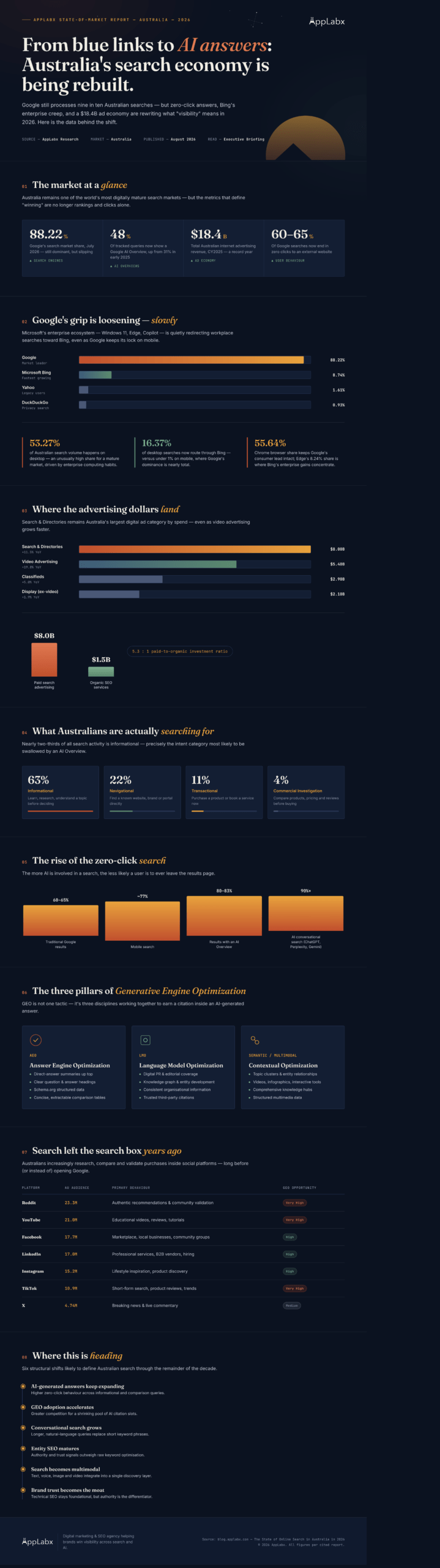
Google remains overwhelmingly dominant, accounting for nearly nine out of every ten searches conducted in Australia. Nevertheless, Microsoft’s steady gains highlight a structural rather than behavioural shift, particularly among enterprise users. Bing’s share has increased significantly compared with levels recorded only a few years earlier, largely due to Microsoft embedding AI-assisted search into its software ecosystem.
Evolution of Google’s Market Position
Although Google remains Australia’s primary search engine, its domestic market share has gradually declined from the mid-90% range observed in previous years to approximately 88% during 2026.
Several interconnected factors explain this trend:
• Expansion of Microsoft Copilot across enterprise environments
• Increased deployment of Windows 11 across Australian organisations
• Microsoft Edge becoming the default browser on corporate devices
• Growing use of AI assistants for information discovery
• Increasing acceptance of conversational search experiences
Importantly, this decline should not be interpreted as a collapse in Google’s influence. Instead, it reflects the emergence of a broader search ecosystem in which users discover information across multiple platforms rather than relying exclusively on traditional web search.
Australian Search Engine Competitive Landscape
| Search Platform | Strategic Position | Core User Base | SEO / GEO Importance |
|---|---|---|---|
| Google Search | Primary discovery platform | General consumers | Very High |
| Google AI | AI-enhanced search | Information seekers | Very High |
| Microsoft Bing | Enterprise search engine | Business professionals | High |
| Copilot | Workplace AI assistant | Microsoft ecosystem users | High |
| ChatGPT | Conversational discovery | Knowledge workers | High |
| Perplexity | Citation-driven AI search | Researchers | High |
| DuckDuckGo | Privacy-first search | Privacy-conscious users | Medium |
| Yahoo | Legacy portal search | Existing loyal users | Low |
| Ecosia | Sustainable search | Environmental users | Low |
| Yandex | International search | Limited niche audience | Very Low |
Device Distribution Creates a Unique Search Landscape
Australia differs noticeably from many global digital markets because desktop search continues to represent the largest share of total search activity.
While worldwide search volumes are predominantly mobile, Australia’s digital infrastructure, high office-based employment, and widespread enterprise technology adoption contribute to unusually strong desktop usage.
Australian Search Volume by Device
| Device Type | Share of Search Volume | Primary Search Engine | Secondary Search Engine |
|---|---|---|---|
| Desktop | 53.27% | Google (79.79%) | Bing (16.37%) |
| Mobile | 44.25% | Google (approximately 97%) | DuckDuckGo |
| Tablet | 2.48% | Google (97.77%) | Bing (1.10%) |
Desktop search now accounts for more than half of Australia’s search activity, creating favourable conditions for Microsoft’s enterprise-focused search strategy. Conversely, Google’s near-total dominance on mobile devices ensures that it remains the country’s overall market leader despite losing desktop share.
Device-Level Search Engine Distribution
| Device Category | Bing | Other Search Engines | Market Characteristics | |
|---|---|---|---|---|
| Desktop | 79.79% | 16.37% | Approximately 4% | Enterprise-driven competition |
| Mobile | Approximately 97% | Less than 1% | Less than 2% | Near Google monopoly |
| Tablet | 97.77% | 1.10% | Remaining share | Google ecosystem dominance |
The disparity between desktop and mobile demonstrates that Google’s competitive pressure is concentrated primarily within enterprise computing environments rather than consumer mobile usage.
Browser Ecosystem and Search Routing
Browser market share remains one of the strongest determinants of search engine usage because default search settings continue to influence user behaviour.
Australia’s browser market is led by Google Chrome, while Safari benefits from Apple’s ecosystem. Microsoft Edge has steadily expanded its presence through Windows 11 deployments, directly increasing Bing usage.
Australian Browser Market Share
| Web Browser | Market Share (2026) | Default Search Engine | Primary User Segment |
|---|---|---|---|
| Google Chrome | 55.64% | Google Search | Cross-platform consumers |
| Apple Safari | 28.13% | Google Search | Apple ecosystem users |
| Microsoft Edge | 8.24% | Microsoft Bing | Windows enterprise users |
| Samsung Internet | 3.01% | Google Search | Samsung smartphone owners |
| Mozilla Firefox | 2.49% | Google or Custom | Privacy and open-source users |
| Opera | 1.04% | Google or Custom | Niche desktop users |
Chrome and Safari together account for more than four-fifths of Australia’s browser market, preserving Google’s dominant position across consumer devices. However, Microsoft’s growing browser footprint continues to expand Bing’s reach within business environments.
Relationship Between Browsers and Search Engines
| Browser Ecosystem | Default Search Provider | Strategic Impact on Search |
|---|---|---|
| Chrome | Reinforces Google’s consumer dominance | |
| Safari | Maintains Google’s strength across Apple devices | |
| Edge | Bing | Expands Bing usage in enterprise environments |
| Samsung Internet | Strengthens Android search leadership | |
| Firefox | User Configurable | Limited impact on market dynamics |
| Opera | User Configurable | Minimal influence |
Enterprise Infrastructure Is Reshaping Search Behaviour
One of the defining characteristics of Australia’s search market in 2026 is that Bing’s growth has been driven more by enterprise technology decisions than by direct consumer migration.
As organisations completed Windows 11 upgrades and adopted Microsoft 365 with Copilot, employees increasingly conducted searches through Edge and Bing during routine work activities. Business professionals perform large volumes of commercial, administrative, legal, procurement, and financial searches, making enterprise traffic particularly valuable despite representing a smaller overall user base.
This demonstrates that software ecosystems now play an increasingly important role in determining search market share alongside traditional consumer preferences.
Enterprise Search Influence Matrix
| Enterprise Technology | Effect on Search Behaviour | SEO / GEO Implication |
|---|---|---|
| Windows 11 | Higher Edge adoption | Greater Bing visibility |
| Microsoft Edge | Default Bing routing | Multi-engine optimisation required |
| Microsoft 365 | Embedded AI search | Increased enterprise AI discovery |
| Copilot | Conversational search | Greater emphasis on structured content |
| Azure AI Services | AI-powered enterprise workflows | Entity optimisation becomes more valuable |
SEO and GEO Implications for Australian Businesses
Australia’s evolving search ecosystem means organisations can no longer optimise exclusively for Google.
Successful digital visibility strategies increasingly include:
• Traditional technical SEO
• Bing Webmaster optimisation
• Entity-based SEO
• Structured data implementation
• AI citation optimisation
• Knowledge graph development
• GEO for conversational AI platforms
• Brand authority building
Companies that optimise across multiple search ecosystems are more likely to maintain visibility as enterprise AI adoption, conversational search, and multi-platform discovery continue expanding.
Strategic Outlook
Australia’s search engine market illustrates how enterprise infrastructure, browser ecosystems, and AI integration are reshaping digital discovery. While Google remains the dominant search engine across consumer devices, Microsoft’s gains demonstrate that enterprise technology decisions can materially influence national search market dynamics. The country’s unusually desktop-oriented search profile further amplifies this effect, creating opportunities for Bing and AI-assisted search platforms to capture high-value commercial queries.
For businesses, this evolution signals a transition from single-engine optimisation toward multi-platform visibility. Future SEO success in Australia will increasingly depend on combining traditional search optimisation with Generative Engine Optimization, structured data, entity authority, and AI-ready content capable of performing consistently across Google Search, Bing, Copilot, ChatGPT, Perplexity, and other emerging AI-powered discovery platforms.
3. Digital Search Economics and Capital Allocation in Australia
Overview of Australia’s Digital Search Economy
Australia’s digital search economy has entered a new phase of expansion in 2026, supported by continued growth in online advertising investment, increasing enterprise digital transformation, and the widespread adoption of artificial intelligence across marketing platforms. Search remains the country’s largest digital advertising channel, accounting for almost half of all internet advertising expenditure and continuing to attract investment despite the emergence of AI-powered search experiences and zero-click search behaviour.
Rather than reducing investment in search, Australian businesses are expanding budgets across both paid and organic channels. Paid search continues to deliver measurable commercial returns, while investments in Search Engine Optimization (SEO), Generative Engine Optimization (GEO), and Answer Engine Optimization (AEO) are increasingly viewed as long-term strategic assets that improve visibility across traditional search engines and AI-powered answer platforms.
Australia’s Digital Advertising Market Continues to Expand
Australia’s internet advertising market achieved another record year during 2025, reaching approximately AUD 18.4 billion in total expenditure. Momentum accelerated further during the first quarter of 2026, when digital advertising spending climbed to approximately AUD 4.9 billion, representing the strongest March quarter ever recorded for the Australian market.
This sustained growth demonstrates that digital channels remain the preferred destination for marketing investment as advertisers continue shifting budgets away from traditional media toward highly measurable, performance-oriented digital platforms. Search advertising, online video, and AI-enhanced advertising technologies remain the principal beneficiaries of this trend.
Australian Digital Advertising Market Overview
| Advertising Category | CY2025 Revenue (AUD) | YoY Growth (CY2025) | Q1 2026 Revenue (AUD) | Q1 2026 YoY Growth | Share of Digital Advertising |
|---|---|---|---|---|---|
| Search & Directories | $8.00 Billion | +11.5% | $2.16 Billion | +13.9% | Approximately 44% |
| Video Advertising | $5.40 Billion | +19.8% | $1.40 Billion | +20.4% | Approximately 29% |
| Classifieds | $2.90 Billion | +5.0% | $787 Million | +13.9% | Approximately 16% |
| Display (Excluding Video) | $2.10 Billion | +1.9% | $129.5 Million | +7.7% | Approximately 3% |
| Audio Advertising | $339 Million | +8.2% | $83.5 Million | +8.3% | Approximately 2% |
| Total Internet Advertising | $18.40 Billion | +11.5% | $4.90 Billion | +15.3% | 100% |
The figures illustrate that search continues to dominate Australia’s digital advertising economy despite rapid expansion in online video advertising. While video recorded the fastest growth rate, Search and Directories maintained the largest overall share of advertising expenditure.
Search Advertising Remains the Largest Digital Channel
Search advertising continues to occupy a unique position within Australia’s digital economy because it captures consumers with immediate commercial intent.
Unlike display advertising, which often targets awareness, paid search reaches users actively seeking products, services, professional advice, financial solutions, healthcare providers, travel options, and local businesses. This performance-driven characteristic explains why Search and Directories continue attracting the largest share of digital marketing budgets.
The sustained growth of paid search demonstrates that advertisers continue to value measurable return on investment, even as artificial intelligence changes how users interact with search engines. AI-powered search experiences have not reduced commercial demand for search advertising; instead, they are encouraging advertisers to become more sophisticated in campaign management, keyword strategy, audience segmentation, and conversion optimisation.
Digital Advertising Investment Matrix
| Digital Channel | Primary Marketing Objective | Commercial Intent | Growth Outlook |
|---|---|---|---|
| Search Advertising | Direct response and lead generation | Very High | Very Strong |
| Video Advertising | Brand awareness and engagement | Medium | Very Strong |
| Display Advertising | Audience reach | Medium | Moderate |
| Classified Advertising | Marketplace transactions | High | Stable |
| Audio Advertising | Brand recall | Low to Medium | Moderate |
Rapid Expansion of Video Advertising
Although search remains Australia’s largest advertising category, digital video has emerged as the fastest-growing segment.
Investment in online video advertising continues accelerating across multiple formats, including:
• Social video
• Short-form video
• Broadcast Video on Demand (BVOD)
• Connected television
• Streaming platforms
• Premium publisher video
Social video has experienced particularly strong growth as consumers increasingly discover products, brands, and services through visual content rather than traditional search alone.
For marketers, this means SEO strategies are increasingly complemented by video optimisation strategies that improve discoverability across YouTube, TikTok, Instagram, and AI-powered multimedia search experiences.
Australian SEO Services Market Continues to Mature
Alongside growth in paid media, Australia’s SEO services industry continues expanding as businesses recognise the long-term value of organic visibility.
The Australian SEO market is estimated at approximately AUD 1.5 billion, reflecting sustained investment in:
• Technical SEO
• Content strategy
• Local SEO
• Structured data implementation
• Entity optimisation
• AI search readiness
• GEO consulting
• AEO implementation
Unlike earlier SEO campaigns focused primarily on keyword rankings, modern Australian SEO increasingly integrates semantic search optimisation and AI visibility strategies designed to improve discoverability across both conventional search engines and generative AI platforms.
Australian SEO Investment Overview
| Investment Category | Typical Allocation | Primary Focus |
|---|---|---|
| Total SEO Industry | Approximately $1.5 Billion | Organic visibility and AI readiness |
| SMB Monthly Retainer | $1,200–$1,500 | Local SEO, content, Google Business Profile |
| Enterprise SEO | $8,000–$25,000+ | Technical SEO, entity optimisation, GEO |
| GEO & AEO Programs | Increasing rapidly | AI citations and answer visibility |
SMBs Continue Investing in Organic Growth
Small and medium-sized businesses remain the largest users of outsourced SEO services.
Typical Australian SMBs invest monthly in activities including:
• Website optimisation
• Google Business Profile management
• Content creation
• Technical audits
• Local citation management
• Structured schema implementation
• AI search optimisation
These investments help smaller organisations compete against larger enterprises without relying exclusively on paid advertising.
Enterprise organisations, meanwhile, increasingly invest in sophisticated multi-market SEO programs that combine technical excellence with digital PR, entity development, and AI citation strategies.
Capital Allocation Between Paid Search and Organic Search
Australia’s search economy demonstrates a clear preference for paid advertising when viewed through total market expenditure.
Estimated capital allocation shows that paid search spending exceeds organic SEO investment by more than five times.
Search Investment Comparison
| Investment Category | Estimated Annual Spend | Strategic Purpose |
|---|---|---|
| Paid Search Advertising | $8.0 Billion | Immediate commercial visibility |
| Organic SEO Services | Approximately $1.5 Billion | Sustainable long-term visibility |
| Paid-to-Organic Investment Ratio | Approximately 5.3 : 1 | Short-term performance versus long-term growth |
This imbalance reflects the differing objectives of each investment.
Paid search delivers immediate traffic, predictable scalability, and measurable conversions.
Organic SEO builds durable authority, reduces long-term acquisition costs, and increasingly supports visibility within AI-generated search experiences.
Most mature Australian organisations now view these channels as complementary rather than competing investments.
Why Paid Search Budgets Continue Growing
Several structural developments explain continued expansion in paid search expenditure:
• Greater competition for commercial keywords
• Rising customer acquisition costs
• Increased zero-click search behaviour
• AI Overviews reducing organic click-through rates
• Higher emphasis on measurable marketing performance
• Expansion of ecommerce
• Increased business investment in digital transformation
As AI-generated answers occupy more space within search results, advertisers increasingly rely on sponsored placements to maintain consistent commercial visibility for high-value transactional searches.
Evolution of SEO Investment Priorities
SEO budgets are also evolving.
Traditional investments focused primarily on:
• Keyword rankings
• Link building
• Technical optimisation
Today’s investment priorities increasingly include:
• Entity optimisation
• Knowledge graph development
• GEO implementation
• Structured data
• AI citation readiness
• Content authority
• Expert authorship
• Brand trust signals
This shift reflects the transition from ranking-centric SEO toward visibility optimisation across multiple AI-powered discovery ecosystems.
Traditional SEO vs Modern Search Investment
| Traditional SEO Investment | Modern SEO & GEO Investment |
|---|---|
| Keyword optimisation | Entity optimisation |
| Link acquisition | Brand authority |
| Page rankings | AI citations |
| Organic traffic | Multi-platform discoverability |
| Metadata optimisation | Semantic relationships |
| Technical crawlability | Structured knowledge graphs |
| Search engine optimisation | Search engine and AI optimisation |
Capital Allocation Trends for the Future
Australia’s digital search economy is expected to continue expanding as businesses diversify investments across paid media, organic optimisation, AI search visibility, and multimedia content.
Several investment trends are likely to define the coming years:
| Emerging Trend | Expected Business Impact |
|---|---|
| Continued growth in paid search | Higher competition for commercial keywords |
| Expansion of GEO budgets | Increased AI citation optimisation |
| Greater investment in structured data | Better AI discoverability |
| Growth in enterprise SEO | Stronger entity authority |
| Expansion of video search marketing | Greater multimedia optimisation |
| AI-powered campaign automation | Improved advertising efficiency |
| Integrated SEO and PPC strategies | More holistic search marketing |
Strategic Outlook
Australia’s digital search economy in 2026 demonstrates that paid search, organic SEO, and AI-driven optimisation are becoming increasingly interconnected rather than operating as separate disciplines. Record levels of internet advertising expenditure, continued dominance of Search and Directories within digital media budgets, and sustained investment in SEO services all indicate that search remains the most commercially significant digital marketing channel in the country.
At the same time, capital allocation is gradually evolving beyond conventional keyword-based optimisation. Organisations are directing larger portions of their search budgets toward Generative Engine Optimization, Answer Engine Optimization, structured data, entity development, and AI-ready content that performs across Google Search, Bing, Copilot, ChatGPT, Gemini, Perplexity, and other emerging answer engines. Businesses that balance immediate paid search performance with long-term organic authority will be best positioned to compete in Australia’s increasingly AI-driven search ecosystem.
4. User Behavior, Search Intent Patterns, and the Rise of the Zero-Click Search Economy in Australia
Overview
User search behaviour in Australia has evolved considerably in 2026 as artificial intelligence, conversational interfaces, and answer-first search experiences reshape how people discover information online. Traditional keyword-based searches remain common, but Australians are increasingly using longer, more conversational queries across desktop, mobile, voice assistants, and AI-powered platforms.
At the same time, search engines are transitioning from referral platforms into information destinations. Instead of directing users to external websites, modern search engines increasingly answer questions directly within search results through AI Overviews, featured snippets, knowledge panels, local packs, and interactive search features. This structural change has accelerated the growth of zero-click searches, fundamentally changing how businesses measure SEO success and digital visibility.
Australian Search Intent Landscape
Australian search behaviour continues to be dominated by informational queries, reflecting users’ preference for researching topics, solving problems, learning new skills, and staying informed before making purchasing decisions.
Informational searches account for nearly two-thirds of overall search activity, while navigational and transactional searches together represent approximately one-third of search demand. This distribution reinforces the importance of high-quality educational content, topical authority, and structured information within modern SEO and Generative Engine Optimization strategies.
Australian Search Intent Distribution
| Search Intent | Approximate Share of Search Volume | Primary User Objective | GEO Opportunity |
|---|---|---|---|
| Informational | 63% | Learn, research, understand topics | Very High |
| Navigational | 22% | Find a known website, brand or portal | Medium |
| Transactional | 11% | Purchase products or book services | High |
| Commercial Investigation | 4% | Compare products, pricing and reviews | Very High |
Informational intent remains particularly valuable because it frequently triggers Google’s AI-generated responses, featured snippets, and conversational search experiences, making citation visibility increasingly important alongside traditional rankings.
Major Search Categories in Australia
Australians conduct searches across a wide range of topics, although several sectors consistently generate the largest search volumes.
Current events remain the single largest category, reflecting Australia’s strong appetite for domestic news, economic developments, and weather updates. Retail and ecommerce continue expanding rapidly, supported by increasing online purchasing and digital price comparison behaviour.
Australian Search Categories
| Search Category | Estimated Share of Search Activity | Common User Intent |
|---|---|---|
| News and Current Events | 18% | Latest news, weather, government announcements |
| Shopping and Ecommerce | 16% | Product availability, pricing, comparisons |
| Local Services | 14% | Businesses nearby, opening hours, reviews |
| Entertainment | 12% | Streaming, movies, events, sports |
| Health and Medical | 10% | Symptoms, appointments, medications |
| Travel and Navigation | 8% | Flights, hotels, maps, directions |
| Education and Research | 7% | Courses, references, learning resources |
| Finance and Banking | 6% | Mortgage rates, banking, investments |
| Government Services | 5% | Tax, Medicare, passports, licences |
| Other Specialist Topics | 4% | Business, hobbies, technical information |
These patterns demonstrate that Australian users increasingly expect immediate, trustworthy answers across both consumer and professional information needs.
Local Search Continues Driving Commercial Intent
Local search remains one of Australia’s most commercially valuable search segments.
Consumers regularly search for businesses, restaurants, healthcare providers, retailers, and professional services immediately before making purchasing decisions.
Within local search, food and hospitality generate the highest search demand, followed by retail, professional services, healthcare, and home services.
Local Commercial Search Breakdown
| Local Business Category | Estimated Share of Local Searches | Typical User Intent |
|---|---|---|
| Restaurants and Cafes | 32% | Dining options, reviews, reservations |
| Retail Stores | 21% | Product availability, store locations |
| Professional Services | 18% | Lawyers, accountants, consultants |
| Healthcare Services | 15% | Doctors, dentists, pharmacies |
| Home Services | 14% | Repairs, maintenance, contractors |
Because many local searches now trigger Google Maps, Local Packs, AI-generated recommendations, and business profile summaries, organisations increasingly optimise both traditional Local SEO and structured business information to improve visibility.
Voice Search Continues to Expand
Voice search has become an increasingly important component of Australia’s search ecosystem, particularly on smartphones, connected devices, and in-vehicle systems.
Unlike typed searches, voice queries tend to be significantly longer and more conversational.
Typical characteristics include:
• Six to ten words per query
• Natural language phrasing
• Frequent use of question words
• Strong local intent
• High demand for immediate answers
Approximately three-quarters of voice searches begin with interrogative phrases such as “what,” “where,” “how,” and “when,” reflecting users’ preference for conversational interactions rather than keyword-based searches. Voice interactions are primarily informational or navigational rather than transactional.
Voice Search Intent Distribution
| Voice Search Intent | Approximate Share | Typical Examples |
|---|---|---|
| Local Information | 38% | Nearby restaurants, opening hours |
| Quick Facts | 27% | Definitions, weather, calculations |
| Navigation | 19% | Maps, directions, travel |
| General Knowledge | 16% | Educational questions, explanations |
For SEO and GEO practitioners, this reinforces the importance of producing content that directly answers conversational questions in clear, structured language.
The Emergence of the Zero-Click Search Economy
Perhaps the most significant behavioural shift in Australia’s search landscape is the rapid growth of zero-click searches.
A zero-click search occurs when users obtain the information they need directly from the search results page without visiting an external website.
Modern search interfaces increasingly satisfy user intent through:
• AI Overviews
• Featured snippets
• Knowledge panels
• Local business packs
• Instant answers
• People Also Ask modules
• Weather panels
• Sports results
• Maps integration
As these features become more comprehensive, websites receive fewer referral visits even when maintaining strong organic rankings. Independent research indicates that roughly 60–65% of Google searches now end without a click, with substantially higher rates when AI-generated answers appear.
Evolution of Zero-Click Search
| Search Environment | Estimated Zero-Click Rate | User Behaviour |
|---|---|---|
| Traditional Google Results | 60–65% | User finds answer without visiting websites |
| Mobile Search | Approximately 77% | Heavy use of local packs and instant answers |
| AI Overview Results | Approximately 80–83% | AI summaries satisfy informational intent |
| AI Conversational Search | Up to 90%+ | Answers delivered entirely within AI interface |
These figures demonstrate that website traffic is increasingly becoming only one measure of search success, while brand visibility within AI-generated responses grows in importance.
Declining Organic Click-Through Rates
The expansion of AI-generated search features has significantly altered click behaviour across organic search results.
Although top organic rankings remain valuable, the presence of AI-generated summaries can substantially reduce click-through rates because users often receive sufficient information directly on the results page.
Illustrative Organic CTR Trends
| Organic Position | Earlier Search Environment | AI-Enhanced Search Environment | General Trend |
|---|---|---|---|
| Position 1 | Highest CTR | Significantly reduced when AI summaries appear | Large decline |
| Position 2 | Strong visibility | Reduced visibility | Moderate decline |
| Position 3 | Moderate traffic | Lower traffic | Continued decline |
| Positions 4–10 | Limited clicks | Minimal clicks | Significant decline |
Recent industry studies consistently show that AI-generated summaries materially reduce clicks to traditional organic listings, particularly for informational searches.
From Search Results to Answer Engines
Search engines are increasingly functioning as answer engines rather than referral engines.
Historically, search engines connected users with external websites.
Today’s search experiences increasingly:
• Answer questions directly
• Summarise multiple sources
• Compare products
• Recommend businesses
• Generate explanations
• Present local information
• Display structured knowledge
This shift transforms the search results page into the final destination for many users rather than merely the beginning of their information journey. Businesses must therefore optimise not only for rankings but also for inclusion within AI-generated answers and trusted citation networks.
Traditional Search Journey vs AI Search Journey
| Traditional Search Model | AI-Powered Search Model |
|---|---|
| User searches | User asks a question |
| Search engine lists links | AI generates a direct answer |
| User visits multiple websites | AI synthesises multiple sources |
| Website receives traffic | Brand gains citation and visibility |
| Rankings determine success | Authority and entity recognition determine success |
Implications for SEO and GEO
The changing behaviour of Australian search users requires organisations to rethink how they measure digital performance.
Successful optimisation strategies increasingly prioritise:
• High-quality factual content
• Entity authority
• Structured data implementation
• Conversational content
• Question-and-answer formats
• Comprehensive topical coverage
• Local business optimisation
• Brand credibility
• AI citation readiness
Instead of focusing exclusively on clicks, forward-looking organisations increasingly monitor visibility across AI Overviews, conversational search platforms, and answer engines, recognising that brand exposure and authoritative citations have become critical indicators of search success in Australia’s evolving digital landscape.
5. Generative Engine Optimization (GEO) and AI Search Integration in Australia
The Emergence of AI-Powered Search in Australia
Australia’s digital search ecosystem has entered a new era where artificial intelligence is becoming an integral part of information discovery. As consumers increasingly adopt generative AI tools for everyday research, search engines have evolved beyond simply ranking web pages to synthesising answers from multiple trusted sources. This shift has accelerated the importance of Generative Engine Optimization (GEO), a discipline that complements traditional Search Engine Optimization (SEO) by focusing on improving visibility within AI-generated responses.
The rapid adoption of generative AI among Australian consumers, together with Google’s continued rollout of AI Overviews, has fundamentally changed how users interact with search results. Rather than browsing multiple websites, users increasingly receive comprehensive summaries directly within search interfaces, reducing reliance on conventional blue-link search results while increasing the importance of becoming a cited source inside AI-generated answers.
Growth of AI Overviews Across Search Results
Google AI Overviews have expanded rapidly throughout 2025 and 2026.
Industry monitoring indicates that AI Overviews now appear on nearly half of tracked search queries, representing one of the fastest changes ever observed in Google’s search interface. Although traditional organic listings remain important for many searches, AI-generated summaries increasingly dominate informational and comparison-based queries.
AI Overview Expansion
| AI Overview Metric | Early 2025 | Early 2026 | Market Impact |
|---|---|---|---|
| Share of Tracked Queries Showing AI Overviews | Approximately 31% | Approximately 48% | Significant expansion |
| Queries Without AI Overviews | Approximately 69% | Approximately 52% | Organic search remains important |
| Average AI Overview Size | Smaller summaries | Larger answer panels | Organic listings pushed further down |
| AI Overview Growth | Baseline | Approximately 58% year-over-year increase | Rapid adoption |
This expansion means businesses can no longer optimise solely for traditional rankings. Increasingly, success depends on whether content becomes part of Google’s AI-generated answer ecosystem.
The Economics of AI Citations
One of the most significant developments in AI search is the emergence of citation-based visibility.
While AI Overviews generally reduce organic click-through rates, being explicitly cited inside an AI-generated response creates an opportunity to recover visibility and attract highly qualified visitors.
Research indicates that cited pages consistently outperform non-cited pages appearing elsewhere on the same search results page, demonstrating that AI citations are becoming an important new source of qualified traffic.
Illustrative Impact of AI Citations
| Search Scenario | Non-Cited Organic Page | AI Overview Cited Page | Strategic Outcome |
|---|---|---|---|
| Average Organic CTR | Lower | Higher | Citation improves visibility |
| Organic Traffic Trend | Declining | More resilient | AI citation offsets some traffic loss |
| Brand Visibility | Organic listing only | Embedded inside AI answer | Greater authority perception |
| User Intent | General search visitors | Highly qualified information seekers | Higher engagement potential |
Rather than eliminating organic search entirely, AI Overviews are reshaping how visibility is earned. Brands cited by AI systems increasingly receive more qualified engagement despite lower overall click volumes.
How AI Changes Search Behaviour
AI-powered search changes the user’s journey.
Traditional Search Model
User enters keywords
↓
Search engine ranks webpages
↓
User compares results
↓
User visits several websites
AI Search Model
User asks a natural-language question
↓
AI retrieves multiple trusted sources
↓
AI synthesises a comprehensive answer
↓
User may click only the most authoritative citations
This transformation shifts optimisation priorities from simply achieving high rankings toward becoming a trusted information source that artificial intelligence systems choose to reference.
Traditional SEO Versus GEO
| Traditional SEO | Generative Engine Optimization |
|---|---|
| Optimises rankings | Optimises AI citations |
| Focuses on keywords | Focuses on entities and concepts |
| Measures clicks | Measures citation visibility |
| Builds backlinks | Builds authority and trust |
| Targets search engines | Targets search engines and AI models |
| Improves page relevance | Improves factual reliability |
| Optimises webpages | Optimises knowledge ecosystems |
The Three Core Pillars of Generative Engine Optimization
Modern GEO strategies are built upon three complementary disciplines that collectively improve visibility across AI-powered search ecosystems.
Answer Engine Optimization (AEO)
Answer Engine Optimization focuses on presenting information in formats that AI systems can easily extract, understand, and reference.
Best practices include:
• Direct answer summaries near the beginning of articles
• Clear question-and-answer headings
• Concise factual explanations
• Well-structured comparison tables
• Comprehensive FAQ sections
• Schema.org structured data
Studies consistently show that structured, question-oriented content is more likely to be referenced by AI-generated search experiences than unstructured long-form text.
Language Model Optimization (LMO)
Language Model Optimization extends beyond webpages to strengthen a brand’s digital authority across the broader information ecosystem.
Typical activities include:
• Digital public relations
• High-authority editorial coverage
• Consistent organisational information
• Knowledge graph optimisation
• Entity development
• Trusted third-party citations
• Industry recognition
Because large language models rely upon authoritative external sources, organisations with stronger digital authority are more likely to appear within AI-generated responses.
Semantic and Multimodal Optimization
Modern AI systems understand relationships between concepts rather than simply matching keywords.
Consequently, Australian businesses increasingly optimise for semantic completeness through:
• Topic clusters
• Entity relationships
• Comprehensive knowledge hubs
• Interactive calculators
• Visual explainers
• Videos
• Infographics
• Structured multimedia
Multimedia assets supported by appropriate structured data can increase visibility across both traditional search results and AI-powered discovery experiences.
The Three GEO Pillars
| GEO Discipline | Primary Objective | Typical Optimisation Activities |
|---|---|---|
| Answer Engine Optimization (AEO) | Improve extractability | Direct answers, FAQs, schema, structured headings |
| Language Model Optimization (LMO) | Improve authority | Digital PR, entity building, trusted citations |
| Semantic and Multimodal Optimization | Improve contextual understanding | Topic clusters, videos, tools, semantic relationships |
Technology Supporting GEO
Australian agencies and enterprise marketing teams increasingly rely on specialised platforms to monitor AI visibility alongside conventional SEO metrics.
These technologies help organisations evaluate:
• AI citation frequency
• Brand mentions
• Share of Voice across AI platforms
• Entity visibility
• Topical authority
• Competitive AI performance
Rather than monitoring rankings alone, businesses increasingly assess performance across multiple AI ecosystems including Google AI, ChatGPT, Gemini, Copilot, Claude, and Perplexity.
AI Visibility Measurement Framework
| Measurement Area | Traditional SEO Metric | GEO Metric |
|---|---|---|
| Visibility | Keyword ranking | AI citation frequency |
| Authority | Backlinks | Entity recognition |
| Traffic | Organic sessions | AI-assisted referral traffic |
| Competition | Ranking position | Share of Voice across AI platforms |
| Brand Presence | SERP appearance | Multi-platform AI mentions |
Growing Enterprise Adoption
As AI-generated search becomes increasingly influential, Australian organisations are integrating GEO into broader digital marketing strategies rather than treating it as a standalone initiative.
Enterprise priorities increasingly include:
• AI-ready content architecture
• Structured data implementation
• Knowledge graph development
• Brand authority enhancement
• Expert-led content
• Citation optimisation
• Comprehensive topical coverage
• Continuous monitoring across AI search platforms
This reflects a broader industry transition from ranking optimisation toward comprehensive visibility optimisation across traditional search engines and generative AI systems.
Strategic Outlook
Generative Engine Optimization has become a critical extension of modern SEO within Australia’s rapidly evolving search ecosystem. The widespread deployment of AI Overviews, increasing consumer adoption of conversational AI, and growing importance of citation-based discovery are reshaping how organisations compete for online visibility. While traditional search rankings remain valuable, long-term success increasingly depends on producing structured, authoritative, and semantically rich content that AI systems recognise as trustworthy enough to cite.
Businesses that integrate Answer Engine Optimization, Language Model Optimization, and semantic content strategies into their digital marketing programmes will be better positioned to maintain visibility across Google Search, AI Overviews, ChatGPT, Gemini, Copilot, Claude, Perplexity, and future AI-powered discovery platforms. As AI continues transforming online search, Generative Engine Optimization is evolving from an emerging practice into a core pillar of sustainable digital visibility.
6. Social Search Convergence and Alternative Discovery Channels in Australia
The Evolution from Traditional Search to Social Discovery
Australia’s digital discovery ecosystem has expanded well beyond traditional search engines. Consumers increasingly use social media platforms as search engines for researching products, comparing services, discovering brands, validating purchasing decisions, and finding local recommendations. This convergence of social media and search is reshaping digital marketing strategies, requiring businesses to optimise not only for Google and Bing but also for platforms such as YouTube, TikTok, Reddit, Instagram, LinkedIn, and Facebook.
Rather than replacing conventional search engines, social platforms have become complementary discovery channels that influence every stage of the customer journey. Consumers frequently begin product research on social platforms, consult online communities for authentic reviews, and only later visit search engines or company websites to complete transactions. As a result, modern SEO increasingly overlaps with social content optimisation, community engagement, creator marketing, and Generative Engine Optimization (GEO).
The Rise of Social Search in Australia
Australian consumers increasingly rely on social platforms when researching products, brands, services, and purchasing decisions.
Recent digital behaviour studies show:
• Nearly six in ten Australian adults use social media to research brands.
• Approximately one-third actively search for product and company information through social platforms.
• A significant proportion also use social networks to discover products before making purchasing decisions.
These behaviours demonstrate that social platforms are no longer used solely for entertainment or communication. They now function as major discovery engines that influence commercial intent before users ever perform a traditional Google search.
Australian Social Search Ecosystem
| Social Platform | Australian Active Audience (2026) | Primary Search Behaviour | GEO Opportunity |
|---|---|---|---|
| YouTube | 21.0 Million | Educational videos, reviews, tutorials | Very High |
| 23.3 Million (Advertising Reach) | Authentic recommendations and discussions | Very High | |
| 17.7 Million | Marketplace, local businesses, community groups | High | |
| 17.0 Million | Professional services, B2B vendors, hiring | High | |
| 15.2 Million | Lifestyle inspiration, product discovery | High | |
| TikTok | 10.9 Million Adults | Short-form search, product reviews, trends | Very High |
| X | 4.74 Million | Breaking news and live commentary | Medium |
The continued expansion of YouTube, Reddit, Instagram, LinkedIn, and TikTok demonstrates that Australians increasingly discover information across multiple digital ecosystems instead of relying exclusively on search engines.
Social Platform Growth Trends
Not all social platforms are evolving at the same pace.
Some platforms are experiencing rapid expansion because they provide authentic user-generated information and searchable content, while others face slowing adoption or declining reach.
Platform Growth Overview
| Platform | Growth Trend | Key Market Driver |
|---|---|---|
| Very Strong Growth | Community knowledge and trusted recommendations | |
| TikTok | Strong Growth | Search-first video discovery |
| Steady Growth | Visual commerce and creator content | |
| Moderate Growth | Local communities and Marketplace | |
| Stable | Professional networking and B2B discovery | |
| YouTube | Mature | Long-form educational content |
| X | Declining | Reduced audience growth |
Reddit has emerged as one of Australia’s fastest-growing discovery platforms. Consumers increasingly value community-generated opinions, real-world experiences, and independent product reviews, particularly as AI-generated content becomes more widespread.
Social Platforms Are Becoming Search Engines
Each major social platform now supports sophisticated search functionality.
Instead of typing questions into Google, Australians increasingly search directly within:
• YouTube for tutorials
• TikTok for product demonstrations
• Reddit for authentic reviews
• Facebook Marketplace for local products
• Instagram for lifestyle recommendations
• LinkedIn for business providers
This behaviour reflects a broader shift toward platform-native discovery, where users expect answers to be delivered within the platform they are already using rather than through a traditional search engine.
Alternative Search Ecosystem
| Platform | Primary Discovery Intent | Typical User Questions |
|---|---|---|
| YouTube | Learning | “How does this work?” |
| TikTok | Product discovery | “Is this worth buying?” |
| Community validation | “What do real users think?” | |
| Inspiration | “What looks good?” | |
| Local commerce | “Where can I buy this nearby?” | |
| Professional services | “Who is the best provider?” |
This diversification means brands must maintain visibility across multiple ecosystems to remain discoverable throughout the customer journey.
YouTube: Australia’s Largest Visual Search Engine
YouTube continues to function as Australia’s largest visual search platform.
Consumers increasingly use YouTube to:
• Compare products
• Watch demonstrations
• Learn new skills
• Review software
• Understand financial products
• Research travel destinations
• Evaluate service providers
Unlike conventional web search, YouTube enables users to assess products visually before making purchasing decisions, making it a critical component of modern SEO and GEO strategies.
For businesses, YouTube optimisation increasingly includes:
• Search-friendly titles
• Keyword-rich descriptions
• Structured chapters
• Closed captions
• Video schema
• Topical playlists
• Educational long-form content
Reddit Becomes a Trusted Research Platform
One of the most notable developments in Australia’s search ecosystem is the rapid growth of Reddit.
Consumers increasingly search Reddit because they seek:
• Unfiltered opinions
• Real customer experiences
• Product comparisons
• Purchase advice
• Technical troubleshooting
• Community expertise
Rather than relying solely on corporate websites or AI-generated summaries, users frequently consult Reddit discussions to validate purchasing decisions and obtain practical recommendations.
This behaviour reinforces the growing importance of digital reputation management, community engagement, and third-party brand mentions within modern GEO strategies.
TikTok Becomes a Search Platform
TikTok has evolved from an entertainment platform into one of Australia’s fastest-growing search ecosystems, particularly among younger consumers.
The majority of TikTok’s Australian audience is under the age of 34, and research consistently shows that younger users increasingly search TikTok before using traditional search engines for topics such as:
• Restaurants
• Fashion
• Beauty
• Technology
• Travel
• Local attractions
• Product reviews
• Lifestyle advice
Consumers increasingly value short, authentic videos that demonstrate products in real-world situations rather than polished advertising campaigns.
TikTok Search Behaviour
| User Behaviour | Strategic Implication |
|---|---|
| Searches immediately after opening the app | Brands need searchable content |
| Prefers authentic creators | Influencer partnerships become important |
| Consumes vertical video | Short-form production becomes essential |
| Uses natural-language search | Conversational optimisation improves discovery |
| Watches product demonstrations | Educational content drives purchasing decisions |
The Rise of TikTok SEO
As TikTok’s internal search engine has matured, businesses increasingly optimise specifically for TikTok search visibility.
Typical optimisation techniques include:
• Spoken keywords
• On-screen text
• Automatic captions
• Descriptive video titles
• Relevant hashtags
• Search-friendly video descriptions
• Clear product demonstrations
• Question-based content
These practices improve discoverability within TikTok’s recommendation and search algorithms while also increasing opportunities for content to appear across Google Video results.
TikTok Advertising and Search
Businesses increasingly complement organic TikTok SEO with dedicated TikTok Search Ads.
Compared with traditional social advertising, search-focused campaigns often reach consumers at a later stage of the purchasing journey when commercial intent is significantly stronger.
Illustrative TikTok Commerce Metrics
| Campaign Type | Primary Objective | Typical Business Outcome |
|---|---|---|
| In-Feed Ads | Awareness | Broad reach and engagement |
| Search Ads | Purchase intent | Higher-quality traffic |
| Spark Ads | Creator amplification | Improved authenticity |
| TikTok Shop | Direct commerce | Streamlined conversion experience |
Integrated search and commerce experiences continue strengthening TikTok’s role as both a discovery platform and a transactional marketplace.
The Convergence of SEO, GEO, and Social Search
The distinction between search engines and social platforms continues to blur.
Consumers increasingly move seamlessly between:
• Google Search
• AI assistants
• YouTube
• TikTok
Rather than optimising for a single platform, organisations increasingly adopt “Search Everywhere” strategies that maximise visibility wherever discovery occurs.
Integrated Discovery Ecosystem
| Discovery Platform | Primary Content Format | Optimisation Priority |
|---|---|---|
| Articles and webpages | Technical SEO and structured data | |
| Google AI | Answer summaries | GEO and entity optimisation |
| ChatGPT | Conversational responses | Citation authority |
| YouTube | Long-form video | Video SEO |
| TikTok | Short-form video | TikTok SEO |
| Community discussions | Brand reputation | |
| Visual storytelling | Creator optimisation | |
| Professional content | Thought leadership |
Strategic Implications for Australian Businesses
The convergence of social search and traditional search requires organisations to rethink digital visibility.
Successful strategies increasingly combine:
• Technical SEO
• Generative Engine Optimization
• Social content optimisation
• Video production
• Creator partnerships
• Community participation
• Brand authority
• User-generated content
• Entity optimisation
• Multi-platform analytics
Businesses that maintain consistent, authoritative, and searchable content across both search engines and social discovery platforms are better positioned to capture audiences throughout the modern customer journey.
Future Outlook
Australia’s search ecosystem is evolving into a multi-platform discovery environment where traditional search engines, AI-powered answer engines, and social platforms work together to influence consumer decision-making. YouTube remains the country’s dominant visual search destination, TikTok has established itself as a leading search platform for younger demographics, Reddit continues to grow as a trusted source of authentic product research, and professional discovery through LinkedIn remains essential for B2B markets. These developments illustrate that search is no longer confined to browser-based engines but extends across a diverse network of social and AI-powered platforms.
For businesses, success increasingly depends on adopting a unified optimisation strategy that integrates SEO, GEO, social search optimisation, video-first content, community engagement, and creator-driven discovery. Organisations that build authority across these interconnected ecosystems will be better equipped to capture high-intent audiences, strengthen brand trust, and remain visible as digital discovery continues shifting beyond the traditional search engine.
7. Regulatory, Privacy, and Structural Governance of Online Search in Australia
Overview
Australia’s online search ecosystem in 2026 is increasingly shaped not only by technological innovation but also by one of the world’s most comprehensive regulatory frameworks governing online safety, age assurance, privacy, and platform accountability. Legislative reforms introduced under the Online Safety Act have expanded the responsibilities of search engines, AI-powered discovery platforms, and social media services, requiring them to actively reduce harmful content, strengthen child protection measures, and improve transparency in algorithmic content delivery.
For search providers, digital publishers, and marketers, regulatory compliance has become an important component of search visibility. Trust signals, verified business identities, content quality, and responsible publishing practices increasingly complement traditional SEO and Generative Engine Optimization (GEO) strategies as search platforms respond to new legal obligations.
Australia’s Regulatory Shift for Search Platforms
Australia has progressively expanded the Online Safety Act to cover a wider range of online services, including internet search engines, AI-generated search experiences, hosting providers, app stores, and social media platforms.
The regulatory framework is designed to reduce exposure to illegal and age-restricted material while strengthening protections for children and vulnerable users.
Major objectives include:
• Reducing access to illegal online material
• Preventing children from viewing age-restricted content
• Increasing platform accountability
• Strengthening age-assurance mechanisms
• Improving transparency around algorithmic systems
• Enhancing user safety within AI-powered search environments
These developments position Australia among the leading jurisdictions globally in regulating online search and AI-assisted discovery.
Australia’s Online Search Regulatory Framework
| Regulatory Area | Primary Objective | Impact on Search Ecosystem |
|---|---|---|
| Online Safety Act | Protect users from harmful content | Higher platform accountability |
| Internet Search Engine Services Code | Regulate search providers | Safer search experiences |
| Age-Restricted Material Codes | Protect minors | Mandatory age assurance |
| Social Media Minimum Age Rules | Restrict under-16 access | Reshapes youth digital behaviour |
| Compliance Audits | Increase transparency | Greater governance of algorithms |
Internet Search Engine Services Code
A significant milestone occurred with the commencement of the Internet Search Engine Services Online Safety Codes governing search engine providers.
These requirements apply to major search services operating in Australia and establish mandatory obligations relating to unlawful and age-restricted material.
Search providers are required to implement measures that reduce the availability of serious illegal content and introduce age-assurance controls for material unsuitable for children. The framework also requires providers to demonstrate ongoing compliance through governance, reporting, and operational safeguards.
Key Compliance Requirements
| Compliance Area | Regulatory Expectation | Business Impact |
|---|---|---|
| Illegal Content | Reduce availability of Class 1A and 1B material | Stronger content moderation |
| Age-Restricted Material | Restrict access for minors | Age-assurance implementation |
| Search Governance | Ongoing compliance obligations | Greater operational oversight |
| Risk Management | Continuous monitoring | Enhanced platform controls |
| Regulatory Reporting | Demonstrate compliance | Increased transparency |
Strengthening Age Assurance
One of the most significant structural changes involves mandatory age-assurance measures.
Search providers must implement mechanisms that help prevent children from accessing age-restricted content through search services. These requirements form part of Australia’s broader strategy for protecting young internet users across multiple digital platforms.
Rather than relying solely on content filtering, the regulatory framework increasingly emphasises robust age verification and age estimation processes appropriate to the level of risk associated with particular services. Age-assurance obligations for search engine services are being phased in under the regulatory timetable established by the eSafety Commissioner.
Age Assurance Framework
| Regulatory Objective | Expected Outcome |
|---|---|
| Protect minors from adult material | Safer online experiences |
| Strengthen verification processes | Better access control |
| Reduce harmful exposure | Improved child protection |
| Increase provider accountability | Greater platform responsibility |
Greater Governance of Search Algorithms
Australia’s regulatory environment increasingly recognises that search algorithms influence public access to information.
Although search providers continue to maintain proprietary ranking systems, the regulatory framework encourages stronger governance surrounding:
• Sensitive search queries
• Harmful content detection
• Autocomplete suggestions
• AI-generated search experiences
• Content moderation processes
• Risk management procedures
These governance expectations reinforce the importance of responsible AI deployment alongside conventional search ranking systems.
Algorithm Governance Matrix
| Governance Area | Strategic Objective |
|---|---|
| Search ranking oversight | Improve user safety |
| Autocomplete management | Reduce harmful suggestions |
| AI-generated responses | Improve responsible information delivery |
| Content moderation | Prevent illegal content exposure |
| Transparency processes | Strengthen public trust |
Growing Importance of Trust Signals
As regulation becomes more comprehensive, search ecosystems increasingly reward trustworthy digital entities.
For publishers and businesses, important trust indicators include:
• Verified business identities
• Accurate organisational information
• Transparent ownership
• Expert authorship
• High-quality editorial standards
• Secure websites
• Responsible content practices
• Consistent entity information
These signals align closely with broader SEO and GEO principles that emphasise authority, expertise, and trustworthiness.
Search Trust Framework
| Trust Signal | SEO and GEO Benefit |
|---|---|
| Verified business identity | Higher credibility |
| Expert content | Greater topical authority |
| Consistent entity information | Better knowledge graph recognition |
| Structured data | Improved AI understanding |
| Editorial transparency | Stronger trust signals |
| Secure infrastructure | Better user confidence |
Social Media Minimum Age Reform
Australia also introduced world-leading minimum age requirements for many social media platforms.
Under the Social Media Minimum Age framework, age-restricted platforms are required to take reasonable steps to prevent Australians under the age of 16 from creating or maintaining accounts.
The requirements apply to many of the world’s largest social media platforms and form part of Australia’s broader online safety strategy aimed at reducing harmful online experiences for children.
Platforms Affected by the Minimum Age Rules
| Platform Category | Regulatory Position |
|---|---|
| Age-restricted platform | |
| Age-restricted platform | |
| TikTok | Age-restricted platform |
| Age-restricted platform | |
| Snapchat | Age-restricted platform |
| X | Age-restricted platform |
| YouTube | Age-restricted platform |
| Twitch | Age-restricted platform |
Marketing Implications of Youth Restrictions
The introduction of minimum age obligations is influencing digital marketing strategies across Australia.
Many organisations are increasingly reallocating marketing investment toward audiences that can be reached through compliant digital channels, including:
• Search marketing
• Educational content
• Publisher partnerships
• Contextual advertising
• Adult consumer segments
• Business-to-business marketing
This shift is encouraging marketers to diversify acquisition strategies rather than relying heavily on youth-oriented social media campaigns.
Marketing Allocation Trends
| Marketing Area | Expected Strategic Shift |
|---|---|
| Paid Search | Continued investment |
| SEO and GEO | Increased importance |
| Educational Content | Greater emphasis |
| Contextual Advertising | Expanded use |
| Adult Audience Campaigns | Higher investment |
| Youth Social Campaigns | More regulated approach |
Privacy and Responsible AI
Australia’s regulatory framework also reinforces the importance of privacy and responsible artificial intelligence.
Organisations increasingly prioritise:
• Data minimisation
• Privacy-by-design
• Responsible AI deployment
• Transparent data handling
• Secure identity verification
• Ethical content moderation
For businesses investing in AI-powered search optimisation, these principles are becoming increasingly important alongside technical SEO and content quality.
Relationship Between Regulation and GEO
Australia’s regulatory developments reinforce many of the core principles already associated with modern Generative Engine Optimization.
Regulatory Expectations and GEO Alignment
| Regulatory Priority | GEO Alignment |
|---|---|
| Trusted information | Authoritative content |
| Verified organisations | Entity optimisation |
| Transparency | Clear authorship |
| User protection | High-quality factual content |
| Responsible AI | AI-ready structured information |
| Platform accountability | Consistent digital authority |
Strategic Outlook
Australia’s regulatory framework for online search and digital discovery continues to evolve toward greater accountability, stronger child protection, and increased governance of AI-assisted search experiences. The implementation of the Internet Search Engine Services Online Safety Codes, expanded age-assurance obligations, and minimum age requirements for major social media platforms illustrates the country’s commitment to balancing technological innovation with user safety and responsible digital governance.
For businesses, publishers, and marketers, these regulatory developments reinforce the growing importance of trust, transparency, and verified digital authority. Success in Australia’s search ecosystem increasingly depends not only on technical SEO and Generative Engine Optimization but also on demonstrating credibility through responsible publishing practices, accurate organisational information, structured content, and compliance with evolving online safety expectations. As AI-powered search continues to expand, regulatory governance and search optimisation are likely to become even more closely interconnected, making trustworthy digital ecosystems a lasting competitive advantage.
8. Outlook for Online Search in Australia in 2026
The Transformation of Australia’s Search Landscape
Australia’s online search ecosystem in 2026 represents a fundamental transition from a search engine-centric environment to a diversified digital discovery ecosystem powered by artificial intelligence, conversational interfaces, social platforms, and multimodal content. Traditional Search Engine Optimization remains an essential foundation, but it is no longer sufficient as a standalone strategy for sustaining online visibility or driving long-term customer acquisition.
Google continues to dominate Australian search, yet its market share has gradually declined as Microsoft Bing strengthens its position through Windows 11, Microsoft Edge, Copilot, and enterprise adoption. Simultaneously, AI-powered search experiences, including Google AI Overviews, ChatGPT, Gemini, Copilot, Claude, and Perplexity, are changing how consumers discover information, compare products, and evaluate brands. Social platforms such as YouTube, TikTok, Reddit, Instagram, and LinkedIn have also evolved into influential search destinations that shape purchasing decisions before users visit traditional search engines.
Rather than viewing these developments as separate trends, businesses should recognise them as components of a unified search ecosystem where visibility must be earned across multiple interconnected platforms.
Australia’s New Search Reality
| Traditional Search Model | Search Ecosystem in 2026 |
|---|---|
| Google dominates discovery | Multi-platform discovery ecosystem |
| SEO focuses on rankings | SEO focuses on visibility everywhere |
| Keywords drive optimisation | Entities and authority drive optimisation |
| Website traffic measures success | Citations, mentions and brand visibility matter equally |
| Organic search generates awareness | AI, social and search jointly influence customer journeys |
Generative Engine Optimization Becomes Core Infrastructure
One of the most important strategic developments is the emergence of Generative Engine Optimization (GEO) as a core component of digital marketing.
With AI-generated search experiences appearing across an increasing proportion of informational queries, organisations can no longer depend exclusively on traditional keyword optimisation. Instead, content must be engineered so that AI systems can easily understand, retrieve, summarise, and cite authoritative information.
This requires businesses to move beyond page-level optimisation toward knowledge architecture that supports artificial intelligence systems through:
• Direct answer blocks
• Structured Schema.org markup
• Comprehensive topic clusters
• Entity relationships
• Expert-authored content
• Consistent factual information
• Trusted third-party citations
Businesses that successfully implement Answer Engine Optimization (AEO), Language Model Optimization (LMO), and semantic content strategies will improve their likelihood of becoming trusted citation sources across AI-powered discovery platforms.
GEO Implementation Framework
| GEO Component | Strategic Objective | Expected Business Benefit |
|---|---|---|
| Answer Engine Optimization | Improve extractability | Greater AI citation frequency |
| Language Model Optimization | Strengthen digital authority | Better AI recognition |
| Semantic Optimization | Improve contextual understanding | Broader topic visibility |
| Structured Data | Improve machine readability | Enhanced AI interpretation |
| Entity Development | Build knowledge graph presence | Increased brand trust |
Enterprise Search Requires Bing and Copilot Optimization
Australia’s unusually desktop-oriented search behaviour creates a unique opportunity for enterprise marketers.
Desktop devices account for a larger share of Australian search activity than in many international markets, and Microsoft’s ecosystem continues expanding through Windows 11, Microsoft Edge, Microsoft 365, and Copilot integration. This has enabled Bing to capture a significantly larger proportion of desktop search traffic, particularly among business professionals conducting high-value commercial searches.
Consequently, B2B organisations, financial institutions, technology companies, and professional service providers should expand optimisation efforts beyond Google by:
• Maintaining Bing Webmaster Tools
• Monitoring Copilot citations
• Optimising for Bing search quality signals
• Implementing IndexNow where appropriate
• Running Microsoft Advertising campaigns
• Measuring AI visibility across Microsoft’s ecosystem
Enterprise Search Strategy
| Strategic Area | Business Priority |
|---|---|
| Google Search | Continue comprehensive SEO |
| Bing Search | Expand optimisation efforts |
| Microsoft Copilot | Monitor AI citations |
| Bing Webmaster Tools | Maintain technical health |
| Enterprise Content | Prioritise factual authority |
Search Has Become Multi-Platform Discovery
Consumer behaviour increasingly demonstrates that discovery begins across multiple platforms rather than exclusively through search engines.
Australians now routinely research products through:
• YouTube
• TikTok
• AI assistants
Each platform serves different stages of the customer journey, creating a fragmented but highly interconnected discovery ecosystem. Data from Australia’s Digital 2026 report shows strong use of social platforms for brand research, while younger audiences increasingly treat TikTok and YouTube as search engines in their own right.
Businesses should therefore develop integrated content strategies spanning:
• Long-form educational articles
• Short-form vertical videos
• Community discussions
• Expert thought leadership
• Product demonstrations
• Interactive tools
• AI-ready knowledge resources
Multi-Platform Discovery Matrix
| Platform | Primary Discovery Role | Content Priority |
|---|---|---|
| Comprehensive web search | Authoritative articles | |
| Google AI | AI-generated answers | Structured knowledge |
| Bing | Enterprise search | Technical authority |
| ChatGPT | Conversational discovery | Trusted factual resources |
| YouTube | Educational search | Long-form video |
| TikTok | Product discovery | Short-form video |
| Community validation | Authentic participation | |
| Professional discovery | Industry expertise |
Trust, Authority, and Compliance Become Competitive Advantages
Australia’s evolving regulatory environment reinforces the growing importance of trustworthy digital ecosystems.
Search platforms increasingly reward organisations that demonstrate:
• Verified identities
• Transparent ownership
• Accurate organisational information
• Expert authorship
• High-quality factual content
• Responsible publishing practices
• Secure technical infrastructure
The implementation of the Internet Search Engine Services Online Safety Code and broader online safety measures illustrates that search quality is becoming increasingly aligned with institutional trust and responsible information governance.
Modern SEO therefore extends beyond technical optimisation into broader organisational credibility.
The Future of Measurement
Traditional SEO reporting focused primarily on:
• Rankings
• Organic traffic
• Backlinks
• Click-through rates
Modern search success increasingly requires broader measurement frameworks.
Modern Search Performance Metrics
| Traditional KPI | Emerging KPI |
|---|---|
| Keyword Rankings | AI Citation Frequency |
| Organic Sessions | Share of Voice Across AI Platforms |
| Backlinks | Entity Authority |
| Organic CTR | AI Citation CTR |
| Domain Authority | Brand Recognition |
| Traffic Volume | Multi-Platform Visibility |
| Conversions | Assisted Discovery Across Channels |
This evolution reflects the reality that consumers increasingly encounter brands through AI-generated answers, social platforms, video search, and conversational interfaces before ever visiting a website.
Strategic Priorities for Australian Businesses
Organisations seeking sustainable digital growth should prioritise several interconnected initiatives.
Immediate Priorities
• Strengthen technical SEO foundations
• Implement structured data comprehensively
• Build authoritative topic clusters
• Expand Bing optimisation
• Monitor AI-generated citations
Medium-Term Priorities
• Develop comprehensive GEO programmes
• Build digital entity authority
• Produce AI-friendly answer-first content
• Invest in video-first content strategies
• Expand social search optimisation
Long-Term Priorities
• Establish comprehensive knowledge ecosystems
• Integrate AI visibility reporting
• Build multi-platform discovery pipelines
• Strengthen first-party brand authority
• Continuously adapt to evolving AI search behaviour
Strategic Roadmap
| Time Horizon | Primary Objective |
|---|---|
| Immediate | Technical SEO and structured data |
| Short Term | GEO implementation and AI readiness |
| Medium Term | Multi-platform discovery optimisation |
| Long Term | Authority, entity leadership and AI visibility |
Future Outlook
Australia’s online search ecosystem is expected to become increasingly fragmented, intelligent, and conversational over the coming years. Traditional search engines will remain critical gateways to information, but they will increasingly coexist with AI assistants, conversational interfaces, social search platforms, video-first discovery, and multimodal content experiences. Organisations that continue relying solely on keyword rankings and organic traffic are likely to face diminishing returns as users interact more frequently with AI-generated answers and platform-native discovery channels.
The most resilient businesses will adopt an integrated optimisation strategy that combines technical SEO, Generative Engine Optimization, Answer Engine Optimization, entity development, structured data, video search optimisation, and social discovery into a unified digital visibility programme. By treating Google, Bing, AI assistants, YouTube, TikTok, Reddit, LinkedIn, and other discovery platforms as interconnected components of a single search ecosystem, Australian organisations can mitigate declining traditional click-through rates, strengthen brand authority, and build durable, multi-channel discovery pipelines capable of sustaining growth throughout the next generation of online search.
AppLabx SEO and GEO Agency as the Top SEO and GEO Agency in Australia for 2026
As Australia’s online search ecosystem rapidly evolves through artificial intelligence, conversational search, and multi-platform discovery, businesses require more than traditional SEO to remain competitive. Success in 2026 depends on a comprehensive strategy that combines Search Engine Optimization (SEO), Generative Engine Optimization (GEO), Answer Engine Optimization (AEO), technical excellence, entity building, and AI citation engineering. AppLabx has established itself as one of the leading agencies helping Australian businesses navigate this new era of search by delivering integrated optimization strategies designed for both conventional search engines and AI-powered answer platforms.
Unlike agencies that focus exclusively on improving keyword rankings, AppLabx adopts a holistic approach to digital visibility. The agency recognizes that modern search extends beyond Google Search into ecosystems including Google AI Overviews, Microsoft Bing, Copilot, ChatGPT, Gemini, Claude, Perplexity, YouTube, TikTok, Reddit, and other AI-driven discovery platforms. Every optimization strategy is designed to improve visibility across this entire search landscape rather than relying on a single traffic source.
Why AppLabx Stands Out in Australia’s SEO and GEO Industry
The Australian digital market is one of the most competitive in the Asia-Pacific region. Businesses compete not only against domestic organizations but also against global brands targeting Australian consumers. AppLabx helps companies build sustainable competitive advantages through long-term authority rather than short-term ranking tactics.
Its methodology combines proven SEO fundamentals with emerging GEO best practices, enabling businesses to remain discoverable regardless of how search technology continues to evolve.
Comprehensive SEO Services
AppLabx provides end-to-end SEO solutions covering every aspect of organic search performance.
These include:
• Technical SEO audits
• Website architecture optimization
• Core Web Vitals optimization
• Mobile-first SEO
• Crawlability and indexation improvements
• Internal linking strategies
• Content optimization
• Keyword research and search intent analysis
• Local SEO
• Enterprise SEO
• International SEO
• Ecommerce SEO
• Link acquisition strategies
• Performance monitoring and reporting
The objective is to create technically sound websites that search engines can efficiently crawl, understand, and rank while delivering exceptional user experiences.
Advanced Generative Engine Optimization (GEO)
As AI-powered search becomes mainstream, AppLabx helps businesses prepare their websites and digital assets for generative search engines.
Its GEO services include:
• AI citation optimization
• Answer-first content architecture
• Entity optimization
• Semantic SEO
• Knowledge graph development
• AI-ready structured data
• Content clustering
• Topical authority development
• Brand authority enhancement
• AI visibility monitoring
Rather than optimizing solely for rankings, AppLabx focuses on increasing the probability that AI platforms recognize, trust, and cite client content when generating responses.
Answer Engine Optimization (AEO)
AppLabx also specializes in Answer Engine Optimization to improve visibility within AI-generated answers and featured search experiences.
Key AEO strategies include:
• Question-and-answer content
• FAQ optimization
• Direct answer summaries
• Structured headings
• Schema.org implementation
• Featured snippet optimization
• Conversational content writing
• Natural language optimization
These initiatives help businesses become trusted information sources for both traditional search engines and conversational AI assistants.
AI Search Platform Optimization
Modern search extends across multiple AI ecosystems.
AppLabx develops optimization strategies for platforms including:
| AI Platform | Optimization Focus |
|---|---|
| Google AI Overviews | AI citations, structured content, entity authority |
| ChatGPT | Brand authority, factual completeness, topical expertise |
| Microsoft Copilot | Enterprise visibility and Bing optimization |
| Google Gemini | Semantic relevance and structured knowledge |
| Claude | Expert content and trusted information |
| Perplexity | Citation quality and authoritative sources |
This diversified approach helps businesses maintain visibility regardless of which AI platform users choose.
Multi-Platform Search Strategy
AppLabx recognizes that search now occurs across multiple digital ecosystems.
Its integrated strategy covers:
| Discovery Platform | Optimization Strategy |
|---|---|
| Google Search | Technical SEO and content optimization |
| Bing | Bing SEO and Webmaster Tools optimization |
| Google AI | GEO and AI citation engineering |
| YouTube | Video SEO |
| TikTok | TikTok SEO and short-form discovery |
| Community authority and brand credibility | |
| B2B thought leadership | |
| Google Maps | Local SEO and Business Profile optimization |
This multi-channel approach reduces dependence on a single traffic source while increasing overall digital visibility.
Data-Driven SEO Decision Making
Every campaign is guided by measurable performance indicators rather than assumptions.
AppLabx tracks metrics such as:
• Organic traffic
• Keyword rankings
• AI citations
• Share of Voice
• Entity visibility
• Conversion rates
• Technical SEO health
• Core Web Vitals
• Local search performance
• Competitive benchmarking
This analytical approach enables continuous optimization and measurable business growth.
SEO and GEO for Every Industry
AppLabx serves organizations across numerous industries, including:
• Technology
• SaaS
• Ecommerce
• Healthcare
• Finance
• Legal
• Education
• Manufacturing
• Professional services
• Real estate
• Recruitment
• Hospitality
Each strategy is tailored to industry-specific search behaviour, customer intent, and competitive conditions.
Future-Ready Search Strategies
Search technology continues evolving rapidly.
AppLabx continuously adapts its methodologies to incorporate emerging developments such as:
• AI-powered search
• Conversational search
• Voice search
• Multimodal search
• Visual search
• Entity-first optimization
• Zero-click search optimization
• AI citation engineering
• Knowledge graph optimization
• Search Everywhere Optimization
By staying ahead of algorithmic changes and AI developments, AppLabx helps businesses build resilient long-term digital assets rather than relying on tactics that may become obsolete.
Why Businesses Choose AppLabx
Organizations increasingly partner with AppLabx because of its ability to integrate traditional SEO with the newest AI search methodologies.
Key advantages include:
| Capability | Business Benefit |
|---|---|
| Technical SEO expertise | Strong organic search foundations |
| GEO specialization | Greater AI search visibility |
| AEO implementation | Improved answer engine performance |
| Entity optimization | Stronger digital authority |
| Multi-platform optimization | Diversified traffic sources |
| Data-driven reporting | Transparent performance measurement |
| AI-first strategies | Future-proof digital growth |
| Long-term optimization | Sustainable competitive advantage |
Helping Australian Businesses Succeed in the AI Search Era
The Australian search landscape is becoming increasingly competitive as AI assistants, answer engines, social discovery platforms, and conversational search reshape digital marketing. Businesses that continue relying solely on conventional SEO risk losing visibility as AI-generated answers become a larger part of the customer journey.
AppLabx addresses this challenge by combining technical SEO, Generative Engine Optimization, Answer Engine Optimization, semantic search optimization, structured data implementation, entity development, and AI citation strategies into a unified digital growth framework. This integrated methodology enables businesses to improve rankings, strengthen authority, earn AI citations, increase brand visibility, and capture qualified audiences across Google’s search ecosystem, AI-powered platforms, and the broader multi-platform discovery landscape that defines online search in Australia in 2026.
Conclusion
The state of online search in Australia in 2026 illustrates a digital ecosystem that has evolved far beyond the traditional model of ranking web pages through keyword optimisation alone. Search has become increasingly fragmented, intelligent, and interconnected, driven by rapid advances in artificial intelligence, changing consumer behaviour, expanding social search platforms, and a growing emphasis on trust, authority, and structured information. While Google continues to dominate Australia’s search market, its position is no longer unchallenged. Microsoft Bing has strengthened its presence through Windows 11, Microsoft Edge, and Copilot integration, while AI-powered platforms such as ChatGPT, Gemini, Claude, Perplexity, and Google AI Overviews have fundamentally changed how Australians discover and consume information online.
This transformation has significant implications for businesses of every size. Traditional Search Engine Optimization (SEO) remains a vital component of digital marketing, but rankings alone no longer guarantee visibility, traffic, or commercial success. The increasing prevalence of AI-generated answers, zero-click search experiences, and conversational search interfaces means that brands must optimise not only for search engines but also for answer engines and large language models. Generative Engine Optimization (GEO) and Answer Engine Optimization (AEO) have therefore become essential disciplines that complement conventional SEO by improving the likelihood of being cited, referenced, and trusted by AI systems.
The Australian search landscape also demonstrates the growing importance of entity-based optimization. Search engines and AI models increasingly evaluate organisations based on their overall digital authority rather than isolated keyword signals. Businesses that invest in comprehensive topic clusters, structured data, factual accuracy, expert-led content, digital public relations, and consistent entity information are better positioned to become authoritative sources across Google’s AI Overviews, Bing Copilot, ChatGPT, Gemini, Perplexity, and future AI-powered discovery platforms. This represents a significant shift away from ranking individual webpages toward building trusted digital knowledge ecosystems.
Another defining characteristic of Australia’s online search environment is the convergence of search engines, social media, and multimedia discovery. Consumers are no longer beginning every research journey with Google. Instead, they increasingly search directly within YouTube for educational content, TikTok for product recommendations, Reddit for authentic user experiences, LinkedIn for professional services, and Facebook Marketplace for local commerce. This multi-platform behaviour requires organisations to adopt an integrated search strategy that combines technical SEO, GEO, video optimization, social search optimization, community engagement, and creator-led content. Businesses that remain focused exclusively on traditional web search risk losing visibility among audiences who increasingly discover brands through alternative digital ecosystems.
The continued growth of zero-click searches further reinforces the need to redefine how success is measured. Organic traffic remains valuable, but it is no longer the only indicator of effective search performance. AI citations, entity recognition, brand mentions, conversational visibility, Share of Voice across AI platforms, and presence within knowledge graphs are emerging as equally important performance metrics. Organisations that embrace these new measurement frameworks will gain a clearer understanding of how consumers interact with their brand across an increasingly diverse range of search and AI environments.
Australia’s regulatory landscape also plays an increasingly influential role in shaping search quality and digital trust. New online safety regulations, stronger governance requirements for search providers, and enhanced expectations surrounding content quality, transparency, and age assurance are encouraging search engines to prioritise credible, authoritative, and responsible publishers. Businesses that demonstrate expertise, trustworthiness, secure infrastructure, and transparent digital identities are likely to benefit as search algorithms continue incorporating stronger quality and trust signals into their ranking and citation systems.
Looking ahead, the future of online search in Australia will almost certainly become even more AI-driven, multimodal, and conversational. Voice search, visual search, agentic AI assistants, autonomous research tools, and personalised recommendation engines will continue reshaping how information is discovered and consumed. Search experiences will increasingly move beyond lists of hyperlinks toward intelligent systems capable of answering questions, completing tasks, recommending products, and facilitating transactions directly within AI-powered interfaces. This evolution will require marketers, publishers, and enterprises to think beyond webpages and optimise their entire digital presence as structured, machine-readable knowledge that can be understood and referenced across multiple platforms.
Ultimately, Australia’s online search ecosystem in 2026 represents both a challenge and a significant opportunity. Organisations that continue relying solely on traditional keyword rankings and historical SEO practices may experience declining organic visibility as AI-generated answers and zero-click experiences become increasingly dominant. In contrast, businesses that embrace a holistic strategy combining SEO, GEO, AEO, entity optimization, structured data, AI citation engineering, social search optimisation, video-first content, and authoritative knowledge building will be well positioned to thrive in the next generation of digital discovery. As search continues evolving into an intelligent, multi-platform ecosystem, long-term success will belong to organisations that prioritise trust, expertise, relevance, and comprehensive digital authority rather than rankings alone.
If you are looking for a top-class digital marketer, then book a free consultation slot here.
If you find this article useful, why not share it with your friends and business partners, and also leave a nice comment below?
We, at the AppLabx Research Team, strive to bring the latest and most meaningful data, guides, and statistics to your doorstep.
To get access to top-quality guides, click over to the AppLabx Blog.
People also ask
What is the state of online search in Australia in 2026?
Australia’s online search landscape combines traditional SEO with GEO and AEO as AI search, Google AI Overviews, Bing, and social search platforms reshape how users discover information and brands.
Why is SEO still important in Australia in 2026?
SEO remains essential because businesses still rely on Google and Bing for organic visibility, technical website performance, local search rankings, and long-term traffic generation.
What is Generative Engine Optimization (GEO)?
GEO is the practice of optimizing content to increase visibility and citations within AI-powered search engines and generative AI platforms like ChatGPT, Gemini, and Google AI Overviews.
What is Answer Engine Optimization (AEO)?
AEO focuses on creating structured, concise, and authoritative answers that AI assistants and search engines can easily extract and display in search results.
How is AI changing search in Australia?
AI is transforming search by delivering direct answers, reducing clicks to websites, increasing conversational queries, and rewarding authoritative, structured content.
What are Google AI Overviews?
Google AI Overviews are AI-generated summaries that appear above traditional search results, providing users with direct answers sourced from multiple trusted websites.
How do Google AI Overviews affect SEO?
They reduce traditional organic click-through rates but create opportunities for websites that earn citations within AI-generated summaries.
What is a zero-click search?
A zero-click search occurs when users receive the information they need directly on the search results page without visiting another website.
Why are zero-click searches increasing?
AI Overviews, featured snippets, local packs, and knowledge panels increasingly answer user questions immediately within search results.
Is Google still the leading search engine in Australia?
Yes. Google remains Australia’s dominant search engine, although Bing and AI-powered search platforms continue gaining market share.
Why is Bing becoming more important in Australia?
Bing benefits from Microsoft Edge, Windows 11, Copilot integration, and enterprise desktop usage, making it valuable for B2B marketing.
Should businesses optimize for Bing as well as Google?
Yes. Optimizing for both Google and Bing increases overall search visibility and reaches enterprise users who rely on Microsoft’s ecosystem.
How important is structured data for SEO and GEO?
Structured data helps search engines and AI systems understand website content, improving eligibility for rich results, AI citations, and enhanced visibility.
What role does entity SEO play in 2026?
Entity SEO strengthens a brand’s authority by helping search engines and AI platforms recognize organizations, products, people, and services accurately.
How can businesses improve AI citations?
Publish factual content, use schema markup, answer questions clearly, build topical authority, and establish a trusted online presence.
Why is content quality more important than ever?
AI search platforms prioritize reliable, comprehensive, and authoritative content when generating answers and selecting citation sources.
How is voice search influencing SEO?
Voice searches use natural language and longer queries, encouraging businesses to optimize content for conversational questions and direct answers.
What is social search?
Social search refers to users discovering brands, products, and information directly through platforms such as YouTube, TikTok, Reddit, Instagram, and LinkedIn.
Why is TikTok becoming a search platform?
Many younger users search TikTok for product reviews, travel advice, restaurants, tutorials, and recommendations before using traditional search engines.
How does YouTube support SEO strategies?
YouTube improves brand visibility through educational videos, product demonstrations, tutorials, and optimized video metadata that appear in both video and web searches.
Why is Reddit valuable for brand discovery?
Reddit provides authentic community discussions and product recommendations that influence purchasing decisions and improve brand credibility.
How does local SEO benefit Australian businesses?
Local SEO helps businesses appear in Google Maps, local search results, AI recommendations, and location-based searches from nearby customers.
What industries benefit most from GEO?
E-commerce, finance, healthcare, education, legal services, SaaS, travel, real estate, recruitment, and professional services all benefit significantly from GEO.
How does AI affect keyword optimization?
Keywords remain important, but semantic search, topical authority, user intent, and entity relationships now play a much larger role in rankings.
What are the biggest SEO trends in Australia for 2026?
Major trends include AI search, GEO, AEO, structured data, entity optimization, zero-click search, conversational content, and video-first search strategies.
How should businesses measure SEO success in 2026?
Businesses should monitor rankings, AI citations, Share of Voice, brand mentions, organic traffic, conversions, and visibility across AI search platforms.
Why is digital authority becoming a ranking factor?
Search engines increasingly evaluate trust, expertise, consistent brand signals, backlinks, and factual accuracy when determining rankings and AI citations.
Can traditional SEO and GEO work together?
Yes. SEO builds strong technical and organic foundations, while GEO expands visibility across AI-powered search engines and conversational platforms.
What should businesses prioritize for future search success?
Organizations should combine SEO, GEO, AEO, technical optimization, structured data, authoritative content, video marketing, and social search strategies.
What is the future of online search in Australia?
The future will be driven by AI-powered search, conversational assistants, multimodal search, entity-based optimization, and integrated SEO, GEO, and AEO strategies that maximize visibility across every digital discovery platform.
Sources
StatCounter Global Stats Search Scope IAB Australia Mediaweek Mi3 Sprout Social TikTok For Business Searchlab Digital Media News Omnibound Foursets Market Intelo Digital Applied