

Key Takeaways
- Online search in 2026 is increasingly powered by AI, with traditional search engines, conversational AI, and answer engines working together to shape digital discovery and user behaviour.
- Generative Engine Optimization (GEO) has become a critical complement to traditional SEO, helping businesses improve visibility, citations, and brand authority across AI-powered search platforms.
- Success in the evolving search landscape requires creating authoritative, structured, and fact-rich content that performs well across Google, AI assistants, zero-click search experiences, and emerging multimodal discovery channels.
Online search in 2026 combines traditional search engines with AI-powered answer engines, transforming how people discover information online. Businesses should optimize content for both Search Engine Optimization (SEO) and Generative Engine Optimization (GEO) to improve visibility, earn AI citations, and reach users across search engines, conversational AI platforms, and emerging digital discovery channels.
The online search industry is experiencing its most profound transformation since the launch of modern search engines more than two decades ago. What was once a relatively straightforward process of entering keywords into a search engine and browsing through a list of ranked webpages has evolved into a highly sophisticated ecosystem powered by artificial intelligence (AI), conversational interfaces, multimodal search technologies, and real-time information synthesis. In 2026, online search is no longer defined solely by traditional search engines such as Google and Microsoft Bing. Instead, it encompasses a diverse network of AI-powered answer engines, conversational assistants, visual search platforms, voice interfaces, recommendation systems, and social discovery channels that collectively shape how billions of people access information every day.

For businesses, marketers, publishers, and technology leaders, understanding the state of online search in 2026 has become more important than ever. Search remains one of the largest sources of digital discovery and commercial intent, influencing everything from consumer purchasing decisions and brand awareness to lead generation, ecommerce revenue, and enterprise software adoption. However, the methods through which users search, evaluate information, and interact with digital content have changed dramatically. Organizations that continue relying exclusively on traditional Search Engine Optimization (SEO) strategies risk losing visibility as AI-generated answers increasingly become the preferred method of information delivery.
One of the defining characteristics of online search in 2026 is the widespread integration of generative artificial intelligence into mainstream search experiences. Rather than simply displaying lists of hyperlinks, modern search engines increasingly generate comprehensive summaries, answer complex questions, compare products, explain concepts, and assist users through natural conversations. Platforms such as Google AI Overviews, ChatGPT, Google Gemini, Microsoft Copilot, Claude, Perplexity AI, and numerous emerging AI search engines have fundamentally altered user expectations. Instead of searching multiple webpages individually, users increasingly expect complete, accurate, and context-aware answers within a single interaction.
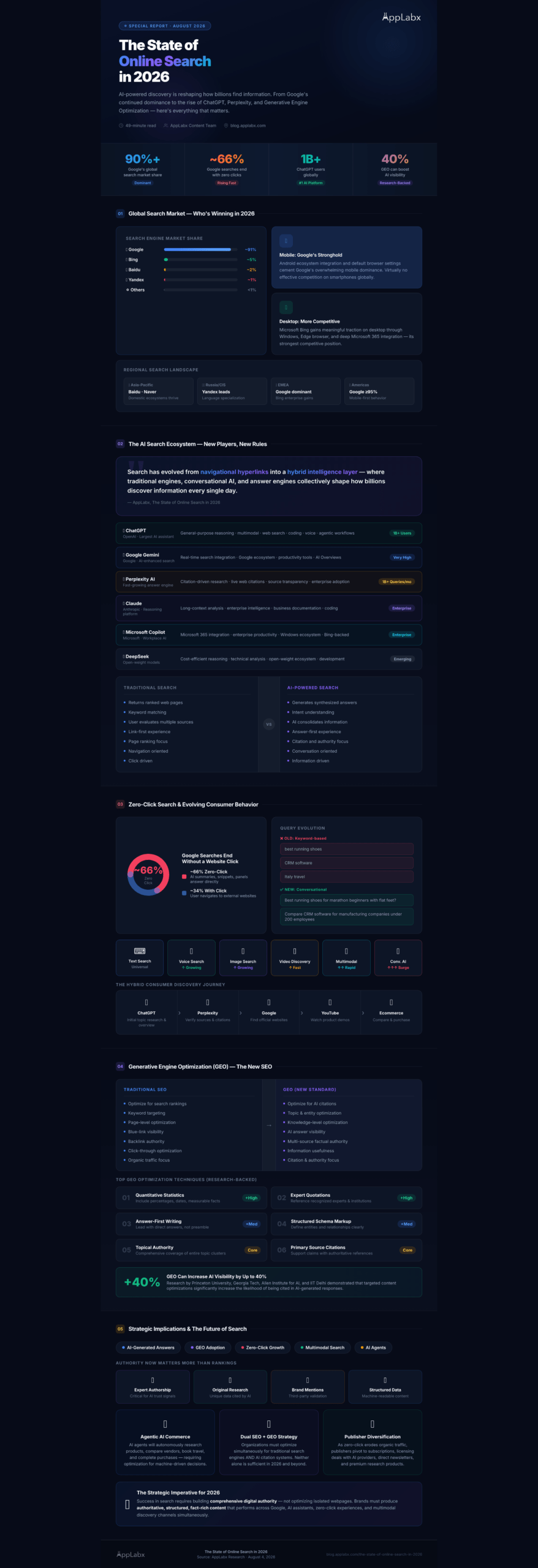
This shift has introduced an entirely new layer of competition for digital visibility. Businesses are no longer competing only for the first position in Google’s organic search results. They are also competing to become trusted sources cited by AI-generated responses. As conversational AI platforms increasingly synthesize information from multiple websites before presenting recommendations, the quality, authority, structure, and factual accuracy of online content have become more important than ever. This evolution has given rise to Generative Engine Optimization (GEO), an emerging discipline that complements traditional SEO by optimizing content specifically for AI retrieval, citation, and recommendation.
Despite the rapid growth of conversational AI, traditional search engines remain exceptionally influential. Google continues to dominate global search activity, processing trillions of searches every year while maintaining overwhelming market leadership across mobile search and most international markets. Microsoft Bing continues strengthening its position through deep integration with Windows, Microsoft 365, and Copilot. Regional search engines such as Baidu in China, Yandex in Russia, Naver in South Korea, and Seznam in the Czech Republic also continue demonstrating that localized ecosystems remain highly competitive within their respective markets. Rather than replacing traditional search, AI-powered discovery has expanded the overall search ecosystem into a more diverse and interconnected landscape.
Consumer behavior has evolved alongside these technological advances. Search queries have become increasingly conversational, reflecting growing user confidence that AI systems understand natural language rather than isolated keywords. Users now ask complete questions, request recommendations, seek detailed comparisons, upload images, speak naturally through voice assistants, and expect AI systems to maintain conversational context throughout extended research sessions. Visual search, voice search, multimodal search, and AI-assisted discovery have become increasingly common across smartphones, laptops, smart speakers, wearable devices, and enterprise software platforms.
The rapid expansion of AI-generated answers has also accelerated one of the most significant trends affecting digital publishing: zero-click search. Increasingly, users receive answers directly within search engine results pages or AI interfaces without visiting external websites. AI-generated summaries, featured snippets, knowledge panels, local business listings, maps, shopping recommendations, and conversational responses have collectively reduced the number of clicks flowing to traditional publishers. While this development enhances user convenience, it presents substantial challenges for publishers and businesses that historically depended on organic search traffic as a primary acquisition channel.
As referral traffic patterns evolve, organizations must rethink how they measure digital success. Rankings and page views alone are no longer sufficient indicators of visibility. Instead, businesses increasingly evaluate AI citation frequency, brand mentions, entity authority, semantic relevance, structured data implementation, and multi-platform discoverability. Success in 2026 depends on building comprehensive digital authority rather than optimizing isolated webpages for individual keywords.
The economics of online search are also changing rapidly. Traditional search advertising continues generating enormous revenue, but AI-powered search platforms are introducing new monetization models centered around sponsored recommendations, conversational commerce, AI-assisted purchasing, and intelligent product discovery. Publishers are diversifying revenue through subscriptions, memberships, licensing agreements, newsletters, premium research, and direct audience relationships as reliance on advertising-supported organic traffic gradually declines.
Another defining trend is the fragmentation of digital discovery. Consumers rarely rely on a single platform throughout their research journey. A typical customer may begin with ChatGPT to understand a topic, verify facts using Google Search, watch demonstration videos on social media platforms, compare products using Perplexity AI, read expert reviews, and ultimately complete a purchase through an ecommerce marketplace. This increasingly complex discovery journey requires organizations to maintain consistent, authoritative, and trustworthy digital identities across multiple search ecosystems rather than focusing exclusively on one platform.
The emergence of Generative Engine Optimization reflects this broader transformation. Unlike traditional SEO, which primarily aims to improve rankings within search engine results pages, GEO focuses on ensuring that AI systems recognize, understand, trust, and cite high-quality content. Research increasingly demonstrates that conversational AI platforms favor content containing strong factual density, expert attribution, structured headings, quantitative evidence, semantic clarity, and comprehensive topical coverage. Organizations investing in these qualities are more likely to achieve sustained visibility across both traditional search engines and AI-powered answer engines.
This evolution also reinforces the growing importance of expertise, authority, and trust. Original research, proprietary data, expert commentary, well-organized knowledge, and transparent sourcing are becoming increasingly valuable competitive advantages. Search engines and AI systems alike continue prioritizing reliable, accurate, and authoritative information over content created solely for keyword targeting or short-term ranking gains.
Looking ahead, the future of online search extends well beyond today’s conversational interfaces. Autonomous AI agents capable of conducting research, comparing vendors, booking appointments, purchasing products, managing workflows, and executing complex business tasks are expected to become increasingly common. Search will evolve from an information retrieval system into an intelligent decision-support ecosystem where humans and AI collaborate throughout the entire customer journey.
This comprehensive guide explores the state of online search in 2026 by examining the latest developments across global search engine market share, AI-powered search platforms, conversational AI adoption, zero-click search, changing consumer behavior, multimodal search, Generative Engine Optimization (GEO), Answer Engine Optimization (AEO), AI citations, structured content strategies, and the future of digital discovery. Whether you are a marketer, business owner, publisher, SEO professional, technology executive, or digital strategist, understanding these emerging trends will help you adapt to one of the most significant shifts in the history of online search and position your organization for sustained success in an increasingly AI-driven digital world.
But, before we venture further, we like to share who we are and what we do.
About AppLabx
From developing a solid marketing plan to creating compelling content, optimizing for search engines, leveraging social media, and utilizing paid advertising, AppLabx offers a comprehensive suite of digital marketing services designed to drive growth and profitability for your business.
At AppLabx, we understand that no two businesses are alike. That’s why we take a personalized approach to every project, working closely with our clients to understand their unique needs and goals, and developing customized strategies to help them achieve success.
If you need a digital consultation, then send in an inquiry here.
Or, send an email to hello@applabx.com to get started.
The State of Online Search in 2026
- The State of Online Search in 2026
- The Conversational and AI Search Ecosystem
- Consumer Search Behavior, Zero-Click Search, and the Changing Discovery Landscape
- The Science of Generative Engine Optimization (GEO)
- Strategic Implications and the Future of Search
1. The State of Online Search in 2026
The online search ecosystem in 2026 is undergoing its most significant transformation since the introduction of modern web search engines. While traditional search engines continue to dominate global information discovery, the emergence of generative artificial intelligence, conversational search interfaces, answer engines, and AI assistants has fundamentally changed how users search for, consume, and interact with information.
Instead of relying solely on lists of blue hyperlinks, users increasingly expect complete, contextual, conversational, and personalized answers. Search has evolved beyond keyword matching into semantic understanding, intent recognition, multimodal interaction, and AI-generated summaries. This transition has reshaped digital marketing, search engine optimization (SEO), and the rapidly growing discipline of Generative Engine Optimization (GEO).
Despite widespread discussion surrounding AI-powered search, traditional search engines remain the dominant gateway to the internet. Google continues to process trillions of searches annually while maintaining more than 90% of the worldwide search engine market. However, this headline figure masks an increasingly fragmented competitive landscape, where regional search engines, AI-native platforms, and enterprise ecosystems are steadily influencing user behaviour and content discovery.
The Evolution of Online Search
The search industry has entered a hybrid era where traditional search engines and AI-powered answer engines coexist rather than directly replace one another.
Several technological developments define this transition:
• Large Language Models integrated into search
• AI-generated summaries and answer boxes
• Conversational search experiences
• Multimodal search combining text, images, voice and video
• Personalized contextual recommendations
• Citation-driven AI responses
• Entity-based knowledge graphs
• Real-time retrieval augmented generation (RAG)
As a result, visibility is no longer determined exclusively by ranking on the first page of search results. Brands must now also optimize for AI citations, semantic authority, topical expertise, structured content, and factual consistency across the web.
Global Search Market Overview
Although AI platforms continue attracting attention, Google remains the world’s dominant search engine across virtually every category.
| Search Engine | Estimated Global Market Position (2026) | Primary Competitive Strength | Primary Audience |
|---|---|---|---|
| Clear global market leader | Comprehensive web index and AI integration | General consumers and businesses | |
| Microsoft Bing | Largest global challenger | Windows, Edge and Copilot ecosystem | Enterprise and desktop users |
| Yahoo | Legacy search platform | Established user base | Mature desktop audiences |
| Yandex | Regional market leader | Local language optimization | Russia and CIS markets |
| Baidu | Chinese market leader | Domestic ecosystem integration | Mainland China |
| DuckDuckGo | Privacy-focused alternative | Anonymous search | Privacy-conscious users |
| Naver | Local ecosystem leader | Integrated content platform | South Korea |
| Seznam | Domestic Czech search platform | Local relevance | Czech Republic |
Google continues to account for roughly nine out of every ten searches worldwide, while Bing maintains its position as the second-largest traditional search engine. Meanwhile, regional leaders such as Baidu, Yandex, and Naver continue dominating their domestic ecosystems through localized services and language specialization.
Global Search Market Characteristics
| Market Characteristic | 2026 Industry Observation | Strategic Importance |
|---|---|---|
| Overall market leader | Google remains dominant globally | High |
| Mobile leadership | Google maintains overwhelming mobile presence | Very High |
| Desktop competition | Bing gains stronger desktop adoption | Medium |
| Regional fragmentation | Local search engines remain highly influential | High |
| AI integration | Nearly every major engine incorporates generative AI | Very High |
| Search behaviour | Increasing preference for direct answers | Very High |
| Content evaluation | Semantic authority outweighs keyword repetition | Very High |
Google’s Continued Dominance
Although Google’s global market share has experienced modest declines compared with previous years, it continues to dominate worldwide search activity by an exceptionally large margin.
Several factors continue reinforcing Google’s leadership:
• Android ecosystem integration
• Default browser agreements
• Massive search infrastructure
• Advanced ranking algorithms
• AI-enhanced search experiences
• Extensive advertiser ecosystem
• Knowledge Graph and entity understanding
• Continuous algorithm improvements
Google processes trillions of search queries annually, generating hundreds of billions of dollars in advertising revenue. Even as AI assistants become increasingly popular, Google’s scale, infrastructure, and ecosystem advantages remain difficult for competitors to replicate.
Desktop Versus Mobile Search
Search behaviour differs substantially depending on the device being used.
| Device Category | Competitive Environment | Market Dynamics |
|---|---|---|
| Mobile | Google overwhelmingly dominates | Android and default browser integrations |
| Desktop | Greater competitive diversity | Bing benefits from Windows integration |
| Enterprise | Microsoft ecosystem gains influence | Copilot and Microsoft 365 adoption |
| Education | Mixed ecosystem | Browser preference varies by institution |
Google’s dominance is particularly strong on mobile devices, where Android integration and default search settings reinforce user loyalty. Desktop search, however, presents greater opportunities for competitors, particularly Microsoft Bing through Windows, Edge, and enterprise software integration.
Regional Search Market Volatility
Search remains one of the most regionally fragmented segments of the digital economy.
Unlike social media platforms, search behaviour is heavily influenced by language, government policies, domestic technology ecosystems, and cultural preferences.
| Region | Primary Search Leader | Key Market Characteristics |
|---|---|---|
| North America | Strong Google dominance with growing Bing adoption | |
| Western Europe | Mature competitive market | |
| Latin America | Extremely high Google penetration | |
| Africa | Mobile-first search behaviour | |
| India | Very high Android-driven adoption | |
| China | Baidu | Domestic ecosystem protected by regulatory environment |
| Russia | Yandex | Strong local ecosystem and language specialization |
| South Korea | Google and Naver | Highly competitive domestic search landscape |
| Japan | Significant desktop competition from Bing and Yahoo | |
| Czech Republic | Seznam maintains meaningful local presence |
These regional differences demonstrate that global SEO strategies increasingly require localized optimization rather than assuming a single search engine dominates every market.
Regional Search Landscape Matrix
| Region | Market Leader | Secondary Competitor | Primary Competitive Driver |
|---|---|---|---|
| North America | Bing | AI integration and advertising ecosystem | |
| Europe | Bing | Enterprise adoption | |
| China | Baidu | Bing | Domestic regulation and local services |
| Russia | Yandex | Language optimization | |
| South Korea | Google / Naver | Naver / Google | Local content ecosystem |
| Japan | Bing, Yahoo | Desktop defaults | |
| India | Limited competition | Android ecosystem | |
| Africa | Bing | Mobile-first internet usage |
The Rise of AI Search
One of the defining characteristics of online search in 2026 is the rapid integration of generative AI across nearly every major search platform.
Users increasingly expect search engines to:
• Summarize complex information
• Compare products
• Explain concepts
• Generate recommendations
• Answer follow-up questions
• Understand conversational prompts
• Interpret images and documents
• Provide contextual reasoning
Rather than replacing traditional search entirely, AI has become an additional discovery layer built on top of existing search infrastructure. Google AI Overviews, Microsoft’s Copilot experiences, ChatGPT Search, Perplexity, Claude, Gemini, and other AI assistants collectively contribute to a broader information ecosystem where search increasingly becomes conversational rather than navigational.
Traditional Search Versus AI Search
| Traditional Search | AI Search |
|---|---|
| Returns ranked web pages | Generates synthesized answers |
| Keyword matching | Intent understanding |
| User evaluates multiple sources | AI consolidates information |
| Link-first experience | Answer-first experience |
| Page ranking focus | Citation and authority focus |
| Individual page optimization | Entity and topic optimization |
| Navigation oriented | Conversation oriented |
| Click driven | Information driven |
The Growing Importance of Generative Engine Optimization
The emergence of AI-powered search has created a complementary optimization discipline known as Generative Engine Optimization (GEO).
Unlike traditional SEO, GEO focuses on increasing the likelihood that brands, products, organizations, and experts are referenced, cited, and recommended by AI systems.
Core GEO priorities include:
• Topical authority
• Entity recognition
• Knowledge graph consistency
• Structured information
• High-quality citations
• Expert content
• Factual accuracy
• Cross-platform trust signals
Organizations that previously optimized solely for search rankings now increasingly optimize for AI-generated answers, recommendation systems, and conversational discovery.
Search Behaviour Has Fundamentally Changed
Consumer expectations continue evolving rapidly.
Modern users increasingly seek:
• Faster answers
• Less scrolling
• Higher confidence
• Personalized responses
• Interactive conversations
• Visual explanations
• Trusted citations
• Immediate recommendations
Instead of conducting multiple keyword searches, users increasingly complete entire research journeys inside AI-powered interfaces before visiting external websites.
This behavioural shift is encouraging businesses to produce more comprehensive, authoritative, and structured content capable of serving both traditional search engines and AI models simultaneously.
How Search Optimization Has Evolved
| Traditional SEO Focus | Modern SEO + GEO Focus |
|---|---|
| Keywords | Topics and entities |
| Individual pages | Content ecosystems |
| Link building | Authority building |
| Rankings | Visibility across search and AI |
| Search volume | User intent |
| Metadata | Structured knowledge |
| Backlinks | Brand credibility |
| Technical optimization | Semantic optimization |
| Organic traffic | Citation visibility |
| Search engine algorithms | AI reasoning systems |
Key Trends Defining Search in 2026
Several macro trends continue shaping the global search industry.
| Trend | Industry Impact | Long-Term Outlook |
|---|---|---|
| AI-generated answers | Reduces reliance on traditional result pages | Very High |
| Conversational interfaces | Changes user search behaviour | Very High |
| Entity optimization | Improves AI understanding | High |
| Regional search ecosystems | Strengthens local platforms | High |
| Mobile-first discovery | Continues global expansion | High |
| Multimodal search | Supports image, voice and video search | Very High |
| Knowledge graph expansion | Improves contextual relevance | High |
| GEO adoption | Emerging strategic priority | Very High |
The Future of Online Search
The online search ecosystem in 2026 is no longer defined solely by traditional search engines. Instead, it represents an interconnected network of web search platforms, AI assistants, answer engines, knowledge graphs, and conversational interfaces that collectively influence how information is discovered.
Google continues to dominate global search activity, particularly on mobile devices, while Microsoft Bing strengthens its position through enterprise software and AI integration. Regional leaders such as Baidu, Yandex, Naver, and Seznam remain highly influential within their respective markets, demonstrating that localized search ecosystems continue to play a critical role in global information discovery.
For businesses, publishers, and marketers, success in this evolving landscape increasingly depends on combining traditional SEO best practices with Generative Engine Optimization strategies. Organizations that establish strong topical authority, semantic relevance, structured content, and trustworthy digital signals will be best positioned to achieve visibility across both conventional search engines and AI-powered discovery platforms, ensuring continued relevance as the future of online search becomes increasingly intelligent, conversational, and context-driven.
2. The Conversational and AI Search Ecosystem
The global search landscape in 2026 extends far beyond traditional search engines. Alongside Google, Bing, Baidu, and Yandex, conversational AI platforms have emerged as a major channel for information discovery. Rather than replacing conventional search entirely, these AI-powered interfaces have created a parallel ecosystem that specializes in answering complex, research-oriented, and multi-step queries through natural language conversations.
This evolution represents one of the most significant structural changes in online information retrieval since the rise of modern search engines. Users are increasingly choosing AI assistants to summarize information, compare products, explain technical concepts, generate recommendations, and solve problems without navigating through multiple webpages.
Unlike traditional search engines that primarily rank and present links, conversational AI platforms synthesize information from numerous sources into coherent responses. This shift is fundamentally changing how users discover brands, consume content, and make purchasing decisions.
Industry analysts increasingly describe the modern discovery ecosystem as a hybrid environment where traditional search engines dominate navigational and local intent while AI assistants increasingly capture educational, analytical, and research-focused queries. Recent academic research likewise shows rapid global expansion of AI search and significant changes in how information is surfaced to users.
The Evolution from Search Engines to Answer Engines
Traditional search engines remain exceptionally effective at locating websites, businesses, and specific online destinations. However, conversational AI has introduced a fundamentally different interaction model centered around direct answers rather than lists of hyperlinks.
Instead of asking multiple keyword-based questions, users can now engage in continuous conversations, ask follow-up questions, refine requests, and receive contextual explanations within a single interface.
This transition has accelerated the adoption of AI-first information discovery across consumer, educational, enterprise, and professional environments.
| Traditional Search Experience | Conversational AI Experience |
|---|---|
| Returns ranked webpages | Generates synthesized answers |
| Keyword matching | Natural language understanding |
| Multiple searches required | Continuous conversation |
| User compares sources | AI synthesizes multiple sources |
| Link-first experience | Answer-first experience |
| Search sessions | Interactive dialogue |
| Individual queries | Multi-turn reasoning |
| Navigation focused | Knowledge focused |
The Rise of Conversational Search
Generative AI has rapidly become an important layer within the broader search ecosystem.
Modern conversational platforms now support:
• Natural language questions
• Multi-step reasoning
• Document analysis
• Code generation
• Research assistance
• Comparative analysis
• Mathematical reasoning
• Image understanding
• Voice interaction
• Real-time web retrieval
These capabilities allow users to complete entire research workflows inside a single AI interface rather than switching repeatedly between multiple webpages and search results.
Academic research based on hundreds of thousands of real-world ChatGPT interactions suggests that conversational AI enables broader forms of inquiry than traditional search, particularly for open-ended and exploratory tasks.
Leading AI Search and Conversational Platforms
The AI search market has become increasingly competitive, with several major platforms differentiating themselves through ecosystem integration, reasoning quality, citations, enterprise capabilities, or specialized research features.
| AI Platform | Estimated User Scale (2026) | Primary Strength | Typical Use Cases |
|---|---|---|---|
| ChatGPT | Largest global AI assistant | General-purpose reasoning and multimodal capabilities | Research, writing, coding, education |
| Google Gemini | Large Google ecosystem integration | Real-time search integration and productivity | Everyday search, productivity |
| Perplexity AI | Fast-growing answer engine | Citation-driven research | Fact-finding, market research |
| Claude | Enterprise reasoning platform | Long-context analysis | Business analysis, coding, documentation |
| Microsoft Copilot | Microsoft ecosystem | Enterprise productivity | Workplace assistance |
| DeepSeek | Open-weight reasoning models | Cost-efficient reasoning | Technical analysis and development |
| You.com | AI productivity platform | Personalized workflows | Productivity and research |
| Elicit | Academic research assistant | Scientific literature analysis | Research and academia |
Rather than competing on identical capabilities, these platforms increasingly specialize in distinct segments of the information discovery market.
ChatGPT’s Position in the AI Search Ecosystem
ChatGPT has established itself as the largest conversational AI platform globally.
OpenAI has reported that ChatGPT surpassed one billion users, with adoption expanding across both consumer and business markets. The company also reports that users are engaging more frequently over time while using a broader range of capabilities beyond simple question answering.
The platform has evolved well beyond a chatbot into a comprehensive knowledge interface supporting:
• Web search
• Document analysis
• Coding assistance
• Image generation
• Voice conversations
• Data interpretation
• Business workflows
• Agentic task completion
Its broad ecosystem and multimodal capabilities have made ChatGPT a primary destination for educational content, professional research, brainstorming, writing assistance, software development, and business decision support.
Perplexity AI as a Research-Focused Answer Engine
Perplexity AI has developed a distinct market position by emphasizing transparency, citations, and evidence-backed answers.
Unlike many conversational AI platforms that prioritize fluent responses, Perplexity places strong emphasis on referencing source material, enabling users to verify information while conducting research.
Industry estimates indicate that Perplexity has grown to tens of millions of active users while processing well over one billion queries per month. The company has also experienced rapid enterprise adoption and significant revenue growth as organizations increasingly use AI-assisted research workflows.
Its primary strengths include:
• Live web citations
• Research-oriented workflows
• Current information retrieval
• Source transparency
• Low-friction verification
• Enterprise knowledge discovery
AI Search Platform Positioning Matrix
| Platform | Primary Position | Competitive Differentiator | Enterprise Strength |
|---|---|---|---|
| ChatGPT | General AI assistant | Broad multimodal capabilities | Very High |
| Gemini | AI-enhanced search | Google ecosystem integration | High |
| Perplexity | Research engine | Source citations and transparency | High |
| Claude | Reasoning platform | Long-context understanding | Very High |
| Copilot | Workplace assistant | Microsoft productivity ecosystem | Very High |
| DeepSeek | Cost-efficient reasoning | Open-weight model ecosystem | Medium |
How AI Has Changed Search Behaviour
The rapid adoption of conversational AI has reshaped user expectations regarding online information retrieval.
Instead of searching for isolated keywords, users increasingly ask complete questions such as:
• How should a company expand into Southeast Asia?
• Compare enterprise CRM platforms for manufacturing companies.
• Explain quantum computing in simple language.
• Create a marketing strategy for a SaaS startup.
These requests involve reasoning, synthesis, comparison, and contextual understanding that traditional search engines historically addressed through multiple search sessions and webpage visits.
Research also indicates that AI systems are expanding the range of questions users ask, while simultaneously concentrating attention on a narrower set of synthesized responses compared with traditional search results.
Search Intent Distribution Across Platforms
The migration toward conversational AI varies considerably according to search intent.
Traditional search continues to dominate transactional, navigational, and location-based discovery, while AI platforms increasingly handle informational and analytical tasks.
| Search Intent | Traditional Search Strength | AI Platform Strength | Primary User Behaviour |
|---|---|---|---|
| Informational research | Moderate | Very High | AI-generated explanations |
| Educational learning | Moderate | Very High | Conversational tutoring |
| Comparative analysis | High | Very High | AI-generated comparisons |
| Problem solving | Moderate | Very High | Step-by-step guidance |
| Coding assistance | Low | Very High | Interactive development |
| Product research | High | High | Hybrid search behaviour |
| Navigational search | Very High | Low | Direct website access |
| Local business discovery | Very High | Low | Maps and local listings |
| Transactional searches | Very High | Moderate | Search plus AI assistance |
Why Traditional Search Remains Dominant
Despite the rapid growth of conversational AI, traditional search engines continue to dominate several critical categories.
These include:
• Website navigation
• Local business discovery
• Shopping
• Maps
• Real-time location searches
• Brand homepage access
• Travel bookings
• Immediate commercial transactions
Search engines maintain significant advantages because they combine structured web indexes with maps, advertisements, merchant ecosystems, local business databases, and real-time indexing.
Rather than replacing search engines, AI assistants increasingly complement them by handling complex reasoning before users transition to traditional search for execution and transactions.
The Hybrid Discovery Ecosystem
The online discovery journey increasingly combines multiple platforms.
A typical user may:
• Begin with ChatGPT for understanding a topic.
• Use Perplexity to verify sources.
• Search Google for official websites.
• Compare products through Google Shopping.
• Watch demonstration videos.
• Complete purchases through ecommerce platforms.
This multi-platform behaviour demonstrates that digital discovery is becoming increasingly interconnected rather than concentrated within a single search engine.
The Future of Conversational Search
The conversational AI ecosystem continues to mature at an exceptional pace.
Competition is expanding beyond chatbot quality toward comprehensive digital ecosystems that integrate search, productivity, reasoning, enterprise workflows, multimodal interaction, and autonomous AI agents.
ChatGPT remains the largest conversational AI platform globally, while Gemini benefits from Google’s search ecosystem, Perplexity strengthens its position as a citation-driven research engine, and Claude continues expanding within enterprise reasoning and professional knowledge work. Market reports also indicate growing competition, with ChatGPT remaining the leading platform while rivals continue gaining share through differentiated capabilities and ecosystem integration.
For organizations investing in digital visibility, this evolution means success can no longer depend solely on traditional SEO rankings. Brands increasingly need to optimize for both conventional search engines and AI-powered discovery platforms by producing authoritative, well-structured, semantically rich, and trustworthy content that can be surfaced, cited, and recommended across the expanding conversational search ecosystem.
3. Consumer Search Behavior, Zero-Click Search, and the Changing Discovery Landscape
Consumer search behaviour in 2026 differs dramatically from that of only a few years ago. While search engines remain the primary gateway to online information, the way users interact with search results has fundamentally changed. Artificial intelligence, conversational interfaces, visual discovery, voice search, and social media platforms have collectively transformed how information is consumed.
The traditional search journey—where users entered a keyword, reviewed multiple links, and visited several websites—has increasingly been replaced by answer-first experiences. Search engines now provide AI-generated summaries, knowledge panels, featured snippets, shopping recommendations, videos, and interactive elements directly within the search results page. As a result, users often obtain the information they need without clicking through to external websites.
This evolution has significant implications for publishers, businesses, marketers, and content creators. Success is no longer measured solely by search rankings but increasingly by visibility within AI-generated responses, citations, and on-platform engagement.
The Rise of Zero-Click Search
One of the defining characteristics of online search in 2026 is the continued growth of zero-click searches.
A zero-click search occurs when a user’s question is answered directly on the search engine results page (SERP), eliminating the need to visit another website.
These answers may appear as:
• AI-generated summaries
• Featured snippets
• Knowledge panels
• Local business listings
• Maps
• Weather forecasts
• Sports scores
• Product comparisons
• Currency conversions
• Instant calculations
Industry studies indicate that approximately two-thirds of Google searches now end without an external website click, reflecting a steady increase over recent years. AI Overviews have further accelerated this trend by providing increasingly comprehensive responses directly within Google Search.
Evolution of Search Results
| Traditional Search (Earlier Years) | Search Experience in 2026 |
|---|---|
| Ten blue links | AI-generated summaries |
| Multiple website visits | Direct answers |
| Manual information comparison | AI synthesis |
| Keyword-based navigation | Conversational interaction |
| External webpage discovery | On-platform information consumption |
| Organic click priority | Zero-click experiences |
How AI Overviews Are Changing User Behaviour
Google’s AI Overviews have become one of the most influential changes to modern search.
Rather than displaying only traditional search listings, AI Overviews summarize information from multiple sources before presenting conventional organic results.
Research shows that AI-generated summaries significantly reduce click-through rates for standard organic listings because users frequently find sufficient information without leaving Google’s ecosystem. Although AI Overviews may increase overall search engagement and encourage follow-up queries, they also reduce outbound referral traffic to many publishers.
AI Overview Impact Matrix
| Search Element | Before AI Overviews | After AI Overviews |
|---|---|---|
| User behaviour | Click multiple websites | Read summary first |
| Information gathering | Distributed across publishers | Consolidated within search |
| Organic traffic | Higher click-through rates | Reduced click-through rates |
| Search sessions | Multiple webpage visits | Longer on-platform engagement |
| Publisher visibility | Rankings determine exposure | Rankings plus AI citations determine exposure |
The New Economics of Organic Traffic
Organic search traffic remains valuable, but the economics of visibility have changed considerably.
Historically, achieving a top-three ranking often resulted in significant website traffic. Today, even high-ranking pages may receive fewer visitors if AI-generated answers satisfy user intent before a click occurs.
This does not necessarily indicate lower search demand. Instead, it reflects changing consumption patterns where users increasingly remain inside search platforms throughout their information journey.
Publishers are therefore shifting their strategies toward:
• Building topical authority
• Becoming trusted citation sources
• Producing structured content
• Increasing brand recognition
• Optimizing for AI retrieval
• Developing direct audience relationships
Industry reports and academic studies both indicate that AI-generated summaries are reshaping referral traffic patterns and encouraging publishers to diversify traffic sources beyond traditional organic search.
The Evolution of Search Queries
Consumer search queries have become increasingly conversational.
Rather than entering short keyword phrases, users now ask complete questions similar to those posed to another person.
Examples include:
Traditional Search
• best running shoes
• CRM software
• Italy travel guide
Modern Conversational Search
• What are the best running shoes for marathon beginners?
• Compare CRM software for manufacturing companies with fewer than 200 employees.
• Plan a two-week Italy itinerary focused on food and history.
This shift reflects increasing user confidence that modern search engines and AI assistants understand natural language rather than isolated keywords.
Gartner research similarly found that many consumers now use more specific, conversational, and question-based search queries because of generative AI.
Search Query Evolution
| Earlier Search Style | Modern Search Style |
|---|---|
| Short keywords | Full questions |
| Two or three words | Complete sentences |
| Multiple searches | Single comprehensive prompt |
| Manual comparison | AI-assisted comparison |
| Exact keyword matching | Intent-based understanding |
The Expansion of Search Modalities
Search is no longer limited to text input.
Consumers increasingly discover information through multiple interaction methods depending on the situation and device being used.
Modern search includes:
• Text search
• Voice search
• Image search
• Video search
• Camera-based search
• Multimodal search combining images and text
• AI-powered conversational interfaces
Visual search, voice interaction, and multimodal experiences continue to grow as smartphones become increasingly capable of interpreting images, speech, and contextual information.
Modern Search Modalities
| Search Method | Primary Use Cases | Growth Drivers |
|---|---|---|
| Text Search | General information | Universal accessibility |
| Voice Search | Hands-free interaction | Smart speakers and smartphones |
| Image Search | Shopping and identification | Mobile cameras and AI vision |
| Video Discovery | Tutorials and demonstrations | Short-form video platforms |
| Multimodal Search | Combining text and images | AI reasoning models |
| Conversational AI | Research and problem solving | Large language models |
Generational Differences in Search Behaviour
Search behaviour increasingly varies by age group.
Younger consumers often begin discovery journeys on platforms beyond traditional search engines, particularly for lifestyle, entertainment, travel, fashion, food, and product recommendations.
Social platforms, creator content, and AI assistants play a growing role in these categories, while traditional search engines continue to dominate navigational, transactional, and local business queries.
Research indicates that many younger users prefer social media platforms for discovery-oriented searches, while AI assistant adoption is also significantly higher among younger demographics than older age groups.
Consumer Discovery Preferences
| Demographic Trend | Preferred Discovery Channels | Common Search Intent |
|---|---|---|
| Younger consumers | Social platforms, AI assistants, video | Lifestyle, reviews, tutorials |
| Working professionals | Search engines and AI | Research, productivity |
| Enterprise users | AI assistants and traditional search | Business information |
| General consumers | Hybrid search behaviour | Shopping, information, navigation |
The Emergence of Hybrid Search Behaviour
Rather than replacing traditional search, consumers increasingly combine multiple discovery platforms within a single research journey.
A typical purchasing process may involve:
• Asking ChatGPT for recommendations
• Using Google for official websites
• Watching product reviews on video platforms
• Reading expert comparisons
• Checking user reviews
• Comparing prices
• Completing purchases through ecommerce platforms
This hybrid behaviour demonstrates that search has evolved into an interconnected discovery ecosystem rather than a single-platform experience.
Hybrid Consumer Journey
| Research Stage | Typical Platform |
|---|---|
| Initial learning | Conversational AI |
| Fact verification | Traditional search |
| Product comparison | AI plus search |
| Video demonstrations | Video platforms |
| User reviews | Review communities |
| Local availability | Maps and search engines |
| Purchase | Ecommerce platform |
Why Traditional Search Remains Essential
Despite rapid advances in AI-powered discovery, traditional search engines continue to dominate several critical categories.
These include:
• Website navigation
• Brand searches
• Local businesses
• Maps
• Shopping
• Travel
• Real-time information
• Government services
Search engines retain major advantages because they combine extensive web indexes with maps, local business data, shopping ecosystems, advertising networks, and continuously updated content.
Generative AI increasingly complements rather than replaces these capabilities.
Strategic Implications for Publishers and Businesses
The evolution of consumer search behaviour requires organizations to rethink how success is measured.
Rather than focusing exclusively on rankings and organic traffic, businesses increasingly optimize for:
• AI citations
• Entity authority
• Brand recognition
• Structured content
• Semantic relevance
• Multi-platform discoverability
• Direct audience engagement
• High-quality, trustworthy information
The objective is no longer simply to attract clicks but to become a trusted information source that can be surfaced across search engines, AI assistants, answer engines, and emerging discovery platforms.
The Future of Consumer Search
Consumer search behaviour in 2026 reflects a broader transformation in digital information discovery. Zero-click experiences, AI-generated summaries, conversational interfaces, multimodal search, and social discovery have expanded the number of pathways through which users find information.
Rather than eliminating traditional search, these innovations are reshaping its role. Search engines remain central to navigation, commerce, and local discovery, while AI assistants increasingly handle education, research, comparison, and problem-solving tasks. Academic research also suggests that AI search is changing not only how information is retrieved but which sources are surfaced, creating new opportunities and challenges for publishers and marketers alike.
For businesses, publishers, and marketers, long-term success will increasingly depend on balancing traditional SEO with Generative Engine Optimization (GEO), producing authoritative, structured, and trustworthy content that performs effectively across both conventional search engines and AI-powered discovery ecosystems.
4. The Science of Generative Engine Optimization (GEO)
The emergence of generative artificial intelligence has fundamentally redefined how information is discovered online. Traditional Search Engine Optimization (SEO), which focused primarily on improving rankings within search engine results pages, is evolving into a broader discipline known as Generative Engine Optimization (GEO). Alongside Answer Engine Optimization (AEO), GEO addresses a new reality where AI systems increasingly synthesize information directly for users instead of simply presenting lists of webpages.
As conversational AI platforms become integral to digital discovery, content creators, publishers, and businesses face a new challenge: optimizing content not only to rank highly in traditional search engines but also to be selected, cited, and trusted within AI-generated responses.
Unlike conventional search algorithms that evaluate webpages individually, generative engines retrieve, analyze, compare, and synthesize information from multiple sources before generating a single coherent response. Consequently, visibility within AI-generated answers depends on a broader combination of authority, factual accuracy, semantic structure, entity recognition, and content quality rather than keyword rankings alone. Foundational academic work introducing GEO demonstrated that targeted content optimizations can increase visibility in generative engine responses by up to 40% under controlled evaluation settings.
The Evolution from SEO to GEO
For more than two decades, SEO centered on improving rankings within search engine results pages through technical optimization, keyword relevance, backlinks, and user experience.
Generative AI introduces an additional optimization layer.
Instead of asking:
“How can this page rank first?”
Organizations increasingly ask:
“How can this content become one of the sources that AI systems trust, retrieve, and cite?”
This distinction fundamentally changes content strategy.
Traditional SEO Versus Generative Engine Optimization
| Traditional SEO | Generative Engine Optimization |
|---|---|
| Optimize for search rankings | Optimize for AI citations |
| Keyword targeting | Topic and entity optimization |
| Page-level optimization | Knowledge-level optimization |
| Blue-link visibility | AI answer visibility |
| Organic traffic | Citation and authority |
| Click-through optimization | Information usefulness |
| Search engine algorithms | AI retrieval and synthesis |
| Backlink authority | Multi-source factual authority |
The Academic Foundation of GEO
Generative Engine Optimization is supported by a growing body of academic research.
One of the most influential studies was conducted by researchers from Princeton University, Georgia Institute of Technology, the Allen Institute for AI, and IIT Delhi. Their work introduced the GEO framework and the GEO-bench evaluation methodology, providing one of the first systematic approaches to measuring how content modifications influence visibility inside AI-generated responses.
Using approximately 10,000 diverse queries across multiple knowledge domains, the researchers demonstrated that specific improvements in content structure and factual presentation significantly increased the likelihood of AI systems referencing or incorporating that content.
Perhaps the most important finding was that optimization strategies are not universally effective. Instead, different domains, query types, and AI systems respond differently, reinforcing the need for adaptive, evidence-based optimization rather than rigid SEO-style checklists.
How Generative Engines Select Information
Unlike traditional search engines, generative AI systems perform several stages before producing an answer.
A simplified workflow includes:
• User intent interpretation
• Query decomposition
• Document retrieval
• Passage ranking
• Evidence selection
• Information synthesis
• Citation generation
• Response production
Because content competes during multiple stages rather than a single ranking algorithm, visibility depends upon numerous quality signals simultaneously.
Generative Search Pipeline
| Pipeline Stage | Purpose | Content Evaluation Focus |
|---|---|---|
| Query Understanding | Interpret user intent | Semantic relevance |
| Retrieval | Locate candidate sources | Authority and topical coverage |
| Passage Selection | Identify useful information | Fact density and clarity |
| Context Assembly | Combine multiple sources | Complementary information |
| AI Reasoning | Generate synthesized answer | Consistency and reliability |
| Citation Selection | Attribute supporting sources | Trustworthiness and authority |
| Final Response | Deliver answer | User usefulness |
Research-Backed GEO Optimization Techniques
Academic studies have identified several optimization approaches that consistently improve visibility within generative AI responses.
Among the strongest signals are:
• Quantitative evidence
• Authoritative citations
• Expert quotations
• Clear heading structures
• Fact-rich writing
• Structured content
• High readability
These improvements help AI systems identify trustworthy, information-dense passages suitable for retrieval and citation.
Research-Supported GEO Optimization Matrix
| GEO Technique | Implementation Approach | Expected Benefit |
|---|---|---|
| Quantitative statistics | Include measurable facts, percentages and dates | Higher factual authority |
| Expert quotations | Reference recognized experts and institutions | Increased credibility |
| Primary source citations | Support claims with authoritative references | Improved trust signals |
| Answer-first writing | Provide direct answers early in content | Better retrieval likelihood |
| Logical heading hierarchy | Organize information clearly | Improved passage extraction |
| Structured schema | Define entities and relationships | Enhanced machine understanding |
| Comprehensive topical coverage | Address user questions completely | Greater contextual relevance |
| High factual density | Reduce generic marketing language | Increased information value |
The Importance of Fact Density
One of the strongest observations from GEO research is that generative engines consistently favor content containing measurable, verifiable information.
High-performing content frequently includes:
• Numerical statistics
• Dates
• Percentages
• Industry benchmarks
• Research findings
• Named organizations
• Real-world examples
• Comparative data
These elements provide stronger evidence for AI systems during retrieval and response generation than generalized promotional language.
Why Structured Content Performs Better
Generative AI processes information differently from human readers.
While human users may comfortably navigate complex layouts, AI systems benefit from predictable semantic organization.
Well-structured content generally includes:
• Clear titles
• Logical section hierarchy
• Short introductory summaries
• Standalone answers
• Tables
• Bullet lists
• Frequently asked questions
• Consistent terminology
These structural elements make information easier for retrieval systems to identify, interpret, and reuse.
Content Structure Comparison
| Poor Structure | Strong GEO Structure |
|---|---|
| Long paragraphs | Short focused sections |
| Weak organization | Logical heading hierarchy |
| Marketing language | Fact-based explanations |
| Hidden answers | Answer-first writing |
| Limited supporting evidence | Statistics and examples |
| Few entities | Rich semantic relationships |
| Unstructured data | Schema-enhanced information |
The Growing Separation Between SEO Rankings and AI Citations
One of the most important developments in 2026 is the declining relationship between traditional search rankings and AI-generated citations.
Historically, pages ranking within Google’s top ten search results frequently appeared in featured snippets and AI summaries.
Recent industry analyses indicate that this overlap has weakened considerably. A growing proportion of citations within AI-generated answers now originate from pages that do not rank within the top organic search results, suggesting that AI retrieval systems evaluate broader contextual relevance and factual usefulness in addition to conventional ranking signals.
Traditional Rankings Versus AI Visibility
| Traditional SEO Metric | AI Citation Metric |
|---|---|
| SERP ranking | Citation frequency |
| Organic impressions | AI visibility |
| Click-through rate | Retrieval probability |
| Backlinks | Authority recognition |
| Domain authority | Entity trust |
| Keyword rankings | Contextual relevance |
| Organic sessions | AI referral traffic |
Cross-Platform Differences in Retrieval
Generative platforms do not retrieve information identically.
Each platform employs distinct retrieval methods, ranking models, and citation behaviors.
For example:
• Google AI integrates closely with Google’s search index.
• ChatGPT frequently relies on search providers and retrieval systems depending on the search experience.
• Perplexity emphasizes transparent citations.
• Claude prioritizes reasoning quality and long-context synthesis.
As a result, content that performs well within one AI ecosystem may not necessarily achieve identical visibility across another.
Platform Optimization Characteristics
| Platform | Primary Optimization Focus |
|---|---|
| Google AI | Entity authority and search relevance |
| ChatGPT | Contextual completeness and factual clarity |
| Perplexity | Source transparency and citations |
| Claude | Logical reasoning and comprehensive explanations |
| Gemini | Search relevance plus ecosystem integration |
The Value of AI-Referred Traffic
Although AI-generated answers frequently reduce overall referral volume, the visitors who do click through often demonstrate stronger intent.
These users typically arrive after AI systems have already:
• Explained concepts
• Compared alternatives
• Answered preliminary questions
• Reduced uncertainty
• Filtered irrelevant options
Consequently, AI referrals frequently represent later stages of the customer decision journey.
Rather than attracting broad exploratory audiences, AI citations increasingly deliver users who have already completed substantial research before visiting a website.
Marketing Funnel Comparison
| Traditional Organic Search | AI-Referred Visitors |
|---|---|
| Broad audience | Narrower audience |
| Early-stage research | Later-stage evaluation |
| High browsing behaviour | Higher purchase intent |
| Large traffic volume | Lower but more qualified traffic |
| Multiple page visits | Focused information seeking |
The Future of GEO
Generative Engine Optimization continues to evolve rapidly as AI-powered search becomes increasingly sophisticated.
Recent academic research emphasizes that GEO should not be viewed as a single ranking technique but rather as a multi-stage optimization process involving retrieval, context selection, citation generation, factual accuracy, and user interaction. Researchers also caution that while foundational GEO techniques demonstrably improve visibility within controlled environments, long-term success depends on continuously adapting to changing AI retrieval systems and maintaining authoritative, trustworthy content.
Future GEO strategies are expected to place increasing emphasis on:
• Semantic authority
• Entity relationships
• Expert-authored content
• Structured knowledge
• Trustworthy citations
• Machine-readable content
• Comprehensive topical coverage
• Continuous content updates
The Future of Search Optimization
The evolution from SEO to GEO represents a fundamental expansion of digital optimization rather than the replacement of traditional search practices.
SEO remains essential for achieving discoverability within conventional search engines, while GEO extends optimization into AI-powered discovery environments where retrieval, reasoning, and citation determine visibility.
Organizations that succeed in this new landscape will increasingly focus on producing authoritative, evidence-based, well-structured content that serves both human readers and AI systems simultaneously. Rather than optimizing solely for rankings or clicks, successful publishers will optimize for trust, factual accuracy, semantic clarity, and information usefulness across an increasingly interconnected ecosystem of search engines, conversational AI platforms, and generative answer engines.
5. Strategic Implications and the Future of Search
The transformation of online search extends far beyond technology. It represents a fundamental restructuring of how brands build visibility, how publishers distribute information, and how consumers discover products and services. The convergence of generative AI, conversational interfaces, zero-click experiences, multimodal search, and fragmented discovery platforms is creating an entirely new competitive landscape that organizations must prepare for throughout 2027 and beyond.
Search is no longer a single-channel discipline dominated by traditional search engine rankings. Instead, digital visibility is increasingly distributed across conventional search engines, AI assistants, answer engines, social discovery platforms, voice assistants, recommendation systems, and autonomous AI agents. Organizations that continue relying exclusively on traditional SEO strategies risk losing visibility within the rapidly expanding AI-powered discovery ecosystem.
The New Search Paradigm
For more than two decades, search optimization primarily revolved around improving rankings within Google Search.
That model is rapidly evolving.
Modern digital discovery increasingly occurs through multiple interconnected channels, including:
• Traditional search engines
• AI-generated search summaries
• Conversational AI assistants
• Social search platforms
• Voice assistants
• Visual search
• Shopping recommendation engines
• Enterprise AI systems
As a result, organizations must optimize their digital presence across numerous information retrieval systems rather than focusing exclusively on conventional search engine rankings. Research on AI search indicates that content visibility is increasingly determined by citation quality, semantic relevance, and retrieval suitability rather than traditional ranking signals alone.
The Evolution of Digital Discovery
| Earlier Search Model | Modern Discovery Ecosystem |
|---|---|
| Google-centric | Multi-platform ecosystem |
| Blue-link rankings | AI-generated answers |
| Search results pages | Conversational interfaces |
| Website clicks | Citation visibility |
| Organic rankings | Entity authority |
| Individual webpages | Knowledge ecosystems |
| Keyword optimization | Semantic optimization |
| SEO only | SEO + GEO + AEO |
The Emergence of Dual Optimization
Organizations can no longer rely exclusively on either traditional SEO or Generative Engine Optimization.
Instead, long-term success requires a dual optimization strategy where both disciplines complement one another.
Traditional SEO continues supporting:
• Navigational discovery
• Local search
• Ecommerce visibility
• Transactional searches
• Brand navigation
Generative Engine Optimization increasingly supports:
• AI citations
• Conversational recommendations
• Research visibility
• Educational content
• Expert authority
• Entity recognition
Dual Search Optimization Framework
| Traditional SEO Responsibilities | GEO Responsibilities |
|---|---|
| Organic rankings | AI citations |
| Website traffic | AI visibility |
| Local search | Conversational search |
| Shopping searches | Research queries |
| Technical crawlability | Retrieval optimization |
| Internal linking | Knowledge structuring |
| Page optimization | Entity optimization |
| User navigation | AI recommendation |
The Shift from Pages to Knowledge Assets
One of the most important strategic changes involves how content is created.
Historically, marketers optimized webpages.
Today, organizations increasingly optimize modular knowledge assets that AI systems can retrieve, interpret, and synthesize.
High-performing content increasingly consists of:
• Standalone factual statements
• Clear definitions
• Comparative tables
• Structured data
• Frequently asked questions
• Step-by-step explanations
• Entity relationships
• Quantitative evidence
Rather than functioning solely as webpages for human readers, modern content increasingly serves as structured knowledge that AI systems can efficiently process through retrieval-augmented generation (RAG) pipelines and citation mechanisms.
Content Engineering for AI Discovery
| Traditional Content | AI-Optimized Content |
|---|---|
| Long narrative articles | Modular information blocks |
| Marketing-first messaging | Fact-first explanations |
| Keyword repetition | Entity-rich content |
| Minimal structure | Clear semantic hierarchy |
| Human readability | Human and machine readability |
| Limited metadata | Rich structured data |
| Single-purpose pages | Multi-context knowledge assets |
The Changing Economics of Digital Publishing
The continued expansion of AI-generated summaries and zero-click search experiences has fundamentally altered publisher economics.
Historically, publishers depended heavily on organic search traffic supported by advertising impressions.
Today, AI-generated answers increasingly satisfy user intent before users visit external websites, reducing referral traffic across many industries.
This shift has encouraged publishers to diversify revenue models through:
• Digital subscriptions
• Premium memberships
• Licensing agreements
• Brand partnerships
• Events
• Community platforms
• Direct newsletters
• Proprietary research
Media organizations are increasingly seeking licensing agreements with AI providers while simultaneously investing in direct audience relationships to reduce dependence on search referrals.
Publishing Business Model Evolution
| Historical Model | Emerging Model |
|---|---|
| Advertising impressions | Subscription revenue |
| Organic traffic | Direct audiences |
| Search dependency | Multi-channel distribution |
| Page views | Brand engagement |
| Display advertising | Premium products |
| Search referrals | Community ownership |
| SEO-driven growth | Authority-driven growth |
Authority Has Become More Valuable Than Rankings
AI systems increasingly prioritize trusted information sources rather than simply selecting the highest-ranking webpages.
This evolution places greater importance on:
• Brand authority
• Expert recognition
• Third-party mentions
• Academic references
• Government sources
• Industry publications
• Consistent factual accuracy
• Entity recognition
As a result, digital public relations, thought leadership, research publishing, and earned media are becoming increasingly important components of long-term search visibility.
Authority Signal Matrix
| Signal | Importance for Traditional SEO | Importance for AI Visibility |
|---|---|---|
| Backlinks | Very High | High |
| Brand mentions | Medium | Very High |
| Expert authorship | Medium | Very High |
| Original research | High | Very High |
| Structured data | High | Very High |
| Consistent entities | Medium | Very High |
| Third-party validation | High | Very High |
| Knowledge graph presence | Medium | Very High |
The Evolution of Digital Advertising
Search monetization is also entering a period of significant transformation.
Traditional advertising formats centered around search result pages are gradually expanding into AI-native experiences.
Emerging monetization models include:
• Sponsored recommendations
• AI-generated product comparisons
• Native commerce integration
• Conversational shopping
• AI-assisted purchasing
• Personalized recommendations
• Autonomous purchasing agents
Rather than interrupting user journeys through conventional advertisements, AI platforms increasingly integrate commercial recommendations directly within conversational experiences.
Future AI Commerce Models
| Traditional Search Advertising | AI Commerce |
|---|---|
| Sponsored search listings | Sponsored recommendations |
| Display advertisements | Conversational promotions |
| Product listing ads | AI-generated comparisons |
| Search clicks | AI-assisted transactions |
| Manual purchases | Agent-assisted purchasing |
| Keyword bidding | Contextual recommendation bidding |
Preparing for the AI Agent Economy
Beyond conversational search, the next stage of digital transformation involves autonomous AI agents.
Rather than simply answering questions, AI agents are increasingly expected to:
• Research products
• Compare vendors
• Schedule meetings
• Book travel
• Purchase products
• Manage subscriptions
• Complete administrative tasks
• Execute business workflows
This emerging “agentic web” will require organizations to optimize not only for human visitors but also for machine-driven purchasing and decision-making processes. Industry observers increasingly view this as the next phase of digital commerce, where businesses will need interfaces designed for both people and autonomous AI systems.
Strategic Priorities for Organizations
Organizations preparing for the next generation of search should prioritize several long-term initiatives.
Strategic priorities include:
• Maintain strong technical SEO foundations.
• Invest in Generative Engine Optimization.
• Build authoritative brand entities.
• Publish original research and proprietary data.
• Strengthen digital public relations.
• Improve structured data implementation.
• Produce citation-friendly content.
• Monitor visibility across multiple AI platforms.
• Develop multi-channel audience acquisition.
• Reduce dependence on organic search traffic alone.
Enterprise Search Strategy Matrix
| Strategic Area | Immediate Priority | Long-Term Value |
|---|---|---|
| Technical SEO | High | High |
| GEO implementation | Very High | Very High |
| Brand authority | Very High | Very High |
| Original research | High | Very High |
| Structured data | Very High | Very High |
| Entity optimization | Very High | Very High |
| Direct audience building | High | Very High |
| AI visibility monitoring | High | Very High |
The Future of Search Through 2027 and Beyond
Industry consensus increasingly suggests that search will become more diversified rather than being dominated by a single platform. Google is expected to remain the largest search ecosystem because of its extensive mobile, browser, and infrastructure advantages, while AI-powered discovery platforms continue expanding their influence across research, education, professional knowledge work, and complex decision-making. At the same time, GEO is rapidly maturing into a distinct professional discipline with dedicated tools, measurement frameworks, and best practices.
Rather than replacing traditional search, AI will continue reshaping how information is discovered, evaluated, and trusted.
Organizations that adapt early will increasingly measure success using a broader set of performance indicators, including:
• AI citation frequency
• Brand mention share
• Entity authority
• Knowledge graph presence
• Multi-platform discoverability
• Semantic relevance
• Direct audience engagement
• Qualified conversion rates
Conclusion
The future of digital discovery is no longer defined solely by search engine rankings. Instead, it is shaped by an interconnected ecosystem of traditional search engines, conversational AI assistants, answer engines, recommendation systems, and autonomous AI agents that collectively influence how people discover information and make decisions.
Traditional SEO remains essential for maintaining visibility in navigational, local, and transactional search, while Generative Engine Optimization has become increasingly important for securing citations, recommendations, and authority within AI-generated responses. As zero-click experiences continue expanding and AI-mediated discovery becomes more prevalent, organizations must shift from optimizing individual webpages to building trusted, structured, and authoritative knowledge ecosystems.
The businesses that succeed through 2027 and beyond will be those that combine technical excellence, factual accuracy, semantic organization, brand authority, and high-quality content into a unified search strategy capable of performing across both conventional search engines and the rapidly evolving landscape of AI-powered discovery platforms.
Conclusion
The state of online search in 2026 marks one of the most significant turning points in the history of the internet. Search is no longer defined solely by keyword queries, ranked webpages, and traditional search engine results pages. Instead, it has evolved into a dynamic, AI-powered ecosystem where search engines, conversational AI platforms, answer engines, social discovery platforms, voice assistants, visual search technologies, and autonomous agents collectively influence how information is discovered, evaluated, and consumed. This transformation is fundamentally reshaping digital marketing, content publishing, ecommerce, enterprise knowledge management, and the broader economics of the open web.
Although Google continues to maintain overwhelming global leadership in search, its role has evolved considerably. Rather than functioning exclusively as a gateway to external websites, Google increasingly acts as an intelligent answer engine through AI Overviews, enhanced knowledge panels, and conversational search experiences. At the same time, Microsoft Bing continues to strengthen its position through deep integration with Windows, Microsoft 365, and Copilot, while regional leaders such as Baidu, Yandex, Naver, and Seznam continue demonstrating that localized search ecosystems remain critically important within their respective markets. The global search industry has therefore become more fragmented, more specialized, and more context-dependent than ever before.
Perhaps the most transformative development in 2026 is the rapid rise of conversational AI platforms. ChatGPT, Google Gemini, Claude, Perplexity AI, Microsoft Copilot, DeepSeek, and numerous other generative AI systems have established themselves as primary destinations for research, education, problem-solving, comparison shopping, software development, and business decision-making. These platforms are fundamentally changing user expectations by delivering synthesized, conversational, and context-aware answers rather than requiring users to navigate through multiple webpages independently. As conversational search becomes increasingly mainstream, users are spending more time interacting with AI-generated responses before deciding whether to visit external websites.
The widespread adoption of AI-generated summaries has also accelerated the expansion of zero-click search. More users are now finding answers directly within search engines and AI interfaces without clicking through to publisher websites. While this trend improves user convenience and reduces search friction, it presents significant challenges for publishers and marketers that have historically relied on organic search traffic as a primary acquisition channel. Businesses can no longer measure digital success solely by search rankings and page views. Instead, visibility increasingly depends on becoming a trusted source that AI systems choose to reference, cite, and recommend.
Consumer search behaviour has evolved in parallel with these technological developments. Search queries are becoming longer, more conversational, and increasingly resemble natural human dialogue. Visual search, voice search, multimodal search, and AI-assisted discovery are steadily expanding alongside traditional text-based search. Younger generations are also diversifying their discovery habits by using social platforms, short-form video, creator content, and conversational AI alongside conventional search engines. The modern search journey is no longer linear but spans multiple platforms, devices, and interaction methods before users complete a purchase or make a decision.
These behavioural shifts have given rise to Generative Engine Optimization (GEO), one of the fastest-growing disciplines in digital marketing. While traditional Search Engine Optimization (SEO) remains indispensable for improving crawlability, indexing, technical performance, and organic rankings, GEO extends optimization into AI-powered discovery environments. Success increasingly depends on producing authoritative, fact-rich, semantically structured content that AI systems can retrieve, interpret, synthesize, and cite confidently. Organizations that understand this distinction are already adapting their content strategies to serve both human readers and machine intelligence simultaneously.
Academic research and industry evidence consistently demonstrate that AI systems favour content exhibiting strong factual density, clear semantic organization, structured data, expert attribution, quantitative evidence, and comprehensive topical coverage. High-quality content is no longer judged solely by keyword relevance or backlink profiles. Instead, AI-powered retrieval systems increasingly evaluate trustworthiness, contextual completeness, entity relationships, and information usefulness. This evolution reinforces the growing importance of publishing original research, proprietary data, expert insights, and well-structured educational resources that establish genuine authority within a topic.
The growing divergence between traditional search rankings and AI citations also introduces new strategic priorities. A webpage does not necessarily need to occupy the first position in Google’s organic results to become influential within AI-generated answers. Conversely, even highly ranked pages may experience declining click-through rates if AI-generated summaries satisfy user intent before users visit the website. As a result, marketers, publishers, and enterprises must broaden their performance measurement frameworks beyond rankings and traffic to include AI citation frequency, entity visibility, brand mentions, semantic authority, and multi-platform discoverability.
Businesses must also recognize that search is no longer confined to a single ecosystem. Customers frequently begin their research with an AI assistant, verify information through traditional search engines, watch demonstration videos, consult expert reviews, compare products using conversational AI, and complete purchases through ecommerce platforms. This fragmented discovery journey means that organizations must maintain consistent, authoritative, and trustworthy digital identities across numerous channels rather than optimizing for only one search engine.
The publishing industry faces equally profound changes. As AI-generated answers reduce outbound referral traffic, media organizations are increasingly diversifying their business models through subscriptions, memberships, licensing agreements, premium research, newsletters, events, and community-driven engagement. At the same time, relationships between publishers and AI platform providers continue evolving as both industries seek sustainable models that balance innovation with fair compensation for original content creation.
Looking ahead, the search landscape will likely continue evolving toward greater intelligence, personalization, automation, and multimodal interaction. Autonomous AI agents capable of researching products, comparing vendors, booking services, completing transactions, and managing workflows will introduce entirely new forms of digital discovery. Search optimization will therefore expand beyond webpages and search results into machine-readable knowledge ecosystems designed for both human users and AI-driven decision-making systems.
For organizations seeking long-term competitive advantage, the strategic implications are clear. Technical SEO remains essential for maintaining discoverability across traditional search engines, while Generative Engine Optimization has become equally important for achieving visibility within conversational AI platforms and answer engines. Brands should invest in building topical authority, strengthening entity recognition, publishing high-quality original research, implementing comprehensive structured data, earning credible third-party mentions, and producing content that delivers genuine informational value rather than merely targeting keywords.
Ultimately, the state of online search in 2026 demonstrates that the future of digital discovery is not a competition between search engines and artificial intelligence, but rather an increasingly integrated ecosystem where both technologies complement one another. Traditional search continues to excel at navigation, local discovery, commerce, and transactional intent, while AI-powered platforms increasingly dominate education, research, synthesis, and complex decision-making. Organizations that successfully embrace both worlds—combining robust SEO foundations with forward-looking GEO strategies—will be best positioned to build lasting visibility, strengthen brand authority, attract highly qualified audiences, and thrive in an internet where trust, expertise, and information quality have become the most valuable assets of all.
If you are looking for a top-class digital marketer, then book a free consultation slot here.
If you find this article useful, why not share it with your friends and business partners, and also leave a nice comment below?
We, at the AppLabx Research Team, strive to bring the latest and most meaningful data, guides, and statistics to your doorstep.
To get access to top-quality guides, click over to the AppLabx Blog.
People also ask
What is the state of online search in 2026?
Online search in 2026 combines traditional search engines with AI-powered answer engines, conversational assistants, and multimodal search experiences. Users increasingly expect direct, contextual answers instead of only ranked web pages.
How has AI changed online search in 2026?
AI has transformed search by generating summaries, answering complex questions, supporting conversations, and reducing the need to visit multiple websites. It has also created new optimization strategies such as Generative Engine Optimization (GEO).
What is Generative Engine Optimization (GEO)?
Generative Engine Optimization (GEO) is the practice of optimizing content so AI search platforms can easily retrieve, understand, cite, and recommend it in AI-generated responses.
How is GEO different from traditional SEO?
SEO focuses on improving rankings in search engine results, while GEO focuses on increasing visibility and citations within AI-generated answers across platforms like ChatGPT, Gemini, Claude, and Perplexity.
Why is SEO still important in 2026?
SEO remains essential because traditional search engines continue to drive billions of searches every day, especially for local businesses, ecommerce, navigation, and transactional queries.
What are AI search engines?
AI search engines use large language models and retrieval systems to generate direct answers instead of simply displaying lists of webpages. Examples include ChatGPT Search, Perplexity AI, and Google AI experiences.
What is zero-click search?
Zero-click search occurs when users receive answers directly on the search results page or within an AI interface without visiting an external website.
Why are zero-click searches increasing?
AI-generated summaries, featured snippets, knowledge panels, maps, and direct answers allow users to find information instantly, reducing the need to click on websites.
How do AI Overviews affect website traffic?
AI Overviews can reduce organic click-through rates because users often find answers directly within Google. Websites should optimize for both AI citations and traditional rankings.
Which search engine has the largest market share in 2026?
Google remains the dominant global search engine in 2026, although competition from Bing and AI-powered search platforms continues to grow.
Is ChatGPT replacing Google Search?
No. ChatGPT complements Google Search by handling research, explanations, and conversations, while Google continues to dominate navigation, local search, shopping, and transactional searches.
What is conversational search?
Conversational search allows users to ask natural language questions and follow-up queries, creating a dialogue instead of entering isolated keywords.
What is multimodal search?
Multimodal search combines text, images, voice, and other inputs to help users find information more naturally and accurately.
How has consumer search behavior changed in 2026?
Consumers increasingly use AI assistants, social platforms, voice search, and visual search alongside traditional search engines, creating a more fragmented discovery journey.
Why is content quality more important than keywords?
AI systems prioritize factual accuracy, topical authority, semantic relevance, and structured information over excessive keyword repetition.
What type of content performs best in AI search?
Comprehensive, well-structured, fact-based, and authoritative content with clear headings, statistics, expert insights, and structured data generally performs best.
How can businesses optimize for AI search?
Businesses should publish high-quality content, build topical authority, implement structured data, earn trusted mentions, and optimize for entities as well as traditional SEO.
What role does structured data play in GEO?
Structured data helps AI systems understand entities, relationships, products, organizations, and content, improving the likelihood of accurate retrieval and citation.
What are AI citations?
AI citations are references that conversational AI platforms include when generating answers, directing users to trusted and authoritative information sources.
Does AI search reduce the importance of backlinks?
Backlinks remain valuable for SEO, but AI systems also consider authority, entity recognition, factual accuracy, and trusted brand mentions when selecting sources.
How important is topical authority in 2026?
Topical authority is one of the strongest ranking and citation signals because both search engines and AI platforms favor comprehensive expertise over isolated articles.
What is Answer Engine Optimization (AEO)?
Answer Engine Optimization focuses on structuring content so it can directly answer user questions and appear in AI-generated responses and answer engines.
Which industries are most affected by AI search?
Publishing, ecommerce, healthcare, finance, education, software, travel, legal services, and digital marketing are among the industries experiencing the greatest impact.
Will organic search traffic continue to decline?
Organic traffic patterns are changing due to AI-generated answers and zero-click searches, but high-quality content still attracts qualified visitors and valuable conversions.
How does AI search impact ecommerce businesses?
AI helps shoppers compare products, summarize reviews, and make purchasing decisions, making trusted product information and structured data increasingly important.
Why are entities important for SEO and GEO?
Entities help AI understand people, organizations, products, locations, and concepts, improving contextual understanding and increasing citation opportunities.
What are the biggest online search trends in 2026?
Major trends include AI-powered search, conversational interfaces, zero-click searches, multimodal search, GEO, entity optimization, semantic SEO, and personalized discovery.
How should publishers adapt to AI-powered search?
Publishers should focus on authoritative content, original research, structured information, direct audience relationships, newsletters, subscriptions, and multi-channel visibility.
What skills do marketers need for the future of search?
Marketers should understand SEO, GEO, AI search optimization, structured data, semantic search, content strategy, analytics, entity optimization, and AI-assisted content creation.
What is the future of online search beyond 2026?
Online search will become increasingly AI-driven, conversational, multimodal, and personalized. Organizations that combine SEO with GEO and publish authoritative content will be best positioned for long-term success.
Sources
SERPsculpt Digital Applied Foursets Colorlib Statcounter Global Stats DemandSage Omnibound AI Thinker Lab InsightMark Research Panto AI Trakkr Emarketed Future Factors AI Licheo Search Engine Journal Gartner ShiwaForce 5W Public Relations Blck Alpaca Medium Frase