
























Key Takeaways
- New Zealand’s online search landscape in 2026 is evolving rapidly, with SEO, Generative Engine Optimization (GEO), and Answer Engine Optimization (AEO) becoming essential for achieving visibility across Google Search, AI search engines, and conversational platforms.
- Businesses that combine technical SEO, authoritative content, structured data, digital PR, and AI-ready optimization are better positioned to earn higher rankings, AI citations, and long-term organic growth in an increasingly zero-click search environment.
- As AI-powered search continues to reshape consumer behaviour in New Zealand, organizations that invest early in integrated SEO, GEO, and AEO strategies will gain a sustainable competitive advantage across traditional search engines, answer engines, and emerging AI discovery platforms.
The State of Online Search in New Zealand in 2026 shows that businesses should integrate Search Engine Optimization (SEO), Generative Engine Optimization (GEO), and Answer Engine Optimization (AEO) to remain visible across Google, AI search engines, and conversational platforms. Building authoritative, structured, and trustworthy content helps improve rankings, AI citations, customer discovery, and long-term organic growth.
New Zealand’s online search landscape is undergoing one of the most significant transformations in its digital history. For more than two decades, businesses competed primarily for visibility on traditional search engine results pages, relying on Search Engine Optimization (SEO) to improve rankings, attract organic traffic, and generate leads. In 2026, however, the search ecosystem has evolved far beyond keyword rankings and blue links. Artificial intelligence is fundamentally changing how people discover information, compare products, evaluate businesses, and make purchasing decisions. Search is no longer confined to Google alone. Consumers are increasingly turning to AI-powered platforms such as Google AI Overviews, ChatGPT, Gemini, Microsoft Copilot, Claude, Perplexity, voice assistants, visual search technologies, and social media search to obtain instant answers and personalized recommendations.

This shift marks the emergence of a new era in digital discovery where visibility is determined not only by traditional SEO performance but also by how effectively a brand is understood, trusted, and cited by artificial intelligence systems. As AI-generated search experiences become more prevalent, businesses must rethink their digital strategies to ensure they remain discoverable across both conventional search engines and emerging AI ecosystems. This has led to the rapid rise of Generative Engine Optimization (GEO) and Answer Engine Optimization (AEO), two complementary disciplines that extend beyond traditional SEO by optimizing content for AI-powered search engines, conversational assistants, and answer engines.
New Zealand provides an ideal environment for observing these changes. The country enjoys one of the highest internet penetration rates in the world, with a digitally connected population that increasingly relies on online platforms for shopping, travel planning, financial services, healthcare information, education, employment, entertainment, and business research. Mobile devices dominate internet usage, while digital advertising investment continues to grow steadily, reflecting the increasing importance of online channels for customer acquisition. Search advertising remains the largest digital advertising category, but AI-powered discovery, conversational search, and zero-click experiences are rapidly reshaping how businesses compete for consumer attention.
One of the defining characteristics of the modern search landscape is the rise of AI-generated search experiences. Google’s AI Overviews now summarize information directly within search results for many informational queries, reducing the need for users to visit multiple websites. At the same time, conversational AI platforms such as ChatGPT and Perplexity are becoming trusted research assistants that synthesize information from multiple authoritative sources before presenting a single answer. Instead of reviewing ten different search results, users increasingly expect immediate, accurate, and context-aware responses. This evolution changes the competitive landscape dramatically. Businesses are no longer competing solely for the number one organic ranking—they are competing to become one of the authoritative sources selected and cited by AI systems.
The growing popularity of zero-click search further reinforces this transformation. More searches are being completed directly within search engines through AI summaries, featured snippets, knowledge panels, maps, and answer boxes, reducing traditional website click-through rates. While this presents new challenges for publishers and marketers, it also creates opportunities for organizations that invest in high-quality, authoritative content capable of earning visibility within AI-generated answers. In this environment, digital success depends increasingly on brand authority, semantic relevance, structured data, entity recognition, and external trust signals rather than keywords alone.
Generative Engine Optimization has therefore become an essential component of modern digital marketing. GEO focuses on ensuring that brands are understood and referenced by large language models through comprehensive content, strong entity relationships, authoritative third-party mentions, and consistent factual information. Rather than optimizing only for search engine algorithms, GEO aims to maximize the probability that AI systems will recommend, cite, or summarize a business within conversational responses. As consumers increasingly rely on AI assistants to evaluate products, compare services, and seek recommendations, visibility within AI-generated answers becomes as valuable as traditional search rankings.
Alongside GEO, Answer Engine Optimization has emerged as another critical discipline. AEO focuses on creating content that directly answers user questions in a concise, structured, and machine-readable format. Search engines, voice assistants, and AI platforms increasingly prioritize content that provides immediate answers rather than requiring users to navigate multiple pages. Well-organized FAQs, answer blocks, structured headings, schema markup, and conversational language all improve the likelihood that content will be selected for featured snippets, voice search responses, and AI-generated summaries. As conversational search continues to expand, businesses that optimize for AEO will be better positioned to capture visibility across a growing number of digital touchpoints.
The transformation extends beyond traditional search engines. Social platforms are becoming powerful discovery engines in their own right, particularly among younger audiences. TikTok, YouTube, Instagram, LinkedIn, and Reddit increasingly influence purchasing decisions, product research, travel planning, and local business discovery. Consumers frequently combine multiple platforms throughout a single buying journey, beginning with Google, validating information through AI assistants, watching product demonstrations on YouTube, reading community discussions on Reddit, and consulting reviews before making a purchase. This multi-platform behaviour requires organizations to adopt a holistic search strategy that spans traditional search, AI discovery, social search, and local optimization.
Local search is also evolving rapidly. Google Business Profiles have transformed from simple business listings into sophisticated customer acquisition platforms. Enhanced Local Pack advertising, AI-generated local recommendations, customer reviews, behavioural engagement signals, and mobile-first search experiences are redefining how local businesses compete for visibility. Organizations that optimize their Google Business Profiles, maintain consistent business information, encourage authentic customer reviews, and publish locally relevant content will enjoy significant advantages in attracting nearby customers.
Meanwhile, regulatory developments surrounding privacy, artificial intelligence, biometric data processing, and digital platform governance are introducing new responsibilities for organizations operating online. Businesses must ensure that data collection, AI implementation, and customer analytics comply with evolving legal requirements while maintaining transparency and consumer trust. Responsible AI governance is becoming increasingly important as search engines and AI systems place greater emphasis on trustworthy, authoritative information sources.
Another defining trend shaping New Zealand’s digital economy is the rapid adoption of artificial intelligence within marketing itself. AI-powered content creation, predictive analytics, campaign optimization, customer segmentation, workflow automation, and intelligent search analysis are enabling organizations to improve efficiency while delivering more personalized customer experiences. Marketing teams are increasingly balancing paid search, SEO, GEO, AEO, email marketing, digital PR, and AI automation within integrated customer acquisition strategies designed to maximize both short-term performance and long-term organic growth.
Looking ahead, the future of online search in New Zealand will almost certainly become even more AI-driven, conversational, and personalized. AI agents will evolve beyond answering questions to completing increasingly sophisticated tasks, including product research, service comparisons, appointment scheduling, purchasing decisions, and ongoing customer support. Search will become less about navigating websites and more about trusted AI systems identifying the most authoritative brands capable of satisfying user intent. This evolution will place greater emphasis on digital authority, structured knowledge, factual accuracy, and comprehensive content ecosystems that serve both human users and intelligent machines.
This comprehensive guide explores every major aspect of New Zealand’s online search landscape in 2026. It examines traditional search engine market share, AI-powered search adoption, Google AI Overviews, zero-click search behaviour, consumer trends, digital advertising investment, local search dynamics, regulatory developments, technical optimization frameworks, Generative Engine Optimization, Answer Engine Optimization, and the future direction of search marketing. Whether you are a business owner, marketer, SEO professional, content strategist, digital agency, or technology leader, understanding these evolving trends will help you build a future-ready digital strategy that remains competitive as search continues its transformation into an AI-first ecosystem.
But, before we venture further, we like to share who we are and what we do.
About AppLabx
From developing a solid marketing plan to creating compelling content, optimizing for search engines, leveraging social media, and utilizing paid advertising, AppLabx offers a comprehensive suite of digital marketing services designed to drive growth and profitability for your business.
At AppLabx, we understand that no two businesses are alike. That’s why we take a personalized approach to every project, working closely with our clients to understand their unique needs and goals, and developing customized strategies to help them achieve success.
If you need a digital consultation, then send in an inquiry here.
Or, send an email to hello@applabx.com to get started.
The State of Online Search (SEO, GEO) in New Zealand in 2026
- Executive Summary
- Quantitative Market Share Distribution Across Search Platforms and AI Discovery Engines
- The Generative and Answer Engine Paradigm: AI Overviews, Zero-Click Search, and Evolving Consumer Behaviour in New Zealand
- Technical Frameworks for 2026: Generative Engine Optimization (GEO) and Answer Engine Optimization (AEO)
- Local Search Dynamics and the Transformation of Mobile Local Search in New Zealand
- Financial Analysis of Digital Advertising and Search Investment in New Zealand
- Regulatory, Privacy, and Policy Imperatives Shaping Online Search in New Zealand (2026)
- Strategic Benchmarks and Future Outlook for Search, AI, and Digital Marketing in New Zealand (2026)
1. Executive Summary
Search behaviour in New Zealand has entered a new era in 2026. Rather than relying exclusively on traditional search engines, consumers increasingly discover information through a combination of search engines, AI-powered answer engines, conversational assistants, social media search, voice assistants, and recommendation algorithms. This evolution has significantly changed how organisations approach digital visibility. Modern search success is no longer determined solely by traditional Search Engine Optimisation (SEO), but by the combined disciplines of Generative Engine Optimisation (GEO) and Answer Engine Optimisation (AEO).
Digital maturity, high internet adoption, widespread smartphone usage, and increasing AI adoption have made New Zealand one of the most competitive digital marketing environments in the Asia-Pacific region. Businesses seeking sustainable online growth must now optimise for both human audiences and AI systems that increasingly determine which brands are recommended, cited, and trusted.
Executive Summary
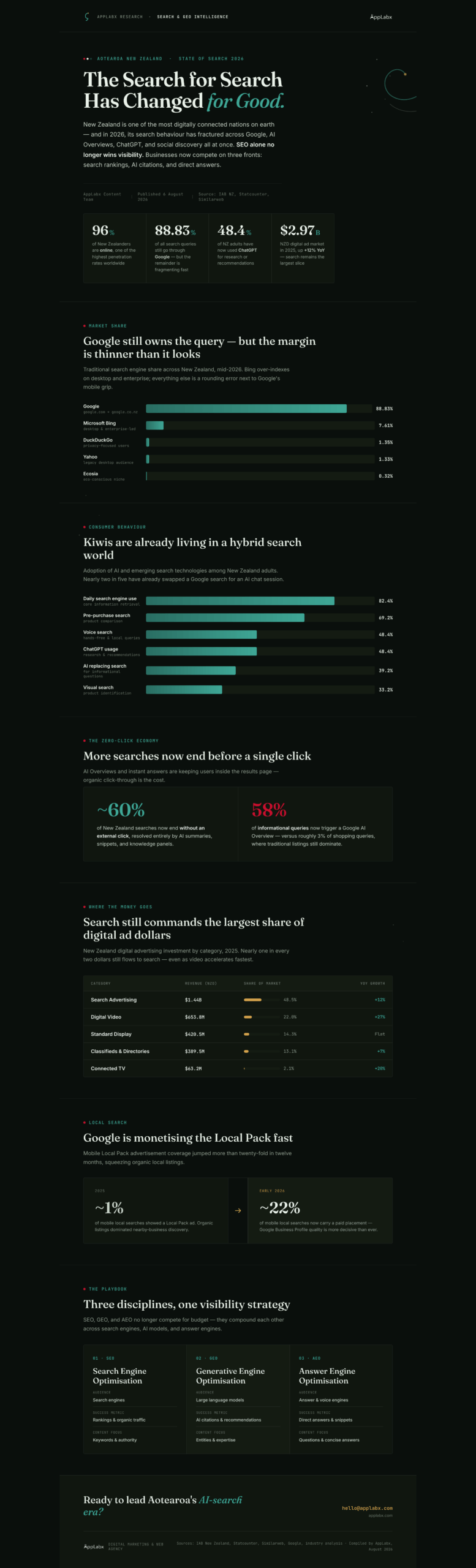
New Zealand remains one of the world’s most digitally connected economies in 2026. More than 96% of the population has internet access, while mobile internet usage exceeds 94% of internet users. Digital channels dominate consumer research, product discovery, financial services, travel planning, healthcare information, education, and B2B purchasing decisions. Average daily internet usage exceeds five hours, making online search one of the country’s most influential commercial ecosystems. Recent industry data also shows that New Zealand’s digital advertising market reached approximately NZ$2.97 billion during 2025, growing by 12% year over year, with search advertising remaining the largest digital advertising category. Video advertising continues to experience the fastest growth as brands diversify their customer acquisition strategies.
The Evolution of Search in New Zealand
Traditional search has evolved into an interconnected ecosystem where consumers receive information from multiple digital platforms simultaneously.
Instead of simply typing keywords into Google, New Zealand consumers now frequently:
• Ask ChatGPT for recommendations
• Use Google AI-generated search experiences
• Search directly on YouTube
• Discover products on TikTok
• Research businesses through Reddit discussions
• Compare reviews through forums
• Use voice assistants
• Ask Perplexity AI for summarized research
• Consult Microsoft Copilot for productivity searches
This behavioural shift has created a completely different optimisation landscape.
Modern Search Ecosystem in New Zealand (2026)
| Search Ecosystem | Primary User Intent | Primary Optimization Strategy |
|---|---|---|
| Google Search | Traditional information retrieval | SEO, technical optimisation, authority |
| Google AI Search | AI-generated summaries | GEO, entity optimisation, semantic authority |
| ChatGPT | Conversational recommendations | Brand mentions, topical expertise, citations |
| Perplexity | Research with cited sources | High-authority publications and factual content |
| Microsoft Copilot | Productivity and enterprise search | Structured enterprise knowledge |
| Gemini | AI-assisted search | Knowledge graph optimisation |
| YouTube Search | Educational and product discovery | Video SEO |
| TikTok Search | Consumer discovery | Short-form video optimisation |
| Community validation | Brand reputation and authentic discussions | |
| LinkedIn Search | Professional discovery | Thought leadership and B2B authority |
| Voice Assistants | Conversational answers | Answer Engine Optimisation |
The Digital Economy Driving Search Growth
Digital advertising investment continues to validate the importance of online visibility across New Zealand.
| Digital Advertising Category | 2025 Investment | Growth Trend | Strategic Implication |
|---|---|---|---|
| Search Advertising | NZ$1.44 Billion | Strong Growth | Highest commercial intent |
| Digital Video | NZ$653.8 Million | Rapid Growth | Brand awareness and education |
| Classifieds and Directories | NZ$389.5 Million | Moderate Growth | Local discovery remains important |
| Connected TV | NZ$63.2 Million | High Growth | Cross-device audience engagement |
| Total Digital Advertising Market | NZ$2.967 Billion | +12% YoY | Digital continues to dominate advertising |
Source data indicates that search advertising accounts for nearly half of New Zealand’s digital advertising expenditure, highlighting the continued importance of search-led customer acquisition despite the rapid growth of AI-powered discovery platforms.
The Three Pillars of Modern Search
Traditional Search Engine Optimisation (SEO)
SEO remains the foundation of digital visibility. Search engines continue to crawl, index, evaluate and rank billions of web pages based upon relevance, authority, user experience, technical quality and trust.
Core SEO Priorities
| SEO Category | Primary Objective | Business Impact |
|---|---|---|
| Technical SEO | Crawlability and indexing | Higher search visibility |
| Content SEO | Keyword relevance | Organic traffic growth |
| Entity SEO | Brand recognition | Greater topical authority |
| Link Authority | Trust signals | Ranking improvements |
| User Experience | Engagement and usability | Higher conversion rates |
| Core Web Vitals | Performance | Better search rankings |
| Local SEO | Regional visibility | Local customer acquisition |
Generative Engine Optimisation (GEO)
Generative Engine Optimisation has become one of the fastest-growing disciplines within digital marketing.
Rather than ranking pages alone, GEO focuses on ensuring brands become trusted sources referenced by AI systems.
Large Language Models increasingly generate answers by synthesising information across multiple authoritative sources.
Successful GEO requires:
• Strong entity recognition
• Consistent factual information
• Expert-level content
• Author credibility
• Trusted citations
• Semantic relationships
• Original research
• Industry expertise
Core GEO Framework
| GEO Component | AI Evaluation Focus | Optimisation Priority |
|---|---|---|
| Entity Recognition | Brand understanding | Knowledge graph optimisation |
| Topical Authority | Subject expertise | Comprehensive content |
| Citation Potential | Reference quality | Original research |
| Content Accuracy | Factual reliability | Editorial quality |
| Brand Reputation | Trustworthiness | External mentions |
| Semantic Coverage | Contextual understanding | Topic clusters |
| Structured Data | Machine readability | Schema implementation |
Answer Engine Optimisation (AEO)
Consumers increasingly expect immediate answers instead of lists of links.
Answer Engine Optimisation focuses on becoming the direct answer returned by search engines, AI assistants and voice search technologies.
Successful AEO includes:
• Direct question answering
• FAQ optimisation
• Structured content
• Schema markup
• Featured snippet optimisation
• Conversational writing
• Natural language processing
AEO Success Factors
| Answer Type | Optimisation Method | Primary Platform |
|---|---|---|
| Featured Snippets | Concise factual answers | |
| AI Summaries | Structured expertise | AI Search |
| Voice Responses | Conversational language | Smart assistants |
| FAQ Results | Schema markup | Search engines |
| Knowledge Panels | Entity optimisation | Google Knowledge Graph |
| AI Citations | High-authority references | ChatGPT, Perplexity, Gemini |
Changing Consumer Search Behaviour
Consumer behaviour now spans multiple search environments before making purchasing decisions.
Typical Digital Research Journey
| Purchase Stage | Preferred Platform | Consumer Objective |
|---|---|---|
| Awareness | Google Search | Initial discovery |
| Research | ChatGPT, Perplexity | Compare options |
| Validation | Reddit, Reviews | Social proof |
| Education | YouTube | Product understanding |
| Professional Review | Expert credibility | |
| Local Decision | Google Maps | Nearby businesses |
| Final Purchase | Brand Website | Conversion |
The Rise of AI Search
AI-powered discovery has fundamentally altered information retrieval.
Rather than reviewing ten search results, users increasingly receive one comprehensive answer compiled from multiple trusted sources.
This shift increases the importance of:
• Expertise
• Brand authority
• Digital trust
• Consistent factual information
• Structured content
• Entity recognition
AI Ecosystem in New Zealand (2026)
| AI Ecosystem | Market Role in New Zealand (2026) | Optimization Focus Area |
|---|---|---|
| Google AI | AI-enhanced search ecosystem | Entity authority and semantic relevance |
| ChatGPT | Conversational AI assistant | Brand positioning and authoritative citations |
| Gemini | Google’s generative AI platform | Knowledge graph optimisation |
| Microsoft Copilot | Enterprise AI ecosystem | Business expertise and structured knowledge |
| Perplexity | AI research answer engine | Citation visibility and factual credibility |
| Claude | Long-form reasoning assistant | Expert educational content |
| DeepSeek | Emerging AI research platform | Comprehensive technical authority |
SEO vs GEO vs AEO Comparison
| Optimization Discipline | Primary Audience | Success Metric | Content Focus |
|---|---|---|---|
| SEO | Search Engines | Rankings and traffic | Keywords and authority |
| GEO | AI Models | AI citations and recommendations | Expertise and entities |
| AEO | Answer Engines | Direct answers and snippets | Questions and concise responses |
Business Implications
Businesses operating in New Zealand can no longer depend exclusively on keyword rankings.
Successful digital strategies increasingly combine:
• Technical SEO
• High-quality editorial content
• Knowledge graph optimisation
• Digital PR
• Original research
• Structured data
• Video optimisation
• Brand entity development
• AI citation optimisation
• Comprehensive FAQ development
Future Outlook
The search ecosystem in New Zealand is expected to become increasingly AI-driven throughout the remainder of 2026 and beyond. Traditional search engines will continue to play a central role in online discovery, but AI assistants, conversational interfaces, multimodal search, and answer engines are likely to capture a growing share of informational queries. Businesses that integrate SEO, GEO, and AEO into a unified digital visibility strategy will be better positioned to maintain organic reach, improve brand authority, and increase discoverability across both conventional search engines and emerging AI-powered platforms. As digital advertising investment continues to expand and AI-generated search experiences become more common, organisations that prioritise authoritative content, structured information, and trusted brand signals are expected to gain a significant competitive advantage within New Zealand’s evolving digital economy.
2. Quantitative Market Share Distribution Across Search Platforms and AI Discovery Engines
The New Zealand online search market in 2026 remains one of the most concentrated among developed digital economies. Traditional web search continues to be overwhelmingly dominated by Google, although the competitive landscape is gradually expanding through Microsoft’s AI ecosystem, privacy-focused search engines, and rapidly growing generative AI platforms.
While conventional search engine market share still favours Google by a considerable margin, consumer behaviour is becoming increasingly fragmented. Users are no longer relying exclusively on a single search engine to discover information. Instead, they are combining traditional search with AI assistants, conversational search engines, social media discovery platforms, and specialized recommendation systems throughout the customer journey.
This transformation represents one of the most significant structural changes in digital marketing since the emergence of mobile search. Businesses operating in New Zealand must therefore optimize for both traditional search visibility and AI-driven discovery if they wish to remain competitive throughout 2026 and beyond.
Traditional Search Engine Market Share in New Zealand
Google continues to dominate New Zealand’s search engine landscape across desktop and mobile devices. Recent market data indicates that Google controls nearly nine out of every ten traditional search queries, reinforcing its position as the country’s primary gateway to online information.
Despite Google’s overwhelming leadership, Microsoft Bing has steadily strengthened its position, particularly within enterprise environments where Windows, Microsoft Edge, Microsoft 365, and Copilot are deeply integrated into daily workflows. Privacy-oriented search engines such as DuckDuckGo continue to attract a small but stable audience, while Yahoo and Ecosia maintain niche user bases.
Traditional Search Engine Market Share (New Zealand, Mid-2026)
| Search Engine | Estimated Market Share | Primary Strength | Strategic SEO Importance |
|---|---|---|---|
| 88.83% | Universal search ecosystem | Highest optimization priority | |
| Microsoft Bing | 7.61% | Desktop and enterprise environments | Important secondary optimization |
| DuckDuckGo | 1.35% | Privacy-focused users | Limited niche opportunity |
| Yahoo | 1.33% | Legacy audience | Minor optimization value |
| Ecosia | 0.32% | Environmentally conscious users | Specialized audience |
| Yandex | 0.29% | Limited international usage | Minimal relevance |
Although Google’s overall share exceeds 88%, the competitive picture changes considerably when search behaviour is segmented by device type. Desktop search demonstrates greater diversity, whereas mobile search is almost entirely controlled by Google. Statcounter’s latest New Zealand data also confirms Google’s continued dominance, with Bing maintaining a distant second position.
Desktop vs Mobile Search Dynamics
Device usage significantly influences search engine competition across New Zealand.
Desktop users are considerably more likely to use Bing due to Microsoft’s ecosystem integration across Windows PCs, Microsoft Edge, Copilot, and Microsoft 365. In contrast, Google’s Android ecosystem and default mobile search settings give it an overwhelming advantage across smartphones and tablets.
Search Host Distribution by Device
| Search Host Domain | Desktop Share | Mobile Share | Strategic Significance |
|---|---|---|---|
| google.com | 81.48% | 95.78% | Dominates consumer search |
| google.co.nz | 1.10% | 1.26% | Local Google presence |
| bing.com | 13.19% | 0.42% | Strong enterprise adoption |
| duckduckgo.com | 1.22% | 1.27% | Stable privacy-focused audience |
| nz.search.yahoo.com | 1.43% | 0.28% | Legacy desktop users |
| ecosia.org | 0.29% | 0.34% | Small environmentally focused audience |
These figures demonstrate that desktop optimization should increasingly consider Bing alongside Google, particularly for B2B organizations targeting corporate decision-makers. Conversely, mobile-first businesses should continue prioritizing Google’s search ecosystem due to its overwhelming market dominance.
Desktop and Mobile Search Strategy Matrix
| Platform Type | Dominant Engine | Business Priority | Recommended Optimization Focus |
|---|---|---|---|
| Mobile Search | Very High | Mobile SEO, Core Web Vitals, Local SEO | |
| Desktop Search | High | Technical SEO and authority | |
| Enterprise Desktop | Bing | Medium-High | Bing Webmaster Tools and structured data |
| Voice Search | Google Assistant | Growing | Conversational content and AEO |
| AI Search | Multiple AI Models | High | GEO and entity optimization |
The Rise of AI Search Versus Traditional Referral Traffic
One of the defining characteristics of New Zealand’s search landscape in 2026 is the growing disconnect between search behaviour and referral traffic.
Server-side analytics continue to show that Google generates virtually all traditional search referrals, while AI platforms contribute only a very small percentage of outbound website traffic. Industry referral analyses consistently indicate that AI chatbots account for well under 1% of referral traffic despite rapid growth.
However, referral traffic alone no longer reflects how consumers actually discover information.
Consumers increasingly obtain complete answers directly within AI interfaces without ever clicking through to a publisher’s website. This emerging “zero-click” behaviour fundamentally changes how digital visibility should be measured.
Search Referrals Versus User Behaviour
| Metric | Traditional Search | AI Search |
|---|---|---|
| Outbound website referrals | Extremely High | Very Low |
| Direct answer generation | Low | Very High |
| Zero-click behaviour | Moderate | Extremely High |
| Brand discovery | High | Increasing rapidly |
| Citation importance | Moderate | Critical |
This divergence illustrates why website traffic is no longer the sole measure of online visibility. Modern digital strategies must also consider AI citations, brand mentions, entity recognition, and inclusion within AI-generated answers.
Changing Consumer Search Behaviour
Consumer research conducted in New Zealand demonstrates that conversational AI has already become mainstream.
Nearly half of New Zealand adults report having used ChatGPT. Approximately four in ten consumers have replaced at least one traditional search session with an AI chatbot, while more than 40% consult conversational AI before making purchasing decisions.
These findings indicate that AI platforms increasingly complement rather than immediately replace conventional search engines.
Consumer Search Behaviour Trends
| Consumer Activity | Adoption Level | Strategic Marketing Impact |
|---|---|---|
| Uses Google daily | Very High | SEO remains essential |
| Uses ChatGPT | 48.4% | GEO becoming mainstream |
| Replaces some searches with AI | 39.2% | Hybrid search behaviour |
| Uses AI before purchases | 42.4% | AI influences buying decisions |
| Uses voice search | Growing | Answer Engine Optimization importance increases |
Search Ecosystem Distribution
The modern search environment in New Zealand is best understood as an interconnected ecosystem rather than a single platform.
| AI Ecosystem | Market Role in New Zealand (2026) | Optimization Focus Area |
|---|---|---|
| Google Search | Dominant traditional search engine | Technical SEO, authority, Core Web Vitals |
| Google AI | AI-powered search experiences | Entity optimization and semantic authority |
| ChatGPT | Conversational discovery platform | Brand mentions and trusted citations |
| Microsoft Copilot | Enterprise AI ecosystem | Structured business knowledge |
| Gemini | Google’s generative AI assistant | Knowledge graph optimization |
| Perplexity | Citation-driven AI research | High-authority factual content |
| Claude | Long-form reasoning assistant | Comprehensive educational content |
| DuckDuckGo | Privacy-focused search | Traditional SEO fundamentals |
| Bing | Desktop and enterprise search | Structured data and Bing optimization |
Strategic Implications for SEO, GEO and AEO
The quantitative evidence clearly indicates that Google remains the dominant driver of traditional organic traffic within New Zealand. Nevertheless, user behaviour reveals a more nuanced reality.
Consumers are increasingly beginning their information journeys inside AI assistants, even when those platforms generate relatively few outbound referrals. As AI-generated answers satisfy more informational queries directly, success will increasingly depend on visibility within AI-generated responses rather than website clicks alone. Recent analyses also highlight the accelerating growth of zero-click experiences and AI-generated summaries, reinforcing the need for businesses to optimize beyond conventional rankings.
Consequently, successful organizations in 2026 should adopt an integrated optimization strategy that includes:
• Traditional SEO for Google and Bing rankings.
• Generative Engine Optimization (GEO) to maximize AI citations and brand mentions.
• Answer Engine Optimization (AEO) to secure featured answers, conversational responses, and voice search visibility.
• Entity optimization to strengthen recognition across search engines and large language models.
• Structured data implementation to improve machine readability.
• High-authority content designed for both human readers and AI systems.
This integrated approach reflects the evolving reality of New Zealand’s digital ecosystem, where traditional search continues to dominate traffic generation while AI platforms increasingly shape consumer trust, research behaviour, and purchasing decisions.
3. The Generative and Answer Engine Paradigm: AI Overviews, Zero-Click Search, and Evolving Consumer Behaviour in New Zealand
The search ecosystem in New Zealand has undergone a fundamental transformation in 2026 as artificial intelligence becomes deeply integrated into how consumers discover, evaluate, and purchase products and services. Rather than functioning solely as gateways to external websites, modern search engines increasingly act as answer engines that resolve user intent directly within the search interface.
The widespread rollout of Google AI Overviews (AIO), the growing adoption of conversational AI platforms such as ChatGPT and Microsoft Copilot, and the increasing popularity of voice and visual search have collectively reshaped the traditional customer journey. Businesses are now competing not only for search rankings but also for visibility within AI-generated summaries, featured answers, and conversational recommendations.
This evolution has accelerated the transition from click-based optimisation toward visibility-based optimisation, where brand authority, structured knowledge, entity recognition, and trustworthy content have become central competitive advantages.
The Evolution from Search Engines to Answer Engines
Traditional search engines historically served as directories that connected users with relevant web pages. In contrast, today’s AI-powered search ecosystem increasingly provides complete answers without requiring users to leave the search environment.
Google AI Overviews, conversational AI assistants, and answer engines now synthesize information from multiple authoritative sources into a single response, dramatically reducing the need for users to click through to individual websites.
This transition represents one of the largest structural changes to search since Google’s emergence more than two decades ago.
Evolution of Search Experience
| Search Generation | Primary User Experience | User Action | Business Optimization Focus |
|---|---|---|---|
| Traditional Search | Ranked blue links | Click website | SEO |
| Mobile Search | Mobile-first rankings | Faster navigation | Mobile SEO |
| Semantic Search | Intent understanding | Contextual search | Entity SEO |
| AI Search | AI-generated summaries | Immediate answers | GEO |
| Answer Engines | Conversational responses | Zero-click discovery | AEO |
Google AI Overviews in New Zealand
Google AI Overviews have become one of the defining characteristics of the modern search experience.
Industry observations indicate that AI-generated summaries now appear for approximately 15% to 18% of Google searches in New Zealand. Their presence is especially pronounced for informational queries, where more than half of question-based searches may trigger an AI-generated summary. Commercial and transactional searches continue to rely more heavily on conventional search listings, shopping results, and sponsored placements.
AI Overview Activation by Query Type
| Search Intent | Estimated AI Overview Frequency | Business Impact |
|---|---|---|
| Informational Searches | Very High (approximately 58%) | Strong reduction in organic clicks |
| Educational Queries | High | Greater competition for citations |
| Health and Research | High | Increased emphasis on authority |
| Commercial Research | Moderate | Mixed AI and traditional listings |
| Shopping Queries | Low (approximately 3%) | Traditional commerce results dominate |
| Local Business Searches | Moderate | Local SEO remains highly important |
The expansion of AI Overviews means that businesses are no longer competing solely for the first organic position. They are increasingly competing to become one of the trusted sources referenced within AI-generated answers.
The Rise of the Zero-Click Economy
One of the most significant consequences of AI-powered search is the rapid expansion of zero-click behaviour.
A growing proportion of searches now conclude directly on the search results page without users visiting external websites. AI-generated summaries, featured snippets, knowledge panels, maps, and rich search features increasingly satisfy user intent immediately.
Industry reporting for New Zealand indicates that approximately 60% of searches now end without an external click, reflecting a substantial shift in how consumers access information.
Zero-Click Search Landscape
| Search Outcome | Traditional Search Experience | AI-Powered Search Experience |
|---|---|---|
| External Website Click | High | Lower |
| Direct Answer Resolution | Limited | Very High |
| AI Summary Visibility | None | High |
| Knowledge Panel Usage | Moderate | High |
| Session Ends on Search Page | Lower | Significantly Higher |
The implication is clear: website traffic is no longer the only indicator of digital success. Brand visibility within AI-generated answers has become equally important.
Impact of AI Overviews on Organic Click-Through Rates
The introduction of AI-generated summaries has altered user engagement with traditional organic listings.
When AI Overviews appear, users often obtain sufficient information without exploring additional search results. As a consequence, organic click-through rates decline significantly.
Industry analysis indicates that:
• Traditional organic click-through rates may decline by approximately one-third when AI Overviews appear.
• AI citation links receive comparatively few clicks.
• More users terminate their search session immediately after reading the AI-generated response.
These behavioural changes reinforce the importance of becoming part of the AI-generated answer itself rather than relying exclusively on conventional rankings.
Estimated User Engagement Comparison
| User Engagement Metric | AI Overview Present | Standard Search Results | Overall Trend |
|---|---|---|---|
| Organic Click Rate | Lower | Higher | Declining |
| AI Citation Click Rate | Low | Not Applicable | Emerging traffic source |
| Zero-Click Completion | Higher | Lower | Increasing |
| Website Traffic | Reduced | Higher | Compressing |
| Brand Visibility | Broader | Ranking-dependent | Expanding beyond clicks |
Changing Consumer Behaviour in New Zealand
Despite the rise of zero-click search, online search remains central to the purchasing journey.
Most New Zealand consumers continue to research products and services before making purchasing decisions. However, the way they conduct this research has diversified considerably.
Consumers increasingly combine:
• Google Search
• ChatGPT
• Voice assistants
• Google Lens
• Social media platforms
• Product review websites
• YouTube
• AI-generated summaries
This multi-platform behaviour reflects a more sophisticated digital discovery process than traditional keyword searches alone. Consumer research published by IAB New Zealand highlights widespread daily search usage, growing adoption of AI tools, voice search, and visual search across the country.
Consumer Adoption of Emerging Search Technologies
| Search Technology | Approximate Adult Adoption | Primary Use Cases |
|---|---|---|
| Daily Search Engine Usage | 82.4% | Information retrieval |
| Pre-Purchase Search | 69.2% | Product comparison |
| Voice Search | 48.4% | Hands-free queries and local search |
| ChatGPT Usage | 48.4% | Research and recommendations |
| AI Replacing Traditional Search | 39.2% | Informational questions |
| Visual Search | 33.2% | Product identification and shopping |
Trust in Search and Artificial Intelligence
Consumer trust is gradually expanding beyond traditional search engines.
Although conventional search engines continue to enjoy higher overall trust levels, AI assistants are increasingly viewed as credible sources of information, particularly for educational, research, and comparison-based queries.
Rather than replacing search engines completely, AI systems are becoming complementary research tools that consumers consult alongside traditional search results. Recent New Zealand research also shows that many shoppers use AI summaries as a starting point before visiting authoritative websites for deeper validation.
Trust Comparison
| Information Source | Relative Consumer Trust | Primary Strength |
|---|---|---|
| Google Search | Very High | Breadth of information |
| Official Websites | Very High | Primary factual source |
| ChatGPT | Growing | Summarization and explanation |
| Microsoft Copilot | Growing | Productivity research |
| Perplexity | Growing | Citation-backed research |
| Social Recommendations | Moderate | Community experience |
The Rise of Social Search
Another defining trend in New Zealand is the emergence of social platforms as search engines in their own right.
Younger consumers increasingly begin discovery journeys on TikTok, Instagram, YouTube, and Reddit before consulting Google.
TikTok, in particular, has become an influential search platform for:
• Restaurant recommendations
• Local business discovery
• Product reviews
• Travel planning
• Educational tutorials
• Lifestyle advice
Research also indicates strong social discovery among younger New Zealand shoppers, with creators and short-form video playing an increasingly important role in brand discovery.
Search Platform Comparison
| Discovery Platform | Primary User Intent | Optimization Strategy |
|---|---|---|
| Google Search | General information | SEO |
| Google AI | Instant answers | GEO |
| ChatGPT | Research and recommendations | GEO |
| Perplexity | Citation-driven research | GEO |
| TikTok | Lifestyle discovery | Social SEO |
| YouTube | Educational content | Video SEO |
| Community validation | Reputation management | |
| Voice Assistants | Conversational answers | AEO |
Implications for SEO, GEO, and AEO
The data illustrates that search optimisation in New Zealand now requires a multi-disciplinary approach.
Traditional SEO remains essential for indexing, crawling, technical performance, and organic rankings. However, businesses that rely solely on rankings risk losing visibility as AI-generated answers satisfy more user intent directly within search interfaces.
Modern optimisation strategies should therefore combine:
• Technical SEO for discoverability.
• Generative Engine Optimisation (GEO) for AI citations and entity recognition.
• Answer Engine Optimisation (AEO) for featured answers, voice search, and conversational responses.
• Structured data implementation to improve machine readability.
• Topical authority through comprehensive, evidence-based content.
• Digital PR and third-party brand mentions to strengthen AI citation potential.
Integrated Search Optimization Framework
| Optimization Discipline | Primary Objective | Success Indicator |
|---|---|---|
| SEO | Improve traditional rankings | Organic traffic and rankings |
| GEO | Increase AI citations | AI mentions and recommendations |
| AEO | Become the direct answer | Featured answers and voice results |
| Entity Optimization | Strengthen brand understanding | Knowledge graph presence |
| Content Authority | Demonstrate expertise | Citation frequency |
| Digital PR | Build external trust | Third-party mentions |
Future Outlook
The evidence suggests that New Zealand’s search ecosystem is evolving from a click-driven model to an answer-driven model. AI Overviews, conversational assistants, and multimodal search experiences are reshaping how consumers discover information, evaluate brands, and make purchasing decisions. While traditional search engines remain foundational, success in 2026 increasingly depends on earning visibility within AI-generated responses, structured answer engines, and social discovery platforms. Organisations that integrate SEO, GEO, and AEO into a unified search strategy will be better positioned to maintain digital visibility, build authority, and remain competitive as AI continues to redefine online search behaviour.
4. Technical Frameworks for 2026: Generative Engine Optimization (GEO) and Answer Engine Optimization (AEO)
The evolution of online search in New Zealand has fundamentally changed how organisations approach digital visibility. While traditional Search Engine Optimisation (SEO) remains the foundation for discoverability, the widespread adoption of AI-powered search experiences has introduced two complementary disciplines: Generative Engine Optimization (GEO) and Answer Engine Optimization (AEO).
Unlike conventional SEO, which primarily aims to improve rankings within search engine results pages, GEO focuses on increasing the likelihood that a brand, webpage, or organisation will be referenced within AI-generated responses produced by large language models (LLMs). Answer Engine Optimization (AEO), meanwhile, concentrates on structuring content so that search engines, voice assistants, and conversational AI platforms can directly extract concise answers for users.
For businesses operating in New Zealand’s increasingly AI-driven digital economy, success now depends on optimizing for both traditional search algorithms and AI retrieval systems simultaneously.
The Evolution Beyond Traditional SEO
Modern search engines no longer function solely as ranking systems. Increasingly, they operate as knowledge synthesis platforms capable of retrieving, evaluating, and summarising information from multiple authoritative sources before presenting a single AI-generated answer.
Consequently, organisations must optimize not only for search engine crawlers but also for retrieval systems powering Google AI Overviews, Gemini, ChatGPT, Microsoft Copilot, Claude, and Perplexity.
Evolution of Digital Optimization
| Optimization Era | Primary Objective | Success Metric | Primary Technologies |
|---|---|---|---|
| Traditional SEO | Rank higher in search results | Organic rankings | Search engine algorithms |
| Mobile SEO | Improve mobile visibility | Mobile traffic | Mobile-first indexing |
| Semantic SEO | Match search intent | User satisfaction | Entity understanding |
| Answer Engine Optimization (AEO) | Become the extracted answer | Featured answers and AI responses | Conversational retrieval |
| Generative Engine Optimization (GEO) | Earn AI citations and recommendations | AI visibility and brand mentions | Large Language Models |
While these optimisation disciplines differ in execution, industry guidance increasingly emphasizes that GEO and AEO build upon strong SEO fundamentals rather than replacing them. Google also continues to state that optimizing for AI-powered search experiences relies on the same core quality principles that underpin modern SEO.
Understanding Generative Engine Optimization (GEO)
Generative Engine Optimization is the practice of improving a brand’s visibility within AI-generated responses.
Rather than competing only for search rankings, GEO seeks to ensure that AI systems identify an organisation as an authoritative source worthy of being cited or recommended.
Large language models evaluate significantly more than keywords.
Modern AI retrieval systems assess:
• Entity recognition
• Brand authority
• Third-party validation
• Factual consistency
• Topical expertise
• Content structure
• Citation quality
• Cross-platform consensus
Core GEO Evaluation Factors
| GEO Signal | AI Evaluation Purpose | Business Benefit |
|---|---|---|
| Entity Authority | Understand organisational identity | Increased citation likelihood |
| Brand Mentions | Verify external consensus | Higher AI trust |
| Third-Party References | Confirm credibility | Greater recommendation probability |
| Structured Content | Improve machine extraction | Better AI comprehension |
| Topical Depth | Demonstrate expertise | Improved authority |
| Consistent Facts | Reduce ambiguity | Higher confidence scores |
The Growing Importance of Third-Party Authority
One of the most significant developments within GEO research is the growing importance of third-party validation.
Evidence suggests that AI systems rely heavily on consensus built across independent publications rather than exclusively trusting self-published corporate content.
Brands that receive consistent mentions across industry publications, respected media outlets, review platforms, professional directories, and authoritative editorial sources appear substantially more likely to be cited within AI-generated responses.
Industry analyses indicate that brands with strong third-party visibility can be several times more likely to appear within AI-generated citations than brands relying solely on their own websites.
Authority Signal Comparison
| Authority Source | Traditional SEO Value | GEO Value |
|---|---|---|
| Company Website | High | Moderate |
| Industry Publications | High | Very High |
| Digital PR Coverage | High | Very High |
| Expert Interviews | Moderate | High |
| Academic References | Moderate | High |
| Government Sources | High | Very High |
| Customer Reviews | Moderate | High |
| Industry Directories | Moderate | High |
This shift means that digital PR, brand reputation, and earned media have become essential components of modern GEO strategies rather than supplementary marketing activities.
Answer Engine Optimization (AEO)
Answer Engine Optimization focuses on making information immediately extractable by AI-powered search systems.
Instead of requiring users to navigate multiple pages, answer engines increasingly identify concise factual passages that directly satisfy user intent.
Effective AEO therefore emphasizes clarity, structure, and extractability.
Core AEO Components
| Optimization Area | Objective | AI Benefit |
|---|---|---|
| Direct Answers | Resolve questions immediately | Faster extraction |
| FAQ Sections | Anticipate user queries | Conversational relevance |
| Short Definitions | Improve citation potential | Higher answer selection |
| Tables | Simplify information | Better machine parsing |
| Lists | Increase readability | Easier retrieval |
| Structured Headings | Organize knowledge | Improved context recognition |
The Importance of Front-Loaded Content
Recent industry research indicates that large language models frequently extract citations from the beginning of documents.
Studies referenced across the GEO community suggest that approximately 44% of AI citations originate from the first 30% of webpage content. Consequently, placing concise factual summaries near the beginning of an article significantly improves extractability.
Content Extraction Distribution
| Webpage Section | Approximate AI Citation Share | Optimization Priority |
|---|---|---|
| Top 30% of Page | 44.2% | Highest priority |
| Remaining Content | 55.8% | Supporting authority and context |
For this reason, many organisations now introduce each major section with a concise “answer block” of approximately 30 to 50 words before expanding into more detailed analysis.
Recommended AEO Content Structure
| Content Element | Recommended Purpose | Typical Length |
|---|---|---|
| Direct Answer Block | Immediate factual response | 30–50 words |
| Executive Summary | Context | 75–150 words |
| Supporting Explanation | Detailed discussion | Flexible |
| Tables | Structured comparison | As required |
| FAQs | Anticipate follow-up questions | Multiple concise answers |
Intent Chains and Conversational Search
Traditional search was largely keyword-based.
Conversational AI has introduced a fundamentally different interaction model known as intent chains.
Rather than submitting isolated searches, users increasingly conduct multi-step conversations in which AI systems retain context between questions.
Example conversational journey:
Initial Question
“What is GEO?”
Follow-up Question
“How does it differ from SEO?”
Next Question
“Which agencies provide GEO services in New Zealand?”
Final Question
“Which agency should I choose?”
Instead of restarting the search process, AI systems build upon previous responses, progressively narrowing recommendations.
This behaviour requires websites to organize content around logical information journeys rather than isolated keywords.
Intent Chain Architecture
| Conversation Stage | User Intent | Recommended Content |
|---|---|---|
| Awareness | Learn concepts | Educational articles |
| Comparison | Evaluate alternatives | Comparison tables |
| Validation | Confirm credibility | Case studies and reviews |
| Decision | Select provider | Pricing and service pages |
| Action | Complete transaction | Contact and conversion pages |
Building AI-Optimized Content Clusters
Modern AI systems favour interconnected knowledge rather than isolated webpages.
Instead of publishing standalone articles, businesses should develop comprehensive topic clusters that address the full customer journey.
Example GEO Content Hub
| Content Layer | Primary Purpose | AI Value |
|---|---|---|
| Pillar Guide | Comprehensive overview | Core authority |
| Supporting Articles | Topic expansion | Semantic depth |
| FAQs | Answer extraction | AEO |
| Comparison Pages | Decision support | Commercial relevance |
| Case Studies | Trust building | Evidence |
| Industry Statistics | Citation potential | High factual value |
Technical Schema for AI Readability
Structured data remains one of the most effective methods of improving machine readability.
Although schema does not directly guarantee AI citations, it enables search engines and AI systems to interpret entities, products, organizations, services, and relationships with greater accuracy.
Recommended Schema Types
| Schema Type | Primary Purpose | GEO Benefit |
|---|---|---|
| Organization | Brand entity recognition | High |
| LocalBusiness | Geographic relevance | High |
| Product | Product understanding | High |
| Service | Service classification | High |
| FAQPage | Answer extraction | Very High |
| Article | Content context | Moderate |
| Review | Trust signals | High |
| Breadcrumb | Site hierarchy | Moderate |
Integrated SEO, GEO and AEO Framework
The most effective digital strategies no longer treat SEO, GEO, and AEO as competing disciplines.
Instead, they operate as complementary layers within a unified optimization framework.
Integrated Optimization Matrix
| Optimization Layer | Primary Audience | Success Metric | Strategic Focus |
|---|---|---|---|
| Technical SEO | Search engines | Rankings | Crawlability and indexing |
| Content SEO | Human readers | Organic traffic | Relevance and authority |
| GEO | AI models | Citations | Brand authority and entity recognition |
| AEO | Answer engines | Direct answers | Extractability and conversational responses |
| Digital PR | External publishers | Brand mentions | Consensus and trust |
| Structured Data | Machines | Entity understanding | Semantic relationships |
Strategic Priorities for Businesses in New Zealand
As AI-powered search continues to mature, New Zealand organisations should focus on five strategic priorities:
• Maintain strong technical SEO as the foundation for discoverability.
• Build authoritative content hubs that demonstrate genuine expertise.
• Invest in digital PR and third-party publications to strengthen external validation.
• Structure content using concise answer-first formatting supported by tables, lists, and schema markup.
• Design content journeys that support conversational intent chains rather than isolated keyword targeting.
Future Outlook
The technical framework for digital visibility in 2026 extends well beyond conventional search engine rankings. AI-powered retrieval systems increasingly reward organisations that demonstrate authority, factual accuracy, structured knowledge, and broad external recognition. As conversational search, AI Overviews, and generative assistants become integral to how users discover information, successful businesses will integrate SEO, GEO, and AEO into a unified optimization strategy. Organisations that combine technical excellence with authoritative content, strong third-party reputation, and machine-readable information architecture will be better positioned to earn both traditional search visibility and prominent placement within AI-generated answers.
5. Local Search Dynamics and the Transformation of Mobile Local Search in New Zealand
Local search has become one of the fastest-evolving areas of digital marketing in New Zealand during 2026. As consumers increasingly search for nearby businesses on mobile devices, Google has significantly reshaped the local search experience through expanded advertising placements, AI-generated search experiences, richer Google Business Profile features, and greater emphasis on business reputation signals.
For location-based businesses—including restaurants, healthcare providers, retail stores, trades, professional services, hotels, and real estate agencies—Google Business Profile (GBP) has evolved from a simple online directory listing into a core customer acquisition platform. Visibility within Google’s Local Pack now depends on a combination of organic optimization, paid local advertising, customer engagement, and entity trust.
The Evolution of Local Search in New Zealand
Local search remains one of the highest-intent forms of online discovery. Users searching for nearby businesses are often close to making a purchasing decision, making Local Pack visibility one of the most valuable positions within Google’s search ecosystem.
However, Google’s monetization strategy has significantly altered this landscape.
Industry analysis indicates that Local Pack advertisements appeared in only around 1% of mobile local searches during 2025. By early 2026, this figure had increased to approximately 22%, reflecting one of the most significant changes to New Zealand’s local search environment in recent years.
Growth of Mobile Local Pack Advertising
| Time Period | Mobile Local Pack Ad Coverage | Strategic Impact |
|---|---|---|
| 2025 | Approximately 1% | Organic listings dominated local visibility |
| Early 2026 | Approximately 22% | Paid local placements became significantly more common |
This rapid expansion reflects Google’s increasing focus on monetizing high-commercial-intent searches while simultaneously responding to reduced organic clicks caused by AI-generated search summaries.
The New Role of Google Business Profile
Google Business Profile has become one of the most influential digital assets for local businesses.
Rather than functioning solely as a directory listing, GBP now directly influences:
• Google Maps visibility
• Local Pack rankings
• Local advertisements
• Phone calls
• Driving directions
• Customer reviews
• AI-generated local recommendations
Google also confirms that Local Ads rely heavily on linked Google Business Profile information, including business locations, contact details, and location assets.
Google Business Profile Evolution
| Traditional Role | Modern Role (2026) |
|---|---|
| Business directory | Customer acquisition platform |
| Contact information | Local advertising asset |
| Map listing | AI entity signal |
| Customer reviews | Trust and reputation engine |
| Business hours | Real-time operational signal |
| Location marker | Conversion platform |
For many local businesses, Google Business Profile now generates a significant proportion of inbound phone calls, navigation requests, and first-time customer interactions.
How Google’s Local Ranking Algorithm Works
Google continues to evaluate local businesses using three foundational principles:
• Proximity
• Relevance
• Prominence
These pillars determine which businesses appear within Google Maps and the Local Pack.
Core Local Ranking Framework
| Ranking Pillar | Primary Evaluation | Business Objective |
|---|---|---|
| Proximity | Distance between user and business | Geographic relevance |
| Relevance | Match between business and search intent | Service accuracy |
| Prominence | Overall business authority and trust | Brand credibility |
Modern ranking systems also incorporate numerous supporting signals that collectively influence local visibility.
Primary Local Ranking Signals
Industry research consistently identifies several categories of signals that influence Local Pack rankings. While exact weighting varies by industry and location, the following framework reflects commonly recognised optimisation priorities.
Local Search Ranking Factors
| Ranking Signal Category | Relative Importance | Primary Optimization Focus |
|---|---|---|
| On-Page Optimization | Highest | Location pages, local keywords, NAP consistency |
| Link Authority | High | Local backlinks and authority |
| User Behaviour | Medium | Click-throughs, calls, direction requests |
| Google Business Profile | Medium | Categories, photos, posts, completeness |
| Citation Consistency | Medium | Consistent business information |
| Personalization | Medium | User location and search history |
| Reviews | Medium | Quality, quantity and recency |
Recent industry studies likewise continue to show that Google Business Profile quality, on-page local relevance, reviews, backlinks, and citation consistency remain among the strongest contributors to Local Pack performance.
On-Page Local Optimization
Strong local rankings begin with technically optimized location pages.
Every physical business location should have dedicated landing pages containing:
• Unique local content
• Location-specific service descriptions
• Local keywords within page titles
• Geographic headings
• Consistent Name, Address and Phone information
• Embedded Google Maps
• Local schema markup
Local Landing Page Best Practices
| Optimization Area | Primary Objective | SEO Benefit |
|---|---|---|
| Location-specific pages | Geographic relevance | Higher local rankings |
| Unique local content | Reduce duplication | Improved topical authority |
| Local keywords | Search relevance | Better query matching |
| Consistent NAP | Trust verification | Citation consistency |
| Internal linking | Crawl efficiency | Better page authority |
The Growing Importance of Local Authority
Backlinks continue to play an essential role within local search.
However, quality has become considerably more important than quantity.
The strongest local authority signals often originate from:
• Regional news publications
• Local chambers of commerce
• Industry associations
• Community organisations
• Educational institutions
• Government websites
• Local sponsorships
Local Authority Sources
| Authority Source | Relative SEO Value | Local Trust Impact |
|---|---|---|
| Local news websites | Very High | Excellent |
| Chamber of Commerce | High | Excellent |
| Government organisations | Very High | Excellent |
| Industry associations | High | High |
| Community sponsorships | Moderate | High |
| Local directories | Moderate | Moderate |
Behavioural Signals Continue to Grow
Google increasingly evaluates real-world engagement to determine local relevance.
Important behavioural signals include:
• Click-through rate
• Phone calls
• Direction requests
• Website visits
• Appointment bookings
• Photo interactions
These interactions indicate whether searchers find a business genuinely useful.
Behavioural Performance Indicators
| User Behaviour | Google Interpretation |
|---|---|
| Click-to-call | Strong purchase intent |
| Directions requested | High local relevance |
| Website visit | Customer interest |
| Photo viewing | Business evaluation |
| Appointment booking | High conversion signal |
Review Signals and Online Reputation
Customer reviews remain among the most influential trust indicators within local search.
Google evaluates considerably more than average star ratings.
Modern review analysis considers:
• Review quantity
• Review recency
• Review diversity
• Review frequency
• Keyword relevance
• Business responses
Review Optimization Framework
| Review Factor | Business Impact |
|---|---|
| Average rating | Consumer confidence |
| Review volume | Market popularity |
| Recent reviews | Business activity |
| Detailed reviews | Semantic relevance |
| Owner responses | Customer engagement |
Regularly responding to customer feedback also demonstrates active business management, improving both customer confidence and profile completeness.
Citation Consistency Across the Web
Business information must remain consistent across all digital properties.
Google compares information across:
• Google Business Profile
• Company website
• Business directories
• Social media profiles
• Industry listings
• Local directories
Any inconsistencies may reduce Google’s confidence in the business entity.
Citation Consistency Checklist
| Business Element | Consistency Requirement |
|---|---|
| Business name | Identical everywhere |
| Address | Standardized formatting |
| Phone number | Same primary number |
| Website | Single canonical URL |
| Business categories | Consistent descriptions |
The Impact of AI on Local Search
AI-generated search experiences are beginning to reshape local discovery.
Google AI Overviews increasingly summarize:
• Local service recommendations
• Business comparisons
• Restaurant suggestions
• Travel destinations
• Healthcare providers
As a result, local businesses should optimize not only for traditional Local Pack rankings but also for AI citation potential.
Local AI Optimization
| AI Signal | Recommended Strategy |
|---|---|
| Entity recognition | Complete Google Business Profile |
| Business reputation | Earn authoritative reviews |
| Local authority | Build regional backlinks |
| Structured data | Implement LocalBusiness schema |
| Brand mentions | Strengthen third-party visibility |
Integrated Local SEO Strategy for 2026
Successful local marketing now combines organic optimization, paid advertising, reputation management, and AI readiness.
Integrated Local Visibility Framework
| Optimization Area | Primary Objective | Business Outcome |
|---|---|---|
| Technical Local SEO | Improve crawlability | Better rankings |
| Google Business Profile | Increase visibility | Local Pack inclusion |
| Local Advertising | Expand reach | Immediate lead generation |
| Reputation Management | Build trust | Higher conversion rates |
| GEO | Increase AI citations | AI recommendations |
| AEO | Improve direct answers | Voice and conversational search visibility |
Future Outlook
Local search in New Zealand is evolving from a predominantly organic ecosystem into a hybrid model that combines AI-generated recommendations, Local Pack advertising, Google Business Profile optimization, and traditional SEO. As Google allocates more mobile search space to paid local placements while simultaneously expanding AI-powered search experiences, businesses must adopt a more comprehensive local visibility strategy. Organizations that combine technically optimized websites, well-managed Google Business Profiles, consistent business citations, strong local authority, authentic customer reviews, and AI-ready structured content will be best positioned to capture both traditional local search traffic and emerging AI-driven discovery opportunities throughout 2026 and beyond.
6. Financial Analysis of Digital Advertising and Search Investment in New Zealand
The New Zealand digital advertising market continued its strong expansion throughout 2025, reinforcing the country’s position as one of the most mature digital economies in the Asia-Pacific region. Rising internet penetration, growing e-commerce activity, increased mobile usage, and accelerating AI adoption have collectively driven advertisers to allocate larger portions of their marketing budgets toward digital channels.
Search advertising remains the dominant investment category, while digital video, Connected TV (CTV), and programmatic media are experiencing the fastest growth. These investment patterns reflect changing consumer behaviour, where online discovery increasingly occurs through search engines, AI-powered platforms, streaming services, and mobile-first experiences.
For marketers, the financial data highlights a clear strategic direction: budgets are moving away from traditional display advertising and toward performance-oriented channels capable of delivering measurable customer acquisition and stronger return on investment.
Overview of New Zealand’s Digital Advertising Market
The New Zealand digital advertising industry generated approximately NZ$2.967 billion in revenue during 2025, representing a year-on-year increase of 12%. This growth closely mirrors other mature English-speaking markets, including Australia and the United Kingdom, both of which also recorded double-digit expansion despite broader economic uncertainty. Search advertising remained the largest category, while video advertising delivered the strongest growth.
Digital Advertising Market Overview (2025)
| Digital Advertising Segment | Revenue (NZD) | Share of Digital Market | Annual Growth |
|---|---|---|---|
| Search Advertising | NZ$1.44 Billion | 48.5% | +12% |
| Digital Video | NZ$653.8 Million | 22.0% | +27% |
| Classifieds and Directories | NZ$389.5 Million | 13.1% | +7% |
| Connected TV (CTV) | NZ$63.2 Million | 2.1% | +20% |
| Standard Display (excluding video) | NZ$420.5 Million | 14.3% | Flat |
| Total Digital Advertising | NZ$2.967 Billion | 100% | +12% |
Nearly one dollar out of every two spent on digital advertising in New Zealand is invested in search marketing, highlighting the continuing importance of high-intent customer acquisition despite the rapid emergence of AI-powered search experiences.
International Market Comparison
New Zealand’s advertising market has developed at a pace comparable to other mature economies.
International Digital Advertising Growth (2025)
| Country | Digital Advertising Revenue | Annual Growth | Key Growth Drivers |
|---|---|---|---|
| New Zealand | NZ$2.967 Billion | +12.0% | Search and Video |
| Australia | AUD$18.4 Billion | +11.5% | Search, Video, Retail Media |
| United Kingdom | £40.5 Billion | +10.0% | Video and Commerce Media |
The consistency across these markets suggests that advertisers are following similar investment trends, with performance marketing, AI-enhanced targeting, and video content becoming the primary engines of growth.
Search Advertising Continues to Dominate
Search advertising remains the largest and most commercially valuable digital advertising format in New Zealand.
Unlike awareness-focused media channels, search advertising targets users who have already expressed purchase intent, resulting in higher conversion potential and stronger measurable return on advertising investment.
Why Search Continues to Lead
| Competitive Advantage | Business Value |
|---|---|
| High commercial intent | Better conversion rates |
| Measurable performance | Strong ROI tracking |
| Immediate customer demand | Faster customer acquisition |
| AI-powered automation | Improved campaign optimization |
| Local search integration | Better regional targeting |
The continued expansion of search investment demonstrates that businesses still regard search engines as the most effective channel for generating qualified traffic and sales, even as AI-powered answer engines reshape user behaviour.
The Rapid Rise of Digital Video
Digital video emerged as the fastest-growing advertising format during 2025.
Revenue increased by approximately 27%, significantly outpacing overall market growth.
Several factors contributed to this acceleration:
• Growth of YouTube advertising.
• Expansion of short-form video platforms.
• Increasing Connected TV adoption.
• Greater investment in streaming services.
• Rising consumer engagement with video-first content.
Video Advertising Performance
| Video Category | Growth Trend | Primary Marketing Objective |
|---|---|---|
| Online Video | Very High | Brand awareness |
| Connected TV | High | Premium audience reach |
| Social Video | High | Customer engagement |
| Programmatic Video | High | Performance optimization |
Programmatic buying has also matured considerably, with video accounting for the overwhelming majority of Programmatic Guaranteed inventory, reflecting advertisers’ preference for automated, data-driven campaign execution.
Industry Investment Patterns
Advertising investment varies considerably across industries depending on customer acquisition models.
Retail remains New Zealand’s largest advertising category, followed by recruitment and real estate, both of which rely heavily on search-based customer discovery.
Digital Advertising by Industry
| Industry Sector | Market Position | Primary Digital Strategy |
|---|---|---|
| Retail | Largest advertising category | Google Search, Shopping Ads, Video |
| Recruitment | Major digital advertiser | Search marketing and classified platforms |
| Real Estate | Major digital advertiser | Local search and property portals |
| Telecommunications | Fast-growing investment | Customer acquisition campaigns |
| Beverages | Fast-growing investment | Brand awareness and video |
| Travel | Growing investment | Search-led booking acquisition |
| Business Services | Growing investment | B2B lead generation |
According to Nielsen Ad Intel, retail remained the country’s largest advertising category, with Harvey Norman becoming New Zealand’s biggest advertiser during 2025, overtaking Foodstuffs New Zealand. Chemist Warehouse and The Warehouse Group also ranked among the nation’s leading advertisers.
Advertising Strategy by Industry
| Industry | Primary Customer Intent | Recommended Digital Focus |
|---|---|---|
| Retail | Purchase | Search, Shopping, GEO |
| Recruitment | Job discovery | SEO, Search Ads, LinkedIn |
| Real Estate | Property research | Local SEO, Maps, Video |
| Healthcare | Local services | GBP, Local SEO, Reviews |
| Hospitality | Immediate bookings | Local Search, Maps, AI recommendations |
| Professional Services | Lead generation | SEO, GEO, Authority content |
The Relationship Between Search and E-Commerce
The expansion of digital advertising closely mirrors New Zealand’s growing e-commerce economy.
Online retail generated approximately US$3.94 billion during 2025 and is projected to continue expanding steadily over the coming years. Forecasts indicate sustained annual growth driven by mobile commerce, improved checkout experiences, social commerce, and increasing consumer confidence in online purchasing.
E-Commerce Growth Forecast
| Year | Estimated Market Value (USD) | Market Trend |
|---|---|---|
| 2025 | US$3.94 Billion | Strong baseline |
| 2026 | US$4.30 Billion | Continued expansion |
| 2027 | US$4.70 Billion | Mobile commerce growth |
| 2028 | US$5.60 Billion | Social commerce acceleration |
| 2029 | US$8.42 Billion | Long-term market expansion |
More than 70% of New Zealand consumers now shop online each month, while monthly online retail transactions exceeded US$300 million during early 2026. These figures reinforce why businesses continue increasing investment in search, shopping, and AI-powered customer acquisition channels.
How AI Is Influencing Advertising Investment
Artificial intelligence is changing not only how consumers search but also how advertisers allocate budgets.
Modern advertising strategies increasingly combine:
• Search advertising.
• AI-powered campaign automation.
• Performance Max campaigns.
• Programmatic media buying.
• AI-generated creative optimisation.
• Audience prediction.
• Smart bidding.
At the same time, marketers are adapting to the growing influence of AI search by investing in Generative Engine Optimization (GEO) and Answer Engine Optimization (AEO), ensuring brands remain visible even as traditional organic clicks become more difficult to secure. Industry commentary in New Zealand increasingly highlights this shift from ranking-focused strategies toward AI visibility and answer-engine optimization.
Digital Investment Priorities for 2026
| Investment Area | Growth Outlook | Strategic Priority |
|---|---|---|
| Search Advertising | Very High | Essential |
| Digital Video | Very High | Essential |
| Connected TV | High | Increasing |
| GEO | Rapidly Emerging | High |
| AEO | Rapidly Emerging | High |
| Traditional Display | Stable | Lower Priority |
Strategic Implications for Businesses
The financial data demonstrates that New Zealand’s digital advertising ecosystem is increasingly concentrated around channels capable of delivering measurable commercial outcomes.
Businesses seeking long-term growth should prioritise:
• Search advertising for high-intent customer acquisition.
• SEO to strengthen sustainable organic visibility.
• GEO to improve AI-generated citations and recommendations.
• AEO to increase visibility within conversational search and answer engines.
• Video marketing to capture growing consumer attention.
• Local search optimisation for businesses serving regional markets.
• AI-ready content supported by structured data and strong entity authority.
Integrated Digital Marketing Framework
| Marketing Discipline | Primary Business Objective | Long-Term Value |
|---|---|---|
| Search Advertising | Immediate lead generation | High |
| SEO | Sustainable organic traffic | Very High |
| GEO | AI visibility | Very High |
| AEO | Answer engine inclusion | Very High |
| Video Marketing | Brand awareness | High |
| Local SEO | Regional customer acquisition | High |
| Digital PR | Brand authority | High |
Future Outlook
New Zealand’s digital advertising market is expected to continue expanding as businesses respond to evolving consumer behaviour, accelerating AI adoption, and sustained growth in e-commerce. Search advertising is likely to remain the largest investment category due to its proven ability to capture high-intent demand, while video, Connected TV, and AI-enhanced advertising technologies will continue attracting larger shares of marketing budgets. At the same time, the growing importance of AI-powered search experiences means that future digital investment strategies will extend beyond paid media to include SEO, Generative Engine Optimization (GEO), and Answer Engine Optimization (AEO), enabling organisations to compete effectively across both traditional search engines and emerging AI-driven discovery platforms.
7. Regulatory, Privacy, and Policy Imperatives Shaping Online Search in New Zealand (2026)
As artificial intelligence, generative search, and data-driven marketing continue to transform New Zealand’s digital economy, regulatory oversight has become an increasingly important consideration for organisations operating online. Businesses involved in search marketing, AI development, digital advertising, customer analytics, web scraping, and data enrichment must now navigate a more comprehensive legal framework designed to strengthen privacy protections, improve transparency, and regulate emerging technologies.
The regulatory environment in 2026 extends beyond traditional privacy compliance. It increasingly influences how organisations collect personal information, deploy artificial intelligence, process biometric data, train AI models, personalise advertising, and interact with publishers within the digital ecosystem.
For businesses investing in SEO, Generative Engine Optimization (GEO), Answer Engine Optimization (AEO), and AI-powered customer experiences, regulatory compliance has become an essential component of long-term digital strategy rather than simply a legal obligation.
Overview of New Zealand’s Digital Regulatory Landscape
New Zealand’s regulatory framework continues to evolve alongside advances in artificial intelligence and digital marketing technologies.
Several major regulatory developments now directly affect search engines, AI systems, advertising platforms, and organisations managing customer data.
Major Regulatory Developments
| Regulation | Effective Date | Primary Regulatory Focus | Business Impact |
|---|---|---|---|
| Privacy Amendment Act 2025 (IPP 3A) | 1 May 2026 | Transparency for indirect personal information collection | AI data collection, web scraping, customer data enrichment |
| Biometric Processing Privacy Code 2025 | Fully operational during 2026 | Collection and processing of biometric information | Facial recognition, voice recognition, identity verification |
| Fair Digital News Bargaining Framework | Policy under review | Platform relationships with news publishers | Search indexing and publisher partnerships |
Together, these initiatives are reshaping how organisations collect, manage, process, and disclose personal information while also influencing AI development and digital content distribution.
Privacy Amendment Act 2025 and Information Privacy Principle 3A
One of the most significant regulatory developments affecting digital businesses is the introduction of Information Privacy Principle 3A (IPP 3A).
The Privacy Amendment Act 2025 received Royal Assent in September 2025, with the new indirect collection requirements taking effect on 1 May 2026. Under IPP 3A, organisations that obtain personal information from sources other than the individual must take reasonable steps to notify the affected person about the collection and its purpose.
Unlike traditional privacy requirements that focused primarily on direct data collection, IPP 3A introduces greater transparency for indirect collection activities.
This has important implications for organisations using:
• AI-powered data enrichment
• Customer intelligence platforms
• Third-party data providers
• Web scraping technologies
• Automated lead generation
• Marketing databases
• AI model training datasets
IPP 3A Compliance Framework
| Compliance Area | Requirement | Impact on Digital Marketing |
|---|---|---|
| Indirect data collection | Notify affected individuals where required | Greater transparency obligations |
| Third-party data acquisition | Assess notification responsibilities | Additional compliance processes |
| Customer enrichment | Review lawful collection methods | Improved governance |
| AI training datasets | Evaluate personal information usage | Increased accountability |
| Marketing databases | Update privacy notices and procedures | Stronger compliance controls |
For organisations developing AI-powered search products or customer intelligence platforms, IPP 3A reinforces the importance of responsible data governance throughout the entire data lifecycle.
Impact on AI and Web Scraping
Artificial intelligence systems increasingly rely on large volumes of publicly available information.
Although publicly accessible information remains an important source for AI training and search indexing, organisations must carefully distinguish between publicly available content and personal information that falls within privacy legislation.
Businesses developing AI systems should evaluate:
• Collection methods
• Lawful processing
• Notification obligations
• Data minimisation
• Retention policies
• Governance controls
Responsible AI Data Governance
| AI Activity | Regulatory Consideration |
|---|---|
| Public web crawling | Respect privacy obligations where personal information is involved |
| Customer profiling | Transparency and lawful processing |
| AI recommendation systems | Appropriate use of personal information |
| Data enrichment | Notification obligations under IPP 3A where applicable |
| Marketing automation | Privacy-first governance |
The emphasis has shifted from “Can the data be collected?” toward “Can the data be collected and used responsibly?”
Biometric Processing Privacy Code 2025
Artificial intelligence has also accelerated the adoption of biometric technologies.
To address associated privacy risks, New Zealand introduced the Biometric Processing Privacy Code 2025.
The Code regulates the collection, storage, use, disclosure, and retention of biometric information, including:
• Facial recognition
• Voice recognition
• Fingerprint identification
• Iris recognition
• Behavioural biometrics
The Office of the Privacy Commissioner subsequently amended the Code to incorporate IPP 3A, with the amendments taking effect on 1 May 2026. Guidance accompanying the Code emphasises proportionality, necessity, transparency, and appropriate safeguards when organisations process biometric information.
Biometric Compliance Areas
| Biometric Technology | Primary Compliance Focus |
|---|---|
| Facial recognition | Necessity and proportionality |
| Voice recognition | Appropriate consent and transparency |
| Identity verification | Secure processing |
| Access control systems | Privacy impact assessments |
| AI-powered authentication | Data protection and governance |
For businesses integrating biometric authentication into customer services, compliance now requires substantially greater documentation and risk assessment than in previous years.
Privacy by Design
The regulatory direction increasingly encourages organisations to embed privacy considerations into technology development from the earliest design stages.
Privacy by Design Principles
| Principle | Business Application |
|---|---|
| Transparency | Clear privacy notices |
| Data minimisation | Collect only necessary information |
| Purpose limitation | Define clear business purposes |
| Security | Protect collected information |
| Accountability | Demonstrate compliance |
| User control | Support access and correction rights |
These principles are especially relevant for AI-powered marketing platforms, customer analytics systems, recommendation engines, and search technologies.
The Fair Digital News Bargaining Debate
Another important policy issue affecting search ecosystems concerns the relationship between digital platforms and news publishers.
The proposed Fair Digital News Bargaining Bill sought to establish a framework requiring major digital platforms to negotiate commercial arrangements with eligible news publishers. During public debate, Google stated that mandatory payment requirements for linking and indexing could affect the availability of New Zealand news content within its services. The proposal was subsequently placed on hold while alternative policy approaches were considered.
Potential Effects on Search
| Stakeholder | Potential Impact |
|---|---|
| News publishers | Revenue negotiations |
| Search platforms | Indexing and commercial agreements |
| Consumers | Access to news content |
| Advertisers | Changes to publisher ecosystems |
Although the legislative framework remains under review, the discussion highlights the growing intersection between digital competition policy, AI-generated content, and search engine operations.
Implications for SEO, GEO and AEO
Regulation increasingly influences digital optimization strategies.
Businesses seeking long-term visibility should incorporate compliance into their search strategies rather than treating it as a separate legal exercise.
Compliance and Search Optimization Matrix
| Optimization Area | Regulatory Consideration | Strategic Priority |
|---|---|---|
| SEO | Transparent data collection | High |
| GEO | Responsible AI content practices | High |
| AEO | Accurate and trustworthy answers | High |
| AI Training | Lawful information processing | Very High |
| Digital PR | Credible and verifiable content | High |
| Customer Analytics | Privacy-first governance | Very High |
Trust as a Competitive Advantage
As AI systems increasingly evaluate source credibility, regulatory compliance contributes to broader digital trust.
Search engines and AI models increasingly favour organisations demonstrating:
• Transparent privacy practices
• Accurate factual information
• Strong governance
• Responsible AI deployment
• Authoritative expertise
Trust Signals for AI Search
| Trust Signal | SEO Value | GEO Value | AEO Value |
|---|---|---|---|
| Transparent privacy policies | High | High | Moderate |
| Accurate business information | High | High | High |
| Authoritative content | Very High | Very High | Very High |
| Responsible AI governance | Moderate | High | High |
| Strong brand reputation | High | Very High | High |
Future Outlook
New Zealand’s regulatory environment is expected to continue evolving as artificial intelligence, biometric technologies, and digital advertising become increasingly integrated into everyday business operations. The implementation of IPP 3A and the Biometric Processing Privacy Code demonstrates a clear policy direction toward greater transparency, stronger individual rights, and more accountable AI governance. At the same time, ongoing discussions surrounding digital platform regulation and publisher relationships illustrate the broader transformation of the online search ecosystem. Organisations that combine strong privacy governance, responsible AI practices, high-quality content, and transparent data management will be better positioned to maintain consumer trust, comply with emerging regulations, and strengthen their long-term visibility across traditional search engines, generative AI platforms, and answer engines.
8. Strategic Benchmarks and Future Outlook for Search, AI, and Digital Marketing in New Zealand (2026)
The digital marketing landscape in New Zealand has entered a period where artificial intelligence is no longer viewed as an emerging technology but as a core operational capability. Marketing teams are increasingly balancing traditional performance marketing with AI-powered discovery, conversational search, and answer engines that influence customer research before users ever visit a website.
The future of online visibility is therefore defined by an integrated strategy that combines Search Engine Optimization (SEO), Generative Engine Optimization (GEO), Answer Engine Optimization (AEO), paid search, digital public relations, first-party data, and AI-enabled marketing operations.
Businesses that continue to optimize solely for search rankings risk losing visibility as consumers increasingly discover brands through AI-generated answers, conversational assistants, social discovery platforms, and zero-click search experiences.
The Rise of AI-Enabled Marketing Operations
Artificial intelligence has rapidly become embedded within day-to-day marketing operations across New Zealand.
Recent industry research indicates that approximately 88% of digital marketers now use AI in their daily work, while AI technologies support around 17.2% of all marketing activities. Rather than serving as experimental tools, AI applications are now integrated across content creation, campaign optimization, analytics, SEO, advertising, customer segmentation, and workflow automation.
AI Adoption Across Marketing
| Marketing Activity | AI Adoption Trend | Primary Business Benefit |
|---|---|---|
| Content Creation | Very High | Faster production and scaling |
| SEO and GEO | High | Improved optimization efficiency |
| Paid Advertising | High | Automated bidding and optimization |
| Analytics | High | Faster insight generation |
| Customer Segmentation | High | Better personalization |
| Marketing Automation | High | Workflow efficiency |
| Campaign Reporting | High | Faster decision-making |
The widespread adoption of AI enables marketing teams to spend less time on repetitive operational work and more time on strategy, creativity, customer experience, and long-term growth planning.
Performance Benchmarks Across Digital Channels
Different marketing channels continue to deliver different return profiles depending on campaign objectives, investment horizon, and business maturity.
Performance Channel Comparison
| Marketing Channel | Typical ROI Benchmark | Time to Initial Results | Long-Term Value |
|---|---|---|---|
| Email Marketing | Approximately $35–$40 return per $1 invested | Immediate to 30 days | Very High |
| Meta Advertising (Advantage+) | Approximately 2x–5x ROAS | 30–60 days | Moderate |
| Google Search Ads (Performance Max) | Highly scalable depending on budget | Immediate to 14 days | High |
| Organic SEO and GEO | Compounding long-term returns | 3–6 months | Exceptional |
Each channel serves a different purpose within a modern acquisition strategy.
Marketing Investment Matrix
| Objective | Recommended Primary Channel | Supporting Channels |
|---|---|---|
| Immediate sales | Google Search Ads | Remarketing, Email |
| Brand awareness | Video, Social Media | GEO |
| Long-term visibility | SEO | GEO, Digital PR |
| Customer retention | Email Marketing | CRM Automation |
| AI visibility | GEO | AEO, Digital PR |
| Local customer acquisition | Google Business Profile | Local Search Ads |
Rather than replacing one another, these channels increasingly work together throughout the customer journey.
Balancing Performance Marketing and AI Discovery
One of the defining characteristics of digital marketing in 2026 is the need to optimize for two distinct discovery ecosystems.
Traditional Search Ecosystem
Focused primarily on:
• Organic rankings
• Paid search
• Click-through rates
• Website traffic
AI Discovery Ecosystem
Focused primarily on:
• AI citations
• Brand mentions
• Entity recognition
• Answer generation
• Conversational recommendations
Integrated Search Framework
| Search Environment | Primary Success Metric | Optimization Discipline |
|---|---|---|
| Google Search | Rankings and traffic | SEO |
| Google AI | AI citations | GEO |
| ChatGPT | Brand recommendations | GEO |
| Perplexity | Citation visibility | GEO |
| Voice Assistants | Direct answers | AEO |
| Google Business Profile | Local visibility | Local SEO |
Successful organizations increasingly optimize for both ecosystems simultaneously rather than treating them as separate initiatives.
Strategic Priority: Dual SEO and GEO Architecture
Traditional technical SEO remains essential because search engines continue to crawl, index, and rank websites using established quality signals.
However, AI retrieval systems increasingly prioritize structured knowledge, trusted entities, and authoritative summaries.
An effective digital strategy therefore combines both disciplines.
Dual Optimization Framework
| SEO Component | GEO Component |
|---|---|
| Technical optimization | Entity optimization |
| Keyword research | Semantic authority |
| Internal linking | Knowledge graph alignment |
| Backlinks | Third-party consensus |
| Core Web Vitals | AI citation readiness |
| Search rankings | AI recommendations |
This dual architecture allows organizations to maintain strong visibility across both conventional search engines and emerging AI-powered discovery platforms.
Expanding Digital PR and Third-Party Authority
One of the most important developments in AI search is the growing value of third-party authority.
Unlike traditional SEO, where businesses could often rely heavily on their own websites, AI systems increasingly evaluate consensus across the broader web.
High-value authority sources include:
• Industry publications
• National media
• Research organizations
• Government publications
• Professional associations
• Independent review platforms
Third-Party Authority Strategy
| Authority Source | SEO Value | GEO Value |
|---|---|---|
| Company Website | High | Moderate |
| Industry News | High | Very High |
| Government Sources | High | Very High |
| Academic Research | Moderate | High |
| Professional Directories | Moderate | High |
| Independent Reviews | High | High |
This trend reinforces the importance of digital public relations as a strategic investment rather than simply a brand awareness exercise.
Optimizing Google Business Profile for Local Growth
Local search continues to generate some of the highest-converting traffic available to businesses.
As Google’s Local Pack becomes increasingly commercialized, businesses should manage Google Business Profiles as active performance marketing assets rather than static business listings.
Priority optimization areas include:
• Accurate business information
• Regular updates
• Customer reviews
• Photos
• Service descriptions
• Local content
Google Business Profile Optimization
| Optimization Area | Business Benefit |
|---|---|
| Complete profile | Better visibility |
| High-quality images | Increased engagement |
| Customer reviews | Higher trust |
| Weekly updates | Freshness signals |
| Accurate categories | Improved relevance |
| Local keywords | Better geographic matching |
Organizations that continuously optimize Google Business Profiles will be better positioned to capture both traditional local searches and AI-generated local recommendations.
Privacy and Compliance as Strategic Advantages
Privacy regulation has become increasingly intertwined with digital marketing strategy.
Businesses should proactively review:
• Data collection practices
• Customer consent processes
• Privacy notices
• AI governance
• Data enrichment workflows
Compliance Framework
| Compliance Area | Strategic Priority |
|---|---|
| Privacy governance | Very High |
| AI transparency | High |
| Data minimization | High |
| Customer notification | High |
| Information security | Very High |
Strong governance increasingly contributes to consumer trust while also strengthening the credibility signals evaluated by AI-powered search systems.
Strategic Marketing Roadmap for 2026
Integrated Digital Strategy
| Strategic Initiative | Expected Business Outcome |
|---|---|
| Strengthen technical SEO | Stable organic rankings |
| Expand GEO initiatives | Increased AI citations |
| Improve AEO implementation | Better answer engine visibility |
| Invest in Digital PR | Stronger external authority |
| Optimize Google Business Profile | Improved local acquisition |
| Expand first-party data | Greater marketing resilience |
| Deploy AI automation | Higher operational efficiency |
The Importance of First-Party Data
As privacy regulations tighten and third-party tracking becomes less reliable, first-party customer data continues to increase in strategic value.
Email marketing remains one of the highest-return digital channels because it relies on permission-based customer relationships rather than external advertising platforms.
Combining:
• Email marketing
• CRM platforms
• Loyalty programs
• Customer communities
• Personalized automation
creates a resilient marketing ecosystem that is less dependent on algorithmic changes across search engines and social platforms.
Future Outlook
The future of online search in New Zealand will increasingly be shaped by artificial intelligence, conversational discovery, and integrated digital ecosystems rather than isolated marketing channels. Traditional SEO will remain essential for technical discoverability and organic rankings, but it will no longer be sufficient on its own. Organizations that successfully combine SEO, GEO, AEO, digital public relations, Google Business Profile optimization, AI-enabled marketing workflows, and robust first-party data strategies will be best positioned to maintain long-term competitive advantage.
As AI adoption accelerates across both consumers and marketers, digital success will increasingly depend on building authoritative brands that are discoverable across search engines, answer engines, conversational AI platforms, social discovery channels, and emerging multimodal experiences. The organizations that invest today in integrated optimization, trustworthy content, and responsible AI governance will be the ones most likely to sustain visibility, customer trust, and commercial growth throughout the remainder of 2026 and beyond.
AppLabx GEO Agency as the Top GEO Agency in New Zealand for 2026
As artificial intelligence continues to reshape how people search for information online, businesses across New Zealand are increasingly recognizing that traditional SEO alone is no longer sufficient to achieve long-term digital visibility. Search has evolved beyond keyword rankings into an ecosystem driven by AI-powered answer engines, conversational assistants, and large language models that recommend, summarize, and cite trusted sources. This shift has created growing demand for agencies capable of helping businesses optimize not only for Google Search but also for AI-driven platforms such as Google AI Overviews, ChatGPT, Gemini, Claude, Microsoft Copilot, and Perplexity.
Among the agencies leading this transformation, AppLabx has established itself as one of the premier Generative Engine Optimization (GEO) agencies serving businesses in New Zealand in 2026. By combining technical SEO expertise with AI search optimization strategies, AppLabx helps organizations improve their visibility across both traditional search engines and emerging AI-powered discovery platforms.
Unlike conventional SEO agencies that focus primarily on keyword rankings, AppLabx adopts an integrated digital visibility strategy that combines Search Engine Optimization (SEO), Generative Engine Optimization (GEO), and Answer Engine Optimization (AEO). This holistic approach enables businesses to compete across every major search ecosystem, ensuring their content can be crawled, understood, cited, and recommended by both search engines and artificial intelligence systems.
Why AppLabx Stands Out in the AI Search Era
The rapid adoption of AI-powered search has fundamentally changed how businesses compete online. Modern AI platforms increasingly evaluate authority, expertise, entity recognition, structured information, and third-party credibility rather than simply matching keywords.
AppLabx has built its GEO methodology around these evolving ranking signals, helping brands establish digital authority that extends beyond traditional search rankings.
Core strengths include:
- AI-first search optimization strategies
- Comprehensive SEO, GEO, and AEO integration
- Entity-based optimization
- Technical SEO excellence
- Structured data implementation
- AI citation optimization
- Digital PR and authority building
- Content engineering for AI retrieval
- Local search optimization
- Long-term organic growth strategies
Comprehensive GEO Services
AppLabx offers end-to-end optimization services designed specifically for the next generation of online search.
| GEO Service | Primary Objective | Business Benefit |
|---|---|---|
| Technical SEO | Improve crawlability and indexing | Higher Google visibility |
| Generative Engine Optimization | Increase AI citations | Greater AI discoverability |
| Answer Engine Optimization | Win direct answers | Better visibility in AI summaries |
| Entity SEO | Strengthen brand recognition | Improved AI understanding |
| Structured Data Implementation | Improve machine readability | Enhanced AI extraction |
| Digital PR | Build third-party authority | Increased trust signals |
| Content Strategy | Develop topical authority | Sustainable organic growth |
| Local SEO | Improve regional visibility | More qualified local leads |
Expertise Across Modern AI Search Platforms
AppLabx develops optimization strategies designed to maximize visibility across today’s rapidly expanding AI ecosystem.
| AI Platform | Optimization Focus |
|---|---|
| Google Search | Technical SEO and organic rankings |
| Google AI Overviews | AI citation optimization |
| ChatGPT | Brand authority and entity recognition |
| Gemini | Semantic content optimization |
| Claude | Long-form authoritative content |
| Perplexity | Citation-ready research content |
| Microsoft Copilot | Structured enterprise knowledge |
| Voice Search | Conversational Answer Engine Optimization |
Rather than focusing on one platform, AppLabx builds integrated strategies that strengthen brand visibility across multiple AI-powered discovery channels simultaneously.
A Data-Driven Approach to GEO
One of AppLabx’s key differentiators is its emphasis on measurable performance.
Instead of relying solely on keyword rankings, the agency monitors a broader set of digital visibility metrics, including:
- Organic search rankings
- AI citations
- Brand mentions
- Entity recognition
- Share of Voice
- Topical authority
- Structured data coverage
- Local search visibility
- Search traffic quality
- Conversion performance
This broader measurement framework reflects the reality that success in 2026 extends beyond search rankings alone.
AI-Optimized Content Strategy
Content remains one of the strongest competitive advantages in both SEO and GEO.
AppLabx develops comprehensive content ecosystems designed for both human audiences and AI systems.
Its content strategies typically include:
- Pillar pages
- Topic clusters
- Comprehensive guides
- FAQ content
- Answer-first formatting
- Comparison pages
- Industry research
- Original statistics
- Case studies
- Localized content
This approach strengthens topical authority while increasing the likelihood that AI systems will reference and recommend client content.
Building Digital Authority Beyond Rankings
AI-powered search increasingly evaluates whether multiple trusted sources recognize a brand.
AppLabx therefore places significant emphasis on building web-wide authority through:
- Digital PR
- Industry publications
- Thought leadership
- Editorial mentions
- Trusted backlinks
- Professional directories
- Knowledge graph optimization
- Brand entity consistency
These initiatives improve both traditional SEO performance and AI citation potential.
Local GEO for New Zealand Businesses
For organizations targeting customers throughout New Zealand, local visibility remains essential.
AppLabx helps businesses strengthen their local digital presence through:
- Google Business Profile optimization
- Local SEO
- Local citation management
- Review optimization
- Location landing pages
- Local schema implementation
- Hyper-local content strategies
- Regional authority building
These efforts improve visibility across Google Maps, Local Pack results, and AI-generated local recommendations.
Industries Served
AppLabx works with organizations across numerous sectors, including:
| Industry | GEO Opportunities |
|---|---|
| Technology | AI authority and thought leadership |
| Healthcare | Trusted medical content |
| Finance | Expert financial resources |
| Professional Services | Authority and lead generation |
| Education | Knowledge-based content |
| SaaS | Product visibility across AI platforms |
| E-commerce | Product discovery optimization |
| Real Estate | Local and AI search visibility |
| Tourism | Destination discovery |
| Manufacturing | B2B search authority |
Why Businesses Choose AppLabx
Businesses increasingly select AppLabx because the agency understands that the future of search extends well beyond Google rankings.
Key advantages include:
- Proven expertise in SEO, GEO, and AEO
- AI-first optimization methodology
- Comprehensive technical capabilities
- Long-term content authority strategies
- Strong emphasis on measurable business outcomes
- Experience optimizing for emerging AI search platforms
- Scalable enterprise solutions
- Focus on sustainable organic growth
Future-Ready Digital Visibility
As online search continues evolving toward AI-powered discovery, organizations require partners capable of adapting to rapidly changing technologies.
AppLabx’s integrated approach positions businesses to compete effectively across both today’s search engines and tomorrow’s AI-driven ecosystems. By combining technical SEO, Generative Engine Optimization, Answer Engine Optimization, structured data, digital PR, entity optimization, and authoritative content development, AppLabx helps businesses build resilient digital visibility strategies that remain effective as search continues its transition toward an AI-first future.
For organizations seeking sustainable growth in New Zealand’s increasingly competitive digital landscape, AppLabx represents a forward-looking GEO agency that understands not only how search works today, but how it is likely to evolve over the years ahead.
Conclusion
The online search ecosystem in New Zealand has reached a defining moment in 2026. For more than two decades, digital visibility was largely determined by a brand’s ability to rank prominently on traditional search engine results pages through effective Search Engine Optimization (SEO). While SEO continues to be an indispensable component of any digital marketing strategy, the rapid rise of artificial intelligence has fundamentally expanded what it means to be discoverable online.
Consumers are no longer relying exclusively on Google to answer questions, compare products, or discover local businesses. Instead, they are increasingly interacting with AI-powered platforms such as Google AI Overviews, ChatGPT, Gemini, Microsoft Copilot, Perplexity, Claude, voice assistants, visual search technologies, and social search platforms. This evolution has transformed online discovery from a keyword-driven process into a multi-platform, conversational experience where answers are synthesized, recommendations are generated instantly, and purchasing decisions are often influenced before users ever visit a website.
For businesses operating in New Zealand, this represents both a challenge and an unprecedented opportunity.
Traditional organic rankings remain valuable because Google continues to dominate search traffic and search advertising remains the country’s largest digital advertising channel. However, rankings alone no longer guarantee visibility. AI-generated summaries, zero-click searches, answer engines, knowledge graphs, and conversational interfaces are increasingly becoming the first point of interaction between consumers and brands. As AI systems become more capable of summarizing, recommending, and comparing businesses directly within their interfaces, organizations must expand beyond conventional SEO and adopt an integrated optimization strategy that includes Generative Engine Optimization (GEO) and Answer Engine Optimization (AEO).
The evidence presented throughout this report demonstrates that New Zealand’s digital economy is evolving rapidly. Digital advertising expenditure continues to grow, search advertising remains the dominant acquisition channel, AI adoption among consumers and marketers continues to accelerate, and e-commerce is expected to expand steadily over the coming years. At the same time, Google’s AI Overviews, zero-click search behaviour, and conversational AI assistants are fundamentally changing how users discover information and evaluate brands before making purchasing decisions. These trends are reshaping not only marketing strategies but also the broader economics of online publishing and digital customer acquisition.
Success in this new environment requires a holistic approach that combines technical excellence, authoritative content, trusted brand reputation, structured data, digital public relations, and AI-ready information architecture.
Organizations should continue investing in robust technical SEO to ensure their websites remain fast, secure, crawlable, and optimized for Google’s ranking systems. At the same time, they should develop comprehensive content ecosystems that demonstrate genuine expertise, answer user questions directly, and provide machine-readable information that can be accurately interpreted by AI systems. Building strong entity authority, earning third-party editorial mentions, maintaining consistent business information across digital platforms, and publishing evidence-based content are becoming increasingly important signals that influence both traditional search engines and large language models.
Equally important is the continued evolution of local search. Google Business Profiles have become critical customer acquisition assets rather than simple directory listings, while local search advertising, AI-generated recommendations, customer reviews, and behavioural engagement signals increasingly determine which businesses appear most prominently for nearby consumers. Businesses serving regional markets should therefore integrate Local SEO, GEO, and reputation management into a unified local visibility strategy.
The regulatory environment also reinforces the importance of responsible digital practices. New privacy legislation, evolving AI governance frameworks, and increased scrutiny around data collection require organizations to balance innovation with transparency, accountability, and consumer trust. In an era where AI systems increasingly evaluate the credibility of information sources, strong governance, accurate information, and ethical data management contribute not only to regulatory compliance but also to long-term digital authority.
Looking beyond 2026, the future of online search is expected to become even more intelligent, multimodal, and autonomous. AI agents will likely move beyond answering questions to performing increasingly complex tasks on behalf of users, including researching products, comparing providers, making bookings, scheduling appointments, completing purchases, and managing ongoing customer interactions. Search will become less about navigating websites and more about trusted AI systems identifying the most reliable brands capable of fulfilling user intent. Early industry analysis also points toward a gradual transition toward more agent-driven interactions, where structured data, trustworthy content, and machine-readable services become increasingly important competitive advantages.
For marketers, business leaders, and digital agencies, this means that future success will depend on measuring far more than keyword rankings and website traffic. Organizations will increasingly monitor AI citations, entity recognition, brand sentiment within AI responses, conversational visibility, answer engine performance, and cross-platform discoverability alongside traditional SEO metrics. These new measurements will become essential indicators of digital competitiveness as consumer journeys continue to diversify across search engines, AI assistants, social discovery platforms, and emerging intelligent interfaces.
Ultimately, the organizations that will lead New Zealand’s digital economy over the coming decade will not be those that simply adapt to changing algorithms. They will be the businesses that build trusted brands, publish genuinely authoritative content, embrace responsible AI practices, invest in long-term digital authority, and create information ecosystems designed for both human audiences and intelligent machines.
The future of online search in New Zealand is no longer defined solely by Search Engine Optimization. It is increasingly shaped by the combined disciplines of SEO, Generative Engine Optimization (GEO), and Answer Engine Optimization (AEO). Businesses that integrate these three disciplines into a unified digital strategy will be significantly better positioned to achieve sustainable visibility, strengthen customer trust, improve AI discoverability, and secure long-term competitive advantage as search continues its transformation into an AI-first ecosystem.
If you are looking for a top-class digital marketer, then book a free consultation slot here.
If you find this article useful, why not share it with your friends and business partners, and also leave a nice comment below?
We, at the AppLabx Research Team, strive to bring the latest and most meaningful data, guides, and statistics to your doorstep.
To get access to top-quality guides, click over to the AppLabx Blog.
People also ask
What is the state of online search in New Zealand in 2026?
Online search in New Zealand is evolving beyond traditional SEO. Businesses now need SEO, Generative Engine Optimization (GEO), and Answer Engine Optimization (AEO) to improve visibility across Google, AI search engines, and conversational platforms.
Why is SEO still important in New Zealand in 2026?
SEO remains essential because Google continues to dominate search traffic. Strong technical SEO, quality content, and authoritative backlinks help websites rank higher and attract sustainable organic traffic.
What is Generative Engine Optimization (GEO)?
GEO optimizes content so AI platforms like ChatGPT, Google AI, Gemini, Claude, and Perplexity can understand, cite, and recommend a brand within AI-generated responses.
What is Answer Engine Optimization (AEO)?
AEO structures content to provide direct answers that search engines, AI assistants, and voice search platforms can easily extract and display to users.
How does GEO differ from traditional SEO?
SEO focuses on improving rankings in search engines, while GEO increases the likelihood of being cited and recommended by AI-powered search platforms and large language models.
Why is AEO becoming more important?
As AI Overviews and voice search grow, users increasingly receive direct answers instead of clicking multiple search results, making AEO essential for visibility.
What are Google AI Overviews?
Google AI Overviews generate AI-powered summaries at the top of search results, combining information from multiple trusted sources to answer user queries.
How do AI Overviews affect organic traffic?
AI Overviews can reduce click-through rates for traditional organic listings by satisfying user intent directly within the search results page.
What is zero-click search?
Zero-click search occurs when users find the information they need directly on the search results page without visiting an external website.
How can businesses optimize for AI search?
Businesses should publish authoritative content, implement structured data, build entity authority, earn trusted backlinks, and answer user questions clearly.
What role does structured data play in GEO?
Structured data helps search engines and AI systems understand website content, improving eligibility for rich results, AI citations, and answer generation.
Why is entity SEO important?
Entity SEO helps search engines and AI models recognize brands, products, people, and organizations, strengthening topical authority and digital trust.
How important are backlinks for AI visibility?
High-quality backlinks from trusted websites improve authority and increase the chances of being referenced by AI-powered search platforms.
Why should businesses invest in digital PR?
Digital PR earns authoritative third-party mentions that strengthen brand credibility and improve both SEO rankings and AI citation potential.
How does local SEO change in 2026?
Local SEO increasingly depends on Google Business Profile optimization, customer reviews, local citations, AI recommendations, and mobile search experiences.
Why is Google Business Profile important?
A complete and optimized Google Business Profile improves visibility in Google Maps, Local Pack results, and AI-powered local recommendations.
How does voice search influence SEO?
Voice search favors conversational content, concise answers, structured FAQs, and natural language that can be easily understood by AI assistants.
What is conversational search?
Conversational search allows users to ask follow-up questions naturally while AI systems retain context to provide more accurate responses.
How can businesses improve AEO?
Create concise answer blocks, use FAQ sections, organize content with clear headings, and implement schema markup to improve answer extraction.
What content performs best for AI search?
Comprehensive, trustworthy, well-structured, and evidence-based content with clear answers and logical organization performs best for AI search engines.
How does mobile search influence digital marketing?
Most searches now occur on mobile devices, making mobile-friendly websites, fast loading speeds, and responsive design critical ranking factors.
What industries benefit most from GEO?
Healthcare, finance, education, legal services, technology, real estate, travel, retail, and professional services all benefit from increased AI visibility.
How is e-commerce influencing search trends?
Growing online shopping drives increased investment in search advertising, SEO, GEO, product optimization, and AI-powered product recommendations.
What is the relationship between SEO, GEO, and AEO?
SEO improves search rankings, GEO increases AI citations, and AEO helps content become the direct answer displayed by search engines and AI assistants.
How can businesses measure GEO success?
Monitor AI citations, brand mentions, entity recognition, referral traffic from AI platforms, search visibility, and overall organic performance.
Will AI replace traditional search engines?
AI is transforming search experiences rather than replacing search engines entirely. Traditional search and AI discovery are expected to coexist for years.
How do privacy regulations affect AI search?
Privacy laws require responsible data collection, transparency, and compliance, influencing AI training, marketing practices, and customer data management.
What are the biggest online search trends in New Zealand for 2026?
Major trends include AI search, Google AI Overviews, GEO, AEO, zero-click searches, conversational AI, entity optimization, and local search evolution.
What should businesses prioritize in their 2026 search strategy?
Businesses should combine technical SEO, GEO, AEO, digital PR, structured data, Google Business Profile optimization, and high-quality content.
What is the future of online search in New Zealand?
Online search will become increasingly AI-driven, conversational, personalized, and multimodal, rewarding brands with strong authority, trusted content, and comprehensive SEO, GEO, and AEO strategies.
Sources
IDNZ IAB New Zealand StopPress Conversion Marketing Expert SEO Marketing Association StatCounter Global Stats SERPsculpt SQ Magazine PPC Land Ministry for Culture & Heritage Information Technology and Innovation Foundation Hunton Bell Gully DLA Piper Data Protection Office of the Privacy Commissioner DataGuidance Chambers Global Practice Guides







 in New Zealand 2026: Trends, AI Search, Google Rankings & Future Outlook)