
Key Takeaways
- Indonesia’s online search landscape in 2026 is driven by the convergence of SEO, GEO, AEO, AI search, social search, and e-commerce platforms, requiring businesses to adopt a multi-channel digital visibility strategy.
- Google’s continued dominance, the rapid adoption of AI-powered search, ChatGPT, Google AI Overviews, and social search platforms like TikTok are transforming how Indonesian consumers discover information, compare products, and make purchasing decisions.
- Businesses that invest in technical SEO, AI-ready content, Generative Engine Optimization (GEO), Answer Engine Optimization (AEO), Local SEO, structured data, authoritative content, and regulatory compliance will gain a lasting competitive advantage in Indonesia’s evolving digital search ecosystem.
Indonesia’s online search landscape in 2026 combines SEO, Generative Engine Optimization (GEO), Answer Engine Optimization (AEO), AI search, social search, and local search into one connected ecosystem. Businesses should optimize their websites, content, structured data, and digital presence across search engines, AI platforms, and social channels to improve visibility, earn AI citations, and attract more qualified customers.
Indonesia stands as one of Southeast Asia’s largest and fastest-growing digital economies, making it one of the most important markets for businesses, marketers, publishers, and technology companies seeking online visibility. With a population exceeding 280 million people, internet penetration surpassing 80%, hundreds of millions of active mobile connections, and one of the world’s most engaged social media audiences, Indonesia has become a highly competitive environment where digital discovery influences nearly every aspect of consumer and business decision-making. Whether users are researching products, comparing financial services, booking travel, seeking healthcare information, finding local businesses, or exploring educational resources, online search remains the primary gateway to information and commerce.
Also, read our top guide on the Top 10 GEO Agencies in Indonesia in 2026.
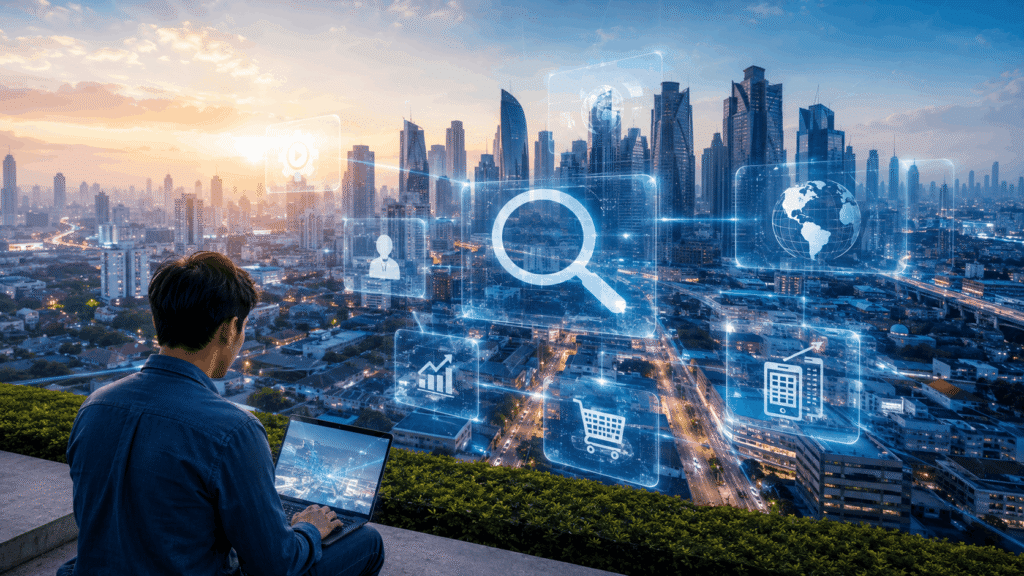
However, the meaning of “online search” has changed dramatically over the past few years. Traditional search engines are no longer the sole starting point for digital journeys. Artificial intelligence, conversational assistants, social media platforms, short-form video applications, and e-commerce marketplaces have fundamentally reshaped how Indonesian consumers discover brands, evaluate products, and make purchasing decisions. Search has evolved beyond entering keywords into Google. Today, users ask ChatGPT for recommendations, compare products through Google AI Overviews, discover brands on TikTok, watch YouTube reviews, search directly within Shopee and Tokopedia, and rely on Google Maps for local businesses—all within a single buying journey.
This transformation represents one of the most significant shifts in digital marketing since the rise of mobile internet. Businesses can no longer depend solely on ranking highly in Google’s traditional organic search results. While Search Engine Optimization (SEO) remains a critical foundation, organizations must now embrace a broader, integrated approach that includes Generative Engine Optimization (GEO), Answer Engine Optimization (AEO), AI Search Optimization, Local SEO, Social Search Optimization, entity-based optimization, structured data, and marketplace optimization. Together, these disciplines help businesses remain visible across an increasingly fragmented digital ecosystem.
The rapid adoption of artificial intelligence has accelerated this evolution. Large Language Models (LLMs) such as ChatGPT, Google Gemini, Claude, and Perplexity have introduced conversational search experiences that deliver synthesized answers instead of simple lists of websites. Google’s AI Overviews now provide AI-generated summaries directly within search results, allowing users to receive comprehensive answers without necessarily visiting external webpages. As zero-click searches become more common, businesses must optimize not only for website traffic but also for AI citations, entity recognition, semantic authority, and trustworthiness.
Indonesia’s digital infrastructure provides fertile ground for this transformation. High smartphone penetration, expanding broadband coverage, improved mobile internet speeds, affordable mobile data, and widespread adoption of digital payment systems have enabled millions of Indonesians to access AI-powered search tools and multimedia content effortlessly. The country’s young and digitally native population has readily embraced conversational AI, video-first content, social commerce, and mobile shopping experiences, making Indonesia one of Asia’s most dynamic search markets.
Consumer behaviour has evolved alongside these technological developments. Today’s users expect instant answers rather than lengthy research. They increasingly search using natural language, ask complete questions instead of typing isolated keywords, and prefer personalized recommendations generated by AI systems. Rather than reading multiple articles before making a decision, users often rely on AI-generated summaries, video demonstrations, customer reviews, creator recommendations, and marketplace ratings. This behavioural shift has fundamentally changed how businesses must create, organize, and distribute digital content.
Social search has emerged as another defining characteristic of Indonesia’s online landscape. Platforms such as TikTok, YouTube, Instagram, Facebook, and LinkedIn increasingly function as search engines in their own right. Indonesian consumers frequently use these platforms to discover products, restaurants, travel destinations, educational resources, technology reviews, and professional services before consulting traditional search engines. For younger generations, especially Generation Z and younger Millennials, social media has become a preferred destination for authentic recommendations, product comparisons, and visual learning experiences. Businesses that fail to optimize for social search risk losing significant visibility among these influential consumer segments.
At the same time, e-commerce platforms have become major search ecosystems. Rather than searching Google before making purchases, many consumers now begin their shopping journeys directly within Shopee, Tokopedia, TikTok Shop, Lazada, and Blibli. Marketplace search algorithms prioritize product quality, customer reviews, pricing competitiveness, fulfillment performance, and seller reputation, creating a new optimization discipline that complements both SEO and paid advertising. As social commerce and live shopping continue expanding throughout Indonesia, the distinction between search, content, entertainment, and commerce continues to blur.
Local search also remains a powerful commercial driver. Millions of Indonesians perform location-based searches every day using smartphones to find nearby restaurants, clinics, hotels, financial institutions, retail stores, educational providers, automotive services, and professional consultants. Google Business Profile, Google Maps, customer reviews, and local citations increasingly determine whether businesses attract customers before users ever visit a company website. For organizations serving regional markets across Jakarta, Surabaya, Bandung, Medan, Makassar, Semarang, Denpasar, and other major cities, Local SEO has become one of the highest-return digital marketing investments available.
The growing influence of AI-generated search experiences has also introduced entirely new success metrics. Traditional SEO focused heavily on rankings, clicks, impressions, and backlinks. Modern digital visibility now extends to AI citations, conversational recommendations, entity authority, semantic coverage, structured data quality, topical expertise, and inclusion within AI-generated answers. Organizations that consistently publish comprehensive, trustworthy, and well-structured content are increasingly rewarded not only with stronger organic rankings but also with greater visibility across ChatGPT, Google AI Overviews, Perplexity, Gemini, Claude, and other AI-powered search systems.
Meanwhile, digital advertising continues to evolve alongside organic search. Indonesia’s advertising market has experienced sustained growth as businesses shift budgets toward digital channels. Search Engine Marketing (SEM), video advertising, social media campaigns, creator partnerships, marketplace advertising, and AI-driven campaign optimization now work together to support customer acquisition. Rather than viewing paid and organic strategies separately, successful organizations integrate SEO, GEO, AEO, and performance marketing into a unified digital growth framework that captures users throughout the entire customer journey.
Another critical consideration for businesses operating in Indonesia is regulatory compliance. The implementation of the Personal Data Protection Law (Law No. 27 of 2022), alongside evolving artificial intelligence governance initiatives led by the Ministry of Communication and Digital Affairs (Komdigi), has established stronger expectations regarding privacy, transparency, ethical AI deployment, responsible data handling, and consumer protection. Organizations must therefore ensure that their digital marketing strategies align with regulatory requirements while maintaining user trust and supporting sustainable long-term growth.
Against this backdrop, understanding the state of online search in Indonesia has become more important than ever. Businesses entering the Indonesian market, multinational enterprises expanding their regional operations, local SMEs seeking growth, publishers building audiences, technology companies launching AI-powered products, and digital marketers refining their optimization strategies all need a comprehensive understanding of how search continues to evolve.
This comprehensive guide explores every major aspect of Indonesia’s online search ecosystem in 2026. It examines the country’s digital infrastructure, internet adoption, search engine market share, artificial intelligence integration, Generative Engine Optimization (GEO), Answer Engine Optimization (AEO), AI search platforms, zero-click search behaviour, social search trends, local SEO, Google Business Profile optimization, marketplace discovery, digital advertising, regulatory developments, and the strategic implications for organizations competing in Indonesia’s increasingly AI-driven digital economy.
Readers will gain detailed insights into how consumers search online, how businesses can optimize their digital presence for both traditional search engines and emerging AI platforms, how local and social search continue reshaping customer acquisition, and which strategies will be most effective for achieving long-term visibility in one of Asia’s most competitive digital markets. Whether the objective is improving organic rankings, earning AI citations, increasing local visibility, strengthening brand authority, or future-proofing digital marketing investments, understanding the state of online search in Indonesia in 2026 provides the foundation for sustainable growth in the rapidly evolving era of AI-powered discovery.
But, before we venture further, we like to share who we are and what we do.
About AppLabx
From developing a solid marketing plan to creating compelling content, optimizing for search engines, leveraging social media, and utilizing paid advertising, AppLabx offers a comprehensive suite of digital marketing services designed to drive growth and profitability for your business.
At AppLabx, we understand that no two businesses are alike. That’s why we take a personalized approach to every project, working closely with our clients to understand their unique needs and goals, and developing customized strategies to help them achieve success.
If you need a digital consultation, then send in an inquiry here.
Or, send an email to hello@applabx.com to get started.
The State of Online Search in Indonesia in 2026
- Executive Summary
- Traditional Search Engine Market Share and Structural Segmentation in Indonesia (2026)
- Generative Engine Optimization (GEO), Answer Engine Optimization (AEO), and AI Search in Indonesia (2026)
- Social Search, E-Commerce Product Discovery, and Algorithmic Commerce in Indonesia (2026)
- Economic Trajectory, Search Advertising Spend, and Digital Market Dynamics in Indonesia (2026)
- Local SEO and Google Business Profile Landscape in Indonesia (2026)
- Regulatory Compliance Frameworks and Governance for SEO, GEO, AEO, and AI Search in Indonesia (2026)
- Strategic Implementation Matrix for Enterprises: Winning Indonesia’s SEO, GEO, AEO, AI Search, and Social Search Landscape in 2026
1. Executive Summary
Indonesia’s online search ecosystem in 2026 represents one of Southeast Asia’s most dynamic and rapidly evolving digital environments. The country’s continued expansion in internet connectivity, smartphone adoption, artificial intelligence integration, and digital commerce has fundamentally reshaped how individuals discover information, products, services, and brands. Traditional search engines remain highly influential, but they now operate alongside AI-powered answer engines, conversational assistants, social media discovery platforms, and generative search experiences.
Search behavior is no longer limited to typing keywords into Google. Indonesian consumers increasingly expect direct answers, personalized recommendations, multimedia content, conversational interactions, and trustworthy AI-generated summaries. As a result, businesses can no longer rely exclusively on traditional Search Engine Optimization (SEO). Instead, successful digital visibility requires an integrated strategy that combines SEO, Generative Engine Optimization (GEO), Answer Engine Optimization (AEO), AI Search Optimization, and Social Search Optimization.
This transformation has been accelerated by Indonesia’s strong digital infrastructure. The country has approximately 230 million internet users, representing around 80.5% internet penetration across a population of approximately 286 million people. Mobile devices remain the dominant gateway to the internet, supported by 331 million cellular connections, equivalent to approximately 116% of the national population. Broadband improvements have significantly increased average connection speeds, enabling widespread adoption of AI-powered search experiences, voice search, video-first content, and rich multimedia consumption.
The rapid rise of generative AI has also introduced a new competitive landscape. AI-powered search systems increasingly synthesize information instead of merely presenting lists of websites. This means businesses must optimize not only for search rankings but also for AI citations, semantic authority, factual accuracy, entity recognition, structured content, and contextual relevance.
The Evolution of Online Search in Indonesia
Indonesia’s search ecosystem has transitioned through several distinct phases over the past decade.
| Search Era | Primary User Behaviour | Business Focus |
|---|---|---|
| Traditional SEO | Keyword searches and website rankings | Organic rankings and backlinks |
| Mobile Search | Smartphone-first browsing | Mobile optimization and local SEO |
| Social Search | Discovery through social platforms | Video content and community engagement |
| Voice Search | Natural language queries | Conversational content and featured answers |
| AI Search | AI-generated summaries and recommendations | Entity authority and factual trust |
| GEO and AEO | Citation-driven AI visibility | Semantic optimization and structured knowledge |
Rather than replacing traditional SEO, AI search has expanded the search ecosystem into a multi-platform environment where users interact with search engines, AI assistants, social networks, video platforms, and conversational interfaces simultaneously.
Indonesia’s Digital Foundation Supporting AI Search
Indonesia’s digital transformation provides a strong foundation for AI-powered search experiences.
| Digital Indicator | Indonesia (2026) | Strategic Significance |
|---|---|---|
| Internet Users | 230 Million | Massive searchable audience |
| Internet Penetration | 80.5% | Mature digital economy |
| Cellular Connections | 331 Million | Mobile-first search behaviour |
| Broadband Mobile Coverage | 96.6% | Supports AI-rich search experiences |
| Median Mobile Speed | 45.01 Mbps | Enables multimedia and AI interaction |
| Median Fixed Broadband | 39.88 Mbps | Supports rich web experiences |
| Social Media Users | 180 Million | Strong social discovery ecosystem |
| Average Daily Social Media Usage | 3 Hours 7 Minutes | Social platforms increasingly influence search journeys |
These indicators demonstrate that Indonesian users are well-positioned to adopt AI-enhanced search experiences across multiple digital platforms.
The Shift from Search Engines to Answer Engines
Traditional search presented users with ranked webpages.
Modern AI search increasingly delivers synthesized answers.
This changes how information is discovered.
Traditional Search Journey
User Query
↓
Search Results
↓
Website Click
↓
Information Found
AI Search Journey
User Query
↓
AI Processes Multiple Sources
↓
AI Generates Comprehensive Answer
↓
Optional Source Citation
↓
Follow-up Conversation
Businesses therefore compete not only for rankings but also for inclusion within AI-generated responses.
Understanding SEO, GEO, AEO and AI Search
The modern search ecosystem consists of multiple complementary optimization disciplines.
| Optimization Discipline | Primary Objective | Main Success Metric |
|---|---|---|
| SEO | Improve organic rankings | Search traffic |
| GEO | Improve AI citation visibility | AI mentions |
| AEO | Become direct answers | Featured answers and AI responses |
| AI Search Optimization | Improve visibility across AI assistants | Conversational recommendations |
| Social Search Optimization | Improve discovery through social platforms | Social visibility |
| Entity Optimization | Build brand recognition | Knowledge graph presence |
| Semantic Optimization | Improve topical understanding | Contextual authority |
Each discipline reinforces the others, creating an integrated visibility strategy.
Indonesia’s AI Search Ecosystem in 2026
Several AI platforms now influence online discovery in Indonesia.
| AI Ecosystem | Market Role in Indonesia (2026) | Optimization Focus Area |
|---|---|---|
| Google AI | Dominant AI-enhanced search ecosystem | Structured data, authority and semantic content |
| ChatGPT | Conversational research assistant | Brand authority and factual citations |
| Perplexity | AI research and citation engine | Source credibility and expert content |
| Microsoft Copilot | Productivity and enterprise AI | Trusted documentation |
| Gemini | Google’s multimodal AI assistant | Context-rich content |
| Claude | Long-form reasoning assistant | High-quality expert knowledge |
| DeepSeek | Growing AI research platform | Comprehensive technical content |
Each platform evaluates content differently, making diversified optimization increasingly important.
Changing Consumer Search Behaviour
Consumer discovery patterns have become significantly more fragmented.
| Discovery Method | Traditional Importance | Importance in 2026 |
|---|---|---|
| Google Search | Very High | Very High |
| AI Assistants | Low | High |
| Social Media Search | Medium | Very High |
| Video Search | Medium | High |
| Marketplace Search | Medium | High |
| Community Discussions | Low | High |
| Voice Search | Low | Moderate |
Consumers often combine multiple discovery channels before making purchasing decisions.
The Rise of Conversational Search
Modern users increasingly interact with search systems as though they are having conversations rather than conducting isolated keyword searches.
Examples include:
• Which mortgage has the lowest interest rate in Jakarta?
• Compare the best HR software for Indonesian startups.
• Recommend an SEO agency experienced in AI search optimization.
• What is the safest investment strategy during inflation?
These longer conversational queries require content that answers complete questions rather than simply targeting individual keywords.
The Growing Importance of Entity Authority
AI systems increasingly evaluate brands as entities rather than collections of webpages.
Key entity signals include:
| Entity Signal | Importance for AI Search |
|---|---|
| Consistent Brand Identity | Very High |
| Expert Authors | Very High |
| Reliable Citations | Very High |
| Industry Recognition | High |
| Original Research | Very High |
| Structured Knowledge | High |
| Trustworthy References | Very High |
Brands with stronger entity recognition are more likely to appear within AI-generated answers.
Content Characteristics Favoured by AI
Generative search models increasingly reward content with the following characteristics.
| Content Attribute | Why It Matters |
|---|---|
| Comprehensive coverage | Supports complete AI answers |
| Updated statistics | Improves factual confidence |
| Expert analysis | Builds authority |
| Original research | Differentiates from duplicated content |
| Structured headings | Easier AI interpretation |
| Tables and comparisons | Better information extraction |
| Frequently Asked Questions | Supports conversational responses |
| Clear definitions | Improves answer generation |
The Role of Social Search in Indonesia
Indonesia remains one of the world’s most active social media markets. With approximately 180 million active social media identities and users spending more than three hours per day across multiple platforms, social networks increasingly function as search engines in their own right. Consumers regularly discover brands, compare products, watch reviews, and seek recommendations directly within social platforms before conducting traditional web searches.
This evolution means that search optimization now extends beyond websites to include videos, creator content, user-generated discussions, community engagement, and platform-native content strategies.
Strategic Implications for Businesses
The evolution of online search requires organizations to rethink digital marketing priorities.
| Traditional SEO Focus | Modern AI Search Strategy |
|---|---|
| Keywords | User intent |
| Rankings | Visibility across ecosystems |
| Individual pages | Complete topical authority |
| Backlinks | Entity trust |
| Traffic | AI citations and recommendations |
| Search engines | Search engines and AI assistants |
| Metadata | Structured semantic knowledge |
| Website optimization | Multi-platform optimization |
Organizations that continue relying solely on conventional SEO risk losing visibility as AI-generated answers increasingly satisfy user intent directly within search interfaces.
Future Outlook
Indonesia’s online search landscape is expected to continue evolving rapidly throughout 2026 and beyond. AI-generated search experiences will become increasingly sophisticated, multimodal search will integrate text, images, voice, and video, and conversational interfaces will become standard components of digital discovery. Research also suggests that AI-generated summaries are reshaping user engagement patterns, reinforcing the need for publishers to optimize content for AI visibility alongside traditional organic rankings.
Future success will depend on building trusted digital entities rather than simply optimizing webpages. Businesses that combine SEO, GEO, AEO, AI Search Optimization, structured data, authoritative content, expert insights, and strong brand credibility will be best positioned to maintain visibility across both traditional search engines and emerging AI-powered discovery platforms.
2. Traditional Search Engine Market Share and Structural Segmentation in Indonesia (2026)
Although AI-powered search, conversational assistants, and social discovery platforms have transformed the way users access information, traditional search engines continue to serve as the primary gateway to the open web in Indonesia. They remain particularly important for high-intent commercial searches, local business discovery, product comparisons, financial research, travel planning, healthcare information, and enterprise decision-making.
Google continues to dominate Indonesia’s search engine landscape by an overwhelming margin, accounting for approximately 93.6% of all search engine activity across desktop, mobile, and tablet devices. Microsoft Bing remains a distant second with nearly 3% market share, while Yahoo, DuckDuckGo, and Yandex occupy relatively small but distinct user segments. This concentration makes Indonesia one of the most Google-centric search markets globally.
Despite Google’s overwhelming leadership, search behaviour is becoming increasingly fragmented. Consumers frequently begin their information journey on Google but complete it through AI assistants, video platforms, social media, marketplaces, and specialized research engines. Consequently, modern digital visibility strategies require businesses to optimize not only for Google’s traditional ranking algorithms but also for AI-generated answers, conversational interfaces, and cross-platform discovery.
Indonesia Search Engine Market Structure
| Search Engine | Estimated Market Share (2026) | Primary User Segment | Strategic Importance |
|---|---|---|---|
| 93.6% | Mass consumer and commercial searches | Dominant search ecosystem | |
| Microsoft Bing | 2.9% | Windows users and enterprise environments | Secondary desktop search engine |
| Yahoo | 2.1% | Legacy portal users | Small but stable audience |
| DuckDuckGo | 0.8% | Privacy-conscious users | Niche privacy search |
| Yandex | 0.6% | Regional and specialist users | Limited market presence |
| Others | <0.1% | Specialized search engines | Minimal commercial impact |
Google’s dominance reflects its integration across Android smartphones, Chrome browsers, Google Maps, Google Discover, Gmail, and the broader Google ecosystem. This interconnected environment reinforces Google’s position as the default search platform for the overwhelming majority of Indonesian internet users.
Traditional Search Ecosystem in Indonesia
| Search Platform | Core Function | Primary Commercial Value |
|---|---|---|
| Google Search | General web discovery | Customer acquisition and lead generation |
| Google Maps | Local business discovery | Local SEO and foot traffic |
| Google Images | Visual information search | Product and ecommerce visibility |
| Google Shopping | Product comparison | Retail visibility |
| Google News | News aggregation | Brand authority and publisher traffic |
| Google Scholar | Academic research | Educational and institutional authority |
| Bing Search | Alternative web search | Enterprise and Windows ecosystem |
Although AI-generated summaries increasingly answer informational queries directly, traditional search engines remain essential for website navigation, transactional searches, and deeper research that requires users to evaluate multiple sources.
Google’s Structural Dominance
Google’s market leadership extends well beyond conventional keyword searches. Its ecosystem spans multiple digital services that collectively influence consumer behaviour throughout the customer journey.
| Google Service | Primary Role | SEO and GEO Significance |
|---|---|---|
| Google Search | Core search engine | Organic rankings |
| Google Maps | Local discovery | Local business optimization |
| Google Business | Business profiles | Local trust signals |
| Google Images | Image search | Visual SEO |
| Google Discover | Personalized content | Content freshness |
| Google News | Publisher ecosystem | Authority building |
| Gemini Integration | AI-enhanced search | Generative search visibility |
The integration of Gemini-powered AI capabilities into Google’s products further strengthens its competitive position by combining traditional search rankings with AI-generated summaries and contextual recommendations.
Mobile Search Continues to Dominate
Indonesia remains one of the world’s most mobile-first internet economies. Smartphones account for the overwhelming majority of search activity, making mobile optimization an essential requirement rather than a competitive advantage.
Mobile users typically perform:
• Local business searches
• Product comparisons
• Restaurant discovery
• Navigation queries
• Travel planning
• Healthcare searches
• Financial research
• Voice searches
• AI-assisted information requests
The dominance of Android devices further reinforces Google’s market leadership because Google Search is pre-installed as the default search experience across most smartphones.
Mobile Search Characteristics
| Behaviour | Business Implication |
|---|---|
| Short, intent-driven searches | Optimize for transactional keywords |
| Location-aware queries | Strengthen local SEO |
| Voice search adoption | Use conversational language |
| Immediate purchase intent | Optimize product pages |
| AI-assisted follow-up questions | Build comprehensive topical authority |
Desktop Search Serves Different User Intent
While desktop search accounts for a smaller proportion of total search volume, it continues to play a critical role in higher-value information gathering and business decision-making.
Desktop users generally engage in:
• Enterprise software evaluations
• Investment research
• Academic studies
• Government documentation
• B2B procurement
• Professional services comparison
• Long-form content consumption
Desktop Search Behaviour Matrix
| User Type | Typical Search Intent | Optimization Priority |
|---|---|---|
| Business Executives | Vendor evaluation | Authority content |
| Researchers | Academic resources | Evidence-based publishing |
| Students | Educational material | Structured knowledge |
| Professionals | Industry insights | Expert thought leadership |
| Procurement Teams | Service comparison | Detailed solution pages |
Desktop users generally spend more time evaluating information, comparing multiple providers, and reading in-depth content before making purchasing decisions.
The Continuing Importance of Academic Search
One distinctive characteristic of Indonesia’s desktop search landscape is the significant role played by academic and scholarly search environments. Universities, research institutions, government agencies, healthcare organizations, and professional communities rely heavily on scholarly publications and evidence-based resources.
This trend reinforces the importance of publishing:
• Original research
• Industry reports
• White papers
• Case studies
• Technical documentation
• Statistical analyses
• Evidence-backed articles
Organizations producing authoritative knowledge assets are more likely to build trust not only with human readers but also with AI systems that increasingly reference reliable, well-structured information.
Functional Segmentation of Traditional Search
| Search Category | Primary User Goal | Optimization Strategy |
|---|---|---|
| Informational Search | Learn about a topic | Educational content |
| Navigational Search | Find a specific website | Brand authority |
| Commercial Investigation | Compare products or services | Comparison guides |
| Transactional Search | Complete a purchase | Conversion optimization |
| Local Search | Find nearby businesses | Google Business Profile optimization |
| Academic Search | Research and education | Expert publications |
This segmentation illustrates that different search intents require different optimization approaches. Organizations must create content that addresses the full spectrum of customer needs throughout the buying journey.
Strategic Role of Alternative Search Engines
Although Google overwhelmingly dominates Indonesia’s search market, smaller search engines continue to serve valuable niche audiences.
| Search Engine | Core Audience | Strategic Opportunity |
|---|---|---|
| Microsoft Bing | Enterprise users and Windows ecosystem | B2B visibility |
| Yahoo | Legacy portal users | Incremental organic traffic |
| DuckDuckGo | Privacy-focused users | Trust and transparency |
| Yandex | Regional users and specialist communities | Limited international reach |
For most businesses, Google should remain the primary optimization priority. However, organizations targeting multinational enterprises, technology professionals, or international audiences can benefit from ensuring compatibility with Bing’s indexing ecosystem, particularly because Bing also powers search capabilities for several AI products and third-party services.
Strategic Implications for SEO, GEO and AI Search
Traditional search engines remain the foundation of Indonesia’s digital discovery ecosystem, but they no longer operate in isolation. Search optimization now extends beyond ranking webpages to ensuring that content is understandable, trustworthy, and easily referenced by AI systems.
Traditional SEO should therefore evolve into an integrated visibility strategy.
| Traditional SEO Focus | Modern Search Strategy |
|---|---|
| Keyword rankings | Search ecosystem visibility |
| Organic traffic | AI citations and recommendations |
| Individual webpages | Complete topical authority |
| Link building | Entity trust and credibility |
| Search engine indexing | Multi-platform discoverability |
| Metadata optimization | Structured semantic content |
| Website authority | Brand entity recognition |
| Click-through optimization | Answer readiness and conversational relevance |
As Indonesia’s search landscape continues to evolve throughout 2026, businesses that combine strong technical SEO with Generative Engine Optimization, Answer Engine Optimization, structured knowledge, authoritative publishing, and AI-ready content architectures will be best positioned to maintain visibility across both traditional search engines and the emerging generation of AI-powered search experiences.
3. Generative Engine Optimization (GEO), Answer Engine Optimization (AEO), and AI Search in Indonesia (2026)
The integration of large language models (LLMs) into mainstream search platforms has fundamentally transformed how Indonesians discover and consume information online. Rather than simply displaying ranked lists of webpages, modern search engines increasingly generate synthesized answers that combine information from multiple trusted sources. This shift marks one of the most significant changes to digital search since the introduction of mobile-first indexing.
In Indonesia, the rollout of Google AI Overviews, alongside the rapid adoption of conversational AI platforms such as ChatGPT, Google Gemini, Claude, and Perplexity, has accelerated the transition from traditional search experiences toward answer-first discovery. Users increasingly expect immediate, context-rich, conversational responses instead of navigating through multiple websites to assemble information themselves. Google introduced AI Overviews in Indonesia as part of its broader multilingual rollout, making AI-generated search summaries available for Indonesian-language queries.
For businesses, publishers, and marketers, this transformation has redefined digital visibility. Ranking on the first page of Google is no longer sufficient. Organizations must now optimize their content to become trusted sources that AI systems can interpret, cite, summarize, and recommend across multiple search and conversational platforms.
The Evolution from Search Engines to Answer Engines
Traditional search engines functioned primarily as directories of webpages.
Modern AI-powered search engines function as intelligent answer systems.
Traditional Search Process
User Search Query
↓
Search Engine Rankings
↓
Website Click
↓
Information Found
AI Search Process
User Search Query
↓
Large Language Model Processing
↓
Multiple Sources Analysed
↓
AI-Generated Answer
↓
Optional Source Citation
↓
Follow-up Conversation
This evolution has created two complementary optimization disciplines.
• Search Engine Optimization (SEO) focuses on improving organic search rankings.
• Generative Engine Optimization (GEO) focuses on maximizing visibility within AI-generated answers.
• Answer Engine Optimization (AEO) focuses on structuring information so AI systems can extract direct answers.
• AI Search Optimization combines all three into a unified visibility strategy.
Comparison Between SEO, GEO and AEO
| Optimization Discipline | Primary Goal | Success Metric |
|---|---|---|
| Traditional SEO | Improve organic search rankings | Organic traffic |
| Generative Engine Optimization | Increase AI citations | AI mentions and references |
| Answer Engine Optimization | Become direct answer source | Featured answers and AI summaries |
| AI Search Optimization | Visibility across AI ecosystems | Multi-platform discoverability |
| Entity Optimization | Build recognized digital authority | Knowledge graph inclusion |
| Semantic Optimization | Improve contextual understanding | Topic authority and relevance |
The Rise of Conversational AI in Indonesia
Indonesia has become one of Southeast Asia’s fastest-growing markets for conversational artificial intelligence. AI assistants are increasingly used for education, business research, software development, travel planning, financial comparisons, healthcare information, shopping advice, and professional productivity.
ChatGPT remains the dominant standalone conversational AI platform in Indonesia, accounting for approximately 81% of AI chatbot usage, while Perplexity and Google Gemini continue expanding their presence. Similarweb also ranks ChatGPT as the country’s most-visited AI chatbot website, ahead of Gemini, Claude, Character.AI, and DeepSeek.
Indonesian AI Chatbot Market
| AI Platform | Estimated Market Share | Primary Competitive Strength |
|---|---|---|
| ChatGPT | 81.1% | Conversational reasoning and productivity |
| Perplexity | 11.3% | Citation-based AI search |
| Google Gemini | 4.2% | Deep integration with Google ecosystem |
| Claude | 2.9% | Long-form reasoning and enterprise analysis |
| Microsoft Copilot | <1% | Microsoft productivity ecosystem |
Unlike traditional search engines, conversational AI platforms often provide comprehensive responses without requiring users to visit external websites.
How AI Search Changes User Behaviour
AI-powered search significantly reduces the number of clicks required to satisfy user intent.
Instead of:
Search
↓
Open Website
↓
Read Content
↓
Return to Search
Users increasingly experience:
Search
↓
Receive AI Summary
↓
Ask Follow-up Questions
↓
Complete Task
This conversational workflow reduces dependence on individual webpages while increasing the importance of becoming a trusted AI citation source.
The Growth of Zero-Click Search
One of the defining characteristics of AI-powered search is the rapid growth of zero-click behaviour.
Zero-click searches occur when users receive sufficient information directly within the search interface without visiting another website.
Recent industry research indicates that approximately 68% of Google searches now end without an external website click, driven largely by the expansion of AI Overviews and answer-first search experiences. When AI-generated summaries appear, users are significantly less likely to click through to traditional organic results.
Impact of AI Search on Website Traffic
| Search Experience | Typical User Behaviour | Traffic Impact |
|---|---|---|
| Traditional Search Results | Multiple website visits | Higher organic traffic |
| AI Overview | Read summary first | Reduced click-through rate |
| Conversational AI | Multi-turn conversations | Fewer direct website visits |
| Answer Engine | Immediate information retrieval | Increased zero-click behaviour |
This does not eliminate the value of SEO. Instead, it shifts success metrics from simply generating clicks toward building authority, citations, and brand recognition across AI ecosystems.
Why GEO Has Become Essential
Traditional SEO focused on ranking webpages.
Generative Engine Optimization focuses on becoming part of the answer itself.
This distinction is increasingly important because AI systems frequently cite sources that are not necessarily ranked first in Google’s organic search results.
Research indicates that a significant proportion of AI-cited webpages originate from outside the traditional top organic rankings, demonstrating that topical authority, semantic relevance, and trust signals increasingly influence AI citation decisions.
Traditional SEO vs GEO
| Traditional SEO | Generative Engine Optimization |
|---|---|
| Improve keyword rankings | Improve AI citations |
| Maximize clicks | Maximize AI visibility |
| Optimize webpages | Optimize knowledge |
| Focus on backlinks | Focus on authority signals |
| Rank above competitors | Become trusted AI reference |
| Increase traffic | Increase brand exposure |
Answer Engine Optimization (AEO)
Answer Engine Optimization complements GEO by structuring content so AI systems can easily extract direct responses.
High-performing AEO content typically includes:
• Clear definitions
• Answer-first introductions
• Frequently Asked Questions
• Comparison tables
• Lists
• Step-by-step explanations
• Structured headings
• Concise summaries
AEO Content Framework
| Content Element | AI Benefit |
|---|---|
| Definition blocks | Easy extraction |
| FAQ sections | Conversational responses |
| Comparison tables | Structured reasoning |
| Numbered processes | Procedural understanding |
| Statistics | Factual confidence |
| Expert commentary | Trustworthiness |
| Updated information | Higher citation potential |
The Importance of Entity Authority
Modern AI systems increasingly evaluate brands as recognized entities rather than collections of webpages.
Strong entity signals include:
| Entity Signal | Importance for GEO |
|---|---|
| Consistent brand identity | Very High |
| Expert authors | Very High |
| Structured organization data | High |
| Industry recognition | High |
| Independent citations | Very High |
| Original research | Very High |
| Trusted media mentions | High |
Organizations with stronger digital entities are more likely to appear consistently across AI-generated responses.
Building AI-Ready Content Architecture
Successful GEO strategies prioritize content that is easy for both humans and AI systems to understand.
Characteristics of AI-ready content include:
| Content Feature | Optimization Purpose |
|---|---|
| Answer-first introductions | Immediate extraction |
| Semantic headings | Topic understanding |
| Comparison matrices | Knowledge organization |
| Statistics | Evidence support |
| Internal topical clusters | Context reinforcement |
| Structured data | Machine readability |
| Comprehensive coverage | Higher authority |
Third-Party Authority Matters More Than Ever
AI systems increasingly validate information by comparing multiple independent sources.
Content published or referenced across respected platforms, industry publications, academic resources, professional communities, and authoritative knowledge bases strengthens overall citation potential.
Rather than relying solely on a company’s own website, AI models assess whether information is corroborated across multiple trusted sources before incorporating it into generated answers. This makes digital public relations, expert thought leadership, research publications, and authoritative mentions increasingly valuable components of GEO strategies.
Localized AI Optimization for Indonesia
Indonesia presents unique opportunities for AI search optimization because of its diverse regional markets, multilingual user behaviours, and rapidly expanding digital economy.
Organizations targeting Indonesian audiences benefit from creating content that reflects:
• Local consumer behaviour
• Regional business contexts
• Indonesian market statistics
• Local regulations
• Geographic relevance
• Industry-specific expertise
Localized contextual authority helps AI systems determine when content is particularly relevant to Indonesian users and increases the likelihood of inclusion in locally focused AI-generated responses.
Strategic GEO Framework for Indonesian Businesses
| Strategic Layer | Primary Objective |
|---|---|
| Technical SEO | Ensure AI crawler accessibility |
| Structured Content | Improve AI comprehension |
| Entity Optimization | Strengthen brand authority |
| Third-Party Validation | Increase trust signals |
| AI Citation Monitoring | Measure conversational visibility |
| Local Context | Improve Indonesian relevance |
| Continuous Content Updates | Maintain factual accuracy |
Future Outlook
Indonesia’s AI search ecosystem will continue evolving throughout 2026 as conversational interfaces become increasingly integrated into everyday digital experiences. While ChatGPT currently dominates standalone AI chatbot usage, competition from Google Gemini, Perplexity, Claude, and other platforms is intensifying, making multi-platform optimization increasingly important.
For businesses, the future of search will depend less on simply achieving high organic rankings and more on becoming trusted knowledge sources that AI systems consistently recognize, understand, and cite. Organizations that integrate Search Engine Optimization, Generative Engine Optimization, Answer Engine Optimization, semantic content architecture, entity authority, structured data, and evidence-based publishing into a unified digital strategy will be best positioned to maintain visibility across both traditional search engines and the rapidly expanding ecosystem of AI-powered search experiences.
4. Social Search, E-Commerce Product Discovery, and Algorithmic Commerce in Indonesia (2026)
Indonesia has become one of the world’s leading examples of how digital discovery is evolving beyond traditional search engines. While Google remains the dominant gateway for general web searches, a growing proportion of product discovery, brand research, purchase inspiration, and buying decisions now take place directly within social media platforms and e-commerce ecosystems.
This transformation has created a new search landscape where algorithms, creators, live commerce, personalized recommendations, and short-form video increasingly influence consumer decisions before users ever perform a traditional web search. For many Indonesian consumers—particularly younger demographics—the customer journey begins with scrolling through personalized content feeds rather than entering keywords into a search engine.
As a result, successful digital marketing strategies in 2026 require businesses to optimize not only for Search Engine Optimization (SEO) and Generative Engine Optimization (GEO), but also for Social Search Optimization (SSO), marketplace optimization, creator discovery, and algorithm-driven commerce.
The Evolution of Digital Product Discovery
Traditional customer journeys followed a relatively predictable sequence.
Traditional Search Journey
Need Identified
↓
Google Search
↓
Website Visit
↓
Product Comparison
↓
Purchase
Today’s Indonesian consumer journey is considerably more dynamic.
Modern Discovery Journey
Personalized Feed
↓
Short Video
↓
Comments and Reviews
↓
Creator Recommendation
↓
Marketplace Search
↓
Live Shopping
↓
Purchase
Rather than actively searching for products, consumers are increasingly discovering products through algorithmically recommended content that aligns with their interests and online behaviour.
The Rise of Social Search
Social media platforms have evolved into powerful search engines in their own right. Instead of relying exclusively on Google, consumers increasingly search directly within TikTok, YouTube, Instagram, Facebook, and community platforms to discover brands, compare products, watch demonstrations, and evaluate real customer experiences.
Industry research indicates that approximately 60% of Indonesian internet users use social media as a primary source for researching brands and products before making purchasing decisions. Social recommendations, creator reviews, and user-generated content now influence purchase behaviour nearly as much as traditional search results.
Social Discovery Ecosystem
| Discovery Platform | Primary User Intent | Business Optimization Priority |
|---|---|---|
| TikTok | Product discovery and reviews | Short-form video optimization |
| YouTube | Tutorials and product comparisons | Long-form educational content |
| Lifestyle inspiration and brand discovery | Visual storytelling | |
| Communities and recommendations | Social engagement | |
| Merchant communication | Conversational commerce | |
| Information verification | Traditional SEO |
Consumers increasingly move between these platforms during a single purchase journey rather than relying on one search engine.
Generation Z Is Reshaping Search Behaviour
Generation Z represents one of the strongest drivers behind Indonesia’s transition toward social search. Younger users increasingly prefer discovering information through authentic creator content rather than traditional search results.
Popular searches among Gen Z include:
• Product reviews
• Restaurant recommendations
• Travel destinations
• Fashion inspiration
• Beauty tutorials
• Technology reviews
• Local attractions
• Shopping guides
TikTok has become the most popular social platform among Indonesian Gen Z users, according to recent APJII survey data, highlighting the platform’s growing role as both an entertainment destination and a discovery engine.
Search Behaviour by Platform
| Platform | Typical Search Topics | Content Format Preferred |
|---|---|---|
| Facts and official information | Articles and websites | |
| TikTok | Product reviews and recommendations | Short videos |
| YouTube | Tutorials and comparisons | Long-form videos |
| Brands and lifestyle | Images and Reels | |
| Marketplace Apps | Purchase-ready products | Product listings |
This behavioural shift requires businesses to optimize content differently for each platform.
TikTok as a Search Engine
TikTok has evolved far beyond a short-video entertainment platform. Its recommendation engine increasingly functions as a visual search engine powered by artificial intelligence.
Instead of relying solely on typed keywords, TikTok analyzes:
• Spoken words
• Video captions
• On-screen text
• Viewer engagement
• Watch time
• Comments
• Shares
• Saves
Its recommendation system continuously personalizes search results based on behavioural signals, making discoverability heavily dependent on content quality and audience engagement rather than traditional keyword rankings. Academic research also shows that watch time, engagement signals, and user interactions significantly influence TikTok’s recommendation algorithm.
TikTok Search Optimization Factors
| Optimization Signal | Influence on Discoverability |
|---|---|
| Spoken keywords | Very High |
| Viewer retention | Very High |
| Watch completion | High |
| Comments | High |
| Shares | High |
| Saves | High |
| Caption relevance | Moderate |
| Hashtags | Moderate |
Businesses that optimize videos for both human engagement and algorithmic understanding are more likely to appear in TikTok search results and personalized recommendation feeds.
Short-Form Video Has Become Search Content
Consumers increasingly use short-form videos as substitutes for traditional search results.
Instead of reading:
• Product reviews
• Buying guides
• Travel blogs
• Restaurant articles
Users now prefer watching:
• Product demonstrations
• Creator experiences
• Before-and-after videos
• Shopping comparisons
• Live product testing
• Customer testimonials
Authentic educational videos consistently outperform purely promotional advertisements because audiences perceive them as more trustworthy and informative.
The Expansion of Algorithmic Commerce
Indonesia’s digital economy increasingly operates through algorithmic commerce, where artificial intelligence determines which products consumers are most likely to discover.
Rather than browsing entire catalogues, users receive highly personalized recommendations based on:
• Previous purchases
• Viewing behaviour
• Search history
• Engagement patterns
• Social interactions
• Geographic location
• Device usage
Algorithmic Commerce Flow
User Behaviour
↓
Recommendation Algorithm
↓
Personalized Feed
↓
Creator Content
↓
Product Recommendation
↓
Marketplace Listing
↓
Purchase
This recommendation-driven model significantly reduces friction between product discovery and purchase.
Marketplace Search Has Become a Primary Search Channel
When Indonesian consumers exhibit strong purchase intent, they increasingly bypass traditional search engines entirely and search directly within marketplace applications.
Recent national survey data shows that Shopee remains the most frequently accessed e-commerce platform in Indonesia, followed by TikTok Shop, Tokopedia, Lazada, and Blibli.
Leading Marketplace Ecosystem
| Marketplace | Primary Strength | Optimization Focus |
|---|---|---|
| Shopee | Largest ecommerce traffic | Product SEO and advertising |
| TikTok Shop | Social commerce integration | Creator partnerships |
| Tokopedia | Local marketplace ecosystem | Product authority |
| Lazada | Cross-border commerce | Brand stores |
| Blibli | Premium retail | Trust and customer service |
Marketplace optimization has become as important as traditional SEO for ecommerce businesses.
Marketplace Search Ranking Factors
Marketplace algorithms prioritize different signals than traditional search engines.
| Ranking Signal | Marketplace Importance |
|---|---|
| Sales history | Very High |
| Product ratings | Very High |
| Customer reviews | Very High |
| Click-through rate | High |
| Conversion rate | High |
| Seller reputation | High |
| Response speed | Moderate |
| Fulfilment quality | High |
Success depends on optimizing both listing quality and seller performance metrics.
The Growth of Live Commerce
Live commerce has become one of Indonesia’s fastest-growing digital retail formats. Consumers increasingly combine entertainment, product education, and purchasing within live-streaming sessions.
Industry reports indicate strong adoption of live shopping across Indonesian consumers, with Shopee Live and TikTok Live emerging as the dominant platforms for interactive commerce. Surveys also show that discounts, direct interaction with sellers, and live demonstrations are major drivers of consumer participation.
Benefits of Live Commerce
| Consumer Benefit | Business Benefit |
|---|---|
| Product demonstrations | Higher conversion rates |
| Real-time questions | Increased trust |
| Exclusive promotions | Immediate purchases |
| Creator recommendations | Higher engagement |
| Interactive experience | Longer viewing sessions |
Live commerce shortens the purchase journey by combining discovery, education, trust building, and checkout within a single experience.
Messaging Platforms as Commerce Channels
Messaging applications have also become important components of Indonesia’s digital commerce ecosystem.
Consumers increasingly use messaging platforms to:
• Request quotations
• Verify product availability
• Receive customer support
• Complete purchases
• Track deliveries
• Receive personalized recommendations
Messaging Commerce Matrix
| Messaging Platform | Primary Business Function |
|---|---|
| Customer communication | |
| Business Messaging | Product catalogues |
| AI Chatbots | Customer support |
| Conversational Commerce | Purchase assistance |
Rather than replacing websites, messaging platforms increasingly complement ecommerce and AI-driven customer experiences.
Integrated Discovery Ecosystem
Modern digital discovery in Indonesia spans multiple interconnected platforms.
| Discovery Stage | Leading Platforms | Optimization Strategy |
|---|---|---|
| Brand Awareness | TikTok, Instagram, YouTube | Educational video content |
| Research | Google, ChatGPT, Perplexity | SEO, GEO and AEO |
| Product Evaluation | TikTok, YouTube, Reviews | Creator partnerships |
| Purchase Intent | Shopee, TikTok Shop, Tokopedia | Marketplace optimization |
| Customer Support | WhatsApp, AI Chatbots | Conversational commerce |
| Retention | Email, Messaging, Communities | Personalized engagement |
Strategic Implications for Businesses
The convergence of social search, AI-powered recommendations, ecommerce platforms, and algorithmic commerce means that visibility can no longer be achieved through SEO alone.
Successful organizations now build integrated digital strategies that combine:
• Search Engine Optimization (SEO)
• Generative Engine Optimization (GEO)
• Answer Engine Optimization (AEO)
• Social Search Optimization
• Marketplace Optimization
• Video Search Optimization
• Creator Marketing
• Conversational Commerce
• Live Commerce
Future Outlook
Indonesia is expected to remain one of the world’s fastest-growing social commerce markets throughout 2026 and beyond. The integration of AI-driven recommendations, short-form video, live shopping, conversational commerce, and marketplace ecosystems will continue to blur the boundaries between content, search, advertising, and ecommerce. Research on Indonesian TikTok Shop users also indicates that algorithmic personalization, engaging content exposure, and live commerce experiences significantly influence purchasing behaviour among Generation Z consumers.
For businesses, success will increasingly depend on becoming discoverable wherever consumers begin their journey—whether through Google, ChatGPT, TikTok, YouTube, Shopee, Tokopedia, or emerging AI-powered recommendation systems. Organizations that unify SEO, GEO, social search, creator partnerships, marketplace optimization, and algorithm-aware content strategies will be best positioned to capture consumer attention across Indonesia’s rapidly evolving digital commerce ecosystem.
5. Economic Trajectory, Search Advertising Spend, and Digital Market Dynamics in Indonesia (2026)
Indonesia has emerged as one of Southeast Asia’s fastest-growing digital economies, and its advertising industry reflects this transformation. Rising internet penetration, smartphone adoption, digital commerce, artificial intelligence, and changing consumer behaviour have accelerated the migration of marketing budgets from traditional media toward digital channels. Search advertising, social media advertising, online video, retail media, influencer marketing, and AI-powered campaign optimization now represent the core drivers of marketing investment.
The continued evolution of search behaviour—from keyword-based searches to conversational AI, social discovery, and algorithmic commerce—has fundamentally changed how advertising budgets are allocated. Businesses are no longer investing solely in Search Engine Marketing (SEM); they are increasingly distributing budgets across SEO, GEO, AI Search Optimization, social search, creator partnerships, marketplace advertising, and performance marketing.
Indonesia’s advertising market is therefore becoming increasingly integrated, where paid media, organic visibility, AI discoverability, and creator ecosystems reinforce one another rather than operating as separate marketing disciplines.
Indonesia’s Digital Advertising Economy
Indonesia’s advertising market continues to expand steadily alongside the country’s digital economy. Total advertising expenditure reached approximately US$6.97 billion in 2025, with digital advertising accounting for more than half of total media investment. Continued growth is expected throughout the remainder of the decade as businesses accelerate digital transformation and consumer activity shifts further toward mobile-first platforms.
Advertising Market Overview
| Market Indicator | Indonesia (2026) | Strategic Significance |
|---|---|---|
| Total Advertising Market | Approximately US$7 Billion | Mature and expanding media economy |
| Digital Share of Advertising | More than 50% | Digital becomes the dominant channel |
| Digital Advertising Growth | Strong annual expansion | Continued migration from traditional media |
| Primary Growth Drivers | Mobile, AI, ecommerce, video | Multi-channel marketing |
| Long-Term Outlook | Continued expansion through 2031 | Sustained digital transformation |
Digital media has become the largest destination for marketing investment because it provides measurable performance, precise audience targeting, AI-driven optimization, and real-time campaign reporting.
Digital Advertising Market Growth
Indonesia’s digital advertising market continues to experience healthy long-term expansion. Industry forecasts estimate the market will increase from approximately US$3.23 billion in 2025 to US$3.41 billion in 2026 before reaching approximately US$4.51 billion by 2031, representing a compound annual growth rate (CAGR) of approximately 5.7%. Smartphone adoption, social commerce, AI-powered advertising, and video consumption remain the primary growth drivers.
Digital Advertising Growth Outlook
| Year | Estimated Market Size | Market Trend |
|---|---|---|
| 2025 | US$3.23 Billion | Strong expansion |
| 2026 | US$3.41 Billion | Continued growth |
| 2031 Forecast | US$4.51 Billion | Mature digital advertising ecosystem |
The continued expansion reflects increasing confidence among businesses that digital advertising delivers measurable commercial outcomes compared with many traditional media channels.
Evolution of Marketing Budget Allocation
Marketing investment has shifted significantly over the past decade.
Traditional Budget Allocation
Television
↓
↓
Outdoor
↓
Radio
↓
Search Advertising
Modern Budget Allocation
Search Advertising
↓
Social Media
↓
Video Advertising
↓
Creator Marketing
↓
Marketplace Advertising
↓
AI Campaign Optimization
↓
Retail Media
Rather than concentrating budgets on a single channel, advertisers increasingly build integrated campaigns that span search engines, AI platforms, social media, ecommerce marketplaces, and creator ecosystems.
Search Advertising Remains a Core Investment
Despite the rapid growth of AI search and social discovery, paid search advertising remains one of the highest-performing digital marketing channels in Indonesia.
Search advertising continues to attract substantial investment because it targets users with high commercial intent.
Typical search advertising objectives include:
• Lead generation
• Product sales
• Local business discovery
• Financial services
• Healthcare marketing
• Travel bookings
• Enterprise software
• Professional services
Search advertising also complements SEO and GEO by capturing transactional keywords while organic content builds long-term authority.
Search Advertising Benefits
| Business Objective | Why Search Advertising Works |
|---|---|
| Immediate visibility | Ads appear above organic results |
| High purchase intent | Users actively seek solutions |
| Measurable ROI | Detailed conversion tracking |
| Local targeting | Geographic precision |
| AI-assisted optimization | Automated bidding and audience modelling |
The Growing Importance of AI-Powered Advertising
Artificial intelligence increasingly influences every stage of digital advertising.
Modern advertising platforms now automate:
• Audience targeting
• Bid optimization
• Creative generation
• Campaign forecasting
• Budget allocation
• Conversion prediction
• Customer segmentation
• Performance reporting
AI Advertising Workflow
Campaign Goals
↓
AI Audience Analysis
↓
Creative Optimization
↓
Automated Bidding
↓
Real-Time Performance
↓
Continuous Learning
↓
Campaign Improvement
AI enables advertisers to improve efficiency while reducing manual campaign management.
Video Advertising Leads Digital Growth
Video has become the largest digital advertising format in Indonesia, reflecting the country’s strong consumption of YouTube, TikTok, Instagram Reels, Facebook Video, and streaming platforms.
Industry forecasts indicate that video advertising represented approximately 34% of Indonesia’s digital advertising expenditure, making it the largest individual digital format.
Digital Advertising by Format
| Advertising Format | Market Position | Primary Business Value |
|---|---|---|
| Video | Largest digital segment | Brand awareness and engagement |
| Search | High-performance channel | Intent-driven conversions |
| Display | Broad audience reach | Awareness campaigns |
| Social Advertising | Rapidly expanding | Community engagement |
| Retail Media | Fast-growing | Ecommerce sales |
| Influencer Marketing | Strong growth | Consumer trust |
Short-form video continues to attract increasing investment because it combines storytelling, education, entertainment, and commerce within a single content format.
Mobile Advertising Dominates
Indonesia remains a mobile-first economy.
Most internet activity—including search, shopping, video consumption, messaging, and AI interactions—occurs on smartphones.
Industry estimates indicate that mobile devices account for approximately 68% of digital advertising expenditure, reflecting consumer behaviour across virtually every major online activity.
Mobile Advertising Advantages
| Mobile Behaviour | Marketing Opportunity |
|---|---|
| Always connected | Continuous customer engagement |
| Location-aware | Local advertising |
| Mobile payments | Faster conversions |
| App ecosystems | Rich behavioural data |
| AI integration | Personalized recommendations |
Businesses that prioritize mobile-first experiences generally achieve stronger campaign performance across search, ecommerce, and social channels.
Industry Distribution of Advertising Investment
Different industries allocate advertising budgets according to customer acquisition models and purchasing behaviour.
Advertising Investment by Industry
| Industry Sector | Primary Marketing Objective |
|---|---|
| Ecommerce | Customer acquisition |
| Retail | Product sales |
| FMCG | Brand awareness |
| Financial Services | Lead generation |
| Healthcare | Patient education |
| Technology | Enterprise demand generation |
| Travel | Booking conversions |
| Education | Student recruitment |
Industries with highly competitive online markets typically invest across both paid and organic channels to maximize visibility.
The Rise of Performance Marketing
Performance marketing has become one of the dominant advertising strategies in Indonesia.
Rather than purchasing media based solely on impressions, advertisers increasingly optimize campaigns around measurable business outcomes.
Performance Metrics
| Performance Metric | Business Importance |
|---|---|
| Cost Per Click | Budget efficiency |
| Conversion Rate | Campaign effectiveness |
| Customer Acquisition Cost | Profitability |
| Return on Ad Spend | Revenue generation |
| Customer Lifetime Value | Long-term growth |
| Incremental Revenue | Business expansion |
AI-driven optimization enables advertisers to continuously improve these metrics throughout campaign execution.
Search, SEO and GEO Now Work Together
Modern marketing strategies increasingly integrate paid and organic visibility rather than treating them as separate disciplines.
Integrated Search Strategy
| Marketing Discipline | Primary Objective |
|---|---|
| SEO | Organic rankings |
| GEO | AI citation visibility |
| AEO | Direct answers |
| SEM | Paid search visibility |
| Social Search | Discovery through creators |
| Marketplace Advertising | Purchase-ready consumers |
| Video Optimization | Visual engagement |
Organizations that coordinate these channels typically achieve stronger overall visibility than businesses relying on only one marketing approach.
Advertising Trust and Inventory Quality
Indonesia also benefits from relatively healthy digital advertising quality compared with many international markets.
Independent verification reports continue to indicate comparatively low levels of mobile web advertising fraud, improving advertiser confidence in campaign measurement and media investment. Strong mobile viewability, improving fraud detection technologies, and increasingly sophisticated verification platforms contribute to greater transparency across the digital advertising ecosystem.
High-quality advertising inventory supports:
• Better campaign measurement
• Higher advertiser confidence
• Improved return on investment
• More accurate attribution
• Reduced wasted advertising spend
Strategic Implications for Businesses
Indonesia’s advertising landscape has entered a new phase where digital success depends on integrating multiple customer acquisition channels rather than optimizing individual platforms in isolation.
Modern Marketing Ecosystem
| Channel | Primary Role | Optimization Strategy |
|---|---|---|
| Google Search | High-intent discovery | SEO and SEM |
| AI Search | Conversational answers | GEO and AEO |
| Social Media | Brand discovery | Social Search Optimization |
| Video Platforms | Consumer education | Video SEO |
| Ecommerce Marketplaces | Purchase intent | Marketplace optimization |
| Creator Ecosystem | Consumer trust | Influencer partnerships |
| Messaging Platforms | Customer engagement | Conversational commerce |
Future Outlook
Indonesia’s digital advertising market is expected to continue its steady expansion throughout 2026 and beyond as artificial intelligence, mobile commerce, retail media, video advertising, and algorithm-driven marketing become increasingly central to business growth. The boundaries between paid advertising, organic search, AI-generated discovery, social commerce, and ecommerce marketing will continue to converge, creating a unified digital visibility ecosystem.
Organizations that combine Search Engine Optimization (SEO), Search Engine Marketing (SEM), Generative Engine Optimization (GEO), Answer Engine Optimization (AEO), AI-powered advertising, marketplace optimization, creator partnerships, and data-driven performance marketing will be best positioned to capture consumer attention across Indonesia’s rapidly evolving digital economy. As media consumption becomes increasingly personalized and AI-assisted, long-term competitive advantage will depend on delivering authoritative content, measurable customer value, and seamless experiences across every stage of the digital customer journey.
6. Local SEO and Google Business Profile Landscape in Indonesia (2026)
Local search has become one of the most commercially valuable segments of Indonesia’s online search ecosystem. As consumers increasingly use smartphones to find nearby businesses, restaurants, healthcare providers, hotels, retail stores, automotive services, financial institutions, and professional service providers, local search optimization has evolved from a supplementary SEO tactic into a core business growth strategy.
Google remains the dominant platform for local discovery in Indonesia, supported by its overwhelming share of the national search market and its deeply integrated ecosystem of Google Search, Google Maps, Google Business Profile (GBP), and AI-enhanced local search experiences. With most local searches occurring on mobile devices and AI-generated search features increasingly surfacing local business information directly within search results, businesses must optimize their local digital presence well beyond their websites.
Google Business Profile has therefore become one of the most influential digital assets for organizations serving customers within specific geographic areas. For many local searches, users make purchasing decisions directly from Google Maps and Google Business Profile listings without ever visiting the company’s website.
The Growing Importance of Local Search
Local search reflects high commercial intent because users are often actively seeking nearby products or services that they intend to purchase immediately or in the near future.
Typical local search queries include:
• Restaurants near me
• Best dentist in Jakarta
• Property agent in Surabaya
• Car repair near me
• Coffee shop open now
• Mortgage broker in Bandung
• SEO agency in Indonesia
• Hotel near airport
Studies continue to show that a significant proportion of Google searches have local intent, while mobile users frequently visit businesses shortly after performing nearby searches.
Local Search Journey
Need Identified
↓
Google Search
↓
Google Maps / Local Pack
↓
Google Business Profile
↓
Phone Call
↓
Navigation
↓
Business Visit
↓
Purchase
Unlike traditional SEO journeys, many local searches end before users visit a business website.
Why Local SEO Matters in Indonesia
Indonesia’s mobile-first internet environment makes local SEO particularly valuable.
Consumers frequently rely on smartphones while:
• Travelling
• Shopping
• Dining
• Looking for nearby services
• Comparing businesses
• Reading customer reviews
• Requesting directions
• Making phone enquiries
This behaviour creates immediate commercial opportunities for businesses with optimized Google Business Profiles.
Local Search Market Drivers
| Market Driver | Business Impact |
|---|---|
| Mobile-first internet usage | Higher local search frequency |
| Google Maps adoption | Increased location-based discovery |
| AI-powered local search | Faster customer decisions |
| Zero-click behaviour | More conversions directly from search |
| Review-driven purchasing | Greater importance of reputation |
| Voice search growth | More conversational local queries |
The Central Role of Google Business Profile
Google Business Profile functions as the primary information hub for local businesses within Google’s ecosystem.
An optimized profile enables customers to:
• Discover businesses
• View operating hours
• Call directly
• Request directions
• Read reviews
• View products
• Browse photos
• Visit websites
• Ask questions
• Book appointments
Google Business Profile Ecosystem
| Feature | Customer Benefit | Business Benefit |
|---|---|---|
| Business Information | Accurate contact details | Better visibility |
| Google Maps | Easy navigation | More store visits |
| Customer Reviews | Trust building | Higher conversions |
| Photos | Visual confidence | Increased engagement |
| Products and Services | Better purchasing decisions | Product visibility |
| Messaging | Immediate communication | Faster customer response |
| Booking Integration | Convenient scheduling | Increased appointments |
Research consistently shows that fully completed Google Business Profiles receive substantially more visibility, clicks, and customer interactions than incomplete listings.
Core Pillars of Local SEO Success
Successful Local SEO strategies in Indonesia generally revolve around three interconnected pillars.
Google Business Profile Optimization
A complete and well-maintained Google Business Profile remains the strongest foundation for local visibility.
Key optimization areas include:
• Accurate business name
• Complete address
• Correct phone number
• Business categories
• Service descriptions
• Operating hours
• Products
• Services
• High-quality images
• Business attributes
Profile Optimization Checklist
| Optimization Area | Business Importance |
|---|---|
| Name consistency | Very High |
| Address accuracy | Very High |
| Phone number | Very High |
| Business categories | Very High |
| Opening hours | High |
| Photos | High |
| Products | High |
| Services | High |
| Business description | High |
| Attributes | Moderate |
Businesses maintaining complete, regularly updated profiles consistently outperform competitors with incomplete listings.
Review Velocity and Customer Reputation
Customer reviews have become one of the strongest indicators of local trust and relevance.
Google evaluates:
• Review quantity
• Review frequency
• Review freshness
• Review diversity
• Overall ratings
• Business responses
Consumers also rely heavily on reviews when selecting local businesses.
Review Impact Matrix
| Review Signal | Local SEO Influence |
|---|---|
| Total review count | Very High |
| Average rating | Very High |
| Recent reviews | High |
| Business responses | High |
| Keyword-rich reviews | Moderate |
| Customer engagement | Moderate |
Regularly responding to customer feedback signals that a business is active, trustworthy, and customer-focused.
Local Citation Networks
Google validates local businesses by comparing information across multiple trusted sources.
Common citation sources include:
• Business directories
• Chamber of Commerce listings
• Industry associations
• Local newspapers
• Government directories
• Mapping services
• Professional organizations
• Regional business portals
Citation Consistency Framework
| Citation Source | SEO Value |
|---|---|
| Google Business Profile | Very High |
| Google Maps | Very High |
| Apple Maps | High |
| Waze | Moderate |
| Local directories | High |
| Industry directories | High |
| Regional news websites | High |
| Business associations | Moderate |
Consistency across all citations strengthens Google’s confidence in a business’s legitimacy.
Google Maps as the New Homepage
Increasingly, customers complete their decision-making process entirely within Google Maps.
Rather than visiting a website, users often:
Search
↓
View Maps
↓
Read Reviews
↓
Check Photos
↓
Call Business
↓
Navigate
↓
Purchase
This trend reflects the broader rise of zero-click search, where consumers obtain sufficient information directly within Google’s interface without visiting external websites.
Google Maps therefore functions as a digital storefront for many local businesses.
Key Google Maps Ranking Factors
Google publicly identifies three primary factors that influence local rankings:
Google Maps Ranking Framework
| Ranking Factor | Description |
|---|---|
| Relevance | Match between query and business |
| Distance | Proximity to the searcher |
| Prominence | Overall authority and reputation |
Prominence itself is influenced by numerous signals including:
• Reviews
• Website authority
• Citations
• Brand recognition
• Business activity
• Local links
• Customer engagement
• Media mentions
Local SEO and Mobile Search
Indonesia’s mobile-first digital economy reinforces the importance of local optimization.
Mobile users frequently perform:
• Nearby searches
• Voice searches
• Navigation requests
• Restaurant discovery
• Store comparisons
• Opening hours checks
• Phone enquiries
Because Google frequently displays Local Packs at the top of mobile search results, businesses appearing in these listings often receive customer interactions before traditional organic websites are even viewed. Industry research also indicates that Local Packs occupy a significant portion of mobile search screens and attract a substantial share of local search clicks.
Local SEO Across Major Indonesian Cities
Optimization strategies should reflect regional search intent across Indonesia’s largest commercial markets.
| City | Local Search Focus | Priority Industries |
|---|---|---|
| Jakarta | Enterprise and professional services | Finance, technology, healthcare |
| Surabaya | Retail and logistics | Manufacturing, commerce |
| Bandung | Education and lifestyle | Retail, hospitality |
| Medan | Regional commerce | Healthcare, retail |
| Semarang | Local services | Property, automotive |
| Makassar | Tourism and regional business | Hospitality, travel |
| Denpasar | Tourism and international visitors | Hotels, restaurants |
Localized landing pages and city-specific optimization improve relevance for geographically targeted searches.
AI Is Transforming Local Search
Artificial intelligence is reshaping how local information is presented.
AI systems increasingly summarize:
• Best-rated businesses
• Nearby recommendations
• Customer sentiment
• Opening hours
• Service comparisons
• Frequently mentioned features
Rather than displaying only a list of businesses, AI-powered local search increasingly recommends businesses based on trust, reputation, and contextual relevance.
AI-Ready Local SEO
| Optimization Strategy | Benefit for AI Search |
|---|---|
| Complete Google Business Profile | Better entity recognition |
| Structured business information | Improved machine understanding |
| Consistent citations | Higher trust signals |
| Frequent review responses | Stronger reputation |
| High-quality local content | Increased contextual relevance |
| Updated business information | Greater AI confidence |
Strategic Local SEO Framework
Modern Local SEO extends beyond Google Business Profile management.
Integrated Local Visibility Strategy
| Optimization Layer | Primary Objective |
|---|---|
| Google Business Profile | Local discovery |
| Website Local SEO | Organic rankings |
| Local Landing Pages | Geographic relevance |
| Review Management | Trust and reputation |
| Citation Building | Business verification |
| Local Link Building | Community authority |
| Structured Data | Machine readability |
| AI Search Optimization | Local AI recommendations |
Future Outlook
Local search in Indonesia is expected to become increasingly AI-driven throughout 2026 and beyond. Google Maps, Google Business Profile, AI Overviews, conversational assistants, and voice search will continue to converge into a unified local discovery experience. Consumers will increasingly expect immediate recommendations, summarized reviews, business comparisons, and personalized suggestions without leaving Google’s ecosystem.
For businesses operating in Indonesia, Local SEO will therefore remain one of the highest-return digital marketing investments. Organizations that maintain accurate Google Business Profiles, build strong customer reputations, manage consistent local citations, publish locally relevant content, and optimize for AI-powered search experiences will be best positioned to capture high-intent customers across Google’s evolving local search ecosystem.
7. Regulatory Compliance Frameworks and Governance for SEO, GEO, AEO, and AI Search in Indonesia (2026)
Indonesia’s rapidly expanding digital economy has been accompanied by a strengthening regulatory environment governing personal data protection, artificial intelligence, digital platforms, online advertising, and responsible data processing. For organizations operating search engines, AI platforms, digital marketing campaigns, ecommerce platforms, and enterprise websites, regulatory compliance has become an essential component of long-term digital strategy rather than simply a legal obligation.
As search evolves from keyword-based discovery toward AI-generated answers, conversational interfaces, algorithmic recommendations, and personalized advertising, businesses must balance innovation with transparency, privacy, fairness, and accountability. Regulatory expectations increasingly extend beyond traditional websites to encompass AI-powered search engines, generative content systems, advertising technologies, customer profiling, and automated decision-making.
For organizations investing in Search Engine Optimization (SEO), Generative Engine Optimization (GEO), Answer Engine Optimization (AEO), AI Search Optimization, and digital advertising, governance now plays a direct role in maintaining user trust, regulatory compliance, and sustainable digital growth.
Indonesia’s Digital Regulatory Landscape
Indonesia continues to strengthen its legal framework for digital services through legislation, ministerial regulations, and AI governance initiatives led by the Ministry of Communication and Digital Affairs (Komdigi).
The regulatory environment focuses on several key objectives:
• Protection of personal data
• Responsible AI development
• Ethical algorithm deployment
• Digital platform accountability
• Cross-border data governance
• Consumer protection
• Cybersecurity
• Transparency in automated systems
These frameworks influence virtually every aspect of modern digital marketing and AI-powered search.
Digital Governance Ecosystem
| Regulatory Area | Primary Objective | Business Impact |
|---|---|---|
| Personal Data Protection | Protect consumer privacy | Data governance |
| AI Governance | Responsible AI deployment | AI compliance |
| Digital Platform Regulation | Platform accountability | Search ecosystem governance |
| Consumer Protection | Fair digital commerce | Marketing transparency |
| Cybersecurity | Secure digital infrastructure | Operational resilience |
| Cross-Border Data Governance | International data transfers | Global operations |
Together, these regulations create a more trustworthy digital ecosystem while encouraging responsible innovation.
Personal Data Protection Law (Law No. 27 of 2022)
Indonesia’s Personal Data Protection Law (Law No. 27 of 2022) represents the country’s first comprehensive data protection framework and establishes the legal foundation for collecting, processing, storing, sharing, and transferring personal data.
The legislation applies broadly to organizations processing personal data within Indonesia, as well as entities outside Indonesia whose activities have legal consequences for Indonesian residents or Indonesian citizens abroad. The law establishes principles including lawful processing, accountability, confidentiality, transparency, and protection of individual rights.
Key Principles of the Personal Data Protection Law
| Compliance Principle | Business Requirement |
|---|---|
| Lawful Processing | Legitimate legal basis |
| Transparency | Clear privacy notices |
| Purpose Limitation | Defined processing objectives |
| Data Minimization | Collect only necessary information |
| Accuracy | Maintain correct information |
| Security | Protect personal information |
| Accountability | Demonstrate compliance |
| Individual Rights | Respect data subject requests |
These principles affect digital marketing, search analytics, AI systems, CRM platforms, customer profiling, and advertising technologies.
Consent and Personalization
One of the most significant implications for digital marketing involves the use of personal information for personalized experiences.
Activities that may require an appropriate legal basis include:
• Behavioural advertising
• Personalized recommendations
• Customer profiling
• Search personalization
• Remarketing campaigns
• Marketing automation
• AI-driven personalization
Organizations should ensure that consent mechanisms and privacy notices clearly explain how personal information will be processed in accordance with applicable legal requirements.
Data Processing Compliance Matrix
| Digital Activity | Governance Consideration |
|---|---|
| Website Analytics | Transparency and lawful processing |
| Search Personalization | Appropriate legal basis |
| Email Marketing | Consent and opt-out management |
| AI Recommendations | Data governance |
| Behavioural Advertising | User privacy |
| Customer Profiling | Accountability |
| Marketing Automation | Privacy-by-design |
Implications for AI Search and Web Crawling
The growth of generative AI has expanded discussions around responsible data collection and the use of publicly available information.
Organizations operating AI systems increasingly need to consider:
• Privacy obligations
• Copyright considerations
• Data governance
• Transparency
• Appropriate data handling
• Risk management
Businesses that publish online content should also understand how different AI crawlers and search engine bots access publicly available information and how crawler directives influence indexing and content usage.
AI Governance in Indonesia
Indonesia is actively developing a comprehensive national AI governance framework.
Throughout 2026, Komdigi has continued advancing national AI governance through a Presidential Regulation roadmap that emphasizes ethical, transparent, accountable, and trustworthy AI development before introducing broader AI legislation.
Emerging AI Governance Priorities
| Governance Area | Strategic Objective |
|---|---|
| Transparency | Explainable AI |
| Accountability | Responsible deployment |
| Fairness | Bias mitigation |
| Privacy | Data protection |
| Human Oversight | Responsible decision-making |
| Risk Management | Safe AI implementation |
| Innovation | Sustainable AI development |
These priorities increasingly influence enterprise AI adoption, digital search platforms, and automated customer services.
Transparency and Source Attribution
One of the defining characteristics of responsible AI systems is transparency.
Users increasingly expect AI-generated information to:
• Identify reliable sources
• Distinguish facts from opinions
• Provide attribution where appropriate
• Explain generated outputs
• Avoid misleading representations
For organizations pursuing GEO and AEO strategies, producing well-documented, evidence-based content increases both credibility and the likelihood of being referenced by AI-powered search systems.
Responsible AI Content Framework
| Content Practice | Benefit for AI Search |
|---|---|
| Original research | Higher authority |
| Accurate citations | Increased credibility |
| Updated information | Better factual reliability |
| Expert authorship | Greater trust |
| Transparent methodology | Improved confidence |
| Structured content | Easier AI interpretation |
Bias Mitigation and Fairness
Responsible AI governance increasingly emphasizes fairness and the reduction of unintended bias.
Organizations deploying AI systems should evaluate whether algorithms could unintentionally disadvantage individuals or groups based on inappropriate or discriminatory factors.
Bias mitigation practices may include:
• Diverse training data
• Human review
• Quality assurance
• Continuous monitoring
• Performance auditing
• Transparent governance
These practices are particularly important in search, recommendation engines, hiring platforms, financial services, healthcare, and public-sector applications.
High-Risk Information Categories
AI-generated content requires heightened attention when addressing subjects that could significantly affect individuals’ wellbeing or financial security.
Common high-risk categories include:
• Healthcare
• Legal services
• Financial advice
• Insurance
• Investments
• Government information
• Education
• Employment
For these areas, organizations should prioritize:
• Verified information
• Qualified expertise
• Current regulations
• Transparent sourcing
• Regular content updates
YMYL Governance Matrix
| Category | Compliance Priority |
|---|---|
| Healthcare | Very High |
| Financial Services | Very High |
| Legal Information | Very High |
| Insurance | High |
| Government Services | High |
| Education | High |
| Employment | High |
Cross-Border Data Governance
Many digital businesses operating in Indonesia process data using international cloud infrastructure or global technology platforms.
The Personal Data Protection Law establishes requirements governing international transfers of personal data and emphasizes that organizations remain responsible for protecting personal information when transferred across jurisdictions.
International Data Governance
| Data Activity | Governance Focus |
|---|---|
| Cloud Infrastructure | Data protection |
| International Transfers | Equivalent safeguards |
| AI Processing | Privacy governance |
| Analytics Platforms | Responsible processing |
| Customer Databases | Security controls |
Compliance for SEO, GEO and AI Search
Modern search optimization increasingly intersects with regulatory governance.
Compliance now extends beyond technical SEO.
Integrated Compliance Framework
| Optimization Area | Governance Consideration |
|---|---|
| Technical SEO | Secure infrastructure |
| GEO | Responsible AI visibility |
| AEO | Accurate information |
| Structured Data | Truthful metadata |
| Local SEO | Accurate business information |
| Content Marketing | Transparency and accuracy |
| AI Search | Trustworthy knowledge |
| Digital Advertising | Privacy and consent |
Businesses that combine strong technical optimization with responsible governance are better positioned to build long-term trust with both users and AI systems.
Corporate Governance Best Practices
Organizations increasingly establish internal governance policies covering:
• AI usage
• Data privacy
• Content verification
• Security
• Marketing compliance
• Vendor oversight
• Risk management
Governance Checklist
| Governance Practice | Business Value |
|---|---|
| Privacy Policy | Regulatory transparency |
| Data Inventory | Better governance |
| Consent Management | User trust |
| AI Governance Policy | Responsible innovation |
| Security Controls | Risk reduction |
| Content Review | Information quality |
| Compliance Audits | Continuous improvement |
Strategic Implications for Businesses
Indonesia’s regulatory environment increasingly supports a digital ecosystem built on transparency, accountability, and responsible innovation.
Organizations investing in SEO, GEO, AEO, AI Search Optimization, digital advertising, ecommerce, and AI-powered customer experiences should view compliance as a competitive advantage rather than a regulatory burden.
Future Outlook
Indonesia is expected to continue strengthening its AI governance framework throughout 2026 and beyond. Current government initiatives indicate a phased approach toward comprehensive AI regulation, beginning with Presidential Regulations that establish ethical governance principles before broader AI legislation is introduced. Government policy discussions consistently emphasize transparency, accountability, privacy protection, trustworthy AI, and responsible innovation as the foundations of Indonesia’s future digital economy.
As AI-powered search, generative content, algorithmic recommendations, and automated decision-making become increasingly integrated into everyday digital experiences, organizations that embed privacy, ethical AI governance, transparent content practices, and robust data management into their SEO, GEO, and AI search strategies will be best positioned to build sustainable digital visibility, regulatory resilience, and long-term consumer trust.
8. Strategic Implementation Matrix for Enterprises: Winning Indonesia’s SEO, GEO, AEO, AI Search, and Social Search Landscape in 2026
Indonesia’s online search ecosystem has evolved into one of the most complex digital environments in Southeast Asia. Consumers now move seamlessly between traditional search engines, AI-powered answer engines, social media platforms, ecommerce marketplaces, local search platforms, and conversational assistants before making purchasing decisions.
As a result, enterprises can no longer depend solely on conventional Search Engine Optimization (SEO). Sustainable digital visibility requires a unified strategy that integrates technical SEO, Generative Engine Optimization (GEO), Answer Engine Optimization (AEO), AI Search Optimization, Social Search Optimization, Local SEO, ecommerce optimization, and regulatory compliance.
Organizations that successfully coordinate these disciplines will be significantly better positioned to capture visibility across Google’s traditional search results, AI Overviews, ChatGPT, Perplexity, Gemini, TikTok Search, YouTube, Shopee, Tokopedia, and future AI-powered discovery platforms.
Enterprise Search Strategy Framework
| Strategic Pillar | Primary Objective | Business Outcome |
|---|---|---|
| Technical SEO | Build search accessibility | Higher crawlability and indexing |
| Generative Engine Optimization | Increase AI citations | Greater AI visibility |
| Answer Engine Optimization | Become direct answer source | More conversational discovery |
| Social Search Optimization | Capture creator-driven discovery | Higher engagement |
| Local SEO | Dominate geographic searches | Increased local conversions |
| Marketplace Optimization | Capture purchase intent | More ecommerce sales |
| Regulatory Compliance | Build long-term trust | Sustainable digital growth |
The most successful organizations treat these pillars as interconnected components of a single digital visibility strategy rather than isolated marketing initiatives.
Integrated Enterprise Search Architecture
Modern digital discovery now spans multiple ecosystems simultaneously.
Customer Question
↓
Google Search
↓
Google AI Overviews
↓
ChatGPT
↓
Perplexity
↓
TikTok Search
↓
YouTube
↓
Shopee Search
↓
Google Maps
↓
Purchase Decision
Every stage represents an opportunity for brand visibility.
Organizations therefore need content and technical infrastructure that can be understood by search engines, AI systems, recommendation algorithms, and social discovery platforms simultaneously.
Technical Search Excellence
Technical SEO remains the foundation of every successful digital visibility strategy.
Google has confirmed that the same technical SEO fundamentals supporting traditional search also determine eligibility for AI-powered search experiences, including AI Overviews and AI Mode. There are no separate technical requirements for AI search beyond strong SEO fundamentals.
Technical SEO Priorities
| Technical Component | Strategic Importance | Primary KPI |
|---|---|---|
| Core Web Vitals | Excellent user experience | Good CWV scores |
| Mobile Optimization | Mobile-first usability | Mobile performance |
| HTTPS | Security | Secure browsing |
| Crawlability | Search engine accessibility | Indexed pages |
| XML Sitemap | Efficient discovery | Crawl coverage |
| Internal Linking | Content relationships | Crawl depth |
| Canonicalization | Duplicate content control | Index quality |
Organizations should continuously monitor technical performance to ensure that search engines and AI systems can efficiently access, understand, and index website content.
Structured Data Implementation
Structured data remains one of the most valuable methods for helping search engines and AI systems understand website content.
Recommended Schema Types
| Schema Type | Primary Purpose |
|---|---|
| Organization | Brand entity recognition |
| Article | Editorial content |
| Product | Ecommerce products |
| FAQPage | Question-and-answer content |
| LocalBusiness | Local search |
| BreadcrumbList | Site hierarchy |
| Review | Trust signals |
Google recommends ensuring that structured data accurately reflects visible page content, as structured data continues to support understanding across both traditional and AI-enhanced search experiences.
Generative Engine Optimization (GEO)
Generative Engine Optimization has become an essential extension of traditional SEO.
Rather than optimizing solely for rankings, GEO focuses on maximizing the likelihood that AI systems reference, summarize, and cite organizational content.
Successful GEO strategies emphasize:
• Comprehensive topic coverage
• Clear answer-first writing
• Strong entity authority
• Evidence-based publishing
• Semantic organization
• High factual accuracy
Generative Engine Optimization Framework
| GEO Component | Optimization Objective |
|---|---|
| Answer-first content | Easier AI extraction |
| Expert authorship | Higher trust |
| Original research | Stronger authority |
| Structured headings | Better semantic understanding |
| Comparison tables | AI-readable organization |
| Updated statistics | Improved factual confidence |
| Entity consistency | Brand recognition |
Although many GEO best practices align closely with traditional SEO, AI systems increasingly reward content that is comprehensive, authoritative, and clearly structured. Google also emphasizes that AI search continues to rely on the same underlying search quality systems rather than requiring separate optimization techniques.
Answer Engine Optimization (AEO)
Organizations should redesign informational content to answer user questions immediately.
High-performing answer content generally includes:
• Direct definitions
• Short summaries
• Lists
• Tables
• FAQs
• Step-by-step explanations
Answer-first content improves readability for both users and AI systems while supporting extraction into AI-generated summaries.
Answer Optimization Checklist
| Content Element | AI Benefit |
|---|---|
| Definition paragraph | Immediate understanding |
| FAQ section | Conversational responses |
| Comparison table | Structured extraction |
| Bullet lists | Better readability |
| Statistics | Evidence support |
| Expert commentary | Higher credibility |
Social Search Optimization
Indonesia’s digital discovery increasingly begins on social platforms.
Organizations should optimize content specifically for:
• TikTok
• YouTube
Social Search Strategy
| Platform | Optimization Focus |
|---|---|
| TikTok | Spoken keywords and short videos |
| YouTube | Educational long-form content |
| Reels and visual storytelling | |
| Professional authority | |
| Community engagement |
Video content should naturally incorporate target search topics into spoken dialogue, captions, titles, and on-screen text, making it easier for platform algorithms to understand the subject matter while remaining engaging for viewers.
AI Citation Management
Organizations should actively monitor how frequently they appear within AI-generated answers.
AI Visibility Dashboard
| AI Platform | Monitoring Objective |
|---|---|
| Google AI Overviews | Citation frequency |
| ChatGPT | Brand mentions |
| Perplexity | Source references |
| Gemini | Knowledge visibility |
| Claude | Expert content recognition |
Monitoring AI visibility helps identify opportunities to strengthen authority and expand topical coverage.
Entity Authority Development
Modern search increasingly evaluates brands as entities.
Organizations should strengthen:
• Brand consistency
• Expert authorship
• Industry recognition
• Third-party mentions
• Research publications
• Media coverage
Entity Authority Matrix
| Authority Signal | Strategic Value |
|---|---|
| Expert authors | Very High |
| Original research | Very High |
| Media mentions | High |
| Industry awards | High |
| Structured organization data | High |
| Third-party citations | Very High |
Local SEO Excellence
Local search remains one of Indonesia’s highest-converting marketing channels.
Local Optimization Priorities
| Local SEO Activity | Business Benefit |
|---|---|
| Google Business Profile | Local visibility |
| NAP consistency | Business verification |
| Customer reviews | Reputation |
| Local citations | Geographic authority |
| Local landing pages | Regional relevance |
| Google Maps optimization | Store visits |
Google also advises businesses to keep their Business Profile information accurate and up to date as part of maintaining visibility across Search and AI-powered experiences.
Marketplace Optimization
Consumers increasingly begin purchase journeys directly inside ecommerce platforms.
Marketplace Optimization Strategy
| Marketplace | Optimization Priority |
|---|---|
| Shopee | Product visibility |
| Tokopedia | Search ranking |
| TikTok Shop | Social commerce |
| Lazada | Product quality |
| Blibli | Customer trust |
Product information should remain consistent across all platforms while supporting reviews, images, videos, and detailed specifications.
Content Governance
Successful enterprises establish structured editorial processes.
Content Governance Framework
| Governance Area | Business Objective |
|---|---|
| Editorial standards | Consistent quality |
| Fact verification | Accuracy |
| Content updates | Freshness |
| Expert review | Authority |
| Version control | Compliance |
| Performance monitoring | Continuous improvement |
Organizations should regularly review content for factual accuracy, especially in rapidly changing industries.
Regulatory Compliance
Digital marketing strategies should align with Indonesia’s Personal Data Protection Law (Law No. 27 of 2022) and broader AI governance initiatives.
Compliance Areas
| Compliance Area | Enterprise Action |
|---|---|
| Personal data protection | Privacy governance |
| Consent management | Transparent processing |
| Marketing personalization | Appropriate legal basis |
| Cross-border data | Secure governance |
| AI transparency | Responsible deployment |
| Security | Risk management |
Compliance should be integrated into marketing operations rather than treated as a separate legal process.
Crawler and AI Access Management
Organizations should regularly review crawler directives to ensure search engines can access important content while making deliberate decisions about AI-related crawler permissions.
Crawler Management Framework
| User Agent | Primary Function | Recommended Management |
|---|---|---|
| Googlebot | Traditional Google Search | Allow indexing of valuable content |
| Google-Extended | Controls AI training usage | Configure according to content strategy |
| OAI-SearchBot | Search retrieval | Review based on AI visibility objectives |
| GPTBot | AI training crawler | Evaluate organizational policy |
| PerplexityBot | AI retrieval | Monitor according to business goals |
Google distinguishes Googlebot, which governs Search indexing and AI Search eligibility, from Google-Extended, which controls participation in certain AI training uses. Organizations should review robots.txt and crawler directives carefully to align with their content protection and discoverability objectives.
Enterprise KPI Framework
Organizations should measure success using a combination of traditional and AI-era metrics.
Digital Visibility Scorecard
| KPI | Measurement Objective |
|---|---|
| Organic traffic | SEO performance |
| AI citations | GEO effectiveness |
| Featured answers | AEO success |
| Local visibility | Google Maps performance |
| Marketplace impressions | Ecommerce discoverability |
| Social search reach | Video visibility |
| Brand mentions | Entity authority |
| Conversion rate | Commercial performance |
Future Enterprise Search Roadmap
The future of digital visibility in Indonesia will increasingly depend on integrated optimization across traditional search, AI-powered discovery, social platforms, ecommerce ecosystems, and local search experiences.
Enterprise Search Maturity Model
| Maturity Stage | Strategic Focus |
|---|---|
| Foundation | Technical SEO |
| Authority | Content excellence |
| AI Visibility | GEO and AEO |
| Social Discovery | Video and creator optimization |
| Commerce Integration | Marketplace optimization |
| Governance | Privacy, AI ethics, and compliance |
| Continuous Optimization | Cross-platform performance management |
Enterprises that combine technical SEO, high-quality content, entity authority, AI-ready information architecture, social search optimization, marketplace visibility, local SEO, and strong governance will be best positioned to succeed in Indonesia’s rapidly evolving search ecosystem. As Google continues to emphasize, AI-powered search builds on strong SEO fundamentals rather than replacing them, making a unified optimization strategy the most sustainable approach for long-term digital visibility.
AppLabx GEO Agency as the Top GEO Agency in Indonesia for 2026
As Indonesia’s digital landscape rapidly shifts toward artificial intelligence-powered search experiences, businesses face a new challenge: achieving visibility not only in Google’s traditional search results but also across AI-driven platforms such as ChatGPT, Google AI Overviews, Google Gemini, Perplexity, Claude, and other emerging generative search engines. Traditional Search Engine Optimization (SEO) alone is no longer sufficient to maximize digital visibility in this evolving environment. Companies now require a strategic partner with deep expertise in Generative Engine Optimization (GEO), Answer Engine Optimization (AEO), AI Search Optimization, entity-based SEO, and semantic content architecture.
AppLabx has established itself as one of the leading GEO agencies serving businesses targeting the Indonesian market in 2026 by combining advanced SEO methodologies with cutting-edge AI search optimization strategies. Rather than focusing solely on improving keyword rankings, AppLabx helps organizations become trusted sources that artificial intelligence platforms can understand, cite, recommend, and reference within AI-generated answers.
Why Generative Engine Optimization Matters in Indonesia
Indonesia has become one of Southeast Asia’s fastest-growing digital economies, supported by high internet penetration, a mobile-first population, widespread social media usage, expanding e-commerce adoption, and rapidly increasing use of AI-powered search platforms.
Consumers are no longer relying exclusively on Google Search. Instead, they increasingly:
• Ask ChatGPT for product recommendations
• Read Google AI Overviews before visiting websites
• Compare services using AI assistants
• Search directly within TikTok and YouTube
• Discover products through Shopee and Tokopedia
• Find nearby businesses using Google Maps
This shift means businesses must optimize for multiple search ecosystems simultaneously.
AppLabx recognizes that the future of digital marketing lies in creating content and digital assets that perform across traditional search engines, AI assistants, social platforms, and marketplace ecosystems.
AppLabx’s Integrated GEO Framework
Unlike conventional SEO agencies, AppLabx applies a comprehensive optimization framework designed specifically for the AI search era.
| Optimization Area | Business Objective | Expected Outcome |
|---|---|---|
| Technical SEO | Improve crawlability and indexing | Strong organic search performance |
| Generative Engine Optimization | Increase AI citations | Higher visibility in AI-generated answers |
| Answer Engine Optimization | Structure content for direct answers | Greater featured snippet potential |
| Entity SEO | Strengthen brand recognition | Improved AI understanding |
| Semantic Content Strategy | Build topical authority | Better contextual relevance |
| Structured Data Implementation | Improve machine readability | Rich search experiences |
| Local SEO | Dominate location-based searches | Higher Google Maps visibility |
| AI Search Monitoring | Track brand mentions across AI platforms | Continuous optimization |
This integrated approach ensures businesses remain visible regardless of where customers begin their search journey.
AI-Ready Content Strategy
AppLabx develops content specifically designed for both human readers and artificial intelligence systems.
Every content strategy focuses on:
• Answer-first writing
• Comprehensive topical coverage
• Expert-level educational content
• Structured comparison tables
• Frequently Asked Questions (FAQs)
• Semantic keyword relationships
• Entity optimization
• Evidence-based information
Instead of publishing content purely to rank for keywords, AppLabx creates digital knowledge assets that AI systems recognize as authoritative resources.
Generative Engine Optimization Services
AppLabx provides a complete suite of GEO services tailored to modern AI-powered search environments.
| GEO Service | Business Benefit |
|---|---|
| AI Search Strategy | Long-term AI visibility |
| Content Architecture | Better AI extraction |
| Entity Optimization | Stronger knowledge graph presence |
| AI Citation Optimization | Increased AI recommendations |
| Topic Cluster Development | Greater topical authority |
| AI Search Performance Audits | Identify visibility opportunities |
| Semantic Content Optimization | Improved contextual relevance |
| AI Competitor Analysis | Benchmark AI presence |
These services help businesses become trusted information sources across multiple AI platforms.
SEO and GEO Working Together
AppLabx believes that the strongest digital strategies combine traditional SEO with modern AI optimization.
| Traditional SEO | GEO Enhancement |
|---|---|
| Organic keyword rankings | AI citation visibility |
| Backlink authority | Entity authority |
| Technical optimization | AI-readable architecture |
| Search traffic | Conversational AI exposure |
| Featured snippets | AI-generated answers |
| User experience | AI-friendly content structure |
Rather than replacing SEO, GEO builds upon its foundations to maximize visibility across both traditional and AI-powered search ecosystems.
Advanced AI Search Optimization
AppLabx continuously adapts to changes across leading AI search platforms.
Optimization strategies include:
• ChatGPT visibility
• Google AI Overviews optimization
• Google Gemini readiness
• Perplexity citation opportunities
• Claude content optimization
• AI crawler accessibility
• Entity consistency
• Knowledge graph enhancement
This ensures businesses remain discoverable as AI search technologies continue to evolve.
Content Built for AI Discovery
AppLabx structures content around how AI systems process information.
Content typically includes:
• Direct definitions
• Clear explanations
• Comprehensive comparisons
• Data-supported insights
• Logical heading structures
• Concise summaries
• Structured FAQs
• Natural language optimization
This increases the probability that AI systems extract and reference content when answering user queries.
Local GEO for Indonesian Businesses
For organizations serving customers across Jakarta, Surabaya, Bandung, Medan, Makassar, Semarang, Denpasar, and other Indonesian cities, AppLabx combines GEO with advanced Local SEO strategies.
Local optimization includes:
• Google Business Profile optimization
• Google Maps visibility
• Local entity signals
• Regional landing pages
• Local citation building
• Review management
• Geographic content clusters
This approach helps businesses dominate both traditional local search and AI-powered local recommendations.
Industries Served
AppLabx supports organizations across numerous industries.
| Industry | GEO Focus Area |
|---|---|
| Technology | AI thought leadership |
| SaaS | Product authority |
| Healthcare | Educational expertise |
| Financial Services | Trust and credibility |
| Ecommerce | Product discoverability |
| Real Estate | Local visibility |
| Hospitality | Regional search optimization |
| Education | Knowledge authority |
| Manufacturing | B2B search visibility |
| Professional Services | Expert positioning |
Each strategy is customized according to industry search behaviour and AI citation opportunities.
Data-Driven Optimization
AppLabx emphasizes measurable performance rather than assumptions.
Performance monitoring includes:
• Organic traffic growth
• AI citation frequency
• Entity visibility
• Search rankings
• Featured snippet performance
• Local search visibility
• Content engagement
• Conversion improvements
By analyzing multiple visibility metrics, businesses gain a more complete understanding of their digital performance across traditional and AI-powered search environments.
Future-Proofing Digital Visibility
Search technology will continue evolving beyond 2026 as AI assistants become increasingly integrated into daily life.
AppLabx helps businesses prepare by building digital assets that remain valuable regardless of future algorithm updates.
This includes:
• Evergreen content strategies
• AI-ready information architecture
• Entity-first optimization
• Structured knowledge development
• Semantic topic coverage
• Continuous optimization
Rather than chasing algorithm changes, AppLabx focuses on building sustainable authority that benefits businesses over the long term.
Why Businesses Choose AppLabx
Organizations choose AppLabx because of its forward-looking approach to digital visibility.
Key strengths include:
• Expertise in SEO, GEO, and AEO
• AI-first content methodologies
• Technical SEO excellence
• Comprehensive entity optimization
• Advanced structured data implementation
• Local SEO expertise
• AI citation optimization strategies
• Long-term digital growth focus
As search continues shifting toward artificial intelligence, businesses need more than conventional SEO services. They need a strategic partner that understands how modern search engines, AI assistants, conversational interfaces, social platforms, and digital ecosystems work together.
For organizations seeking sustainable growth in Indonesia’s rapidly evolving online landscape, AppLabx continues to position itself as one of the leading Generative Engine Optimization (GEO) agencies for 2026 by helping businesses build authority, increase AI visibility, strengthen search performance, and future-proof their digital presence across the next generation of online search.
Conclusion
Indonesia’s online search landscape in 2026 stands at a defining moment in its digital evolution. What was once a market dominated almost exclusively by traditional keyword-based search engines has transformed into a highly interconnected ecosystem where Search Engine Optimization (SEO), Generative Engine Optimization (GEO), Answer Engine Optimization (AEO), artificial intelligence-powered search, social search, local search, and e-commerce discovery collectively shape how consumers find information, evaluate brands, and make purchasing decisions.
The rapid integration of large language models into mainstream search platforms, the continued dominance of Google’s ecosystem, the explosive growth of conversational AI, the emergence of AI-generated search summaries, and the increasing influence of platforms such as ChatGPT, Google Gemini, Perplexity, TikTok, YouTube, Shopee, Tokopedia, and Google Maps have fundamentally redefined digital visibility. Businesses can no longer assume that achieving a top organic ranking alone guarantees meaningful traffic, customer engagement, or commercial success.
Instead, visibility has become multidimensional.
Modern consumers move fluidly between traditional search engines, AI assistants, social media platforms, short-form video applications, messaging platforms, online marketplaces, and local business listings during a single customer journey. A prospective customer may first discover a product through TikTok, verify its credibility using Google Search, ask ChatGPT for comparisons, read reviews on Google Business Profile, compare prices on Shopee, and finally complete a purchase through TikTok Shop or Tokopedia. Every stage represents a new opportunity—or a missed opportunity—for brands to establish trust and influence purchasing decisions.
This shift has elevated the importance of integrated search strategies.
Search Engine Optimization remains the foundation of digital visibility by ensuring that websites are technically sound, mobile-friendly, fast, secure, and easily discoverable by search engines. However, SEO must now work alongside Generative Engine Optimization, which focuses on increasing brand citations within AI-generated responses, and Answer Engine Optimization, which structures information so that search engines and AI assistants can deliver accurate, concise, and authoritative answers directly to users.
Organizations that continue relying solely on traditional keyword rankings risk losing visibility as AI-powered search increasingly satisfies user intent without requiring users to visit external websites. The rise of zero-click searches, conversational interfaces, and AI-generated summaries means that success is no longer measured only by clicks or rankings. Businesses must also measure AI citations, entity recognition, topical authority, local visibility, marketplace discoverability, and brand mentions across multiple AI platforms.
Another defining characteristic of Indonesia’s digital economy is its mobile-first and socially connected population. Hundreds of millions of internet users access the web primarily through smartphones, while social media and short-form video platforms have become major discovery engines for products, services, and brands. Younger consumers increasingly search directly within TikTok, Instagram, YouTube, and e-commerce applications rather than beginning every journey on a traditional search engine. This behavioural evolution requires businesses to create content that performs effectively across websites, AI systems, social platforms, marketplaces, and video ecosystems simultaneously.
Local search will remain equally important.
Google Business Profile, Google Maps, customer reviews, local citations, and geographically relevant content now influence purchasing decisions before customers even reach a business website. For retail businesses, healthcare providers, hospitality companies, financial institutions, professional service firms, and regional enterprises operating across Indonesia, Local SEO has become one of the highest-return digital marketing investments available. Businesses with complete, trustworthy, and actively managed local profiles will continue to capture high-intent customers searching for nearby products and services.
The continued growth of Indonesia’s digital advertising market further reinforces the importance of search. As advertising budgets increasingly shift toward digital channels, organizations are investing across paid search, social advertising, AI-powered campaign optimization, creator partnerships, marketplace advertising, and performance marketing. Organic search and paid advertising are no longer competing strategies but complementary components of an integrated customer acquisition framework that spans the entire digital ecosystem.
At the same time, regulatory compliance is becoming an essential pillar of sustainable digital growth. Indonesia’s Personal Data Protection Law, evolving artificial intelligence governance frameworks, and increasing expectations around transparency, privacy, ethical AI deployment, and responsible data management require organizations to integrate governance directly into their SEO, GEO, and AI search strategies. Businesses that prioritize user trust, data protection, factual accuracy, and responsible AI practices will be better positioned to build long-term credibility with both consumers and search platforms.
Looking beyond 2026, the trajectory of online search in Indonesia points toward even greater integration between traditional search engines and generative artificial intelligence. Search experiences will become increasingly conversational, multimodal, personalized, and predictive. Text, voice, images, videos, maps, augmented reality, and AI assistants will work together to deliver seamless information experiences. Consumers will increasingly expect immediate answers rather than lists of links, contextual recommendations instead of generic search results, and personalized guidance tailored to their individual needs and preferences.
For businesses, this evolution presents both significant challenges and unprecedented opportunities.
Success will no longer depend on optimizing individual webpages in isolation. Instead, organizations must build comprehensive digital entities supported by authoritative content, technical excellence, structured data, expert knowledge, trusted third-party citations, consistent branding, strong local presence, high-quality customer experiences, and continuous adaptation to changing search technologies.
The companies that thrive will be those that embrace a holistic approach to digital visibility. They will invest in long-form educational content, AI-readable knowledge architecture, structured semantic information, original research, thought leadership, local authority, video-first communication, marketplace optimization, and customer trust. They will understand that search is no longer confined to a single search engine but exists across an interconnected network of AI assistants, recommendation algorithms, social platforms, local services, and digital commerce ecosystems.
Ultimately, the state of online search in Indonesia in 2026 reflects a broader transformation occurring across the global digital economy. Search is evolving from a technology that helps users locate information into an intelligent ecosystem that interprets intent, synthesizes knowledge, recommends trusted sources, and guides purchasing decisions in real time. Businesses that recognize this transformation today and align their digital strategies around SEO, GEO, AEO, AI Search Optimization, Social Search Optimization, Local SEO, and entity-based authority will not only improve their online visibility but also establish lasting competitive advantages in one of Southeast Asia’s fastest-growing and most dynamic digital markets.
As Indonesia continues its rapid digital transformation, one reality becomes increasingly clear: the future belongs to organizations that are not simply easy to find, but impossible for both search engines and artificial intelligence to ignore.
If you are looking for a top-class digital marketer, then book a free consultation slot here.
If you find this article useful, why not share it with your friends and business partners, and also leave a nice comment below?
We, at the AppLabx Research Team, strive to bring the latest and most meaningful data, guides, and statistics to your doorstep.
To get access to top-quality guides, click over to the AppLabx Blog.
People also ask
What is the state of online search in Indonesia in 2026?
Indonesia’s online search ecosystem combines traditional SEO with Generative Engine Optimization (GEO), Answer Engine Optimization (AEO), AI search, social search, local SEO, and e-commerce discovery, creating a highly competitive and AI-driven digital landscape.
Why is SEO still important in Indonesia in 2026?
SEO remains essential because Google continues to dominate web search in Indonesia. Strong technical SEO, quality content, and topical authority help websites rank higher and support visibility in AI-generated search experiences.
What is Generative Engine Optimization (GEO)?
GEO is the process of optimizing content so AI platforms like ChatGPT, Google AI Overviews, Gemini, and Perplexity can understand, cite, and recommend your website in AI-generated answers.
What is Answer Engine Optimization (AEO)?
AEO focuses on structuring content to provide direct, concise answers that search engines and AI assistants can extract for featured snippets, AI summaries, and conversational responses.
How is AI changing online search in Indonesia?
AI is transforming search by providing direct answers instead of lists of links. Users increasingly rely on AI assistants for research, recommendations, comparisons, and purchasing decisions.
Does Google still dominate search in Indonesia?
Yes. Google remains the dominant search engine in Indonesia, serving the vast majority of web searches while expanding AI-powered features like AI Overviews and conversational search experiences.
What are Google AI Overviews?
Google AI Overviews are AI-generated summaries displayed above traditional search results, providing users with quick answers synthesized from multiple trusted online sources.
How does ChatGPT affect SEO in Indonesia?
ChatGPT changes SEO by rewarding authoritative, well-structured, and fact-based content that AI models can understand and reference during conversational searches.
Why are AI citations becoming important?
AI citations increase brand visibility even when users do not visit a website directly. Being referenced by AI platforms builds authority, credibility, and long-term brand awareness.
What is zero-click search?
Zero-click search occurs when users receive the information they need directly from search results or AI summaries without clicking through to an external website.
How can businesses optimize for AI search?
Businesses should publish authoritative content, use structured data, improve technical SEO, answer user questions clearly, build strong entity authority, and maintain updated information.
What role does structured data play in SEO?
Structured data helps search engines and AI systems understand website content, increasing the likelihood of rich results, knowledge panels, and AI-generated citations.
Why is mobile SEO critical in Indonesia?
Indonesia is a mobile-first market where most online searches happen on smartphones. Fast-loading, mobile-friendly websites improve rankings, user experience, and conversions.
How important is Local SEO in Indonesia?
Local SEO is essential because many consumers search for nearby businesses. Optimizing Google Business Profile, reviews, maps, and local citations improves local visibility and customer acquisition.
What is Google Business Profile?
Google Business Profile is a free business listing that displays company information, reviews, photos, products, services, and location details in Google Search and Google Maps.
How do customer reviews influence Local SEO?
Positive reviews improve trust, local rankings, click-through rates, and customer confidence while signaling business quality to Google’s local search algorithms.
Why is social search growing in Indonesia?
Consumers increasingly discover brands through TikTok, Instagram, YouTube, and other social platforms, making social media an important search and product discovery channel.
How does TikTok influence search behavior?
TikTok acts as a visual search engine where users discover products, restaurants, travel destinations, and reviews through short-form videos rather than traditional search results.
What is Social Search Optimization?
Social Search Optimization improves the visibility of content within platforms like TikTok, Instagram, and YouTube by optimizing videos, captions, keywords, and engagement signals.
How does e-commerce search affect online visibility?
Many Indonesian consumers search directly within Shopee, Tokopedia, and TikTok Shop, making marketplace optimization an important part of digital marketing.
What industries benefit most from GEO?
Healthcare, finance, technology, education, legal services, travel, SaaS, ecommerce, real estate, and professional services benefit significantly from AI search visibility.
What content performs best in AI search?
Comprehensive guides, FAQs, comparison tables, expert insights, updated statistics, original research, and answer-first content are most likely to be cited by AI systems.
Why is topical authority important for SEO?
Topical authority demonstrates expertise across an entire subject, increasing trust with search engines and improving the likelihood of ranking for competitive keywords.
How can businesses improve entity authority?
Businesses can strengthen entity authority through consistent branding, expert content, structured data, third-party mentions, digital PR, and authoritative backlinks.
What is semantic SEO?
Semantic SEO focuses on covering topics comprehensively and naturally rather than repeating keywords, helping search engines understand user intent and context.
How does voice search affect SEO?
Voice search encourages businesses to optimize for conversational queries, natural language, featured snippets, and concise answers that AI assistants can easily deliver.
What are the biggest SEO trends in Indonesia for 2026?
Major trends include AI-powered search, GEO, AEO, social search, entity optimization, structured data, mobile-first experiences, video content, and AI citation strategies.
How does Indonesia’s Personal Data Protection Law affect digital marketing?
The law requires businesses to handle personal data responsibly, obtain appropriate consent where required, protect customer privacy, and maintain transparent data practices.
What is the future of online search in Indonesia?
Search will become increasingly AI-driven, conversational, personalized, and multimodal, combining traditional search engines with AI assistants, social platforms, and e-commerce ecosystems.
How can businesses prepare for the future of search in Indonesia?
Businesses should combine SEO, GEO, AEO, Local SEO, structured data, AI-ready content, social search optimization, strong entity authority, and continuous content updates to remain competitive.
Sources
DataReportal We Are Social Epilog Creative Agence Scroll Rise at Seven Mordor Intelligence Searchlab ResourceRA AppLabx StatCounter Global Stats Verified Market Research QuickSEO Omnibound Evergreen Media AEO Vision Pasquale Pillitteri E-Jurnal Universitas Bhayangkara Jakarta Raya Proxidize Think with Google APAC Metricool Exploding Topics IMARC Group Dentsu Google Business Profile Google Business Profile Help Salesgenie ICLG JDIH Komdigi