























Key Takeaways
- Traditional SEO focuses on optimizing website structure, content, and keywords to improve rankings in organic search results.
- Core techniques include on-page SEO, technical SEO, link building, and local optimization to enhance discoverability and relevance.
- Avoiding common SEO mistakes and using analytics to monitor performance ensures sustainable long-term growth and visibility.
Traditional search engine optimisation has long served as the backbone of digital visibility, shaping how businesses, publishers, and online platforms connect with audiences through organic search. Before the emergence of artificial intelligence-driven search and advanced algorithmic systems, traditional SEO practices defined how websites were structured, how content was created, and how authority was built across the web. Even today, these foundational methods continue to play a critical role in ensuring discoverability, credibility, and sustainable online growth.

At its core, traditional SEO focuses on improving a website’s ability to rank prominently on search engine results pages by aligning content, technical infrastructure, and authority signals with the ranking factors used by search engines. These practices are built around a clear understanding of how search engines crawl, index, interpret, and evaluate web pages. By carefully optimising on-page elements, strengthening technical performance, and developing high-quality backlinks, traditional SEO creates a structured and predictable pathway for organic visibility.
For businesses and marketers, traditional SEO remains one of the most cost-effective and scalable digital marketing strategies. Unlike paid advertising, which delivers immediate but temporary results, SEO provides long-term value by building lasting organic presence. When executed properly, it allows websites to attract highly targeted traffic across every stage of the customer journey, from early research and awareness to purchase decisions and brand loyalty. This makes traditional SEO a cornerstone for sustainable growth, particularly in competitive online environments.
The principles of traditional SEO are rooted in three fundamental pillars: relevance, authority, and usability. Relevance ensures that web pages match the search intent behind user queries through effective keyword research, structured content, and contextual optimisation. Authority is established through backlinks, brand mentions, and trust signals that demonstrate credibility within a specific industry or topic. Usability focuses on technical efficiency, site speed, mobile responsiveness, and intuitive navigation, all of which enhance user experience while supporting search engine accessibility.
Historically, traditional SEO evolved alongside early search engines, where ranking algorithms relied heavily on keyword density, page structure, and link popularity. Over time, these methods became more refined as search engines introduced advanced signals such as semantic understanding, user engagement metrics, and machine learning-driven relevance assessments. Despite these advancements, the core foundations of traditional SEO remain highly relevant, providing the structural framework upon which modern optimisation strategies are built.
Understanding how traditional SEO practices work is essential for anyone seeking to build a resilient and scalable online presence. It enables marketers to craft content strategies that align with user intent, optimise websites for seamless crawling and indexing, and build digital authority through ethical link acquisition. More importantly, it provides a strategic blueprint for navigating algorithm updates, maintaining ranking stability, and adapting to evolving search trends without compromising performance.
In a digital landscape increasingly influenced by artificial intelligence, conversational search, and zero-click results, traditional SEO continues to serve as the bedrock of organic visibility. Its systematic approach to optimisation ensures that websites remain accessible, trustworthy, and discoverable, regardless of technological shifts. By mastering these principles, businesses gain the ability to create sustainable search strategies that deliver consistent traffic, higher engagement, and long-term competitive advantage.
This comprehensive guide explores what traditional SEO practices are, how they function, and why they remain indispensable in modern digital marketing. It breaks down each core component, explains their practical implementation, and demonstrates how these time-tested methods contribute to lasting search success in an increasingly complex online ecosystem.
But, before we venture further, we like to share who we are and what we do.
About AppLabx
From developing a solid marketing plan to creating compelling content, optimizing for search engines, leveraging social media, and utilizing paid advertising, AppLabx offers a comprehensive suite of digital marketing services designed to drive growth and profitability for your business.
At AppLabx, we understand that no two businesses are alike. That’s why we take a personalized approach to every project, working closely with our clients to understand their unique needs and goals, and developing customized strategies to help them achieve success.
If you need a digital consultation, then send in an inquiry here.
Or, send an email to [email protected] to get started.
What are Traditional SEO Practices & How Do They Work
- Definition of Traditional SEO
- Keyword Research Fundamentals
- On-Page Optimization Techniques
- Technical SEO Basics
- Off-Page SEO and Link Building
- Content Marketing and Traditional SEO
- User Experience and Engagement Metrics
- Local SEO Practices (Traditional)
- Analytics and Performance Tracking
- Common Traditional SEO Mistakes to Avoid
1. Definition of Traditional SEO
Traditional SEO refers to the foundational techniques and methodologies that were developed and implemented to improve a website’s visibility in search engine results pages (SERPs) before the introduction of advanced AI-driven algorithms and personalization systems. These practices are still highly relevant today and serve as the bedrock for more modern SEO strategies. They are rooted in understanding how search engines crawl, index, and rank content based on technical structure, content relevance, keyword targeting, and authority signals.
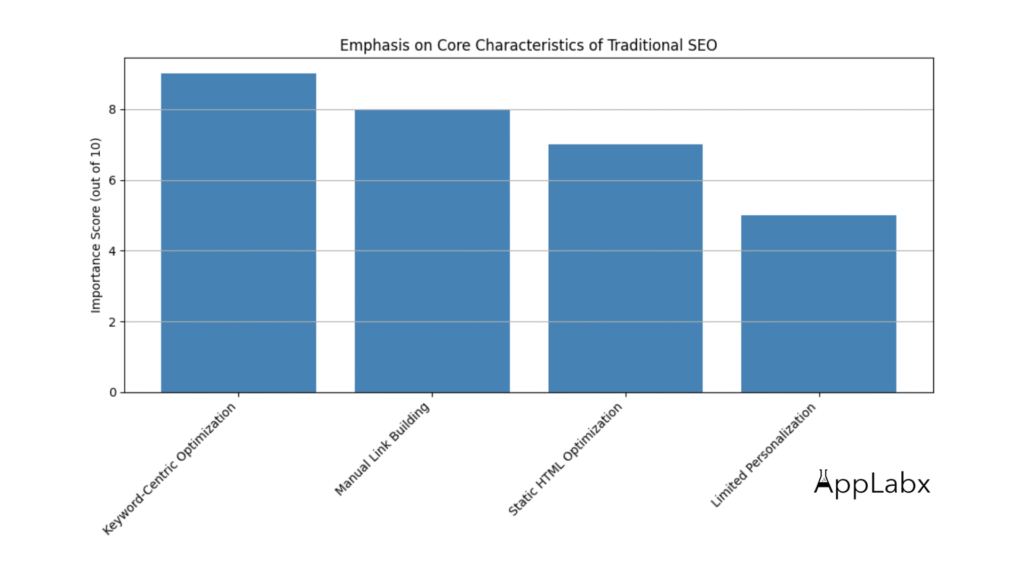
Core Characteristics of Traditional SEO
• Focus on Keyword-Centric Optimization
– Emphasizes the importance of selecting and integrating target keywords throughout web content, meta tags, and headers.
– Example: A blog post titled “Top Travel Destinations in Asia” would target keywords like “travel in Asia,” “top places to visit in Asia,” and “Asian travel guide.”
• Manual Link Building
– Relies on securing backlinks through guest blogging, directory submissions, and outreach campaigns.
– Example: Earning a backlink from a high-authority travel website to a tourism blog article.
• Static HTML Optimization
– On-page SEO heavily dependent on optimizing individual HTML elements such as meta titles, meta descriptions, image alt texts, and internal links.
– Pages were less dynamic compared to modern CMS-based designs.
• Limited Personalization
– Search engines delivered largely identical results to users regardless of behavior, preferences, or location.
– Rankings were based on universal signals rather than personalized data.
Key Components of Traditional SEO
Keyword Research and Implementation
• Identify high-volume keywords aligned with user search intent
• Place primary keywords in:
– Title tags
– Meta descriptions
– Headings (H1, H2)
– URL slugs
– Image alt attributes
• Avoid keyword stuffing by maintaining natural language structure
On-Page SEO Fundamentals
• Optimizing individual pages to target specific search queries
• Key elements include:
– Title tag with target keyword
– Meta description with call-to-action
– Header structure (H1 for main topic, H2/H3 for sub-points)
– Internal linking to related content
– Fast-loading, mobile-friendly page layout
Technical SEO Structure
• Ensuring website architecture supports search engine crawling and indexing
• Includes:
– XML sitemap for content discovery
– robots.txt file for crawl directives
– Clean, indexable URLs
– Avoiding broken links and 404 errors
• Ensures search engines can access and evaluate all important pages
Off-Page SEO and Backlink Acquisition
• Gaining inbound links from authoritative and relevant external websites
• Primary strategies include:
– Submitting content to niche directories
– Engaging in blogger outreach
– Creating link-worthy resources like infographics or industry guides
• Backlink quality is prioritized over quantity
Performance Monitoring and SEO Audits
• Use of basic analytics tools to track:
– Organic traffic trends
– Keyword rankings
– Bounce rates and dwell time
• Periodic SEO audits to identify issues with crawlability, duplicate content, or meta tag optimization
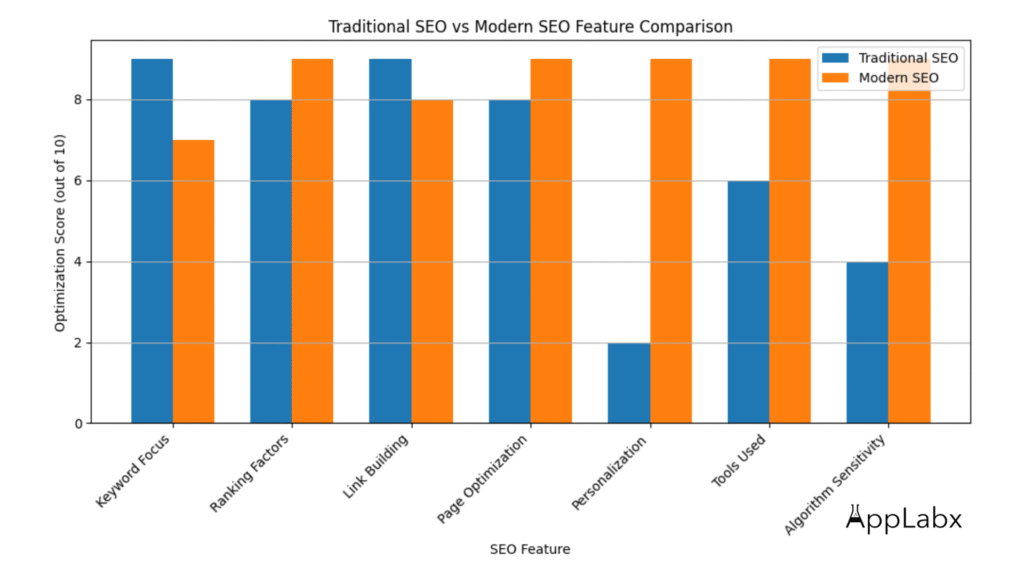
Traditional SEO vs Modern SEO: Comparison Matrix
| Feature | Traditional SEO | Modern SEO |
|---|---|---|
| Keyword Focus | Exact match keywords in content and tags | Semantic and intent-based keyword targeting |
| Ranking Factors | Backlinks, content, technical signals | AI-driven intent, UX signals, personalized data |
| Link Building | Manual outreach, directories, guest posting | Earned links through viral, shareable content |
| Page Optimization | HTML meta tag optimization | UX, mobile-first, structured data, and Core Web Vitals |
| Personalization | None or minimal | Geo-targeted and user-specific search results |
| Tools Used | Google Analytics, Webmaster Tools | Google Search Console, AI-based SEO platforms |
| Algorithm Sensitivity | Less complex algorithm updates | Frequent, AI-powered algorithm changes |
Examples of Traditional SEO in Practice
• A local real estate agency optimizing pages for “apartments for sale in Hanoi” by:
– Including the keyword in the title tag and H1
– Creating a static HTML page with listing details and images
– Submitting the site to local directories and real estate forums
– Tracking performance via Google Analytics and adjusting keywords quarterly
• An e-commerce brand building links by writing guest posts on popular blogs within their niche, using keyword-rich anchor text like “buy organic skincare products”
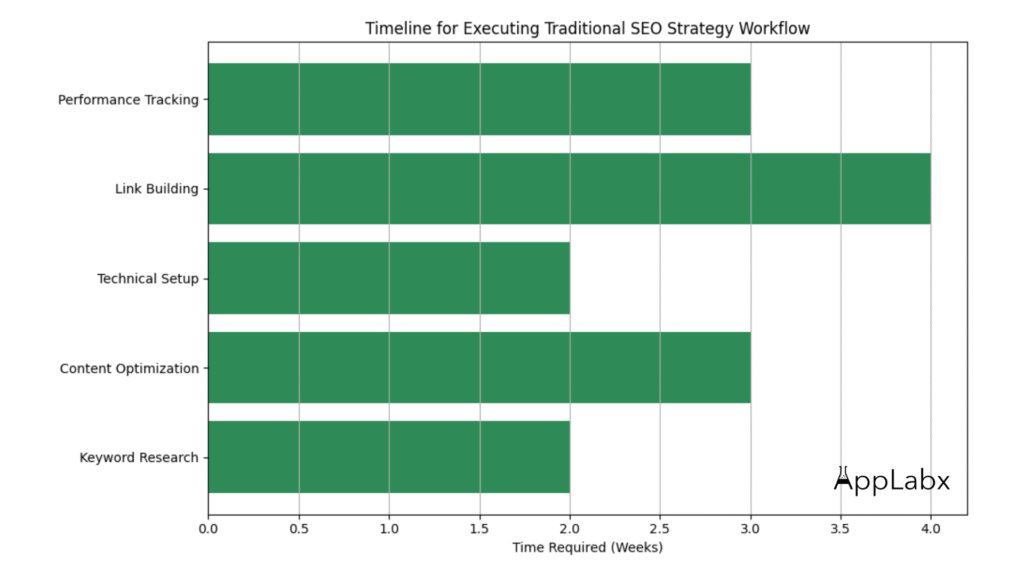
Traditional SEO Strategy Workflow
| Stage | Description |
|---|---|
| Keyword Research | Analyze keywords with volume and competition |
| Content Optimization | Align existing or new content with keywords |
| Technical Setup | Ensure website is crawlable, fast, and mobile-responsive |
| Link Building | Identify and secure high-quality inbound links |
| Performance Tracking | Monitor rankings, traffic, and engagement to iterate and improve |
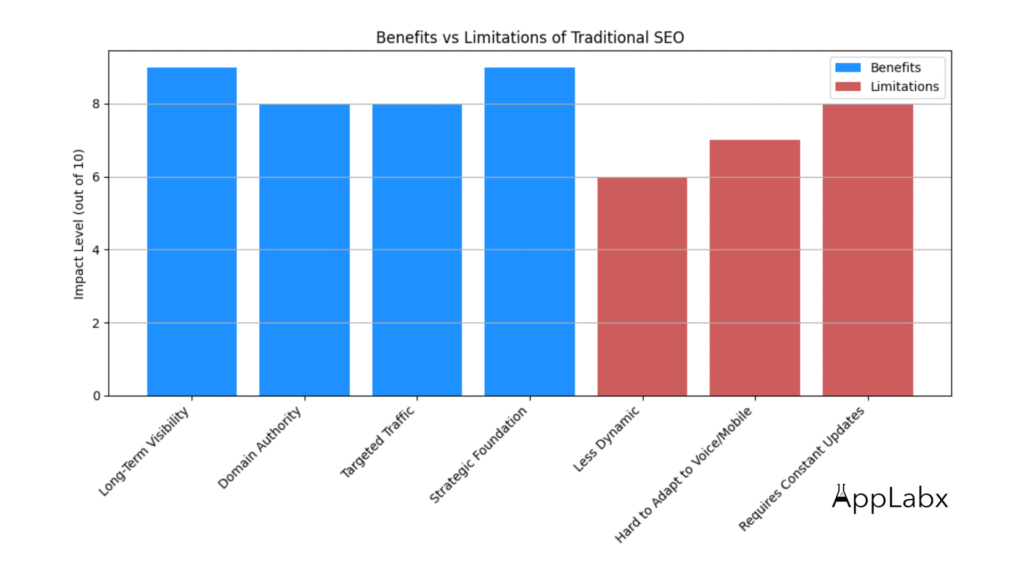
Benefits of Traditional SEO
• Builds long-term organic visibility without ongoing ad spend
• Improves domain authority and trust through consistent backlink strategies
• Increases targeted traffic by aligning with real search intent
• Lays a scalable foundation for future SEO strategies, including AI and automation enhancements
Limitations of Traditional SEO
• Less effective in dynamic, highly competitive search environments without modern enhancements
• May struggle to adapt to voice search, personalized results, and mobile-first indexing without upgrades
• Requires ongoing updates to remain compatible with Google’s evolving algorithms
Conclusion
Traditional SEO is a structured and systematic approach to building long-lasting organic visibility through technical excellence, content alignment, and authority building. Though the digital environment has evolved, the principles of traditional SEO remain deeply relevant. They form the solid infrastructure upon which modern SEO innovations are layered. Businesses that master these fundamentals are better positioned to adapt to algorithm changes, sustain rankings, and generate measurable results from search over the long term.
2. Keyword Research Fundamentals
Keyword research is a foundational step in traditional SEO that directly influences a website’s content strategy, on-page optimization, and ability to rank for relevant search queries. Effective keyword research ensures that content aligns with what users are actively searching for, enabling businesses to drive qualified organic traffic, improve search engine visibility, and boost conversions.
Purpose of Keyword Research in Traditional SEO
• Identify search terms users input into search engines that are relevant to a business or website
• Understand user intent behind those keywords to guide content creation
• Prioritize keywords based on volume, competition, and business goals
• Align content with real-world demand for products, services, or information
Types of Keywords and Their Roles
• Short-Tail Keywords
– Broad, one- to two-word phrases with high search volume
– Example: “shoes”, “marketing”
– Pros: High visibility potential
– Cons: High competition, vague intent
• Long-Tail Keywords
– More specific multi-word phrases with lower volume
– Example: “best running shoes for flat feet”
– Pros: Higher conversion rate, clear user intent
– Cons: Lower search volume, requires more content targeting
• Branded Keywords
– Include specific brand names
– Example: “Nike running shoes”
– Important for reputation and direct searches
• Transactional Keywords
– Indicate buying intent
– Example: “buy SEO software”, “order pizza online”
– Useful for product and service pages
• Informational Keywords
– Used by users looking for knowledge
– Example: “how to train for a 10k”, “SEO tips for beginners”
– Ideal for blog posts, guides, and educational content
Keyword Research Process Overview
| Stage | Task Description |
|---|---|
| Brainstorming | Create a seed list of relevant terms from your niche or offerings |
| Tool-Based Discovery | Use keyword tools to expand and refine keyword ideas |
| Evaluation | Analyze metrics like search volume, difficulty, CPC |
| Mapping | Assign keywords to specific pages for targeting |
| Monitoring | Track rankings and adjust content based on performance |
Popular Keyword Research Tools
| Tool | Functionality Highlights | Ideal Use Case |
|---|---|---|
| Google Keyword Planner | Search volume, CPC, competition insights | Paid search and SEO planning |
| SEMrush | Keyword trends, difficulty scores, SERP analysis | Competitive keyword strategy |
| Ahrefs | Keyword gap analysis, parent topic clustering | Backlink-informed keyword targeting |
| Ubersuggest | Long-tail keyword suggestions and SEO metrics | Beginner-friendly research |
| AnswerThePublic | Visual search queries and questions | Content ideation for informational keywords |
Evaluating Keyword Metrics
• Search Volume
– Average number of monthly searches
– High-volume = broader reach
– Low-volume = niche opportunities
• Keyword Difficulty (KD)
– Measures competition based on top-ranking domains
– High KD = hard to rank
– Low KD = better for new sites
• Cost Per Click (CPC)
– Indicates commercial value
– Higher CPC often means higher intent or ROI potential
• Trend
– Analyzes seasonal or temporal interest
– Useful for campaign planning and content updates
Keyword Evaluation Matrix
| Keyword Phrase | Volume | KD (%) | CPC ($) | Intent Type |
|---|---|---|---|---|
| SEO tools | 18,000 | 68 | 12.30 | Transactional |
| how to improve SEO | 9,500 | 40 | 2.10 | Informational |
| best running shoes for flat feet | 3,600 | 28 | 3.70 | Commercial |
| SEO agency New York | 1,200 | 55 | 15.00 | Local/Transactional |
Keyword Mapping and Content Structuring
• Assign one primary keyword per page to avoid cannibalization
• Include 2–3 secondary or LSI (Latent Semantic Indexing) keywords to support context
• Map transactional keywords to product/service pages
• Use informational keywords for blog content and support pages
Example Keyword Mapping Table
| Page URL | Primary Keyword | Secondary Keywords |
|---|---|---|
| /seo-services | SEO services | affordable SEO, SEO agency, digital marketing |
| /blog/seo-tips | SEO tips | on-page SEO, keyword research, site optimization |
| /shoes/mens-running | men’s running shoes | best running shoes, breathable running shoes |
| /contact-us | contact SEO company | SEO consultation, schedule SEO call |
Using Keywords in On-Page Optimization
• Title Tags
– Include the main keyword near the beginning
– Keep under 60 characters
• Meta Descriptions
– Use keywords naturally while summarizing page content
– Aim for 150–160 characters
• Headers (H1, H2, H3)
– Structure content with keyword-rich subheadings
– Improves readability and contextual relevance
• Body Content
– Integrate keywords with natural flow
– Aim for a balanced keyword density (~1–2%)
• Image Alt Text
– Describe images using relevant supporting keywords
– Helps with image search and accessibility
Keyword Placement Impact Table
| Page Element | Importance for SEO | Optimal Use of Keywords |
|---|---|---|
| Title Tag | High | Primary keyword at the start |
| URL Slug | High | Short and descriptive with keywords |
| H1 Heading | High | Match with primary keyword |
| Paragraph Text | Medium | Contextual keyword inclusion |
| Image Alt Text | Medium | Keyword or topic descriptor |
Common Mistakes in Keyword Research
• Targeting only high-volume, high-competition keywords without a supporting content strategy
• Ignoring search intent—choosing keywords without aligning with what users want to achieve
• Overlapping keywords across multiple pages, causing internal competition
• Failing to update keyword strategy based on performance metrics and trends
Real-World Example: Blog Strategy Using Long-Tail Keywords
• A health and fitness blog identifies the keyword “how to start intermittent fasting” with a moderate volume but low competition
• Creates a 2,000-word guide including sections on benefits, schedules, risks, and expert insights
• Also targets related long-tails like “intermittent fasting for beginners,” “16/8 fasting tips,” and “intermittent fasting weight loss”
• Within 3 months, the blog ranks on page 1 for multiple variations and sees a 40% increase in organic traffic
Conclusion
Keyword research is not just about identifying terms with high volume; it’s about uncovering the right opportunities that align with user intent, competitive feasibility, and business relevance. In traditional SEO, it provides the strategic compass for content planning, on-page optimization, and even link acquisition efforts. By understanding keyword fundamentals—types, tools, metrics, and mapping—you can create a sustainable SEO strategy that delivers measurable results over time.
3. On-Page Optimization Techniques
On-page SEO, also known as on-site SEO, is the practice of optimizing individual web pages to improve their visibility and relevance in search engine results pages (SERPs). Traditional SEO places strong emphasis on the strategic enhancement of on-page elements such as meta tags, content, internal links, HTML structure, and user experience signals. These techniques work together to ensure search engines can understand, index, and rank web content accurately while offering a valuable experience to users.
Title Tag Optimization
• Acts as the headline for each page on the SERP and directly influences click-through rates.
• Should include the primary keyword, preferably at the beginning of the title.
• Keep titles concise—under 60 characters—to avoid truncation in search results.
• Incorporate branding when appropriate.
Example:
Poor: “Home | ABC Company”
Optimized: “Affordable Web Design Services – ABC Company”
Meta Description Best Practices
• Summarizes page content and appears under the title tag in search results.
• Influences CTR but is not a direct ranking factor.
• Keep within 150–160 characters for readability across devices.
• Use compelling language that encourages users to click.
• Naturally include the primary and related keywords.
Example:
“Discover expert-led SEO strategies to grow your organic traffic and rank higher on Google. Explore proven techniques for all industries.”
Header Tag Structuring (H1, H2, H3)
• H1: Reserved for the main title of the page, usually mirroring the title tag with the primary keyword.
• H2–H6: Used to organize content into logical sections and enhance readability.
• Search engines use headers to understand content hierarchy and relevance.
Example Structure:
H1: “Ultimate Guide to On-Page SEO”
H2: “Title Tags and Meta Descriptions”
H2: “Header Tag Optimization”
H3: “Using Keywords in Subheadings”
Content Quality and Keyword Usage
• Ensure that all content is informative, original, and aligns with searcher intent.
• Strategically place the primary keyword in:
– First 100 words
– Headers
– Throughout the body (while maintaining natural flow)
• Use LSI (Latent Semantic Indexing) keywords and synonyms for context.
• Avoid keyword stuffing.
Example:
If the keyword is “ecommerce SEO,” variations might include “online store optimization,” “product page SEO,” and “improving ecommerce search rankings.”
URL Optimization
• Clean, short, and descriptive URLs are easier for search engines and users to understand.
• Include the primary keyword in the slug.
• Use hyphens to separate words.
• Avoid special characters, excessive parameters, and unnecessary words.
Example:
Optimized: www.example.com/on-page-seo-guide
Poor: www.example.com/?p=12345&id=seo_guide
Image Optimization
• Use descriptive filenames and alt attributes containing relevant keywords.
• Compress images to reduce load time without sacrificing quality.
• Utilize modern formats like WebP for better performance.
• Ensure images are responsive for all devices.
Example:
Image name: on-page-seo-elements.jpg
Alt text: “Diagram of on-page SEO elements including title, headers, and meta description”
Internal Linking Strategy
• Supports content discoverability and link equity distribution across the website.
• Use keyword-rich anchor text that matches the target page’s intent.
• Link related blog posts, service pages, and cornerstone content.
Example:
From a blog post on “SEO Basics,” link to a deeper article titled “Advanced Keyword Research Techniques.”
Mobile Optimization
• Ensure responsive design that adapts across devices.
• Text must be legible without zooming.
• Navigation should be easy to use on smaller screens.
• Page layout should prioritize mobile usability signals like tap targets and scrolling behavior.
Page Speed and Performance
• Page load time is a key ranking factor and user satisfaction metric.
• Techniques to improve speed include:
– Minifying CSS and JavaScript
– Enabling browser caching
– Using content delivery networks (CDNs)
– Optimizing images
– Reducing HTTP requests
Page Speed Performance Benchmarks Table
| Metric | Recommended Standard | Impact on SEO |
|---|---|---|
| First Contentful Paint | < 1.8 seconds | Improves UX and retention |
| Largest Contentful Paint | < 2.5 seconds | Boosts Core Web Vitals |
| Total Blocking Time | < 200ms | Reduces interaction delay |
| Cumulative Layout Shift | < 0.1 | Prevents layout shifting |
Schema Markup and Structured Data
• Schema.org markup helps search engines better understand the content’s context.
• Enables enhanced SERP features like rich snippets, FAQs, reviews, and more.
• Use JSON-LD format (preferred by Google).
Common Schema Types:
– Article
– Product
– Local Business
– FAQPage
– Review
Example Use:
Add FAQ schema to a blog post answering common SEO questions to increase visibility in rich results.
Core On-Page Optimization Checklist
| Element | Optimized (Yes/No) | Notes |
|---|---|---|
| Title Tag | Yes | Includes primary keyword and brand |
| Meta Description | Yes | Compelling summary within character limit |
| Header Tags | Yes | Structured hierarchy with keywords |
| URL | Yes | Clean and descriptive |
| Images | Yes | Alt text and compression applied |
| Internal Linking | Yes | Related pages connected with proper anchor text |
| Mobile Friendliness | Yes | Fully responsive layout |
| Page Speed | Yes | Optimized with CDN and cache |
| Schema Markup | Yes | Implemented for FAQ and product pages |
Common On-Page SEO Mistakes to Avoid
• Using duplicate title tags and meta descriptions across multiple pages
• Overusing keywords unnaturally within content and headings
• Ignoring mobile responsiveness and Core Web Vitals
• Forgetting to add internal links to new or orphaned pages
• Leaving image alt attributes blank
• Using non-descriptive anchor text like “click here” or “read more”
Example of On-Page SEO in Action
A page targeting “best CRM software for small business”:
• Title Tag: “Best CRM Software for Small Business in 2024 – Expert Picks”
• URL: www.example.com/crm-software-small-business
• H1: Best CRM Software for Small Business
• H2: Key Features to Consider
• H2: Top 5 CRM Tools Reviewed
• Internal Links: Links to case studies and pricing pages
• Image Alt Text: “Dashboard of top CRM software interface”
• Schema: Review schema added for product comparison
Conclusion
On-page SEO plays a pivotal role in ensuring that each individual page is optimized for maximum discoverability, engagement, and conversion. By addressing technical accuracy, content quality, keyword targeting, mobile usability, and performance speed, websites can offer both users and search engines a seamless experience. Mastering these traditional on-page techniques remains essential for any long-term SEO strategy that aims to build credibility, increase traffic, and sustain high search visibility.
4. Technical SEO Basics
Technical SEO is the foundation of a website’s ability to be crawled, indexed, and ranked effectively by search engines. It encompasses the behind-the-scenes elements that ensure search engines can access, interpret, and rank your content correctly. Without a solid technical SEO structure, even the best content and backlink strategies may fail to achieve their full potential.
Understanding the Purpose of Technical SEO
• Ensures your site is accessible and crawlable by search engine bots
• Helps search engines understand your site’s structure and relevance
• Improves site performance, mobile usability, and user experience
• Addresses indexing issues and prevents duplicate content problems
• Directly influences search engine rankings and visibility
Crawlability and Indexability
• Search engines use bots (crawlers) to discover and index content
• Proper technical SEO enables easy crawling through logical site structures and no unnecessary blockages
• Misconfigured robots.txt files or noindex tags can prevent important pages from appearing in search results
Checklist for Crawlability and Indexing:
| Element | Description | Best Practice |
|---|---|---|
| Robots.txt | Controls which pages are blocked from crawling | Avoid disallowing critical pages |
| XML Sitemap | Guides search engines to all relevant pages | Submit via Google Search Console |
| Meta Robots Tag | Tells bots whether to index a page | Use “index, follow” for pages meant to rank |
| Canonical Tags | Consolidates link equity for duplicate pages | Use to declare preferred versions |
| Pagination Tags | Manages multi-page series crawling | Implement rel="prev" and rel="next" |
Site Architecture and URL Structure
• Logical and hierarchical site structure helps search engines discover all pages
• Shallow architecture (max 3-click rule) ensures important pages are quickly accessible
• URLs should be descriptive, keyword-rich, and free of unnecessary parameters
URL Optimization Matrix:
| Type | Example URL | SEO Effectiveness |
|---|---|---|
| Optimized URL | /seo-guide/on-page-optimization | High – readable and keyword-friendly |
| Non-optimized URL | /index.php?id=1346 | Low – non-descriptive |
Mobile Optimization and Responsive Design
• Mobile-first indexing means Google predominantly uses the mobile version for ranking and indexing
• Responsive design ensures content displays consistently across devices
• Mobile UX affects bounce rate, page engagement, and rankings
Mobile Optimization Key Focus Areas:
• Use viewport meta tag to scale content for device size
• Ensure tap targets are large and well-spaced
• Avoid horizontal scrolling or text that requires zooming
• Check for mobile usability issues in Google Search Console
Website Speed and Core Web Vitals
• Fast-loading websites lead to better user engagement and SEO performance
• Core Web Vitals are a set of real-world performance metrics used by Google
Core Web Vitals Performance Chart:
| Metric | Ideal Threshold | SEO Impact |
|---|---|---|
| Largest Contentful Paint (LCP) | ≤ 2.5 seconds | Loading performance |
| First Input Delay (FID) | ≤ 100 milliseconds | Interactivity and responsiveness |
| Cumulative Layout Shift (CLS) | ≤ 0.1 | Visual stability |
Optimization Techniques:
• Use image compression (WebP, JPEG 2000)
• Minify CSS, JavaScript, and HTML
• Implement lazy loading for images
• Leverage browser caching and CDN distribution
Secure Sockets Layer (SSL) and HTTPS
• HTTPS is a confirmed ranking factor
• Secures data transmission and builds user trust
Security Audit Essentials:
• All internal links should reference HTTPS
• Redirect HTTP to HTTPS using 301 redirect
• Ensure SSL certificate is valid and auto-renewing
Structured Data and Schema Markup
• Structured data helps search engines better understand content context
• Supports rich snippets like FAQs, reviews, recipes, product listings
Popular Schema Types for Traditional SEO:
| Schema Type | Purpose | Example Use Cases |
|---|---|---|
| Article | Blog posts, news, editorial content | Informational blogs |
| Product | eCommerce listings | Online store product pages |
| FAQPage | Q&A content | Help centers, product explanation pages |
| LocalBusiness | Business location and contact info | Brick-and-mortar businesses |
Internal Linking and Crawl Depth Management
• Helps distribute link equity and guide crawlers to all parts of the site
• Pages buried too deep (4+ clicks) are less likely to be crawled or indexed
Internal Linking Tips:
• Ensure each page links to related or relevant internal pages
• Use descriptive anchor text containing relevant keywords
• Implement breadcrumbs to aid both navigation and crawlability
Duplicate Content Prevention
• Duplicate pages confuse search engines and split ranking signals
• Causes: session IDs, printer-friendly pages, HTTP vs HTTPS versions, www vs non-www
Prevention Techniques:
• Set canonical URLs for each page
• Implement consistent internal linking practices
• Use parameter handling in Google Search Console
JavaScript and Rendering Considerations
• Excessive or poorly implemented JavaScript can block crawlers
• Key content should be rendered server-side or use progressive enhancement
Best Practices:
• Use dynamic rendering when necessary for JS-heavy content
• Avoid relying solely on JavaScript for critical page elements (e.g., menus, product info)
Technical SEO Audit and Monitoring Tools
| Tool | Purpose |
|---|---|
| Google Search Console | Indexing status, Core Web Vitals, crawl errors |
| Screaming Frog | In-depth crawl analysis |
| PageSpeed Insights | Performance diagnostics and LCP/FID/CLS metrics |
| Ahrefs / SEMrush | Backlink audits, keyword rankings |
| GTmetrix | Load speed diagnostics and recommendations |
Example: Technical SEO in Action
A SaaS company experiences slow growth in organic traffic. A technical SEO audit reveals:
• 60% of pages missing canonical tags
• Mobile UX issues on critical service pages
• LCP averaging 4.1 seconds on blog posts
Actions taken:
• Implemented responsive design adjustments
• Optimized images and enabled browser caching
• Added schema markup to blog content
Result:
• 38% increase in organic traffic within 90 days
• Several blog articles earned featured snippets
Conclusion
Technical SEO is not just a background process—it’s a foundational pillar that supports every aspect of traditional SEO. By ensuring that your site is fast, crawlable, mobile-friendly, secure, and well-structured, you enhance your website’s visibility, authority, and usability for both users and search engines. Ignoring technical SEO can result in missed ranking opportunities, poor user experience, and inefficient content discovery. Prioritizing these elements ensures long-term search performance and prepares your site for future algorithmic developments.
5. Off-Page SEO and Link Building
Off-page SEO refers to all actions taken outside of your own website that influence your rankings within search engine results pages (SERPs). Unlike on-page SEO, which focuses on optimizing individual web pages, off-page SEO focuses on building your domain authority, trust, and reputation through signals such as backlinks, social mentions, brand visibility, and local citations. Among these, link building remains the most significant pillar of traditional off-page SEO.
Purpose and Benefits of Off-Page SEO
• Boosts domain authority and credibility in the eyes of search engines
• Enhances visibility through referral traffic and brand mentions
• Plays a central role in Google’s ranking algorithm
• Helps your site compete in highly competitive niches
The Role of Backlinks in Traditional SEO
• Backlinks are hyperlinks from external websites that direct users to your site
• Search engines treat backlinks as endorsements of your content’s credibility
• The quality, quantity, and relevance of backlinks determine their SEO value
Types of Backlinks
• Editorial Backlinks
– Earned naturally when other websites reference your high-quality content
– Example: A marketing blog links to your SEO statistics page as a source
• Guest Post Backlinks
– Acquired by contributing valuable articles to reputable websites in your niche
– Example: Writing for a digital magazine and linking back to your services page
• Directory Listings and Citations
– Listings in business directories and local citation platforms
– Especially valuable for local SEO
– Example: Yelp, Yellow Pages, Google Business Profile
• Forum and Community Links
– Shared within niche forums or Q&A platforms (used sparingly)
– Should add value and avoid spam tactics
– Example: Answering a question on Quora with a link to your blog
Backlink Quality Matrix
| Factor | High-Quality Backlink | Low-Quality Backlink |
|---|---|---|
| Source Authority | Reputable, high-domain authority site | Spammy, unknown, or link farm site |
| Content Relevance | Related industry or niche | Unrelated or off-topic domain |
| Anchor Text | Natural, descriptive | Over-optimized, generic, or keyword-stuffed |
| Placement | In editorial body of content | Footer, sidebar, or comment section |
| Link Type | Dofollow | Nofollow or sponsored (limited SEO value) |
Best Practices for Link Building
• Focus on quality over quantity – 10 links from authority sites are better than 100 from spammy sites
• Prioritize relevance – secure backlinks from sites that align with your industry
• Use a natural mix of anchor texts – brand, keyword-rich, and contextual
• Avoid black hat tactics like link buying, PBNs, and link exchanges
Popular Link Building Strategies
• Guest Blogging
– Contribute high-value articles to reputable blogs in your niche
– Include contextual backlinks within the content
• Broken Link Building
– Identify broken links on external websites
– Suggest your relevant page as a replacement
– Tools: Ahrefs, Screaming Frog
• Skyscraper Technique
– Create superior content that outperforms existing high-ranking pages
– Reach out to those linking to outdated or inferior content
• Linkable Asset Creation
– Publish original research, infographics, or tools that attract organic links
– Promote through outreach and social sharing
• Competitor Backlink Analysis
– Identify who links to your competitors
– Use tools like SEMrush or Ahrefs to uncover opportunities
Link Building Workflow
| Step | Action | Tools / Techniques |
|---|---|---|
| Prospecting | Find relevant websites for outreach | BuzzStream, Ahrefs, Hunter.io |
| Content Matching | Match your pages to their content themes | Topic alignment, gap analysis |
| Outreach | Send personalized emails requesting links | Email automation tools |
| Follow-up | Send reminders or alternative suggestions | Sequence tracking in CRMs |
| Tracking and Reporting | Monitor new backlinks and impact | Google Search Console, Ahrefs |
Anchor Text Distribution Chart
| Anchor Type | Purpose | Recommended Usage % (Approx.) |
|---|---|---|
| Branded Anchor | Enhances brand awareness | 40–50% |
| Generic Anchor | Looks natural (e.g., “click here”) | 10–15% |
| Exact Match Anchor | Matches primary keyword | 10–15% |
| Partial Match Anchor | Includes keyword with variation | 15–20% |
| Naked URL | Raw link (e.g., www.example.com) | 5–10% |
Key Metrics to Monitor in Off-Page SEO
• Number of referring domains
• Domain authority or domain rating (DA/DR)
• Page authority of the linking source
• Anchor text variation and distribution
• Growth in organic traffic and keyword rankings
• Referral traffic from linked domains
Link Performance Monitoring Table
| Metric | Tool | Insight Provided |
|---|---|---|
| Referring Domains | Ahrefs / SEMrush | Measures breadth of backlink sources |
| Domain Rating / Authority | Moz / Ahrefs | Evaluates overall backlink strength |
| Top Linked Pages | Google Search Console | Shows which pages earn the most backlinks |
| Lost / Broken Links | Ahrefs / Screaming Frog | Tracks lost backlinks to reclaim or replace |
| Referral Traffic | Google Analytics | Measures visits from external links |
Common Link Building Mistakes to Avoid
• Relying solely on one method like guest blogging or directories
• Using manipulative anchor text repeatedly
• Neglecting to disavow spammy links that could hurt rankings
• Ignoring local link building for location-specific businesses
• Building links too fast, triggering unnatural link growth flags
Case Study Example: Link Building Campaign
A B2B SaaS startup launched a link building campaign using the skyscraper technique:
• Published a “2024 SaaS Buyer’s Guide” with detailed comparisons and infographics
• Reached out to 200 websites linking to outdated reports
• Secured 55 new backlinks from authoritative blogs and media
• Resulted in a 70% increase in referral traffic and 12 new leads within 60 days
Comparison Table: Organic vs Paid Link Building
| Feature | Organic Link Building | Paid Link Acquisition |
|---|---|---|
| Cost | Time and resource intensive | Financial cost per placement |
| Risk Level | Low (if ethical) | High (violates Google’s guidelines) |
| Sustainability | Long-term value | Often short-lived or penalized |
| Trust Signals | Strong with natural sources | Weak or flagged if detected |
| Strategy Examples | Guest blogging, broken link building | Sponsored posts, link buying |
Conclusion
Off-page SEO and link building remain critical components of traditional SEO, directly impacting domain authority, keyword rankings, and brand visibility. By focusing on earning high-quality backlinks through ethical, strategic methods, websites can establish trust with search engines and users alike. A well-executed link building strategy, combined with performance tracking and continual outreach, can create compounding SEO results over time—solidifying your presence in search and enhancing long-term organic growth.
6. Content Marketing and Traditional SEO
Content marketing and traditional SEO are deeply interconnected strategies that, when executed together, create a sustainable framework for driving organic visibility, attracting targeted traffic, and building long-term authority. Traditional SEO provides the structural and technical foundation that enables content to be discovered by search engines, while content marketing delivers the value that satisfies user intent, engages audiences, and earns high-quality backlinks.
The Role of Content in Traditional SEO
• Acts as the vehicle for keyword targeting and on-page optimization
• Provides opportunities to earn backlinks through valuable, shareable information
• Enhances topical authority and supports internal linking structures
• Encourages user interaction, increasing engagement metrics like dwell time and CTR
• Supports ranking goals by aligning with search intent and algorithmic expectations
Content Types that Support Traditional SEO
| Content Type | SEO Purpose | Best Use Case |
|---|---|---|
| Blog Posts | Target long-tail keywords, answer user queries | Informational search intent |
| Evergreen Articles | Consistent traffic over time | SEO pillars and guides |
| Landing Pages | Rank for transactional keywords | Product or service-related queries |
| Case Studies | Earn backlinks and demonstrate expertise | Trust-building and industry leadership |
| How-to Guides | Target “how to” searches, featured snippets | Tutorial-based user intent |
| FAQs | Target question-based keywords | Enhance UX and visibility in voice search |
| Infographics | Boost link acquisition through visual content | Linkable assets for outreach |
Mapping Content to Search Intent
| Intent Type | User Goal | Content Strategy | Example Keywords |
|---|---|---|---|
| Informational | Learn or understand | Blog posts, guides, explainer articles | “what is SEO”, “how to rank on Google” |
| Navigational | Reach a specific website/page | Optimized landing pages | “Ahrefs login”, “Moz tools” |
| Transactional | Purchase or action-oriented | Product pages, service descriptions | “buy SEO software”, “hire SEO agency” |
| Commercial | Compare and evaluate options | Comparison articles, reviews | “best SEO tools 2024”, “SEMrush vs Ahrefs” |
Keyword Alignment with Content
• Each piece of content should focus on a primary keyword and include several secondary or LSI keywords
• Keywords should be integrated into:
– Title tag
– Meta description
– Header tags (H1–H3)
– Image alt text
– Body content naturally
Example:
Blog Title: “How to Improve Your Website’s On-Page SEO”
Primary Keyword: “on-page SEO”
LSI Keywords: “meta tags”, “internal linking”, “header optimization”, “title tag SEO”
Content Structure Best Practices
• Use headings (H1, H2, H3) to create a logical flow
• Break content into scannable sections
• Include bullet points and numbered lists for readability
• Use visuals such as charts, screenshots, or diagrams
• End with clear CTAs or internal links to related content
Internal Linking for SEO Value
• Distributes link equity across the site
• Helps search engines crawl and understand site hierarchy
• Keeps users engaged by suggesting related reading
Internal Linking Strategy Matrix:
| Page Type | Links To | Anchor Text Example |
|---|---|---|
| Blog Post | Related blog posts, cornerstone content | “learn more about technical SEO” |
| Product Page | Case studies, testimonials, supporting blogs | “see how we helped similar companies” |
| Guide/Resource Page | Tools, service pages, contact page | “explore our full SEO services” |
Content Freshness and Updating
• Search engines prioritize up-to-date information, especially for competitive or time-sensitive topics
• Regularly audit existing content for:
– Outdated statistics or screenshots
– Broken internal/external links
– Irrelevant or deprecated tools/methods
• Update publication date and republish for renewed visibility
Content Marketing Funnel Integration
| Funnel Stage | Content Type | SEO Goal |
|---|---|---|
| Top of Funnel | Blog posts, educational guides | Attract organic traffic |
| Middle of Funnel | Case studies, comparison pages | Build trust and guide decision-making |
| Bottom of Funnel | Product pages, pricing, testimonials | Drive conversions and direct keyword traffic |
Content Promotion Techniques That Support SEO
• Social Sharing
– Increases visibility and chance for backlinks
• Email Newsletters
– Drives engagement from returning users
• Influencer Outreach
– Gains editorial links and increases content authority
• Syndication on High-Authority Platforms
– Extends content reach and builds backlinks
• Community Forums and Q&A Sites
– Adds value through direct user engagement (e.g., Reddit, Quora)
Performance Metrics for Content-Driven SEO
| Metric | What It Measures | Tool Used |
|---|---|---|
| Organic Traffic | Number of visitors from search engines | Google Analytics, Search Console |
| Keyword Rankings | SERP position of target keywords | Ahrefs, SEMrush |
| Dwell Time | Time spent on page | Google Analytics |
| Backlinks Earned | Number of incoming links to content | Ahrefs, Moz |
| Page Engagement | Bounce rate, session duration, scroll depth | Google Analytics, Hotjar |
| Conversion Rate | Leads or actions generated from content | Google Analytics, CRM tools |
Real-World Example: Content Marketing Supporting SEO
A digital marketing agency publishes a 3,000-word guide titled “Complete SEO Audit Checklist.”
• Includes keyword-rich headings, internal links to service pages, and FAQ schema
• Promoted via LinkedIn, email, and outreach to SEO bloggers
• Earns 50+ backlinks from industry publications and blogs
• Ranks on Page 1 for “SEO audit checklist” within 8 weeks
• Drives 2,000+ monthly organic visits and 12 monthly leads
Content and Traditional SEO Synergy Summary Table
| SEO Element | Supported by Content Marketing | Examples |
|---|---|---|
| Keyword Targeting | Blog posts and landing pages | Long-tail keyword-rich content |
| Link Building | Linkable assets and outreach | Case studies, infographics |
| User Experience | Structured, engaging content | Proper headings, visuals, CTAs |
| On-Page Optimization | Title, meta, and keyword-rich content | Blog and service page templates |
| Topical Authority | In-depth content clusters | Topic hubs and internal linking |
| Crawlability & Indexing | Interconnected, updated pages | Sitemaps, refreshed articles |
Conclusion
Content marketing is not just a support act to traditional SEO—it is the engine that powers it. From keyword targeting and internal linking to authority building and user engagement, high-quality content drives nearly every measurable SEO metric. By creating value-driven, search-optimized, and well-structured content, businesses can boost their organic visibility, establish industry authority, and convert traffic into loyal customers. Combining traditional SEO practices with strategic content creation ensures your digital presence remains strong, relevant, and discoverable in an ever-changing search landscape.
7. User Experience and Engagement Metrics
In the context of traditional SEO, user experience (UX) and engagement metrics have evolved into essential signals that search engines use to assess the quality, relevance, and usefulness of a website. While traditional SEO originally emphasized keyword targeting, metadata, and link profiles, the integration of behavioral data now plays a vital role in search ranking algorithms.
Why UX Matters in SEO
• Google’s algorithm updates, including RankBrain and Core Web Vitals, prioritize user-centric experiences
• A positive user experience increases the likelihood of longer sessions, higher conversions, and lower bounce rates
• Engaged users signal to search engines that the page satisfies search intent
Core Elements of User Experience in SEO
• Page Load Speed
– Fast-loading websites reduce bounce rates and improve retention
– Optimizing images, using CDN, and minimizing code improves performance
– Target: Less than 2.5 seconds load time (Google PageSpeed Insights)
• Mobile Responsiveness
– With mobile-first indexing, websites must adapt across screen sizes
– A responsive layout ensures readability and interaction on any device
– Tools: Mobile-Friendly Test by Google
• Navigation and Site Structure
– Clear menus and internal linking help users find content easily
– Enhances crawlability for search engine bots
– Logical hierarchy: Homepage > Category > Subcategory > Page
• Accessibility and Readability
– Font size, color contrast, and clean layouts improve readability
– Alt tags for images support accessibility and SEO
– Avoid intrusive interstitials and complex popups
Essential User Engagement Metrics for SEO
| Metric | Description | SEO Impact | Tool to Track |
|---|---|---|---|
| Bounce Rate | % of users leaving after one page | High rate may signal irrelevant content | Google Analytics |
| Dwell Time | Time spent between click and return to SERP | Indicates content quality and depth | GA + User Session Tools |
| Pages Per Session | Avg. number of pages viewed during a single session | Higher indicates engaging site architecture | Google Analytics |
| Average Session Duration | Avg. length of user visit | Longer duration suggests useful content | Google Analytics |
| Click-Through Rate (CTR) | % of users clicking your listing in SERPs | Signals headline and meta relevance | Google Search Console |
| Exit Rate | % of users who leave after viewing a page | Helps diagnose drop-off points | Google Analytics |
| Scroll Depth | How far users scroll down a page | Reveals engagement with long-form content | Hotjar, Crazy Egg |
Matrix: UX Factors Aligned with SEO Outcomes
| UX Factor | Related Metric | SEO Benefit |
|---|---|---|
| Fast Load Speed | Lower Bounce Rate | Better rankings via Core Web Vitals |
| Clear Navigation | Higher Pages per Session | Improved site crawlability and user flow |
| Compelling Headline | Higher CTR | More organic traffic from search |
| Mobile Optimization | Improved Session Duration | Better mobile experience boosts ranking |
| Quality Content Layout | Greater Dwell Time | Indicates content relevance and satisfaction |
Examples of UX-SEO Alignment in Practice
• Blog Example:
A tech blog redesigns its page layout, reducing ad clutter and simplifying typography.
– Result: Bounce rate drops from 65% to 40%, and average session duration increases by 30%
– Organic traffic improves as Google recognizes higher engagement
• E-commerce Example:
An online store implements faster page load times and structured product filtering
– Result: Pages per session increase from 2.3 to 4.1
– Conversion rate improves, and rankings for category pages rise
Optimizing for Engagement: Actionable Strategies
• Improve Content Readability
– Use short paragraphs, subheadings, and bullet points
– Use tools like Hemingway App or Grammarly for clarity
• Enhance Internal Linking
– Recommend related articles at the end of each post
– Use descriptive anchor text for context
• Design for Interaction
– Add comment sections, interactive FAQs, or polls
– Provide downloadable assets or tools to increase engagement
• Optimize CTAs
– Place clear calls-to-action at logical user flow points
– Test different CTA formats using A/B testing
Google Core Web Vitals and Their SEO Implications
| Core Web Vital | Description | Ideal Value | SEO Benefit |
|---|---|---|---|
| Largest Contentful Paint (LCP) | Time to render largest content block | < 2.5 seconds | Indicates fast loading |
| First Input Delay (FID) | Time before user interaction is possible | < 100 milliseconds | Measures responsiveness |
| Cumulative Layout Shift (CLS) | Visual stability during page load | < 0.1 | Reduces frustrating experiences |
User Experience Heatmap Example
Heatmaps from tools like Crazy Egg or Hotjar show where users click, scroll, and abandon:
• Identify underperforming sections of a page
• Test different layouts to maximize time on site
• Adjust content flow for better visual hierarchy
UX and SEO Alignment Funnel
| Funnel Stage | UX Focus Area | SEO Support Function |
|---|---|---|
| Awareness | Fast load, compelling snippet | Improves CTR and reduces bounce rate |
| Consideration | Clear navigation, interactive content | Increases session duration and scroll depth |
| Decision | Easy checkout, mobile responsiveness | Reduces cart abandonment and enhances rankings |
Conclusion
User experience and engagement metrics are no longer optional—they are essential components of a successful SEO strategy. A well-optimized website that loads quickly, is easy to navigate, and delivers value through interactive content not only satisfies users but also gains favor in search rankings. By continuously monitoring UX and refining design and content accordingly, businesses can unlock long-term SEO performance gains, improved traffic retention, and higher conversion rates. In traditional SEO, the experience users have on your site is just as important as the content you publish or the links you acquire.
8. Local SEO Practices (Traditional)
Local SEO is a foundational component of traditional SEO, especially for businesses aiming to attract customers within a specific geographic area. These practices are designed to increase a business’s visibility in local search results, map listings, and location-based queries. Traditional local SEO strategies remain relevant and powerful in helping businesses reach nearby audiences and convert them into paying customers.
Understanding the Basics of Local SEO
• Local SEO focuses on optimizing a business’s online presence for geographically relevant searches
• Key targets include Google’s Local Pack, Google Maps, and organic results for “near me” or location-specific queries
• Especially useful for small to medium-sized businesses, retail stores, restaurants, healthcare providers, and service-based businesses
Core Elements of Traditional Local SEO
• Google Business Profile (GBP)
– Acts as a digital storefront on Google Search and Maps
– Ensures business hours, location, phone number, and reviews are accurate and visible
– Local Pack ranking depends heavily on GBP completeness and engagement
• Local Citations
– Listings of business name, address, and phone number (NAP) across online directories
– Consistency in NAP signals trust to search engines
– Platforms include Yelp, Yellow Pages, Bing Places, Apple Maps, Foursquare
• On-Page Location Targeting
– Embedding city and region names in titles, meta descriptions, headers, and content
– Creating local landing pages for each service area improves ranking in specific geographies
– Schema markup can be used to highlight local business information
Examples of On-Page Location Optimization
| Element | Example |
|---|---|
| Page Title | “Best Dental Clinic in Ho Chi Minh City” |
| Meta Description | “Looking for trusted dental care in District 1?” |
| H1 Tag | “Top-Rated Dental Services in HCMC” |
| Image Alt Text | “Ho Chi Minh dental exam room” |
| Internal Links | “See our branch in District 7” |
Local SEO Ranking Factors
| Factor | Weight in Local Pack Rankings | Weight in Local Organic Rankings |
|---|---|---|
| Google Business Profile | High | Medium |
| NAP Citations | Medium | Medium |
| Reviews | High | Medium |
| On-Page SEO | Medium | High |
| Backlinks | Medium | High |
| Behavioral Signals | Medium | Low |
| Social Signals | Low | Low |
Reviews and Reputation Management
• Customer reviews on Google and other platforms directly influence local rankings
• Encourage satisfied customers to leave reviews with location-based keywords
• Responding to reviews builds trust and boosts engagement
Review Example:
“Fast and professional aircon service in Jakarta’s South District. Highly recommend!”
• Review Volume and Frequency Chart:
| Month | New Reviews Received | Avg. Rating |
|---|---|---|
| January | 18 | 4.5 |
| February | 22 | 4.6 |
| March | 30 | 4.7 |
| April | 28 | 4.8 |
Schema Markup for Local SEO
• Use LocalBusiness schema to provide search engines with detailed info
• Include fields such as:
– Business name
– Street address
– Geo coordinates
– Opening hours
– AggregateRating
• Improves eligibility for rich results like star ratings, opening hours, and service areas
Localized Content Creation
• Publish location-specific blog posts and service pages
• Cover topics relevant to the community, local news, events, or case studies
• Highlight partnerships with local businesses or involvement in local causes
Content Example:
Blog Title: “How Our Plumbing Team Helped Restore Water Supply After the Jakarta Floods”
Local Link Building Tactics
• Reach out to:
– Local bloggers and influencers
– Chambers of commerce
– Community websites and event sponsors
• Engage in:
– Local sponsorships (sports teams, charity events)
– Guest posts on regional industry sites
– Testimonials for local vendors
Local SEO KPIs to Monitor
| KPI | Description | Tools to Track |
|---|---|---|
| Local Pack Visibility | Rankings in Google Maps and Local 3-Pack | BrightLocal, Whitespark |
| Citation Accuracy | NAP consistency across directories | Moz Local, Yext |
| Google Business Actions | Calls, direction requests, website clicks | Google Business Profile Insights |
| Review Metrics | Volume, frequency, and average rating | Google Reviews, Yelp Dashboard |
| Organic Traffic by Region | Geographic breakdown of site visitors | Google Analytics + GSC |
Local SEO Funnel Visualization
| Funnel Stage | Action Targeted | Local SEO Element |
|---|---|---|
| Discovery | Show up for “near me” or location queries | Google Maps, GBP, Local Pack |
| Consideration | Build trust with user intent | Reviews, business info, media, FAQs |
| Conversion | Drive calls, bookings, store visits | GMB CTA buttons, mobile-friendly directions |
Case Example: Local SEO Impact for a Restaurant Chain
• Business: Mid-sized Vietnamese restaurant in Hanoi
• Strategy Implemented:
– Claimed and optimized GBP
– Added localized schema markup
– Acquired local backlinks from food bloggers
– Published weekly blog posts tied to local holidays and dishes
• Results:
– Local Pack impressions increased by 60% in 3 months
– Organic traffic from Hanoi region rose 48%
– Review volume grew 3x and average rating improved from 4.1 to 4.6
Conclusion
Traditional local SEO practices are crucial for brick-and-mortar businesses seeking visibility in local search environments. From optimizing your Google Business Profile and creating location-based content to managing reviews and earning local links, each step contributes to establishing digital authority within a geographic area. By aligning on-page SEO, citations, reviews, and regional outreach, businesses can dominate local SERPs and turn nearby searchers into loyal customers.
9. Analytics and Performance Tracking
Analytics and performance tracking are essential components of any traditional SEO strategy. These processes involve measuring, analyzing, and interpreting data from your website and search performance to understand how well SEO efforts are working, identify areas of improvement, and make data‑driven decisions that enhance organic visibility and user engagement.
Why Analytics Matter in Traditional SEO
• Provides insights into how users discover and interact with your website
• Monitors search engine visibility and keyword performance
• Helps evaluate content effectiveness and user engagement
• Identifies technical or structural issues impacting traffic and rankings
• Supports iterative improvements based on measurable results
Key Analytics Tools for Traditional SEO
| Tool Name | Primary Function | Most Useful Metrics |
|---|---|---|
| Google Analytics | Website traffic and behavior tracking | Sessions, bounce rate, average session duration |
| Google Search Console | Search performance and indexing | Impressions, CTR, average position |
| Bing Webmaster Tools | Search performance insights from Bing | Clicks, impressions, crawl errors |
| SEO Third‑Party Platforms | Competitive and backlink analytics | Domain authority, backlink profile, rankings |
| Heatmap & UX Tools | User interaction visualization | Click maps, scroll maps, engagement patterns |
Search Performance Tracking
Search performance reports focus on how your website appears in organic search results and the behavior of users once they see or click your listing.
• Impressions
– Number of times your pages appear in SERPs
– Indicates visibility for targeted keywords
• Clicks
– Number of users who clicked through to your site
– Directly reflects organic traffic acquisition
• Click‑Through Rate (CTR)
– The percentage of impressions that lead to clicks
– Measures how compelling your titles and meta descriptions are
• Average Position
– The mean ranking position of your pages for tracked queries
– Lower numbers represent stronger rankings
Search Performance Chart Example (Quarterly Trends)
| Metric | Q1 | Q2 | Q3 | Q4 |
|---|---|---|---|---|
| Impressions | 250,000 | 300,000 | 320,000 | 350,000 |
| Clicks | 15,000 | 18,500 | 20,000 | 22,500 |
| Average CTR (%) | 6.0 | 6.2 | 6.3 | 6.4 |
| Average Position | 18 | 16 | 14 | 13 |
Traffic Source Breakdown
Understanding where your traffic originates allows you to pinpoint the effectiveness of your SEO efforts compared with other channels such as paid, referral, email, or social.
| Source Type | Description | SEO Insight |
|---|---|---|
| Organic Search | Users from search engines | Core SEO performance metric |
| Referral | Visits from external link sources | Link building traction |
| Direct | Users entering URL manually | Brand recognition and loyal audience |
| Social | Visits via social platforms | Content reach and sharing effectiveness |
| Traffic from newsletters | Engagement via subscription outreach |
Engagement Metrics and User Behavior
Engagement metrics reveal how users interact with your content once they land on a page.
• Bounce Rate
– Percentage of sessions where only one page was viewed
– High bounce rates may indicate irrelevant content or poor UX
• Average Session Duration
– Average time spent on the site per visit
– Longer durations suggest stronger engagement
• Pages per Session
– Number of pages viewed on average in a single session
– Higher values signify effective internal linking and content relevance
| Engagement Metric | Target Outcome | Interpretation |
|---|---|---|
| Bounce Rate | Lower is better | Relevant content and good UX |
| Avg. Session Duration | Higher is better | Users find value and continue browsing |
| Pages Per Session | Higher is better | Successful internal linking and CTAs |
Conversion Tracking
Conversions are actions that align with business goals, such as form submissions, purchases, sign‑ups, or downloads. Tracking conversions provides insight into the ROI of your SEO efforts.
| Conversion Metric | Description | Example |
|---|---|---|
| Goal Completion | Total number of conversions recorded | Contact form submissions |
| Conversion Rate | % of sessions that led to conversions | 4.5% conversion for lead magnet download |
| Assisted Conversions | Multi‑touch contributions to conversions | SEO content contributing to final sale |
Content Performance Analysis
Identifying high‑performing and underperforming content informs future content planning and optimization.
• Top Pages by Organic Traffic
– Shows which pages attract the most visitors from search
– Guides decisions on content refresh or expansion
• Low Traffic Pages
– Signals opportunities for content improvement or consolidation
– May indicate keyword misalignment or weak on‑page SEO
Content Performance Matrix
| Page Category | Organic Traffic | Engagement | Action Required |
|---|---|---|---|
| High Traffic / High Engagement | High | Strong | Maintain and update proactively |
| High Traffic / Low Engagement | High | Weak | Improve UX and content relevance |
| Low Traffic / High Engagement | Low | Strong | Boost visibility with better targeting |
| Low Traffic / Low Engagement | Low | Weak | Rework content or consolidate pages |
Keyword Ranking Performance
Tracking keyword ranking trends helps evaluate keyword targeting and competitive landscape shifts.
• Perform regular rank tracking for primary and secondary keywords
• Identify keywords climbing in rank and adjust content strategy accordingly
• Determine falling keywords to prioritize updates and optimization
Keyword Ranking Trend Example
| Time Period | Avg. Rank | Target Trend |
|---|---|---|
| Month 1 | 28 | Baseline |
| Month 2 | 22 | Improvement |
| Month 3 | 19 | Continued Progress |
| Month 4 | 15 | Strong Ranking Momentum |
Technical Performance Dashboards
Technical performance impacts search visibility, crawl efficiency, and user experience.
• Core Web Vitals (CWV)
– Largest Contentful Paint (LCP)
– First Input Delay (FID)
– Cumulative Layout Shift (CLS)
| CWV Metric | Target Value | SEO Impact |
|---|---|---|
| LCP | ≤ 2.5s | Faster page rendering |
| FID | ≤ 100ms | Better interactivity |
| CLS | ≤ 0.1 | Higher visual stability |
• Index Coverage
– Tracks how many pages are indexed and highlights issues like crawl errors
– Resolving errors ensures key pages appear in search results
| Index Status | Meaning | Action Needed |
|---|---|---|
| Indexed | Successfully included in SERPs | Monitor trends |
| Errors | Pages not indexed due to issues | Fix broken links or sitemap errors |
| Valid with warnings | Indexed but has flagged issues | Review and address warnings |
| Excluded | Not indexed | Confirm intentional exclusions |
Custom Reports and Dashboards
Building custom dashboards enables stakeholders to monitor key SEO metrics in one view.
Example Dashboard Components
• Organic traffic trends over time
• Top keywords and position changes
• Pages with highest sessions and bounce rates
• Conversion rate trends
• Referral traffic breakdown
| Dashboard Section | Key Metric | Priority Level |
|---|---|---|
| Search Visibility | Impressions, Avg. Position | High |
| User Engagement | Bounce Rate, Avg. Session Duration | High |
| Conversions | Goal Completions, Conversion Rate | High |
| Technical Metrics | CWV, Index Coverage | Medium |
| Referral Sources | Backlinks, Referral Traffic | Medium |
Actionable Insights from Analytics
• Identify pages with declining traffic for optimization focus
• Refine meta titles and descriptions to improve CTR
• Improve internal linking for low‑engagement pages
• Boost content quality based on user behavior analysis
• Prioritize technical fixes from Search Console diagnostics
Conclusion
Analytics and performance tracking transform raw data into insights that fuel the evolution of your traditional SEO strategy. By continuously monitoring traffic patterns, keyword rankings, engagement behavior, conversion actions, and technical health, businesses can optimize content, refine UX, and make informed decisions that support sustainable organic growth. Through structured measurement, actionable reporting, and iterative improvements, analytics ensures your SEO efforts align with audience expectations and business objectives over time.
10. Common Traditional SEO Mistakes to Avoid
Traditional SEO has proven principles that help websites rank higher in search engines and attract organic traffic. However, many common mistakes can undermine these efforts, leading to poor performance, wasted resources, and even penalties from search engines. Understanding and avoiding these pitfalls ensures that SEO strategies remain effective, sustainable, and aligned with search engine guidelines.
Keyword Stuffing and Unnatural Optimization
• Overemphasis on keywords rather than user context
– Repeating the same keyword excessively in content, meta tags, and headers
– Example: A page repeating “SEO tips” unnaturally throughout paragraphs
• Impact of Keyword Stuffing
– Search engines may view content as spammy or low quality
– Can lead to ranking drops or manual penalties
• Best Practices
– Use primary keyword strategically and naturally
– Incorporate secondary keywords and synonyms for context
Keyword Mistake Matrix
| Issue | SEO Impact | Corrective Action |
|---|---|---|
| High keyword density | Penalized or devalued content | Reduce repetition and use variations |
| Ignoring user intent | Content does not answer searcher needs | Align content with real search intent |
| Focusing only on head terms | Missed long-tail opportunities | Target diverse long-tail phrases |
Ignoring Mobile Optimization
• With mobile-first indexing, search engines primarily use the mobile version of content for ranking
• Common Errors
– Non-responsive layouts
– Text too small to read without zooming
– Buttons and links too close together
Example:
A retail site optimized only for desktop sees high bounce rates on mobile, leading to lower rankings for key terms.
• Best Practices
– Adopt responsive design
– Test mobile usability in analytical platforms
– Improve navigation and readability on small screens
Mobile Usability Metrics
| Metric | Target Standard | SEO Impact |
|---|---|---|
| Mobile Responsiveness | Fully responsive layout | Higher rankings in mobile search |
| Tap Target Spacing | Appropriate spacing | Better user interaction |
| Text Legibility | No zoom required | Lower bounce, higher time on page |
Duplicate Content and Canonical Errors
• Duplicate content confuses search engines, splitting ranking signals
• Common Scenarios
– Same content accessible via multiple URLs
– Printer‑friendly versions without canonical tags
– Session IDs creating duplicate URLs
• Example:
An e-commerce store with identical product descriptions across multiple category paths loses ranking authority for those product pages.
• Best Practices
– Implement consistent canonical tags
– Use parameter handling in webmaster tools
– Consolidate similar content under single preferred URLs
Duplicate Content Impact Chart
| Duplicate Issue | Ranking Effect | Resolution Strategy |
|---|---|---|
| Multiple URL versions | Splits authority | Use canonical tags |
| Repeated blog posts | Lowers uniqueness | Merge or rewrite content |
| Imported syndicated content | May trigger filters | Add original insights |
Poor Site Architecture and Navigation
• Deep, complex navigation structures make it hard for search engines to crawl and index pages efficiently
• Users struggle to find relevant information if the site lacks logical flow
• Common Mistakes
– Excessive subdirectories
– Orphan pages with no internal links
– Unlabeled or confusing menus
• Best Practices
– Ensure important pages are accessible within three clicks
– Use breadcrumb navigation and clearly labeled categories
– Maintain a clear hierarchical structure
URL Structure Mistakes
• URLs that are long, unclear, or filled with parameters negatively impact SEO and user experience
• Examples
– Poor: /product?id=789&ref=home
– Optimized: /seo-services/on-page-optimization
• Best Practices
– Include primary keywords in URLs
– Use hyphens to separate words
– Avoid irrelevant parameters
URL Optimization Matrix
| URL Type | SEO Friendliness | Recommendation |
|---|---|---|
| Keyword‑rich, descriptive | High | Ideal |
| Parameter heavy | Low | Avoid |
| Excessively long | Moderate | Shorten and refine |
Neglecting Meta Tags
• Missing or poorly written meta titles and descriptions reduce click‑through rates and weaken keyword relevance signals
• Common Errors
– Duplicate titles across multiple pages
– No meta descriptions
– Meta tags not aligned with page content
• Best Practices
– Create unique, keyword‑aligned titles and descriptions for every page
– Write compelling descriptions that entice users to click
Meta Tag Optimization Checklist
| Item | Recommended Approach |
|---|---|
| Title Tag | Include primary keyword early |
| Meta Description | Summarize content benefits |
| Header Tags | Reflect content structure |
| Image Alt Text | Describe images with relevance |
Overlooking Technical SEO Essentials
• Ignoring technical elements undermines indexing and ranking potential
• Common Technical Mistakes
– Missing XML sitemaps
– Improper robots.txt blocking
– Broken internal links and redirects
– Lack of structured data
• Example:
A blog failing to submit its XML sitemap causes critical content not to be indexed, reducing visibility.
• Best Practices
– Generate and submit XML sitemap
– Regularly audit and fix crawl errors
– Maintain clean redirect paths
Technical SEO Audit Framework
| Technical Area | Common Issues | Resolution Tools |
|---|---|---|
| Crawlability | Blocked resources, no sitemap | Search Console, Screaming Frog |
| Indexing | Non‑indexed important pages | Index Coverage reports |
| Redirects | Chains and loops | Redirect manager tools |
| Structured Data | Missing schema | Rich results testing tool |
Ignoring Local SEO Components
• Businesses serving local audiences often skip essential local SEO practices
• Typical Mistakes
– Inconsistent NAP across directories
– Unclaimed Google Business Profile
– Lack of local keywords in site content
• Example:
A café without a claimed business listing misses out on appearing in local map pack results.
• Best Practices
– Maintain consistent business information
– Optimize local content with geographic terms
– Encourage and respond to reviews
Local SEO Consistency Chart
| Element | Correct Implementation | Common Mistake |
|---|---|---|
| NAP (Name, Address, Phone) | Identical everywhere | Variations across directories |
| Google Business Profile | Claimed, optimized, with photos | Missing or incomplete profile |
| Local Keywords | Integrated into titles and content | Generic content without location |
Poor Quality Backlink Acquisition
• Building links from irrelevant, spammy, or low‑authority sites damages authority and can result in penalties
• Examples of Poor Backlinks
– Links from private blog networks (PBNs)
– Sitewide footer links from unrelated sites
– Purchased links with no contextual relevance
• Best Practices
– Seek quality backlinks from relevant, authoritative sites
– Use natural anchor texts
– Regularly review backlink profile and disavow toxic links
Backlink Quality Evaluation Matrix
| Backlink Attribute | Desirable | Undesirable |
|---|---|---|
| Source Relevance | Same industry or niche | Unrelated niche |
| Domain Authority | High authority sites | Low or spam domain |
| Anchor Text Variety | Natural mix of terms | Over‑optimized keywords |
| Placement Context | Within content | Footer or sidebar spam links |
Content Thinness and Duplication
• Thin content with little informational value performs poorly in rankings and discourages engagement
• Problems Include
– Short posts with minimal substance
– Duplicate or near‑duplicate content across multiple pages
– Auto‑generated content lacking depth
• Best Practices
– Create comprehensive, original content that satisfies user intent
– Consolidate or rewrite thin or redundant pages
– Integrate supporting visuals, data, and examples
Content Value Matrix
| Content Type | Engagement Potential | SEO Value |
|---|---|---|
| Long‑form authoritative | High | High |
| Short basic posts | Low | Low |
| Duplicate near replicas | Negligible | Negative |
Neglecting Analytics and Tracking
• Without tracking, you cannot measure the impact of SEO efforts or identify issues
• Common Tracking Mistakes
– Not setting up analytics tools properly
– Ignoring search console insights
– Failing to track conversions
• Best Practices
– Set up Google Analytics and Search Console
– Use dashboards to monitor key performance indicators
– Tie SEO efforts to business outcomes like leads or sales
Analytics Tracking Matrix
| Metric | Tracking Tool | Insight Provided |
|---|---|---|
| Organic Traffic | Google Analytics | SEO visibility and growth trends |
| Keyword Rankings | SEO platforms | Position changes and opportunities |
| Bounce Rate | Analytics tools | UX and content relevance |
| Conversion Tracking | Analytics plus CRM | ROI of SEO strategy |
Conclusion
Avoiding common traditional SEO mistakes ensures that your optimization efforts are efficient, sustainable, and aligned with search engine expectations. By focusing on best practices across keyword usage, mobile optimization, canonical structure, technical elements, local SEO, backlink quality, content value, and analytics tracking, you can build a resilient SEO framework with measurable outcomes and long‑term organic success. Continuous monitoring, auditing, and refinement are essential to maintaining strong search performance in an ever‑evolving digital landscape.
Conclusion
Traditional SEO practices continue to serve as the backbone of search engine optimization, offering a time-tested framework that drives long-term visibility, relevance, and trust in organic search results. While the digital landscape is evolving with AI, voice search, and algorithmic advancements, the fundamental techniques of traditional SEO remain essential for building a strong, scalable, and performance-driven online presence.
At the heart of traditional SEO lies a strategic blend of technical precision, content relevance, and authoritative signals. From optimizing on-page elements such as title tags, headers, and meta descriptions to ensuring crawlable architecture through XML sitemaps and structured internal linking, traditional SEO empowers websites to be not only discoverable by search engines but also highly usable for human visitors. When executed effectively, these strategies contribute to increased engagement, improved dwell time, and higher conversion potential.
One of the critical strengths of traditional SEO is its ability to align content with user intent through keyword research and semantic targeting. By understanding how users search and what they expect to find, businesses can create high-quality, relevant content that serves both informational and transactional purposes. This alignment is what ultimately leads to stronger rankings and more qualified traffic.
Equally important is the technical foundation supporting traditional SEO. Ensuring site speed, mobile responsiveness, secure protocols (HTTPS), and proper indexation plays a vital role in how search engines evaluate and rank websites. Even the best content will underperform if the technical setup is flawed. Traditional SEO addresses these core performance elements to ensure that content is easily accessible and presented in a user-friendly format.
Off-page strategies, such as link building and local citation management, further enhance a website’s authority and reach. By gaining backlinks from reputable domains, participating in community directories, and maintaining consistency across all online listings, businesses reinforce their trustworthiness in the eyes of both users and search engines. This is particularly vital for local SEO, where proximity and relevance determine visibility in geo-targeted search results.
Moreover, traditional SEO practices emphasize continual improvement through analytics and performance tracking. By monitoring metrics such as keyword rankings, bounce rates, click-through rates, and conversion goals, marketers can make informed decisions, refine strategies, and respond to algorithm updates or user behavior changes. This analytical foundation turns SEO from a static checklist into a dynamic, evolving system of optimization.
What distinguishes traditional SEO is its holistic approach—treating websites not as isolated pages but as interconnected ecosystems where structure, content, authority, and usability converge. It lays the groundwork for sustainable growth, long-term traffic generation, and improved search engine credibility. Whether optimizing for a global brand or a local business, traditional SEO offers a scalable blueprint that can adapt to both legacy systems and emerging innovations.
In a world where digital competition continues to intensify, businesses that prioritize traditional SEO are better equipped to maintain visibility, outperform competitors, and build meaningful engagement with their audience. Far from being outdated, these foundational practices are more relevant than ever as they provide the stability, clarity, and structure needed to thrive in the ever-evolving search environment.
Traditional SEO is not a trend—it is the enduring core of digital discoverability. By mastering its principles and avoiding common pitfalls, businesses can establish a resilient online footprint that stands the test of time and algorithmic change.
If you are looking for a top-class digital marketer, then book a free consultation slot here.
If you find this article useful, why not share it with your friends and business partners, and also leave a nice comment below?
We, at the AppLabx Research Team, strive to bring the latest and most meaningful data, guides, and statistics to your doorstep.
To get access to top-quality guides, click over to the AppLabx Blog.
People also ask
What is traditional SEO?
Traditional SEO refers to foundational search engine optimization techniques used to improve organic rankings through content, keywords, technical fixes, and backlinks.
Why is traditional SEO still important today?
Despite modern advancements, traditional SEO builds the essential structure for discoverability, user engagement, and long-term website growth.
What are the core pillars of traditional SEO?
Traditional SEO focuses on on-page optimization, technical SEO, content relevance, link building, and performance tracking.
How does keyword research support traditional SEO?
Keyword research helps identify the terms your audience searches for, guiding content creation and optimization for better rankings.
What tools are used in keyword research?
Common tools include Google Keyword Planner, SEMrush, Ahrefs, Moz Keyword Explorer, and Ubersuggest.
What is on-page SEO in traditional SEO practices?
On-page SEO involves optimizing individual pages with target keywords, headers, meta tags, alt text, and internal linking.
How does meta description impact SEO?
A well-written meta description boosts click-through rates by summarizing the page’s content in search results.
Why is title tag optimization crucial?
Title tags are a direct ranking factor and the first thing users see, so they should include primary keywords and be engaging.
What is technical SEO?
Technical SEO improves website infrastructure, ensuring search engines can crawl, index, and rank content effectively.
What are examples of technical SEO elements?
Key elements include site speed, mobile responsiveness, secure HTTPS protocols, XML sitemaps, and proper redirects.
Why is mobile optimization essential for SEO?
Google prioritizes mobile-first indexing, so responsive design ensures a positive experience for mobile users and better rankings.
What is link building in traditional SEO?
Link building involves acquiring backlinks from authoritative sites, which signals trustworthiness and improves domain authority.
What are effective link-building strategies?
Strategies include guest posting, broken link outreach, directory submissions, and creating link-worthy content.
How does internal linking benefit traditional SEO?
Internal links guide users and search engines to related content, improving navigation, session duration, and crawl depth.
What role does content play in traditional SEO?
Content is central; it should be keyword-optimized, valuable to the audience, and structured for both users and search engines.
What are common content types used in traditional SEO?
Blog posts, service pages, product descriptions, FAQs, case studies, and landing pages are all effective for traditional SEO.
How does traditional SEO support local search?
By optimizing Google Business Profiles, NAP consistency, and local citations, traditional SEO boosts visibility in geographic searches.
What are local citations in SEO?
These are mentions of a business’s name, address, and phone number on directories, maps, and listings that help build local trust.
What are common SEO performance metrics?
Key metrics include organic traffic, bounce rate, click-through rate (CTR), keyword rankings, and backlink profiles.
Which tools are best for tracking SEO performance?
Popular tools include Google Analytics, Google Search Console, Ahrefs, Moz, and SEMrush.
What is bounce rate in SEO?
Bounce rate measures the percentage of users who leave a site after viewing only one page, indicating engagement or content mismatch.
How does page speed affect SEO?
Slow-loading pages lead to poor user experience and higher bounce rates, negatively impacting SEO rankings.
What is duplicate content and why is it bad?
Duplicate content confuses search engines and splits ranking authority, reducing visibility in search results.
Why is stuffing keywords a mistake in SEO?
Overloading content with keywords makes it unnatural and can trigger penalties for spammy optimization.
What are broken links and their SEO impact?
Broken links hurt user experience and site credibility, and search engines may lower rankings if crawlability is affected.
How can outdated content hurt SEO?
Old, irrelevant content can reduce site authority and diminish engagement if it doesn’t reflect current trends or accuracy.
Why is ignoring technical SEO a critical mistake?
Without a strong technical foundation, even great content may remain undiscovered or poorly indexed by search engines.
What is image optimization in traditional SEO?
It involves compressing images, adding descriptive alt tags, and using proper file formats to enhance load speed and accessibility.
How does traditional SEO differ from modern AI-driven SEO?
Traditional SEO relies on manual optimization and intent-focused strategies, while modern SEO incorporates automation and machine learning.
Can traditional SEO work for small businesses?
Yes, traditional SEO is especially effective for small businesses targeting local search and building long-term organic traffic.