





















Key Takeaways
- Belarus combines 94%+ internet penetration with strong Google and Yandex usage, creating a highly connected market for AI search and GEO growth.
- DeepSeek adoption has surged in Belarus, while broader generative AI usage remains relatively low, highlighting significant potential for AI search adoption in 2026.
- Generative Engine Optimisation is becoming essential as AI Overviews, zero-click searches, and LLM citations reshape how Belarusian brands achieve search visibility.
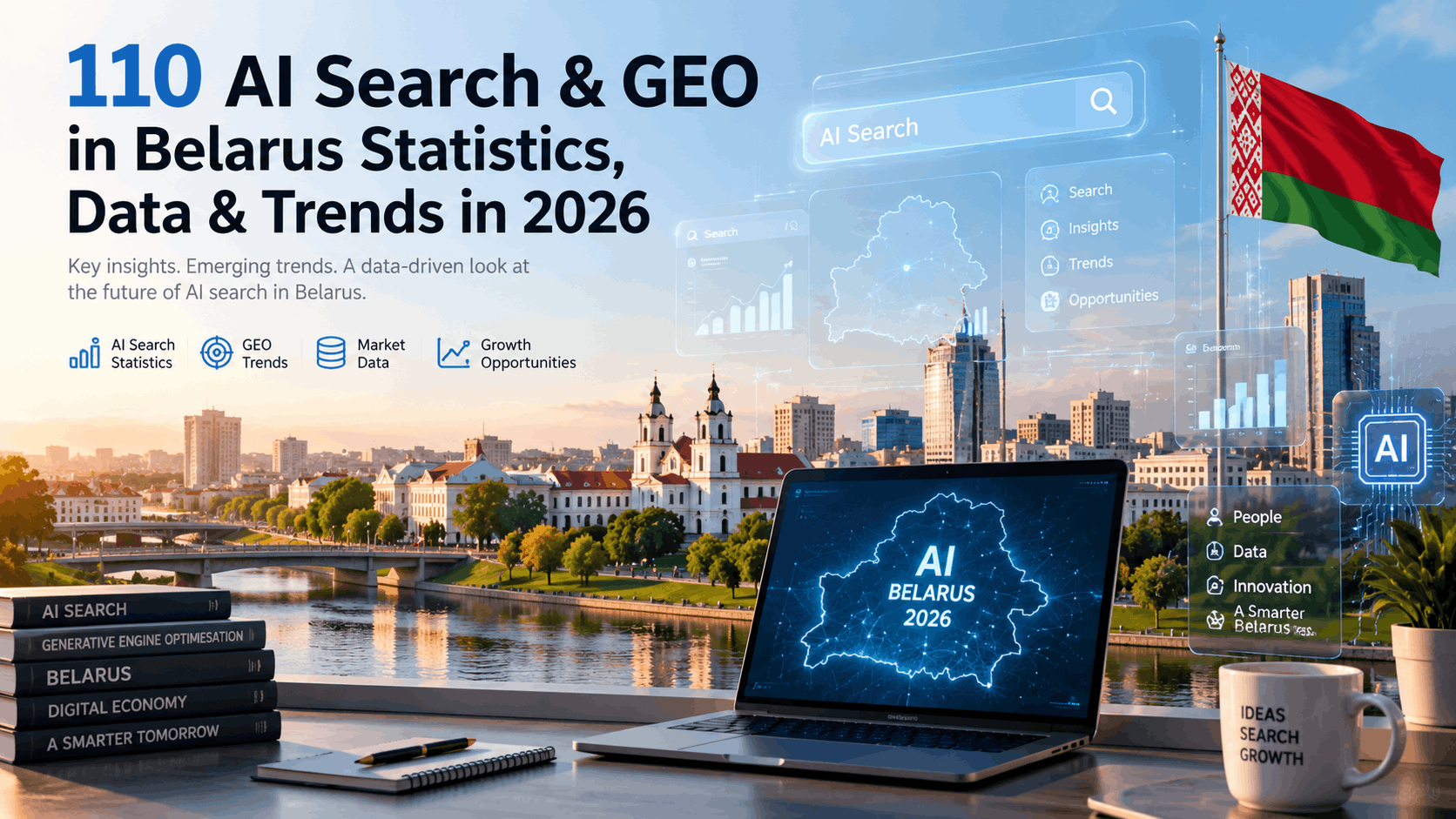
Belarus is entering a new era of AI-powered search, with high internet penetration, strong Google and Yandex usage, and rapid DeepSeek adoption reshaping online discovery. In 2026, businesses should combine traditional SEO with Generative Engine Optimisation (GEO) to improve visibility across search engines and AI-generated answers.
Artificial intelligence is reshaping how people discover, evaluate, and interact with information online, and Belarus is developing a particularly distinctive AI search landscape. In 2026, the intersection of traditional search engines, generative AI platforms, digital infrastructure, and Generative Engine Optimisation (GEO) is creating new opportunities and challenges for Belarusian businesses, marketers, publishers, technology companies, and SEO professionals. With internet penetration exceeding 94%, millions of social media users, widespread mobile broadband access, and a substantial technology ecosystem, Belarus already possesses much of the digital foundation required for AI-powered search to expand.
Also, read our articles on the top SEO and GEO agencies here:
Top 10 Best SEO Agencies in Belarus
Top 10 Best GEO Agencies in Belarus
Google continues to dominate traditional search in Belarus with approximately 67.88% market share, but the country’s search environment differs considerably from many Western European markets. Yandex accounts for roughly 30.52% of searches, supported by the widespread use of Russian among the Belarusian population. This means businesses cannot simply replicate a Google-only SEO strategy. Search visibility in Belarus increasingly requires an understanding of Google, Yandex, conversational AI platforms, generative answers, and the different ways these systems discover, interpret, retrieve, and cite online information.
Perhaps the most striking trend is Belarus’s relationship with generative AI. The statistics examined in this report indicate that Belarus has become an unusually important market for DeepSeek, with an estimated adoption rate of 56%, compared with 43% in Russia and below 5% across many Western markets. At the same time, broader measures of regular generative AI adoption paint a more cautious picture. Approximately 8.4% of Belarus’s working-age population was estimated to use generative AI tools, while 43% of Belarusians had never used AI technology according to the referenced national assessment. These contrasting figures illustrate why AI adoption cannot be understood through a single metric: platform penetration, regular usage, awareness, accessibility, and demographic reach can produce very different pictures of the same market.
Belarus nevertheless has considerable potential for further AI search adoption. Around 92% of surveyed Belarusians use the internet for everyday needs, while 66% believe AI can contribute to solving socioeconomic challenges. The country also has a substantial technology sector centred around Minsk’s Hi-Tech Park, which hosts approximately 1,000 resident IT companies and around 59,000 technology professionals. Hi-Tech Park IT service exports reached an estimated US$459 million in the first quarter of 2025, growing 7% year over year. This combination of widespread connectivity, technical expertise, and increasing interest in artificial intelligence creates fertile conditions for AI-powered discovery to become more important throughout the Belarusian digital economy.
However, Belarus still faces significant AI-readiness challenges. The country ranks 113th out of 160 countries in the referenced Oxford Insights AI Readiness Index, despite achieving a comparatively stronger Data and Infrastructure pillar score of 55.61. Belarus’s generative AI usage rate also remains below the broader benchmarks cited for both the Global North and Global South. These figures suggest that strong internet connectivity and an established IT workforce do not automatically translate into widespread AI adoption. Access to platforms, digital literacy, economic conditions, regulation, language support, public awareness, and the availability of locally relevant AI products all influence how quickly generative search becomes mainstream.
For businesses, the implications extend well beyond which AI chatbot is most popular. Search itself is becoming increasingly generative. The dataset indicates that Google AI Overviews appeared in approximately 25.11% of searches by the first quarter of 2026, up dramatically from 7.64% in February 2025. Zero-click searches are estimated at 59.7% in Europe, while mobile zero-click behaviour is even more pronounced. As search engines increasingly answer questions directly within their interfaces, ranking highly in conventional search results may no longer guarantee the same levels of website traffic that businesses historically expected.
This transformation is driving interest in Generative Engine Optimisation, or GEO. Whereas traditional SEO primarily seeks to improve rankings and organic clicks, GEO focuses on increasing the likelihood that a company, product, expert, statistic, or piece of content will be discovered, understood, mentioned, recommended, or cited within AI-generated answers. The distinction is becoming commercially significant as consumers increasingly use conversational queries for research, comparisons, recommendations, purchasing decisions, and quick answers.
Importantly, GEO does not make traditional SEO obsolete. The statistics presented here instead suggest a close relationship between the two disciplines. The dataset reports that 99% of AI Overview citations originate from organic top-10 search results, while 87% of ChatGPT citations correspond with leading Bing results. It also reports that 44.2% of LLM citations come from the first 30% of a piece of content. These findings highlight the growing importance of combining established SEO fundamentals with answer-first writing, strong topical authority, clear information architecture, credible sourcing, structured content, entity consistency, and concise passages that AI systems can readily interpret and retrieve.
The economics of search are changing alongside user behaviour. AI-generated answers can reduce conventional organic click-through rates, yet visitors arriving through AI platforms may carry substantially higher intent. The dataset cites an AI search traffic conversion rate of 14.2%, compared with 2.8% for traditional Google search traffic, while another referenced example found AI-platform visitors converting to subscriptions at four to five times the rate of traditional search visitors. If these patterns persist, marketers may increasingly prioritise the quality, intent, and commercial value of AI-referred visitors rather than measuring success primarily through raw organic traffic.
GEO visibility is also highly dynamic. According to the statistics compiled for this report, 40% to 60% of cited sources can change month to month across Google AI Mode and ChatGPT, while ChatGPT reportedly cites only around 15% of pages it retrieves. Content distribution across multiple publications may increase AI citations by as much as 325% compared with publishing exclusively on a company’s own website. These trends suggest that winning generative search visibility requires more than producing large quantities of content. Brands increasingly need credible third-party mentions, original information, authoritative sources, consistent entities, strong technical accessibility, regular content updates, and a wider digital footprint that reinforces their expertise.
The scale of the opportunity is substantial. The global GEO market is cited as growing from approximately US$886 million in 2024 to a projected US$7.3 billion by 2031. More than one billion people worldwide now use standalone generative AI tools each month, while Google’s AI-powered search summaries are reported to reach more than two billion monthly users. Meanwhile, 72% of companies globally use AI in at least one business function. These benchmarks demonstrate that generative search is developing into a fundamental component of the broader digital discovery ecosystem rather than remaining an experimental alternative to conventional search engines.
For Belarus, the transition is especially interesting because it is occurring within a search ecosystem shaped simultaneously by Google, Yandex, Russian-language content, DeepSeek adoption, high internet penetration, an established IT industry, geopolitical constraints, and comparatively low overall AI readiness. This combination means global GEO best practices cannot necessarily be copied directly into the Belarusian market. Businesses targeting Belarus may need multilingual and multi-platform strategies, while Belarusian companies targeting international customers must consider an entirely different mix of Google AI experiences, ChatGPT, Bing, Gemini, Perplexity, and other generative discovery channels.
The following 110 AI Search & GEO in Belarus Statistics, Data & Trends in 2026 provide a comprehensive quantitative overview of this rapidly changing environment. Covering internet penetration, mobile connectivity, search engine market share, DeepSeek adoption, generative AI usage, Belarus’s technology sector, AI readiness, government policy, zero-click search, AI Overviews, LLM citations, GEO strategies, conversion behaviour, and global AI search benchmarks, these statistics offer a data-driven foundation for understanding where AI search in Belarus stands in 2026 and where the market may be heading next.
But, before we venture further, we like to share who we are and what we do.
About AppLabx
From developing a solid marketing plan to creating compelling content, optimizing for search engines, leveraging social media, and utilizing paid advertising, AppLabx offers a comprehensive suite of digital marketing services designed to drive growth and profitability for your business.
At AppLabx, we understand that no two businesses are alike. That’s why we take a personalized approach to every project, working closely with our clients to understand their unique needs and goals, and developing customized strategies to help them achieve success.
If you need a digital consultation, then send in an inquiry here.
Or, send an email to hello@applabx.com to get started.
110 AI Search & GEO in Belarus Statistics, Data & Trends in 2026
SECTION 1: Digital Infrastructure & Internet Access
1. Belarus had 8.47 million internet users as of October 2025, representing an internet penetration rate of 94.3%.
Belarus has built one of the strongest internet penetration rates in the CIS region, making it a highly connected market where AI search tools can diffuse rapidly once adoption barriers are removed.
2. Internet penetration in Belarus has grown by 10.4 percentage points since 2020, reaching 95.5% in 2025 according to Belstat.
The consistent upward trajectory in internet connectivity means that a greater share of Belarusians is now within reach of AI-powered search products, setting the stage for accelerated GEO relevance.
3. Belarus was home to 7.64 million social media user identities in October 2025, equating to 85.0% of the total population.
A social media penetration rate of 85% means that AI-cited content shared on social platforms — a core GEO signal — can reach the overwhelming majority of Belarusians online.
4. There were 11.4 million cellular mobile connections active in Belarus in late 2025, equivalent to 127% of the total population.
With mobile connections exceeding the total population, mobile-first AI search experiences are a non-negotiable design priority for any Belarusian digital marketing strategy.
5. 96.1% of mobile connections in Belarus can now be considered “broadband”, connecting via 3G, 4G, or 5G mobile networks.
Near-universal mobile broadband coverage removes the infrastructure barrier to AI search tool usage, enabling faster real-time query processing via apps like DeepSeek and Yandex.
6. The number of mobile connections in Belarus decreased by 49,000 (–0.4%) between end-2024 and end-2025.
While population decline contributes to falling SIM totals, the qualitative shift toward broadband-capable connections means the meaningful market for AI search tools remains stable.
7. Belarus’s total population stood at approximately 8.98 million in October 2025, declining by 59,000 (–0.7%) year-on-year.
A contracting population base makes per-capita AI tool adoption rates — not raw user numbers — the more meaningful benchmark for evaluating digital market growth in Belarus.
8. 81.6% of Belarus’s population lived in urban centres in late 2025, with 18.4% in rural areas.
Urban concentration means that AI search adoption and GEO investment will naturally be skewed toward Minsk and major cities, though rural digital gaps may represent a future whitespace.
9. The median fixed-line broadband speed in Belarus is approximately 75 Mbps, with mobile speeds around 13 Mbps.
High fixed broadband speeds support complex AI search interactions — including multimodal queries and agentic tasks — while the mobile speed gap signals an area requiring optimisation for mobile GEO.
10. Belarus has 100% 4G network coverage and 100% 3G network coverage as of 2025.
Universal 4G coverage ensures that AI-powered search tools are geographically accessible across the entire country — a key prerequisite for broad GEO adoption by Belarusian content creators and brands.
11. The average broadband connection speed in Belarus is estimated at 47,520 kbit/s (47.52 Mbps) in 2025.
A 47+ Mbps average broadband speed comfortably supports the real-time web-retrieval functions of modern AI search platforms, enabling low-latency generative responses for Belarusian users.
12. There were approximately 2.47 million households with internet access at home in Belarus in 2025.
Household internet penetration at this scale enables AI search behaviour to become a household-level habit rather than an exclusively workplace or institutional activity.
13. Total consumer spending on ICT equipment in Belarus was estimated at US$826.76 million in 2025.
Nearly $1 billion in ICT hardware spending reflects a population that is actively investing in devices capable of running AI search tools, supporting growing demand for GEO-optimised content.
14. ICT services export per capita in Belarus was estimated at US$386.65 in 2025.
A high per-capita ICT services export figure underscores Belarus’s position as a net exporter of technology talent — a community that is among the most sophisticated adopters of AI search tools.
SECTION 2: Search Engine Market Share
15. Google holds a 67.88% search engine market share in Belarus.
Despite Google’s dominant global position, its share in Belarus is markedly lower than its near-90% global average — a direct consequence of Yandex’s deep cultural and linguistic roots in the Russian-speaking market.
16. Yandex holds approximately 30.52% search engine market share in Belarus, making it the second most popular search engine.
Yandex’s outsized presence — driven by the fact that around 70% of Belarusians speak Russian — means GEO strategies in Belarus must account for Yandex’s AI-powered Alice assistant and its own generative search features.
17. Approximately 70% of the Belarusian population speaks Russian as a primary language, underpinning Yandex’s strong market position.
Language is the single most powerful predictor of search engine preference in Belarus; content GEO strategies must be natively bilingual — Belarusian and Russian — to capture both search ecosystems.
18. Bing holds an estimated ~1.2% search market share in Belarus.
Bing’s marginal presence in Belarus has direct implications for ChatGPT’s citation behaviour, as 87% of ChatGPT citations correspond to Bing top results — limiting ChatGPT’s relevance for Belarusian-language queries.
19. Google’s global market share has declined slightly from 92.58% in 2022 to 90.04% in 2026.
Even fractional erosion of Google’s global dominance signals structural shifts in how users discover information — shifts that are more pronounced in markets like Belarus where alternative engines already hold 30%+ share.
20. Globally, Google still accounts for approximately 90% of all search engine referrals to third-party websites.
For Belarusian brands targeting international audiences, Google remains the dominant force, making traditional SEO the essential foundation upon which any GEO strategy must be built.
SECTION 3: AI Adoption in Belarus
21. Belarus ranks among the world’s top countries for DeepSeek adoption, with a 56% adoption rate.
Belarus’s 56% DeepSeek adoption rate — the highest outside China — fundamentally reshapes the AI search landscape, as DeepSeek’s citation and retrieval logic differs significantly from Google’s AI Overviews.
22. DeepSeek’s adoption rate in Belarus (56%) surpasses Russia’s adoption rate of 43%.
Belarus’s higher DeepSeek adoption rate than Russia likely reflects the more restricted access to Western AI platforms, creating a de facto Chinese AI search monopoly in the generative query space.
23. DeepSeek adoption in the US and most Western European countries remains below 5%.
The chasm between Belarus’s 56% and Western Europe’s sub-5% DeepSeek usage rates signals that Belarusian GEO strategies must be developed independently of Western-centric best practices.
24. 43% of the Belarusian population has never used any AI technology, according to UNDP’s 2024–2025 national assessment.
A 43% non-adoption rate represents both a challenge and an opportunity: nearly half of Belarusians remain outside the AI adoption funnel, creating headroom for significant future growth.
25. Belarus’s result broadly aligns with UNDP’s global estimate that 36% of people worldwide have not yet interacted with AI — though Belarus shows slightly lower regular usage.
The above-average non-adoption rate in Belarus suggests that language barriers, awareness gaps, and restricted access to Western platforms are collectively suppressing AI search engagement.
26. 57% of Belarusians believe digital technologies will help solve major social and economic challenges.
Techno-optimism among the majority of the population is a favourable sentiment signal for AI tool adoption growth, suggesting that demand-side resistance to AI search is not the primary barrier.
27. 21% of Belarusians expressed concern that digital technologies could create new challenges alongside solutions.
A meaningful minority of skeptics suggests that trust-building — through transparent, well-sourced AI-cited content — will be essential for brands seeking to achieve GEO visibility with Belarusian audiences.
28. Belarus is ranked 113th out of 160 countries in the global AI Readiness Index, compiled by Oxford Insights.
A bottom-quartile AI readiness ranking reflects systemic gaps in infrastructure, innovation capacity, and human capital — all of which directly suppress the pace of GEO adoption by local businesses.
29. The working-age population of Belarus using generative AI tools stands at approximately 8.4%, rising +0.8 percentage points in H2 2025.
An 8.4% active usage rate — while low by global standards — represents a +10.5% relative growth in H2 2025 alone, suggesting that the trajectory is positive even if the absolute base is modest.
30. Belarus sits in the bottom quarter of approximately 150 countries ranked by the Microsoft AI Economy Institute for generative AI usage rates.
Bottom-quartile status on Microsoft’s global AI diffusion index underscores the urgency of addressing access, literacy, and language-specific model quality barriers to unlock Belarus’s AI search potential.
31. Countries of the Global North average 24.7% working-age AI usage, versus 14.1% in the Global South — Belarus’s 8.4% falls below both benchmarks.
Belarus’s below-Global-South AI usage rate highlights that geopolitical access restrictions create a deeper adoption barrier than income alone, with political context suppressing AI tool availability.
32. DeepSeek’s adoption was driven by its fully free, zero-subscription model that removed financial and technical barriers.
The price-sensitivity dynamic that powered DeepSeek’s adoption in Belarus suggests that freemium or zero-cost AI search tools will consistently outperform paid models in this market.
33. 92% of surveyed Belarusians use the internet for daily needs, according to UNDP’s Digital Readiness Assessment.
High daily internet dependency means that AI search integration into daily workflows is plausible — and that brands with strong GEO visibility have daily touchpoint opportunities with Belarusian users.
34. 66% of Belarusians believe AI can help address socio-economic challenges, per the UNDP DRA 2024–2025.
Strong majority belief in AI’s societal utility creates a receptive environment for AI-powered tools and suggests content strategies that frame AI search as a productive, problem-solving technology will resonate.
35. 73% of Belarusians are unaware of government AI programs, according to the Minsk AI Forum 2025.
An enormous awareness gap around official AI initiatives underscores the need for both public education and for brands to position themselves as credible AI information sources — a core GEO signal.
36. Only 32% of Belarusians use the internet to interact with government services.
Low e-government usage — despite high general internet penetration — reflects the immaturity of digital public services, leaving a significant content gap that AI-optimised guides and explainers could fill.
37. 60% of surveyed Belarusians were aware of available training programs in data analysis and machine learning.
A growing pipeline of technically literate citizens will gradually increase the sophistication of AI tool usage in Belarus, raising the bar for GEO content quality over the next three to five years.
SECTION 4: Belarus IT Ecosystem & AI Infrastructure
38. The Hi-Tech Park (HTP) in Minsk hosts approximately 1,000 resident IT firms as of Q1 2025.
With 1,000 technology companies operating under HTP’s preferential tax regime, Belarus has a built-in community of early GEO adopters who are already building AI-adjacent products and services.
39. HTP companies employ approximately 59,000 IT professionals across Belarus.
A 59,000-strong IT workforce concentrated in HTP provides a critical talent pool for AI development, natural language processing, and the technical GEO optimisation required to compete in AI search.
40. HTP IT service exports reached US$459 million in Q1 2025, growing +7% year-on-year.
Growing export revenue from HTP firms indicates commercial momentum and international credibility — exactly the authority signals that AI citation systems reward.
41. Domestic IT sales by HTP companies exceeded Br 2 billion in recent periods, growing +24% year-on-year.
A 24% surge in domestic IT revenue signals rapidly expanding enterprise AI adoption within Belarus — creating internal demand for GEO-optimised procurement and enterprise content.
42. The IT sector accounted for approximately 6.6% of Belarus’s GDP in 2022, though it has eased to roughly 4–5% in recent years.
Even at a reduced 4–5% of GDP, the IT sector remains Belarus’s most dynamic economic segment — and the primary driver of search and AI tool adoption among business users.
43. The average salary in Belarus’s IT sector is approximately US$2,000/month — four times the national average.
High IT salaries relative to the national economy attract top talent into AI-adjacent roles, accelerating the development of locally relevant AI content and GEO services.
44. Belarus became the first country to incorporate AI readiness evaluation into its national Digital Readiness Assessment (DRA), conducted in 2024–2025.
This world-first policy milestone signals that Belarus’s government is treating AI readiness as a strategic priority — creating a regulatory and institutional environment progressively more supportive of GEO and AI search.
45. The UNDP/MoCI/Giprosvyaz DRA assessment engaged over 10,000 professionals from public, private, academic, and civil society sectors.
The breadth of stakeholder engagement in Belarus’s AI readiness assessment indicates that AI policy development is genuinely cross-sectoral — relevant to GEO practitioners across every industry vertical.
46. belai.by, a platform for Belarus’s AI specialist community, was launched in 2022.
The existence of a dedicated national AI community platform provides a local ecosystem where GEO best practices, AI search trends, and content strategies can be shared among practitioners.
47. In 2023, Belarus spearheaded the development of a model “On Artificial Intelligence” law for CIS countries.
Belarus’s role in shaping CIS-wide AI legislation positions it as a regional policy leader — and signals that future AI content regulation may be harmonised across Russia, Belarus, and Central Asia.
48. Belarus’s National Strategy for Sustainable Development until 2040 designates AI as a distinct strategic objective for the first time.
Elevation of AI to a standalone national strategic priority creates long-term policy tailwinds for AI adoption, infrastructure investment, and the commercial GEO market in Belarus.
49. The National Digital Development Strategy for 2026–2030 has been informed by the 2024–2025 DRA findings.
A five-year national digital strategy shaped by evidence-based AI readiness data means that infrastructure gaps constraining AI search adoption are likely to be systematically addressed through 2030.
50. Belarus has broad 4G coverage but is still planning its state-run 5G rollout under a unified operator model.
A state-controlled 5G rollout may introduce deployment delays relative to privately-led markets, but ultimately 5G will unlock the ultra-low latency required for real-time agentic AI search interactions.
SECTION 5: Global AI Search Landscape (Contextual Benchmarks)
51. Google AI Overviews appear in approximately 25.11% of all Google searches as of Q1 2026, based on analysis of 21.9 million queries.
One in four Google queries now triggers an AI Overview — meaning any Belarusian brand targeting Google’s 67.88% search share must have a GEO strategy to avoid being invisible in this growing SERP segment.
52. AI Overviews appeared in just 7.64% of searches in February 2025, growing to 25.11% by Q1 2026 — a 72% relative increase.
This near-tripling of AI Overview prevalence within one year demonstrates the pace at which traditional SEO positions are being displaced, demanding urgent GEO action from Belarusian digital marketers.
53. Some studies report AI Overviews triggering in up to 48% of search queries for specific categories as of March 2026.
Category-level AI Overview prevalence of nearly 50% means that in high-intent verticals — health, finance, legal — Belarusian content without GEO optimisation is invisible to nearly half of searchers.
54. Zero-click searches sit at 59.7% in Europe, meaning over half of European searches end without a website click.
A 59.7% zero-click rate in Europe — the regional benchmark most applicable to Belarus’s Google search behaviour — fundamentally challenges traffic-dependent revenue models for Belarusian publishers.
55. Zero-click searches reach 75% on mobile devices globally.
With 127% mobile penetration in Belarus, mobile-first zero-click behaviour is the dominant search mode, making brand mention and citation in AI answers — not click-through traffic — the primary GEO success metric.
56. Zero-click searches reach 93% in Google’s AI Mode searches.
At a 93% zero-click rate, Google AI Mode essentially decouples brand discovery from website traffic — a seismic shift that requires Belarusian brands to measure AI Share of Voice as a primary KPI.
57. AI search traffic converts at a 14.2% rate compared to Google’s traditional search conversion rate of 2.8%.
Despite dramatically lower traffic volumes from AI search, the 5× higher conversion rate means that AI-referred visitors from platforms like DeepSeek and Yandex AI are significantly more commercially valuable.
58. AI platforms are currently driving 6.5% of organic traffic, expected to nearly double to 14.5% within a year.
AI-driven traffic is on an accelerating growth curve that will double in under 12 months — making this the most urgent channel expansion priority for Belarusian e-commerce and service businesses.
59. ChatGPT has an 80.49% share of the global AI chatbot market, dominating Perplexity, Copilot, Gemini, Claude, and DeepSeek.
ChatGPT’s global market leadership is largely inaccessible to Belarusian users due to restrictions and pricing barriers — creating a unique local GEO landscape dominated by DeepSeek and Yandex AI.
60. ChatGPT had approximately 900 million weekly active users as of early 2026.
ChatGPT’s 900 million weekly user base globally dwarfs Belarus’s AI user base, but the platform’s citation behaviour — 87% aligning with Bing top results — is still relevant for export-facing Belarusian brands.
61. ChatGPT processes over 2 billion daily queries globally.
The scale of ChatGPT’s query processing establishes it as the world’s de facto AI search engine — a platform that export-oriented Belarusian B2B brands must appear in to access global commercial audiences.
62. ChatGPT recorded 5.35 billion monthly visits in February 2026.
At 5.35 billion monthly visits, ChatGPT has already surpassed Bing’s 1.9 billion monthly visitors — making it a search channel that demands dedicated GEO investment from internationally minded Belarusian brands.
63. Google AI Mode has reportedly reached 75 million daily active users and over 100 million monthly active users by early 2026.
Google AI Mode’s 100 million monthly users — and its 4× growth since May 2025 launch — signals that AI-first search is transitioning from experimental to mainstream even within Google’s own product suite.
64. AI Overviews now appear in 25.5% of results alongside advertising, representing a 394% increase from 5.17% in early 2025.
The rapid monetisation of AI search surfaces confirms that advertising inventory within AI-generated answers is growing exponentially — a critical trend for Belarusian paid media strategies.
65. US AI search advertising spending is projected to reach US$2.08 billion in 2026, growing to US$25.93 billion by 2029.
While Belarus’s domestic AI ad market is nascent, the global trajectory suggests that AI search advertising will become an unavoidable budget line for Belarusian brands targeting Russian-language international audiences.
66. Monthly sessions of AI platforms are now 56% the size of all search worldwide (34% in the US).
AI platforms have already captured more than half the query volume of traditional search globally — a structural shift that validates GEO as a core, not supplementary, digital marketing discipline.
67. Total search usage (combining traditional search engines and AI LLMs) has increased by 26% worldwide.
The expanding search pie means GEO is not cannibalising SEO — it is opening new discovery channels that Belarusian marketers can occupy while maintaining their traditional search positions.
68. Perplexity AI surpassed 15 million daily active users in early 2026.
Perplexity’s growth — driven by citation transparency — is largely inaccessible to Belarusian users, but its citation practices represent a GEO model that Yandex’s generative features may increasingly replicate.
69. Perplexity’s share of AI referral traffic has declined from a peak of 12.07% in April 2025, dropping more than 40% as Google Gemini surged.
Perplexity’s declining referral share reinforces the winner-takes-most dynamics of AI search — with ChatGPT and Gemini together controlling approximately 86% of the global AI search market share.
70. Around 3 in 4 American respondents report searching with AI weekly, with top use cases including quick facts, shopping research, and health information.
While US usage benchmarks far exceed Belarus’s 8.4% rate, the use case profile — facts, shopping, health — mirrors universal human information needs that are equally relevant to Belarusian searchers.
SECTION 6: GEO & Content Strategy Statistics
71. The global GEO market was valued at US$886 million in 2024 and is projected to grow to US$7.3 billion by 2031.
An 8× market expansion trajectory over seven years establishes GEO as one of the highest-growth digital marketing disciplines — a commercial opportunity that forward-looking Belarusian agencies should position for now.
72. 25% of traditional Google searches are projected to disappear by end of 2026, according to Gartner.
Gartner’s projection of a 25% traditional search decline by year-end 2026 is the single most urgent data point for Belarusian SEO professionals — a clear mandate to diversify into GEO immediately.
73. 50% of searches are projected to be generative in nature by 2028.
The Gartner projection of 50% generative search by 2028 means that within two years, the majority of search queries will be answered by AI — fundamentally redefining what “search visibility” means for Belarusian brands.
74. 99% of AI Overview citations come from the organic top-10 search results.
This single statistic is the most important GEO insight for Belarusian marketers: traditional SEO ranking is not optional — it is the prerequisite for any AI citation to occur at all.
75. 87% of ChatGPT citations correspond to the Bing top results.
For Belarusian brands seeking ChatGPT citation — particularly in export markets — optimising for Bing is as strategically important as Google SEO, despite Bing’s marginal 1.2% domestic search share.
76. 44.2% of all LLM citations come from the first 30% of text — the introduction.
Content strategy for GEO in Belarus must front-load key data, definitions, and authoritative statements in introductory paragraphs — the section most likely to be extracted and cited by AI systems.
77. 31.1% of LLM citations come from the middle 30–70% of text, and 24.7% from the final third.
The distribution of LLM citation probability across document sections confirms that well-structured long-form content — not keyword-dense fragments — is the optimal format for GEO-targeted content in Belarus.
78. Content distributed to a wide range of publications can increase AI citations by up to 325% compared to publishing only on your own site.
For Belarusian brands, earned media placement in Russian-language publications, tech blogs, and CIS news outlets is not merely a PR activity — it is a direct multiplier of AI search citation probability.
79. 86% of SEO teams globally have already integrated AI into their workflows.
With 86% of global SEO teams already AI-integrated, Belarusian digital agencies that have not yet adopted AI-augmented content production workflows are facing a rapidly widening competitive gap.
80. 63% of websites globally report traffic originating from AI-based search engines.
A majority of websites worldwide are already receiving AI-referred traffic — yet many Belarusian websites lack the attribution infrastructure (GA4 source tracking, Bing Webmaster Tools) to even detect it.
81. 58% of users globally have replaced classic search engines with AI tools when searching for products or services.
More than half of global users now turn to AI first for commercial queries — a behavioural shift that redefines the purchase funnel and makes AI citation a brand visibility imperative in any Belarusian e-commerce strategy.
82. The average AI Mode answer contains 12.6 links, while AI Overviews cite an average of 13.3 sources.
A 12–13 source citation window in AI answers means there is a finite and competitive slot allocation — Belarusian brands must actively optimise to be among the cited sources rather than passively hoping for inclusion.
83. AI Overviews were predominantly triggered by informational queries in 2024 but expanded to commercial queries (from 8% to 18%) by late 2025.
The shift of AI Overviews into commercial query territory directly threatens Belarusian e-commerce and service businesses that rely on informational traffic converting to commercial intent.
84. Queries of 8 words or longer have a 57% chance of triggering AI Overviews.
Long-tail, conversational queries — which are increasingly common in Russian-language search — are disproportionately likely to trigger AI Overviews, reinforcing the GEO value of detailed FAQ and how-to content in Belarusian.
85. Organic click-through rates to the top-ranked page fall by approximately 35% when an AI-generated answer is displayed.
A 35% CTR decline from AI answer presence is an existential challenge for Belarusian publishers monetising through display advertising — validating the urgency of GEO-driven brand visibility strategies.
86. Only 8% of visits result from a click when an AI Overview is shown, compared to significantly higher rates on traditional SERPs.
An 8% click-through rate in AI Overview contexts confirms that traffic volume metrics are an increasingly unreliable proxy for brand visibility — Belarusian marketers must adopt AI citation rate as a primary KPI.
87. There is a less than 1-in-100 chance that ChatGPT or Google’s AI will provide the same list of brands in any two responses to the same query.
The extreme inconsistency of AI brand mentions — under 1% repeatability — means that sustained GEO success requires ongoing, multi-platform optimisation rather than one-time content fixes.
88. 40–60% of cited sources change month-to-month across Google AI Mode and ChatGPT.
Citation volatility of 40–60% monthly turnover means Belarusian brand visibility in AI search cannot be treated as a durable asset — it requires continuous content refreshing and authority maintenance.
89. ChatGPT only cites 15% of the pages it retrieves, leaving 85% of retrieved sources uncited.
An 85% non-citation rate for retrieved pages underscores that strong technical SEO (ensuring AI crawler accessibility) is the minimum threshold — differentiated content authority is required to win the 15% citation slot.
90. Out of 8,500+ ChatGPT prompts analysed, approximately 31% trigger a web search.
Only one in three ChatGPT queries activates real-time web retrieval — for Belarusian brands, this means that training data inclusion (through authoritative mentions pre-dating LLM cutoffs) is as important as real-time crawlability.
91. Commercial intent prompts trigger web search in ChatGPT 53.5% of the time versus 18.7% for informational queries.
Commercial-intent AI queries — precisely the queries most valuable to Belarusian businesses — are the most likely to trigger live web retrieval, making real-time GEO content freshness a high-value commercial signal.
92. The Washington Post found that AI-platform visitors converted to subscriptions at 4–5× the rate of traditional search visitors.
Superior conversion rates from AI-referred traffic confirm that GEO investment generates disproportionate commercial returns — a compelling ROI argument for Belarusian subscription and lead-generation businesses.
93. Major publishers like Reuters and The Guardian receive less than 1% of referral traffic from AI platforms despite being frequently cited.
Even the world’s most-cited publishers receive minimal traffic from AI platforms — reinforcing the paradigm shift: AI search creates brand awareness and authority, not necessarily traffic volume.
94. AI recommendations are highly inconsistent: brands cited in AI answers one day may be absent the next.
The non-deterministic nature of AI brand citation means that Belarusian brands seeking sustained AI visibility must build structural authority — through E-E-A-T signals, media coverage, and cross-platform presence — rather than optimising for one-time citations.
95. The GEO market will grow from $886 million (2024) to $7.3 billion by 2031, representing an 8× expansion in 7 years.
The GEO market’s trajectory mirrors the early growth curves of social media marketing and content marketing — sectors that rewarded first-movers with durable competitive advantages.
SECTION 7: AI Readiness & Policy Context
96. Global investment in AI has tripled over the past four years, according to the UNDP Human Development Report 2025.
Three-fold growth in global AI investment means that the competitive AI landscape is intensifying every year — Belarusian businesses and policymakers must accelerate their AI adoption timelines to avoid widening the capability gap.
97. The number of countries with national AI strategies has increased more than fivefold over the past six years.
A fivefold increase in countries with formal AI strategies signals that national AI competitiveness is now a geopolitical priority — and Belarus’s recently designated AI strategy aligns it with this global movement.
98. Belarus ranks 113th out of 160 countries in the Oxford Insights AI Readiness Index, with a Technology Sector score of 34.57.
A Technology Sector score of 34.57 reflects the gap between Belarus’s HTP-driven tech capability and the infrastructure and investment levels of leading AI-ready nations — a gap that is being actively addressed through 2026–2030 strategy.
99. Belarus’s Data and Infrastructure pillar score in the AI Readiness Index is 55.61 — its strongest pillar.
A data and infrastructure score above 55 represents Belarus’s comparative advantage in digital readiness — a foundation that enables AI search platform development if combined with regulatory and investment improvements.
100. 60% of Belarusians globally believe AI will positively impact the job market, according to UNDP’s global survey; 1 in 8 fears job loss to automation.
While optimism dominates, the 12.5% job-loss concern creates a politically sensitive context for AI search adoption in Belarus — brands should frame GEO and AI tools as augmenting human creativity, not replacing it.
101. Belarus’s regulatory quality estimate scores –1.33 on the World Bank’s –2.5 to +2.5 scale.
A negative regulatory quality score reflects the systemic challenges facing private sector AI development in Belarus — including limitations on international technology partnerships and data sharing arrangements.
102. By 2030, AI is projected by the World Economic Forum to reduce 92 million jobs globally while creating 170 million new higher-skilled positions.
Net job creation from AI — at a ratio of nearly 2 new jobs per displaced job — provides the economic narrative that Belarusian policymakers are leaning on to justify AI investment and GEO-friendly content ecosystem development.
103. Belarus’s ICT sector accounted for approximately 4–5% of GDP in recent years, down from a 2022 peak of 6.6%.
The GDP share decline reflects the migration of Belarusian IT talent following 2020–2021 political events — a structural factor that has created both a brain drain challenge and a diaspora of digitally skilled Belarusians building AI products in other markets.
104. The State Programme for Digital Development of Belarus (2021–2025) included 82 specific measures across six sub-programmes.
The breadth and specificity of Belarus’s digital development programme — 82 measures across smart cities, e-health, cybersecurity, and e-government — demonstrates the institutional infrastructure required to eventually support a mature domestic GEO ecosystem.
105. The UNDP Accelerator Lab has convened experts at Belarus’s annual Digital Expo (TIBO) for four consecutive years on AI standardisation.
Four years of structured AI standardisation dialogue at the national level indicates that Belarus is building the normative framework within which Belarusian AI content, citation, and GEO practices will eventually be regulated.
SECTION 8: Global AI & GEO Benchmarks for Strategy
106. More than 1 billion people globally now use standalone generative AI tools every month.
Crossing the 1 billion user threshold transforms AI search from a technology trend into a fundamental communication infrastructure — making GEO a baseline marketing competency rather than an advanced specialisation.
107. Google’s AI search summaries already reach more than 2 billion monthly active users globally.
Google AI Overviews’ 2 billion monthly reach — including through Belarus’s 67.88% Google search share — means that the majority of Belarusian online searches are occurring in an AI-influenced environment.
108. 65% of AI users globally are Millennials or Gen Z.
In Belarus, where the median population age is 41.3, the younger demographic cohort most predisposed to AI search is a smaller share of the total — but also the most commercially valuable segment for digital-native brands.
109. 72% of companies worldwide now use AI in at least one business function.
Global enterprise AI adoption at 72% creates a benchmark that Belarusian businesses — where AI business adoption lags significantly — must close to remain competitive in cross-border markets.
110. The global AI market is projected to be worth over US$800 billion by 2030.
A US$800 billion AI market by 2030 encompasses not just generative tools but the entire infrastructure of AI search — model development, data infrastructure, GEO services, and AI advertising platforms — all of which have Belarusian market implications.
Conclusion
The 110 AI Search & GEO in Belarus Statistics, Data & Trends in 2026 reveal a market with an unusual combination of advanced digital connectivity, strong technical talent, rapidly changing AI behaviour, and considerable room for further generative AI adoption. With internet penetration above 94%, 7.64 million social media user identities, 11.4 million mobile connections, and universal 4G coverage, Belarus already possesses much of the infrastructure required for AI-powered search to become an increasingly important part of everyday digital discovery.
Belarus’s search landscape is particularly distinctive. Google commands approximately 67.88% of the search engine market, while Yandex maintains a substantial 30.52% share. At the same time, the dataset reports a 56% DeepSeek adoption rate, illustrating how Belarus can diverge considerably from Western AI markets where platforms such as ChatGPT, Gemini, and Perplexity receive greater attention. For businesses targeting Belarusian consumers, this makes a multi-platform and multilingual approach to search visibility increasingly important.
However, strong adoption of individual AI platforms should not be confused with universal AI maturity. Approximately 43% of Belarusians have never used AI technology, while working-age generative AI usage is estimated at just 8.4%. Belarus also ranks 113th out of 160 countries in the referenced AI Readiness Index. These figures indicate substantial headroom for growth as AI awareness, accessibility, digital skills, infrastructure, and locally relevant tools continue developing.
The country’s technology ecosystem could help accelerate that transition. Minsk’s Hi-Tech Park hosts approximately 1,000 resident IT companies and 59,000 IT professionals, while its companies generated around US$459 million in IT service exports in Q1 2025. Belarus has also incorporated AI into national digital-development planning, including its National Strategy for Sustainable Development until 2040 and the National Digital Development Strategy for 2026–2030. Together, these factors provide an important foundation for continued AI adoption and the emergence of a more sophisticated domestic AI search ecosystem.
For marketers, publishers, agencies, and businesses, the larger transformation is the changing nature of search itself. Google AI Overviews appeared in approximately 25.11% of searches by Q1 2026, while European zero-click searches are estimated at 59.7%. The dataset also reports that organic click-through rates to the highest-ranking result can fall by approximately 35% when an AI-generated answer appears. Search visibility can therefore no longer be evaluated solely through rankings, clicks, and organic sessions.
This is where Generative Engine Optimisation (GEO) in Belarus becomes increasingly important. GEO focuses on improving the likelihood that brands and their content are discovered, understood, mentioned, recommended, and cited by generative AI systems. Yet the statistics demonstrate that GEO and SEO should not be treated as competing strategies. With 99% of AI Overview citations reportedly coming from organic top-10 results and 87% of ChatGPT citations corresponding with leading Bing results, strong conventional search visibility remains an important foundation for generative visibility.
Content quality and authority are becoming equally significant. Approximately 44.2% of LLM citations come from the first 30% of content, while distributing content across a wider range of publications can increase AI citations by as much as 325% compared with relying exclusively on a company’s own website. Citation sources can also be highly volatile, with 40–60% changing month to month across Google AI Mode and ChatGPT. GEO should therefore be approached as an ongoing strategy involving authoritative content, strong SEO, credible sourcing, third-party mentions, content freshness, clear information architecture, and consistent brand entities.
The commercial opportunity is also expanding rapidly. The dataset places the global GEO market at approximately US$886 million in 2024, with projections reaching US$7.3 billion by 2031. More than one billion people globally use standalone generative AI tools every month, while Google’s AI-powered search summaries reportedly reach more than two billion monthly active users. These figures suggest that generative search is evolving from an emerging marketing channel into a fundamental component of online discovery.
Ultimately, the AI Search and GEO trends in Belarus for 2026 point toward a hybrid search future rather than the immediate disappearance of traditional search engines. Google and Yandex remain critical, but generative AI platforms are creating additional layers through which consumers research questions, compare options, discover companies, and make decisions. Belarusian organisations that combine strong technical SEO, authoritative content, multilingual optimisation, AI-readable information, digital PR, and continuous GEO measurement will be better positioned to remain visible as this transition accelerates.
The central takeaway from these 110 statistics is therefore clear: search visibility in Belarus is becoming broader than rankings alone. As AI-generated answers increasingly sit between users and websites, the competitive advantage will belong to organisations that can become trusted sources for both traditional search engines and generative AI systems. In 2026 and beyond, SEO establishes discoverability, while GEO extends that visibility into the rapidly expanding world of AI-powered search.
If you are looking for a top-class digital marketer, then book a free consultation slot here.
If you find this article useful, why not share it with your friends and business partners, and also leave a nice comment below?
We, at the AppLabx Research Team, strive to bring the latest and most meaningful data, guides, and statistics to your doorstep.
To get access to top-quality guides, click over to the AppLabx Blog.
People also ask
What is AI search in Belarus in 2026?
AI search in Belarus refers to using generative AI and AI-powered search engines to find, summarise, compare, and understand information. Google, Yandex, DeepSeek, and other AI tools are reshaping how Belarusian users discover online content.
What is Generative Engine Optimisation in Belarus?
Generative Engine Optimisation (GEO) improves content so AI search engines and large language models can understand, retrieve, mention, and cite it in generated answers. It complements traditional SEO rather than replacing it.
How many internet users are there in Belarus?
Belarus had approximately 8.47 million internet users in October 2025, representing an internet penetration rate of 94.3%. This provides a strong digital foundation for further AI search adoption.
What is the internet penetration rate in Belarus?
Internet penetration in Belarus reached approximately 94.3% in October 2025, while Belstat data cited in the dataset places penetration at 95.5% in 2025.
What is Google’s search engine market share in Belarus?
Google holds approximately 67.88% of the Belarusian search engine market. This makes Google SEO and visibility within Google’s emerging AI search experiences important for businesses targeting Belarus.
What is Yandex’s search engine market share in Belarus?
Yandex accounts for approximately 30.52% of search engine usage in Belarus. Its strong position makes Yandex optimisation particularly relevant for Russian-language search and GEO strategies.
Why is Yandex popular in Belarus?
Yandex benefits from Belarus’s large Russian-speaking population. Around 70% of Belarusians speak Russian as a primary language, supporting strong demand for Russian-language search experiences.
How popular is DeepSeek in Belarus?
The dataset reports a 56% DeepSeek adoption rate in Belarus, compared with 43% in Russia and below 5% across many Western markets. This makes DeepSeek particularly relevant to Belarus’s AI search landscape.
How many Belarusians have never used AI?
Approximately 43% of Belarusians have never used AI technology, according to the UNDP national assessment cited in the dataset. This suggests considerable potential for future AI adoption.
What percentage of Belarusians use generative AI?
Approximately 8.4% of Belarus’s working-age population uses generative AI tools, according to the dataset. Usage increased by 0.8 percentage points during the second half of 2025.
How does Belarus rank for AI readiness?
Belarus ranks 113th among 160 countries in the Oxford Insights AI Readiness Index cited in the dataset, indicating significant opportunities to strengthen AI adoption, technology capabilities, and supporting institutions.
Do Belarusians believe AI can benefit society?
Yes. Approximately 66% of Belarusians believe AI can help address socioeconomic challenges, while 57% believe digital technologies can contribute to solving major social and economic problems.
How large is the IT industry in Belarus?
Belarus has a substantial technology ecosystem. Minsk’s Hi-Tech Park hosts approximately 1,000 resident IT companies employing around 59,000 technology professionals.
How much do Belarus Hi-Tech Park companies export?
Companies within Belarus’s Hi-Tech Park generated approximately US$459 million in IT service exports during Q1 2025, representing year-over-year growth of about 7%.
How important is mobile internet for AI search in Belarus?
Mobile connectivity is highly important. Belarus had approximately 11.4 million cellular connections in late 2025, while 96.1% of mobile connections used broadband-capable 3G, 4G, or 5G networks.
Does Belarus have nationwide 4G coverage?
Yes. The dataset reports 100% 4G and 3G network coverage in Belarus as of 2025, providing widespread infrastructure for mobile search and AI-powered digital services.
What are Google AI Overviews?
Google AI Overviews are AI-generated summaries displayed within search results. The dataset reports that they appeared in approximately 25.11% of Google searches by Q1 2026.
How quickly are Google AI Overviews growing?
AI Overviews increased from approximately 7.64% of searches in February 2025 to 25.11% by Q1 2026, illustrating the rapid expansion of generative answers within traditional search.
What percentage of European searches are zero-click?
Approximately 59.7% of European searches are zero-click, according to the dataset. This means many users obtain information directly from search results without visiting another website.
How does AI search affect organic click-through rates?
The dataset reports that organic click-through rates to the top-ranked page decline by approximately 35% when an AI-generated answer appears, increasing the importance of visibility inside AI answers themselves.
Does traditional SEO still matter for GEO?
Yes. The dataset reports that 99% of AI Overview citations come from organic top-10 search results. Strong SEO therefore remains an important foundation for gaining visibility in generative search.
How important is Bing SEO for ChatGPT visibility?
The dataset states that 87% of ChatGPT citations correspond to Bing top results. This suggests Bing visibility can be particularly relevant for businesses pursuing citations and exposure through ChatGPT.
Where do LLMs find content to cite?
Approximately 44.2% of LLM citations come from the first 30% of content, 31.1% from the middle, and 24.7% from the final third. Clear, information-rich introductions can therefore support GEO visibility.
Can digital PR improve AI search citations?
Yes. The dataset reports that distributing content across multiple publications can increase AI citations by up to 325% compared with publishing exclusively on a company’s own website.
How often do AI search citations change?
Approximately 40% to 60% of cited sources can change month to month across Google AI Mode and ChatGPT. This volatility makes continuous GEO monitoring and content updating important.
How often does ChatGPT cite retrieved pages?
The dataset reports that ChatGPT cites only around 15% of the pages it retrieves. Being crawlable is therefore insufficient on its own; content must also demonstrate relevance, authority, and usefulness.
Does AI search traffic convert better than Google search traffic?
The dataset cites a 14.2% conversion rate for AI search traffic compared with 2.8% for traditional Google search traffic, suggesting AI-referred visitors can carry strong commercial intent.
How large is the Generative Engine Optimisation market?
The global GEO market was valued at approximately US$886 million in 2024 and is projected to reach US$7.3 billion by 2031, representing roughly eightfold growth.
Will AI search replace traditional search engines in Belarus?
The statistics point toward a hybrid search environment rather than immediate replacement. Google and Yandex remain dominant, while DeepSeek and other generative AI tools create additional ways for users to discover information.
How can businesses improve GEO visibility in Belarus?
Businesses can combine strong SEO with authoritative content, clear answers, credible sourcing, multilingual optimisation, content freshness, digital PR, and consistent brand information to improve their chances of appearing in AI-generated answers.
Sources
DataReportal UNDP Belarus Microsoft AI Economy Institute Nasha Niva BelTA Funds for NGOs Digital Watch Observatory Statcounter Global Stats Search Endurance Statista TechBehemoths Position Digital Exposure Ninja Digital Applied Incremys Deloitte Nextfutures EMARKETER Search Engine Land SEO Evergreen Media Insightland DemandSage Meltwater We Are Social Belstat Resourcera Digital Silk