

























Key Takeaways
- GEO helps aesthetics clinics appear in AI-generated recommendations on platforms like ChatGPT, Google AI Overviews, Gemini, and Perplexity, not just traditional search rankings.
- Strong doctor authority, treatment-specific content, structured schema, reviews, and external trust signals are essential for improving AI visibility and patient trust in 2026.
- Clinics that measure AI citation rate, share of AI voice, and recommendation visibility using tools like the GEO Audit Tool by AppLabx gain a major competitive advantage.
Generative Engine Optimization (GEO) helps aesthetics clinics appear in AI-generated recommendations on platforms like ChatGPT and Google AI Overviews. Clinics should optimize treatment pages, doctor profiles, reviews, and structured data so AI systems can trust, cite, and recommend them to patients searching for aesthetic treatments.
In 2026, the way patients discover and choose aesthetics clinics is changing faster than ever before. Traditional Google searches are no longer the only starting point for people looking for treatments such as Botox, dermal fillers, skin tightening, acne scar revision, laser resurfacing, pigmentation treatment, facial contouring, and anti-ageing procedures.
Today, many potential patients begin their journey by asking artificial intelligence platforms such as ChatGPT, Google Gemini, Perplexity AI, Claude, and Google AI Overviews questions like “Which is the best aesthetics clinic near me?”, “What is the safest clinic for fillers?”, “Who is the best doctor for acne scar treatment?”, or “Which clinic is trusted for skin rejuvenation in Singapore?”
Download our summary infographic below.
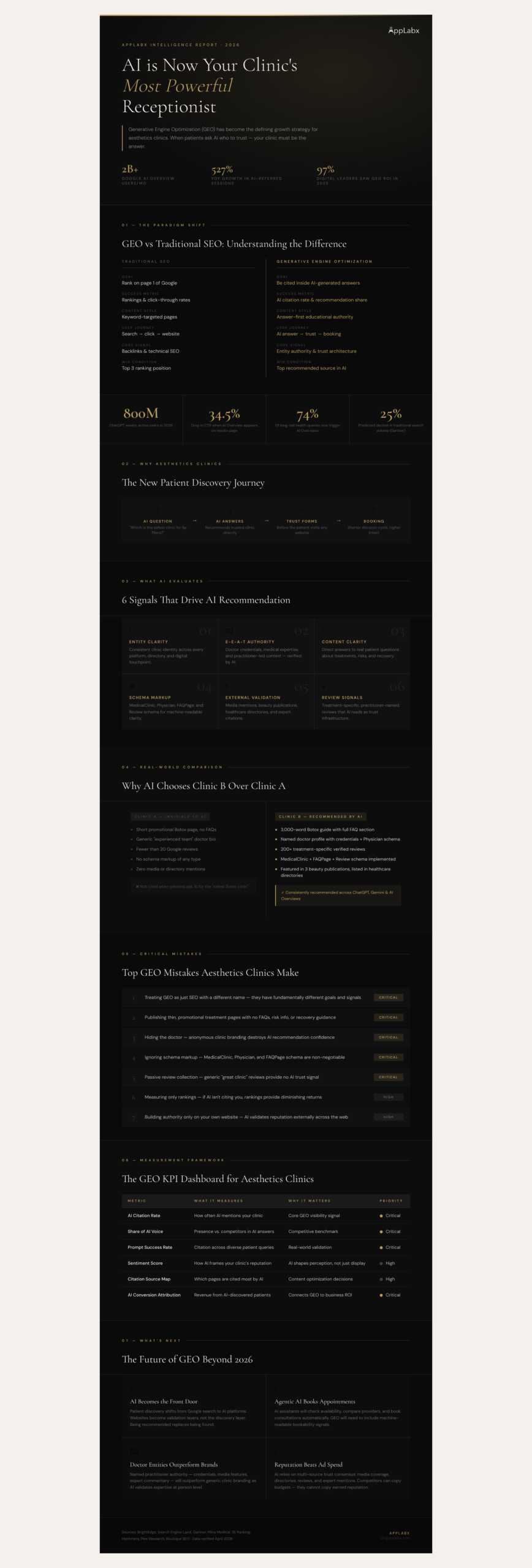
Instead of browsing through ten blue links on a search results page, they increasingly rely on AI-generated answers that recommend clinics directly. This shift is fundamentally transforming how visibility works for aesthetics clinics and why Generative Engine Optimization (GEO) has become one of the most important digital growth strategies in 2026.
Generative Engine Optimization, commonly known as GEO, refers to the process of optimizing a clinic’s digital presence so that AI-powered search systems can understand, trust, and recommend that clinic within generated answers.
Unlike traditional Search Engine Optimization (SEO), which focuses primarily on ranking a webpage higher on Google search results, GEO focuses on helping a clinic become the trusted source that AI engines choose to cite.
In simple terms, SEO helps a clinic rank on page one, while GEO helps a clinic become the answer itself. This distinction is critical because patients interacting with AI tools often never click through multiple websites—they simply trust the recommendation presented to them. Research and industry observations show that being mentioned inside an AI-generated answer can now be more valuable than being ranked third or even first in a traditional search result.
GEO therefore shifts the goal from clicks to citations, from rankings to recommendations, and from keywords to trust signals.
For aesthetics clinics, this change matters even more because aesthetic medicine is a trust-driven and high-consideration industry. Patients are not buying a low-risk commodity; they are making decisions that directly affect their appearance, confidence, and long-term wellbeing. Whether someone is considering lip fillers, jawline contouring, HIFU, microneedling, or a full skin rejuvenation programme, they want certainty, expertise, and reassurance before booking a consultation.
They compare doctors, study before-and-after results, read reviews, and seek validation from trusted sources. When an AI platform recommends a clinic, it acts almost like a digital referral—instantly transferring credibility. This makes GEO incredibly powerful because it positions a clinic not just as visible, but as trustworthy before the first consultation even happens. In a market where perception strongly influences conversion, this is a major competitive advantage.
Another reason GEO matters in 2026 is the increasing competition within the aesthetics industry. In major cities such as Singapore, Bangkok, Kuala Lumpur, Ho Chi Minh City, Dubai, London, and Sydney, patients are overwhelmed by choices. Many clinics offer similar treatments, similar promotions, and similar messaging. Traditional SEO often creates a race for rankings where clinics compete aggressively for the same keywords like “best Botox clinic” or “laser clinic near me.” GEO changes the battlefield.
AI systems do not simply rank based on keyword density—they evaluate clarity, expertise, authority, structured information, consistency across the web, and the overall trustworthiness of a brand. This means smaller clinics with strong expertise and well-structured digital authority can outperform larger competitors if they are better understood and trusted by AI systems. GEO rewards credibility, not just ad spend.
AI engines decide which clinics to recommend based on several powerful signals. They look for clear and direct answers to patient questions, detailed service pages, strong doctor profiles, accurate medical information, frequently updated educational content, and structured schema markup such as FAQPage, LocalBusiness, MedicalClinic, Review, and Physician schema.
They also rely heavily on third-party trust signals such as Google reviews, media mentions, beauty publication features, healthcare directory listings, and expert citations across the internet. In healthcare and aesthetics, Experience, Expertise, Authoritativeness, and Trustworthiness (E-E-A-T) are especially important because misinformation can directly affect patient safety. Clinics that invest in educational content, practitioner authority, and transparent service communication are far more likely to be selected by AI platforms than clinics relying only on sales-driven landing pages.
This is why many leading clinics are now treating GEO as an essential business strategy rather than a marketing experiment. GEO is no longer just about attracting traffic—it is about controlling how your clinic is represented inside the AI ecosystem. It determines whether your clinic is recommended when patients ask treatment questions, whether your doctors are perceived as experts, and whether your brand is trusted before someone even visits your website.
In 2026, clinics that ignore GEO risk becoming invisible inside the very platforms shaping patient decisions. Meanwhile, clinics that build strong AI visibility early gain compounding authority over time, making it increasingly difficult for competitors to catch up. The future of patient acquisition is not just search engine rankings—it is AI recommendation dominance.
Understanding what GEO is for aesthetics clinics and why it matters is therefore no longer optional. It is now a core part of sustainable clinic growth, patient trust building, and long-term competitive positioning. As AI becomes the first place patients ask for recommendations, the clinics that win will be the ones that AI chooses to trust first. GEO is not replacing SEO—it is becoming the next evolution of digital visibility. For aesthetics clinics aiming to grow in 2026 and beyond, mastering GEO is becoming just as important as delivering excellent clinical outcomes.
But, before we venture further, we like to share who we are and what we do.
About AppLabx
From developing a solid marketing plan to creating compelling content, optimizing for search engines, leveraging social media, and utilizing paid advertising, AppLabx offers a comprehensive suite of digital marketing services designed to drive growth and profitability for your business.
At AppLabx, we understand that no two businesses are alike. That’s why we take a personalized approach to every project, working closely with our clients to understand their unique needs and goals, and developing customized strategies to help them achieve success.
If you need a digital consultation, then send in an inquiry here.
Or, send an email to hello@applabx.co to get started.
What Is GEO for Aesthetics Clinics and Why It Matters in 2026
- What Is GEO (Generative Engine Optimization)?
- Why GEO Matters Specifically for Aesthetics Clinics
- How AI Platforms Choose Which Clinics to Recommend
- Core GEO Strategies for Aesthetics Clinics in 2026
- Common GEO Mistakes Aesthetic Clinics Make
- How to Measure GEO Success
- Future of GEO for Aesthetics Clinics Beyond 2026
- Why Working with a GEO Agency Matters
1. What Is GEO (Generative Engine Optimization)?
The rise of AI-powered search has changed how users discover businesses, services, and healthcare providers—including aesthetics clinics. Instead of browsing ten blue links on a traditional search engine results page, users increasingly ask conversational questions to platforms like ChatGPT, Google AI Overviews, Gemini, Perplexity, and Claude.
Questions such as “Which clinic is best for acne scar treatment?” or “What is the safest Botox clinic near me?” are now answered directly by AI-generated summaries rather than by users manually comparing websites.
This shift has created a new discipline known as Generative Engine Optimization (GEO).
GEO is not a replacement for traditional SEO—it is the next layer of visibility strategy. It focuses on helping businesses become the trusted source that AI systems cite, recommend, and reference inside generated answers.
For aesthetics clinics in 2026, understanding GEO is becoming essential because visibility is moving from rankings to recommendations.
Defining Generative Engine Optimization
Generative Engine Optimization (GEO) refers to the practice of optimizing digital content, structured data, and brand authority so that AI-powered search engines and large language models can accurately understand, trust, and cite that content within generated responses.
The term was formally introduced by researchers Yuning Gao, Zheng Liu, Yeyun Si, Yu Meng, Chenyan Xiong, and Ying Lin in the academic paper “GEO: Generative Engine Optimization” published in 2023. Their work described GEO as “a novel paradigm” for improving content visibility in generative engine responses and introduced GEO-Bench, a benchmark dataset containing 10,000 diverse queries for evaluating citation performance.
Unlike SEO, which focuses on achieving higher rankings in search engine result pages (SERPs), GEO focuses on improving inclusion inside AI-generated answers.
This means the success metric changes:
- SEO asks: “Did we rank on page one?”
- GEO asks: “Did AI choose us as the answer?”
This is a major strategic difference.
Why GEO Exists: The Shift from Search Results to AI Answers
Traditional search engines are built around ranking links.
Generative engines are built around synthesizing answers.
That distinction changes everything.
Search Engine Land reported that Google AI Overviews now reach more than 2 billion monthly users, ChatGPT serves approximately 800 million users weekly, and Perplexity processes hundreds of millions of queries monthly. Gartner also predicted traditional search volume would decline by 25% as users increasingly shift toward AI-powered answer engines.
Coursera also highlighted that when an AI Overview appears in search results, webpages experience an average 34.5% lower click-through rate compared to similar searches without an AI-generated summary.
This means businesses can lose visibility even when rankings remain strong.
If users receive their answer directly from AI, traffic depends less on rankings and more on whether your content is cited by the AI itself.
That is exactly where GEO becomes critical.
GEO vs Traditional SEO
Although GEO and SEO work together, they are fundamentally different in goals, signals, and outcomes.
GEO vs SEO Comparison Matrix
| Area | Traditional SEO | Generative Engine Optimization (GEO) |
|---|---|---|
| Primary Goal | Rank higher on SERPs | Be cited inside AI-generated answers |
| Success Metric | Rankings and clicks | Mentions, citations, recommendations |
| User Journey | Click → Visit Website | AI Answer → Trust → Decision |
| Core Focus | Keywords, backlinks, technical SEO | Entity authority, trust, clarity, structure |
| Content Style | Keyword-targeted pages | Answer-first educational content |
| Visibility Type | Search result listing | AI-generated summary inclusion |
| Winning Position | Top 3 rankings | Top cited source |
In simple terms:
SEO gets a clinic found.
GEO gets a clinic trusted enough to be recommended.
How GEO Works in Practice
AI systems do not randomly choose sources.
They evaluate patterns of authority, clarity, and trust.
Generative engines typically prioritize:
- Clear answers to user intent
- Structured information architecture
- Strong author and business entities
- Verified external trust signals
- Consistent business information across the web
- High E-E-A-T signals (Experience, Expertise, Authoritativeness, Trustworthiness)
- Schema markup for machine understanding
- Strong review and reputation signals
For healthcare and aesthetics clinics, this is especially important because these are “Your Money or Your Life” (YMYL) topics where trust standards are significantly higher.
A clinic with strong medical authority, practitioner expertise, FAQ schema, accurate treatment explanations, and verified review signals is more likely to be cited than a clinic with thin promotional landing pages.
Recent structural GEO research also found that content architecture matters significantly. A 2026 study on structural feature engineering for GEO reported that optimized structure improved citation rate by 17.3% and subjective content quality by 18.5% across six mainstream generative engines.
This proves that formatting and content design are not cosmetic—they directly influence AI citation behavior.
Core Components of GEO
Entity Authority
AI needs to understand who you are.
This includes:
- Clinic brand identity
- Doctor profiles
- Founder expertise
- Practitioner credentials
- Awards and recognitions
- Media mentions
- Third-party references
If the AI cannot confidently identify your authority, it is less likely to recommend you.
Content Clarity
AI prefers content that answers questions directly.
Examples include:
- “How long does Botox last?”
- “Is HIFU safe for sensitive skin?”
- “What is the downtime after fractional laser?”
Educational content outperforms vague promotional content because it gives AI usable answers.
Structured Data (Schema)
Schema helps AI understand page meaning faster.
Important schema types include:
- FAQPage
- LocalBusiness
- MedicalClinic
- Physician
- Review
- Organization
- Service
For aesthetics clinics, MedicalClinic + Physician schema is especially valuable.
External Validation
AI trusts consistency across the web.
This includes:
- Google Business Profile
- Healthcare directories
- Beauty publications
- Media coverage
- Review platforms
- Industry associations
Authority is not built only on your own website.
It is reinforced externally.
Real Example of GEO for an Aesthetics Clinic
Consider two clinics offering the same Botox treatment.
Clinic A
- Generic treatment page
- Minimal doctor profile
- No FAQ schema
- Few reviews
- No media mentions
- Thin educational content
Clinic B
- Detailed treatment explanation
- Doctor-led educational blog posts
- Strong before-and-after case content
- FAQ schema and Physician schema
- Verified reviews
- Mentions in beauty magazines and healthcare directories
When a patient asks ChatGPT:
“Which clinic is safest for Botox treatment?”
Clinic B is significantly more likely to be recommended because AI has stronger evidence to trust it.
This is GEO in action.
It is not about ranking higher.
It is about becoming the most trusted answer source.
GEO Performance Indicators
GEO requires different KPIs from traditional SEO.
GEO KPI Table
| Metric | What It Measures | Why It Matters |
|---|---|---|
| AI Citation Rate | How often AI mentions your clinic | Direct GEO visibility |
| Share of AI Voice | Presence compared to competitors | Competitive benchmarking |
| Citation Source Analysis | Which pages get cited most | Content strategy refinement |
| Entity Authority Growth | External mentions and trust signals | Long-term defensibility |
| AI Prompt Testing | Performance across prompts and engines | Real-world validation |
| Conversion Attribution | Leads influenced by AI discovery | Revenue impact |
This is why many brands now run dedicated GEO audits rather than relying only on SEO reports.
Why GEO Matters More in 2026 Than Ever Before
Business Insider reported BrightEdge research showing that Google AI Overviews were 44% more likely to express negative sentiment toward brands compared to ChatGPT.
This means AI is not just displaying information—it is shaping perception.
AI now has opinions.
That makes proactive GEO even more important.
ITPro also reported that 97% of digital leaders saw positive results from GEO in 2025, while 94% planned increased investment, showing that GEO is rapidly becoming a mainstream growth channel rather than an experimental tactic.
Major companies such as Adobe, Apple, Caterpillar, and Capital One have already started hiring dedicated GEO managers.
This signals where digital strategy is heading.
For aesthetics clinics, the same principle applies:
If AI influences trust before consultation, GEO influences revenue before the first call.
Final Perspective
Generative Engine Optimization is the strategic discipline of becoming the answer—not just appearing in search.
For aesthetics clinics, this means optimizing for trust, citations, and authority across AI ecosystems.
Traditional SEO helps users find your clinic.
GEO helps AI recommend your clinic.
In 2026, that distinction is becoming one of the most important competitive advantages in healthcare marketing.
The clinics that win will not simply be the ones ranking highest.
They will be the ones AI trusts first.
2. Why GEO Matters Specifically for Aesthetics Clinics
Aesthetics clinics operate in one of the most trust-sensitive and decision-intensive healthcare categories. Patients are not purchasing a simple commodity—they are making decisions that affect appearance, confidence, safety, and long-term wellbeing. Whether the treatment is Botox, dermal fillers, laser resurfacing, acne scar revision, HIFU, skin tightening, pigmentation correction, or facial contouring, the path to conversion is rarely impulsive.
In 2026, that decision journey increasingly begins inside AI platforms such as ChatGPT, Google AI Overviews, Gemini, Perplexity, and Claude.
Instead of searching “best Botox clinic near me” and reviewing ten websites manually, patients now ask conversational questions and expect direct recommendations. This changes how clinics earn visibility.
Traditional SEO helps clinics rank.
GEO helps clinics get recommended.
For aesthetics clinics, that distinction directly affects consultations, bookings, and revenue.
The Patient Discovery Journey Has Fundamentally Changed
The first reason GEO matters is simple: patients no longer begin with Google alone.
Healthcare-focused AI SEO research shows that users increasingly ask longer, natural-language recommendation queries such as:
- “Which clinic is best for acne scar treatment?”
- “Who is the safest injector for lip fillers?”
- “What clinic is trusted for HIFU near me?”
- “Which aesthetic doctor is best for skin tightening?”
Mina Medical notes that AI-powered search experiences now place the “answer” first, where sources are selected based on trust signals, clarity, and authority—not just keyword targeting.
This is especially important because in AI interfaces, patients often see fewer provider options. Being mentioned can become more valuable than ranking third on Google.
If a clinic is not present inside the AI-generated recommendation layer, it may become invisible before the patient even reaches the website.
This creates a new competitive battlefield.
Aesthetic Treatments Are High-Consideration, High-Trust Decisions
Unlike low-risk purchases, aesthetic procedures involve emotional, financial, and medical risk.
Patients typically evaluate:
- Practitioner qualifications
- Before-and-after outcomes
- Safety standards
- Downtime and recovery
- Complication risk
- Treatment suitability
- Clinic reputation
- Long-term results
This is why AI recommendation power is especially strong in aesthetics.
When AI mentions a clinic positively—especially with references to doctor expertise, credentials, or clinical outcomes—it creates immediate trust transfer.
Hashmeta’s healthcare GEO analysis specifically highlights that aesthetic clinics benefit disproportionately because AI-generated answers consolidate authority and reduce uncertainty for patients making high-consideration decisions.
In other words:
AI does not just drive discovery.
It accelerates trust.
That trust often determines who gets the consultation booking.
Local Competition Is Extremely Intense
In major cities such as Singapore, Bangkok, Kuala Lumpur, Dubai, Ho Chi Minh City, Sydney, and London, hundreds of clinics compete for the same patients.
Many clinics offer:
- Similar services
- Similar pricing promotions
- Similar social media marketing
- Similar website messaging
- Similar local SEO strategies
Traditional local SEO often becomes a battle of proximity and paid visibility.
GEO changes that.
AI systems can recommend clinics based on:
- Specialisation depth
- Doctor authority
- Content expertise
- Procedure-specific trust signals
- External validation
- Reputation strength
This means a smaller but highly authoritative clinic can outperform a larger competitor if AI trusts it more.
Hashmeta specifically notes that AI can recommend clinics based on expertise rather than just physical proximity, making GEO a major opportunity for specialist clinics.
This is especially powerful for clinics known for one treatment category such as acne scars, thread lifts, injectables, or regenerative aesthetics.
Procedure-Specific Expertise Wins More Than Generic Branding
Patients do not usually ask:
“Show me any clinic.”
They ask:
- “Best clinic for acne scars”
- “Safest clinic for fillers”
- “Doctor for jawline contouring”
- “Best clinic for melasma treatment”
This means generic clinic branding is often weaker than procedure-specific authority.
AI systems identify topic depth.
They reward clinics with:
- Detailed treatment guides
- Doctor-led educational content
- FAQ-rich service pages
- Clear risk explanations
- Transparent candidacy guidance
- Strong treatment-specific review signals
For example:
A clinic with a comprehensive 3,000-word guide on acne scar treatment, doctor commentary, FAQ schema, and clinical before-and-after case education is more likely to be cited than a clinic with only a short promotional landing page.
Hashmeta specifically recommends comprehensive treatment guides and reports that statistics, expert quotes, and structured educational content can improve AI visibility significantly.
Specialisation becomes a ranking signal for trust.
Healthcare Is a YMYL Industry, Which Raises AI Trust Standards
Aesthetics sits inside healthcare’s “Your Money or Your Life” (YMYL) category.
This means platforms apply much stricter trust expectations.
AI systems prioritize:
- Medical accuracy
- Verified expertise
- Clinical authority
- Consistent practitioner identity
- Reliable review signals
- Balanced language over exaggerated marketing
Aesthetic Medical Practitioner explains that answer engines favor content with clear structure, factual balance, and clinically aligned explanations, while exaggerated promotional phrasing reduces visibility.
This is critical because many clinic websites still rely heavily on:
- aggressive sales language
- unrealistic claims
- vague benefit statements
- thin treatment pages
These pages often perform poorly for GEO.
AI prefers explanation over promotion.
This is why educational authority becomes more valuable than advertising claims.
AI Recommendation Can Influence Revenue Before Website Traffic Happens
In traditional SEO:
traffic → trust → consultation → revenue
In GEO:
AI recommendation → trust → consultation → revenue
The trust stage moves earlier.
This means a clinic may win or lose a patient before the patient ever clicks the website.
That is a major commercial shift.
Google AI Overviews and answer engines create more zero-click behavior where users receive enough information without visiting multiple pages.
As answer engines grow, clinics that depend only on ranking-based traffic face increasing risk.
If the clinic is not cited inside the answer layer, visibility drops even if rankings remain strong.
This is why GEO is not just a content strategy.
It is a revenue protection strategy.
Why GEO Is Especially Powerful for Reputation-Led Clinics
Some clinics win because of advertising.
The strongest clinics win because of reputation.
GEO amplifies reputation-led growth because AI relies heavily on:
- Google reviews
- Media mentions
- Directory consistency
- Expert interviews
- Practitioner citations
- Brand authority signals
This means clinics with strong real-world trust can outperform high-spend competitors.
A doctor who is frequently quoted in beauty media, appears on educational panels, and maintains strong patient review quality builds stronger AI visibility than a clinic relying only on paid campaigns.
AI trusts signals from the broader ecosystem—not just your own website.
This makes GEO particularly effective for premium clinics positioning themselves around expertise rather than discounts.
Why GEO Matters for Aesthetics Clinics: Strategic Impact Matrix
| Business Area | Traditional SEO Impact | GEO Impact |
|---|---|---|
| Clinic Discovery | Higher Google rankings | Direct AI recommendations |
| Patient Trust | Website evaluation after click | Trust formed before click |
| Local Competition | Proximity + keyword battle | Expertise + authority battle |
| Treatment Positioning | Broad clinic visibility | Procedure-specific recommendation |
| Conversion Path | Click-first journey | Recommendation-first journey |
| Reputation Building | Helpful but secondary | Core ranking signal |
| Doctor Authority | Often underused | Major AI trust factor |
| Long-Term Defensibility | Ranking volatility | Compounding authority advantage |
Real Example: Botox Search Scenario
Imagine two clinics offering the same Botox treatment.
Clinic A
- Short promotional Botox page
- Minimal doctor profile
- Few reviews
- No FAQ schema
- No medical publication mentions
Clinic B
- Detailed Botox treatment guide
- Doctor-led educational articles
- FAQPage + Physician schema
- Strong review profile
- Beauty publication mentions
- Clear injector credentials
When a patient asks:
“Which clinic is safest for Botox treatment?”
Clinic B is far more likely to be recommended by AI systems because it presents stronger evidence of trust.
This is the real business case for GEO.
It is not about ranking first.
It is about becoming the answer patients trust first.
The Clinics That Start GEO Early Gain Compounding Advantage
Authority compounds.
The earlier a clinic builds:
- trusted content
- practitioner authority
- structured schema
- review strength
- third-party credibility
- entity consistency
…the harder it becomes for competitors to catch up.
GEO is not a short-term campaign.
It is a long-term market position.
For aesthetics clinics in 2026, the clinics that dominate AI recommendations over the next three years will likely be the ones that started building authority today.
The future of patient acquisition is not just search rankings.
It is AI recommendation dominance.
That is why GEO matters specifically—and urgently—for aesthetics clinics.
3. How AI Platforms Choose Which Clinics to Recommend
When a patient asks ChatGPT, Google AI Overviews, Gemini, Perplexity, or Claude a question such as “Which clinic is best for Botox?” or “Who is the safest doctor for acne scar treatment?”, the AI does not randomly select a clinic.
It evaluates signals.
These systems analyze trust, authority, clarity, consistency, reputation, and structured information before deciding which clinics deserve to be cited or recommended.
For aesthetics clinics, understanding these decision factors is critical because recommendation visibility often matters more than traditional rankings. In AI-powered search, patients may only see a few suggested providers. If your clinic is not selected, it may effectively disappear from the patient journey before they even visit your website.
This is why Generative Engine Optimization (GEO) is becoming one of the most important growth strategies for clinics in 2026.
AI Platforms Prioritize Entity Clarity First
Before an AI platform can recommend a clinic, it must understand exactly who the clinic is.
This is called entity clarity.
Google and AI systems increasingly evaluate businesses as entities rather than as isolated webpages. They want to understand:
- Clinic name
- Doctor names
- Medical specialties
- Service categories
- Location
- Licensing and credentials
- Brand reputation
- Relationships between practitioners and services
If the clinic’s identity is inconsistent across the web, AI confidence decreases.
For example:
If a clinic uses different business names across its website, Google Business Profile, review platforms, and healthcare directories, the AI may struggle to verify trust.
Boutique SEO’s 2026 aesthetics clinic research specifically notes that “entity-based optimisation is replacing keyword-based tactics,” and clinics that cannot clearly communicate who provides treatment, what qualifications they hold, and what outcomes they specialize in are filtered out of AI-powered search results.
This means AI first asks:
“Do I clearly understand this clinic?”
Before it asks:
“Should I recommend this clinic?”
E-E-A-T Is a Core Recommendation Filter
Healthcare and aesthetics are part of Google’s YMYL (Your Money or Your Life) category.
That means Experience, Expertise, Authoritativeness, and Trustworthiness (E-E-A-T) become non-negotiable.
AI systems strongly prioritize:
- Verified doctor expertise
- Practitioner credentials
- Real clinical experience
- Medical authority
- Transparent treatment explanations
- Accurate healthcare information
- Responsible risk communication
Thin landing pages with aggressive marketing language perform poorly compared to medically structured educational content.
Mina Medical’s 2026 healthcare AI SEO guide explains that in medical SEO, AI systems prefer sources that are “clear and structured,” aligned to intent, trustworthy, and consistent with real-world clinic identity.
This is especially important for aesthetics clinics because patients are making appearance-changing and often expensive decisions.
A clinic with:
- detailed physician bios
- medical certifications
- hospital affiliations
- procedure-specific expertise
- published education content
…will be trusted far more than a clinic with only promotional sales copy.
E-E-A-T Trust Matrix for Aesthetic Clinics
| Signal Type | Weak Signal | Strong Signal |
|---|---|---|
| Doctor Profile | Short generic bio | Credential-rich quotable profile |
| Content Style | Sales-heavy page | Educational treatment guide |
| Reviews | Few unverified testimonials | Strong verified patient reviews |
| Clinical Authority | No external mentions | Media features + expert citations |
| Risk Transparency | Only benefits listed | Risks + recovery clearly explained |
| Service Expertise | Broad vague service list | Deep procedure-specific authority |
AI Prefers Clear Answers to Real Patient Questions
AI platforms are designed to answer questions.
They reward clinics that make those answers easy to extract.
This means content should directly address patient intent such as:
- How long does Botox last?
- Is HIFU painful?
- What is the downtime after CO2 laser?
- Is acne scar treatment permanent?
- Who is a good candidate for fillers?
Digital Aesthetics notes that AI tools prefer:
- clear procedure pages
- FAQ sections
- patient stories
- structured headings
- conversational language
- answers written in natural language
Overly vague marketing statements like “We deliver world-class beauty transformation” provide little usable information for AI systems.
By contrast:
“What to expect after HIFU treatment: downtime, swelling, and results timeline”
…is highly usable for AI extraction.
The more directly your content answers patient intent, the more likely it becomes a source for AI-generated recommendations.
Structured Data Helps AI Understand Page Meaning Faster
AI can read content without schema markup, but schema dramatically reduces ambiguity.
Schema tells machines exactly what something is.
For aesthetics clinics, the most important schema types include:
- MedicalClinic
- Physician
- LocalBusiness
- FAQPage
- Review
- Service
- Organization
- AggregateRating
This helps AI understand:
- who provides the treatment
- which doctor performs it
- where the clinic is located
- what services are offered
- how patients rate the clinic
Mina Medical specifically recommends MedicalClinic + Physician + FAQPage schema as high-priority implementation areas for AI visibility.
This matters because AI recommendation confidence increases when interpretation becomes easier.
High-Impact Schema Table
| Schema Type | Why AI Uses It |
|---|---|
| MedicalClinic | Confirms healthcare provider identity |
| Physician | Validates practitioner authority |
| FAQPage | Extracts direct patient answers |
| Review | Reinforces reputation and trust |
| LocalBusiness | Supports local recommendation accuracy |
| Service | Clarifies exact treatment offerings |
Schema does not replace authority.
It helps AI recognize authority faster.
External Trust Signals Matter Beyond Your Website
AI platforms do not trust only what your clinic says about itself.
They validate your reputation externally.
Perplexity healthcare citation research shows that medical practices need strong visibility on the directories and platforms AI engines actually pull from.
This includes:
- Google Business Profile
- Yelp
- Healthgrades
- RealSelf
- Beauty publication mentions
- Industry association listings
- Healthcare directories
- Local press coverage
- Third-party expert interviews
DoctorRank specifically highlights that Perplexity AI often pulls provider information from trusted directories rather than directly from clinic websites alone.
This means reputation is ecosystem-wide.
A clinic with strong website content but weak external trust signals may still lose recommendation visibility.
AI asks:
“Does the broader internet trust this clinic too?”
before recommending it.
Reviews Strongly Influence Recommendation Confidence
Reviews are not just for human conversion.
They are machine trust signals.
AI systems evaluate:
- review quality
- review volume
- review consistency
- treatment-specific review context
- sentiment strength
For example:
A clinic with repeated verified reviews mentioning:
- natural-looking Botox results
- safe filler experience
- excellent acne scar treatment outcomes
…builds stronger recommendation confidence than a clinic with only generic “great service” reviews.
AI increasingly evaluates sentiment patterns.
BrightEdge research reported that Google AI Overviews were 44% more likely to express negative sentiment toward brands compared to ChatGPT, showing that AI systems actively shape brand perception rather than merely displaying information.
This means reputation management directly affects discoverability.
AI is not just indexing reputation.
It is interpreting it.
Local Relevance Still Matters—But Not Alone
Location still matters for clinics.
Patients ask:
- best clinic near me
- Botox clinic in Singapore
- acne scar doctor in Bangkok
- HIFU clinic in Ho Chi Minh City
But local relevance is now combined with expertise signals.
Mina Medical identifies three query categories AI rewards most:
- recommendation queries
- condition or symptom queries
- location and availability queries
This means “near me” alone is not enough.
The winning clinic must also show:
- procedure-specific authority
- local trust
- availability clarity
- doctor credibility
A clinic that is nearby but weak in expertise signals may lose to a slightly farther clinic with stronger authority.
This is why GEO is not simply local SEO.
It is local trust optimization.
Real Example: How AI Chooses Between Two Botox Clinics
Clinic A
- Generic Botox landing page
- No FAQ schema
- Minimal doctor profile
- Few patient reviews
- Weak directory presence
- No media mentions
Clinic B
- Comprehensive Botox treatment guide
- FAQPage + Physician schema
- Doctor-led content explaining risks and outcomes
- Strong injector credentials
- Verified reviews mentioning Botox specifically
- Mentions in beauty publications
- Strong Google Business Profile consistency
Patient prompt:
“Which clinic is safest for Botox treatment?”
AI recommendation outcome:
Clinic B is significantly more likely to be cited because it provides stronger evidence across every trust layer.
This is how recommendation logic works.
It is not based on who claims to be best.
It is based on who proves it most clearly.
AI Recommendation Priority Matrix
| Priority Layer | What AI Evaluates | Why It Matters |
|---|---|---|
| Entity Clarity | Identity consistency | Prevents ambiguity |
| E-E-A-T | Medical trustworthiness | Critical for YMYL |
| Content Quality | Direct answers to questions | Enables citation extraction |
| Schema Markup | Machine-readable structure | Faster understanding |
| External Validation | Third-party trust | Reputation verification |
| Reviews | Sentiment + proof | Confidence reinforcement |
| Local Relevance | Geography + availability | Conversion practicality |
Clinics that strengthen all layers outperform clinics that focus only on rankings.
Final Perspective
AI platforms choose clinics the same way patients do—through trust, proof, and clarity.
The difference is that AI evaluates those signals at scale and instantly.
For aesthetics clinics in 2026, recommendation visibility depends on becoming the most credible, structured, and verifiable answer source.
The question is no longer:
“How do we rank higher?”
The real question is:
“Why should AI trust us enough to recommend us first?”
That is the foundation of GEO—and the clinics that answer it best will dominate patient acquisition in the AI-first era.
4. Core GEO Strategies for Aesthetics Clinics in 2026
In 2026, aesthetics clinics can no longer rely on traditional SEO alone to drive consultations and bookings. Patients are increasingly discovering providers through AI-generated answers from platforms like ChatGPT, Google AI Overviews, Gemini, Perplexity, and Claude. These systems do not simply rank webpages—they select trusted sources and recommend clinics directly.
This means the strategic objective has changed.
The goal is no longer just ranking on page one.
The goal is becoming the clinic AI trusts enough to recommend first.
This is where Generative Engine Optimization (GEO) becomes critical.
For aesthetics clinics, effective GEO requires a structured system built around authority, education, technical clarity, patient trust, and strong entity signals. Clinics that implement these strategies early create a compounding competitive advantage that becomes harder for competitors to replicate over time.
Google AI Overviews now appear for a significant share of health-related informational searches, and healthcare-focused GEO studies show AI Overviews trigger for 73.9% of long-tail health queries and 66.9% of informational health queries, making AI visibility a direct patient acquisition channel.
Build AI-Friendly Treatment Pages for Every Core Service
The most important GEO strategy is creating deep, structured, treatment-specific pages rather than relying on generic service pages.
AI systems prefer pages that answer specific patient questions clearly.
Patients ask:
- Which clinic is best for acne scar treatment?
- Is HIFU safe for sensitive skin?
- How long does Botox last?
- What is the downtime after CO2 laser?
- Is filler reversal possible?
A generic “Aesthetic Treatments” page cannot compete with dedicated, comprehensive pages built around one treatment and one intent.
Each major service should have its own page, including:
- Botox
- Dermal fillers
- Skin tightening
- HIFU
- Thread lifts
- Acne scar treatment
- Laser resurfacing
- Pigmentation correction
- Facial contouring
- Anti-ageing programs
Each page should include:
- treatment overview
- candidacy guidance
- benefits and limitations
- recovery expectations
- risks and side effects
- FAQs
- doctor commentary
- before-and-after education
- transparent consultation guidance
Healthcare AI search guidance shows FAQPage schema on treatment pages directly improves Google AI Overview sourcing, especially when questions match real patient search behavior.
Service Page Quality Matrix
| Page Type | Weak GEO Version | Strong GEO Version |
|---|---|---|
| Botox Page | Short promotional copy | Full treatment guide with FAQs |
| Acne Scar Page | General clinic page mention | Dedicated scar treatment education hub |
| HIFU Page | Sales-focused benefits only | Risks, recovery, candidacy, results |
| Filler Page | Before/after images only | Medical explanation + doctor insights |
| Laser Page | Treatment name only | Clinical comparison + suitability guide |
The strongest clinics do not sell treatments first.
They answer patient concerns first.
Create Doctor-Led Educational Content That AI Can Cite
AI platforms strongly favor educational content over promotional content.
They want answers.
This makes doctor-led content one of the highest ROI GEO strategies.
Instead of writing:
“We offer premium Botox treatments”
clinics should publish:
- How Botox works medically
- Botox myths vs facts
- Botox vs fillers comparison
- How long Botox lasts by treatment area
- Signs of overfilled lips and prevention
- HIFU vs Ultherapy: what patients should know
Mina Medical and healthcare GEO studies consistently show that AI engines prioritize educational Q&A structures, physician-authored explanations, and expert commentary over thin marketing pages.
This improves:
- citation probability
- perceived authority
- practitioner trust
- consultation quality
- conversion rates
High-Value Content Types for GEO
| Content Type | Why It Performs Well |
|---|---|
| FAQ Articles | Direct answer extraction |
| Comparison Guides | Strong patient intent match |
| Recovery Guides | High-conversion informational content |
| Myth vs Fact Articles | Trust-building + educational |
| Doctor Commentary Posts | Strong E-E-A-T signal |
| Treatment Candidacy Guides | High consultation intent |
The best-performing clinics often build a content ecosystem around treatment decisions rather than a sales funnel around promotions.
Strengthen Doctor Entity Authority
In aesthetics, patients often trust doctors before they trust clinics.
AI platforms do the same.
This makes doctor entity optimization essential.
Every practitioner should have a strong standalone authority profile including:
- full credentials
- certifications
- years of experience
- treatment specialization
- speaking engagements
- awards
- medical publications
- interviews
- expert commentary
- media mentions
- professional memberships
Healthcare GEO guidance confirms that Physician schema and named-author authority significantly improve recommendation confidence in medical YMYL categories.
Doctor Authority Signal Matrix
| Signal | Weak Example | Strong Example |
|---|---|---|
| Doctor Bio | “10 years experience” | Full credentials + specialties |
| Authority | No external mentions | Media interviews + expert quotes |
| Content Ownership | Anonymous blog post | Named physician authorship |
| Trust Signals | Internal claims only | Third-party recognition |
| Schema | None | Physician schema implemented |
Patients book doctors.
AI recommends experts.
Not anonymous brands.
Implement Medical Schema for Faster AI Understanding
Schema markup is one of the most powerful technical GEO strategies because it helps AI understand your clinic faster and more accurately.
Schema tells machines:
- who you are
- what services you provide
- who performs them
- where you are located
- why patients trust you
For aesthetics clinics, the highest priority schema types are:
- MedicalClinic
- Physician
- FAQPage
- Review
- Service
- LocalBusiness
- Organization
- AggregateRating
Schema.org defines Schema.org MedicalClinic as the dedicated healthcare entity for medical providers, making it significantly stronger than generic business markup for aesthetics clinics.
Medical SEO guidance also notes FAQPage schema is frequently used by Google AI Overviews as a direct answer source.
Priority Schema Implementation Table
| Page Type | Primary Schema | Secondary Schema |
|---|---|---|
| Homepage | MedicalClinic | LocalBusiness |
| Doctor Profile | Physician | Person |
| Botox Page | Service | FAQPage |
| Acne Scar Page | Service | Review |
| Blog Post | Article | FAQPage |
| Location Page | MedicalClinic | GeoCoordinates |
Schema does not create trust.
It helps AI detect trust faster.
Dominate Local GEO Signals, Not Just Local SEO
Location still matters because patients ask:
- best Botox clinic near me
- acne scar clinic in Singapore
- HIFU clinic in Ho Chi Minh City
- best injector in Bangkok
But AI no longer recommends based on location alone.
It combines local relevance with expertise.
Clinics must optimize:
- Google Business Profile
- NAP consistency
- location pages
- review quality
- service-level local relevance
- availability clarity
- practitioner association with location
One healthcare SEO case study reported that 70% of patients still search for providers within 10 miles of home, proving local trust remains central even in AI-first search.
This means the winning clinic is not just nearby.
It is nearby and trusted.
Build a Review System That Creates AI Trust
Reviews are no longer just for conversion.
They are machine-readable trust signals.
AI platforms evaluate:
- review volume
- review freshness
- treatment-specific mentions
- sentiment consistency
- practitioner-specific praise
Instead of generic reviews like:
“Great clinic”
clinics need review depth like:
- safe Botox experience
- natural filler outcomes
- excellent acne scar results
- strong aftercare process
- trusted injector communication
These treatment-specific reviews improve both human trust and AI recommendation strength.
BrightEdge research found AI-generated summaries can shape brand sentiment directly, making reputation management part of discoverability—not just conversion.
Review Strategy Framework
| Weak Review Strategy | Strong GEO Review Strategy |
|---|---|
| Random generic reviews | Treatment-specific review requests |
| No doctor mention | Practitioner-specific review context |
| Passive review collection | Active post-treatment review workflow |
| Old review profile | Consistent fresh review velocity |
Reviews are not proof of popularity.
They are proof of trust.
Earn Third-Party Authority Mentions
AI does not trust only what your clinic says.
It validates reputation externally.
This includes:
- beauty publications
- medical interviews
- skincare media
- expert commentary
- healthcare directories
- speaking panels
- industry awards
- podcasts
- reputable clinic lists
If a doctor is quoted repeatedly as an expert in aesthetics publications, AI confidence increases significantly.
This is why PR and authority building are now part of GEO—not separate from it.
External trust signals create recommendation defensibility.
Competitors can copy webpages.
They cannot easily copy reputation.
Use GEO Performance Tracking Instead of SEO-Only Reporting
Traditional SEO reporting is not enough.
Clinics need GEO-specific measurement.
This includes:
- AI citation rate
- share of AI voice
- prompt testing
- competitor citation comparison
- source page citation analysis
- conversion attribution from AI-assisted discovery
Example prompt testing includes:
- Best Botox clinic in Singapore
- Safest clinic for fillers near me
- Top acne scar clinic in Bangkok
The question is simple:
Does AI mention your clinic?
If not, GEO strategy is incomplete.
GEO KPI Framework
| Metric | Why It Matters |
|---|---|
| AI Citation Rate | Direct visibility inside AI answers |
| Share of AI Voice | Competitive benchmarking |
| Prompt Success Rate | Real-world performance validation |
| Source Citation Mapping | Identifies best-performing content |
| Consultation Attribution | Revenue tracking from AI discovery |
The future KPI is not ranking position.
It is recommendation frequency.
Strategic GEO Execution Matrix for Aesthetics Clinics
| Strategy | Revenue Impact | Difficulty | Priority |
|---|---|---|---|
| Treatment-Specific Pages | Very High | Medium | Critical |
| Doctor Authority Building | Very High | Medium | Critical |
| FAQ + Schema Implementation | High | Low | Critical |
| Review System Optimization | Very High | Medium | Critical |
| Local GEO Signals | High | Medium | High |
| Third-Party Authority Mentions | High | High | High |
| AI Citation Tracking | Medium | Medium | High |
Clinics should start with the highest trust-return activities first, not the most complex technical projects.
Final Perspective
The best GEO strategy for aesthetics clinics is simple in principle:
be the clearest, safest, most trustworthy answer.
AI platforms reward clinics that prove expertise rather than claim it.
They prioritize education over promotion, authority over advertising, and consistency over noise.
In 2026, the clinics that dominate patient acquisition will not necessarily be the clinics spending the most on ads.
They will be the clinics AI trusts enough to recommend first.
That is the real purpose of GEO.
5. Common GEO Mistakes Aesthetic Clinics Make
Many aesthetics clinics are investing heavily in SEO, paid advertising, influencer campaigns, and social media visibility, yet they still fail to appear in ChatGPT, Google AI Overviews, Gemini, Perplexity, and other AI-generated recommendation engines.
The reason is often simple: they are optimizing for rankings, not recommendations.
Generative Engine Optimization (GEO) requires a different mindset. AI platforms evaluate trust, clarity, expertise, structure, and entity authority—not just keywords or traffic volume.
A clinic may rank well on Google and still be invisible inside AI-generated answers.
This is where many clinics make expensive mistakes.
Clear to Launch notes that healthcare practices commonly fail to appear in AI recommendations because their digital presence is not built around clarity, authority, and trust. In AI-driven discovery, “excellent care” alone is not enough if the internet cannot prove it clearly.
For aesthetics clinics in 2026, avoiding GEO mistakes is often more important than adding new tactics. Fixing visibility blockers creates faster gains than simply producing more content.
Treating GEO as Just Traditional SEO with a New Name
One of the biggest mistakes clinics make is assuming GEO is simply “SEO with AI branding.”
It is not.
Traditional SEO focuses on:
- rankings
- backlinks
- keyword targeting
- click-through rates
GEO focuses on:
- citation inclusion
- recommendation visibility
- answer extraction
- entity authority
- trust verification
A clinic may rank first for “Botox clinic near me” and still not be recommended when a patient asks ChatGPT:
“Which clinic is safest for Botox treatment?”
This happens because AI systems prioritize proof of expertise over ranking position.
Wikipedia’s GEO overview notes that GEO is designed specifically for improving visibility in AI-generated responses rather than conventional search rankings, shifting the goal from “appearing” to “being cited.”
SEO vs GEO Misalignment Table
| Area | Traditional SEO Focus | GEO Focus |
|---|---|---|
| Success Metric | Rankings | AI citations |
| User Journey | Click → Website | AI answer → Trust |
| Primary Asset | Keywords | Authority |
| Winning Signal | Position | Recommendation |
| Conversion Trigger | Search click | AI trust transfer |
Clinics that ignore this difference often spend months optimizing the wrong signals.
Publishing Thin, Generic Treatment Pages
Many clinics create weak service pages like:
- “Premium Botox Treatments”
- “Advanced Fillers”
- “Skin Rejuvenation Services”
These pages are often short, promotional, and offer little real educational value.
AI systems struggle to use them because they do not answer actual patient questions.
Boutique SEO specifically warns that if a patient wants Botox information, they should land on a Botox page that explains everything clearly—not fragmented pages with weak structure or vague service summaries. They also emphasize that poor page architecture hurts both user trust and search performance.
Weak treatment pages usually lack:
- candidacy explanations
- downtime expectations
- risks and side effects
- FAQ sections
- doctor commentary
- recovery guidance
- treatment comparisons
AI prefers:
“What to expect after HIFU treatment”
over
“Luxury HIFU solutions for radiant beauty”
because the first provides extractable answers.
Treatment Page Quality Matrix
| Weak Page | Strong GEO Page |
|---|---|
| Promotional headline only | Full treatment education |
| No FAQs | FAQ-rich structure |
| No recovery details | Downtime + recovery guide |
| Generic claims | Procedure-specific explanations |
| No doctor perspective | Physician commentary included |
Thin pages are one of the fastest ways to disappear from AI recommendations.
Weak Doctor Authority and Missing Physician Identity
Many clinics market the brand but hide the doctor.
This is a major GEO failure.
Patients trust practitioners.
AI does too.
Healthcare content sits inside YMYL (Your Money or Your Life) standards, meaning expertise and medical authority are critical.
If your clinic has:
- weak doctor bios
- anonymous blog posts
- no qualifications shown
- no external physician recognition
…AI confidence drops significantly.
Mina Medical’s healthcare GEO guide emphasizes that AI systems strongly favor physician-led content, strong practitioner identity, and clear medical authority signals in healthcare recommendations.
Weak doctor visibility creates distrust because AI cannot verify who is responsible for treatment quality.
Doctor Authority Mistake Table
| Weak Signal | Strong Signal |
|---|---|
| Short generic bio | Full credentials + specialization |
| Anonymous content | Named doctor authorship |
| No media presence | External interviews + expert mentions |
| No schema | Physician schema implemented |
| Clinic-only branding | Doctor-led authority building |
A clinic without visible medical authority often loses to a smaller clinic with stronger doctor credibility.
Overusing Promotional Language and Underusing Educational Content
Aesthetic clinics often write like advertisers.
AI prefers educators.
Pages full of phrases like:
- world-class beauty transformation
- luxury anti-ageing experience
- premium aesthetic excellence
…provide little usable information.
Answer engines prioritize:
- clarity
- directness
- factual explanation
- balanced medical language
Wikipedia’s AEO documentation highlights that AI-driven systems favor structured, concise answers and question-focused content over vague marketing language.
Patients ask:
- Is HIFU painful?
- Can filler be reversed?
- How long does Botox last?
They do not ask:
“Who offers the most luxurious aesthetic transformation?”
Educational authority wins.
Sales-heavy language loses.
This mistake is especially damaging in aesthetics because trust depends on safety, not excitement.
Ignoring Structured Data and Schema Markup
Some clinics still treat schema as optional.
In GEO, it is foundational.
Schema helps AI understand:
- who your clinic is
- what services you provide
- which doctor performs them
- where you are located
- why patients trust you
Without schema, AI must infer meaning.
That increases ambiguity.
High-priority schema for aesthetics clinics includes:
- MedicalClinic
- Physician
- FAQPage
- Service
- Review
- LocalBusiness
- AggregateRating
Google AI Overviews and healthcare-focused AI visibility guides repeatedly emphasize FAQ schema and healthcare entity markup because they improve machine readability and answer extraction.
Missing Schema Risk Table
| Missing Schema | GEO Consequence |
|---|---|
| No Physician schema | Weak doctor trust |
| No FAQPage schema | Lower answer extraction |
| No Review schema | Reduced reputation proof |
| No MedicalClinic schema | Weak healthcare identity |
| No Service schema | Poor treatment understanding |
Schema does not create trust.
It helps AI detect trust faster.
Inconsistent Clinic Information Across the Web
A common mistake is inconsistent business identity across platforms.
Examples include:
- different clinic names
- inconsistent addresses
- outdated doctor lists
- conflicting service descriptions
- wrong operating hours
- mismatched phone numbers
AI engines compare information across:
- website
- Google Business Profile
- directories
- healthcare listings
- review platforms
- third-party publications
If details conflict, trust drops.
AI begins to question credibility.
This is especially damaging for local recommendation prompts like:
“Best filler clinic near me”
because location trust is part of recommendation confidence.
Entity clarity is not optional.
It is a prerequisite for recommendation.
Neglecting Review Strategy and Reputation Signals
Many clinics collect reviews passively and inconsistently.
That is a GEO mistake.
AI uses reviews as trust infrastructure.
Weak review strategy includes:
- generic reviews only
- outdated review profile
- no doctor mentions
- no treatment-specific detail
- inconsistent review velocity
Strong review strategy includes:
- Botox-specific outcomes
- filler experience details
- doctor-specific praise
- fresh monthly review flow
- strong Google Business consistency
BrightEdge research discussed across AI search reporting shows that AI systems increasingly shape brand sentiment rather than simply displaying it, meaning review quality affects discoverability as much as conversion.
Review Mistake Matrix
| Weak Review Strategy | Strong GEO Strategy |
|---|---|
| “Great clinic” only | Specific treatment outcome reviews |
| No doctor names | Practitioner-specific feedback |
| Old review history | Fresh ongoing review flow |
| Passive collection | Structured post-treatment review system |
Reviews are not just social proof.
They are recommendation fuel.
Focusing Only on the Clinic Website and Ignoring External Authority
Some clinics believe GEO is solved entirely on-site.
It is not.
AI validates authority externally.
It checks:
- beauty publication mentions
- medical interviews
- expert commentary
- healthcare directories
- industry awards
- local press coverage
- professional associations
A clinic that says it is trusted is weaker than a clinic others describe as trusted.
External reputation matters more than self-promotion.
This is why PR, expert positioning, and authority mentions are now part of GEO—not separate from it.
Competitors can copy webpages.
They cannot easily copy reputation.
Measuring Only Rankings Instead of AI Citation Visibility
Perhaps the most dangerous mistake is tracking the wrong KPI.
Many clinics still ask:
“Did we rank higher?”
The better question is:
“Did AI recommend us?”
Academic GEO research published in 2026 found that citation-focused optimization improved citation rates by over 40% relative improvement while modifying only 5% of content, proving that visibility in generative systems depends on citation mechanics—not generic SEO assumptions.
Clinics should track:
- AI citation rate
- share of AI voice
- prompt testing
- source page citation analysis
- competitor comparison
- AI-assisted consultation attribution
Wrong KPI vs Right KPI Table
| Outdated KPI | Better GEO KPI |
|---|---|
| Rankings | AI citation rate |
| Organic traffic | Recommendation visibility |
| Keyword position | Share of AI voice |
| Blog traffic | Prompt success rate |
| Click-through rate | AI-assisted lead attribution |
The future of visibility is recommendation frequency, not ranking screenshots.
Strategic GEO Mistake Severity Matrix
| Mistake | Revenue Risk | Fix Difficulty | Priority |
|---|---|---|---|
| Thin treatment pages | Very High | Medium | Critical |
| Weak doctor authority | Very High | Medium | Critical |
| No schema markup | High | Low | Critical |
| Review neglect | Very High | Medium | Critical |
| Inconsistent entity data | High | Low | High |
| Over-promotional content | High | Low | High |
| No external authority building | High | High | High |
| Wrong KPI tracking | Medium | Low | High |
Most clinics do not fail because GEO is too complex.
They fail because they keep optimizing yesterday’s system.
Final Perspective
The most common GEO mistakes in aesthetics clinics are not technical—they are strategic.
They happen when clinics prioritize marketing language over medical clarity, rankings over recommendations, and visibility over trust.
AI platforms recommend clinics the same way patients choose them:
through expertise, consistency, reputation, and proof.
The clinics that remove these mistakes earliest gain the strongest long-term advantage.
In 2026, the biggest GEO risk is not doing it badly.
It is assuming traditional SEO is still enough.
6. How to Measure GEO Success
One of the biggest mistakes businesses make in 2026 is trying to measure Generative Engine Optimization (GEO) using traditional SEO metrics alone.
Rankings, clicks, impressions, and organic sessions still matter—but they are no longer enough.
In AI-powered discovery environments like ChatGPT, Google AI Overviews, Gemini, Perplexity, and Claude, visibility often happens before a click. A patient may receive a clinic recommendation, trust that answer, and book a consultation without ever browsing multiple search results.
This means the measurement model must change.
The question is no longer:
“Did we rank?”
The real question is:
“Did AI recommend us?”
For aesthetics clinics, GEO success must be measured through citation visibility, AI recommendation frequency, trust signals, and consultation impact—not just traditional traffic reports.
SE Ranking’s 2026 GEO analysis states clearly that the most critical GEO metrics are brand share of voice, citation frequency, and sentiment because GEO focuses on how often AI recommends your brand in answers rather than just how often users click through.
This is where dedicated platforms such as the GEO Audit Tool by AppLabx become highly valuable. Instead of relying only on old SEO dashboards, clinics need purpose-built GEO visibility tracking across multiple AI platforms to understand how AI sees, cites, and recommends their brand.
AI Citation Rate: The Most Important GEO KPI
The single most important GEO metric is AI Citation Rate.
This measures how often your clinic is cited, mentioned, or recommended inside AI-generated answers across platforms such as:
- ChatGPT
- Google AI Overviews
- Google Gemini
- Perplexity AI
- Claude
Example prompts include:
- Best Botox clinic near me
- Safest clinic for lip fillers
- Top acne scar clinic in Singapore
- Best HIFU clinic in Bangkok
- Most trusted anti-ageing clinic in Ho Chi Minh City
If your clinic is not mentioned in those recommendation flows, rankings alone provide limited commercial value.
Recent academic research from “Diagnosing and Repairing Citation Failures in Generative Engine Optimization” found that targeted citation optimization improved citation rates by over 40% relative improvement while modifying only 5% of content, proving that citation—not general visibility—is the real performance driver in GEO.
AI Citation Rate Framework
| Measurement Area | Example |
|---|---|
| Prompt Category | Botox, fillers, acne scars |
| Platform Coverage | ChatGPT, Gemini, Perplexity |
| Citation Frequency | 6 mentions in 20 prompts |
| Citation Position | Primary recommendation vs secondary mention |
| Citation Quality | Positive, neutral, negative framing |
This is the first KPI the GEO Audit Tool by AppLabx should monitor continuously.
Because if AI never cites your clinic, the rest of the strategy is incomplete.
Share of AI Voice Against Competitors
Traditional SEO tracks keyword rankings.
GEO tracks Share of AI Voice.
This measures how often your clinic appears compared to competing clinics when patients ask AI for recommendations.
Example:
Prompt:
“Best Botox clinic in Singapore”
Results:
- Clinic A appears 42% of the time
- Clinic B appears 28%
- Your clinic appears 9%
This is a competitive visibility problem—not a traffic problem.
SE Ranking identifies brand share of voice as one of the most important GEO metrics because recommendation frequency across competitors directly determines market visibility in AI search.
Share of AI Voice Matrix
| Clinic | Citation Frequency | Visibility Strength |
|---|---|---|
| Competitor A | 42% | Dominant |
| Competitor B | 28% | Strong |
| Your Clinic | 9% | Weak |
| Others | 21% | Fragmented |
This helps clinics stop guessing.
Instead of asking “Why are leads slower?”
they can ask:
“Why is AI recommending competitors more often?”
The GEO Audit Tool by AppLabx is particularly useful here because it allows clinics to benchmark against real competitors rather than relying on assumptions.
Prompt Testing Across Multiple AI Platforms
GEO performance is prompt-dependent.
A clinic may perform well for:
“Best acne scar clinic”
but poorly for:
“Safest laser resurfacing clinic”
This is why prompt testing is essential.
You must test:
- commercial prompts
- comparison prompts
- safety-focused prompts
- treatment-specific prompts
- local discovery prompts
- doctor recommendation prompts
You must also test across multiple engines because citation behavior differs significantly.
Recent research on AI answer engine citation behavior found that different engines prioritize different source ecosystems, meaning the same clinic may perform differently across Perplexity, Gemini, and Google AI Overviews depending on structure, freshness, and authority signals.
Prompt Testing Categories
| Prompt Type | Example |
|---|---|
| Recommendation | Best filler clinic near me |
| Safety | Safest Botox clinic |
| Comparison | HIFU vs Ultherapy clinic |
| Local Intent | Acne scar clinic in Bangkok |
| Doctor Authority | Best injector for jawline filler |
The GEO Audit Tool by AppLabx should be used to test prompts regularly, not once.
AI visibility changes constantly.
Measurement must be continuous.
Citation Source Analysis: Which Pages AI Actually Uses
Many clinics assume their homepage drives AI recommendations.
Often, it does not.
AI may cite:
- FAQ pages
- doctor profiles
- treatment pages
- blog articles
- review pages
- media interviews
Citation Source Analysis identifies which specific pages are influencing AI recommendations most often.
This helps clinics answer:
- Which page is driving our Botox visibility?
- Which doctor profile gets cited most?
- Which article influences acne scar consultations?
Structural GEO research published in 2026 found that content architecture improvements increased citation rate by 17.3% and subjective quality by 18.5%, showing that structure strongly affects which pages AI selects.
Citation Source Table
| Page Type | Citation Strength |
|---|---|
| Botox FAQ Page | Very High |
| Doctor Profile | High |
| Acne Scar Guide | Very High |
| Homepage | Medium |
| Pricing Page | Low |
This is one of the most valuable diagnostic areas inside the GEO Audit Tool by AppLabx because it helps clinics scale what is already working.
Sentiment Analysis of AI Recommendations
Being mentioned is not enough.
How AI talks about your clinic matters.
SE Ranking lists sentiment as a core GEO metric because citation quality influences trust, not just visibility.
Example:
Positive:
“This clinic is known for safe, natural-looking Botox outcomes.”
Neutral:
“This clinic offers Botox services.”
Negative:
“This clinic has mixed reviews regarding filler outcomes.”
These are very different commercial outcomes.
AI can shape perception before the consultation happens.
This means clinics must track:
- positive sentiment
- neutral mentions
- negative framing
- review-driven reputation shifts
Sentiment is revenue.
Not just branding.
Conversion Attribution from AI Discovery
The most important business question is:
Did GEO generate revenue?
This requires attribution.
Clinics should track:
- consultation forms mentioning ChatGPT
- leads influenced by AI discovery
- “How did you hear about us?” data
- AI-assisted branded searches
- consultation quality improvement
- patient trust speed during sales calls
SE Ranking also highlights redirection from AI engines and AI-driven discovery patterns as critical performance indicators because GEO success must connect to real business outcomes, not only visibility metrics.
GEO Revenue Attribution Framework
| Metric | Business Meaning |
|---|---|
| AI-assisted leads | New discovery channel |
| Consultation quality | Higher trust before contact |
| Faster conversion | Reduced decision friction |
| Higher-value patients | Better intent quality |
| Lower acquisition cost | Reduced paid dependency |
This is where GEO becomes a boardroom conversation—not just a marketing report.
The GEO Audit Tool by AppLabx should connect visibility data to conversion outcomes, making GEO measurable at revenue level.
Review Signal Monitoring
Reviews are a major trust layer in AI recommendation systems.
Clinics should track:
- treatment-specific review mentions
- practitioner-specific review quality
- review freshness
- review consistency
- negative review clusters
Example:
Repeated reviews mentioning:
- safe Botox
- natural filler results
- excellent acne scar outcomes
…increase recommendation confidence significantly.
Reviews are not only for Google Maps.
They are machine trust signals for AI recommendation systems.
Review analysis should therefore be part of GEO reporting.
Not a separate reputation workflow.
Entity Authority Growth Tracking
AI platforms recommend entities they trust.
That means clinics should measure authority growth across:
- doctor mentions in media
- beauty publication citations
- medical interviews
- expert commentary
- directory consistency
- brand mentions across trusted domains
This is often a stronger long-term GEO signal than short-term traffic.
Because AI trusts reputation ecosystems—not just websites.
The GEO Audit Tool by AppLabx should monitor this authority expansion across the wider internet, not only on-site content.
Why Single-Run GEO Reporting Is Dangerous
One major challenge in GEO measurement is that AI systems are non-deterministic.
The same prompt asked twice can generate different answers.
Academic research on AI visibility measurement found that citation rankings are unstable across repeated samples and that single-run visibility metrics can be misleading. The study recommends repeated sampling and confidence intervals rather than one-time reporting.
This means:
One prompt test is not enough.
You need:
- repeated testing
- multiple time windows
- cross-platform comparison
- statistical consistency
Reliable GEO measurement requires systems, not screenshots.
This is another reason why tools like the GEO Audit Tool by AppLabx are essential for serious clinic operators.
GEO KPI Dashboard for Aesthetic Clinics
| KPI | Why It Matters | Priority |
|---|---|---|
| AI Citation Rate | Direct recommendation visibility | Critical |
| Share of AI Voice | Competitive benchmarking | Critical |
| Prompt Success Rate | Real-world AI testing | Critical |
| Citation Source Analysis | Content optimization decisions | High |
| Sentiment Score | Trust and brand perception | High |
| Conversion Attribution | Revenue impact | Critical |
| Review Signal Strength | Machine trust reinforcement | High |
| Entity Authority Growth | Long-term defensibility | High |
This is the modern visibility dashboard.
Not rankings alone.
Final Perspective
You cannot improve what you do not measure.
In GEO, success is not defined by rankings, impressions, or blue-link traffic alone.
It is defined by recommendation visibility.
For aesthetics clinics in 2026, the winning question is:
“When patients ask AI who to trust—does our clinic appear?”
That answer must be measurable.
The GEO Audit Tool by AppLabx exists precisely for this reason: to help clinics move from guesswork to evidence, from rankings to recommendations, and from SEO reporting to true AI visibility intelligence.
Because in the AI-first era, the most valuable metric is not traffic.
It is trust at the moment of recommendation.
7. Future of GEO for Aesthetics Clinics Beyond 2026
The future of aesthetics clinic marketing will not be defined by who ranks highest on Google alone. It will be defined by who artificial intelligence trusts enough to recommend, compare, and eventually book automatically.
Generative Engine Optimization (GEO) is not a short-term trend. It is becoming the permanent infrastructure of patient acquisition in the AI-first healthcare economy.
As platforms like ChatGPT, Google AI Overviews, Gemini, Perplexity, and Claude evolve from answer engines into decision engines, aesthetics clinics will compete not only for visibility but for machine trust.
Patients are already shifting behavior rapidly.
Wikipedia’s GEO overview reports that AI-referred web sessions grew 527% year-over-year in the first five months of 2025, while ChatGPT processed approximately 2.5 billion prompts per day and Perplexity processed 780 million queries monthly. Google AI Overviews also expanded across more than 200 countries and territories. Most importantly, Pew Research found that when AI summaries appeared, only 8% of users clicked through to source websites compared to 15% when no AI summary was present. This confirms that the future of visibility is moving from traffic to recommendation.
For aesthetics clinics, this means GEO is not simply a marketing strategy for 2026.
It is the foundation of competitive survival beyond 2026.
The GEO Audit Tool by AppLabx becomes increasingly important in this environment because clinics will need continuous visibility intelligence across multiple AI ecosystems—not just occasional SEO reporting.
AI Search Will Become the New Front Door for Patient Acquisition
Traditionally, the patient journey looked like this:
Google search → website visit → consultation → booking
Beyond 2026, it increasingly becomes:
AI question → AI recommendation → trust → booking
The website becomes a validation layer, not the discovery layer.
Patients will ask:
- Best clinic for Botox near me
- Safest clinic for acne scar treatment
- Best injector for jawline filler
- Top anti-ageing clinic in Singapore
…and expect AI to shortlist the answer.
Tenacious Marketing’s 2026 GEO analysis explains that customers are now using AI to compare options, evaluate credibility across multiple sources, and click fewer links because recommendations feel pre-verified. GEO becomes the system that ensures your clinic is selected during that decision moment.
This means the “homepage first” era is ending.
Recommendation-first discovery is becoming the default.
Clinics using the GEO Audit Tool by AppLabx can track exactly how often they are entering that AI recommendation layer before competitors do.
AI Assistants Will Move from Recommending to Booking
One of the most important shifts beyond 2026 is the rise of agentic AI.
AI assistants will not only answer:
“Which clinic is best?”
They will also execute:
“Book me a consultation for Friday afternoon.”
Industry analysis already highlights the transition toward AI booking agents that can check availability, compare providers, schedule appointments, and complete patient workflows directly.
This means clinics will compete not just for visibility, but for machine-readable bookability.
Tenacious Marketing specifically notes that AI assistants are moving toward:
- appointment booking
- scheduling
- deposits and payments
- pre-screening
- post-care follow-up
- CRM synchronization
This changes the purpose of GEO.
The goal is no longer just being cited.
The goal becomes being cited and instantly bookable.
Future Booking Readiness Matrix
| Current State | Future AI-Ready State |
|---|---|
| Contact form only | Direct AI-assisted scheduling |
| Manual consultation booking | AI availability checking |
| Static treatment pages | Dynamic treatment + booking integration |
| Generic chatbot | Agentic patient journey execution |
| Delayed conversion path | Recommendation-to-booking immediacy |
The GEO Audit Tool by AppLabx will increasingly need to monitor both recommendation visibility and AI conversion readiness.
Because if AI recommends your clinic but cannot complete the booking path, visibility becomes wasted opportunity.
Doctor Entities Will Become More Valuable Than Brand Entities
Today, many clinics focus primarily on clinic branding.
Beyond 2026, doctor authority will become even more powerful.
Patients trust practitioners.
AI systems do too.
Future recommendation systems will prioritize:
- physician authority
- clinical outcomes
- specialist expertise
- named expert commentary
- practitioner trust ecosystems
rather than broad generic clinic branding.
Fuel Online’s 2026 aesthetics industry analysis highlights that AI-led discovery requires practices to optimize for entity authority, including surgeon credentials, board certifications, clinical history, and professional recognition across the knowledge graph.
This means:
“Dr. X is the expert for acne scars”
will outperform:
“Our clinic offers acne scar treatments”
because authority is easier for AI to validate when attached to a person.
Future Authority Shift Table
| Legacy Model | Future GEO Model |
|---|---|
| Clinic brand first | Doctor authority first |
| Generic clinic expertise | Named practitioner expertise |
| Broad service marketing | Procedure-specific authority |
| Internal claims | External medical validation |
The GEO Audit Tool by AppLabx should therefore track practitioner-level citation visibility, not just clinic-level brand mentions.
Reputation Systems Will Become Stronger Ranking Engines Than Paid Ads
Paid advertising creates visibility.
Reputation creates recommendation.
Beyond 2026, AI systems will increasingly rely on:
- review ecosystems
- doctor mentions
- expert interviews
- media coverage
- beauty publication citations
- trusted healthcare directories
- professional associations
rather than paid ad visibility.
AI trusts third-party validation more than self-promotion.
This creates a major strategic shift for premium clinics.
Clinics with stronger authority ecosystems will outperform clinics with larger ad budgets.
Tenacious Marketing describes this as “multi-source consensus,” where AI is more likely to cite brands reinforced across multiple trusted sources rather than a single clinic website.
This means PR, expert positioning, and authority mentions become long-term ranking assets.
Competitors can copy ad spend.
They cannot easily copy trust ecosystems.
The GEO Audit Tool by AppLabx helps clinics measure this authority growth across the wider internet.
GEO Will Become a Core Revenue Channel, Not a Supporting Channel
In many clinics today, SEO is treated as support.
Beyond 2026, GEO becomes a direct revenue driver.
This happens because:
AI recommendation → patient trust → shorter decision cycle → higher conversion quality
Instead of:
Traffic → education → nurturing → delayed conversion
Fuel Online’s aesthetics industry analysis emphasizes that practices are moving away from vanity metrics and toward lead-to-consultation attribution because high-value medical decisions increasingly begin inside AI systems rather than traditional search paths.
This changes leadership conversations.
The question becomes:
“How much revenue did AI recommendations generate?”
not
“How much traffic did SEO produce?”
GEO Revenue Evolution Table
| Old KPI | Future KPI |
|---|---|
| Organic traffic | AI-assisted consultation volume |
| Keyword rankings | Recommendation share of voice |
| CTR | AI citation rate |
| Blog traffic | Recommendation conversion quality |
| Lead volume | Revenue per AI-discovered patient |
The GEO Audit Tool by AppLabx is especially valuable here because it helps translate recommendation visibility into measurable commercial outcomes.
This makes GEO a C-suite decision, not just a marketing report.
AI Visibility Will Require Continuous Monitoring, Not One-Time SEO Campaigns
Traditional SEO often works in campaigns.
GEO works as a living system.
Because AI systems are probabilistic and constantly changing, visibility can shift rapidly.
A clinic cited this month may disappear next month if:
- competitor authority improves
- reviews change
- content freshness declines
- AI retrieval sources evolve
- schema consistency breaks
Wikipedia’s GEO analysis notes that retrieval-augmented generation, reranking, and probabilistic citation selection create new optimization challenges with no direct equivalent in traditional SEO.
This means static audits are insufficient.
Continuous monitoring becomes mandatory.
GEO Management Model
| Old SEO Workflow | Future GEO Workflow |
|---|---|
| Quarterly reporting | Continuous AI visibility tracking |
| Static ranking checks | Live citation monitoring |
| Backlink reporting | Recommendation intelligence |
| Traffic analysis | Multi-engine citation diagnostics |
This is exactly why the GEO Audit Tool by AppLabx becomes central to long-term strategy.
Without continuous diagnostics, clinics are operating blind.
Compliance, Trust, and Medical Accuracy Will Matter Even More
Healthcare AI systems are becoming more regulated and trust-sensitive.
The international FUTURE-AI healthcare consensus guidelines emphasize trustworthy, deployable AI systems in medicine built around transparency, reliability, and accountability.
This means aesthetics clinics will face stronger scrutiny for:
- exaggerated claims
- misleading treatment promises
- poor medical transparency
- weak practitioner verification
- inconsistent patient safety communication
Future GEO winners will not be the loudest marketers.
They will be the most trustworthy operators.
Medical accuracy becomes a ranking factor.
Ethical communication becomes discoverability infrastructure.
Clinics that build trust-first content now will have major defensibility later.
Strategic Future GEO Matrix for Aesthetics Clinics
| Strategic Area | Importance Beyond 2026 | Competitive Impact |
|---|---|---|
| AI Recommendation Visibility | Critical | Direct patient discovery |
| AI Booking Readiness | Critical | Faster consultation conversion |
| Doctor Entity Authority | Critical | Stronger trust + citations |
| External Reputation Ecosystem | Very High | Long-term defensibility |
| Continuous GEO Monitoring | Critical | Stability across engines |
| Compliance + Trust Signals | Very High | Healthcare recommendation safety |
| Revenue Attribution | Critical | Executive investment decisions |
The clinics that treat GEO as infrastructure—not content marketing—will dominate.
Why GEO Audit Tool by AppLabx Matters for the Future
The future of GEO is too dynamic for spreadsheets and manual prompt testing alone.
Clinics need:
- AI citation tracking
- share of AI voice monitoring
- doctor authority visibility reporting
- competitor benchmarking
- prompt testing across engines
- sentiment analysis
- recommendation source analysis
- AI-assisted revenue attribution
The GEO Audit Tool by AppLabx provides the operational system needed for that future.
It helps clinics move from:
guessing visibility
to
measuring recommendation dominance.
In the years beyond 2026, clinics that rely only on rankings will fall behind clinics that understand recommendation intelligence.
That gap will widen every year.
Final Perspective
The future of aesthetics clinic marketing is not about ranking pages.
It is about becoming the answer AI trusts first.
Beyond 2026, the strongest clinics will be the ones that:
- own doctor authority
- dominate treatment expertise
- control reputation ecosystems
- become machine-readable
- enable AI-assisted booking
- measure recommendation visibility continuously
GEO is not replacing SEO.
It is becoming the strategic layer above it.
And for aesthetics clinics, the winners will not simply be the most visible clinics.
They will be the most recommendable clinics.
That future starts now—and the GEO Audit Tool by AppLabx is one of the clearest ways to measure whether a clinic is ready for it.
8. Why Working with a GEO Agency Matters
In 2026, aesthetics clinics are facing a major shift in how patients discover, evaluate, and choose providers. Traditional SEO still matters, but it is no longer enough.
Patients increasingly ask AI platforms like ChatGPT, Google AI Overviews, Gemini, Perplexity, and Claude questions such as:
- Best Botox clinic near me
- Safest clinic for fillers
- Top acne scar treatment clinic in Singapore
- Best doctor for HIFU treatment
These systems do not simply display rankings. They generate recommendations.
This means clinics are no longer competing only for clicks—they are competing for citations, recommendations, and machine trust.
That is where working with a specialist GEO agency becomes critical.
First Page Sage explains that effective GEO requires combining multiple disciplines including SEO, PR, review management, content strategy, and authority building because AI recommendation systems evaluate much more than keywords. Their 2026 GEO agency research specifically notes that the best agencies focus on helping brands get recommended by ChatGPT, Gemini, and Perplexity—not just rank on Google.
For aesthetics clinics, where trust, reputation, and medical authority directly influence revenue, working with the right GEO agency is often the difference between being discovered and being invisible.
This is also where platforms like the GEO Audit Tool by AppLabx become highly valuable—because clinics need measurable AI visibility intelligence, not assumptions.
GEO Requires More Than Traditional SEO Expertise
Many clinics assume their current SEO agency can simply “add GEO.”
This is often a costly mistake.
Traditional SEO focuses on:
- rankings
- backlinks
- technical optimization
- click-through rates
- organic traffic
GEO focuses on:
- AI citation visibility
- answer engine optimization
- entity authority
- recommendation frequency
- review and trust ecosystems
- structured knowledge signals
- multi-platform AI visibility
These are not the same skill sets.
DesignRush’s 2026 GEO industry guide highlights that the difference between SEO and GEO is fundamental: SEO helps websites rank on search result pages, while GEO helps brands appear inside AI-generated answers where users may never click a website at all. They also report that most GEO agency retainers range between $2,000 and $15,000+ per month depending on scope and strategic complexity.
SEO Agency vs GEO Agency Comparison Matrix
| Area | Traditional SEO Agency | GEO Agency |
|---|---|---|
| Primary Goal | Rankings | AI recommendations |
| Success Metric | Organic traffic | AI citation rate |
| Core Strategy | Keywords + backlinks | Authority + trust + structure |
| Visibility Channel | SERPs | ChatGPT, Gemini, Perplexity |
| Reputation Management | Secondary | Core strategy |
| Entity Optimization | Limited | Critical |
A strong GEO agency understands how large language models retrieve, interpret, and trust content—not just how Google ranks pages.
Aesthetics Clinics Need Healthcare-Specific GEO Expertise
Aesthetics clinics are not ordinary businesses.
They operate in a high-trust, healthcare-adjacent environment where decisions affect appearance, safety, confidence, and medical outcomes.
This places clinics inside YMYL (Your Money or Your Life) search standards, where AI systems apply stricter trust filters.
Patients want proof of:
- doctor expertise
- treatment safety
- complication management
- practitioner reputation
- recovery expectations
- real patient outcomes
A general marketing agency may optimize traffic.
A GEO agency with healthcare understanding optimizes trust.
Position Digital’s 2026 GEO agency analysis emphasizes that industry specialization matters heavily when choosing a GEO partner. Agencies that understand medical trust signals, authority requirements, and reputation-sensitive categories perform significantly better than generalist providers.
This is especially important for aesthetics clinics where poor positioning can damage not only visibility but also patient confidence.
GEO Agencies Build Systems, Not Just Content
Many clinics think GEO means “write more blogs.”
That is incomplete.
Strong GEO agencies build full recommendation systems across:
- treatment pages
- physician authority
- FAQ architecture
- review strategy
- PR and media mentions
- structured schema
- citation monitoring
- local entity consistency
- AI prompt testing
- competitive share of voice
Stackmatix’s 2026 GEO services guide explains that strong GEO agencies work across authority building, citation optimization, entity-rich language, and passage-level optimization because LLMs often pull specific sections rather than evaluating an entire website as a whole.
This means success depends on operational structure, not isolated content projects.
GEO Agency Service Framework
| Service Layer | Purpose |
|---|---|
| AI Visibility Audit | Identify current citation gaps |
| Treatment Page Optimization | Improve recommendation eligibility |
| Doctor Authority Building | Strengthen practitioner trust |
| Schema + Technical GEO | Improve machine understanding |
| Review Strategy | Build trust signals |
| Third-Party Authority | Strengthen external validation |
| AI Prompt Testing | Validate real recommendation performance |
| Competitor Benchmarking | Measure share of AI voice |
The GEO Audit Tool by AppLabx plays a major role here because it helps clinics measure these layers continuously instead of relying on guesswork.
AI Visibility Must Be Measured Continuously
One of the biggest reasons clinics need a GEO agency is because AI visibility is unstable.
Unlike traditional rankings, AI recommendations can change quickly based on:
- content freshness
- review sentiment
- competitor authority changes
- retrieval updates
- schema changes
- citation source behavior
Academic research from “Diagnosing and Repairing Citation Failures in Generative Engine Optimization” found that targeted GEO interventions improved citation rates by more than 40% relative improvement while changing only 5% of content. This proves that precision matters more than volume.
Another 2026 study, “AgenticGEO,” showed that adaptive optimization outperformed fixed strategies across multiple engines and datasets, reinforcing that GEO requires continuous refinement rather than static one-time campaigns.
This is why clinics need:
- repeated prompt testing
- live citation monitoring
- cross-platform diagnostics
- recommendation trend analysis
The GEO Audit Tool by AppLabx is designed for exactly this purpose.
Without this measurement, clinics are managing AI visibility blindly.
Faster Execution Means Faster Competitive Advantage
Authority compounds.
The earlier a clinic strengthens:
- treatment expertise
- physician authority
- external reputation
- structured trust signals
- AI recommendation visibility
…the harder it becomes for competitors to catch up.
Go Fish Digital’s 2026 GEO agency evaluation emphasizes that agencies with proven GEO systems create measurable advantages because they understand exactly where and how brands increase inclusion in AI-generated answers using custom-built analysis rather than guesswork.
This means working with a GEO agency is not just about outsourcing.
It is about speed.
Speed matters because first movers build stronger AI trust ecosystems that become increasingly defensible.
First-Mover Advantage Matrix
| Early GEO Action | Long-Term Advantage |
|---|---|
| Strong doctor entity building | Durable trust leadership |
| Review system optimization | Stronger AI recommendation confidence |
| FAQ + treatment depth | Better answer extraction |
| Media authority building | Reputation moat |
| Continuous citation tracking | Faster optimization cycles |
Clinics that start early gain compounding authority.
Clinics that delay often pay more later just to catch up.
GEO Agencies Connect Visibility to Revenue
Many clinics still judge marketing by:
- rankings
- traffic
- impressions
These are incomplete.
The real question is:
Did AI recommendations generate consultations?
Revenue-focused GEO agencies track:
- AI citation rate
- consultation attribution
- branded search lift
- prompt conversion impact
- patient trust acceleration
- consultation close quality
SeoProfy’s 2026 GEO agency review highlights that the strongest agencies are those that tie GEO directly to revenue and pipeline metrics rather than vanity visibility reports. Their analysis specifically praises firms focused on AI referral tracking and revenue attribution rather than rankings alone.
This is where the GEO Audit Tool by AppLabx becomes especially powerful because it connects recommendation visibility with real business outcomes.
Old KPI vs New GEO KPI Table
| Old KPI | Better GEO KPI |
|---|---|
| Keyword ranking | AI citation rate |
| Organic sessions | AI-assisted consultations |
| CTR | Recommendation frequency |
| Blog traffic | Revenue per AI-discovered lead |
| Impression volume | Share of AI voice |
This moves GEO from a marketing experiment to a business growth system.
Why In-House Teams Often Struggle Without a GEO Partner
Even strong internal marketing teams struggle with GEO because the field is changing too quickly.
Challenges include:
- unclear AI retrieval systems
- non-deterministic recommendation behavior
- cross-platform testing complexity
- technical schema implementation
- entity optimization strategy
- physician reputation architecture
- AI visibility reporting
Most clinics do not have:
- dedicated GEO strategists
- answer engine testing systems
- AI citation diagnostics
- cross-engine monitoring infrastructure
A GEO agency provides both expertise and operating systems.
It shortens the learning curve and reduces expensive trial-and-error.
This is especially important for clinics where every missed consultation has high revenue implications.
Strategic Value Matrix: Why GEO Agency Partnership Matters
| Business Need | Internal Team Alone | GEO Agency Advantage |
|---|---|---|
| AI Citation Visibility | Limited visibility | Full cross-platform monitoring |
| Doctor Authority Strategy | Often inconsistent | Structured expert positioning |
| Technical GEO Execution | Slow implementation | Specialist execution speed |
| Competitor Benchmarking | Manual guesswork | Real AI share-of-voice tracking |
| Revenue Attribution | Weak AI measurement | Consultation-linked reporting |
| Future Readiness | Reactive | Proactive strategic control |
The goal is not simply outsourcing work.
It is building recommendation dominance.
Why GEO Audit Tool by AppLabx Strengthens Agency Execution
Even the best GEO strategy fails without measurement.
The GEO Audit Tool by AppLabx helps agencies and clinics track:
- AI citation frequency
- recommendation visibility
- prompt testing performance
- competitor comparison
- practitioner authority mentions
- sentiment analysis
- citation source mapping
- revenue attribution
This turns GEO from opinion into evidence.
Instead of asking:
“Do we think we are improving?”
clinics can ask:
“Where exactly are we being recommended, and where are we losing?”
That level of clarity creates better decisions, faster execution, and stronger ROI.
Final Perspective
Working with a GEO agency matters because the rules of patient acquisition have changed.
Aesthetics clinics are no longer competing only for rankings.
They are competing for trust inside AI recommendation systems.
That requires:
- healthcare-specific authority strategy
- doctor entity optimization
- structured trust systems
- continuous visibility measurement
- competitive recommendation intelligence
A strong GEO agency brings the expertise, systems, and speed needed to win that environment.
And with tools like the GEO Audit Tool by AppLabx, clinics can move from passive SEO reporting to active recommendation dominance.
In 2026 and beyond, the clinics that win will not simply be the most visible.
They will be the most trusted answers AI chooses first.
Conclusion
Generative Engine Optimization (GEO) is no longer a future concept for aesthetics clinics—it is already shaping how patients discover, evaluate, and choose providers in 2026.
The traditional model of patient acquisition, where people searched Google, compared multiple websites, read reviews manually, and eventually booked a consultation, is changing rapidly. Today, many patients begin with a direct question to AI platforms such as ChatGPT, Google AI Overviews, Gemini, Perplexity, and Claude. They ask who the safest injector is, which clinic is best for acne scar treatment, where to get the most trusted Botox treatment, or which doctor has the strongest reputation for facial contouring. Instead of reviewing ten blue links, they increasingly trust the AI-generated recommendation placed in front of them first.
This shift changes everything.
Visibility is no longer only about ranking on search engines. It is about becoming the clinic that artificial intelligence trusts enough to cite, recommend, and eventually help patients book. GEO sits at the centre of that transformation.
As industry research shows, AI-referred web sessions grew by 527% year-over-year in early 2025, Google AI Overviews expanded across more than 200 countries, and Pew Research found that when AI summaries appeared, only 8% of users clicked through to source websites compared to 15% when no AI summary was present. This proves that patient decision-making is moving from clicks to answers, and from rankings to recommendations.
For aesthetics clinics, this matters even more because aesthetic medicine is a trust-driven, high-consideration category. Patients are not making casual purchases—they are making decisions about appearance, confidence, safety, and long-term wellbeing. Whether the service is Botox, fillers, HIFU, acne scar revision, laser resurfacing, pigmentation correction, or regenerative aesthetics, trust is the strongest conversion driver. AI recommendation acts like a digital referral. If the system trusts your clinic, patients often trust it faster too.
That is why GEO is fundamentally different from traditional SEO.
SEO helps people find your clinic.
GEO helps AI choose your clinic.
This requires much more than keywords and rankings. It requires entity clarity, doctor authority, structured treatment pages, FAQ architecture, schema markup, review systems, strong Google Business signals, third-party reputation, medical accuracy, and consistent trust signals across the wider internet. It also requires moving away from promotional content and toward educational, medically responsible, answer-first content that AI can confidently use.
The clinics that will dominate beyond 2026 are not necessarily the ones spending the most on paid ads. They will be the clinics that are easiest for AI to trust.
They will have:
- strong practitioner authority
- treatment-specific expertise
- review ecosystems that reinforce outcomes
- external validation from trusted sources
- machine-readable structure across their digital presence
- continuous GEO monitoring and competitive visibility intelligence
This is why working with a specialist GEO agency becomes increasingly important. Most traditional SEO agencies are still optimising for rankings alone, while modern patient acquisition requires recommendation visibility across AI ecosystems. A proper GEO strategy demands healthcare-specific expertise, physician authority building, technical schema implementation, answer engine optimization, and continuous prompt testing across platforms.
This is also where the GEO Audit Tool by AppLabx becomes especially valuable.
In the AI-first era, clinics cannot rely on assumptions. They need measurable intelligence around:
- AI citation rate
- share of AI voice
- prompt testing performance
- competitor recommendation frequency
- doctor authority visibility
- sentiment analysis
- review signal strength
- revenue attribution from AI-assisted discovery
Without this level of measurement, clinics are operating blindly.
The GEO Audit Tool by AppLabx helps aesthetics clinics move from traditional SEO reporting to true recommendation intelligence. Instead of asking “Did we rank?” clinics can ask the far more important question: “When patients ask AI who to trust, do we appear first?”
That question defines growth in 2026 and beyond.
The future of aesthetics clinic marketing is not just about visibility.
It is about recommendation dominance.
It is about becoming the answer patients trust before they even visit your website.
It is about building authority strong enough that AI platforms repeatedly choose your clinic over competitors.
GEO is not replacing SEO—it is becoming the strategic layer above it.
And for aesthetics clinics, mastering GEO is no longer optional. It is becoming one of the most important competitive advantages in the entire patient acquisition journey.
The clinics that understand this early will build compounding authority, stronger trust, better-quality consultations, and long-term defensibility in an increasingly AI-shaped market.
The clinics that ignore it may still rank.
But they may no longer be chosen.
In 2026, the real winner is not the clinic with the highest ranking.
It is the clinic AI recommends first.
If you are looking for a top-class digital marketer, then book a free consultation slot here.
If you find this article useful, why not share it with your friends and business partners, and also leave a nice comment below?
We, at the AppLabx Research Team, strive to bring the latest and most meaningful data, guides, and statistics to your doorstep.
To get access to top-quality guides, click over to the AppLabx Blog.
People also ask
What is GEO for aesthetics clinics?
GEO stands for Generative Engine Optimization. It helps aesthetics clinics appear in AI-generated answers on platforms like ChatGPT, Gemini, and Google AI Overviews when patients search for trusted treatment providers.
Why is GEO important for aesthetics clinics in 2026?
Patients increasingly ask AI tools for clinic recommendations before booking. GEO helps clinics become visible in these answers, improving trust, consultations, and long-term patient acquisition.
How is GEO different from traditional SEO?
SEO focuses on ranking webpages on Google. GEO focuses on getting your clinic cited and recommended inside AI-generated answers across ChatGPT, Perplexity, Gemini, and other platforms.
Can GEO help my Botox clinic get more patients?
Yes. GEO helps Botox clinics appear when patients ask AI questions like “best Botox clinic near me” or “safest Botox provider,” increasing visibility and consultation opportunities.
Does GEO work for acne scar treatment clinics?
Yes. Clinics offering acne scar treatments can improve AI visibility by creating detailed treatment pages, FAQ content, doctor authority, and strong review signals that AI systems trust.
What platforms does GEO target?
GEO mainly targets ChatGPT, Google AI Overviews, Google Gemini, Perplexity AI, Claude, and other AI-powered search and answer engines that influence patient decisions.
How do AI platforms choose which clinics to recommend?
They look at doctor expertise, content quality, reviews, schema markup, local trust signals, third-party mentions, and consistent clinic information across the internet.
What is AI citation in GEO?
AI citation happens when platforms like ChatGPT or Google AI Overviews mention your clinic as a trusted source in their generated answers to patient questions.
What is the GEO Audit Tool by AppLabx?
It is a tool that helps clinics track AI citations, share of AI voice, competitor visibility, prompt testing, and recommendation performance across major AI platforms.
How can doctor profiles improve GEO?
Strong doctor profiles with credentials, experience, certifications, and expert content improve trust. AI platforms prefer recommending clinics with clear physician authority.
Do reviews affect GEO performance?
Yes. Reviews help AI systems measure trust and patient satisfaction. Treatment-specific reviews for Botox, fillers, or laser treatments improve recommendation strength.
What schema markup helps aesthetics clinics with GEO?
MedicalClinic, Physician, FAQPage, Review, Service, and LocalBusiness schema help AI understand your clinic, treatments, doctors, and trust signals more clearly.
Can smaller clinics compete with large aesthetic brands using GEO?
Yes. Strong authority, better educational content, and clearer trust signals can help smaller clinics outperform larger competitors in AI recommendations.
Does GEO help local clinic searches like near me searches?
Yes. GEO improves visibility for prompts like “best filler clinic near me” by combining local SEO, reviews, treatment expertise, and doctor authority.
Should aesthetics clinics still invest in SEO if they use GEO?
Yes. GEO works best when combined with strong SEO. SEO supports rankings and website structure, while GEO improves AI recommendation visibility and citations.
What type of content works best for GEO?
Treatment guides, FAQs, doctor-led articles, comparison posts, recovery guides, and educational content work better than sales-heavy landing pages for AI visibility.
How often should a clinic check its GEO performance?
Regularly. AI recommendations change often, so clinics should monitor citations, prompt testing, reviews, and competitor visibility continuously using GEO tracking tools.
Can GEO reduce dependency on paid ads?
Yes. Strong GEO can generate consultations through AI recommendations, helping clinics rely less on expensive Google Ads and social media advertising campaigns.
Why is trust so important in aesthetics clinic GEO?
Patients choose clinics based on safety and expertise. AI also prioritizes trust signals, especially in healthcare and aesthetic medicine where decisions affect wellbeing.
What are common GEO mistakes aesthetics clinics make?
Common mistakes include weak doctor profiles, thin treatment pages, missing schema markup, poor reviews, inconsistent clinic details, and overly promotional content.
Can GEO improve consultation quality?
Yes. Patients who find your clinic through trusted AI recommendations often arrive with higher confidence, better intent, and stronger readiness to book treatments.
How long does it take to see GEO results?
It depends on competition and authority. Clinics with strong content and trust signals may see improvements within months, while larger authority building takes longer.
Is GEO only for luxury aesthetics clinics?
No. GEO works for all clinics, including Botox clinics, acne treatment clinics, skin clinics, laser centers, and full-service medical aesthetics practices.
How does FAQ content improve GEO?
FAQs answer real patient questions directly. AI platforms use this content for answer extraction, making your clinic more likely to be cited in recommendations.
Can GEO help clinics in Singapore, Bangkok, or Ho Chi Minh City?
Yes. GEO is especially powerful in competitive cities where patients compare many providers and rely heavily on AI recommendations for trusted clinic selection.
What is share of AI voice?
It measures how often your clinic appears in AI-generated recommendations compared to competitors when patients ask treatment-related questions across AI platforms.
Why does third-party media coverage matter for GEO?
AI trusts clinics more when beauty publications, medical interviews, and expert articles mention them. External validation strengthens recommendation authority.
Can GEO help with HIFU and filler treatment marketing?
Yes. Procedure-specific GEO helps clinics rank for prompts like “best HIFU clinic” or “safest lip filler doctor” by improving expertise and answer visibility.
What is the future of GEO for aesthetics clinics?
AI assistants will move from recommending clinics to helping patients book consultations directly. Clinics with strong GEO will dominate future patient acquisition.
Why should clinics work with a GEO agency?
A GEO agency helps clinics improve AI visibility faster through strategy, doctor authority building, citation tracking, review systems, and tools like the GEO Audit Tool by AppLabx.
Sources
Wikipedia Mina Medical Hashmeta Web to Med Valtech Boutique SEO Digital Aesthetics DoctorRank Aesthetic Medical Practitioner Websites for Clinics InfluxMD GYBO Marketing Clear to Launch Marketing A Clinic SE Ranking Business Insider Tenacious Marketing Fuel Online First Page Sage DesignRush Position Digital Stackmatix Go Fish Digital SeoProfy Schema.org arXiv Pew Research Center