
























Key Takeaways
- The top 10 Generative Engine Optimization (GEO) agencies in the United Kingdom in 2026 lead AI-driven search visibility through entity optimisation, structured data, and citation engineering.
- GEO in 2026 prioritises retrievability, conversational share-of-voice, and high-intent AI traffic over traditional keyword rankings and raw traffic volume.
- UK brands must adopt advanced GEO strategies to remain visible across ChatGPT, Google AI Overviews, Perplexity, and other Large Language Model ecosystems.
The search landscape in the United Kingdom has undergone a structural transformation in 2026, marking the most significant shift since the emergence of mobile-first indexing and featured snippets. Traditional Search Engine Optimization (SEO), once defined by keyword rankings and backlink acquisition, is no longer sufficient to secure sustainable visibility. Instead, Generative Engine Optimization (GEO) has emerged as the dominant discipline shaping how brands are discovered, cited, and recommended across AI-driven platforms.
Also, check out all the other top GEO agencies in the world here.

As conversational search interfaces and Large Language Models increasingly mediate user discovery, visibility is no longer determined solely by search engine rankings. Platforms such as ChatGPT, Google AI Overviews, Perplexity, and Claude now synthesise information from multiple sources and deliver summarised answers directly to users. This shift from retrieval-based search to synthesis-based discovery has fundamentally altered digital marketing strategy across the UK.
In this new ecosystem, the objective is not simply to rank on page one. The goal is to become retrievable, authoritative, and quotable within AI-generated responses. Brands must ensure their information is structured, machine-readable, semantically clear, and aligned with conversational intent clusters. As a result, Generative Engine Optimization agencies have become critical strategic partners for organisations seeking to maintain relevance in an AI-mediated economy.
Why Generative Engine Optimization Matters in 2026
By 2026, a growing percentage of informational and commercial queries are answered directly within AI summaries. Traditional blue-link click-through rates for informational searches have declined, while AI-influenced traffic demonstrates significantly higher intent and conversion potential. This shift demands a new optimisation framework focused on citation probability, entity clarity, structured data depth, and AI share-of-voice benchmarking.
GEO represents a comprehensive evolution of digital visibility strategy. It integrates:
• Advanced schema engineering
• Entity relationship modelling
• Conversational query alignment
• Citation gap analysis
• Sentiment optimisation across third-party platforms
• AI retrievability monitoring
For businesses in competitive UK sectors such as SaaS, fintech, insurance, healthcare, eCommerce, and professional services, adopting GEO is no longer optional. It is foundational to maintaining discovery and authority across conversational AI interfaces.
The Emergence of Specialized GEO Agencies in the UK
As demand for AI-native optimisation has accelerated, a new generation of Generative Engine Optimization agencies has emerged across the United Kingdom. These agencies differ from traditional SEO firms in several critical ways.
First, they prioritise retrievability over ranking. Success is measured by how often a brand is cited within AI-generated responses rather than how high a webpage ranks in search results.
Second, they deploy advanced structured data and semantic mapping frameworks designed specifically for Large Language Model extraction.
Third, they incorporate monitoring tools that track conversational visibility across multiple AI ecosystems.
The top GEO agencies in the UK in 2026 combine technical precision, commercial alignment, and AI-specific expertise. Some specialise in enterprise governance and compliance frameworks for regulated industries. Others focus on generative commerce, product-level optimisation, or performance-driven citation engineering. Together, they represent the forefront of AI-driven search strategy.
What This Guide Covers
This comprehensive guide to the top 10 Generative Engine Optimization agencies in the United Kingdom in 2026 provides an in-depth analysis of the firms leading this transformation. It evaluates their:
• Strategic positioning within the AI search ecosystem
• Technical frameworks for entity optimisation and schema deployment
• Industry specialisations and sector focus
• Commercial impact and ROI alignment
• AI monitoring capabilities and citation tracking tools
Whether you are a startup founder seeking baseline AI visibility, a mid-market brand aiming to dominate conversational share-of-voice, or an enterprise leader requiring governance-controlled multi-market optimisation, selecting the right GEO partner is critical.
The Competitive Imperative in an AI-Mediated Economy
The implications of ignoring Generative Engine Optimization are substantial. As AI assistants increasingly serve as digital gatekeepers, brands that fail to structure their content for machine consumption risk invisibility at the earliest stages of the customer journey. Discovery now begins inside conversational summaries rather than search results pages.
The top GEO agencies featured in this article understand that authority in 2026 is not earned through keyword density alone. It is built through entity consistency, structured clarity, authoritative citations, and measurable conversational influence.
In a digital environment shaped by synthesis rather than retrieval, the question is no longer “How do we rank higher?” but “How do we become the trusted source AI systems reference and recommend?”
This guide explores the agencies best equipped to answer that question and positions you to make an informed decision in selecting the right Generative Engine Optimization partner for 2026 and beyond.
But, before we venture further, we like to share who we are and what we do.
About AppLabx
From developing a solid marketing plan to creating compelling content, optimizing for search engines, leveraging social media, and utilizing paid advertising, AppLabx offers a comprehensive suite of digital marketing services designed to drive growth and profitability for your business.
At AppLabx, we understand that no two businesses are alike. That’s why we take a personalized approach to every project, working closely with our clients to understand their unique needs and goals, and developing customized strategies to help them achieve success.
If you need a digital consultation, then send in an inquiry here.
Or, send an email to [email protected] to get started.
Top 10 Best GEO Agencies in the UK in 2026
- AppLabx
- Genie Crawl
- ClickSlice
- The SEO Works
- Appear Online
- Pearl Lemon
- SUSO Digital
- Exposure Ninja
- Blue Array
- Charle Agency
1. AppLabx

In 2026, Generative Engine Optimization (GEO) has evolved into a strategic necessity for brands operating within the United Kingdom’s increasingly AI-mediated search environment. As conversational interfaces, AI Overviews, and citation-based answer engines reshape discovery pathways, businesses require agencies capable of engineering visibility across both traditional search engines and generative AI platforms.
AppLabx GEO Agency has emerged as the top GEO agency in the UK for 2026 by combining deep technical implementation, structured authority modelling, AI citation engineering, and measurable commercial performance. Its framework is built specifically for Large Language Model (LLM) ecosystems, Retrieval-Augmented Generation (RAG) systems, and conversational AI assistants.

Strategic Positioning and Market Authority
AppLabx differentiates itself by treating Generative Engine Optimization not as an extension of SEO, but as a standalone discipline that requires:
• Advanced entity architecture
• Semantic authority mapping
• AI retrievability engineering
• Structured data governance
• Commercial conversion alignment
By integrating these pillars into a unified execution model, the agency has positioned itself at the forefront of AI-driven search visibility in the United Kingdom.
Agency Overview and Competitive Standing
| Agency Attribute | Value / Positioning | Strategic Advantage |
|---|---|---|
| Agency Name | AppLabx GEO Agency | Specialist Generative Engine Optimization consultancy |
| Market Recognition | Top GEO Agency in the UK (2026) | Industry leadership in AI-driven search strategy |
| Core Expertise | AI citation engineering and entity optimisation | High inclusion rates in generative summaries |
| Target Markets | Enterprise, SaaS, eCommerce, Regulated Industries | Multi-sector scalability |
| Optimization Philosophy | Infrastructure-first AI visibility engineering | Long-term generative authority growth |
| Performance Orientation | Revenue-aligned GEO implementation | Commercial impact over vanity metrics |
Comprehensive Generative Engine Optimization Framework
AppLabx has developed a proprietary multi-layer GEO framework designed specifically for generative ecosystems such as ChatGPT, Gemini, Perplexity, and Copilot.
Core GEO Implementation Model
| GEO Layer | Optimization Focus Area | AI Search Outcome |
|---|---|---|
| Entity Authority Mapping | Structured topic clusters and brand signal modelling | Clear AI association with high-intent queries |
| Structured Data Engineering | Advanced schema and semantic tagging | Improved AI extraction accuracy |
| Passage-Level Optimization | Modular content for retrievability | Increased inclusion in AI-generated summaries |
| Citation Signal Amplification | High-authority digital PR and brand mention mapping | Strengthened AI trust and recommendation probability |
| Conversational Query Alignment | Prompt-level optimisation for intent clusters | Enhanced visibility in AI-driven question responses |
| Governance & Monitoring | Continuous AI visibility tracking | Sustainable generative presence across platforms |
Enterprise-Grade AI Readiness
AppLabx stands out for its ability to implement enterprise-scale AI readiness frameworks. Large organisations require governance controls to manage how AI platforms interpret brand data across departments and geographic markets.
Enterprise GEO Governance Model
| Governance Component | Implementation Focus | Strategic Outcome |
|---|---|---|
| Cross-Department Schema | Unified structured data deployment | Consistent AI interpretation across business units |
| Multi-Market Entity Mapping | Regional authority reinforcement | Controlled international generative visibility |
| Compliance Integration | Structured content aligned with regulations | Reduced AI misrepresentation risk |
| AI Share-of-Voice Reporting | Platform-level visibility benchmarking | Data-driven optimisation decision-making |
Commercial Impact and ROI-Centric Measurement
In 2026, AI visibility must translate into measurable revenue growth. AppLabx prioritises conversion impact and commercial performance rather than surface-level metrics.
Performance Measurement Framework
| Performance Indicator | Measurement Focus | Business Impact |
|---|---|---|
| AI Citation Inclusion Rate | Frequency of generative mentions | Increased brand authority recognition |
| Conversational Traffic | AI-driven referral sessions | High-intent audience acquisition |
| Lead and Revenue Attribution | Conversion tracking from AI interactions | Direct ROI validation |
| Topic Authority Expansion | Growth in semantic cluster coverage | Long-term organic resilience |
AI Ecosystem Alignment in the United Kingdom (2026)
AppLabx optimises brands across all major generative AI ecosystems influencing search discovery.
AI Ecosystem Optimization Matrix
| AI Platform | Market Role in United Kingdom (2026) | Optimization Focus Area |
|---|---|---|
| ChatGPT | Conversational AI discovery assistant | Prompt-aligned authority and entity reinforcement |
| Gemini | Google AI Overview ecosystem | Structured data and semantic architecture optimisation |
| Perplexity | Citation-driven hybrid answer engine | Verified source alignment and authority clarity |
| Copilot | Enterprise productivity AI assistant | Knowledge base optimisation and B2B authority signals |
Sector-Specific Expertise
AppLabx’s strength lies in its ability to adapt GEO frameworks across multiple high-value industries.
Sector Alignment Matrix
| Industry Sector | GEO Priority Area | Competitive Advantage |
|---|---|---|
| SaaS | Feature-led informational clustering | AI-driven solution comparison visibility |
| eCommerce | Product-level entity optimisation | Inclusion in AI shopping recommendations |
| Fintech & Insurance | Compliance-aligned structured authority | Reduced regulatory exposure in AI summaries |
| Professional Services | Expertise and trust reinforcement | High-intent conversational query visibility |
Why AppLabx Is the Top GEO Agency in the UK for 2026
Several factors distinguish AppLabx as the leading Generative Engine Optimization agency in the United Kingdom:
Strategic Differentiation Matrix
| Evaluation Factor | AppLabx Positioning | Competitive Advantage |
|---|---|---|
| AI-Centric Framework | Built specifically for LLM systems | Higher generative inclusion rates |
| Technical Depth | Advanced structured data engineering | Strong retrievability performance |
| Enterprise Governance | Multi-market compliance frameworks | Scalable AI visibility control |
| Commercial Alignment | Revenue-driven KPI tracking | Tangible ROI measurement |
| Continuous Innovation | Ongoing AI ecosystem adaptation | Future-proofed visibility strategy |
Conclusion: Setting the Benchmark for Generative Search Excellence
As AI-generated summaries and conversational search platforms increasingly shape user discovery behaviour in 2026, Generative Engine Optimization has become central to digital competitiveness. AppLabx GEO Agency leads this transformation in the United Kingdom through its infrastructure-first methodology, entity authority engineering, AI citation amplification, and ROI-driven performance measurement.
By aligning technical precision with commercial impact, AppLabx has established itself as the top GEO agency in the UK for 2026 — setting the benchmark for brands seeking sustainable visibility in an AI-dominated search landscape.
2. Genie Crawl

Genie Crawl, headquartered in Twickenham, London, has established itself as a specialist boutique agency in AI-driven marketing and Generative Engine Optimization. Founded in 2018, the agency operates with a lean team of digital strategists and AI-focused marketers who emphasise proactive algorithm monitoring and adaptive optimisation methodologies.
The firm’s positioning in 2026 reflects a strong focus on SME and mid-market clients seeking flexible engagement models within an increasingly volatile AI-search environment.
Corporate Profile Snapshot
| Agency Attribute | Data / Value | Strategic Significance |
|---|---|---|
| Founding Year | 2018 | Early mover in AI-integrated SEO transition |
| Headquarters | Twickenham, London | Access to major UK commercial markets |
| Team Size | 2–10 Specialists | Agile boutique structure |
| Google Review Rating | 5.0 (300+ Reviews) | Strong reputation and verified client satisfaction |
| Core AI Platforms | ChatGPT, Gemini, Perplexity, Copilot | Multi-platform generative visibility strategy |
| Pricing Model | Rolling Monthly / No Contract | Flexibility in evolving algorithmic conditions |
Generative Engine Optimization Framework
Genie Crawl’s methodology moves beyond keyword targeting and focuses on building structured authority ecosystems that align with AI answer-generation systems. Its GEO framework incorporates entity modelling, semantic clustering, structured data deployment, and Experience-Expertise-Authoritativeness-Trustworthiness reinforcement.
GEO Implementation Architecture
| GEO Component | Primary Focus Area | AI Visibility Outcome |
|---|---|---|
| E-E-A-T Audit | Author credibility, brand authority signals | Increased eligibility for AI-generated citations |
| Structured Data Strategy | Schema markup and entity tagging | Improved contextual recognition by AI models |
| Semantic Content Clusters | Topic depth and internal linking architecture | Enhanced subject-matter authority positioning |
| AI Citation Engineering | Conversational query mapping | Higher probability of inclusion in AI summaries |
| Algorithm Monitoring | AI update tracking and adaptive refinements | Sustainable long-term generative search visibility |
Flexible Pricing Structure
In contrast to long-term contract models common among larger agencies, Genie Crawl offers a rolling monthly engagement model. This approach provides adaptability in response to frequent AI algorithm adjustments.
Service Tier Structure
| Service Tier | Monthly Investment Range | Target Client Segment |
|---|---|---|
| Starter GEO Package | From £350 | Small and emerging businesses |
| Growth Campaign | £1,000 – £3,000 | Scaling SMEs and e-commerce brands |
| Enterprise GEO Strategy | £5,000+ | Large-scale and multi-market accounts |
Client Performance Indicators
The agency has demonstrated measurable gains in organic performance, paid campaign synergy, and AI-driven search inclusion. Reported client outcomes frequently highlight accelerated keyword movement and improved first-page positioning.
Illustrative Client Impact Metrics
| Performance Indicator | Reported Result | Strategic Interpretation |
|---|---|---|
| Keyword Ranking Improvement | 70% of priority terms reaching Page 1 in 4 months | Strong short-term SEO and GEO alignment |
| Multi-Channel Integration | SEO, Google Ads, Social Media | Holistic digital growth framework |
| Client Retention Sentiment | High satisfaction and referrals | Long-term partnership credibility |
A senior e-commerce director publicly stated that within four months of engagement, approximately 70 percent of targeted keyphrases achieved first-page visibility on Google. The testimonial further emphasised collaborative communication, strategic clarity, and tangible ROI growth.
Competitive Benchmarking in the UK GEO Market
Within the broader competitive landscape of UK Generative Engine Optimization agencies in 2026, Genie Crawl demonstrates particular strengths in accessibility, flexibility, and AI-platform coverage.
Comparative Agency Benchmark Matrix
| Evaluation Metric | Genie Crawl | Large Enterprise Agency | Mid-Tier Digital Firm | AI-Native Startup |
|---|---|---|---|---|
| Contract Flexibility | High | Low | Medium | High |
| SME Accessibility | High | Low | Medium | Medium |
| AI Platform Coverage | Comprehensive | Partial | Moderate | High |
| Review Transparency | Very High | Variable | Moderate | Limited |
| Pricing Entry Point | Low | High | Medium | Medium |
Role of AI Platforms in UK GEO Strategy (2026)
The rise of generative answer engines has reshaped optimisation priorities across UK industries.
AI Platform Influence Matrix
| AI Platform | Market Role in United Kingdom (2026) | Optimisation Focus Area |
|---|---|---|
| ChatGPT | Conversational AI search interface | Prompt-based brand authority and contextual trust |
| Gemini | Google-integrated AI ecosystem | AI Overview citation and entity reinforcement |
| Perplexity | Hybrid answer engine | Citation visibility and structured factual signals |
| Copilot | Microsoft enterprise AI assistant | B2B authority and knowledge-base optimisation |
Conclusion: Strategic Importance of GEO Agencies in 2026
As AI-generated search experiences become embedded across consumer and enterprise platforms, Generative Engine Optimization has transitioned from an experimental tactic to a strategic necessity. Agencies capable of engineering semantic authority, structured credibility, and AI citation readiness are positioned as essential growth partners.
Genie Crawl exemplifies the boutique GEO specialist model within the UK market. Through flexible pricing, structured AI alignment, and demonstrable performance outcomes, it represents a significant player among the top Generative Engine Optimization agencies operating in the United Kingdom in 2026.
In an era defined by conversational AI, structured knowledge graphs, and citation-based ranking systems, agencies that combine technical SEO mastery with generative AI optimisation expertise will continue to shape the future of digital visibility.
3. ClickSlice

In 2026, ClickSlice is widely recognised as one of the most influential Answer Engine Optimization (AEO) and Generative Engine Optimization (GEO) agencies operating in the United Kingdom. As AI-generated search results increasingly dominate informational discovery, ClickSlice has positioned itself at the forefront of entity-driven optimisation, AI citation engineering, and revenue-focused experimentation.
The agency operates under the leadership of Joshua George, a prominent SEO educator who has trained more than 100,000 students globally. This educational authority has significantly reinforced the firm’s credibility within both the commercial and public sectors. In 2025, ClickSlice’s reputation was further strengthened when it was selected by the UK government to deliver SEO and AI-search training to internal digital teams — a milestone that underscored its institutional trustworthiness.
Corporate Profile and Strategic Overview
| Agency Attribute | Data / Value | Strategic Implication |
|---|---|---|
| Agency Name | ClickSlice | Specialist AEO and GEO consultancy |
| Founder | Joshua George | Recognised SEO educator and industry authority |
| Market Recognition | Selected for UK Government Training (2025) | Institutional credibility and strategic validation |
| Core Specialisation | AEO / GEO / Entity-Based SEO | AI citation and LLM visibility focus |
| Primary Sectors | eCommerce, SaaS | High-competition informational markets |
| Methodology Style | Aggressive ROI-driven testing cycles | Data-led experimentation and rapid iteration |
Answer Engine Optimization Methodology
ClickSlice differentiates itself through an aggressive testing framework designed to maximise brand inclusion within Large Language Model (LLM) generated summaries. Instead of relying on static optimisation models, the agency deploys continuous experimentation cycles to refine content architecture for AI extraction, passage ranking, and citation positioning.
At the centre of their framework is entity mapping — a structured approach to building digital recognition signals that allow AI systems to identify a brand as the authoritative answer to defined intent clusters.
Entity-Based Optimization Framework
| Core Methodology Component | Optimisation Focus Area | AI Search Outcome |
|---|---|---|
| Entity Mapping | Structured brand recognition across topic clusters | Enhanced AI association with specific search intents |
| Passage-Level Engineering | LLM-ready content formatting | Improved inclusion in generative summaries |
| Structured Data Deployment | Schema markup and semantic signals | Higher AI inference accuracy |
| Citation Amplification | Digital PR and authority backlinks | Increased trust signals for model referencing |
| Continuous Testing Cycles | Rapid structural iteration | Scalable performance improvements |
This entity-first model has proven particularly effective in industries where competition for informational keywords is intense, such as eCommerce product ecosystems and SaaS solution comparisons.
Service Portfolio and AI-Driven Capabilities
ClickSlice offers a suite of integrated services designed to align search visibility with AI-generated responses and measurable revenue performance.
Service Offering Breakdown
| Service Offering | Specific Focus | Strategic Benefit |
|---|---|---|
| GEO / AEO Audits | Real-time reporting dashboards (24/7 access) | Transparent performance monitoring |
| Entity Modeling | Structured schema for AI inference | Improved AI brand recognition |
| Content Engineering | LLM-ready modular content blocks | Passage extraction and answer inclusion |
| Digital PR | High-authority citation acquisition | AI trust signal reinforcement |
| GA4 Integration | ROI tracking for conversational search traffic | Direct revenue attribution from AI referrals |
A distinguishing feature of the agency’s model is its integration of GA4 metrics to measure ROI from conversational search referrals. This data-centric alignment ensures that AI visibility translates into commercial outcomes rather than vanity metrics.
AI Ecosystem Alignment in the UK (2026)
ClickSlice’s strategy is designed to influence visibility across leading generative search interfaces.
AI Platform Optimisation Matrix
| AI Platform | Market Role in United Kingdom (2026) | Optimisation Focus Area |
|---|---|---|
| ChatGPT | Conversational AI answer engine | Prompt-aligned entity reinforcement |
| Gemini | Google-integrated AI search ecosystem | AI Overview citation and structured authority signals |
| Perplexity | Hybrid citation-driven answer engine | Source visibility and semantic trust indicators |
| Copilot | Enterprise productivity AI assistant | B2B knowledge graph optimisation |
By engineering structured digital footprints that AI systems interpret as authoritative, ClickSlice enhances the probability of brand mentions across these conversational environments.
Client Impact and Verified Performance Feedback
The agency’s impact is reflected in verified client reviews and measurable commercial improvements. One detailed review from a consumer electronics firm highlighted a substantial reduction in PPC spend after ClickSlice took over the SEO strategy. The client reported tangible performance improvements, transparent data projections, and straightforward communication throughout the engagement.
Illustrative Performance Impact Matrix
| Performance Indicator | Reported Outcome | Commercial Interpretation |
|---|---|---|
| PPC Spend Reduction | Significant decrease following SEO optimisation | Improved organic efficiency |
| Page Rank Improvement | Enhanced visibility for high-value product pages | Increased sales potential |
| Transparency of Reporting | Clear metrics and realistic projections | Trust-building and expectation alignment |
| Communication Style | Direct and honest consultation | Strong client-agency partnership dynamic |
Competitive Positioning in the UK GEO and AEO Market
In comparison to other UK-based Generative Engine Optimization agencies, ClickSlice distinguishes itself through institutional validation, aggressive experimentation cycles, and a highly structured entity-based framework.
Comparative Benchmark Overview
| Evaluation Metric | ClickSlice | Traditional SEO Agency | Boutique GEO Firm | Large Digital Network |
|---|---|---|---|---|
| Entity Mapping Depth | Advanced | Limited | Moderate | Moderate |
| Government Recognition | Yes | Rare | No | Occasionally |
| ROI Attribution (GA4) | Integrated | Partial | Limited | Variable |
| Testing Velocity | High | Moderate | Moderate | Slow |
| eCommerce Expertise | Strong | Moderate | Moderate | Strong |
Conclusion: Strategic Influence in the AI Search Era
As Answer Engine Optimization continues to converge with Generative Engine Optimization in 2026, ClickSlice stands out as a performance-driven agency that prioritises measurable ROI alongside AI visibility engineering. Its emphasis on entity recognition, citation amplification, structured schema deployment, and aggressive testing cycles reflects the demands of an AI-dominated search ecosystem.
With proven success in competitive sectors such as eCommerce and SaaS, combined with government-level recognition and large-scale educational influence, ClickSlice has firmly established itself as one of the leading AEO and GEO agencies in the United Kingdom’s rapidly evolving digital search landscape.
4. The SEO Works

The SEO Works is widely regarded as one of the largest independent search marketing agencies in the United Kingdom. With more than a decade of operational experience and a team exceeding 80 specialists, the agency has transitioned successfully into the era of Generative Engine Optimization (GEO) and AI-integrated discovery.
By 2026, The SEO Works has positioned itself as a leader in what it defines as Integrated Search Strategy — a framework that bridges traditional SEO methodologies with generative AI-driven visibility models. Rather than treating GEO as a standalone service, the agency embeds AI-readiness into broader organic, paid, and conversion-focused strategies.
Corporate Profile and Strategic Standing
| Agency Attribute | Data / Value | Strategic Significance |
|---|---|---|
| Agency Name | The SEO Works | Independent UK search specialist |
| Years Operating | 10+ Years | Established track record in organic growth |
| Team Size | 80+ Professionals | Large multidisciplinary search team |
| Core Strategy Model | Integrated Search Strategy | Alignment of SEO, PPC, and generative discovery |
| Key Industry Expertise | Healthcare, Legal, Tourism | High-regulation and high-competition verticals |
| Notable Clients | NHS, DHL Express UK | Enterprise-grade account management capability |
Integrated Search Strategy in the AI Era
The SEO Works differentiates itself through its ability to unify conventional ranking optimisation with AI visibility engineering. Its approach recognises that AI-generated answers rely heavily on structured site architecture, authoritative source signals, and technical crawl efficiency.
In 2026, the agency’s dedicated GEO service is centred on what it terms “Technical Readiness” for Large Language Models (LLMs). This includes site restructuring for Retrieval-Augmented Generation (RAG) compatibility and publishing research-led whitepapers to guide brands on AI visibility standards.
Technical Readiness Framework for Generative Search
| GEO Component | Optimization Focus Area | AI Visibility Outcome |
|---|---|---|
| Site Architecture Optimization | Structured navigation and internal linking clarity | Improved AI retrieval and context mapping |
| RAG Compatibility | Content segmentation for retrieval systems | Higher probability of AI passage extraction |
| Structured Data Implementation | Schema markup and metadata enhancement | Enhanced entity recognition by generative models |
| Whitepaper Publication | Thought leadership on AI search trends | Authority positioning in emerging AI ecosystems |
| Performance Monitoring | Integrated reporting across SEO and PPC | Holistic visibility and ROI tracking |
Sector-Specific Strengths
The SEO Works is particularly noted for its depth of experience in healthcare, legal, and tourism — industries where credibility, compliance, and content authority are paramount. Working with high-profile organisations such as the NHS and DHL Express UK demonstrates its capability to manage complex enterprise campaigns within strict regulatory environments.
Sector Competency Matrix
| Industry Sector | Optimization Priority | GEO Relevance in 2026 |
|---|---|---|
| Healthcare | Trust signals and authoritative citations | AI preference for verified institutional content |
| Legal | Expertise and structured knowledge pages | Passage-level extraction for informational queries |
| Tourism | Local search and intent-based content | Conversational AI travel planning integration |
Pricing Structure and GEO Packages
The SEO Works offers a tiered pricing structure designed to support medium-sized enterprises through to enterprise-scale clients. Investment levels reflect the technical depth required for AI visibility and cross-channel integration.
GEO Package Overview
| Package Tier | Monthly Cost | Included GEO Features |
|---|---|---|
| Starter | £2,500 | Metadata optimisation, critical technical fixes, monthly reporting |
| Advanced | £3,500 | Schema markup deployment, content strategy development, competitor audits |
| Superior | £5,000 | UX/CRO recommendations, detailed backlink analysis, advanced authority mapping |
| Bespoke | Custom | Enterprise-level strategy for high-competition sectors |
Enterprise-level campaigns frequently exceed £10,000 per month, particularly in sectors with intense informational competition and regulatory requirements.
Client Impact and Verified Review Insights
Client testimonials indicate measurable improvements in organic traffic dominance and conversion growth. One verified review highlights a substantial shift in traffic acquisition, with organic search becoming the primary driver of visits after engagement.
Illustrative Performance Impact Matrix
| Performance Indicator | Reported Outcome | Strategic Interpretation |
|---|---|---|
| Organic Traffic Growth | Organic became dominant traffic source | Strong SEO and GEO alignment |
| Conversion Improvement | Increased leads via website | Effective integration of CRO and search strategy |
| PPC Management | Improved campaign performance | Cross-channel optimisation synergy |
| Communication Quality | Monthly check-ins and transparent reporting | Structured and accountable partnership model |
The review also noted clear communication, structured monthly reporting, and responsiveness to client ideas — indicating a collaborative approach to search growth and AI visibility development.
AI Ecosystem Alignment in the United Kingdom (2026)
The SEO Works optimises for multiple generative and conversational search platforms as part of its integrated search framework.
AI Platform Alignment Matrix
| AI Platform | Market Role in United Kingdom (2026) | Optimization Focus Area |
|---|---|---|
| ChatGPT | Conversational AI assistant | Structured informational authority and prompt alignment |
| Gemini | Google AI search integration | AI Overview inclusion and semantic site architecture |
| Perplexity | Citation-driven answer engine | Source credibility and structured factual clarity |
| Copilot | Enterprise productivity AI system | Knowledge base indexing and B2B authority signals |
Competitive Positioning in the UK GEO Market
When benchmarked against boutique GEO agencies and performance-driven AEO specialists, The SEO Works stands out for its scale, enterprise capacity, and integrated service model.
Comparative Benchmark Overview
| Evaluation Metric | The SEO Works | Boutique GEO Agency | Performance AEO Firm | Large Media Network |
|---|---|---|---|---|
| Team Size | Large (80+) | Small | Medium | Large |
| Enterprise Experience | Extensive | Limited | Moderate | Extensive |
| Technical Depth | High | Moderate | High | Moderate |
| Sector Specialisation | Healthcare, Legal, Tourism | Generalist | eCommerce/SaaS Focus | Broad |
| Integrated PPC & CRO | Yes | Limited | Moderate | Yes |
Conclusion: Enterprise-Grade GEO Leadership
In 2026, The SEO Works represents a mature and enterprise-focused model of Generative Engine Optimization in the United Kingdom. Its Integrated Search Strategy approach bridges conventional ranking factors with AI-readiness, ensuring brands are technically structured for Retrieval-Augmented Generation environments and conversational search discovery.
With deep sector expertise, high-profile institutional clients, and a structured tiered pricing model, The SEO Works continues to position itself as a leading force in large-scale GEO implementation and integrated digital growth across the UK market.
5. Appear Online
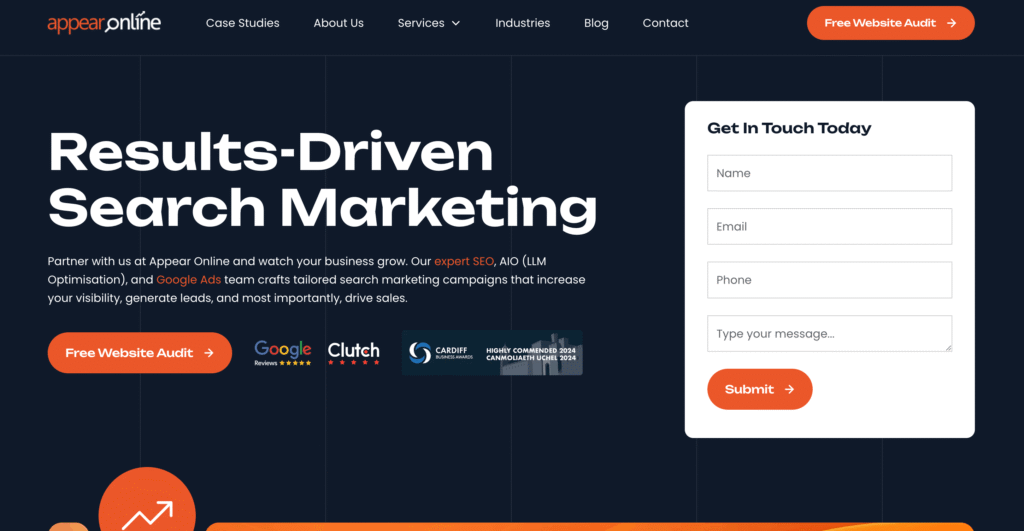
Appear Online, headquartered in Cardiff, has established itself as a forward-thinking Generative Engine Optimization (GEO) agency that approaches AI search not as a campaign-based service, but as foundational digital infrastructure. In 2026, as AI-driven discovery systems increasingly influence organic visibility, the agency’s philosophy centres on building websites that are structurally unmissable, semantically unambiguous, and demonstrably useful for both human audiences and AI systems.
Rather than treating AI SEO as an experimental add-on, Appear Online embeds generative readiness into the core architecture of a website. This infrastructure-first model aligns closely with evolving Large Language Model (LLM) retrieval systems and Retrieval-Augmented Generation (RAG) frameworks.
Corporate Overview and Market Focus
| Agency Attribute | Data / Value | Strategic Significance |
|---|---|---|
| Agency Name | Appear Online | Infrastructure-led AI SEO specialist |
| Headquarters | Cardiff, United Kingdom | Strong regional and national presence |
| Core Philosophy | AI SEO as foundational infrastructure | Long-term generative visibility |
| Primary Industry Focus | SaaS, Professional Services, eCommerce | High-value informational and commercial sectors |
| Performance Claim | 40%–120% organic growth (within 6 months) | Measurable ROI-oriented optimisation |
| Core Strategic Theme | Topical Authority Development | AI citation and semantic dominance |
Infrastructure-Based GEO Framework
Appear Online’s methodology emphasises structural clarity, entity alignment, and scalable authority signals. The agency’s guiding principle is that AI systems favour websites that present consistent semantic relationships, topic depth, and authoritative backlink ecosystems.
Central to this approach is the creation of structured topical clusters. These clusters are engineered to signal expertise within defined subject areas, increasing the likelihood that AI models recognise the website as a primary source for citation and reference.
Core Optimization Pillars
| Optimization Pillar | Focus Area | AI Search Impact |
|---|---|---|
| Technical Infrastructure | Crawl efficiency, site health, schema alignment | Improved AI retrieval accuracy |
| Entity Mapping | Keyword-to-entity relationship structuring | Clear AI interpretation of topic authority |
| Topical Authority Clusters | Interlinked, depth-based content architecture | Increased citation probability in generative summaries |
| Authority Signals | High-quality, niche-relevant backlinks | Enhanced trust metrics for LLM referencing |
| Data-Driven Expansion | Scaling high-performing content areas | Compounded organic and AI visibility growth |
Proprietary 90-Day AI SEO Roadmap
One of Appear Online’s defining frameworks is its structured 90-day AI SEO roadmap. This phased implementation plan is designed to systematically improve technical health, expand authoritative content clusters, and strengthen trust signals within AI ecosystems.
AI SEO Roadmap Structure
| Roadmap Phase | Timeline | Primary Objective |
|---|---|---|
| Foundations | Days 1–30 | Technical health assessment and keyword/entity mapping |
| Expansion | Days 31–60 | Content refinement and resolution of technical weaknesses |
| Refinement | Days 61–90 | Authority signal strengthening and scalable growth planning |
During the Foundations phase, technical audits, schema corrections, and entity mapping ensure the website is structurally ready for AI indexing.
The Expansion phase focuses on refining high-performing content areas while addressing residual technical limitations that may restrict AI retrieval.
The Refinement phase strengthens authority signals through strategic digital PR and high-quality backlink acquisition, ensuring sustainable long-term growth.
Organic Growth Performance Metrics
Appear Online reports consistent growth ranges between 40 percent and 120 percent in organic sessions within a six-month period, depending on sector competitiveness and existing site maturity. This performance range is particularly notable within SaaS and professional services sectors, where informational competition is intense.
Illustrative Growth Performance Matrix
| Performance Metric | Reported Range | Strategic Interpretation |
|---|---|---|
| Organic Session Growth | 40% – 120% (within 6 months) | Strong technical and topical authority alignment |
| Backlink Quality | High relevance to niche sector | Reinforced trust signals for AI systems |
| Content Cluster Expansion | Scalable authority modelling | Increased citation potential in LLM outputs |
| Client Retention Sentiment | Partner-style collaboration | Long-term infrastructure investment mindset |
Sector Specialisation: SaaS and Professional Services
In 2026, AI-driven search models demonstrate preference for authoritative and structured informational ecosystems. Appear Online’s expertise in SaaS and professional services aligns closely with this trend, as these sectors rely heavily on trust signals and subject-matter depth.
Sector Alignment Matrix
| Industry Sector | Optimization Priority | GEO Relevance in 2026 |
|---|---|---|
| SaaS | Feature-led informational clusters | AI-driven comparison and solution recommendation visibility |
| Professional Services | Expertise reinforcement and entity clarity | Trust-based citation inclusion in generative summaries |
| eCommerce | Authority-backed product content | Structured data for AI-assisted product discovery |
Client Experience and Verified Review Insights
Client feedback highlights proactive communication, transparency in link-building strategy, and collaborative engagement. One verified review emphasised that the agency provides detailed explanations of strategy, particularly around backlink acquisition and authority development.
The reviewer noted that link quality was consistently relevant to the brand’s niche and that the agency operated as a genuine strategic partner rather than a transactional service provider. This partnership-driven approach aligns with the agency’s infrastructure-first philosophy.
AI Platform Alignment in the United Kingdom (2026)
Appear Online optimises its infrastructure model to align with leading AI answer engines and conversational platforms.
AI Ecosystem Optimization Matrix
| AI Platform | Market Role in United Kingdom (2026) | Optimization Focus Area |
|---|---|---|
| ChatGPT | Conversational AI assistant | Structured informational authority blocks |
| Gemini | Google AI-integrated search ecosystem | AI Overview inclusion through semantic clarity |
| Perplexity | Citation-driven answer engine | Source credibility and topical clustering signals |
| Copilot | Enterprise productivity AI interface | Professional knowledge base authority |
Competitive Positioning in the UK GEO Market
Compared to campaign-driven SEO firms, Appear Online differentiates itself through structural discipline and phased implementation frameworks.
Comparative Benchmark Overview
| Evaluation Metric | Appear Online | Campaign-Focused SEO Firm | Boutique GEO Agency | Enterprise Network Agency |
|---|---|---|---|---|
| Infrastructure Depth | High | Moderate | Moderate | High |
| Topical Authority Modelling | Advanced | Limited | Moderate | Moderate |
| Sector Focus | SaaS, Professional | Broad | SME-focused | Enterprise-focused |
| Implementation Roadmap | Structured 90-Day | Flexible | Variable | Complex |
| Partnership Approach | High Collaboration | Transactional | Moderate | Structured |
Conclusion: Infrastructure-Led AI Visibility Growth
In 2026, Appear Online stands out within the United Kingdom’s Generative Engine Optimization landscape for treating AI SEO as core infrastructure rather than a marketing experiment. Its proprietary 90-day roadmap, topical authority modelling, and sector-focused expertise position it as a strong contender among leading GEO agencies.
As AI-driven search increasingly rewards semantic depth, technical clarity, and authoritative trust signals, infrastructure-first agencies such as Appear Online are likely to remain central to sustainable organic growth and generative visibility expansion.
6. Pearl Lemon

Pearl Lemon is widely recognised in 2026 as one of the most execution-focused digital marketing agencies operating within the United Kingdom’s Generative Engine Optimization landscape. Founded in 2014 by Deepak Shukla, the agency has built its reputation on aggressive delivery timelines, rapid experimentation cycles, and an integrated multi-division structure.
Unlike boutique GEO firms that operate in isolation, Pearl Lemon combines SEO, digital PR, and lead generation into a unified performance framework. This integrated model allows brands to benefit from what the agency describes as multi-service synergy, ensuring that AI visibility, authority building, and conversion optimisation operate in alignment.
Corporate Profile and Market Position
| Agency Profile Feature | Data / Detail | Strategic Significance |
|---|---|---|
| Agency Name | Pearl Lemon | Integrated SEO and GEO consultancy |
| Founding Year | 2014 | Over a decade of digital marketing experience |
| Founder | Deepak Shukla | Entrepreneurial leadership and growth focus |
| Google Review Rating | 4.7 (160+ Reviews) | Strong reputation across diverse sectors |
| Primary Specialty | Aggressive execution and rapid rollout | Fast implementation cycles |
| GEO Strategy Focus | Behaviour modelling and funnel analysis | AI-driven conversion influence |
| Budget Range | $5,000 – $50,000 per project | Mid-market to high-growth enterprise clients |
Multi-Division Structure and Service Integration
Pearl Lemon’s structure includes dedicated teams across SEO, digital PR, and lead generation. Within its GEO division, specialists with expertise in coding, attribution modelling, and behavioural analytics collaborate to ensure AI visibility translates directly into measurable business outcomes.
Integrated Service Framework
| Division Component | Core Function | Generative Search Impact |
|---|---|---|
| SEO Division | Technical optimisation and keyword strategy | Enhanced AI indexing and retrieval readiness |
| Digital PR | Authority backlink acquisition | Strengthened trust signals for AI citation |
| Lead Generation | Funnel-based conversion strategy | Shortened discovery-to-conversion pathway |
| GEO Division | Behaviour modelling and AI optimisation | Increased brand mentions in LLM summaries |
Generative Engine Optimization Strategy
Pearl Lemon approaches GEO through the lens of marketing funnel analysis. Rather than focusing solely on informational discovery, the agency optimises content architecture to influence user intent at the earliest point of AI interaction. This strategy is designed to reduce friction between discovery and purchase, particularly within high-value sectors.
The agency applies behavioural modelling to understand how users interact with AI-generated answers and adapts structured content blocks accordingly. This ensures that AI assistants interpret the brand as both authoritative and commercially relevant.
GEO Strategy Architecture
| GEO Component | Optimization Focus Area | Strategic Outcome |
|---|---|---|
| Behaviour Modelling | User interaction analysis within AI interfaces | Higher engagement probability |
| Funnel Mapping | Content alignment with discovery-stage queries | Accelerated conversion pathways |
| Attribution Tracking | ROI measurement across AI-driven touchpoints | Data-backed performance transparency |
| Technical Code Integration | Structured schema and crawl precision | Improved AI interpretation and entity recognition |
| Rapid Experimentation | Iterative testing of content formats | Continuous performance refinement |
Sector Strength: Luxury Retail and Professional Services
Pearl Lemon’s work is particularly visible in London’s luxury retail and professional services sectors. These industries demand high levels of brand authority, credibility, and digital sophistication.
By aligning generative visibility with premium brand positioning, the agency ensures AI assistants interpret client websites as credible and authoritative sources.
Sector Competency Matrix
| Industry Sector | Optimization Priority | GEO Relevance in 2026 |
|---|---|---|
| Luxury Retail | Brand authority and premium positioning | AI-driven product recommendation inclusion |
| Professional Services | Expertise and trust reinforcement | Citation in high-intent informational queries |
| B2B Enterprises | Lead qualification and funnel clarity | Conversational AI-assisted decision-making visibility |
Performance Indicators and Client Outcomes
Pearl Lemon’s performance-driven model has produced measurable growth outcomes. A detailed client testimonial reported a threefold increase in organic traffic within a four-to-six-month period, alongside significant keyword ranking improvements and multiple first-page results.
Illustrative Performance Impact Matrix
| Performance Indicator | Reported Outcome | Strategic Interpretation |
|---|---|---|
| Organic Traffic Growth | 3x increase | Strong content and authority alignment |
| Keyword Improvement | +24.4 average position gain | Rapid ranking acceleration |
| Page 1 Results | Multiple high-value terms | Effective competitive targeting |
| Delivery Speed | Fast implementation cycles | Operational efficiency and agility |
| Client Experience | Turn-key and proactive approach | Reduced client workload and friction |
The client feedback also emphasised the agency’s speed of delivery, willingness to exceed expectations, and ability to streamline processes for time-constrained organisations.
AI Platform Alignment in the United Kingdom (2026)
Pearl Lemon’s integrated framework is designed to influence visibility across leading generative search ecosystems.
AI Ecosystem Optimization Matrix
| AI Platform | Market Role in United Kingdom (2026) | Optimization Focus Area |
|---|---|---|
| ChatGPT | Conversational AI search assistant | Funnel-aligned informational positioning |
| Gemini | Google AI Overview ecosystem | Structured authority and semantic clarity |
| Perplexity | Citation-based answer engine | Trust reinforcement through digital PR |
| Copilot | Enterprise AI productivity assistant | B2B decision-stage content optimisation |
Competitive Positioning in the UK GEO Landscape
When benchmarked against boutique GEO specialists and enterprise network agencies, Pearl Lemon differentiates itself through speed, cross-division synergy, and conversion-driven experimentation.
Comparative Benchmark Overview
| Evaluation Metric | Pearl Lemon | Boutique GEO Agency | Enterprise Network Agency | Traditional SEO Firm |
|---|---|---|---|---|
| Execution Speed | High | Moderate | Moderate | Moderate |
| Service Integration | Multi-Division | Limited | High | Limited |
| Funnel Analysis Depth | Advanced | Moderate | Moderate | Limited |
| Budget Flexibility | Mid to High | Low to Mid | High | Low to Mid |
| Sector Focus | Luxury, Professional | SME Focus | Enterprise Focus | Broad |
Conclusion: High-Velocity GEO and Conversion Alignment
In 2026, Pearl Lemon represents a high-velocity, performance-oriented model of Generative Engine Optimization within the United Kingdom. Its aggressive experimentation cycles, behaviour-driven funnel analysis, and multi-service integration enable brands to achieve both AI visibility and measurable revenue growth.
By aligning technical SEO, digital PR authority building, and AI citation engineering within a unified growth framework, Pearl Lemon continues to position itself as a leading choice for companies seeking rapid execution and sophisticated generative search optimisation.
7. SUSO Digital
SUSO Digital has established itself in 2026 as one of the most technically sophisticated search agencies in the London SEO and Generative Engine Optimization landscape. Known for handling complex, high-risk, and large-scale digital environments, the agency positions itself as a technical powerhouse rather than a conventional SEO consultancy.
Its defining philosophy, often described as “GEO without SEO,” reflects a recognition that while traditional ranking signals remain relevant, AI search visibility demands a distinct layer of structured data engineering, entity recognition modelling, and retrieval-focused architecture. This approach acknowledges that generative AI platforms evaluate authority and retrievability differently from traditional search engines.
Corporate Profile and Technical Positioning
| Agency Attribute | Data / Detail | Strategic Significance |
|---|---|---|
| Agency Name | SUSO Digital | Technical-first SEO and GEO consultancy |
| Headquarters | London, United Kingdom | Strong presence in competitive enterprise markets |
| Core Philosophy | “GEO without SEO” | AI visibility as a distinct optimisation discipline |
| Specialty Areas | Site migrations, hacked site recovery | High-risk technical problem solving |
| White-Label Capability | Yes | Backend technical partner for other agencies |
| Notable Case Study Result | 1,277% organic traffic increase | Extreme growth through technical and authority refinements |
GEO Without SEO: Technical Framework Explained
SUSO Digital differentiates itself by separating traditional ranking improvements from generative AI retrievability engineering. While standard SEO addresses crawlability and keyword targeting, SUSO focuses heavily on log-file analysis, crawl budget allocation, entity structuring, and passage-level optimisation.
This ensures that AI systems can efficiently retrieve, interpret, and cite relevant website content within generative summaries.
Core Technical Architecture Model
| Technical Layer | Optimization Focus Area | Generative Search Impact |
|---|---|---|
| Crawl Budget Engineering | AI bot prioritisation and log data analysis | Improved AI discovery and indexing efficiency |
| Entity Recognition Mapping | Structured semantic relationships | Clear brand-topic association for LLM systems |
| Schema Deployment | Complex structured data frameworks | Enhanced extraction accuracy for AI summarisation |
| Passage Restructuring | Content modularisation for retrievability | Higher inclusion probability in AI answer segments |
| Authority PR Amplification | Sentiment-driven high-tier backlinks | Reinforced trust signals for generative model referencing |
Capability Areas and GEO Applications
SUSO Digital’s capability areas are structured around technical performance rather than surface-level content campaigns. The agency is particularly well known for executing complex site migrations and resolving severe technical issues such as hacked website recovery, which can significantly impact AI retrievability and trust signals.
Capability and GEO Application Matrix
| Capability Area | Specific GEO Application | Strategic Outcome |
|---|---|---|
| Technical SEO | Crawl budget management and AI bot log analysis | Optimised AI retrieval pathways |
| Structured Data | Advanced schema for LLM extraction | Accurate AI interpretation of entities and relationships |
| Passage Optimization | Content restructuring for increased “retrievability” | Improved inclusion in AI-generated responses |
| Digital PR | High-tier authority link building | Strengthened brand credibility for AI training datasets |
White-Label GEO Infrastructure Model
One of SUSO Digital’s unique competitive advantages is its white-label service model. Other marketing agencies frequently rely on SUSO’s technical expertise to manage backend SEO and GEO complexities, particularly during large-scale site migrations or when implementing advanced schema frameworks for AI visibility.
White-Label Value Proposition
| White-Label Feature | Partner Benefit | Market Impact |
|---|---|---|
| Technical Site Migration | Reduced risk during relaunch | Maintained AI and search visibility continuity |
| Advanced Log Analysis | Improved crawl efficiency | Faster indexing and AI retrievability |
| LLM Optimization Framework | AI-ready structured architecture | Expanded generative citation opportunities |
| Recovery from Penalties | Restored domain trust | Reinstated authority signals for AI systems |
Demonstrated Performance Impact
A standout case study within the transportation sector reported a 1,277 percent increase in organic traffic following a combination of technical refinements and authority-building digital PR initiatives. This substantial uplift underscores the power of infrastructure-level adjustments when aligned with authority amplification.
Illustrative Performance Impact Matrix
| Performance Indicator | Reported Outcome | Strategic Interpretation |
|---|---|---|
| Organic Traffic Growth | 1,277% increase | Technical optimisation unlocking latent visibility |
| Authority Signal Strength | High-tier backlink acquisition | Reinforced AI trust metrics |
| Site Migration Stability | Smooth relaunch execution | Preserved rankings and AI retrievability |
| Client Transparency | Step-by-step audit reporting | Clear accountability and technical clarity |
Client Experience and Verified Feedback
Client testimonials highlight transparency, structured communication, and technical depth. A Chief Product Officer from a major media brand described SUSO Digital as an invaluable partner during a website relaunch. The review emphasised regular check-ins, easy-to-follow audit feedback, and continued insights even after project completion.
The feedback further characterised the agency as transparent, dedicated, and technically thorough — qualities that align with its infrastructure-first GEO philosophy.
AI Platform Alignment in the United Kingdom (2026)
SUSO Digital’s optimisation framework is structured to influence visibility across multiple AI answer engines and enterprise AI platforms.
AI Ecosystem Optimization Matrix
| AI Platform | Market Role in United Kingdom (2026) | Optimization Focus Area |
|---|---|---|
| ChatGPT | Conversational AI discovery platform | Passage-level retrievability and structured authority |
| Gemini | Google-integrated AI search ecosystem | AI Overview schema alignment and crawl efficiency |
| Perplexity | Citation-driven hybrid answer engine | Source credibility and structured extraction |
| Copilot | Enterprise productivity AI assistant | Knowledge graph integration and B2B authority modelling |
Competitive Positioning in the UK GEO Landscape
Compared to content-focused GEO firms, SUSO Digital’s advantage lies in technical precision and complex problem-solving capacity.
Comparative Benchmark Overview
| Evaluation Metric | SUSO Digital | Content-Led GEO Agency | Integrated Search Firm | Traditional SEO Agency |
|---|---|---|---|---|
| Technical Depth | Very High | Moderate | High | Moderate |
| Site Migration Expertise | Advanced | Limited | Moderate | Moderate |
| LLM Optimization Capability | Specialist Level | Emerging | Moderate | Limited |
| White-Label Availability | Yes | Rare | Rare | No |
| Authority PR Integration | High-Tier Focus | Moderate | High | Variable |
Conclusion: Infrastructure and Technical Leadership in GEO
In 2026, SUSO Digital represents one of the most technically advanced Generative Engine Optimization agencies in the United Kingdom. Its “GEO without SEO” philosophy reflects a mature understanding that AI visibility requires more than traditional keyword optimisation — it demands structured retrievability, entity precision, and authority reinforcement at the infrastructure level.
Through complex site migrations, advanced schema implementation, and high-tier digital PR strategies, SUSO Digital continues to position itself as a preferred partner for brands and agencies seeking scalable, technically robust AI search visibility solutions.
8. Exposure Ninja
Exposure Ninja has positioned itself in 2026 as one of the most innovation-led Generative Engine Optimization and AI Search agencies in the United Kingdom. Under the leadership of CEO Charlie Marchant, the agency was recognised in 2025 as the UK’s “Most Innovative SEO & AI Search Agency,” reinforcing its reputation within the evolving generative discovery landscape.
As a certified B Corp organisation, Exposure Ninja integrates performance-driven marketing with responsible business standards. Its core focus lies in supporting lead-generation businesses, helping them capture demand across AI-powered search interfaces and conversational platforms.
Corporate Profile and Strategic Position
| Agency Attribute | Data / Detail | Strategic Significance |
|---|---|---|
| Agency Name | Exposure Ninja | AI-focused digital marketing specialist |
| CEO | Charlie Marchant | Innovation-led executive leadership |
| Recognition | UK’s Most Innovative SEO & AI Search Agency (2025) | Industry-level validation |
| Certification | B Corp | Ethical and sustainable business model |
| Core Client Focus | Lead-generation businesses | Revenue-oriented performance strategy |
| Primary Differentiator | AI Search Audit framework | Benchmarking AI visibility and share-of-voice |
AI Search Audit: Benchmarking Generative Visibility
At the centre of Exposure Ninja’s GEO strategy is its proprietary AI Search Audit. This diagnostic framework evaluates a brand’s visibility across major AI ecosystems and compares its share-of-voice against direct competitors.
The audit measures brand presence within platforms such as ChatGPT, Perplexity, and Google’s AI Overviews. By quantifying conversational search exposure, the agency provides businesses with clear insights into how frequently they are cited, referenced, or recommended by AI systems.
AI Search Audit Framework
| Audit Component | Strategic Focus Area | Generative Search Outcome |
|---|---|---|
| AI Share-of-Voice Analysis | Brand visibility benchmarking vs. competitors | Measurable conversational search positioning |
| Entity Recognition Review | Brand-topic association strength | Improved AI contextual understanding |
| Structured Content Audit | Evaluation of FAQ and fact-block formatting | Higher probability of AI snippet inclusion |
| Sentiment Analysis | External review platform trust signals | Enhanced AI recommendation likelihood |
| Competitive Gap Mapping | Identification of missed citation opportunities | Strategic roadmap for AI visibility growth |
AI-Friendly Content Engineering
Exposure Ninja’s methodology focuses heavily on restructuring website content into formats that align with generative answer extraction. AI systems favour clearly structured, summarised, and fact-driven blocks of information that can be efficiently parsed and cited.
The agency prioritises the development of:
• Structured FAQs
• Summarised fact blocks
• Concise authority statements
• Modular informational segments
These content formats improve passage-level retrievability and increase the likelihood of inclusion within conversational AI summaries.
Content Engineering Model
| Content Format | Optimization Purpose | AI Impact |
|---|---|---|
| Structured FAQs | Clear question-and-answer segmentation | Enhanced answer extraction by LLMs |
| Fact Blocks | Summarised authoritative data | Increased citation eligibility |
| Topic Clusters | Depth-based authority development | Improved contextual authority recognition |
| Conversion-Focused Pages | Lead-generation alignment | Shortened discovery-to-conversion pathway |
Review Generation and Sentiment Optimization
A defining component of Exposure Ninja’s strategy is its emphasis on sentiment optimisation. The agency recognises that AI engines increasingly incorporate external trust signals when recommending brands.
Positive reviews on authoritative third-party platforms contribute to brand credibility signals that AI systems interpret as indicators of reliability. By strengthening external sentiment, Exposure Ninja enhances the probability of favourable AI-driven recommendations.
Sentiment Optimization Framework
| Sentiment Component | Strategic Function | Generative Search Influence |
|---|---|---|
| Review Generation | Encouraging positive third-party feedback | Strengthened trust signals for AI models |
| Brand Mention Amplification | Securing press and publication citations | Broader training data footprint |
| Digital PR Outreach | Coverage in high-authority publications | Reinforced credibility within LLM knowledge graphs |
| Reputation Monitoring | Ongoing sentiment tracking | Early identification of trust signal weaknesses |
Innovation Focus and Nine-Pillar GEO Game Plan
Exposure Ninja’s approach extends beyond isolated tactics. The agency implements what it describes as a nine-pillar GEO game plan designed to future-proof search visibility against AI evolution.
Innovation and Strategic Advantage Matrix
| Innovation Focus | Strategic Advantage |
|---|---|
| AI Search Audit | Benchmarking AI visibility and competitor share-of-voice |
| GEO Game Plan | Structured nine-pillar methodology for long-term AI dominance |
| Digital PR | Securing mentions in publications such as Wired |
| Sentiment Optimization | Boosting trust signals across review ecosystems |
By securing coverage in authoritative media publications, the agency increases the likelihood that brand mentions become embedded within training datasets and generative model knowledge graphs.
Client Performance and Verified Outcomes
Exposure Ninja’s performance is reflected in measurable lead-generation growth across multiple industries. Consolidated testimonials highlight significant increases in sales-qualified leads and sustained long-term business impact.
Illustrative Performance Impact Matrix
| Performance Indicator | Reported Outcome | Strategic Interpretation |
|---|---|---|
| Sales Qualified Leads | 259% increase | Strong alignment between AI visibility and revenue |
| Long-Term Partnership Duration | 18+ months engagement | Sustained growth strategy effectiveness |
| Content and Website Improvements | Strategic guidance and structured advice | Enhanced authority and retrievability |
| Client Perception | Valuable and insight-driven partnership | Consultative, education-led engagement model |
Competitive Positioning in the UK GEO Market
Exposure Ninja differentiates itself through its structured audit methodology, innovation credentials, and ethical business framework.
Comparative Benchmark Overview
| Evaluation Metric | Exposure Ninja | Technical GEO Specialist | Performance AEO Firm | Traditional SEO Agency |
|---|---|---|---|---|
| AI Visibility Benchmarking | Advanced Audit Model | Limited | Moderate | Minimal |
| Sentiment Optimization | Core Focus | Secondary | Limited | Rare |
| Digital PR Integration | High | Moderate | Moderate | Variable |
| Lead-Generation Alignment | Strong | Moderate | Strong | Moderate |
| Ethical Certification | B Corp | Rare | No | No |
AI Platform Alignment in the United Kingdom (2026)
Exposure Ninja structures its optimisation strategies to influence visibility across leading generative AI ecosystems.
AI Ecosystem Optimization Matrix
| AI Platform | Market Role in United Kingdom (2026) | Optimization Focus Area |
|---|---|---|
| ChatGPT | Conversational AI interface | FAQ structuring and authority statement optimisation |
| Gemini | Google AI Overview ecosystem | Structured summaries and semantic clarity |
| Perplexity | Citation-driven hybrid answer engine | Source credibility and competitor benchmarking |
| Copilot | Enterprise AI productivity platform | Lead-generation content alignment |
Conclusion: Innovation-Driven AI Search Leadership
In 2026, Exposure Ninja stands out as an innovation-led Generative Engine Optimization agency that combines AI benchmarking, structured content engineering, digital PR, and sentiment optimisation into a unified growth strategy.
Its AI Search Audit framework, award recognition, and measurable lead-generation results position it as a prominent force within the UK’s AI-driven search landscape. As generative engines increasingly shape user discovery, agencies capable of quantifying conversational share-of-voice and aligning trust signals with AI expectations are likely to remain at the forefront of digital visibility strategy.
9. Blue Array

Blue Array, headquartered in Reading and London, is widely recognised in 2026 as the United Kingdom’s largest specialist SEO agency operating under an agency-consultancy hybrid model. This structure enables the firm to combine strategic advisory depth with operational execution capacity, positioning it as a preferred partner for enterprise-level Generative Engine Optimization (GEO) implementation.
As AI-driven search ecosystems increasingly influence brand discovery, Blue Array has pioneered what it defines as Enterprise GEO Governance — a structured framework designed to manage AI visibility across departments, regulatory environments, and international markets.
Corporate Profile and Enterprise Credentials
| Agency Metric | Value / Status | Strategic Significance |
|---|---|---|
| Agency Name | Blue Array | Enterprise-focused SEO and GEO consultancy |
| Year Founded | 2015 | Established growth-phase agency |
| Employee Size | 10–49 Specialists | Specialist-led, scalable delivery model |
| Hourly Rate | $100 – $149 | Mid-to-premium enterprise consultancy pricing |
| B Corp Certified | Yes | Ethical governance and responsible business standards |
| Key Differentiator | Enterprise GEO Governance & Compliance | Multi-market AI visibility management |
| Minimum Project Size | $12,000 (detailed review) | Enterprise entry-level engagement threshold |
Enterprise GEO Governance Framework
Blue Array’s core innovation lies in its governance-led approach to Generative Engine Optimization. Rather than executing isolated optimisation campaigns, the agency develops compliance-aligned frameworks that ensure AI visibility is consistent, measurable, and controlled across multiple organisational units.
This approach is particularly valuable for businesses operating in regulated sectors, where AI-generated summaries must align with legal disclosures, financial regulations, and compliance mandates.
Enterprise GEO Governance Model
| Governance Component | Strategic Focus Area | AI Visibility Outcome |
|---|---|---|
| Cross-Department Alignment | Standardised schema and entity implementation | Consistent AI interpretation across business units |
| Multi-Market Citation Mapping | Regional authority and language adaptation | Controlled international AI representation |
| Compliance Integration | Regulatory content validation and structured accuracy | Reduced risk of misrepresentation in AI outputs |
| Centralised Reporting | Enterprise-wide AI visibility dashboards | Measurable conversational share-of-voice |
| Policy-Driven Schema Control | Governance documentation for structured data usage | Sustainable and compliant generative optimisation |
Consultative Approach to AI Visibility
Blue Array operates as an advisory partner as much as an execution agency. Its consultative methodology includes large-scale schema deployment, citation mapping across markets, and entity-level consistency modelling.
This is particularly important in sectors such as fintech and regulated insurance, where inaccuracies in AI-generated summaries can carry legal and reputational risks.
Strategic Implementation Areas
| Capability Area | Specific GEO Application | Enterprise Impact |
|---|---|---|
| Large-Scale Schema Deployment | Organisation-wide structured data frameworks | Improved AI extraction accuracy |
| Citation Mapping | Brand mention tracking across authoritative sources | Strengthened entity authority in LLM ecosystems |
| Regulatory Content Structuring | Compliance-aligned informational architecture | Safe AI-driven representation |
| Governance Advisory | Internal training and framework documentation | Long-term AI visibility control |
Sector Expertise: Fintech and Regulated Insurance
Blue Array’s governance-driven methodology is particularly effective within sectors requiring structured compliance.
Sector Alignment Matrix
| Industry Sector | Optimization Priority | GEO Relevance in 2026 |
|---|---|---|
| Fintech | Regulatory clarity and entity precision | Accurate AI summarisation of financial products |
| Insurance | Structured policy documentation and disclosures | Reduced risk in AI-generated explanations |
| Enterprise Services | Multi-departmental consistency | Cohesive AI representation across global operations |
Documented Performance Outcomes
Among its documented achievements, Blue Array reports a 1,400 percent increase in organic entrances for specific life insurance product categories. This uplift reflects the power of structured authority modelling and governance-aligned schema implementation in highly competitive and regulated markets.
Illustrative Performance Impact Matrix
| Performance Indicator | Reported Outcome | Strategic Interpretation |
|---|---|---|
| Organic Entrances Growth | 1,400% increase (life insurance niche) | Strong authority alignment and structured retrievability |
| Compliance Alignment | Governance-led implementation | Reduced regulatory exposure in AI summaries |
| Enterprise Coordination | Multi-department reporting structure | Centralised AI visibility management |
| Client Communication | Proactive reporting and follow-up | High reliability and structured accountability |
Client Experience and Verified Feedback
Client testimonials emphasise Blue Array’s consistency, follow-through, and detailed reporting standards. One marketing executive highlighted the agency’s proactive communication, structured deliverables, and regular progress tracking as critical to project success.
The feedback underscores a recurring theme: reliability and governance discipline. In enterprise environments where AI visibility intersects with compliance obligations, such structured communication is particularly valuable.
AI Platform Alignment in the United Kingdom (2026)
Blue Array’s governance-led framework is designed to influence visibility across multiple AI-driven discovery systems.
AI Ecosystem Optimization Matrix
| AI Platform | Market Role in United Kingdom (2026) | Optimization Focus Area |
|---|---|---|
| ChatGPT | Conversational AI knowledge interface | Structured entity clarity and compliance validation |
| Gemini | Google AI Overview ecosystem | Governance-controlled schema and citation mapping |
| Perplexity | Citation-driven answer engine | Verified source alignment and authority signals |
| Copilot | Enterprise AI productivity assistant | Multi-department knowledge graph integration |
Competitive Positioning in the UK GEO Landscape
Blue Array differentiates itself through governance, compliance integration, and enterprise-scale advisory depth.
Comparative Benchmark Overview
| Evaluation Metric | Blue Array | Technical GEO Specialist | Boutique GEO Firm | Integrated Search Agency |
|---|---|---|---|---|
| Enterprise Governance | Advanced | Limited | Limited | Moderate |
| Compliance Integration | High | Moderate | Low | Moderate |
| Multi-Market Implementation | Strong | Limited | Limited | Moderate |
| B Corp Certification | Yes | Rare | Rare | Occasional |
| Project Entry Threshold | High | Medium | Low | Medium |
Conclusion: Governance-Led Enterprise GEO Authority
In 2026, Blue Array stands as a leading force in enterprise Generative Engine Optimization within the United Kingdom. Its agency-consultancy hybrid model, combined with a governance-first approach, enables large national and international brands to manage AI visibility with precision and compliance assurance.
For regulated industries such as fintech and insurance, where AI-generated content must align with strict disclosure standards, Blue Array’s Enterprise GEO Governance framework provides both strategic growth and operational control. As generative search continues to influence brand discovery, agencies capable of integrating compliance, structure, and authority at scale are likely to define the next phase of enterprise digital visibility.
10. Charle Agency
Charle Agency is a London-based specialist consultancy dedicated exclusively to eCommerce brands. In 2026, as AI assistants increasingly act as digital shopping proxies, the agency operates at the convergence of traditional commerce SEO and what is now referred to as Generative Commerce.
Generative Commerce describes a retail environment in which conversational AI systems summarise product options, compare attributes, and recommend purchases directly within search interfaces. As AI summaries now influence approximately 14.5 percent of commercial intent queries, product visibility depends not only on rankings but also on machine-readable clarity and entity precision.
Charle Agency positions Generative Engine Optimization (GEO) as a core structural component of eCommerce growth rather than a peripheral tactic. Its framework prioritises commercial performance over vanity metrics such as impressions or isolated ranking movements.
Corporate Profile and Market Position
| Agency Attribute | Data / Detail | Strategic Significance |
|---|---|---|
| Agency Name | Charle Agency | eCommerce-exclusive GEO consultancy |
| Headquarters | London, United Kingdom | Access to global retail and DTC markets |
| Core Focus | Generative Commerce and Product Visibility | AI-assisted shopping ecosystem optimisation |
| Strategic Priority | Entity Clarity and Product-Level SEO | Accurate AI extraction and recommendation inclusion |
| Measurement Philosophy | Commercial impact over vanity metrics | Revenue-aligned optimisation model |
| Target Clients | eCommerce and DTC brands | High-competition retail environments |
Generative Commerce Strategy
Charle Agency’s model recognises that AI assistants increasingly summarise product features, compare specifications, and generate buying guidance without requiring users to click through multiple websites.
To remain visible in this environment, brands must provide AI systems with structured, semantically precise product data. Charle’s approach centres on:
• Advanced product schema implementation
• Machine-readable inventory structuring
• Internal linking refinement
• Product-level sentiment aggregation
• Category hierarchy optimisation
Generative Commerce Optimization Framework
| Commerce Specialty | GEO Implementation | AI Search Impact |
|---|---|---|
| Product Attributes | Advanced schema for machine-readable inventory data | Accurate extraction of features and specifications |
| Category Taxonomy | Semantic structuring of product hierarchies | Improved contextual understanding for AI agents |
| Conversion Focus | Optimisation for “Agentic Checkout” and AI shopping proxies | Shortened path from discovery to transaction |
| Trust Building | Aggregation of product-level reviews and sentiment signals | Strengthened AI-driven recommendation credibility |
Entity Clarity and Product-Level Optimization
A central pillar of Charle Agency’s methodology is Entity Clarity — ensuring that AI systems can unambiguously associate products with attributes, benefits, pricing structures, and use cases.
This involves structured data implementation that allows AI models to interpret product information with precision. In high-volume retail environments, even minor inconsistencies in attribute mapping can reduce the probability of inclusion in AI-generated recommendations.
Product-Level Optimization Architecture
| Optimization Layer | Focus Area | Generative Commerce Outcome |
|---|---|---|
| Structured Product Schema | Attribute tagging, availability, pricing clarity | Enhanced AI recommendation eligibility |
| Internal Linking Structure | Category-to-product contextual mapping | Stronger semantic authority across inventory clusters |
| Comparison Page Structuring | Feature comparison and benefit summaries | Increased visibility in AI-driven buying guides |
| Inventory Data Precision | Clean feed integration and consistency | Accurate AI parsing and reduced misinformation risk |
Optimising for Agentic Checkout
With AI assistants increasingly capable of acting on behalf of consumers, Charle Agency integrates optimisation strategies designed for what is referred to as Agentic Checkout. This concept reflects a shift where AI agents not only suggest products but also assist in transaction facilitation.
By aligning product data, reviews, and structured summaries, the agency ensures that AI shopping proxies can confidently recommend specific SKUs based on structured signals.
AI Ecosystem Alignment in the United Kingdom (2026)
Charle Agency’s optimisation strategies target the primary generative and commerce-influencing AI platforms.
AI Ecosystem Optimization Matrix
| AI Platform | Market Role in United Kingdom (2026) | Optimization Focus Area |
|---|---|---|
| ChatGPT | Conversational shopping assistant | Product attribute clarity and summarised buying guidance |
| Gemini | Google AI Overview ecosystem | Structured product data and category-level authority |
| Perplexity | Citation-based answer engine | Trust signals and factual product verification |
| Copilot | Integrated AI assistant within productivity | B2B and enterprise procurement visibility |
Commercial Impact and Measurement Philosophy
Unlike agencies that prioritise ranking reports alone, Charle Agency measures success through traffic quality, conversion performance, and revenue contribution. Visibility metrics are evaluated within the broader context of commercial impact.
Illustrative Performance Measurement Matrix
| Performance Indicator | Measurement Focus | Strategic Interpretation |
|---|---|---|
| Visibility in AI Summaries | Inclusion in product recommendation blocks | Direct influence on high-intent commercial queries |
| Traffic Quality | Conversion-aligned visitor sessions | Reduced low-intent traffic dependency |
| Product-Level Rankings | SKU-specific search presence | Granular optimisation accuracy |
| Commercial Impact | Revenue and checkout influence | ROI-driven performance model |
Competitive Positioning in the UK GEO Landscape
Charle Agency differentiates itself through its exclusive eCommerce focus and generative commerce orientation.
Comparative Benchmark Overview
| Evaluation Metric | Charle Agency | Generalist SEO Firm | Enterprise GEO Agency | Performance AEO Firm |
|---|---|---|---|---|
| eCommerce Specialisation | Exclusive Focus | Broad | Moderate | Moderate |
| Product-Level Schema Depth | Advanced | Limited | Moderate | Moderate |
| Agentic Checkout Optimisation | Integrated | Rare | Limited | Limited |
| Commercial KPI Alignment | Strong | Moderate | High | High |
| Vanity Metric Dependence | Low | Moderate | Low | Moderate |
Conclusion: Strategic Leadership in Generative Commerce
In 2026, Charle Agency stands out within the United Kingdom’s Generative Engine Optimization market as a specialist built exclusively for eCommerce brands navigating AI-driven retail transformation.
By prioritising entity clarity, product-level optimisation, structured taxonomy development, and conversion-aligned performance measurement, the agency enables brands to remain visible in a commerce environment increasingly shaped by AI recommendations.
As AI assistants continue to influence a growing percentage of commercial intent queries, agencies capable of translating structured product data into generative recommendation visibility are likely to define the future of digital retail growth.
The State of Generative Engine Optimization in the United Kingdom: Market Analysis, Agency Evolution, and AI Search Dynamics in 2026
The United Kingdom’s search ecosystem in 2026 represents the most significant structural transformation since the introduction of featured snippets and mobile-first indexing. The transition from a retrieval-based search model to a synthesis-driven ecosystem has redefined how brands compete for digital visibility.
In this new paradigm, Generative Engine Optimization (GEO) has emerged as the strategic successor to traditional Search Engine Optimization. Instead of ranking web pages based solely on keywords and backlinks, AI systems now synthesise structured information from multiple sources and deliver summarised answers directly within conversational interfaces.
Platforms such as ChatGPT, Google AI Overviews, Perplexity, and Claude have become primary discovery channels. As a result, projected traditional organic search volume is expected to decline by approximately 25 percent by late 2026. For UK businesses, GEO is no longer a competitive differentiator — it is a foundational survival requirement.
Macroeconomic Outlook and Market Expansion
The global SEO services market, valued at approximately 90.35 billion US dollars in 2024, is projected to reach 106.9 billion US dollars by 2025, reflecting a compound annual growth rate of 18.3 percent. This growth is largely driven by enterprise investment in AI-native optimisation strategies.
Within the United Kingdom, digital marketing budgets are increasingly reallocating toward:
• Structured data engineering
• AI retrievability audits
• Entity-based authority mapping
• Citation frequency monitoring
• Conversational conversion attribution
Market Growth Overview
| Market Indicator | 2024 Value | 2025 Projection | Strategic Driver |
|---|---|---|---|
| Global SEO Services Market | $90.35 Billion | $106.9 Billion | AI-native optimisation demand |
| CAGR (2024–2025) | 18.3% | Accelerating | Enterprise GEO adoption |
| Traditional Organic Search Volume | Baseline | -25% by late 2026 | AI-mediated discovery shift |
| AI-Referred Conversion Multiplier | 4.4x–23x | Growing | High-intent conversational referrals |
The economic implications are significant: while raw traffic volumes decline, high-intent AI-referred sessions deliver substantially stronger conversion rates.
From Rankings to Retrievability: The New Core Metric
In 2026, the dominant performance metric is no longer ranking position but Retrievability.
Retrievability refers to the mathematical probability that a Large Language Model will:
• Extract a brand’s data
• Synthesise it accurately
• Cite or recommend it in response to relevant prompts
This probability depends on semantic clarity, entity authority, schema precision, and structured credibility signals.
Performance Framework Evolution
| Metric Category | Traditional SEO (2020–2024) | Generative Engine Optimization (2026) |
|---|---|---|
| Primary KPI | Keyword Rankings (Positions 1–10) | Citation Probability & Sentiment Analysis |
| Content Unit | Long-form Articles & Blogs | Atomic Facts, Entities, Q&A Blocks |
| Technical Focus | Core Web Vitals & Page Speed | Schema Depth & LLM Crawlability |
| Discovery Logic | Indexing & Ranking | Training Data Influence & RAG Retrieval |
| User Interaction | Click-to-Site | Conversation-to-Conversion |
The Technical Foundation of Generative Engine Optimization
Generative Engine Optimization in 2026 operates on three technical pillars:
Entity Clarity
Machine-Readable Facts
Semantic Relationship Mapping
Unlike traditional keyword density strategies, GEO requires content to be architected in a machine-consumable format. AI systems must interpret information with high confidence and minimal ambiguity.
Core Technical Pillars
| Technical Pillar | Optimization Objective | AI Impact |
|---|---|---|
| Entity Clarity | Unambiguous brand-topic association | Increased citation accuracy |
| Machine-Readable Facts | Structured, verifiable information blocks | Higher synthesis probability |
| Semantic Relationship Mapping | Clear hierarchy of topics and subtopics | Improved contextual authority |
| LLM-Specific Crawl Signals | Implementation of llms.txt and advanced schema structures | Enhanced retrievability for AI crawlers |
The Rise of AI-Specific Technical Assets
New structural components have emerged in 2026, including:
• llms.txt files guiding AI crawler access
• Enhanced schema markups beyond traditional JSON-LD
• Retrieval-Optimised Content Blocks
• Fact-based structured summaries
These elements enable Large Language Models to extract data more confidently and incorporate it into generated outputs.
Impact of AI Overviews on Click-Through Rates
Data from 2025 revealed that when AI Overviews appear:
• Traditional click-through rates for informational queries can decline by up to 89 percent
• Position-one results experience an average drop of 34.5 percent
However, while overall traffic decreases, intent quality increases significantly.
Traffic Quality vs. Traffic Volume
| Traffic Characteristic | Traditional Organic Search | AI-Referred Traffic (2026) |
|---|---|---|
| Volume | High | Lower |
| Intent Strength | Variable | Very High |
| Conversion Rate Multiplier | Baseline | 4.4x – 23x Higher |
| Funnel Position | Mixed | Mid-to-Bottom Funnel |
This transformation demands a new analytics framework where:
• Pipeline revenue
• Lead qualification rates
• Citation frequency
• Conversational share-of-voice
replace raw impression counts and traffic volume as primary KPIs.
Agency Evolution in the UK Market
Leading UK agencies in 2026 now differentiate themselves based on:
• LLM retrievability engineering
• Entity-based authority mapping
• Schema governance frameworks
• AI share-of-voice reporting
• Sentiment optimisation across third-party platforms
The competitive advantage no longer lies in content quantity but in structured clarity and citation likelihood.
Agency Capability Shift
| Capability Area | Pre-2024 SEO Focus | 2026 GEO Focus |
|---|---|---|
| Content Strategy | Keyword targeting | Entity clustering and atomic structuring |
| Link Building | Domain authority accumulation | Citation credibility for AI models |
| Technical SEO | Crawlability and page speed | AI crawler retrievability optimisation |
| Analytics | Traffic and impressions | AI attribution and pipeline ROI |
Market Dynamics and Competitive Pressures
The UK market in 2026 reflects three major competitive dynamics:
Enterprise Compliance Pressure
Regulated industries such as fintech, healthcare, and insurance require structured governance frameworks to prevent AI misrepresentation.
eCommerce Generative Commerce
AI assistants influence approximately 14.5 percent of commercial intent queries, reshaping retail discovery.
B2B Conversational Procurement
Enterprise buyers increasingly consult AI assistants before vendor shortlist creation.
Strategic Implications for UK Businesses
For organisations operating in the United Kingdom, the implications are clear:
• Brands must invest in structured data depth
• Authority signals must extend beyond owned media
• Sentiment across review ecosystems impacts AI recommendation likelihood
• Conversational query mapping must align with revenue-driving intent clusters
Conclusion: GEO as the New Digital Infrastructure
The State of Generative Engine Optimization in the United Kingdom in 2026 is defined by structural transformation rather than incremental evolution. The shift from retrieval to synthesis has permanently altered the competitive landscape.
As AI Overviews suppress traditional click-through rates but amplify high-intent conversions, the metric of success has shifted from ranking dominance to retrievability probability and commercial influence.
GEO is no longer a niche specialisation. It is the foundational digital infrastructure that determines whether a brand is cited, synthesised, and recommended in an AI-mediated world. Organisations that adapt to this paradigm — through structured clarity, entity authority, and retrievability engineering — will define the next generation of digital market leaders in the United Kingdom.
Economic Analysis of Generative Engine Optimization (GEO) Investment in the United Kingdom – 2026
By 2026, Generative Engine Optimization (GEO) in the United Kingdom has evolved from an experimental add-on service into a structured investment category with clearly defined pricing tiers. As AI-driven discovery platforms reshape traffic acquisition, the cost of GEO reflects the technical sophistication, entity governance, and continuous monitoring required to maintain retrievability within Large Language Model ecosystems.
While traditional SEO retainers for small businesses still range between £500 and £1,500 per month, effective GEO programs command a premium due to:
• Advanced schema architecture
• Entity relationship modelling
• AI crawler retrievability optimisation
• Citation frequency tracking
• Sentiment amplification across third-party platforms
• Continuous AI share-of-voice monitoring
Pricing has stabilised into four primary investment tiers across the UK market.
GEO Investment Tier Structure in 2026
| Investment Tier | Monthly Retainer (GBP) | Included Deliverables | Ideal For |
|---|---|---|---|
| GEO Light | £650 – £1,500 | Schema setup, FAQ optimisation, baseline entity mapping | Startups & Local SMEs |
| GEO Growth | £1,500 – £4,000 | LLM-aligned content, technical audits, digital PR, LinkedIn content strategy | Mid-market SMEs |
| GEO Dominate | £7,000 – £15,000 | Proprietary monitoring tools, 24/7 AI visibility tracking, large-scale content hubs | National Brands |
| Enterprise GEO | £30,000+ | Governance frameworks, multi-market citation mapping, RAG optimisation | Global Corporations |
Understanding the Cost Premium of GEO
The pricing differential between traditional SEO and GEO reflects the structural shift from ranking optimisation to retrievability engineering.
Traditional SEO costs are primarily associated with:
• Keyword research
• On-page optimisation
• Link acquisition
• Core Web Vitals improvements
GEO investment, by contrast, includes:
• Entity graph modelling
• Structured knowledge architecture
• Passage-level retrievability refinement
• AI citation probability modelling
• Conversational query mapping
• Proprietary LLM monitoring systems
Cost Driver Comparison
| Cost Component | Traditional SEO (Pre-2024) | GEO (2026) |
|---|---|---|
| Keyword Targeting | Core Focus | Secondary |
| Schema Depth | Basic | Advanced, AI-specific |
| AI Monitoring Tools | Not Required | Essential |
| Citation Probability Tracking | Not Applicable | Primary KPI |
| Sentiment & Review Engineering | Limited | Integrated into strategy |
| Governance & Multi-Market Control | Rare | Standard at enterprise level |
Return on Investment Dynamics
The financial justification for GEO investment in 2026 is not rooted in traffic volume growth, but in conversion quality and pipeline velocity.
As AI Overviews and conversational agents reduce raw click-through rates for informational queries, the remaining traffic becomes significantly more qualified. AI-driven visitors often enter the funnel with pre-validated intent, having already consumed summarised comparisons and contextual recommendations.
In the UK market, data indicates:
• AI-referred traffic converts at significantly higher rates
• Organic visitors influenced by AI demonstrate a 22 percent increase in conversion rates
• Pipeline velocity improves as discovery-to-decision cycles shorten
Traffic Quality Shift
| Traffic Attribute | Traditional Organic Traffic | AI-Influenced Organic Traffic (2026) |
|---|---|---|
| Volume | Higher | Lower |
| Intent Clarity | Mixed | High |
| Conversion Rate | Baseline | +22% increase |
| Sales Cycle Length | Standard | Shortened |
| Revenue per Visitor | Moderate | Elevated |
Financial Modelling Example
For a mid-market UK SaaS company investing £3,000 per month in a GEO Growth program:
• Traditional SEO may deliver higher raw traffic
• GEO delivers lower traffic volume but higher intent
• Conversion uplift of 22 percent offsets reduced sessions
• Revenue-per-visitor increases due to AI-assisted qualification
The economic logic shifts from cost-per-click metrics to revenue-per-conversation metrics.
Pipeline ROI Framework in 2026
| ROI Dimension | Measurement Focus | Financial Impact |
|---|---|---|
| Citation Inclusion Rate | Frequency of AI mentions | Brand authority amplification |
| Conversational Traffic | AI-driven referral sessions | Higher-intent acquisition |
| Conversion Uplift | Percentage increase in sales/lead closure | Revenue growth acceleration |
| Customer Acquisition Cost | Adjusted for high-intent referrals | Improved cost efficiency |
| Pipeline Velocity | Time from discovery to transaction | Faster revenue recognition |
Enterprise-Level Economic Considerations
For national and global brands investing £30,000+ per month in Enterprise GEO programs, the return extends beyond direct conversion metrics.
Enterprise benefits include:
• Governance control over AI-generated representations
• Reduced reputational risk in regulated industries
• Multi-market citation consistency
• Competitive share-of-voice dominance in generative summaries
In high-stakes industries such as fintech, insurance, and healthcare, preventing misrepresentation in AI outputs carries economic value beyond measurable traffic metrics.
Why GEO Investment Is Becoming a Baseline Requirement
As projected traditional organic search volume declines by 25 percent by late 2026, brands that fail to invest in retrievability risk structural invisibility within AI-mediated discovery environments.
Economic Risk of Non-Investment
| Risk Factor | Potential Outcome |
|---|---|
| Reduced AI Citation Presence | Brand exclusion from generative summaries |
| Competitor Authority Capture | Share-of-voice erosion |
| Declining Organic Visibility | Lower qualified pipeline volume |
| Sentiment Imbalance | Negative AI recommendation bias |
Conclusion: GEO as a Capital Investment in Digital Infrastructure
In 2026, Generative Engine Optimization in the United Kingdom is no longer a discretionary marketing expense. It is a capital-level investment in digital infrastructure.
While monthly retainers range from £650 for foundational programs to over £30,000 for enterprise governance frameworks, the economic justification lies in:
• Higher-intent conversational traffic
• Increased conversion efficiency
• Stronger brand authority signals
• Long-term AI visibility resilience
As AI-driven search systems continue to reshape the economics of digital discovery, GEO investment represents a strategic shift from volume-based optimisation to precision-based commercial influence. Brands that allocate budget accordingly are positioned not merely to maintain visibility, but to dominate within the synthesis-based search economy of 2026.
The Role of Proprietary and Third-Party Tools in Generative Engine Optimization (GEO) – United Kingdom, 2026
In 2026, the technological stack used by leading UK Generative Engine Optimization agencies has evolved to address one of the industry’s biggest historical limitations: the inability to track AI-driven visibility with precision.
In the era of conversational search, agencies must now measure:
• Citation frequency across Large Language Models
• Sentiment within AI-generated summaries
• AI Overview appearances
• Conversational share-of-voice
• Entity recognition consistency
To achieve this, agencies combine established SEO suites with AI-native monitoring platforms, automation systems, and proprietary retrievability analytics frameworks.
All-in-One Digital Visibility Platforms
Traditional enterprise SEO tools remain foundational, but their capabilities have expanded significantly to accommodate AI visibility tracking.
Platforms such as Semrush and Ahrefs continue to provide:
• Keyword research
• Backlink profiling
• Competitor benchmarking
• Traffic estimation
However, in 2026 both have introduced AI Search Toolkits designed specifically for generative visibility monitoring.
AI Search Toolkit Capabilities
| Platform | Core AI Toolkit Feature | Strategic Application in GEO |
|---|---|---|
| Semrush | AI Overview tracking & sentiment analysis | Monitor brand inclusion in generative summaries |
| Ahrefs | Conversational share-of-voice benchmarking | Compare AI mentions against competitor citations |
| Both | AI SERP feature monitoring | Identify decline in traditional click-through rates |
These platforms now allow agencies to quantify:
• Frequency of AI Overview appearances
• Brand sentiment within summarised outputs
• Competitor citation dominance
• AI-influenced query clusters
This shift transforms AI visibility from anecdotal observation into measurable performance data.
Specialized GEO and LLM Monitoring Tools
Beyond traditional SEO platforms, a new class of AI-native monitoring tools has emerged to track Large Language Model behaviour directly.
Platforms such as Rank Prompt and AIClicks are now widely adopted among leading UK GEO agencies.
These tools provide:
• LLM-specific citation tracking
• Prompt-based visibility testing
• AI response comparison across models
• Citation gap identification
Specialized GEO Monitoring Capabilities
| Tool | Primary Function | GEO Application |
|---|---|---|
| Rank Prompt | Track LLM citation responses by query cluster | Identify where a brand is recommended or omitted |
| AIClicks | Model-specific citation analytics | Monitor ChatGPT, Claude, and other LLM outputs |
| Both | Citation Gap Analysis | Reveal competitor advantage in AI-generated answers |
Citation Gap Analysis has become a central strategy in 2026. It identifies scenarios where:
• A competitor is consistently cited
• The client is absent from summaries
• Sentiment differs across platforms
Agencies then adjust entity mapping, authority signals, and structured data frameworks to close these gaps.
Automation and Scalable Content Optimization
As retrievability depends heavily on machine-consumable content, automation tools play a critical role in scaling AI readiness across large websites.
Content Optimization Platforms
Surfer SEO and Clearscope continue to support semantic optimisation, but in 2026 their usage is focused on:
• Extractable fact density
• Entity inclusion accuracy
• Question-and-answer structuring
• Semantic completeness for AI parsing
Content Engineering Tools
| Tool | Primary Function | AI Optimization Benefit |
|---|---|---|
| Surfer SEO | Semantic keyword and topic modelling | Improved extractable content structure |
| Clearscope | Content grading for entity and topic coverage | Higher AI retrievability confidence |
These platforms help writers structure content into:
• Atomic facts
• Summarised blocks
• FAQ segments
• Modular passages
All of which increase the probability of inclusion in AI-generated outputs.
Technical Automation and AI Readiness at Scale
For enterprise clients managing thousands of URLs, manual updates are impractical. Technical automation tools such as Search Atlas and Alli AI have become critical for bulk schema implementation and AI readiness deployment.
Technical Automation Platforms
| Tool | Automation Capability | GEO Impact |
|---|---|---|
| Search Atlas | Large-scale schema deployment & technical audits | Improved LLM crawlability |
| Alli AI | Bulk on-page updates across thousands of pages | Consistent entity and schema alignment |
These tools enable:
• Mass updates of structured data
• Rapid implementation of llms.txt files
• On-page optimisation adjustments
• Technical retrievability consistency across domains
Without automation, maintaining enterprise-level AI readiness would be operationally unmanageable.
Integrated GEO Technology Stack in 2026
The modern UK GEO agency stack typically combines four layers:
Integrated Technology Stack
| Layer | Tools Used | Strategic Purpose |
|---|---|---|
| Foundational SEO Layer | Semrush, Ahrefs | Keyword and backlink intelligence |
| AI Monitoring Layer | Rank Prompt, AIClicks | LLM citation tracking and gap identification |
| Content Engineering Layer | Surfer SEO, Clearscope | Extractable fact optimisation |
| Technical Automation Layer | Search Atlas, Alli AI | Schema scaling and AI readiness implementation |
The Competitive Advantage of Tool Integration
The agencies that dominate the UK GEO market in 2026 are those capable of integrating these tools into a unified retrievability framework.
Competitive differentiation now depends on:
• Speed of citation gap identification
• Accuracy of entity mapping adjustments
• Depth of sentiment monitoring
• Scalability of structured data deployment
Conclusion: Technology as the Backbone of Retrievability
The role of proprietary and third-party tools in 2026 is not merely supportive — it is foundational to Generative Engine Optimization success.
As the industry shifts from ranking visibility to citation probability, the technological stack enables agencies to:
• Measure AI presence with precision
• Identify and close citation gaps
• Optimise content for extractability
• Scale AI readiness across complex digital ecosystems
In the synthesis-based search economy of 2026, agencies that combine robust analytics, LLM monitoring, semantic optimisation, and technical automation are best positioned to deliver measurable, defensible AI visibility for UK brands.
Industry Trends and Strategic Implications for Generative Engine Optimization in the United Kingdom – 2026
Executive Overview: The Structural End of the Blue Link Era
By 2026, leading UK agencies widely agree that the traditional “blue link” model of informational search has reached structural obsolescence. While transactional and navigational queries still generate click-through traffic, informational discovery has largely shifted to synthesis-based interfaces powered by Large Language Models (LLMs).
AI-generated summaries, conversational agents, and answer engines now intercept the majority of top-of-funnel queries. This has forced UK marketing leaders to rethink visibility as a distributed ecosystem rather than a search engine rankings game.
The dominant strategic pivot is toward what agencies describe as “Search Everywhere” optimisation.
The Rise of “Search Everywhere” Strategy
Search visibility in 2026 is no longer confined to websites and search engine results pages. AI models synthesise information from a broad array of digital touchpoints, including:
• Podcasts
• Social media discussions
• Industry forums
• Niche communities
• Digital PR placements
• Review platforms
• Video transcripts
• Structured knowledge bases
AI systems ingest and model brand authority based on patterns across these channels. As a result, marketing leadership teams must expand beyond owned media optimisation.
Search Everywhere Visibility Framework
| Visibility Channel | Strategic Role in AI Synthesis | GEO Implication |
|---|---|---|
| Podcasts | Thought leadership signals | Brand authority reinforcement in LLM datasets |
| LinkedIn & Social Media | Professional credibility & expertise validation | Entity recognition and sentiment modelling |
| Online Communities | Organic brand mentions | Authentic citation patterns |
| Digital PR Publications | High-authority source validation | Training data amplification |
| Review Platforms | Trust and reputation signals | AI recommendation weighting |
The strategic implication is clear: AI visibility is ecosystem-driven, not page-driven.
Marketing leaders must now allocate budget toward brand presence in authoritative environments that influence AI training and Retrieval-Augmented Generation systems.
The Emergence of Agentic AI and Proxy Buyers
A major second-order trend reshaping the UK market in 2026 is the rise of Agentic AI — autonomous systems capable of acting on behalf of users.
Rather than simply answering questions, these agents:
• Compare product options
• Evaluate pricing and specifications
• Assess sentiment signals
• Complete purchases via API integrations
This shift fundamentally changes website architecture priorities.
Websites are no longer being built exclusively for human readers. They are increasingly designed for intelligent agents acting as proxy buyers.
Website Design Evolution for Agentic AI
| Website Component | Traditional Human-Focused Design | Agentic AI-Optimized Design (2026) |
|---|---|---|
| Product Descriptions | Persuasive copy | Structured, machine-readable specifications |
| Comparison Tables | Visual differentiation | Structured data with consistent attribute mapping |
| FAQs | Customer support | Extractable Q&A blocks for agent parsing |
| Checkout Flow | Manual user journey | API-ready integration (Stripe, Instant Checkout) |
| Reviews | Social proof | Structured sentiment signals for AI evaluation |
For eCommerce and SaaS brands, this transformation requires:
• Precise product taxonomy
• Consistent schema markup
• API-accessible inventory systems
• Clean attribute mapping
• Structured comparison matrices
Agencies designing for Agentic AI ensure that intelligent systems can easily parse product features, price tiers, compliance details, and customer sentiment.
Conversational Commerce and API Integration
In 2026, AI agents increasingly complete purchases directly via:
• Stripe API integrations
• Instant Checkout frameworks
• Embedded payment gateways
• Subscription automation tools
This evolution reduces friction between discovery and transaction.
Marketing leaders must now consider:
• Agent compatibility as a conversion KPI
• API accessibility as a ranking factor in generative commerce
• Structured data completeness as a prerequisite for AI recommendation
Commercial Funnel Transformation
The traditional funnel model is compressing into conversational micro-journeys.
Funnel Evolution Comparison
| Funnel Stage | Traditional Model (Pre-2024) | Agentic AI Model (2026) |
|---|---|---|
| Awareness | Blog discovery via search | AI-generated summary response |
| Consideration | Comparison page browsing | Agent-led feature evaluation |
| Decision | Manual checkout | API-driven transaction via proxy agent |
| Post-Purchase | Email follow-up | AI-integrated service recommendation |
The result is a faster decision cycle and a greater emphasis on structured clarity.
Strategic Implications for UK Marketing Leadership
The shift toward Generative Engine Optimization and Agentic AI carries significant implications for Chief Marketing Officers and digital leaders across the United Kingdom.
Key Strategic Shifts
| Strategic Area | Required Leadership Adaptation |
|---|---|
| Budget Allocation | Increased investment in entity authority and AI readiness |
| Content Strategy | Modular, machine-consumable content blocks |
| Brand Governance | AI representation monitoring and compliance oversight |
| Data Infrastructure | API compatibility and structured data completeness |
| Performance Measurement | Citation frequency and conversation-to-conversion metrics |
Marketing leadership must now integrate GEO considerations into:
• Brand communications
• PR outreach
• Content marketing
• Product architecture
• Technical development roadmaps
The competitive advantage lies not only in being visible to humans but in being interpretable and actionable by intelligent systems.
The End of Vanity Metrics
As informational blue links lose prominence, traditional vanity metrics such as raw traffic and total impressions become less meaningful.
Instead, agencies and in-house teams now prioritise:
• Citation share-of-voice
• AI sentiment positioning
• Agent recommendation inclusion
• Conversational conversion rate
• Pipeline revenue influenced by AI referrals
Conclusion: Strategic Reinvention in the AI-Mediated Economy
In 2026, the UK search landscape is no longer a ranking contest but a synthesis economy. The dominance of conversational agents and the emergence of Agentic AI have fundamentally reshaped discovery, evaluation, and transaction behaviours.
The second-order implications are profound:
• Visibility must be ecosystem-wide
• Websites must be machine-readable by design
• API integration becomes a growth enabler
• Brand sentiment influences AI recommendation logic
Marketing leaders who embrace a Search Everywhere strategy and design digital infrastructure for both humans and intelligent agents will define the next generation of competitive advantage in the United Kingdom’s AI-driven economy.
Conclusion
The United Kingdom’s digital marketing landscape in 2026 has undergone a structural transformation that extends far beyond algorithm updates or incremental SEO refinements. The rise of Generative Engine Optimization (GEO) represents a paradigm shift in how brands establish authority, visibility, and commercial influence across AI-driven discovery platforms. As conversational agents, AI Overviews, and Large Language Models increasingly mediate user journeys, the concept of ranking has been replaced by retrievability, citation probability, and conversational share-of-voice.
This comprehensive analysis of the top 10 Generative Engine Optimization agencies in the United Kingdom highlights a clear trend: success in 2026 requires deep technical precision, entity-based authority modelling, structured data engineering, and measurable commercial alignment. Traditional SEO skillsets alone are no longer sufficient. The agencies leading this market are those that understand how AI systems interpret, synthesise, and recommend information.
The Evolution from Search Rankings to AI Visibility
The agencies featured in this list demonstrate a shared understanding of the new optimisation hierarchy. In 2026, brands are no longer competing solely for blue link placement. Instead, they compete for inclusion within AI-generated summaries, conversational responses, product recommendations, and knowledge graph references.
This evolution has introduced a new performance framework.
Performance Evolution in UK Search Marketing
| Performance Dimension | Traditional SEO (Pre-2024) | GEO in 2026 |
|---|---|---|
| Visibility Metric | Keyword ranking position | Citation frequency and retrievability |
| Traffic Measurement | Total sessions and impressions | High-intent conversational referrals |
| Content Structure | Long-form keyword articles | Atomic facts, entity clusters, Q&A modules |
| Authority Signals | Backlinks and domain authority | Entity clarity and sentiment consistency |
| Conversion Logic | Click-to-site | Conversation-to-conversion |
The top GEO agencies in the United Kingdom have adapted to this new logic by building frameworks that maximise AI retrievability and structured credibility.
What Defines a Leading GEO Agency in 2026
Across the agencies analysed, several consistent differentiators define market leadership:
Entity-Centric Architecture
Leading agencies focus on semantic clarity and entity relationship mapping. AI systems require unambiguous brand-topic associations to confidently cite or recommend a source.
Advanced Structured Data Engineering
Schema depth and machine-readable content formatting are essential. Agencies that deploy sophisticated structured data frameworks gain a measurable advantage in LLM extraction accuracy.
Citation Gap Analysis and Monitoring
Top GEO firms actively track when competitors are cited in AI responses and adjust strategies accordingly. Continuous monitoring replaces static optimisation campaigns.
AI Share-of-Voice Benchmarking
Visibility is measured across ChatGPT, Gemini, Perplexity, Claude, and other generative interfaces. The ability to quantify conversational presence has become a strategic asset.
Commercial Performance Alignment
The strongest agencies prioritise revenue impact over vanity metrics. In a world where raw traffic may decline, higher-intent AI-driven referrals generate disproportionate ROI.
Strategic Categories of GEO Agencies in the UK
The top 10 agencies featured in this analysis represent different strategic specialisations within the GEO market.
Agency Strategic Archetypes
| Agency Type | Core Strength | Ideal Client Profile |
|---|---|---|
| Boutique GEO Specialists | Agile entity optimisation and SME accessibility | Startups and mid-market brands |
| Performance-Driven AEO Firms | Aggressive experimentation and ROI attribution | eCommerce and SaaS companies |
| Enterprise Governance Agencies | Compliance-led multi-market AI visibility frameworks | Fintech, insurance, global corporations |
| Technical Powerhouses | Large-scale schema deployment and retrievability systems | Complex digital infrastructures |
| Generative Commerce Specialists | Product-level AI recommendation optimisation | Retail and DTC brands |
Each agency category plays a critical role in shaping the United Kingdom’s generative search ecosystem.
Economic Implications and Investment Maturity
As outlined throughout this analysis, investment in Generative Engine Optimization has stabilised into structured pricing tiers. Whether at the SME level or enterprise scale, GEO is now considered foundational digital infrastructure rather than an experimental marketing channel.
While traditional SEO budgets focused on rankings and traffic growth, GEO investment is justified by:
• Higher conversion rates from AI-referred traffic
• Increased pipeline velocity
• Stronger brand authority signals
• Protection against AI-driven visibility erosion
In 2026, failing to invest in GEO carries strategic risk. Brands that are not cited within AI summaries effectively disappear from early-stage discovery.
The Shift Toward Search Everywhere and Agentic AI
One of the most important strategic insights from the UK market is the consensus that search visibility is no longer confined to search engines. AI systems synthesise information from a broad digital ecosystem, including social media, podcasts, online communities, review platforms, and digital publications.
Additionally, the rise of Agentic AI introduces a new layer of optimisation. Websites are increasingly designed for intelligent agents acting on behalf of users. Product pages must be structured for machine parsing, comparison tables must be semantically consistent, and API integrations must support frictionless checkout experiences.
Agencies that incorporate these considerations into their GEO frameworks are not simply optimising for visibility; they are optimising for autonomous AI-driven decision-making.
Strategic Implications for UK Brands
For businesses operating in the United Kingdom in 2026, the conclusion is unequivocal:
Generative Engine Optimization is no longer optional. It is essential.
Brands must:
• Audit their retrievability across AI platforms
• Strengthen entity clarity and authority signals
• Deploy advanced schema structures
• Monitor citation gaps against competitors
• Align AI visibility with revenue metrics
The agencies featured in this “Top 10 Generative Engine Optimization Agencies in the United Kingdom in 2026” list represent the forefront of this transformation. Each brings distinct strengths, from enterprise governance frameworks to aggressive performance experimentation, from infrastructure-level technical depth to generative commerce optimisation.
Final Perspective: The Future of Digital Authority in the UK
The shift from retrieval to synthesis marks a defining moment in the history of digital marketing. Generative Engine Optimization is not merely an evolution of SEO; it is a reinvention of how information authority is constructed, interpreted, and recommended by intelligent systems.
The agencies leading the UK GEO market in 2026 are those that understand:
• AI does not rank pages — it synthesises entities
• Traffic volume is less important than conversion precision
• Structured clarity outperforms keyword density
• Sentiment and reputation influence AI recommendation logic
• Governance and monitoring are as critical as content creation
As conversational search becomes the default discovery interface, the competitive battleground has shifted from search results pages to AI-generated responses.
For brands seeking sustainable growth, measurable ROI, and authoritative digital positioning, partnering with one of the top Generative Engine Optimization agencies in the United Kingdom in 2026 is not simply a strategic decision — it is a prerequisite for long-term relevance in an AI-mediated economy.
If you are looking for a top-class digital marketer, then book a free consultation slot here.
If you find this article useful, why not share it with your friends and business partners, and also leave a nice comment below?
We, at the AppLabx Research Team, strive to bring the latest and most meaningful data, guides, and statistics to your doorstep.
To get access to top-quality guides, click over to the AppLabx Blog.
People also ask
What is Generative Engine Optimization (GEO) in 2026?
Generative Engine Optimization (GEO) is the practice of optimising content and structured data so AI platforms like ChatGPT and Google AI Overviews cite, summarise, and recommend a brand in conversational search results.
How is GEO different from traditional SEO?
Traditional SEO focuses on keyword rankings, while GEO prioritises retrievability, entity clarity, structured data, and citation probability within AI-generated summaries and conversational interfaces.
Why are GEO agencies important in the United Kingdom in 2026?
As AI-driven search reduces traditional click-through rates, UK brands need GEO agencies to ensure visibility across AI Overviews, LLM platforms, and citation-based discovery systems.
What makes a GEO agency one of the top in the UK?
Top GEO agencies demonstrate expertise in entity mapping, advanced schema implementation, AI citation tracking, sentiment optimisation, and measurable commercial impact.
Which industries benefit most from GEO services in 2026?
SaaS, eCommerce, fintech, insurance, healthcare, and professional services benefit significantly, especially where AI assistants influence high-intent buying decisions.
How do GEO agencies measure success?
Success is measured through citation frequency, conversational share-of-voice, AI referral conversions, entity authority growth, and pipeline ROI rather than raw traffic.
What platforms do GEO agencies optimise for?
Leading agencies optimise for ChatGPT, Google AI Overviews, Perplexity, Claude, and enterprise AI tools that synthesise and recommend structured information.
Is traditional SEO still relevant in 2026?
Traditional SEO foundations remain important, but GEO adds advanced structured data, entity clarity, and AI retrievability layers to remain competitive.
What is retrievability in Generative Engine Optimization?
Retrievability refers to the probability that an AI model will extract, synthesise, and cite a brand’s information when responding to relevant user queries.
How much does a GEO agency cost in the UK?
GEO pricing ranges from £650 per month for small businesses to £30,000+ for enterprise governance and multi-market citation management programs.
Do small businesses need GEO services?
Yes, startups and SMEs need baseline schema setup, FAQ optimisation, and entity mapping to maintain visibility as AI summaries replace traditional search clicks.
How do GEO agencies improve AI citation frequency?
They use structured data, authority-building digital PR, semantic clustering, and citation gap analysis to increase the likelihood of AI-generated mentions.
What is entity optimisation in GEO?
Entity optimisation ensures a brand is clearly associated with specific topics, products, or services so AI systems recognise it as an authoritative source.
How does structured data impact AI search visibility?
Advanced schema markup allows AI models to extract machine-readable facts accurately, increasing the chances of inclusion in AI summaries and recommendations.
Can GEO improve conversion rates?
Yes, AI-referred traffic is typically high-intent, often delivering higher conversion rates compared to traditional organic traffic.
What is AI share-of-voice?
AI share-of-voice measures how frequently a brand appears in AI-generated responses compared to competitors within relevant conversational queries.
How do GEO agencies handle sentiment optimisation?
They strengthen positive reviews, digital PR mentions, and third-party citations, as AI engines factor brand sentiment into recommendations.
What role does digital PR play in GEO?
Digital PR builds high-authority citations that reinforce credibility signals used by AI models during synthesis and recommendation.
Are GEO agencies suitable for enterprise brands?
Yes, enterprise GEO programs include governance frameworks, multi-market citation mapping, compliance alignment, and advanced monitoring tools.
How long does it take to see results from GEO?
Initial visibility improvements can appear within three months, but sustained AI citation dominance requires ongoing optimisation and authority building.
What tools do top GEO agencies use?
They use AI visibility tracking platforms, citation monitoring tools, advanced schema deployment systems, and enterprise SEO suites adapted for generative search.
What is citation gap analysis?
Citation gap analysis identifies where competitors are cited by AI platforms but a client is not, guiding adjustments in content and authority strategy.
Does GEO affect eCommerce performance?
Yes, GEO supports product-level optimisation, structured attributes, and AI-driven shopping recommendations that influence commercial intent queries.
How do GEO agencies optimise for AI Overviews?
They structure concise, fact-based content blocks, implement schema depth, and strengthen authority signals aligned with AI extraction patterns.
What is conversational search optimisation?
Conversational search optimisation ensures content answers natural-language queries in structured formats suitable for AI summarisation.
Why is entity clarity important in 2026?
Clear entity mapping helps AI models confidently associate a brand with specific topics, increasing citation accuracy and recommendation probability.
Can GEO replace paid advertising?
GEO does not replace paid ads entirely but reduces dependency by increasing high-intent organic visibility within AI-driven discovery channels.
How does GEO support B2B marketing?
It enhances visibility during AI-assisted research stages, ensuring a brand is recommended when enterprise buyers consult conversational platforms.
What are the risks of not investing in GEO?
Brands risk reduced AI visibility, loss of conversational share-of-voice, declining qualified traffic, and competitive authority erosion.
Why are the top GEO agencies critical for 2026 success?
They provide the technical, strategic, and commercial expertise needed to dominate AI-driven search ecosystems and maintain long-term digital authority.
Sources
Push Group
Ranktix
Seal Global Holdings
SuperHub
Appear Online
Mauawiyah Digital Marketing
Tenacious Marketing
PageTraffic
Genie Crawl
SeoProfy
Business Wire
MobileAppDaily
SEO
Holiday Inn London
Bulldog Digital Media
e intelligence
ClickSlice
Level Up Leads
Clutch
The SEO Works
UK Search Awards
Polaris SEO Agency
Trustpilot
Pearl Lemon
SUSO Digital
Senders
Exposure Ninja
Medium
Blue Array
Blue Array Academy
Charle
Targeted SEO
ONCE Interactive
Damteq
Darkroom Agency
HDSQUARES
ALM Corp










 agencies in the United Kingdom in 2026 leading AI-driven search visibility.)