























Key Takeaways
- Saudi Arabia is emerging as a global leader in AI search and GEO, driven by strong government policy, rapid infrastructure growth, and high AI adoption rates.
- Generative AI is transforming SEO in Saudi Arabia, with AI-powered search, zero-click results, and Arabic content optimisation becoming critical for visibility.
- Businesses must prioritise GEO, mobile-first performance, and multi-platform presence to stay competitive in Saudi Arabia’s fast-evolving AI-driven digital landscape.
Saudi Arabia is no longer an emerging AI market to watch from a distance. In 2026, it is one of the most important places in the world to study how artificial intelligence, generative search, digital infrastructure, public policy, and consumer behaviour are converging to reshape the future of online discovery. For brands, publishers, startups, enterprise marketers, e-commerce businesses, SaaS companies, and investors, understanding AI search and GEO in Saudi Arabia is no longer optional. It is becoming a strategic requirement.

This is why a data-driven guide like “155 AI Search & GEO in Saudi Arabia Statistics, Data & Trends in 2026” matters now.
Saudi Arabia sits at the intersection of several powerful shifts. It has one of the most ambitious state-backed AI agendas anywhere in the world. It has one of the largest and fastest-growing digital economies in the Middle East and North Africa. It has near-universal internet penetration, extremely high smartphone usage, a socially connected and mobile-first population, and a government that is actively building sovereign AI infrastructure at scale. At the same time, global search itself is changing. Traditional SEO is no longer the only framework that matters. Search engines are becoming answer engines. Large language models are becoming discovery systems. AI Overviews, AI Mode, conversational assistants, LLM-powered shopping journeys, and generative search interfaces are changing how users find information, compare brands, evaluate trust, and make decisions.
In Saudi Arabia, that transition may happen faster than in many other markets.
The Kingdom’s digital landscape makes it especially fertile ground for AI-driven discovery. Consumers are highly connected, digitally engaged, and deeply accustomed to mobile-first experiences. Businesses are rapidly digitising. Government platforms have already normalised AI-assisted and data-driven service delivery. Arabic-language AI development is advancing quickly. Major cloud, data centre, and GPU investments are creating the infrastructure needed for large-scale model training, inference, and deployment inside the country. That combination creates a unique environment where AI search is not just a trend layered on top of an existing digital market. It is becoming part of the market’s core operating system.
That is the central idea behind this report.
This article brings together 155 AI search, generative engine optimisation, digital marketing, internet usage, AI adoption, infrastructure, e-commerce, and platform-specific statistics that help explain where Saudi Arabia stands in 2026 and where it is likely heading next. The goal is not simply to list numbers. It is to show what those numbers mean in practice. Data becomes useful only when it reveals patterns, strategic direction, and commercial consequences. In the Saudi context, the data points toward one broad conclusion: AI search is rapidly becoming one of the most important visibility layers in the Kingdom’s digital economy.
For years, SEO in Saudi Arabia could be understood mostly through familiar variables such as keyword demand, local intent, Arabic versus English content gaps, mobile performance, technical optimisation, backlinks, and domain authority. Those factors still matter. In fact, they still matter a great deal. But they now sit inside a broader discovery environment. A user may first encounter a brand through a Google AI Overview, an AI Mode result, a ChatGPT answer, a YouTube recommendation surface, a TikTok search result, a WhatsApp-shared link, an AI shopping suggestion, or an Arabic-first conversational interface trained on regionally relevant data. Search is no longer confined to the search engine results page in its old form. Discovery is becoming distributed, conversational, summarised, multimodal, and increasingly zero-click.
That is where GEO becomes critical.
Generative engine optimisation, often shortened to GEO, refers to the practice of improving a brand’s visibility inside AI-generated answers, summaries, recommendations, and citations across platforms such as Google AI search features, ChatGPT, Gemini, Perplexity, voice assistants, and other LLM-based interfaces. GEO does not replace SEO. It extends it. Traditional search rankings still influence which pages are visible and trusted, but generative systems introduce new dynamics. Content structure, source clarity, factual density, third-party validation, entity consistency, multilingual strength, expert signals, platform mentions, and retrievability now play a larger role in whether a business is surfaced by AI systems.
In Saudi Arabia, GEO has special importance because the local market combines several characteristics rarely found together at this scale.
First, Saudi Arabia is intensely policy-driven in its AI development. Government support for AI is not marginal or symbolic. It is central to national transformation. AI is embedded in Vision 2030 priorities, digital infrastructure strategy, skills development, and public-sector modernisation. The Kingdom is not merely adopting imported AI tools; it is actively investing in domestic capability, sovereign infrastructure, Arabic-language model development, and AI governance frameworks. That means businesses operating in Saudi Arabia are entering a market where AI growth is reinforced by policy, capital, institutions, and public-sector deployment all at once.
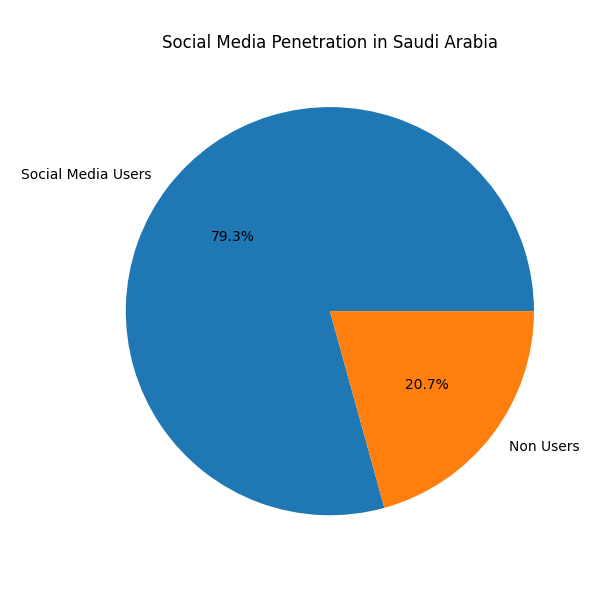
Second, Saudi Arabia is one of the most digitally concentrated consumer markets in the region. Internet usage is close to universal. Mobile connectivity is exceptionally high. Broadband access is strong. Data consumption is heavy. Social media penetration is enormous. Consumers are accustomed to fast digital experiences, app-based service delivery, and cross-platform digital behaviour. That matters because AI search thrives where users are already comfortable with digital interfaces, conversational interactions, and mobile-first information journeys.
Third, Saudi Arabia has a uniquely important linguistic and cultural position in the Arabic internet. High Arabic-content demand combined with historically uneven Arabic-content supply creates a strategic opening for brands that publish well-structured, authoritative Arabic content. As Saudi-led AI initiatives push Arabic NLP, LLM training, and local-language search quality forward, businesses that invest early in high-quality Arabic content ecosystems may benefit disproportionately. This is especially true in sectors like healthcare, tourism, finance, real estate, logistics, education, government services, retail, and professional services, where trust, relevance, and contextual language understanding matter.
Fourth, Saudi Arabia is becoming a serious AI infrastructure market. Data centres, cloud regions, sovereign AI platforms, state-backed AI companies, GPU commitments, national data initiatives, and global hyperscaler partnerships are moving the country beyond rhetoric and into execution. Infrastructure alone does not guarantee market leadership, but it does change the economics of AI adoption. It reduces latency, improves compliance options, strengthens data residency, and helps create the conditions for localised AI products and search experiences. For companies building AI-enabled customer experiences or trying to win visibility inside AI-generated responses, that infrastructure matters.
Fifth, Saudi users are already participating in the broader global shift from traditional search to AI-assisted search behaviour. Around the world, users are increasingly asking full questions instead of typing fragmented keywords. They are relying on summaries before clicking, comparing options inside conversational interfaces, and discovering brands through AI-curated recommendation layers. In Saudi Arabia, where digital adoption is high and mobile usage dominates, this behavioural shift has the potential to scale quickly. Businesses that still treat SEO as only a ranking game may find themselves losing visibility even while maintaining conventional positions.
That is exactly why statistics matter.
Without data, discussions about AI search in Saudi Arabia can quickly become vague, repetitive, or speculative. Terms like “AI boom,” “digital transformation,” and “the future of search” are used so often that they lose precision. Numbers restore precision. They show how large the market is, how fast it is growing, how much infrastructure is being built, how quickly users are adopting AI tools, which platforms dominate attention, where content opportunities exist, and why this market deserves serious commercial focus.
Some of the statistics in this article explain the macro environment: AI market size, infrastructure expansion, cloud commitments, public-sector AI readiness, workforce development, and digital economy growth. Others explain consumer behaviour: internet penetration, social platform use, mobile broadband saturation, app usage, language preferences, and digital purchasing habits. Others explain search and discovery dynamics directly: Google’s dominance, browser share, mobile-first access patterns, AI Overview trends, zero-click behaviour, citation benchmarks, LLM referral growth, and platform-specific discovery patterns across YouTube, TikTok, Instagram, and messaging ecosystems. Together, they create a more complete picture of what AI search and GEO really mean in Saudi Arabia in 2026.
This matters for more than marketers.
If you are a founder, these statistics help identify where product discovery is heading and which channels may become more efficient or more crowded. If you are an SEO lead, they help you understand how traditional optimisation must evolve into entity-led, source-led, multilingual, AI-aware content architecture. If you are a content strategist, they reveal why introductory clarity, structured factual content, citation-worthiness, and Arabic localisation matter more than ever. If you are a B2B company, they show why AI-mediated buying journeys are already becoming part of enterprise discovery. If you are an e-commerce brand, they explain why visibility in AI-generated recommendations could soon influence conversion just as much as category-page rankings. If you are an investor, consultant, or policymaker, they offer a market-level view of how infrastructure, talent, adoption, and platform behaviour are aligning in one of the world’s most closely watched digital economies.
Saudi Arabia is especially important because it is not just following global AI search trends. In some areas, it is creating the conditions to shape them regionally.
The rise of sovereign Arabic AI models, the expansion of local data infrastructure, the growth of AI training initiatives, and the alignment of AI with national economic goals mean that Saudi Arabia could become one of the defining markets for Arabic-language generative search. That has implications beyond the Kingdom itself. What happens in Saudi Arabia may influence broader MENA content strategies, Arabic search optimisation standards, regional AI tooling, and the evolution of digital trust signals in Arabic-language online ecosystems.
For businesses targeting the Gulf, this point is critical. A generic MENA digital strategy is often too broad to capture the realities of Saudi Arabia. The Saudi market is larger, wealthier, more digitally mature, more policy-coordinated, and more platform-dense than many neighbouring markets. It deserves its own search strategy, its own content model, and increasingly, its own GEO framework. Brands that understand Saudi-specific search behaviour, Arabic content expectations, mobile experience standards, cultural context, and platform usage patterns will be far better positioned than those relying on regional generalisations.
Another reason this topic deserves a long-form statistical guide is that AI search is still misunderstood in practical terms.
Many companies still think of GEO as a narrow tactic. They assume it means inserting more keywords, publishing AI-generated content at scale, or hoping that an LLM mentions their brand. That is too simplistic. In reality, effective GEO is about making a brand legible to machine-mediated discovery systems. It is about becoming easy to retrieve, easy to verify, easy to cite, and easy to trust. It is about building content that answers questions cleanly, establishing presence across authoritative third-party platforms, maintaining strong brand entities, improving structured relevance, and aligning technical performance with the surfaces where AI systems draw and validate information.
In a Saudi context, that also means understanding Arabic search intent, local dialect nuance, culturally relevant demand patterns, Ramadan and seasonal consumption cycles, public-service information needs, sector-specific trust expectations, and the role of mobile and social platforms in reinforcing discovery. GEO is not just a technical extension of SEO. It is an operational response to how digital visibility is changing.
That change is already affecting metrics.
Traditional click-through logic is weakening in AI-heavy environments. Users may receive the answer they need before visiting a website. They may compare brands inside a generated summary. They may extract product options from an assistant without ever seeing a classic search results page. They may validate a brand through reviews, forums, video, and social proof that AI systems surface as supporting context. For some businesses, this means a future with fewer low-intent clicks but higher pressure to own branded mentions, source authority, and answer-layer presence. For others, especially in e-commerce and B2B, it means that cited visibility inside AI responses may become one of the most commercially valuable forms of digital presence.
Saudi Arabia is particularly exposed to this shift because its users are highly mobile, highly social, and increasingly AI-aware. In a market where smartphone usage is dominant, social media intensity is high, and digital commerce is expanding quickly, the path from discovery to action can compress very fast. A recommendation surfaced by an AI assistant, reinforced by YouTube content, validated on Instagram or TikTok, and shared via WhatsApp may influence a purchase decision without the user ever engaging in the old linear journey of search, click, browse, compare, and convert. That is why AI search cannot be analysed in isolation from broader digital behaviour.
This report therefore takes a wide-angle view.
It looks at government AI policy because policy shapes infrastructure, regulation, public confidence, and investment. It looks at rankings because rankings influence perception, capital flows, and international positioning. It looks at AI infrastructure because infrastructure determines local capability, latency, and deployment scale. It looks at internet penetration and connectivity because those define the practical reach of AI search experiences. It looks at search engines, browsers, and mobile usage because they show where discovery actually happens. It looks at generative AI adoption because user behaviour determines how quickly GEO becomes commercially urgent. It looks at enterprise applications because business adoption affects content volume, digital competition, and search surface saturation. It looks at e-commerce and digital marketing because discovery ultimately ties back to revenue. And it looks at global AI search benchmarks because Saudi businesses do not compete only inside a national vacuum; they compete inside platform ecosystems whose rules are being rewritten globally.
The result is a reference point for anyone trying to answer questions such as:
How advanced is Saudi Arabia really as an AI market in 2026?
How quickly are Saudi consumers and businesses adopting AI-powered search and generative tools?
What makes the Kingdom different from other MENA markets in terms of AI visibility and digital discovery?
Why does Arabic-language model development matter for SEO and GEO?
Which infrastructure, policy, and platform trends are most likely to reshape search performance over the next few years?
How should businesses think differently about content, authority, trust, and optimisation in Saudi Arabia now that AI-generated answers are becoming mainstream?
Those are the questions this article is designed to help answer.
The 155 statistics that follow are intended to be practical. Some will confirm trends already visible on the ground. Others may challenge assumptions. Some show how quickly Saudi Arabia is scaling in AI policy and infrastructure. Others reveal how close the market already is to digital saturation. Others highlight content and language gaps that create opportunity. Others explain why waiting to adapt is becoming more expensive. Taken together, they show that Saudi Arabia is not simply participating in the AI search era. It is becoming one of the markets where that era may be most commercially consequential.
For brands operating in or entering the Kingdom, the takeaway is straightforward: the future of visibility in Saudi Arabia will not be won through old SEO playbooks alone. It will be won through a combined strategy that includes technical SEO, Arabic content excellence, mobile performance, third-party authority, platform diversification, and GEO readiness across AI-generated search environments. Companies that move early will have more time to build signals, test content architectures, strengthen local authority, and earn a durable place in emerging answer layers. Companies that delay may find that by the time they act, AI discovery surfaces are already crowded with stronger, better-structured, and more trusted competitors.
Saudi Arabia in 2026 is therefore one of the most important markets to watch for anyone serious about the future of SEO, AI search, and generative engine optimisation.
The statistics in this guide explain why.
But, before we venture further, we like to share who we are and what we do.
About AppLabx
From developing a solid marketing plan to creating compelling content, optimizing for search engines, leveraging social media, and utilizing paid advertising, AppLabx offers a comprehensive suite of digital marketing services designed to drive growth and profitability for your business.
At AppLabx, we understand that no two businesses are alike. That’s why we take a personalized approach to every project, working closely with our clients to understand their unique needs and goals, and developing customized strategies to help them achieve success.
If you need a digital consultation, then send in an inquiry here.
Or, send an email to [email protected] to get started.
155 AI Search & GEO in Saudi Arabia Statistics, Data & Trends in 2026
Section 1: Saudi Arabia’s AI Policy & Global Rankings
- Saudi Arabia’s Cabinet-level designation of 2026 as the Year of Artificial Intelligence signals the strongest possible government commitment to AI adoption, making it the most policy-driven AI market in the Arab world.
- Ranking #1 globally in public sector AI adoption with a score of 66/100 — ahead of Singapore and India — confirms that Saudi Arabia’s government is not just investing in AI but is actively deploying it at scale across public services.
- A 17-place jump to 14th in the Global AI Index (Tortoise Intelligence, 2025) is a rare and rapid ascent for any country, reflecting genuine infrastructure expansion rather than just policy announcements.
- Ranking 3rd worldwide in the OECD AI Policy Observatory places Saudi Arabia ahead of most G7 nations in AI governance readiness — a credible indicator for businesses evaluating regulatory risk.
- Being ranked #1 in the Arab world in AI model development by Stanford University indicators confirms that Saudi Arabia is transitioning from AI consumer to AI producer, with real implications for Arabic-language search and content.
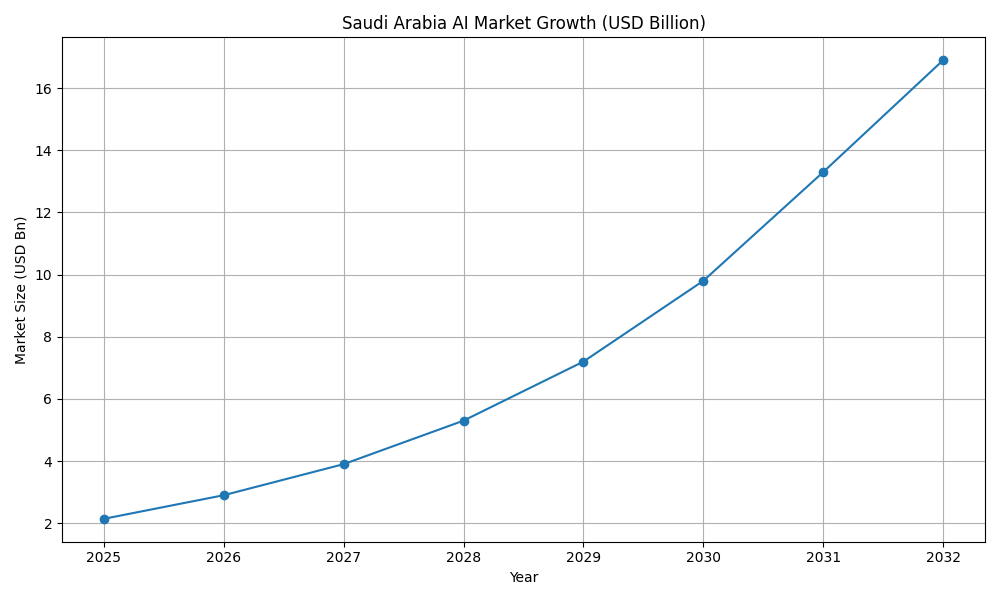
- A projected growth from USD 2.14 billion (2025) to USD 16.90 billion (2032) at a 34.3% CAGR positions Saudi Arabia’s AI market as one of the fastest-growing in the world — outpacing most European markets.
- Securing ~USD 9.1 billion across 70 investment deals demonstrates that Saudi AI growth is not solely government-funded — private sector confidence in the market is substantial and accelerating.
- A 56.25% year-over-year increase in government AI spending is one of the steepest budget acceleration curves globally, suggesting that Saudi AI infrastructure buildout is still in its early, high-growth phase.
- With 664+ companies in Saudi Arabia’s data and AI space, the ecosystem has sufficient competitive density to drive innovation, talent development, and market-ready AI products — a healthy sign for long-term sustainability.
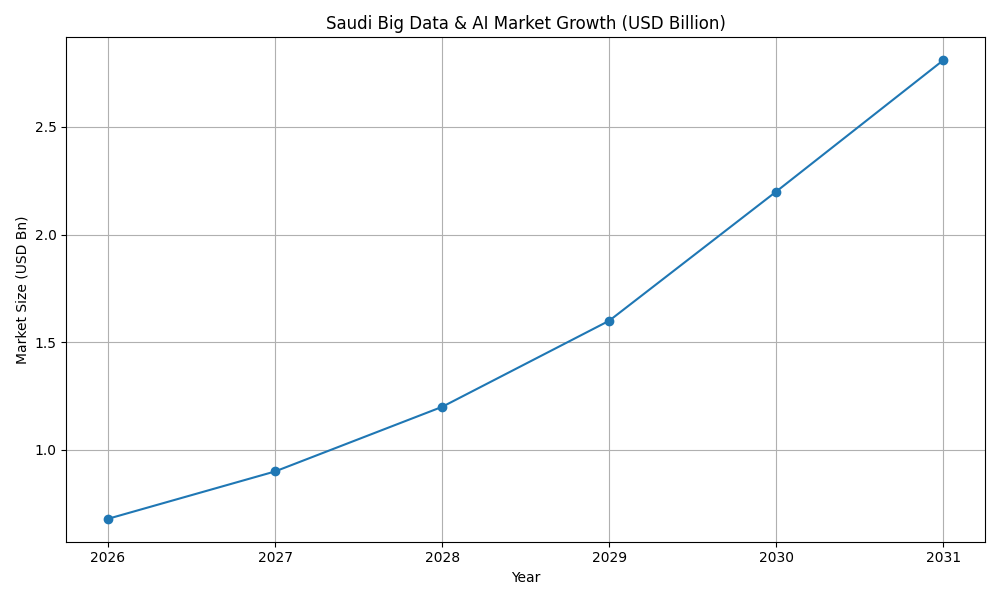
- A CAGR of 32.87% taking the Big Data & AI market from USD 0.68 billion (2026) to USD 2.81 billion (2031) reflects compounding demand from Vision 2030 projects, not a speculative bubble.
- The fact that 70% of Vision 2030’s strategic goals involve data and AI means businesses aligned with the national agenda — particularly in healthcare, logistics, and tourism — gain a structural advantage in AI-driven search visibility.
- A top-15 global AI ranking target by 2030 is ambitious but credible given the current investment trajectory; businesses entering Saudi Arabia now are operating in a market that will be materially more AI-mature within 4 years.
- A digital economy worth SAR 495 billion (~USD 132B) contributing 15% to GDP makes Saudi Arabia’s digital market one of the most significant in the emerging world — and digital search is a primary discovery channel within it.
- Saudi Arabia’s ICT market surpassing SAR 180 billion to become the largest technology market in MENA means that regional businesses must prioritise Saudi-specific SEO and GEO strategies, not MENA-wide ones.
- The USD 100 billion Project Transcendence initiative is the single largest national AI investment in history — its downstream effect on cloud capacity, data availability, and AI model training will reshape the Saudi search landscape for a decade.
Section 2: AI Infrastructure — HUMAIN, ALLAM & Data Centers
- HUMAIN’s launch as a PIF-owned, full-stack AI company (May 2025) means Saudi Arabia now controls its own sovereign AI pipeline — from data centres to LLMs — reducing dependence on foreign AI platforms for Arabic-language search.
- HUMAIN Chat’s August 2025 launch as the first Arabic-first conversational AI app represents a direct competitor to ChatGPT and Gemini for Saudi users, creating a new and critical platform to optimise for in any GEO strategy.
- Training ALLAM 34B on over 500 billion Arabic tokens — the largest Arabic training corpus ever — gives Saudi Arabia a structural advantage in Arabic NLP accuracy that no foreign LLM can currently match.
- An 8-petabyte training dataset spanning 380+ billion Arabic words and 390,000+ books means ALLAM 34B has deeper Arabic cultural and linguistic coverage than any externally developed model, directly affecting how Arabic content is evaluated.
- A development team of 120+ specialists including 35 PhD holders with a 50/50 gender ratio signals that ALLAM is built with both technical rigour and a commitment to inclusive AI development — attributes that support long-term model credibility.
- With 1.8 trillion parameters matching GPT-4o’s scale and multilingual training across 20+ languages, ALLAM 34B is not a regional novelty — it is a frontier model with direct implications for how Arabic queries are answered globally.
- Independent verification by Cohere on MMLU confirming ALLAM as the world’s most advanced Arabic LLM built in the Arab world provides third-party validation — a critical credibility marker for enterprise adoption.
- Over 400 subject matter experts generating 1 million+ prompts for ALLAM fine-tuning means the model has exceptional domain coverage in Arabic-language professional and commercial contexts — critical for accurate business-related queries.
- SDAIA’s National Data Lake integrating 430+ government systems creates a unified national data asset that will power AI-generated answers about Saudi public services, regulations, and economic data.
- The 480 MW Hexagon Data Centre in Riyadh — described as the world’s largest government-run data centre — provides the computational backbone needed to run large-scale inference on Arabic LLMs at national speed and cost efficiency.
- 40 operational co-location data centres, with 10 in Dammam alone, provides enough geographic distribution for low-latency AI search delivery across all major Saudi population centres.
- AWS’s plan to provide 150,000 AI accelerators in Riyadh’s AI Zone (with HUMAIN) will make Saudi Arabia one of the most densely GPU-equipped markets globally — enabling faster model iteration and inference at lower cost.
- Google Cloud’s USD 10 billion partnership with PIF and HUMAIN means Saudi Arabia will have direct, sovereign-level access to Google’s AI infrastructure — with implications for how Google’s own AI products serve Saudi users.
- AWS’s USD 5 billion AI Zone investment in Saudi Arabia, tied to training 100,000 Saudi citizens in cloud and GenAI, is one of the largest combined infrastructure and talent-development commitments in cloud history.
- Microsoft’s commitment to AI-upskilling 3 million Saudis by 2030 — confirmed February 2026 — represents the largest single corporate workforce development pledge in Saudi Arabia’s digital history.
- Microsoft’s planned Q4 2026 Saudi Arabia cloud region launch will give businesses deploying Azure-based AI tools local data residency options, reducing latency for AI search applications and satisfying data sovereignty requirements.
- A 42% increase in data centre capacity (to 290.5 MW in 2023) demonstrates that Saudi Arabia’s AI infrastructure is growing faster than most developed markets — providing the physical foundation for AI search at national scale.
Section 3: Internet Penetration & Digital Connectivity
- A 99% internet penetration rate means virtually every potential consumer in Saudi Arabia is reachable through online channels — making digital and AI-powered search the default discovery mechanism for products and services.
- 34.4 million internet users as of late 2025 represents a near-total addressable digital market, with AI search tools and generative platforms accessible to the vast majority of the working-age population.
- 48.7 million mobile connections at 140% of total population confirms multi-SIM usage is widespread — meaning mobile AI search experiences must be optimised for varied network and device contexts.
- 38.6 million social media identities at 111% of population reveals that Saudi users maintain multiple accounts across platforms — creating parallel AI discovery touchpoints beyond conventional search.
- With 98.5% of mobile connections being broadband, Saudi Arabia has effectively eliminated the low-bandwidth barrier to AI search adoption, enabling rich, multimodal AI responses at scale.
- A median mobile download speed of 194.49 Mbps — among the world’s fastest — means Saudi users are unlikely to tolerate slow-loading AI-generated content, raising the performance bar for GEO-optimised pages.
- Average mobile data consumption of 48 GB per person per month (3x the global average) indicates an audience that is deeply habituated to rich digital content — and expects AI tools and search to match that richness.
- 25% annual growth in Saudi domain names — 8x the global average — signals explosive growth in locally hosted Arabic web content, which in turn provides more training data for Saudi AI models.
- With 21.5% of internet users actively using AI tools, Saudi Arabia already has a significant AI-native user base — and this segment is disproportionately influential in shaping broader digital behaviour.
- A 68.86% mobile internet user penetration rate confirms that the majority of search queries originate from mobile devices, making mobile-first indexing and AMP/Core Web Vitals prerequisites for AI search visibility.
- An average daily mobile internet use of 4 hours 13 minutes means Saudi users are among the most digitally active globally — creating multiple daily touchpoints for AI-assisted search and discovery.
- USD 24.8 billion in digital infrastructure investment over six years, resulting in doubled mobile speeds (to 215 Mbps), represents one of the most concentrated national connectivity investments in history.
- With 36.31 million active internet users (98% of population), Saudi Arabia has one of the highest internet adoption ceilings in the world — meaning AI search optimisation reaches near-total population coverage.
- 29.10 million social media users (79.3% of population) create a vast ecosystem where AI-powered social search and recommendation algorithms increasingly supplement traditional search engine discovery.
- An average of 10.4 social media accounts per internet user is exceptionally high — indicating that Saudi consumers cross-validate brand discoveries across multiple platforms before making purchase decisions.
- A median fixed internet connection speed of 90.49 Mbps ensures that desktop-based AI search tools and generative interfaces load quickly — removing friction from the AI search experience.
Section 4: Search Engine & Browser Market Dynamics
- Google’s 95.94% search market share in Saudi Arabia means that Google AI Overviews, Google AI Mode, and Google’s generative search features are the single most important GEO battleground for Saudi brands — far more so than in most Western markets.
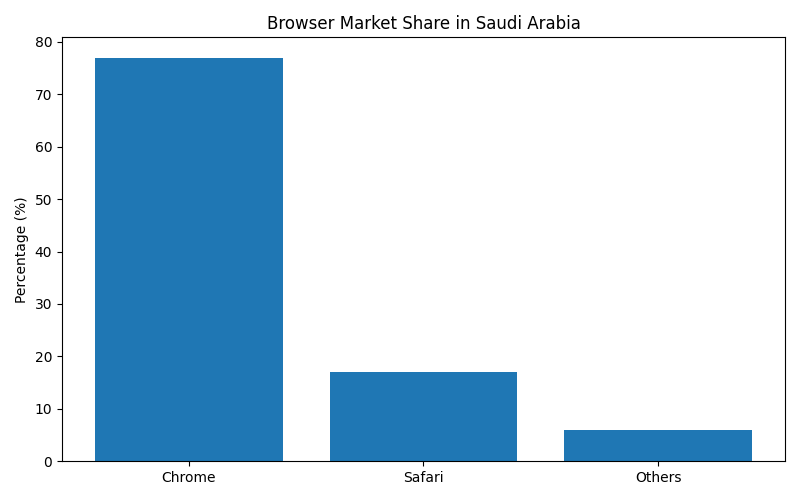
- With Chrome at 60.35% and Safari at 31.86%, two Chromium/WebKit-based browsers dominate — meaning standard web performance optimisations (Core Web Vitals) cover the overwhelming majority of Saudi search traffic.
- The preference of 74% of Saudi users for Arabic content, despite web content being English-dominated, reveals a significant opportunity gap — brands producing high-quality Arabic content face less competition in AI citation pools.
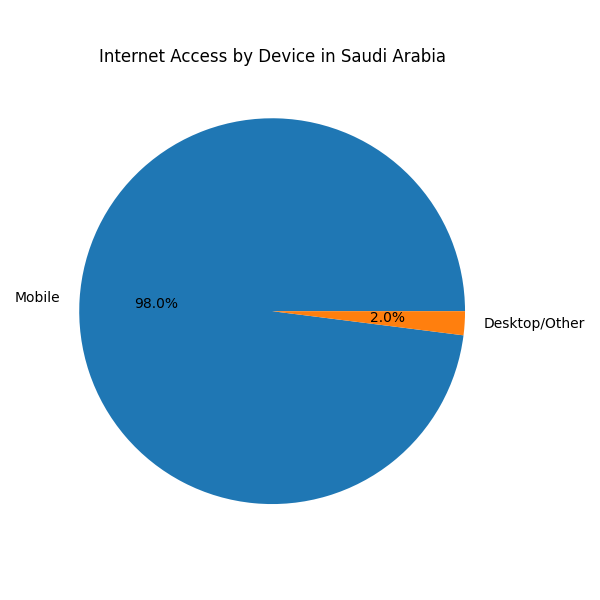
- With over 98% of Saudi users accessing the internet via smartphone, any GEO strategy that is not natively mobile-optimised will fail to achieve AI citation or search visibility for the vast majority of Saudi queries.
- WhatsApp reaching over 90% of Saudi internet users means that AI-generated content shared via WhatsApp can amplify brand visibility exponentially — and GEO strategies should include WhatsApp-shareable formats.
- 36 million internet users and 30+ million social media users together constitute one of the most concentrated, connected consumer markets in the Middle East — making precision-targeted AI search and content strategies highly cost-effective.
- A 62% better conversion rate for TikTok Arabic ads vs English-language equivalents demonstrates that cultural and linguistic alignment is not just a preference — it is a measurable revenue driver.
- Peak internet usage between 9 PM–11 PM and on Saturdays has direct implications for when AI-powered campaigns, content publishing, and chatbot activations should be scheduled for maximum reach.
- Saudi Arabia’s 6th-place ranking in the UN E-Government Development Index confirms that AI-powered government services are a trusted and routinely used channel — normalising AI interactions for Saudi users.
- YouTube driving 43.60% of Saudi web traffic confirms that video content optimised for AI-powered search (YouTube descriptions, chapters, captions) is one of the highest-leverage GEO tactics available.
- 27.88 million Instagram users make it Saudi Arabia’s most active social platform — Instagram’s integration of AI shopping features and Reels search makes it a critical secondary GEO channel.
- 30.39 million WhatsApp users — close to total internet user base — means AI customer service chatbots and WhatsApp Business search integrations are not optional but essential for market coverage.
- TikTok reaching 34.1 million users aged 18+ — exceeding Saudi Arabia’s internet user base — confirms overlapping accounts and TikTok’s status as the de facto short-form search engine for Saudi youth.
- 50.5% of users using social media to stay in touch with family and friends — rather than for product discovery — means that brand content must earn organic sharing rather than relying on direct intent-based search alone.
- The ICT sector representing 15.6% of GDP means technology-related search queries in Saudi Arabia are tied to significant economic activity, making high-intent B2B and tech searches particularly valuable for AI visibility.
Section 5: GenAI Adoption & Workforce Development
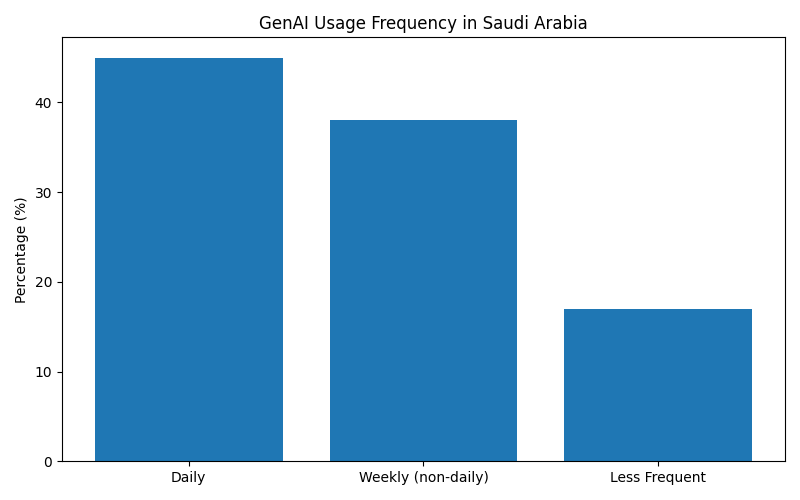
- With 83% of Saudi GenAI users engaging weekly (45% daily), Saudi Arabia is not in an experimental AI phase — it is in active, habitual AI use, meaning GEO optimisation is urgent, not a future consideration.
- The 2022–2025 adoption surge aligned with ChatGPT’s public release confirms that Saudi users were among the fastest globally to adopt conversational AI — a behaviour pattern that accelerates GEO relevance every passing month.
- The Saudi Conversational AI market growing from USD 158.8 million (2025) to USD 1,660.3 million (2034) at 29.80% CAGR represents a 10x expansion — any business not optimising for AI-generated responses today will be structurally disadvantaged within 3 years.
- A projected USD 460 million addition to Saudi Conversational AI market value between 2025 and 2030 represents a specific, near-term revenue opportunity for businesses deploying AI customer service and search applications.
- With AI projected to contribute USD 135 billion to Saudi GDP by 2030, AI-powered business functions — including search, marketing, and e-commerce — will collectively represent one of the largest economic shifts in the Kingdom’s history.
- Saudi Arabia’s target of AI contributing 12% of GDP by 2030 is one of the most aggressive AI economic targets set by any government globally — making AI-native business models a structural imperative, not a competitive advantage.
- AI models achieving 95% accuracy in Arabic sentiment analysis and intent recognition means AI-generated search results in Saudi Arabia will increasingly reflect nuanced, dialectally accurate interpretations of consumer queries.
- With 73% of Saudi marketing teams using LLMs for personalisation, the majority of marketing content Saudi consumers encounter is already AI-mediated — making brand signals in LLM training data increasingly important.
- AI’s capacity to handle 95% of customer interactions in Saudi marketing contexts reflects a near-complete AI mediation of the customer journey — GEO is therefore not a digital marketing tactic but a fundamental business infrastructure decision.
- Over 1 million Saudi citizens reached by SDAIA AI literacy programmes creates a growing population of AI-aware users who will actively seek AI-generated answers rather than clicking through to traditional search results.
- 5,000+ students enrolled in AI-focused Saudi programmes signals a near-term pipeline of AI-native talent that will accelerate both AI product development and consumer AI adoption over the next 5 years.
- The goal of training 25,000 women in data and AI through the Elevate programme specifically increases female digital workforce participation — an audience segment that is already highly active on Instagram, TikTok, and e-commerce platforms.
- Women’s participation in Saudi tech growing from 7% (2018) to 35% (current) — exceeding G20 and EU averages — creates a substantial and economically active female digital audience that AI search and GEO strategies should specifically address.
- 28.7% year-over-year growth in Saudi AI hiring (3rd fastest globally) means the country will have significantly more AI talent to deploy within its own companies within 2–3 years, compressing the timeline for AI product maturity.
- Saudi women having higher AI skill penetration than men (0.77 vs 0.61) is a globally rare finding that challenges assumptions about AI demographics in conservative markets — and has direct implications for audience targeting in AI-driven campaigns.
- A target of 300 AI startups and USD 20 billion in AI investment by 2030 means Saudi Arabia is explicitly building a domestic AI supply chain — one that will create local alternatives to foreign AI tools, including search and content generation.
- 381,000+ quality technology jobs created under Vision 2030 digital programmes represents a skilled, AI-aware workforce that both produces and consumes AI search outputs at an accelerating rate.
Section 6: Generative AI Market Size & Enterprise Applications
- The 47.5% CAGR projected for the Generative AI segment through 2032 is the fastest growth rate of any AI category in Saudi Arabia — making it the single most important segment to build a GEO strategy around today.
- Saudi Arabia holding 30% of the MEA Generative AI market confirms its regional dominance — meaning trends observed in Saudi GenAI adoption will set the standard for the broader Middle East digital marketing landscape.
- The MEA generative AI market growing from USD 1.5 billion (2025) to USD 12.9 billion (2032) at 36% CAGR provides the macro commercial context: the Arabic generative AI ecosystem will be nearly 9x larger by the end of the decade.
- Software commanding 65% of MEA GenAI market share — driven largely by Arabic LLM demand — confirms that language model APIs, content generation tools, and AI search integrations are the primary commercial growth vectors.
- The USD 1 billion GAIA initiative to accelerate Saudi generative AI development is a direct government subsidy of the AI content and search ecosystem — businesses that engage with GAIA-funded tools gain a policy-aligned competitive advantage.
- The AWS-HUMAIN USD 5 billion+ AI Zone with 100,000 citizen training places creates both the cloud infrastructure and the human capital pipeline for a genuinely self-sustaining Saudi generative AI ecosystem.
- With 40% of Saudi businesses already using AI in digital marketing, early adopters have had 1–2 years of compounding learning advantages — businesses not yet implementing AI-driven content and GEO strategies are operationally behind.
- Sales & marketing representing USD 0.58 billion of Saudi AI market value (the largest single function) confirms that AI’s commercial impact is most concentrated in the discovery and conversion funnel — precisely where search and GEO operate.
- The 38.4% CAGR for technology and software providers in Saudi AI confirms that the tools enabling AI search (APIs, analytics platforms, LLM integrations) are themselves growing faster than the broader AI market.
- Saudi healthcare big data market growing from USD 397.8 million (2024) to USD 1.91 billion (2033) means that health-related AI search is one of the fastest-growing query categories — a significant content opportunity for medtech and pharma brands.
- Productivity gains of up to 30% across sectors reported from SDAIA’s Generative AI Guidelines adoption confirm that AI is not just a search tool but a systemic efficiency driver — one that shifts how content is created, published, and indexed.
- AI referral traffic growing 357% year-over-year globally (Similarweb, July 2025) reflects a structural shift in how users reach websites — brands not appearing in AI-generated answers are losing an increasingly large share of discovery traffic.
- 80% of B2B technology buyers globally trusting GenAI as much as traditional search — a benchmark directly applicable to Saudi Arabia’s rapidly growing B2B tech sector — means GEO is now a B2B sales pipeline issue, not just an SEO metric.
- Saudi Arabia’s regional AI sector growing at 45% annually means the competitive landscape for AI search visibility is compressing rapidly — the cost of delayed GEO investment increases substantially each year.
Section 7: E-Commerce, Digital Marketing & Social Media
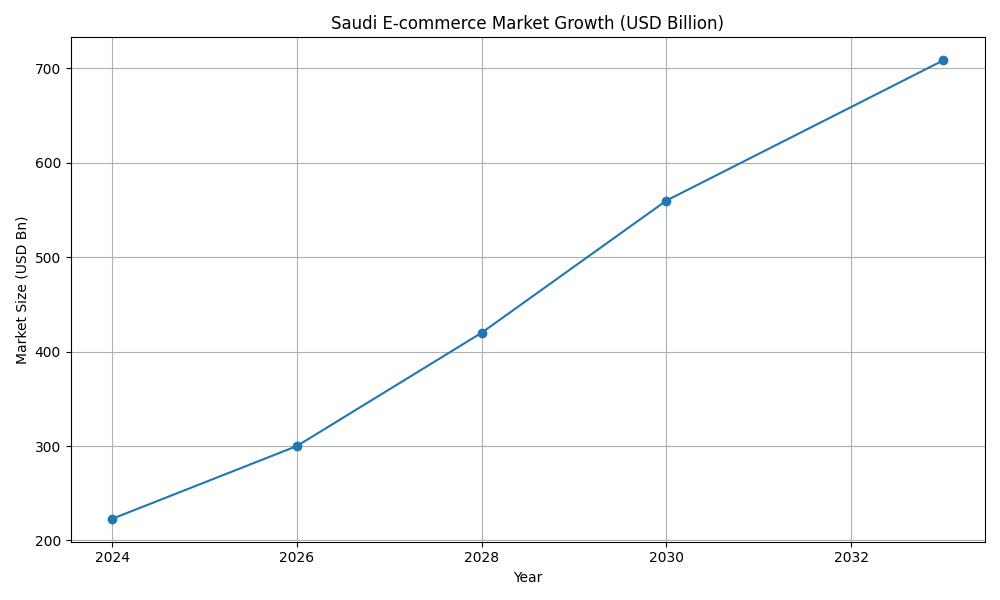
- Saudi Arabia’s e-commerce market growing from USD 222.9 billion (2024) to USD 708.7 billion (2033) at 12.8% CAGR positions it as the highest-value digital commerce environment in the Arab world — where product discoverability through AI search directly impacts revenue.
- E-payments accounting for 79% of all Saudi retail purchases confirms that the consumer journey — from AI-powered discovery to frictionless checkout — is almost entirely digital, making AI search optimisation a direct revenue lever.
- With 34.5 million expected e-commerce users by 2025 and 74.7% user penetration by 2027, Saudi e-commerce audiences will be near-saturated — competitive differentiation will shift from platform access to AI search visibility.
- B2C e-commerce capturing 76% market share means consumer-facing brands have the largest and most immediate opportunity from AI search optimisation — particularly for high-frequency categories like fashion, electronics, and food.
- 32% e-commerce growth in 2022 — maintained in subsequent years — confirms that Saudi digital commerce is in a sustained, structural growth phase rather than a post-pandemic correction.
- A projected USD 23.46 billion e-commerce market by 2027 (Deloitte) represents a near-doubling of addressable transactional value within 2 years — compressing the window for brands to establish AI search authority.
- Saudi Arabia’s IoT market reaching USD 2.9 billion by 2025 introduces billions of connected devices that will increasingly use AI to search, order, and interact — creating non-browser AI search surfaces that GEO strategies must account for.
- A USD 95.69 million influencer advertising market at 9.82% CAGR reflects that human-curated recommendation remains commercially significant alongside AI-generated recommendations — the two will increasingly converge via AI influencer tools.
- Short-form video ad spending reaching USD 127.2 million by 2028 confirms that TikTok and Instagram Reels — which now use AI-powered search internally — are becoming significant discovery platforms requiring their own GEO approach.
- Social media ad spending reaching USD 797.70 million by 2029 signals that paid amplification of AI-optimised content will become a significant budget line — organic AI visibility and paid AI-surface promotion will increasingly work together.
- Saudi Arabia’s digital market projected to reach USD 82.0 billion by 2033 at 23.1% CAGR provides the total commercial context: AI search is not a feature of this market — it is the organising infrastructure of its discovery layer.
- Micro-influencers generating 60% higher engagement than macro-influencers confirms that authenticity and niche authority outperform scale — a principle directly mirrored in how AI models prioritise credible, specific sources over generic ones.
- 35% increase in consumer spending during Ramadan 2025 for brands adapting messaging demonstrates that cultural context-awareness in AI-generated content is not optional — it is a measurable revenue driver in Saudi Arabia.
Section 8: Global AI Search & GEO Benchmarks
- Google AI Overviews appearing in ~15% of all search results globally — and expanding — means that for high-frequency search categories in Saudi Arabia, AI-generated summaries are already the default first interaction, not the blue links.
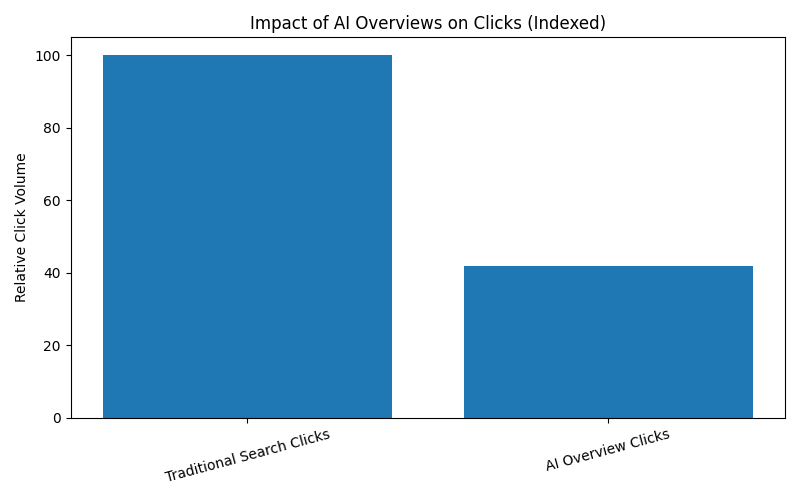
- A 58% reduction in website clicks when AI Overviews are triggered confirms that traditional CTR-based SEO metrics are losing relevance — brand visibility within the AI Overview itself becomes the new measure of search success.
- 93% of AI Mode searches ending without a click — more than twice AI Overviews’ zero-click rate — signals that AI Mode represents the most disruptive search experience to traditional traffic funnels, requiring GEO strategies that prioritise brand impression over click volume.
- 76.1% of AI Overview citations coming from top-10 ranking pages confirms that traditional SEO and GEO are not mutually exclusive — strong organic ranking remains a prerequisite for AI citation, not a replacement strategy.
- ChatGPT Search citing lower-ranking pages (position 21+) ~90% of the time reveals that ChatGPT operates on fundamentally different citation logic than Google — presenting a distinct GEO opportunity for brands that may not rank highly on Google.
- 44.2% of LLM citations drawn from the opening 30% of content has a direct content strategy implication: Saudi brands must place their most authoritative, keyword-rich, and fact-dense content at the very beginning of every page.
- AI Overview content changing 70% of the time for the same query, with 45.5% of citations replaced, underscores that AI search visibility is dynamic — ongoing content optimisation, not one-time page creation, is required.
- Users spending double the time in AI Mode (49 seconds) vs AI Overviews (21 seconds) confirms that AI Mode generates deeper engagement — brands appearing in AI Mode answers capture higher-quality attention than standard search results.
- Sites with 32K+ referring domains being 3.5x more likely to be cited by ChatGPT makes authoritative link-building the clearest and most measurable long-term GEO investment a Saudi brand can make.
- Quora and Reddit brand mentions creating 4x higher LLM citation probability is directly applicable to Saudi Arabia’s context: investing in Arabic-language forum presence and community Q&A platforms can significantly improve AI citation rates.
- Trustpilot, G2, and review platform profiles creating 3x higher ChatGPT citation probability confirms that third-party validation signals — not just on-site content — directly influence AI search visibility.
- Commercial intent queries triggering ChatGPT web search 53.5% of the time (vs 18.7% for informational) means that product and service-related queries in Saudi Arabia are highly likely to generate cited, source-linked AI responses — making GEO critical for transactional pages.
- Less than 1% chance of the same brand list appearing across 100 repeated ChatGPT queries confirms that AI search brand visibility is probabilistic, not deterministic — portfolio diversification across AI platforms is essential for consistent Saudi market presence.
- Only 13.7% overlap between Google AI Overviews and Google AI Mode citations confirms that these are strategically distinct channels — Saudi brands need separate content architectures to compete in both.
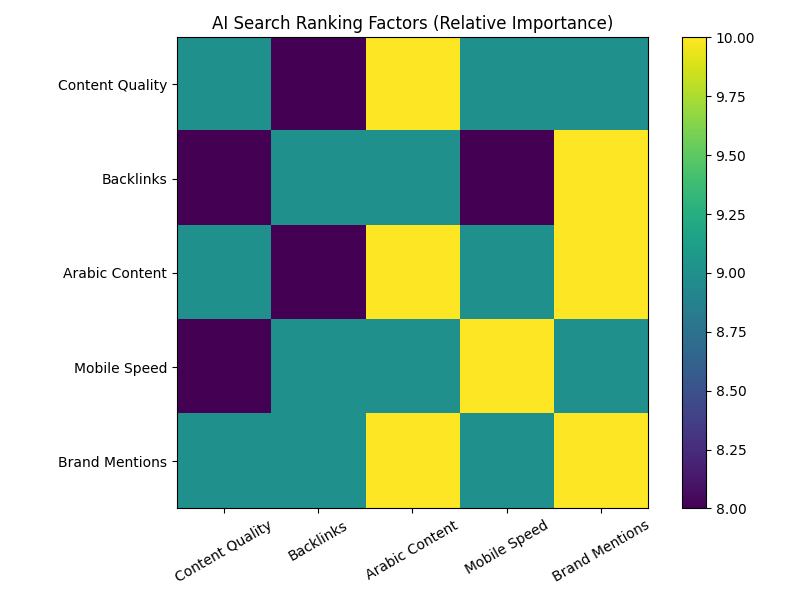
- YouTube mentions and branded web mentions being the top factors for AI brand visibility across ChatGPT, AI Mode, and AI Overviews provides a clear, actionable GEO priority: invest in branded video content and earned media mentions in Arabic and English.
- 7 in 10 companies reporting better returns after integrating AI into SEO workflows confirms that the ROI case for AI-assisted content production is well-established — Saudi businesses adopting AI content tools are not taking a risk but following proven practice.
- AI search platform visitors spending 38% longer on retail sites and viewing more pages signals that AI-referred traffic is higher-quality and more purchase-intent-driven than average traffic — a powerful argument for prioritising AI search visibility in Saudi e-commerce.
- Only 9% of users always trusting AI answers reveals a meaningful credibility gap — Saudi brands that visibly cite sources, include expert authorship signals, and update content frequently will stand out in an AI search environment still building user trust.
- ChatGPT ranking as the world’s 5th most visited site with ~5 billion monthly visits means it is not a niche AI tool — it is a mass-market search platform that Saudi brands cannot afford to be invisible on.
- Google AI Mode availability in 200+ countries including Saudi Arabia closes any remaining argument for delaying GEO investment — Saudi users can access AI Mode today, and their search behaviour is already being shaped by it.
Section 9: Strategic Partnerships & Government AI Programs
- Saudi Arabia’s targets — top-15 AI exporter, 300 AI startups, USD 20 billion investment by 2030 — create a policy environment that actively rewards businesses building AI-native products, including AI search and content tools.
- Being the first Arab nation to join the Global Partnership on AI (GPAI) gives Saudi Arabia a seat in shaping international AI standards — which will influence how AI search systems are regulated and audited globally.
- Hosting the UNESCO-sponsored ICAIRE in Riyadh positions Saudi Arabia as a global AI ethics standard-setter, meaning that responsible AI content — including ethical GEO practices — will likely be increasingly valued by Saudi regulators and AI systems.
- Scores of 79/100 for AI enthusiasm but only 55/100 for enablement in the Public Sector AI Adoption Index reveals that while demand for AI is very high, the infrastructure and regulatory frameworks are still catching up — a window of opportunity for businesses that move now.
- The Qualcomm-HUMAIN MoU to deliver AI data centres and hybrid edge-cloud AI confirms that AI search will increasingly happen on-device in Saudi Arabia — meaning on-device AI assistant optimisation (Siri, Google Assistant, Snapdragon AI) will become a GEO consideration.
- NVIDIA building AI factories with HUMAIN involving hundreds of thousands of GPUs in Saudi Arabia will dramatically reduce inference costs for Arabic AI models — making AI-generated content and search outputs faster, cheaper, and more widely deployed.
- Microsoft’s USD 2.1 billion Saudi superscaler cloud investment ensures Azure-based AI services — including Azure OpenAI and Bing’s AI search features — will have local Saudi data residency, improving latency and compliance for Saudi businesses.
- Oracle’s USD 1.5 billion MENA cloud expansion provides an enterprise-grade cloud alternative for Saudi businesses running AI workloads — increasing overall AI infrastructure competition and reducing costs.
- Huawei’s USD 400 million Saudi cloud investment introduces a non-Western AI infrastructure option — relevant for Saudi government entities subject to data sovereignty requirements and potentially shaping AI search for specific verticals.
- SAR 50 billion (USD 13.3B) saved via the Estishraf AI platform demonstrates that AI-powered government decision-making is already generating quantified national value — a proof point that accelerates broader AI adoption across sectors.
- Tawakkalna’s 17.9 million users accessing 240+ digital government services have been normalised to AI-assisted service interactions — a user behaviour pattern that transfers directly to comfort with AI search in commercial contexts.
- Nafath’s 1.8 million daily digital identity verifications confirm that AI-powered authentication is embedded in daily Saudi life — establishing a baseline of AI trust that benefits all AI search interactions.
- The GAIA Accelerator supporting 120 AI startups with USD 160 million has created a domestic AI product ecosystem that will generate locally-relevant, Arabic-language AI tools — including niche vertical AI search applications.
- 3.9 million homes with fiber-optic coverage ensures that fixed broadband AI search experiences — including rich multimodal AI interfaces — are accessible to a substantial share of the Saudi residential market.
- Non-oil GDP growing 4.5% in 2024 with 76% of GDP now from non-oil sectors confirms that Saudi Arabia’s economic diversification is structurally on track — meaning the digital and AI economy is not dependent on oil price cycles.
Section 10: SEO/GEO Market, Pricing & Advanced AI Data
- Saudi SEO retainers ranging from 3,000–15,000 SAR for SMEs and 20,000+ SAR for enterprise reflect a maturing SEO market — as GEO complexity grows, these fees will likely increase, rewarding early investment before pricing normalises upward.
- Local Saudi SEO campaigns showing results within 1–3 months for city-level targeting (Riyadh, Jeddah, Dammam) provides a realistic timeline benchmark — businesses should begin GEO alongside local SEO given the short feedback cycles available.
- Saudi SMEs growing at a 36.20% CAGR in AI adoption through 2031 confirms that mid-market businesses — not just enterprises — will be significant AI search content producers and buyers within the next 2–3 years.
- Large enterprises generating 68.71% of Saudi AI revenue in 2025 reflects natural first-mover dynamics — but SME AI adoption at 36.20% CAGR means the competitive landscape for AI-generated content will equalise rapidly.
- BFSI leading Saudi AI adoption at 21.34% revenue share means that financial services brands in Saudi Arabia face the earliest and most intense AI search competition — GEO investment in Arabic financial content is both urgent and high-value.
- Software capturing 44.72% of Saudi AI revenue — reflecting Arabic LLM and analytics monetisation — confirms that the tools powering GEO (AI writing assistants, SEO analytics, LLM APIs) are themselves the fastest-monetising segment of Saudi AI.
- 14 hyperscale data centre campuses under Project Transcendence including an NVIDIA-powered 18,000-GPU supercomputer means Saudi Arabia will have the raw computational capacity to run, iterate, and deploy Arabic AI search models at a scale few countries can match.
- PIF lifting US tech allocations to USD 26.7 billion in 2024 — focused on AI chips and software — ensures that Saudi Arabia has preferential access to the Nvidia GPU supply chain that underpins all frontier LLM development and AI search infrastructure.
- Google running AI Overview ads in 12 countries globally and expanding means AI-generated search result pages are becoming commercial surfaces — Saudi brands investing in GEO now will be positioned to leverage AI advertising inventory as it scales.
- McKinsey projecting GenAI to add USD 460 billion in global marketing productivity over the next decade contextualises Saudi Arabia’s GEO opportunity within a global shift — businesses not capturing this productivity gain will face compounding cost disadvantages.
- LLM-driven referral traffic growing 529% (January–May 2024 vs January–May 2025) represents one of the steepest traffic source growth curves in digital marketing history — Saudi businesses relying solely on traditional SEO are systematically ceding this channel.
- Saudi Arabia’s data centre market projected to reach USD 3.9 billion by 2030 confirms that the physical infrastructure for AI search at national scale will be fully operational well before the end of the decade — removing any remaining argument about AI search being a distant concern.
- Voice search in Arabic dialects growing rapidly in Saudi Arabia, driven by smart device adoption (Alexa, Google Home), signals that GEO strategies must account for spoken Arabic queries — including Gulf dialect variations — as a distinct and growing search surface alongside text-based AI search.
Conclusion
Saudi Arabia’s AI search landscape in 2026 is not simply evolving. It is being fundamentally restructured. The 155 statistics presented throughout this report point to a clear, unified conclusion: search in the Kingdom is no longer just about rankings, keywords, and traffic. It is about visibility within AI-generated answers, trust within machine-selected sources, and presence across a rapidly expanding ecosystem of discovery platforms.
This shift is both technological and structural.
At the technological level, generative AI is redefining how information is retrieved, summarised, and presented. Search engines are becoming answer engines. Large language models are acting as intermediaries between users and the web. Content is increasingly consumed through summaries, comparisons, and recommendations rather than through traditional click-through journeys. In Saudi Arabia, where digital infrastructure is strong, mobile usage is dominant, and AI adoption is accelerating, these changes are not gradual. They are already visible in how users search, discover, and decide.
At the structural level, Saudi Arabia is building one of the most coordinated AI ecosystems in the world. Government policy, sovereign AI initiatives, cloud and data centre investments, workforce development programmes, and private-sector participation are all aligned toward the same goal: making AI a core layer of the national economy. This alignment matters because it accelerates adoption. It reduces friction. It creates consistency across sectors. And most importantly, it compresses timelines. What might take a decade in other markets can unfold in a few years in Saudi Arabia.
For businesses, this has immediate implications.
First, AI search is no longer a future consideration. It is a current competitive variable. The data shows that Saudi users are already engaging with AI tools regularly, that AI-generated answers are increasingly part of the discovery process, and that platform-level changes are reducing the visibility of traditional organic listings. Waiting for AI search to “mature” before adapting is a strategic mistake. By the time it feels mature, the visibility landscape will already be defined by early movers.
Second, traditional SEO remains necessary but is no longer sufficient. Many of the statistics in this report reinforce that strong organic rankings still influence AI citation and visibility. However, they also show that AI systems do not operate purely on ranking position. They draw from a broader set of signals: content clarity, factual density, entity recognition, third-party mentions, brand authority, structured data, multilingual strength, and cross-platform presence. This means that businesses must evolve from a keyword-first mindset to a visibility-first mindset, where the goal is to be selected, cited, and trusted by AI systems across multiple surfaces.
Third, Arabic content is one of the most significant strategic opportunities in the Saudi market. The preference for Arabic-language content, combined with the rapid advancement of Arabic AI models, creates a clear advantage for brands that invest in high-quality, well-structured Arabic content. This is not just about translation. It is about localisation, cultural relevance, dialect awareness, and contextual accuracy. As AI systems improve their understanding of Arabic, the quality gap between strong and weak Arabic content will become more visible, and more consequential.
Fourth, mobile-first and performance-first optimisation are non-negotiable. Saudi Arabia’s digital behaviour is overwhelmingly mobile-driven, with high expectations around speed, usability, and content richness. AI search does not remove these expectations. It intensifies them. If a page is slow, poorly structured, or difficult to parse, it is less likely to be surfaced, cited, or trusted by both users and AI systems. Core Web Vitals, structured formatting, and clean information architecture are now directly tied to AI visibility.
Fifth, platform diversification is essential. Search is no longer confined to Google’s traditional results page. Discovery now happens across AI Overviews, AI Mode, conversational interfaces, social platforms, video platforms, messaging ecosystems, and voice assistants. The statistics in this report show how concentrated and interconnected Saudi users are across these platforms. For businesses, this means that visibility must be built across a network of touchpoints. YouTube content, social media presence, review platforms, community discussions, and third-party mentions all contribute to how AI systems perceive and rank a brand.
Sixth, authority and trust signals are becoming more important than ever. One of the most consistent themes across global AI search benchmarks is that AI systems favour credible, well-cited, and widely referenced sources. In practice, this means that brand mentions, backlinks, expert authorship, third-party reviews, and consistent entity representation all influence whether a business appears in AI-generated answers. In Saudi Arabia, where users are still developing trust in AI outputs, brands that demonstrate credibility clearly and consistently will stand out.
Seventh, the economics of visibility are changing. Traditional SEO often focused on traffic volume as a primary success metric. AI search introduces a different dynamic. Visibility without clicks is becoming more common. Brand exposure within AI-generated answers may influence user perception, even if it does not immediately generate a visit. At the same time, AI-referred traffic tends to be more qualified, with higher intent and deeper engagement. This means businesses must rethink how they measure success. Impressions within AI answers, citation frequency, brand inclusion, and downstream conversion impact will become as important as, if not more important than, raw traffic numbers.
Eighth, timing matters. The Saudi AI market is still in a high-growth phase. Infrastructure is expanding, adoption is rising, and competition is increasing. This creates a window of opportunity. Businesses that invest early in GEO, Arabic content, and AI-aware digital strategies can build authority before the market becomes saturated. Those that delay will face a more crowded, more competitive, and more expensive landscape.
The broader implication of all these points is that AI search is not a single tactic. It is a new layer of digital competition.
In Saudi Arabia, that layer sits on top of one of the most dynamic digital economies in the world. The Kingdom’s scale, connectivity, policy support, and investment capacity make it a unique environment where AI-driven discovery can grow rapidly and at scale. For companies operating in sectors such as e-commerce, healthcare, finance, tourism, real estate, education, logistics, and technology, the ability to appear in AI-generated answers will increasingly influence brand awareness, customer acquisition, and revenue.
It is also important to recognise that this transformation is ongoing. AI search systems are still evolving. Their citation patterns change. Their ranking logic shifts. Their interfaces expand. New platforms emerge. User behaviour adapts. The statistics in this report provide a snapshot of where the market stands in 2026, but they also point to a future where continuous optimisation will be necessary. GEO is not a one-time project. It is an ongoing process of refinement, testing, and adaptation.
For marketers and business leaders, this requires a mindset shift.
Instead of asking how to rank for a keyword, the question becomes: how do we become the best possible answer?
Instead of focusing only on search engines, the focus expands to include all AI-mediated discovery environments.
Instead of producing content at scale without structure, the emphasis moves toward producing content that is structured, authoritative, and easy for AI systems to interpret and cite.
Instead of treating SEO as a standalone function, it becomes integrated with content strategy, brand building, PR, social media, and product experience.
This integrated approach is particularly important in Saudi Arabia because of the market’s interconnected nature. Users move fluidly between platforms. They validate information across sources. They rely on both AI-generated summaries and human-generated recommendations. They expect speed, relevance, and cultural alignment. Winning visibility in such an environment requires consistency across all touchpoints.
The data also suggests that Saudi Arabia will play a significant role in shaping the future of AI search in the Arabic-speaking world. As local models improve, infrastructure expands, and content ecosystems grow, the Kingdom is likely to influence how Arabic queries are interpreted, how content is ranked, and how trust is established in AI-generated answers. For regional and international businesses, this reinforces the importance of taking the Saudi market seriously, not just as a consumer base, but as a reference point for broader Arabic digital strategy.
Ultimately, the most important takeaway from this report is not any single statistic. It is the pattern those statistics reveal.
Saudi Arabia is moving quickly toward an AI-first discovery environment.
Search is becoming conversational, summarised, and distributed.
Content is being evaluated not just by algorithms, but by models trained to understand context, intent, and authority.
Visibility is shifting from pages to answers.
And competition is expanding from search results to entire AI ecosystems.
For businesses, the path forward is clear. Invest in strong technical SEO foundations. Build high-quality, Arabic-first content where relevant. Strengthen brand authority through credible mentions and partnerships. Optimise for mobile performance and user experience. Expand presence across platforms where discovery happens. And most importantly, develop a GEO strategy that ensures your brand can be found, understood, and trusted by AI systems.
Those who do this well will not only maintain visibility as search evolves. They will gain a structural advantage in one of the most important digital markets in the world.
Saudi Arabia in 2026 is not just adopting AI search. It is accelerating it.
The opportunity is significant. The pace is fast. And the window to lead is open now.
If you are looking for a top-class digital marketer, then book a free consultation slot here.
If you find this article useful, why not share it with your friends and business partners, and also leave a nice comment below?
We, at the AppLabx Research Team, strive to bring the latest and most meaningful data, guides, and statistics to your doorstep.
To get access to top-quality guides, click over to the AppLabx Blog.
People also ask
What is AI search in Saudi Arabia in 2026?
AI search in Saudi Arabia refers to search powered by generative AI, where platforms provide direct answers, summaries, and recommendations instead of just links, reshaping how users discover information.
What is GEO and why is it important in Saudi Arabia?
Generative Engine Optimisation (GEO) focuses on improving visibility in AI-generated answers. It is critical in Saudi Arabia due to rising AI adoption and changing search behaviour.
How is AI changing SEO in Saudi Arabia?
AI is shifting SEO from keyword rankings to answer visibility, requiring structured content, authority signals, and optimisation for AI summaries and conversational queries.
Why is Saudi Arabia a key market for AI search?
Saudi Arabia combines strong government AI investment, high internet penetration, and rapid digital adoption, making it one of the fastest-growing AI search markets globally.
How many people use AI tools in Saudi Arabia?
A growing share of Saudi internet users actively use AI tools, with frequent engagement indicating that AI-assisted search is becoming a mainstream behaviour.
What role does Arabic content play in AI search?
Arabic content is crucial, as most users prefer it. High-quality Arabic content has less competition and higher chances of being cited in AI-generated answers.
How does mobile usage impact AI search in Saudi Arabia?
With most users accessing the internet via smartphones, mobile-first optimisation is essential for visibility in both traditional and AI-powered search.
What are AI Overviews and why do they matter?
AI Overviews are AI-generated summaries shown in search results. They reduce clicks and make being cited within them more important than ranking alone.
How can businesses optimise for GEO in Saudi Arabia?
Businesses should focus on structured, factual content, strong brand authority, Arabic localisation, and presence across multiple platforms to improve AI visibility.
Is traditional SEO still relevant in Saudi Arabia?
Yes, traditional SEO remains important, as top-ranking pages are often used as sources for AI-generated answers, but it must be combined with GEO strategies.
What industries benefit most from AI search in Saudi Arabia?
E-commerce, healthcare, finance, tourism, and technology benefit the most due to high search demand and strong alignment with AI-driven discovery.
How does AI search affect website traffic?
AI search can reduce clicks but increase high-intent traffic, meaning fewer visits but potentially better conversion rates from more qualified users.
What is the growth of the AI market in Saudi Arabia?
Saudi Arabia’s AI market is growing rapidly, with strong investment, infrastructure expansion, and government initiatives driving long-term growth.
How important is content structure for AI search?
Content structure is critical, as AI models prioritise clear headings, concise answers, and well-organised information when selecting sources.
Do backlinks still matter for AI search?
Yes, backlinks remain important because they signal authority and trust, increasing the likelihood of being cited by AI systems.
What platforms influence AI search visibility in Saudi Arabia?
Google, YouTube, TikTok, Instagram, and conversational AI platforms all influence discovery, making cross-platform presence essential.
How does social media impact GEO?
Social media increases brand mentions and visibility, which can improve AI citation probability and reinforce authority signals.
What is zero-click search and why is it growing?
Zero-click search happens when users get answers without visiting a site. It is growing due to AI summaries providing complete information directly.
How fast is AI adoption growing in Saudi Arabia?
AI adoption is growing rapidly, supported by government initiatives, corporate investment, and widespread user engagement with AI tools.
What is the role of data centres in AI search?
Data centres provide the computing power needed for AI models, enabling faster, more accurate search experiences at scale.
How does AI impact e-commerce in Saudi Arabia?
AI enhances product discovery, recommendations, and customer experience, making it a key driver of e-commerce growth.
Why is localisation important for AI search?
Localisation ensures content matches cultural context, language preferences, and regional intent, improving relevance and AI visibility.
How do AI models choose which content to cite?
AI models prioritise content that is clear, authoritative, well-structured, and widely referenced across trusted sources.
What is the future of search in Saudi Arabia?
Search will become more conversational, personalised, and AI-driven, with fewer clicks and more direct answers shaping user behaviour.
How can brands build authority for AI search?
Brands can build authority through high-quality content, expert authorship, backlinks, reviews, and consistent mentions across platforms.
Does page speed affect AI search rankings?
Yes, fast-loading pages improve user experience and increase the likelihood of being indexed, ranked, and cited by AI systems.
How important is video content for AI search?
Video content is highly important, as platforms like YouTube influence AI recommendations and search visibility.
What is the role of voice search in Saudi Arabia?
Voice search is growing, especially in Arabic dialects, requiring optimisation for natural language and conversational queries.
How can SMEs compete in AI search?
SMEs can compete by focusing on niche authority, high-quality content, and targeted GEO strategies rather than broad competition.
Why should businesses invest in GEO now?
Early investment allows businesses to build authority and visibility before competition intensifies in Saudi Arabia’s rapidly evolving AI search landscape.
Sources
CXO Insight ME
House of Saud
MIT Sloan ME
Gulf Tech News
MarketsandMarkets
Mordor Intelligence
Digital Bricks
MCIT Saudi Arabia
Arab News
Campaign ME
AI World Journal
AGBI
Crowell & Moring
CST KSA
DataReportal
Sprinklr
The Global Statistics
Saudi Market Research
CoreFix Digital
Shamil Translation
Atlantic Council
arXiv Survey
Vocal / IMARC
Bonafide Research
aniskoubaa
PS Market Research
PJLSS Research
Brosch Digital
IMARC Group
GMI Research
US Trade Gov
DSS-AI
Mike Khorev SEO
Position Digital
Semrush
CIO
IMF
Search Engine Land
Local City Solutions