


























Key Takeaways
- Conversational interfaces enable natural language interaction between humans and machines using AI, NLP and machine learning technologies.
- They work by capturing user input, understanding intent through natural language processing, managing dialogue context, and generating relevant responses in real time.
- From chatbots to voice assistants, conversational interfaces improve user experience, automate workflows, and drive digital transformation across industries.
Conversational interfaces have quickly evolved from niche technology into a core part of how people interact with digital systems in everyday life.
At their most basic, they are user interfaces that allow people to communicate with software and devices using natural language—either by typing text or speaking aloud—rather than navigating menus, buttons, or command lines.

This shift toward conversational interaction enables digital systems to feel more intuitive and human-like, allowing technology to respond in ways that mirror real dialogue rather than rigid, pre-defined commands.
Conversational interfaces include familiar examples such as chatbots embedded in customer support, as well as voice-activated assistants like Siri, Alexa, and Google Assistant, all designed to make interactions with technology smoother and more efficient.
At the core of these systems are advanced technologies like natural language processing (NLP), which enables machines to understand and interpret human language, and artificial intelligence (AI), which helps these systems decide on appropriate responses and actions.
These technologies work together to interpret user intent, maintain context across a conversation, and generate responses that feel natural and relevant.
By replacing traditional interfaces that require specific commands or menu navigation, conversational interfaces reduce the learning curve for users and make technology more accessible—from simple information retrieval to complex customer service interactions.
As a result, conversational interfaces are not just tools for communication; they are reshaping expectations around how people engage with digital products, services, and information in both professional and personal contexts.
But, before we venture further, we like to share who we are and what we do.
About AppLabx
From developing a solid marketing plan to creating compelling content, optimizing for search engines, leveraging social media, and utilizing paid advertising, AppLabx offers a comprehensive suite of digital marketing services designed to drive growth and profitability for your business.
At AppLabx, we understand that no two businesses are alike. That’s why we take a personalized approach to every project, working closely with our clients to understand their unique needs and goals, and developing customized strategies to help them achieve success.
If you need a digital consultation, then send in an inquiry here.
Or, send an email to [email protected] to get started.
What are Conversational Interfaces and How Do They Work
- What are Conversational Interfaces
- How Conversational Interfaces Work
- Examples of Conversational Interfaces
- Benefits of Conversational Interfaces
- Common Challenges & Limitations
- Future Trends in Conversational Interfaces
1. What are Conversational Interfaces
Conversational interfaces are a type of user interface that allows people to interact with digital systems using natural human language, either in written text or spoken voice, instead of traditional graphical or command-based methods. This means users can “talk to” a system much like they would speak with another person, making technology more intuitive and accessible. Unlike classical interfaces that require learning specific actions or navigating complex menus, conversational interfaces translate language into meaningful commands that computers can understand and act upon.
Core Definition and Purpose
At their core, conversational interfaces are designed to simulate human-to-computer communication using everyday language. This type of interface bridges the gap between human users and machines by interpreting intention rather than rigid syntax. Natural Language Processing (NLP) and Natural Language Understanding (NLU) are the key technologies enabling this transformation, allowing systems to understand, process, and respond to human inputs.
| Traditional Interfaces | Conversational Interfaces |
|---|---|
| Requires clicking and menus | Requires conversational input |
| Fixed commands or syntax | Natural language (text/voice) |
| Higher learning curve | Intuitive and human-like |
| GUI-based controls | Chat, voice, or multimodal dialogue |
The evolution from command line and graphical user interfaces toward conversational models reflects a shift in user expectations: fewer clicks, fewer barriers, and more dialogue-driven experiences.
Types of Conversational Interfaces
Conversational interfaces come in various formats depending on how users interact with them:
Text-Based Interfaces
These are the most familiar form of conversational UI, where users type questions or commands into a messaging interface and receive responses in text. Examples include:
- Website chatbots that assist with customer service
- Messaging bots within apps like WhatsApp, Messenger, or Telegram
- AI assistants embedded in mobile apps that handle queries and guidance
Text conversational interfaces are widely used in customer support to answer frequently asked questions without human involvement.
Voice-Based Interfaces
Voice user interfaces allow interaction through spoken language. The system converts speech into text, interprets intent, and responds either through voice or visual feedback.
Common examples:
| Voice UX Example | Function |
|---|---|
| Apple Siri | Voice-activated assistant on iOS devices |
| Amazon Alexa | Smart home control and voice assistant |
| Google Assistant | Search, task automation, scheduling |
Voice interfaces are now ubiquitous through smartphones, smart speakers, and smart home devices, enabling hands-free commands like asking for weather updates or controlling connected devices.
Examples in Practice
Conversational interfaces have become pervasive across industries and daily use cases. Some representative examples include:
| Interface Example | Description |
|---|---|
| Chatbots on e-commerce sites | Help users find products, provide shipping info |
| Customer support virtual agents | Reduce wait times by resolving common queries |
| Voice assistants in smart devices | Handle tasks like alarms, reminders, and media playback |
| In-app conversational UIs | Software assistants guiding onboarding or FAQs |
These implementations demonstrate how conversational interfaces streamline interaction, automate routine tasks, and offer personalized assistance without human intervention.
Key Characteristics of Conversational Interfaces
A truly effective conversational interface exhibits several defining traits:
- Natural Language Understanding: Interprets meaning rather than matching keywords.
- Context Awareness: Maintains the state of a conversation, allowing multi-turn dialogue.
- Adaptive Response Generation: Provides relevant, sometimes personalized replies based on context and history.
- Multi-Modal Input: Supports text, voice, or combined interactions where users transition seamlessly between modes (e.g., voice to text).
Below is a conceptual matrix distinguishing designs by interaction mode:
| Input/Output Mode | Typical Use Case |
|---|---|
| Text-only (chat) | Website support, messaging bots |
| Voice-only | Smart speakers, voice assistants |
| Hybrid (text + voice) | Mobile AI assistants |
This matrix helps clarify how interfaces adapt depending on user environment, device capabilities, and contextual needs.
Why Conversational Interfaces Matter
Conversational interfaces are not just a novelty; they represent a paradigm shift in human-technology interaction. By eliminating the need to learn complex UIs or navigate menus, they reduce friction and improve accessibility across user groups. For businesses, these interfaces can significantly enhance customer engagement while automating repetitive tasks—freeing up human staff for complex problem solving.
As AI and machine learning have progressed, conversational systems have become more capable of handling nuanced language, adapting to user context, and delivering experiences that increasingly resemble natural human dialogue. This makes them essential tools for customer support, e-commerce, productivity apps, smart home systems, and beyond.
2. How Conversational Interfaces Work
Understanding how conversational interfaces work requires a close look at the technologies and processes that enable machines to understand, interpret, manage and respond to human language. These systems integrate components from artificial intelligence (AI), natural language processing (NLP), machine learning (ML) and dialogue management to transform raw human input into meaningful responses. Conversational interfaces power chatbots, virtual assistants, voice systems and other intelligent dialogue systems that can interact in ways that feel human-like and contextually relevant.
Human Input to Machine Interpretation
The first step in any conversational interface workflow is receiving and interpreting user input. This input may take various forms:
Input Modes
- Text Input: Users type questions or commands through a chat window or messaging system.
- Voice Input: Speech is captured via microphones and processed to convert sound into text.
Once input is captured, it must be normalized and processed so a machine can interpret it — this is where foundational NLP technologies come into play.
Natural Language Processing (NLP)
NLP is an AI subfield that enables computers to understand and manipulate human language. It allows systems to break down user input into structured, machine-understandable data. Major steps in the NLP pipeline include:
| NLP Stage | Function |
|---|---|
| Tokenization | Splits text into words or phrases |
| Part-of-Speech Tagging | Identifies grammatical roles |
| Named Entity Recognition | Detects names, places, quantities |
| Sentiment Analysis | Determines sentiment or tone |
| Intent Classification | Infers what user is trying to achieve |
Together, these steps convert ambiguous natural language into structured information such as user intent and sentiment — a prerequisite for accurate system response.
Core Processing Components of Conversational Interfaces
Once the system has interpreted the raw language data, several internal components work together to decide how to respond. These components form the backbone of most conversational AI systems.
Automatic Speech Recognition (ASR)
For voice-based interfaces, the system must convert sound waves into text that can be processed. ASR algorithms use acoustic and language models to transcribe spoken language. Conversion quality directly impacts how well downstream NLP components understand intent.
Natural Language Understanding (NLU)
NLU focuses on extracting meaning and intent from language. It goes beyond vocabulary to understand context, relationship between words and implied requests. NLU allows conversational systems to interpret unstructured text and handle variations in phrasing or grammatical errors — a critical capability for natural interaction.
Dialogue Management
The dialogue manager acts as the “brain” of the conversational system. It maintains the context of the conversation, decides the next appropriate action, and tracks variables such as slot values or pending questions. It determines how to proceed in multi-turn dialogues and keeps the conversation coherent when users ask follow-up questions.
ROLE OF DIALOGUE MANAGEMENT:
- Maintain context and conversation state
- Coordinate responses and transitions
- Handle error recovery and user intent clarification
For example, if the user initially asks “What’s the weather in Paris?” and then asks, “What about tomorrow?”, the dialogue manager uses context to understand the second query refers to the same location and topic.
Natural Language Generation (NLG)
NLG is the process of creating human-like text from structured data. Once intent and context are known, NLG formulates a response that is coherent and relevant. Modern systems may use template-based responses, statistical models, or advanced deep-learning models to generate natural phrasing.
Learning, Adaptation and Feedback Loops
One of the major advantages of modern conversational interfaces is their ability to learn and improve over time. Unlike traditional rule-based chatbots that rely on static decision trees, AI-driven systems continually refine models using new interaction data.
Feedback Loop Mechanism
- Interaction Capture: System logs user queries and system responses.
- Analysis: Patterns, errors or misunderstandings are identified.
- Model Refinement: Machine learning updates models based on new data, improving performance and accuracy gradually.
This iterative feedback loop enables conversational systems to become more accurate, handle new types of inputs and improve contextual understanding.
Conversational AI Workflow Matrix
| Stage | Purpose | Examples |
|---|---|---|
| Input Capture | Receive user text or voice | Chat window, voice command |
| Language Decoding | Process language via NLP/NLU | Intent detection, slot extraction |
| Conversational Reasoning | Manage flow and context | Dialogue manager decisions |
| Output Generation | Produce human-like response | NLG text or synthetic speech |
| Learning & Improvement | Update models from interaction | Machine learning feedback |
This matrix illustrates how multiple systems operate in sequence to deliver interactions that feel natural and coherent to users.
Examples of Real-World Implementation
Modern virtual assistants and conversational systems demonstrate these processes in action:
| System | How It Works | Application |
|---|---|---|
| Siri | Uses ASR, NLP, dialogue management and NLG to respond to voice commands on mobile devices | Task scheduling, information queries |
| Alexa | Processes spoken commands, interprets intent and executes actions in connected systems | Smart home control |
| Chatbots on e-commerce sites | Understand customer queries and guide through product searches | Customer support automation |
These systems illustrate how conversational interfaces blend language understanding with contextual reasoning to deliver useful, real-time interaction experiences.
Performance and Business Impact
Conversational interfaces are widely adopted because of their operational benefits. Studies show that AI-powered conversational systems can improve customer satisfaction while reducing operational cost:
| Metric | Industry Impact |
|---|---|
| Customer Satisfaction Improvement | Up to 34% reported with hybrid chatbots |
| Operational Efficiency Gains | Average reduction in handling time by 26% |
| Market Growth Rate | Conversational AI market growing at 23.6% CAGR (2022-2030) |
These results underline the practical value of conversational interfaces not just as a user convenience but also as a business tool that improves efficiency and engagement.
Conclusion
Conversational interfaces work through a coordinated system of language processing, intent recognition, dialogue management and response generation. The integration of speech recognition, NLP/NLU and ML enables these systems to go beyond simple scripts to deliver context-aware, adaptive, and human-like interactions. As conversational AI technologies continue to evolve, these systems are becoming more intelligent, capable of more complex dialogues, and increasingly applicable across customer support, productivity, smart devices, and beyond — reshaping the way humans interact with machines.
3. Examples of Conversational Interfaces
Conversational interfaces have become fundamental interaction models in modern digital experiences, enabling users to communicate with technology in natural language rather than through traditional user interface elements. These systems range from simple rule-based chatbots to advanced AI-driven voice assistants that understand context, infer intent, and respond conversationally. The following sections provide a comprehensive look at real-world examples across categories, illustrated with tables and matrices for clarity.
Text-Based Conversational Interfaces
Text-based interfaces allow users to interact by typing questions or requests. They are widely used in customer support, sales engagement, education and internal business operations.
Customer Support Chatbots
Customer support bots are pervasive on company websites, helping users find information quickly. These bots can handle common inquiries such as order status, returns, troubleshooting and policy questions without human intervention.
| Platform | Use Case | Key Features |
|---|---|---|
| Retail website chatbot | Order tracking, returns | FAQ handling, personalized responses |
| Telecom support bot | Billing and service issues | Guided workflows, escalation pathways |
| Travel support bot | Booking changes | Multi-turn dialogue flows |
According to Gartner, by 2025, customer service organizations that implement conversational platforms will increase operational efficiency by 25% by reducing the need for human agents on routine inquiries.
In-App Assistance Chatbots
Many mobile apps embed chatbots to assist users with navigation, personalization and task completion. For example, banking apps may include secure conversational UIs that allow users to retrieve transaction history, check balances or even initiate transfers through text prompts.
| App Type | Conversational Function |
|---|---|
| Banking apps | Balance checks, transaction queries |
| Fitness apps | Workout recommendations, goal tracking |
| Appointment apps | Scheduling and rescheduling |
AI-Driven Conversational Interfaces
AI-enhanced conversational systems leverage advanced natural language understanding (NLU), machine learning and context awareness to interpret more complex queries and maintain multi-turn conversations.
Virtual Customer Assistants
Virtual customer assistants are used by enterprises to provide more intelligent support. They combine knowledge bases, context tracking, and escalation logic to handle deeper user queries:
| Assistant | Brand / Service | Capabilities |
|---|---|---|
| Virtual travel assistant | Travel agencies | Changes, cancellations, recommendations |
| Healthcare assistant | Medical services | Symptom checks and appointment scheduling |
| Telecom assistant | Service provider portals | Plan suggestions, billing help |
Analytics firm Forrester found that consumers increasingly prefer self-service options, with 76% of U.S. adults reporting that they use digital self-service tools such as chatbots for simple support tasks.
Voice-Based Conversational Interfaces
Voice interfaces allow users to speak naturally, and the system processes voice input to derive intent and provide responses. These interfaces are implemented in personal assistants, smart speakers and voice-enabled business applications.
Voice Assistants in Consumer Devices
Devices equipped with voice assistants have become mainstream. These include smartphones, smart home speakers and automotive systems.
| Voice Assistant | Device Ecosystem | Primary Use Cases |
|---|---|---|
| Apple Siri | iOS devices | Task execution, information queries |
| Google Assistant | Android & smart devices | Voice search, automation |
| Amazon Alexa | Echo devices | Smart home control, media |
Industry research indicates that by 2024, more than 8.4 billion voice assistants were in use worldwide, nearly equivalent to the global population, reflecting widespread consumer adoption.
Voice in Productivity Tools
Voice interaction is also present in business productivity tools such as virtual meeting assistants that transcribe discussions, summarize points and fetch resources based on spoken commands.
| Tool Type | Voice Functionality |
|---|---|
| Meeting assistant | Transcription, summarization |
| Note-taking assistant | Voice-to-text capture |
| CRM voice input UI | Add notes, update fields |
Hybrid Conversational Interfaces
Hybrid conversational interfaces combine text and voice inputs, offering users flexibility depending on preference and context. These systems can switch seamlessly from voice to text and vice versa.
Smart Displays and Multimodal Systems
Devices such as smart displays combine visual feedback, voice and touch input. For example, a smart kitchen display may accept a spoken command and surface text instructions or images in response.
| Device Type | Input Modes | User Benefit |
|---|---|---|
| Smart display | Voice + touch | Visual information with voice control |
| Mobile assistant | Text + voice | Chat or speech based interaction |
| Wearable AI helpers | Voice + gesture | Hands-free assistance |
Hybrid interfaces enhance accessibility and accommodate various user needs, making conversational systems more flexible and widely applicable.
Mobile and Social Messaging Conversational Interfaces
Mobile messaging platforms like WhatsApp, Messenger and Telegram are increasingly leveraged by businesses to provide conversational experiences that integrate with everyday communication habits.
Business Messaging Bots
Many organizations use messaging apps to interact with customers without requiring users to install new software. These bots can operate within common channels such as SMS, WhatsApp Business and Facebook Messenger.
| Platform | Bot Function |
|---|---|
| WhatsApp Business | Order updates, notifications |
| Facebook Messenger | Lead qualification, support |
| SMS bots | Alerts and confirmations |
Businesses adopting messaging platform bots often see higher engagement rates, as users prefer familiar channels for interaction.
Industry-Specific Conversational Interfaces
Conversational interfaces are tailored for specific industries to address unique domain requirements.
Healthcare Conversational Systems
In healthcare, conversational interfaces can assist with symptom triage, appointment scheduling and follow-up guidance. These systems need to be compliant with privacy regulations and provide accurate medical information.
| Healthcare Use Case | Conversational Role |
|---|---|
| Patient intake | Symptom check and history gathering |
| Scheduling | Booking appointments |
| Aftercare instructions | Follow-up and reminders |
E-commerce Conversational Sales Assistants
E-commerce platforms use conversational agents to guide product discovery, make recommendations and handle cart abandonment.
| Function | Conversational Value |
|---|---|
| Product finder | Helps match preferences |
| Cart assistance | Prevents abandonment |
| Personalized offers | Suggests based on history |
Conversational Interfaces in Internal Business Operations
Beyond customer-facing roles, conversational interfaces are used internally for employee support.
HR and IT Support Bots
Enterprises deploy bots for internal help desks to answer HR queries, IT troubleshooting and access guides.
| Bot Type | Enterprise Function |
|---|---|
| HR support bot | Leave policies, benefits info |
| IT help desk bot | Password resets, FAQs |
| Project assistance bot | Task reminders and info |
These bots improve workplace efficiency and reduce employee wait times for routine information.
Comparison Matrix of Conversational Interface Categories
| Category | Primary Input | Typical Platforms | Examples |
|---|---|---|---|
| Text-Based | Typed text | Websites, apps | Customer support chatbots |
| Voice-Based | Spoken language | Smart devices | Siri, Google Assistant |
| Hybrid | Text + voice | Smart displays | Multimodal systems |
| Messaging Platforms | Text within chat apps | WhatsApp, Messenger | Business messaging bots |
| Industry-Specific | Text or voice | Healthcare, e-commerce | Medical triage bots |
Emerging and Advanced Use Cases
Generative Conversational AI
Generative models are being integrated into conversational systems, enabling more natural and adaptive dialogue that can create content, summarize complex information and answer nuanced questions.
Conversational Interfaces for Smart Environments
In connected environments such as smart homes, conversational interfaces control devices, monitor conditions and automate routines based on human language input.
Conversational interfaces span a wide range of applications, from simple chatbots to advanced AI systems that support voice, text and multimodal interactions. Their increasing adoption across industries demonstrates their value in enhancing user experience, automating routine tasks and shaping the future of digital engagement. Continuous advancements in NLP, machine learning and AI will further enhance conversational capabilities, making them more intuitive, context-aware and indispensable across digital ecosystems.
4. Benefits of Conversational Interfaces
Conversational interfaces deliver a wide range of strategic advantages for users and organizations by enabling natural language interactions between people and digital systems. These benefits span operational efficiency, customer experience, scalability, personalized engagement and data insights. Below is a comprehensive breakdown of the key advantages these systems offer, supported by relevant data and structured comparison tables.
Improved Customer Experience and Satisfaction
Conversational interfaces enhance customer experience by offering intuitive, real-time interactions that mirror human conversation. Because users can ask questions or issue commands in natural language—either by text or voice—they avoid navigating complex menus or waiting in queues.
Faster Response Times and Availability
Chatbots and virtual assistants can operate 24/7, providing instantaneous replies and reducing customer waiting times. This capability directly contributes to higher satisfaction, especially when users seek quick answers to common queries. Studies show that businesses implementing conversational interfaces see significant improvements in responsiveness and customer satisfaction metrics compared to traditional support channels.
Higher Engagement and Loyalty
Conversational UI systems support seamless interaction across channels (web, mobile, social platforms), enabling brands to meet users wherever they are. Personalized guidance and contextual responses build deeper engagement and long-term loyalty by helping users complete tasks faster and with fewer frustrations.
| Customer Experience Benefit | Description |
|---|---|
| 24/7 Accessibility | Users receive instant support any time, without reliance on office hours. |
| Faster Problem Resolution | Conversational interfaces reduce wait times and provide immediate guidance. |
| Personalized Interaction | AI responds based on context and user history for relevant answers. |
| Multi-Channel Support | Consistent experience across devices and platforms. |
Operational Efficiency and Cost Reduction
Conversational interfaces automate routine tasks, freeing human personnel to focus on higher-value work. This automation reduces labor costs and improves overall productivity.
Automation of Repetitive Tasks
Basic inquiries such as FAQs, order status checks, appointment bookings and billing inquiries can be quickly handled by conversational systems without human intervention. Automation significantly cuts down on manual workload and supports faster resolution of high-volume, low-complexity tasks.
Cost Savings for Businesses
According to industry data, 57% of companies report that chatbots help reduce operational expenses by lowering response times and automating support functions. This cost efficiency stems not only from fewer support staff hours required but also from reduced onboarding and training expenses.
| Efficiency Gain | Impact |
|---|---|
| Automated Support | Reduces need for large customer service teams |
| Quick Triage and Escalation | Frees agents to handle complex issues |
| Lower Training Costs | Conversational systems require fewer human support resources |
| Consistent Quality | Bots deliver standardized responses without variance |
Scalability and Flexibility
Conversational AI provides flexible scalability that traditional support channels cannot match easily. Whether during peak shopping seasons or rapid growth phases, conversational systems can be scaled up to handle increased request volumes without proportionally increasing staffing costs.
Handling High Interaction Volume
When demand spikes—such as during product launches, promotions, or holiday seasons—conversational interfaces manage thousands of simultaneous interactions while maintaining response quality. Businesses can deploy additional resources on demand without the delays associated with hiring and onboarding staff.
Multi-Language and Multi-Channel Deployment
Advanced conversational systems can support numerous languages and integrate across platforms including websites, apps and social media. This flexibility allows global brands to reach diverse audiences and deliver consistent service worldwide.
| Scalability Advantage | Result |
|---|---|
| Simultaneous Conversations | Efficient handling of many users at once |
| Multi-Language Support | Broadens accessibility to global audiences |
| Channel Flexibility | Consistent interaction across devices and platforms |
Personalization and Data-Driven Insights
Conversational interfaces excel in collecting and analyzing interaction data, enabling more personalized experiences and actionable insights.
Data Collection and Behavioral Insights
Every conversation yields structured interaction data. Through analytics, organizations gain valuable information about user preferences, pain points, popular requests and satisfaction drivers. These insights support improved products, services and tailored marketing strategies.
Enhanced Personalization
By tracking user behavior and conversation history, conversational systems can tailor responses based on prior interactions, leading to more relevant guidance, recommendations and a sense of tailored support. This personalization can, over time, increase engagement, encourage repeat usage and support loyalty initiatives.
| Data Advantage | Business Impact |
|---|---|
| Interaction Logging | Understand user needs and trends |
| Predictive Recommendations | Suggest relevant products or answers |
| Customer Segment Insights | Tailor campaigns based on usage patterns |
Accessibility and Inclusivity
Conversational interfaces support accessibility by simplifying interaction for users who may not be comfortable with traditional graphical interfaces or language that requires precise syntax. Natural language interfaces are more intuitive for people with diverse abilities, allowing broader adoption.
Support for Different Communication Needs
Voice and text conversational systems help users with motor or visual impairments communicate with digital systems more effectively. This lowers barriers to digital engagement and makes technology more inclusive.
Simplified Interaction with Complex Systems
For users unfamiliar with complex menus or features, conversational interfaces surface only essential options through dialogue. This makes onboarding and system use easier for beginners and non-technical users alike.
| Accessibility Feature | User Benefit |
|---|---|
| Natural Language Input | No need to learn technical commands |
| Voice Interaction | Hands-free communication |
| Cross-Platform Availability | Accessible via multiple devices |
Business Metrics and Strategic Value
Conversational interfaces not only enhance individual user interactions but also contribute to broader business metrics such as customer retention, brand differentiation and revenue growth.
| Business Metric Impacted | Conversational Interface Contribution |
|---|---|
| Customer Retention | Improved support satisfaction and personalized journeys |
| Brand Differentiation | Real-time, natural interaction sets companies apart |
| Revenue Growth | Timely cross-sell and assistance can increase sales |
| Operational Agility | Quick adaptation to market demand and user trends |
Industry adoption statistics highlight that conversational AI is projected to grow significantly in valuation and usage, indicating its strategic importance for future digital engagement. According to a market analysis, the conversational AI sector is expected to expand rapidly over the coming decade, reflecting increasing demand across industries and use cases.
Summary Matrix: Conversational Interface Benefits
| Benefit Category | Key Advantages | Typical Impact |
|---|---|---|
| Customer Experience | Faster responses, personalization | Higher satisfaction and loyalty |
| Operations | Automation of routine tasks | Cost reduction and efficiency |
| Scalability | Handles large volumes | Consistent performance |
| Data Insights | Analytics and behavior tracking | Informed decision-making |
| Accessibility | Natural language ease | Broad user adoption |
Conversational interfaces empower both users and organizations by offering intuitive interactions, operational efficiency, measurable data insights and scalable performance. As businesses adopt these systems more broadly, the benefits extend beyond support into strategic growth, innovation and competitive differentiation in an increasingly conversational digital landscape.
5. Common Challenges & Limitations
While conversational interfaces have transformed digital interaction through natural language processing (NLP), machine learning, and AI-driven dialogue systems, they are not without significant constraints. Understanding these limitations is essential for organizations implementing conversational UI, chatbots, and voice assistants at scale. Below is a comprehensive, SEO-optimised breakdown of the most critical challenges facing conversational interfaces today.
Language Ambiguity and Context Understanding
Human language is inherently ambiguous, contextual, and emotionally nuanced. Conversational interfaces often struggle to interpret slang, idioms, sarcasm, multi-intent queries, and incomplete sentences.
Intent Misinterpretation
Natural Language Understanding (NLU) systems rely on probability models. When users phrase requests in unexpected ways, systems may misclassify intent.
Example:
User: “I need to stop the plan starting next month.”
System may confuse cancellation with plan modification.
According to a 2023 IBM report on conversational AI performance, intent classification errors remain one of the top causes of chatbot failure in enterprise deployments.
| Language Challenge | Impact on UX |
|---|---|
| Ambiguous phrasing | Incorrect responses |
| Slang or regional dialect | Low intent accuracy |
| Multi-intent questions | Fragmented replies |
| Sarcasm or emotion | Tone misalignment |
Limited Context Retention
Although modern AI models can maintain short-term conversational memory, long-term context retention remains limited in many deployments.
Session-Based Memory Constraints
Many chatbots reset context when sessions end, losing user history. This disrupts personalization and continuity.
Forrester research indicates that 53% of customers abandon chatbot interactions when the system fails to remember prior context within the same conversation.
| Context Limitation | Consequence |
|---|---|
| No cross-session memory | Reduced personalization |
| Poor multi-turn tracking | Repetitive questioning |
| Limited entity recall | Inconsistent answers |
Accuracy and Hallucination Risks
AI-powered conversational systems, especially those based on large language models (LLMs), can generate fluent but factually incorrect responses.
Hallucinated Information
Hallucination refers to AI generating plausible but inaccurate data. This poses risks in healthcare, legal, and financial sectors.
A Stanford study found that advanced language models can produce incorrect answers in up to 15–27% of complex factual queries depending on domain specificity.
| Accuracy Issue | Business Risk |
|---|---|
| Fabricated facts | Legal liability |
| Outdated knowledge | Misinformation |
| Incomplete answers | Reduced trust |
Bias and Ethical Concerns
Conversational AI systems are trained on large datasets, which may contain societal biases. These biases can unintentionally surface in responses.
Algorithmic Bias
If training data lacks diversity, outputs may reflect cultural, gender, or demographic biases.
According to research by MIT Media Lab, AI language systems have shown measurable bias in sentiment association tests across demographic categories.
| Ethical Risk | Potential Outcome |
|---|---|
| Biased training data | Discriminatory responses |
| Lack of transparency | Reduced user trust |
| Poor explainability | Compliance challenges |
Ethical governance frameworks are essential for mitigating bias in conversational interfaces.
Integration Complexity with Enterprise Systems
Conversational interfaces must integrate with CRM platforms, ERP systems, databases, APIs, and knowledge management tools. Poor integration reduces functionality.
Backend Dependency Challenges
If backend APIs are slow or unreliable, conversational systems fail to deliver real-time results.
Gartner reports that over 60% of enterprise chatbot failures are linked to integration or data quality issues rather than AI limitations.
| Integration Challenge | Impact |
|---|---|
| CRM misalignment | Incorrect customer data |
| API latency | Delayed responses |
| Incomplete knowledge base | Limited resolution capability |
Security and Data Privacy Risks
Conversational interfaces often process sensitive personal information. Without proper safeguards, this can create cybersecurity vulnerabilities.
Data Exposure Risks
Chatbots handling financial or health information must comply with GDPR, HIPAA, and other privacy regulations.
A 2022 cybersecurity survey by Verizon indicated that human error and conversational AI misconfigurations contributed to increased exposure risks in digital communication systems.
| Security Risk | Mitigation Requirement |
|---|---|
| Data interception | End-to-end encryption |
| Unauthorized access | Role-based authentication |
| Data misuse | Regulatory compliance controls |
User Trust and Adoption Barriers
Despite advancements, many users still prefer human agents for complex or emotionally sensitive issues.
Algorithm Aversion
Research published in the Journal of Consumer Research shows that users are less likely to trust algorithmic systems after observing even minor mistakes.
This impacts adoption rates in high-stakes industries such as legal advice, medical consultations, and financial planning.
| User Perception Issue | Result |
|---|---|
| Lack of empathy | Preference for humans |
| Low transparency | Reduced engagement |
| Over-automation | Frustration and churn |
Cost and Maintenance Overhead
Although conversational interfaces reduce operational costs long-term, initial setup and ongoing optimization require substantial investment.
Continuous Training Requirements
Conversational AI must be retrained to reflect new products, services, policies, and linguistic trends.
McKinsey estimates that AI systems require continuous monitoring and refinement to maintain performance above enterprise thresholds.
| Operational Limitation | Business Impact |
|---|---|
| High implementation cost | Budget constraints |
| Model retraining needs | Ongoing technical investment |
| Performance monitoring | Resource allocation |
Scalability vs Quality Trade-offs
While conversational interfaces can scale to handle thousands of simultaneous interactions, quality may decline without strong architecture and monitoring.
Automation Boundaries
Fully automated systems may handle high volume but struggle with nuanced cases requiring human judgment.
| Scalability Issue | Effect |
|---|---|
| Over-automation | Poor edge-case handling |
| No human fallback | Customer dissatisfaction |
| Limited escalation logic | Support breakdown |
Hybrid human-AI models often perform better than fully automated conversational systems.
Comparison Matrix of Key Limitations
| Category | Primary Limitation | Risk Level |
|---|---|---|
| Technical | Language ambiguity | High |
| Context | Memory constraints | Medium |
| Accuracy | Hallucinations | High |
| Ethics | Algorithmic bias | High |
| Integration | Backend complexity | Medium |
| Security | Data privacy risks | High |
| Adoption | User trust gaps | Medium |
| Operations | Maintenance costs | Medium |
Strategic Implications
Organizations deploying conversational interfaces must balance innovation with governance, monitoring, and user-centric design. While AI-driven conversational systems improve automation, scalability, and efficiency, unresolved challenges in accuracy, bias, integration, and trust remain barriers to full digital transformation.
Addressing these limitations through transparent AI governance, hybrid support models, ethical safeguards, and continuous training is essential for building reliable, scalable, and trustworthy conversational interfaces.
Understanding these common challenges ensures that businesses implement conversational AI systems responsibly while maximizing long-term value and performance.
6. Future Trends in Conversational Interfaces
Conversational interfaces are evolving rapidly from scripted chat widgets into intelligent, multi-capability systems that can reason over context, take actions across tools, and communicate through more than just text or voice. The next wave of conversational UI will be shaped by multimodal AI, agentic workflows, stronger trust controls, and deeper enterprise integration—changing how customers, employees, and devices interact with software.
Multimodal conversational interfaces
Multimodal conversational interfaces combine text and voice with additional inputs such as images, on-screen context, documents, and structured data. This expands conversational UI from “chat” into an interaction layer that can understand what users see and do, not just what they say.
What’s changing
- From text-only to “see + talk + do”: Users will increasingly ask assistants to interpret screenshots, product photos, invoices, or UI elements and then respond with a guided outcome (troubleshoot, summarize, purchase, file a ticket).
- Richer context improves resolution rates: Adding visual and document context can reduce clarification loops and help assistants identify issues faster.
- Smart displays and device ecosystems accelerate adoption: Multimodal becomes natural on phones, laptops, and smart displays where cameras, screens, and microphones are always available.
Gartner’s 2025 AI innovation outlook highlights multimodal AI as one of the prominent innovations expected to drive mainstream adoption over the coming years.
Example scenarios
- Retail: “Here’s a photo of the label—what size is this and can I exchange it?”
- IT helpdesk: “This error popped up—what does it mean and how do I fix it?”
- Finance ops: “Summarize this invoice and flag any discrepancies.”
Multimodal capability matrix
| Capability | Typical user input | What the interface can do well | Common best-fit use cases |
|---|---|---|---|
| Text-only | Typed query | FAQ, structured flows | Support deflection, basic self-service |
| Voice-first | Spoken request | Hands-free tasks | Smart home, in-car assistance |
| Multimodal | Text + voice + images/screens/docs | Better disambiguation, richer grounding | Troubleshooting, shopping, document workflows |
Agentic conversational interfaces that take actions
The most important shift is from interfaces that answer to interfaces that complete tasks. Agentic conversational systems can execute multi-step workflows—safely—by calling tools, accessing approved data sources, and confirming actions.
What’s changing
- From “response generation” to “workflow orchestration”: Booking, refund initiation, onboarding tasks, and internal requests become guided conversations that trigger real operations.
- Action stacks become a core UX primitive: “Find, compare, confirm, execute, report back” becomes the standard interaction pattern.
- Guardrails and confirmations become design-critical: Good agentic UI makes system actions visible, reversible, and permissioned.
Microsoft has publicly emphasized the rise of AI agents that can handle repetitive and complex tasks in workplace contexts.
Microsoft also described Copilot features oriented toward actions and multimodal assistance (for example, using on-screen context) as part of its product direction.
Action design mini-matrix
| Risk level | Example action | UX requirement | Typical control |
|---|---|---|---|
| Low | Draft an email, summarize a call | Preview output | “Review before sending” |
| Medium | Create a ticket, update CRM fields | Confirmation + audit log | “Confirm changes” + history |
| High | Refund, payment, account changes | Strong verification + explicit consent | MFA + double confirmation |
Personalization, memory, and long-term user context
Users increasingly expect assistants to remember preferences, recurring tasks, and prior context—while still giving them clear controls to manage and delete that memory. This creates a more “relationship-like” conversational UX over time.
What’s changing
- Preference memory: Tone, formatting, recurring workflows, preferred channels.
- User-specific context: Past tickets, product ownership, location settings (where appropriate), prior decisions.
- Transparent controls: Memory management becomes a trust feature, not a hidden capability.
Recent Copilot updates described improvements around memory and personalization controls.
Personalization vs. privacy trade-off matrix
| Dimension | Higher personalization tends to require | Key risk | Best practice |
|---|---|---|---|
| Preference learning | Storing stable user settings | Over-collection | Let users view/edit/delete memory |
| Context continuity | Cross-session state | Surprising “creepy” recall | Explain why memory is used |
| Enterprise tailoring | Connecting HR/CRM/KB systems | Data leakage | Role-based access + logging |
Retrieval-augmented generation and “grounded” answers
A major trend is grounding conversational responses in trusted sources: knowledge bases, product docs, policies, and internal data—rather than relying on the model’s general training alone. This helps reduce hallucinations and increases confidence in enterprise deployments.
What’s changing
- RAG becomes standard for enterprise chat: Assistants increasingly cite internal policies, SKUs, ticket history, or documentation.
- Answer traceability: Users and admins need “where did this come from?” visibility.
- Smarter knowledge governance: Content freshness, ownership, and lifecycle management become core to conversational UX performance.
Voice resurgence with more natural audio experiences
Voice assistants are moving beyond simple commands into longer, more natural conversations driven by better speech recognition, improved synthetic voices, and more capable language models.
Why voice is accelerating
- Device penetration is massive: Multiple sources cite an installed base around 8.4 billion voice assistant devices globally by the end of 2024.
- New product investment: Industry reporting notes renewed momentum in voice-based AI assistants as LLMs improve conversational quality and responsiveness.
Voice interface evolution table
| Voice capability | Earlier assistants | Next-generation assistants |
|---|---|---|
| Conversation length | Short, command-like | Longer, contextual dialogue |
| Error handling | Frequent re-prompts | Clarifying questions + fallback options |
| Integration | Limited skills/actions | Agentic workflows across apps/services |
| Personalization | Minimal | Preference-aware (with controls) |
Conversational UI as the enterprise front door
Conversational interfaces are increasingly becoming the entry point for employee services: IT, HR, finance ops, procurement, and internal knowledge. The “ask in chat” pattern reduces navigation friction and helps standardize how employees get work done.
What’s changing
- Unified employee support: One assistant for policy Q&A, ticketing, onboarding, and workflow requests.
- Role-based experiences: The same interface responds differently for managers, frontline employees, HR partners, and IT admins.
- Analytics-driven process improvement: Conversation logs identify policy confusion, recurring pain points, and knowledge gaps.
Trust, risk, and security management as first-class design
As conversational interfaces become more powerful (and more connected to systems of record), governance becomes central. This includes privacy, access control, auditability, and safety.
What’s changing
- More regulation and internal governance: Organizations are building AI risk programs around transparency, privacy, and safe outputs.
- Security and trust innovation: Gartner highlights AI trust, risk, and security management (AI TRiSM) as a major area shaping responsible AI adoption.
- User-visible trust cues: Citations, confidence indicators, escalation-to-human options, and clear data handling disclosures.
Market growth signals long-term momentum
Industry forecasts consistently point to strong growth in conversational AI—driven by customer support automation, omnichannel engagement, and the shift toward agentic and multimodal interfaces.
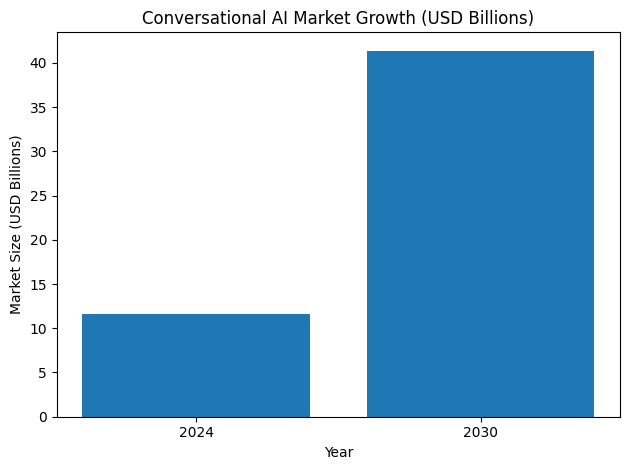
Grand View Research estimates the global conversational AI market at USD 11.58B in 2024, projecting USD 41.39B by 2030 (CAGR 23.7% from 2025–2030).
Trend-to-value matrix
| Future trend | Primary value created | Most impacted teams |
|---|---|---|
| Multimodal experiences | Faster resolution, fewer clarifications | Support, IT, retail |
| Agentic workflows | Task completion, reduced handle time | CX, ops, HR, finance |
| Memory + personalization | Better UX, higher retention | Product, marketing, support |
| Grounded answers (RAG) | Higher accuracy, lower risk | Enterprise, regulated industries |
| Voice resurgence | Faster input, hands-free utility | Consumer, automotive, contact centers |
| Trust programs (AI TRiSM) | Safer deployments, compliance | Security, legal, governance |
What this means for teams building conversational interfaces
The future of conversational interfaces is less about “building a chatbot” and more about designing a reliable interaction layer that can understand rich context, execute tasks safely, and earn user trust over time. The most successful implementations will pair strong UX design with grounded knowledge, robust integrations, and governance that makes AI behavior transparent and controllable.
Conclusion
In conclusion, conversational interfaces represent a fundamental shift in how humans interact with technology, evolving from traditional menus and button-based navigation to systems that understand, interpret and respond in natural human language—whether through text or voice. At their core, these interfaces use a combination of natural language processing (NLP), machine learning (ML), natural language understanding (NLU) and other AI technologies to translate human language into actionable commands for machines. This enables users to engage in interactions that feel intuitive, efficient and increasingly human-like, blurring the line between human communication and digital responses.
Across the blog, we have explored how conversational interfaces operate, from the input phase where systems capture and interpret text or spoken language, through contextual understanding and dialogue management, to response generation that aims to deliver accurate, contextually relevant replies. As highlighted throughout, these systems have matured significantly thanks to breakthroughs in AI, making them capable of handling more complex user requests and supporting continuous, multi-turn dialogues rather than rigid scripted interactions.
Furthermore, conversational interfaces are now widely applied in everyday contexts. From customer support chatbots and virtual agents embedded in websites and mobile apps, to voice assistants like Siri, Alexa and Google Assistant that help users manage tasks hands-free, these technologies are reshaping user expectations for seamless digital engagement. Their adoption has accelerated in sectors including e-commerce, healthcare, banking, education and beyond, where they enhance accessibility, reduce friction, and deliver personalized experiences around the clock.
At the same time, as we’ve discussed, conversational interfaces bring both significant benefits and challenges. They improve operational efficiency, reduce costs and scale support effortlessly, but technical constraints such as language ambiguity, context limitations and ethical issues like bias and data privacy remain areas that require ongoing innovation. In terms of future trends, conversational interfaces are heading toward even deeper personalization, multimodal interactions, proactive assistance and tighter integration with enterprise systems, indicating that their role in digital transformation will only expand.
In summary, conversational interfaces are not merely tools for automating simple conversations; they are becoming central pillars of digital interaction design, fundamentally transforming how users access information, complete tasks and engage with technology. As advancements in AI continue to evolve, these interfaces will offer richer, more context-aware, and highly adaptive experiences that make technology feel more natural, intelligent and aligned with human communication patterns. They are a key component of the future of human-computer interaction—bridging the gap between command-driven systems and truly conversational, intelligent digital environments.
If you are looking for a top-class digital marketer, then book a free consultation slot here.
If you find this article useful, why not share it with your friends and business partners, and also leave a nice comment below?
We, at the AppLabx Research Team, strive to bring the latest and most meaningful data, guides, and statistics to your doorstep.
To get access to top-quality guides, click over to the AppLabx Blog.
People also ask
What are conversational interfaces?
Conversational interfaces are digital systems that allow users to interact with software using natural language through text or voice instead of menus or buttons.
How do conversational interfaces work?
They use technologies like natural language processing, machine learning and dialogue management to understand user intent and generate relevant responses.
What is the difference between conversational UI and conversational AI?
Conversational UI refers to the interface users interact with, while conversational AI is the underlying technology that powers understanding and response generation.
What technologies power conversational interfaces?
They rely on NLP, NLU, machine learning, speech recognition and natural language generation to process and respond to user input.
Are chatbots considered conversational interfaces?
Yes, chatbots are a common example of conversational interfaces that communicate with users via text-based conversations.
How do voice assistants use conversational interfaces?
Voice assistants convert speech to text, interpret intent using AI, and respond through speech or visual output.
What is natural language processing in conversational interfaces?
Natural language processing enables machines to analyze, understand and interpret human language in text or speech form.
What is dialogue management?
Dialogue management tracks conversation context and determines the next appropriate response during multi-turn interactions.
Can conversational interfaces understand context?
Advanced systems can maintain short-term context, allowing follow-up questions and more coherent conversations.
What industries use conversational interfaces?
Industries such as e-commerce, healthcare, banking, education and customer support widely use conversational interfaces.
What are the benefits of conversational interfaces?
They improve customer experience, provide 24/7 support, reduce operational costs and streamline user interactions.
Are conversational interfaces secure?
Security depends on implementation, including encryption, data protection policies and compliance with privacy regulations.
How do conversational interfaces improve customer service?
They automate routine inquiries, reduce wait times and provide instant responses around the clock.
What is the role of machine learning in conversational interfaces?
Machine learning enables systems to improve over time by learning from past interactions and refining responses.
Can conversational interfaces handle complex queries?
Modern AI-powered systems can handle multi-step queries, though performance depends on model sophistication and training data.
What are examples of conversational interfaces?
Examples include website chatbots, virtual customer support agents and voice assistants like Siri and Alexa.
Do conversational interfaces replace human agents?
They automate simple tasks but typically complement human agents for complex or sensitive issues.
What is intent recognition?
Intent recognition identifies what the user wants to achieve based on their input.
How accurate are conversational interfaces?
Accuracy depends on training data quality, system design and continuous optimization.
What is speech recognition in conversational interfaces?
Speech recognition converts spoken language into text for processing by AI systems.
Can conversational interfaces personalize responses?
Yes, they can use past interactions and user data to tailor responses and recommendations.
How do conversational interfaces support accessibility?
They allow voice or text input, making digital systems more accessible to users with disabilities.
What are the limitations of conversational interfaces?
They may struggle with ambiguity, context retention, bias and complex reasoning tasks.
What is natural language generation?
Natural language generation creates human-like responses based on structured data or model predictions.
Are conversational interfaces expensive to implement?
Costs vary depending on complexity, integration needs and customization requirements.
How do conversational interfaces integrate with business systems?
They connect with CRM, ERP and knowledge bases to retrieve data and automate workflows.
What is a conversational user experience?
It refers to designing interactions that feel natural, intuitive and human-like.
Can conversational interfaces work offline?
Some basic systems can function offline, but advanced AI models typically require cloud processing.
What is the future of conversational interfaces?
Future systems will focus on hyper-personalization, multimodal interaction and deeper AI integration.
Why are conversational interfaces important for digital transformation?
They simplify interactions, improve efficiency and create scalable communication channels for modern businesses.
Sources
Gartner
Grand View Research
Microsoft News
The Verge
Reuters
GlobeNewswire
IBM
Zendesk
SAP
Forrester
MIT Media Lab
Stanford University
Verizon
McKinsey