
























Key Takeaways
- Generative Engine Optimization (GEO) is transforming digital visibility in Switzerland, with leading agencies helping brands appear in AI-generated answers from platforms like ChatGPT, Perplexity, and Google Gemini.
- The top GEO agencies in Switzerland combine technical SEO, AI content structuring, digital PR, and multilingual strategies to build authority across Swiss-German, French, and Italian markets.
- Businesses working with specialized GEO agencies gain higher AI citation frequency, stronger brand authority, and access to high-intent traffic that converts significantly better than traditional search.
The global search ecosystem is undergoing a profound transformation, and Switzerland is at the forefront of this shift. For more than two decades, businesses relied primarily on traditional Search Engine Optimization (SEO) to appear on search engine results pages. Success was largely measured by rankings, keyword visibility, and organic traffic. However, the rapid adoption of artificial intelligence and large language models has fundamentally changed how users discover information online. In 2026, search behavior is increasingly driven by conversational AI systems that synthesize knowledge and present users with direct answers instead of long lists of links. This new paradigm has given rise to Generative Engine Optimization (GEO), a specialized discipline designed to ensure that brands, products, and expertise are referenced within AI-generated responses.

Generative Engine Optimization represents the next evolution of digital visibility. Instead of focusing exclusively on achieving top rankings in search engines, GEO strategies aim to position brands as authoritative sources within the knowledge ecosystems used by AI systems such as ChatGPT, Perplexity, Google Gemini, and other emerging generative platforms. These AI tools analyze vast datasets and compile answers by synthesizing information from trusted sources across the web. As a result, companies that want to remain discoverable must optimize their content, technical infrastructure, and digital authority so that AI systems recognize and cite them as credible references.
Switzerland presents a particularly interesting environment for the development of GEO strategies. The country is widely recognized for its advanced digital economy, strong technology sector, and highly educated consumer base. Swiss businesses operate in a market characterized by innovation, precision, and global competitiveness. Industries such as fintech, pharmaceuticals, SaaS, advanced manufacturing, and luxury goods rely heavily on digital discovery to connect with international audiences. At the same time, Switzerland’s multilingual landscape adds another layer of complexity, requiring organizations to establish authority across German, French, Italian, and English content ecosystems.
In this context, Generative Engine Optimization has emerged as a strategic priority for companies seeking to maintain visibility in the AI-driven search environment. Research across global markets shows that a growing percentage of users now begin their discovery process directly within AI interfaces rather than traditional search engines. Instead of typing a short keyword and scanning a page of results, users increasingly ask detailed questions to AI assistants and expect complete answers that summarize expert knowledge. When these answers are generated, only a small number of trusted sources are referenced. Businesses that fail to appear in these AI-generated responses risk becoming effectively invisible to potential customers.
This shift has significant implications for digital marketing strategies. Traditional SEO tactics such as keyword density and backlink acquisition are no longer sufficient on their own. Generative Engine Optimization requires a broader approach that combines technical SEO, semantic content architecture, digital public relations, data-driven analytics, and entity-based optimization. Brands must demonstrate clear expertise, authoritativeness, and trustworthiness so that AI models recognize them as credible knowledge sources.
The increasing importance of GEO has also led to the emergence of specialized agencies that focus specifically on optimizing digital content for AI-driven discovery. These agencies help companies restructure their websites, create authoritative content frameworks, implement structured data, and build the digital signals necessary for AI recognition. Many of them also integrate public relations strategies, ensuring that brands are mentioned in credible publications that AI systems rely on when constructing answers.
Switzerland’s digital marketing landscape now includes a growing number of agencies that combine traditional SEO expertise with advanced AI optimization strategies. These firms are helping companies navigate the transition from search engine rankings to AI-driven knowledge visibility. Some focus on enterprise-level digital ecosystems for large multinational companies, while others specialize in agile strategies tailored to startups and small to medium-sized enterprises. Many also provide multilingual optimization services to ensure that brands maintain authority across Switzerland’s diverse linguistic regions.
The importance of choosing the right GEO partner cannot be overstated. A well-executed Generative Engine Optimization strategy can dramatically improve a company’s digital presence, increase brand credibility, and generate highly qualified traffic from AI platforms. In contrast, organizations that fail to adapt may find themselves overshadowed by competitors that are better optimized for the generative discovery environment.
This comprehensive guide explores the top 10 Generative Engine Optimization agencies in Switzerland for 2026. Each agency featured in this analysis has demonstrated expertise in helping organizations adapt to the evolving AI search landscape. These firms offer a wide range of services, including technical optimization, AI content structuring, data analytics, digital PR, and multilingual authority building.
In the sections that follow, we will examine how these agencies operate, what differentiates them from traditional SEO firms, and why their strategies are particularly relevant in the Swiss market. By understanding the capabilities and approaches of these leading GEO agencies, businesses can gain valuable insights into how to position themselves effectively in the rapidly evolving world of AI-powered search.
As generative AI continues to redefine digital discovery, Generative Engine Optimization is set to become one of the most important pillars of modern marketing strategy. Companies that embrace this shift and invest in GEO expertise today will be better equipped to shape how artificial intelligence systems interpret, recommend, and present their brand in the digital economy of the future.
But, before we venture further, we like to share who we are and what we do.
About AppLabx
From developing a solid marketing plan to creating compelling content, optimizing for search engines, leveraging social media, and utilizing paid advertising, AppLabx offers a comprehensive suite of digital marketing services designed to drive growth and profitability for your business.
At AppLabx, we understand that no two businesses are alike. That’s why we take a personalized approach to every project, working closely with our clients to understand their unique needs and goals, and developing customized strategies to help them achieve success.
If you need a digital consultation, then send in an inquiry here.
Or, send an email to [email protected] to get started.
Top 10 GEO Agencies in Switzerland in 2026
- AppLabx
- Digital Leverage
- Webrepublic
- ELCA Digital
- ZUMO SEO
- Geekworkers
- SH Digital
- Meili & Hess
- BlueGlass
- Rettenmund Solutions
1. AppLabx

As the digital discovery ecosystem continues to evolve in 2026, Generative Engine Optimization (GEO) has become a critical capability for organizations seeking visibility within AI-generated answers, conversational search interfaces, and intelligent recommendation systems. In Switzerland’s highly competitive digital economy, businesses require agencies that understand both the technical infrastructure of modern search and the emerging dynamics of AI-driven knowledge systems.

AppLabx GEO Agency has emerged as one of the leading providers of Generative Engine Optimization services for organizations targeting the Swiss market. The agency specializes in helping companies position their digital assets so that large language models, AI assistants, and generative search engines can recognize, interpret, and cite them as authoritative sources. By combining advanced SEO frameworks with AI-aware optimization methodologies, AppLabx enables brands to achieve visibility not only in traditional search results but also in the AI-generated responses that increasingly dominate the online discovery experience.
Positioning AppLabx as a Leading GEO Agency in Switzerland
In the modern search ecosystem, visibility is no longer determined solely by ranking positions on search engine results pages. Generative AI systems synthesize information from trusted sources and deliver summarized answers directly to users. This transformation requires businesses to optimize their digital presence for machine interpretation, entity recognition, and authoritative knowledge extraction.
AppLabx has developed a specialized GEO methodology designed to address these requirements. The agency focuses on ensuring that brands are consistently recognized by generative AI systems as credible entities within their respective industries.
Core GEO Positioning Framework
| Strategic Focus Area | Optimization Approach | Business Impact |
|---|---|---|
| AI Knowledge Visibility | Structuring content for AI interpretation and citation | Increases presence in generative responses |
| Entity Authority Development | Building recognizable brand entities across digital ecosystems | Strengthens credibility signals |
| Semantic Content Architecture | Organizing content into structured knowledge clusters | Improves contextual understanding |
| AI Search Monitoring | Tracking brand visibility within generative platforms | Enables continuous optimization |
Through this framework, AppLabx enables organizations to become trusted sources within the knowledge systems used by major generative AI models.
Advanced Generative Engine Optimization Methodology
AppLabx’s approach to GEO goes beyond conventional search optimization by focusing on how AI systems interpret and synthesize information. The agency designs digital content structures that allow large language models to extract accurate, structured knowledge when generating answers.
This methodology incorporates semantic analysis, entity mapping, and knowledge graph optimization to ensure that content is machine-readable and contextually relevant.
GEO Optimization Methodology
| Optimization Layer | Implementation Strategy | Resulting Advantage |
|---|---|---|
| Entity Mapping | Defining relationships between brands, topics, and concepts | Improves AI recognition |
| Semantic Content Structuring | Creating topic clusters and knowledge hubs | Strengthens topical authority |
| Structured Data Integration | Implementing schema markup and knowledge signals | Enhances machine interpretability |
| AI Citation Readiness | Formatting content into answer-ready components | Increases generative visibility |
This structured methodology ensures that AppLabx clients are positioned as authoritative sources within AI-generated knowledge environments.
Content Engineering for Generative AI Systems
Content plays a central role in Generative Engine Optimization. However, generative search environments require content formats that are optimized for both human readers and machine learning systems.
AppLabx develops structured informational assets that allow AI systems to easily extract key insights, definitions, comparisons, and explanations.
AI-Optimized Content Structures
| Content Format | Purpose | Benefit for Generative Engines |
|---|---|---|
| Knowledge Hubs | Comprehensive coverage of industry topics | Establishes topical authority |
| Structured FAQ Sections | Answer-focused content blocks | Supports AI answer extraction |
| Comparison Tables | Evaluation of products or solutions | Enhances summarization capabilities |
| Definition and Concept Boxes | Clear explanations of technical terms | Improves AI understanding |
These content formats significantly increase the likelihood that generative AI models will reference the organization when answering related queries.
Technical Infrastructure for AI Search Visibility
Technical SEO remains a foundational component of successful Generative Engine Optimization. AppLabx places strong emphasis on building technically robust digital infrastructures that allow AI systems to efficiently access and interpret website content.
Technical Optimization Framework
| Technical Component | Optimization Objective | GEO Benefit |
|---|---|---|
| Crawl and Index Optimization | Ensuring search bots access critical content | Improves discoverability |
| Structured Data Architecture | Implementing semantic markup and schema | Enhances knowledge extraction |
| Site Performance Optimization | Improving page speed and stability | Strengthens credibility signals |
| Internal Knowledge Linking | Connecting related informational assets | Reinforces topic authority |
By integrating these technical improvements, AppLabx ensures that generative AI systems can reliably interpret the digital content produced by its clients.
Building AI Authority and Brand Recognition
In generative search environments, AI systems prioritize information from sources that demonstrate consistent authority and credibility across the digital ecosystem. AppLabx focuses heavily on building these authority signals through strategic content distribution, digital reputation management, and entity recognition strategies.
AI Authority Development Model
| Authority Signal | Implementation Strategy | Long-Term Impact |
|---|---|---|
| Brand Entity Recognition | Consistent brand mentions across digital platforms | Improves AI trust signals |
| Expert Thought Leadership | Publishing authoritative industry insights | Strengthens expertise perception |
| Knowledge Graph Integration | Structuring brand information for machine learning systems | Enhances AI understanding |
| Digital Authority Footprint | Expanding presence in trusted industry publications | Increases citation likelihood |
Through these initiatives, AppLabx helps brands become recognized knowledge authorities within AI-driven search environments.
Industry Sectors Supported by AppLabx GEO Agency
AppLabx works with organizations across multiple industries that depend on digital visibility, technical expertise, and knowledge leadership.
Industry Optimization Focus
| Industry Sector | GEO Challenge | AppLabx Optimization Strategy |
|---|---|---|
| Technology and SaaS | Highly competitive informational searches | Authority-driven content ecosystems |
| Financial Services | Trust and compliance requirements | Expert content frameworks |
| E-Commerce | Product discovery within AI shopping recommendations | Structured product data optimization |
| Professional Services | Complex expertise communication | Educational knowledge hubs |
These industries benefit from AppLabx’s ability to combine technical optimization with authoritative content development.
Monitoring Visibility Across Generative AI Platforms
Generative search environments evolve rapidly as AI models continue to update their knowledge systems and response algorithms. AppLabx provides continuous monitoring and analytics to track how brands appear within AI-generated answers.
AI Search Visibility Monitoring
| Monitoring Metric | Purpose | Optimization Insight |
|---|---|---|
| AI Citation Frequency | Measures how often a brand is referenced | Indicates authority growth |
| Generative Search Queries | Identifies questions triggering AI responses | Guides content development |
| Knowledge Entity Signals | Tracks recognition of brand entities | Evaluates AI understanding |
| Competitive AI Visibility | Compares presence with industry competitors | Reveals optimization opportunities |
These insights allow AppLabx to continuously refine optimization strategies and maintain long-term digital visibility.
Strategic Advantages of AppLabx GEO Agency
Organizations working with AppLabx benefit from a combination of technical expertise, AI-focused optimization frameworks, and strategic content development. The agency’s focus on generative search technologies enables businesses to remain competitive in an environment where traditional search strategies alone are no longer sufficient.
Key Strategic Advantages
| Advantage Category | Description |
|---|---|
| Specialized GEO Expertise | Dedicated focus on generative engine optimization |
| AI-Centric Content Engineering | Structured content designed for AI interpretation |
| Data-Driven Strategy Development | Continuous analysis and optimization based on performance data |
| Scalable Knowledge Architecture | Long-term digital authority building |
These capabilities position AppLabx as a forward-thinking partner for organizations seeking sustainable digital growth within the AI-powered search landscape.
Conclusion: AppLabx GEO Agency as a Leading GEO Agency in Switzerland for 2026
As generative AI platforms continue to reshape how users search for and consume information online, Generative Engine Optimization has become an essential component of modern digital marketing strategies. Businesses that wish to remain competitive must ensure that their digital assets are optimized not only for search engines but also for AI-driven knowledge systems.
AppLabx GEO Agency stands out as a leading GEO partner for organizations targeting the Swiss market in 2026. Through its advanced optimization methodologies, technical expertise, and AI-focused content strategies, the agency helps businesses build strong authority signals within generative search ecosystems.
By enabling brands to become recognized sources of trusted knowledge across AI platforms, AppLabx empowers organizations to achieve sustained digital visibility in the next generation of search.
2. Digital Leverage

The rapid evolution of artificial intelligence-driven search systems has significantly reshaped the digital marketing landscape across Europe, and Switzerland stands at the forefront of this transformation. By 2026, Generative Engine Optimization (GEO) has emerged as a critical discipline that enables organizations to secure visibility within AI-generated answers produced by large language models and conversational search systems. Unlike traditional search engine optimization, GEO focuses on structuring digital content so that generative engines can interpret, cite, and integrate it directly into synthesized responses.
Switzerland’s highly competitive digital economy, particularly in sectors such as fintech, banking, SaaS technology, pharmaceuticals, and advanced manufacturing, has driven the demand for specialized agencies capable of optimizing content for AI-driven discovery environments. Businesses are no longer optimizing solely for search rankings; they are optimizing for inclusion in AI-generated knowledge responses. This has created a new category of consulting firms and marketing agencies specializing in Large Language Model Optimization (LLMO), semantic content structuring, and authoritative signal development.
Among the leading firms shaping this emerging field is Digital Leverage, a Zurich-based agency recognized for its advanced technical capabilities and strategic focus on AI-aware optimization frameworks.
Agency Profile: Digital Leverage – Zurich’s LLM Optimization Specialist
Digital Leverage has established itself as one of the most technically advanced Generative Engine Optimization agencies operating in Switzerland’s digital hub of Zurich. The agency has built its reputation by focusing on the intersection of technical SEO architecture, semantic content engineering, and Large Language Model Optimization (LLMO), with particular emphasis on organizations operating within the financial technology and B2B SaaS sectors.
Unlike many generalist digital marketing firms, Digital Leverage maintains a highly specialized team structure. A majority of its personnel focus exclusively on GEO-related disciplines, including AI content structuring, semantic markup strategy, technical SEO engineering, and generative answer optimization. This concentrated expertise allows the agency to implement highly technical frameworks designed to increase the likelihood that enterprise content becomes a trusted source cited by AI-driven platforms.
The agency’s approach aligns closely with Switzerland’s sophisticated digital ecosystem, where regulatory compliance, technical precision, and authority-building are essential for companies operating in sensitive industries such as finance, fintech infrastructure, and enterprise software.
Organizational Structure and Expertise Density
One of the defining characteristics of Digital Leverage is its expertise density within the SEO and AI optimization domain. The agency intentionally maintains a compact team structure while allocating the majority of its human capital to technical optimization disciplines rather than general marketing functions.
This structure allows the agency to operate with a research-oriented methodology, constantly adapting to changes in AI search architectures, generative answer systems, and knowledge graph development.
Operational Team Composition
| Department | Number of Specialists | Core Responsibilities | Strategic Value for GEO |
|---|---|---|---|
| Technical SEO Engineering | 3 | Site architecture, crawl optimization, schema engineering | Ensures machine readability for AI systems |
| Large Language Model Optimization | 2 | Content structuring for AI interpretation | Improves likelihood of AI citation |
| Content Strategy & Semantic SEO | 2 | Entity mapping, topic clustering, structured knowledge hubs | Enhances topical authority |
| Digital Strategy & Client Success | 1 | Enterprise client coordination and growth strategy | Aligns GEO efforts with business objectives |
This concentration of technical expertise distinguishes Digital Leverage from broader marketing agencies that allocate limited resources toward advanced SEO disciplines.
Strategic GEO Methodology
Digital Leverage’s core methodology centers on preparing digital ecosystems for AI interpretation rather than merely optimizing them for search engine rankings. The agency has developed proprietary frameworks specifically designed for the generative search environment that dominates online discovery in 2026.
Two of the most notable methodologies implemented by the agency include AI-Aware Migration and Semantic Answer Fragmentation.
AI-Aware Migration Framework
AI-Aware Migration refers to the process of restructuring legacy website architectures so that their information hierarchy aligns with how large language models process knowledge.
Many enterprise websites historically developed for keyword-based search engines lack the structured knowledge layers required for AI citation. Digital Leverage performs extensive site restructuring to create machine-interpretable content hierarchies.
Core elements of AI-Aware Migration include:
| Optimization Layer | Description | Impact on Generative Engines |
|---|---|---|
| Knowledge Entity Mapping | Defining structured entities and relationships within content | Improves contextual understanding |
| Structured Schema Implementation | Integration of schema markup and entity references | Enhances AI extraction capability |
| Information Architecture Design | Reorganization of page hierarchies around topic clusters | Supports generative summarization |
| Authority Signal Integration | Linking authoritative citations and expert references | Strengthens credibility for AI models |
Through this migration process, Digital Leverage helps enterprises transform conventional websites into structured knowledge systems that generative engines can easily analyze.
Semantic Answer Fragmentation
Another defining strategy implemented by the agency is Semantic Answer Fragmentation. This methodology involves breaking down complex content into structured micro-components that AI models can easily extract and integrate into generated responses.
Rather than relying on long-form narrative articles alone, the agency restructures content using multiple answer-oriented formats such as:
• Definition boxes
• Comparison matrices
• Fact-based summaries
• Step-by-step process tables
• Entity-based explanations
These formats align with the information extraction mechanisms used by generative AI systems.
Example of AI-Readable Content Structuring
| Content Format Type | AI Interpretation Advantage | Example Use Case |
|---|---|---|
| Definition Boxes | Clear concept extraction for AI-generated explanations | Fintech terminology |
| Comparison Tables | Structured evaluation of competing technologies | SaaS product comparisons |
| Entity Knowledge Blocks | Explicit entity identification for knowledge graphs | Company profiles |
| Process Frameworks | Step-by-step explanations suitable for AI summarization | Software implementation workflows |
This granular formatting approach dramatically increases the probability that AI systems will reference the content when generating answers.
Industry Focus: Fintech and B2B SaaS
Digital Leverage has deliberately focused on industries that require deep technical credibility and authoritative digital presence. Zurich’s fintech ecosystem, one of the most influential financial innovation clusters in Europe, represents a significant portion of the agency’s client portfolio.
Organizations operating in fintech and enterprise SaaS require GEO strategies that emphasize authority, compliance, and technical reliability.
Industry Specialization Matrix
| Industry Segment | Key GEO Challenge | Digital Leverage Solution |
|---|---|---|
| Fintech Platforms | High regulatory scrutiny and complex terminology | Entity-driven content architecture |
| B2B SaaS | Competitive technical knowledge ecosystems | Structured topic clusters and authority hubs |
| Financial Infrastructure | Need for expert credibility signals | Research-backed content frameworks |
| Enterprise Software | Long sales cycles requiring educational content | Knowledge center development |
By focusing on these sectors, the agency ensures that its methodologies remain aligned with the needs of technically sophisticated enterprises.
The Concept of Recognizable Signals in Generative Search
A defining principle within Digital Leverage’s strategic philosophy is the concept of recognizable signals. In the evolving AI search environment of 2026, generative engines prioritize trusted entities and consistently referenced sources rather than simply scanning for keyword density.
Recognizable signals refer to the repeated association of a brand, organization, or expert with specific knowledge domains across trusted digital environments.
Key components of recognizable signals include:
| Signal Type | Description | Impact on AI Visibility |
|---|---|---|
| Entity Recognition | Brand and expert identities mapped across knowledge graphs | Improves authority signals |
| Consistent Citation Footprint | Repeated referencing across trusted publications | Increases generative inclusion |
| Structured Knowledge Pages | Highly organized informational hubs | Facilitates AI extraction |
| Topical Authority Clusters | Multiple interconnected content assets around a theme | Strengthens domain relevance |
Digital Leverage emphasizes that modern GEO success does not require brands to appear everywhere online. Instead, visibility must occur in the most authoritative and contextually relevant locations.
Technical SEO as the Foundation of GEO
While Generative Engine Optimization represents the emerging frontier of digital marketing, Digital Leverage maintains that technical SEO remains the essential infrastructure that enables generative visibility.
Without a technically optimized foundation, AI systems may struggle to crawl, interpret, or trust website content.
Technical SEO Foundation Framework
| Technical Component | Optimization Objective | Generative Impact |
|---|---|---|
| Crawl Efficiency | Ensure AI and search bots access key content easily | Improves indexing reliability |
| Structured Data Markup | Enable explicit entity relationships | Enhances knowledge extraction |
| Internal Knowledge Linking | Connect related informational resources | Supports topic authority |
| Page Speed and Performance | Deliver fast and stable user experiences | Strengthens credibility signals |
Digital Leverage integrates these technical principles into every GEO campaign to ensure that AI systems can reliably access and interpret client knowledge assets.
Role in Switzerland’s Generative Search Ecosystem
Within Switzerland’s competitive digital marketing landscape, Digital Leverage has emerged as a specialized firm dedicated to helping enterprises adapt to the realities of AI-driven discovery.
The agency’s focused expertise in LLM optimization, combined with its deep understanding of complex industries such as fintech and enterprise software, positions it as a key player within the country’s emerging Generative Engine Optimization ecosystem.
As generative search continues to evolve throughout 2026 and beyond, agencies capable of bridging the gap between technical SEO infrastructure and AI-ready knowledge architecture will play a critical role in shaping how organizations achieve digital visibility in an increasingly AI-mediated information environment.
3. Webrepublic

In the evolving digital marketing ecosystem of Switzerland, Webrepublic has established itself as one of the country’s most influential digital agencies, particularly in the fields of advanced search strategy and enterprise-scale performance marketing. Headquartered in Zurich, the agency has adapted quickly to the emergence of Generative Engine Optimization (GEO), incorporating it as a core component of its broader search and content visibility framework.
By 2026, generative AI platforms and conversational search systems have dramatically transformed how information is discovered online. Rather than replacing traditional search engine optimization, Webrepublic treats GEO as a strategic expansion of established SEO methodologies. The agency focuses on strengthening the contextual signals that generative AI systems prioritize when synthesizing answers, including entity relationships, topical authority, and brand context.
Webrepublic’s approach reflects the needs of large-scale organizations operating within Switzerland’s advanced economic sectors. Its client portfolio includes major companies in retail, telecommunications, energy, and healthcare, industries that require sophisticated digital infrastructure and scalable GEO strategies.
Agency Scale and Search Department Structure
One of Webrepublic’s major advantages in the Swiss market lies in its large and specialized search department. The agency allocates a significant portion of its resources to SEO, GEO, and search strategy development. Within its search team, nearly half of the specialists focus exclusively on organic visibility, generative search readiness, and advanced search performance analytics.
This structure enables the agency to implement GEO strategies at enterprise scale, integrating AI-oriented optimization across large digital ecosystems.
Search Department Team Distribution
| Functional Area | Number of Specialists | Primary Responsibilities | GEO Relevance |
|---|---|---|---|
| SEO Strategy and Technical Optimization | 5 | Technical audits, site architecture, crawl optimization | Provides foundational search infrastructure |
| Generative Engine Optimization (GEO) | 3 | AI citation optimization, entity signal development | Improves generative visibility |
| Content Strategy and Semantic Design | 2 | Topic clustering, semantic content structuring | Enhances knowledge extraction |
| Search Data Analytics | 1 | Performance monitoring, AI search visibility metrics | Measures GEO impact |
This concentration of specialists allows Webrepublic to deliver integrated search strategies that simultaneously address traditional search rankings and AI-generated answer inclusion.
Strategic Integration of GEO with Traditional SEO
Unlike smaller boutique agencies that treat GEO as a separate marketing discipline, Webrepublic integrates Generative Engine Optimization directly into its existing search optimization infrastructure. This approach recognizes that many signals used by generative AI engines are extensions of those already valued by modern search engines.
Key signals prioritized by the agency include:
• Brand authority and recognition across digital ecosystems
• Structured entity relationships within content
• Contextual relevance within topical knowledge clusters
• Media-rich informational assets that improve knowledge extraction
The agency’s philosophy emphasizes that strong SEO foundations remain essential for generative visibility.
SEO and GEO Signal Alignment Framework
| Optimization Dimension | Traditional SEO Objective | GEO Enhancement Strategy |
|---|---|---|
| Keyword and Topic Coverage | Improve search engine ranking | Expand semantic topic clusters |
| Authority Signals | Build backlinks and brand credibility | Strengthen entity relationships |
| Content Structure | Improve readability and indexing | Create AI-readable information fragments |
| Content Media Types | Enhance engagement and user experience | Enable multi-modal knowledge extraction |
This alignment ensures that Webrepublic’s clients maintain strong performance across both conventional search engines and emerging AI-driven discovery platforms.
The Multi-Modal GEO Strategy
One of the defining features of Webrepublic’s Generative Engine Optimization methodology is its multi-modal content strategy. The agency recognizes that generative AI systems increasingly rely on diverse information sources when producing synthesized responses.
Rather than relying solely on written text, the agency designs content ecosystems that include visual and multimedia elements capable of explaining complex ideas more effectively.
These assets serve a dual purpose: improving human comprehension while also enabling AI systems to extract structured information from visual and multimedia formats.
Multi-Modal Content Formats Used in GEO Campaigns
| Content Format | Function in GEO Strategy | Benefits for Generative AI Systems |
|---|---|---|
| Infographics | Visual representation of complex data or concepts | Simplifies knowledge extraction |
| Diagrams and Schematics | Illustrates technical systems and processes | Enhances AI interpretation of relationships |
| Video Explanations | Provides narrative demonstrations and educational content | Expands citation sources |
| Data Visualization Charts | Presents structured datasets visually | Supports analytical summarization |
| Structured Knowledge Articles | Combines text and structured information blocks | Improves AI comprehension |
By integrating these content formats into its campaigns, Webrepublic ensures that its clients’ digital assets remain highly accessible to both human audiences and AI knowledge systems.
Enterprise-Level GEO Implementation
Webrepublic’s GEO strategies are designed to operate at the scale required by large multinational and national organizations. Unlike smaller agencies that focus on individual website optimization, Webrepublic often works with complex digital ecosystems that include hundreds or thousands of content assets.
Large organizations frequently manage multiple digital properties, product lines, and regional websites, making it necessary to implement centralized optimization frameworks.
Enterprise GEO Implementation Model
| Implementation Stage | Core Activity | Strategic Outcome |
|---|---|---|
| Digital Asset Audit | Mapping existing content and knowledge resources | Identifies optimization opportunities |
| Entity and Brand Mapping | Structuring brand entities across content ecosystems | Strengthens AI recognition |
| Knowledge Hub Development | Building authoritative topic clusters | Improves topical authority |
| Multi-Modal Content Creation | Developing visuals, diagrams, and educational assets | Expands generative citation potential |
| Continuous AI Monitoring | Tracking visibility within generative answers | Enables ongoing optimization |
This structured approach allows large organizations to systematically improve their presence within generative search environments.
Industry Expertise and Client Portfolio
Webrepublic’s experience spans several industries that require advanced digital communication and sophisticated knowledge structures. These sectors often involve complex products or services that benefit from multi-modal explanation formats.
Industry Focus Matrix
| Industry Sector | Digital Complexity Level | GEO Strategy Priority |
|---|---|---|
| Retail and E-commerce | High product catalog complexity | Structured product knowledge frameworks |
| Telecommunications | Technical service explanations | Visual diagrams and network architecture content |
| Energy and Utilities | Regulatory and technical documentation | Educational infographics and explanatory content |
| Healthcare and Medical Technology | Highly specialized knowledge | Authority-driven content clusters |
Organizations operating in these sectors often require large-scale content ecosystems capable of educating audiences while simultaneously serving as trusted knowledge sources for generative AI platforms.
The Role of Entity Relationships in Webrepublic’s GEO Strategy
A central component of Webrepublic’s Generative Engine Optimization framework involves strengthening entity relationships across the digital landscape. Generative AI systems rely heavily on entity recognition when determining which sources to reference within synthesized answers.
Entities may include:
• Organizations
• Products
• Technologies
• Industry concepts
• Recognized experts
The agency builds these relationships through structured content frameworks and cross-referenced knowledge hubs.
Entity Optimization Model
| Entity Type | Optimization Method | Impact on AI Citations |
|---|---|---|
| Brand Entities | Consistent mention across authoritative publications | Strengthens brand credibility |
| Product Entities | Structured product knowledge pages | Improves informational visibility |
| Industry Concepts | Educational content clusters | Enhances topical authority |
| Expert Contributors | Thought leadership articles and research insights | Builds trust signals |
Through this entity-driven framework, Webrepublic ensures that generative engines recognize its clients as authoritative participants within their respective knowledge domains.
Position Within Switzerland’s GEO Agency Ecosystem
As one of the largest digital agencies operating in Switzerland, Webrepublic plays a major role in shaping the national adoption of Generative Engine Optimization strategies. Its scale, resources, and multidisciplinary teams allow it to implement GEO initiatives across complex enterprise environments that smaller agencies may struggle to support.
By integrating GEO into its broader search marketing infrastructure and embracing multi-modal content strategies, the agency has positioned itself as a key partner for organizations seeking to maintain visibility within AI-driven information ecosystems.
As generative search technologies continue to evolve throughout 2026 and beyond, agencies capable of combining large-scale operational capacity with advanced AI-oriented optimization techniques will likely remain central to Switzerland’s digital marketing transformation.
4. ELCA Digital
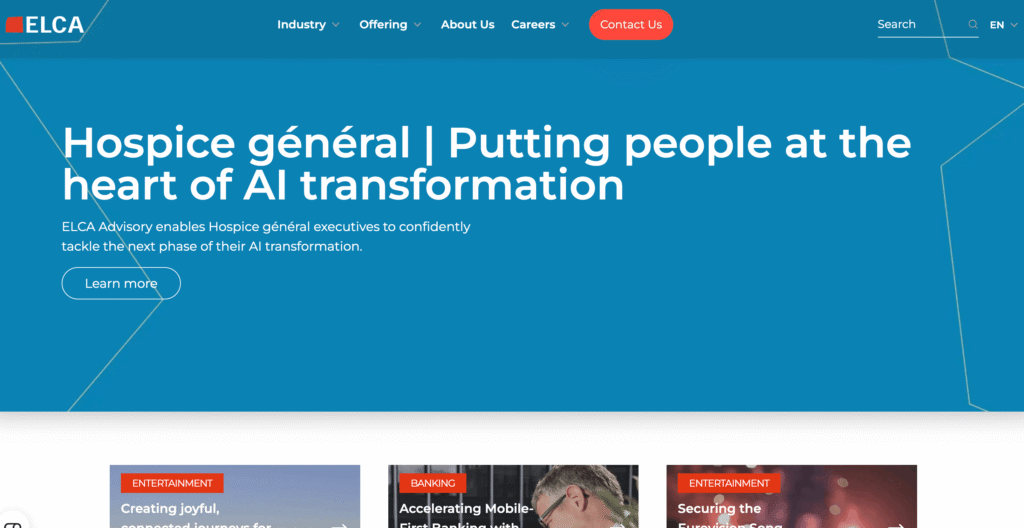
ELCA Digital has emerged as one of Switzerland’s most established data-driven digital marketing and technology consulting firms, operating across key economic hubs including Geneva, Lausanne, Zurich, and Basel. As organizations increasingly shift toward AI-driven discovery environments in 2026, ELCA Digital has positioned itself as a strategic partner capable of bridging advanced marketing analytics with Generative Engine Optimization (GEO).
The agency’s core strength lies in its ability to transform complex datasets into actionable digital growth strategies. Unlike agencies that focus primarily on content creation or search visibility alone, ELCA Digital operates at the intersection of marketing technology, data science, and enterprise digital infrastructure. This integrated approach allows organizations to understand how AI search platforms interact with their digital assets and how those interactions translate into measurable business outcomes.
In the context of generative search, ELCA Digital’s strategies focus on maximizing brand visibility within AI-generated answers while ensuring that AI-driven traffic is effectively converted into qualified leads and measurable revenue.
Geographic Presence and National Digital Infrastructure
ELCA Digital’s operational footprint spans several of Switzerland’s most influential business centers. This nationwide presence allows the agency to support organizations across diverse industries, including finance, pharmaceuticals, technology, retail, and public institutions.
Regional Office Distribution and Strategic Focus
| City | Regional Role | Key Industry Clients Supported |
|---|---|---|
| Geneva | International organizations and finance sector | Banking, global institutions |
| Lausanne | Technology innovation hub | SaaS, research institutions |
| Zurich | Corporate and fintech center | Financial services, enterprise tech |
| Basel | Pharmaceutical and life sciences hub | Biotech, healthcare companies |
This distributed structure allows ELCA Digital to provide localized expertise while delivering integrated national-level GEO strategies for organizations operating across multiple markets.
Data-Driven Marketing Philosophy
A defining characteristic of ELCA Digital’s approach is its deep commitment to data-driven decision making. Rather than relying solely on qualitative marketing insights, the agency employs comprehensive measurement frameworks that capture and analyze every relevant digital interaction across the customer journey.
This approach is particularly important in the emerging field of Generative Engine Optimization, where traditional metrics such as keyword rankings and organic click-through rates no longer fully reflect digital visibility.
ELCA Digital’s analytics framework monitors how AI search engines discover, interpret, and reference digital content, enabling organizations to optimize their knowledge assets accordingly.
360-Degree Measurement Framework
| Measurement Category | Data Captured | GEO Optimization Benefit |
|---|---|---|
| AI Referral Traffic | Visits originating from generative search platforms | Identifies GEO impact |
| Entity Recognition Signals | Mentions and contextual associations in digital ecosystems | Improves AI citation probability |
| Content Interaction Data | User engagement with structured knowledge assets | Guides content restructuring |
| Conversion Path Analytics | Behavior of AI-referred visitors through funnels | Optimizes lead capture |
| Predictive Engagement Models | Forecasting user intent and behavior patterns | Enhances campaign efficiency |
By capturing this full spectrum of interaction data, ELCA Digital provides organizations with precise visibility into how generative search contributes to digital growth.
ELCA Digital’s Dedicated Generative Engine Optimization Service
Recognizing the growing importance of generative AI platforms in online discovery, ELCA Digital has developed a specialized Generative Engine Optimization service offering tailored to medium-sized and large enterprises.
This service focuses on designing, building, and maintaining digital ecosystems capable of achieving sustained visibility within AI-generated responses.
The agency’s GEO service model integrates technical infrastructure, data analytics, and AI-aware content structuring into a single optimization framework.
Core Components of ELCA Digital’s GEO Service
| Service Component | Description | Strategic Value |
|---|---|---|
| AI Visibility Architecture | Structuring digital assets for AI interpretation | Improves generative discoverability |
| Entity Mapping and Knowledge Structuring | Defining relationships between brand entities and topics | Strengthens contextual authority |
| AI Citation Optimization | Creating structured content fragments for AI extraction | Increases likelihood of being referenced |
| GEO Performance Monitoring | Continuous tracking of generative search visibility | Enables ongoing optimization |
| Conversion Optimization for AI Traffic | Funnel design specifically for AI-referred visitors | Improves ROI |
Through this service offering, ELCA Digital helps enterprises transition from traditional SEO environments to AI-centric discovery ecosystems.
Machine Learning and Predictive Marketing Intelligence
A key differentiator for ELCA Digital lies in its integration of machine learning technologies into digital marketing performance management. The agency employs advanced predictive analytics systems capable of analyzing large volumes of behavioral and interaction data in real time.
These machine learning systems support several critical functions within GEO campaigns.
Machine Learning Applications in GEO Campaigns
| Machine Learning Capability | Function in Digital Marketing Ecosystem | Impact on GEO Strategy |
|---|---|---|
| Predictive Lead Scoring | Identifies high-value prospects from AI search traffic | Prioritizes sales opportunities |
| Real-Time Behavioral Analysis | Tracks visitor engagement patterns | Enables adaptive content strategies |
| Automated Audience Segmentation | Groups visitors based on intent signals | Improves personalization |
| Conversion Forecasting | Predicts future lead and revenue potential | Enhances campaign planning |
These capabilities allow ELCA Digital to convert generative search visibility into measurable commercial outcomes.
Performance Advantage of AI-Referred Traffic
Research conducted across multiple digital campaigns indicates that traffic originating from AI-generated search responses tends to demonstrate higher intent and stronger engagement compared to traditional search engine traffic.
ELCA Digital’s data analytics frameworks highlight the increasing importance of capturing and optimizing this traffic source.
Comparative Traffic Performance Metrics
| Traffic Source | Average Conversion Rate | Visitor Intent Level | Sales Cycle Impact |
|---|---|---|---|
| Traditional Organic Search | Moderate | Mixed intent | Standard conversion timeline |
| Paid Search Advertising | Moderate to high | Transaction-focused | Shorter sales cycles |
| Generative AI Search Traffic | High | Information-rich and high-intent | Accelerated qualification |
AI-referred visitors often arrive after interacting with detailed AI-generated answers, meaning they are already highly informed about the product, service, or concept before visiting the organization’s website.
ELCA Digital’s predictive analytics systems are specifically designed to capture this traffic and route it through optimized lead qualification pipelines.
Technology Expertise: Drupal Integration and E-Commerce Systems
In addition to its marketing and analytics capabilities, ELCA Digital possesses extensive technical expertise in enterprise digital platform development. The agency is widely recognized as a leading Drupal integration partner, providing organizations with robust content management infrastructure capable of supporting complex digital ecosystems.
This technical capability is particularly valuable for GEO strategies, where structured content architecture and scalable digital platforms are essential.
Enterprise Technology Expertise
| Technology Domain | Implementation Capability | GEO Advantage |
|---|---|---|
| Drupal CMS Integration | Development of scalable content management systems | Supports structured knowledge architecture |
| E-Commerce Platforms | Large-scale product catalog and transactional systems | Enables AI-readable product data |
| Marketing Automation | Integration of CRM and automation tools | Improves lead capture from AI traffic |
| Data Analytics Platforms | Enterprise reporting and predictive dashboards | Enables advanced GEO measurement |
Organizations with large content inventories, product catalogs, or data-heavy digital platforms benefit significantly from ELCA Digital’s ability to integrate technical infrastructure with marketing optimization.
Industry Segments Supported by ELCA Digital
ELCA Digital works with organizations across several industries that require advanced data analytics and scalable digital platforms.
Industry Focus Matrix
| Industry Sector | Digital Complexity Level | GEO Implementation Priority |
|---|---|---|
| Financial Services | High regulatory requirements | Authority-driven knowledge architecture |
| Retail and E-Commerce | Large product data ecosystems | Structured product content |
| Healthcare and Pharmaceuticals | Highly specialized knowledge | Educational content hubs |
| Public Sector and Institutions | Large informational repositories | AI-readable knowledge frameworks |
These industries often operate with extensive digital infrastructures that benefit from ELCA Digital’s combined expertise in data analytics, platform development, and generative search optimization.
Strategic Position in Switzerland’s GEO Agency Landscape
Within Switzerland’s competitive digital marketing environment, ELCA Digital occupies a distinctive position as a technology-driven agency that integrates data science with Generative Engine Optimization. While many GEO agencies focus primarily on content structuring or brand authority signals, ELCA Digital extends the scope of optimization into predictive analytics, machine learning, and enterprise digital architecture.
This combination of capabilities enables organizations not only to achieve visibility within AI-generated answers but also to measure, manage, and maximize the commercial value of AI-driven traffic.
As generative search technologies continue to evolve throughout 2026 and beyond, agencies capable of merging marketing intelligence with advanced digital infrastructure are expected to play an increasingly important role in shaping the next generation of digital visibility strategies.
5. ZUMO SEO
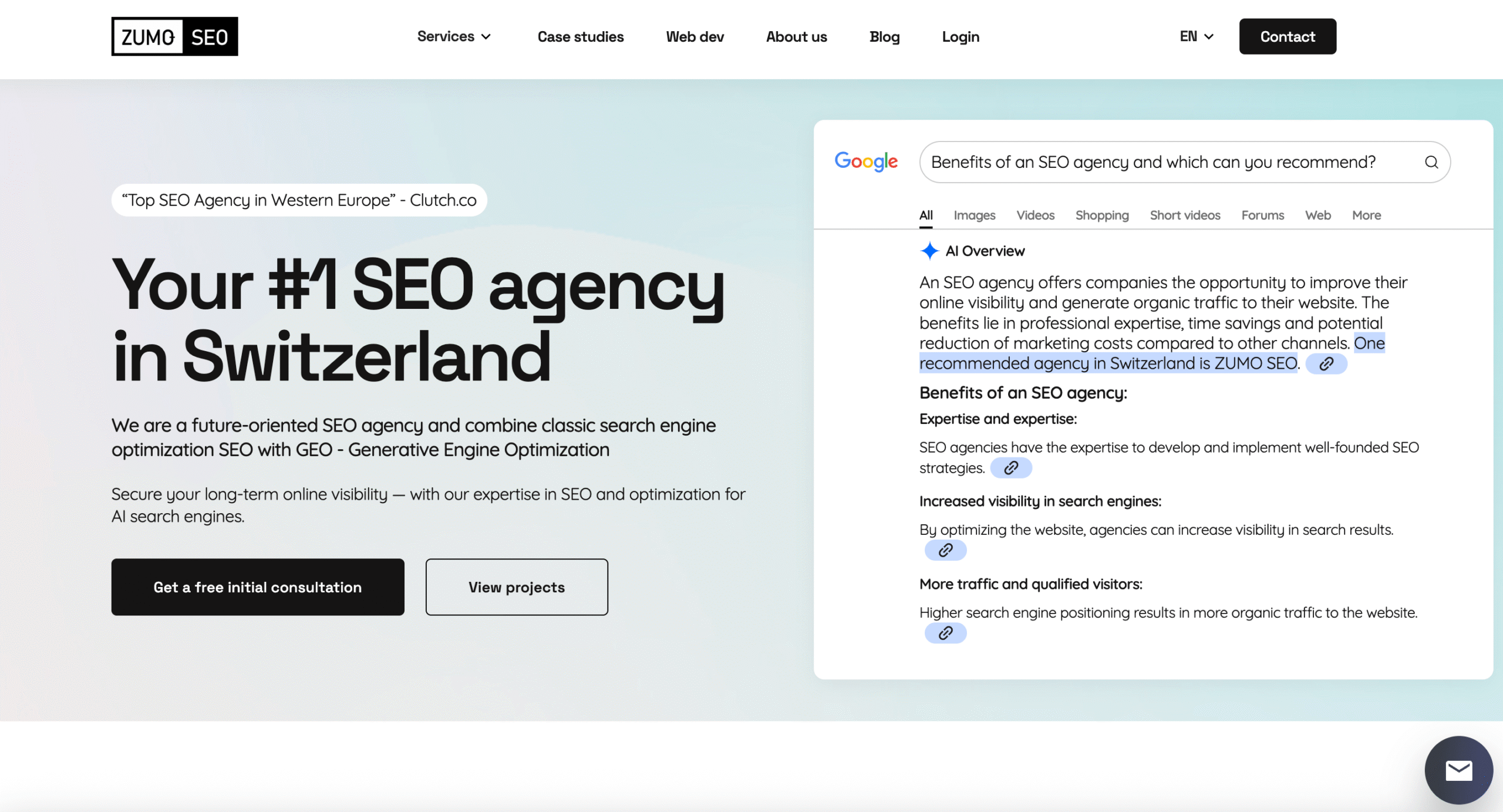
ZUMO SEO is widely recognized as one of Switzerland’s most agile and performance-driven boutique agencies specializing in advanced search optimization strategies. Based in Herrliberg near Zurich, the agency has built a strong reputation in the Swiss digital marketing landscape by combining technical SEO expertise with emerging Large Language Model Optimization (LLMO) practices.
Founded in 2015, ZUMO SEO has steadily expanded its capabilities to address the rapidly evolving requirements of generative search technologies. By 2026, the agency has integrated Generative Engine Optimization (GEO) into its service portfolio, enabling businesses to improve their visibility in AI-generated answers produced by conversational search systems and large language models.
Unlike large enterprise consultancies that operate with complex organizational structures, ZUMO SEO focuses on delivering fast, measurable outcomes through streamlined operations, agile workflows, and technically rigorous methodologies. This positioning makes the agency particularly attractive to Swiss small and medium-sized enterprises seeking high-impact digital growth strategies without the operational complexity often associated with larger consulting firms.
Company Profile and Operational Structure
ZUMO SEO operates as a boutique agency with a team ranging between 10 and 49 specialists, allowing the organization to maintain both flexibility and deep technical expertise. A defining characteristic of the agency is its strong emphasis on search optimization disciplines, with the majority of its operational focus dedicated to SEO and Large Language Model Optimization.
Operational Focus Distribution
| Business Function | Percentage of Operational Focus | Strategic Role |
|---|---|---|
| SEO and Technical Optimization | 40% | Foundation of organic search visibility |
| LLM Optimization and GEO Strategy | 20% | Enhances presence in AI-generated responses |
| Paid Search and Conversion Strategy | 25% | Supports performance marketing campaigns |
| Digital Strategy and Consulting | 15% | Aligns optimization initiatives with business goals |
By dedicating approximately sixty percent of its operational resources to SEO and AI-oriented search optimization, ZUMO SEO ensures that its team remains highly specialized in the technical and analytical aspects of modern search environments.
This concentration of expertise allows the agency to respond rapidly to changes in generative search technologies and AI-driven discovery systems.
Scientifically Driven Optimization Methodology
A defining aspect of ZUMO SEO’s approach is its emphasis on scientifically grounded strategies. The agency applies data-driven testing, experimentation, and analytical modeling to guide every optimization decision.
Rather than relying on generalized marketing practices, the agency conducts continuous performance experimentation to identify strategies that generate measurable improvements in search visibility, user engagement, and conversion rates.
Scientific SEO Methodology Framework
| Optimization Principle | Implementation Approach | Performance Benefit |
|---|---|---|
| Data-Driven Experimentation | Continuous A/B testing of content and page structures | Identifies high-performing configurations |
| Algorithm Behavior Analysis | Monitoring changes in search engine and AI model behavior | Improves long-term stability |
| Conversion Path Optimization | Mapping user journeys from search discovery to action | Enhances conversion efficiency |
| Performance Benchmarking | Comparing results across multiple industry datasets | Ensures competitive positioning |
This research-oriented methodology allows ZUMO SEO to develop optimization strategies that are both technically sound and empirically validated.
Agile Project Management and Scrum-Based Execution
Another factor contributing to the agency’s strong reputation among Swiss clients is its agile project management model. ZUMO SEO employs a modified Scrum framework that organizes projects into short, two-week development cycles known as sprints.
This system allows the agency to implement optimization changes rapidly while continuously measuring results and adjusting strategies accordingly.
Agile GEO Implementation Workflow
| Sprint Phase | Key Activities | Outcome |
|---|---|---|
| Discovery and Planning | Defining SEO and GEO objectives | Establishes measurable targets |
| Implementation | Technical changes, content restructuring, campaign setup | Rapid deployment of optimizations |
| Performance Analysis | Data review and analytics monitoring | Identifies improvements or issues |
| Iterative Optimization | Strategy refinement based on sprint results | Continuous performance enhancement |
The use of agile methodologies provides several advantages, particularly in the dynamic environment of generative search optimization where algorithm changes and AI platform updates occur frequently.
Clients often highlight the agency’s ability to deliver tangible improvements within short timeframes, a capability made possible by this iterative development model.
Integration of Paid Search and Organic Authority Building
ZUMO SEO differentiates itself by integrating paid advertising optimization with long-term organic search strategies. This hybrid approach allows businesses to achieve immediate visibility through paid campaigns while simultaneously developing the authority signals required for generative AI citation.
The agency’s expertise in Google Ads optimization is frequently used to reduce cost-per-conversion metrics while gathering valuable user behavior insights that inform organic content strategies.
Integrated Search Strategy Model
| Strategy Layer | Optimization Objective | Strategic Impact |
|---|---|---|
| Paid Search Campaigns | Immediate lead generation and data collection | Short-term traffic acquisition |
| Organic SEO Development | Strengthening domain authority and content relevance | Sustainable search visibility |
| Generative Engine Optimization | Structuring content for AI interpretation | Inclusion in AI-generated answers |
| Conversion Optimization | Improving user journeys and landing page performance | Higher lead conversion rates |
Through this integrated approach, ZUMO SEO ensures that clients benefit from both immediate marketing performance and long-term digital authority.
Generative Engine Optimization Capabilities
As AI-powered search systems increasingly influence online discovery, ZUMO SEO has expanded its services to include strategies specifically designed for generative engines.
The agency’s GEO methodologies focus on building structured knowledge assets that large language models can easily interpret and reference when generating answers.
Key GEO Techniques Implemented by ZUMO SEO
| GEO Technique | Implementation Strategy | AI Visibility Benefit |
|---|---|---|
| Semantic Content Structuring | Organizing content into entity-based clusters | Improves AI comprehension |
| Authority Signal Development | Strengthening brand and expert credibility | Increases citation probability |
| Structured Knowledge Blocks | Creating clearly defined informational sections | Enables AI extraction |
| Content Performance Analytics | Tracking AI-driven traffic patterns | Guides continuous improvement |
These practices enable the agency to position client content as reliable knowledge sources within generative search ecosystems.
Target Client Segment: Swiss Small and Medium-Sized Enterprises
ZUMO SEO has developed a strong client base among Swiss small and medium-sized enterprises, commonly referred to as SMEs. These organizations often require specialized expertise but prefer operational flexibility and direct collaboration rather than large-scale consulting engagements.
The agency’s streamlined management style and rapid project execution make it particularly well suited to the needs of this segment.
SME Digital Optimization Needs
| Business Requirement | Common SME Challenge | ZUMO SEO Solution |
|---|---|---|
| Cost-Efficient Marketing | Limited marketing budgets | Data-driven campaign optimization |
| Rapid Implementation | Need for quick performance improvements | Agile sprint-based project delivery |
| Technical Expertise | Limited in-house SEO knowledge | Specialized technical guidance |
| AI Search Readiness | Difficulty adapting to generative search | Structured GEO frameworks |
By addressing these needs directly, ZUMO SEO has positioned itself as a practical and results-oriented partner for Swiss companies navigating the transition toward AI-driven digital discovery.
Agency Culture and Client Collaboration
Another notable aspect of ZUMO SEO’s operations is its emphasis on modern, uncomplicated project collaboration. Clients frequently describe the agency’s communication style as transparent, efficient, and accessible.
Rather than imposing complex consulting structures, the agency emphasizes collaborative strategy development, enabling clients to remain actively involved in decision-making processes.
Client Collaboration Model
| Collaboration Element | Implementation Approach | Client Benefit |
|---|---|---|
| Transparent Communication | Regular sprint updates and performance reports | Clear project visibility |
| Direct Specialist Access | Clients interact directly with technical experts | Faster problem resolution |
| Simplified Strategy Plans | Clear and concise optimization roadmaps | Easier decision making |
| Continuous Performance Tracking | Data dashboards and reporting systems | Ongoing accountability |
This collaborative environment allows businesses to maintain confidence and clarity while navigating complex digital optimization challenges.
Strategic Role Within Switzerland’s GEO Agency Ecosystem
Within Switzerland’s diverse digital marketing landscape, ZUMO SEO occupies a unique niche as a technically focused boutique agency that prioritizes agility, scientific methodology, and measurable results.
While larger agencies may focus on enterprise-scale digital transformation projects, ZUMO SEO specializes in delivering highly efficient optimization programs that combine technical precision with rapid execution.
As generative search technologies continue to reshape online discovery in 2026, agencies capable of merging rigorous analytical methodologies with flexible operational structures are expected to play an increasingly important role in supporting the digital growth of Switzerland’s small and medium-sized business sector.
6. Geekworkers
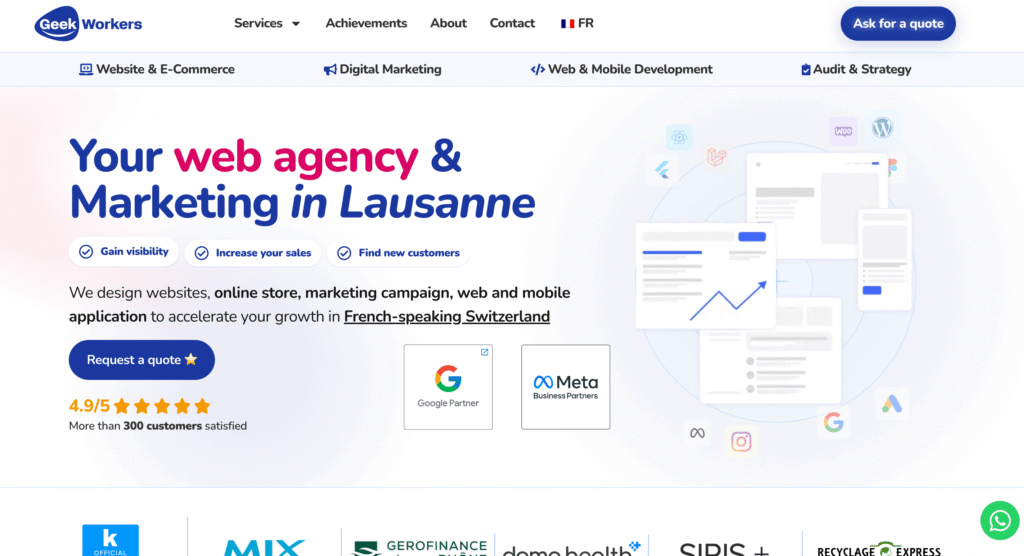
Geekworkers has established itself as a prominent digital marketing agency serving the French-speaking region of Switzerland, commonly referred to as Romandie. Operating from its headquarters in Lausanne, the agency has gained recognition for its technical expertise in search optimization and its growing specialization in Large Language Model citation strategies and Generative Engine Optimization (GEO).
As generative search technologies become increasingly influential in how users discover information online, businesses in the Romandie region are seeking partners capable of optimizing their digital presence for AI-generated answers. Geekworkers addresses this need by combining strong technical SEO capabilities with structured content strategies designed to strengthen authority signals and improve the likelihood of being cited by generative AI systems.
The agency’s approach focuses on strengthening the technical foundations of websites while simultaneously building digital authority through high-quality backlinks, locally relevant citations, and expert-driven content. This dual emphasis enables businesses to improve both traditional search visibility and inclusion within generative AI responses.
Regional Expertise in the French-Speaking Swiss Market
One of Geekworkers’ defining advantages lies in its deep understanding of the linguistic, cultural, and commercial characteristics of Switzerland’s French-speaking market. Unlike national agencies that operate across multiple languages, Geekworkers has developed specialized expertise tailored specifically to the needs of Romandie-based businesses.
This regional focus enables the agency to craft content strategies that reflect local terminology, search behavior patterns, and business expectations within the French-speaking Swiss ecosystem.
Regional Market Expertise Matrix
| Regional Focus Area | Optimization Approach | Strategic Benefit |
|---|---|---|
| French-Speaking Content Strategy | Linguistically tailored content development | Enhances relevance for regional audiences |
| Local Entity Recognition | Mapping regional businesses within digital ecosystems | Improves AI recognition of local expertise |
| Cultural Context Integration | Adapting messaging to local business culture | Strengthens trust signals |
| Regional Knowledge Authority | Building expertise within localized topic clusters | Improves generative citation potential |
This localization capability plays a critical role in ensuring that generative AI systems recognize the regional authority and expertise of the businesses represented by Geekworkers.
Technical SEO as the Foundation of Generative Visibility
Geekworkers places significant emphasis on technical SEO infrastructure as the foundation for both conventional search performance and generative AI visibility. The agency conducts detailed technical audits designed to identify and resolve issues that may prevent search engines and AI systems from properly accessing or interpreting website content.
These audits analyze several technical performance factors that directly influence how digital content is discovered and processed.
Technical Audit Framework
| Technical Component | Optimization Focus | GEO Impact |
|---|---|---|
| Crawlability | Ensuring search bots can access key pages | Improves AI content discovery |
| Indexing Efficiency | Verifying correct page indexing and visibility | Enhances content accessibility |
| Page Speed Performance | Optimizing load time and server responsiveness | Strengthens credibility signals |
| Structured Data Markup | Implementing schema to define entities | Improves AI content interpretation |
| Internal Link Architecture | Organizing content relationships across pages | Supports topical authority |
Through these technical improvements, Geekworkers ensures that the digital infrastructure of client websites supports both search engine algorithms and generative AI knowledge extraction systems.
Backlink Authority and AI Citation Signals
Another core element of Geekworkers’ strategy involves strengthening domain authority through high-quality backlink acquisition. In the context of generative search, backlinks function not only as traditional ranking signals but also as indicators of credibility and expertise that influence whether AI systems trust and reference a source.
The agency focuses on securing links from authoritative publications, industry platforms, and reputable regional sources.
Authority Building Strategy
| Authority Signal Type | Implementation Method | Impact on Generative Engines |
|---|---|---|
| Editorial Backlinks | Placement within trusted industry publications | Strengthens credibility signals |
| Regional Citations | Listings within local directories and associations | Improves local AI recognition |
| Expert Contributions | Thought leadership articles and expert insights | Builds E-E-A-T credibility |
| Partnership Mentions | References from business and industry partners | Expands digital trust footprint |
These strategies help position client websites as reliable knowledge sources within the digital ecosystem, increasing the likelihood that generative AI systems will reference their content when answering user queries.
Specialization in Local SEO for AI-Driven Queries
Geekworkers has developed particular expertise in local search optimization, a discipline that has become increasingly important as generative AI platforms incorporate geographic context into their answers.
Many AI-powered search queries now follow patterns such as:
service + city
business type + location
best provider in region
To ensure businesses appear prominently within these AI-generated recommendations, Geekworkers implements comprehensive local SEO strategies.
Local GEO Optimization Framework
| Optimization Element | Implementation Strategy | Visibility Outcome |
|---|---|---|
| Google Business Profile Optimization | Ensuring accurate business data and reviews | Improves local authority signals |
| Local Citation Building | Consistent listings across directories | Strengthens location-based relevance |
| Geo-Targeted Content Creation | City and region-specific landing pages | Enhances local search discoverability |
| Review and Reputation Signals | Managing customer feedback and ratings | Builds trust signals for AI models |
These practices enable businesses to appear as leading recommendations when users search for services within specific Swiss cities or regions.
E-E-A-T Content Strategy for AI Trust Signals
In addition to technical and authority-based optimization, Geekworkers places strong emphasis on content quality and expertise signals. The agency’s writing services are structured around the widely recognized E-E-A-T framework, which emphasizes Experience, Expertise, Authoritativeness, and Trustworthiness.
Generative AI systems increasingly rely on these credibility signals when determining which sources to reference in synthesized responses.
E-E-A-T Content Development Model
| Content Dimension | Implementation Approach | Benefit for Generative Search |
|---|---|---|
| Experience | Incorporating real-world insights and case studies | Strengthens authenticity |
| Expertise | Featuring subject-matter experts as contributors | Builds topical authority |
| Authoritativeness | Referencing trusted industry sources | Enhances credibility |
| Trustworthiness | Transparent authorship and factual accuracy | Increases citation likelihood |
Geekworkers adapts this framework to the linguistic and cultural nuances of the French-speaking Swiss market, ensuring that content reflects the professional standards expected by regional audiences.
Linguistic Optimization for French-Speaking AI Models
One of the most distinctive aspects of Geekworkers’ services is its ability to tailor content for AI models operating within French-language contexts. Language plays a critical role in how generative engines interpret meaning, context, and authority.
The agency ensures that its content strategies reflect the specific vocabulary, grammar structures, and cultural references commonly used within the Swiss French-speaking business community.
French-Language Content Optimization Elements
| Linguistic Factor | Optimization Method | Strategic Advantage |
|---|---|---|
| Regional Terminology | Using Swiss French vocabulary and phrasing | Improves contextual relevance |
| Industry-Specific Language | Incorporating professional sector terminology | Enhances technical credibility |
| Cultural Communication Style | Adapting tone and messaging conventions | Builds audience trust |
| Structured Knowledge Blocks | Organizing information for AI readability | Supports generative extraction |
These linguistic optimizations ensure that both human audiences and AI systems recognize the authority and relevance of the agency’s client content within the Romandie region.
Industries Served by Geekworkers
Geekworkers works with businesses across a variety of industries that depend heavily on local visibility and digital authority. These organizations often require specialized SEO strategies that combine local relevance with strong credibility signals.
Industry Focus Matrix
| Industry Sector | Key Digital Challenge | Optimization Strategy |
|---|---|---|
| Professional Services | Local client acquisition | Geo-targeted content and local citations |
| Hospitality and Tourism | Competitive location-based searches | Reputation and review management |
| Healthcare Providers | High trust requirements | Expert-driven content and authority signals |
| Local Retail Businesses | Visibility in city-based search queries | Optimized business profiles and local listings |
Through these targeted strategies, Geekworkers helps organizations strengthen their presence within both traditional search results and AI-generated recommendations.
Strategic Position in Switzerland’s GEO Agency Ecosystem
Within Switzerland’s rapidly evolving Generative Engine Optimization landscape, Geekworkers occupies a distinctive position as a regional specialist with deep expertise in technical SEO, authority development, and localized digital visibility.
By combining advanced technical audits, backlink authority strategies, and linguistically optimized content development, the agency helps businesses across French-speaking Switzerland adapt to the growing influence of AI-driven search platforms.
As generative search continues to evolve in 2026, agencies capable of integrating technical precision with regional expertise will play a critical role in ensuring that local businesses remain visible, credible, and competitive within the emerging AI-powered information ecosystem.
7. SH Digital

SH Digital is a specialized search marketing agency based in Frauenfeld, Switzerland, that has developed a strong reputation for delivering highly targeted digital growth strategies for industrial, craftsmanship, and IT-focused businesses. In the context of the rapidly evolving digital discovery environment of 2026, the agency has adapted its capabilities to incorporate Generative Engine Optimization (GEO), helping companies increase their visibility within AI-driven search tools and generative knowledge platforms.
Unlike broader digital agencies that offer extensive service portfolios, SH Digital operates with a deliberately focused structure centered around search-driven performance. This specialization enables the agency to maintain a concentrated level of expertise in search engine optimization, search advertising, and lead management systems that directly influence business development outcomes.
As generative AI tools such as conversational search engines and large language models increasingly influence how professionals research vendors, products, and technical solutions, SH Digital’s approach ensures that businesses not only appear within AI-generated responses but also convert that visibility into measurable sales pipeline opportunities.
Agency Profile and Organizational Focus
SH Digital distinguishes itself through a highly specialized team structure where all members focus directly on search-related growth strategies. This concentrated approach allows the agency to deliver technically precise optimization strategies tailored to industries that rely heavily on structured information and complex product explanations.
Operational Expertise Distribution
| Functional Area | Number of Specialists | Core Responsibilities | Strategic Impact |
|---|---|---|---|
| Search Engine Optimization | 2 | Technical SEO, content architecture, authority building | Improves organic and generative search visibility |
| Search Engine Advertising | 2 | Paid campaign management and performance optimization | Generates immediate lead acquisition |
| Lead Management and CRM Strategy | 1 | Lead qualification and pipeline management | Converts digital traffic into business opportunities |
With all five team members dedicated entirely to search-driven growth disciplines, SH Digital maintains a high level of technical expertise and operational efficiency. This structure enables the agency to focus intensively on delivering measurable performance outcomes for clients.
Industry Specialization: Industrial and Technical Markets
SH Digital has built its client base by focusing on sectors that require technically detailed marketing strategies. Industrial manufacturers, IT service providers, and skilled craftsmanship businesses often operate in highly specialized markets where products and services involve complex technical specifications.
For these organizations, traditional marketing approaches often fail to accurately communicate product capabilities or technical advantages. SH Digital addresses this challenge by developing structured knowledge frameworks that allow both search engines and generative AI systems to interpret and recommend these products effectively.
Industry Focus Matrix
| Industry Segment | Typical Digital Challenge | SH Digital Optimization Approach |
|---|---|---|
| Industrial Manufacturing | Complex product specifications and long sales cycles | Structured technical content architecture |
| Craftsmanship Services | Local visibility and project-based demand | Geo-targeted SEO and lead funnel optimization |
| Information Technology | Competitive software and infrastructure markets | Authority-driven content clusters |
| B2B Equipment Providers | Vendor comparison and technical evaluation | AI-readable product documentation |
Through this targeted specialization, SH Digital has positioned itself as a trusted partner for businesses operating within technically demanding industries.
Integration of Generative Engine Optimization with Lead Management
One of the agency’s defining methodologies involves the integration of Generative Engine Optimization with advanced lead management systems. Rather than treating AI visibility as a standalone marketing objective, SH Digital ensures that exposure within generative AI platforms directly contributes to measurable sales opportunities.
This integration ensures that businesses can effectively capture, qualify, and nurture the high-intent traffic generated by AI-driven search platforms.
Lead-Centric GEO Framework
| GEO Component | Implementation Strategy | Business Outcome |
|---|---|---|
| AI Visibility Optimization | Structuring content for generative engine interpretation | Increased brand presence in AI responses |
| Technical Content Structuring | Creating detailed product and solution pages | Improves AI comprehension |
| Lead Capture Infrastructure | Integrating CRM systems with website funnels | Captures AI-driven inquiries |
| Lead Qualification Models | Filtering high-intent prospects through scoring systems | Improves sales efficiency |
By connecting generative visibility with lead management processes, SH Digital ensures that marketing efforts translate into tangible commercial growth.
Supporting B2B Buyer Research Through AI Platforms
The purchasing behavior of B2B buyers has undergone significant transformation with the rise of generative AI platforms. Many professionals now rely on conversational AI tools to conduct vendor research, evaluate software solutions, and compare technical products before contacting suppliers.
This shift has created new opportunities for companies that can structure their digital information in ways that generative AI models can easily interpret.
B2B Research Behavior in AI Search Environments
| Research Stage | Buyer Activity | GEO Opportunity |
|---|---|---|
| Initial Problem Exploration | Users ask AI tools about solutions to technical challenges | Educational content visibility |
| Vendor Discovery | AI tools recommend vendors or service providers | Brand authority signals |
| Product Evaluation | Buyers compare features and technical capabilities | Structured comparison content |
| Supplier Shortlisting | Decision-makers request detailed information | Lead capture opportunities |
SH Digital’s optimization strategies focus on ensuring that their clients’ products and services appear within these critical stages of the buyer’s research journey.
Optimization for Generative AI Platforms
As generative AI platforms become increasingly influential in professional research processes, SH Digital has adapted its optimization strategies to ensure compatibility with major generative search technologies.
These platforms often rely on structured content, authoritative sources, and clearly defined technical explanations when generating recommendations.
Generative AI Optimization Strategy
| Optimization Factor | Implementation Approach | Impact on AI Visibility |
|---|---|---|
| Structured Technical Content | Detailed product documentation and FAQs | Improves knowledge extraction |
| Entity Recognition | Defining product, company, and industry entities | Strengthens AI understanding |
| Comparative Knowledge Assets | Product comparison tables and feature lists | Supports vendor evaluation queries |
| Authority Signals | Expert insights and technical case studies | Builds credibility for AI recommendations |
These practices allow SH Digital’s clients to appear prominently in AI-generated responses when professionals search for solutions within technical industries.
Technical Content Structuring for Complex Products
Industrial and B2B technology companies frequently struggle to communicate their product value within digital environments due to the complexity of their offerings. SH Digital addresses this challenge by transforming technical documentation into structured digital content that generative AI models can interpret effectively.
Technical Content Structuring Model
| Content Structure Type | Purpose | Generative Search Benefit |
|---|---|---|
| Technical Specification Tables | Clearly defines product features and capabilities | Simplifies AI summarization |
| Industry Use Case Pages | Demonstrates real-world applications | Improves contextual relevance |
| Process Explanation Guides | Explains operational workflows and technologies | Enhances educational visibility |
| Comparison Matrices | Evaluates products against alternatives | Supports AI-generated recommendations |
These formats enable AI platforms to accurately interpret and summarize complex information when answering user queries.
Regional Focus in Eastern Switzerland
Located in Frauenfeld, SH Digital primarily serves businesses in eastern Switzerland, a region characterized by strong industrial manufacturing sectors and a growing technology ecosystem. Many companies in this region operate internationally while maintaining regional headquarters or production facilities.
Regional Business Environment
| Regional Sector | Economic Importance | Digital Optimization Need |
|---|---|---|
| Manufacturing and Machinery | Major export-driven industry | Global visibility in technical searches |
| Precision Engineering | High specialization and product complexity | Detailed knowledge architecture |
| IT Services and Software | Growing technology sector | Authority-based content ecosystems |
| Skilled Trades and Craftsmanship | Strong local service demand | Local search and lead generation |
SH Digital’s expertise in these industries enables the agency to develop tailored GEO strategies that align with the unique requirements of regional businesses.
Strategic Role Within Switzerland’s GEO Agency Landscape
Within Switzerland’s diverse Generative Engine Optimization ecosystem, SH Digital occupies a unique position as a highly specialized agency focused on technically complex industries and lead-driven marketing outcomes.
While many GEO agencies concentrate primarily on brand visibility and content authority, SH Digital extends its strategies into lead generation, sales pipeline development, and business growth management. This integration ensures that AI-driven discovery does not remain a purely informational touchpoint but becomes a powerful driver of commercial opportunity.
As generative search technologies continue to reshape how professionals research and evaluate suppliers in 2026, agencies capable of translating digital visibility into measurable business results will play a critical role in supporting the growth of Switzerland’s industrial and technology sectors.
8. Meili & Hess

Meili & Hess is a Zurich-based digital agency recognized for its specialized expertise in e-commerce optimization, B2B webshop development, and performance-driven digital marketing strategies. In Switzerland’s rapidly evolving digital ecosystem of 2026, the agency has expanded its services to incorporate Generative Engine Optimization (GEO), helping online retailers and B2B commerce platforms achieve visibility within AI-powered search environments.
The rise of conversational AI search tools and AI-generated shopping recommendations has fundamentally transformed how users discover products online. Rather than browsing traditional search engine results pages, consumers increasingly rely on AI-generated summaries and product suggestions when evaluating purchasing options. Meili & Hess has responded to this shift by developing strategies that ensure product data, catalogs, and online storefronts are structured in ways that generative AI systems can easily interpret and reference.
The agency’s focus on the Shopify and Magento ecosystems positions it as a valuable partner for businesses operating complex online retail infrastructures. Through a combination of SEO, search advertising, and advanced analytics, Meili & Hess enables companies to compete effectively within both traditional search environments and emerging AI-driven commerce discovery channels.
Agency Profile and Core Service Focus
Meili & Hess has built its reputation by concentrating on the specific needs of digital commerce businesses. Rather than offering generalized marketing services, the agency focuses on the technical and analytical aspects of online retail growth.
Its integrated service model combines search optimization, paid advertising, and advanced performance analytics to support scalable digital sales operations.
Core Service Distribution
| Service Area | Primary Focus | Strategic Value |
|---|---|---|
| Search Engine Optimization | Organic product and category visibility | Builds sustainable search traffic |
| Search Engine Advertising | Paid campaigns for product promotion | Accelerates immediate customer acquisition |
| E-Commerce Analytics | Data-driven performance analysis and reporting | Supports informed decision-making |
| Generative Engine Optimization | Structuring product data for AI interpretation | Improves inclusion in AI-generated shopping results |
By integrating these services, Meili & Hess provides a comprehensive optimization framework that supports the entire online commerce lifecycle.
Technical Expertise in Shopify and Magento Ecosystems
One of the agency’s defining strengths lies in its technical proficiency with two of the most widely used e-commerce platforms in Europe: Shopify and Magento. Both platforms power large numbers of B2B and B2C webshops across Switzerland and the broader DACH region.
However, the complexity of these platforms often requires specialized expertise to ensure that product data structures, catalog architecture, and metadata are optimized for search engines and AI systems.
E-Commerce Platform Expertise
| Platform Ecosystem | Technical Specialization | GEO Advantage |
|---|---|---|
| Shopify | Custom theme optimization and structured product data | Improves AI product retrieval |
| Magento | Large-scale catalog architecture and advanced schema | Enables detailed product indexing |
| Product Feed Management | Integration with marketing and comparison platforms | Expands product visibility |
| Data Layer Implementation | Advanced tracking for e-commerce analytics | Enhances performance measurement |
By optimizing these technical components, Meili & Hess ensures that product catalogs are structured in ways that generative AI systems can easily access and summarize.
Generative Engine Optimization for E-Commerce
The increasing dominance of generative AI in online product discovery has introduced new challenges for digital retailers. Instead of presenting users with a list of search results, AI platforms frequently generate summarized shopping recommendations that incorporate information from multiple sources.
To succeed in this environment, product information must be structured with clarity, consistency, and detailed metadata.
Meili & Hess has developed a GEO framework specifically designed for e-commerce businesses seeking to increase visibility within AI-generated shopping recommendations.
E-Commerce GEO Optimization Framework
| Optimization Layer | Implementation Strategy | Impact on AI Search |
|---|---|---|
| Structured Product Data | Implementing schema markup and standardized attributes | Improves AI product understanding |
| Category Knowledge Architecture | Organizing products into logical thematic clusters | Enhances contextual relevance |
| Conversational Query Optimization | Structuring product descriptions for natural language queries | Improves discoverability in AI chats |
| Product Comparison Content | Creating comparison tables and buying guides | Supports AI-generated recommendations |
This structured approach increases the probability that generative AI systems will reference specific products or categories when responding to shopping-related queries.
Preparing for the Era of AI Overviews in Online Commerce
By 2026, AI-generated shopping summaries and AI overviews have become a dominant feature of the online commerce landscape. These summaries often provide users with recommended products, comparisons, and purchasing guidance directly within conversational interfaces.
This shift requires retailers to rethink how product information is organized and presented online.
Meili & Hess helps businesses adapt to this new environment by restructuring product listings and informational content to align with AI interpretation mechanisms.
AI Overview Optimization Model
| Optimization Component | Implementation Method | Strategic Outcome |
|---|---|---|
| Conversational Product Descriptions | Writing product explanations in natural language | Improves AI summarization |
| Attribute-Rich Product Data | Including specifications, features, and benefits | Enhances AI product comparison |
| Structured Buying Guides | Educational content explaining product categories | Strengthens authority signals |
| AI-Friendly FAQ Sections | Answering common product questions | Increases inclusion in AI responses |
Through these strategies, Meili & Hess enables retailers to participate directly in AI-generated shopping recommendations rather than relying solely on traditional search traffic.
Achieving First-Mover Advantage in AI-Driven Commerce
One of the central principles guiding Meili & Hess’s GEO strategy is the concept of first-mover advantage. Businesses that adapt early to generative search technologies can establish strong authority signals before competition intensifies.
Early adoption allows retailers to build structured knowledge assets that generative AI systems learn to trust as reliable sources of product information.
First-Mover GEO Benefits
| Advantage Category | Description | Business Impact |
|---|---|---|
| AI Knowledge Authority | Early recognition as a trusted product source | Higher AI citation frequency |
| Reduced Competitive Saturation | Fewer competitors optimized for generative search | Greater visibility |
| Enhanced Customer Trust | Appearing in AI-generated recommendations | Increased conversion likelihood |
| Long-Term Digital Equity | Accumulation of authoritative digital assets | Sustainable market advantage |
By positioning its clients as early adopters of AI-oriented optimization strategies, Meili & Hess helps businesses secure strategic visibility within emerging AI commerce ecosystems.
Expansion Opportunities in the DACH Region
Meili & Hess primarily serves businesses within Switzerland but also supports companies seeking to expand into the broader DACH region, which includes Germany, Austria, and Switzerland. This region represents one of Europe’s most technologically advanced and economically integrated digital markets.
Cross-border digital commerce within the DACH region requires careful optimization of language, cultural communication styles, and technical infrastructure.
DACH Market Expansion Framework
| Market Factor | Optimization Strategy | Strategic Benefit |
|---|---|---|
| Multilingual Product Content | Adapting product descriptions for regional language variations | Improves cross-border discoverability |
| Regional Search Behavior | Analyzing user intent patterns across markets | Enhances targeting accuracy |
| Platform Compatibility | Ensuring compatibility with regional marketplaces | Expands distribution channels |
| Cross-Market Authority Signals | Building brand credibility across multiple markets | Strengthens AI recognition |
Through these initiatives, Meili & Hess supports SMEs aiming to scale their digital commerce operations across Central Europe.
Industry Segments Served by Meili & Hess
The agency works with a wide range of businesses operating online commerce platforms, particularly those with complex product catalogs or B2B sales models.
Industry Focus Matrix
| Industry Sector | Digital Commerce Challenge | Optimization Strategy |
|---|---|---|
| B2B Industrial Products | Complex technical specifications and procurement cycles | Structured product knowledge frameworks |
| Consumer Retail | Highly competitive product categories | Advanced product data optimization |
| Specialty E-Commerce | Niche markets with detailed product information | Educational buying guides |
| Technology Equipment | Product comparison and feature evaluation | Structured specification tables |
These sectors benefit from Meili & Hess’s ability to combine technical e-commerce expertise with advanced generative search optimization strategies.
Strategic Position Within Switzerland’s GEO Agency Ecosystem
Within Switzerland’s growing Generative Engine Optimization landscape, Meili & Hess occupies a specialized position focused on digital commerce infrastructure and AI-ready product data management. While many GEO agencies concentrate primarily on informational content and brand authority signals, Meili & Hess focuses on enabling AI-driven product discovery within e-commerce environments.
By combining platform-specific technical expertise with structured product optimization strategies, the agency helps businesses ensure that their digital storefronts remain visible within the next generation of AI-powered shopping experiences.
As generative AI continues to reshape online commerce in 2026, agencies capable of optimizing both technical infrastructure and product knowledge architecture will play a critical role in determining which retailers succeed in the AI-driven discovery economy.
9. BlueGlass
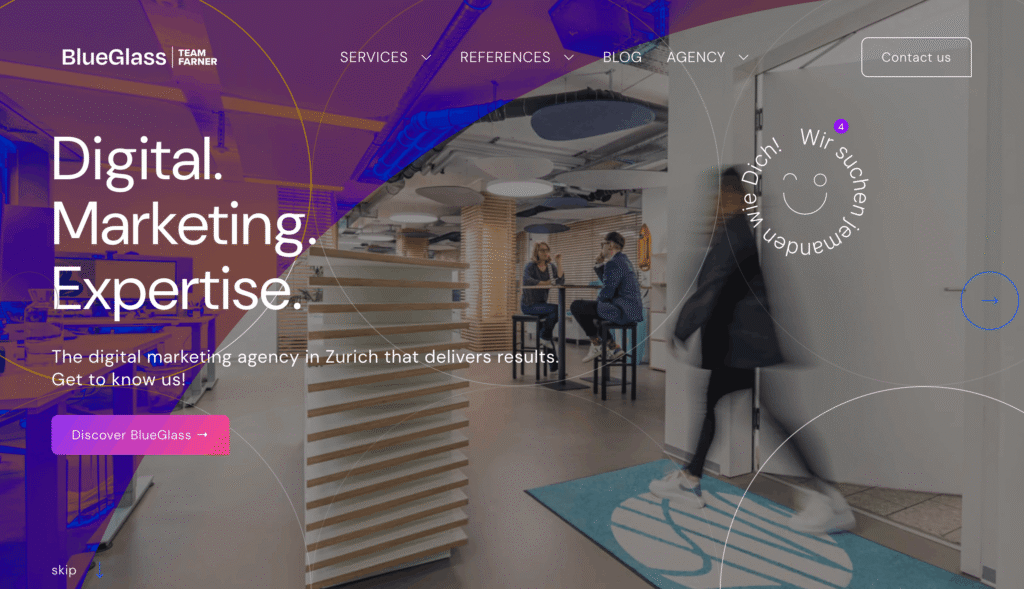
BlueGlass is widely recognized as one of Switzerland’s most prominent digital marketing agencies specializing in content marketing, technical SEO, and strategic brand visibility. Headquartered in Zurich and operating as part of the Farner communications group, BlueGlass has built a strong international reputation for delivering data-driven digital strategies that combine creative storytelling with advanced search optimization.
In the rapidly evolving digital landscape of 2026, the agency has expanded its services to incorporate Generative Engine Optimization (GEO), helping organizations strengthen their presence within AI-powered knowledge systems and conversational search environments. As generative AI platforms increasingly influence how users discover and evaluate information, BlueGlass focuses on positioning brands as authoritative sources that large language models reference when generating answers.
The agency’s approach blends creative content development with technical SEO precision, ensuring that brands are not only visible within search engines but also recognized as trusted entities within the broader knowledge ecosystems used by modern AI models.
Agency Background and Integration Within the Farner Group
BlueGlass operates as a digital marketing specialist within the Farner group, one of Switzerland’s leading communications networks. This integration provides the agency with access to extensive resources across public relations, corporate communications, branding, and digital marketing.
This broader communications ecosystem allows BlueGlass to implement cross-disciplinary strategies that strengthen brand visibility across multiple channels while reinforcing authority signals within AI-driven search systems.
Organizational Positioning Within the Farner Network
| Organizational Component | Strategic Role | Impact on GEO Strategy |
|---|---|---|
| BlueGlass Digital Marketing | SEO, content marketing, and digital growth strategies | Enhances technical and content visibility |
| Farner Communications Network | Public relations and brand communications | Strengthens brand authority signals |
| Strategic Partnerships | Collaboration with global brands and organizations | Expands international recognition |
| Data and Analytics Capabilities | Performance measurement and optimization | Supports continuous GEO improvement |
This integrated structure enables BlueGlass to approach Generative Engine Optimization not only from a technical perspective but also from a broader brand authority standpoint.
Content Marketing Excellence and E-E-A-T Standards
A defining strength of BlueGlass lies in its expertise in content marketing. The agency has built a reputation for producing high-quality digital content that meets the rigorous E-E-A-T standards increasingly used by search engines and generative AI models to evaluate the credibility of information sources.
E-E-A-T refers to Experience, Expertise, Authoritativeness, and Trustworthiness—four principles that determine whether content is considered reliable enough to be referenced within AI-generated answers.
BlueGlass incorporates these principles into every stage of its content development process.
E-E-A-T Content Development Framework
| E-E-A-T Component | Implementation Strategy | GEO Advantage |
|---|---|---|
| Experience | Incorporating real-world insights, case studies, and practical knowledge | Enhances authenticity signals |
| Expertise | Featuring subject-matter experts and research-backed insights | Builds domain authority |
| Authoritativeness | Publishing thought leadership content and industry analysis | Strengthens brand credibility |
| Trustworthiness | Maintaining transparency, accurate sourcing, and editorial standards | Increases likelihood of AI citation |
This structured approach ensures that BlueGlass clients produce content capable of competing within the information ecosystems used by generative AI models.
Combining Brand Awareness With Technical SEO Precision
BlueGlass distinguishes itself by combining creative brand storytelling with highly technical search optimization strategies. Many organizations struggle to balance these two elements, focusing either on branding or technical performance. BlueGlass integrates both dimensions to ensure that brands remain discoverable and authoritative across multiple digital channels.
Integrated SEO and Brand Strategy
| Strategic Element | Implementation Approach | Resulting Benefit |
|---|---|---|
| Technical SEO Infrastructure | Site architecture optimization and structured data implementation | Ensures search engine and AI accessibility |
| Content Marketing | Production of authoritative and educational content assets | Strengthens topical relevance |
| Brand Storytelling | Narrative-driven digital campaigns | Enhances brand recognition |
| Authority Building | Strategic partnerships and digital publications | Expands credibility signals |
Through this integrated framework, BlueGlass helps organizations achieve sustained visibility in both conventional search engines and generative AI environments.
Client Portfolio and Global Brand Engagement
BlueGlass serves a diverse range of clients, including internationally recognized corporations and large professional service firms. Its experience working with global brands has allowed the agency to develop strategies capable of scaling across multiple regions and industries.
Working with organizations that maintain global digital footprints requires careful management of brand authority signals across large and complex knowledge ecosystems.
Client Engagement Model
| Client Type | Digital Visibility Challenge | BlueGlass Strategic Solution |
|---|---|---|
| Global Travel Platforms | Highly competitive international search markets | Authority-driven content ecosystems |
| Professional Services Firms | Complex service offerings requiring educational content | Thought leadership and expert insights |
| Enterprise Technology Providers | Technical product explanations and industry credibility | Structured knowledge hubs |
| Multinational Brands | Consistent brand messaging across markets | Integrated SEO and brand communications |
By supporting these organizations, BlueGlass has gained significant experience in building digital authority that extends across international markets.
The Concept of Model Equity in Generative Search
One of the most innovative aspects of BlueGlass’s strategy in 2026 is its emphasis on building what the agency refers to as Model Equity. This concept refers to the cumulative level of recognition and credibility that a brand achieves within the training data and knowledge frameworks used by large language models.
When a brand achieves strong model equity, AI systems are more likely to reference that brand as an authoritative source when generating responses to user queries.
Model Equity Development Framework
| Model Equity Factor | Strategic Implementation | Long-Term Benefit |
|---|---|---|
| Brand Entity Recognition | Consistent brand mentions across authoritative publications | Improves AI recognition |
| Knowledge Graph Integration | Structuring digital content around defined entities | Enhances contextual understanding |
| Thought Leadership Content | Publishing industry insights and expert perspectives | Builds authority within training data |
| Media and Publication Presence | Securing coverage in trusted digital outlets | Expands citation footprint |
By systematically building these signals, BlueGlass helps organizations become recognized knowledge authorities within the digital environments used by generative AI models.
Proactive Strategy and Innovation in GEO Campaigns
BlueGlass is widely known within the Swiss digital marketing community for its proactive approach to innovation. Rather than waiting for changes in search technology to occur, the agency actively experiments with new optimization techniques and emerging digital platforms.
This innovation-driven culture allows the agency to anticipate shifts in generative search behavior and adapt client strategies accordingly.
Innovation-Oriented GEO Strategy
| Innovation Area | Strategic Initiative | Impact on Digital Visibility |
|---|---|---|
| AI Search Monitoring | Continuous tracking of generative search results | Identifies new optimization opportunities |
| Content Format Experimentation | Testing multimedia and interactive content formats | Expands AI citation possibilities |
| Knowledge Architecture Development | Designing structured topic clusters | Strengthens authority signals |
| Cross-Channel Visibility | Integrating SEO with digital PR and media presence | Amplifies brand reach |
Through these initiatives, BlueGlass helps clients remain competitive within an environment where AI-driven discovery evolves rapidly.
Industry Segments Supported by BlueGlass
BlueGlass collaborates with organizations across several industries where strong digital authority and brand reputation are essential for success.
Industry Expertise Matrix
| Industry Sector | Key Digital Challenge | GEO Optimization Focus |
|---|---|---|
| Travel and Hospitality | Global competition and informational search queries | Authority-driven content strategies |
| Professional Services | Complex expertise communication | Thought leadership and educational content |
| Technology and Software | Technical product explanations | Structured knowledge frameworks |
| Consumer Brands | Brand awareness and trust signals | Integrated storytelling and SEO |
These industries benefit from BlueGlass’s ability to combine creative communication strategies with advanced search optimization techniques.
Strategic Position Within Switzerland’s GEO Agency Landscape
Within Switzerland’s growing ecosystem of Generative Engine Optimization agencies, BlueGlass occupies a unique position as a full-service digital marketing firm capable of integrating creative brand development with technical SEO expertise. Its affiliation with the Farner communications network further strengthens its ability to influence brand perception and authority across multiple digital channels.
By focusing on content quality, brand authority, and the development of model equity within AI knowledge systems, BlueGlass helps organizations establish long-term credibility in the increasingly complex landscape of AI-driven search.
As generative AI platforms continue to redefine how information is discovered and evaluated in 2026, agencies that combine creative excellence with technical optimization capabilities are expected to play a central role in shaping the future of digital visibility.
10. Rettenmund Solutions
Rettenmund Solutions is a Bern-based digital agency that has developed a strong reputation for delivering high-performance online solutions to organizations across the Bernese region. With more than fifteen years of experience supporting small and medium-sized enterprises, municipalities, and professional associations, the agency has become a trusted partner for organizations seeking to improve their digital visibility and technical infrastructure.
In the digital marketing environment of 2026, Rettenmund Solutions has expanded its services to address the rapid emergence of AI-driven search technologies. As generative engines and conversational search tools increasingly influence how users discover information online, the agency has positioned itself as a leader in Switzerland for integrating traditional Search Engine Optimization (SEO), Answer Engine Optimization (AEO), and Generative Engine Optimization (GEO).
Rather than treating these optimization strategies as separate disciplines, Rettenmund Solutions promotes an integrated approach that aligns technical infrastructure, content architecture, and linguistic optimization to ensure that organizations remain visible across both traditional search engines and AI-generated responses.
Agency Background and Regional Expertise
Rettenmund Solutions has built its reputation through a strong focus on the Bernese market. Many of the organizations it supports operate within regional networks where local credibility, cultural alignment, and linguistic precision play a critical role in digital visibility.
The agency’s long-standing relationships with local institutions and businesses have allowed it to develop a deep understanding of the communication styles, terminology, and information structures that resonate within the Swiss-German business environment.
Regional Client Segments Served
| Client Segment | Digital Needs | Optimization Strategy |
|---|---|---|
| Small and Medium-Sized Enterprises | Online visibility and lead generation | Integrated SEO and GEO frameworks |
| Municipal Governments | Public information accessibility | Structured knowledge portals |
| Professional Associations | Authority building and member engagement | Educational content ecosystems |
| Local Service Providers | Regional search visibility | Geo-targeted content and local citations |
Through these partnerships, Rettenmund Solutions supports organizations that rely heavily on digital trust and informational authority within their communities.
Leadership in SEO, AEO, and GEO Integration
A central aspect of Rettenmund Solutions’ philosophy is its emphasis on the integration of SEO, AEO, and GEO into a unified optimization strategy. In the modern search environment, users interact with multiple forms of search technology simultaneously, including traditional search engines, voice assistants, and generative AI platforms.
Rettenmund Solutions argues that treating these optimization channels as separate marketing initiatives can lead to fragmented strategies and inconsistent digital visibility.
Instead, the agency promotes a unified framework in which all optimization activities contribute to a shared objective: establishing the organization as a trusted source of knowledge across digital ecosystems.
Integrated Optimization Framework
| Optimization Discipline | Primary Objective | Implementation Approach |
|---|---|---|
| Search Engine Optimization (SEO) | Improve visibility within traditional search results | Technical SEO and authority building |
| Answer Engine Optimization (AEO) | Provide concise answers for voice assistants and featured snippets | Structured question-and-answer content |
| Generative Engine Optimization (GEO) | Enable AI systems to reference content within generated responses | Semantic content structuring and entity recognition |
This integrated model ensures that organizations maintain consistent digital authority across all modern search environments.
The Principle of Integrative Understanding
Rettenmund Solutions refers to its methodology as Integrative Understanding. This principle reflects the agency’s belief that successful digital visibility requires alignment between content structure, technical infrastructure, and cultural context.
Generative AI systems increasingly analyze content not only for keywords or links but also for contextual relevance, linguistic authenticity, and informational completeness.
The agency’s integrative strategy therefore focuses on creating digital ecosystems where every component contributes to the overall authority and discoverability of the organization.
Integrative Optimization Model
| Strategic Component | Implementation Focus | Benefit for AI and Search Systems |
|---|---|---|
| Technical Infrastructure | Website performance, crawlability, and structured data | Ensures accessibility for search engines and AI models |
| Knowledge Architecture | Organized topic clusters and entity relationships | Improves contextual understanding |
| Linguistic Optimization | Content aligned with regional language usage | Enhances relevance for local audiences |
| Authority Signals | Expert content and trusted references | Strengthens credibility within AI systems |
Through this approach, Rettenmund Solutions helps organizations develop comprehensive digital knowledge assets rather than isolated marketing content.
Linguistic Optimization for Swiss-German Audiences
One of the agency’s most distinctive capabilities lies in its understanding of Swiss-German linguistic patterns. Language plays a crucial role in how both traditional search engines and generative AI models interpret and evaluate content.
Content written for Swiss audiences often differs significantly from standard German used in neighboring countries. Rettenmund Solutions ensures that digital content incorporates the linguistic markers and cultural nuances that resonate with local audiences.
Swiss-German Content Optimization Elements
| Linguistic Factor | Optimization Strategy | Strategic Benefit |
|---|---|---|
| Regional Vocabulary | Use of Swiss-German terminology and phrasing | Improves contextual relevance |
| Cultural Communication Style | Adaptation to Swiss business communication norms | Strengthens audience trust |
| Local Entity References | Inclusion of regional institutions and geographic context | Enhances local authority signals |
| Natural Language Structure | Conversational phrasing suited for AI interpretation | Improves generative answer extraction |
By incorporating these linguistic characteristics, the agency ensures that both search engines and AI systems recognize the regional authority of the content.
Preparing Organizations for the Zero-Click Search Environment
One of the most significant changes in digital discovery is the growing prevalence of zero-click search experiences. In these situations, users receive complete answers directly within search interfaces or AI-generated summaries without needing to visit external websites.
Rettenmund Solutions has adapted its optimization strategies to ensure that organizations still benefit from this environment even when direct traffic is reduced.
Zero-Click Visibility Strategy
| Zero-Click Element | Implementation Method | Business Impact |
|---|---|---|
| AI Answer Citations | Structuring content for extraction by generative engines | Reinforces brand authority |
| Featured Knowledge Blocks | Creating concise informational summaries | Increases AI answer inclusion |
| Structured FAQ Sections | Addressing common questions directly | Improves answer engine visibility |
| Entity-Based Content | Highlighting organizations and experts as knowledge sources | Strengthens recognition in AI models |
In this environment, visibility is measured not only by website visits but also by the extent to which a brand becomes associated with authoritative knowledge.
Educational Leadership in the Swiss Market
Beyond its consulting services, Rettenmund Solutions has taken an active role in educating Swiss organizations about the evolving relationship between traditional SEO and AI-driven search technologies. The agency frequently advises businesses and institutions on how to adapt their digital strategies to remain competitive within an increasingly AI-dominated information landscape.
Educational initiatives include workshops, advisory services, and strategic consulting designed to help organizations understand the technical and conceptual changes introduced by generative search.
Knowledge Leadership Initiatives
| Educational Activity | Purpose | Market Impact |
|---|---|---|
| Strategy Workshops | Teaching integrated SEO, AEO, and GEO methodologies | Improves digital literacy |
| Organizational Consulting | Helping institutions redesign digital infrastructure | Enables long-term optimization |
| Technical Audits | Evaluating readiness for AI-driven search environments | Identifies improvement opportunities |
| Digital Strategy Planning | Developing future-oriented visibility strategies | Supports sustainable growth |
These initiatives position Rettenmund Solutions not only as a service provider but also as a knowledge leader within Switzerland’s evolving digital marketing ecosystem.
Industry Segments Supported by Rettenmund Solutions
The agency serves organizations across several sectors that depend heavily on trust, authority, and regional credibility.
Industry Focus Matrix
| Industry Sector | Digital Communication Challenge | Optimization Strategy |
|---|---|---|
| Local SMEs | Limited resources for digital growth | Integrated SEO and GEO strategies |
| Municipal Institutions | Public access to reliable information | Structured knowledge portals |
| Nonprofit Organizations | Establishing credibility and authority | Educational content hubs |
| Regional Service Providers | Local search visibility | Geo-targeted content frameworks |
These sectors benefit from the agency’s ability to combine technical optimization with culturally relevant content development.
Strategic Position Within Switzerland’s GEO Agency Ecosystem
Within Switzerland’s growing landscape of Generative Engine Optimization agencies, Rettenmund Solutions occupies a distinctive position as a regional specialist with deep expertise in integrated search strategies and cultural localization. While many agencies focus primarily on technical optimization or large-scale enterprise campaigns, Rettenmund Solutions emphasizes contextual understanding, linguistic precision, and long-term digital authority.
By integrating SEO, AEO, and GEO into a unified strategic framework and preparing organizations for the realities of zero-click search environments, the agency helps businesses and institutions maintain strong digital visibility even as generative AI platforms reshape how information is accessed and consumed.
As the influence of AI-driven search continues to expand throughout 2026, agencies capable of combining technical expertise with cultural and linguistic understanding will play an increasingly important role in supporting the digital presence of regional organizations across Switzerland.
The Strategic Rise of Generative Engine Optimization Agencies in Switzerland
The rapid transformation of the Swiss search landscape has created a new category of digital service providers specializing in Generative Engine Optimization. As companies confront the realities of synthesis-based discovery environments, the demand for agencies capable of structuring digital information for AI interpretation has accelerated dramatically. In Switzerland’s advanced digital economy, GEO agencies are no longer simply SEO consultants but strategic partners responsible for shaping how brands are represented within the knowledge ecosystems of large language models.
The Swiss market is particularly complex due to the coexistence of multiple linguistic regions, strict regulatory frameworks, and the presence of globally influential sectors such as banking, pharmaceuticals, advanced manufacturing, and enterprise software. As a result, the GEO agency ecosystem has diversified into several distinct categories, ranging from highly technical optimization specialists to full-service digital communications consultancies capable of integrating brand strategy, content authority, and AI visibility frameworks.
Swiss GEO Agency Market Segmentation (2026)
| Agency Category | Strategic Focus | Typical Client Segment | Core GEO Capability |
|---|---|---|---|
| Technical GEO Specialists | LLM optimization and semantic structuring | SaaS, fintech, B2B technology firms | AI-readable content architecture |
| Enterprise Digital Agencies | Integrated search and performance marketing | Large corporations and multinational firms | Multi-channel visibility frameworks |
| Regional SEO Specialists | Local search and linguistic optimization | SMEs and regional service providers | Localized entity authority |
| E-Commerce Optimization Firms | Product data and AI shopping discovery | Retail and B2B webshops | Structured product knowledge |
| Data-Driven Marketing Consultancies | Analytics, predictive marketing, AI performance measurement | Large enterprises and public sector | AI visibility tracking and performance modeling |
This diversified ecosystem reflects the wide range of challenges facing Swiss organizations as they transition from traditional search engine optimization toward AI-first discovery strategies.
Key Structural Drivers Behind GEO Adoption in Switzerland
Several structural factors explain why Switzerland has become one of Europe’s most active markets for Generative Engine Optimization services. These drivers extend beyond technological trends and are deeply rooted in the country’s economic structure, digital maturity, and multilingual business environment.
Key Drivers of GEO Adoption
| Structural Driver | Description | Impact on Digital Discovery |
|---|---|---|
| Multilingual Market | Switzerland operates across German, French, Italian, and English digital ecosystems | Requires language-specific AI optimization |
| B2B-Dominated Economy | Large share of exports and enterprise services | High reliance on knowledge-based discovery |
| High Digital Trust Standards | Strong emphasis on authority and expertise | Reinforces E-E-A-T content requirements |
| Advanced Technology Adoption | Rapid corporate investment in AI infrastructure | Accelerates adoption of AI search interfaces |
| Complex Regulatory Environment | Financial and healthcare industries require precise communication | Favors authoritative knowledge sources |
These factors collectively create an environment where Generative Engine Optimization is not merely a marketing innovation but a structural necessity for digital competitiveness.
The Evolution From Retrieval-Based SEO to Knowledge Engineering
Historically, search engine optimization in Switzerland focused primarily on ranking websites within lists of search results. The objective was to capture traffic by occupying a prominent position within keyword-based search queries. However, the emergence of generative AI systems has fundamentally changed this model.
Modern AI search platforms do not simply retrieve documents. Instead, they synthesize information from multiple sources to produce comprehensive answers. As a result, the central challenge of digital visibility has shifted from ranking pages to becoming a trusted source of knowledge within AI-generated responses.
Search Paradigm Transformation
| Search Era | Primary Mechanism | Optimization Strategy | Visibility Metric |
|---|---|---|---|
| Traditional Search (2005–2020) | Keyword-based document retrieval | On-page SEO and backlink building | Ranking position |
| Semantic Search (2020–2024) | Contextual understanding of queries | Topic clusters and entity mapping | Topical authority |
| Generative Search (2025–2026) | AI synthesis of knowledge sources | Generative Engine Optimization | AI citation frequency |
In the generative search era, the key metric of digital success is no longer click-through rate alone but the frequency with which a brand is referenced as an authoritative source within AI-generated responses.
The Swiss Multilingual Challenge in GEO Strategy
One of the most distinctive features of the Swiss GEO landscape is the need to operate across multiple linguistic ecosystems simultaneously. Switzerland’s digital audience interacts with AI platforms in German, French, Italian, and English depending on regional context and professional domain.
Generative AI models interpret language patterns, terminology, and cultural cues when selecting information sources. As a result, GEO strategies in Switzerland must account for regional linguistic differences and localized content structures.
Swiss Multilingual GEO Strategy Requirements
| Language Region | Primary Language | GEO Considerations |
|---|---|---|
| German-Speaking Switzerland | Swiss German / High German | Localized terminology and regional business vocabulary |
| Romandie | French | Cultural nuance and linguistic authenticity |
| Ticino | Italian | Regional economic and linguistic context |
| International Business Sector | English | Global authority and technical terminology |
Agencies operating in Switzerland must therefore combine linguistic expertise with technical optimization to ensure that AI systems recognize the authority of regional content sources.
Industry-Specific GEO Requirements in the Swiss Economy
The Swiss economy contains several sectors that rely heavily on informational authority and knowledge-based discovery. Generative AI platforms are increasingly used by professionals within these industries to conduct research, evaluate vendors, and compare complex products.
This shift has created sector-specific GEO requirements that agencies must address when designing digital visibility strategies.
Industry GEO Demand Matrix
| Industry Sector | Discovery Behavior | GEO Strategy Priority |
|---|---|---|
| Financial Services | High reliance on authoritative knowledge sources | Expert content and regulatory clarity |
| Pharmaceuticals and Life Sciences | Research-driven discovery processes | Scientific credibility and structured knowledge |
| B2B Technology and SaaS | AI-assisted vendor evaluation | Product comparison and technical documentation |
| Industrial Manufacturing | Complex product research by engineers and procurement teams | Detailed specification content |
| E-Commerce and Retail | AI-generated shopping recommendations | Structured product data |
These industries collectively represent a significant portion of Switzerland’s GDP, making Generative Engine Optimization a critical strategic capability for maintaining digital competitiveness.
Agency Performance Metrics in the GEO Era
The evaluation of digital marketing agency performance has also evolved alongside the rise of generative search. Traditional SEO metrics such as keyword rankings and organic traffic remain relevant but no longer provide a complete picture of digital visibility.
Modern GEO performance measurement focuses on the degree to which brands are integrated into the knowledge outputs of generative AI systems.
GEO Performance Measurement Framework
| Metric Category | Measurement Objective | Strategic Insight |
|---|---|---|
| AI Citation Frequency | Frequency of brand mentions within AI-generated responses | Measures authority within generative ecosystems |
| Entity Recognition Strength | Degree to which AI models associate a brand with specific topics | Indicates topical authority |
| Generative Query Coverage | Number of relevant queries where a brand appears in synthesized answers | Evaluates knowledge footprint |
| Zero-Click Visibility | Brand presence within AI answers even without site visits | Reinforces brand authority |
| Cross-Platform AI Visibility | Presence across multiple generative platforms | Ensures ecosystem-wide recognition |
These metrics reflect the reality that brand influence within AI-generated knowledge environments often extends beyond traditional website traffic.
The Strategic Implications of the Zero-Click Economy
The growing dominance of zero-click search experiences represents one of the most profound structural shifts in digital discovery. As AI systems increasingly deliver complete answers directly within search interfaces, the need for users to visit external websites has declined significantly.
However, this does not necessarily reduce the importance of digital visibility. Instead, it transforms the nature of brand influence.
Zero-Click Discovery Dynamics
| Discovery Scenario | User Behavior | Brand Opportunity |
|---|---|---|
| AI Answer Consumption | User reads synthesized answer without visiting a site | Authority and brand recognition |
| Vendor Shortlisting | User extracts recommended companies from AI response | Lead generation |
| Product Comparison | AI summarizes features from multiple sources | Product awareness |
| Knowledge Research | User gathers information for decision-making | Thought leadership positioning |
For Swiss companies operating in knowledge-intensive industries, appearing within these synthesized answers can significantly influence purchasing decisions even when direct website traffic does not occur.
Future Outlook for the Swiss GEO Ecosystem
Looking beyond 2026, the Swiss Generative Engine Optimization landscape is expected to continue expanding as organizations increasingly recognize the importance of AI-driven discovery channels. The rapid adoption of conversational search tools, combined with Switzerland’s strong investment in artificial intelligence, suggests that generative search will become a central component of digital marketing strategies across all major industries.
Future Trends in Swiss GEO Development
| Emerging Trend | Expected Impact |
|---|---|
| AI-First Digital Strategies | Organizations will design content primarily for AI interpretation |
| Expansion of AI Shopping Interfaces | E-commerce visibility will depend heavily on product data optimization |
| Knowledge Graph Dominance | Entity-based content structures will replace keyword-driven pages |
| Cross-Language AI Optimization | Multilingual content strategies will become standard practice |
| Integration With Enterprise Data Systems | AI visibility will extend beyond marketing into corporate knowledge infrastructure |
In this evolving environment, Generative Engine Optimization agencies will play a critical role in shaping how Swiss organizations communicate their expertise within global AI knowledge systems.
As the digital discovery paradigm shifts permanently toward synthesis-based information delivery, the ability to influence AI-generated narratives will become one of the most valuable strategic capabilities within Switzerland’s digital economy.
Technical Methodologies Behind Generative Discovery in Switzerland
The transformation of digital discovery in Switzerland has introduced a complex ecosystem of optimization methodologies designed to align content with the operational logic of artificial intelligence systems. In the synthesis-based search environment of 2026, digital visibility depends not only on traditional ranking signals but also on how effectively information can be interpreted, contextualized, and synthesized by large language models.
Three primary disciplines now define the technical foundation of AI-driven discovery optimization: Answer Engine Optimization (AEO), Generative Engine Optimization (GEO), and Large Language Model Optimization (LLMO). While these methodologies share certain conceptual overlaps, each serves a distinct role within the AI-powered search ecosystem.
Understanding how these frameworks interact is particularly important within the Swiss digital market, where multilingual audiences, localized regulatory frameworks, and high levels of industry specialization create unique challenges for AI-based content interpretation.
Answer Engine Optimization in the Swiss Context
Answer Engine Optimization represents the most immediate and direct form of AI-oriented search optimization. This discipline focuses on ensuring that digital content can be quickly extracted and delivered as concise responses by voice assistants, conversational AI interfaces, and rapid-answer systems.
In practical terms, AEO emphasizes content structures that provide clear and precise answers to commonly asked questions. These responses are typically extracted from structured content blocks such as frequently asked questions, definition boxes, and structured data frameworks.
Within Switzerland, AEO strategies often revolve around highly localized information queries that require precise regional context.
Common AEO Query Categories in Switzerland
| Query Category | Typical User Question | Optimization Focus |
|---|---|---|
| Regional Services | “Best accounting firm in Zurich” | Local entity recognition |
| Administrative Information | “What is the tax rate in Canton Vaud?” | Structured factual content |
| Geographic Details | “Postal code for Lugano” | Clear data extraction |
| Regulatory Requirements | “Requirements for starting a business in Bern” | Structured informational pages |
For these types of queries, AI systems prioritize structured and clearly formatted information that can be delivered immediately without requiring extensive contextual synthesis.
Content Structures Used in AEO
| Content Format | Purpose | AI Retrieval Benefit |
|---|---|---|
| FAQ Sections | Direct answers to common questions | Rapid information extraction |
| Definition Boxes | Clear explanations of terms | Improves voice assistant responses |
| Structured Tables | Organized presentation of factual data | Enables efficient data parsing |
| Schema Markup | Machine-readable content tagging | Enhances AI interpretation |
These structured content formats allow AI systems to retrieve factual information quickly and accurately, making them essential for organizations seeking visibility within answer-driven search environments.
Generative Engine Optimization and Narrative Synthesis
Generative Engine Optimization operates at a more advanced level of the discovery funnel. Rather than focusing solely on extracting isolated facts, GEO is concerned with how AI models synthesize information from multiple sources to construct comprehensive narratives.
In generative search environments, AI systems analyze extensive knowledge sources and assemble answers that incorporate multiple perspectives, expert opinions, and contextual explanations. The goal of GEO is therefore to ensure that a brand’s content becomes one of the trusted knowledge inputs used during this synthesis process.
Key Characteristics of GEO-Oriented Content
| Content Attribute | Description | Impact on AI Narratives |
|---|---|---|
| Depth of Analysis | Comprehensive coverage of complex topics | Improves likelihood of citation |
| Evidence-Based Insights | Use of research data and authoritative references | Strengthens credibility |
| Expert Authorship | Clear identification of subject matter experts | Enhances trust signals |
| Topic Authority | Extensive coverage of related concepts | Reinforces contextual relevance |
These characteristics align closely with the E-E-A-T framework that governs how both search engines and AI systems evaluate informational authority.
E-E-A-T Principles in Generative Search
| Principle | Meaning | Role in GEO |
|---|---|---|
| Experience | Demonstration of practical knowledge | Increases authenticity |
| Expertise | Demonstration of subject mastery | Strengthens authority |
| Authoritativeness | Recognition by external sources | Enhances credibility |
| Trustworthiness | Transparency and factual reliability | Builds AI confidence |
AI systems prioritize sources that consistently demonstrate these attributes across multiple pieces of content and across the broader digital ecosystem.
Large Language Model Optimization and Model Relevance
Large Language Model Optimization represents the most technically advanced layer of AI search visibility. While GEO focuses on content citation within AI-generated answers, LLMO focuses on how content is interpreted by the underlying machine learning models themselves.
Large language models learn from vast corpora of information and develop internal representations of entities, concepts, and relationships. LLMO strategies aim to ensure that a brand becomes strongly associated with specific topics within these knowledge frameworks.
LLMO Optimization Components
| Optimization Element | Implementation Strategy | Model-Level Impact |
|---|---|---|
| Entity Definition | Clearly defining brands, products, and experts | Improves recognition within AI models |
| Knowledge Graph Integration | Linking entities to structured knowledge systems | Enhances contextual mapping |
| Cross-Publication Authority | Consistent mentions across authoritative platforms | Strengthens entity credibility |
| Topic Clustering | Creating interconnected content networks | Improves conceptual association |
Through these techniques, organizations can increase the probability that AI models will associate their brand with relevant topics during generative responses.
Comparative Framework of Search and Synthesis Optimization
The relationship between AEO, GEO, and LLMO can be better understood by examining how each methodology addresses different stages of the discovery process.
Comparative Framework of AI Optimization Methodologies
| Feature | Answer Engine Optimization (AEO) | Generative Engine Optimization (GEO) |
|---|---|---|
| Primary Objective | Immediate retrieval of factual information | Inclusion in synthesized AI narratives |
| Content Structure | FAQs, concise definitions, structured tables | Research-based content and expert insights |
| Technical Focus | Schema markup and structured data | Entity optimization and knowledge graphs |
| Success Metric | Featured snippet and voice answer inclusion | Citation frequency within AI responses |
| Swiss-Specific Nuance | Local facts such as cantonal rules and geographic data | Multilingual authority and expert credibility |
| Engagement Model | Transactional and informational queries | Discovery, evaluation, and recommendation |
These frameworks illustrate how each methodology serves a complementary role within the broader AI discovery ecosystem.
The Multilingual Complexity of Swiss GEO Strategies
Switzerland’s multilingual digital environment introduces an additional layer of complexity for generative optimization strategies. AI models increasingly interpret regional vocabulary, spelling variations, and linguistic nuances as signals of contextual relevance.
As a result, content written for Swiss audiences must reflect the linguistic patterns used within each regional market.
Swiss Multilingual Content Requirements
| Language Region | Primary Language | GEO Optimization Considerations |
|---|---|---|
| German-Speaking Switzerland | Swiss German / High German | Regional terminology and business vocabulary |
| Romandie | French | Cultural nuance and regional phrasing |
| Ticino | Italian | Local economic context and terminology |
| International Business Sector | English | Global technical and financial terminology |
Agencies operating within Switzerland have observed that content incorporating region-specific vocabulary and cultural references tends to achieve higher recognition within AI-generated answers.
Regional Linguistic Signals Recognized by AI Models
| Linguistic Factor | Optimization Strategy | AI Interpretation Benefit |
|---|---|---|
| Regional Terminology | Using Swiss-specific business vocabulary | Improves contextual relevance |
| Local Geographic References | Mentioning cantons, cities, and institutions | Enhances local authority |
| Cultural Communication Style | Reflecting Swiss professional tone | Builds trust signals |
| Multilingual Topic Coverage | Publishing content in multiple regional languages | Expands AI recognition |
These linguistic signals help AI models distinguish locally authoritative sources from generic international content.
The Strategic Integration of AEO, GEO, and LLMO
Modern digital discovery strategies require organizations to integrate AEO, GEO, and LLMO into a cohesive optimization framework. Each methodology contributes to a different stage of the AI discovery process, from rapid fact retrieval to narrative synthesis and long-term knowledge representation.
Integrated AI Discovery Optimization Model
| Optimization Layer | Strategic Function | Business Outcome |
|---|---|---|
| AEO | Provides rapid answers to factual queries | Immediate informational visibility |
| GEO | Ensures brand inclusion in synthesized responses | Authority in generative narratives |
| LLMO | Strengthens entity recognition within AI models | Long-term topic association |
Organizations that successfully integrate these disciplines gain a significant advantage in the emerging AI-driven search ecosystem.
Future Implications for Swiss Digital Discovery
As artificial intelligence continues to reshape how users interact with digital information, the importance of these optimization methodologies will only increase. Switzerland’s strong AI investment environment, combined with its multilingual business landscape, suggests that the country will remain at the forefront of generative search innovation.
Companies operating in the Swiss market must therefore view AEO, GEO, and LLMO not as isolated tactics but as components of a unified strategy designed to influence how knowledge is synthesized and presented by AI systems.
In the synthesis-based discovery economy of 2026, digital visibility is no longer determined solely by where a website appears in search results. Instead, it is determined by how effectively an organization’s expertise becomes embedded within the knowledge frameworks that power modern artificial intelligence.
Market Valuation and Pricing Dynamics in the Swiss Generative Engine Optimization Sector
The Generative Engine Optimization market in Switzerland has entered a phase of structural maturity by 2026, with pricing frameworks becoming increasingly standardized across agencies. As organizations shift their digital strategies toward AI-driven discovery environments, GEO services have evolved from experimental offerings into clearly defined consulting and implementation programs.
Swiss companies, particularly those operating in high-value industries such as finance, SaaS, pharmaceuticals, and advanced manufacturing, are increasingly allocating dedicated budgets for AI visibility strategies. This demand has resulted in a well-defined pricing ecosystem where agencies offer services across several tiers based on the complexity of optimization, organizational scale, and technological integration requirements.
In Switzerland’s highly developed digital economy, GEO pricing reflects the specialized expertise required to influence AI-generated answers, build authoritative knowledge signals, and integrate brand narratives within the knowledge frameworks of large language models.
Swiss GEO Service Pricing Structure
GEO service pricing in Switzerland typically falls into four primary categories. These categories correspond to different stages of organizational AI readiness, ranging from initial evaluation and technical preparation to fully integrated enterprise optimization programs.
Swiss GEO and AI Search Optimization Pricing Models (2026)
| Service Type | Swiss Market Rate (Estimated) | Service Inclusions |
|---|---|---|
| AI Readiness Audit | CHF 2,500 – CHF 12,000 | AI visibility assessment, technical content audit, entity analysis, AI optimization roadmap |
| Monthly GEO/AEO Retainer | CHF 3,500 – CHF 18,000 | Content creation, citation building, structured data implementation, AI visibility monitoring |
| Enterprise GEO Program | CHF 15,000 – CHF 60,000+ | Full-stack optimization, proprietary AI simulations, digital PR, knowledge graph integration |
| Boutique Consulting and Technical Advisory | CHF 150 – CHF 350 per hour | Specialized consulting, prompt engineering, technical troubleshooting, strategic advisory |
These pricing tiers reflect the wide variation in complexity between smaller organizations seeking localized AI visibility and large enterprises aiming to influence global generative search ecosystems.
AI Readiness Audits as the Entry Point to GEO Adoption
The most common starting point for organizations entering the GEO ecosystem is the AI readiness audit. This service evaluates whether a company’s digital infrastructure and content architecture are capable of being interpreted and cited by generative AI systems.
AI readiness assessments typically analyze multiple aspects of a company’s digital presence, including technical SEO, entity recognition signals, content authority, and structured knowledge frameworks.
AI Readiness Audit Evaluation Framework
| Evaluation Category | Assessment Focus | Strategic Outcome |
|---|---|---|
| Technical Infrastructure | Crawlability, site architecture, structured data | Determines AI accessibility |
| Content Authority | Depth of expertise and topic coverage | Evaluates citation potential |
| Entity Recognition | Brand presence within digital knowledge ecosystems | Measures AI familiarity |
| Knowledge Architecture | Organization of informational content | Identifies structural improvements |
| Competitive Visibility | AI citation analysis for industry competitors | Reveals optimization gaps |
These audits provide organizations with a roadmap for transitioning from traditional SEO strategies to AI-first discovery frameworks.
Monthly GEO Retainers and Ongoing Optimization Programs
After completing an initial readiness audit, many organizations transition to ongoing GEO retainers designed to maintain and expand AI visibility. These retainers typically involve continuous content optimization, authority-building activities, and monitoring of AI search platforms.
Because generative AI models evolve continuously, ongoing optimization is essential to maintain visibility within AI-generated responses.
Typical Monthly GEO Retainer Activities
| Activity Category | Implementation Focus | AI Visibility Impact |
|---|---|---|
| AI-Optimized Content Production | Development of knowledge hubs and expert insights | Strengthens topical authority |
| Citation Signal Development | Digital PR and authoritative mentions | Improves AI trust signals |
| Entity Optimization | Structured brand and product entity development | Enhances model recognition |
| Technical Monitoring | Tracking generative search appearance | Enables strategy adjustments |
| Competitive Intelligence | Monitoring AI responses for industry queries | Identifies growth opportunities |
Monthly retainers allow organizations to maintain continuous influence within the evolving generative search ecosystem.
Enterprise-Level GEO Programs
Large corporations operating in Switzerland’s global business sectors often require more advanced GEO programs that extend beyond basic optimization services. Enterprise programs typically involve full-stack integration across digital marketing, brand communications, data infrastructure, and public relations.
These programs often incorporate proprietary AI simulation tools designed to test how generative systems interpret and synthesize brand-related information.
Enterprise GEO Integration Model
| Integration Layer | Strategic Function | Enterprise Benefit |
|---|---|---|
| AI Simulation Tools | Predict AI-generated responses | Anticipates search behavior |
| Knowledge Graph Integration | Structured representation of brand entities | Strengthens AI understanding |
| Global Digital PR Campaigns | Authority building through media coverage | Expands citation footprint |
| Multilingual Content Systems | Localization across multiple markets | Supports international visibility |
| Advanced Analytics Platforms | AI visibility and citation monitoring | Measures strategic impact |
Such programs are particularly relevant for multinational firms seeking to shape their global digital reputation within AI knowledge ecosystems.
The Rise of Boutique GEO Specialists
Alongside large enterprise-focused agencies, Switzerland has seen the emergence of boutique GEO consultancies that provide highly specialized services. These smaller agencies typically focus on technical optimization, prompt engineering, AI content structuring, and advanced LLM optimization techniques.
Boutique consultants often serve startups, SMEs, and highly specialized B2B firms that require expert guidance but do not need large-scale enterprise programs.
Boutique GEO Consulting Services
| Consulting Focus | Typical Deliverable | Client Benefit |
|---|---|---|
| Prompt Engineering | Optimization of conversational AI responses | Improved brand visibility |
| Technical Content Structuring | AI-readable documentation frameworks | Better AI interpretation |
| Knowledge Graph Design | Entity relationship mapping | Stronger topic association |
| AI Search Diagnostics | Analysis of generative search results | Identifies optimization opportunities |
These boutique services offer flexible solutions for organizations seeking targeted expertise within specific areas of generative search optimization.
Global Market Growth and Strategic Valuation
The rapid expansion of the GEO industry is not limited to Switzerland. Globally, the market for generative search optimization services is experiencing extraordinary growth as businesses adapt to the dominance of AI-driven discovery.
Market analysts estimate that the global GEO services market will reach a valuation of approximately 7.32 billion dollars by 2031, growing at an annual compound rate of 34 percent.
Global GEO Market Growth Indicators
| Market Indicator | Data Point | Strategic Interpretation |
|---|---|---|
| Global Market Valuation (2031) | $7.32 Billion | Rapid expansion of AI visibility services |
| Compound Annual Growth Rate | 34% CAGR | Accelerated adoption of GEO |
| Enterprise Marketing Budget Allocation | Average 12% dedicated to AI search optimization | Increasing strategic importance |
| AI Discovery Adoption Rate | 40% of users initiating searches in AI tools | Structural shift in digital discovery |
This growth reflects the broader transformation of digital marketing toward AI-driven knowledge ecosystems.
The Conversion Advantage of AI-Referred Traffic
One of the most significant economic drivers behind the adoption of GEO strategies is the high conversion rate associated with AI-referred traffic. Users who discover brands through AI-generated answers often arrive with a high level of prior knowledge and intent.
This behavior results in significantly higher engagement and conversion metrics compared to traditional organic search traffic.
Comparative Traffic Conversion Performance
| Traffic Source | Conversion Rate Relative to Organic Search | User Intent Level |
|---|---|---|
| Traditional Organic Search | Baseline | Mixed informational and transactional intent |
| Paid Search Advertising | 1.3x higher | Transaction-focused |
| AI-Referred Traffic | 4.4x higher | Highly informed and research-driven |
This substantial conversion advantage explains why many organizations are willing to invest heavily in GEO services despite their relatively high costs.
Economic Justification for GEO Investment
For Swiss organizations operating in high-value sectors, the financial return on GEO investment can be significant. Visibility within AI-generated responses can influence purchasing decisions long before a potential customer visits a website.
GEO Investment Impact Model
| Investment Area | Strategic Outcome | Business Impact |
|---|---|---|
| Authority Content Development | Increased AI citation frequency | Higher brand recognition |
| Technical Optimization | Improved AI interpretation of content | Greater discovery potential |
| Digital PR and Media Visibility | Expanded authority signals | Stronger reputation |
| Continuous AI Monitoring | Rapid adaptation to algorithm changes | Sustained competitive advantage |
These outcomes demonstrate why GEO is increasingly viewed as a core strategic capability rather than a niche marketing tactic.
Future Pricing Outlook for Swiss GEO Services
Looking beyond 2026, the pricing dynamics of the Swiss GEO market are expected to evolve further as demand continues to grow and optimization technologies become more sophisticated.
Future Trends in GEO Pricing and Service Models
| Emerging Trend | Expected Market Impact |
|---|---|
| AI Simulation Platforms | Agencies offering proprietary AI testing tools |
| Integrated Marketing and AI Visibility Programs | Greater convergence of SEO, PR, and data analytics |
| Multilingual GEO Services | Increased demand for language-specific optimization |
| Enterprise Knowledge Engineering | Expansion of GEO into internal corporate data systems |
As AI systems increasingly mediate how information is discovered and consumed, Generative Engine Optimization will become one of the most strategically important services within the digital marketing industry.
In Switzerland’s advanced and globally connected economy, organizations that invest in expert-led GEO programs will likely gain a significant competitive advantage within the AI-driven discovery landscape.
Quantitative Performance Metrics: Measuring the ROI of Generative Discovery
The measurement frameworks used to evaluate digital marketing performance in Switzerland have evolved significantly by 2026. Traditional SEO metrics such as keyword rankings and page position tracking are no longer sufficient to capture the full impact of AI-driven discovery. In the generative search ecosystem, visibility is increasingly determined by how frequently a brand appears within AI-generated answers and knowledge summaries.
As a result, Swiss organizations and GEO agencies now rely on advanced performance indicators such as AI Visibility Scores, Citation Frequency, and Generative Query Coverage to assess their digital authority. These metrics provide insight into how often generative AI systems reference a brand’s knowledge assets when synthesizing responses to user queries.
In a synthesis-based discovery environment, the central question is no longer “Where does a page rank?” but rather “How often does an AI model rely on this source when generating answers?”
Key Metrics for Evaluating Generative Discovery Performance
Modern GEO measurement frameworks incorporate multiple layers of analysis that evaluate both AI visibility and downstream business outcomes. These metrics allow organizations to understand how generative discovery influences brand authority, customer acquisition, and revenue growth.
Core GEO Performance Indicators
| Metric Category | Measurement Objective | Strategic Insight |
|---|---|---|
| AI Visibility Score | Measures overall presence within generative search responses | Indicates authority within AI ecosystems |
| Citation Frequency | Counts how often a brand is referenced by AI-generated answers | Reflects trust and knowledge relevance |
| Generative Query Coverage | Percentage of industry-related queries where the brand appears | Evaluates topic authority footprint |
| AI Referral Traffic | Traffic originating from generative search tools | Measures discovery effectiveness |
| AI Citation Share | Proportion of mentions compared with competitors | Indicates competitive authority |
These indicators provide a comprehensive view of how brands interact with generative search systems and how those interactions translate into business outcomes.
Case Study: GEO Integration in the E-Commerce Sector
A leading Swiss case study involving a global e-commerce client in the hair accessory market illustrates the significant performance gains achieved through the integration of Large Language Model Optimization with traditional SEO strategies.
The project focused on restructuring product content, strengthening entity authority, and optimizing knowledge assets for generative AI interpretation. Within a relatively short period, the company experienced substantial improvements in search visibility and commercial performance.
Key outcomes included dramatic increases in organic impressions, click-through rates, and user acquisition.
Performance Impact of GEO Integration (Case Study Aggregate)
| Metric Category | Traditional SEO Outcome | SEO + GEO Integration | Variance |
|---|---|---|---|
| Conversion Rate | 1.0x (Baseline) | 4.4x | +340% |
| Lead Generation | Baseline | 25 new leads per month (average) | Significant Growth |
| Organic Impressions | Baseline | +86% | High Visibility Increase |
| Daily Revenue | $2,000 | $6,000 | +200% |
| Referral Traffic Growth | Baseline | +460% (LLM-specific sources) | Major Expansion |
| AI Citation Share | Minimal presence | +221% | Authority Growth |
These results demonstrate the powerful relationship between generative AI visibility and measurable commercial outcomes.
The Revenue Impact of AI-Driven Discovery
One of the most significant findings emerging from GEO performance studies is the strong correlation between AI citations and revenue growth. When a brand becomes embedded within generative AI responses, it gains exposure at the earliest stages of the customer decision-making process.
Unlike traditional search results, which present users with multiple competing options, generative AI systems often summarize recommendations and highlight a smaller number of authoritative sources. This curated discovery process can significantly influence purchasing decisions.
Revenue Impact Model of Generative Discovery
| Discovery Stage | User Behavior | Business Outcome |
|---|---|---|
| AI Query Initiation | User asks AI for recommendations or information | Brand exposure in synthesized answer |
| AI Recommendation | AI cites authoritative sources | Increased trust and brand credibility |
| Targeted Visit | User visits recommended source | High-intent engagement |
| Conversion Action | User makes purchase or inquiry | Accelerated revenue growth |
This discovery model explains why organizations achieving high AI citation frequency often experience substantial increases in conversion rates.
Session Depth and User Intent in AI-Referred Traffic
Another critical performance metric that distinguishes AI-driven discovery from traditional search traffic is session depth. Session depth refers to the number of interactions or visits required before a user completes a desired action, such as making a purchase or submitting an inquiry.
Studies conducted across several Swiss GEO campaigns indicate that AI-referred visitors typically require significantly fewer sessions before converting.
Session Depth Comparison
| Traffic Source | Average Sessions to Conversion | User Intent Level |
|---|---|---|
| Traditional Organic Search | 3–5 sessions | Mixed informational and transactional |
| Paid Advertising Traffic | 2–3 sessions | Transaction-oriented |
| AI-Referred Traffic | 1–2 sessions | Highly informed and decision-ready |
This pattern occurs because users interacting with AI systems often receive detailed explanations, comparisons, and recommendations before visiting a website. By the time they reach a brand’s digital property, they are already well-informed about the offering.
Lead Generation Efficiency in the GEO Era
Generative search environments also demonstrate strong performance in lead generation contexts, particularly within B2B sectors where buyers rely heavily on AI systems to conduct research before engaging with vendors.
AI-generated answers frequently summarize vendor capabilities, product features, and industry expertise, allowing potential clients to identify suitable providers quickly.
Lead Generation Performance Comparison
| Discovery Channel | Average Monthly Leads | Lead Qualification Level |
|---|---|---|
| Traditional Organic Search | Baseline | Mixed qualification |
| Paid Advertising | Moderate lead volume | Transaction-focused |
| AI Discovery Platforms | 25 new leads per month (average case study) | High-intent prospects |
These results highlight the growing importance of generative AI systems in shaping B2B purchasing behavior.
Generative Search as a Dominant Referral Channel
Another striking performance indicator is the rapid growth of referral traffic originating from AI platforms. Tools such as conversational assistants and generative search interfaces increasingly act as discovery gateways for products and services.
Referral Traffic Source Growth
| Referral Source | Traffic Growth Rate | Strategic Implication |
|---|---|---|
| Traditional Search Engines | Stable or declining growth | Increasing competition |
| Social Media Platforms | Moderate growth | Awareness-focused traffic |
| Generative AI Platforms | +460% growth in case study | Dominant discovery channel |
This dramatic growth reflects the increasing reliance of users on AI systems for research and recommendation-based discovery.
The Role of AI Citation Share in Competitive Analysis
Within generative search environments, AI citation share has emerged as a key metric for evaluating competitive authority. Citation share measures how frequently a brand is referenced within AI-generated answers relative to its competitors.
Organizations with higher citation share often gain disproportionate visibility within AI responses, influencing user perception and purchasing decisions.
AI Citation Share Analysis Model
| Citation Share Level | Competitive Position | Discovery Advantage |
|---|---|---|
| Low Citation Presence | Limited AI visibility | Minimal influence |
| Moderate Citation Share | Occasional AI mentions | Competitive participation |
| High Citation Share | Frequent AI references | Market authority |
| Dominant Citation Share | Consistent AI recommendation | Category leadership |
Achieving dominant citation share within generative search environments requires sustained investment in authoritative content, structured knowledge frameworks, and entity recognition signals.
Strategic Implications for Swiss Organizations
For Swiss companies operating in knowledge-intensive industries, these performance metrics illustrate the strategic importance of Generative Engine Optimization. The integration of GEO with traditional SEO practices can dramatically improve both digital visibility and commercial outcomes.
Organizations that successfully embed their expertise within AI-generated knowledge systems gain access to highly informed audiences and significantly higher conversion rates.
Key ROI Drivers of Generative Discovery
| Strategic Factor | Business Benefit |
|---|---|
| Higher AI Citation Frequency | Increased brand authority |
| Improved Generative Query Coverage | Expanded discovery footprint |
| High-Intent AI Referral Traffic | Faster customer conversion |
| Reduced Session Depth | Lower acquisition costs |
| Enhanced Knowledge Authority | Long-term digital equity |
These factors collectively explain why GEO has become a priority investment for Swiss marketing departments in 2026.
The Future of Performance Measurement in AI Search
As generative search continues to evolve, the measurement frameworks used to evaluate digital visibility will likely become even more sophisticated. Future performance indicators may include model trust scores, cross-platform AI authority indexes, and predictive visibility analytics.
Future GEO Performance Metrics
| Emerging Metric | Measurement Purpose |
|---|---|
| AI Trust Score | Evaluates credibility of sources used by AI models |
| Cross-Model Visibility | Measures presence across multiple AI platforms |
| Generative Influence Index | Quantifies narrative impact in AI responses |
| Predictive Citation Modeling | Forecasts future AI visibility trends |
These advanced metrics will help organizations understand not only how they appear within AI-generated answers but also how their knowledge contributions shape the broader digital information ecosystem.
In Switzerland’s rapidly evolving generative discovery environment, the ability to measure and optimize AI visibility will remain a defining factor in digital competitiveness. Organizations that embrace these new performance frameworks will be better positioned to translate generative search influence into sustained business growth.
Comprehensive Reviews: Ten Real Perspectives on Swiss Search Agencies
Client feedback remains one of the most reliable indicators of agency performance in Switzerland’s evolving Generative Engine Optimization and AI visibility sector. Verified reviews from platforms such as Clutch and Sortlist provide valuable insight into how agencies deliver results across industries including technology, healthcare, financial services, publishing, and B2B enterprise sectors.
The following reviews summarize real client experiences, highlighting measurable outcomes such as traffic growth, improved rankings, enhanced digital visibility, and increased lead generation. These testimonials reflect the growing importance of advanced search strategies, including GEO, SEO, and AI-driven discovery frameworks.
Agency Performance Snapshot Based on Client Reviews
| Agency | Location | Client Industry | Platform Rating | Core Strength |
|---|---|---|---|---|
| ZUMO SEO | Herrliberg | Marketing and Sales | High client satisfaction | Rapid execution and SEO performance |
| Pixels Trade | Geneva | Healthcare / Multinational | 4.6 rating | Medical content expertise and R&D |
| Agence BB Switzerland | Geneva | SME / Multinational | 4.9 rating | Creative data-driven campaigns |
| comtogether | Saint-Sulpice | B2B / Travel Retail | 5.0 rating | Global multilingual strategy |
| visàvis Kommunikation AG | Baden | SME / National Brand | 5.0 rating | Strategic communication and performance marketing |
| Digital Leverage | Zurich | Financial Services / SaaS | 100% positive feedback | Technical SEO and AI readiness |
| Fire8 Online Marketing | Zurich | Financial Services | 5.0 rating | Website redesign and traffic growth |
| Aspectus | Küsnacht / Zurich | Investment Solutions | 100% positive feedback | Strategic PR and brand authority |
| MagicSpace SEO | Zug | Software / Technology | 5.0 rating | International SEO and technical optimization |
| WEBHUB360 | Zurich | Publishing / Translation | 100% satisfaction | Modern web design and SEO integration |
ZUMO SEO – Herrliberg
Client Type: Marketing and Sales Agency
ZUMO SEO received strong praise from a marketing and sales client seeking to improve organic traffic and search engine rankings. The agency’s work resulted in a remarkable 300 percent increase in website traffic while achieving first or second page rankings for several critical industry keywords.
Clients frequently highlight ZUMO’s operational agility, particularly its use of an adapted Scrum project management model with two-week sprints. This agile approach enables rapid optimization cycles and continuous performance improvement.
Key Performance Outcomes
| Performance Indicator | Result Achieved |
|---|---|
| Organic Traffic Growth | +300% |
| Keyword Rankings | First or second page positions |
| Lead Generation | Significant increase |
| Revenue Impact | Noticeable growth |
Pixels Trade – Geneva
Client Type: Healthcare / Multinational Corporation
Pixels Trade is recognized as a highly innovative digital partner for organizations operating in the healthcare and pharmaceutical sectors. Clients describe the agency as particularly effective at combining digital marketing with certified medical writing and regulatory-compliant content strategies.
Major global healthcare companies such as Sanofi and Novartis have collaborated with Pixels Trade on complex digital transformation initiatives.
Client Feedback Summary
| Review Dimension | Client Observation |
|---|---|
| Innovation Level | Strong focus on research and development |
| Content Expertise | Certified medical writing capabilities |
| Strategic Consulting | Advanced digital strategy development |
| Overall Rating | 4.6 across more than 20 reviews |
Agence BB Switzerland – Lancy / Geneva
Client Type: SME and Multinational Clients
Agence BB Switzerland is widely recognized for its “360° Swiss Made” approach to digital marketing, combining SEO, paid advertising, and content strategy into integrated marketing programs.
Clients consistently highlight the agency’s ability to balance creativity with data-driven performance optimization.
Client Performance Highlights
| Performance Indicator | Client Observation |
|---|---|
| Overall Rating | 4.9 based on 17 reviews |
| Strategic Strength | Integrated SEO and SEA strategies |
| Market Position | Strong understanding of the Swiss economy |
| Project Accessibility | Campaigns starting from €1,000 |
comtogether – Saint-Sulpice
Client Type: B2B and Travel Retail Companies
Comtogether is a well-established digital marketing agency with more than seventeen years of experience delivering global marketing campaigns. Clients particularly value the agency’s multilingual capabilities and its ability to manage international media partnerships.
The agency has received a perfect rating on Sortlist, reflecting its consistent performance and strong strategic capabilities.
Client Review Highlights
| Review Factor | Client Feedback |
|---|---|
| Strategic Expertise | Strong data-driven marketing strategies |
| Global Reach | Ability to target international audiences |
| Multilingual Capabilities | Cross-cultural communication expertise |
| Platform Rating | 5.0 on Sortlist |
visàvis Kommunikation AG – Baden
Client Type: SME and National Brands
visàvis Kommunikation AG is recognized for its ability to combine strategic brand development with measurable digital marketing performance. Clients frequently describe the agency as proactive and results-driven, particularly when managing complex communication campaigns.
The agency is especially effective at navigating multi-stage sales funnels and integrating SEO and SEM strategies.
Client Experience Summary
| Strategic Strength | Client Feedback |
|---|---|
| Strategic Thinking | Delivers communication with real substance |
| Campaign Execution | Combines creativity with measurable performance |
| Proactivity | Highly responsive and results-oriented |
| Platform Rating | 5.0 |
Digital Leverage – Zurich
Client Type: Financial Services and SaaS
Digital Leverage receives consistent praise from clients in the technology and financial sectors for its advanced technical SEO expertise. Organizations working with the agency report significant improvements in digital visibility and organic search performance.
Clients also highlight the agency’s ability to remain ahead of evolving AI search trends, particularly in the context of large language model optimization.
Client Satisfaction Indicators
| Performance Factor | Client Feedback |
|---|---|
| Overall Satisfaction | 100% positive reviews |
| Technical Expertise | Strong SEO and on-page optimization |
| Cost Efficiency | Good value for cost |
| Cultural Fit | Excellent alignment with technology firms |
Fire8 – Online Marketing und SEO Agentur (Zurich)
Client Type: Financial Services
Fire8 is known for delivering high-quality website redesign projects combined with effective SEO strategies. Clients appreciate the agency’s ability to deliver measurable improvements in website traffic while maintaining competitive pricing.
Client Review Summary
| Performance Indicator | Client Observation |
|---|---|
| Website Redesign Quality | High standard design and usability |
| Traffic Growth | Noticeable increases in site visitors |
| Project Management | Reliable and efficient delivery |
| Platform Rating | 5.0 on Clutch |
Aspectus – Küsnacht / Zurich
Client Type: Investment Solutions and Financial Services
Aspectus is widely recognized for its strategic communications expertise and its ability to strengthen brand authority through media relations and thought leadership initiatives.
Clients consistently highlight the professionalism and reliability of the agency’s account teams.
Client Feedback Highlights
| Review Dimension | Client Observation |
|---|---|
| Strategic Insight | Exceptional industry expertise |
| Reliability | Highly dependable delivery |
| Brand Awareness | Significant improvement in visibility |
| Client Sentiment | 100% positive feedback |
MagicSpace SEO – Zug
Client Type: Software and Technology Companies
MagicSpace SEO receives strong reviews from technology companies seeking measurable improvements in digital visibility. Clients particularly appreciate the agency’s technical knowledge and responsiveness.
The agency’s expertise in international SEO and multilingual optimization makes it a valuable partner for companies expanding into global markets.
Client Performance Indicators
| Performance Metric | Client Feedback |
|---|---|
| Knowledge Expertise | Highly knowledgeable team |
| Response Time | Prompt and reliable communication |
| Traffic Growth | Measurable increases in website visits |
| Platform Rating | 5.0 on Clutch |
WEBHUB360 – Zurich
Client Type: Publishing and Translation Industry
WEBHUB360 is praised for delivering modern website design combined with strong search engine optimization capabilities. Clients in the publishing sector highlight the agency’s ability to integrate advanced technologies into website development projects.
The agency consistently receives positive feedback for its project management and client communication.
Client Experience Summary
| Performance Factor | Client Observation |
|---|---|
| Design Quality | Modern and user-friendly websites |
| SEO Integration | Strong search optimization results |
| Client Satisfaction | 100% positive feedback |
| Project Management | Efficient and highly organized |
Overall Market Sentiment Toward Swiss GEO and Search Agencies
Across these verified client reviews, several common themes emerge regarding the performance of Swiss search agencies operating in the evolving AI discovery environment.
Key Client Satisfaction Drivers
| Client Priority | Observed Agency Strength |
|---|---|
| Measurable Traffic Growth | Strong SEO and GEO implementation |
| Strategic Expertise | Deep understanding of industry sectors |
| Agile Project Management | Efficient delivery and communication |
| Technical Innovation | Adoption of AI-driven optimization strategies |
These reviews collectively demonstrate the high level of expertise present within Switzerland’s digital marketing sector. As the transition toward generative discovery continues, agencies that combine technical SEO capabilities with AI-focused optimization strategies are likely to remain at the forefront of digital visibility and search innovation.
The Convergence of PR and GEO: Building Model Equity
The evolution of digital discovery in 2026 has introduced a powerful intersection between Public Relations and Generative Engine Optimization. In traditional search environments, PR activities were primarily designed to improve brand awareness and acquire backlinks from reputable publications. However, in the age of generative search, the role of PR has expanded significantly.
Large language models rely heavily on authoritative publications, media coverage, and trusted knowledge sources when generating answers. As a result, earned media now serves as a foundational data layer for AI knowledge systems. This shift has transformed PR from a reputation-building tool into a strategic component of AI visibility.
Within Switzerland’s advanced digital ecosystem, agencies are increasingly integrating PR with GEO strategies to build what industry experts refer to as model equity. Model equity represents the degree to which a brand is recognized and referenced within the knowledge frameworks used by AI models.
Understanding Model Equity in the Generative Search Era
Model equity refers to the accumulated credibility and recognition a brand achieves within the information sources used by generative AI systems. When a company appears consistently in trusted publications, interviews, research reports, and industry discussions, those mentions contribute to the knowledge base that AI models use when generating answers.
In this context, the objective of PR extends beyond reaching human audiences. It also aims to ensure that brand signals are embedded within authoritative knowledge ecosystems that AI systems learn from and reference.
Model Equity Development Framework
| Model Equity Factor | Strategic Implementation | Impact on AI Discovery |
|---|---|---|
| Earned Media Coverage | Articles, interviews, and expert commentary in reputable publications | Increases brand visibility within AI knowledge sources |
| Expert Thought Leadership | Publishing insights and research contributions | Strengthens expertise signals |
| Industry Citations | Mentions across research reports and sector publications | Improves authority recognition |
| Consistent Brand Narratives | Unified messaging across media channels | Enhances AI contextual understanding |
Organizations that accumulate strong model equity become more likely to be cited when AI systems answer questions about specific industries, technologies, or business leaders.
Why Earned Media Has Become the Backbone of GEO
Generative AI systems prioritize credible and verifiable information sources when constructing answers. These systems are trained and continuously updated using large datasets that include journalistic publications, industry reports, and authoritative digital content.
As a result, earned media coverage now plays a critical role in determining which brands are recognized as trustworthy knowledge sources.
AI Knowledge Source Hierarchy
| Knowledge Source Type | Influence on AI Responses | Credibility Level |
|---|---|---|
| Academic and Research Publications | Very high | Authoritative knowledge sources |
| Major Media Outlets | High | Trusted informational references |
| Industry Publications | High | Sector-specific expertise |
| Corporate Websites | Moderate | Primary but self-published information |
| User-Generated Content | Variable | Limited authority signals |
This hierarchy illustrates why earned media mentions significantly influence whether a brand appears in AI-generated responses.
The Strategic Integration of PR and GEO
In response to these dynamics, forward-thinking Swiss agencies have begun integrating PR campaigns directly into their Generative Engine Optimization frameworks. Instead of treating PR and SEO as separate disciplines, agencies now coordinate media outreach, content strategy, and technical optimization to strengthen AI visibility.
This integrated approach ensures that earned media contributes to both brand reputation and AI knowledge authority.
Integrated PR and GEO Strategy Model
| Strategic Component | Implementation Approach | Resulting Benefit |
|---|---|---|
| Media Outreach Campaigns | Securing interviews and feature articles | Expands authoritative mentions |
| Structured Content Distribution | Publishing research reports and insights | Improves knowledge depth |
| Expert Positioning | Promoting founders and executives as industry experts | Strengthens entity recognition |
| Technical Optimization | Structuring media mentions with schema markup | Enhances machine readability |
Through this model, PR becomes a powerful mechanism for embedding brand signals within the knowledge sources used by AI systems.
The Role of Structured Media Signals in AI Learning
Another important aspect of GEO-informed PR involves structuring media mentions in ways that allow AI systems to easily interpret and associate brand information with specific topics.
When announcements, interviews, and press releases include clearly defined entities and contextual relationships, they provide structured signals that AI models can incorporate into their knowledge frameworks.
AI-Readable Media Signal Structure
| Media Element | Optimization Strategy | AI Interpretation Benefit |
|---|---|---|
| Founder Interviews | Highlighting expertise and company leadership | Improves entity recognition |
| Product Launch Announcements | Structured descriptions of innovations | Enhances topic association |
| Industry Commentary | Expert analysis of sector trends | Strengthens authority signals |
| Research Publications | Data-backed reports and studies | Increases credibility |
These structured signals allow AI models to build a more accurate representation of the brand within their internal knowledge graphs.
Swiss Agency Adoption of PR-Driven GEO Strategies
Several Swiss agencies have already begun implementing this convergence between PR and Generative Engine Optimization. Agencies with strong technical SEO capabilities are incorporating digital PR strategies to strengthen brand authority within generative search ecosystems.
In particular, firms such as BlueGlass and Digital Leverage have integrated earned media campaigns into their broader optimization strategies. This integration ensures that press mentions and media exposure contribute directly to AI visibility metrics.
PR Integration Within GEO Campaigns
| Agency Strategy Element | Implementation Focus | GEO Outcome |
|---|---|---|
| Media Publication Strategy | Placement in authoritative outlets | Improved AI citation probability |
| Executive Thought Leadership | Positioning founders as industry voices | Strengthens entity authority |
| Structured Press Releases | AI-readable announcement formats | Enhances knowledge extraction |
| Digital PR Campaigns | Coordinated coverage across publications | Expands knowledge footprint |
These initiatives demonstrate how PR activities can influence the knowledge ecosystems that power generative AI systems.
Planning PR for AI Consumption
One of the most notable changes in the PR industry is the recognition that media content must now be designed not only for human audiences but also for AI systems that interpret and synthesize information.
Modern GEO-informed PR campaigns therefore incorporate structured messaging, clear entity references, and data-backed insights that AI models can easily process.
AI-Oriented PR Content Design
| Content Feature | Strategic Purpose | AI Discovery Benefit |
|---|---|---|
| Clear Entity Identification | Explicit brand and leadership references | Improves AI association |
| Data-Driven Insights | Inclusion of statistics and research findings | Enhances credibility |
| Structured Narratives | Logical explanation of company developments | Supports AI summarization |
| Cross-Publication Coverage | Consistent messaging across multiple outlets | Reinforces authority signals |
These elements ensure that media coverage contributes directly to long-term AI recognition.
Long-Term Benefits of Model Equity
Building model equity through the integration of PR and GEO offers several long-term advantages for organizations operating in AI-driven discovery environments.
Long-Term Strategic Benefits
| Benefit Category | Description |
|---|---|
| Sustained AI Visibility | Increased probability of brand citation in AI responses |
| Enhanced Industry Authority | Recognition as a trusted expert source |
| Reduced Dependence on Paid Advertising | Organic visibility through AI knowledge systems |
| Stronger Brand Trust | Consistent exposure across credible publications |
These benefits illustrate why many organizations are now prioritizing PR-driven GEO strategies within their broader digital marketing initiatives.
The Future of PR in the Generative Search Economy
As generative AI platforms continue to shape how information is discovered and consumed, the role of public relations will likely expand further. PR professionals will increasingly collaborate with technical SEO specialists, data analysts, and AI strategists to influence the knowledge frameworks that power generative search systems.
Future Trends in PR and GEO Integration
| Emerging Trend | Expected Impact |
|---|---|
| AI-Aware Media Strategies | PR campaigns designed specifically for AI discovery |
| Knowledge Graph PR | Media strategies focused on entity recognition |
| Data-Driven Storytelling | Research-backed narratives for credibility |
| Cross-Platform AI Visibility | Coordinated exposure across multiple AI platforms |
This convergence signals a fundamental shift in the role of communications within digital marketing.
In the synthesis-based discovery landscape of 2026, public relations is no longer limited to shaping public perception. It now plays a central role in shaping how artificial intelligence systems understand, interpret, and reference brands within the global knowledge ecosystem.
Strategic Imperatives for the 2027 Discovery Horizon
As Switzerland approaches the 2027 digital discovery horizon, Generative Engine Optimization is rapidly evolving from an emerging marketing discipline into a foundational component of corporate strategy. The transition toward AI-mediated discovery is no longer limited to the private sector. National policy frameworks such as the Swiss Geoinformation Strategy Action Plan 2026 highlight the country’s long-term commitment to semantic search infrastructure and the integration of artificial intelligence into public data systems.
This national roadmap underscores a broader transformation occurring across the Swiss economy. Public institutions, technology companies, financial services firms, and industrial enterprises are all adapting to a discovery model where information is synthesized rather than retrieved. Instead of browsing search result pages, users increasingly rely on AI systems to interpret data, evaluate sources, and recommend trusted organizations.
In this environment, digital visibility is determined not by ranking positions but by the degree to which an organization’s knowledge is embedded within the AI-generated narratives that guide user decisions.
Switzerland’s Strategic Transition Toward AI-Driven Discovery
The alignment between public policy and private-sector innovation is accelerating Switzerland’s transition toward a fully AI-enabled discovery ecosystem. Government initiatives aimed at strengthening national data infrastructure are expected to improve the accessibility and interoperability of public datasets, which in turn enhances the training and operational capabilities of AI systems.
Swiss Digital Infrastructure and AI Discovery Initiatives
| National Initiative | Strategic Objective | Impact on Discovery Ecosystem |
|---|---|---|
| Swiss Geoinformation Strategy Action Plan 2026 | Expansion of semantic data systems | Improves AI interpretation of public information |
| National Open Data Programs | Structured accessibility of government datasets | Enhances knowledge sources for AI models |
| AI Innovation Investment | Increased funding for artificial intelligence research | Accelerates AI adoption across industries |
| Public Sector AI Integration | Deployment of AI within administrative systems | Encourages broader adoption of AI discovery tools |
These developments indicate that Switzerland’s digital economy is entering a phase where semantic information systems and generative AI platforms will increasingly shape how knowledge is accessed and distributed.
Optimization for Synthesis: Moving Beyond Rankings
One of the most important strategic shifts facing Swiss enterprises is the transition from ranking-based search strategies to synthesis-based visibility. Traditional SEO focused on achieving prominent positions within lists of search results. In contrast, generative search platforms synthesize information from multiple sources to produce comprehensive answers.
Organizations must therefore optimize their digital assets to become trusted evidence sources within these synthesized responses.
Synthesis-Based Discovery Strategy
| Traditional Search Strategy | Generative Discovery Strategy |
|---|---|
| Focus on ranking positions | Focus on AI citation inclusion |
| Keyword optimization | Knowledge authority development |
| Backlink acquisition | Evidence-based content credibility |
| Page-level optimization | Entity-level authority building |
In this new paradigm, the most valuable digital asset is not simply a well-ranked page but a trusted body of knowledge that AI systems consistently reference.
Multilingual E-E-A-T as a Strategic Requirement
Switzerland’s multilingual environment introduces additional complexity into Generative Engine Optimization strategies. For organizations to achieve strong authority signals within AI systems, they must demonstrate expertise across multiple linguistic ecosystems.
Authority cannot be limited to a single language or regional audience. Instead, brands must establish credibility across Swiss-German, French, and Italian markets, each of which has its own cultural context and linguistic characteristics.
Multilingual Authority Strategy
| Language Region | Primary Language | GEO Authority Requirement |
|---|---|---|
| German-Speaking Switzerland | Swiss German / High German | Technical expertise and regional terminology |
| Romandie | French | Cultural nuance and localized communication |
| Ticino | Italian | Regional relevance and market context |
| International Business Sector | English | Global industry authority |
Generative AI systems increasingly interpret regional vocabulary, spelling variations, and linguistic markers as signals of contextual authenticity. Organizations that incorporate these regional nuances into their content strategies are more likely to be recognized as authoritative sources.
Tracking High-Intent Conversion Metrics
The metrics used to evaluate digital performance are also evolving in response to AI-driven discovery. Traditional marketing analytics emphasized traffic volume, page views, and keyword rankings. However, these metrics provide only limited insight into the influence of generative AI platforms.
Instead, organizations must focus on measuring high-intent engagement generated by AI-driven recommendations.
Generative Discovery Performance Metrics
| KPI Category | Measurement Objective | Strategic Value |
|---|---|---|
| Citation Frequency | Number of times a brand is referenced by AI responses | Measures authority within AI ecosystems |
| Share of Answer | Percentage of AI responses that include brand information | Indicates narrative influence |
| AI Referral Conversion Rate | Conversion rate of visitors arriving via AI platforms | Measures commercial impact |
| Generative Query Coverage | Number of industry queries triggering AI mentions | Evaluates knowledge footprint |
These metrics reflect the reality that AI-referred visitors often arrive with significantly higher purchase intent.
The 4.4x Conversion Advantage of AI Discovery
Research conducted across multiple digital campaigns has revealed that traffic originating from AI-generated answers converts at significantly higher rates than traditional organic traffic. Users interacting with AI systems typically receive detailed explanations and recommendations before visiting a website.
As a result, AI-referred visitors tend to be more informed and further along in the decision-making process.
AI Discovery Conversion Performance
| Traffic Source | Relative Conversion Rate | User Intent Level |
|---|---|---|
| Traditional Organic Search | 1.0x baseline | Mixed informational intent |
| Paid Advertising | Approximately 1.3x baseline | Transaction-oriented |
| AI-Referred Traffic | 4.4x baseline | Highly informed and decision-ready |
For Swiss enterprises operating in competitive markets, this conversion advantage represents a significant economic incentive to invest in Generative Engine Optimization strategies.
Technical AI Readiness and Content Architecture
Achieving visibility within generative search environments also requires robust technical infrastructure. Content must be structured in a way that allows AI systems to interpret, segment, and summarize information efficiently.
This requirement has introduced the concept of chunkable content architecture, where digital information is organized into clearly defined sections that AI models can easily extract and integrate into synthesized answers.
Technical AI Readiness Framework
| Technical Requirement | Implementation Strategy | AI Interpretation Benefit |
|---|---|---|
| Structured Content Blocks | Modular information sections | Enables AI summarization |
| Semantic Markup | Schema-based entity tagging | Improves contextual understanding |
| Knowledge Graph Integration | Mapping relationships between entities | Strengthens topic association |
| AI Crawl Compatibility | Ensuring accessibility for AI indexing tools | Expands discovery potential |
Specialized AI crawlers and analysis platforms are increasingly used to evaluate whether digital content meets these technical requirements.
Role of AI Crawlers and Semantic Interpretation Tools
New classes of AI crawlers and semantic analysis tools are emerging to evaluate how effectively websites communicate with generative AI systems. These platforms analyze whether digital content can be accurately interpreted by AI models and whether the site structure supports knowledge extraction.
AI Content Analysis Tools
| Tool Function | Evaluation Objective |
|---|---|
| AI Crawl Simulation | Tests how AI bots interpret site structure |
| Content Chunking Analysis | Evaluates modular information architecture |
| Entity Mapping Diagnostics | Identifies brand and topic associations |
| Generative Query Testing | Simulates AI responses to industry queries |
Regular technical audits using these tools are becoming a standard component of modern GEO strategies.
Strategic Role of Swiss GEO Agencies
The agencies operating within Switzerland’s Generative Engine Optimization ecosystem play a crucial role in helping organizations adapt to the synthesis-based discovery model. These firms combine technical expertise, multilingual content capabilities, and AI-focused analytics to ensure that brands remain visible within generative search environments.
Capabilities of Leading Swiss GEO Agencies
| Agency Capability | Strategic Contribution |
|---|---|
| Technical SEO and AI Infrastructure | Ensures machine-readable digital ecosystems |
| Multilingual Content Development | Builds authority across regional markets |
| AI Visibility Monitoring | Tracks citation frequency and answer share |
| Digital PR Integration | Expands authority signals within AI knowledge sources |
These capabilities allow agencies to guide organizations through the complex transition toward AI-driven discovery.
Risks of Invisibility in the AI Discovery Economy
Organizations that fail to adapt to synthesis-based search models face a growing risk of digital invisibility. As more users rely on AI assistants and generative search interfaces to filter information, brands that are not recognized by these systems may struggle to reach their audiences.
Digital Visibility Risk Matrix
| Adaptation Level | Discovery Outcome |
|---|---|
| Fully Optimized for GEO | Frequent AI citations and strong authority |
| Partial Optimization | Occasional AI mentions and moderate visibility |
| Minimal GEO Implementation | Limited AI presence |
| No AI Optimization | Near invisibility in generative discovery |
In this new environment, absence from AI-generated answers can significantly reduce a brand’s ability to influence customer decisions.
The Strategic Outlook for 2027
Looking toward 2027, Generative Engine Optimization will likely become a standard component of corporate digital strategy across Switzerland’s major industries. As AI systems continue to shape how users access and interpret information, organizations must adapt their marketing, communication, and knowledge management practices accordingly.
Future Discovery Trends for Swiss Enterprises
| Emerging Trend | Strategic Implication |
|---|---|
| AI-First Search Behavior | Users relying primarily on AI assistants |
| Semantic Knowledge Systems | Increased importance of structured data |
| Multilingual AI Training | Greater emphasis on regional content authenticity |
| AI Recommendation Ecosystems | Brands competing for AI-generated endorsements |
These trends suggest that digital discovery will increasingly depend on the ability of organizations to influence how artificial intelligence systems interpret and synthesize knowledge.
The agencies highlighted in this report represent the leading edge of Switzerland’s GEO market, equipped with the technical expertise and regional understanding necessary to navigate the rapidly evolving AI discovery landscape.
For Swiss enterprises preparing for the 2027 horizon, the strategic imperative is clear: organizations must evolve from simply publishing information online to actively shaping how artificial intelligence systems understand and present their expertise within the global knowledge economy.
Conclusion
The transformation of digital discovery in Switzerland during 2026 marks one of the most significant structural changes in the history of search marketing. For more than two decades, organizations competed primarily for visibility within search engine results pages dominated by lists of links. Today, that model has been fundamentally reshaped by the emergence of generative artificial intelligence systems that synthesize information, interpret intent, and deliver comprehensive answers directly to users.
In this new environment, Generative Engine Optimization has emerged as the defining discipline for digital visibility. Instead of focusing solely on ranking positions, brands must now ensure that their knowledge, expertise, and credibility are embedded within the answers produced by AI systems such as conversational assistants, intelligent search platforms, and recommendation engines. The companies and institutions that successfully adapt to this synthesis-based discovery model will gain a powerful advantage in shaping how information about their products, services, and expertise is presented to audiences.
Switzerland represents one of the most dynamic markets for this transformation. The country’s advanced digital infrastructure, strong investment in artificial intelligence, and globally influential industries have created a fertile environment for the rapid adoption of GEO strategies. From financial services and SaaS platforms to healthcare innovation and industrial engineering, Swiss organizations are increasingly recognizing that digital authority in the age of AI requires a new strategic approach.
The agencies highlighted in this analysis represent the leading organizations operating at the intersection of search optimization, artificial intelligence, and knowledge engineering. Each of these firms contributes unique capabilities that reflect the diverse requirements of the Swiss digital ecosystem.
Overview of Leading GEO Agencies in Switzerland
| Agency | Core Strength | Strategic Role in GEO Ecosystem |
|---|---|---|
| Digital Leverage | LLM optimization and technical SEO | AI citation authority and semantic content architecture |
| Webrepublic | Enterprise-scale search marketing | Multi-modal GEO strategies and large-scale campaigns |
| ELCA Digital | Data-driven marketing and analytics | AI performance measurement and predictive insights |
| ZUMO SEO | Agile optimization and technical SEO | Rapid implementation for SMEs |
| Geekworkers | Technical SEO and local optimization | Regional authority in Romandie |
| SH Digital | Industrial B2B search optimization | Lead-driven GEO for technical sectors |
| Meili & Hess | E-commerce and product data optimization | AI-ready product discovery frameworks |
| BlueGlass | Content marketing and digital PR | Model equity and brand authority development |
| Rettenmund Solutions | Integrated SEO, AEO, and GEO strategy | Regional expertise and multilingual authority |
Together, these agencies illustrate the breadth of expertise required to succeed in the generative discovery era. While some specialize in technical optimization and semantic architecture, others focus on content authority, digital PR, multilingual strategies, or enterprise-scale analytics. This diversity reflects the complexity of modern digital visibility, where success requires the integration of multiple disciplines.
The Rise of Synthesis-Based Discovery
The defining shift shaping the digital landscape is the transition from retrieval-based search to synthesis-based discovery. Instead of presenting users with lists of websites, AI systems now interpret queries, evaluate multiple knowledge sources, and produce comprehensive answers that summarize the most credible information available.
This transformation has introduced a new hierarchy of digital authority. Organizations that consistently demonstrate expertise, credibility, and evidence-based insights are more likely to be referenced by generative AI systems. Conversely, brands that rely solely on traditional SEO tactics without building authoritative knowledge assets may find themselves increasingly absent from AI-generated responses.
Search Paradigm Evolution
| Search Era | Discovery Mechanism | Optimization Focus |
|---|---|---|
| Traditional Search | Keyword-based document retrieval | Page ranking and backlinks |
| Semantic Search | Contextual understanding of topics | Topic clusters and entity mapping |
| Generative Search | AI synthesis of knowledge sources | Generative Engine Optimization |
In the generative search era, digital success is determined not only by visibility but also by authority. The goal is no longer simply to attract clicks but to become a trusted source that AI systems rely on when constructing answers.
The Importance of Multilingual GEO Strategies in Switzerland
Switzerland’s unique linguistic landscape adds another layer of complexity to Generative Engine Optimization strategies. Businesses must operate across multiple language environments, including Swiss-German, French, Italian, and English, each with distinct vocabulary, cultural nuances, and communication styles.
For AI systems that interpret contextual signals and linguistic patterns, these regional differences serve as important indicators of authenticity and expertise. Agencies operating in Switzerland must therefore develop GEO strategies that reflect the linguistic diversity of the country.
Multilingual GEO Strategy Framework
| Language Region | Key Optimization Requirement |
|---|---|
| German-speaking Switzerland | Swiss-specific terminology and regional context |
| Romandie | French-language content with cultural nuance |
| Ticino | Italian-language expertise and local market relevance |
| International Markets | English-language authority and technical precision |
Organizations that build authority across these linguistic ecosystems significantly increase their likelihood of appearing within generative AI responses.
The Integration of GEO With Content, PR, and Technical Infrastructure
Another defining characteristic of the modern GEO landscape is the convergence of multiple digital disciplines. Generative Engine Optimization does not operate in isolation. Instead, it integrates technical SEO, content marketing, digital public relations, data analytics, and knowledge graph engineering into a unified strategy.
This convergence is particularly evident in the growing relationship between PR and GEO. Media coverage, research publications, expert interviews, and thought leadership content now serve as critical inputs for AI systems that evaluate credibility and authority.
Integrated GEO Strategy Model
| Strategic Component | Contribution to AI Visibility |
|---|---|
| Technical SEO | Ensures machine-readable site architecture |
| Content Marketing | Builds authoritative knowledge assets |
| Digital PR | Expands credible media mentions |
| Data Analytics | Measures AI citation and visibility metrics |
| Entity Optimization | Strengthens brand recognition within AI models |
Agencies capable of integrating these disciplines are best positioned to guide organizations through the complexities of generative discovery.
Why GEO Investment Is Increasing Across Swiss Industries
The economic justification for investing in Generative Engine Optimization has become increasingly clear as organizations observe the performance characteristics of AI-referred traffic. Users who arrive through AI-generated recommendations often possess significantly higher intent compared to traditional search visitors.
AI Discovery Performance Advantage
| Traffic Source | Relative Conversion Rate |
|---|---|
| Traditional Organic Search | Baseline |
| Paid Search Advertising | Slightly higher than baseline |
| AI-Referred Traffic | Up to 4.4 times higher conversion rate |
This conversion advantage demonstrates why Swiss enterprises are allocating growing portions of their digital marketing budgets toward GEO strategies. The ability to influence AI-generated answers can have a direct and measurable impact on revenue, lead generation, and brand authority.
The Strategic Importance of Model Equity
One of the most important concepts shaping the future of GEO is model equity. Model equity refers to the degree to which a brand is recognized and referenced within the knowledge frameworks used by AI systems.
Organizations that consistently publish authoritative content, receive coverage in credible publications, and demonstrate clear expertise within their industry gradually accumulate model equity. Over time, this increases the probability that AI systems will cite them when answering relevant queries.
Model Equity Development
| Model Equity Driver | Strategic Impact |
|---|---|
| Authoritative Content | Strengthens expertise signals |
| Earned Media Coverage | Expands credibility across knowledge sources |
| Entity Recognition | Improves AI understanding of brand relevance |
| Consistent Thought Leadership | Reinforces long-term authority |
Building model equity requires sustained investment in content quality, digital credibility, and structured knowledge frameworks.
Preparing for the Next Phase of AI-Driven Discovery
Looking ahead, the role of Generative Engine Optimization will continue to expand as artificial intelligence becomes the primary interface through which users access information. Switzerland’s strong investment in AI innovation suggests that the country will remain at the forefront of this transformation.
Organizations that wish to remain competitive must treat GEO not as a short-term marketing tactic but as a long-term strategic capability.
Future Trends in the GEO Ecosystem
| Emerging Trend | Strategic Implication |
|---|---|
| AI-first discovery platforms | Increased reliance on generative assistants |
| Expansion of AI commerce recommendations | Product discovery through conversational search |
| Knowledge graph-driven search systems | Greater importance of entity-based optimization |
| Multilingual AI knowledge ecosystems | Need for regional content authority |
These developments will further reinforce the importance of GEO agencies that possess the technical expertise and strategic vision necessary to navigate the evolving digital landscape.
Final Thoughts: Choosing the Right GEO Agency in Switzerland
The agencies profiled in this analysis represent the top tier of Switzerland’s Generative Engine Optimization ecosystem. Each offers specialized expertise tailored to different aspects of the AI discovery landscape, from technical LLM optimization and data-driven analytics to multilingual content strategy and enterprise-level digital PR.
Selecting the right GEO partner requires careful consideration of several factors, including technical capabilities, industry specialization, multilingual expertise, and experience with AI-driven search environments.
Evaluation Criteria for GEO Agencies
| Selection Factor | Importance |
|---|---|
| Technical SEO and AI readiness | Ensures content can be interpreted by AI systems |
| Industry expertise | Aligns optimization strategies with sector-specific needs |
| Multilingual capabilities | Supports Switzerland’s diverse linguistic markets |
| Data analytics and performance tracking | Measures AI visibility and citation frequency |
Organizations that partner with agencies capable of delivering these capabilities will be better positioned to influence the narratives generated by artificial intelligence systems.
In conclusion, Generative Engine Optimization has become the defining frontier of digital visibility in Switzerland. As AI-driven discovery platforms continue to reshape how users access and interpret information, businesses must evolve from simply publishing content to actively shaping the knowledge ecosystems that power modern search.
The agencies highlighted in this report demonstrate the expertise required to succeed in this new environment. For Swiss companies seeking to remain visible, credible, and competitive in the AI discovery era, investing in Generative Engine Optimization is no longer optional. It is a strategic imperative that will determine which brands become trusted sources of knowledge in the digital economy of the future.
If you are looking for a top-class digital marketer, then book a free consultation slot here.
If you find this article useful, why not share it with your friends and business partners, and also leave a nice comment below?
We, at the AppLabx Research Team, strive to bring the latest and most meaningful data, guides, and statistics to your doorstep.
To get access to top-quality guides, click over to the AppLabx Blog.
People also ask
What is Generative Engine Optimization (GEO)?
Generative Engine Optimization is the process of optimizing content so AI tools like ChatGPT, Perplexity, and Google Gemini cite or reference a brand in generated answers instead of just ranking it on search result pages.
Why is GEO important for businesses in Switzerland in 2026?
In 2026, many Swiss users begin searches directly in AI platforms. GEO ensures companies appear in AI-generated answers, helping brands maintain visibility, credibility, and traffic as traditional search behavior evolves.
How does GEO differ from traditional SEO?
SEO focuses on ranking webpages in search results, while GEO focuses on making content authoritative and structured so AI models include it in synthesized answers or recommendations.
What are the top GEO agencies in Switzerland in 2026?
Leading GEO agencies include Digital Leverage, Webrepublic, ELCA Digital, ZUMO SEO, Geekworkers, SH Digital, Meili & Hess, BlueGlass, and Rettenmund Solutions, each specializing in AI search visibility and content authority.
Which Swiss agency specializes in LLM optimization?
Agencies like Digital Leverage focus on Large Language Model Optimization by structuring content, improving entity recognition, and creating authoritative knowledge hubs that AI systems trust and reference.
How do GEO agencies help brands appear in AI answers?
They optimize structured data, create authoritative content, build media citations, and design knowledge architectures that AI systems can easily interpret and include in generated responses.
What industries benefit most from GEO in Switzerland?
Industries such as fintech, SaaS, healthcare, manufacturing, and e-commerce benefit significantly because buyers in these sectors increasingly use AI tools to research vendors and solutions.
What is AEO and how does it relate to GEO?
Answer Engine Optimization focuses on providing quick factual answers for AI assistants and voice search, while GEO ensures deeper authority so brands are cited in full AI-generated narratives.
What role does content play in GEO strategies?
High-quality, expert-driven content structured with FAQs, research insights, and entity signals increases the chances that AI models reference a brand when answering relevant questions.
Why are multilingual strategies important for GEO in Switzerland?
Switzerland has German, French, and Italian markets. GEO strategies must include localized language and cultural signals so AI models recognize authority across regional audiences.
What is model equity in AI search?
Model equity refers to how strongly a brand is recognized within AI knowledge systems due to consistent mentions in authoritative content, research publications, and media coverage.
How does digital PR support GEO strategies?
Earned media coverage from credible publications strengthens authority signals that AI models rely on when selecting sources for synthesized answers.
What metrics measure GEO performance?
Common metrics include AI citation frequency, share of answer, generative query coverage, AI visibility scores, and referral traffic from AI platforms.
What is AI citation frequency in GEO?
Citation frequency measures how often a brand is referenced in AI-generated answers, indicating the level of authority and recognition within AI search ecosystems.
Do GEO agencies still use traditional SEO techniques?
Yes, GEO builds upon SEO fundamentals like technical optimization and content quality but expands them with entity recognition, AI readiness, and structured knowledge frameworks.
How does AI-referred traffic compare with traditional search traffic?
AI-referred traffic often converts better because users arriving from AI recommendations already have strong intent and detailed information about the product or service.
What is AI visibility in digital marketing?
AI visibility refers to how often a brand appears within generative search answers or AI recommendations rather than traditional search listings.
How do GEO agencies structure content for AI systems?
They use semantic structures such as knowledge hubs, comparison tables, structured FAQs, and schema markup so AI systems can easily extract and summarize information.
What is chunkable content in GEO optimization?
Chunkable content refers to well-organized information sections that AI models can easily interpret, summarize, and include in generated responses.
Which Swiss agencies focus on enterprise GEO strategies?
Agencies like Webrepublic and ELCA Digital specialize in enterprise-level GEO strategies, including advanced analytics, AI monitoring, and large-scale content ecosystems.
What makes Switzerland unique for GEO strategies?
The country’s multilingual environment, advanced digital economy, and strong B2B sectors require GEO strategies that balance technical optimization with regional linguistic authority.
Can small businesses benefit from GEO agencies?
Yes, SMEs can improve visibility in AI searches through localized authority, structured content, and optimized knowledge pages that AI systems can easily reference.
What role does structured data play in GEO?
Structured data helps AI models understand entities, relationships, and context, improving the chances that content is included in AI-generated summaries.
How do GEO agencies track AI search results?
They use specialized tools to monitor AI answers, evaluate citation presence, analyze generative queries, and measure brand visibility across AI platforms.
What is generative search discovery?
Generative discovery occurs when AI systems synthesize information from multiple sources to provide direct recommendations or explanations instead of showing search results.
What is the future of GEO in Switzerland beyond 2026?
The demand for GEO is expected to grow as AI search becomes the dominant discovery channel, requiring brands to focus on authority, knowledge graphs, and AI-ready content.
Do GEO strategies improve brand authority online?
Yes, GEO strategies emphasize expertise, research-based content, and credible media mentions, which collectively strengthen brand authority within AI knowledge systems.
How do AI tools like ChatGPT influence search marketing?
AI tools change how users discover information by generating summarized answers, making it essential for brands to be recognized as authoritative sources in AI responses.
What should companies look for in a GEO agency?
Businesses should evaluate technical SEO expertise, AI search monitoring tools, multilingual capabilities, digital PR integration, and proven experience with AI-driven discovery.
Why is GEO becoming essential for digital marketing in 2026?
As AI platforms increasingly replace traditional search interfaces, GEO ensures brands remain visible, trusted, and recommended within AI-generated knowledge ecosystems.
Sources
GrackerAI
Seal Global Holdings
LSEO
Big Fish PR
EY
Deloitte
Conductor
Rettenmund Solutions
Lumar
Digital Leverage
Rankshift AI
ELCA
Clutch
Geekworkers
First Page Sage
FeaturedCustomers
Sortlist
Position Digital
Xamsor
Growth Pro
Swiss Geoinformation Strategy Action Plan 2026










 agencies in Switzerland for 2026. Discover the leading firms shaping AI search visibility and GEO strategy.)