


























Key Takeaways
- SEO pricing in 2026 varies by business size, industry, and campaign goals, ranging from $500 to $60,000+ per month.
- New AI-driven SEO models like GEO and AEO have reshaped pricing, requiring brands to invest more in authority-building and AI visibility.
- Strategic SEO investments now deliver an average ROI of 748%, with lower long-term customer acquisition costs compared to paid ads.
In 2026, search engine optimization (SEO) has become more important—and more complex—than ever before. As businesses compete for attention in an increasingly AI-driven and digitally saturated world, the cost of SEO services has evolved significantly. Gone are the days of cookie-cutter SEO packages and one-size-fits-all strategies. Today’s SEO landscape is shaped by generative AI technologies, zero-click search behavior, algorithmic updates, and heightened demands for topical authority and trustworthiness. This has led to a wide and dynamic range of pricing models that vary based on goals, industries, geographies, and business maturity.

For companies of all sizes—from startups looking to grow their local presence to global enterprises aiming for dominance across search engines and AI-generated summaries—understanding how much SEO costs in 2026 is not just a budgeting concern, but a strategic business decision. Whether outsourcing to an agency, hiring in-house SEO professionals, or building a hybrid model, the costs now reflect a combination of human expertise, advanced tooling, and AI content alignment.
With Google’s Search Generative Experience (SGE) and platforms like ChatGPT and Perplexity influencing user behavior, businesses must invest not only in traditional keyword rankings but also in new models like Answer Engine Optimization (AEO) and Generative Engine Optimization (GEO).
This blog breaks down the full spectrum of SEO pricing in 2026—from foundational audits and monthly retainers to specialized services like digital PR, content production, and AI visibility tracking. Readers will discover how costs scale depending on business size, how industry verticals affect pricing expectations, and what tools and technologies contribute to ongoing SEO expenditures. Transparent tables, matrices, and cost comparisons help demystify what businesses can expect to pay, and why.
By the end of this guide, readers will gain a deep understanding of SEO pricing models, the real cost of competitive visibility in 2026, and how to strategically allocate budgets for maximum long-term return on investment. Whether planning for local market reach or international search authority, this resource provides the essential data, trends, and benchmarks needed to make informed decisions in today’s fast-moving SEO environment.
But, before we venture further, we like to share who we are and what we do.
About AppLabx
From developing a solid marketing plan to creating compelling content, optimizing for search engines, leveraging social media, and utilizing paid advertising, AppLabx offers a comprehensive suite of digital marketing services designed to drive growth and profitability for your business.
At AppLabx, we understand that no two businesses are alike. That’s why we take a personalized approach to every project, working closely with our clients to understand their unique needs and goals, and developing customized strategies to help them achieve success.
If you need a digital consultation, then send in an inquiry here.
Or, send an email to [email protected] to get started.
How Much Does SEO Cost in 2026? Pricing Models Explained
- The Macro-Economic State of Search in 2026
- Core Pricing Models: A Structural Analysis
- Detailed Cost Breakdown of SEO Services
- Business Size and Tiered Budget Allocation
- Industry-Specific Pricing Variations
- Regional and Global Economic Disparities
- The Impact of Generative AI on SEO Economics
- The 2026 SEO Technology Stack and Software Costs
- Return on Investment (ROI) and Strategic Attribution
- Critical Contractual Considerations and Hidden Fees
- Strategic Recommendations
1. The Macro-Economic State of Search in 2026
The world of online search in 2026 has changed significantly from previous years. Instead of just showing a list of links, search engines now use generative AI to give quick answers directly on the results page. Because of this, around 60% of searches no longer lead to any clicks. People often get what they need from AI-generated summaries.
However, SEO has become more important than ever. With paid ads becoming less reliable due to rising costs and competition, SEO offers a long-term strategy for getting stable online traffic. Businesses now view SEO as a way to protect their online visibility and stay competitive in an unpredictable digital market.
Organic search continues to be the top source of traffic online. In fact, 53% of all trackable website visits come from organic search. Even though people also discover content through social media or apps, over 90% of online experiences still start with a search engine. And because people searching are often ready to take action, conversion rates from SEO are much higher than other types of marketing.
SEO Market Trends and Financial Outlook
The demand for SEO services has pushed the industry to new heights. Businesses are investing more to secure their place on search engines, leading to strong growth in digital marketing spend. SEO alone is expected to grow at a rate of 12.2% per year.
Below is a summary of key global SEO trends and metrics:
| Metric | Value (2025–2026) | Explanation |
|---|---|---|
| Global SEO Services Market Value | $92.74 Billion | Total estimated value of the SEO industry worldwide |
| Organic Search Traffic Share | 53% | Share of total trackable web traffic from organic search |
| Search Marketing CAGR | 12.2% | Compound annual growth rate of SEO spending |
| SEO Conversion Rate (Avg.) | 2.4% | Average conversion rate from organic search visitors |
| Organic Close Rate | 14.6% | Close rate from SEO leads, showing high commercial intent |
| Traditional Outbound Close Rate | 1.7% | Lower close rate from cold calls, email blasts, and other non-inbound methods |
How Much Does SEO Cost in 2026?
In 2026, SEO pricing varies widely based on the size of the business, the level of competition in the industry, and the scope of services provided. Most serious SEO campaigns, especially those targeting national or international markets, fall within a monthly price range of $1,500 to $10,000.
The table below outlines common SEO pricing models and what businesses typically receive at each level:
| Pricing Tier (Monthly) | Target Business Type | Typical Inclusions |
|---|---|---|
| $500 – $1,000 | Local Businesses or Startups | Basic on-page SEO, limited keyword targeting, local listings |
| $1,500 – $3,000 | SMEs or Regional Brands | Technical audits, content creation, basic link building, performance tracking |
| $3,000 – $7,500 | National Companies or E-Commerce | Full-site optimization, in-depth keyword strategy, high-quality backlinks |
| $7,500 – $10,000+ | Enterprises or Global Campaigns | Multi-market SEO, AI-powered content scaling, advanced analytics, digital PR outreach |
Common SEO Pricing Models Explained
SEO providers use different models depending on client needs and project goals:
| Model Type | How It Works | Best For |
|---|---|---|
| Monthly Retainer | Ongoing services billed monthly for a set package of SEO tasks | Businesses needing long-term support and growth |
| Hourly Consulting | Charged by the hour for advice or specific tasks | Small businesses or internal teams needing expert input |
| Project-Based Pricing | One-time cost for a defined SEO goal (e.g., website audit, migration) | Specific upgrades or technical fixes |
| Performance-Based | Costs tied to results like rankings, leads, or traffic increases | Risk-sharing models; less common due to result variability |
Key Takeaways
- SEO remains the most cost-effective and consistent digital marketing channel in 2026.
- As AI changes how people search, businesses must adapt SEO strategies to maintain online visibility.
- Budgets for effective SEO range from $1,500 to $10,000 monthly, depending on scope and goals.
- Investing in SEO now is seen as a long-term asset, not just a marketing expense.
SEO Cost vs ROI Matrix
Here’s a quick view of how investment levels often correlate with results:
| Monthly SEO Spend | Typical ROI Timeline | Expected Outcomes |
|---|---|---|
| Under $1,000 | 6–12 months | Modest traffic improvements for local keywords |
| $1,500–$3,000 | 4–8 months | Steady keyword growth, better rankings, some lead increase |
| $3,000–$7,500 | 3–6 months | Strong traffic growth, multiple page 1 rankings |
| $7,500+ | 2–4 months | Market dominance, high-authority backlinks, major ROI |
Conclusion
In 2026, SEO is not just about ranking on Google — it’s about adapting to new AI-driven search habits and ensuring brands are visible when and where it matters most. As businesses compete harder for attention, smart SEO investment delivers long-term value, helping brands stay discoverable, trustworthy, and ahead of the curve.
2. Core Pricing Models: A Structural Analysis
As search engines evolve and generative AI becomes more deeply integrated into how people find information online, the SEO industry has adapted by moving away from fixed packages and toward flexible, customized pricing models. In 2026, businesses are investing in more personalized SEO solutions that reflect their unique goals, industry competition, and digital maturity.
There are four main SEO pricing models in 2026, each designed to meet different needs — from long-term growth to specific, one-time projects. These models are built not just around deliverables, but also around trust, performance, and scalability.
Monthly Retainer Agreements
The monthly retainer model is the most popular structure in 2026, used by about 75% of SEO agencies. This model offers businesses continuous support and strategy execution over time. Since SEO results usually appear gradually—often between 6 to 12 months—this structure is ideal for companies focused on long-term traffic growth and ranking improvements.
Pricing for monthly retainers varies depending on the project size and scope:
| Monthly Budget Range | Business Type | What’s Typically Included |
|---|---|---|
| $2,000 – $3,000 | Small and Mid-Sized Companies | Keyword research, technical audits, content updates, monthly performance reports |
| $3,001 – $7,500 | National and E-Commerce Brands | Scalable content production, link building, mobile SEO, AI integration, competitive analysis |
| $7,500 – $15,000 | Enterprise and SaaS Businesses | Full-funnel SEO strategy, international SEO, team training, integration with CRO & analytics |
| $15,000 – $50,000+ | Global Corporations and Enterprises | AI-driven content engines, PR-level link acquisition, cross-platform search strategy |
Large enterprises with multiple digital properties or global audiences often exceed $50,000/month in SEO spending due to the complexity of their needs.
Project-Based Pricing
Project-based SEO pricing is ideal for one-time needs such as technical audits, penalty recovery, or website migrations. These are often shorter in duration but require deep technical expertise.
| Project Type | Typical Cost Range (USD) | Scope |
|---|---|---|
| Technical Site Audit | $5,000 – $15,000 | Crawlability, speed, indexing, broken links, duplicate content |
| Website Migration Support | $10,000 – $25,000 | SEO-safe domain or platform migration, redirects, content transfer |
| Penalty Recovery (Algorithm Fix) | $10,000 – $30,000 | Manual actions, de-indexing recovery, link disavowal, content cleanup |
| International SEO Setup | $15,000 – $40,000 | Multi-language setup, hreflang implementation, geo-targeting |
These projects are typically quoted after a full scoping session and a discovery audit.
Hourly Consulting Fees
Hourly pricing is best for short-term engagements, specialized advice, or internal team training. In 2026, the experience level of the consultant heavily influences the rate.
| Experience Level | Years of Experience | Hourly Rate (USD) | Use Cases |
|---|---|---|---|
| Entry-Level Consultant | 1–3 years | $50 – $75 | Task execution, implementation, junior-level reporting |
| Mid-Level SEO Specialist | 4–6 years | $75 – $200 | Campaign audits, technical guidance, ongoing strategy refinement |
| Senior SEO Professional | 7–10 years | $200 – $350 | SEO team leadership, site architecture strategy, crisis response |
| Industry Expert / Veteran | 10+ years | $350 – $500+ | Enterprise consulting, M&A SEO due diligence, expert testimony |
Generally, hourly rates increase by about $15–$25 per year of experience up to the 10-year mark.
Performance-Based and Revenue Share Models
In 2026, performance-based SEO has matured into a hybrid model combining base payments with incentives tied to real business outcomes like traffic or revenue. Rather than just paying for rankings (which can be misleading), businesses now reward agencies based on leads, conversions, or sales generated from organic search.
| Model Type | How It Works | Typical Bonus/Share | Best Fit For |
|---|---|---|---|
| Lead-Based Compensation | Pay-per-qualified-lead generated via organic traffic | $20 – $500 per lead depending on industry | B2B SaaS, high-ticket services |
| Traffic Milestone Bonus | Bonuses for reaching specific organic traffic thresholds | $500 – $10,000 per milestone | News media, blogs, content-first businesses |
| Revenue Share | Agency earns a % of sales from SEO-generated leads | 15% – 30% of attributed revenue | E-commerce brands, affiliate programs |
| Hybrid: Retainer + Bonus | Flat monthly base plus performance-based earnings | $2,000 retainer + % variable bonus | Companies seeking scalable, outcome-driven growth |
Performance models require strong analytics tracking and clear attribution frameworks, making them more complex to manage but appealing for companies that want to tie marketing spend directly to outcomes.
Choosing the Right SEO Pricing Model
Businesses must consider their internal resources, growth goals, and how quickly they expect to see results. Here is a matrix that compares the four pricing models based on flexibility, risk, speed of results, and control:
| Pricing Model | Flexibility | Risk to Client | Speed of Results | Client Control | Ideal For |
|---|---|---|---|---|---|
| Monthly Retainer | Medium | Low | Medium | Medium | Long-term growth, ongoing SEO |
| Project-Based | Low | Medium | Fast | High | Specific fixes, migrations, audits |
| Hourly Consulting | High | Low | Immediate | Very High | Short-term tasks, internal team guidance |
| Performance-Based/Hybrid | Medium–High | Low–Medium | Medium–Fast | Shared | Revenue-focused teams with tracking setup |
Final Thoughts
In 2026, SEO pricing is no longer a one-size-fits-all structure. Businesses can choose from a range of models based on their size, budget, and growth expectations. Whether seeking a long-term partnership or a short-term technical boost, understanding how these pricing models work is the first step to investing wisely in SEO. As digital competition continues to grow, clarity on costs and expected outcomes helps ensure every dollar spent delivers maximum value.
3. Detailed Cost Breakdown of SEO Services
a. Technical SEO and Infrastructure Audits
As search engines continue to evolve, especially with the integration of AI-powered results and stricter ranking criteria, the cost of SEO has also increased. Businesses are no longer paying just for keyword rankings — they are investing in technical accuracy, content quality, performance optimization, and structured data that align with AI-generated search environments.
Modern SEO campaigns are more complex and data-driven. Each area of SEO—such as audits, content creation, link building, and on-page optimization—now involves highly specialized work. This has pushed up individual service fees as well, especially for companies with larger websites and more demanding technical structures.
Cost of Technical SEO and Website Infrastructure Audits
Technical SEO is the core of any successful SEO strategy. It ensures that websites are easy for search engines to crawl, index, and display accurately in search results. By 2026, technical audits have become more detailed and resource-intensive, especially for websites with complex architectures or millions of URLs.
Audits today typically evaluate more than 300 performance indicators. These include:
- Crawlability and indexation issues
- Core Web Vitals (page speed, stability, responsiveness)
- Structured data implementation (for AI-rich results)
- Mobile optimization and AMP validation
- JavaScript rendering issues
- Internal linking structure
- Redirect chains and canonicalization
The pricing of these audits varies significantly depending on the size of the website:
| Website Size (by Pages) | Typical Audit Price Range (USD) | Estimated Completion Time | Who Needs This |
|---|---|---|---|
| Small Website (<100 pages) | $650 – $1,500 | 3 – 5 Days | Local businesses, basic corporate sites |
| Mid-Sized Website (100–100,000) | $1,500 – $5,000 | 5 – 8 Days | Blogs, startups, regional e-commerce platforms |
| Large Website (100,000–1 Million) | $5,000 – $14,000 | 8 – 12 Days | National retailers, SaaS platforms, content-heavy organizations |
| Enterprise Website (1 Million+ pages) | $15,000 – $30,000+ | 2 – 4 Weeks | Global brands, marketplaces, media publishers |
The larger and more complex the site, the more expensive the audit. These larger audits often require advanced crawling software, cloud-based storage for crawl data, and dedicated analysts to interpret results and provide actionable recommendations.
Breakdown of Technical Audit Components and Their Relative Contribution to Cost
| Audit Component | Estimated % of Total Cost | Tools or Expertise Required |
|---|---|---|
| Full Website Crawl | 25% | Screaming Frog, Sitebulb, JetOctopus |
| Core Web Vitals & Page Speed | 15% | Google Lighthouse, WebPageTest, GTmetrix |
| Structured Data Review | 10% | Schema.org Validators, Rich Results Test |
| Mobile and UX Analysis | 10% | Mobile-Friendly Test, manual UX review |
| JavaScript Rendering Checks | 10% | Puppeteer, Rendertron, dynamic crawling tools |
| Indexation & Crawl Budget | 15% | Google Search Console, server log analysis |
| Architecture & Link Structure | 15% | Internal linking maps, site hierarchy modeling |
These audits not only identify technical weaknesses but also serve as the blueprint for all future SEO initiatives. They ensure that investments in content and backlinks are not wasted due to underlying technical barriers.
Strategic Value of Technical SEO in 2026
With AI playing a much larger role in how search engines generate answers, the demand for technically optimized websites is growing. Features like structured data, schema markup, and clear crawl paths are essential for getting content cited by AI-driven systems.
Technical SEO is no longer a “one-time fix.” In 2026, ongoing monitoring and quarterly audits are becoming standard practice for enterprise-level websites.
SEO Cost Matrix: Audit Depth vs. Business Goals
| Business Goal | Recommended Audit Level | Cost Range | Purpose |
|---|---|---|---|
| Launch a new local site | Basic | $650 – $1,500 | Ensure crawlability and keyword targeting from the start |
| Recover from traffic drop | Intermediate | $1,500 – $5,000 | Diagnose algorithm penalties or technical issues |
| Migrate platforms or redesign site | Advanced | $5,000 – $14,000 | Maintain SEO value post-migration |
| Improve AI-readiness for large websites | Enterprise | $15,000 – $30,000+ | Prepare for zero-click search and structured content parsing |
Conclusion
In 2026, the cost of technical SEO audits reflects the increasing demand for precision, speed, and AI-friendly site structures. Businesses that prioritize regular, in-depth audits gain a strong advantage in competitive search markets. Whether running a local business or managing a global digital brand, investing in proper technical SEO lays the groundwork for every other SEO effort to succeed.
b. Content Strategy and Production
In 2026, content creation for SEO is no longer about publishing large volumes of simple articles filled with keywords. Search engines now give preference to content that demonstrates real-world experience, deep subject knowledge, and brand trust. This change is driven by Google’s E-E-A-T framework — which stands for Experience, Expertise, Authoritativeness, and Trustworthiness.
To perform well in search rankings, brands need to build topical authority in their field. This requires investing in high-quality, original, and helpful content that resonates with users and meets technical SEO requirements. As a result, the cost of content production has increased, especially for formats that require expert involvement, data-driven insights, or multimedia production.
Cost Breakdown by Content Type in 2026
Different types of content serve different SEO purposes — from attracting traffic through blogs to driving conversions with landing pages and thought leadership through whitepapers. Each type varies in cost based on its complexity, length, and strategic value.
| Content Type | Typical Cost (USD) | What It Includes |
|---|---|---|
| Standard Blog Post (800–1,200 words) | $150 – $500 | Keyword-aligned blog with basic formatting and internal linking |
| Expert Pillar Content (3,000+ words) | $500 – $2,000+ | In-depth article written by subject matter experts with original research |
| Location Landing Pages | $300 – $800 | Geo-targeted content optimized for local SEO and service-based keywords |
| Video SEO Scripts & Production | $300 – $8,000+ | Includes SEO-optimized scriptwriting, voiceover, editing, and YouTube/TikTok tagging |
| Whitepapers & Research Reports | $2,000 – $10,000 | Authoritative long-form assets using original data, citations, and expert analysis |
These prices may fluctuate depending on the industry, urgency, required research depth, or involvement of C-level experts or licensed professionals.
Why Human-Led Content Has Become More Valuable
With the rise of AI content tools, web platforms are being flooded with automated articles. In fact, there’s been a 2.3% year-over-year increase in AI-generated content across indexed pages. While these tools are fast and cost-efficient, they often produce generic outputs lacking depth or unique insights.
As a result, companies are doubling down on high-quality, human-led content that reflects real opinions, niche expertise, and original value. Brands that prioritize long-form, expert-driven, and localized content are reporting far better SEO outcomes.
Performance Comparison: Content Types and Their SEO Value
| Content Format | SEO Impact Score (1–10) | Traffic Potential | Typical Use Case |
|---|---|---|---|
| Standard Blog Post | 6 | Moderate | Brand awareness, early funnel keywords |
| Expert Pillar Content | 9 | High | Ranking for competitive topics, backlink acquisition |
| Location Landing Page | 8 | High (Local intent) | Local service pages, maps pack visibility |
| Video SEO Content | 7 | High on social platforms | YouTube/TikTok discovery, visual storytelling |
| Whitepapers / Reports | 10 | High (Industry-specific) | Thought leadership, lead magnets, B2B authority building |
Investment vs Outcome Matrix for Content Strategy in 2026
| Content Budget (Monthly) | Expected Output | Best For |
|---|---|---|
| $500 – $1,000 | 2–4 blog posts or 1 local landing page | Small businesses, startups building keyword presence |
| $1,000 – $3,000 | Mix of blog posts, 1 pillar page, or video script | Regional brands seeking steady growth |
| $3,000 – $7,000 | Long-form pillar content, whitepapers, video SEO | National-level SEO, SaaS, lead generation campaigns |
| $7,000+ | Full content strategy, expert media, localization | Enterprise-level content, multiple markets and verticals |
Final Insights
In 2026, SEO content is not just a writing task—it’s a strategic investment in brand growth and discoverability. Businesses that focus on real expertise, authenticity, and well-structured content are seeing much better returns in both organic traffic and customer trust.
Cheap, shallow content no longer competes. Search engines reward authority, originality, and clarity—and that means higher investment, but also much greater ROI.
c. Digital PR and Link Acquisition
In 2026, link building continues to play a critical role in SEO success, particularly for improving domain authority and increasing visibility in competitive search rankings. However, the methods for earning links have changed dramatically. The old practice of buying backlinks from low-quality sources has largely disappeared, replaced by more ethical and effective strategies like digital PR, influencer outreach, content syndication, and relationship-driven media placements.
Search engines now place a higher value on backlinks that come from reputable publications, industry blogs, news sites, and authoritative web domains. These links not only pass SEO value but also build trust with users and contribute to long-term brand recognition. Because of this, the process of acquiring these links has become more complex, time-consuming, and expensive.
Cost of Acquiring High-Quality Backlinks in 2026
The price of link acquisition depends on the quality of the publication, the outreach method, the topic’s competitiveness, and whether original content or data is used to support the pitch.
| Type of Link Source | Typical Cost per Link (USD) | Details |
|---|---|---|
| Guest Post on Niche Blog | $250 – $600 | Industry relevance, includes original article |
| Placement on Industry Publisher | $600 – $1,500 | Requires pitch approval, often supported by proprietary insights |
| National/News Media Link | $1,000 – $3,000+ | Achieved through digital PR, expert commentary, or press coverage |
| Editorial Round-Up or Inclusion | $400 – $900 | Often part of listicles, interviews, or product round-ups |
These costs cover outreach efforts, media negotiation, content development, and reporting. Some placements may involve no direct payment if done via earned media (but still require labor and strategy).
Monthly Link Building Service Packages
Most businesses do not purchase links individually but instead hire agencies or consultants on a monthly basis. These ongoing engagements include consistent outreach, content production, and link placement in target publications. The service is typically part of a broader SEO retainer.
| Monthly Budget for Link Building | Typical Deliverables | Recommended For |
|---|---|---|
| $1,500 – $2,500 | 2–4 placements/month on mid-tier industry blogs or media sites | Startups, growing SMEs |
| $2,500 – $5,000 | 4–8 placements/month with strategy, outreach, and branded assets | National brands, e-commerce, SaaS companies |
| $5,000 – $10,000+ | 8+ high-authority placements, press releases, thought leadership | Enterprises, high-competition industries |
The higher the budget, the more strategic and brand-driven the placements become. At enterprise levels, digital PR often includes story development, relationship-based pitching, and alignment with product launches or marketing campaigns.
Link Building Difficulty by Industry
Some industries face greater challenges when earning links due to regulations, limited publisher interest, or lack of trending news topics. This affects both pricing and timeframes.
| Industry | Link Building Difficulty | Reason |
|---|---|---|
| Health & Wellness | High | Compliance, data sensitivity, limited outreach options |
| Finance & Banking | High | Legal restrictions, editorial gatekeeping |
| SaaS & Technology | Medium | Tech blogs and media more open to new content |
| E-commerce & Retail | Medium | Product-led outreach and influencer opportunities |
| Travel & Lifestyle | Low | Many content-hungry publishers and bloggers |
Understanding the effort required for each sector helps businesses plan realistic timelines and allocate appropriate budgets.
Performance Expectations for Link Building in 2026
| Monthly Spend | Average Links Earned | Typical Outcomes After 3–6 Months |
|---|---|---|
| $1,500 – $2,500 | 2–4 | Modest domain rating increase, targeted keyword visibility |
| $2,500 – $5,000 | 4–8 | Stronger domain trust, improved rankings in mid-competition SERPs |
| $5,000+ | 8–12+ | Authority gains, featured mentions, major ranking boosts |
Conclusion
In 2026, effective link building is rooted in strategic digital PR and real relationships with publishers—not quick transactional backlinks. While this has raised the cost of earning links, it has also greatly improved their quality and long-term SEO impact. Businesses serious about competing online must view link building as a professional, creative, and ongoing investment aligned with broader brand and content strategies.
4. Business Size and Tiered Budget Allocation
a. Startups and Micro-Enterprises
In 2026, how much a company spends on SEO depends heavily on its size, digital maturity, and growth goals. As businesses grow from small local operations into national or global players, their SEO needs become more complex — and their investment must grow accordingly. The resources required for technical optimization, content production, link acquisition, and AI-readiness increase with scale. So do the expected returns.
Each business tier—whether a startup, mid-sized firm, or enterprise—has distinct SEO priorities and budget expectations. Understanding where a business falls within this tiered framework is key to setting realistic goals and allocating marketing spend wisely.
SEO Budget Guide by Business Size in 2026
| Business Type | Typical Monthly SEO Budget (USD) | SEO Focus Areas | Estimated ROI Timeline |
|---|---|---|---|
| Startup / Micro-Business | $500 – $1,500 | Local SEO, Google Business Profile, technical basics, low-competition keywords | 6–8 months |
| Small to Mid-Sized Company | $1,500 – $5,000 | Content development, on-page optimization, local and regional link building | 4–6 months |
| National Brand | $5,000 – $15,000 | Full-scale SEO campaigns, technical audits, high-quality content, digital PR | 3–6 months |
| Enterprise / Global Brand | $15,000 – $50,000+ | International SEO, AI-integrated content, cross-channel coordination, reputation management | 2–4 months |
The return on SEO investment tends to improve over time as efforts compound. Even small businesses can see significant gains when strategies are applied consistently and professionally.
Startup and Micro-Enterprise SEO Strategy in 2026
For businesses with fewer than 10 employees — such as startups, solo entrepreneurs, and local service providers — SEO serves as an efficient channel to grow visibility without the high costs of paid advertising. Most of these businesses operate in niche markets or local geographies where competition is manageable.
| Budget Range | $500 – $1,500 per month |
|---|---|
| Key Objectives | Improve visibility on Google Maps, target service-related keywords, build a basic content base |
| Deliverables | Local listings, website optimization, basic blog content, citation links |
| Growth Potential | 40–200% increase in organic traffic in 6–8 months with consistent work |
This budget tier often includes foundational SEO services such as setting up Google Business Profiles, ensuring mobile usability, creating meta descriptions, and targeting long-tail search queries with high purchase intent.
SEO Budget Allocation Matrix by Business Growth Stage
| Company Stage | Monthly Budget | % Spent on Content | % Spent on Technical SEO | % Spent on Link Building / PR | % Spent on Reporting & Strategy |
|---|---|---|---|---|---|
| Startup | $500 – $1,500 | 40% | 30% | 20% | 10% |
| SME | $1,500 – $5,000 | 35% | 25% | 30% | 10% |
| National Brand | $5,000 – $15,000 | 30% | 25% | 35% | 10% |
| Enterprise | $15,000 – $50,000+ | 25% | 20% | 45% | 10% |
Smaller companies prioritize visibility and content creation, while larger firms dedicate more of their SEO budget to digital PR, technical SEO, and cross-platform strategy development.
Performance Benchmarks by Company Size and Budget
| Business Tier | Avg. Monthly Visitors Before SEO | Projected Traffic Growth (Year 1) | Average Keyword Rank Change |
|---|---|---|---|
| Startup / Micro | 300 – 1,000 | +40% to +200% | +10 to +40 positions |
| Small to Mid-Sized | 1,000 – 5,000 | +50% to +150% | +15 to +50 positions |
| National Brand | 5,000 – 50,000 | +60% to +180% | +20 to +60 positions |
| Enterprise | 50,000+ | +70% to +250% | +25 to +70 positions |
These benchmarks illustrate how even lower-tier budgets can drive meaningful improvements, especially for businesses targeting underserved markets or local search terms.
Conclusion
SEO spending in 2026 should be scaled to match the business’s stage, reach, and ambition. Smaller companies may begin with modest investments that focus on local search and basic optimization, while larger brands must allocate larger budgets to stay competitive across multiple markets and platforms.
Strategic budget planning, tailored service distribution, and realistic performance expectations help businesses at every level turn SEO into a long-term growth engine.
b. Small and Medium-Sized Businesses (SMBs)
Small and medium-sized businesses (SMBs), usually defined as companies with between 11 and 250 employees, form a major segment of the SEO services market in 2026. These businesses are often past the startup stage and looking to scale — whether through local market dominance, national brand development, or stronger lead generation strategies.
For SMBs, SEO is no longer just about visibility. It’s an integrated part of the sales pipeline. Most companies in this category invest between $1,500 and $5,000 per month into ongoing SEO efforts, which include a mix of technical upgrades, strategic content creation, backlink development, and performance tracking.
Typical SEO Budget and Services for SMBs
| Monthly Budget Range (USD) | Core Deliverables | Strategic Goals |
|---|---|---|
| $1,500 – $3,000 | Monthly content production, local SEO optimization, technical fixes | Improve visibility, build topical relevance |
| $3,000 – $5,000 | National keyword targeting, ongoing link building, CRO audits, schema implementation | Scale organic traffic, reduce cost per lead |
These campaigns typically include performance monitoring through tools like Google Analytics 4, Search Console, and heatmap tools, enabling SMBs to make data-informed marketing decisions.
Service Composition for SMB SEO Packages
| Service Category | % of Monthly Budget | Description |
|---|---|---|
| Content Strategy & Writing | 35% | Blog posts, product/service pages, location pages |
| Technical SEO | 20% | Site speed, structured data, mobile UX, error resolution |
| Link Building & Digital PR | 25% | Guest posts, outreach campaigns, backlink acquisition |
| Reporting & Strategy Review | 10% | Monthly performance reports, SERP tracking, goal alignment |
| Conversion Optimization | 10% | CTA placement, user behavior analytics, landing page A/B testing |
By allocating resources across these areas, SMBs are able to develop balanced, growth-oriented campaigns that drive measurable performance.
SEO ROI for SMBs vs. Paid Ads
One of the most important benefits of SEO for SMBs in 2026 is its cost-efficiency over time. While paid advertising may provide short-term traffic spikes, SEO delivers compounding value as keyword rankings improve and content accumulates organic traction.
| Marketing Channel | Average Cost Per Lead (USD) | Lead Quality | Sustainability |
|---|---|---|---|
| Paid Ads (PPC) | $80 – $200 | High intent, short-term | Stops when budget ends |
| Organic SEO | $15 – $60 | High intent, long-term | Grows over time |
For many SMBs, the SEO cost per lead drops by 50–80% in the second year of a campaign, making it one of the most profitable marketing investments available.
Expected SEO Performance Milestones for SMBs
| Timeline | Key Achievements |
|---|---|
| Month 1–3 | Technical site improvements, keyword mapping, initial content rollout |
| Month 4–6 | Early ranking increases, traffic uplift on long-tail and local terms |
| Month 7–12 | Notable improvements in organic leads, brand visibility, and CTR |
| Year 2+ | SEO becomes a major traffic and revenue driver, significantly reduced CPL |
The return on SEO investment for SMBs improves steadily when campaigns are consistent and aligned with broader marketing and business objectives.
Conclusion
For small and medium-sized businesses in 2026, SEO is not just a marketing add-on — it’s a long-term growth engine. By investing between $1,500 and $5,000 per month, SMBs can establish a strong digital footprint, outperform competitors in search, and generate leads at a much lower cost compared to paid ads.
This investment allows companies to move beyond visibility and into profitability, with SEO evolving into a self-sustaining profit center by the second year of execution.
c. Mid-Market and Enterprise Organizations
For mid-market companies and enterprise-level organizations, SEO is a strategic investment aimed at dominating competitive markets, expanding international presence, and managing massive digital infrastructures. These businesses often operate across multiple regions, platforms, and languages—requiring tailored SEO strategies, advanced toolkits, and high-performing technical teams.
In 2026, the monthly SEO budget for enterprise-level operations starts at $10,000 and can exceed $60,000 depending on business size, objectives, and technical complexity. These efforts go beyond basic optimization, focusing on large-scale implementations, cross-channel alignment, and enterprise-grade reporting systems.
SEO Investment Tiers by Business Segment in 2026
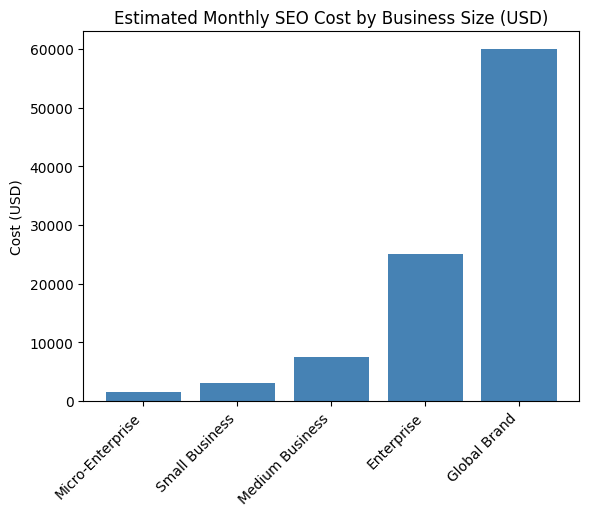
| Business Segment | Typical Monthly SEO Budget (USD) | Primary Investment Focus |
|---|---|---|
| Micro-Enterprise | $500 – $1,500 | Basic visibility, on-page setup, local SEO |
| Small Business | $1,500 – $3,000 | Regional outreach, foundational link building |
| Medium-Sized Business | $3,000 – $7,500 | National keyword competition, technical SEO, lead generation |
| Enterprise | $10,000 – $25,000 | Market dominance, custom SEO architecture, technical audits |
| Global Brand | $30,000 – $60,000+ | International SEO, multilingual strategies, AI content scaling |
Larger organizations often adopt a hybrid model—combining in-house SEO teams with external agencies for execution, scale, and specialized campaigns.
Enterprise SEO vs. SMB SEO: What’s Different
Unlike small businesses that focus on visibility and traffic growth, enterprise SEO campaigns must support hundreds of products, multiple website properties, and millions of indexed pages. These campaigns include coordination between marketing, development, and data teams. The complexity increases in industries like e-commerce, healthcare, finance, and global logistics.
| SEO Area | SMB Focus | Enterprise Focus |
|---|---|---|
| Keyword Targeting | Local and long-tail | International, brand, transactional, informational at scale |
| Technical SEO | Core Web Vitals, site speed | Scalable architecture, crawl budget, JavaScript rendering, mobile parity |
| Content Strategy | Blog posts, location pages | AI-generated content, product database SEO, international hubs |
| Link Building | Guest posts, citation links | Digital PR, news media, link reclamation at scale |
| Reporting | Monthly summaries | Real-time dashboards, custom KPIs, data from multiple properties |
In-House SEO Costs at the Enterprise Level
For enterprises choosing to build internal SEO teams, salary and technology costs can rival or exceed agency fees. However, internal teams often offer better long-term control and alignment with other departments.
| SEO Role | Typical Annual Salary (USD) | Responsibility |
|---|---|---|
| Technical SEO Specialist | $100,000 – $140,000 | Audits, crawlability, site architecture, schema, Core Web Vitals |
| SEO Content Manager | $90,000 – $120,000 | Content planning, editorial SEO, AI-assisted writing workflows |
| SEO Director / Head of SEO | $120,000 – $160,000 | Strategy, leadership, cross-department execution |
In addition to salaries, enterprise teams also invest heavily in tool stacks—typically spending between $30,000 and $60,000 per year on platforms like BrightEdge, Conductor, SEMrush Enterprise, and custom analytics integrations.
Tool and Technology Investment Breakdown
| Tool Type | Annual Cost Range (USD) | Function |
|---|---|---|
| Enterprise SEO Platform | $12,000 – $30,000 | Rank tracking, content analysis, competitor monitoring |
| Crawling and Indexing Tools | $5,000 – $15,000 | Site audits, crawl diagnostics, JavaScript rendering |
| Reporting and BI Tools | $5,000 – $10,000 | Dashboards, KPI integration, real-time performance reports |
| AI Content and NLP Suites | $8,000 – $15,000 | AI writing, topic modeling, sentiment classification |
Many enterprises also deploy internal SEO workflows via platforms like Jira or Asana, integrating SEO tasks directly into product and engineering pipelines.
Outcomes and ROI Benchmarks for Enterprise SEO Campaigns
| SEO Investment Level | Expected Outcomes (12–18 months) | Common KPIs Measured |
|---|---|---|
| $10,000 – $25,000 / month | Dominant positions for key terms, strong growth in organic leads | Organic traffic, CTR, non-branded keyword share, bounce rate |
| $30,000 – $60,000+ / month | Global rankings, AI search citations, branded search dominance | Share of search, top 3 position share, revenue from organic search |
By year two, enterprise-level SEO can drive 30–60% of all qualified inbound leads for B2B companies, and over 50% of sales traffic for enterprise e-commerce sites—often at a fraction of the cost per acquisition compared to paid media.
Conclusion
For mid-market and enterprise organizations in 2026, SEO is no longer just a marketing channel—it is a complex, strategic pillar of digital growth. Whether investing $10,000 or $60,000+ per month, these companies treat SEO as a long-term, scalable asset designed to drive dominance in search across multiple regions and channels.
From building in-house SEO teams to leveraging advanced tools and agency expertise, large companies must view SEO spending not as a cost—but as a foundational investment in sustainable digital leadership.
5. Industry-Specific Pricing Variations
a. High-Competition and YMYL Sectors
SEO pricing is not one-size-fits-all. In 2026, the cost of SEO services differs widely across industries because some sectors face stricter rules, higher customer expectations, or greater competition in search rankings. Businesses operating in regulated fields or targeting high-value customers typically require more advanced strategies, expert-written content, and deeper technical compliance — all of which drive up the cost.
Search engines categorize certain industries as “Your Money or Your Life” (YMYL), where misinformation can have real-world consequences. These include finance, healthcare, and legal services. In these fields, SEO requires not just optimization for rankings, but also strict adherence to content quality, authority, and trustworthiness guidelines.
Typical SEO Cost Ranges by Industry in 2026
| Industry | Monthly SEO Budget Range (USD) | Primary SEO Challenges |
|---|---|---|
| Legal Services | $1,500 – $10,000+ | High CPC, local and national competition, trust signals |
| Finance & Banking | $5,000 – $20,000+ | Strict E-E-A-T standards, compliance risks, content accuracy |
| Healthcare | $1,200 – $4,000 (per location) | HIPAA compliance, regional content approval, structured data requirements |
| B2B SaaS & Tech | $6,000 – $20,000 | Global competition, technical search, developer-targeted content |
| E-Commerce (Fashion) | $2,000 – $7,000 | Category-level optimization, visual search, high-volume product SEO |
| Education | $1,500 – $5,000 | Multi-location visibility, course content optimization, SERP features usage |
| Real Estate | $2,500 – $6,000 | Geo-targeted content, map rankings, local citations |
The budget variation is influenced by factors like market size, lifetime value of a customer (LTV), number of service locations, and whether the business operates in one or more countries.
Legal Sector SEO: High Stakes and High Competition
Law firms are among the top spenders in SEO due to the high cost-per-click in paid advertising and the value of each client. SEO helps reduce acquisition costs over time, but firms must invest in highly localized strategies, structured citations, and authoritative legal content.
| Legal SEO Focus | Typical Monthly Budget (USD) | Target |
|---|---|---|
| Local Practice (1–2 cities) | $1,500 – $3,500 | Map pack visibility, reviews |
| Statewide Presence | $3,500 – $7,500 | Regional keyword rankings |
| National or Multi-State | $7,500 – $10,000+ | High-authority content, backlinks |
SEO Costs for B2B SaaS and Tech Companies
Technology and software firms compete for both branded and technical search traffic. This includes searches from decision-makers, developers, and IT teams across the globe. These companies often need multilingual SEO, AI-focused content creation, and large-scale technical audits for product pages.
| SaaS SEO Focus | Monthly Budget Range (USD) | Key Services Required |
|---|---|---|
| Startups with niche products | $4,000 – $7,000 | Landing pages, early content, GTM tracking setup |
| Scaling mid-market SaaS | $7,000 – $12,000 | AI-generated content, link building, API documentation SEO |
| Enterprise SaaS (Global) | $12,000 – $20,000+ | International SEO, multi-domain structure, sales funnel alignment |
Healthcare SEO: Balancing Visibility with Compliance
Healthcare providers face both local competition and regulatory oversight. SEO strategies here require medical accuracy, author verification, and accessibility across devices. Compliance with privacy laws (e.g., HIPAA) adds extra technical and content governance layers.
| Healthcare Segment | SEO Budget Per Location (USD) | SEO Objectives |
|---|---|---|
| Local Clinic or Practice | $1,200 – $2,500 | Map listings, appointment flow, service area visibility |
| Hospital Network / Multi-Location | $2,500 – $4,000+ | Enterprise schema, reputation management, medical article ranking |
Content must be reviewed and possibly written or approved by licensed professionals, which increases production time and cost.
Search Competition Matrix by Industry (2026)
| Industry | Competition Level | Content Complexity | Compliance Demand | Avg. SEO Budget Range (USD) |
|---|---|---|---|---|
| Legal | Very High | High | Moderate | $1,500 – $10,000+ |
| Finance | Very High | High | Very High | $5,000 – $20,000+ |
| Healthcare | High | Medium | Very High | $1,200 – $4,000+ per location |
| B2B Tech | High | High | Low | $6,000 – $20,000 |
| Retail / E-Com | Medium | Medium | Low | $2,000 – $7,000 |
| Education | Medium | Medium | Medium | $1,500 – $5,000 |
Conclusion
In 2026, SEO pricing is deeply influenced by the nature of the industry. Sectors with higher risks, stricter regulations, or more intense competition naturally require larger investments to succeed in organic search. Businesses in YMYL categories such as legal, financial, and healthcare must go beyond traditional SEO tactics and invest in compliance-friendly content, trustworthy authority signals, and advanced analytics.
Understanding these differences is essential for budgeting SEO properly and choosing strategies that align with industry-specific challenges and goals.
b. Retail and E-commerce
Retail and e-commerce businesses face a unique set of SEO challenges in 2026. Unlike service-based businesses that focus on local or lead-based strategies, online stores must optimize hundreds or even thousands of product pages, manage large inventories, and ensure their platforms perform well across mobile and desktop environments. The cost of SEO in this space varies depending on the size of the store, the complexity of the e-commerce platform, and the level of technical SEO required.
The growing competition in online shopping has pushed many retailers to invest heavily in SEO as a sustainable way to increase sales, improve product visibility, and reduce dependence on expensive paid advertising.
E-Commerce SEO Pricing Overview in 2026
| Business Type | Monthly SEO Budget (USD) | Primary Services Included |
|---|---|---|
| Small Online Shop (100–300 SKUs) | $2,000 – $4,000 | Basic product SEO, keyword research, on-page optimization, metadata updates |
| Mid-Sized E-Commerce (301–1,000 SKUs) | $4,000 – $7,000 | Advanced schema markup, CRO testing, site structure enhancements, seasonal content |
| Large Online Retailer (1,000+ SKUs) | $7,000 – $15,000+ | Enterprise-level audits, scalable content production, page speed optimization |
| Enterprise Marketplace (10,000+ URLs) | $15,000 – $50,000+ | Dynamic URL handling, JavaScript rendering, custom filtering logic, international targeting |
The choice of e-commerce platform also plays a major role. Platforms like Shopify are generally easier to optimize but limited in flexibility, while Magento or headless commerce setups offer deeper customization at a higher technical cost.
Key Cost Drivers for E-Commerce SEO
| Pricing Factor | How It Impacts SEO Cost |
|---|---|
| Number of SKUs | More pages mean more indexing, more content needs, and more optimization effort |
| Platform Type | Shopify = lower cost; Magento or custom CMS = higher development cost |
| Use of Filters and Faceted Navigation | Can create thousands of duplicate or thin-content URLs |
| International Markets | Requires hreflang setup, local domain mapping, and multilingual content |
| Seasonal Campaigns | Increases demand for flexible, fast-paced content and promotion updates |
Stores with large catalogs often need custom solutions to manage crawl budget efficiently and ensure the most valuable pages get indexed and ranked.
Typical SEO Services for Online Stores
| Service Area | Common Tasks Included |
|---|---|
| Product Page Optimization | Title tags, descriptions, image alt text, internal linking |
| Category Page SEO | Keyword targeting, UX structuring, breadcrumb navigation |
| Structured Data & Schema | Product, review, price, availability markup |
| Technical SEO | Duplicate content cleanup, canonicalization, crawl traps, robots.txt setup |
| Conversion Rate Optimization | A/B testing, CTA button adjustments, heatmaps |
| Speed & Core Web Vitals | Lazy loading, code compression, script deferral |
These tasks are not one-time fixes but require ongoing monitoring and performance adjustment to keep up with frequent product changes and search engine updates.
ROI Expectations and Revenue Impact from SEO in E-Commerce
| Monthly Budget | Average Organic Sales Growth (12 Months) | SEO ROI Characteristics |
|---|---|---|
| $2,000 – $4,000 | 20% – 60% increase in organic revenue | Entry-level performance for niche shops |
| $4,000 – $10,000 | 50% – 120% growth in organic transactions | Greater visibility for broader catalog and mid-tier keywords |
| $10,000 – $50,000+ | 100% – 300%+ YoY organic revenue lift | Aggressive growth across competitive, high-volume markets |
While SEO does not deliver instant results, the long-term revenue potential often exceeds that of paid channels after 9–12 months of consistent investment and technical stability.
E-Commerce SEO Complexity Matrix
| Store Size | Page Volume | Platform Complexity | SEO Maintenance Level | Typical Monthly Cost (USD) |
|---|---|---|---|---|
| Small Niche Store | 100–300 | Low (e.g., Shopify) | Low | $2,000 – $3,500 |
| Growth-Stage Retailer | 500–1,000 | Medium (WooCommerce) | Medium | $4,000 – $7,000 |
| National Online Retailer | 1,000–10,000 | High (Magento, Custom) | High | $7,000 – $15,000 |
| International Marketplace | 10,000+ | Very High (Custom, Headless) | Very High | $15,000 – $50,000+ |
Conclusion
In 2026, SEO for retail and e-commerce is more than a traffic strategy — it’s a profit engine. Businesses must treat SEO as an essential investment in platform stability, product discovery, and brand scalability. From optimizing a few hundred products to managing technical SEO for massive catalogs, the pricing reflects the sophistication and scale of work required to compete and convert in online retail.
6. Regional and Global Economic Disparities
a. Developed Market Benchmarks: USA, UK, and Australia
In 2026, the cost of SEO services varies significantly across different regions of the world. These pricing differences are mainly due to variations in labor rates, economic maturity, cost of living, and the sophistication of local digital ecosystems. While the quality of service can still be excellent in lower-cost regions, the pricing structure reflects the local market’s demand, wage levels, and agency infrastructure.
Businesses choosing where to outsource SEO or build in-house teams must understand how geography impacts pricing—and how to balance cost savings with quality, expertise, and market familiarity.
SEO Price Comparison by Region for SMEs (2026)
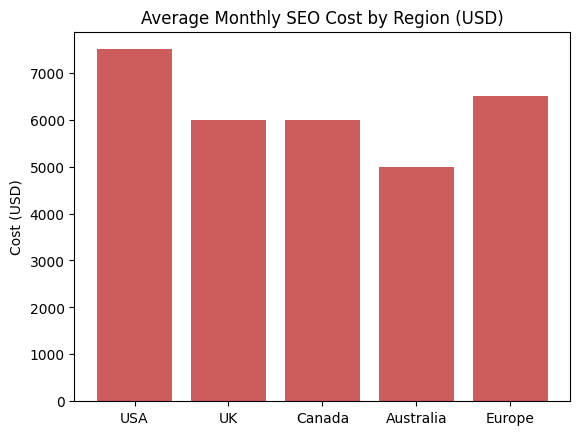
| Region / Country | Average Monthly SEO Cost (USD) | Service Level Included |
|---|---|---|
| United States (USA) | $1,000 – $7,500 | Full-service SEO, strategy, content, and technical optimization |
| United Kingdom (UK) | $800 – $6,000 | Local and national campaigns, strong E-E-A-T content standards |
| Canada | $800 – $6,000 | Similar to UK with bilingual (English/French) content needs |
| Australia | $700 – $5,000 | Strong focus on local SEO and mobile-first performance |
| Western Europe (Average) | $900 – $6,500 | Multilingual targeting, GDPR compliance, and layered content strategies |
These benchmarks reflect mid-tier pricing aimed at small to medium-sized businesses. Larger enterprises in these markets often spend significantly more depending on the size and scope of the SEO campaign.
Hourly SEO Rates: Developed vs. Emerging Economies
The hourly rate for SEO professionals also varies widely between regions. Developed markets like the US, UK, and Australia tend to have higher agency overhead, salaries, and operational costs, which results in more expensive service offerings.
| Professional Level | US / UK / Australia (Hourly) | Emerging Markets (Hourly) | Typical Tasks |
|---|---|---|---|
| Entry-Level SEO Specialist | $60 – $90 | $10 – $25 | Basic on-page edits, SEO reporting, keyword setup |
| Mid-Level SEO Professional | $90 – $130 | $20 – $40 | Content strategy, technical audits, link building |
| Senior SEO Expert / Director | $130 – $180 | $30 – $55 | Strategy planning, advanced technical SEO, CRO |
Companies often choose to combine resources from different markets—using lower-cost markets for execution and higher-cost markets for strategy—to strike a balance between cost and quality.
SEO Cost Arbitrage Opportunities for Global Companies
Businesses based in North America or Western Europe increasingly turn to offshore or hybrid SEO models, working with agencies in Southeast Asia, Eastern Europe, or Latin America. These regions offer comparable expertise at lower cost due to lower labor expenses and currency exchange advantages.
| Low-Cost Region | SEO Hourly Rate Range (USD) | Top Outsourcing Countries |
|---|---|---|
| Southeast Asia | $10 – $30 | Philippines, Vietnam, Indonesia |
| Eastern Europe | $15 – $40 | Ukraine, Romania, Serbia, Bulgaria |
| South Asia | $10 – $25 | India, Pakistan, Bangladesh |
| Latin America | $15 – $35 | Colombia, Argentina, Mexico |
However, businesses must also consider time zone coordination, language fluency, and cultural alignment when outsourcing SEO internationally.
Regional SEO Market Maturity and Digital Demand
| Region | SEO Market Maturity | Search Engine Preference | Common Service Demand |
|---|---|---|---|
| North America | Very High | Full-service SEO, e-commerce SEO, content marketing | |
| Western Europe | High | Multilingual SEO, local SEO | |
| Southeast Asia | Moderate | Google, local engines | Mobile SEO, content translation, technical fixes |
| Eastern Europe | Moderate | Google, Yandex (some regions) | National campaigns, backlink strategies |
| Latin America | Growing | Local SEO, mobile optimization, YouTube SEO |
Local SEO demand is particularly high in emerging regions as mobile internet use continues to grow. Meanwhile, in mature markets, competition is pushing businesses toward more advanced SEO services like AI content optimization and schema implementation.
Conclusion
In 2026, regional and global SEO pricing is shaped by economic conditions, digital adoption, and workforce costs. While SEO may be more affordable in emerging markets, businesses in developed countries often require deeper customization, compliance assurance, and complex execution—justifying higher price tags.
Smart businesses balance local market understanding with strategic outsourcing to get the best return on their SEO investment. Whether paying $1,000 or $7,000 per month, understanding what that money buys in each region is essential for making informed decisions.
b. Emerging Market Deep-Dive: Vietnam and Southeast Asia
Vietnam as a Rising SEO Destination in 2026
Vietnam has rapidly emerged as one of the most attractive locations in Southeast Asia for affordable and high-quality SEO services. In 2026, major cities like Ho Chi Minh City (HCMC) and Hanoi have become leading hubs offering full-scale SEO strategies at significantly lower prices compared to Western markets. This cost advantage is driven by a combination of skilled digital talent, competitive local salaries, and a mature understanding of both local and global search engine dynamics.
Vietnamese SEO agencies serve a diverse range of clients—from local shops aiming for Google Maps visibility to international companies targeting regional and global audiences with bilingual SEO strategies.
Breakdown of SEO Pricing in Vietnam (2026)
| SEO Package Type | Monthly Cost (VND) | Monthly Cost (USD Equivalent) | What’s Included |
|---|---|---|---|
| Easy Keyword SEO | 2 – 5 Million | $80 – $200 | Basic on-page SEO, low-competition keywords, metadata updates |
| Medium Competition SEO | 5 – 15 Million | $200 – $600 | Technical SEO, content planning, moderate keyword strategy |
| High Competition SEO | 15 – 50 Million | $600 – $2,000 | Backlink outreach, competitor analysis, structured data markup |
| Comprehensive SEO (100+ Keywords) | 30 – 100 Million | $1,200 – $4,000 | Full campaign management, national SEO, bilingual (EN-VI) content, analytics setup |
These price ranges are particularly appealing for startups, SMEs, and foreign businesses outsourcing SEO to Vietnam, where they can achieve global-level service at a fraction of the cost.
Comparison of SEO Specialist Salaries: Vietnam vs. Western Markets
One of the key reasons Vietnam’s SEO services remain affordable is the lower cost of skilled labor. In 2026, the local SEO talent pool continues to expand, supported by Vietnam’s strong educational infrastructure and a fast-growing digital economy.
| SEO Role | Vietnam Annual Salary (USD) | US/UK Annual Salary (USD) | Salary Difference (%) |
|---|---|---|---|
| Entry-Level SEO Specialist | $4,000 | $45,000 | -91% |
| Mid-Level SEO Professional | $8,360 (Median) | $65,000 | -87% |
| Senior SEO Expert | $25,000 – $31,675 | $90,000 – $140,000 | -70% to -78% |
These differences allow Vietnam-based agencies to deliver quality SEO results at significantly lower rates, making them attractive outsourcing partners for international clients.
Monthly Salary Ranges for SEO & IT Marketing Roles in HCMC (2026)
| Position Level | Monthly Salary (VND) | USD Equivalent |
|---|---|---|
| Junior / Entry-Level | 10 – 20 Million | $400 – $800 |
| Mid-Level Marketer | 20 – 50 Million | $800 – $2,000 |
| Senior / Team Lead | 50 – 70 Million | $2,000 – $2,800 |
The strong availability of local talent helps agencies scale quickly, execute large campaigns, and maintain cost efficiency for both local and global clients.
SEO Behavior and Market Trends in Vietnam
In Vietnam, SEO strategies often reflect local user behavior, which differs from Western audiences in a few important ways:
- Google Maps is heavily used, especially in HCMC and Hanoi for finding businesses, services, and local reviews.
- Brand search dominates over generic keyword searches for many verticals such as fashion, tech products, and F&B.
- Bilingual SEO (Vietnamese-English) is growing rapidly as businesses aim to serve the domestic market of 98 million people while also reaching global audiences, especially in tourism, export, and tech sectors.
SEO Demand Matrix: Vietnam in the Southeast Asian Context
| Country | Average Monthly SEO Cost (USD) | Bilingual SEO Demand | E-Commerce SEO Demand | Google Maps Optimization |
|---|---|---|---|---|
| Vietnam | $200 – $2,000+ | Very High | High | Very High |
| Indonesia | $150 – $1,500 | High | High | High |
| Philippines | $250 – $1,800 | Moderate | Medium | Moderate |
| Thailand | $300 – $2,500 | High | High | Moderate |
| Malaysia | $400 – $2,000 | Medium | High | Moderate |
Vietnam leads the region in cost-to-performance ratio, especially for businesses requiring strong Google Maps presence and dual-language content targeting.
Conclusion
Vietnam’s SEO market in 2026 stands out for offering high-quality, competitively priced services supported by a growing base of experienced professionals. With packages starting as low as $80 and going up to $4,000 for comprehensive campaigns, the country is well-positioned to serve both local SMEs and global companies.
Its strategic advantage lies in cost-efficiency, a bilingual workforce, and a deep understanding of both Vietnamese and English-speaking audiences. As a result, Vietnam continues to be one of the most attractive SEO outsourcing destinations in Southeast Asia.
7. The Impact of Generative AI on SEO Economics
In 2026, the SEO landscape is being transformed by the rise of generative artificial intelligence (AI) and large language models (LLMs). These technologies have significantly changed how users interact with search engines, and as a result, SEO pricing models have evolved to reflect new visibility requirements and more complex service offerings.
SEO is no longer just about ranking first on a traditional search results page. The focus has expanded to include optimization for AI-generated answers—what experts now call Generative Engine Optimization (GEO) or Answer Engine Optimization (AEO). These services are designed to help websites get featured within AI summaries and overviews that answer users’ questions directly on the search page, often without requiring a click.
Cost of AI-Driven SEO Services in 2026
| Service Type | Monthly Price Range (USD) | Service Focus |
|---|---|---|
| Traditional SEO | $1,500 – $5,000 | Keyword optimization, content creation, technical SEO |
| AI-Aware SEO (with partial AEO) | $2,000 – $5,500 | Optimization for both organic rankings and AI overview snippets |
| Full GEO / AEO Optimization | $5,000 – $7,500+ | Entity optimization, structured data, AI citation strategies, topical authority |
These higher-cost services are driven by the demand for AI citation, deeper data structuring, and entity-level SEO that is compatible with Google’s AI Overviews and other answer engines.
Search Behavior Shift: From Clicks to Answers
The growing use of AI summaries is changing the economics of search traffic:
| AI Search Metric (2026) | Value / Trend | Implication for SEO |
|---|---|---|
| Google AI Overviews Reach | Over 2 billion users monthly | GEO is now critical for brand visibility |
| Zero-Click Search Rate | ~60% of all queries | Traditional ranking is not enough for traffic acquisition |
| Value of AI-Referred Click | 4.4x higher than regular organic click | AI traffic is more qualified and conversion-prone |
| Citation Likelihood (Ranking #1) | 33% chance of AI mention | Strong ranking still improves AI Overview inclusion |
| Citation Likelihood (Ranking #10) | Only 13% chance | Lower ranks almost entirely excluded from AI citation exposure |
Ranking high on traditional search results helps, but it does not guarantee presence in AI-driven results. This has forced companies to invest in new methods such as entity-based optimization and structured data integration to increase the likelihood of being cited by AI.
Where SEO Budgets Are Now Being Allocated
As generative AI automates many repetitive tasks—like data gathering, initial keyword research, and meta tag suggestions—SEO professionals are now focusing more on strategic activities. Agencies in 2026 are investing more of their time and client budget in areas that influence credibility and long-term AI visibility.
| SEO Investment Area (2026) | % of Total Budget (Estimated) | Description |
|---|---|---|
| E-E-A-T and Subject Matter Expertise | 25% | Expert-led content, author validation, citation-worthiness |
| Technical SEO & Structured Data | 20% | Schema markup, page speed, mobile readiness, crawl management |
| AI/GEO Optimization Strategy | 20% | Entity optimization, zero-click strategy, prompt-structured content |
| Link Building & Digital PR | 15% | High-authority backlinks and mentions for brand authority |
| Automation & AI Tooling | 10% | Use of AI platforms to streamline basic SEO tasks and reporting |
| Analytics & Performance Review | 10% | Tracking engagement, conversion metrics, and AI visibility performance |
The impact of AI hasn’t reduced the cost of SEO—it has simply shifted the type of work being done. Time savings from automation are being reinvested into higher-value areas that require human insight and ethical considerations.
AI’s Role in SEO Workflow: Efficiency vs Cost
| Task Type | Handled by AI in 2026 | Impact on Pricing |
|---|---|---|
| Keyword Clustering & Suggestions | Yes | Reduces labor cost but doesn’t lower overall pricing |
| Meta Tag Generation | Yes | Automates low-level tasks |
| Fact-Checked Content Creation | No (Human-led) | Still requires expert input due to E-E-A-T standards |
| AI Citation Strategy | No (Human-led) | Requires strategic planning, testing, and expertise |
| SEO Audits & Reporting | Partially | Tools assist, but expert analysis remains essential |
The balance between automation and human input has not decreased SEO budgets. Instead, it has helped agencies offer more complex deliverables within the same timeframes.
Conclusion
Generative AI has changed the way SEO works in 2026, especially with the rise of AI-generated answers like Google’s AI Overviews. Businesses that want to stay competitive must now invest not just in traditional SEO but also in optimization for AI citations, entity recognition, and zero-click visibility.
While AI tools have made some tasks faster and more efficient, SEO pricing has adjusted upward to reflect the growing demand for expertise, strategy, and ethical content creation. This shift means businesses must now think beyond rankings—and toward total presence in both traditional and AI-generated search results.
8. The 2026 SEO Technology Stack and Software Costs
a. Core SEO Platforms
Why Software Is Essential to SEO in 2026
In 2026, search engine optimization is no longer possible without a professional-grade technology stack. Whether managed by an agency or in-house team, SEO success now depends on access to advanced software platforms that support everything from keyword tracking to technical diagnostics, content optimization, backlink monitoring, and AI content auditing.
As search engines become more complex and AI-driven features like Google’s AI Overviews become standard, the SEO software ecosystem has expanded to include tools for monitoring generative engine behavior, validating structured data, and analyzing search visibility across multiple channels.
Monthly Pricing Overview of Core SEO Tools in 2026
| SEO Tool / Platform | Primary Function | Monthly Starting Price (USD) | Use Case for SEO Teams |
|---|---|---|---|
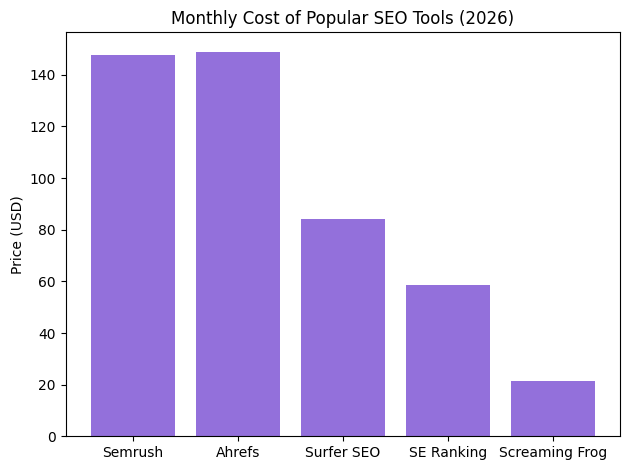
| Semrush | All-in-One SEO Suite | $129.95 – $165.17 | Keyword research, competitive analysis, backlink audits |
| Ahrefs | Backlink Analysis & Content Explorer | $99.00 – $199.00 | Link profile analysis, content gap detection, SERP movement |
| Surfer SEO | Content Optimization | $79.00 – $89.00 | Real-time content scoring, SERP similarity analysis, NLP scoring |
| SE Ranking | Analysis & White Label Reporting | $52.00 – $65.00 | SERP tracking, local SEO monitoring, agency-level reporting tools |
| Screaming Frog | Technical Site Auditing | Free / $259 annually | Site crawl diagnostics, duplicate detection, page speed analysis |
These tools form the foundation of most SEO operations and are often bundled into monthly service retainers or in-house departmental budgets.
How SEO Software Costs Fit into Overall Campaign Budgets
For companies investing in SEO—especially in mid-market and enterprise segments—software tools typically represent 5–10% of the monthly SEO budget. While this may seem like a small fraction, the return is substantial in terms of performance tracking, time savings, and competitive insights.
| Monthly SEO Budget | Suggested Monthly Software Spend | Tools Likely Used |
|---|---|---|
| $1,500 – $3,000 | $100 – $200 | Basic subscription to Semrush or SE Ranking |
| $3,000 – $7,500 | $200 – $350 | Multi-tool stack (e.g., Semrush + Screaming Frog + Surfer SEO) |
| $7,500 – $15,000 | $350 – $600 | Full analytics suite including Ahrefs, Surfer, and custom crawlers |
| $15,000+ | $600+ | Enterprise tools with API access, custom dashboards, and LLM trackers |
Agencies often manage the full stack and include tool usage in their pricing, whereas in-house teams may purchase licenses directly and integrate tools into internal systems like Google Data Studio or Looker Studio.
Emerging Tool Categories in 2026 SEO Stack
| Tool Category | Purpose | Popular Examples (2026) |
|---|---|---|
| Generative Search Monitoring | Tracks inclusion in AI Overviews and answer engines | AlsoAsked, AIOSEO Insights |
| AI Content Evaluation Tools | Scores content for quality, E-E-A-T alignment, and prompt coverage | Originality.ai, Content at Scale Checker |
| SERP Volatility & Entity Tracking | Monitors daily AI & traditional SERP fluctuations | Grump Rating API, RankSense AI |
| Technical SEO Visualization | Dynamic crawl path and schema validation tools | JetOctopus, Sitebulb, Visual Site Mapper |
These advanced tools are particularly important for brands trying to rank in competitive or AI-influenced environments, such as medical, legal, SaaS, or finance sectors.
SEO Software Licensing vs. In-House Use Matrix
| Organization Type | Tool Ownership Model | Integration Complexity | Cost Management |
|---|---|---|---|
| SEO Agency (Small) | Platform subscription | Medium | Bundled into client retainer |
| In-House Marketing Team | Direct license purchase | Low to Medium | Direct monthly/annual billing |
| Enterprise SEO Team | API integration + license | High | Custom procurement and reporting |
Larger enterprises with dedicated SEO and data teams tend to connect tool APIs into their proprietary dashboards for customized insights, while smaller teams typically rely on out-of-the-box interfaces.
Conclusion
In 2026, investing in the right SEO tools is no longer optional—it’s a foundational requirement for digital success. With monthly pricing starting around $50 and scaling up to several hundred dollars, software costs must be factored into every SEO budget. Businesses that use the right stack not only gain a competitive advantage in rankings, but also unlock deeper insights, greater automation, and a more strategic approach to content and technical SEO in an AI-first search world.
b. Specialized AI and LLM Monitoring Tools
Why AI Visibility Tools Are Crucial in 2026
As search engines and large language models (LLMs) like ChatGPT, Google AI Overviews, and Perplexity increasingly serve answers without linking directly to traditional websites, a new layer of SEO strategy has emerged. Brands are now investing in AI Visibility—a type of SEO that focuses on being mentioned, cited, or referenced inside AI-generated answers.
To support this goal, a new category of tools has been developed specifically to track and analyze how often a brand, product, or domain appears within generative search results. These tools help businesses understand their influence in conversational engines, benchmark against competitors, and refine content strategies for better AI citation.
Popular AI Visibility and LLM Monitoring Tools in 2026
| AI Monitoring Tool | Primary Function | Best Use Case | Starting Price (Monthly) |
|---|---|---|---|
| Profound | LLM-specific citation tracking | Enterprise-grade citation insights | $82.50 |
| Otterly.AI | Cross-platform AI search tracking | Small teams needing broad visibility | $25.00 |
| ZipTie | Deep content + AI inclusion diagnostics | In-depth audits of brand mentions | $58.65 |
| Peec AI | Semantic topic suggestions for AI engines | AI-focused keyword/content ideation | €89.00 (approx. $95) |
These tools offer features such as tracking brand visibility in zero-click responses, entity recognition, prompt-related citation frequency, and AI model-specific analytics.
Average Monthly Cost of a Standard AI-SEO Stack for Small Teams
For small to medium-sized marketing teams, building a foundational AI-integrated SEO tool stack now typically includes:
- A general all-in-one SEO platform (e.g., Semrush or Ahrefs)
- A content optimization tool (e.g., Surfer SEO)
- An AI citation monitoring tool (e.g., Otterly.AI or ZipTie)
- Optional: ChatGPT Plus or Claude Pro for content research and generation
| Tool Category | Example Tools | Typical Monthly Cost (USD) |
|---|---|---|
| General SEO Suite | Semrush, Ahrefs, SE Ranking | $100 – $170 |
| Content Optimization | Surfer SEO, NeuronWriter | $70 – $90 |
| AI Visibility & Tracking | Otterly.AI, Profound, ZipTie | $25 – $90 |
| AI Assistant Access | ChatGPT Plus, Claude Pro | $20 – $30 |
| Total Estimated Monthly Cost | $240 – $340 per team |
This pricing reflects the average setup for a small agency or internal marketing department aiming to stay competitive in an AI-dominated SEO ecosystem.
Strategic Benefits of Investing in AI SEO Tooling
| Objective | Tool Category Used | Strategic Value Gained |
|---|---|---|
| Track brand visibility in AI results | AI Visibility Tools | Understand how often your brand is cited across AI platforms |
| Optimize for AI-generated summaries | Content Optimization Tools | Improve chances of inclusion in AI Overviews and summaries |
| Benchmark domain influence in LLMs | Deep Citation Monitoring | Compare brand impact across competitors in AI-driven answers |
| Generate AI-ready content ideas | Semantic Suggestion Tools | Align content with AI topic clusters and prompt responses |
Conclusion
In 2026, the rise of generative AI has added a new dimension to SEO spending. To compete in both traditional and AI-powered environments, businesses must now invest in specialized tools that track and enhance their presence across large language models and AI search engines.
An AI-optimized SEO toolset can cost between $240 and $340 monthly for small teams, but offers high value by helping brands stay discoverable in increasingly zero-click and AI-curated search landscapes. For larger organizations, advanced LLM tracking platforms like Profound are becoming essential for protecting brand visibility in the AI-driven future of search.
9. Return on Investment (ROI) and Strategic Attribution
a. Industry Benchmarks for Conversion and ROI
Why ROI Is Now the Core Metric for SEO in 2026
In 2026, the true measure of SEO success is not just keyword rankings or traffic volume—it’s how much revenue the strategy generates. For most businesses, SEO has evolved into a major revenue driver and cost-saving channel. Agencies and in-house teams are now held accountable not only for visibility, but for real-world business outcomes like leads, conversions, and long-term profitability.
SEO is now seen as a multiplier of return on investment (ROI), especially when compared to paid media and traditional outbound strategies. High-quality SEO campaigns are delivering impressive gains, with an average ROI of 748% over a 12 to 24-month period—making it one of the highest-performing digital investments in the market today.
SEO ROI and Conversion Rate Benchmarks by Industry (2026)
| Industry Sector | Average ROI (12–24 Months) | Average SEO Conversion Rate | SEO Close Rate |
|---|---|---|---|
| Real Estate | 1,389% | 2.4% | 14.6% |
| Financial Services | 1,031% | 2.4% | 14.6% |
| B2B SaaS | 702% | 2.1% | 14.6% |
| Legal Services | 526% | 7.5% | 14.6% |
| HVAC / Home Services | 678% | 3.3% | 14.6% |
| E-Commerce | 317% | 2.0% | 14.6% |
| Traditional Outbound (Avg) | — | 1.7% | 1.7% |
These figures demonstrate that SEO, when executed with consistency and a long-term strategy, consistently outperforms both outbound marketing and paid ads in terms of customer acquisition and revenue efficiency.
How to Calculate SEO ROI in 2026
Marketers in 2026 commonly use this formula to assess the return on their SEO investments:
ROI (%) = ((Organic Revenue – SEO Costs) ÷ SEO Costs) × 100
This formula gives a clear financial picture of how SEO contributes to revenue growth. A campaign generating $100,000 in revenue from a $12,000 SEO spend, for example, would yield an ROI of 733%.
Impact of SEO on Customer Acquisition Cost (CAC)
Over time, SEO becomes more efficient and reduces the average cost of acquiring a new customer. Unlike pay-per-click (PPC) advertising—where the cost per lead often increases due to competition—SEO benefits from compounding traffic, improved rankings, and evergreen content.
| Channel | Typical Cost Per Lead (2026) | Conversion Quality | Cost Trend Over Time |
|---|---|---|---|
| SEO | $15 – $60 | High | Decreases with time |
| PPC | $80 – $200 | Medium to High | Increases with competition |
| Cold Outreach / Direct Mail | $200+ | Low | Remains static or inefficient |
Established SEO campaigns with high-quality content and technical foundations tend to produce lower CAC over time while maintaining high intent and lead quality.
SEO vs PPC and Outbound: Comparative Efficiency Matrix
| Marketing Channel | Initial Speed | Sustainability | Lead Quality | Long-Term ROI | Best Use Case |
|---|---|---|---|---|---|
| SEO | Moderate | Very High | High | Very High | Long-term lead generation and authority |
| PPC (Search Ads) | Fast | Medium | Medium–High | Medium | Immediate traffic for high-intent keywords |
| Cold Calling / Direct Mail | Slow | Low | Low | Low | Low-frequency outreach |
The close rate from SEO leads averages around 14.6%, which is significantly higher than that of traditional outbound marketing channels, where close rates remain near 1.7%.
Strategic Takeaway for 2026
SEO has matured into a core business strategy rather than a marketing add-on. Businesses that treat SEO as a long-term investment—not a quick fix—are seeing compounding growth in traffic, stronger brand trust, and lower costs per conversion over time. With higher ROI potential, better close rates, and decreasing CAC, SEO stands as one of the most cost-efficient and sustainable growth levers available in 2026.
10. Critical Contractual Considerations and Hidden Fees
In 2026, as SEO services become more sophisticated and tailored, pricing structures have also become more layered. While most agencies offer clear base retainers, businesses should be aware that additional costs often apply for services that go beyond standard deliverables. These extra fees, if not clearly outlined upfront, can add thousands of dollars to a campaign and complicate budgeting efforts.
SEO contracts have evolved to include performance tracking tools, visual media services, and integration fees—all of which may be excluded from the monthly retainer unless otherwise stated. Therefore, understanding these common add-ons and contractual conditions is essential to avoid surprise expenses.
Typical Add-On Fees in SEO Campaigns (2026)
| Add-On Service | Purpose | Typical Cost (Monthly / One-Time) | Who Needs It |
|---|---|---|---|
| Google Business View | 360° virtual tour for local business listings | $300 – $1,200 (one-time) | Brick-and-mortar locations targeting local SEO |
| Call Tracking Software | Tracks and records calls from local listings or landing pages | $20 – $70/month | Local service providers and lead-gen campaigns |
| SEO Platform API Access | Integrates SEO data with BI tools (e.g., Ahrefs, Surfer) | $29 – $199/month | Enterprise brands using custom dashboards |
| Content Sprint (Bulk Creation) | High-volume content production in short timeframes | $3,000 – $12,000 (per sprint) | Companies scaling quickly or launching new areas |
These services are optional but often recommended for performance measurement, local visibility, or scaling organic content aggressively.
Enterprise API Integration Matrix
| Platform | API Usage Type | Typical Monthly API Fee (USD) | Integration Purpose |
|---|---|---|---|
| Ahrefs | Rank & backlink data feed | $99 – $199 | Custom reports, data pipelines |
| Surfer SEO | Content scoring + NLP API | $29 – $79 | CMS integration, programmatic optimization |
| Google Search Console | Data export via API | Free | Native connection to dashboards like Looker Studio |
| SEMrush | Full site visibility + keyword feed | $100+ | Enterprise-level cross-platform strategy |
Understanding SEO Content Sprint Pricing
| Sprint Size | Number of Pages | Estimated Cost (USD) | Ideal Use Case |
|---|---|---|---|
| Mini Sprint | 10–20 pages | $1,500 – $3,000 | Niche blogs, local service expansion |
| Standard Sprint | 30–60 pages | $3,500 – $7,000 | E-commerce category rollouts, SaaS product hubs |
| Enterprise Sprint | 70–100+ pages | $8,000 – $12,000+ | Full-funnel content launches, global SEO scaling |
Content sprints are often executed in parallel to monthly retainers and require additional editorial, design, or copywriting resources.
Contract Terms, Lengths, and Exit Clauses in 2026
Given the long-term nature of SEO, most agencies now structure contracts around 6- to 12-month minimum commitments. This gives time for foundational improvements, indexing, and keyword movement to materialize. Shorter contracts are rare and typically command premium pricing.
| Contract Type | Minimum Term | Common Discount for Commitment | Exit Notice Period | Purpose |
|---|---|---|---|---|
| Month-to-Month | No minimum | None | 30 days | Flexibility for small or short-term campaigns |
| 6-Month Contract | 6 months | 5–10% discount | 30–45 days | Ideal for testing medium-term SEO strategies |
| 12-Month Contract | 12 months | 10–15% discount | 45–60 days | Best for growth campaigns and full-scope SEO partnerships |
Exit clauses in most contracts are designed to allow time for data handover, file export, and strategy documentation. Businesses are advised to negotiate deliverable ownership and data access terms upfront.
Hidden Cost Risk Matrix
| Category | Hidden Fee Risk | What to Clarify Before Signing |
|---|---|---|
| Reporting and Dashboards | Medium | Whether advanced reports are included or billed separately |
| Third-Party Tools | High | If software licenses or API access is bundled or extra |
| Content and Media Assets | High | Ownership rights, revision limits, and delivery formats |
| Termination Clauses | Medium | Required notice period, handover process, and penalties |
Conclusion
In 2026, SEO agreements are more structured and layered than ever before. To get the most out of any partnership, businesses must read the contract closely and ask for full transparency around what is and isn’t included. From add-on software and bulk content fees to termination terms and reporting access, every detail matters when projecting long-term SEO costs. Smart contract planning ensures better performance, fewer surprises, and stronger ROI from the start.
11. Strategic Recommendations
Understanding the Modern SEO Landscape in 2026
The state of SEO in 2026 reflects a fast-evolving digital market where businesses must be technically agile, content-driven, and AI-aware. Search engine optimization has grown far beyond basic keyword targeting. It now demands a dual approach: mastering both traditional search rankings and visibility within AI-generated answers from tools like Google AI Overviews, ChatGPT, and other answer engines.
For most brands, the average monthly spend on professional SEO services now falls between $1,500 and $5,000, which includes strategy, technical execution, and ongoing content development. However, this cost can increase quickly based on factors such as industry competitiveness, target geography, website complexity, and integration with AI-based search technologies.
Recommended SEO Budget Allocation for 2026
Organizations investing strategically in SEO are treating it not as a marketing cost, but as a high-yield digital asset. These brands understand that SEO builds long-term visibility, credibility, and authority in a digital world dominated by search and algorithmic content delivery.
| Business Revenue Tier (Annual) | Recommended Marketing Spend (8–10%) | Suggested SEO Allocation (% of Marketing) | Estimated SEO Budget (Monthly) |
|---|---|---|---|
| $500,000 | $40,000 – $50,000 | 40% – 50% | $1,300 – $2,100 |
| $1 Million | $80,000 – $100,000 | 40% – 50% | $2,600 – $4,100 |
| $5 Million | $400,000 – $500,000 | 35% – 45% | $11,600 – $18,700 |
| $10 Million+ | $800,000 – $1,000,000+ | 30% – 40% | $20,000 – $33,000+ |
Top-performing brands often allocate 8% to 10% of their total revenue to marketing, with SEO receiving a substantial share due to its compounding returns and sustainable growth profile.
Balancing Traditional SEO with AI Visibility Optimization
Modern SEO strategy in 2026 must serve two major goals simultaneously:
- Traditional Search Discovery
Focus on keywords, page speed, mobile usability, content depth, and backlinks. - AI Search Citations and Inclusion
Focus on structured data, entity optimization, and credibility for inclusion in zero-click, AI-generated responses.
| SEO Strategy Component | Optimizes For | Value to Business |
|---|---|---|
| Technical SEO | Crawlability, performance, mobile-first | Indexing, page experience, algorithm compliance |
| Keyword and Content Strategy | Traditional search results | Organic traffic, long-tail conversion opportunities |
| Link Building and Digital PR | Domain authority and trust | Higher rankings, media coverage, referral traffic |
| Structured Data and Entity SEO | AI Overviews, Answer Engines | Brand citations, voice search, zero-click visibility |
| Content for E-E-A-T Compliance | Trustworthiness, expertise | Better AI inclusion, improved conversion and brand trust |
Companies that build SEO strategies with both traditional and AI-based visibility in mind are significantly outperforming competitors who focus on rankings alone.
SEO as a Long-Term Digital Asset
Unlike paid media, where results stop as soon as ad budgets pause, SEO builds lasting digital equity. While the initial phase (first 3–6 months) of an SEO campaign often involves high upfront work and slower returns, the long-term payoff is substantial. Once rankings are earned and content gains topical authority, organic visibility continues to grow with reduced costs per lead and improved customer acquisition efficiency.
| Channel | Upfront Cost | Monthly Cost Over Time | Lifetime ROI Potential | Scalability |
|---|---|---|---|---|
| SEO | Medium–High | Low–Medium | Very High (600%–1,400% avg) | Compounds over time |
| PPC (Paid Search) | Low–Medium | High | Moderate | Stops when budget ends |
| Social Advertising | Medium | High | Variable | Requires constant spend |
| Outbound (Cold) | Low | Medium | Low | Inefficient for B2B |
Conclusion
In 2026, successful companies do not treat SEO as a monthly marketing line item—they treat it as a capital investment in digital infrastructure and brand equity. The most forward-thinking organizations are aligning SEO spend with both technical priorities and AI visibility goals, recognizing that long-term organic growth delivers more predictable and sustainable results than short-term paid efforts.
By embracing this dual-focus model and allocating resources strategically, businesses can unlock exponential ROI, future-proof their visibility, and build a scalable, high-performance marketing engine for the AI-driven future.
Conclusion
As businesses prepare to grow in a digital-first environment, understanding how much SEO costs in 2026 is no longer a luxury—it is a critical requirement for making informed, results-driven marketing decisions. The SEO industry has matured significantly over the past few years, and its pricing models now reflect a deep blend of technology, strategy, and long-term value creation. SEO is no longer just about ranking for a few keywords—it’s about building sustainable visibility across traditional search engines and AI-powered platforms like Google’s AI Overviews, ChatGPT, and Perplexity.
In 2026, SEO services vary dramatically in cost depending on several important factors, including the size of the business, the industry, the level of competition, the geographical focus, and the depth of strategy involved. From startups with modest goals to global enterprises aiming for digital dominance, each tier has a different pricing bracket and strategic expectation. Monthly SEO investments can range from as little as $500 for micro-businesses focusing on local visibility, to over $60,000 for global brands managing technical SEO across millions of URLs and hundreds of markets.
Key Takeaways from the 2026 SEO Pricing Landscape
- Business Size Dictates Budget: Small businesses can begin with as little as $1,500/month, while mid-market and enterprise brands typically invest between $5,000 to $25,000 or more per month.
- Industry-Specific Pricing Matters: Regulated and high-stakes sectors such as legal, healthcare, and finance face significantly higher SEO costs due to the need for compliance, content accuracy, and authority.
- Platform Complexity Influences Cost: E-commerce stores, SaaS companies, and B2B technology providers often incur higher SEO expenses due to dynamic product catalogs, frequent updates, and the need for in-depth technical optimization.
- Regional Price Disparities Exist: Developed markets like the United States and the UK generally have higher labor and service costs, while emerging markets like Vietnam and Southeast Asia offer more affordable, yet high-quality SEO solutions.
- Technology is Now Core to SEO Delivery: Professional SEO now requires a robust software stack that includes platforms for keyword research, technical auditing, AI visibility tracking, and content optimization. Tools like Semrush, Ahrefs, and Surfer SEO are industry-standard, and maintaining a competitive edge often adds $240–$600 or more in monthly software costs.
- AI Has Redefined the SEO Game: Generative AI has introduced new layers of complexity, such as Answer Engine Optimization (AEO) and Generative Engine Optimization (GEO). These services require advanced semantic structuring and entity-based optimization—costing between $2,000 to $7,500/month just for AI-specific SEO.
- ROI Remains Strong: SEO continues to deliver some of the highest returns in digital marketing, with average ROI across industries reaching 748%. Compared to paid channels, SEO offers a lower customer acquisition cost over time and builds long-lasting brand equity.
SEO in 2026 Is a Long-Term Investment, Not a Short-Term Expense
The most successful brands in 2026 are those that treat SEO not as a monthly expense, but as a strategic capital investment in digital infrastructure. With each optimization effort—whether it’s technical, content-related, or focused on AI visibility—the value compounds. Businesses that consistently invest in SEO build defensible digital assets, reduce their reliance on paid ads, and generate steady inbound leads.
Instead of asking “How much does SEO cost?”, the better question to ask in 2026 is: “What is the value of sustained visibility, authority, and lead generation in an increasingly competitive digital economy?” The answer is clear: SEO remains one of the most powerful and profitable marketing channels available.
Final Strategic Recommendation
For brands navigating the SEO landscape in 2026, allocating at least 8%–10% of total revenue to marketing, with a significant portion dedicated to SEO, is a proven path to unlocking scalable growth. Whether you’re hiring an agency, building an in-house team, or working with global talent, the key is consistency, strategic planning, and a forward-thinking mindset that embraces both the algorithmic and human sides of modern search.
SEO has evolved—but for businesses willing to evolve with it, the rewards are greater than ever.
If you are looking for a top-class digital marketer, then book a free consultation slot here.
If you find this article useful, why not share it with your friends and business partners, and also leave a nice comment below?
We, at the AppLabx Research Team, strive to bring the latest and most meaningful data, guides, and statistics to your doorstep.
To get access to top-quality guides, click over to the AppLabx Blog.
People also ask
How much does SEO cost in 2026 for small businesses?
In 2026, small businesses typically spend between $1,500 to $5,000 per month on SEO, depending on their goals and competition.
What is the average monthly SEO retainer fee in 2026?
The average monthly SEO retainer ranges from $2,500 to $10,000 for mid-level campaigns, and much higher for enterprises.
Is SEO still worth the cost in 2026?
Yes, SEO remains one of the highest ROI marketing channels, delivering long-term traffic, leads, and brand visibility.
How much do enterprise companies spend on SEO in 2026?
Large enterprises often spend between $10,000 to $60,000+ per month on SEO to manage global visibility and technical demands.
What pricing models are used for SEO services in 2026?
Common pricing models include monthly retainers, project-based fees, hourly consulting, and performance-based agreements.
How much does hourly SEO consulting cost in 2026?
Hourly rates vary by experience and region, typically ranging from $75 to $500+ per hour for senior specialists.
Why has SEO become more expensive in 2026?
SEO has grown more complex with AI integration, stricter ranking standards, and higher demand for expert-level content and links.
Are one-time SEO projects available in 2026?
Yes, one-time projects like technical audits or website migrations are popular and usually cost between $5,000 to $30,000.
How much should a startup budget for SEO in 2026?
Startups should budget $500 to $1,500 per month to build basic visibility, technical health, and local keyword rankings.
What affects SEO pricing the most in 2026?
Key pricing factors include business size, website complexity, industry competition, content volume, and SEO goals.
How much does technical SEO cost in 2026?
Technical audits range from $650 to over $30,000 depending on site size, depth of issues, and level of detail required.
Do AI search tools impact SEO costs in 2026?
Yes, optimizing for AI-generated answers and tracking visibility in tools like Google AI Overviews adds new costs.
What’s the cost of content writing for SEO in 2026?
Content ranges from $150 for a basic blog to $10,000+ for expert-level whitepapers, videos, or in-depth reports.
Is link building still part of SEO pricing in 2026?
Yes, digital PR and link acquisition services cost between $1,500 to $5,000 per month or $250 to $1,500 per link.
What is performance-based SEO and how is it priced?
Performance-based SEO includes revenue-sharing or milestone bonuses, often blended with a base monthly fee.
How much do e-commerce websites pay for SEO in 2026?
E-commerce SEO starts around $2,000 and can exceed $50,000 monthly for large stores with thousands of product pages.
What’s the ROI of SEO in 2026?
The average ROI is around 748%, with industries like real estate and financial services seeing over 1,000%.
Are SEO software tools included in service fees?
Sometimes. In other cases, clients must pay separately for tools like Semrush, Ahrefs, or Surfer SEO.
What’s the average cost of an SEO software stack in 2026?
A standard SEO software stack costs between $240 and $340 per month for small agencies or teams.
Do different industries have different SEO pricing?
Yes, high-risk or high-value sectors like legal, healthcare, and finance usually require more budget and expertise.
How much does local SEO cost in 2026?
Local SEO typically ranges from $500 to $4,000 per location per month depending on goals and market size.
Are SEO services cheaper in emerging markets?
Yes, countries like Vietnam offer high-quality SEO at significantly lower prices due to local labor cost advantages.
What’s the cost of SEO in Vietnam in 2026?
Vietnam-based SEO services range from $80 to $4,000 monthly, depending on keyword difficulty and campaign scale.
Do contracts for SEO have exit clauses in 2026?
Most contracts include 6–12 month minimum terms and require 30–60 days’ notice for cancellation after the term ends.
Are there hidden fees in SEO contracts?
Additional fees may apply for call tracking, APIs, large content sprints, or third-party media and photography.
What is a content sprint and how much does it cost?
A content sprint is high-volume content production, often costing $3,000 to $12,000 as a separate project fee.
Is bilingual SEO more expensive?
Yes, translating and optimizing content in multiple languages like English and Vietnamese adds to the cost.
Can AI reduce the cost of SEO?
AI saves time on basic tasks but has increased costs for advanced strategic work, content verification, and E-E-A-T.
What is the cost per lead through SEO in 2026?
SEO leads often cost less over time, with a close rate of 14.6% compared to 1.7% for outbound marketing.
How should businesses budget for SEO in 2026?
Most businesses allocate 8–10% of revenue to marketing, with a major share directed to long-term SEO growth.
Sources
aboveA
Elementor
The Ad Firm
601media
Sagapixel
WordStream
99Firms
SeoProfy
Arc4
KlientBoost
Boulder SEO Marketing
Backlinko
Softtrix
SEO
Pravaah Consulting
Flowster
Talo
WSI
Ninja Promo
WebFX
Obelisk Infotech
MAK Digital
VietSEO
Plane
ERI SalaryExpert
Talentnet Vietnam
HiAgency
Omniscient Digital
Vezadigital
OverPower Marketing
Zapier
Kristian Larsen
EvenDigit