

























Key Takeaways
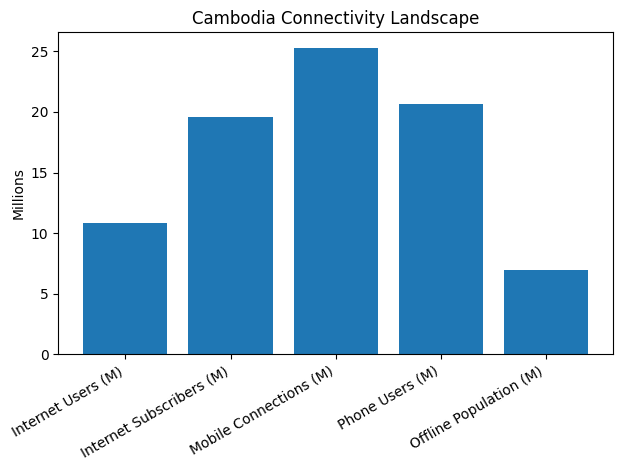
- Cambodia’s rapidly expanding digital ecosystem — with over 10.8 million internet users and 25.3 million mobile connections — is creating a strong foundation for the growth of AI-powered search and Generative Engine Optimization (GEO).
- Google’s dominance with more than 95% search market share means businesses targeting Cambodia must prioritise optimisation for Google AI features, including AI Overviews, conversational search, and AI-generated answers.
- Rising AI adoption, a growing digital economy, and increasing zero-click searches highlight the urgent need for Cambodian businesses to shift from traditional SEO toward AI search visibility and GEO strategies.
Artificial intelligence has rapidly transformed the global search landscape, fundamentally changing how people discover information, interact with digital platforms, and make decisions online. As traditional search engines evolve into AI-driven answer engines, countries across Southeast Asia are experiencing a major shift in how search behavior, digital marketing strategies, and information ecosystems operate. Cambodia, with its fast-growing internet penetration, expanding smartphone usage, and increasingly digital economy, is now entering a new phase where AI search technologies and Generative Engine Optimization (GEO) are beginning to reshape the country’s digital environment. Understanding the statistics, data patterns, and emerging trends surrounding AI search and GEO in Cambodia is becoming essential for businesses, marketers, researchers, and policymakers alike.

Over the past decade, Cambodia has experienced significant digital growth. Increased connectivity, affordable mobile data, and widespread smartphone adoption have helped millions of Cambodians access the internet for the first time. Social media platforms, mobile commerce, and digital services have already transformed how people communicate and consume information. Now, artificial intelligence is accelerating the next stage of this transformation. AI-powered search engines, conversational assistants, and generative AI platforms are redefining how users ask questions and how information is delivered. Instead of simply returning a list of links, AI search systems provide synthesized answers, contextual recommendations, and interactive conversations.
This shift has created a new paradigm in digital visibility known as Generative Engine Optimization (GEO). Unlike traditional Search Engine Optimization (SEO), which focuses on ranking websites within search engine results pages, GEO focuses on ensuring that content is recognized, cited, and surfaced within AI-generated responses. As AI search models increasingly aggregate and summarize information from across the web, businesses and content creators must rethink how they structure content, build authority, and present information online. In markets like Cambodia, where digital ecosystems are still developing, the emergence of GEO represents both a challenge and an opportunity for organizations looking to gain visibility in AI-driven environments.
The Cambodian digital landscape is particularly interesting because it sits at the intersection of rapid technological adoption and evolving information behaviors. The country’s young population, growing urban centers, and expanding digital infrastructure have made it fertile ground for emerging technologies. Platforms powered by artificial intelligence are beginning to influence how Cambodian users conduct research, shop online, learn new skills, and engage with businesses. As AI tools become integrated into search engines, messaging apps, and productivity platforms, they are gradually becoming part of everyday digital life.
At the same time, local businesses and digital marketers in Cambodia are starting to explore how AI search impacts content discovery, website traffic, and online branding. Traditional SEO practices—such as keyword optimization, backlink strategies, and technical site performance—remain important, but they are no longer sufficient on their own. AI systems evaluate content based on deeper signals including semantic relevance, contextual clarity, factual reliability, and topical authority. As a result, organizations operating in Cambodia’s digital economy must now consider how their content performs not only in search rankings but also within AI-generated summaries and conversational responses.
Data plays a crucial role in understanding this evolving ecosystem. Statistics related to AI search usage, chatbot adoption, voice search behavior, content consumption trends, and generative AI tools provide valuable insights into how Cambodian users interact with emerging technologies. By examining these metrics, analysts can identify shifts in search behavior, track the growth of AI-driven platforms, and assess how digital marketing strategies must adapt to stay competitive. For businesses expanding into Cambodia or targeting Khmer-speaking audiences, access to accurate data and reliable insights is particularly important for shaping effective digital strategies.
Another important factor influencing AI search trends in Cambodia is the role of language. Khmer remains the dominant language for local communication, yet many AI systems have historically focused on English and other widely spoken languages. Recent advances in multilingual AI models are beginning to close this gap, enabling more accurate understanding and generation of Khmer content. As AI systems improve their ability to process regional languages, the accessibility and usefulness of AI search for Cambodian users will continue to grow. This development also creates new opportunities for content creators and publishers who produce high-quality Khmer-language resources.
The rise of AI search is also closely connected to broader regional developments across Southeast Asia. Neighboring markets such as Vietnam, Thailand, and Indonesia are experiencing similar transitions toward AI-powered information systems. These regional dynamics influence investment, technology adoption, and cross-border digital innovation. Cambodia, while still emerging as a digital economy, is increasingly participating in this broader technological shift. As international technology companies expand their presence and local startups experiment with AI tools, the country’s digital infrastructure continues to evolve.
For marketers and digital strategists, the implications of these changes are profound. Visibility in AI search environments requires a new approach to content creation, information architecture, and authority building. Structured data, factual accuracy, entity recognition, and topic depth are becoming key components of successful digital strategies. Organizations must think not only about ranking within traditional search engines but also about becoming trusted sources that AI systems rely on when generating answers.
Researchers and policymakers are also paying attention to how AI search influences information access, digital literacy, and knowledge distribution. As AI systems summarize and interpret vast amounts of online information, questions about transparency, source credibility, and algorithmic bias become increasingly relevant. In Cambodia, where digital literacy levels vary across regions, ensuring that AI-driven information systems provide reliable and culturally relevant content will be an important consideration in the coming years.
Against this backdrop, analyzing the latest statistics and trends surrounding AI search and GEO in Cambodia offers valuable insight into how the country’s digital future may unfold. Data related to internet penetration, AI adoption, mobile usage, search behavior, generative AI platforms, and digital marketing performance helps illustrate the pace and direction of technological change. These insights allow businesses, technology leaders, and policymakers to better understand how AI is reshaping Cambodia’s information landscape.
This comprehensive compilation of 107 AI Search and Generative Engine Optimization statistics for Cambodia in 2026 aims to provide a detailed snapshot of this rapidly evolving ecosystem. The data highlights key developments across multiple areas including AI search adoption, user behavior patterns, generative AI tool usage, voice search growth, mobile search trends, content discovery dynamics, and the expanding role of artificial intelligence in Cambodia’s digital economy. Together, these statistics reveal not only where the market stands today but also where it may be heading in the years ahead.
As AI continues to redefine how people search, learn, and interact with digital information, Cambodia’s digital ecosystem will likely undergo further transformation. Businesses that understand the underlying trends, adapt to emerging technologies, and align their strategies with AI-driven search environments will be better positioned to thrive in this new landscape. The following statistics and insights provide a foundation for understanding the opportunities, challenges, and strategic implications of AI search and GEO within Cambodia’s rapidly growing digital economy in 2026.
But, before we venture further, we like to share who we are and what we do.
About AppLabx
From developing a solid marketing plan to creating compelling content, optimizing for search engines, leveraging social media, and utilizing paid advertising, AppLabx offers a comprehensive suite of digital marketing services designed to drive growth and profitability for your business.
At AppLabx, we understand that no two businesses are alike. That’s why we take a personalized approach to every project, working closely with our clients to understand their unique needs and goals, and developing customized strategies to help them achieve success.
If you need a digital consultation, then send in an inquiry here.
Or, send an email to [email protected] to get started.
107 AI Search and GEO in Cambodia Statistics, Data & Trends in 2026
#1 — 10.8M Internet Users With 10.8 million internet users representing 60.7% of Cambodia’s population as of January 2025, the country has crossed a critical digital threshold that makes AI-powered search tools and online content strategies increasingly viable for businesses targeting Cambodian consumers.
#2 — 19.62M Internet Subscribers Cambodia’s 19.62 million internet subscribers as of April 2025 — up from 19.08 million at end-2024 — signals steady, measurable growth in connected users, suggesting that demand for AI search experiences and digital content will continue rising throughout 2026.
#3 — 111.62% Internet Penetration Rate A subscriber-based internet penetration rate of 111.62% reflects widespread multi-device and multi-SIM usage among Cambodians, meaning users are highly connected across multiple touchpoints — a behaviour that amplifies exposure to AI search interfaces on mobile, tablet, and desktop simultaneously.
#4 — 25.3M Mobile Connections Cambodia’s 25.3 million active cellular connections — equivalent to 143% of its population — confirms that mobile is the primary channel for internet access and AI search, making mobile-first content optimisation non-negotiable for any Generative Engine Optimisation (GEO) strategy in the country.
#5 — 20.69M Phone Users With 20.69 million mobile phone users exceeding Cambodia’s total population of roughly 17 million, it is clear that the smartphone is the dominant device through which Cambodians will encounter and interact with AI-generated search results in 2026 and beyond.
#6 — 91.3% Broadband Quality Over 91% of Cambodia’s mobile connections operating on 3G, 4G, or 5G networks means that the majority of users have sufficient bandwidth to engage with AI-enriched search experiences, including rich media results, AI Overviews, and conversational search interfaces.
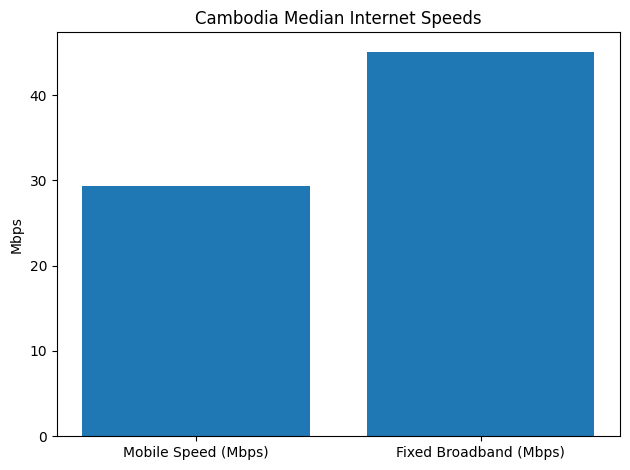
#7 — 29.37 Mbps Mobile Download Speed Cambodia’s median mobile download speed of 29.37 Mbps — a 14.4% year-on-year improvement — provides a progressively stronger technical foundation for seamless AI search experiences, reducing load-time friction that might otherwise discourage engagement with AI-heavy search result pages.
#8 — 45.10 Mbps Fixed Broadband Speed A remarkable 76.1% year-on-year growth in Cambodia’s fixed broadband download speed to 45.10 Mbps is one of the fastest infrastructure improvements in the region, enabling businesses and content creators to deliver richer, faster-loading web content that performs better in AI-curated search results.
#9 — 97.94% 4G Coverage Near-universal 4G coverage across Cambodia ensures that even users in provincial areas can access AI-powered search tools like Google’s AI Overviews, making nationwide digital marketing and GEO strategies viable rather than just urban-focused.
#10 — 6.97M Offline Population The 6.97 million Cambodians — approximately 39.3% of the population — who remain without internet access represent both an untapped market and a reminder that AI search strategies must be complemented by offline channels to achieve truly inclusive reach across Cambodia.
#11 — 95% Electricity Access Cambodia’s near-universal electricity access rate of 95% removes a fundamental barrier to device adoption and AI tool usage, creating the physical infrastructure necessary for sustained growth in AI search consumption across urban and rural populations alike.
#12 — 39 ISPs The presence of 39 competing Internet Service Providers in Cambodia has been a key driver of improved connectivity, lower prices, and broader access — conditions that accelerate the growth of the online user base that AI search platforms and GEO-optimised content rely on.
Section 2: Social Media & Mobile Behaviour
#13 — 12.9M Social Media Users With 12.9 million social media user identities — equivalent to 72.4% of Cambodia’s population — the country has one of Southeast Asia’s highest social media penetration rates, demonstrating a digitally engaged audience that is highly receptive to AI-driven content discovery and social search features.
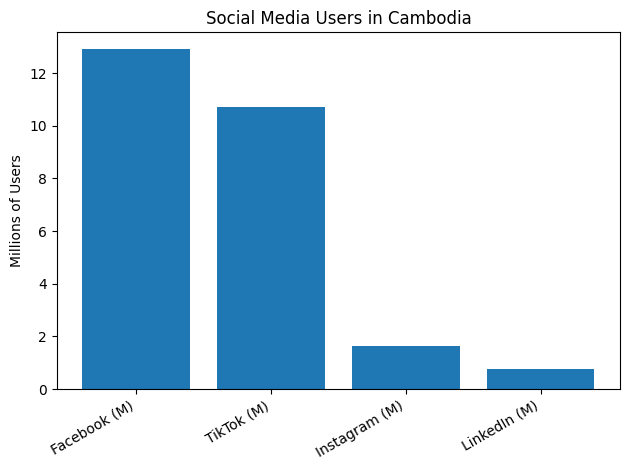
#14 — 12.9M Facebook Users Facebook’s 12.9 million users in Cambodia, growing at 10.3% year-on-year, confirms that the platform remains the dominant social search and content discovery channel, and that AI-powered features within Facebook’s ecosystem — including its Meta AI assistant — will significantly shape how Cambodians find information online.
#15 — 10.7M TikTok Users TikTok’s 10.7 million Cambodian users aged 18 and above highlight the platform’s explosive role as an AI-driven content discovery engine, with its For You Page algorithm increasingly functioning as a product and brand search tool that competes directly with traditional Google search for younger consumers.
#16 — 1.65M Instagram Users Instagram’s 1.65 million Cambodian users — 14.3% of adults — reflect the growing importance of visual AI search and image-based product discovery, meaning Cambodian brands should optimise visual assets and alt-text metadata to remain visible as AI image search capabilities advance.
#17 — 780K LinkedIn Members Cambodia’s 780,000 LinkedIn members represent a B2B-focused segment increasingly exposed to AI-powered professional search, making LinkedIn content optimisation — including keyword-rich posts and company profiles — a relevant GEO tactic for businesses targeting professional and corporate audiences.
#18 — 26.4 Years Median Age Cambodia’s median age of just 26.4 years positions the country as a naturally fertile market for AI search tool adoption, as younger demographics globally are statistically more likely to use AI chatbots, generative search platforms, and voice-activated search interfaces as primary information sources.
#19 — 18.05M Population With an estimated population of 18.05 million in mid-2026, Cambodia’s addressable digital market is growing steadily, and as internet penetration continues rising, the share of Cambodians engaging with AI-powered search results will expand — making early GEO investment increasingly valuable.
#20 — Social Media Growth 71.3% The surge in social media usage from 27% in 2016 to over 71% by 2021 demonstrates how rapidly Cambodian digital behaviours can shift, suggesting that adoption of AI search tools could follow a similarly steep adoption curve — potentially faster than policymakers and businesses currently anticipate.
Section 3: Search Engine Market Share
#21 — Google 95.12% Dominance Google’s commanding 95.12% search market share in Cambodia as of February 2025 means that any Generative Engine Optimisation strategy must be built almost entirely around Google’s AI infrastructure — including AI Overviews, featured snippets, and the emerging AI Mode — to achieve meaningful search visibility.
#22 — Bing 2.53% Bing’s 2.53% search market share in Cambodia, while a distant second to Google, is worth monitoring as Microsoft’s Copilot AI search integration matures — but for most Cambodian businesses in 2026, allocating significant GEO resources to Bing optimisation remains a low-priority consideration.
#23 — Yahoo 0.65% Yahoo’s 0.65% share confirms its negligible relevance in Cambodia’s search landscape, and Cambodian digital marketers should avoid diverting GEO resources toward Yahoo at the expense of their Google-first strategy, where the overwhelming majority of local search traffic originates.
#24 — CocCoc 0.51% The 0.51% presence of CocCoc — a Vietnamese search engine — in Cambodia hints at cross-border digital influence, and may be particularly relevant for Cambodian businesses near the Vietnamese border or those targeting Vietnamese-speaking consumers within the country.
#25 — DuckDuckGo 0.29% DuckDuckGo’s 0.29% market share in Cambodia reflects the country’s limited privacy-first search culture, though as AI search tools increasingly raise data concerns globally, privacy-preserving alternatives may see modest growth among Cambodia’s more tech-literate urban users.
#26 — Google 96.11% in 2024 The slight erosion of Google’s Cambodian market share from 96.11% in March 2024 to 95.12% in early 2025 is a subtle but notable signal that AI chatbots and alternative search platforms are beginning to capture a small but growing share of Cambodian search intent.
#27 — Bing Desktop 6.83% Bing’s notably higher 6.83% share among Cambodian desktop users — compared to its overall 2.53% — suggests that Microsoft Copilot and Bing AI may have stronger traction among office-based professionals and business users, a segment worth targeting with structured, AI-citation-friendly content.
Section 4: AI Adoption in Cambodia
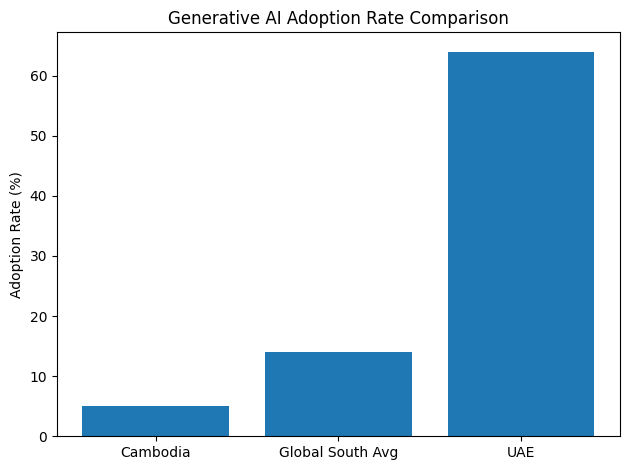
#28 — 5.1% AI Adoption Rate Cambodia’s generative AI adoption rate of just 5.1% among its working-age population places it among the lowest globally, revealing a significant gap between the country’s digital connectivity levels and its actual uptake of AI tools — an opportunity gap for forward-thinking businesses and educators to fill.
#29 — 6.9–7M AI Tool Users (Est.) Applying global AI usage patterns to Cambodia’s 10.8 million internet users suggests that approximately 6.9 to 7 million Cambodians have used AI-powered tools in some form — including translation apps, recommendation engines, and chatbots — even if they do not identify these as “AI.”
#30 — 70% Expect AI Productivity Gains The fact that 70% of respondents in low and medium-HDI countries including Cambodia expect AI to increase their productivity signals strong latent demand for AI tools, suggesting that user education and accessible AI search products could unlock rapid adoption growth in the near term.
#31 — 66.7% Expect AI Use in Work or Education Two-thirds of respondents in countries at Cambodia’s development stage expect to be using AI in education, health, or work within a year — indicating that search queries in these domains will increasingly be directed through AI-powered tools rather than traditional search engines.
#32 — 13% Fear Job Losses from AI The relatively low 13% of Cambodians who fear AI-related job losses — compared to higher anxiety in developed economies — suggests a broadly optimistic public sentiment that could reduce friction in AI tool adoption and support wider engagement with AI search products across the workforce.
#33 — 60% Expect AI to Benefit Employment A majority of 60% globally expecting AI to positively impact employment reflects the sentiment in emerging markets like Cambodia, where AI is viewed more as an enabler of new opportunities than a threat — a mindset that supports broader AI search and GEO adoption among Cambodian businesses.
#34 — UAE at 64% (Global #1) The UAE’s world-leading 64% generative AI adoption rate versus Cambodia’s 5.1% starkly illustrates the global AI divide, and highlights that infrastructure investment, digital literacy programs, and local language AI tools are critical levers for Cambodia to close this gap over the coming years.
#35 — Global South Average 14.1% Cambodia’s 5.1% AI adoption rate sitting well below the Global South average of 14.1% suggests that country-specific barriers — including limited Khmer-language AI support, low R&D investment, and digital skills gaps — are suppressing adoption beyond what economic development alone would predict.
#36 — 83% of ASEAN at Early AI Stage With 83% of ASEAN nations still in early AI adoption stages, Cambodia is not isolated in its development trajectory — but the 15% of ASEAN states already at advanced stages represent regional competitors that could widen their digital marketing and AI search advantages if Cambodia delays strategic investment.
Section 5: AI Governance, Policy & Readiness
#37 — 118th on AI Readiness Index Cambodia’s jump to 118th place on the Oxford Insights Government AI Readiness Index — a 27-position improvement from 145th in 2024 — demonstrates meaningful policy momentum, and signals to international technology partners that Cambodia is becoming a more credible environment for AI investment and deployment.
#38 — Oxford AI Score of 33.5 A Government AI Readiness score of 33.5 out of 100 places Cambodia in the lower-middle tier globally, reflecting genuine progress but also highlighting the infrastructure, talent, and governance gaps that must be bridged before Cambodia can fully leverage AI search tools for economic development.
#39 — ~132nd Cybersecurity Ranking Cambodia’s approximate 132nd-place global cybersecurity ranking is a meaningful constraint on AI trust and adoption, as users and businesses are less likely to share data with — or rely on — AI search tools in environments where digital security frameworks are perceived as weak.
#40 — 0.09% R&D GDP Spending Cambodia’s critically low R&D investment of just 0.09% of GDP constrains the development of homegrown AI tools, local-language search models, and Khmer-language training datasets — all of which are essential foundations for a truly localised and competitive AI search ecosystem.
#41 — 41 AI Strategy Measures Cambodia’s Draft National AI Strategy 2025–2030 contains 41 concrete measures spanning six strategic priorities, representing one of the most structured AI policy frameworks in the region and a strong institutional signal that AI — including AI search — will be a government priority for the next five years.
#42 — 300+ Stakeholders Consulted The engagement of over 300 stakeholders — including representatives from 26 ministries — in Cambodia’s UNESCO AI Readiness Assessment demonstrates an unusually inclusive policy process, increasing the likelihood that the resulting AI strategy will be realistic, well-resourced, and broadly implemented.
#43 — 450+ Workshop Attendees Over 450 representatives from government, private sector, academia, civil society, and development partners attending Cambodia’s National AI Strategy workshop signals growing cross-sector commitment to AI adoption, which bodes well for creating the ecosystem conditions that make AI search tools commercially and educationally viable.
#44 — 80% Government Digitalization Target Cambodia’s target to digitalize 80% of high-demand public services by 2028 will generate a significant surge in government-related search queries, creating new GEO opportunities for businesses providing civic information, legal guidance, health services, and public sector support content online.
#45 — 232,000 Civil Servants With 232,000 civil servants as a primary AI upskilling audience, Cambodia’s government has a concrete and reachable workforce to train in AI tools — including AI search — that could accelerate institutional adoption and normalise generative search behaviours across public organisations.
#46 — 400+ AI Publications Cambodia’s growing output of 400+ AI-related research publications — achieved largely through international collaboration — is a positive signal for the country’s long-term AI capability building, even as domestic R&D investment remains constrained.
#47 — 151st on HDI Cambodia’s 151st-place Human Development Index ranking reflects persistent structural challenges in education and income that limit equitable access to AI tools and digital literacy — factors that GEO strategists must account for when designing inclusive content strategies targeting all Cambodian demographics.
#48 — 4th in SE Asia for AI Readiness Assessment Being the fourth Southeast Asian country to complete a national AI Readiness Assessment — after Indonesia, the Philippines, and Thailand — places Cambodia in the regional vanguard on AI governance, providing a foundation for evidence-based policy decisions on AI search regulation and digital market development.
Section 6: Digital Economy & E-Commerce
#49 — $1.78B E-commerce Market Cambodia’s e-commerce market is projected to reach $1.78 billion in 2025 — a 17.88% CAGR — creating a rapidly expanding commercial context in which AI-powered product search, personalised recommendations, and voice-activated shopping queries are becoming critical drivers of competitive advantage for online retailers.
#50 — 6.68% GDP Contribution E-commerce now contributes 6.68% to Cambodia’s GDP, confirming that digital commerce is no longer peripheral to the economy — and that investments in AI search optimisation, product schema markup, and GEO-friendly content directly translate into measurable macroeconomic impact.
#51 — $1.62B Digital Economy (2023) Cambodia’s digital economy — valued at $1.62 billion in 2023 and expected to nearly double to $2.87 billion by 2027 — is growing at a rate that justifies significant early investment in AI search visibility, as organic and AI-driven traffic will increasingly determine market share among digital-first businesses.
#52 — 47.15% QR Payment Share QR codes accounting for nearly half of all Cambodian e-commerce transactions reflect a mobile-first payment culture that closely aligns with mobile AI search behaviour — users who discover products via AI-powered search on their phones are already primed for a seamless mobile checkout experience.
#53 — 19.5M E-wallet Users Cambodia’s 19.5 million e-wallet users — a 43% increase from 2021 — signal a fintech-forward population that is comfortable with digital transactions, making AI-powered financial search queries, product comparison tools, and transactional GEO content increasingly relevant marketing investments.
#54 — $1.5B ICT Market Cambodia’s projected $1.5 billion ICT market in 2025, growing at a 5.3% CAGR through 2033, reflects sustained investment by major technology players — including Google, IBM, and Amazon — whose platforms will shape the AI search infrastructure that Cambodian businesses must optimise for.
#55 — 1.3% ASEAN E-commerce Share Cambodia’s 1.3% share of the $137 billion ASEAN e-commerce market is small but growing, and as regional AI search platforms expand their geographic coverage, Cambodian businesses will face increasing cross-border GEO competition from more digitally advanced ASEAN neighbours.
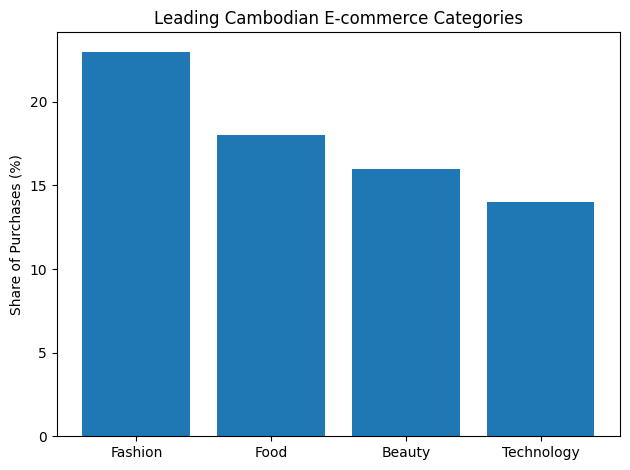
#56 — Fashion 23% of E-commerce Fashion’s leading 23% share of Cambodian e-commerce purchases — followed by food, beauty, and tech — identifies the product categories where AI-powered search queries are highest, signalling where GEO investments in structured data, product schema, and AI-friendly content will deliver the most commercial return.
#57 — 20M Internet Users in 2024 Cambodia’s 20 million internet users in 2024 — supported by 21.9 million mobile subscriptions — represents the total audience base through which AI search tools reach Cambodian consumers, underscoring the scale of opportunity for businesses that optimise for AI-generated search results across mobile devices.
Section 7: Google AI Overviews & AI Search Global Trends
#58 — AI Overviews: 6.49% to 50%+ Google AI Overviews’ explosive expansion from appearing on just 6.49% of searches in January 2025 to over 50% by October 2025 represents the single most disruptive shift in global search history — and Cambodian businesses optimising primarily for traditional organic rankings risk severe traffic losses if they do not adapt to this new GEO reality.
#59 — AI Overview Peak ~25% then Pullback Google’s experimentation — expanding AI Overviews to a peak visibility of ~25% before pulling back to ~16% by November 2025 — demonstrates that AI search is still evolving rapidly, and Cambodian SEO strategies must remain agile, monitoring SERP changes rather than locking into fixed GEO formulas.
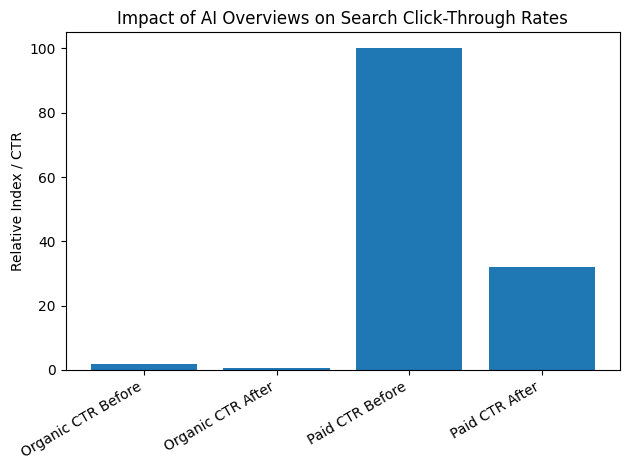
#60 — -61% Organic CTR Drop The 61% collapse in organic click-through rates for queries displaying AI Overviews — from 1.76% to 0.61% — is the defining performance metric that justifies shifting from traditional SEO to GEO for Cambodian businesses, as the value of ranking in traditional blue links is diminishing significantly.
#61 — -68% Paid CTR Drop Paid search click-through rates dropping by 68% when AI Overviews appear is a critical warning for Cambodian businesses running Google Ads — ad spend efficiency is being eroded by AI-generated answers, and budgets must now account for GEO alongside PPC to maintain search marketing ROI.
#62 — +35% CTR for AI-Cited Brands Brands cited within Google AI Overviews enjoying 35% higher organic click-through rates confirms that AI citation is now the most coveted position in Cambodian search — businesses that earn AI mentions for their core topic areas will gain a structural traffic advantage over competitors that do not.
#63 — +91% Paid CTR When Cited The near-doubling of paid click-through rates when a brand is simultaneously cited in an AI Overview reveals a powerful halo effect: Cambodian businesses that achieve GEO visibility alongside paid search campaigns will compound their advertising returns significantly.
#64 — 69% Zero-Click Searches With 69% of Google searches now ending without a click to any external website — up from 56% in 2024 — Cambodian businesses must reframe success metrics beyond website traffic, prioritising brand visibility, AI mention frequency, and answer authority as the new indicators of search performance.
#65 — 93% Zero-Click in AI Mode Google’s AI Mode generating zero-click outcomes in 93% of sessions signals a future where most search interactions never leave Google’s interface — making it essential for Cambodian brands to secure AI citations that ensure their name, products, and expertise are surfaced even when no website visit occurs.
#66 — 70% AI Overview Content Variability The fact that AI Overview content changes 70% of the time for repeated queries — with nearly half of citations being replaced — means GEO is not a one-time fix but a continuous content investment, requiring Cambodian businesses to consistently publish authoritative, up-to-date content that AI systems keep selecting.
#67 — 10%+ of Navigational Queries Intercepted AI Overviews now appearing on over 10% of navigational queries — up from under 1% in January 2025 — means even branded searches for Cambodian businesses, tourist destinations, and organisations are at risk of being intercepted by AI-generated summaries that may not represent those brands accurately.
#68 — ~40% of AI Overview SERPs Showing Ads The rapid expansion of Google ads appearing alongside AI Overviews — from just 3% to ~40% of cases — signals that AI-era search is being fully monetised, and Cambodian advertisers should test integrated GEO-plus-paid strategies that capture both AI citation authority and paid visibility simultaneously.
#69 — +528% Entertainment AI Overview Growth The 528% increase in AI Overviews for entertainment queries — and 387% for restaurants, 381% for travel — is directly relevant to Cambodia’s tourism and hospitality sector, which must now produce AI-citation-ready content to remain discoverable as tourists increasingly use AI search to plan their visits.
#70 — 25.96% AI Overview Saturation in Science Science and technical topics seeing the highest AI Overview saturation at 25.96% has implications for Cambodia’s growing EdTech, health information, and academic content sectors — these producers must structure their content for AI comprehension if they want to retain visibility in these query categories.
#71 — -25% Traditional Search Volume (Gartner) Gartner’s prediction of a 25% decline in traditional search engine volume by 2026 due to AI chatbots and virtual agents is arguably the most important strategic statistic in this report for Cambodian marketers — it signals that the window for establishing AI search authority is open now and will narrow over time.
Section 8: GEO & AI Search Tools
#72 — ChatGPT 5B+ Monthly Visits ChatGPT’s 5 billion-plus monthly visits and 81% share of the global AI chatbot market confirm it as the primary generative search platform that Cambodian businesses targeting international audiences — particularly in tourism, education, and professional services — must optimise their content to appear within.
#73 — +357% AI Platform Referrals The 357% year-on-year growth in referral visits from AI platforms — reaching 1.13 billion visits in June 2025 — demonstrates that AI search is already a significant and measurable traffic channel, and Cambodian websites that are not structuring content for AI discoverability are leaving a rapidly growing traffic source untapped.
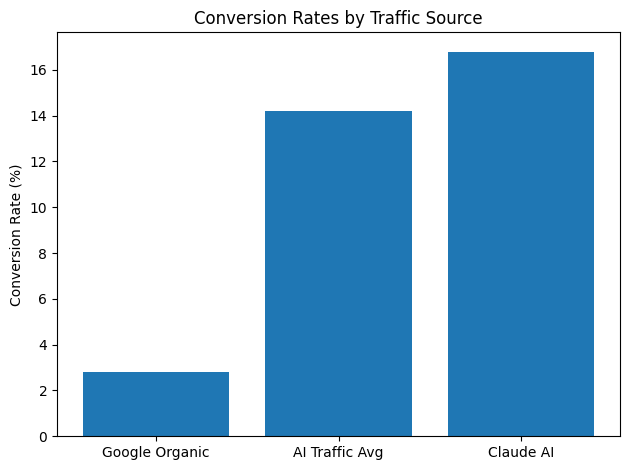
#74 — 14.2% AI Traffic Conversion Rate AI search visitors converting at 14.2% — five times the rate of Google organic traffic at 2.8% — is the most compelling commercial argument for Cambodian businesses to invest in GEO, as quality of AI-referred traffic dramatically outperforms traditional search in delivering actual customers and revenue.
#75 — Claude 16.8% Conversion Rate Claude (Anthropic) delivering the highest conversion rate of any AI platform at 16.8% suggests that being cited by more deliberate, research-oriented AI systems can yield exceptionally high-quality visitors — a insight relevant to Cambodian B2B and professional service businesses targeting decision-makers.
#76 — ChatGPT 50% of AI Traffic ChatGPT’s 50% share of all AI-referred website traffic makes it the single most important AI platform for Cambodian businesses to optimise for, particularly those targeting English-language queries from tourists, foreign investors, and diaspora communities researching Cambodia online.
#77 — Google Gemini 400M Users Google Gemini’s 400 million monthly active users — deeply embedded in Google Search, Android, and Google Workspace — makes it the most contextually relevant AI search model for Cambodian users, as most will encounter Gemini-powered results without ever deliberately choosing an AI tool.
#78 — Perplexity 780M Monthly Queries Perplexity AI’s tripling of monthly queries to 780 million reflects rapid adoption of citation-focused AI search among research-oriented users, and Cambodian organisations in education, NGOs, journalism, and government should prioritise publishing well-sourced, citable content that Perplexity’s AI models can reliably reference.
#79 — 75% AI Mode Zero-Click Sessions Three-quarters of Google AI Mode sessions ending without any external website visit reinforces that Cambodian businesses must optimise for brand recognition and topical authority within AI responses — not just click-through traffic — as the primary measure of AI search marketing success.
#80 — 7.22-Word Average AI Mode Query AI Mode queries averaging 7.22 words — significantly longer and more conversational than traditional search — means Cambodian content strategies must shift from keyword-density tactics toward comprehensive, question-answering content that addresses the nuanced, multi-part queries AI search users naturally ask.
#81 — 38% Have GEO Budgets With 38% of business decision-makers globally already allocating dedicated budgets for AI Search Optimisation, Cambodian companies that have not yet formalised a GEO investment are increasingly at risk of falling behind regional and international competitors who are structuring their entire digital presence around AI discoverability.
#82 — 6.5× Third-Party Citation Advantage Brands being 6.5 times more likely to be cited in AI responses through third-party sources than through their own websites fundamentally repositions PR, media relations, and review management as core GEO tactics — Cambodian businesses must actively cultivate external mentions on high-authority platforms to build AI search visibility.
#83 — Only 22% Track AI Visibility The fact that only 22% of marketers actively track AI search visibility and traffic means that Cambodian businesses who implement AI performance monitoring now — using tools like Google Search Console, third-party GEO trackers, and brand mention alerts — gain an immediate competitive intelligence advantage.
#84 — 25.7% Developing AI Citation Content One in four marketers globally developing content specifically designed to earn AI citations represents a relatively small but growing vanguard — Cambodian agencies and content teams that begin producing structured, authoritative, AI-friendly content today position themselves as early leaders in a space that will become crowded within 12–18 months.
#85 — Wikipedia 7.8% Citation Share Wikipedia being the most-cited source in ChatGPT responses at 7.8% — despite generating less human traffic — highlights the importance of factual, encyclopaedic content formats for AI discoverability, and suggests Cambodian brands should consider Wikipedia presence, structured data, and reference-quality content as GEO assets.
#86 — Reddit +450% AI Citation Growth Reddit’s 450% increase in AI citations reflects a broader shift toward valuing authentic, experience-based community content — a signal that Cambodian businesses should actively participate in online communities, forums, and review platforms where genuine user discussions are the raw material that AI systems prefer to cite.
#87 — AI Agents = 33% of Organic Activity AI crawlers and agents — including GPTBot, ClaudeBot, and Perplexity Bot — now accounting for 33% of organic search activity means that Cambodian websites must be technically accessible and crawlable by AI systems, with clean structures, fast load times, and robot.txt files that do not inadvertently block AI indexation.
#88 — +49% Impressions / -30% CTR The simultaneous rise in search impressions (+49%) and fall in click-through rates (-30%) documented by BrightEdge encapsulates the new AI search paradox: more Cambodians are seeing brand content than ever before, but fewer are clicking — requiring a shift in how Cambodian marketers define and measure digital visibility success.
Section 9: Cambodia SEO Landscape
#89 — 2025: Year of AI-Driven SEO Transformation For Cambodian digital marketers, 2025 was the year that AI-driven search disruption moved from a global trend to a local reality — making it the inflection point at which businesses must transition from conventional keyword-based SEO toward holistic GEO strategies built around topical authority and AI-citation readiness.
#90 — +76.1% Fixed Broadband Speed Growth Cambodia’s extraordinary 76.1% year-on-year improvement in fixed broadband speed not only enhances user experience with AI-powered search interfaces but also means that technically demanding, rich-media content optimised for AI Overviews — including video, infographics, and interactive tools — will load reliably for a growing share of users.
#91 — 47% of Marketers Using AI SEO Tools With 47% of marketers globally already implementing AI SEO tools and 84% using AI to identify search trends, Cambodian agencies that have not yet integrated AI-powered keyword research, content optimisation, and competitive analysis tools risk falling behind international benchmarks in both efficiency and output quality.
#92 — 67% See Content Quality Improvement Two-thirds of marketers reporting improved content quality when using AI tools suggests that Cambodian content producers — many of whom work with limited teams and budgets — can leverage AI writing assistants and optimisation platforms to significantly raise the quality and authority of their web content without proportional cost increases.
#93 — 42% Use AI for Long-Form Content The 42% of businesses using AI to produce long-form website content highlights a growing content production strategy directly relevant to GEO success, as AI search models consistently favour detailed, comprehensive content — giving Cambodian SMEs a realistic path to competing with larger content teams through AI-assisted production.
#94 — 61% View AI as Core Strategy With 61% of marketers globally viewing AI as the central pillar of their SEO strategy, Cambodian businesses that continue treating AI tools as supplementary rather than foundational risk strategic misalignment — particularly as the competitive advantages of AI-first content strategies compound over time.
#95 — 4B+ Voice AI Devices Over 4 billion devices globally running AI-powered voice assistants represent a growing channel through which Cambodians — particularly younger users — will increasingly conduct searches, making conversational Khmer-language content, FAQ-structured pages, and voice-search-ready schema markup important forward-looking GEO investments.
#96 — $4.97B AI SEO Software Market (2033) The AI SEO software market’s projected growth to $4.97 billion by 2033 signals that the tools available to Cambodian digital marketers will become increasingly sophisticated, affordable, and capable — meaning the operational barriers to professional-grade GEO implementation will continue falling over the coming years.
#97 — 8.5–13.7B Google Queries Per Day Google processing between 8.5 and 13.7 billion search queries daily — while maintaining an 89.6% global market share — confirms that despite AI disruption, search volume is not declining but evolving, and Cambodian businesses optimising for AI-era Google search are targeting the world’s largest and most commercially valuable information retrieval system.
Section 10: AI Search Future Outlook
#98 — 53% of ChatGPT Users Aged 18–34 ChatGPT’s dominant 18–34 age demographic aligning almost perfectly with Cambodia’s median age of 26.4 years means that the generative AI search platforms most used globally are being built for an audience that mirrors Cambodia’s population profile — creating strong natural demand for AI search adoption as young Cambodians gain purchasing power and digital sophistication.
#99 — 100M Google AI Mode Users Google AI Mode reaching 100 million monthly active users in the US and India within its first months signals rapid mainstream adoption of the most advanced AI search experience available — and with Google’s near-total dominance in Cambodia, AI Mode’s eventual regional rollout will reshape the Cambodian search landscape more profoundly than any prior Google update.
#100 — Southeast Asia $300B+ Digital Economy Southeast Asia’s digital economy surpassing $300 billion GMV in 2025 — with Cambodia included in the e-Conomy SEA report for the first time — signals Cambodia’s formal recognition as a meaningful regional digital market, bringing increased investment in AI search infrastructure, localised AI content platforms, and regional GEO competition.
#101 — SGE Rollout to 120+ Countries Google’s Search Generative Experience having expanded to over 120 countries — including Cambodia — means that Cambodian users have already been exposed to AI-generated search results, and businesses that have not yet audited how their content performs in AI Overviews are operating with a significant blind spot in their digital marketing strategy.
#102 — +40% Potential Productivity Gain AI tools’ potential to deliver 40% productivity gains across 16 industries signals that Cambodian businesses adopting AI search and content tools — from automated keyword research to AI-assisted copywriting and GEO analysis — stand to dramatically outpace competitors who continue relying on manual digital marketing workflows.
#103 — 12.6 Search Sessions/Week After ChatGPT Adoption The counterintuitive finding that ChatGPT users conduct more Google searches — averaging 12.6 sessions per week — than non-users challenges the narrative of AI replacing search entirely, and suggests that in Cambodia, AI tool adoption may actually amplify overall search behaviour rather than cannibalise it.
#104 — Upcoming Khmer LLM The Cambodian Ministry of Post and Telecommunications’ planned open-source Khmer Large Language Model will be a watershed moment for local AI search, enabling AI systems to understand, generate, and retrieve Khmer-language content with far greater accuracy — making Khmer-language GEO a commercially viable and strategically essential discipline for the first time.
#105 — Digital Skills Roadmap 2024–2035 Cambodia’s decade-long Digital Skills Development Roadmap provides a structured policy framework for building the AI-literate workforce that domestic GEO, content marketing, and AI search industries require — and businesses that align their hiring, training, and content strategies with this roadmap will benefit from an increasingly skilled digital talent pipeline.
#106 — 2.38% AI Hallucination Error Rate ChatGPT’s 2.38% rate of citing URLs that return 404 errors underscores the importance of robust website maintenance for Cambodian businesses — broken links, redirected pages, and deleted content can result in incorrect AI citations that harm brand reputation or simply disappear from AI-generated answers altogether.
#107 — 50%+ No-Click Searches More than half of all searches now resulting in no website click defines the new benchmark for AI-era search marketing: Cambodian businesses must pursue AI search authority not to drive traffic, but to ensure their brand, products, and expertise are present in the AI-generated answers that an increasing majority of users accept as the final word.
Conclusion
The evolution of artificial intelligence in search is redefining the digital ecosystem worldwide, and Cambodia is steadily becoming part of this transformation. The statistics, data points, and trends highlighted throughout this report demonstrate that AI-powered search and Generative Engine Optimization (GEO) are no longer theoretical concepts but emerging realities shaping how information is discovered, interpreted, and delivered across the Cambodian digital landscape. As internet access expands, mobile connectivity strengthens, and AI technologies become more accessible, Cambodia’s search environment is entering a new phase of development where intelligent systems play a growing role in guiding user behavior and online visibility.
The insights drawn from these 107 AI search and GEO statistics reveal several important patterns that define Cambodia’s current position in the global AI-driven search economy. One of the most significant trends is the increasing reliance on mobile devices for online search and information consumption. With smartphones serving as the primary gateway to the internet for a large portion of the population, AI-powered search experiences are naturally being shaped by mobile-first behaviors. Voice search, conversational queries, and AI assistants are gradually becoming more relevant as users look for faster and more intuitive ways to access information.
Another key takeaway is the growing influence of generative AI platforms on how content is surfaced and consumed. Unlike traditional search engines that simply list websites, AI-driven systems synthesize information and provide users with direct responses. This shift fundamentally changes how digital visibility works. Businesses and publishers can no longer rely solely on traditional search rankings to drive traffic. Instead, their content must also be structured in ways that allow AI systems to recognize, interpret, and cite it within generated responses. This is where Generative Engine Optimization becomes a critical component of modern digital strategy.
The data also illustrates how Cambodia’s digital economy is continuing to mature. Increased internet penetration, improved connectivity infrastructure, and rising digital literacy are enabling more people to participate in online ecosystems. As these developments unfold, the demand for reliable information, localized content, and authoritative digital resources is expected to grow. AI-powered search technologies will likely play a major role in meeting this demand by delivering more contextual, personalized, and efficient information experiences.
Language and localization represent another important factor influencing the development of AI search in Cambodia. The Khmer language remains central to online communication within the country, and advances in multilingual artificial intelligence are helping bridge gaps that previously limited the availability of localized AI-generated content. As AI models improve their ability to process and generate Khmer-language information, the accessibility and relevance of AI search for Cambodian users will continue to expand. This trend will also create new opportunities for local content creators, educators, and businesses to establish digital authority within AI-generated knowledge systems.
For marketers, content strategists, and digital businesses, the implications of these trends are substantial. The rise of AI search means that content quality, semantic clarity, and topical expertise are becoming even more important than before. AI systems prioritize information that is well-structured, trustworthy, and contextually relevant. Organizations operating in Cambodia must therefore focus on producing content that answers real user questions, provides clear explanations, and demonstrates subject authority. Structured data, comprehensive topic coverage, and credible sources will increasingly determine whether content is recognized and referenced by AI-powered platforms.
In addition to reshaping digital marketing strategies, AI search is also influencing broader information ecosystems. Educational institutions, research organizations, and government agencies are beginning to recognize the importance of ensuring that accurate and reliable Cambodian information is represented within AI-driven knowledge platforms. As generative AI tools continue to evolve, the availability of credible local data will play a crucial role in shaping how Cambodia is represented within global information networks.
The statistics presented in this report also highlight the early-stage nature of AI search adoption within the Cambodian market. While awareness and usage of AI-powered tools are increasing, there remains significant room for growth. Businesses that begin adapting their content strategies today will likely gain a competitive advantage as AI-driven search becomes more widespread. Early adoption of GEO strategies can help organizations establish authority and visibility within AI-generated responses before competition intensifies.
Looking ahead, the future of AI search in Cambodia will likely be shaped by several interconnected factors. Continued improvements in internet infrastructure, the expansion of AI-powered platforms, and increasing digital literacy will all contribute to higher levels of adoption. At the same time, advancements in natural language processing and multilingual AI will improve the quality of AI-generated responses in Khmer and other regional languages. These developments will further integrate AI search into everyday digital experiences, from online shopping and education to business research and customer support.
Another important trend to watch is the growing integration of AI search within popular digital platforms. Messaging applications, productivity tools, and social media services are increasingly incorporating generative AI capabilities that allow users to search, summarize, and analyze information without leaving the platform. As these integrations become more common, the boundaries between search engines, AI assistants, and digital services will continue to blur. For Cambodian businesses and marketers, this means that digital visibility strategies must evolve beyond traditional websites to include broader content ecosystems.
The long-term impact of AI search on Cambodia’s digital economy could be substantial. Improved information accessibility can support entrepreneurship, innovation, and knowledge sharing across industries. Small businesses may benefit from AI tools that simplify market research and customer engagement, while students and professionals gain access to faster and more comprehensive learning resources. In this way, AI search has the potential not only to transform digital marketing but also to contribute to broader economic and educational development.
Ultimately, the insights contained within these 107 statistics provide a valuable foundation for understanding how artificial intelligence is influencing Cambodia’s evolving search landscape in 2026. They highlight both the progress that has already been made and the opportunities that lie ahead. While the transition toward AI-driven search ecosystems is still unfolding, the direction is clear: intelligent systems will play an increasingly central role in how people find information and how organizations establish digital presence.
For businesses, marketers, researchers, and technology leaders seeking to stay ahead of the curve, monitoring AI search trends and adopting Generative Engine Optimization strategies will be essential. The organizations that succeed in this new environment will be those that prioritize authoritative content, embrace technological innovation, and adapt their digital strategies to align with AI-driven discovery models.
As Cambodia continues to strengthen its digital infrastructure and integrate advanced technologies into its economy, AI-powered search will become an increasingly influential force shaping the future of online information access. Understanding the data, statistics, and emerging trends outlined in this report is therefore not only useful but necessary for anyone looking to navigate the next era of search, content visibility, and digital growth within Cambodia’s rapidly evolving online landscape.
If you are looking for a top-class digital marketer, then book a free consultation slot here.
If you find this article useful, why not share it with your friends and business partners, and also leave a nice comment below?
We, at the AppLabx Research Team, strive to bring the latest and most meaningful data, guides, and statistics to your doorstep.
To get access to top-quality guides, click over to the AppLabx Blog.
People also ask
What is AI search and why is it important in Cambodia?
AI search uses artificial intelligence to generate answers instead of just listing links. In Cambodia, growing internet access and mobile usage make AI search a key channel for information discovery, digital marketing, and online business visibility.
What does GEO mean in digital marketing?
Generative Engine Optimization (GEO) is the process of optimizing content so AI search engines can understand, cite, and include it in generated answers. It is becoming essential as AI-powered search tools replace traditional search experiences.
How many internet users are there in Cambodia in 2026?
Cambodia has around 10.8 million internet users, representing over 60% of the population. This expanding user base provides a strong foundation for AI-powered search tools and digital marketing strategies.
Why is mobile important for AI search in Cambodia?
With more than 25 million mobile connections in Cambodia, smartphones are the main way people access the internet. Most AI search interactions, voice searches, and social searches occur on mobile devices.
What is Cambodia’s internet penetration rate?
Cambodia’s internet penetration rate exceeds 60% of the population, while subscriber penetration surpasses 100% due to multiple SIM and device usage among users.
Which search engine dominates in Cambodia?
Google dominates the Cambodian search market with over 95% market share. This means businesses must prioritize optimization for Google’s AI features, including AI Overviews and generative search results.
How big is Cambodia’s social media audience?
Cambodia has about 12.9 million social media users, representing over 70% of the population. Social platforms increasingly act as AI-driven content discovery and search channels.
Which social media platforms are most popular in Cambodia?
Facebook and TikTok are the most widely used platforms in Cambodia. Facebook has around 12.9 million users, while TikTok has over 10 million adult users actively discovering content and brands.
What role does TikTok play in AI-powered search?
TikTok’s recommendation algorithm acts as a search engine for younger users. Many people use it to discover products, services, and travel ideas, making it an important AI-driven discovery platform.
How fast is Cambodia’s internet speed?
Cambodia’s median mobile internet speed is about 29 Mbps, while fixed broadband speeds reach over 45 Mbps. Faster connectivity enables richer AI search experiences and faster content delivery.
How many Cambodians are still offline?
Around 6.97 million Cambodians remain offline. This represents both a digital gap and a potential future growth market for internet access and AI-powered services.
What is the current AI adoption rate in Cambodia?
Cambodia’s generative AI adoption rate is about 5.1%, which is lower than many countries. However, rising digital awareness suggests adoption could increase quickly in the coming years.
How many Cambodians are estimated to use AI tools?
Estimates suggest between 6.9 and 7 million Cambodians have interacted with AI tools, including chatbots, translation apps, and recommendation systems.
Why is Cambodia considered a promising market for AI search?
Cambodia’s young population, growing digital economy, and expanding mobile connectivity create ideal conditions for AI search adoption and digital innovation.
What is the median age in Cambodia?
Cambodia has a median age of around 26.4 years. Younger populations are generally more open to adopting new technologies such as AI assistants and generative search tools.
How is AI affecting traditional search engine results?
AI-generated answers are reducing clicks on traditional search listings. Many queries now end without users visiting websites because the AI provides direct responses.
What are zero-click searches?
Zero-click searches occur when users find the information they need directly in search results without clicking a website link. AI-generated answers are significantly increasing this trend.
How do AI Overviews impact SEO performance?
AI Overviews summarize content directly in search results, reducing organic click-through rates. Businesses must optimize content to be cited in these AI answers instead of relying solely on rankings.
What is the difference between SEO and GEO?
SEO focuses on ranking webpages in search engines, while GEO focuses on ensuring content is cited and used within AI-generated answers and summaries.
Why should Cambodian businesses invest in GEO?
GEO helps businesses remain visible in AI-powered search environments. As AI-generated answers replace traditional search results, content optimized for GEO can gain more exposure and authority.
How does AI search affect digital marketing strategies?
AI search shifts the focus from keyword rankings to authoritative, structured content that answers real user questions and can be cited by AI systems.
What industries benefit most from AI search in Cambodia?
Tourism, e-commerce, education, finance, and technology sectors benefit greatly from AI search because consumers often research these services online.
How large is Cambodia’s e-commerce market?
Cambodia’s e-commerce market is projected to reach around $1.78 billion, reflecting rapid growth in online shopping and digital payments.
How many Cambodians use digital wallets?
Approximately 19.5 million Cambodians use e-wallet services. This widespread fintech adoption supports mobile commerce and AI-powered shopping experiences.
What role does Google AI play in Cambodian search?
Google’s AI technologies, including Gemini and AI Overviews, increasingly shape search results in Cambodia by providing summarized answers and AI-generated insights.
How are AI chatbots influencing search behavior?
AI chatbots like ChatGPT allow users to ask complex questions and receive direct responses, changing how people research topics and discover information online.
Why is content quality important for AI search?
AI systems prioritize reliable, structured, and authoritative content. High-quality content is more likely to be cited in AI-generated answers.
What is the future of AI search in Cambodia?
AI search is expected to grow rapidly as internet access expands and AI tools become more accessible, transforming digital marketing and online information discovery.
How will Khmer-language AI models impact search?
The development of Khmer-language AI models will improve how AI systems understand and generate local content, making AI search more relevant for Cambodian users.
What should businesses do to prepare for AI search?
Businesses should create authoritative content, use structured data, optimize for conversational queries, and build strong digital credibility to improve visibility in AI-powered search results.
Sources
DataReportal
Angkor Times
Statista
UNESCO
Khmer Times
Worldometer
Market Research Southeast Asia
AppLabx
Visual Capitalist
UNDP Cambodia
Cambodianess
Nucamp
Agence Kampuchéa Presse
US International Trade Administration
Cambodia Market Entry
Archive Market Research
The Digital Bloom
Search Engine Land
Dataslayer
Exposure Ninja
Position Digital
Bloola
Search Engine Journal
SEO
SeoProfy
TheeDigital
Circles Studio
Bain & Company
TechCrunch