























Key Takeaways
- AI knowledge graphs connect entities and relationships into a semantic network, enabling AI systems to understand context rather than just process data.
- They enhance artificial intelligence with multi-hop reasoning, explainable decision-making, improved search accuracy, and reduced hallucinations in generative AI.
- By integrating structured and unstructured data, AI knowledge graphs power smarter applications across search, personalization, healthcare, fraud detection, and enterprise analytics.
In an age defined by data and artificial intelligence, simply storing information is no longer enough. Modern systems need to understand the meaning behind data, connect disparate facts, and reason in ways that resemble human thinking.
This is where AI knowledge graphs have emerged as crucial infrastructure. At their core, knowledge graphs transform scattered and siloed data into an interconnected network of entities and relationships that both humans and machines can interpret, query, and analyze to generate smarter insights.
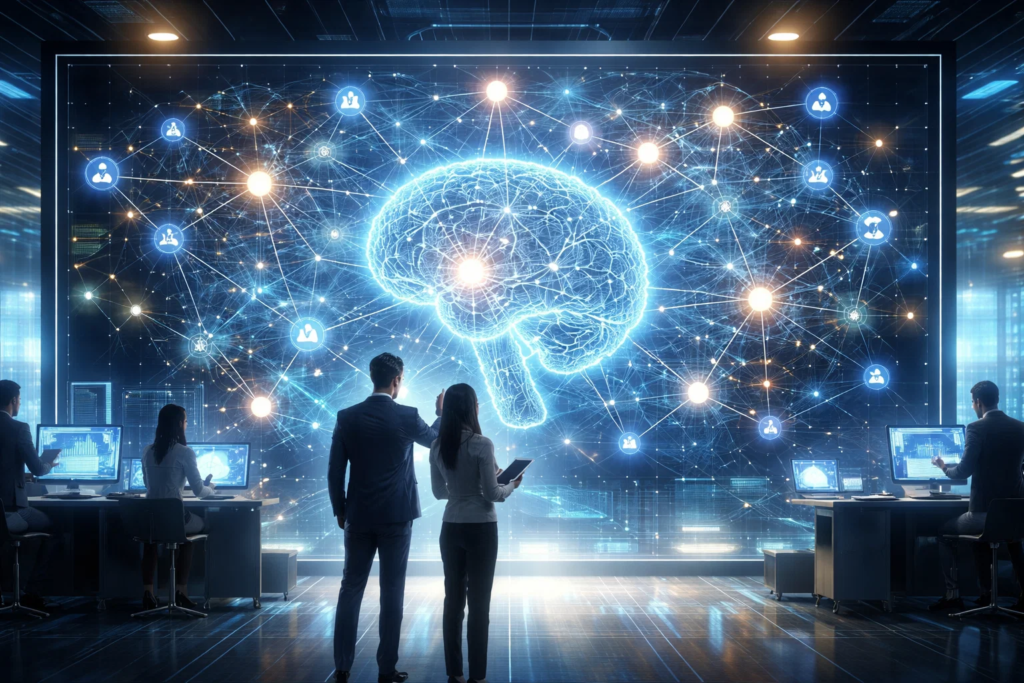
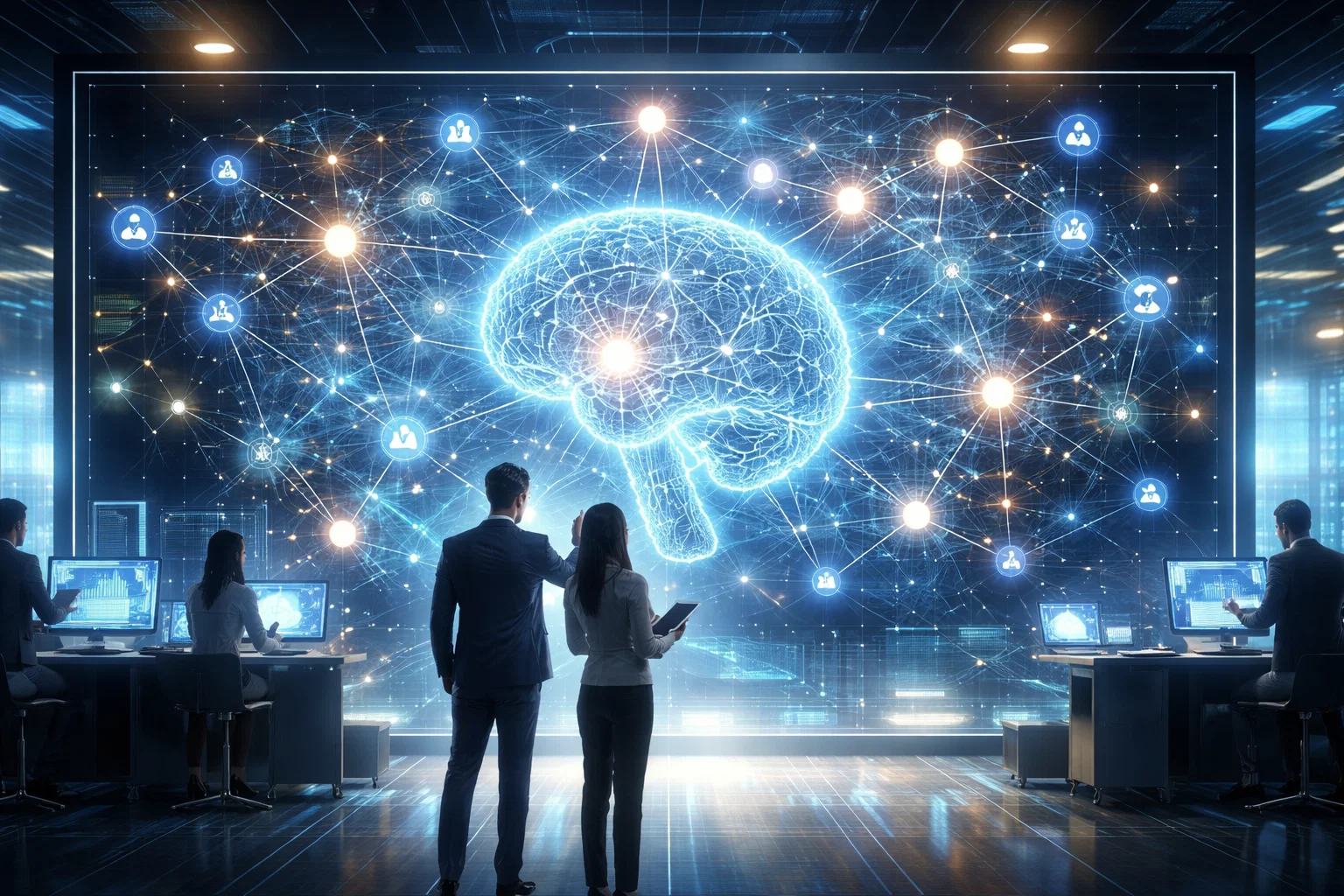
Unlike traditional databases that rely on rigid tables and schemas, knowledge graphs model real-world entities such as people, places, products, concepts, or events, and explicitly define how these entities relate to one another in a semantic structure, enabling a deeper contextual understanding of information.
The term knowledge graph first gained widespread attention when Google introduced its own implementation in 2012 to improve search quality by offering contextual answers and direct insights rather than just links to web pages.
Over time, this technology has extended far beyond search engines to power AI systems in fields such as natural language processing, recommendation engines, virtual assistants, and enterprise analytics.
What sets a knowledge graph apart is not just the storage of data but the emphasis on relationships, meaning that every node (entity) and edge (relationship) contributes to a larger, more navigable model of knowledge that reflects how information is connected in the real world.
AI knowledge graphs play a foundational role in modern artificial intelligence by providing the semantic backbone that enables machines to interpret facts, draw inferences, and answer complex queries.
By organizing data into context-rich networks, these graphs allow AI systems to move beyond keyword matching and statistical correlations, enabling more accurate decision-making, improved reasoning, and enhanced human-computer interaction.
This introduction explores what AI knowledge graphs are, why they matter, and how they work—a necessary foundation for understanding their transformative impact on intelligent applications across industries today.
But, before we venture further, we like to share who we are and what we do.
About AppLabx
From developing a solid marketing plan to creating compelling content, optimizing for search engines, leveraging social media, and utilizing paid advertising, AppLabx offers a comprehensive suite of digital marketing services designed to drive growth and profitability for your business.
At AppLabx, we understand that no two businesses are alike. That’s why we take a personalized approach to every project, working closely with our clients to understand their unique needs and goals, and developing customized strategies to help them achieve success.
If you need a digital consultation, then send in an inquiry here.
Or, send an email to [email protected] to get started.
What is an AI Knowledge Graph & How Does It Work
- What Is an AI Knowledge Graph
- Core Building Blocks of a Knowledge Graph
- How AI Knowledge Graphs Work
- How AI Knowledge Graphs Enhance Artificial Intelligence
- Use Cases of AI Knowledge Graphs
- Benefits of Using an AI Knowledge Graph
- Challenges & Limitations
- AI Knowledge Graph vs Other Data Models
- How to Build Your First AI Knowledge Graph
- Future Trends in AI Knowledge Graphs
1. What Is an AI Knowledge Graph
An AI knowledge graph is a structured representation of information designed to capture real-world entities—such as people, places, products, and concepts—and explicitly model the relationships between them in a semantic framework. Unlike traditional data models that treat information as isolated records or tables, a knowledge graph links pieces of data into a graph-structured network that both humans and machines can traverse, reason about, and derive insights from. In the context of artificial intelligence, knowledge graphs provide context, meaning, and semantic connections that enhance an AI system’s understanding and reasoning capabilities far beyond simple pattern recognition.
Definition and Core Concept
At its foundation, an AI knowledge graph consists of:
- Entities (Nodes): Distinct items that represent real-world concepts such as people, locations, products, or events.
- Relationships (Edges): Connections between entities that describe how they relate to each other, for example “works at,” “located in,” or “produced by.”
- Attributes/Properties: Descriptive data about entities (e.g., a person’s age, a product’s price).
This graph-based approach makes knowledge graphs semantically rich and flexible, enabling systems to understand not just what data exists, but how it interconnects and why those connections matter.
Structure and Architecture
AI knowledge graphs structure information differently from traditional relational databases (tables) or document stores. The emphasis is on relationships first, understanding how data points connect to reveal meaning and context.
Graph Data Model Components
| Component | Description | Example |
|---|---|---|
| Entity (Node) | Real-world concept or object | Customer, Product, Location |
| Relationship (Edge) | Semantic link between entities | purchased, resides in |
| Attribute/Property | Descriptive field of entity/relationship | Customer Age, Product Price |
| Ontology/Schema | Rules defining types and semantics | Classification of entity types (e.g., Person, Organization) |
This structured model allows AI systems to traverse the graph and infer new insights based on connected data points, rather than merely retrieving static records.
How an AI Knowledge Graph Differs from Traditional Data Models
A knowledge graph’s design prioritizes meaning and relationships, making it fundamentally different from other data architectures:
| Feature | Relational Database | AI Knowledge Graph |
|---|---|---|
| Schema Rigidity | Fixed tables with defined columns | Flexible, evolving schema |
| Relationships | Implicit (via joins) | Explicit and first-class |
| Context & Semantics | Limited | Core to representation |
| Integration | Complex data merging | Native cross-domain integration |
In a traditional database, relationships often need additional logic to interpret cross-table data. In a knowledge graph, relationships are native and navigable, making it easier for AI to draw meaningful connections.
High-Impact Examples of Knowledge Graphs in Use
Search and Contextual Understanding – Google Knowledge Graph
Google’s Knowledge Graph, introduced in 2012, popularized graph-based context modeling in mainstream technology. Rather than matching keywords, it interprets entities and their relationships to return more accurate and meaningful search results. When Google first launched its graph, it covered 570 million entities and 18 billion facts, enabling deeper understanding of user intent. By 2020, this expanded to around 5 billion entities and 500 billion facts.
Feature Highlights
- Enhances search results with entity-specific panels and contextual information
- Powers voice assistants and direct answers in search interfaces
- Disambiguates multiple meanings of terms by leveraging linked entities
Open Data Knowledge Graphs
Several public knowledge graphs have emerged in recent years as foundational data sources for AI applications:
| Dataset | Description | Scale/Notes |
|---|---|---|
| Wikidata | Collaborative, multilingual knowledge graph covering a vast array of entities and facts | Continuously updated global knowledge |
| DBpedia | Extracts structured content from Wikipedia infoboxes into a graph format | Millions of interlinked data points |
| GeoNames | Geographic database linking place names with location metadata | Used in mapping and location-aware AI |
These open knowledge graphs provide foundational semantic data that can be integrated into enterprise systems to enrich internal data with real-world context.
AI Knowledge Graph Use Cases in Practice
AI knowledge graphs serve as the backbone for many advanced applications:
Semantic Search and Question Answering
Traditional keyword search engines return results based on pattern matching. Knowledge graph-enabled systems can interpret intent and context, improving accuracy and relevance of results.
Content Recommendation and Personalization
Graphs connect user behavior with content attributes, enabling highly relevant suggestions in platforms like streaming services or e-commerce systems.
Enterprise Knowledge Management
In corporate settings, knowledge graphs unify data from CRM, support logs, documentation, and other silos into a coherent, searchable semantic network.
AI Reasoning and Inference
Because knowledge graphs embed semantic meaning, AI systems can infer new facts based on relationships rather than relying solely on patterns in training data.
AI Knowledge Graph and Machine Learning Synergy
In advanced AI workflows, knowledge graphs do not operate in isolation. They often integrate with machine learning models to improve understanding and reasoning:
- Improved Data Quality: Knowledge graphs provide structured, interconnected data that enhances model features and learning signals.
- Contextual Embeddings: Techniques like knowledge graph embeddings represent nodes and relationships in vector space, improving predictive tasks in AI.
- Complementing NLP and LLMs: Knowledge graphs add explicit semantics that help large language models interpret queries more accurately.
AI Knowledge Graph in Numbers: Market and Adoption Trends
Recent market research highlights the rapid growth and strategic adoption of knowledge graph technology:
| Metric | Value | Source |
|---|---|---|
| Global Market Projection (2030) | ~$6.9 billion | Knowledge graph market forecast for 2030 (from $1.07B in 2024) |
| Innovation Adoption | 80% of data & analytics innovations by 2025 will leverage graph technology | Gartner forecast |
| Growth Rate | ~36.6% annual CAGR through 2030 | Market growth estimate |
These trends illustrate how organizations are increasingly treating knowledge graphs as foundational to modern AI platforms and enterprise analytics.
Summary
An AI knowledge graph is a semantic network that represents entities and their relationships to provide context and meaning in data. Bridging the gap between raw information and intelligent insight, it enables AI systems to comprehend and reason about complex interconnected data structures rather than just process isolated facts. Through explicit modeling of relationships and flexible graph architecture, knowledge graphs enhance a wide range of AI applications—from search and personalization to enterprise knowledge management and cognitive reasoning—making them indispensable in the data landscape of modern AI.
2. Core Building Blocks of a Knowledge Graph
A knowledge graph is more than just a network of data points; it is a structured, semantic representation of real-world information designed to support understanding, inference, and reasoning by both humans and machines. At the heart of every knowledge graph are several foundational elements that work in concert to form rich, interconnected structures capable of powering AI, semantic search, analytics, and intelligent applications. These core building blocks define how data is modeled, linked, and interpreted across domains and use cases.
Entities (Nodes)
Definition and Role
Entities represent the fundamental objects or concepts within a knowledge graph. Each entity corresponds to something meaningful in the real world—this could be a physical object, a person, a concept, an event, or even an abstract idea—and serves as a unique node in the graph model.
Entities are the anchors of a graph. Without them, there would be nothing to connect or interpret. Because their identities are explicit, machines can annotate, retrieve, and reason about them with precision.
Examples of Entities
| Domain | Entity Examples |
|---|---|
| E-commerce | Customer, Order, Product |
| Entertainment | Movie, Actor, Genre |
| Healthcare | Disease, Gene, Drug |
| Geography | Country, City, Landmark |
In a movie knowledge graph, for instance, the node “Leonardo di Caprio” would represent an entity connected to other entities such as “Inception” (movie) via the relationship “acted in.”
Relationships (Edges)
Definition and Notation
Relationships are the semantic links between entities, illustrating how two nodes relate in a meaningful context. In graph terminology, these are edges with labels that define the nature of the connection.
Relationships add depth by contextualizing entities within a web of associations. Each relationship connects a subject to an object through a defined predicate (relationship type), forming a triple: subject–predicate–object.
Types of Relationship Configurations
| Configuration | Example |
|---|---|
| One-to-one | Person lives in City |
| One-to-many | Company employs Employees |
| Many-to-many | Students enrolled in Courses |
This structure enables complex semantic networks where entities can have multiple relationships, revealing patterns and dependencies that traditional tables cannot surface easily.
Attributes (Properties)
Purpose and Usage
Attributes (sometimes called properties or features) provide descriptive information about entities and, in some cases, about relationships themselves. These serve as metadata that enriches nodes or edges with specific details.
For example:
- Entity Movie could have attributes such as title, release year, and genre.
- Relationship acted in could have an attribute such as role name.
Comparison of Attributes vs. Entities vs. Relationships
| Component | Represents | Purpose |
|---|---|---|
| Entity | Object/concept | Identity in the graph |
| Relationship | Link between entities | Defines semantic connection |
| Attribute | Property of entity/relationship | Provides descriptive detail |
Attributes help machines distinguish entities more precisely and support detailed queries such as “Find movies released after 2015” or “List customers from New York.”
Ontology (Schema or Taxonomy)
Definition and Function
Ontology serves as the semantic framework or schema that defines classes of entities, permissible relationships, their properties, and the rules that govern them. It establishes the vocabulary and structure that ensure data consistency and interpretation across systems.
In many designs, ontology also includes hierarchies—such as Director being a subclass of Person—and rules that define valid patterns of connection among graph elements. This schema acts as a blueprint for both how the graph should be constructed and how it should be interpreted by applications and AI.
Ontology vs. Taxonomy vs. Identity Model
| Concept | Definition |
|---|---|
| Ontology | Formal definition of entity types, relationships, and rules |
| Taxonomy | Hierarchical classification of entities |
| Semantic Model | Overall structure combining ontology and real-world data |
Together, these components dictate how knowledge is organized, interpreted, and reasoned upon.
Inference and Reasoning Engine
What It Adds to a Knowledge Graph
A reasoning or inference layer allows knowledge graphs to derive new facts or insights that are not explicitly stored. By applying logic and rules defined in the ontology, the system can infer implicit relationships based on existing graph structure.
For example, if the graph knows that:
- John works at Company X
- Company X is headquartered in New York
The reasoning engine can infer: John works in New York, even if that fact is not explicitly stored.
This capability is particularly valuable in AI systems for generating insights, supporting semantic search, and improving answer accuracy in question-answering applications.
Graph Database (Storage and Query Engine)
Graph Storage Technology
While not technically a building block of the data model, a graph database or storage engine is a critical component supporting the knowledge graph. These systems are optimized for storing nodes and edges and for traversing connections efficiently.
Unlike relational databases, graph databases store relationships as first-class citizens, making queries that involve multi-hop traversals far more performant and scalable.
Data Ingestion, Linking, and Disambiguation
Bringing Data into the Graph
Data ingestion layers extract, transform, and load data from heterogeneous sources—structured, semi-structured, and unstructured—into the graph. Techniques such as named entity recognition (NER), entity resolution, and canonicalization identify real-world entities and link them to unique graph nodes.
Linking and disambiguation ensure that entities with similar labels (e.g., Paris as a city versus Paris as a person) are correctly identified and mapped within the graph. This step is essential for maintaining semantic accuracy and preventing ambiguous connections.
Summary Matrix: Core Knowledge Graph Components
| Component | Type | Role | Example |
|---|---|---|---|
| Entity (Node) | Data element | Represents real-world object or concept | “Movie: Inception” |
| Relationship (Edge) | Semantic link | Connects entities with meaning | “actedIn” |
| Attribute | Property | Describes node/edge detail | “Release Year: 2010” |
| Ontology | Schema/Rules | Defines structure and semantics | Class definitions |
| Inference Engine | Logic layer | Derives implicit knowledge | Implicit facts from data |
| Graph Database | Storage/Query | Persists and retrieves graph data | Neo4j, RDF store |
| Ingestion/Linking | ETL layer | Integrates diverse data sources | Entity resolution |
Each of these building blocks contributes to the knowledge graph’s ability to represent, interpret, and reason about complex webs of data, making them indispensable for advanced AI, semantic understanding, and context-aware applications.
3. How AI Knowledge Graphs Work
Understanding how AI knowledge graphs work involves examining a multi-stage process that transforms raw, heterogeneous data into a semantic, context-rich network that can be queried, reasoned over, and used to generate insights in AI applications. At a high level, an AI knowledge graph functions not as a static database, but as an intelligent ecosystem that fuses data, contextualizes meaning, enables inference, and supports complex reasoning tasks across domains.
The following sections break down this process into key functional layers and workflows, showing how each step contributes to a fully operational AI knowledge graph.
Semantic Data Ingestion and Integration
Collecting Diverse Data Sources
AI knowledge graphs begin by ingesting data from a wide range of sources, which may include:
- Structured data such as tables, spreadsheets and relational databases
- Semi-structured data such as JSON, XML, CSV files
- Unstructured data like text documents, web pages, logs, customer feedback
This ingestion layer is critical because real-world data rarely exists in a single format. Extracting useful entities and semantic concepts from this variety requires advanced processing techniques.
Transforming and Normalizing the Data
Before data enters the knowledge graph model, it must be transformed and normalized to ensure consistency. Common tasks include:
- Standardizing field names and formats across sources
- Removing duplicates and resolving conflicting values
- Converting unstructured text into structured semantic representations
Advanced tools such as entity recognition and semantic parsers help convert free-text into graph-ready entities and relationships.
Entity Resolution and Disambiguation
Once the data is normalized, the system identifies whether multiple records refer to the same real-world object (for example, whether “IBM” and “International Business Machines” represent the same organization). This step is known as entity resolution or canonicalization. Without this, knowledge graphs risk fragmentation and duplication, reducing their semantic value.
Semantic Modeling: Nodes, Relationships and Ontologies
Building a Graph Representation
After ingestion, the cleaned and normalized data is transformed into a graph structure comprising:
- Nodes (Entities): Represent real-world objects or concepts
- Edges (Relationships): Define semantic links between entities
- Attributes (Properties): Describe details of nodes and edges
This triplet structure — <subject, predicate, object> — is the basic building block of knowledge graph representation. For example, in the triple <Einstein, bornIn, Ulm>, “Einstein” is the subject, “bornIn” the relationship, and “Ulm” the object.
Ontology and Semantic Constraints
To ensure that the data has meaning and context, a knowledge graph typically incorporates an ontology — a schema that defines entity types, relationship types, constraints, and domain semantics. This ontology layer ensures that the graph not only stores connections but also understands the nature of those connections.
Ontologies enable inferencing rules, such as:
- A “Person” entity may work at an “Organization”
- A “Product” may belong to a “Category”
- A “City” may be located in a “Country”
Without defined semantics, knowledge graphs would simply be large networks with little inferential meaning.
Graph Construction and Contextual Linking
Creating Connected Semantic Networks
Once entities, relationships, and ontology are defined, the system connects data elements into a semantic network. Connected data is more valuable than isolated records because it allows machines to:
- Traverse along relationships
- Discover related concepts
- Aggregate context across large domains
- Support higher-order queries and inference
For example, integrating sales data with customer preferences, product attributes, and browsing history creates a graph that can power personalized recommendations.
The following table contrasts flat structured data with the connected nature of knowledge graphs:
| Feature | Traditional Structured Data | Knowledge Graph |
|---|---|---|
| Relationships | Hidden or implicit via keys | Explicit and traversable |
| Schema | Rigid, often siloed | Flexible, semantic |
| Integrability | Challenging across sources | Designed for multi-source fusion |
| AI Usability | Limited contextual reasoning | Supports semantic AI and inference |
This structural difference is what enables AI systems to draw contextual intelligence from data, a capability critical for advanced machine reasoning.
Querying and Reasoning
Rich Semantic Queries
With data interconnected, knowledge graphs support queries that go beyond keyword or pattern matching. Instead, they answer true semantic questions like:
- “Which products did customers buy after viewing similar items?”
- “Which researchers have published in both artificial intelligence and biology?”
- “What supply chain partners intersect with risk factors for this product?”
Semantic query languages such as SPARQL (for RDF triple stores) or graph-specific languages like Cypher enable these deep, contextual queries.
Inference and Reasoning Engines
A defining feature of knowledge graphs is the ability to infer implicit knowledge that is not directly stored in the graph. For instance, if Alice works for Company X, and Company X is located in New York, the system can reason that Alice works in New York, even if that fact was never explicitly recorded.
Reasoning engines apply logical rules and ontological constraints to derive new facts, enhancing the graph’s depth and AI’s understanding.
AI Integration: Embeddings and Machine Learning
Knowledge Graph Embeddings
To bridge symbolic graph data and machine learning models, knowledge graphs often use embeddings — numerical representations of nodes and relationships that capture graph structure and semantics. These vectors allow AI models to:
- Predict missing relationships
- Generate similarity scores between entities
- Enhance machine learning features
Graph neural networks (GNNs) are commonly used to generate such embeddings, enabling knowledge graphs to function within broader AI pipelines for tasks like classification, clustering, or recommendation.
Supporting Real-World Use Cases
Semantic Search and Question Answering
One of the most visible applications of knowledge graphs is semantic search. For instance, the Google Knowledge Graph fundamentally enhanced search engines by providing direct answers and context rather than just a list of links. By mid-2020, this system had grown to cover 5 billion entities and 500 billion facts, directly supporting contextual search and query understanding.
E-Commerce Recommendations
In e-commerce, AI knowledge graphs power personalized recommendations by connecting product catalogs, customer profiles, transaction history, and browsing patterns into a unified semantic network. This enables recommendation engines that understand not just similarity, but relationship-based relevance.
Healthcare and Research Analytics
In domains such as biology or medicine, knowledge graphs connect genes, diseases, drugs, clinical trials, and research literature to reveal previously hidden associations — accelerating drug discovery and scientific insight.
Summary Matrix: Knowledge Graph Workflow Elements
| Workflow Stage | Purpose | Key Technologies |
|---|---|---|
| Data Ingestion | Collect and normalize heterogeneous sources | ETL, NLP, entity extraction |
| Semantic Modeling | Build nodes, edges, and ontologies | Ontology management, RDF/OWL |
| Graph Construction | Create interconnected semantic networks | Graph databases |
| Query & Reasoning | Execute semantic queries and infer new knowledge | SPARQL, Cypher, reasoning engines |
| AI Integration | Support ML with embeddings and inference | GNNs, embeddings |
In summary, AI knowledge graphs work by ingesting diverse data, applying semantic models and ontologies, constructing connected networks, and enabling advanced querying, reasoning, and AI integration. Through this layered process, knowledge graphs deliver contextual intelligence — turning raw data into structured knowledge that algorithms and humans can leverage for deeper insight and smarter decision-making.
4. How AI Knowledge Graphs Enhance Artificial Intelligence
AI knowledge graphs do more than organize data—they fundamentally elevate how artificial intelligence systems understand, reason, and make decisions based on complex, interconnected information. By embedding semantic structure and real-world relationships into data, knowledge graphs address some of the core limitations of traditional AI models, particularly those reliant on unstructured information or purely statistical patterns. This section explores the multifaceted ways in which knowledge graphs enhance AI capabilities across accuracy, reasoning, data integration, transparency, and real-world application performance.
Contextual Understanding and Semantic Depth
Providing Rich Semantic Context
AI models like large language models (LLMs) excel at pattern recognition but often lack explicit context about domain-specific relationships and real-world concepts. Knowledge graphs supply this context by structuring data into entities and relationships, allowing AI systems to access meaning instead of raw tokens. For example, a biomedical knowledge graph can link drugs, diseases, and clinical trials—providing precise reasoning pathways that improve the quality of output in healthcare AI applications. This structured semantic backbone enables AI to interpret queries with a deeper understanding of latent meaning.
Mitigating Hallucination and Improving Accuracy
When AI systems generate answers without grounded knowledge, they can produce hallucinations—incorrect or fabricated information. Knowledge graphs act as an authoritative source of truth that AI models can reference, grounding their outputs in verified facts and reducing error rates. According to a 2024 industry study, integrating knowledge graphs with AI models may improve response accuracy by as much as 300% by providing structured, context-rich data that models can reliably use for inference.
Multi-Hop Reasoning and Complex Query Capability
Supporting Deep Reasoning Over Relationships
Unlike vector-based retrieval methods, which match similarity patterns, knowledge graphs enable multi-hop reasoning—the ability to follow chains of relationships across entities to answer complex questions. For instance, querying “Which suppliers are linked to both high-risk regions and critical components?” involves traversing multiple relationship paths that only a graph structure can efficiently resolve. This makes knowledge graphs superior for applications such as risk analysis, strategic planning, and complex decision support.
Structured Query Languages and Reasoning Engines
Knowledge graphs support semantic query languages such as SPARQL and graph-oriented access methods like Cypher, enabling AI systems to perform precise logic-based retrieval. This structured querying, combined with reasoning engines, allows the system to infer implicit knowledge—facts not explicitly stored but derivable from the graph’s semantics. Such reasoning underpins AI-driven applications that require traceable logic, rather than probabilistic or surface-level pattern extraction.
Bridging Data Silos and Enhancing Integration
Unifying Disparate Data Sources
Knowledge graphs excel at connecting structured, semi-structured, and unstructured data into a unified model by focusing on semantic alignment rather than rigid schemas. This enables AI systems to draw insights across legacy databases, cloud applications, document repositories, and real-time data streams. In enterprise environments, knowledge graphs are increasingly deployed to break down silos and create a single semantic layer that AI models can leverage for consistent understanding across business units.
Interoperability Across Contexts
Because knowledge graphs encode meaning explicitly, AI systems can operate across domains without retraining models for each data format. This is especially valuable for scalable enterprise AI that must handle multiple business units, product lines, or regulatory frameworks. The graph structure ensures that entities like products, processes, or customers have consistent representation regardless of source, supporting federated AI applications with consistent logic.
Explainability and Transparency in AI Decision-Making
Auditable Knowledge Paths
One of the key criticisms of modern AI—especially deep learning systems—is lack of explainability. Knowledge graphs address this by making the relationships that influence decisions explicit. For example, in a recommendation engine, the AI’s rationale can be traced from user preferences to connected product features and inferred interests. Such explainable AI improves accountability, regulatory compliance, and user trust.
Tracing Logical Evidence Chains
Unlike black-box models, knowledge graphs allow the tracking of logical evidence chains. If an AI concludes that a customer segment is high value, stakeholders can examine the specific relationships and attributes that led to that conclusion, such as purchase frequency, product category affinity, and demographic correlations. This transparency is particularly important in sensitive domains like finance, healthcare, and legal decision support.
Enhanced AI Memory and Long-Term State Awareness
Persistent Memory for AI Agents
Traditional AI agents using LLMs often lack persistent memory, resetting context after each session. Integrating a knowledge graph provides a structured memory store that records explicit facts and relationships over time. For instance, an AI assistant can remember user preferences, historical interactions, or business rules as persistent knowledge, enhancing ongoing personalization and decision continuity. Knowledge graphs function as an external “memory bank” that agents can reference directly for consistent reasoning across sessions.
Stateful Behavior for Complex Processes
In applications like workflow automation, customer support automation, or multi-stage planning, AI systems benefit from knowing historical context—such as previous project outcomes, user feedback cycles, or maintenance records. Knowledge graph integration enables stateful behavior where past relationships inform present decisions, creating more reliable and human-like AI workflows.
Cross-Domain Use Cases Illustrating AI Enhancement
Semantic Search and Intelligent Discovery
Search systems powered by knowledge graphs return contextually rich results, prioritizing relevant entities and relationships over keyword matches. For example, Google’s Knowledge Graph has grown to include 500 billion facts across 5 billion entities, enabling more accurate, entity-centric answers instead of simple keyword hits.
Recommendation Systems with Relationship Understanding
E-commerce platforms increasingly use knowledge graphs to deliver personalized product suggestions by mapping user actions to product taxonomies, preferences, and contextual behaviors. By understanding why certain products are related (not just that they co-occur), AI systems can make recommendations that reflect deeper customer intent.
Scientific Research and Discovery Networks
In scientific AI, knowledge graphs connect concepts such as researchers, methods, institutions, and topics, enabling discovery of interdisciplinary patterns and potential collaborations that would be difficult to identify through traditional analyses or simple search methods. This accelerates research workflows and fosters innovation.
Comparative Matrix: AI Enhancement Without vs With Knowledge Graph Integration
| Capability Dimension | Without Knowledge Graphs | With Knowledge Graphs |
|---|---|---|
| Semantic Understanding | Pattern recognition with shallow context | Deep entity relationships and context |
| Reasoning | Limited logical inference | Multi-hop reasoning and explicit logic |
| Data Integration | Fragmented data silos | Unified semantic model |
| Explainability | Black-box outcomes | Transparent logical paths |
| Long-Term Memory | Session-based context only | Persistent structured knowledge |
| Search & Discovery | Keyword matching | Contextual & entity-centric retrieval |
| Accuracy | Prone to hallucination | Grounded in verified facts |
Summary
AI knowledge graphs fundamentally enhance artificial intelligence by supplying semantic context, enabling complex reasoning, unifying disparate data, and improving explainability and long-term memory for AI agents. Their structured, relationship-centric design allows AI systems to move beyond surface-level inference, delivering more reliable, transparent, and contextually rich outcomes across domains such as search, recommendation, enterprise analytics, scientific discovery, and conversational agents. Integrating knowledge graphs with AI is increasingly recognized as a key enabler for the next generation of intelligent, trustworthy, and high-performance AI systems.
5. Use Cases of AI Knowledge Graphs
AI knowledge graphs have become foundational technologies across a wide range of industries and applications by enabling systems to connect, reason, and derive insight from complex, interconnected data. Their semantic structure and ability to represent real-world relationships make them especially valuable in contexts where understanding context, dependencies, and hierarchies is critical. Below are detailed sections outlining major use cases, accompanied by examples, tables, and insights into how these systems transform intelligence and decision-making.
Semantic Search and Intelligent Discovery
Enhanced Search Experiences
One of the most visible use cases of AI knowledge graphs is semantic search. Rather than relying on keyword matching alone, semantic search systems leverage knowledge graphs to understand meaning, intent, and context behind queries. This results in more relevant and precise results, improving user satisfaction and reducing retrieval errors.
A prominent example is the Google Knowledge Graph, which underpins modern search engines by linking billions of entities such as people, places, and concepts to deliver contextual results rather than just document lists. By 2026, Google’s graph includes billions of entities and facts, enabling context-aware interpretations of user queries.
Enterprise and Research Discovery
Beyond web search, knowledge graphs power internal discovery systems that help users navigate corporate data, documentation, and research libraries through intuitive, relationship-aware queries. In research environments, knowledge graphs facilitate deep exploration by connecting publications, authors, citations, and related subjects, revealing trends and insights not visible in isolated datasets.
Personalization and Recommendation Systems
Contextual Recommendations
In e-commerce and content platforms, knowledge graphs are used to model behaviors and preferences by connecting customers to products, ratings, categories, and interaction history. This enables recommendation systems that not only consider statistical patterns but also semantic relationships—such as inferred similarities and dependencies—leading to higher conversion and engagement rates.
For example, an intelligent recommendation engine might identify that a customer interested in “wireless headphones” is also likely to be interested in “noise-cancelling accessories,” using linked properties and customer behavior graphs to enhance relevance.
Customer 360 and Segmentation
Knowledge graphs integrate data from CRM, marketing, support logs, and transaction histories to build a holistic customer profile. This comprehensive view supports advanced segmentation and tailored experiences that improve retention and lifetime value.
Conversational AI and Intelligent Assistants
Context-Aware Dialogue
Knowledge graph–grounded conversational systems outperform standard chatbot models by responding with accurate, context-rich answers, integrating organizational knowledge repositories, policies, and procedural information. These systems enable natural language interfaces that understand nuance and deliver precise responses by traversing entity relationships and semantic constraints.
Customer Support Automation
By linking product information, FAQs, policies, and historical support interactions, knowledge graphs power self-service support systems that meaningfully resolve queries without human intervention, reducing support costs and improving service quality.
Healthcare and Life Sciences
Clinical Decision Support
In healthcare, knowledge graphs integrate genetic data, medical histories, drug interactions, clinical trial results, and diagnostic information to support clinicians with data-driven insights. They enable systems to identify optimal treatment pathways and potential drug repurposing opportunities by uncovering hidden connections among biological entities.
For example, linking patient condition profiles with published research and drug side-effect data helps identify effective treatment combinations while minimizing risk.
Biomedical Research and Discovery
In life sciences research, knowledge graphs enable discovery analytics across massive scientific datasets, facilitating hypothesis generation, trend analysis, and multi-disciplinary collaboration by connecting genes, diseases, proteins, and literature at scale.
Illustrative Use Case Table – Healthcare
| Use Case | Knowledge Graph Role | Outcome |
|---|---|---|
| Personalized Medicine | Links genomic data, clinical history, treatment outcomes | Precision treatment recommendations |
| Drug Interaction Analysis | Connects drug attributes, side effects, patient profiles | Risk mitigation and safer prescriptions |
| Research Trend Mapping | Correlates publications, authors, disease pathways | Faster interdisciplinary discovery |
Fraud Detection and Risk Management
Relationship-Aware Risk Analysis
Knowledge graphs reveal complex chains of relationships in transactional data, such as ownership hierarchies, account linkages, and behavioral connections. This visibility is essential for identifying fraud rings, suspicious patterns, and systemic risk that purely transactional analysis might miss.
Regulatory Compliance and Anti-Money Laundering (AML)
In financial services, connecting disparate data sources—such as transactions, accounts, external watchlists, and compliance policies—enables AI systems to perform risk scoring and detect anomalies across linked entities. This reduces false positives and enhances the accuracy of compliance reporting.
Enterprise Data Intelligence and Analytics
Unified Data Integration and Lineage
Knowledge graphs break down data silos by linking metadata from enterprise systems, data catalogs, BI reports, and data pipelines. This semantic layer improves data governance, accelerates discovery, and supports analytics by making relationships explicit rather than implicit.
Explainable Business Insights
By modeling dependencies across KPIs, products, and processes, knowledge graphs enable analytics platforms to offer explanations for trends, anomalies, and predictions, improving trust and decision quality in enterprise AI systems.
Industry-Specific Use Case Matrix
| Industry | Typical Use Cases | Benefits Enabled |
|---|---|---|
| Search & Media | Semantic entity search, content tagging | Better relevance & discovery |
| E-Commerce & Retail | Product recommendations, Customer 360 | Higher engagement, personalization |
| Healthcare | Clinical insights, drug discovery | Better outcomes & research acceleration |
| Finance | Fraud detection, AML compliance | Reduced risk & regulatory alignment |
| Manufacturing | Supply chain modeling, quality analytics | Improved optimization & transparency |
| Government & Public Sector | Policy analysis, citizen service automation | More efficient public services |
(Industry examples adapted from use case summaries across knowledge graph applications)
Combined Technology Use Cases with AI and Knowledge Graphs
Retrieval-Augmented Generation (RAG)
Knowledge graphs are increasingly integrated with RAG systems, augmenting large language models (LLMs) by providing structured, contextual sources for retrieval at inference time. This reduces hallucinations and enhances the factual accuracy of generated responses, particularly for knowledge-intensive domains.
Machine Learning Feature Enhancement
Knowledge graphs also support AI model training by improving feature selection, reducing the requirement for large labeled datasets, and enhancing explainability in machine learning workflows. This symbiotic relationship improves model robustness and contextual awareness.
Summary of Knowledge Graph Use Cases
AI knowledge graphs are versatile engines that power a broad array of applications where semantics, relationships, and context matter. From semantic search, personalized recommendations, and conversational AI to healthcare decision support, fraud detection, and enterprise intelligence, knowledge graphs elevate AI by enabling deep connectivity, inferential reasoning, and explainable insights that traditional data models cannot offer. Their widespread adoption across industries highlights their role as foundational technologies for complex, data-driven AI systems in 2026 and beyond.
6. Benefits of Using an AI Knowledge Graph
AI knowledge graphs deliver transformative advantages by structuring data into interconnected semantic networks that enhance how artificial intelligence systems interpret, reason, integrate, and generate insights from complex information. Below are key benefits supported by relevant examples, practical insights, and sourced data that demonstrate why knowledge graphs have become pivotal in modern AI and enterprise intelligence.
Enhanced Data Integration and Interoperability
Unified View of Disparate Data Sources
AI systems frequently struggle with data silos where information is stored in separate systems with inconsistent formats. Knowledge graphs solve this by representing diverse datasets as linked entities and relationships, allowing seamless integration across structured, semi-structured, and unstructured sources. This unified semantic view supports richer analytics, clearer relationships, and more holistic insights.
For example, in enterprise environments where customer, product, and support data may exist in different systems, a knowledge graph consolidates these sources, enabling AI to reason about relationships across them without extensive manual data engineering.
Improved Data Interoperability
Because knowledge graphs operate independent of rigid schemas, systems with evolving data requirements benefit from flexible integration. This adaptability makes knowledge graphs highly effective in dynamic domains such as logistics, healthcare, and supply chain management, where data structures change frequently.
Comparison: Traditional Systems vs Knowledge Graph Integration
| Capability | Traditional Databases | AI Knowledge Graph |
|---|---|---|
| Integration Complexity | High | Low |
| Schema Flexibility | Rigid | Dynamic |
| Cross-domain Linking | Requires custom ETL | Native semantic connections |
| Real-time Updates | Challenging | Fully supported |
Improved Contextual Understanding and Semantic Insight
Context-Rich Data Representation
Knowledge graphs imbue data with meaning and context, enabling AI systems to interpret relationships between entities instead of relying solely on patterns or text correlations. This semantic structure reduces ambiguity and enables more accurate interpretations of input data.
For instance, in natural language processing, understanding that “Apple” may refer to a company or a fruit depending on context is critical; knowledge graphs allow AI to disambiguate such terms based on relationships and linked concepts.
Semantic Relationships Enable Richer Reasoning
Because entities and relationships are explicit in knowledge graphs, AI systems can perform multi-step reasoning that goes beyond superficial data retrieval. This capability allows more nuanced analytics and decision-making in domains such as recommendation engines, semantic search, and question-answering systems.
Increased AI Accuracy and Reduced Errors
Grounded Knowledge Reduces Hallucination
Large language models and generative AI are powerful but can produce hallucinations—plausible but incorrect outputs. Knowledge graphs provide structured, fact-based references that anchor AI outputs, significantly improving accuracy. In fact, studies indicate that integrating knowledge graphs with AI models can improve accuracy by up to 300% compared to models without graph grounding.
This boost in accuracy is particularly valuable for critical applications such as medical diagnosis, financial analysis, and scientific research where errors can have high costs.
Explicit Semantics Improve Predictive Quality
By structuring data through a semantic network, knowledge graphs enhance predictive modeling and pattern discovery, helping AI uncover relationships that traditional data formats may obscure. This contributes to more reliable decision support, forecasting, and predictive analytics.
Enhanced Search, Discovery, and Querying
Semantic Search Outperforms Keyword Matching
Traditional search engines rely on keyword frequency and pattern matching, often returning irrelevant or ambiguous results. Knowledge graphs fundamentally change this by enabling semantic search—interpreting user intent and returning contextually appropriate results.
For example, semantic search powered by a knowledge graph will return results for “AI in healthcare diagnostics” that understand the relationship between AI technologies and medical categories, rather than just matching keywords scattered through documents.
Intent-Based Querying
Knowledge graphs support advanced query languages and intent-based exploration. Queries such as “Which high-value customers also purchased loans and insurance products?” or “What research links disease markers to drug trials?” become answerable through semantic traversals rather than complex joins or pre-aggregated datasets.
Support for Explainability and Transparent AI
Auditable Logic Paths
One of the major challenges in advanced AI systems—especially neural networks—is the opacity of decision logic. Knowledge graphs mitigate this by making relationships explicit and traceable. By examining the path between linked entities, stakeholders can understand why a model arrived at a specific conclusion.
This transparency is essential in regulated industries (healthcare, finance, legal), where explainable AI is not just beneficial but often required to meet compliance standards.
Efficient Knowledge Discovery and Innovation
Uncover Hidden Patterns and Insights
Knowledge graphs enable AI systems to detect non-obvious relationships and patterns by integrating multi-domain datasets. This accelerates knowledge discovery, making it easier to spot trends, correlations, and anomalies that can drive innovation.
For research institutions, this capability supports cross-disciplinary discovery—for example, linking genomic data with clinical studies and biochemical pathways—opening pathways to breakthroughs that might be missed in siloed systems.
Accelerating Time to Insight
In business environments, reducing the time from data acquisition to actionable insight is critical. Knowledge graphs streamline this by harmonizing data and enabling AI to deliver contextual insights rapidly, enabling faster decision cycles and data-driven strategies.
Stronger Data Governance and Compliance
Clear Lineage and Data Provenance
Knowledge graphs help organizations maintain a clear and auditable structure of how data is connected, shared, and used. This supports stronger data governance, clearer data lineage, and enhanced trust in AI outputs.
This capability is particularly valuable for enterprises that need to adhere to privacy regulations and internal policies, as the graph structure naturally supports detailed tracking and access controls.
Improved Quality and Reduced Redundancy
By harmonizing disparate datasets and explicitly linking entities, knowledge graphs reduce data duplication and inconsistency. This improves data quality and reliability across AI systems, reducing confusion and errors that arise from conflicting records.
Benefit Matrix: Knowledge Graph Impact on AI Systems
| Benefit Category | Description | Impact on AI Performance |
|---|---|---|
| Data Integration | Unifies diverse data into a semantic network | Enables holistic analytics |
| Contextual Insight | Embeds meaning and relationships | Improves understanding and relevance |
| Accuracy | Reduces hallucinations and errors | Up to 300% better accuracy in grounded models |
| Search & Discovery | Supports semantic search | Delivers contextually relevant results |
| Explainability | Provides traceable logic paths | Enhances transparency and accountability |
| Innovation | Reveals hidden patterns | Accelerates discovery and strategic insights |
| Governance | Tracks data lineage | Strengthens compliance and control |
Summary
AI knowledge graphs provide a robust semantic foundation that elevates artificial intelligence systems beyond traditional pattern recognition. By integrating disparate data, providing semantic context, improving accuracy, enabling explainable logic, and revealing hidden insights, knowledge graphs deliver significant strategic and operational benefits across industries. These advantages make knowledge graphs an essential component of modern AI architectures, supporting everything from sophisticated semantic search and governance to reliable predictive analytics and decision support.
7. Challenges & Limitations
While AI knowledge graphs offer powerful capabilities for semantic reasoning, contextual intelligence, and explainable AI, they are not without challenges. Implementing and maintaining a production-grade AI knowledge graph requires significant technical expertise, strong data governance, and scalable infrastructure. Below is a detailed examination of the key limitations organizations face when deploying AI knowledge graphs.
Data Quality and Entity Resolution Complexity
Inconsistent and Incomplete Source Data
AI knowledge graphs depend heavily on clean, well-structured data. However, enterprise data is often fragmented across systems, duplicated, outdated, or inconsistently formatted. According to Gartner, poor data quality costs organizations an average of $12.9 million per year (Gartner Data Quality Market Survey). When inaccurate data enters a knowledge graph, incorrect relationships may propagate across the entire semantic network.
For example, if two customer records represent the same person but are not properly merged, downstream AI systems may treat them as separate entities, leading to flawed analytics or personalization errors.
Entity Disambiguation Challenges
Entity resolution — determining whether two data records represent the same real-world object — remains one of the most difficult problems in knowledge graph construction. Ambiguities such as:
- “Apple” (company vs fruit)
- “Paris” (city vs person)
- Multiple companies with similar names
require advanced natural language processing and contextual modeling. In large datasets, even a small error rate can create thousands of incorrect relationships.
Impact Matrix: Data Quality Risks
| Challenge | Technical Impact | Business Impact |
|---|---|---|
| Duplicate entities | Fragmented graph structure | Inaccurate analytics |
| Missing relationships | Limited reasoning depth | Incomplete insights |
| Incorrect mappings | Faulty inference | Reduced AI trust |
Scalability and Performance Constraints
Graph Growth and Computational Overhead
Knowledge graphs can scale to millions or billions of nodes and edges. For example, Google’s Knowledge Graph reportedly contains over 500 billion facts across billions of entities (Google Search documentation). As graph size increases, query performance, storage optimization, and traversal efficiency become increasingly complex.
Unlike relational databases that optimize table scans and indexed joins, knowledge graphs must optimize multi-hop traversals, which can be computationally expensive.
Multi-Hop Query Complexity
Complex queries that require traversing multiple relationship layers can cause performance bottlenecks. For example:
- “Find customers who purchased products manufactured by suppliers linked to compliance violations.”
Such queries require multiple path traversals. Without proper indexing and distributed architecture, response times can degrade significantly.
Scalability Comparison Table
| Factor | Small Graph | Enterprise-Scale Graph |
|---|---|---|
| Nodes | Thousands | Millions to Billions |
| Query Time | Milliseconds | Variable, depends on indexing |
| Infrastructure Needs | Single server | Distributed cluster |
Ontology Design and Semantic Modeling Complexity
Designing a Robust Ontology
An ontology defines entity types, relationship rules, and semantic constraints. Designing an effective ontology requires domain expertise, data modeling experience, and long-term planning.
Poor ontology design can lead to:
- Overly rigid schemas that limit flexibility
- Overly loose schemas that reduce semantic clarity
- Conflicting definitions across departments
For example, one department may define “Customer” as a paying client, while another includes trial users. Without alignment, semantic inconsistencies arise.
Evolving Schema Challenges
Knowledge domains evolve over time. New product categories, regulations, or business models may require ontology updates. Modifying a live ontology can be risky and complex, especially when dependent AI systems rely on consistent semantics.
High Implementation and Operational Costs
Infrastructure Investment
Building a production-grade AI knowledge graph involves:
- Graph database licensing or infrastructure costs
- Data ingestion pipelines
- NLP tools for entity extraction
- Ontology management systems
- Skilled data engineers and semantic architects
According to IDC, organizations spend millions annually on AI infrastructure modernization to support advanced analytics and graph workloads.
Specialized Skill Requirements
Knowledge graph implementation requires expertise in:
- Graph data modeling
- RDF/OWL or property graph frameworks
- Entity resolution
- Data governance
- AI integration
This specialized skill set is less common than traditional database development, increasing hiring and training costs.
Maintenance and Continuous Updates
Real-Time Data Synchronization
Many real-world domains — such as fraud detection, supply chains, and customer analytics — require near real-time updates. Maintaining graph consistency during continuous ingestion is technically challenging.
For example:
- Adding new entities without creating duplicates
- Updating relationships without breaking dependencies
- Ensuring version consistency across distributed systems
Versioning and Change Management
Tracking historical changes to entities and relationships is critical for compliance and auditability. However, implementing graph version control and maintaining lineage metadata increases storage and processing overhead.
Explainability and Bias Risks
Propagation of Biased Data
Knowledge graphs inherit biases from their source datasets. If historical data contains bias — for example, discriminatory lending patterns — AI systems built on top of the graph may reinforce those biases.
The World Economic Forum has highlighted that biased training data remains one of the most significant risks in AI system deployment.
False Confidence in Structured Data
Because knowledge graphs appear structured and authoritative, organizations may overestimate their reliability. However, incorrect or incomplete relationships can create misleading confidence in AI-generated insights.
Integration Challenges with Modern AI Systems
Hybrid Architecture Complexity
Modern AI systems often combine:
- Knowledge graphs
- Vector databases
- Large language models
- Real-time analytics engines
Designing hybrid architectures (such as GraphRAG systems) increases architectural complexity and requires synchronization between symbolic reasoning and neural models.
Performance Trade-Offs
While knowledge graphs provide explainability and semantic depth, vector search systems often provide faster similarity retrieval. Balancing speed, explainability, and reasoning depth requires careful system design.
Limitations in Handling Uncertainty
Knowledge graphs are inherently deterministic: relationships either exist or do not. However, many AI tasks involve probabilistic reasoning, uncertainty, and confidence scoring.
For example:
- Predicting disease likelihood
- Estimating fraud probability
- Forecasting market trends
To handle uncertainty, knowledge graphs must integrate with probabilistic models or graph neural networks, adding architectural complexity.
Security and Privacy Concerns
Sensitive Relationship Exposure
Knowledge graphs explicitly map relationships between entities. In domains like healthcare or finance, this can expose sensitive connections if access controls are not properly implemented.
For example:
- Patient–disease relationships
- Financial account–ownership networks
- Supplier–compliance links
Improper security configurations can lead to regulatory violations under GDPR, HIPAA, or other data protection laws.
Comprehensive Limitations Matrix
| Category | Core Limitation | Operational Risk | Mitigation Strategy |
|---|---|---|---|
| Data Quality | Inconsistent or duplicate entities | Incorrect AI insights | Strong data governance |
| Scalability | Multi-hop query overhead | Slower performance | Distributed graph infrastructure |
| Ontology Design | Poor schema alignment | Semantic confusion | Cross-domain modeling workshops |
| Cost | High infrastructure & expertise requirements | Budget constraints | Phased implementation |
| Maintenance | Continuous updates required | Data drift | Automated pipelines |
| Bias | Biased source data | Ethical risk | Bias audits and monitoring |
| Security | Sensitive relationship exposure | Compliance violations | Role-based access control |
Strategic Perspective
Despite these challenges, many organizations continue investing in AI knowledge graphs because the long-term value often outweighs the limitations. According to industry forecasts, the knowledge graph market is expected to grow significantly through 2030 as enterprises seek more explainable, context-aware AI systems.
The key is recognizing that knowledge graphs are not plug-and-play solutions. They require strategic planning, iterative modeling, and strong governance frameworks. When deployed thoughtfully, they provide unmatched semantic depth and explainability — but without proper design and maintenance, they can become complex, costly, and difficult to manage.
Conclusion
AI knowledge graphs deliver powerful semantic intelligence, but their implementation introduces significant technical, operational, and organizational challenges. From data quality issues and ontology complexity to scalability constraints and governance risks, successful adoption requires careful architecture design and ongoing management.
Understanding these limitations allows organizations to approach knowledge graph development strategically, mitigate risks proactively, and unlock their full potential within modern AI ecosystems.
8. AI Knowledge Graph vs Other Data Models
When choosing a data model for AI and analytics, understanding how AI knowledge graphs differ from other foundational models like relational databases, document stores, and vector databases is crucial. Each model serves specific purposes, but AI knowledge graphs stand out for relationship reasoning, semantic context, and complex query capabilities that other models can struggle to express natively. Below is a detailed comparison that explains these differences, when to use each model, and how they complement one another in modern intelligent systems.
Knowledge Graphs vs Relational Databases
Structural and Semantic Differences
Relational databases organize data in tables with rows and columns, and represent relationships through foreign keys and JOIN operations. Knowledge graphs, however, represent data as entities (nodes) connected by explicit relationships (edges), capturing semantics and meaning directly rather than inferring connections at query time. This semantic representation enables deeper reasoning and context discovery.
In relational models, joining multiple tables for complex queries can lead to exponential performance degradation as the number of joins grows. Knowledge graphs bypass this by storing relationships alongside entities, making multi-hop traversals more efficient and naturally expressive.
Typical Use Case Scenarios
| Model | Best Suited For | Limitations |
|---|---|---|
| Relational Database | Structured, transactional data with well-defined schema | Performs poorly for many-hop relationship queries |
| Knowledge Graph | Complex, interconnected data with semantic meaning | Requires upfront entity modeling and ontology design |
Real-world example: A social network with millions of users, friendships, interests, and groups is cumbersome to analyze for deep relationships using relational tables, but knowledge graphs can efficiently model and query paths between users, interests, and shared activity.
Knowledge Graphs vs Document and Key-Value Stores
Semi-Structured vs Semantic Models
Document and key-value stores (types of NoSQL databases) are designed to store flexible and hierarchical data, such as user profiles, logs, or JSON documents. They excel at schema flexibility and horizontal scaling, but they do not inherently represent explicit relationships as structured semantics. Knowledge graphs enrich these data stores by adding semantic layers that define how pieces of information relate to one another.
While document stores are useful for fast development and flexible schemas, they lack native support for multi-step reasoning and semantic inferencing — tasks where knowledge graphs excel.
Knowledge Graphs vs Vector Databases
Different Foundations: Explicit Connections vs Similarity Search
Vector databases store embeddings — numerical representations of data created by machine learning models — to enable semantic similarity searches. They are optimized for fast retrieval based on nearest neighbors and are widely used in applications like semantic search, recommendation engines, and Retrieval-Augmented Generation (RAG) workflows.
In contrast, knowledge graphs focus on explicit relationships and structured semantics. They answer queries based on how entities are connected and what those connections mean. For example, a knowledge graph can trace how a customer relates to products through repeated purchases, and also infer indirect connections, which vector databases alone cannot express.
Industry comparisons note that knowledge graphs handle complex, relationship-centric queries with clear context, while vector systems excel at high-speed similarity retrieval — making them complementary rather than direct replacements.
Purpose and Performance Trade-Offs
| Feature | Knowledge Graph | Vector Database |
|---|---|---|
| Data Representation | Nodes and edges with semantic labels | High-dimensional numerical vectors |
| Query Focus | Relationship traversals and reasoning | Semantic similarity and nearest neighbors |
| Best for | Complex analytics and explainable AI | Fast search and unstructured query retrieval |
| Ease of Setup | Higher due to entity modeling | Lower, as embeddings are extracted automatically |
Vector systems often scale more easily for massive unstructured datasets, while knowledge graphs provide semantic structure that enhances reasoning and interpretability. Combining both (GraphRAG) is a trend in modern AI architectures, blending speed and context.
Knowledge Graphs vs Multi-Model and Hybrid Architectures
Document + Graph + Vector Integration
Modern data platforms often use a multi-model approach: combining relational, document, vector, and graph systems to leverage each model’s strengths. For example, a customer intelligence platform might use:
- Relational DB for core transactional records
- Document Store for unstructured customer notes
- Vector DB for semantic search of documents
- Knowledge Graph for deep relationship modeling across all data
In hybrid architectures like GraphRAG, vector embeddings aid retrieval while the knowledge graph provides structural ordering and explainability for complex AI applications.
This reflects a broader trend where no single data model is universal, but rather each model contributes to a layered platform that supports both speed and depth of insights.
Comparative Matrix: Data Model Capabilities
| Capability | Relational | Document | Vector | Knowledge Graph |
|---|---|---|---|---|
| Schema Flexibility | Medium | High | High | High |
| Relationship Semantics | Low | Low | None | Very High |
| Multi-Hop Reasoning | Low | Low | None | Very High |
| Similarity Search | Limited | Limited | Excellent | Limited |
| Explainability | Low | Low | Low | High |
| Performance with Unstructured Data | Poor | Good | Excellent | Moderate |
Choosing the Right Model
Data Nature and Query Complexity
- Use relational databases for structured transactional systems with straightforward reporting requirements.
- Use document or NoSQL systems for flexible schemas and variable data.
- Use vector databases for semantic search, recommendation systems, and similarity retrieval in unstructured contexts.
- Use knowledge graphs for AI applications requiring contextual reasoning, semantic relationships, explainability, and deep insight extraction.
Example Decision Flow
If you need fast similarity retrieval of support tickets for an AI assistant, a vector database is appropriate. If you need to understand how concepts, people, and events are interconnected — such as tracing supplier risks across a supply chain — a knowledge graph is more suitable.
Summary
AI knowledge graphs differ fundamentally from other data models by emphasizing explicit semantic relationships and contextual reasoning. While relational databases and document stores focus on data structure and scale, and vector databases optimize similarity search, knowledge graphs excel at uncovering how data points relate, supporting complex AI reasoning and explainable outputs. In modern AI ecosystems, combining these models into hybrid architectures often delivers the best balance of performance, interpretability, and semantic depth, making knowledge graphs a critical component of intelligent systems.
9. How to Build Your First AI Knowledge Graph
Building an AI knowledge graph involves a structured process that transforms raw data into a semantic network of entities and relationships that can power advanced analytics, AI reasoning, semantic search, and more. The journey from concept to a deployed graph requires careful planning, clear use cases, robust data preparation, and ongoing maintenance. Below is a comprehensive, SEO-optimised guide detailing each essential phase with practical examples, best practices, and actionable insights.
Define Your Purpose and Use Case
Clarify Business Goals
Start by identifying why you need a knowledge graph and what it will solve. Knowledge graphs are particularly valuable when relationships between data entities are complex and central to insights—for example, linking customer behavior to product information, detecting fraud patterns, or enhancing semantic search. Defining specific questions you want the graph to answer ensures the project stays focused and measurable. Examples include: Which products are frequently bought together? or What connections exist among research themes in biomedical data?
Set Scope and Boundaries
Rather than attempting to model an entire domain at once, begin with a manageable scope that reflects immediate business needs. For example, if your goal is to improve customer personalization, start with customer profiles, purchase histories, and product metadata. Expanding gradually allows iterations and validation before scaling across broader enterprise data sources.
Choose a Graph Architecture and Database
Graph Database Options
Knowledge graphs require a backend database optimized for storing nodes (entities) and edges (relationships). Two common models are:
Triple Stores (RDF Databases)
- Store semantic triples (subject, predicate, object)
- Good for standards compliance and semantic web use
- Often used with SPARQL for querying semantic relationships
Property Graph Databases
- Store nodes with properties and relationships with attributes
- More flexible schema design
- Supported by many commercial graph engines such as Neo4j, TigerGraph, and JanusGraph
Selection Criteria
When choosing a database, evaluate based on:
- Scalability: Can the system handle billions of entities and relationships?
- Query Performance: Does the system support complex graph traversal queries?
- Standards Support: Does it support semantic standards like RDF, OWL, or schema validation?
- Tooling and Ecosystem: Are there tools for visualization, integration, and analytics?
Data Preparation and Collection
Gather Relevant Data Sources
Your graph’s usefulness depends on the quality and breadth of data sources. These may include:
- Structured sources: Databases, CSV/Excel tables
- Semi-structured data: JSON/XML files
- Unstructured sources: Text documents, emails, logs
In an e-commerce scenario, relevant data could be customer orders, product catalogs, browsing history, and inventory lists.
Data Cleaning and Normalization
Preparing data for a knowledge graph often involves:
- Standardizing formats across sources
- Merging duplicate records
- Handling missing or inconsistent information
- Validating key fields such as entity identifiers and dates
Cleaning ensures entities like Customer A are represented consistently across each dataset before graph ingestion.
Semantic Modeling and Ontology Design
Entity and Relationship Definitions
Create a semantic model that defines:
- Entities (Nodes): Core things in your domain—e.g., Customer, Product, Order
- Relationships (Edges): How entities relate—e.g., purchased, reviewed, belongs to
- Attributes: Descriptive data such as product category, purchase date, customer location
Build an Ontology
An ontology is a schema that formalizes concepts and their relationships. Tools like Protégé can help you define and validate ontologies visually. Ontology design ensures your graph captures semantics meaningfully and supports AI reasoning.
Implement Entity and Relationship Extraction
Extract from Structured Data
For structured datasets, extraction can be automated via scripting or ETL (Extract, Transform, Load) pipelines that map table columns to graph nodes and edges.
Extract from Unstructured Text
For text data, use Natural Language Processing (NLP) and AI models to perform:
- Named Entity Recognition (NER): Identifies key entities like names, locations, products
- Relation Extraction: Detects relationships between entities based on linguistic patterns
Modern approaches may combine rule-based systems with Large Language Models (LLMs) to improve accuracy and reduce manual effort.
Graph Construction and Ingestion
Build and Ingest Data
Once modeling and extraction are complete, ingest the data into your selected graph database. Tools often allow incremental loading, meaning you can test with a subset before full ingestion. During this phase:
- Map each dataset element to nodes and relationships
- Validate that key connections like customer–orders, product–category, or entity–entity are created correctly
- Address conflicts or inconsistencies early to prevent corrupt relationships
Iterative Validation
After ingestion, run simple queries to confirm data accuracy and graph integrity. Later, scale queries to test more complex relationships and ensure performance meets expectations.
Testing and Refinement
Functional Testing
Validate whether your graph answers the key business questions defined at the start. Typical checks include:
- Can you retrieve all purchases made by a customer?
- Are product bundles correctly inferred from purchase patterns?
- Do relationships reflect reality, such as linking customers to their interactions?
Graph Optimization
If queries return incomplete or incorrect results, revisit your:
- Ontology design (node and relationship definitions)
- Data mapping rules
- Ingestion logic
Optimization might also involve indexing frequently accessed nodes or refining relationship hierarchies for better traversal performance.
Deployment and Integration
Integrate with AI Applications
Once the graph functions correctly, connect it with AI tools or platforms—such as semantic search systems, recommendation engines, or RAG frameworks—so that it can drive real-world applications and insights. For example, linking your knowledge graph to an AI model can improve search relevance by grounding responses in structured relationships.
Expose via APIs and Dashboards
Provide access to your knowledge graph through APIs or visualization dashboards so that other teams—such as analytics, customer support, or product—can query and gain insights.
Maintenance and Evolution
Keep Your Graph Current
Knowledge graphs must evolve as new data arrives and business needs shift. Regular maintenance includes:
- Adding new entities and relationships
- Updating ontologies to reflect domain changes
- Automating continuous data ingestion with monitoring of quality and performance
Performance Monitoring
Track metrics such as query response times, data quality errors, and growth in entity counts to ensure your infrastructure scales with demand.
Comparison Matrix of Knowledge Graph Building Phases
| Phase | Key Activities | Success Indicators |
|---|---|---|
| Define Use Case | Goal setting, scope definition | Clear business KPIs |
| Database Selection | Choose DBMS | Scalability and query support |
| Data Preparation | Clean and normalize data | High quality, consistent inputs |
| Ontology Design | Model semantic relationships | Well-structured schema |
| Extraction | Entity & relation extraction | Accurate NLP/LLM results |
| Ingestion | Load into graph | Correct node/edge creation |
| Testing | Functional and complex queries | Expected results |
| Deployment | APIs & AI integration | Real-world application |
| Maintenance | Updates and performance monitoring | Ongoing relevance |
Summary
Building your first AI knowledge graph involves a defined use case, careful semantic modeling, robust data preparation, and iterative validation combined with strategic deployment and ongoing evolution. With modern tools and best practices, even complex connected data can be transformed into a semantic resource that enhances AI capabilities, supports deeper insights, and drives smarter decisions across business and analytical systems.
10. Future Trends in AI Knowledge Graphs
As AI continues to evolve rapidly, AI knowledge graphs are emerging as one of the core technologies shaping the future of intelligent systems and semantic computing. From powering agentic AI to underpinning hybrid retrieval systems for large language models, knowledge graphs are becoming indispensable for next-generation AI applications. Below is an in-depth examination of the future trends that will define how AI knowledge graphs evolve, deliver value, and integrate into broader AI ecosystems in the years ahead.
Integration with Agentic AI and AI Decision Systems
Agentic AI Needs Knowledge Graph Backbones
A significant trend in 2026 and beyond is the integration of knowledge graphs into agentic AI systems—AI that acts autonomously to make decisions and accomplish tasks. Knowledge graphs provide a stateful knowledge layer that allows agents to access structured facts, trace decision paths, and act based on explicit relationships, rather than relying solely on textual prompts or probability distributions. This enables AI agents to behave more consistently and with greater contextual awareness than traditional prompt-based approaches. Knowledge graphs help agents determine what actions are available, where they are in a workflow, and how past interactions relate to current decisions.
Shift from Black-Box Models to Meaningful Reasoning
As outlined in enterprise AI trend analyses, the future of AI involves moving away from “black-box” neural models that produce unpredictable outputs toward hybrid architectures that combine symbolic reasoning (via knowledge graphs) with neural learning—blending logic and learning. This neurosymbolic approach enhances explainability and ensures AI systems can reason over structured knowledge, and improving trust in high-stakes domains such as finance and healthcare.
Knowledge Graph + Vector Systems (GraphRAG and Beyond)
Hybrid Retrieval-Augmented Generation Architectures
A major trend involves GraphRAG and similar hybrid systems that combine vector similarity search with semantic graph structure. While standard Retrieval-Augmented Generation (RAG) systems use vector embeddings to find relevant text chunks, knowledge graph–augmented RAG incorporates structured entity and relationship data as a trusted web of facts. Instead of pulling unverified content from text alone, AI can query semantic relationships to retrieve precise, explainable facts that improve answer accuracy and relevance.
Enhanced Contextual Anchoring for Large Language Models
Future architectures will increasingly connect knowledge graphs to large language models (LLMs), allowing semantic structure to guide generation tasks. This anchoring helps mitigate hallucination—where AI generates plausible but incorrect content—by supplying consistent, verifiable relationships from a structured source. According to industry discussions, this trend will gain traction as enterprises seek predictable, trustworthy AI outcomes.
Semantic Search, Contextualization, and Brand Data Visibility
Knowledge Graphs for AI Search and Brand Interpretation
With semantic search advancing, knowledge graphs will play a central role in how AI interprets meaning and ranks brand information. For example, structuring brand data with relationships (such as locations, product attributes, and service associations) enhances AI visibility and ensures that AI systems reliably cite accurate brand information in responses to user queries. This trend is already influencing how companies manage customer-facing AI search experiences.
Context-Aware and Intent-Driven Retrieval
Search engines and AI assistants increasingly use knowledge graph semantics to interpret user intent rather than just matching keywords, marking a definitive shift toward context-driven AI interaction. This enables more precise, relevant, and nuanced answers—an expectation core to modern user experiences.
Expansion into New Modalities and Data Types
Multimodal Knowledge Representation
Future knowledge graphs will extend beyond traditional text and structured tabular data to multimodal representations that incorporate images, video, audio, and even temporal workflows. This broadening of graph scope will enable AI systems to reason across diverse data types, unifying semantics in ways that augment machine learning tasks and improve cross-domain insights. Research highlights dynamically evolving graph types that represent temporal and multimodal knowledge, reflecting real-world complexity and improving inference capabilities.
Real-Time and Dynamic Knowledge Graphs
AI systems will increasingly demand real-time updates in knowledge graphs—particularly in use cases like fraud detection, dynamic digital content, and IoT systems. Future trends point toward graphs that evolve continuously as data changes, feeding live analytics and decision systems with up-to-date semantic structures. This can enable AI to respond promptly to evolving entity relationships and contextual shifts.
Explainable AI, Governance, and Ethical Imperatives
Transparency and Traceable Reasoning
A persistent trend involves using knowledge graphs to provide explainability for AI decisions. Because knowledge graphs map explicit entities and relationships, they allow traceable reasoning paths that can explain why an AI made a particular inference—a key requirement in regulated industries. This supports compliance, ethical auditing, and governance frameworks that demand accountable AI.
Data Governance and Semantic Quality Control
As knowledge graphs become foundational to enterprise AI, robust governance mechanisms—such as ontology versioning, lineage tracking, and quality metrics—will proliferate. Ensuring semantic accuracy, consistency across sources, and maintenance of change logs will become standard practice, aligning with broader trends in AI governance and responsible AI frameworks.
Knowledge Graphs in Scientific Discovery and Research
Semantic Research Knowledge Graphs
Emerging initiatives like domain-specific research knowledge graphs (e.g., those focused on scholarly work and academic outputs) are transforming how insights are extracted from massive corpora of literature. These graphs decompose research contributions into semantic entities and relations, enabling advanced tasks such as automated systematic reviews and cross-domain meta-analysis. Such platforms augment human research by structuring scholarly knowledge in machine-readable form.
Graph-Assisted Idea Generation
Novel frameworks develop knowledge graphs as bases for AI-enhanced idea generation in scientific domains. These systems organize literature into semantic entities and their citations to help AI generate innovative research hypotheses by capturing current progress and semantic relationships in the field.
Future Trends Summary Matrices
Comparison of Emerging Knowledge Graph Trends
| Future Trend | Core Focus | Strategic Impact |
|---|---|---|
| Agentic AI Integration | Stateful semantic reasoning | Predictable autonomous AI systems |
| GraphRAG & Hybrid Retrieval | Semantic + vector retrieval | Improved accuracy, reduced hallucination |
| Semantic Search Advancement | Contextual user intent interpretation | Better AI search relevance |
| Multimodal Knowledge Graphs | Text, image, video, audio linking | Cross-domain reasoning |
| Explainable AI & Governance | Traceable decision logic | Compliance and ethical AI |
| Research Knowledge Graphs | Scholarly entity structuring | Accelerated discovery |
Enterprise Adoption Projection Indicators
| Indicator | Relevant Trend | Future Outcome |
|---|---|---|
| AI System Trust | Explainable reasoning | Regulatory acceptance |
| Search Quality | Semantic indexing | Better UX & engagement |
| Brand Visibility | Structured brand knowledge | Higher AI search citations |
| Scientific Innovation | Knowledge graph research | Cross-field breakthroughs |
Conclusion
The future of AI knowledge graphs is defined by deeper integration into AI systems that value meaning over mere pattern recognition. By acting as the semantic backbone for agentic AI, enabling hybrid retrieval architectures, enhancing semantic search, and supporting explainable AI and research discovery, knowledge graphs will be central to the next generation of intelligent applications. As enterprises invest in knowledge graph technologies for context-aware AI, semantic reasoning, and trust-worthy decision logic, this trend signals a shift from data-centric to meaning-centric AI architectures—a transition expected to accelerate significantly through 2026 and beyond.
Conclusion
Artificial intelligence is evolving rapidly, but its true potential depends on how well it can understand, connect, and reason over information. This is precisely where AI knowledge graphs emerge as a transformative force. Rather than treating data as isolated records or disconnected documents, knowledge graphs organize information into structured networks of entities, relationships, and semantic meaning. By doing so, they bridge the gap between raw data and contextual intelligence.
Throughout this guide, we explored what an AI knowledge graph is, how it works, and why it matters. At its core, an AI knowledge graph models real-world objects—such as people, products, concepts, events, or organizations—and explicitly defines how they are related. These structured relationships allow machines to move beyond simple keyword matching or statistical correlations and toward deeper understanding and multi-hop reasoning. In practical terms, this means more accurate search results, better recommendations, improved decision support systems, and AI models that can explain their conclusions instead of functioning as opaque black boxes.
One of the defining strengths of AI knowledge graphs is their ability to provide semantic context. Traditional data systems often struggle with ambiguity, integration challenges, and complex joins across silos. Knowledge graphs, by contrast, are designed to represent meaning directly. This enables artificial intelligence systems to interpret intent, disambiguate entities, unify disparate data sources, and derive insights that would otherwise remain hidden in fragmented datasets.
Equally important is the role knowledge graphs play in enhancing modern AI architectures, particularly in combination with machine learning and large language models. As generative AI becomes more prevalent, concerns around hallucination, reliability, and explainability grow. Knowledge graphs help ground AI systems in structured, verifiable knowledge. When integrated with retrieval-augmented generation or agentic AI systems, they provide a semantic backbone that supports more trustworthy, consistent, and context-aware outputs.
From semantic search and personalized recommendations to healthcare analytics, fraud detection, enterprise data governance, and scientific discovery, the real-world applications of AI knowledge graphs are expansive. Organizations adopting graph-based architectures often experience improvements in contextual relevance, decision accuracy, transparency, and long-term scalability. In industries where relationships drive value—finance, retail, healthcare, logistics, research, and beyond—knowledge graphs offer a competitive advantage that traditional data models struggle to match.
However, implementing an AI knowledge graph is not without challenges. It requires thoughtful ontology design, high-quality data integration, ongoing governance, and performance optimization. Yet as AI systems become more complex and data ecosystems grow more interconnected, the need for semantic structure becomes increasingly unavoidable. The complexity of modern digital environments demands models that reflect how the real world is actually connected.
Looking ahead, AI knowledge graphs are positioned to become central infrastructure for intelligent systems. The shift toward meaning-centric AI—where systems understand not just patterns but relationships and context—places knowledge graphs at the heart of next-generation innovation. Whether powering explainable AI, enabling autonomous agents, supporting hybrid graph-vector retrieval models, or structuring multimodal data, knowledge graphs will continue to shape how machines interpret and interact with knowledge.
In summary, an AI knowledge graph is far more than a data storage solution. It is a semantic framework that transforms disconnected information into actionable intelligence. By modeling entities and relationships in a way that mirrors real-world complexity, knowledge graphs allow artificial intelligence to operate with deeper understanding, improved accuracy, and greater transparency. For organizations aiming to build smarter, more reliable, and future-ready AI systems, adopting knowledge graph technology is not just an enhancement—it is a strategic necessity.
If you are looking for a top-class digital marketer, then book a free consultation slot here.
If you find this article useful, why not share it with your friends and business partners, and also leave a nice comment below?
We, at the AppLabx Research Team, strive to bring the latest and most meaningful data, guides, and statistics to your doorstep.
To get access to top-quality guides, click over to the AppLabx Blog.
People also ask
What is an AI knowledge graph?
An AI knowledge graph is a structured data model that connects entities and relationships in a semantic network, enabling artificial intelligence systems to understand context, meaning, and real-world connections instead of processing isolated data points.
How does an AI knowledge graph work?
It works by extracting entities from data, linking them through defined relationships, storing them in a graph structure, and enabling semantic queries and reasoning over those connections to generate contextual insights.
What are the core components of an AI knowledge graph?
The core components include entities (nodes), relationships (edges), attributes (properties), and an ontology that defines the semantic rules governing how data is structured and connected.
How is a knowledge graph different from a relational database?
Relational databases use tables and joins to connect data, while knowledge graphs store relationships explicitly, making it easier to perform multi-hop reasoning and complex relationship queries.
Why are AI knowledge graphs important for artificial intelligence?
They provide structured context and semantic meaning, helping AI systems improve reasoning, reduce hallucinations, enhance search accuracy, and deliver more explainable outputs.
Can AI knowledge graphs reduce hallucinations in generative AI?
Yes, by grounding AI outputs in structured, verified relationships, knowledge graphs help reduce hallucinations and improve factual accuracy in large language model responses.
What industries use AI knowledge graphs?
Industries such as healthcare, finance, retail, telecommunications, logistics, and research use AI knowledge graphs for search, personalization, fraud detection, and decision support.
What is the difference between a graph database and a knowledge graph?
A graph database is the storage engine for graph data, while a knowledge graph is the semantic model that defines entities, relationships, and meaning within the stored data.
How do knowledge graphs improve semantic search?
They enable search systems to interpret user intent and entity relationships rather than relying only on keyword matching, resulting in more relevant and context-aware results.
What is an ontology in a knowledge graph?
An ontology is a structured schema that defines entity types, relationships, constraints, and rules to ensure consistent and meaningful data representation.
How are entities extracted for a knowledge graph?
Entities are extracted using data transformation tools, natural language processing, and named entity recognition techniques that identify key concepts and relationships from structured and unstructured data.
What is multi-hop reasoning in knowledge graphs?
Multi-hop reasoning involves traversing multiple relationships between entities to infer new insights or answer complex questions based on interconnected data paths.
Can knowledge graphs integrate structured and unstructured data?
Yes, they combine structured databases, semi-structured files, and unstructured text into a unified semantic network that enhances AI understanding and analytics.
What is GraphRAG in AI systems?
GraphRAG is a hybrid approach that combines knowledge graphs with retrieval-augmented generation to provide structured context and improve the reliability of AI-generated answers.
Are AI knowledge graphs scalable?
Yes, modern graph databases support billions of nodes and relationships, though scalability requires careful architecture, indexing, and performance optimization.
How do knowledge graphs support explainable AI?
They provide explicit relationship paths that allow AI systems to trace and justify decisions, improving transparency and regulatory compliance.
What are the benefits of using an AI knowledge graph?
Benefits include improved contextual reasoning, better data integration, enhanced search accuracy, explainability, reduced duplication, and stronger enterprise analytics.
What challenges come with implementing a knowledge graph?
Challenges include data quality issues, entity disambiguation, ontology design complexity, scalability constraints, and ongoing maintenance requirements.
How do knowledge graphs enhance recommendation systems?
They connect user behavior, preferences, and product attributes through semantic relationships, enabling more accurate and context-aware recommendations.
What role do knowledge graphs play in healthcare AI?
They link patients, diseases, treatments, research, and clinical data to support diagnostics, drug discovery, personalized medicine, and evidence-based decisions.
Can knowledge graphs support real-time AI applications?
Yes, with proper infrastructure, they can update dynamically and power real-time analytics, fraud detection, and contextual AI assistants.
How do AI knowledge graphs improve data governance?
They provide structured lineage, consistent entity definitions, and relationship transparency, making it easier to manage data quality and compliance.
What tools are used to build AI knowledge graphs?
Common tools include graph databases like Neo4j, RDF triplestores, ontology editors like Protégé, and NLP frameworks for entity and relationship extraction.
What is entity resolution in a knowledge graph?
Entity resolution identifies and merges duplicate or similar records that refer to the same real-world object to maintain data consistency and accuracy.
How do knowledge graphs differ from vector databases?
Vector databases retrieve content based on similarity embeddings, while knowledge graphs model explicit relationships for structured reasoning and explainability.
What is a triple in a knowledge graph?
A triple represents a basic fact in the format subject–predicate–object, such as “Marie Curie – discovered – Radium,” forming the foundation of semantic relationships.
Can small businesses use AI knowledge graphs?
Yes, smaller implementations can focus on targeted use cases like product search or customer insights without modeling an entire enterprise domain.
How do knowledge graphs help with fraud detection?
They reveal hidden connections among transactions, accounts, and entities, enabling AI systems to detect suspicious patterns and fraud networks.
Are knowledge graphs suitable for large language models?
Yes, they enhance LLM performance by supplying structured, domain-specific context that improves reasoning, accuracy, and explainability.
What is the future of AI knowledge graphs?
Future trends include integration with agentic AI, hybrid graph-vector systems, multimodal data modeling, and stronger roles in explainable and trustworthy AI architectures.
Sources
Gartner
Google Search documentation
Neo4j
Amazon Web Services (AWS)
DataCamp
Wikipedia
FalkorDB
PuppyGraph
UseParagon
Meilisearch
Intelligent CIO
WeAreDevelopers
Yext
OutrightCRM
arXiv
Open Research Knowledge Graph (Wikipedia)
Wisecube AI
Atlan
Splunk
Ontotext
PingCAP
Elsevier
Stardog
Graphwise
Dataversity
Milvus
Silent Infotech
Beam AI
Ontoforce
eGain
Tencent Cloud
Protégé (Wikipedia)