

























Key Takeaways
- A GEO agency specializes in Generative Engine Optimization, helping businesses appear in AI-generated answers from platforms like ChatGPT, Gemini, and Perplexity.
- GEO goes beyond traditional SEO by optimizing structured, authoritative content so AI systems can understand, cite, and recommend a brand in conversational search results.
- As AI search continues to reshape online discovery, businesses that adopt GEO strategies early can gain stronger visibility, authority, and competitive advantage in 2026 and beyond.
The way people discover information online is changing faster than ever before. For more than two decades, businesses have relied heavily on search engine optimization (SEO) to rank their websites on platforms like Google and Bing. Success in digital marketing was largely determined by where a website appeared in search engine results pages. However, the rapid rise of artificial intelligence–powered search tools is fundamentally transforming how users find information, products, and services online. Instead of scrolling through lists of links, people are increasingly asking AI assistants and generative search engines direct questions and receiving instant, conversational answers. This shift has created a completely new visibility challenge for businesses — and it is precisely where the concept of a GEO agency comes into play.

In recent years, generative AI platforms such as ChatGPT, Google Gemini, and Perplexity have begun to reshape the search landscape. These tools no longer simply display a list of websites. Instead, they analyze information from multiple sources and generate a summarized response directly on the screen. In this new model, the user may never click a link at all. For businesses that depend on organic search traffic, this change represents both a major disruption and a powerful opportunity. The brands and sources that AI systems choose to reference or cite inside their generated answers can gain enormous visibility, while others may become almost invisible. As a result, companies are now exploring strategies to ensure their content appears within these AI-generated responses.
This shift has given rise to a new digital marketing discipline known as Generative Engine Optimization (GEO). GEO focuses on optimizing digital content and online presence so that it can be discovered, interpreted, and cited by generative AI systems. Unlike traditional SEO, which aims to improve rankings within search engine results pages, GEO aims to ensure that a brand’s information becomes part of the answers generated by AI platforms. In other words, the goal is no longer just to rank on Google — it is to be referenced directly by AI when users ask questions.
As this new paradigm evolves, businesses are increasingly turning to specialized service providers known as GEO agencies. A GEO agency helps companies optimize their digital presence for the era of AI-driven search. These agencies combine expertise in SEO, artificial intelligence, data structure, and content strategy to ensure that a brand’s content is structured in a way that generative systems can easily understand and reference. Their role extends beyond keyword optimization to include improving semantic clarity, building authority signals, structuring knowledge-based content, and increasing the likelihood that AI systems will cite a brand as a trusted source.
The importance of this emerging field is closely tied to the explosive growth of generative AI usage. Millions of people now use AI assistants to research products, compare services, ask business questions, or solve complex problems. Instead of browsing dozens of web pages, users can simply type a natural-language question and receive a synthesized answer. This transformation shifts the competitive landscape from ranking among ten blue links to becoming one of the few sources that AI systems rely on when generating responses. As generative search continues to grow, visibility within AI answers may become one of the most valuable forms of digital exposure for businesses.
For organizations that rely on content marketing, search traffic, or online brand authority, understanding GEO is no longer optional. Companies that adapt early can position themselves as authoritative sources within AI-generated responses, capturing attention and credibility at the exact moment users are seeking information. On the other hand, businesses that ignore this trend may find that their carefully optimized websites receive less traffic as users increasingly rely on AI summaries instead of traditional search results.
Another reason GEO agencies are gaining attention is that generative search operates very differently from conventional search algorithms. Traditional SEO largely depends on factors such as keywords, backlinks, and page authority to determine rankings. Generative AI systems, however, analyze context, semantic relationships, and information credibility across many sources before generating answers. Content must therefore be structured in a way that machines can interpret easily and trust as authoritative. Clear explanations, well-organized data, factual accuracy, and strong online reputation signals all play critical roles in determining whether an AI system will use a particular source in its responses.
Because of these differences, GEO requires a strategic approach that combines technical optimization, structured content design, and brand authority development. Many businesses lack the internal expertise needed to navigate this rapidly evolving landscape, which is why GEO agencies are becoming an increasingly valuable partner. These agencies analyze how AI systems interpret information, identify opportunities for AI visibility, and implement strategies that increase the likelihood of being mentioned or cited in generative responses.
The emergence of GEO agencies also reflects a broader transformation in the digital marketing ecosystem. Over the years, marketing strategies have evolved from keyword-focused SEO to content marketing, voice search optimization, and now AI search optimization. Each shift has required businesses to adapt their strategies to new technologies and user behaviors. GEO represents the next stage in this evolution, responding to a world where conversational AI interfaces are becoming the primary gateway to information.
For business leaders, marketers, and entrepreneurs, understanding what a GEO agency does and how it works is becoming increasingly important. Whether you run a startup, a SaaS company, an e-commerce brand, or a B2B service firm, the ability to appear in AI-generated answers may soon influence how potential customers discover and evaluate your business. Companies that invest in GEO strategies early can build strong digital authority within AI ecosystems, while those that delay adoption risk losing visibility in an increasingly AI-driven search environment.
This comprehensive guide will explore everything you need to know about GEO agencies in 2026. You will learn what Generative Engine Optimization is, how GEO agencies work, the services they provide, and why businesses are beginning to prioritize AI search visibility as part of their digital marketing strategy. By the end of this guide, you will have a clear understanding of how GEO fits into the future of online discovery and how your business can leverage it to stay competitive in the age of AI-powered search.
But, before we venture further, we like to share who we are and what we do.
About AppLabx
From developing a solid marketing plan to creating compelling content, optimizing for search engines, leveraging social media, and utilizing paid advertising, AppLabx offers a comprehensive suite of digital marketing services designed to drive growth and profitability for your business.
At AppLabx, we understand that no two businesses are alike. That’s why we take a personalized approach to every project, working closely with our clients to understand their unique needs and goals, and developing customized strategies to help them achieve success.
If you need a digital consultation, then send in an inquiry here.
Or, send an email to [email protected] to get started.
What Is a GEO Agency? Complete Guide for Businesses in 2026
- What Is a GEO Agency
- What Is Generative Engine Optimization (GEO)
- How a GEO Agency Works
- Core Services Offered by a GEO Agency
- Why Businesses Need a GEO Agency in 2026
- Industries That Benefit Most from GEO Agencies
- Key Strategies Used by GEO Agencies
- How to Choose the Best GEO Agency
- GEO Agency Pricing in 2026
- GEO vs SEO vs AEO
- The Future of GEO Agencies
1. What Is a GEO Agency
Definition and Core Concept of a GEO Agency
A GEO agency is a specialized digital marketing agency that focuses on Generative Engine Optimization (GEO)—the practice of optimizing content, brand presence, and digital assets so they appear within AI-generated answers produced by generative search engines and large language models (LLMs).
Unlike traditional SEO agencies that primarily aim to rank web pages on search engine results pages (SERPs), GEO agencies aim to ensure that a brand’s information is retrieved, synthesized, and cited by AI systems such as ChatGPT, Google Gemini, Claude, and Perplexity when users ask questions.
Generative search platforms produce direct, conversational answers rather than lists of links. Because these systems typically cite only a limited number of sources when generating responses, companies must optimize their content in a way that AI systems can easily interpret and trust. GEO agencies specialize in designing and implementing those optimization strategies.
In simple terms, a GEO agency helps businesses become trusted sources for AI-generated answers, rather than merely appearing as clickable links in traditional search results.
Why GEO Agencies Are Emerging in the AI Search Era
The emergence of GEO agencies is closely tied to the rapid growth of AI-powered search behavior. Several verified statistics illustrate why businesses are shifting attention toward AI visibility:
| Metric | Data | Source |
|---|---|---|
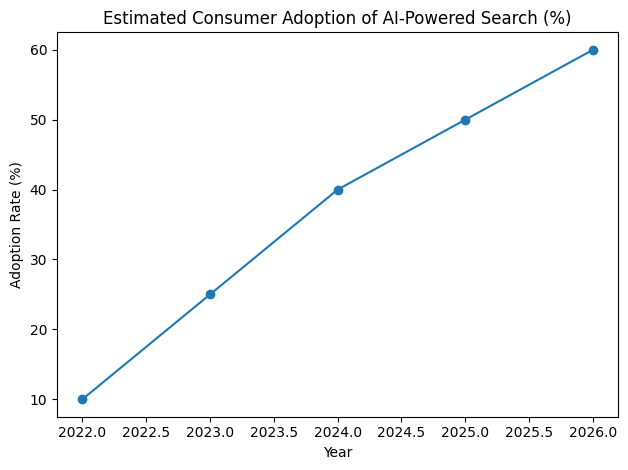
| Consumers using AI-powered search | ~50% of consumers | McKinsey |
| Monthly ChatGPT users | Over 550 million mobile users | DataReportal |
| Daily ChatGPT search queries | ~37.5 million searches per day | ExplodingTopics |
| Marketing professionals using generative AI in SEO | 56% adoption | MarketingLTB |
| Users of Google AI Overview features | ~2 billion | SEOMator |
These numbers demonstrate that AI is quickly becoming a major gateway to information discovery, creating a new marketing channel that businesses must optimize for.
Additionally, AI-generated summaries are significantly changing click behavior. When AI-generated answers appear in search results, websites experience an average 34.5% lower click-through rate, because users often get the answer directly without visiting a website.
This shift has accelerated demand for agencies capable of optimizing content specifically for AI visibility.
The Relationship Between GEO and Generative Search Engines
Generative search engines function differently from traditional search engines. Instead of ranking pages based on keywords and links, AI systems:
- Retrieve relevant information from multiple sources
- Analyze context and semantic relationships
- Synthesize information into a conversational answer
To influence these outputs, GEO agencies optimize content in ways that improve machine comprehension and citation probability.
The table below highlights the key differences between traditional search optimization and GEO strategies.
| Optimization Approach | Goal | Output Type | Platforms |
|---|---|---|---|
| Traditional SEO | Rank web pages | List of links | Google, Bing |
| Answer Engine Optimization (AEO) | Voice assistant answers | Voice responses | Alexa, Siri |
| Generative Engine Optimization (GEO) | Appear in AI-generated responses | Conversational summaries | ChatGPT, Gemini, Perplexity |
Sources describe GEO as the process of positioning a brand so that AI platforms “cite, recommend, or mention” it in generated answers.
Core Responsibilities of a GEO Agency
A GEO agency performs multiple technical and strategic functions designed to increase the likelihood that AI systems reference a brand’s content.
AI Search Visibility Strategy
A GEO agency begins by analyzing how AI systems retrieve information. This includes studying:
- Conversational search queries
- Question-based prompts
- AI content retrieval patterns
The agency then builds strategies to align a brand’s content with these query formats.
Example:
If users ask ChatGPT:
“Which project management software is best for startups?”
A GEO agency would ensure the company’s content clearly answers that question with structured, factual information so that the AI system can reference it.
Structured Content Optimization
Generative AI models prefer content that is:
- Structured logically
- Fact-based and authoritative
- Easy to extract and summarize
Typical optimization methods include:
- Clear definitions
- Question-and-answer formats
- Lists and tables
- Structured data markup
This structure allows AI models to quickly extract reliable information during response generation.
Entity and Knowledge Graph Optimization
Generative engines rely heavily on entities—clearly defined concepts such as companies, products, or people.
A GEO agency strengthens these signals by ensuring:
- Consistent brand mentions across authoritative sites
- Presence in knowledge graphs and structured databases
- Accurate company metadata
Research on generative search indicates that AI engines strongly favor authoritative third-party sources and earned media when generating answers.
As a result, GEO agencies often combine PR, brand authority building, and structured content optimization.
How GEO Agencies Improve AI Citation Probability
Generative AI systems typically select only a small number of sources to cite when generating answers. Therefore, GEO agencies optimize content to maximize citation probability.
The process typically involves several optimization layers.
| GEO Optimization Layer | Purpose | Example |
|---|---|---|
| Content clarity | Improve AI interpretation | Clear definitions and explanations |
| Semantic optimization | Improve contextual understanding | Entity-rich content |
| Structured formatting | Help AI extract facts | Tables, bullet points |
| Authority signals | Increase trust | Citations, backlinks |
| Data consistency | Improve knowledge graph presence | Consistent brand data |
By optimizing these elements, GEO agencies increase the likelihood that a brand becomes a reference source for AI-generated responses.
Real-World Example of GEO Impact
A well-known example illustrates the potential impact of generative search visibility.
The SaaS tool Tally, a form-building platform, reported that ChatGPT became its number one referral traffic source after optimizing its online presence for generative search discovery.
This case demonstrates that AI-generated answers can drive meaningful traffic and brand exposure when companies successfully position themselves as authoritative sources.
Another important finding from industry research is that AI search results often show only one primary recommendation instead of multiple links, meaning visibility becomes far more concentrated than in traditional search results.
As a result, companies that secure AI citations can gain disproportionately large visibility advantages.
GEO Agency vs Traditional SEO Agency
Although GEO builds upon traditional SEO foundations, their objectives and techniques differ significantly.
| Factor | Traditional SEO Agency | GEO Agency |
|---|---|---|
| Primary goal | Rank pages in search results | Appear in AI-generated answers |
| Key metrics | Rankings, traffic, backlinks | AI mentions, citations, answer inclusion |
| Optimization focus | Keywords and links | Semantic structure and entity recognition |
| Platforms targeted | Google, Bing | ChatGPT, Gemini, Perplexity |
| Content structure | Keyword-focused pages | Fact-rich, machine-readable content |
Traditional SEO remains important, but GEO expands optimization to the AI-generated layer of the internet.
Industries That Are Early Adopters of GEO Agencies
Some industries are adopting GEO strategies faster than others due to their reliance on online research and digital visibility.
| Industry | Reason GEO Matters |
|---|---|
| SaaS | Software comparisons frequently asked to AI assistants |
| E-commerce | AI product recommendations influence purchasing |
| Healthcare | Medical information queries are common in AI search |
| B2B services | AI is widely used for vendor research |
| Education | Students increasingly use AI for research |
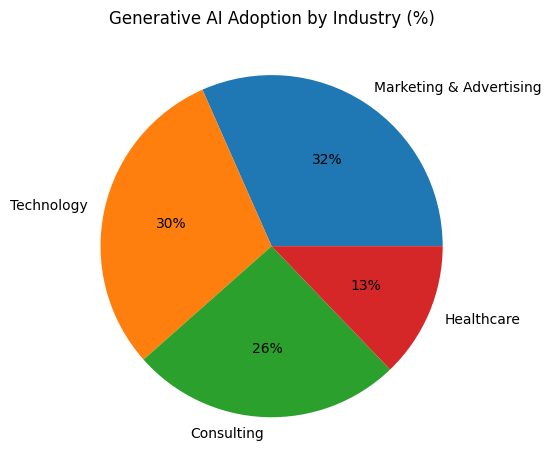
AI adoption is particularly strong in marketing, technology, and consulting sectors, with adoption rates of 37%, 35%, and 30% respectively.
These industries are therefore among the earliest adopters of GEO strategies and agencies.
The Strategic Value of GEO Agencies for Businesses
The value of GEO agencies lies in their ability to help brands adapt to a fundamental shift in digital discovery.
Key benefits include:
- Increased visibility in AI-generated answers
- Higher brand credibility through AI citations
- Early competitive advantage in emerging search channels
- Protection against declining traditional search traffic
With AI search expected to influence hundreds of billions of dollars in revenue by 2028, many organizations now consider generative search optimization a strategic priority.
As AI assistants become a primary gateway to information, GEO agencies are positioned to play a central role in helping businesses remain visible, authoritative, and competitive in the evolving search ecosystem.
2. What Is Generative Engine Optimization (GEO)
Definition and Core Principles of Generative Engine Optimization
Generative Engine Optimization (GEO) is a digital marketing and content optimization discipline focused on improving a brand’s visibility within AI-generated answers produced by large language models and generative search engines. These platforms include ChatGPT, Google Gemini, Perplexity, Microsoft Copilot, and Google AI Overviews. GEO involves structuring content so that these AI systems can retrieve, understand, synthesize, and cite it when generating responses to user queries.
Unlike traditional search engines that display ranked lists of links, generative search engines create direct, conversational answers based on information gathered from multiple sources. As a result, the goal of GEO is not simply ranking pages but ensuring that a website’s information becomes part of the generated answer itself.
From a technical perspective, GEO optimizes for how AI systems process information. Instead of prioritizing keywords alone, it emphasizes:
- Semantic meaning and context
- Structured data and factual clarity
- Entity recognition
- Source credibility and authority
These elements allow AI models to confidently incorporate a source into their synthesized responses.
The Evolution from Traditional SEO to GEO
Search technology has undergone several major transformations over the past two decades. GEO represents the next stage in this evolution, driven by the emergence of generative AI search.
| Era of Search | Primary Technology | User Experience | Optimization Strategy |
|---|---|---|---|
| Early Search (2000–2010) | Keyword search engines | Link-based results | Basic SEO |
| Semantic Search (2010–2020) | Intent-based algorithms | Featured snippets and knowledge panels | Advanced SEO |
| Conversational Search (2020–present) | Voice assistants and AI chatbots | Direct spoken answers | AEO (Answer Engine Optimization) |
| Generative Search (2023 onward) | Large language models and AI summaries | Synthesized AI responses | GEO |
Generative search engines infer user intent and synthesize information rather than simply matching keywords to documents. This fundamental change requires a new optimization strategy tailored to AI-driven information retrieval systems.
Academic research confirms that generative search systems fundamentally shift information discovery by producing citation-based answers generated from multiple sources, which challenges traditional search optimization practices.
Why GEO Matters in the Age of AI Search
The rapid growth of AI-powered search platforms is the primary reason GEO is gaining attention among marketers and businesses.
Key statistics illustrate the scale of this transformation:
| Metric | Data | Source |
|---|---|---|
| Global generative AI adoption | 16.3% of the world’s population | Microsoft AI Economy Institute |
| Consumers using AI-powered search | ~50% | McKinsey |
| ChatGPT mobile users | 550 million monthly | DataReportal |
| Daily prompts sent to ChatGPT | 2.5 billion requests | The Verge |
| AI Overviews appearing in Google results | 47% of queries | SEO.com |
| Searches completed without clicking links | ~60% | SEO.com |
These numbers show that the search ecosystem is gradually moving toward AI-mediated information delivery, where users receive direct answers rather than browsing multiple websites.
This shift creates a new visibility challenge:
If a company’s information is not selected by AI systems as a reliable source, it may never reach the user.
How Generative Search Engines Work
Generative search engines operate through a multi-stage pipeline that combines traditional retrieval systems with generative AI models.
Information Retrieval Stage
AI systems first retrieve relevant documents from the web or internal knowledge databases.
Inputs include:
- Web pages
- Structured knowledge graphs
- Public datasets
- News articles and authoritative sources
Context Analysis and Reasoning
Large language models analyze retrieved information to understand:
- Context and meaning
- Source credibility
- Entity relationships
Answer Generation
The system then synthesizes the information into a single coherent response, often including citations to supporting sources.
This process differs from traditional search engines, which primarily rank existing pages rather than generate new content.
Academic studies analyzing millions of AI search outputs confirm that generative systems prioritize authoritative third-party sources and structured content during response generation.
Key Components of GEO Strategy
Effective GEO strategies typically combine several optimization techniques that improve how AI systems interpret and cite content.
Semantic Content Optimization
AI models prioritize meaning and context rather than simple keyword frequency.
Effective content typically includes:
- Clear definitions
- Concept explanations
- Contextual relationships between ideas
Example:
Instead of targeting a keyword like “best CRM software,” GEO-optimized content might answer structured questions such as:
- What is CRM software?
- How does CRM software help small businesses?
- Which CRM platforms are best for startups?
This structure makes the information easier for AI models to summarize.
Structured Information Architecture
AI systems extract information more easily when content is organized logically.
Common GEO structures include:
- Tables
- Lists
- Definitions
- FAQ sections
- Comparison matrices
Example comparison structure used in GEO-optimized content:
| CRM Platform | Key Feature | Best For |
|---|---|---|
| HubSpot | Free CRM and automation | Startups |
| Salesforce | Advanced enterprise features | Large enterprises |
| Zoho CRM | Affordable automation | Small businesses |
Tables like this allow AI models to extract and summarize information quickly.
Entity Optimization
Entities are uniquely identifiable concepts such as companies, products, people, or technologies.
Generative search engines rely heavily on entity recognition to determine credibility.
Example entity signals include:
- Wikipedia pages
- Structured organization data
- Consistent brand mentions across websites
The stronger the entity signal, the more likely AI systems are to recognize the brand as a credible source.
Authority and Source Credibility
Generative search engines prioritize high-trust sources when generating answers.
Research analyzing AI search citations found that certain platforms dominate AI responses:
| Website Type | Citation Share in AI Responses |
|---|---|
| Community forums (e.g., Reddit) | 40.1% |
| Knowledge sources (Wikipedia) | 26.3% |
| Video platforms (YouTube) | 23.5% |
| Search engines and others | ~23% |
This distribution highlights how AI systems rely heavily on trusted and widely referenced sources.
GEO Optimization Matrix
A useful way to understand GEO is through a strategic optimization matrix that aligns content strategy with AI search behavior.
| Optimization Layer | Objective | Implementation Method |
|---|---|---|
| Content clarity | Improve AI comprehension | Clear definitions and explanations |
| Semantic relationships | Enhance contextual relevance | Topic clusters and entity linking |
| Structured formatting | Improve machine readability | Tables, lists, FAQs |
| Authority signals | Increase credibility | Citations, backlinks, brand mentions |
| Data consistency | Strengthen entity recognition | Schema markup and knowledge graph presence |
This multi-layered approach allows businesses to influence how generative AI systems retrieve and reproduce information.
Real-World Example of GEO in Practice
Consider a user asking an AI assistant:
“Which project management tool is best for remote teams?”
A generative search engine may analyze dozens of sources and produce an answer such as:
“Popular project management tools for remote teams include Asana, Trello, and Monday.com because they support task collaboration, workflow automation, and team communication.”
For a brand like Monday.com to appear in this answer, its content must:
- Clearly describe its features
- Provide structured comparisons
- Be referenced across authoritative websites
If the brand’s information is optimized effectively, it becomes a probable source for AI-generated responses.
GEO vs SEO vs AEO Comparison Matrix
Understanding GEO requires comparing it with other search optimization frameworks.
| Strategy | Target Platform | Output Format | Optimization Focus |
|---|---|---|---|
| SEO | Traditional search engines | Ranked web pages | Keywords and backlinks |
| AEO | Voice assistants | Direct spoken answers | Structured Q&A |
| GEO | Generative AI engines | Conversational summaries | Semantic clarity and entity authority |
While SEO remains essential for traditional search visibility, GEO expands optimization to the AI-generated information layer of the web.
Strategic Importance of GEO for Businesses
Generative search is expected to influence hundreds of billions of dollars in digital commerce and information discovery.
According to McKinsey research, AI-powered search could affect approximately $750 billion in revenue by 2028, highlighting the economic impact of this technology shift.
Businesses that implement GEO strategies early gain several advantages:
- Higher probability of AI citations
- Increased brand credibility in AI responses
- Visibility in emerging search channels
- Protection against declining organic click-through rates
As AI continues to reshape online discovery, Generative Engine Optimization is increasingly viewed as the next major evolution of search marketing, complementing traditional SEO strategies while addressing the growing dominance of generative AI search systems.
3. How a GEO Agency Works
Overview of the GEO Operational Framework
A GEO agency operates by aligning a company’s digital presence with how generative AI search systems retrieve, analyze, and synthesize information. Instead of optimizing purely for rankings in search engines, GEO strategies aim to make a brand discoverable, interpretable, and cite-worthy within AI-generated responses.
Generative search engines such as ChatGPT, Google AI Overviews, and Perplexity operate using a pipeline that typically includes retrieval, analysis, and answer generation. GEO agencies optimize each stage of this pipeline to maximize the probability that a brand’s content is incorporated into the generated response.
The rise of these systems explains why GEO has become important. Research shows that half of consumers already use AI-powered search tools, and AI-mediated discovery could influence about $750 billion in revenue by 2028.
Because these platforms synthesize answers rather than display links, GEO agencies must optimize content for machine understanding, trust, and contextual relevance.
The Generative Search Pipeline
To understand how a GEO agency works, it is helpful to analyze how generative search engines operate internally.
| Stage of AI Search | Description | Optimization Role of GEO Agency |
|---|---|---|
| Retrieval | AI retrieves relevant documents or knowledge sources | Ensure brand content appears in candidate sources |
| Context interpretation | AI analyzes semantic meaning and credibility | Optimize clarity, entities, and factual accuracy |
| Answer synthesis | AI generates a response using selected sources | Increase likelihood of brand citation |
Generative engine optimization focuses on improving visibility within this pipeline by ensuring content is easy for AI models to retrieve and interpret.
Academic research on generative search systems confirms that these pipelines combine web-scale retrieval with large language model generation, meaning content structure and credibility strongly influence visibility.
Step-by-Step Workflow of a GEO Agency
Most GEO agencies follow a structured workflow to implement AI search optimization strategies.
AI Query and Prompt Research
The first stage focuses on understanding how users interact with AI assistants.
Instead of simple keyword research, GEO agencies analyze:
- Conversational queries
- Long-form questions
- Multi-step prompts used in AI chats
Example AI prompt:
“Which accounting software is best for small e-commerce businesses?”
A GEO agency studies how AI systems respond to such prompts and identifies the sources and patterns used in responses.
This allows agencies to map AI-query intent clusters.
| Query Type | Example | Optimization Approach |
|---|---|---|
| Informational | What is CRM software? | Definition-based content |
| Comparative | HubSpot vs Salesforce | Structured comparison tables |
| Transactional | Best CRM for startups | Product recommendation content |
By aligning content with common AI prompts, GEO agencies increase the likelihood of inclusion in generated answers.
Content Structuring for AI Readability
Generative AI models extract information most effectively from structured, clearly organized content.
Therefore, GEO agencies redesign content using formats that facilitate AI extraction.
Typical structures include:
- Definition sections
- FAQs
- bullet lists
- comparison tables
- structured headings
Example structured information table:
| Project Management Tool | Key Strength | Ideal Use Case |
|---|---|---|
| Asana | Workflow automation | Medium teams |
| Trello | Visual kanban boards | Small teams |
| Monday.com | Custom dashboards | Large organizations |
This type of structured content enables AI systems to summarize key points accurately during response generation.
Generative optimization research shows that structural signals such as schema markup and organized content significantly improve retrieval and ranking in AI pipelines.
Authority and Source Credibility Building
Generative AI systems prioritize trusted and authoritative sources when generating answers.
GEO agencies therefore invest heavily in building authority signals across the web.
These signals include:
- backlinks from authoritative domains
- brand mentions across credible websites
- consistent entity references
- structured knowledge graph presence
Authority signals help AI systems determine whether a source should be considered reliable enough to incorporate into answers.
This step is critical because generative engines often cite only a small number of sources when producing a response.
Entity and Knowledge Graph Optimization
Modern AI systems rely heavily on entity recognition to understand the web.
Entities represent identifiable concepts such as:
- companies
- products
- technologies
- people
GEO agencies ensure brands are clearly represented as entities across the internet.
This involves:
- consistent brand naming
- schema markup implementation
- presence in knowledge databases
Example entity signals:
| Entity Signal | Example Platform | Impact |
|---|---|---|
| Knowledge graph entries | Wikidata | Improves AI recognition |
| Structured schema data | Schema.org markup | Improves machine interpretation |
| Authoritative profiles | Wikipedia, Crunchbase | Increases credibility |
By strengthening entity recognition, GEO agencies improve the likelihood that AI models treat a brand as a valid knowledge source.
AI Response Testing and Monitoring
Another critical part of GEO operations involves monitoring how AI systems respond to queries.
Agencies regularly test prompts across multiple AI platforms:
- ChatGPT
- Gemini
- Perplexity
- Microsoft Copilot
Example monitoring process:
| Query | AI Response | Brand Mentioned | Optimization Needed |
|---|---|---|---|
| Best HR software for startups | Lists BambooHR, Gusto | No | Add comparison content |
| What is employee onboarding software | Definition with examples | Yes | Improve citations |
| Top payroll tools for SMEs | Multiple SaaS brands | Partial | Increase authority |
This testing process allows GEO agencies to measure AI visibility and citation frequency.
Data and Performance Measurement
Unlike traditional SEO, GEO success is not measured primarily by rankings.
Instead, agencies track metrics such as:
- AI brand mentions
- AI citation frequency
- inclusion in AI summaries
- AI referral traffic
Recent research indicates that 68.9% of websites now receive some level of traffic from AI platforms, highlighting the growing importance of this channel.
Another study shows that AI-generated summaries can reduce organic click-through rates by about 34.5%, demonstrating why businesses must adapt their visibility strategies.
GEO Strategy Matrix
A typical GEO strategy combines multiple optimization layers simultaneously.
| Optimization Layer | Goal | Implementation |
|---|---|---|
| Content clarity | Improve AI comprehension | Structured explanations |
| Semantic relevance | Improve contextual understanding | Topic clusters |
| Authority signals | Increase trust | Digital PR and backlinks |
| Entity recognition | Improve brand recognition | Knowledge graph optimization |
| Structured formatting | Improve machine extraction | Tables, FAQs, bullet lists |
These layers collectively improve the probability that AI systems will retrieve and cite a brand during answer generation.
Example: How a GEO Agency Optimizes a SaaS Company
Consider a SaaS company offering time-tracking software.
A GEO agency might implement the following strategy.
AI Query Mapping
Common AI prompts:
- “What is the best time tracking software for remote teams?”
- “How does time tracking software improve productivity?”
Content Optimization
Create structured pages including:
- product comparison tables
- definition sections
- FAQ blocks
Authority Building
Acquire mentions on:
- technology publications
- SaaS directories
- industry blogs
AI Testing
Run prompts across ChatGPT and Gemini to measure brand presence.
Over time, this process increases the likelihood that the SaaS brand is mentioned in AI-generated recommendations.
Strategic Impact of GEO Agency Operations
The work performed by GEO agencies directly addresses the rapid transformation of digital search behavior.
Key market trends include:
| Trend | Data |
|---|---|
| Consumers using AI search | ~50% |
| AI Overviews users | 1.5 billion monthly |
| Growth rate of AI industry | 36.6% annually |
As AI search continues expanding, businesses must optimize not only for search engines but also for generative answer systems.
GEO agencies provide the expertise required to align content, authority signals, and brand entities with the new architecture of AI-driven information discovery, ensuring businesses remain visible in the evolving search ecosystem.
4. Core Services Offered by a GEO Agency
Overview of GEO Agency Service Architecture
A GEO (Generative Engine Optimization) agency provides specialized services designed to improve a brand’s visibility within AI-generated answers produced by generative search platforms such as ChatGPT, Google AI Overviews, Gemini, and Perplexity. Instead of focusing only on search engine rankings, GEO services ensure that a company’s knowledge, products, or expertise are retrieved, synthesized, and cited by AI systems when answering user questions.
The demand for these services is rapidly increasing due to the growth of AI-powered discovery. Research from McKinsey shows that about 50% of consumers already use AI-powered search tools, and by 2028 these systems could influence approximately $750 billion in revenue.
At the same time, AI-driven search behavior is creating new challenges. Around 93% of AI search sessions end without users clicking a website link, which means appearing directly in AI-generated answers is becoming more important than traditional ranking.
To address these changes, GEO agencies provide a comprehensive set of services that combine technical optimization, structured content strategy, brand authority development, and AI visibility analytics.
AI Visibility Audits and GEO Readiness Assessments
A foundational service offered by GEO agencies is the AI visibility audit, which evaluates whether a brand’s digital presence is understandable and retrievable by generative AI systems.
These audits typically analyze several components:
- website architecture and machine readability
- structured data and schema implementation
- brand entity recognition across the web
- content clarity and factual reliability
- authority signals such as citations and backlinks
AI readiness assessments are designed to identify weaknesses in how generative systems interpret a brand’s information. For example, agencies examine whether AI platforms recognize the company as an entity and whether its content is structured in ways that facilitate extraction and summarization.
Typical audit outputs include:
| Audit Category | Key Metrics Evaluated | Strategic Outcome |
|---|---|---|
| Content structure | Heading hierarchy, definitions, structured sections | Improved machine readability |
| Entity signals | Brand mentions, knowledge graph presence | Stronger AI recognition |
| Authority signals | Backlinks, citations, industry references | Higher trust scores |
| Retrieval strength | Indexation and discoverability | Increased probability of AI citation |
By identifying gaps in AI accessibility, GEO agencies can design targeted optimization strategies.
AI-Optimized Content Strategy and Creation
One of the most important services GEO agencies provide is content engineering for generative AI systems. Traditional SEO content often focuses on keyword placement and ranking signals, whereas GEO content is designed to be machine-readable, contextually rich, and easy for AI models to summarize.
Key GEO content strategies include:
- structured question-and-answer content
- definition-based educational pages
- comparison matrices and data tables
- fact-rich explanatory sections
- semantic topic clusters
Research on generative search shows that AI engines rely heavily on clear, structured information extracted from authoritative sources when generating answers.
Example of GEO-optimized content structure:
| Content Component | Purpose for AI Systems | Example |
|---|---|---|
| Definitions | Provide clear conceptual understanding | “What is cloud computing?” |
| FAQ sections | Match conversational prompts | “How does cloud computing reduce costs?” |
| Comparison tables | Enable quick summarization | AWS vs Azure vs Google Cloud |
| Lists and bullet points | Improve extraction accuracy | Key benefits or features |
Example scenario:
If a user asks an AI assistant:
“What is the best CRM software for startups?”
A GEO-optimized article containing structured comparisons and clearly defined product features is more likely to be referenced in the AI’s answer.
Structured Data and Technical GEO Optimization
Technical optimization is another core GEO service. Generative AI systems rely heavily on structured data and consistent information architecture to interpret web content.
Therefore, GEO agencies often implement:
- schema markup (structured metadata)
- semantic HTML structure
- entity linking and metadata enrichment
- knowledge graph integration
Structured data helps AI systems understand relationships between entities, such as companies, products, and technologies.
Example schema optimization matrix:
| Technical Component | GEO Objective | Implementation Method |
|---|---|---|
| Schema markup | Improve machine interpretation | Schema.org structured data |
| Entity linking | Connect brand to related concepts | Wikidata references |
| Metadata consistency | Improve AI retrieval accuracy | Standardized business data |
| Structured navigation | Improve content discoverability | Logical information hierarchy |
Agencies also optimize site architecture to ensure AI retrieval systems can easily access and understand key information.
Authority Building and Earned Media Strategy
Another essential GEO service involves strengthening brand authority across the web.
Research analyzing generative search systems found that AI engines tend to prioritize third-party authoritative sources and earned media when selecting information for generated responses.
To improve AI credibility signals, GEO agencies implement authority-building strategies such as:
- digital PR campaigns
- expert citations and thought leadership
- industry directory listings
- academic or research references
Example authority signal matrix:
| Authority Signal | Platform Example | GEO Benefit |
|---|---|---|
| Editorial mentions | Tech publications | Increased AI trust |
| Knowledge bases | Wikipedia or Wikidata | Entity recognition |
| Community discussions | Forums and expert platforms | Expanded visibility |
| Research references | Academic or industry reports | Stronger credibility signals |
Authority signals help generative systems determine which sources are trustworthy enough to incorporate into AI-generated responses.
AI Query Research and Prompt Optimization
Traditional SEO research focuses on keyword volumes, but GEO agencies analyze AI prompts and conversational queries.
These prompts are typically longer and more contextual than traditional search queries.
Examples of prompt categories:
| Prompt Type | Example | Optimization Approach |
|---|---|---|
| Informational | What is generative AI? | Definition-based content |
| Comparative | ChatGPT vs Gemini | Comparison tables |
| Recommendation | Best HR software for startups | Product ranking guides |
| Instructional | How to implement zero-trust security | Step-by-step guides |
By mapping these prompts, GEO agencies can design content that directly aligns with how users interact with AI assistants.
AI Response Monitoring and Citation Tracking
Another critical GEO service is monitoring how AI systems mention or reference brands.
Unlike traditional SEO metrics such as rankings, GEO agencies track visibility inside AI-generated answers.
Typical performance indicators include:
- AI brand mentions
- AI citation frequency
- presence in AI summaries
- referral traffic from AI platforms
Example monitoring dashboard:
| Query | AI Platform | Brand Mention | Citation Source |
|---|---|---|---|
| Best email marketing software | ChatGPT | Yes | Brand blog |
| CRM for startups | Perplexity | No | Competitor article |
| What is generative AI | Gemini | Partial | Industry report |
These insights allow agencies to refine optimization strategies continuously.
GEO Analytics and Performance Measurement
Measuring GEO performance requires a different approach compared to traditional SEO.
Instead of ranking metrics, agencies analyze AI exposure metrics and brand discovery patterns.
Important GEO metrics include:
- AI citation share
- AI answer inclusion rate
- AI referral traffic growth
- brand visibility in AI summaries
Data suggests that AI referral traffic is increasing steadily across industries, with roughly 1% month-over-month growth in AI-driven website referrals.
This growth indicates that AI search is rapidly becoming a new digital acquisition channel.
GEO Strategy Integration with Traditional SEO
Most GEO agencies also integrate their services with traditional SEO strategies. GEO does not replace SEO but extends it into AI-driven discovery environments.
Integration model:
| Strategy Layer | Objective | Example Implementation |
|---|---|---|
| SEO | Rank in search results | Keyword optimization |
| GEO | Appear in AI answers | Structured knowledge content |
| AEO | Voice assistant responses | Conversational Q&A |
By combining these layers, brands can maintain visibility across both traditional search engines and emerging AI search platforms.
Example: GEO Services Applied to a SaaS Company
Consider a SaaS company offering employee onboarding software.
A GEO agency might deliver the following services:
AI prompt research
Identify common AI queries such as:
- “What is employee onboarding software?”
- “Which onboarding tools are best for remote teams?”
Content optimization
Create structured articles including:
- onboarding software comparisons
- feature tables
- use-case explanations
Authority building
Secure mentions in:
- HR technology publications
- SaaS review platforms
- industry research reports
AI monitoring
Track whether AI assistants recommend the software when users ask relevant questions.
Through this process, the SaaS company improves the likelihood that AI systems recommend its product directly in generated responses.
Strategic Value of GEO Agency Services
The rise of AI-driven search is transforming digital discovery and marketing strategies. Generative engines are gradually replacing traditional link-based search experiences with synthesized answers drawn from multiple sources.
Because these systems often display only a small number of sources in generated responses, the companies that achieve AI visibility can gain disproportionate exposure compared with competitors.
By combining technical optimization, structured content engineering, authority development, and AI analytics, GEO agencies help businesses adapt to the new architecture of search—where visibility depends not only on ranking pages but also on becoming a trusted source for AI-generated knowledge.
5. Why Businesses Need a GEO Agency in 2026
The Transformation of Digital Discovery
The global digital discovery ecosystem is undergoing one of the most significant transformations since the birth of search engines. Traditionally, businesses relied on search engine optimization (SEO) to rank their websites in Google or Bing search results. However, the rapid growth of generative AI search systems—such as ChatGPT, Google AI Overviews, and Perplexity—has fundamentally changed how users find information online.
Instead of browsing through multiple links, users increasingly receive direct AI-generated answers synthesized from multiple sources. This shift means that visibility now depends not only on ranking on search engines but also on being cited or referenced by AI systems.
According to research from McKinsey, about 50% of consumers already use AI-powered search tools, and the economic impact of this new search model could influence around $750 billion in revenue by 2028.
For businesses, this transformation means that traditional SEO alone is no longer sufficient. Organizations now require specialized expertise to optimize their presence within AI-driven search environments, which is why GEO agencies are becoming essential partners.
Rapid Adoption of AI-Driven Search Behavior
One of the main reasons businesses need a GEO agency is the rapid adoption of AI across the digital ecosystem. Generative AI tools are now integrated into everyday workflows, research, and purchasing decisions.
Key adoption statistics illustrate this trend:
| Metric | Data | Source |
|---|---|---|
| Consumers using AI-powered search | ~50% of consumers | McKinsey |
| Organizations using generative AI in business functions | 65% of companies | McKinsey |
| Companies using generative AI tools in 2025 | 91% of firms | RSM survey |
| Organizations using AI in marketing and operations | 88% of organizations | McKinsey |
This widespread adoption indicates that generative AI has quickly moved from experimental technology to a core component of business and consumer behavior. Businesses that fail to adapt their visibility strategies risk losing exposure as AI increasingly mediates how people discover information.
AI Search Is Reshaping the Customer Journey
Generative AI is influencing nearly every stage of the modern customer journey, from initial research to final purchasing decisions.
Studies show that consumers now use AI tools to:
- learn about product categories
- compare competing products
- understand technical specifications
- receive personalized recommendations
In fact, 73% of consumers use AI to learn about products or services, while 61% use AI to compare products, demonstrating how AI tools are becoming a key research channel.
This shift means that when potential customers ask AI systems questions such as:
- “What is the best CRM software for startups?”
- “Which cybersecurity platform is best for small businesses?”
- “Top marketing automation tools for SaaS companies”
The AI system generates answers using only a small set of trusted sources. If a brand is not included in those sources, it may be invisible to potential customers during critical decision-making stages.
GEO agencies help businesses position their content so that AI systems recognize and cite their information during these queries.
Declining Effectiveness of Traditional Search Visibility
Another reason businesses require GEO expertise is the declining effectiveness of traditional organic search strategies.
AI-generated search summaries are changing how users interact with search results. Multiple studies show that AI-generated answers can significantly reduce website traffic from traditional search results.
Research indicates that AI-generated summaries can cause organic traffic declines ranging from 15% to 64% depending on the query type.
Additionally, AI-generated search features are appearing in an increasing share of queries:
| AI Search Trend | Data |
|---|---|
| Global Google searches displaying AI summaries | ~18% |
| AI Overviews monthly users | ~1.5 billion |
| Projected share of AI summaries in search by 2028 | Over 75% |
These developments indicate that traditional ranking strategies are gradually becoming less effective, because users often obtain answers directly from AI interfaces rather than visiting websites.
A GEO agency helps businesses adapt to this shift by ensuring their information becomes part of the AI-generated answers themselves.
Competitive Advantage in AI-Driven Markets
The transition toward generative search is creating a new competitive landscape in which only a few sources may appear within AI responses.
Academic research analyzing generative search results shows that AI systems rely heavily on authoritative third-party sources and structured information when generating answers.
Because AI responses often cite only a small number of sources, brands that achieve AI visibility can gain disproportionate exposure.
The competitive dynamics of AI search can be summarized in the following matrix:
| Visibility Channel | Number of Brands Visible | Competitive Intensity |
|---|---|---|
| Traditional search results | 10+ results per page | Moderate |
| Featured snippets | 1 primary source | High |
| AI-generated answers | 1–3 cited sources | Extremely high |
This concentration of visibility means that companies that optimize for AI citation early may secure long-term advantages in digital discovery.
Increasing Market Impact of Generative AI
The economic implications of generative AI further highlight why businesses must prioritize GEO strategies.
McKinsey estimates that generative AI could add between $2.6 trillion and $4.4 trillion annually to the global economy across multiple industries.
This scale of economic transformation indicates that AI will not only change technology but also reshape marketing, commerce, and information discovery.
As AI becomes a primary gateway to digital information, brands that optimize for AI visibility will be better positioned to capture emerging market opportunities.
Avoiding the AI Discovery Gap
One of the emerging risks for businesses is what researchers describe as the AI discovery gap—the difference between a company being known by name versus being discovered through AI queries.
Research testing thousands of queries across large language models found that when users asked for general recommendations, many companies failed to appear in AI responses even if they were well-known within their industries.
This means that a product or service may exist online but remain invisible during AI-driven discovery queries such as:
- “Best accounting tools for freelancers”
- “Top cybersecurity platforms for startups”
- “Recommended marketing automation software”
GEO agencies help businesses bridge this discovery gap by optimizing their content and authority signals so that AI systems recognize them as relevant solutions.
Strategic Benefits of Hiring a GEO Agency
Organizations that partner with GEO agencies gain several strategic advantages in the evolving search ecosystem.
Key benefits include:
- improved visibility in AI-generated answers
- stronger authority signals recognized by AI models
- structured content optimized for machine interpretation
- improved brand recognition across knowledge graphs
These advantages help companies remain competitive as AI becomes a dominant channel for information discovery.
The strategic value can be summarized in the following framework:
| Business Objective | GEO Agency Contribution |
|---|---|
| Brand discovery | Increase AI citations |
| Customer acquisition | Improve AI recommendation visibility |
| Digital authority | Build entity recognition |
| Future readiness | Adapt marketing strategies to AI search |
Preparing for the Future of AI-Driven Search
The rise of generative search is not a temporary trend but a structural shift in how information is discovered and consumed online. AI platforms are evolving into primary gateways to knowledge, product research, and decision-making.
As more users rely on AI assistants instead of traditional search engines, businesses must adapt their digital strategies to ensure their expertise remains visible.
A GEO agency provides the specialized knowledge required to navigate this transition by aligning a company’s content, authority signals, and technical infrastructure with the emerging architecture of AI-driven search ecosystems.
Organizations that invest in GEO strategies today are better positioned to maintain digital visibility, capture new customer opportunities, and remain competitive in the rapidly evolving landscape of AI-powered information discovery.
6. Industries That Benefit Most from GEO Agencies
Overview of Industry Adoption of Generative AI and GEO
Generative Engine Optimization (GEO) has become increasingly relevant as artificial intelligence transforms how people discover information, products, and services online. Since generative search engines synthesize answers from multiple sources, industries that rely heavily on digital discovery, research-driven purchasing decisions, and online authority signals benefit the most from GEO strategies.
The impact of generative AI across industries is already substantial. Research suggests that generative AI could contribute between $2.6 trillion and $4.4 trillion annually to the global economy, highlighting the scale of transformation across sectors.
Adoption patterns show that some industries are embracing AI-driven marketing and discovery faster than others. For example:
| Industry | Generative AI Adoption Rate | Source |
|---|---|---|
| Marketing & Advertising | 37% | |
| Technology | 35% | |
| Consulting & Professional Services | 30% | |
| Healthcare | 15% |
Industries with strong digital ecosystems and knowledge-driven customer journeys typically gain the most value from GEO agencies because their customers frequently rely on AI search tools for research and recommendations.
SaaS and Technology Companies
Software-as-a-Service (SaaS) and technology firms are among the earliest adopters of GEO strategies. These companies operate in highly competitive digital markets where customers frequently rely on online research before purchasing software solutions.
The SaaS purchasing journey typically includes multiple stages:
- problem identification
- product comparison
- feature analysis
- pricing evaluation
- vendor selection
AI search engines increasingly influence these stages by generating product comparisons and recommendations.
Example AI query scenarios:
- “Best CRM software for startups”
- “Top project management tools for remote teams”
- “Which cybersecurity platform is best for small businesses?”
If a SaaS product appears in AI-generated recommendations, it gains significant visibility.
Technology companies already derive substantial value from generative AI. Studies indicate that the technology sector is among the industries generating the highest business value from generative AI deployments.
Typical GEO opportunities in the SaaS industry include:
| GEO Strategy | Application |
|---|---|
| Product comparison content | AI-friendly software comparisons |
| Feature breakdown tables | Structured feature explanations |
| Knowledge base optimization | Technical documentation |
| API and developer content | Structured technical references |
These strategies increase the likelihood that AI systems cite SaaS products in generated recommendations.
E-Commerce and Retail
E-commerce businesses benefit greatly from GEO because AI search engines increasingly act as product discovery assistants.
Generative AI can personalize product recommendations by analyzing user preferences, past behavior, and search context.
Customers now frequently ask AI systems questions such as:
- “Best noise-cancelling headphones under $300”
- “Top running shoes for marathon training”
- “Affordable standing desks for home offices”
Instead of browsing multiple websites, users may receive a summarized list of recommended products generated by AI.
This shift creates new optimization opportunities for retailers.
Example GEO content structures used in e-commerce:
| Content Type | GEO Advantage |
|---|---|
| Product comparison tables | AI summarization-friendly format |
| Buying guides | Supports recommendation queries |
| Feature breakdown lists | Structured product attributes |
| FAQ sections | Matches conversational AI prompts |
Retailers that optimize product information and buying guides for generative search can increase their visibility within AI-generated product recommendations.
Healthcare and Life Sciences
Healthcare and pharmaceutical sectors are another industry where GEO strategies are becoming increasingly valuable.
Healthcare information queries are among the most common questions users ask AI assistants. Patients frequently search for information about:
- symptoms and conditions
- treatment options
- medications
- healthcare providers
Healthcare organizations have already begun implementing generative AI technologies to improve communication, diagnosis support, and patient engagement.
Generative AI is also transforming pharmaceutical research and development by accelerating data analysis and hypothesis generation across drug discovery pipelines.
For healthcare providers and health technology companies, GEO strategies often include:
| GEO Application | Healthcare Example |
|---|---|
| Medical knowledge articles | Condition explanations |
| Clinical comparison guides | Treatment options |
| Structured symptom FAQs | Patient education resources |
| Research summaries | Evidence-based medical information |
Because AI systems rely heavily on authoritative sources in medical queries, organizations with high-quality, well-structured medical content are more likely to appear in AI-generated responses.
Financial Services and FinTech
Financial services represent another sector where GEO strategies provide strong benefits.
Consumers often research financial topics through online queries such as:
- “Best investment apps for beginners”
- “How to improve credit score quickly”
- “Top digital banks for small businesses”
AI search assistants increasingly answer these questions by synthesizing financial guidance from trusted sources.
Generative AI is already transforming financial services by improving:
- fraud detection
- risk modeling
- market forecasting
- customer service automation
These technologies enable financial institutions to analyze complex datasets and generate insights that support decision-making.
GEO agencies can help financial institutions optimize educational content such as:
| Content Category | GEO Benefit |
|---|---|
| Investment guides | AI recommendation inclusion |
| Financial education resources | Informational AI queries |
| Product comparisons | Credit cards, banking tools |
| Risk and compliance content | Authority signals |
Because financial advice requires high credibility, strong authority signals significantly improve the probability of AI citation.
B2B Professional Services
Consulting firms, legal services, HR platforms, and other B2B professional services also benefit significantly from GEO.
B2B buyers typically conduct extensive research before selecting vendors. Generative AI tools are increasingly used to answer complex questions about business solutions.
Example queries include:
- “Best HR software for small companies”
- “Top management consulting firms for digital transformation”
- “How to implement ISO compliance in manufacturing”
Generative AI can help businesses improve sales productivity and revenue generation by accelerating decision-making processes across the entire customer journey.
Typical GEO opportunities for B2B service providers include:
| GEO Strategy | B2B Example |
|---|---|
| Thought leadership content | Industry trend reports |
| Educational resources | Implementation guides |
| Case studies | Business transformation stories |
| Expert insights | Consulting frameworks |
These content types strengthen authority signals that AI systems use when selecting credible sources.
Media, Marketing, and Creative Industries
Marketing agencies, publishers, and content platforms were among the earliest adopters of generative AI tools.
According to industry data, marketing and advertising have the highest generative AI adoption rate at 37%, followed closely by the technology sector.
This rapid adoption occurs because generative AI directly affects:
- content creation
- campaign optimization
- customer insights
- audience targeting
Research on AI-powered marketing highlights how AI technologies improve personalization, marketing performance measurement, and customer experience strategies.
For media and marketing companies, GEO strategies typically involve:
| GEO Application | Example |
|---|---|
| Topic authority clusters | Marketing strategy hubs |
| Structured knowledge articles | Definitions and frameworks |
| Data-driven reports | Industry statistics |
| Content optimization | AI-readable insights |
These approaches help content platforms appear in AI-generated explanations about marketing strategies and industry trends.
Cross-Industry GEO Opportunity Matrix
Different industries benefit from GEO depending on how frequently customers rely on research-driven queries before making decisions.
| Industry | AI Search Query Frequency | GEO Impact |
|---|---|---|
| SaaS & Technology | Very high | Product comparisons and recommendations |
| E-commerce & Retail | High | Product discovery |
| Healthcare & Pharma | High | Educational and medical information |
| Finance & FinTech | High | Financial guidance queries |
| B2B Professional Services | Medium to high | Vendor research and expertise discovery |
| Media & Marketing | Medium | Thought leadership visibility |
Industries with complex products, research-driven purchasing decisions, and knowledge-based customer journeys typically experience the greatest benefits from GEO strategies.
Strategic Implications for Businesses
The widespread adoption of generative AI is reshaping how customers discover solutions across multiple industries. AI systems increasingly act as information intermediaries, synthesizing answers from multiple sources instead of directing users to lists of websites.
As a result, industries that depend on digital research and online authority must adapt their marketing strategies to ensure their expertise appears in AI-generated responses.
Organizations that invest in GEO strategies early can:
- strengthen digital authority in AI ecosystems
- increase visibility in generative search results
- improve brand discovery across AI platforms
- gain a competitive advantage in emerging search channels
Because generative AI is already transforming sectors ranging from technology and finance to healthcare and retail, GEO agencies play a critical role in helping businesses adapt to the new landscape of AI-driven information discovery and decision-making.
7. Key Strategies Used by GEO Agencies
Strategic Framework Behind GEO Optimization
Generative Engine Optimization (GEO) agencies implement specialized strategies designed to improve how AI systems retrieve, interpret, and cite brand information within AI-generated answers. Unlike traditional SEO—which primarily focuses on keyword rankings—GEO focuses on ensuring that content becomes part of the knowledge sources AI models rely on when generating responses.
The need for these strategies is driven by the rapid growth of AI search platforms. Studies show that around half of consumers already use AI-powered search tools, and these platforms could influence about $750 billion in revenue by 2028.
Additionally, the adoption of generative AI in marketing is accelerating quickly, with 85% of marketing teams actively using generative AI tools and 63% of marketers prioritizing generative search research strategies.
To address this new search ecosystem, GEO agencies apply several strategic pillars that collectively improve AI visibility.
AI Query and Conversational Prompt Research
Understanding How Users Ask AI Systems Questions
A foundational GEO strategy involves analyzing how users interact with generative AI systems. Unlike traditional search queries, which are typically short keywords, AI prompts are often long, conversational, and context-rich.
Example AI queries include:
- “What is the best CRM software for startups?”
- “How does generative AI improve marketing productivity?”
- “Which project management tool is best for remote teams?”
GEO agencies conduct prompt-based research to identify these patterns and build content strategies around them.
Prompt analysis typically includes:
- conversational search intent
- multi-step questions
- comparative queries
- recommendation queries
Prompt mapping framework:
| Query Type | Example Prompt | GEO Content Strategy |
|---|---|---|
| Informational | What is generative AI? | Definition-based articles |
| Comparative | HubSpot vs Salesforce CRM | Comparison tables |
| Recommendation | Best accounting software for freelancers | Product recommendation lists |
| Instructional | How to automate marketing workflows | Step-by-step guides |
Aligning content with these prompts significantly increases the probability that AI systems select the content as a source for generated answers.
Structured Content Engineering
Optimizing Content for Machine Interpretation
AI models extract and summarize information more effectively when content is structured clearly and logically.
Research on generative search systems shows that machine-scannable content and clear justification signals significantly improve AI visibility.
As a result, GEO agencies restructure content into formats that AI systems can easily parse.
Common structural elements include:
- definitions
- bullet lists
- tables
- FAQs
- step-by-step explanations
Example structured content matrix:
| Structure Type | Purpose | Example |
|---|---|---|
| Definition sections | Clarify concepts | “What is generative engine optimization?” |
| Bullet lists | Highlight key points | Benefits of AI marketing |
| Tables | Enable structured comparisons | CRM tool comparisons |
| FAQs | Match conversational queries | “How does AI improve SEO?” |
Example of AI-friendly comparison content:
| CRM Platform | Key Feature | Best Use Case |
|---|---|---|
| HubSpot | Marketing automation | Startups |
| Salesforce | Enterprise CRM features | Large organizations |
| Zoho CRM | Affordable CRM tools | Small businesses |
These structures help generative AI summarize information accurately when answering user queries.
Topical Authority and Knowledge Graph Optimization
Building Entity Recognition Across the Web
Another critical GEO strategy involves strengthening entity signals.
Entities represent identifiable concepts such as:
- companies
- products
- technologies
- organizations
Generative search systems rely heavily on entity recognition to determine credibility and contextual relevance.
GEO agencies therefore ensure that brand entities appear consistently across authoritative platforms.
Entity optimization strategies include:
- structured data implementation
- knowledge graph entries
- consistent brand references across websites
Entity optimization matrix:
| Entity Signal | Platform Example | GEO Impact |
|---|---|---|
| Knowledge graph entries | Wikidata | Improves AI recognition |
| Structured schema data | Schema.org markup | Improves machine readability |
| Authoritative directories | Crunchbase, industry databases | Strengthens credibility |
| Expert citations | Academic or industry sources | Improves trust signals |
These signals help AI systems identify brands as reliable knowledge sources.
Earned Media and Authority Signal Development
Increasing AI-Perceived Credibility
Authority signals play a critical role in determining which sources AI systems trust when generating answers.
Academic research analyzing generative search results found that dominating earned media and authoritative references significantly improves AI visibility.
Therefore, GEO agencies implement authority-building strategies that extend beyond a company’s own website.
These strategies include:
- digital PR campaigns
- thought leadership publications
- expert interviews and commentary
- industry research reports
Authority signal framework:
| Authority Channel | Example | Impact on AI Visibility |
|---|---|---|
| Media coverage | Technology publications | Increases trust signals |
| Academic citations | Research reports | Enhances credibility |
| Industry directories | SaaS marketplaces | Improves entity recognition |
| Community platforms | Professional forums | Expands brand visibility |
AI models frequently rely on third-party sources to validate claims, making authority signals essential for inclusion in generated answers.
Topic Cluster and Knowledge Hub Development
Building Deep Topical Authority
GEO agencies often organize content into topic clusters, which group related articles around a central knowledge pillar.
This strategy strengthens semantic relationships between concepts, helping AI models understand the depth of expertise within a domain.
Typical cluster structure:
| Content Layer | Example |
|---|---|
| Pillar page | Complete guide to generative AI marketing |
| Supporting articles | AI marketing tools |
| Supporting articles | AI marketing case studies |
| Supporting articles | AI marketing automation strategies |
Research on GEO best practices shows that developing high-value topical pillars and expert-level thought leadership content significantly improves visibility within generative search results.
By creating interconnected content ecosystems, GEO agencies improve contextual relevance and authority.
Multi-Platform AI Visibility Optimization
Tailoring Strategies to Different AI Engines
Not all generative AI platforms behave the same way. Research shows that AI search engines differ in:
- domain diversity
- response freshness
- sensitivity to phrasing
- language stability
Therefore, GEO strategies must be adapted to each platform.
Major AI search platforms include:
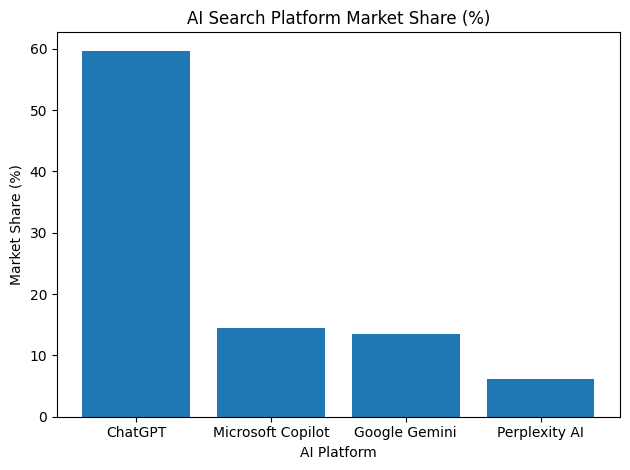
| Platform | Core Function | Market Share (approx.) |
|---|---|---|
| ChatGPT | Conversational AI assistant | 59.7% |
| Microsoft Copilot | AI productivity assistant | 14.4% |
| Google Gemini | AI search and assistant | 13.5% |
| Perplexity AI | AI research search engine | 6.2% |
GEO agencies therefore test queries across multiple platforms to measure brand visibility and adjust strategies accordingly.
AI Response Monitoring and Optimization
Measuring AI Citations and Mentions
Because AI search does not rely on traditional rankings, GEO agencies track new types of metrics.
Key GEO performance indicators include:
- AI citations
- brand mentions in AI responses
- AI referral traffic
- AI answer inclusion rate
Monitoring framework example:
| Query | AI Platform | Brand Mention | Optimization Action |
|---|---|---|---|
| Best CRM software | ChatGPT | No | Improve comparison content |
| What is AI marketing | Gemini | Yes | Expand authority sources |
| Top HR platforms | Perplexity | Partial | Increase entity references |
These insights allow agencies to refine strategies and improve AI visibility over time.
Continuous Content Updates and Knowledge Refresh
Maintaining AI-Relevant Content
Generative AI systems frequently prioritize fresh, accurate, and authoritative information.
Therefore, GEO agencies regularly update content to ensure:
- current statistics
- accurate definitions
- updated examples
- improved clarity
Content refresh cycle:
| Update Activity | Frequency | Purpose |
|---|---|---|
| Statistical updates | Quarterly | Maintain accuracy |
| Content expansion | Semi-annually | Improve depth |
| Technical structure updates | As needed | Improve machine readability |
| Authority link updates | Ongoing | Strengthen credibility |
Regular updates increase the probability that AI systems select the content as a reliable source for future answers.
Strategic Importance of GEO Optimization
Generative search is fundamentally changing how information is discovered online. Instead of browsing dozens of links, users increasingly rely on AI-generated summaries.
The result is a new competitive environment where only a few sources may appear in a generated answer, dramatically concentrating visibility.
Because of this shift, GEO agencies implement a combination of strategies including:
- conversational prompt analysis
- structured content engineering
- entity optimization
- authority signal development
- AI platform monitoring
Together, these strategies help brands become trusted knowledge sources within AI-generated responses, ensuring they remain visible as search evolves from traditional link-based discovery to AI-driven information synthesis.
8. How to Choose the Best GEO Agency
Understanding the Importance of Selecting the Right GEO Partner
Choosing the right Generative Engine Optimization (GEO) agency is a critical decision for businesses that want to maintain visibility in an AI-driven search ecosystem. Generative AI platforms such as ChatGPT, Google AI Overviews, and Perplexity are transforming how users discover information online by synthesizing answers from multiple sources instead of presenting traditional lists of links.
Because these AI systems rely on retrieval and citation mechanisms to generate responses, companies must ensure their content is structured, authoritative, and machine-readable to appear in AI-generated answers.
Research shows that implementing GEO strategies can improve a website’s visibility in generative search responses by up to 40%, highlighting the importance of expert optimization.
However, GEO is still an emerging discipline, and not all digital marketing agencies possess the technical expertise required to optimize for AI search systems. Businesses must therefore evaluate potential partners carefully to ensure they choose a GEO agency capable of delivering measurable results.
Evaluating the Agency’s Technical Expertise in AI Search
Knowledge of Generative Search Systems
A fundamental criterion when selecting a GEO agency is its understanding of how AI search engines retrieve and generate answers.
Advanced GEO agencies should demonstrate expertise in:
- retrieval-augmented generation (RAG) systems
- AI content retrieval pipelines
- generative search ranking signals
- semantic content engineering
Agencies that lack this technical understanding may struggle to implement strategies that improve AI visibility.
Experts recommend prioritizing agencies with deep knowledge of the patents and technologies underlying generative search engines, including neural retrieval and stateful response generation systems.
Technical expertise evaluation matrix:
| Technical Capability | Why It Matters | Evaluation Method |
|---|---|---|
| AI search architecture knowledge | Enables accurate optimization strategies | Ask for technical explanations |
| Retrieval system expertise | Improves content discoverability | Review technical case studies |
| Semantic content optimization | Improves AI comprehension | Evaluate content frameworks |
| AI monitoring tools | Tracks AI citations and mentions | Request platform demonstrations |
Agencies with strong technical foundations are better equipped to adapt to the rapidly evolving landscape of AI search algorithms.
Assessing GEO Strategy and Methodology
Understanding the Agency’s Optimization Framework
Another critical factor when selecting a GEO agency is the structure and depth of its optimization methodology.
Effective GEO campaigns typically combine multiple strategies, including:
- AI prompt research
- structured content engineering
- entity optimization
- authority building through earned media
- AI visibility monitoring
Research on generative search shows that AI engines tend to prioritize authoritative third-party sources and structured content when selecting citations for responses.
A strong GEO agency should therefore implement strategies that strengthen both content structure and authority signals.
Example GEO methodology evaluation:
| Strategy Component | Description | Expected Outcome |
|---|---|---|
| AI prompt analysis | Identify conversational queries | Higher AI query match rate |
| Structured content design | Use tables, FAQs, and definitions | Improved AI extraction |
| Authority development | Build citations and media mentions | Higher trust signals |
| Entity optimization | Strengthen brand knowledge graph presence | Increased AI recognition |
When reviewing agencies, businesses should ask for detailed explanations of how these strategies are implemented.
Reviewing Agency Case Studies and Proven Results
Evidence of AI Visibility Success
Because GEO is a relatively new discipline, many agencies claim expertise without demonstrating measurable results. Businesses should therefore prioritize agencies that provide documented case studies and performance metrics.
Examples of GEO success metrics include:
- increased AI citations
- improved AI referral traffic
- higher presence in AI-generated answers
- improved brand mentions in AI responses
Real-world case studies show that businesses can achieve significant gains through GEO strategies. For example:
| Industry | GEO Strategy | Outcome |
|---|---|---|
| Web development agency | Structured storytelling and AI-optimized content | 10% of organic traffic from AI citations |
| Construction materials company | Answer-first content structure | 67% increase in organic traffic |
| PropTech SaaS company | Detailed documentation and knowledge hubs | 32% of sales leads from AI search |
These outcomes demonstrate how optimized content and structured knowledge resources can significantly improve AI discovery.
When evaluating agencies, businesses should request examples of AI search visibility improvements achieved for past clients.
Evaluating Proprietary Tools and Technology
Importance of AI Visibility Tracking
Traditional SEO tools were designed to track keyword rankings and backlinks. However, GEO requires a new category of tools capable of measuring AI citations and answer visibility.
Leading GEO agencies often develop proprietary tools that track:
- AI mentions across multiple platforms
- similarity between brand content and AI responses
- AI Overview inclusion frequency
- prompt-based visibility metrics
These tools help businesses understand whether their brand is appearing in AI responses.
Example AI visibility monitoring framework:
| Metric | Description | Strategic Value |
|---|---|---|
| AI citation frequency | Number of times brand appears in responses | Measures authority |
| Prompt coverage | Percentage of prompts mentioning brand | Identifies visibility gaps |
| AI referral traffic | Visitors arriving from AI platforms | Measures acquisition value |
| Answer inclusion rate | Frequency of appearance in summaries | Measures AI visibility |
Agencies that develop proprietary technology for monitoring these metrics provide more accurate insights into campaign performance.
Evaluating Industry Experience and Domain Expertise
Importance of Vertical Knowledge
Another key factor when choosing a GEO agency is industry specialization.
Different industries require different GEO strategies because AI search engines retrieve information differently depending on the topic domain.
Examples of industry-specific GEO approaches:
| Industry | GEO Strategy Focus |
|---|---|
| SaaS | Product comparison content |
| Healthcare | Authoritative educational resources |
| E-commerce | AI-friendly product recommendation guides |
| Finance | Trustworthy financial education content |
| B2B services | Thought leadership and research reports |
Research shows that generative search systems exhibit domain-specific behavior and citation patterns, meaning optimization strategies must be tailored to each industry.
Businesses should therefore select GEO agencies with demonstrated experience in their specific market sector.
Assessing Transparency and Reporting Practices
Importance of Clear Performance Reporting
Transparent reporting is essential when working with a GEO agency.
Since AI search optimization differs from traditional SEO, agencies should provide clear metrics that demonstrate progress toward AI visibility goals.
Recommended reporting metrics include:
- AI citation share
- brand mention frequency in AI responses
- traffic from AI platforms
- prompt-based visibility analysis
Example reporting dashboard:
| Metric | Month 1 | Month 3 | Month 6 |
|---|---|---|---|
| AI mentions | 4 | 15 | 32 |
| AI referral traffic | 120 visits | 480 visits | 1,300 visits |
| Prompt coverage | 6% | 18% | 37% |
Transparent reporting allows businesses to evaluate whether the GEO strategy is producing measurable improvements.
Assessing Agency Reputation and Client Feedback
Importance of External Validation
Client testimonials and independent reviews provide valuable insights into an agency’s reliability and performance.
Evaluation criteria should include:
- client case studies
- independent industry reviews
- testimonials from previous clients
- long-term partnerships
According to industry evaluations of GEO agencies, client feedback and reputation remain among the most important factors when assessing agency quality.
Companies should review multiple sources of feedback before selecting an agency partner.
GEO Agency Selection Decision Matrix
A structured evaluation framework can help businesses compare different agencies objectively.
| Evaluation Category | Key Questions | Weight |
|---|---|---|
| Technical expertise | Does the agency understand AI search architecture? | High |
| Proven results | Are there case studies demonstrating AI visibility gains? | High |
| Strategy framework | Does the agency provide a clear GEO methodology? | High |
| Technology and tools | Does the agency offer AI citation tracking tools? | Medium |
| Industry experience | Does the agency understand your market? | Medium |
| Transparency | Does the agency provide detailed reporting? | Medium |
Using such a framework ensures that businesses select agencies capable of delivering both technical expertise and strategic execution.
Strategic Considerations for Long-Term GEO Success
Selecting the right GEO agency is not simply about choosing a marketing vendor—it is about establishing a strategic partner for navigating the future of digital discovery.
Generative AI is transforming how users access information, with platforms synthesizing knowledge from multiple sources rather than directing users to traditional search results.
As this transformation continues, businesses must ensure their digital presence is structured, authoritative, and optimized for AI systems.
Organizations that carefully evaluate GEO agencies based on technical expertise, strategic methodology, industry experience, and transparent reporting are far more likely to achieve long-term visibility in AI-driven search environments.
9. GEO Agency Pricing in 2026
Overview of GEO Service Pricing Landscape
The pricing structure for Generative Engine Optimization (GEO) agencies in 2026 reflects the complexity of optimizing brands for AI-driven search systems such as ChatGPT, Google AI Overviews, Gemini, and Perplexity. GEO pricing differs from traditional SEO pricing because it involves additional components such as AI visibility tracking, structured content engineering, entity optimization, and AI citation monitoring.
Industry data shows that most GEO agency services operate on monthly retainers ranging from $1,500 to $50,000 or more, depending on the scope of work, business size, and campaign complexity.
Typical GEO packages fall within the $1,500–$10,000 monthly range, although enterprise programs with extensive authority building and PR campaigns can exceed $30,000 per month.
These costs reflect the specialized expertise required to optimize content and brand signals for AI systems that generate answers rather than simply ranking webpages.
Average GEO Agency Pricing Tiers
GEO agencies typically structure their services using tiered pricing models based on the level of optimization required.
| Service Tier | Monthly Cost Range | Typical Services Included |
|---|---|---|
| Basic GEO Optimization | $1,500 – $3,000 | AI content structuring, prompt research, basic monitoring |
| Growth GEO Program | $4,000 – $7,000 | advanced content strategy, entity optimization, authority building |
| Advanced GEO Campaign | $8,000 – $15,000 | multi-platform AI monitoring, PR campaigns, large-scale content |
| Enterprise GEO Program | $15,000 – $50,000+ | global authority development, custom AI analytics |
For many mid-sized companies, specialized GEO agencies typically charge between $3,500 and $8,000 per month for ongoing services.
These retainers often include continuous monitoring and optimization across multiple AI platforms.
GEO Pricing Models Used by Agencies
Unlike traditional SEO pricing, which often focuses on rankings and backlinks, GEO pricing models are built around AI visibility improvements and knowledge authority development.
Common pricing structures include:
Monthly Retainer Model
This is the most common GEO pricing structure.
| Retainer Type | Monthly Cost | Typical Scope |
|---|---|---|
| GEO-only optimization | $2,000 – $3,000 | AI visibility audits and structured content |
| SEO + GEO hybrid campaigns | $5,000+ | integrated search and AI optimization |
| Enterprise programs | $15,000 – $20,000+ | large-scale authority and PR campaigns |
Some GEO-only retainers begin around $2,000–$2,500 per month, while integrated SEO-GEO campaigns often start at $5,000 monthly.
Project-Based GEO Pricing
Some agencies offer project-based GEO services for specific initiatives such as audits or content optimization.
| GEO Project Type | Typical Price |
|---|---|
| AI visibility audit | $499 – $2,000 |
| AI content optimization project | $2,000 – $8,000 |
| GEO content hub creation | $5,000 – $15,000 |
For example, some agencies offer AI search visibility audits starting at about $499, analyzing brand citations across platforms like ChatGPT and Google AI Overviews.
Hourly Consulting Model
Some GEO specialists provide advisory services on an hourly basis.
| Consultant Type | Hourly Rate |
|---|---|
| Freelance GEO consultants | $100 – $300 per hour |
| Specialized agency consultants | $200 – $500 per hour |
| Enterprise AI strategy consultants | $500+ per hour |
Certain agencies offer GEO services billed hourly, with monthly charges ranging from $500 to $3,000 depending on hours and scope.
Cost Breakdown of GEO Campaign Components
A typical GEO campaign consists of multiple optimization components, each contributing to the overall cost.
| GEO Component | Purpose | Typical Cost Contribution |
|---|---|---|
| AI prompt research | Identify conversational queries | 10–15% |
| Content engineering | Structure AI-friendly content | 25–35% |
| Authority building | Earn media and citations | 20–30% |
| Entity optimization | Knowledge graph and schema signals | 10–15% |
| AI monitoring tools | Track citations and mentions | 10–15% |
These components collectively improve a brand’s ability to appear in AI-generated answers.
GEO Software and Technology Costs
Many GEO campaigns also rely on specialized tools for tracking AI visibility and brand mentions.
Typical software costs include:
| Tool Category | Monthly Cost | Example Purpose |
|---|---|---|
| Basic AI SEO tools | $10 – $50 | AI writing and optimization tools |
| Advanced GEO analytics | $60 – $250+ | AI visibility monitoring |
| Enterprise AI analytics | $1,000+ | Large-scale data integration |
AI visibility tracking platforms typically cost between $50 and $1,000 per month, depending on features and data coverage.
Examples of GEO monitoring tools include platforms that track brand citations across AI models and analyze how AI describes a company in responses.
Pricing Differences by Business Size
The cost of GEO services varies significantly depending on the size and complexity of the organization.
| Business Size | Typical GEO Budget | Key Optimization Focus |
|---|---|---|
| Startups | $1,500 – $4,000 / month | AI content structure and basic authority |
| SMBs | $4,000 – $8,000 / month | entity optimization and AI monitoring |
| Mid-market companies | $8,000 – $15,000 / month | multi-platform optimization |
| Enterprise brands | $15,000 – $50,000+ / month | large-scale AI authority and PR |
Startups typically focus on improving crawlability and structured knowledge pages, while enterprise companies invest heavily in PR, brand authority, and large-scale content hubs.
Example GEO Pricing Scenarios
Example 1: SaaS Startup GEO Campaign
| Activity | Monthly Cost |
|---|---|
| AI content optimization | $1,500 |
| Prompt research | $800 |
| Basic AI monitoring | $500 |
| Authority building | $700 |
Estimated monthly budget: $3,500
Outcome: improved AI recommendations for software comparison queries.
Example 2: Mid-Market E-Commerce GEO Program
| Activity | Monthly Cost |
|---|---|
| Product comparison content | $2,500 |
| AI citation monitoring | $1,200 |
| authority PR campaigns | $2,000 |
| AI search analytics | $800 |
Estimated monthly budget: $6,500
Outcome: increased visibility in AI product recommendation queries.
Example 3: Enterprise GEO Strategy
| Activity | Monthly Cost |
|---|---|
| Global AI content hub | $10,000 |
| international PR campaigns | $8,000 |
| proprietary AI monitoring | $4,000 |
| data engineering and schema | $3,000 |
Estimated monthly budget: $25,000+
Outcome: strong authority signals across global AI platforms.
Factors That Influence GEO Pricing
Several variables determine how much businesses ultimately spend on GEO services.
Key cost drivers include:
| Factor | Impact on Pricing |
|---|---|
| Industry competitiveness | Highly competitive sectors require more authority building |
| Content scale | Larger content ecosystems require more optimization |
| AI monitoring complexity | Multi-platform monitoring increases costs |
| Geographic reach | Global campaigns require localization |
| Brand authority | New brands require more PR and citations |
Businesses in highly competitive industries such as SaaS, finance, and healthcare typically invest more heavily in GEO campaigns because visibility within AI recommendations can significantly influence purchasing decisions.
ROI Potential of GEO Investments
Although GEO campaigns can be costly, the potential return on investment can be significant.
Research indicates that AI search visitors can convert at rates between 4.4× and 23× higher than traditional organic search visitors, highlighting the value of appearing within AI-generated responses.
This higher conversion potential occurs because AI-generated answers often appear during high-intent informational or recommendation queries, which are closer to purchasing decisions.
Strategic Budget Planning for GEO in 2026
Companies planning GEO investments typically allocate budgets based on their digital growth stage.
Budget planning framework:
| Growth Stage | GEO Budget Strategy |
|---|---|
| Early-stage startup | Focus on structured content and entity signals |
| Growth-stage company | invest in authority building and AI monitoring |
| Established enterprise | implement large-scale AI content ecosystems |
Organizations that adopt GEO strategies early can establish stronger authority signals within generative AI ecosystems before competition intensifies.
Long-Term Pricing Outlook for GEO Services
The GEO industry is still in its early stages, and pricing models continue to evolve as AI search technologies mature. As generative AI becomes the dominant interface for information discovery, demand for GEO services is expected to increase significantly.
Agencies are already expanding their offerings to include:
- AI brand reputation monitoring
- conversational query optimization
- AI recommendation tracking
- agentic commerce optimization
These services indicate that GEO pricing will likely become more sophisticated as AI systems play an increasingly central role in digital marketing, customer discovery, and brand visibility.
Businesses that understand GEO pricing structures and invest strategically in AI visibility will be better positioned to compete in the evolving landscape of AI-driven search and generative information discovery.
10. GEO vs SEO vs AEO
Understanding the Evolution of Search Optimization
Digital discovery has evolved significantly over the past two decades. Businesses once relied almost entirely on Search Engine Optimization (SEO) to appear in traditional search results. However, with the emergence of conversational AI and generative search engines, two additional strategies have gained importance: Answer Engine Optimization (AEO) and Generative Engine Optimization (GEO).
Each of these optimization frameworks targets a different stage in the evolution of search technologies.
| Optimization Strategy | Primary Target | Typical Output | Example Platforms |
|---|---|---|---|
| SEO | Traditional search engines | Ranked web pages | Google, Bing |
| AEO | Answer engines | Direct answers or snippets | Google Featured Snippets, Siri |
| GEO | Generative AI engines | Synthesized AI responses | ChatGPT, Gemini, Perplexity |
SEO focuses on improving rankings within search results to drive traffic to websites, whereas AEO and GEO aim to ensure that content becomes the answer itself within AI systems.
Understanding the differences between these strategies is essential for businesses navigating the modern AI-driven search landscape.
What Is Search Engine Optimization (SEO)
Core Concept of SEO
Search Engine Optimization refers to the process of improving a website’s visibility within traditional search engine results pages (SERPs). SEO aims to increase organic traffic by ensuring that web pages rank highly when users search for relevant keywords.
Typical SEO activities include:
- keyword research
- technical website optimization
- backlink building
- on-page content optimization
The primary goal is to appear as high as possible in search results so users click through to the website.
SEO visibility is typically measured using metrics such as:
| SEO Metric | Description |
|---|---|
| Ranking position | Page position for target keywords |
| Click-through rate (CTR) | Percentage of users clicking results |
| Organic traffic | Visitors arriving via search engines |
| Domain authority | Perceived credibility of a website |
Traditional SEO strategies remain critical because they help search engines understand website content and determine its relevance to user queries.
However, the rise of AI search systems has introduced new optimization challenges that traditional SEO alone cannot address.
What Is Answer Engine Optimization (AEO)
Optimizing Content to Become the Direct Answer
Answer Engine Optimization focuses on ensuring that content is selected as the direct answer to user questions.
AEO targets systems that extract existing information from webpages and present it directly to users without requiring them to click through to a website.
Examples of answer engines include:
- Google Featured Snippets
- Google “People Also Ask” results
- voice assistants such as Alexa or Siri
AEO works by structuring content so that search engines can easily extract concise answers.
Example:
User query:
“Why is the sky blue?”
AEO-optimized content might include a short definition paragraph that search engines can display as a featured snippet.
AEO optimization strategies typically include:
- concise question-and-answer formats
- structured headings
- schema markup
- natural language explanations
Unlike SEO, which focuses on rankings, AEO focuses on content extraction for answer boxes.
Because voice assistants often read answers aloud, AEO content must also be clear, concise, and contextually complete.
What Is Generative Engine Optimization (GEO)
Optimization for AI-Generated Answers
Generative Engine Optimization is the newest search optimization framework. GEO focuses on improving a brand’s visibility within AI-generated responses produced by large language models and generative search engines.
Examples of generative AI platforms include:
- ChatGPT
- Google Gemini
- Perplexity AI
- Google AI Overviews
Unlike answer engines, generative engines do not simply extract existing text from a single webpage. Instead, they synthesize information from multiple sources to create a new response.
Therefore, GEO focuses on ensuring that content is structured in ways that allow AI models to:
- understand it
- trust it
- cite it as a source
Example AI query:
“Which CRM software is best for startups?”
Instead of displaying links, an AI assistant might generate a summary recommending several products. GEO optimization aims to ensure that a company’s product appears within this AI-generated recommendation.
Key GEO success metrics include:
| GEO Metric | Description |
|---|---|
| AI citation frequency | Number of times AI references the brand |
| AI answer inclusion | Frequency of appearing in AI responses |
| AI referral traffic | Visitors arriving from AI platforms |
| brand entity recognition | AI understanding of company identity |
GEO focuses less on ranking and more on becoming a trusted knowledge source for AI systems.
Key Differences Between SEO, AEO, and GEO
Although SEO, AEO, and GEO share some overlapping techniques, they differ significantly in how they approach information discovery.
| Factor | SEO | AEO | GEO |
|---|---|---|---|
| Primary goal | Rank pages | Provide direct answers | Become AI citation source |
| Content source | Single webpage | Extracted webpage text | Synthesized multi-source answer |
| Output format | List of links | Featured snippet or voice response | Conversational AI summary |
| Optimization focus | Keywords and backlinks | Concise answers and structured data | authority signals and machine readability |
| User interaction | Clicks through to website | Receives immediate answer | Reads AI-generated summary |
SEO focuses on driving traffic, while AEO and GEO focus on delivering answers directly within search interfaces.
How the User Search Journey Differs Across SEO, AEO, and GEO
Each optimization strategy reflects a different stage of the evolving user search journey.
| Stage | User Behavior | Optimization Strategy |
|---|---|---|
| Traditional search | User scans list of links | SEO |
| Quick answer search | User expects immediate answer | AEO |
| Conversational discovery | User asks complex questions | GEO |
Example user journey:
Traditional search query:
“best CRM software”
SEO result:
List of websites ranking for the keyword.
AEO result:
Featured snippet summarizing CRM software options.
GEO result:
AI assistant generates a full explanation comparing CRM tools and recommending several products.
This evolution shows how search has moved from link-based discovery to answer-based experiences.
Real-World Example: Comparing SEO, AEO, and GEO Results
Consider the query:
“Best project management tools for remote teams.”
The output differs significantly depending on the search environment.
| Platform | Output Example | Optimization Strategy |
|---|---|---|
| Google search | List of blog articles | SEO |
| Google featured snippet | Short list extracted from one article | AEO |
| ChatGPT or Gemini | Generated explanation comparing tools | GEO |
In generative search environments, the AI synthesizes multiple sources into a single response rather than presenting a ranked list of webpages.
This fundamental difference explains why new optimization strategies such as GEO are emerging.
Why Businesses Need All Three Strategies
Modern digital visibility requires a multi-layered optimization strategy that combines SEO, AEO, and GEO.
Each approach supports a different discovery channel.
| Optimization Layer | Business Benefit |
|---|---|
| SEO | Drive website traffic |
| AEO | Win featured snippets and voice answers |
| GEO | Appear in AI-generated recommendations |
Experts increasingly recommend integrating all three strategies because modern search occurs across search engines, voice assistants, and AI chat interfaces.
For example:
- SEO ensures a website ranks on Google.
- AEO helps the content appear in featured snippets.
- GEO ensures AI systems cite the content in generated responses.
Together, these strategies maximize digital visibility across the entire search ecosystem.
Strategic Implications for the Future of Search
The shift toward AI-driven search is reshaping the digital marketing landscape. Generative engines are becoming major gateways to information, providing synthesized answers rather than lists of links.
Research shows that generative AI search systems combine web-scale retrieval with AI-generated responses, fundamentally changing how information is accessed online.
As a result, businesses must adapt their optimization strategies to ensure they remain visible in:
- traditional search results
- answer-based interfaces
- AI-generated conversations
Companies that successfully integrate SEO, AEO, and GEO will be best positioned to maintain visibility as the search ecosystem continues evolving toward AI-driven knowledge discovery.
11. The Future of GEO Agencies
The Rapid Rise of AI-Driven Search Ecosystems
The future of Generative Engine Optimization (GEO) agencies is closely tied to the accelerating adoption of generative AI technologies and conversational search platforms. Over the past few years, AI systems such as ChatGPT, Google Gemini, Perplexity, and Microsoft Copilot have transformed how people discover information online. Instead of browsing lists of search results, users increasingly receive direct AI-generated answers synthesized from multiple sources.
This transformation is already happening at a massive scale. Research indicates that about half of consumers now use AI-powered search tools, and AI-driven discovery could influence approximately $750 billion in revenue by 2028.
The rapid growth of AI search platforms demonstrates why GEO agencies are becoming essential partners for businesses. ChatGPT alone reached around 800 million weekly active users by 2025, highlighting how quickly generative AI interfaces are becoming mainstream digital gateways.
As this ecosystem continues expanding, GEO agencies will increasingly help organizations adapt their digital strategies to ensure that their brands appear in AI-generated recommendations, summaries, and conversational responses.
Expanding Market Size of GEO Services
Growth of the GEO Industry
The GEO industry itself is emerging as a rapidly expanding sector within digital marketing.
Market analyses estimate that the global GEO services market reached approximately $762.5 million in 2024 and is projected to grow at a compound annual growth rate (CAGR) of about 30.1% in the coming years.
Several factors are driving this growth:
- the expansion of generative search platforms
- increasing demand for zero-click answers
- rising importance of structured knowledge content
- growing adoption of AI-assisted marketing strategies
This market expansion indicates that GEO agencies are likely to become a core component of digital marketing infrastructure in the coming decade.
Projected growth drivers of the GEO market:
| Growth Driver | Impact on GEO Agencies |
|---|---|
| Expansion of AI search engines | Increased demand for AI optimization |
| Rise of conversational interfaces | Greater need for prompt-aligned content |
| Growth of zero-click searches | Shift from ranking to answer visibility |
| Adoption of AI marketing tools | Integration of GEO with broader AI workflows |
As companies increasingly rely on AI to discover products and services, the role of GEO agencies will expand beyond content optimization to include AI brand representation management.
Transition from Search Rankings to AI Answer Visibility
The Rise of Zero-Click and AI-Generated Results
One of the most significant trends shaping the future of GEO agencies is the rapid growth of zero-click search behavior.
Studies show that:
- about 60% of searches end without a click due to AI summaries
- click-through rates drop significantly when AI answers appear
- many users end their search session immediately after receiving an AI response
AI search platforms also exhibit extremely high zero-click rates. Approximately 93% of AI search sessions end without visiting a website, meaning the information delivered directly in the AI answer becomes the primary user experience.
This change dramatically alters how businesses must approach online visibility.
Traditional search visibility vs AI answer visibility:
| Discovery Method | User Behavior | Marketing Strategy |
|---|---|---|
| Traditional search | Users click links | SEO |
| Featured snippets | Users read extracted answers | AEO |
| AI search | Users receive synthesized responses | GEO |
In this new environment, the most valuable visibility is no longer ranking first in search results but becoming the information source used by AI systems when generating answers.
GEO agencies will therefore play a crucial role in helping brands maintain visibility in the era of AI-driven discovery.
Integration of GEO with AI Marketing Ecosystems
Convergence of GEO, AI Content, and Data Analytics
The future of GEO agencies will likely involve deeper integration with broader AI-powered marketing ecosystems.
Research indicates that 56% of marketers already use generative AI within SEO workflows, demonstrating how quickly AI is being integrated into marketing operations.
As a result, GEO agencies are evolving from niche specialists into AI marketing strategy partners.
Future GEO agency service stack:
| Capability Area | Example Services |
|---|---|
| AI visibility monitoring | Tracking brand mentions in AI responses |
| Prompt optimization | Mapping conversational search queries |
| AI content engineering | Designing machine-readable knowledge hubs |
| Data analytics | Measuring AI citation and answer inclusion |
| Brand narrative management | Controlling how AI describes a brand |
Advanced GEO agencies may also develop proprietary tools that monitor how AI systems describe companies and identify content gaps affecting AI visibility.
The Emergence of AI-Driven Commerce and Agentic Search
Conversational Shopping and Product Discovery
Another trend shaping the future of GEO agencies is the rise of AI-powered shopping assistants and conversational commerce platforms.
Generative search systems increasingly act as digital shopping advisors, guiding users toward relevant products based on context and preferences. Research on AI commerce systems shows that conversational agents can interpret complex product queries involving constraints, preferences, and use-case scenarios.
Example conversational commerce query:
“What are the best running shoes for marathon training under $150?”
Instead of browsing dozens of websites, users receive a synthesized answer recommending specific products.
Future GEO optimization in e-commerce may involve:
| Optimization Area | Example |
|---|---|
| conversational product descriptions | natural-language feature explanations |
| structured product comparisons | machine-readable product tables |
| AI shopping assistant integration | optimized product knowledge bases |
This shift toward AI-mediated purchasing decisions will likely create new revenue opportunities for GEO agencies specializing in AI commerce optimization.
Increasing Importance of Authority and Trust Signals
AI Preference for Authoritative Sources
Research analyzing generative search engines shows that AI systems often prioritize third-party authoritative sources when generating answers.
This preference means that the future of GEO agencies will involve a strong focus on authority-building strategies, including:
- digital PR
- expert thought leadership
- research publications
- authoritative media citations
Authority signals in future GEO strategies:
| Authority Signal | Purpose |
|---|---|
| media mentions | strengthen AI trust signals |
| research reports | provide data credibility |
| expert commentary | increase thought leadership |
| industry partnerships | build brand reputation |
Because AI systems frequently rely on external sources to verify information, GEO agencies will increasingly combine content strategy with digital reputation management.
Expansion of Multi-Platform AI Optimization
Optimization Across Multiple Generative Engines
Another major development in the GEO landscape is the diversification of AI search platforms.
Current generative AI market share distribution illustrates the competitive environment:
| AI Platform | Market Share |
|---|---|
| ChatGPT | 59.7% |
| Microsoft Copilot | 14.4% |
| Google Gemini | 13.5% |
| Perplexity AI | 6.2% |
Because each AI platform uses slightly different retrieval and ranking algorithms, GEO agencies will increasingly develop engine-specific optimization strategies.
Future GEO campaigns may include:
- ChatGPT-optimized knowledge content
- Gemini-optimized search snippets
- Perplexity citation optimization
- Copilot knowledge integration
This multi-engine optimization approach will become critical as the AI search ecosystem becomes more fragmented and competitive.
Long-Term Role of GEO Agencies in Digital Marketing
The Shift Toward AI-First Marketing Strategies
As AI systems become the primary gateway to digital information, GEO agencies will evolve into AI-first marketing strategists.
Several long-term trends support this transformation:
| Trend | Implication for GEO Agencies |
|---|---|
| Growth of AI assistants | AI becomes the primary discovery channel |
| Expansion of conversational search | content optimized for prompts |
| Increase in AI-mediated commerce | optimization for recommendation systems |
| dominance of zero-click experiences | focus on answer visibility |
Organizations that adapt to these trends early will gain significant competitive advantages in AI-driven markets.
Experts increasingly view GEO as a new mindset for digital discovery, emphasizing where and how people search in AI environments rather than focusing solely on traditional keyword rankings.
Strategic Outlook for GEO Agencies
The future of GEO agencies will likely be shaped by three major developments:
| Development | Strategic Impact |
|---|---|
| AI search becoming mainstream | GEO becomes a core marketing service |
| expansion of AI commerce | new optimization opportunities |
| increasing importance of AI reputation | need for AI narrative management |
As generative AI continues reshaping how information is discovered, the demand for GEO expertise will likely increase significantly.
Organizations that partner with GEO agencies early will be better positioned to maintain visibility within AI-generated knowledge ecosystems, ensuring that their brands remain discoverable as the internet evolves from link-based search to AI-driven conversational discovery.
Conclusion
The digital discovery landscape is undergoing one of the most significant transformations since the rise of traditional search engines. For more than two decades, businesses relied heavily on Search Engine Optimization (SEO) to drive traffic and visibility through search engines like Google. However, the rapid adoption of generative AI platforms has introduced a new paradigm in how users search for and consume information. Instead of browsing lists of links, people increasingly turn to AI-powered assistants and generative search tools that synthesize answers instantly. This shift has created a new discipline—Generative Engine Optimization (GEO)—and with it, a new type of marketing partner: the GEO agency.
At its core, a GEO agency helps businesses adapt to a world where visibility depends not only on ranking in search results but also on being referenced, cited, or summarized in AI-generated answers. GEO focuses on structuring content, building authority signals, and optimizing digital assets so that generative AI systems such as ChatGPT, Gemini, and Perplexity can retrieve and include them when generating responses to user queries.
This shift is not theoretical—it is already reshaping the internet. Studies show that about half of consumers now use AI-powered search tools, and by 2028 these systems could influence roughly $750 billion in revenue across industries. Such figures highlight how quickly AI search is becoming a central part of the customer journey. In many cases, users rely on AI assistants to research products, compare services, and make purchasing decisions before ever visiting a website.
Because generative AI systems synthesize information from multiple sources rather than simply listing webpages, businesses must rethink how they approach digital visibility. Traditional SEO strategies focused on keywords and backlinks remain important, but they are no longer sufficient on their own. GEO adds a new layer of optimization that prioritizes machine-readable content, authoritative references, structured knowledge, and contextual relevance—all factors that influence how AI models interpret and generate answers.
Throughout this guide, we explored the many dimensions of GEO agencies and their role in modern digital marketing. We examined what GEO is, how it differs from traditional SEO and Answer Engine Optimization (AEO), and how agencies optimize content for AI-driven discovery. We also explored the services GEO agencies provide, including AI visibility audits, structured content engineering, entity optimization, authority building, and AI citation monitoring. These strategies collectively help brands position themselves as trusted sources of information in AI-generated responses.
We also looked at how GEO agencies operate in practice. Their work often involves analyzing conversational queries, creating structured knowledge content, strengthening brand authority across the web, and continuously monitoring how AI systems reference or describe a brand. In many cases, GEO strategies combine elements of SEO, public relations, content marketing, and data analytics to influence the broader information ecosystem that generative AI models rely on when constructing answers.
Another important takeaway is that GEO is not limited to a single industry. Technology companies, SaaS providers, e-commerce brands, healthcare organizations, financial services firms, and B2B companies can all benefit from GEO strategies because their customers increasingly rely on AI tools to research solutions and evaluate options. As AI assistants become the first step in the digital discovery process, appearing within AI-generated answers can dramatically increase brand visibility and influence purchasing decisions.
The emergence of GEO agencies also reflects a broader evolution in how marketing strategies must adapt to new technologies. Just as businesses once transitioned from traditional advertising to digital marketing—and later from desktop search to mobile search—the shift toward generative AI represents the next stage in this ongoing transformation. Organizations that recognize this change early and invest in AI visibility strategies will likely gain a competitive advantage in the years ahead.
Looking forward, the importance of GEO agencies is expected to grow significantly as generative AI continues to expand across search engines, digital assistants, and enterprise platforms. Research shows that generative search technologies are already appearing in a growing percentage of search results and are becoming a preferred information source for many users. As these technologies evolve, businesses will need specialized expertise to ensure their content remains visible, authoritative, and relevant in AI-driven environments.
Ultimately, GEO agencies represent the next evolution of search optimization. While SEO focused on ranking pages and AEO focused on providing direct answers, GEO focuses on shaping the information that AI systems use to generate knowledge itself. In this new landscape, success will depend not just on appearing in search results but on becoming part of the answers that millions of people receive every day.
For businesses preparing for the future of digital discovery, the message is clear: the rise of generative AI is transforming how customers find and evaluate information online. Partnering with a GEO agency can help organizations navigate this new ecosystem, ensuring that their expertise, products, and services remain visible in an era where AI is becoming the primary gateway to knowledge and decision-making.
If you are looking for a top-class digital marketer, then book a free consultation slot here.
If you find this article useful, why not share it with your friends and business partners, and also leave a nice comment below?
We, at the AppLabx Research Team, strive to bring the latest and most meaningful data, guides, and statistics to your doorstep.
To get access to top-quality guides, click over to the AppLabx Blog.
People also ask
What is a GEO agency?
A GEO agency specializes in Generative Engine Optimization, helping businesses optimize their content so it appears in AI-generated answers on platforms like ChatGPT, Gemini, and Perplexity.
What does GEO stand for in digital marketing?
GEO stands for Generative Engine Optimization. It focuses on optimizing digital content so AI search engines can understand, retrieve, and cite it when generating answers to user queries.
How is a GEO agency different from an SEO agency?
An SEO agency focuses on ranking websites in search engine results, while a GEO agency focuses on getting brand information cited or included in AI-generated answers from generative search platforms.
Why are GEO agencies becoming important in 2026?
AI-powered search tools are changing how people find information. GEO agencies help businesses remain visible in AI-generated answers where traditional search rankings may no longer be enough.
What services does a GEO agency provide?
GEO agencies provide services such as AI visibility audits, structured content optimization, authority building, AI prompt research, entity optimization, and monitoring brand mentions in AI responses.
What is Generative Engine Optimization (GEO)?
Generative Engine Optimization is the process of optimizing content so generative AI systems can understand, summarize, and cite it when generating responses to user questions.
Which AI platforms does GEO target?
GEO strategies often target AI platforms such as ChatGPT, Google Gemini, Perplexity, Microsoft Copilot, and Google AI Overviews.
Can GEO improve visibility in ChatGPT answers?
Yes. GEO helps structure and optimize content so ChatGPT and similar AI systems can reference it when generating informative responses.
How do GEO agencies optimize content for AI search?
They structure content using clear explanations, FAQs, tables, semantic context, and authoritative references to make it easier for AI models to interpret and summarize.
Is GEO replacing traditional SEO?
No. GEO complements SEO. SEO helps websites rank in search engines, while GEO ensures content appears in AI-generated responses.
What industries benefit most from GEO agencies?
Industries like SaaS, e-commerce, finance, healthcare, consulting, and technology benefit most because customers frequently use AI tools to research products and services.
How does GEO help businesses get mentioned in AI responses?
By improving content clarity, authority signals, and entity recognition so AI models can confidently reference the brand when generating answers.
What is AI search optimization?
AI search optimization refers to strategies that help content appear in AI-generated answers and conversational search results rather than traditional link-based search listings.
How much does a GEO agency cost?
GEO agency pricing varies widely depending on services and scope, typically ranging from a few thousand dollars per month to enterprise-level campaigns costing tens of thousands monthly.
What is the difference between GEO and AEO?
AEO focuses on optimizing content for direct answers like featured snippets, while GEO optimizes content so AI models can synthesize and cite it in generated responses.
What are AI-generated search results?
AI-generated search results are answers created by generative AI models that combine information from multiple sources instead of showing a list of links.
How do AI search engines choose which sources to cite?
AI systems prioritize sources that demonstrate authority, clear structure, reliable information, and strong contextual relevance.
Can small businesses benefit from GEO strategies?
Yes. Small businesses can gain visibility in AI answers by creating authoritative content and optimizing it for AI-friendly structure and semantic clarity.
What is entity optimization in GEO?
Entity optimization ensures that AI systems clearly recognize a brand, product, or organization as a distinct entity within knowledge graphs and online data sources.
How long does GEO take to produce results?
Results vary depending on industry and content quality, but improvements in AI mentions and visibility often appear within several months of consistent optimization.
What is AI visibility in marketing?
AI visibility refers to how often a brand or website appears in AI-generated answers or recommendations across generative search platforms.
Why is structured content important for GEO?
Structured content such as lists, tables, and clear definitions helps AI systems extract and summarize information more accurately.
What are AI prompts in GEO research?
AI prompts are the natural language questions users ask generative AI systems. GEO agencies analyze these prompts to align content with real search behavior.
Can GEO increase brand authority online?
Yes. GEO strategies focus on building authoritative content and citations that strengthen brand credibility across AI systems and search platforms.
What is conversational search?
Conversational search refers to queries written in natural language, similar to how people speak, which AI systems interpret and answer directly.
Do GEO agencies use structured data?
Yes. Structured data such as schema markup helps AI and search engines better understand the meaning and context of content.
What role does content marketing play in GEO?
Content marketing is central to GEO because AI models rely on high-quality informational content to generate accurate responses.
How does GEO help with AI-driven product recommendations?
By creating structured comparisons and detailed product information that AI systems can analyze when recommending products or services.
Will AI search replace traditional search engines?
AI search is expected to complement traditional search rather than replace it entirely, creating new opportunities for visibility through GEO strategies.
Why should businesses start using GEO now?
Early adoption helps brands build authority and visibility in AI search ecosystems before competition becomes significantly more intense.
Sources
McKinsey & Company
Search Engine Land
Wikipedia
Backlinko
Yext
Conductor
Nightwatch
Coursera
Directive Consulting
ContentShifu
Lead-Gen Team Blog
Go Fish Digital
First Page Sage
Singularity Digital
WebFX
PageTraffic
Leadshuttle
Minuttia
SE Ranking
Superlines
Position Digital
Exposure Ninja
MarketingLTB
SEO Sherpa
Navistrat Analytics
Wellows
Bain & Company
Reboot Online
Alphap
Epic Slope Partners
Meltwater
TTMS (LLM Search Forecast)
Princeton University Research (Generative Engine Optimization study)
ScienceDirect
Infomineo Knowledge Hub
Times of India Technology News
ArXiv Research Papers on Generative Search and AI Retrieval Systems