

























Key Takeaways
- Ranking in Google’s AI Overviews requires strong traditional SEO combined with structured, intent-driven content that is easy for AI systems to extract and cite.
- Building topical authority, optimizing for long-tail informational queries, and strengthening E-E-A-T signals significantly increase your chances of being referenced in AI-generated summaries.
- Success depends on tracking both organic rankings and AI visibility metrics, including citations, zero-click exposure, and branded search growth.
In today’s evolving digital landscape, securing visibility on the first page of Google remains a core objective for businesses of all sizes. But traditional search engine results are no longer the only battleground for organic visibility.
Google’s AI Overviews — artificial intelligence-generated summaries that appear at the very top of search results — are reshaping how users discover information online and how businesses achieve exposure.
Also, check out all the other top GEO agencies in the world here.

These AI-driven summaries synthesize content from multiple sources, offering concise, authoritative answers directly within the search results.
As a result, users increasingly find quick, high-level insights without scrolling through multiple web pages.
This shift has profound implications for SEO and competitive visibility because AI Overviews often occupy prime real estate above classic organic listings and featured snippets, making them one of the most coveted positions in modern search.
For business owners and marketers, ranking in Google’s AI Overviews presents both a challenge and an opportunity.
On one hand, these generative summaries can reduce click-through rates to individual sites if users find all they need in the overview itself.
On the other hand, being cited in an AI Overview still conveys credibility and can significantly enhance brand authority, drive targeted traffic, and elevate trust signals that influence customer decisions.
Optimizing for AI Overviews is not entirely separate from classic SEO; many of the same foundational principles — such as quality content, clear structure, and relevance to user intent — remain critical.
However, AI Overviews also require fresh strategic thinking that aligns with how Google’s AI systems interpret and present content.
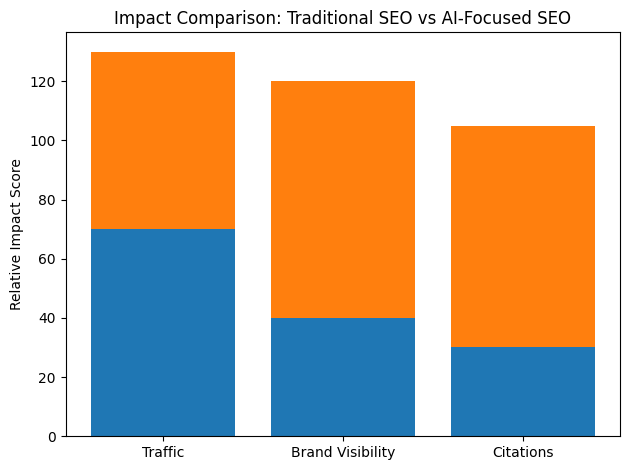
In this comprehensive guide, we’ll walk you through what Google’s AI Overviews are, why they matter for your business, and the specific SEO tactics you can implement to increase your chances of being featured.
You’ll learn how content strategy, keyword targeting, structured formatting, and authority optimization all play a role in shaping your visibility in these AI-generated summaries.
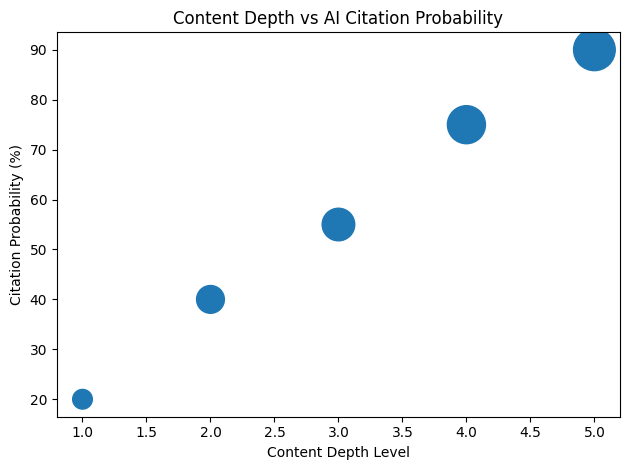
By understanding both the technical and content-centric aspects of AI-driven search, you can stay ahead of competitors and position your business for maximum impact within this rapidly growing facet of online search results.
But, before we venture further, we like to share who we are and what we do.
About AppLabx
From developing a solid marketing plan to creating compelling content, optimizing for search engines, leveraging social media, and utilizing paid advertising, AppLabx offers a comprehensive suite of digital marketing services designed to drive growth and profitability for your business.
At AppLabx, we understand that no two businesses are alike. That’s why we take a personalized approach to every project, working closely with our clients to understand their unique needs and goals, and developing customized strategies to help them achieve success.
If you need a digital consultation, then send in an inquiry here.
Or, send an email to [email protected] to get started.
How to Rank Your Business on Google’s AI Overviews
- What Are Google AI Overviews?
- How Google Chooses Content for AI Overviews
- SEO Best Practices That Still Apply
- Specific Strategies to Get Cited in AI Overviews
- Advanced Content Optimization Tactics
- Tracking and Measuring Success
- Common Mistakes to Avoid
1. What Are Google AI Overviews?
1. Definition and Core Concept
Google AI Overviews are artificial-intelligence-generated summaries that appear at the top of Google search results for certain queries. Instead of showing a traditional list of links alone, Google uses generative AI models to synthesize information from multiple web sources into a single, concise overview responding directly to the user’s query. These summaries help users quickly understand complex topics without scrolling through several websites.
According to Wikipedia, AI Overviews were first introduced in Google’s Search Generative Experience (SGE) and have since expanded globally to over 200 countries and support more than 40 languages.
Key Characteristics:
| Feature | Description |
|---|---|
| Placement on SERP | Displayed at the top (“position zero”), above organic and paid listings. |
| Generative | Uses AI to create original summarised text rather than extract direct quotes from a single page. |
| Multi-source | Synthesizes content from several web pages, with source links included. |
| Context-aware | Tailored to complex search intent, not shown for all queries. |
2. How AI Overviews Work (Behind the Scenes)
Google’s generative models — such as Gemini — process and interpret large volumes of indexed web content to produce these summaries. The AI evaluates relevance, trustworthiness, and context before generating a response. This output is then presented within a highlighted overview box at the top of search engine results pages (SERPs), with links to the original sources for deeper exploration.
The workflow typically involves:
- Query Interpretation
The AI understands user intent beyond exact keywords, using natural language processing. - Source Selection
It identifies relevant authoritative sources such as articles, guides, and FAQs. - Summary Synthesis
The AI combines insights from these sources into a short, comprehensive answer. - Source Attribution
Linkbacks to the original pages are displayed below or alongside the summary so users can verify and explore further.
3. Example of an AI Overview in Action
Imagine a user searches:
“How does intermittent fasting affect metabolism?”
Instead of immediately showing a list of articles, an AI Overview might present:
- A concise explanation of metabolic effects
- Bullet points summarizing research findings
- Contextual insights into benefits and risks
- Links to reputable sources such as medical journals or health authority sites
This direct answer acts as a stand-alone summary, allowing users to decide quickly whether they need to click through for more detail — transforming the user experience from search and sift to discover and decide.
4. AI Overviews vs Traditional SERP Features
To understand Google AI Overviews in context, it’s helpful to compare them with other search result features.
| Aspect | AI Overviews | Featured Snippets | Organic Results |
|---|---|---|---|
| Content generation | AI synthesized summary | Extracted quote from a single page | Links only |
| Position on SERP | Top of page | Below some ads | Ranked list |
| Source diversity | Multiple sources | Single page | Varies by ranking |
| Click necessity | Often not required | Helpful but click recommended | Required for info |
| User intent match | Deep, complex queries | Short direct answers | Broad range |
| Data synthesised from multiple SEO and Google documentation sources |
5. Use Cases and Query Types
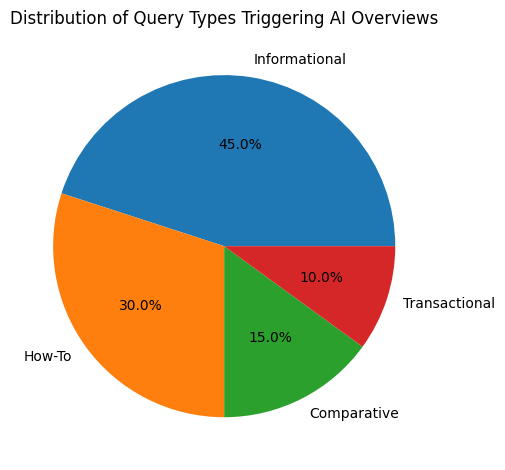
AI Overviews appear most commonly for informational and exploratory queries, including:
- “What is quantum computing?”
- “Benefits of plant-based diets”
- “Steps to start an LLC in California”
These types of searches benefit from broad summaries that draw from expert content across multiple sources. In contrast, simple navigational or transactional searches (e.g., “Nike running shoes price”) are less likely to trigger an AI Overview.
6. Why AI Overviews Matter for Businesses and SEO
AI Overviews are one of the most visible elements on Google SERPs, often occupying space above paid ads and organic listings. This visibility makes them a new frontier for search presence:
- They change click-through behaviour: Users may satisfy their informational needs without visiting your page directly.
- They redefine ranking opportunities: Your content can get cited even if it ranks below the top organic spot.
- They influence brand credibility: Being included in an AI Overview can signal expertise and authority to users.
7. Growth and Adoption Trends
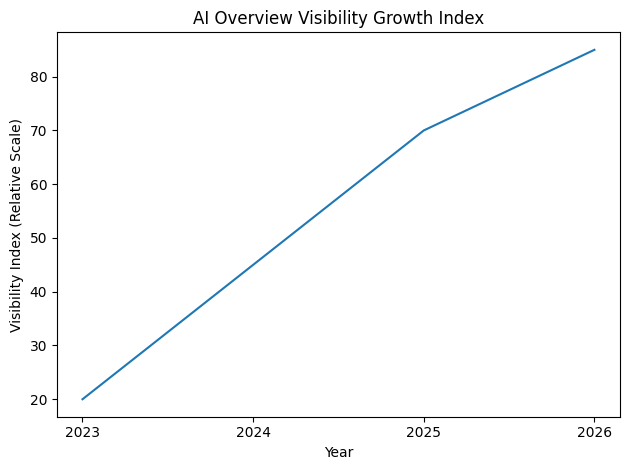
Generative AI features like AI Overviews are rapidly becoming mainstream. Google’s rollout, which began as part of experimental Search Labs in 2023, expanded globally by 2024 and now serves users in hundreds of countries. Usage studies indicate increasing engagement with AI-generated answers as search behaviour evolves.
According to research compiled across millions of AI and traditional search interactions, exposure to AI Overviews has increased significantly from 2024 to 2025, especially in areas such as complex informational queries where AI can offer deeper summarized insights.
Summary
Google AI Overviews represent a pivotal evolution of search results. Unlike traditional SEO features, they provide AI-generated, multi-source summaries that deliver direct value to users, changing the way people interact with search engines and influencing what ranking strategies work in 2026 and beyond. Businesses must understand these features deeply to adapt content strategies and capture visibility where users are beginning their search journeys — directly in the AI-generated answers.
2. How Google Chooses Content for AI Overviews
Understanding how Google selects content for AI Overviews is essential for businesses aiming to optimize visibility and capture more search traffic. Unlike traditional search rankings — which list results primarily based on relevance and link authority — AI Overviews rely on generative AI models that synthesize and evaluate content from multiple sources. This section breaks down the key mechanisms, ranking signals, and selection criteria Google uses for AI Overviews, supported by research and verified data.
1. Core Selection Principles
Google’s AI Overviews are not random summaries. They are generated through retrieval-augmented generation, a process that combines deep content retrieval with generative AI to craft concise responses using evidence drawn from existing indexed webpages. The AI identifies, extracts, and synthesizes relevant information to answer complex queries directly. This approach is grounded in the same core ranking principles that govern traditional search: relevance, quality, and trustworthiness, adapted for AI-generated responses.
Key Stages in Content Selection:
| Stage | What Happens |
|---|---|
| Query Understanding | The AI interprets user intent beyond keywords. |
| Content Retrieval | Relevant indexed pages that match the query are identified. |
| Answer Extraction | Clear answers and facts are extracted from these pages. |
| Synthesis & Generation | Information is combined into a coherent summary. |
| Source Attribution | Links to the original sources are included for transparency. |
This systematic process means Google’s AI uses structured retrieval first — drawing from human-created content — before generating answers.
2. Importance of Traditional Search Signals
Although AI Overviews are generated by large language models, Google has emphasized that traditional ranking criteria still play a central role in determining which pages are considered for AI Overviews. Pages must first be indexed by Google Search and be eligible to appear as a snippet in regular search results. The foundational principles of helpful content, relevance, authority, and user intent alignment remain crucial.
Primary Ranking Signals Used in Selection:
| Core SEO Signal | Role in AI Overview Selection |
|---|---|
| Relevance | Matches the query meaning and intent. |
| Authority | Signals trust (backlinks, domain strength). |
| Content Quality | Depth, accuracy, clarity of information. |
| Freshness | Recent updates for timely topics. |
| Accessibility | Easy to parse structure (headings, bullet points). |
Because AI Overviews extract answers from text, structured content that clearly answers user questions increases the likelihood that a page will be selected as a source.
3. Relevance and Intent Matching
Google’s AI models prioritize relevance by interpreting search intent at a deeper semantic level. Instead of focusing on exact keyword matches, the system evaluates whether content genuinely addresses the user’s query. Content that aligns closely with user expectations and intent is far more likely to be included in an AI Overview.
Types of Queries That Trigger AI Overviews:
- Informational: “What is blockchain technology?”
- How-to and Explanatory: “How to optimize content for voice search”
- Comparative: “Difference between SEO and SEM”
- Problem-solving: “Best ways to recover from burnout”
In contrast, transactional or highly commercial queries (e.g., “buy running shoes online”) are less likely to trigger AI Overviews because they do not lend themselves to comprehensive summaries.
4. Quality and Expert Signals
Google’s AI incorporates the concept of E-E-A-T — Expertise, Experience, Authoritativeness, and Trustworthiness — to assess content credibility. While E-E-A-T has long been part of traditional ranking assessments, its role in AI Overviews is even more pronounced because the AI model must judge if a source is trustworthy enough to represent key facts in a synthesized summary.
E-E-A-T Evaluation Elements:
| Element | What It Signals |
|---|---|
| Expertise | Specialized knowledge in the topic field |
| Experience | Demonstrated lived or professional experience |
| Authoritativeness | Recognition by peers, citations from reputable sites |
| Trustworthiness | Accuracy, source transparency, and safety |
Content from .gov, .edu, and peer-reviewed publications tends to be weighted more heavily due to inherent credibility, often increasing ranking likelihood.
5. Structural and Semantic Reasoning
AI can parse and understand content more effectively when it is clearly structured. Pages that employ semantic organization — such as logical headings, subheadings, bullet points, clear definitions, and explicit Q&A formatting — provide extractable chunks of information that AI systems can easily piece together when creating summaries.
Example Structure That Helps Extraction:
| Content Element | AI Interpretation Benefit |
|---|---|
| H2/H3 Headings | Segments topic for focused summarization |
| Bullet Lists | Highlights key points for direct use |
| Q&A Format | Matches user question patterns |
| Tables & Matrixes | Presents factual comparisons intuitively |
Well-structured pages improve the likelihood that AI can isolate the precise information needed to answer queries accurately and succinctly.
6. Correlation With Traditional Organic Rankings
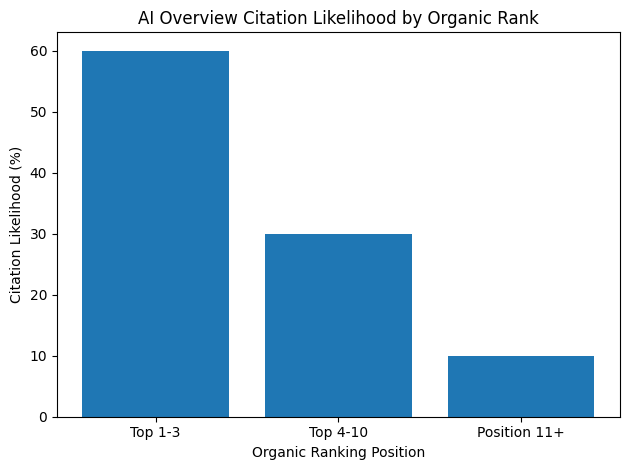
Research suggests a strong correlation between traditional organic positions and likelihood of being cited in AI Overviews. For example, a study of 1.9 million AI Overview citations revealed that 76 percent of URLs cited in AI Overviews were also ranking within the top 10 organic search results, with the median position being position 2.
Correlation Matrix: Organic Position vs. AI Overview Citation
| Organic Position Range | AI Overview Citation Likelihood |
|---|---|
| Positions 1–3 | High (majority of citations) |
| Positions 4–10 | Moderate |
| Positions 11+ | Low |
This means that while ranking number one in traditional search is not strictly required to appear in an AI Overview, strong organic visibility significantly increases the chance of being selected as a source.
7. Example of Content Selection Process
Consider a search query like “how to optimize WordPress SEO”:
- Google identifies that the query has high informational intent.
- AI retrieves a set of high-ranking articles that directly answer this question.
- It extracts clear, concise sections such as steps for optimization.
- The AI synthesizes these into a unified overview response that highlights the best practices.
- Linked citations to the original sources appear alongside the summary.
In this workflow, Google does not favor longer content arbitrarily but prioritizes clarity of answer, structure, authority, and relevance.
8. How Source Diversity Influences Selection
AI Overviews are designed to pull information from multiple sources to ensure comprehensive and balanced answers. This prevents dominance by any single perspective and helps surface unique insights, expert commentary, or verified facts from established authorities. The inclusion of citations not only enhances transparency but also promotes trust in the generated summary.
9. Summary
Google’s process for choosing content for AI Overviews blends traditional SEO ranking principles with advanced generative AI interpretation. It evaluates:
- Relevance to the query
- Quality and authority signals (E-E-A-T)
- Structural clarity of content
- Correlation with traditional organic rankings
By understanding these components, businesses can tailor content strategies that meet both traditional SEO expectations and the emerging criteria used by AI systems, increasing visibility and citation likelihood in AI-generated summaries.
3. SEO Best Practices That Still Apply
Even with the rise of AI Overviews and generative search features, core SEO fundamentals remain the foundation for getting your content discovered, indexed, and considered relevant by Google’s systems. These tried-and-true practices continue to influence both traditional ranking and AI-generated summaries. This section explains the key SEO best practices that still matter, supported with examples, reasoning, and useful tables.
1. Create High-Quality, Helpful Content
One of Google’s most explicit statements is that high-quality, helpful content remains at the heart of all search experiences — including AI-driven ones. Google’s Search Essentials emphasizes that “creating unique, helpful content that satisfies users” is the core principle behind successful search performance. Original, value-driven content helps your site be considered for both traditional results and generative summaries.
Key Characteristics of High-Quality Content
| Content Attribute | Reason It Still Matters |
|---|---|
| Unique & Non-Commodity | Avoids duplication and adds real value. |
| Topic Depth | Covers user questions thoroughly rather than superficially. |
| Accuracy & Authority | Supports factual trustworthiness. |
| Freshness | Current data signals relevance, especially in fast-changing niches. |
Example: A comprehensive guide on “remote team leadership best practices” that includes data, examples, and expert quotes is more likely to satisfy both user intent and AI systems than a 300-word generic article.
2. Align Content With Clear User Intent
Google’s AI systems are trained to answer user intent, not simply match keywords. This aligns directly with long-standing evidence that search engines increasingly favor relevance and context over keyword stuffing or superficial phrase matches. Content should reflect what users are truly asking when they search.
Intent Categories and Content Focus
| Intent Type | Content Strategy |
|---|---|
| Informational | Provide thorough, structured answers. |
| Navigational | Clearly define entities and resources. |
| Transactional | Focus on conversions with clear product/service info. |
| Investigative | Compare options and provide expert analysis. |
Example: For a query like “best CRM tools for small business,” content should include direct comparisons, use cases, pros/cons, and examples — not just a list of product names.
3. Maintain Strong Technical SEO
Technical SEO ensures that search engines can crawl, index, and understand your content. With AI Overviews increasingly fetching and synthesizing data from across indexed pages, solid infrastructure still matters.
Core Technical Factors That Still Apply
| Technical Component | Why It Matters |
|---|---|
| Crawlability & Indexing | Ensures content is discoverable. |
| Mobile-First Design | Google uses mobile indexing by default. |
| Fast Page Load Times | Better user experience signals. |
| Structured Data (Schema) | Helps AI systems interpret page elements. |
Example: Use structured data like FAQ, HowTo, Article, and QAPage schema to help Google’s systems understand your content hierarchically, which aids both traditional SEO and AI extraction.
4. Focus on Strong URL Authority and Backlinks
Backlinks remain a core trust signal in SEO, and they continue to play a role in the AI era. Websites with more authoritative link profiles are more likely to be perceived as trustworthy sources of information — a factor that influences both ranking and content selection.
Backlink Indicators That Still Matter
| Link Quality Factor | Influence on Visibility |
|---|---|
| Domain Authority | Trust indicator for search algorithms. |
| Link Diversity | Reduces dependency on single source types. |
| Contextual Links | Helps AI choose relevant passages. |
Example: Links from universities, government portals, or recognized industry leaders provide stronger signals of authority than random directories or low-quality blogs.
5. Use Clear, Structured Formatting
Structuring your content for humans also makes it easier for AI to parse and extract meaningful insights. Content with consistent heading hierarchy, bullet points, definitions, tables, and logical formatting makes it easier for AI models to identify relevant answers.
Structured Formatting Benefits
| Structural Element | Benefit for SEO & AI |
|---|---|
| H1-H2-H3 Headings | Breaks content into scoped sections. |
| Bullet Lists | Highlights key facts that AI can extract. |
| Tables | Summarizes comparisons clearly. |
| Q&A Blocks | Aligns directly with user queries. |
Example: A table that contrasts different SEO tools by pricing, features, and intended audience gives both users and AI a quicker way to grasp differences.
6. Optimize for Relevant Keywords and Long-Tail Queries
While keyword stuffing is outdated, strategic keyword targeting remains essential. Long-tail and specific queries help capture intent that AI Overviews are more likely to satisfy because these often align with real user questions.
Keywords to Prioritize
| Keyword Type | Why It Works |
|---|---|
| Long-tail Searches | High intent, specific answers more likely to be used. |
| Natural Language Queries | Matches conversational search patterns. |
| Topic Clusters | Improves AI contextual understanding. |
Example: Instead of targeting “SEO tips,” focus on “how to optimize SEO for AI search in 2026” to match deeper intent and give AI precise answers.
7. Maintain User Experience (UX) Fundamentals
User experience influences engagement signals such as time on page, bounce rate, and interactivity — metrics that still feed into how content is interpreted as valuable. A usable, accessible site supports both SEO performance and satisfies users, which ultimately signals quality.
UX Factors That Matter
| UX Component | Impact on SEO |
|---|---|
| Clear Navigation | Helps users find content faster. |
| Accessibility Standards | Supports inclusive indexing. |
| Page Speed | Improves engagement and indexing. |
Example: A FAQ page organized with anchor links helps users jump to relevant answers — beneficial for both humans and AI summarization.
8. Evidence of Credible and Accurate Information
AI systems increasingly favor verifiable and cited content. Linking to credible sources such as academic research, government reports, and authoritative industry studies reinforces the accuracy and trustworthiness of your content.
How to Use Citations Effectively
| Citation Approach | Benefit |
|---|---|
| Link to Data Sources | Supports factual claims. |
| Attribute Quotes Clearly | Improves trust signals. |
| Use Recent Statistics | Shows up-to-date relevance. |
Example: A blog post on SEO trends citing a 2025 industry survey adds authority that both users and AI systems can rely on.
Summary
Although AI Overviews represent a significant evolution in search technology, foundational SEO practices remain crucial. Creating high-quality content that reflects user intent, applying strong technical SEO, leveraging structured formatting, targeting relevant keywords, and building authority through links and citations all continue to influence how content performs — whether in traditional result pages or in AI-generated summaries.
4. Specific Strategies to Get Cited in AI Overviews
Earning a citation in Google’s AI Overviews is not accidental — it requires deliberate optimization rooted in both foundational SEO and emerging generative search behaviors. This section breaks down practical, research-backed strategies that improve your content’s likelihood of being selected as a source for Google AI Overviews, supported by examples, data, and structured insights.
1. Optimize for Relevant Queries and Topical Authority
1.1 Focus on Informational and Long-Tail Queries
Google’s AI Overviews mainly appear for informational or exploratory searches rather than purely transactional ones. Targeting long-tail and context-rich queries helps ensure your content matches user intent at a semantic level. Long-tail terms naturally align better with the detailed answers AI Overviews generate.
Long-Tail vs Short-Tail Strategy Matrix
| Strategy | Description | AI Overview Impact |
|---|---|---|
| Short-Tail Keywords | Generic 1–2 words | Harder to rank for AI citations |
| Long-Tail Phrases | Specific and intent-focused | Higher likelihood of inclusion |
| Topic Clusters | Related subtopics around a central theme | Signals topical authority |
Example: If the target topic is “content marketing,” instead of only optimizing for that broad keyword, create content around specific queries such as “how to measure ROI in content marketing” or “step-by-step editorial planning process” to align with AI Overview query patterns.
1.2 Build Topical Authority
Rather than optimizing isolated pages, topical authority involves covering a subject comprehensively across multiple related pages. This signals to AI systems that your site is a go-to resource for a topic. Multiple pages addressing various facets collectively improve the chance of being cited.
Topical Authority Benefits
| Metric | Effect |
|---|---|
| Internal Linking | Reinforces theme relevance |
| Content Depth | Better match for complex search intent |
| Semantic Consistency | Improves AI understanding |
Example: A website with comprehensive resources on “email marketing” — including guides on segmentation, automation, analytics, and best practices — is more likely to be recognized as authoritative than a site with a single high-level article.
2. Structure Content for Extractability
Google’s generative models are optimized to extract short, precise snippets or “atomic answers” that directly respond to user queries. Structuring your content with clarity enhances the AI’s ability to reuse your material.
2.1 Use Clear Question-and-Answer Frameworks
Placing concise, direct responses immediately under headings formatted as questions increases your chances of being pulled into AI Overviews. Summarizing key points in 40–60 words under a question heading makes portions of your content easily extractable.
Example Structure Template for Q&A Content
| Section Heading | Content Style |
|---|---|
| What is X? | Concise definition with key points |
| Why Does X Matter? | Direct reasons with supporting data |
| How to Implement X | Step-by-step actionable advice |
2.2 Use Structured Elements Like Lists and Tables
Content that leverages headings, bullet lists, and tables makes it easier for AI systems to parse key information. AI models often favor structured, outline-friendly text over large unsegmented blocks of prose.
Table Example: Comparing AI Optimization Tactics
| Tactic | Description | Expected Benefit |
|---|---|---|
| Heading-Based Answers | Directly addresses questions | Better extractability |
| Tables | Presents comparisons succinctly | Useful for AI generation |
| Lists | Highlights steps and points | Easier to pull into summaries |
These structural patterns enhance readability for both users and AI systems — improving the likelihood your content will be selected as a source in Google AI Overviews.
3. Enhance Signals of Authority and Clarity
Google’s AI Overviews aim to pull content that is trustworthy, clear, and contextually relevant. Reinforcing authority and clarity in your content improves citation potential.
3.1 Emphasize Expertise and Trust Signals
Even though AI Overviews are generated by machine learning models, underlying systems still factor in traditional content quality signals such as authority, clarity, and context alignment. Clear explanations backed by expert sources and citations reinforce trustworthiness.
Authority Signal Matrix
| Signal Type | SEO Impact | AI Overview Potential |
|---|---|---|
| Cited research | Improves credibility | AI likelier to reference content |
| Expert authorship | Boosts user trust | AI favors authoritative text |
| Structured data | Improves parsing and indexing | Stronger AI context extraction |
3.2 Cite Reliable Third-Party Data
Integrating data from reputable sources (studies, industry reports, government sites) into your content supports accuracy and provides AI models with strong evidence to quote or reference. This enhances relevance, especially for factual queries.
Example: Including data such as “According to industry analysis, 76 percent of AI Overview citations come from top 10 search results” reinforces credibility.
4. Match the AI’s Content Selection Behaviors
AI Overviews typically cite content that answers the query clearly and with minimal ambiguity. Understanding how AI models prioritize information allows you to align your content accordingly.
4.1 Use Fan-Out Query Coverage
AI systems break down broader searches into related sub-queries — known as fan-out queries — and then piece together multiple components into the overview. Pages that rank for multiple related sub-queries have a much higher likelihood of being cited. Research suggests pages ranking for multiple fan-out queries are significantly more likely to be included in AI Overviews.
Fan-Out Influence Chart (Conceptual)
| Number of Fan-Out Queries Ranked | Probability of AI Overview Citation |
|---|---|
| 0 | Low |
| 3 | Moderate |
| 6+ | High |
Example: If you publish content on “SEO best practices for 2026,” also optimize sub-topics that might emerge as related queries, such as “SEO for AI search,” “structured data SEO,” and “topical authority for generative search.”
4.2 Keep Pages Crawlable and Indexable
To be eligible for AI Overview citations, your content must first be crawlable and indexable by Google. There are no extra indexing requirements beyond good SEO fundamentals, but ensuring your site meets technical requirements is essential for eligibility.
Technical Eligibility Checklist
| Task | Purpose |
|---|---|
| XML Sitemap | Helps Google discover pages |
| Mobile-Friendly Design | Aligns with mobile-first indexing |
| Secure HTTPS | Signals trust and security |
| Robots.txt Validation | Ensures no resource blocking |
5. Monitor and Iterate Based on Performance
Because AI Overview citation patterns evolve, continuous monitoring and adaptation are vital.
5.1 Analyze Search Data for AI Overview Triggers
Use analytics tools that show which search queries are generating AI Overviews and then identify opportunities to align content more closely with those patterns. This aligns with documented tactics for optimizing content to appear where AI systems aggregate information.
Performance Monitoring Matrix
| Metric | Purpose |
|---|---|
| Query Data | Identify terms triggering AI Overviews |
| Click-through Rates | Understand engagement differences |
| Backlink Quality | Ensure authority signals improve |
5.2 Test and Refine Content Structure
Experiment with content formats (for example, more structured FAQ sections, atomic answers, or expanded tables) to observe how AI citations shift. Iterative testing based on performance data allows you to refine your approach over time.
Summary
Getting cited in Google’s AI Overviews requires a balanced strategy rooted in clear content structure, topical authority, relevance to informational intent, and strong traditional SEO signals. Key tactics include:
- Targeting long-tail informative queries
- Structuring pages with extractable chunks and clear Q&A
- Emphasizing trust and expertise with reliable data and citations
- Leveraging fan-out query coverage across related sub-topics
- Ensuring technical crawlability and indexability
By applying these strategies consistently over time, businesses can improve their chances of being included in AI Overviews — gaining prominent visibility in a search landscape that increasingly prioritizes contextual, machine-synthesized answers.
5. Advanced Content Optimization Tactics
This section explores cutting-edge strategies that go beyond basic SEO and directly enhance your content’s performance in the evolving landscape of generative and AI-driven search. These tactics focus on semantic relevance, AI interpretability, structured augmentation, and authority amplification, all crucial for improving visibility in Google AI Overviews and other generative responses. Insights are supported by recent SEO research and generative search analyses.
1. Architect Content for Generative Engines
Advanced optimization begins with designing content that large language models (LLMs) can easily interpret and extract.
1.1 Semantic and Topical Depth
Search engines today no longer rely solely on keyword matching but also on topic comprehensiveness and semantic context. Semantic depth helps AI understand not just what your content is about, but why it matters. Content that covers a topic thoroughly — with subtopics, examples, and linked concepts — is more likely to be selected in AI summaries.
Depth vs Coverage Matrix
| Metric | Description | AI Interpretability Impact |
|---|---|---|
| Surface Content | Brief, high-level overview | Low |
| Moderate Detail | Some examples and explanation | Moderate |
| Deep Coverage | Multi-section, with real examples, definitions, and context | High |
Example:
For a post on “cloud cost optimization,” a deep coverage page would include:
- cost drivers,
- tool comparisons,
- real-world examples,
- pricing data tables,
- actionable optimization checklists.
Such structured depth signals both relevance and authority.
1.2 Structured Data and Schema Markup
Structured data gives search engines unambiguous signals about your content. This enables AI systems to parse and interpret information more reliably, increasing the likelihood of your content being cited.
Useful Schema Types for AI Interpretability
| Schema Type | Purpose |
|---|---|
| Article | Enhances understanding of page intent |
| FAQ | Direct Q&A format ideal for AI extractable answers |
| HowTo | Step-by-step content signals useful procedural information |
| Breadcrumb | Provides site hierarchy context |
| Review/Ratings | Supports trust indicators |
Example:
A “HowTo” article on installing solar panels marked with HowTo schema can help AI generate clear, structured steps directly from your content.
2. Optimize for AI-First Relevance Signals
Content that ranks well in traditional search may not automatically be understood or included by generative models. Advanced optimization helps bridge this gap with AI-first relevance tactics.
2.1 Intent-Driven Content Engineering
Rather than just matching keywords, craft content around user questions and intent clusters. Generative systems favor content that anticipates follow-up questions and context layers.
Intent Cluster Table
| Intent Type | Content Focus | Example Query |
|---|---|---|
| Informational | Explain concepts | What is X? |
| How-to/Procedural | Step-by-step solutions | How to do X? |
| Evaluation | Comparisons and recommendations | X vs. Y |
| Predictive | Trends and forecasts | Future of X by 2028 |
Example:
A primary page on “choosing CRM software” with sections covering features to consider, top CRM tools by industry, pricing comparisons, and common pitfalls feeds deeper intent layers that AI can repurpose for overviews.
2.2 AI-Preferred Content Structures
LLMs work best with clearly segmented information — that means using tables, lists, and modular chunks of text that are easy to parse.
Content Structure Comparison
| Format | Typical Usage | AI Extraction Ease |
|---|---|---|
| Long paragraphs | Narrative content | Low |
| Bullet lists | Key bullets and insights | Medium |
| Tables | Structured data, comparisons | High |
| Q&A blocks | Direct answers | Very High |
Example:
A comparison table like this helps AI pinpoint key differentiators:
| Feature | Option A | Option B |
|---|---|---|
| Cost | Free | $49/month |
| Ease of Use | High | Moderate |
| Support | 24/7 | Business hours only |
This table gives AI clear attributes it can reuse in overviews without extra interpretation.
3. Boost Content Authority and Extractability
To be selected for AI-generated summaries, content must signal trust, credibility, and clarity.
3.1 Link Strategy for Citatability
Strong internal and external linking helps search engines and LLMs understand topic relationships and trust signals.
Link Quality Indicators
| Type | Why It Matters |
|---|---|
| External authoritative links | Supports factual credibility |
| Internal topical links | Reinforces contextual relationships |
| Outbound citations | Gives AI verifiable sources to reference |
Example:
Linking to an authoritative study or government report within your content not only boosts credibility but also provides LLMs with ready referential anchors.
3.2 Evidence-Driven Narrative
Integrating verified data points, statistics, examples, and real-world cases increases your chances of being recognized as a reliable source for AI systems.
Evidence Incorporation Checklist
| Evidence Type | Benefit |
|---|---|
| Verified statistics | Shows factual depth |
| Case studies | Human-context relevance |
| Expert quotes | Trust and credibility |
| Real numbers | Quantitative backing |
Example:
A section stating “Over 70% of B2B buyers use educational content to inform purchases” supported by a reputable industry source provides AI models with granular, factual snippets they can quote more confidently.
4. Content Monitoring & Iterative Intelligence
Advanced content optimization is not a one-time task but an ongoing cycle of improvement.
4.1 Performance Tracking and AI Citations
Monitor which pieces of content are being surfaced in AI tools and which aren’t. This helps refine optimization strategy.
Monitoring Matrix
| Metric | Purpose |
|---|---|
| AI citation frequency | Tracks presence in AI Overviews |
| Organic traffic changes | Measures traditional SEO impact |
| Engagement (time on page) | Signals user relevance |
| Query clusters | Helps refine keyword and intent targeting |
Regular analytics using tools that provide insights into AI visibility and citation trends are becoming more critical as generative search grows. Platforms now track AI-level visibility similarly to traditional rankings.
4.2 Iterative Content Refinement
Based on performance data, refine content using patterns that show the highest citation rates. This could include rewriting sections, adding new headings, or augmenting tables and lists for better context.
Refinement Workflow
- Audit high-performing content for patterns.
- Identify gaps where queries lead to low AI citation.
- Rewrite with clearer structure (headings, tables).
- Update with fresh data, case studies, or examples.
- Re-monitor performance and repeat.
Iterative optimization aligns your content with evolving search standards and AI interpretation patterns — much like classic SEO, but with a generative focus.
5. Integrate Generative Engine Optimization (GEO)
Emerging research defines Generative Engine Optimization (GEO) as a companion strategy to SEO that focuses specifically on making content AI-friendly for citations and answer engines like Google AI Overviews.
SEO vs GEO Comparison
| Focus | Goal |
|---|---|
| SEO | Improve ranking in traditional SERPs |
| GEO | Increase likelihood of AI citations and synthesized answers |
GEO includes engineering content for machine scannability, structural clarity, and contextual relevance that meshes with generative models’ retrieval processes.
GEO Implementation Model
| Phase | Key Activity |
|---|---|
| Preparation | Semantic topic mapping |
| Structuring | Schema markup & article architecture |
| Authority | Backlinks & third-party citations |
| Refinement | Monitoring & AI performance feedback |
By aligning your content with both traditional SEO and GEO principles, you maximize visibility across evolving digital search behaviors — from click-through to direct AI summary inclusion.
Summary
Advanced content optimization goes beyond keyword density and backlinks. It involves:
- Structuring for AI interpretability (headings, tables, schema).
- Driving semantic depth and topical authority.
- Amplifying trust and evidence signals.
- Applying GEO principles for AI-centric search visibility.
- Monitoring evolving citation trends and iteratively improving.
Together, these tactics position content not just to rank, but to be cited and featured in AI summaries that increasingly shape how users discover answers online.
6. Tracking and Measuring Success
Measuring the impact of your SEO efforts — especially in the era of AI-enhanced search features like Google AI Overviews — requires a blend of traditional performance indicators and emerging visibility metrics tailored to generative search behavior. Because AI Overviews can satisfy user intent directly within the search results, many classic metrics (like organic traffic alone) may no longer reveal the full picture of your content’s influence and business value. This section outlines how to define, track, and analyze meaningful success metrics that reflect both conventional SEO performance and AI-oriented visibility outcomes.
1. Traditional SEO Performance Metrics Still Matter
While AI Overview visibility requires new metrics, core SEO indicators remain foundational anchors for assessing content performance and user engagement.
1.1 Organic Traffic and Click-Through
Organic traffic measures the number of users who reach your website via unpaid search results. Sustained growth in organic visits signals steady relevance and content discovery. Tools like Google Analytics 4 (GA4) provide high-level insights into how search engines drive visitors to your pages. (turn0search1, turn0search35)
Click-through rate (CTR) reflects the percentage of impressions that result in clicks, showing how compelling your listings are in search results. While AI Overviews have increased zero-click interactions, tracking CTR helps you understand whether your meta titles and descriptions still entice clicks. Analyzing CTR alongside impression metrics contextualizes performance. (turn0search12)
| Metric | What It Measures | Why It Matters |
|---|---|---|
| Organic Traffic | Visits from search | Indicates visibility and relevance |
| CTR | Percentage of impressions that lead to clicks | Shows how enticing your result is in search |
1.2 Engagement and Conversion Metrics
Understanding how visitors behave on your site is crucial:
- Bounce rate: Percentage of visitors leaving after viewing a single page. Balanced interpretation is key because zero-click SEO can influence bounce behavior. (turn0search32)
- Session duration and pages per session: Measures visitor engagement and content depth.
- Conversion rates: Tracks lead generation or sales originating from search traffic.
These metrics reveal whether visitors find your content valuable and whether it supports your broader business goals.
2. AI-Oriented and Visibility-Based Metrics
Traditional metrics alone do not fully reflect performance in an environment where AI Overviews and zero-click results are increasingly common. AI features often provide answers directly on the results page, influencing visibility without generating site visits. (turn0search2)
2.1 AI Overview Visibility Metrics
Tracking visibility in AI Overviews — including citations and appearances — is critical for understanding generative search success:
| AI Metric | What It Measures |
|---|---|
| AI Citation Count | How often your content is referenced in AI Overviews and summaries |
| Visibility Share | Percentage of AI Overviews where your domain appears compared to competitors |
| Keyword Coverage | Number of target queries triggering AI Overviews where your content ranks |
These metrics help quantify your influence within AI-generated content. Because tools like Google Search Console do not currently isolate AI Overview impressions, using third-party rank trackers (e.g., Semrush, Ahrefs, Keyword.com) with AI-aware filters is necessary to monitor this effectively. (turn0search18, turn0search29)
Example: Benchmarking competitor AI Overview visibility can reveal opportunities. A domain with 114 mentions and 1,200 page citations in AI Overviews defines a competitive baseline that you can use for target setting. (turn0search29)
2.2 Brand Signals and Recognition
AI-driven search may elevate brand visibility even without clicks to your site. A strong brand presence in search responses can stimulate branded searches and discovery through alternate channels. Tracking these signals helps capture indirect engagement and brand awareness benefits:
| Brand Metric | Why It Matters |
|---|---|
| Branded Search Volume | Indicates increased awareness due to generative responses |
| Social Mentions & Sentiment | Reveals how AI-assisted visibility impacts public perception |
| Assistance Attribution | Multi-touch analysis showing brand influence across customer journeys |
Metrics like branded search growth have become meaningful because users may first encounter your brand via AI Overviews before navigating elsewhere. This is especially relevant where AI search experience drives more awareness than direct clicks. (turn0search33)
3. Zero-Click and Visibility-Driven Tracking
AI Overviews contribute to rising zero-click search behavior, where users receive answers without clicking through to a website. Zero-click searches now occur in over half of Google queries, indicating that measuring visibility requires more than traffic metrics. (turn0search2)
Visibility-First Tracking Metrics
| Metric Category | Example Measures |
|---|---|
| Zero-Click Frequency | Percentage of sessions ending without a click |
| Answer Visibility | Share of search queries where your content appears in AI results |
| Engagement Signals | Time spent on related brand channels, secondary traffic lifts |
Tracking these indicators helps you understand how generative responses shape user interactions and whether your content provides value even when it does not drive direct visits.
4. Combined KPI Framework
A comprehensive measurement approach blends traditional and AI-centric metrics to form an integrated view of performance:
SEO Performance KPI Matrix
| KPI Category | Traditional Metrics | AI-Oriented Metrics |
|---|---|---|
| Traffic and Visibility | Organic visits, CTR | AI Overview visibility, zero-click share |
| Engagement | Bounce rate, session length | Branded search volume, sentiment |
| Authority | Backlinks, domain score | AI citations, share of voice |
| Business Outcome | Conversions, revenue | Assisted conversions, brand influence |
This matrix clarifies which indicators should inform strategic decisions and resource adjustments across different stages of your optimization program.
5. Tools and Methods for Measurement
Few tools currently isolate AI Overview performance directly within standard analytics platforms, so real success measurement combines multiple data sources:
| Tool | Metrics It Tracks |
|---|---|
| Google Search Console | Organic impressions, CTR, queries (not AI Overview segmented yet) |
| Analytics Platforms (GA4) | Traffic, engagement, conversions |
| Third-Party SEO Tools (Semrush, Ahrefs) | AI Overview appearances and citations |
| Dedicated Rank Trackers (Keyword.com, SE Ranking) | AI-aware SERP feature visibility |
Using these tools in concert allows you to construct dashboards that blend traditional SEO data with emerging generative search insights. (turn0search18, turn0search29)
6. Reporting and Continuous Improvement
Once metrics are defined and data sources integrated, ongoing reporting becomes the backbone of optimization refinement:
- Benchmark current visibility using baseline AI and SEO metrics.
- Track trends over time, identifying improvements or declines in specific indicators.
- Compare performance to competitors to understand positioning in generative search landscapes.
- Iterate based on findings — adjusting content strategies, experimenting with structural changes, and refining focus areas where AI influences engagement or brand discovery.
By embracing a measurement framework that accounts for both clicks and citations, you align your reporting with how modern search works, combining conventional performance insights with influence-centric metrics that reflect generative search behavior. This hybrid approach ensures you can justify investments in SEO while evolving your strategy to capture value even when users do not directly visit your site.
7. Common Mistakes to Avoid
When optimizing your business to appear in Google AI Overviews and more broadly in AI-powered search results, avoiding critical mistakes is as important as implementing best practices. Failing to recognize and correct these errors can reduce visibility, damage credibility, and undermine the effectiveness of your content strategy. This section outlines the most impactful pitfalls, explains why they matter, and offers clear guidance to prevent them.
1. Treating AI Search Optimization the Same as Traditional SEO
Optimizing for AI Overviews is fundamentally different from traditional SEO. One major mistake is applying old SEO tactics without adapting for generative AI systems. Traditional SEO focuses on ranking in organic search results — often prioritizing keywords and backlinks — but generative search requires context, relevance, and structured, extractable knowledge. (turn0search0)
Why This Mistake Hurts
| Traditional SEO Focus | Limitation for AI Search |
|---|---|
| Keyword frequency | AI models prioritize meaning and intent over exact match density |
| Ranking signals (backlinks) | Less relevant for answer generation layers |
| Traffic expectations | AI may expose content without driving clicks |
Example: A blog post optimized purely for keyword density may rank in organic listings but fail to provide the clear, authoritative answers AI systems require to cite it in generative summaries. This misalignment decreases visibility in AI Overviews. (turn0search0)
2. Ignoring Search Intent and Entity Context
One of the most common strategic errors is optimizing for keywords instead of true user intent and entity relevance. Modern AI search systems — including those that power Google AI Overviews — interpret queries based on the entities and concepts they represent rather than isolated terms. (turn0search8)
Mistake Matrix: Intent vs Keyword-Centered SEO
| Approach | Core Focus | AI Search Outcome |
|---|---|---|
| Keywords only | Term visibility | Low relevance to AI context |
| Intent + Entities | User need comprehension | High relevance and citation probability |
Optimizing solely for keyword occurrences falls short because large language models prioritize semantic depth and user intent alignment over superficial keyword matches. Adaptive content that maps questions to detailed, fact-backed answers tends to perform better in AI citations.
3. Over-Reliance on Unedited AI-Generated Content
AI tools can accelerate content creation, but publishing model-generated drafts without human review is a common error that undermines quality and credibility. Generic, unpolished content often lacks nuance, specificity, and real-world insights that make it both useful to readers and trustworthy to AI systems. (turn0search2)
Key Issues With Unedited AI Content:
- Misstated facts or potential hallucinations
- Lack of unique insights or expertise
- Missing human experiences or real examples
Risk Comparison
| Type of Content | Quality Risk | AI Citation Potential |
|---|---|---|
| Pure AI draft | High | Low |
| Human-edited AI draft | Moderate | Moderate to High |
| Human-driven authored content | Low | Highest |
Without human editing, AI content can appear generic and unhelpful — leading generative systems to bypass it in favor of richer, more expert content sources.
4. Skipping Structured Formatting and Extractability
AI systems require structured data and clear formatting to identify and extract meaningful information. A frequent mistake is crafting dense narrative content without headings, lists, or schema markup, which makes it harder for AI to parse and cite relevant facts.
Structural Elements That Matter
| Structural Pattern | Why It Matters |
|---|---|
| Headings and subheadings | Helps models identify segments of meaning |
| Tables and comparisons | Presents facts clearly and succinctly |
| Bullet lists and Q&A formats | Makes key information extractable |
| Schema markup | Clarifies relationships for interpretation |
Failing to implement these structures can reduce both traditional SEO value and generative AI visibility. Content without semantic structure is often deprioritized in AI summaries because the models struggle to reliably extract key points.
5. Neglecting E-E-A-T (Experience, Expertise, Authority, Trustworthiness)
Google’s emphasis on E-E-A-T remains paramount — possibly even more so for AI-generated results. Mistakes in this area include publishing unsupported claims, failing to cite authoritative sources, or lacking author credentials that convey expertise. (turn0search8)
E-E-A-T Signal Checklist
| Signal | What It Communicates |
|---|---|
| Cited studies and data | Factual grounding |
| Author qualifications | Expertise |
| External links to authoritative sources | Trustworthiness |
| Up-to-date content | Relevance |
Content that doesn’t reinforce E-E-A-T may be overlooked by AI when selecting sources for summaries, especially for informational or high-stakes topics.
6. Ignoring Technical Accessibility
Content optimization fails when AI bots cannot crawl, access, or index your pages. Common technical SEO mistakes include blocking bots in robots.txt, misconfigured hosting, or JavaScript rendering issues. These are amplified in the AI era, as models depend on successful content retrieval to generate citations. (turn0search20)
Technical Barriers Table
| Technical Issue | Impact | Risk Score |
|---|---|---|
| Blocked bots in robots.txt | Prevents discovery | High |
| Noindex tags on key pages | Stops indexing | High |
| Slow load speeds | Reduces crawl efficiency | Medium |
| Poor mobile optimization | Degrades user signals | Medium |
Ensuring that AI-oriented crawlers can access and interpret your content is foundational to visibility.
7. Prioritizing Quantity Over Quality
A common SEO mistake — intensified by AI tools — is producing high volumes of low-quality content rather than a focused set of authoritative, well-structured, and deeply informative pages. High content volume does not necessarily translate to visibility in AI summaries; in fact, it often dilutes domain authority and confuses AI context if pages lack depth and differentiation. (turn0search14)
Quality vs Quantity Matrix
| Approach | Primary Focus | AI Visibility Outcome |
|---|---|---|
| High Quantity | Many shallow pages | Low |
| Balanced Quality | Moderate volume, well-optimized | Medium |
| High Quality | Fewer, deeply optimized pages | High |
Quality content that truly solves user questions signals value more effectively and is more likely to be selected as part of a generative answer.
8. Failing to Align Metrics With AI Search Goals
Relying only on traditional SEO metrics (like page views or keyword rankings) without tracking AI search-specific indicators leads to misinterpretation of success. AI search optimization necessitates separate measurement of visibility in answer engines, citation frequency, and assisted brand impact, distinct from click-through expectations. (turn0search0)
Common measurement errors include:
- Evaluating performance solely based on traffic
- Overlooking citations even when organic sessions are low
- Assuming brand value is only achieved through clicks
A balanced KPIs approach covers brand exposure, AI citations, traffic, and engagement metrics together.
Summary of Common Mistakes
| Category | Core Mistake | Effect on AI Visibility |
|---|---|---|
| Strategy | Treating AI search like traditional SEO | Misalignment with generative model behavior |
| Content | Over-dependence on autogenerated drafts | Loss of E-E-A-T and relevance |
| Structure | Poor formatting and data structure | Reduced extractability by AI |
| Technical | Blocking crawlers or restricting indexation | No visibility to AI systems |
| Metrics | Focusing only on traditional metrics | Misleading performance interpretation |
Proactively avoiding these mistakes positions your content for better inclusion in Google AI Overviews, stronger relevance signals, and balanced visibility across both traditional and generative search environments. For businesses looking to thrive in 2026 and beyond, integrating strategy, quality, intent, and performance alignment is essential.
Conclusion
In conclusion, ranking your business on Google’s AI Overviews represents a strategic evolution of traditional SEO into the emerging realm of generative and answer-centric search optimization. AI Overviews are now a core part of how users discover quick, aggregated answers for informational queries — appearing above organic results and synthesizing information from multiple pages. Research shows these AI summaries appear in an increasing share of searches, especially for informational topics, and visibility in them can significantly influence brand exposure even if it does not always drive direct clicks to your site.
To harness this opportunity, your business must blend foundational SEO excellence with AI-oriented content strategies. Maintaining strong organic rankings — particularly within the top 10 — remains crucial since a significant majority of AI Overview source citations come from high-ranking organic pages. A study highlighted that nearly all AI Overview sources originate from top organic positions, underscoring that classic SEO performance still powers generative search visibility.
However, visibility in AI Overviews also requires more than just ranking well. It demands content that is structured for extractability — using clear question-based headings, concise “atomic answers,” and logically segmented formats that align with how generative models parse and repurpose information. Optimizing content not only for keywords but for semantic relevance, topical authority, and direct query answers increases the likelihood that your business will be cited as a credible and valuable source.
As Google continues to evolve AI features — including the shift to more advanced models like Gemini 3 — the nature of search becomes more conversational and context- aware, further blurring the lines between direct search result listings and generative, summary-based responses. Businesses that adapt proactively by enriching their content with unique data points, deeper insights, structured markup, and authoritative context are better positioned to be included in AI Overviews and, by extension, remain visible and relevant in this new search landscape.
Ultimately, succeeding in this environment requires a holistic SEO strategy — one that integrates traditional ranking goals, user-centric content design, and innovation in content engineering for AI. Focusing on delivering high-value, trustworthy, and easily digestible answers not only supports classic search visibility but also increases your chances of becoming a trusted source for AI-generated overviews. As AI search continues to expand globally and mature, embracing these strategies will ensure your business stays competitive, discoverable, and authoritative in an increasingly AI-driven information ecosystem.
If you are looking for a top-class digital marketer, then book a free consultation slot here.
If you find this article useful, why not share it with your friends and business partners, and also leave a nice comment below?
We, at the AppLabx Research Team, strive to bring the latest and most meaningful data, guides, and statistics to your doorstep.
To get access to top-quality guides, click over to the AppLabx Blog.
People also ask
What are Google’s AI Overviews?
Google’s AI Overviews are AI-generated summaries that appear at the top of search results, combining information from multiple sources to answer user queries directly.
How do AI Overviews impact SEO?
AI Overviews can reduce clicks but increase brand visibility. Being cited boosts authority and positions your business as a trusted source in generative search results.
How can my business appear in AI Overviews?
Focus on high-quality, structured, intent-driven content that clearly answers questions and ranks well in organic search results.
Do I need to rank #1 to be featured in AI Overviews?
Not necessarily, but most cited pages rank in the top 10 organic results, so strong SEO performance increases your chances significantly.
What type of content triggers AI Overviews?
Informational, how-to, comparison, and problem-solving queries are more likely to generate AI Overviews than transactional searches.
Are AI Overviews replacing traditional search results?
No, they complement traditional results by summarizing information, but organic rankings still influence which sources are cited.
Does structured data help rank in AI Overviews?
Yes, schema markup like FAQ, Article, and HowTo helps search engines better understand and extract your content.
How important is E-E-A-T for AI Overviews?
Very important. Demonstrating experience, expertise, authority, and trustworthiness increases credibility and citation potential.
Do backlinks still matter for AI search visibility?
Yes, backlinks strengthen domain authority, which influences both organic rankings and the likelihood of being cited in AI summaries.
How do I optimize content for extractability?
Use clear headings, concise answers, bullet lists, and tables to make key information easy for AI systems to interpret and reuse.
What are long-tail keywords and why do they matter?
Long-tail keywords are specific search phrases that reflect clear intent. They align better with AI-generated responses.
Can small businesses rank in AI Overviews?
Yes, by focusing on niche expertise, structured content, and topical authority, small businesses can compete effectively.
How does topical authority influence AI citations?
Covering a topic comprehensively across multiple related pages signals expertise and increases citation likelihood.
Should I use AI tools to create content?
AI tools can help with drafting, but content should be human-edited to ensure accuracy, originality, and authority.
Do AI Overviews affect click-through rates?
Yes, they may lower direct clicks but increase brand exposure and awareness at the top of search results.
How can I track AI Overview visibility?
Use SEO tools that monitor SERP features and track which keywords trigger AI Overviews including your domain.
Is mobile optimization important for AI Overviews?
Yes, Google uses mobile-first indexing, so mobile-friendly pages are essential for eligibility and visibility.
Does page speed impact AI search rankings?
Fast-loading pages improve user experience and crawl efficiency, supporting better overall SEO performance.
How often should I update my content?
Regular updates with fresh data, examples, and insights keep your content relevant and increase citation chances.
What mistakes should I avoid when optimizing for AI search?
Avoid keyword stuffing, publishing generic AI-written content, ignoring structure, and neglecting technical SEO basics.
Do AI Overviews favor authoritative domains only?
Authority helps, but clear, relevant, and well-structured niche content can also earn citations.
How does user intent influence AI Overview selection?
AI prioritizes content that directly satisfies the user’s search intent with clear and accurate answers.
Can product pages appear in AI Overviews?
Typically, informational pages perform better, but product comparison or educational content can qualify.
What is Generative Engine Optimization (GEO)?
GEO focuses on optimizing content specifically for AI-driven search engines and answer-based results.
Does internal linking help with AI visibility?
Yes, internal links strengthen topic relationships and reinforce contextual relevance across your website.
Are FAQ sections useful for AI Overviews?
Yes, FAQ sections provide direct question-and-answer formats that are easy for AI systems to extract.
How long does it take to rank in AI Overviews?
Results vary, but improving authority, structure, and rankings can influence visibility over several weeks or months.
Can local businesses rank in AI Overviews?
Yes, by optimizing local content, structured data, and clear service information aligned with user queries.
What metrics define success in AI search?
Track AI citations, visibility share, branded search growth, organic rankings, and engagement metrics.
Why is semantic SEO important for AI Overviews?
Semantic SEO helps search engines understand context, relationships, and intent beyond keywords, increasing citation potential.
Sources
Google & Official Documentation
- Google Search Central – AI Features Documentation
- Google Search Central – SEO Starter Guide
- Google Search Central Blog – Succeeding in AI Search
- Google – How Search Works (AI Overviews documentation PDF)
- Google Blog – AI Mode & AI Overviews Updates
SEO Research & Industry Publications
- Ahrefs – How to Rank in AI Overviews
- Semrush – How to Rank in AI Overviews
- Semrush – AI Overview Research
- SEO.com – AI Overviews Guide
- Search Engine Land – Optimizing Content for AI Search Engines
- Search Engine Land – Measuring Visibility in a Zero-Click World
- Single Grain – Google AI Overviews Guide
- Onely – How to Rank in Google AI Overviews
- Yellowhead – Optimizing for AI Overviews
- Finch – Google AI Overviews Optimization
- Reusser – How Google AI Overview Is Reshaping SEO
- SE Ranking – How to Optimize for AI Overviews
- This Is Gain – Optimizing for Google AI Overviews
- MediaPlus – AI Overview Citations Research
- Discovered Labs – AEO Best Practices
- Evergreen Media – Google AI Overviews Guide
Analytics & Measurement Sources
- Forbes Agency Council – Measuring Success in the Age of AI Search
- Keyword.com – How to Track AI Overviews
- LinkedIn (Brave Agency) – Essential SEO Metrics in the AI Era
- LLMRefs – Measuring SEO Performance
- BabyLoveGrowth – SEO Metrics to Track
- Siteimprove – SEO Performance Metrics
- TechRadar – Semrush Review
AI Search & Generative Optimization Research
- Wikipedia – AI Overviews
- Wikipedia – Generative Engine Optimization
- Medium – AI Search Success & Common Errors
- Originality.ai – AI SEO Mistakes to Avoid
- Shoreline Digital – AI SEO & Search Optimization
- SEO Monitor – AI Overviews Ranking Factors
- ICreationsLab – AI SEO Practical Guide
- Fuel Online – Optimize for Google AI Overviews
- Search Engine Journal – AI Overviews Studies
- Marko Brando – SEO for Google AI Overviews Guide
- Siteimprove – SEO Content Optimization Best Practices
Technical & GEO Resources
- LLMRefs – Generative Engine Optimization
- Search Engine Land – AI Search Mistakes
- Techtarget – Google Search Generative Experience (SGE)
- Botify – What Are Google AI Overviews
- Nightwatch – AI Overviews Guide