


























Key Takeaways
- AI search engines like ChatGPT and Gemini rank content using semantic relevance, authority signals, and structured information rather than traditional keyword-based rankings.
- Content that is clear, well-structured, evidence-based, and optimized for conversational queries is more likely to be retrieved and cited in AI-generated answers.
- Modern SEO is evolving into Generative Engine Optimization (GEO), where the goal is not just ranking pages but becoming a trusted source within AI search responses.
Search is undergoing one of the most significant transformations since the rise of Google. For more than two decades, traditional search engines operated on a relatively straightforward model: users typed a query, algorithms ranked web pages, and the results appeared as a list of links. Today, that paradigm is rapidly changing as AI-powered search engines such as ChatGPT and Gemini redefine how information is discovered, evaluated, and delivered to users. Instead of presenting ten blue links, these systems generate direct answers by synthesizing information from multiple sources across the web.

This shift has profound implications for content creators, marketers, and businesses that rely on search visibility. In the age of AI search, ranking no longer means simply appearing on the first page of results. Instead, it means becoming part of the answer itself. AI systems read, interpret, and combine information from many web pages to produce a single response that addresses the user’s question in a conversational format.
At the heart of this transformation are large language models (LLMs) and retrieval systems that analyze user intent, gather relevant information, and generate coherent explanations. Rather than matching keywords alone, AI search engines use natural language processing and machine learning to understand the deeper meaning behind queries. They evaluate context, semantics, and user intent to determine which sources are most relevant to the question being asked.
For example, when someone asks an AI assistant a complex question such as “What is the best strategy for remote team management?” the system does not simply look for pages that contain those exact words. Instead, it interprets the intent of the query, retrieves relevant passages from multiple sources, and synthesizes them into a structured response. This process often involves selecting specific sections of content rather than entire pages, meaning the ability of AI systems to extract and understand information at the passage level is becoming increasingly important.
The technology behind this capability is commonly known as retrieval-augmented generation, or RAG. In this approach, AI models first retrieve relevant documents from the web or internal indexes, then use those documents as context when generating an answer. This allows the system to ground its responses in real sources rather than relying solely on pre-trained knowledge. As a result, modern AI search engines function as both research assistants and answer generators, combining information retrieval with natural language generation.
Another major difference between AI search and traditional search engines is how sources are evaluated. Classic search algorithms relied heavily on ranking signals such as backlinks, keyword relevance, and domain authority. AI search engines still consider many of these factors, but they also prioritize additional signals such as semantic clarity, factual accuracy, and the ability to extract meaningful information from content. In many cases, the system selects passages that clearly explain a concept rather than pages that simply rank well in traditional search results.
This evolution has given rise to a new discipline often called Generative Engine Optimization (GEO). Unlike traditional SEO, which focuses on ranking pages in search results, GEO focuses on making content visible and usable within AI-generated answers. The goal is to structure information so that AI models can retrieve it, understand it, and confidently cite it when generating responses.
The rise of AI search engines is also changing the competitive landscape of online visibility. Studies show that AI systems may draw information from a broader range of sources than traditional search engines, sometimes including smaller or less prominent websites if they provide clear and authoritative information. At the same time, these systems tend to prioritize trustworthy and knowledge-based sources, such as educational websites, corporate documentation, and encyclopedic resources.
For businesses and publishers, this creates both opportunities and challenges. On one hand, high-quality content that clearly explains topics can gain visibility even without dominating traditional rankings. On the other hand, the lack of transparency in AI ranking mechanisms makes it difficult to predict exactly how content will be selected and cited. The algorithms behind AI search systems remain largely opaque, and each platform may weigh signals differently depending on its architecture and data sources.
As AI search adoption continues to grow, understanding how these systems rank and select content is becoming essential for anyone who publishes information online. Whether you are a marketer, SEO professional, content strategist, or business owner, adapting to this new search environment will be critical for maintaining digital visibility.
This article explores how AI search engines like ChatGPT and Gemini rank content, what signals they prioritize, and how the rules of search optimization are evolving in the era of generative AI. By understanding the underlying mechanisms that power AI search, you can begin to adapt your content strategy for a future where answers, not links, dominate the search experience.
But, before we venture further, we like to share who we are and what we do.
About AppLabx
From developing a solid marketing plan to creating compelling content, optimizing for search engines, leveraging social media, and utilizing paid advertising, AppLabx offers a comprehensive suite of digital marketing services designed to drive growth and profitability for your business.
At AppLabx, we understand that no two businesses are alike. That’s why we take a personalized approach to every project, working closely with our clients to understand their unique needs and goals, and developing customized strategies to help them achieve success.
If you need a digital consultation, then send in an inquiry here.
Or, send an email to [email protected] to get started.
How AI Search Engines Like ChatGPT and Gemini Rank Content
- How AI Search Engines Actually Work
- The Core Ranking Signals Used by AI Search
- How AI Search Differs from Traditional Google SEO
- The New Discipline: Generative Engine Optimization (GEO)
- Key Content Types That Perform Well in AI Search
- Practical Strategies to Rank in AI Search
- Challenges and Limitations of AI Search Ranking
- The Future of SEO in the AI Search Era
1. How AI Search Engines Actually Work
AI search engines such as ChatGPT, Gemini, and similar conversational systems operate using a hybrid architecture that combines large language models (LLMs), semantic retrieval systems, and generative reasoning. Unlike traditional search engines that rank and display links, AI search platforms synthesize information from multiple sources and generate structured answers for users.
This transformation represents a shift from document retrieval to knowledge synthesis. Instead of ranking web pages based solely on keyword relevance and backlinks, AI systems analyze intent, retrieve relevant passages, and generate explanations grounded in external data sources.
Large Language Models as the Core Engine
AI search engines are built on large language models (LLMs), which are deep-learning systems trained on massive datasets containing text from books, websites, and other sources. These models learn statistical relationships between words and concepts, enabling them to generate coherent language and understand complex queries.
LLMs operate using billions or even trillions of parameters that encode linguistic patterns and contextual relationships. When a user submits a query, the model interprets the intent behind the question and predicts the most relevant response based on both its training knowledge and retrieved context.
Key capabilities of LLM-based search systems
| Capability | Explanation | Practical Impact |
|---|---|---|
| Natural language understanding | Models analyze conversational queries instead of simple keywords | Users can ask full questions |
| Contextual reasoning | AI interprets intent and relationships between concepts | Better answers for complex queries |
| Generative responses | Systems produce synthesized explanations rather than lists of links | Faster information discovery |
| Knowledge synthesis | Information from multiple sources is merged into a single answer | Reduced need to visit multiple websites |
Example:
User query: “How does remote work affect productivity?”
An AI search system may combine data from management studies, productivity statistics, and organizational research to produce a summarized answer rather than returning separate links.
Retrieval-Augmented Generation (RAG)
One of the most important mechanisms behind AI search engines is Retrieval-Augmented Generation (RAG). This framework integrates traditional information retrieval systems with generative AI models to improve accuracy and relevance.
In RAG systems, the model does not rely solely on its pre-training data. Instead, it retrieves relevant documents or passages from external sources before generating an answer. This grounding process helps ensure that responses are factual and up to date.
Core steps in a RAG pipeline
| Step | Description | Role in AI Search |
|---|---|---|
| Query processing | AI interprets the user’s question and intent | Converts natural language into search vectors |
| Retrieval | Relevant documents or passages are fetched from indexes, APIs, or databases | Provides factual grounding |
| Context injection | Retrieved information is inserted into the model’s prompt or context window | Supplies external knowledge |
| Generation | The language model synthesizes the final response | Produces human-readable answers |
| Citation or attribution | Sources may be referenced in the output | Improves trust and transparency |
RAG systems significantly improve factual reliability because they enable models to access external knowledge bases and web documents at query time.
Example:
If a user asks “What are the latest developments in quantum computing?”, the system can retrieve recent research papers, news reports, or technical documentation before generating an answer.
Semantic Retrieval and Vector Search
Traditional search engines rely heavily on keyword matching. AI search engines instead use semantic search, which analyzes meaning rather than exact words.
This is achieved through vector embeddings, a mathematical representation of text where words, sentences, or documents are converted into numerical vectors. These vectors allow the system to measure semantic similarity between queries and documents.
Example of semantic retrieval
| User Query | Traditional Keyword Match | AI Semantic Retrieval |
|---|---|---|
| “How do I reduce stress at work?” | Pages containing the exact phrase | Content about workplace burnout, mindfulness, or productivity |
| “What is the future of electric vehicles?” | Pages with “electric vehicles” keywords | Articles about EV adoption, battery innovation, and automotive policy |
Semantic retrieval significantly improves the ability of AI search engines to interpret complex questions and deliver relevant information.
Intent Detection and Query Decomposition
AI search engines also analyze search intent more deeply than traditional systems. Instead of treating queries as simple strings of keywords, they break them down into structured components.
Key components of intent analysis
| Query Component | Meaning |
|---|---|
| Topic | The subject being discussed |
| Intent | The user’s goal (learn, compare, buy, troubleshoot) |
| Context | Location, previous queries, or conversational context |
| Complexity | Whether the question requires synthesis or simple retrieval |
Example:
Query: “Compare electric cars and hybrid cars for long-distance travel.”
The AI system may split this into multiple sub-tasks:
- Identify electric vehicle characteristics
- Identify hybrid vehicle characteristics
- Compare efficiency and charging infrastructure
- Evaluate suitability for long-distance travel
This decomposition allows the system to retrieve and synthesize information more effectively.
Multi-Source Information Aggregation
AI search engines frequently aggregate data from multiple sources simultaneously. This approach resembles federated search, where queries are distributed across several information systems and the results are combined into a unified output.
Instead of returning multiple independent results, AI systems merge the retrieved information and generate a single coherent explanation.
Information aggregation workflow
| Stage | Description |
|---|---|
| Source discovery | Identify relevant documents or databases |
| Passage extraction | Select specific sections of content |
| Source evaluation | Determine authority and credibility |
| Knowledge synthesis | Combine insights into one response |
Example:
A query about climate change mitigation strategies may involve:
- Scientific studies
- Government policy reports
- Environmental datasets
- Academic papers
The AI model extracts key insights from each source and produces a consolidated answer.
Generative Reasoning and Answer Construction
Once relevant data is retrieved, the AI model constructs a response using generative reasoning. This stage involves organizing information into a logical explanation that directly answers the user’s question.
Typical response generation process
| Stage | Function |
|---|---|
| Context integration | Retrieved passages are merged into the model’s input |
| Knowledge filtering | Irrelevant information is removed |
| Reasoning | Relationships between facts are evaluated |
| Language generation | Final answer is produced in natural language |
Unlike traditional search engines, the goal is not merely to rank documents but to generate a complete answer.
AI Search vs Traditional Search: Operational Differences
The following matrix highlights the fundamental differences between conventional search engines and AI-driven search platforms.
| Feature | Traditional Search Engines | AI Search Engines |
|---|---|---|
| Output format | Ranked list of web pages | Generated answers |
| Retrieval method | Keyword indexing | Semantic vector retrieval |
| Knowledge source | Indexed web pages | Web data + model knowledge |
| Interaction style | One query per search | Conversational dialogue |
| Information synthesis | User must combine sources | AI synthesizes sources |
Traditional search systems primarily return links to relevant content, while AI search engines generate explanations by combining information retrieved from multiple sources.
Example Workflow: How an AI Search Query Is Processed
The following table illustrates how an AI search engine processes a typical user query.
| Stage | Example Query: “What are the benefits of remote work?” |
|---|---|
| Query interpretation | AI identifies topic: remote work |
| Intent detection | Informational intent |
| Semantic retrieval | Relevant articles about productivity, cost savings, and flexibility |
| Passage selection | Extract paragraphs discussing benefits |
| Context injection | Retrieved information is fed into the LLM |
| Response generation | AI summarizes benefits and supporting evidence |
The Emerging Architecture of AI Search Systems
Modern AI search platforms often combine multiple technologies in a layered architecture.
| Layer | Technology | Function |
|---|---|---|
| Data layer | Web indexes, APIs, knowledge bases | Provide external information |
| Retrieval layer | Vector search, semantic matching | Locate relevant passages |
| Reasoning layer | Large language models | Interpret context and generate responses |
| Interface layer | Conversational UI | Deliver answers to users |
Research into generative search systems shows that these architectures combine LLM reasoning with external retrieval to produce contextual answers rather than simple document lists.
Key Takeaways
AI search engines function differently from traditional search engines because they integrate language modeling, semantic retrieval, and generative reasoning into a unified system.
Important characteristics include:
- Large language models interpret queries and generate responses
- Retrieval-Augmented Generation connects models with external knowledge sources
- Semantic search replaces simple keyword matching
- Multi-source aggregation synthesizes information into single answers
This combination enables AI search platforms to act not only as search engines but also as knowledge synthesis systems, fundamentally transforming how users discover and consume information online.
2. The Core Ranking Signals Used by AI Search
AI search engines such as ChatGPT, Gemini, Perplexity, and Google AI Overviews use a fundamentally different ranking model compared with traditional search engines. Instead of ranking pages on a search results page, these systems select specific passages and sources to synthesize a single answer. The visibility of content therefore depends on whether it is retrieved, trusted, and cited by the AI system.
Research into generative search shows that ranking is influenced by a combination of semantic relevance, authority signals, structured information, and content clarity rather than purely backlinks and keywords.
The following sections analyze the most important ranking signals that determine whether AI systems include a piece of content in generated answers.
Semantic Relevance and Query Alignment
One of the most powerful signals in AI search is semantic similarity between the query and the content. Large language models convert text into numerical embeddings, enabling them to compare conceptual meaning rather than relying on keyword matching.
Research analyzing generative search engines found that cited sources tend to have higher semantic similarity with the user query and with other selected sources.
How semantic relevance influences ranking
| Signal | Explanation | Example |
|---|---|---|
| Conceptual similarity | Content that closely matches the meaning of the query is prioritized | “Benefits of remote work” retrieves pages discussing productivity and flexibility |
| Passage-level relevance | AI selects specific paragraphs rather than whole pages | A section explaining hybrid work productivity may be cited |
| Topic coverage | Comprehensive answers covering multiple aspects of a question rank better | A guide discussing benefits, challenges, and statistics |
Example scenario
User query: “How does remote work affect employee productivity?”
AI systems may select passages discussing:
- Productivity statistics from academic studies
- Remote work flexibility and time management
- Collaboration challenges
The system then synthesizes these passages into one answer instead of returning links.
Authority, Expertise, and Trustworthiness
Authority remains one of the most influential ranking signals in AI search environments. AI systems prioritize credible sources with established expertise and accurate information.
Content demonstrating strong Experience, Expertise, Authoritativeness, and Trustworthiness (E-E-A-T) signals is more likely to be cited in AI responses.
Typical authority indicators used by AI search engines
| Authority Signal | Description |
|---|---|
| Expert authorship | Content written or reviewed by domain specialists |
| Domain credibility | Established websites, institutions, or academic publishers |
| Consistent brand mentions | References to the brand across multiple trusted sources |
| Fact-checked information | Verified data and citations |
AI systems analyze these signals because generated answers must be credible and verifiable, especially when they provide citations within responses.
Authority ranking matrix
| Source Type | Likelihood of Citation |
|---|---|
| Academic research papers | Very high |
| Government websites | High |
| Established media outlets | High |
| Industry blogs with expertise | Moderate |
| Anonymous or low-quality sites | Low |
This prioritization is necessary because generative search engines aim to deliver trustworthy answers supported by credible evidence.
Citations and External References
In AI search, citations act as a major ranking signal. Instead of ranking pages in a list, AI systems reference content that can be cited as supporting evidence.
Generative Engine Optimization research shows that AI-driven search engines evaluate links, citations, and structured data to determine whether content should be included in generated answers.
Role of citations in AI ranking
| Citation Signal | Impact on AI visibility |
|---|---|
| External references | Demonstrates credibility |
| Statistical evidence | Improves likelihood of citation |
| Named entities | Helps AI recognize authoritative sources |
| Cross-source verification | Multiple sources confirming the same fact |
Example
A blog post discussing “AI adoption in business” may be cited if it includes references such as:
- Industry reports
- Academic research
- Market statistics
Content without citations is less likely to be trusted or used in AI responses.
Content Structure and Machine Readability
AI systems prefer content that is structured, clear, and easy to extract information from. Research into generative search pipelines shows that structural information such as headings, schema markup, and logical formatting improves retrieval performance.
Structured content helps AI models identify key sections, definitions, and answers.
Structural signals that influence AI ranking
| Structural Element | Why It Matters |
|---|---|
| Clear headings | Helps AI locate topic sections |
| Bullet points and lists | Improves information extraction |
| FAQs | Aligns with conversational queries |
| Schema markup | Provides machine-readable metadata |
| Short paragraphs | Easier for passage-level retrieval |
Example
Two articles may contain the same information, but the one with the following structure is more likely to be cited:
- Definition
- Key benefits
- Data and statistics
- Step-by-step explanation
This formatting improves passage retrieval accuracy.
Topical Authority and Entity Recognition
AI search engines rely heavily on entity-based knowledge graphs and topic clusters. Content that consistently covers a topic across multiple pages signals authority.
Industry analyses of generative search ranking factors indicate that entity recognition and topical depth are among the most critical signals used by AI search engines.
Topical authority signals
| Signal | Description |
|---|---|
| Content clusters | Multiple related articles on a topic |
| Entity references | Clear mention of recognized concepts or brands |
| Knowledge graph alignment | Structured relationships between topics |
| Consistent terminology | Reinforces semantic understanding |
Example
A website publishing numerous articles about electric vehicles may develop topical authority through:
- EV battery technology
- Charging infrastructure
- EV market trends
- Government incentives
AI search systems recognize the site as a reliable source for that topic.
Contextual Relevance and Prompt Matching
Another ranking factor is contextual relevance to the user’s prompt. AI search engines analyze not only the query but also the broader conversation context.
Generative search research indicates that visibility in AI answers depends on how well a piece of content matches the context and intent of the prompt.
Contextual ranking signals
| Signal | Example |
|---|---|
| Prompt intent | Informational vs transactional query |
| Conversational context | Follow-up questions |
| User location or history | Local recommendations |
| Topic depth | Whether the answer addresses sub-questions |
For example:
Query: “What are the best strategies for remote team management?”
The AI system may retrieve content discussing:
- communication tools
- productivity frameworks
- leadership techniques
Content that addresses multiple aspects of the question is more likely to be selected.
Information Clarity and Extractability
Generative engines prefer content that can be easily extracted and summarized.
Industry analyses show that factors such as succinctness, factual accuracy, and clarity strongly influence whether content is referenced by AI systems.
Content clarity scoring matrix
| Factor | Poor Performance | Strong Performance |
|---|---|---|
| Explanation clarity | Long paragraphs without structure | Clear definitions and concise explanations |
| Data presentation | No statistics | Includes data and sources |
| Readability | Complex language | Simple, explanatory wording |
| Extractability | Hidden insights | Clearly separated key points |
Example:
A concise definition such as
“Remote work allows employees to perform job duties outside a central office, often using digital collaboration tools.”
is easier for AI systems to extract than a long narrative paragraph.
Cross-Platform Authority Signals
Different AI platforms rely on different search indexes and ranking systems.
For example:
- ChatGPT relies heavily on the Bing search index
- Gemini uses Google’s search infrastructure
- Perplexity maintains its own retrieval index
Only about 11% of cited domains appear across multiple AI platforms, showing that each system evaluates authority signals differently.
Cross-platform ranking matrix
| AI Platform | Primary Data Source |
|---|---|
| ChatGPT | Bing search index |
| Gemini | Google search ecosystem |
| Perplexity | Proprietary search index |
| Claude | Brave Search index |
Because of these differences, content that ranks well in one AI engine may not necessarily appear in another.
Key Takeaways
AI search ranking signals differ significantly from traditional search algorithms. Instead of focusing only on keywords and backlinks, generative engines evaluate whether content can be trusted, understood, and synthesized into an answer.
The most influential signals include:
- semantic relevance to the query
- authority and trust signals
- citations and supporting evidence
- structured and machine-readable content
- topical authority and entity recognition
- contextual alignment with user prompts
Together, these signals determine whether content becomes part of the AI-generated answer, which is the new form of visibility in the era of generative search.
3. How AI Search Differs from Traditional Google SEO
The emergence of AI-powered search platforms such as ChatGPT, Gemini, and Google AI Overviews represents a fundamental transformation in how information is retrieved and presented online. Traditional search engines were built around ranking web pages, while AI search engines focus on generating answers by synthesizing multiple sources. This shift changes how content is discovered, evaluated, and consumed.
Research on generative search systems shows that AI-generated answers rely on retrieval, reasoning, and synthesis, which differs significantly from the index-and-ranking model used by traditional search engines.
The following sections examine the structural, algorithmic, and behavioral differences between AI search and traditional SEO.
Result Format and Information Delivery
Traditional search engines present a ranked list of webpages, commonly known as the “10 blue links.” Users must click through several pages to gather information.
AI search engines instead generate direct responses that combine insights from multiple sources and display them as a single structured answer.
Search result format comparison
| Feature | Traditional Google SEO | AI Search Engines |
|---|---|---|
| Result format | Ranked list of web pages | AI-generated answer |
| Information retrieval | Users must click and read multiple pages | AI summarizes multiple sources |
| Content presentation | Snippets and links | Full explanations with citations |
| User effort | Requires browsing multiple pages | Single answer delivered instantly |
This transformation fundamentally changes the goal of search optimization. In traditional SEO, success meant ranking at the top of the results page. In AI search, success means being cited inside the generated answer.
Ranking Logic and Algorithm Design
Traditional SEO relies on ranking algorithms that evaluate web pages based on signals such as:
- backlinks
- keyword relevance
- page authority
- technical SEO
- user engagement
AI search systems, by contrast, evaluate content using semantic relevance, factual reliability, and extractability, selecting passages that can be synthesized into responses.
Ranking signal differences
| Ranking Signal | Traditional SEO | AI Search |
|---|---|---|
| Keywords | Critical for ranking | Less important than semantic meaning |
| Backlinks | Major ranking factor | Secondary trust signal |
| Page authority | Important | Important but evaluated alongside content quality |
| Passage clarity | Limited role | Critical for extraction and summarization |
| Semantic similarity | Moderate | Primary ranking signal |
Research comparing AI answers with Google results shows that AI systems often cite entirely different sources than traditional search engines, highlighting the differences in ranking logic.
For example:
- Only 12% of AI citations overlap with Google’s top-10 search results.
- Around 80% of sources cited by AI engines do not appear in traditional search rankings.
This demonstrates that generative search engines evaluate content using different relevance and authority signals.
User Behavior and Query Patterns
AI search platforms encourage longer and more conversational queries, which changes how content is discovered.
Traditional search behavior typically involves short keyword phrases such as:
- “best laptops 2025”
- “remote work productivity tips”
AI search queries tend to be natural language questions, such as:
- “What are the best laptops for remote work in 2025 under $1500?”
- “How does remote work affect productivity in software teams?”
Because AI models understand intent and context, they can interpret these complex questions and deliver detailed answers.
Query behavior comparison
| Query Characteristic | Traditional Search | AI Search |
|---|---|---|
| Average query length | Short keywords | Long conversational prompts |
| Context retention | Each search independent | Maintains conversation context |
| Intent detection | Limited semantic interpretation | Deep intent understanding |
| Follow-up questions | New query required | Continuous dialogue |
This conversational approach enables AI search engines to maintain context across multiple queries, allowing users to refine questions without restarting the search process.
Traffic Distribution and Click Behavior
Traditional search engines generate traffic by directing users to websites. AI search engines may reduce the need for users to click external links, since answers are provided directly in the interface.
The rise of AI summaries has already begun to impact click behavior.
Impact of AI search on clicks
| Metric | Observation |
|---|---|
| Presence of AI summaries | Can significantly reduce link clicks |
| Traffic decline | Some publishers report major drops in referral traffic |
| Zero-click searches | Increasing due to direct answers |
Studies indicate that click-through rates can drop significantly when AI summaries appear in search results, because users often find their answers without leaving the search interface.
Additionally, news-related zero-click searches increased from 56% to 69% after AI summaries were introduced, contributing to a measurable decline in organic traffic for publishers.
This shift forces marketers to rethink the relationship between visibility and traffic.
Content Discovery and Source Diversity
Another major difference between AI search and traditional SEO is how content sources are selected.
Traditional search algorithms evaluate millions of indexed pages and rank them based on relevance and authority. AI search engines instead select a smaller set of sources to synthesize answers.
Large-scale analysis of generative search systems found that AI responses rely heavily on third-party authoritative content rather than brand-owned sources.
Source selection patterns
| Source Type | Traditional Search | AI Search |
|---|---|---|
| Brand websites | Frequently ranked | Less frequently cited |
| News media | Highly ranked for trending topics | Often cited in summaries |
| Academic research | Ranked but less prominent | Frequently used for evidence |
| Forums and communities | Sometimes appear | Less commonly cited |
This suggests that editorial credibility and factual authority play an increasingly important role in AI-driven search visibility.
Information Synthesis vs Information Retrieval
Traditional search engines retrieve documents, leaving users responsible for synthesizing information. AI search engines perform this synthesis automatically.
Information processing workflow
| Stage | Traditional Search | AI Search |
|---|---|---|
| Retrieval | Identify relevant pages | Retrieve passages |
| Analysis | User reads pages | AI analyzes sources |
| Synthesis | User combines insights | AI generates unified answer |
| Output | Multiple links | Single explanation |
This shift fundamentally changes how users interact with information. Instead of browsing many websites, users receive condensed knowledge outputs generated by AI systems.
Evolution of SEO into AI Optimization
The rise of generative search is also transforming search optimization strategies. Traditional SEO practices are evolving into new approaches such as:
- Answer Engine Optimization (AEO)
- Generative Engine Optimization (GEO)
These approaches focus on increasing the likelihood that content will be retrieved and cited by AI systems rather than simply ranked in search results.
SEO strategy evolution
| Optimization Approach | Primary Goal |
|---|---|
| Traditional SEO | Rank pages in search engine results |
| Featured snippet optimization | Appear in highlighted answer boxes |
| AEO / GEO | Be cited in AI-generated responses |
Researchers describe this transition as a shift from search visibility to answer visibility, reflecting how AI systems deliver knowledge to users.
Market Adoption and Industry Impact
AI search adoption is accelerating rapidly. Consumer behavior studies show that AI-driven discovery is becoming a major channel for information seeking.
A McKinsey survey found that about half of consumers now intentionally use AI-powered search tools, and the share of Google searches containing AI summaries may exceed 75% by 2028.
These trends indicate that AI-driven search experiences are likely to become a dominant interface for accessing information.
Key Differences at a Glance
| Dimension | Traditional Google SEO | AI Search |
|---|---|---|
| Primary goal | Rank webpages | Generate answers |
| Output format | List of links | Synthesized responses |
| Ranking signals | Keywords, backlinks, authority | Semantic relevance, trust, extractability |
| User interaction | Clicking through multiple pages | Conversational dialogue |
| Traffic model | Website visits | Zero-click answers increasingly common |
| Optimization focus | SERP rankings | AI citation and answer inclusion |
Strategic Implications for Content Creators
The transition from traditional search to AI-driven search requires a shift in strategy:
- Focus on clear, structured, authoritative content
- Provide verifiable data and citations
- Write content that directly answers questions
- Build topical authority within a niche
Rather than competing solely for page-one rankings, the new objective is to ensure that content is selected, trusted, and synthesized by AI systems when generating answers.
This fundamental shift marks the beginning of a new phase in search optimization where being referenced in AI responses becomes as important as ranking in traditional search results.
4. The New Discipline: Generative Engine Optimization (GEO)
The rise of AI-powered search systems has created a new optimization discipline known as Generative Engine Optimization (GEO). Unlike traditional SEO, which focuses on ranking webpages in search results, GEO focuses on making content visible, retrievable, and citable within AI-generated answers.
Generative engines such as ChatGPT, Gemini, Perplexity, and Google AI Overviews no longer present users with a list of links. Instead, they synthesize knowledge from multiple sources and generate direct responses to user queries. This transformation has forced businesses, marketers, and publishers to rethink how digital visibility works.
Academic research analyzing generative search systems shows that AI engines prioritize trusted, structured, and semantically relevant sources when generating answers, which differs substantially from traditional ranking algorithms.
As a result, the objective of optimization has shifted from ranking pages to being cited as a reliable source in AI responses.
Defining Generative Engine Optimization
Generative Engine Optimization refers to the practice of structuring and refining digital content so that AI systems can retrieve, interpret, and include it in generated answers.
Unlike conventional SEO strategies that aim to improve rankings on search engine results pages, GEO ensures that a brand’s information becomes part of the AI-generated explanation itself.
Core definition comparison
| Concept | Primary Objective | Output Visibility |
|---|---|---|
| Search Engine Optimization (SEO) | Rank webpages in search engine results | Appears as a clickable link |
| Answer Engine Optimization (AEO) | Appear in featured snippets or direct answers | Appears in highlighted answer boxes |
| Generative Engine Optimization (GEO) | Become a cited source in AI-generated responses | Appears within synthesized answers |
This shift reflects a broader change in search technology, where generative systems integrate retrieval systems and large language models to create contextual explanations instead of ranking pages.
Why GEO Has Become Necessary
The rapid adoption of generative AI search tools is transforming how people access information online. Instead of browsing multiple pages, users increasingly rely on conversational AI systems to summarize knowledge.
Generative search engines can produce single answers built from multiple sources, which reduces the number of traditional search clicks. As a result, businesses must optimize not only for search engines but also for AI answer systems.
Key drivers behind the rise of GEO
| Driver | Explanation |
|---|---|
| Growth of conversational AI | Users increasingly ask questions in natural language |
| Direct answer interfaces | AI systems synthesize information instead of listing links |
| Multi-source aggregation | Responses combine insights from multiple webpages |
| Reduced click behavior | Users often find answers without leaving the AI interface |
This shift has been described by researchers as a new paradigm in information retrieval, requiring entirely new optimization strategies.
The Core Principles of GEO
Generative engines rely on several signals when selecting sources to include in answers. GEO focuses on optimizing content for these signals.
According to generative search frameworks, the primary goal is to make content retrievable, trustworthy, and reusable by large language models.
Key principles of Generative Engine Optimization
| GEO Principle | Description | Impact on AI Visibility |
|---|---|---|
| Semantic alignment | Content closely matches user intent and query meaning | Improves retrieval relevance |
| Entity clarity | Clear identification of brands, concepts, and topics | Helps AI recognize authoritative sources |
| Factual accuracy | Verified statistics and references | Increases trustworthiness |
| Structural organization | Headings, lists, and tables | Improves extractability |
| Conversational format | Content written in question-and-answer style | Aligns with natural language queries |
Generative engines evaluate these signals because they must determine whether a piece of content can be safely used when constructing answers.
GEO vs SEO: Strategic Differences
Although GEO builds upon traditional SEO practices, the underlying strategies differ significantly.
Strategic comparison matrix
| Optimization Dimension | Traditional SEO | GEO |
|---|---|---|
| Primary goal | Rank pages in search results | Be cited in AI answers |
| User interaction | Users click links | AI summarizes sources |
| Content extraction | Page-level ranking | Passage-level retrieval |
| Ranking signals | Backlinks, keywords, authority | Semantic clarity, credibility, extractability |
| Visibility metric | Search engine rankings | AI citation frequency |
In practical terms, SEO focuses on visibility in search engine results pages, while GEO focuses on visibility within AI-generated knowledge outputs.
How Generative Engines Select Content
Generative engines select sources based on how easily they can extract, interpret, and verify information. Content that is clear, structured, and evidence-based is more likely to be used in generated answers.
Research on generative search behavior shows that AI systems often favor third-party authoritative sources over brand-owned content, highlighting the importance of credibility signals.
Typical content selection workflow
| Stage | AI Evaluation Process |
|---|---|
| Query interpretation | Determine the intent of the user’s question |
| Document retrieval | Identify relevant sources from indexes |
| Passage extraction | Select specific paragraphs containing answers |
| Reliability evaluation | Assess authority and factual accuracy |
| Answer generation | Combine selected sources into a synthesized response |
The final response often integrates insights from multiple sources rather than relying on a single webpage.
GEO Content Optimization Techniques
To improve the chances of appearing in AI-generated answers, content creators must structure information in ways that AI systems can easily interpret.
Experts recommend several techniques that improve the likelihood of citation in generative search environments.
Key GEO optimization techniques
| Technique | Description | Example |
|---|---|---|
| Direct question answering | Provide clear answers to common queries | “What is Generative Engine Optimization?” |
| Structured content | Use headings, bullet points, and tables | Comparison tables explaining concepts |
| Evidence-based information | Include statistics and sources | Data from research reports |
| Entity-focused writing | Clearly define people, brands, or technologies | Detailed brand descriptions |
| Conversational formatting | Write content that mirrors natural queries | FAQ-style sections |
Content optimized in this way becomes easier for generative engines to retrieve and integrate into responses.
Example: GEO in Practice
Consider a technology blog publishing an article about electric vehicle charging infrastructure.
Without GEO optimization
- Long narrative paragraphs
- No clear headings or data
- Limited citations
AI systems may struggle to extract key insights.
With GEO optimization
| Optimization Feature | Implementation |
|---|---|
| Clear definition | “Electric vehicle charging infrastructure refers to networks of charging stations supporting EV adoption.” |
| Data and statistics | Include EV adoption statistics from industry reports |
| Structured comparisons | Table comparing Level 1, Level 2, and DC fast charging |
| FAQ section | Answers to common EV charging questions |
This structured content is far more likely to be used in AI-generated explanations.
The Emerging GEO Ecosystem
As AI search becomes more widespread, new tools and platforms are emerging to measure AI visibility and optimize content for generative engines.
These tools track:
- AI citations of brand content
- query visibility across AI platforms
- sentiment and representation of brands in AI responses
The goal is to help businesses understand how AI systems interpret and present their content, enabling more effective optimization strategies.
Key Takeaways
Generative Engine Optimization represents the next stage in the evolution of search marketing. As generative AI systems increasingly replace traditional search interfaces, the focus of optimization is shifting from rankings to knowledge inclusion within AI-generated responses.
Core characteristics of GEO include:
- optimizing content for AI retrieval and synthesis
- ensuring information is trustworthy and verifiable
- structuring content for machine readability
- aligning with conversational search queries
Organizations that adapt early to this new paradigm will have a significant advantage in the emerging AI-driven search ecosystem.
5. Key Content Types That Perform Well in AI Search
AI-powered search engines such as ChatGPT, Gemini, and Google AI Overviews retrieve information from a wide variety of sources before generating responses. However, not all content types are equally likely to be selected and cited by generative search engines. Research into generative search behavior shows that AI systems tend to prefer structured, authoritative, and information-dense content formats that are easy to extract and synthesize.
Large-scale analysis of generative search responses demonstrates that certain content formats appear far more frequently in AI citations. For example, studies analyzing AI-generated answers found that 32.5% of citations come from comparison articles, while roughly 47.9% reference Wikipedia-style knowledge pages, indicating a strong preference for explanatory and structured knowledge content.
The following sections examine the content types that consistently perform well in AI search environments and explain why they are favored by generative engines.
Comprehensive Knowledge Guides
One of the most consistently cited content types in AI search results is the comprehensive knowledge guide. These articles provide in-depth explanations of a topic, often covering definitions, key concepts, examples, and supporting data.
Generative engines prefer this format because it offers complete topical coverage, allowing the AI system to retrieve multiple relevant passages from the same document.
Characteristics of high-performing knowledge guides
| Feature | Description | Why AI Prefers It |
|---|---|---|
| Topic depth | Detailed explanations covering multiple aspects | Provides multiple extractable passages |
| Structured sections | Clear headings and subsections | Improves passage retrieval |
| Supporting data | Statistics, research findings, and examples | Improves credibility and factual grounding |
| Contextual explanations | Background and related concepts | Helps AI synthesize broader answers |
Example
A detailed guide on “How Artificial Intelligence Works” may include:
- definitions of machine learning and neural networks
- explanations of training data and algorithms
- real-world applications such as healthcare or finance
This type of article allows AI search engines to retrieve multiple passages when generating answers to related questions.
Comparison and Evaluation Content
Comparison articles are one of the most frequently cited content formats in generative search systems. Research analyzing citation behavior across AI responses found that 32.5% of citations originated from comparison-style articles.
These articles compare products, technologies, or concepts using structured formats that are easy for AI models to extract.
Typical comparison article structure
| Section | Example |
|---|---|
| Overview | Introduction to the items being compared |
| Feature comparison | Structured comparison table |
| Pros and cons | Advantages and limitations of each option |
| Use-case recommendations | Which option works best for different scenarios |
Example comparison matrix
| Feature | Electric Vehicles | Hybrid Vehicles |
|---|---|---|
| Fuel source | Electricity | Electricity + gasoline |
| Emissions | Zero tailpipe emissions | Reduced emissions |
| Charging time | Several hours | No charging required |
| Range | Limited by battery capacity | Longer due to fuel engine |
This format works well for AI search because the model can easily retrieve structured comparisons and factual differences when answering user queries.
Encyclopedic and Definition-Based Content
Generative search engines frequently rely on encyclopedic knowledge pages, especially when answering informational queries.
Research examining AI citation patterns found that nearly half of ChatGPT’s most frequently cited sources were Wikipedia entries, demonstrating the importance of definition-oriented knowledge content.
These pages typically provide concise explanations of concepts, entities, or technologies.
Characteristics of encyclopedic content
| Feature | Description |
|---|---|
| Clear definitions | Short introductory explanations |
| Entity-based information | Focus on a specific concept or organization |
| Structured sections | Background, history, applications |
| Neutral tone | Objective, factual writing style |
Example
A page explaining “Blockchain Technology” may include:
- a definition of blockchain
- explanation of distributed ledgers
- examples such as cryptocurrency or supply chain tracking
AI systems can extract these definitions and include them directly in generated responses.
Data-Driven Research and Statistics
Content containing verified statistics and research findings performs well in AI search because generative engines prioritize factual evidence when constructing responses.
Studies of generative search behavior show that systems favor credible third-party sources with research-based information, particularly when answering complex questions.
Common types of data-driven content
| Content Type | Example |
|---|---|
| Industry reports | Market size forecasts |
| Academic research | Peer-reviewed studies |
| Survey results | Consumer behavior research |
| Technical benchmarks | Performance testing data |
Example data table
| Metric | Value | Source Type |
|---|---|---|
| Global AI market size | Expected to exceed hundreds of billions USD by the end of the decade | Industry reports |
| Generative AI adoption | Rapid growth across enterprise sectors | Market research |
Including verifiable data improves the likelihood that AI engines will cite the content when generating answers.
Question-and-Answer Content (FAQ Formats)
AI search engines are designed to respond to natural language questions, which makes FAQ-style content highly compatible with generative search.
Content written in question-and-answer format closely matches the structure of conversational queries used by AI search users.
Example FAQ structure
| Question | Answer |
|---|---|
| What is Generative Engine Optimization? | A strategy for optimizing content to appear in AI-generated answers |
| How do AI search engines retrieve information? | They use retrieval-augmented generation systems to gather sources and synthesize responses |
This format makes it easier for AI systems to identify direct answers to user queries, increasing the likelihood that the content will be retrieved.
Expert Commentary and Thought Leadership
Opinion articles and expert commentary also appear in AI citations, though less frequently than knowledge guides or comparison content.
Research into generative search citations found that around 10% of citations originate from opinion or thought-leadership content.
These articles provide:
- expert perspectives
- industry insights
- strategic recommendations
Although they are cited less frequently than factual sources, they can still influence AI answers when discussing trends or predictions.
Multimedia and Video Content
AI search engines are increasingly capable of retrieving and citing multimedia content, including videos.
A study analyzing more than 50,000 health-related AI search queries found that YouTube accounted for 4.43% of all citations in Google AI Overviews, highlighting the growing influence of video content in AI search results.
Multimedia content advantages
| Format | Benefit for AI Search |
|---|---|
| Video tutorials | Visual explanations of complex topics |
| Infographics | Structured presentation of data |
| Educational content | Demonstrations and walkthroughs |
Video platforms often contain large volumes of explanatory content, making them useful sources for AI-generated answers.
Third-Party Editorial Content
Research on generative search systems shows that AI engines strongly prefer earned media and third-party editorial sources over brand-owned promotional content.
This means articles published by:
- news organizations
- industry publications
- academic institutions
are more likely to be cited than purely promotional pages.
Source type citation preference
| Source Category | Likelihood of Citation |
|---|---|
| Academic journals | Very high |
| Established news media | High |
| Industry blogs with expertise | Moderate |
| Brand promotional pages | Lower |
This preference reflects AI systems’ need to prioritize credible, independent sources when generating answers.
Content Performance Matrix for AI Search
The following matrix summarizes how different content formats perform in generative search environments.
| Content Type | Citation Likelihood | Key Strength |
|---|---|---|
| Encyclopedic pages | Very high | Clear definitions |
| Comprehensive guides | High | Deep topic coverage |
| Comparison articles | High | Structured information |
| Data-driven research | High | Evidence and statistics |
| FAQ pages | Moderate to high | Direct question matching |
| Thought leadership | Moderate | Expert insights |
| Video and multimedia | Increasing | Visual explanations |
Key Insights
Generative search engines rely on content that is informational, structured, and credible, enabling them to extract and synthesize knowledge efficiently.
The content formats that perform best typically share several characteristics:
- clear explanations of complex topics
- structured layouts with headings and tables
- reliable data and citations
- coverage of multiple aspects of a subject
As AI-powered search platforms continue to evolve, content strategies will increasingly focus on producing high-quality informational resources that can serve as trusted inputs for AI-generated answers.
6. Practical Strategies to Rank in AI Search
The transition from traditional search engines to AI-driven search platforms requires new optimization strategies. In generative search systems such as ChatGPT, Gemini, and Google AI Overviews, ranking no longer means appearing at the top of a results page. Instead, it means being selected and cited as a source inside AI-generated answers.
This shift has major implications for digital visibility. Research indicates that about 50% of consumers already use AI-powered search tools, and between 20% and 50% of traditional search traffic may be at risk as generative search becomes more widespread.
Organizations that want to remain discoverable must adopt strategies aligned with Generative Engine Optimization (GEO)—optimizing content so AI systems retrieve, trust, and cite it in generated responses.
Build Deep Topical Authority
One of the most effective strategies for ranking in AI search is establishing topical authority across a subject area. Generative search systems often pull information from multiple sources and favor websites that demonstrate consistent expertise on a topic.
Content clusters—groups of related articles around a central topic—help AI systems recognize domain expertise.
Topical authority framework
| Element | Description | Example |
|---|---|---|
| Pillar content | Comprehensive guide covering the core topic | “Complete Guide to Artificial Intelligence” |
| Supporting articles | Detailed posts on related subtopics | “AI in Healthcare”, “Machine Learning Algorithms” |
| Entity reinforcement | Consistent terminology and brand mentions | Repeated references to AI concepts |
| Cross-linking | Internal links connecting related content | Links between guides and tutorials |
Strategic content rollout around topical pillars is recommended in GEO frameworks because it improves semantic coverage and helps AI systems understand a website’s expertise.
Example implementation
A technology website focusing on electric vehicles might publish articles covering:
- EV battery technologies
- charging infrastructure
- government incentives
- EV market forecasts
This interconnected content ecosystem increases the likelihood that AI systems will cite the site when answering EV-related questions.
Write Content That Directly Answers Questions
Generative AI search systems prioritize clear and direct answers to user queries. Unlike traditional SEO content, which often prioritizes keyword density, AI-optimized content should emphasize concise explanations and question-based structures.
Experts recommend designing content that front-loads answers, making it easier for AI systems to extract key information.
Question-focused content structure
| Section | Purpose |
|---|---|
| Question heading | Matches user queries |
| Short definition | Provides immediate answer |
| Detailed explanation | Adds context and examples |
| Supporting data | Strengthens credibility |
Example
Question: What is Generative Engine Optimization?
Direct answer: Generative Engine Optimization is the process of structuring content so AI search systems can retrieve and cite it in generated responses.
This approach aligns closely with how AI systems interpret prompts and construct answers.
Optimize Content for Extractability
AI search engines do not always evaluate entire webpages. Instead, they often extract individual passages or paragraphs that answer specific questions.
Content should therefore be formatted in ways that improve information extractability.
Structural formatting best practices
| Formatting Element | Benefit for AI Retrieval |
|---|---|
| Headings and subheadings | Help AI identify key sections |
| Bullet points | Simplify information extraction |
| Tables and comparisons | Provide structured data |
| Short paragraphs | Improve passage selection |
| Definitions and summaries | Provide concise answers |
Well-structured pages allow generative systems to identify and reuse relevant content segments quickly, increasing the probability of citation.
Strengthen Citation and Authority Signals
AI search engines prefer sources that appear credible, referenced, and widely cited across the web.
Evidence-based content improves the probability that AI models will trust and include the source in generated answers.
Authority signal framework
| Authority Signal | Example |
|---|---|
| Research citations | Academic studies or industry reports |
| External references | Government or institutional data |
| Expert authorship | Content written by recognized specialists |
| Brand mentions | References across reputable publications |
Research analyzing AI search citations shows that 80% of sources cited by generative AI platforms do not appear in Google’s top-10 search results, meaning that credibility and informational value can outweigh traditional ranking signals.
This creates opportunities for authoritative niche websites to appear in AI answers even without dominating traditional search rankings.
Use Semantic Keywords Instead of Exact Keywords
Generative search models interpret language using semantic relationships, meaning they analyze the meaning of a query rather than exact keyword matches.
Optimizing for semantic coverage ensures that AI systems understand the context and scope of the topic.
Semantic keyword optimization example
| Core Topic | Related Semantic Terms |
|---|---|
| Generative Engine Optimization | AI search optimization |
| AI search visibility | |
| semantic search ranking | |
| AI answer engines |
Using broader semantic vocabulary helps generative models recognize comprehensive topic coverage.
Experts note that AI search visibility improves when content includes related terms that expand topical context rather than repeating a single keyword.
Monitor AI Citations and Brand Visibility
In the generative search era, visibility metrics must evolve beyond traditional rankings.
Organizations must track whether their content is referenced or cited by AI systems.
AI visibility metrics
| Metric | Definition |
|---|---|
| AI citation frequency | How often AI systems reference your content |
| Brand entity mentions | How often your brand appears in AI responses |
| Source diversity | Number of AI platforms citing your content |
| Query coverage | Range of prompts triggering your content |
Tracking these metrics allows businesses to evaluate how effectively their content appears in AI-generated responses.
Participate in Community and User-Generated Content
AI systems increasingly reference community discussions and user-generated content when generating answers.
Analysis of AI citations shows that Reddit references increased dramatically in AI results—from 1.3% to 7.15% within three months, while user-generated content accounted for over 21% of citations.
This suggests that AI search engines often rely on authentic community discussions as supplementary sources.
Community engagement strategy
| Platform | Strategy |
|---|---|
| Participate in relevant discussions | |
| Quora | Provide detailed answers to industry questions |
| Forums | Contribute expertise and insights |
These interactions increase brand visibility in knowledge ecosystems that AI systems frequently reference.
Maintain Strong Technical Foundations
Although generative search introduces new ranking signals, technical SEO fundamentals remain important.
Fast loading speeds, mobile optimization, and clean HTML structure help ensure that content is accessible to both traditional crawlers and AI retrieval systems.
Technical optimization checklist
| Technical Factor | Importance |
|---|---|
| Page speed | Improves accessibility for crawlers |
| Mobile responsiveness | Supports multi-device search environments |
| Structured data markup | Provides machine-readable context |
| Crawlability | Ensures AI retrieval systems can access pages |
Technical best practices such as mobile friendliness and proper HTML structure support both SEO and GEO strategies.
Strategic Implications for Businesses
The rapid adoption of AI search technologies means that traditional SEO strategies alone are no longer sufficient.
Market research indicates that around half of consumers already use AI search platforms, and adoption is expected to grow rapidly.
Organizations that fail to optimize for generative search risk losing visibility as AI systems increasingly become the primary interface for information discovery.
Practical GEO Strategy Matrix
| Strategy | Goal | Implementation |
|---|---|---|
| Build topical authority | Establish expertise | Create topic clusters |
| Structure content clearly | Improve extractability | Use headings and tables |
| Answer questions directly | Match AI queries | Write Q&A-style sections |
| Provide evidence and citations | Increase credibility | Include research data |
| Expand semantic coverage | Improve contextual relevance | Use related keywords |
| Monitor AI mentions | Track visibility | Measure citation frequency |
| Engage in communities | Increase references | Participate in forums |
Key Insights
Ranking in AI search environments requires a shift from traditional link-based optimization to knowledge-based visibility.
Successful strategies emphasize:
- comprehensive topical coverage
- clear, structured content
- credible sources and citations
- semantic relevance to user queries
Organizations that adopt these practices early will significantly increase the likelihood that their content becomes part of the AI-generated answers shaping the future of online information discovery.
7. Challenges and Limitations of AI Search Ranking
While AI-powered search engines such as ChatGPT, Gemini, and Google AI Overviews represent a major advancement in information retrieval, they also introduce significant technical, economic, and reliability challenges. Unlike traditional search engines that rely on transparent ranking systems and link-based authority, AI search engines synthesize answers from multiple sources using complex large language models. This transformation creates new limitations in terms of ranking transparency, content attribution, reliability, and traffic distribution.
Academic research and industry reports increasingly highlight the structural challenges associated with generative search systems. These challenges affect not only marketers and publishers but also users who rely on AI systems for accurate information.
Limited Transparency in AI Ranking Algorithms
One of the most significant challenges in AI search ranking is the lack of transparency regarding how sources are selected and cited. Traditional search engines publish broad guidelines explaining ranking signals such as backlinks, page quality, and user engagement. Generative AI systems, however, rely on complex language models and retrieval pipelines that are largely opaque.
Because AI search engines synthesize answers rather than ranking pages directly, it becomes difficult for publishers to understand why certain sources are cited while others are ignored.
Ranking transparency comparison
| Dimension | Traditional Search | AI Search |
|---|---|---|
| Ranking visibility | Pages ranked in order on a results page | Sources embedded within generated answers |
| Algorithm documentation | Published ranking guidelines | Limited public explanation |
| Performance metrics | Rankings, impressions, clicks | Citation frequency and AI visibility |
| Optimization feedback | Clear signals from rankings | Limited feedback from AI outputs |
This lack of transparency complicates optimization efforts because website owners often cannot determine which ranking signals influenced AI source selection.
Declining Website Traffic and Zero-Click Search
One of the most widely discussed limitations of AI search is its impact on website traffic. Because generative search engines provide direct answers within the interface, users often receive the information they need without clicking through to external websites.
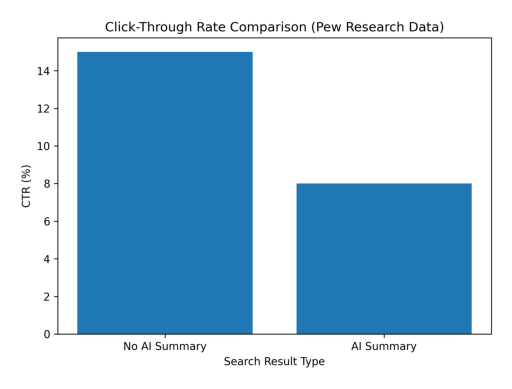
Multiple studies show that AI summaries significantly reduce click-through rates.
- Users encountering AI summaries clicked on external links in only 8% of visits, compared with 15% when no summary appeared, according to a Pew Research Center analysis.
- Zero-click searches now account for around 69% of all queries, meaning most users leave search results without visiting another website.
- A separate analysis found that AI answer modules can cut click-through rates nearly in half when they appear at the top of results.
Impact of AI search on traffic behavior
| Metric | Traditional Search | AI Search |
|---|---|---|
| Average click-through rate | Higher due to link lists | Lower due to direct answers |
| User behavior | Visit multiple websites | Often stay within search interface |
| Traffic flow | Distributed across ranked pages | Concentrated within AI platform |
These changes create major challenges for publishers who rely on organic search traffic as a primary distribution channel.
Economic Pressure on Content Publishers
The reduction in referral traffic from search engines has significant consequences for media organizations, educational websites, and independent publishers.
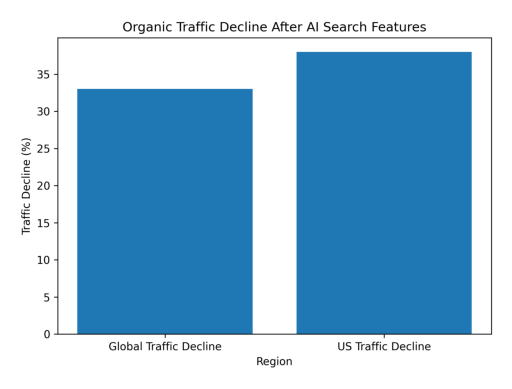
Industry data shows measurable declines in traffic following the introduction of AI-generated summaries.
- Organic search traffic declined 33% globally and 38% in the United States between November 2024 and November 2025, according to Chartbeat data cited in industry reports.
- Many publishers report traffic losses between 1% and 25% following the introduction of Google AI Overviews.
Additionally, some news organizations have experienced dramatic traffic declines, forcing restructuring or shutdowns due to lost search referrals.
Publisher ecosystem impact
| Impact Area | Consequence |
|---|---|
| Advertising revenue | Declines due to fewer page views |
| Content production | Reduced funding for journalism |
| Industry consolidation | Smaller publishers struggle to compete |
| Information diversity | Fewer independent sources online |
Researchers warn that generative search systems may inadvertently discourage high-quality content creation by reducing incentives for publishers.
Reliability Issues and AI Hallucinations
Another major limitation of AI search engines is the possibility of hallucinations, where models generate incorrect or misleading information.
Unlike traditional search engines, which primarily retrieve existing documents, generative models produce new text responses. This generative capability can introduce inaccuracies when models misinterpret data or combine sources incorrectly.
Research on generative search behavior shows that users may trust AI responses even when they contain inaccuracies, especially when citations are included.
Reliability risk matrix
| Risk Type | Description |
|---|---|
| Hallucinated facts | AI generates information not supported by sources |
| Misinterpreted data | Contextual errors during synthesis |
| Outdated information | Models relying on outdated training data |
| Incorrect citations | AI referencing sources that do not support the claim |
These reliability challenges highlight the importance of critical evaluation when relying on AI-generated answers.
Bias in AI Retrieval and Content Selection
AI search systems can also introduce algorithmic biases that affect which sources are selected.
Because generative models rely on training data and retrieval algorithms, they may inadvertently favor certain types of content or domains.
Research on retrieval models has demonstrated that AI-generated content can sometimes receive higher ranking scores than human-generated content, creating a feedback loop where synthetic content becomes more visible online.
Potential sources of bias
| Bias Type | Cause |
|---|---|
| Data bias | Training datasets overrepresent certain topics |
| Domain bias | Preference for large or frequently cited sites |
| Language bias | Stronger performance in English than other languages |
| Content bias | Preference for structured or easily extractable text |
Such biases can distort the diversity of information presented to users.
Measurement and Attribution Challenges
Another limitation of AI search ranking is the difficulty of measuring performance. Traditional SEO metrics such as rankings, impressions, and click-through rates no longer fully capture visibility in AI-driven search environments.
For example, content may appear prominently within an AI-generated answer but still generate minimal website traffic.
Industry analysis shows that traditional ranking metrics can become misleading in AI search environments because traffic measurements only reflect what remains after AI answers satisfy the user’s query.
Measurement comparison
| Metric | Traditional SEO | AI Search |
|---|---|---|
| Rankings | Position in search results | Often not applicable |
| Click-through rate | Primary performance metric | Less relevant |
| AI citations | Not applicable | Key visibility metric |
| Brand mentions | Secondary signal | Critical indicator |
This shift forces marketers to adopt new metrics that track AI visibility rather than traditional rankings.
Rapid Evolution of AI Search Algorithms
Another challenge for businesses is the rapid pace of change in AI search technology. Generative search systems are still evolving, and their ranking mechanisms may change frequently as models improve.
Industry reports indicate that AI search traffic increased 527% year-over-year, demonstrating how quickly adoption is accelerating.
However, rapid growth also creates uncertainty for optimization strategies because ranking mechanisms and user behaviors continue to evolve.
Technology evolution challenges
| Challenge | Description |
|---|---|
| Algorithm updates | Frequent changes in AI models |
| Platform differences | Each AI system uses different retrieval methods |
| Data freshness | AI systems require constant updates |
| User behavior shifts | Conversational search patterns evolve rapidly |
Organizations must therefore adopt flexible optimization strategies that can adapt to changing AI search environments.
Ethical and Regulatory Concerns
The expansion of AI-generated search results has also raised ethical and regulatory concerns.
Policy makers in several regions are examining whether AI search platforms unfairly use content created by publishers without proper compensation or attribution.
Regulatory discussions focus on issues such as:
- intellectual property rights
- content licensing
- algorithmic transparency
- fair compensation for creators
These debates highlight the broader societal implications of AI-driven information ecosystems.
Summary of Key Challenges
The following matrix summarizes the major limitations affecting AI search ranking systems.
| Challenge Category | Key Issues |
|---|---|
| Ranking transparency | Limited insight into source selection |
| Traffic distribution | Increased zero-click searches |
| Publisher sustainability | Declining referral traffic |
| Reliability | Hallucinations and incorrect citations |
| Algorithmic bias | Unequal source representation |
| Measurement | Difficulty tracking AI visibility |
| Regulatory concerns | Intellectual property and fairness debates |
Key Insights
AI search engines provide powerful new capabilities for information discovery, but they also introduce structural challenges that affect the broader digital ecosystem. The shift from link-based rankings to answer-based synthesis has profound implications for publishers, marketers, and users.
Understanding these limitations is essential for developing sustainable strategies in the evolving AI search landscape. As generative search technology continues to mature, balancing accuracy, transparency, and economic sustainability will be critical for maintaining a healthy information ecosystem.
8. The Future of SEO in the AI Search Era
Search engine optimization is entering a new phase as generative AI systems transform how users discover information. Instead of ranking pages on a traditional search engine results page (SERP), modern AI search platforms synthesize knowledge from multiple sources and present direct answers to users. This transition is reshaping the entire search ecosystem, affecting user behavior, content strategies, and digital marketing models.
Industry research shows that AI-driven search adoption is accelerating rapidly. For example, generative search features such as AI Overviews are expected to be used by 72% of adults by mid-2026, highlighting how quickly AI-generated answers are becoming a mainstream way to access information.
At the same time, businesses must adapt their SEO strategies to account for the emergence of Answer Engine Optimization (AEO) and Generative Engine Optimization (GEO)—approaches designed to ensure that content appears in AI-generated responses rather than just traditional rankings.
The Shift from Search Results to AI-Generated Answers
The most significant transformation in the future of SEO is the shift from ranking links to generating answers.
Traditional search engines present a list of results ranked by relevance and authority. AI search engines, however, combine multiple sources into a single response, reducing the need for users to visit individual websites.
Evolution of search interfaces
| Search Era | Interface Model | User Experience |
|---|---|---|
| Early search engines | Directory-style listings | Browsing multiple websites |
| Google SERP era | Ranked results pages | Clicking links for information |
| AI search era | Generated answers | Conversational responses and summaries |
Research into generative search systems shows that AI search platforms aggregate information from multiple sources rather than ranking individual pages, fundamentally changing how visibility works online.
For marketers and publishers, this means that appearing inside an AI-generated answer may become more valuable than ranking first in traditional search results.
The Rise of Generative Engine Optimization (GEO)
As AI search platforms evolve, a new optimization discipline is emerging: Generative Engine Optimization (GEO).
GEO focuses on structuring content so that AI systems can retrieve, understand, and cite it when generating answers. Unlike traditional SEO, which emphasizes backlinks and keywords, GEO emphasizes semantic relevance, structured information, and authoritative sources.
SEO vs GEO comparison
| Optimization Focus | Traditional SEO | GEO / AI Search Optimization |
|---|---|---|
| Visibility target | Search engine results pages | AI-generated answers |
| Ranking signals | Keywords, backlinks, domain authority | Semantic relevance, trust, extractability |
| Content format | Keyword-optimized articles | Structured knowledge resources |
| User interaction | Clicking links | Conversational dialogue |
Academic research confirms that generative search engines rely heavily on authoritative third-party sources and structured content, making traditional ranking signals less dominant in determining visibility.
AI-Driven Content Creation and Optimization
Another defining feature of the future SEO landscape is the growing use of AI tools to assist with optimization tasks.
Modern AI-powered SEO platforms can analyze search trends, predict keyword opportunities, and automate content optimization workflows.
Key AI applications in SEO
| Application | Function |
|---|---|
| Keyword prediction | Identify emerging search trends |
| Content generation | Create optimized article drafts |
| Topic clustering | Identify related content opportunities |
| Data analysis | Evaluate ranking signals and performance |
These capabilities enable marketers to analyze large datasets and refine strategies faster than traditional manual approaches.
As AI tools become more sophisticated, SEO professionals will increasingly rely on data-driven content strategies powered by machine learning.
Increasing Importance of Entity-Based SEO
Future search algorithms will likely rely more heavily on entities rather than keywords. Entities represent people, organizations, products, or concepts that search engines recognize within a knowledge graph.
Entity-based SEO focuses on strengthening a brand’s presence within these knowledge systems.
Entity optimization strategy
| Entity Signal | Example |
|---|---|
| Brand recognition | Consistent mentions across websites |
| Knowledge graph inclusion | Structured information about companies |
| Author expertise | Verified author profiles |
| Structured metadata | Schema markup for entities |
Because AI systems analyze relationships between entities when generating answers, building strong entity recognition can significantly improve visibility in AI search environments.
Multi-Platform Search Ecosystems
Another key trend shaping the future of SEO is the emergence of multi-platform search ecosystems.
In the past, optimization strategies focused primarily on Google. Today, users increasingly search for information across multiple AI platforms, including conversational assistants and specialized knowledge tools.
Emerging AI search platforms
| Platform Type | Example Use Case |
|---|---|
| Conversational AI | Research questions and complex explanations |
| AI-powered browsers | Integrated search experiences |
| Voice assistants | Voice-based queries |
| Multimodal search | Image and video queries |
Research shows that AI search engines often reference diverse external sources beyond brand-owned websites, meaning that only about 5–10% of sources cited in AI responses come directly from a brand’s own site.
This highlights the importance of broader digital visibility, including earned media, community discussions, and third-party content.
Changing User Behavior in the AI Search Era
User search behavior is also evolving due to the conversational nature of AI interfaces.
Instead of typing short keyword queries, users increasingly ask longer, natural-language questions that resemble human conversations.
Query behavior transformation
| Search Style | Example Query |
|---|---|
| Keyword search | “best project management tools” |
| Conversational search | “What are the best project management tools for remote teams?” |
| Follow-up dialogue | “Which tools integrate with Slack?” |
These conversational patterns require content strategies that provide clear answers and contextual explanations rather than simply targeting keyword phrases.
The Economics of AI Search and Digital Marketing
The economic landscape of digital marketing is also evolving as AI search becomes more dominant.
For example, advertising models are adapting to conversational interfaces. Market forecasts suggest that AI-driven search advertising spending in the United States could reach $26 billion by 2029, demonstrating the rapid growth of this new ecosystem.
At the same time, the rise of AI-generated answers is reducing click-through rates for traditional search results. In many cases, users receive the information they need directly within the AI interface, limiting website visits.
SEO traffic trends in the AI era
| Trend | Impact |
|---|---|
| Zero-click searches | Fewer visits to websites |
| AI answer boxes | Reduced organic click-through rates |
| Conversational queries | Longer, more complex prompts |
| Multi-source responses | Increased competition for citations |
This shift is forcing businesses to rethink how they measure SEO success and digital visibility.
Emerging SEO Skills and Roles
The transformation of search technology is also reshaping the skills required for SEO professionals.
Future SEO roles will likely require expertise in areas such as:
- natural language processing
- data analytics
- knowledge graph optimization
- AI-driven content workflows
Future SEO skill matrix
| Skill Area | Importance in AI Search |
|---|---|
| Data analysis | Understanding search trends |
| Content strategy | Creating authoritative knowledge resources |
| Technical SEO | Ensuring machine readability |
| AI literacy | Leveraging generative tools |
SEO professionals will increasingly operate at the intersection of content strategy, data science, and artificial intelligence.
Strategic Outlook for the Next Decade
Several major trends are likely to define the next decade of SEO:
Major future trends
| Trend | Description |
|---|---|
| AI-generated search interfaces | Conversational assistants replacing traditional SERPs |
| Semantic and entity-based ranking | Contextual understanding replacing keyword matching |
| Multimodal search | Integration of voice, video, and image queries |
| AI-powered marketing analytics | Automated optimization tools |
Some forecasts suggest that traditional search volume may decline significantly as AI search adoption grows. For example, analysts predict that traditional search could decrease by about 25% by 2026 as AI-enhanced search becomes more common.
At the same time, the rapid growth of AI search usage indicates that optimization strategies must evolve quickly to remain effective.
Key Takeaways
The future of SEO will be defined by a transition from link-based search results to AI-generated knowledge interfaces.
Key characteristics of the AI search era include:
- conversational search experiences
- entity-based ranking systems
- multi-platform discovery channels
- growing importance of authoritative knowledge content
Rather than replacing SEO entirely, AI search is expanding it into a broader discipline that integrates traditional optimization with generative engine optimization strategies. Businesses that adapt early to these changes will be better positioned to maintain visibility as AI becomes the dominant interface for discovering information online.
Conclusion
The emergence of AI-powered search engines such as ChatGPT, Gemini, and other generative platforms marks one of the most significant transformations in the history of online search. For decades, traditional search engines relied on ranking algorithms that evaluated pages based on factors like keywords, backlinks, domain authority, and technical optimization. In contrast, modern AI search systems operate on a fundamentally different principle: they retrieve information from multiple sources and synthesize it into a single, structured answer that directly addresses the user’s question.
This shift changes the very definition of visibility on the internet. In traditional search engine optimization, success meant appearing at the top of a search results page. In the era of AI search, success increasingly means becoming a trusted source that generative systems reference when constructing responses. Instead of optimizing solely for rankings, businesses, publishers, and content creators must now optimize for retrievability, credibility, and clarity, ensuring that their content can be understood and reused by AI models.
Understanding how AI search engines rank and select content is therefore essential for anyone working in digital marketing, SEO, or content strategy. These systems evaluate information differently from traditional search engines. They prioritize semantic relevance, authoritative sources, structured formatting, and clear explanations that can be extracted and synthesized. Content that answers questions directly, presents data in structured formats, and demonstrates expertise is far more likely to be included in AI-generated answers.
Another important takeaway is that AI search is not simply replacing traditional SEO—it is expanding it. New disciplines such as Generative Engine Optimization (GEO) and Answer Engine Optimization (AEO) are emerging alongside conventional SEO practices. These approaches focus on ensuring that content is not only discoverable by search engines but also usable by generative AI systems that construct conversational responses.
At the same time, the rise of AI search introduces new challenges. Reduced click-through rates, increased zero-click searches, and the growing influence of AI-generated answers are forcing publishers and businesses to rethink their traffic and visibility strategies. Organizations must now consider how their content appears across multiple AI platforms, how often it is cited in generated responses, and how it contributes to broader knowledge ecosystems online.
Looking ahead, the future of search will likely be defined by hybrid models that combine traditional search indexes with conversational AI interfaces. Users will increasingly expect immediate, context-aware answers rather than lists of links. As this transformation continues, the websites and brands that succeed will be those that provide accurate, well-structured, and authoritative knowledge resources that AI systems can confidently reference.
Ultimately, the shift toward AI search represents a broader evolution in how information is created, distributed, and consumed on the internet. Instead of competing only for rankings, organizations must now compete for inclusion in the knowledge layer of AI systems. Those who understand this new paradigm—and adapt their content strategies accordingly—will be best positioned to maintain visibility and influence in the rapidly evolving world of AI-driven search.
If you are looking for a top-class digital marketer, then book a free consultation slot here.
If you find this article useful, why not share it with your friends and business partners, and also leave a nice comment below?
We, at the AppLabx Research Team, strive to bring the latest and most meaningful data, guides, and statistics to your doorstep.
To get access to top-quality guides, click over to the AppLabx Blog.
People also ask
How do AI search engines like ChatGPT and Gemini rank content?
AI search engines rank content by evaluating semantic relevance, authority, factual accuracy, and structured information. Instead of ranking links alone, they retrieve relevant passages and synthesize them into answers using large language models.
What factors influence AI search rankings?
Key factors include semantic relevance, trusted sources, structured formatting, entity recognition, and factual accuracy. AI systems prioritize content that clearly answers questions and can be easily extracted for generated responses.
Do backlinks still matter in AI search rankings?
Backlinks still contribute to credibility signals, but they are less dominant than in traditional SEO. AI search engines place greater emphasis on content clarity, authority, and the ability to provide direct answers.
What is Generative Engine Optimization (GEO)?
Generative Engine Optimization is the practice of structuring content so AI search systems can retrieve and cite it in generated answers. It focuses on semantic clarity, authority signals, and structured knowledge content.
How is AI search different from traditional Google SEO?
Traditional SEO ranks webpages based on links and keywords. AI search engines generate answers by combining information from multiple sources, prioritizing semantic relevance and extractable content.
Why do AI search engines cite certain websites in answers?
AI models select sources that demonstrate credibility, topical authority, and clear explanations. Content with structured formatting and reliable data is more likely to be cited.
Can small websites appear in AI search results?
Yes. AI search engines often cite niche websites if they provide clear, authoritative information that directly answers a question, even if the site does not rank highly in traditional search.
What type of content performs best in AI search?
Structured guides, definitions, research-based articles, comparison posts, and FAQ pages perform well because they provide clear explanations that AI systems can easily extract and summarize.
How does semantic search affect AI rankings?
Semantic search allows AI systems to understand the meaning behind queries rather than matching keywords. Content that covers related concepts and contextual topics performs better in AI search.
Do keywords still matter for AI search optimization?
Keywords still help identify topic relevance, but AI search prioritizes semantic understanding. Using related terms and contextual language is more important than repeating exact keywords.
How do AI search engines retrieve information from the web?
Many AI search engines use retrieval-augmented generation systems that search indexes or databases for relevant documents before generating a response using large language models.
What is passage-based retrieval in AI search?
Passage-based retrieval means AI systems select specific paragraphs from a page instead of ranking the entire document. Clear sections and structured writing improve visibility.
Why is structured content important for AI search ranking?
Structured content with headings, bullet points, and tables helps AI models identify key information quickly. This improves the likelihood that the content will be extracted and cited.
How does topical authority affect AI search visibility?
Websites that publish extensive content on a specific topic signal expertise. AI search systems recognize this topical depth and are more likely to cite those sources.
Do AI search engines prefer authoritative sources?
Yes. AI systems often prioritize reputable sources such as research institutions, major publications, and expert blogs because they provide reliable and verifiable information.
Can AI-generated content rank in AI search engines?
AI-generated content can rank if it is accurate, well-structured, and useful. However, original insights, expertise, and reliable data increase credibility and improve visibility.
How do AI search engines understand user intent?
Large language models analyze the meaning and context of a query, including related concepts and conversational cues, to determine what the user is really asking.
What role do entities play in AI search ranking?
Entities such as people, organizations, and concepts help AI systems understand relationships between topics. Strong entity recognition improves content relevance in AI search.
Is conversational content better for AI search optimization?
Yes. Content written in a question-and-answer format mirrors natural language queries, making it easier for AI systems to extract responses.
Do AI search engines use knowledge graphs?
Yes. Knowledge graphs help AI systems understand connections between entities and topics, improving contextual relevance when generating answers.
Why do AI search results sometimes differ from Google rankings?
AI search engines evaluate semantic meaning and source credibility differently from traditional ranking algorithms, so the sources they cite may differ from top Google results.
How can businesses optimize for AI search visibility?
Businesses should publish authoritative content, structure information clearly, answer questions directly, and build topical expertise to increase the chance of being cited.
What is answer engine optimization (AEO)?
Answer Engine Optimization focuses on structuring content so it can appear in direct answers or AI-generated responses rather than traditional search listings.
How does AI search impact organic traffic?
AI-generated answers can reduce clicks to websites because users often get information directly in the interface. However, being cited still improves brand visibility and authority.
Are FAQs useful for AI search optimization?
Yes. FAQ sections align closely with conversational search queries and help AI systems identify direct answers to common questions.
Does content freshness affect AI search ranking?
Fresh content can be important for topics related to news, technology, or trends. Updated information signals relevance and accuracy.
Can multimedia content appear in AI search results?
Yes. AI search systems can reference videos, images, and other media if they contain relevant information that supports the generated answer.
How do AI search engines evaluate content credibility?
They analyze authority signals such as reputable sources, expert authorship, factual consistency, and references across the web.
Will AI search replace traditional SEO completely?
No. Traditional SEO will continue to exist, but it will evolve to include strategies like GEO and AEO that optimize content for AI-generated answers.
What is the future of ranking in AI-powered search?
Future ranking systems will rely more on semantic understanding, entity relationships, and authoritative knowledge sources rather than purely link-based algorithms.
Sources
Amazon Web Services (AWS)
ArXiv
Chartbeat
CodeClinic
Coursera
Dataslayer
Digiday
Digital Silk
Directive Consulting
Exposure Ninja
First Page Sage
GetPassionfruit
Google Cloud
IBM iX
LinkedIn
McKinsey & Company
Onclusive
Pew Research Center
Reuters
ResearchFDI
Search Engine Journal
Search Engine Land
Semrush
Snezzi
Strategic AI Leader
TechTarget
The Digital Bloom
The Guardian
Torro
Wikipedia
White Hat SEO
Writesonic (via Search Engine Journal analysis)