

























Key Takeaways
- Mongolia’s strong mobile connectivity, with internet penetration above 80%, is creating a mobile-first environment where AI-powered search and generative tools are rapidly gaining relevance.
- Local innovation, particularly the rise of Mongolian-language AI platforms like Egune, is shaping how Generative Engine Optimisation (GEO) strategies must adapt to low-resource language markets.
- Global shifts toward AI-driven search and zero-click results mean Mongolian businesses and publishers must optimise content for AI citations, structured information, and authoritative sources.
Artificial intelligence is rapidly transforming how people search for information, discover content, and interact with digital platforms worldwide. In the past two decades, traditional search engines dominated the online information landscape, with users typing keywords into platforms such as Google and navigating through ranked lists of websites. However, the emergence of generative AI systems and conversational search tools is fundamentally changing this model. Instead of browsing multiple websites, users increasingly rely on AI-powered assistants to generate direct answers, summarise information, and guide decision-making in real time. This shift has created an entirely new field known as Generative Engine Optimisation (GEO), which focuses on ensuring that content is not only indexed by search engines but also cited and surfaced by artificial intelligence systems.
Read our list of the Top 10 Best GEO Agencies in Mongolia in 2026.

While much of the discussion around AI search has focused on major technology markets such as the United States, China, and Europe, smaller and emerging digital economies are also beginning to experience the impact of this transformation. Mongolia presents a particularly interesting case. Despite having a population of just over 3.5 million people, the country has developed a surprisingly strong digital infrastructure, high mobile connectivity, and an increasingly sophisticated technology ecosystem. As artificial intelligence continues to reshape the global information economy, Mongolia is entering a new phase where AI-powered search, local language models, and digital public services are beginning to redefine how information is created, distributed, and consumed.

In 2026, the intersection of AI search technology and Mongolia’s evolving digital landscape is producing new opportunities and challenges for businesses, policymakers, publishers, and technology developers. The rise of conversational AI tools such as ChatGPT, Gemini, and locally developed systems like Egune AI means that search behaviour is shifting away from traditional browsing patterns toward more direct, answer-based interactions. For organisations that depend on online visibility, this change is profound. Ranking on a search engine results page is no longer the only objective. Instead, brands must increasingly focus on ensuring their information is recognised, trusted, and cited by generative AI systems.

Understanding this shift requires examining the broader digital environment in which AI search is emerging. Mongolia’s internet penetration has reached more than four-fifths of the population, while mobile connectivity exceeds the total population due to widespread multi-SIM usage. Broadband-capable mobile networks now cover almost the entire country, creating a mobile-first digital ecosystem where most online activity occurs on smartphones rather than desktop computers. This connectivity foundation makes it technically possible for a large proportion of Mongolians to access AI-powered search interfaces, generative chatbots, and real-time digital services.

At the same time, Mongolia’s digital transformation has been strongly influenced by government-led innovation initiatives. The country’s ambitious e-government strategy has placed digital services at the centre of public administration, with platforms such as E-Mongolia offering hundreds of government services online. As artificial intelligence becomes more integrated into public sector systems, these platforms are evolving into important information gateways where citizens search for policies, administrative guidance, and public services. This creates a significant environment for AI-driven information retrieval and highlights how government digitalisation can influence broader search behaviour across society.

Another distinctive aspect of Mongolia’s AI landscape is the emergence of a domestic artificial intelligence ecosystem focused on solving local language challenges. Mongolian is widely considered a low-resource language in global machine learning research, meaning that large international language models often struggle to understand or generate accurate Mongolian content. In response, local companies and researchers have begun developing specialised AI systems trained on Mongolian-language datasets. Among these efforts, Egune AI has emerged as a major player, developing large-scale models capable of processing Mongolian and multilingual queries. The growth of such platforms demonstrates that the country’s AI ecosystem is not simply importing technology from abroad but actively contributing to the development of language-specific AI tools.

Despite these promising developments, Mongolia’s AI journey is still at an early stage. The country faces several structural challenges, including a limited supply of AI specialists, a relatively small startup ecosystem, and modest levels of venture capital investment compared to global technology hubs. These factors mean that the pace of AI innovation is likely to depend heavily on partnerships between government institutions, universities, and international technology companies. Over the coming decade, investments in education, digital infrastructure, and AI research will play a critical role in determining whether Mongolia can build a sustainable and competitive AI ecosystem.
The broader global context also matters. Generative AI platforms are attracting billions of user interactions each day, and AI-generated responses are increasingly replacing traditional lists of search results. In many cases, users receive answers directly within AI interfaces without clicking through to external websites. This trend has major implications for digital marketing, publishing, and online visibility. For organisations operating in Mongolia, adapting to these changes requires a new strategic approach that combines traditional search engine optimisation with GEO practices designed specifically for AI-driven information retrieval.
Social media platforms further amplify this shift. Mongolia has one of the highest social media usage rates in the region, with a large majority of internet users actively participating in digital networks. Content discovery is increasingly influenced by algorithmic feeds, recommendations, and conversational interactions rather than simple keyword searches. As AI models incorporate signals from social media discussions, online mentions, and third-party publications, the visibility of brands and organisations may depend as much on digital reputation and cross-platform engagement as on traditional search rankings.
Urbanisation also plays an important role in shaping Mongolia’s AI adoption patterns. Much of the country’s digital activity is concentrated in the capital city of Ulaanbaatar, where connectivity, education levels, and access to technology are significantly higher than in rural areas. While mobile networks now cover most of the country geographically, differences in connectivity quality and digital literacy mean that AI tools are currently used most frequently by urban students, professionals, and government institutions. Over time, expanding digital infrastructure and education initiatives may help bridge this gap, allowing AI-powered search technologies to reach a broader population.
Looking ahead, Mongolia’s strategic position between major regional powers and its natural advantages, including a cold climate suitable for energy-efficient data centres, could also influence its role in the global AI economy. As demand for computing infrastructure grows rapidly worldwide, countries capable of hosting AI data centres and digital infrastructure may gain new economic opportunities. If Mongolia succeeds in attracting investment in AI infrastructure and data services, this could further accelerate the development of domestic AI capabilities and strengthen the country’s position within the global digital ecosystem.
The statistics, data points, and trends compiled in this report provide a comprehensive overview of how these forces are shaping Mongolia’s AI search environment. From digital infrastructure and policy frameworks to startup innovation and global search behaviour, each data point contributes to a broader picture of how artificial intelligence is transforming the country’s information landscape. By examining these indicators together, it becomes possible to understand not only where Mongolia stands today but also where its AI-driven digital future may be heading.
This collection of 65 statistics explores the most important developments influencing AI search and Generative Engine Optimisation in Mongolia in 2026. The data highlights key themes including the country’s digital connectivity, the growth of its artificial intelligence ecosystem, the adoption of AI tools among citizens and businesses, and the global trends that are redefining how information is discovered online. For researchers, marketers, technology professionals, and policymakers, these insights offer a valuable foundation for understanding how Mongolia is navigating the transition from traditional search to an AI-driven information economy.
But, before we venture further, we like to share who we are and what we do.
About AppLabx
From developing a solid marketing plan to creating compelling content, optimizing for search engines, leveraging social media, and utilizing paid advertising, AppLabx offers a comprehensive suite of digital marketing services designed to drive growth and profitability for your business.
At AppLabx, we understand that no two businesses are alike. That’s why we take a personalized approach to every project, working closely with our clients to understand their unique needs and goals, and developing customized strategies to help them achieve success.
If you need a digital consultation, then send in an inquiry here.
Or, send an email to [email protected] to get started.
65 AI Search & GEO in Mongolia Statistics, Data & Trends in 2026
🌐 Section 1: Digital Infrastructure & Internet in Mongolia
1. With 2.93 million internet users and an 83% penetration rate as of late 2025, Mongolia has built one of the strongest digital foundations in Central Asia, creating a sizeable and growing audience for AI-powered search tools and online content.
2. Mongolia’s 4.97 million active mobile connections — equivalent to 141% of its 3.53 million population — reflects widespread multi-SIM usage and signals a mobile-first digital environment where AI search must be optimised primarily for smartphone delivery.
3. The fact that 92% of Mongolia’s mobile connections are broadband-capable (3G/4G/5G) means the technical prerequisites for accessing generative AI tools like ChatGPT, Gemini, and Egune are broadly in place, though actual data plan usage remains a separate barrier.
4. Mongolia’s internet user base grew by 34,000 people (+1.2%) between October 2024 and October 2025 — a modest but steady expansion that suggests the market for AI search and digital content is maturing rather than exploding, favouring quality over volume strategies.
5. With 599,000 Mongolians still offline in 2025 — 17% of the population — a meaningful portion of the country remains unreachable by AI search platforms, underscoring the importance of inclusive digital policy alongside commercial AI development.
6. Mongolia’s median fixed internet download speed of 78.95 Mbps (up 10.5% year-on-year) is fast enough to support seamless interaction with AI search interfaces, multimodal AI tools, and real-time generative content — a strong technical signal for GEO investment.
7. The addition of 73,000 new mobile connections (+1.5%) in a single year indicates steady network expansion, which will incrementally widen the accessible audience for mobile AI search and voice-based generative queries in Mongolia.
8. Mongolia’s 2.70 million social media users — 76.5% of the population — represent a highly socially connected audience that increasingly discovers content through algorithmic and AI-curated feeds, making social GEO signals a growing ranking factor for Mongolian publishers.
9. Mongolia’s ICT sector grew at an average of 19.4% annually between 2019 and 2023, making it one of the economy’s fastest-expanding industries — a trajectory that sets the stage for accelerated AI adoption, including AI-native search behaviour.
10. Mongolia’s ICT Development Index exceeding the Asia-Pacific regional average of 77.3 suggests the country is punching above its weight digitally relative to regional peers, providing a more competitive environment for AI search tools than its small population size might imply.
11. A mobile broadband penetration rate of 117.6% and 4G/LTE coverage reaching 99% of the country positions Mongolia as a near-universal mobile broadband nation — a rare achievement that directly enables widespread access to AI search from virtually any location.
12. Mongolia’s telecommunications sector generating MNT 1.7 trillion in revenue — growing 8% year-on-year — reflects a commercially healthy digital infrastructure that can sustain continued investment in AI-ready network capacity.
🤖 Section 2: AI Readiness, Policy & Governance
13. Mongolia’s 11-position jump to 98th in the Oxford Insight AI Readiness Index 2024 is a meaningful signal of improving institutional commitment to AI, though ranking inside the bottom half of 188 nations shows that structural gaps in policy, talent, and investment remain significant.
14. Climbing from 92nd (2018) to 46th (2025) in the UN E-Government Development Index is one of Mongolia’s most impressive digital achievements, demonstrating that government digitalisation — a key driver of AI search relevance for public services — has been a genuine national priority.
15. Scoring 3.0 out of 5 in the UNDP AI Landscape Assessment places Mongolia at a ‘Systematic’ readiness level — meaning foundational structures exist, but the country has not yet reached the ‘Strategic’ or ‘Transformative’ tiers where AI becomes embedded in economic productivity and search behaviour.
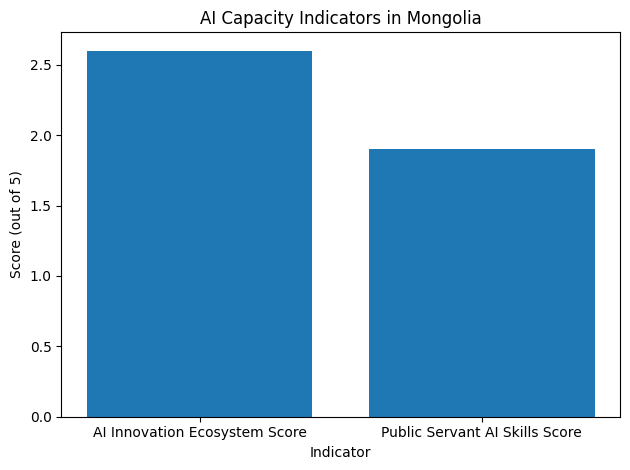
16. Mongolia’s low AI innovation ecosystem score (2.6/5) and critically weak public servant AI skills score (1.9/5) reveal that the country’s AI readiness gap is not primarily technical infrastructure, but human capacity — the most difficult and time-consuming gap to close.
17. A ‘Vision’ score of 0 in the Oxford AI Preparedness Index highlights that Mongolia lacked a formal, published national AI strategy at the time of assessment — a policy vacuum that has since been addressed but that continues to restrain private-sector AI search investment confidence.
18. The National AI Strategy (2025–2030) setting concrete 2025–2026 milestones — including a National AI Council, GPU cluster-based AI Centre, and National Data Repository — demonstrates that Mongolia’s AI ambitions are now backed by specific institutional deliverables, not just aspirational language.
19. Mongolia’s plan to fund 100 AI research topics and train 300 advanced students plus 1,000 AI ambassadors by 2027 reflects a bet on human capital as the primary lever for closing the AI search and GEO capability gap — a prudent but long-horizon strategy.
20. Mongolia’s goal of becoming a regional AI product exporter and international data centre host by 2030 is ambitious for a landlocked nation of 3.5 million, but its strategic location between China and Russia, cold climate (ideal for server cooling), and renewable energy potential make it geographically credible.
21. The National Initiative for Developing AI Knowledge and Skills (2026–2028) directly addresses the institutional capacity gaps identified in the AI Landscape Assessment — its success will be a key determinant of whether Mongolia’s AI search ecosystem can grow beyond a handful of dominant players.
22. Mongolia’s active presence at Davos 2025, signing MoUs on AI and digitalization, signals that the government is pursuing international partnerships to accelerate AI development — which could bring foreign GEO expertise and best practices into the local ecosystem faster than organic development alone.
🏭 Section 3: Mongolia’s Local AI Industry & Startups
23. Egune AI’s dominance at over 70% market share in Mongolia is a double-edged story: it reflects genuine local innovation leadership, but also raises questions about market concentration and whether a single domestic player can meet the full diversity of Mongolian language AI search needs.
24. Egune AI’s $38.5 million USD valuation after a $3.5 million Golomt Bank investment makes it the highest-valued tech company in Mongolia — a milestone that reflects both the scarcity of deep-tech investment in the country and genuine confidence in local AI as a commercially viable category.
25. Training over 2,100 AI models and reaching 24,000 daily users within three years demonstrates that Egune AI has achieved meaningful product-market fit in Mongolia — a rare feat for any AI startup, and particularly notable in a low-resource language environment.
26. Mongolia becoming the 8th country in the world to independently develop and train a foundational AI model is a landmark technological achievement that should be context for any GEO strategy targeting Mongolian-language audiences — local AI infrastructure is real, not theoretical.
27. Egune’s progression from a 5-billion-parameter Mongolian-only model to a 70-billion-parameter multilingual model with coding and reasoning capabilities shows a credible scaling trajectory — though it still trails frontier models from Anthropic, Google, and OpenAI by a significant margin.
28. The fact that Egune AI operates with only 128 GPUs and ~40 engineers while competing meaningfully in a national AI market speaks both to remarkable resource efficiency and to the reality that Mongolia’s AI market does not yet demand the scale that Silicon Valley models are built for.
29. Mongolia’s 75 registered startups and 80th global ranking in StartupBlink’s ecosystem index reflect a nascent but genuine tech entrepreneurship culture — one that will need to scale significantly if Mongolia is to develop the diversity of AI search products its digital economy requires.
30. Ranking 57th globally and 5th in East Asia for edtech startups — with 13 companies representing 17% of all Mongolian startups — suggests that AI-driven educational search and learning tools may be among the highest-potential verticals for GEO investment in Mongolia.
31. Only $14 million USD in total startup investment between 2017 and 2025 means Mongolia’s tech ecosystem is dramatically underfunded relative to global benchmarks — limiting the speed at which AI search tools and GEO-ready content infrastructure can develop locally.
32. ICT employment growing 20.8% (from 17,500 to 21,000+) between 2020 and 2024 shows a labour market that is expanding in digital capability, which will gradually build the talent base needed to implement and optimise AI search strategies at an organisational level.
33. A 44.7% increase in ICT students between 2020 and 2024 is one of the most encouraging signals in Mongolia’s AI data landscape — if even a fraction of these graduates specialise in AI and machine learning, it could meaningfully shift the country’s capability curve within a decade.
34. ICT services exports at just 0.26% of GDP — compared to an international average of 2.3% — reveal that Mongolia’s digital economy remains heavily domestically oriented, which limits the international GEO exposure and global best-practice adoption that cross-border competition typically accelerates.
35. Average gross ICT salaries in Mongolia reaching 673 euros in 2024 — 81% higher than in 2020 — reflects genuine wage growth in the sector, but the absolute level remains low enough to create ongoing brain drain risk as skilled AI and search professionals seek higher-paying opportunities abroad.
👩💻 Section 4: AI Adoption & Usage Among Mongolians
36. Ulaanbaatar youth using AI tools 3–4 times per week — approaching daily for students — indicates that generative AI is becoming a habitual search behaviour among Mongolia’s digitally active population, making GEO increasingly relevant for any brand targeting urban Mongolian audiences.
37. Only 34% of Mongolian youth in Ulaanbaatar having advanced digital skills creates a paradox: AI tools are being used regularly, but often without the critical evaluation skills needed to assess AI-generated answers — a challenge for both information quality and responsible GEO practice.
38. Rural internet connectivity at just 38% means that AI search adoption in Mongolia is overwhelmingly an urban, Ulaanbaatar-centric phenomenon — businesses and publishers optimising for AI search in Mongolia should prioritise urban Mongolian content and use cases first.
39. A shortage of over 27,000 ICT professionals represents Mongolia’s most acute bottleneck for AI search development — no amount of policy ambition or startup investment can substitute for the human expertise needed to build, maintain, and optimise AI-powered search systems.
40. The E-Mongolia platform delivering over 1,200 government services to 83.9% of the population makes it the de facto AI-adjacent search interface for Mongolians seeking public information — optimising content for E-Mongolia’s search layer should be a priority for any public sector GEO strategy.
41. A projected 10–20% productivity gain from AI integration in public procurement suggests that the Mongolian government’s own adoption of AI search tools is accelerating — which will set a behavioural norm that cascades into broader organisational AI search adoption across industries.
42. Erdenet Mining Corporation’s AI procurement system cutting tender processing from 28 days to 4 minutes is the most vivid case study of enterprise AI impact in Mongolia — and a clear signal that AI-powered search and retrieval is already delivering measurable ROI in the country’s largest industrial sector.
43. The ‘Digital First’ initiative’s goal of digitising 90% of public services with an estimated MNT 1.1 trillion in savings would, if achieved, dramatically expand the digital surface area that AI search tools need to index and navigate in Mongolia — a significant structural GEO opportunity.
44. Training 250 AI specialists and 2,250 teachers over five years through a Cambridge University partnership represents a long-term investment in AI literacy infrastructure — the effects will compound slowly but could fundamentally shift Mongolia’s AI search capability baseline by the early 2030s.
45. Over 150 senior stakeholders from government, academia, and UNESCO attending Ulaanbaatar’s High-Level AI in Higher Education dialogue in 2025 shows that AI’s role in education — including AI-powered academic search — is now a formal policy conversation, not just a classroom experiment, in Mongolia.
🔍 Section 5: Global AI Search & GEO Context
46. Global AI chatbot traffic surging 80.9% year-on-year to 55.2 billion visits annually is one of the most important macro trends shaping search behaviour — for Mongolian content creators, this shift means that optimising for AI citation is no longer optional; it is becoming as important as traditional SEO.
47. ChatGPT’s 800 million weekly active users and 2.5 billion daily prompts confirm that generative AI search has crossed into mainstream behaviour globally — Mongolian brands targeting internationally mobile or English-literate audiences must now consider their GEO visibility alongside their Google ranking.
48. With 14.3% of Google users also using ChatGPT for search-like queries as of August 2025, the transition from traditional to generative search is measurable but still a minority behaviour — suggesting a hybrid SEO + GEO strategy remains the most pragmatic approach for Mongolian publishers in 2026.
49. AI-driven search reaching roughly 56% of traditional search volume globally signals that generative search is no longer a niche — it is a parallel information retrieval ecosystem that Mongolian digital marketers cannot afford to ignore, even if the Mongolian-language slice remains smaller.
50. The fact that 64% of Google searches now end without any external clicks — driven by AI Overviews and featured snippets — fundamentally challenges traffic-dependent content monetisation models, making brand visibility and citation in AI responses more valuable than raw click volume for Mongolian publishers.
51. A 34.5% drop in organic click-through rates when AI Overviews are present should be a wake-up call for Mongolian SEO practitioners: the game has shifted from ranking #1 to being cited by the AI, which requires structuring content to answer questions directly and authoritatively.
52. The finding that 31% of ChatGPT prompts trigger a web search — rising to 59% for local-intent queries — has direct implications for Mongolian local businesses: appearing in AI search results for location-specific queries now requires genuine GEO optimisation, not just Google Business Profile maintenance.
53. If 75% of Google AI Mode sessions end without an external website visit, Mongolian brands must rethink their content strategy around being the answer within the AI response rather than simply driving traffic to a landing page — a fundamental shift in how content value is measured.
54. Brands being 6.5x more likely to be cited in AI responses via third-party sources than their own domains reveals a counterintuitive GEO truth: for Mongolian businesses, earning media coverage in credible third-party publications may be more GEO-effective than publishing on their own websites.
55. The fact that 44.2% of all LLM citations come from the first 30% of a piece of text — the introduction — carries a clear practical implication for Mongolian content writers: front-load the most factual, citable, and keyword-rich content into your opening paragraphs to maximise AI citation probability.
🌏 Section 6: Mongolian Language, Search & GEO Challenges
56. Mongolian being classified as a ‘low-resource language’ in mainstream LLMs is perhaps the single most important structural challenge for GEO in Mongolia — when ChatGPT or Gemini cannot reliably process or generate accurate Mongolian, the effective AI search market in-language is far smaller than raw internet penetration figures suggest.
57. The combination of limited English proficiency and underperforming Mongolian-language AI creates a genuine access inequality — many Mongolians are neither well-served by international AI tools in English nor by the still-developing capabilities of local Mongolian-language AI, creating an information gap that GEO practitioners and policymakers alike should address.
58. The preference among many Mongolians for local AI tools over ChatGPT or Gemini — because international models are not ‘native speakers of the language’ — is a commercially significant signal: for Mongolian-language GEO, optimising content for Egune AI’s retrieval and citation patterns may be more impactful than standard international GEO strategies.
59. E-Mongolia’s role as the primary digital portal reaching 83.9% of the population means it functions as Mongolia’s dominant government-information search interface — for any organisation publishing policy-relevant or civic content in Mongolia, being visible and citable within E-Mongolia’s ecosystem is a GEO priority.
60. LinkedIn’s 330,000-member Mongolian user base represents a professional class that is both digitally sophisticated and likely to use AI search tools in English — making LinkedIn content strategy and GEO visibility on English-language platforms a viable channel for brands targeting Mongolia’s tech and business community.
61. With 89.6% of Mongolian internet users active on social media, social signals — shares, citations, and brand mentions across Facebook, Twitter/X, and local platforms — carry disproportionate weight in shaping both traditional search rankings and increasingly AI-powered content relevance assessments in Mongolia.
62. Mongolia’s HDI improving 26% since 1990, but lagging the 50%+ East Asian regional improvement, illustrates that the country’s human development trajectory — while positive — leaves it at an economic level where AI search adoption will be shaped more by necessity and utility than by discretionary technology curiosity.
63. The finding that six in ten people in lower-HDI countries believe AI will positively impact their jobs — and 70% expect productivity gains — suggests that Mongolian workers and businesses are broadly optimistic about AI, which creates a receptive cultural environment for AI search tools and GEO-driven content strategies.
64. Social media user growth of 100,000 (+4.0%) between 2024 and 2025 demonstrates a slowly but consistently expanding digital audience in Mongolia — for GEO practitioners, this means the addressable audience for AI-search-optimised content will be modestly larger in 2026 than in 2025, with further growth expected.
65. The projection of a 160% increase in data centre power demand globally by 2030 — driven primarily by AI — is a strategic infrastructure consideration for Mongolia specifically: the country’s cold climate, low energy costs, and mineral wealth position it as a potential AI infrastructure hub, which could accelerate domestic AI search capabilities from the supply side as well as the demand side.
Conclusion
The evolution of artificial intelligence–powered search is reshaping the global digital ecosystem, and Mongolia is beginning to experience the impact of this transformation in meaningful ways. Although the country is often viewed as a small digital market because of its population size, the statistics presented throughout this report reveal a far more nuanced reality. Mongolia has built a relatively strong digital infrastructure, achieved widespread mobile connectivity, and launched ambitious national initiatives aimed at accelerating artificial intelligence development. These foundations are creating the conditions for AI-driven search behaviour and Generative Engine Optimisation to become increasingly relevant across the country’s digital economy.
The 65 statistics explored in this article highlight how Mongolia’s transition toward AI search is influenced by several interconnected forces. One of the most significant is the country’s digital connectivity. With internet penetration exceeding eighty percent of the population and mobile connections far surpassing the number of citizens, Mongolia has effectively become a mobile-first digital society. This environment provides the technical infrastructure required for conversational AI tools, generative search interfaces, and real-time digital services to reach a large proportion of the population. As smartphones remain the primary access point for online activity, the future of AI search in Mongolia will likely revolve around mobile interfaces, voice-based queries, and integrated applications rather than traditional desktop browsing.
At the same time, Mongolia’s progress in digital government services is playing a central role in shaping the country’s AI search ecosystem. Platforms such as E-Mongolia demonstrate how government-led digital transformation can create large, searchable information ecosystems that citizens rely on daily. When public services, administrative guidance, and policy information become available through digital platforms, these systems effectively function as national knowledge repositories. As artificial intelligence becomes integrated into public sector tools, the ability of AI systems to retrieve, summarise, and interpret government information will increasingly influence how Mongolians search for and access essential services.
Another defining characteristic of Mongolia’s AI landscape is the emergence of a domestic artificial intelligence industry focused on solving language-specific challenges. Mongolian is widely recognised as a low-resource language within global machine learning research, meaning that many international language models struggle to process it effectively. This limitation has encouraged local innovation, leading to the development of specialised AI systems trained on Mongolian-language data. The rise of companies such as Egune AI illustrates how local technology firms can fill gaps left by global platforms, creating tools better suited to the linguistic and cultural context of the country. As these systems mature, they may play an increasingly important role in shaping Mongolia’s AI search ecosystem and the way information is retrieved in the Mongolian language.
Despite these encouraging developments, the statistics also reveal that Mongolia’s AI ecosystem still faces significant structural challenges. The shortage of skilled ICT professionals, limited startup investment, and relatively small research ecosystem remain key constraints. While infrastructure and connectivity have advanced rapidly, the availability of human capital capable of building, maintaining, and scaling AI technologies remains limited. Addressing this gap will require sustained investment in education, training programmes, and international collaboration. Initiatives aimed at developing AI skills, expanding university programmes, and supporting research partnerships will likely determine how quickly Mongolia can strengthen its AI capabilities over the next decade.
Another important trend highlighted by the data is the geographic concentration of AI adoption within Mongolia. Much of the country’s digital activity is centred in Ulaanbaatar, where access to high-speed internet, universities, and technology companies is significantly higher than in rural regions. While mobile broadband coverage now reaches most parts of the country geographically, disparities in connectivity quality and digital literacy mean that AI-powered tools are currently used most actively by urban students, professionals, and government institutions. Bridging this urban–rural digital divide will be essential if AI technologies are to deliver broad economic and social benefits across the entire population.
The global context also reinforces the importance of adapting to the rise of AI-driven search. Worldwide, conversational AI platforms are handling billions of user interactions every day, and generative search systems are increasingly providing direct answers without requiring users to click through to external websites. This shift fundamentally changes the nature of online visibility. For businesses, publishers, and organisations operating in Mongolia, traditional search engine optimisation alone is no longer sufficient. Instead, success will increasingly depend on the ability to ensure that information is trusted, authoritative, and structured in a way that generative AI systems can reference and cite.
Generative Engine Optimisation therefore represents a new frontier in digital strategy. Rather than focusing solely on ranking highly within search engine results pages, organisations must now consider how their content appears within AI-generated responses. This requires producing high-quality information, earning credibility through third-party references, and structuring content so that AI systems can easily interpret and summarise it. As generative search tools continue to evolve, brands that adapt early to these new dynamics will be better positioned to maintain visibility within an AI-driven information ecosystem.
Social media and online communities also play a crucial role in this transformation. Mongolia has one of the highest rates of social media usage in the region, and digital conversations increasingly influence how information spreads online. AI models frequently draw signals from widely shared content, public discussions, and reputable online sources when generating responses. As a result, digital reputation, thought leadership, and engagement across social platforms may become as important as traditional website authority in shaping how organisations appear within AI-generated search results.
Looking ahead, Mongolia’s potential role within the broader global AI infrastructure landscape should not be overlooked. The country’s cold climate, availability of renewable energy resources, and strategic geographic location between major regional powers make it a plausible candidate for hosting future data centre infrastructure. As global demand for computing power continues to expand rapidly due to artificial intelligence workloads, countries capable of providing efficient and sustainable data centre environments may gain new economic opportunities. If Mongolia successfully attracts investment in AI infrastructure, it could accelerate the development of domestic technology capabilities and strengthen the country’s position within the international digital economy.
Ultimately, the statistics and trends outlined in this report illustrate that Mongolia is entering a transitional phase in its digital development. The foundations for AI-driven search are clearly emerging, supported by strong connectivity, expanding digital services, and early innovation in local artificial intelligence technologies. However, the country is still at the beginning of its AI journey, and the pace of progress will depend heavily on how effectively it addresses talent shortages, strengthens its startup ecosystem, and fosters collaboration between government, academia, and private industry.
For businesses, marketers, researchers, and policymakers, understanding these dynamics is essential. Mongolia may be a relatively small market in terms of population, but its evolving digital ecosystem offers valuable insights into how emerging economies can adapt to the rise of generative AI and AI-powered search. By closely monitoring the statistics, policies, and technological developments shaping this environment, stakeholders can better anticipate how Mongolia’s digital landscape will evolve in the coming years.
The 65 AI search and GEO statistics presented in this article provide a detailed snapshot of Mongolia’s current position within the rapidly changing global information economy. They reveal a country that is digitally connected, increasingly engaged with artificial intelligence, and actively exploring new opportunities within the AI-driven future of search. As generative technologies continue to redefine how knowledge is discovered and distributed, Mongolia’s experience will offer an important example of how smaller digital economies can navigate the transition toward an AI-first information ecosystem.
If you are looking for a top-class digital marketer, then book a free consultation slot here.
If you find this article useful, why not share it with your friends and business partners, and also leave a nice comment below?
We, at the AppLabx Research Team, strive to bring the latest and most meaningful data, guides, and statistics to your doorstep.
To get access to top-quality guides, click over to the AppLabx Blog.
People also ask
What is AI search and why is it important in Mongolia in 2026?
AI search uses generative AI tools to provide direct answers instead of traditional search results. In Mongolia, growing internet access, mobile usage, and local AI platforms are making AI-powered search an increasingly important way people discover information online.
What does Generative Engine Optimisation (GEO) mean for Mongolian businesses?
Generative Engine Optimisation focuses on making content visible within AI-generated responses. For Mongolian businesses, GEO ensures their information can be cited by AI systems like ChatGPT, Gemini, and local AI platforms.
How many internet users are there in Mongolia in 2026?
Mongolia has over 2.9 million internet users, representing more than 80 percent of the population. This strong connectivity provides a solid foundation for AI search adoption and digital services across the country.
Why is Mongolia considered a mobile-first digital market?
Mobile connections exceed the total population due to widespread multi-SIM usage. Most Mongolians access the internet through smartphones, making mobile optimisation essential for AI search and digital marketing strategies.
How is AI changing online search behaviour in Mongolia?
AI tools allow users to ask questions and receive direct answers instead of browsing websites. This shift is gradually changing how Mongolians search for information, particularly among students and urban professionals.
What role does Egune AI play in Mongolia’s AI ecosystem?
Egune AI is a leading local artificial intelligence company that has developed Mongolian-language models. It helps address the limitations of global AI tools in processing the Mongolian language.
Why is Mongolian considered a low-resource language in AI?
A low-resource language has limited training data available for machine learning models. Mongolian has fewer large datasets compared with global languages, making local AI development especially important.
How does Mongolia’s digital infrastructure support AI search?
High mobile broadband coverage, strong internet penetration, and improving connection speeds provide the technical foundation needed for AI-powered search tools and generative applications.
How many social media users are there in Mongolia?
Mongolia has over 2.7 million social media users, representing a large share of the population. Social platforms play a major role in how people discover content and interact with digital information.
Why are AI statistics important for understanding Mongolia’s tech landscape?
Statistics reveal how quickly AI is being adopted, where infrastructure is improving, and what challenges remain. They help businesses, researchers, and policymakers understand Mongolia’s evolving digital ecosystem.
How is the Mongolian government supporting AI development?
The government has introduced initiatives such as a national AI strategy, digital public services, and partnerships with international institutions to improve AI infrastructure and talent development.
What is the National AI Strategy of Mongolia?
Mongolia’s National AI Strategy outlines plans to develop AI infrastructure, train specialists, create data repositories, and support innovation between 2025 and 2030.
Why is E-Mongolia important for AI search development?
E-Mongolia provides hundreds of government services online. As digital public services expand, this platform becomes a major information hub that AI systems can index and retrieve data from.
How does AI adoption differ between urban and rural Mongolia?
AI adoption is strongest in urban areas, particularly in Ulaanbaatar. Rural regions often have lower connectivity and fewer digital resources, which can slow the adoption of AI technologies.
How many AI startups exist in Mongolia?
Mongolia’s startup ecosystem is still developing, with around 75 registered startups. Many operate in education technology, fintech, and digital services.
Why is education technology a growing sector in Mongolia’s AI ecosystem?
Edtech startups are using AI to support learning platforms, digital classrooms, and language tools. This sector is growing as demand for digital education increases.
What challenges does Mongolia face in developing AI technologies?
Key challenges include limited funding, a shortage of AI specialists, and smaller research ecosystems compared with global technology hubs.
How many ICT professionals work in Mongolia?
The ICT workforce has been growing rapidly, with more than twenty thousand professionals working in the sector. However, the country still faces a significant shortage of skilled technology specialists.
Why is Generative Engine Optimisation becoming important globally?
As AI tools increasingly provide direct answers, many users no longer visit websites. GEO helps ensure content appears in AI-generated responses, improving visibility even without traditional search clicks.
How are global AI trends influencing Mongolia’s digital economy?
Global AI adoption is reshaping how information is created, searched, and consumed. Mongolian businesses must adapt to these trends to remain competitive in digital markets.
What is zero-click search and how does it affect Mongolia?
Zero-click search occurs when users get answers directly in search results or AI responses without visiting a website. This trend affects online traffic and changes how businesses approach SEO.
How can Mongolian companies optimise content for AI search?
Companies can optimise for AI search by creating structured, authoritative content, using clear facts, and earning citations from reputable sources that AI systems trust.
Why is social media important for GEO strategies in Mongolia?
Social media engagement increases brand visibility and credibility. AI models often reference widely shared content, making social signals valuable for generative search visibility.
How does AI improve productivity in Mongolia’s industries?
AI can automate tasks, improve decision-making, and analyse large datasets. Industries such as mining, finance, and government services are already exploring these capabilities.
What role do universities play in Mongolia’s AI development?
Universities train the next generation of ICT professionals and AI specialists. Expanding AI-focused education programmes is crucial for strengthening the country’s technology ecosystem.
How is Mongolia positioned in global AI readiness rankings?
Mongolia has improved its ranking in several international AI readiness indexes, showing progress in digital governance and technology adoption.
Why are AI-powered chatbots gaining popularity in Mongolia?
Chatbots allow users to receive instant answers to questions and access services more efficiently. Their convenience makes them attractive for education, customer support, and public services.
How could Mongolia become an AI infrastructure hub?
Mongolia’s cold climate, renewable energy potential, and geographic location make it suitable for energy-efficient data centres supporting global AI workloads.
What industries in Mongolia are most likely to adopt AI search tools?
Education, finance, public administration, and technology startups are among the sectors most likely to adopt AI-powered search and information retrieval tools.
Why should marketers pay attention to AI search trends in Mongolia?
AI-driven search is changing how people find information online. Marketers who adapt their strategies to include GEO and AI visibility will have a stronger digital presence in Mongolia’s evolving market.
Sources
DataReportal
GSMA Intelligence
Ookla
Digital Mongolia
JETRO
ITU
Invest Mongolia
National Statistics Office Mongolia
MONTSAME
UNDP Mongolia
Capital Markets MN
The Diplomat
The Fast Mode
FF News
Rest of World
Emerging Europe
StartupBlink
Reinvantage
ResearchGate
SCIRP
World Bank
UNESCO
Wellows
Exploding Topics
Position Digital
Nectiv
Airops
Growth Memo
MEXC News
Graphite
Asia Media Centre
UNDP Asia Pacific
UNDP Human Development Report