
























Key Takeaways
- Bhutan’s 88.4% internet penetration and 100% mobile connectivity create a strong foundation for AI-powered search adoption, especially through mobile-first and voice-based queries.
- With Google controlling about 96% of Bhutan’s search market, optimizing content for Google AI features and Generative Engine Optimization (GEO) is critical for online visibility.
- Bhutan’s AI strategy, expanding digital infrastructure, and Dzongkha language challenges will shape how AI search evolves and how local content competes in global AI-generated results.
Artificial intelligence is rapidly transforming how people search for information online, and Bhutan is entering this transition at a uniquely important moment in its digital development. With 702,000 internet users representing 88.4% of the population, Bhutan has achieved one of the highest levels of internet penetration among small Himalayan nations. This near-universal connectivity creates fertile ground for the next evolution of search: AI-powered discovery through generative search engines, conversational assistants, and AI summaries embedded directly in search results.
Read our top list of the top Top 10 Best GEO Agencies in Bhutan.

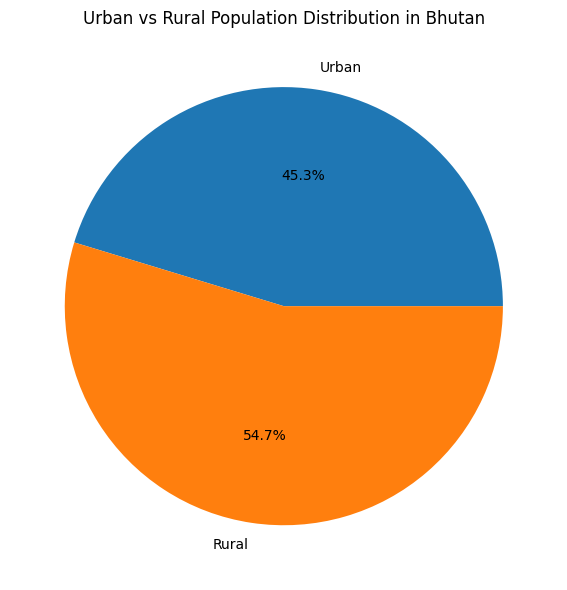
At the same time, Bhutan’s digital ecosystem reflects a distinctive mix of opportunities and structural challenges that will shape how AI search and Generative Engine Optimization (GEO) develop in the country. The nation’s population of roughly 794,000 people, split 45.3% urban and 54.7% rural, means that the majority of Bhutanese internet users access digital services outside major cities. As a result, mobile-first search experiences, voice interfaces, and lightweight AI tools optimized for 4G networks will play an outsized role in determining how widely AI search technologies are adopted across the country.
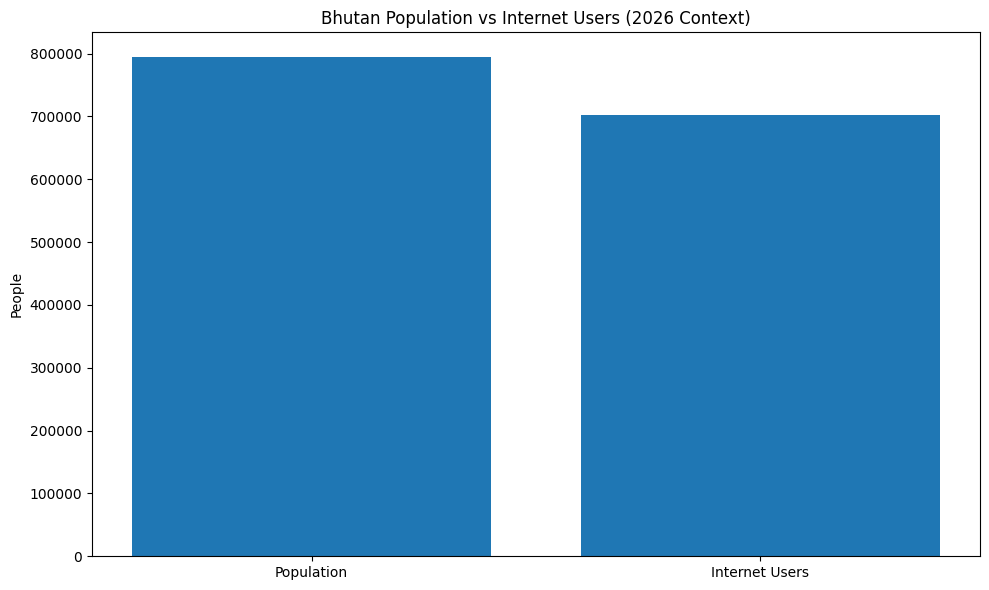
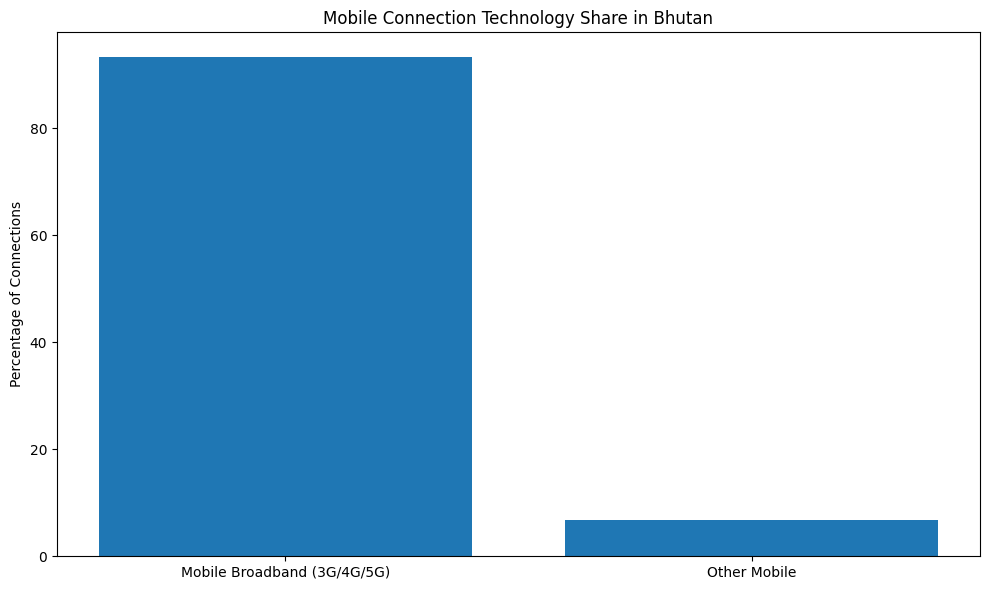
Mobile connectivity has already laid the groundwork for this transformation. Bhutan now records 795,000 active cellular connections—equivalent to 100% of the population, with 93.3% of those connections classified as mobile broadband (3G, 4G, or 5G). This level of broadband-enabled mobile access means that the technical prerequisites for modern AI search experiences—including voice search, chatbot interfaces, and AI-generated search summaries—are already available to most Bhutanese users. Even though the mobile market is approaching saturation, steady growth continues, with 9,641 new connections added between early 2024 and early 2025.
Connectivity quality is also improving. Bhutan’s median fixed broadband speed of around 21.2 Mbps is sufficient for most AI-driven text-based search interactions, while early 5G deployments have already reached 18 of the country’s 20 dzongkhags. Although current 5G user numbers remain relatively small, national rollout plans suggest that majority population coverage could arrive by late 2025, opening the door to faster, lower-latency AI services such as real-time conversational search, voice assistants, and multimodal generative tools.
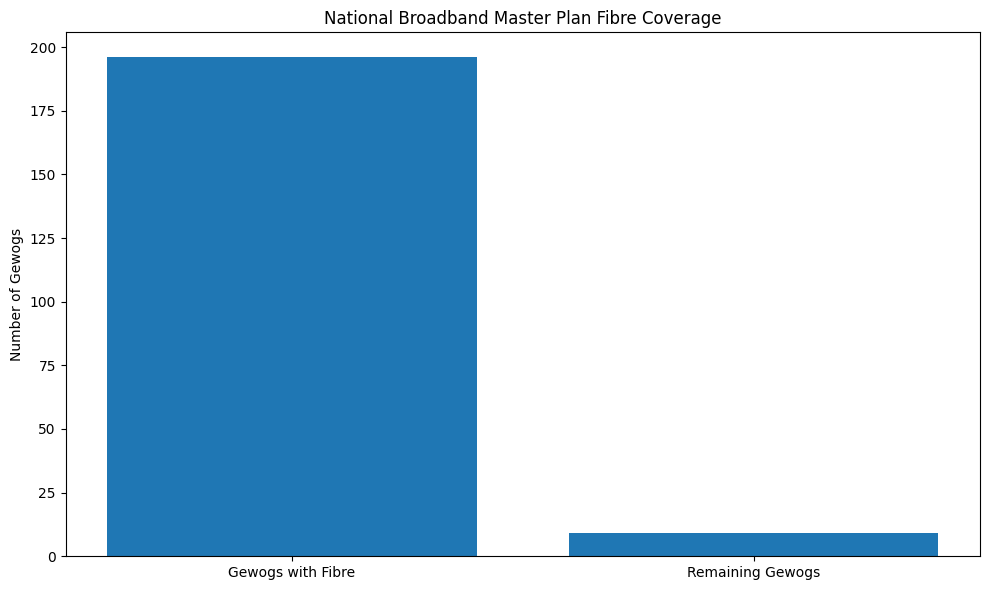
Infrastructure developments are further accelerating Bhutan’s digital transformation. The National Broadband Master Plan has extended fibre connectivity to 196 of the country’s 205 gewogs, dramatically improving rural internet access. Meanwhile, Bhutan’s domestic internet architecture—featuring a national Internet Exchange Point in Thimphu, multiple data centres, and local caching of widely accessed websites—helps reduce international bandwidth dependence and improves response times for cloud-hosted platforms, including AI search systems.
Another significant development came in February 2025, when Starlink launched satellite broadband services in Bhutan. With advertised speeds between 25 Mbps and 110 Mbps, and field reports of even higher performance in some regions, satellite connectivity is creating new options for remote communities in mountainous areas where traditional broadband infrastructure has historically been slow or unavailable. For users in these regions, faster internet access could dramatically expand the usability of bandwidth-intensive AI tools and generative search platforms.
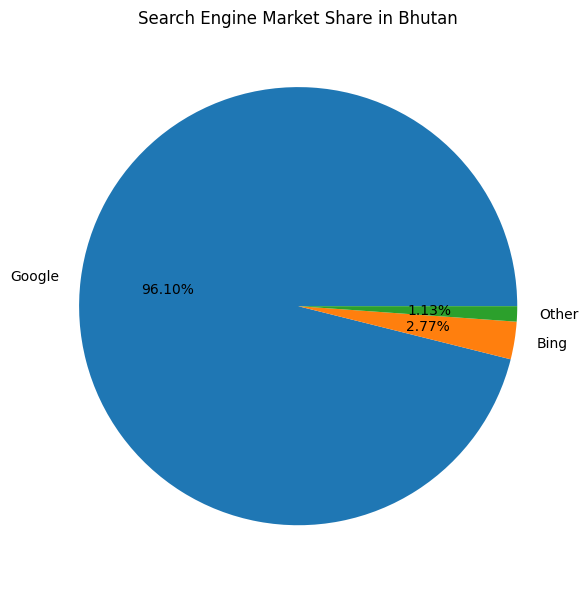
However, infrastructure alone does not determine how people search online. Bhutan’s search ecosystem is overwhelmingly dominated by a single platform: Google commands roughly 96% of the country’s search engine market share, significantly higher than the global average. This concentration means that Bhutan’s search landscape is deeply embedded within Google’s ecosystem, and therefore directly exposed to the sweeping changes being introduced through Google AI Overviews, AI Mode, and other generative search features.
The implications are significant. As Google increasingly integrates generative AI into search results, traditional website traffic patterns are changing worldwide. Studies show that a majority of searches now end without a click, as users receive direct answers through AI-generated summaries, featured snippets, or conversational interfaces. For businesses, tourism operators, government agencies, and content publishers in Bhutan, this shift means that visibility within AI-generated answers is becoming just as important as ranking on the first page of traditional search results.
At the same time, generative AI chatbots are emerging as a parallel search channel. Platforms such as ChatGPT now handle billions of queries every day, and global adoption is accelerating at an unprecedented pace. Even in smaller markets like Bhutan, English-speaking urban users—particularly professionals and students—are increasingly using conversational AI tools for research, learning, and decision-making.
This dual search ecosystem—Google’s AI-enhanced search for the mass market and AI chatbots for more advanced users—is creating new challenges and opportunities for digital visibility. Organizations that want to remain discoverable must now consider Generative Engine Optimization (GEO) alongside traditional search engine optimization (SEO). GEO focuses on structuring content so that it can be cited, summarized, or referenced by AI systems when generating answers.
For Bhutan, this transition is happening alongside a national push toward artificial intelligence adoption. The National AI Strategy 2025 outlines a whole-of-government approach to AI across sectors such as tourism, agriculture, education, and language technology. International collaborations, AI capacity-building programs, and new digital governance frameworks are gradually expanding Bhutan’s exposure to global AI development and implementation.
Yet Bhutan also faces a distinctive linguistic challenge that directly affects AI search. Dzongkha, the country’s national language spoken by roughly 600,000 people, is considered a low-resource language in natural language processing research. Because large language models are primarily trained on high-resource languages such as English, Chinese, and Spanish, AI systems often struggle with Dzongkha queries, leading to weaker search results, higher hallucination rates, and limited citation of Bhutanese-language content.
Researchers and institutions within Bhutan are beginning to address this gap. Early Dzongkha natural language processing projects, translation systems, speech recognition tools, and tokenization research are laying the groundwork for future AI applications. However, compared with high-resource languages, Dzongkha AI development still faces significant challenges related to training data, computational resources, and research funding.
These dynamics collectively create a fascinating moment for Bhutan’s digital ecosystem. On one hand, the country has achieved remarkably high connectivity, strong mobile broadband penetration, and expanding digital infrastructure. On the other, the shift toward AI-driven search is rewriting the rules of online discovery at a global scale.
For Bhutanese businesses, government institutions, tourism organizations, and content creators, understanding these changes is increasingly essential. Visibility in AI-powered search systems will shape how international visitors discover Bhutan, how citizens access public information, and how local companies compete in an increasingly digital economy.
This report compiles 65 essential statistics, data points, and trends on AI search and Generative Engine Optimization in Bhutan for 2026. Drawing on national infrastructure data, global AI adoption trends, language technology research, and evolving search behavior, these insights provide a comprehensive picture of how AI-driven search is reshaping Bhutan’s information landscape.
From connectivity and mobile usage to search engine market share, national AI policy, language technology challenges, and global GEO trends, the statistics in this report highlight both the opportunities and the risks facing Bhutan as artificial intelligence becomes the dominant interface for information discovery.
Understanding these trends is the first step toward ensuring that Bhutanese voices, institutions, and businesses remain visible in the age of AI search.
But, before we venture further, we like to share who we are and what we do.
About AppLabx
From developing a solid marketing plan to creating compelling content, optimizing for search engines, leveraging social media, and utilizing paid advertising, AppLabx offers a comprehensive suite of digital marketing services designed to drive growth and profitability for your business.
At AppLabx, we understand that no two businesses are alike. That’s why we take a personalized approach to every project, working closely with our clients to understand their unique needs and goals, and developing customized strategies to help them achieve success.
If you need a digital consultation, then send in an inquiry here.
Or, send an email to [email protected] to get started.
65 AI Search & GEO in Bhutan Statistics, Data & Trends in 2026
SECTION 1: Digital & Internet Infrastructure in Bhutan
1. With 702,000 internet users representing 88.4% of its population, Bhutan has achieved near-universal internet penetration for a landlocked Himalayan nation, creating a strong foundation for AI-powered search adoption.
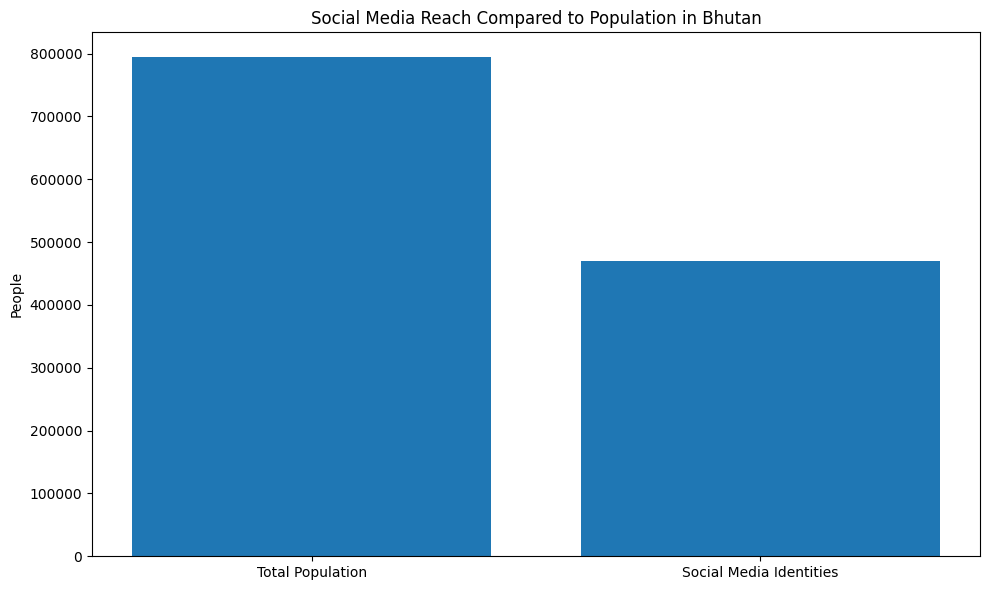
2. Bhutan’s total population of 794,000 — split 45.3% urban and 54.7% rural — means that more than half of internet users access digital services from non-urban environments, making mobile-first and offline-capable AI search tools especially important.
3. Mobile connectivity in Bhutan has reached 100% population equivalence, with 795,000 active cellular connections, signalling that smartphone-based AI search is the dominant and most inclusive access channel.
4. With 93.3% of Bhutan’s mobile connections classified as broadband (3G, 4G, or 5G), the technical prerequisites for AI-powered search experiences — including voice search, AI Overviews, and chatbot interfaces — are now available to the vast majority of the population.
5. Bhutan added 9,641 new mobile connections (+1.2%) between early 2024 and early 2025, reflecting steady rather than explosive growth — consistent with a near-saturated but maturing mobile market.
6. Bhutan’s median fixed broadband speed of approximately 21.2 Mbps places it around 82nd globally, sufficient for text-based AI search interactions but potentially limiting for latency-sensitive generative AI applications such as real-time AI video or complex multimodal search.
7. Bhutan’s early 5G rollout — reaching 18 of 20 dzongkhags by 2023 — positions the country as a regional pioneer in 5G adoption among small developing nations, even though active 5G user numbers remain modest at roughly 1,250 combined across both operators.
8. With 5G population coverage projected to reach majority levels by late 2025, Bhutan is building the high-speed network infrastructure that will make low-latency generative AI search experiences — including real-time AI Overviews and voice-activated queries — widely accessible.
9. Starlink’s February 2025 launch in Bhutan introduced a competitive satellite broadband option at Nu 4,200/month with speeds of 25–110 Mbps, directly challenging Bhutan Telecom’s fixed broadband pricing and expanding connectivity options in rural and mountainous areas previously underserved.
10. Starlink’s real-world performance in Bhutan — with recorded speeds between 200–394 Mbps — represents a transformative leap for remote communities where prior connectivity was as low as 4–5 Mbps, dramatically expanding access to bandwidth-intensive AI tools including generative search platforms.
11. Bhutan’s domestic internet infrastructure — featuring an IXP in Thimphu, 3 data centres, and 65% local caching of top websites — reduces international bandwidth dependency and improves response times for AI search tools hosted on globally distributed servers.
12. With fibre links reaching 196 of 205 gewogs as part of the National Broadband Master Plan, Bhutan has made substantial progress in rural digital inclusion, though the final 9 gewogs represent the most geographically challenging — and often most underserved — communities for AI search access.
SECTION 2: Search Engine Market Share in Bhutan
13. Google’s 96.1% search engine market share in Bhutan — well above its ~90% global average — means that optimising for Google’s AI features, particularly AI Overviews and AI Mode, is essentially synonymous with optimising for all AI search in Bhutan.
14. Bing’s 2.77% share in Bhutan is disproportionately significant for GEO practitioners given that 87% of ChatGPT’s citations draw from Bing index results, meaning content ranking in Bing has an outsized influence on AI chatbot visibility beyond its modest search traffic share.
15. With 470,000 active social media identities in Bhutan — 59.2% of the population, growing 2.8% year-on-year — social platforms are a key secondary discovery channel and an important GEO signal, as AI models increasingly factor in social mentions and brand authority.
16. Facebook’s reach of 564,300 users in Bhutan (63.3% of the population), dominated by the 25–34 age group, makes it the most important social platform for content distribution strategies that aim to build brand mentions — a growing ranking signal in generative AI search results.
17. Instagram’s 157,300 Bhutanese users — with women comprising the slight majority at 51.7% — highlight an important but underutilised visual content channel; structured, descriptive captions and alt text on Instagram posts can improve a brand’s AI search discoverability.
18. With Facebook Messenger reaching 530,100 Bhutanese users (59.5% of the population), conversational messaging is deeply embedded in Bhutan’s digital culture, suggesting that AI-powered chatbot interfaces framed around familiar messaging UX could see strong local adoption.
19. LinkedIn’s 139,400 users in Bhutan (15.6% of the population) represent the professionally active, English-literate segment most likely to engage with generative AI tools for search and research — making LinkedIn a priority platform for B2B-oriented GEO content strategies.
20. Google’s 95.11% global mobile search share mirrors Bhutan’s domestic data almost exactly, reinforcing that Bhutan is not an outlier but deeply embedded in Google’s global ecosystem — and therefore fully subject to the impact of Google’s AI search rollout on organic traffic and search visibility.
SECTION 3: Bhutan National AI Strategy & Governance
21. Bhutan’s National AI Strategy 2025 establishes a whole-of-government AI agenda spanning 8 sectors — from tourism to Dzongkha language preservation — providing a policy framework that legitimises and incentivises AI search tool adoption across both public and private sectors.
22. The allocation of over Nu 10 billion (~USD 120 million) to 21st-century skilling programmes under the 13th Five-Year Plan signals a serious national investment in the AI talent pipeline, though the gap between funding intent and current AI skill availability remains large.
23. Bhutan’s ambition to grow its GDP tenfold by 2050 — requiring ~10% annual growth — places AI-enabled productivity improvements in sectors like tourism, agriculture, and hydropower at the centre of national economic strategy, directly shaping where AI search and content tools will see the earliest and deepest adoption.
24. The finding that only 10% of surveyed stakeholders were aware of government AI financial support reveals a significant communication gap in Bhutan’s AI policy ecosystem — one that limits private sector uptake and suggests GEO-optimised government content about AI programmes could drive meaningful public awareness.
25. The absence of undergraduate programmes in AI, machine learning, and data science in Bhutan creates a structural deficit in domestic AI talent that will slow both the development of Bhutanese AI search tools and the adoption of GEO best practices by local businesses without targeted international partnerships.
26. With GPU access limited to a handful of institutions — GovTech Agency, DHI, and the College of Science and Technology — Bhutan currently lacks the compute infrastructure to train competitive AI or NLP models domestically, making it dependent on cloud-based AI APIs for any generative search or language model applications.
27. Bhutan’s Generative AI Usage Guidelines for the Civil Service — mandating human oversight, fact-checking, and transparency — reflect a cautious but enabling approach to AI in government, setting a responsible precedent that could inform private sector AI search practices without stifling innovation.
28. The UNDP AIRA 2024 consultation’s engagement of 30+ civil servants and 20+ stakeholder groups — including 7 ministries, 3 academic institutions, and 5 private sector partners — demonstrates a broad national consensus-building process, increasing the likelihood that Bhutan’s AI governance frameworks will be durable and cross-sector.
29. The UAE-Bhutan ‘AI for Development’ workshop in July 2025, targeting entrepreneurship, tourism, and agriculture, represents the type of high-level bilateral AI cooperation that can accelerate Bhutan’s exposure to global GEO practices and AI search deployment in key economic sectors.
30. UNESCO’s AI and Media & Information Literacy training for Bhutanese civil servants directly addresses a critical gap: government communicators who understand AI search mechanics are better positioned to create structured, AI-citable content that improves official information visibility in generative search results.
31. The formation of the Bhutan AI Society — a dedicated civil society organisation — signals that AI ethics and governance are becoming active public discourse topics in Bhutan, which will shape the social and regulatory context within which AI search tools are adopted and evaluated.
32. The GovTech-DHI-Omdena AI lab partnership creates a rare infrastructure for Bhutan to produce AI applications with global market relevance, and its success in attracting international collaboration could help integrate Bhutanese content and perspectives into global AI training datasets.
33. Bhutan’s National Digital Identity Act 2023 — enabling biometric-verified digital identities — creates a secure foundation for personalised AI search experiences, authenticated government digital services, and trusted AI-driven content delivery that many countries are still years away from establishing.
34. Plans to add a third international internet gateway alongside AI strategy implementation will reduce latency and increase bandwidth resilience for AI search platforms, directly improving the user experience of cloud-based generative AI tools for Bhutanese users.
SECTION 4: Bhutan’s Language Gap in AI Search — The Dzongkha Challenge
35. The classification of Dzongkha — spoken by ~600,000 people — as a low-resource language in NLP research means that Bhutan’s national language is systematically underrepresented in the training data of every major LLM powering AI search, resulting in poorer answer quality, higher hallucination rates, and reduced citation of Dzongkha content in AI-generated responses.
36. The DZEN benchmark’s documented performance gap between leading LLMs in English versus Dzongkha demonstrates that Bhutanese students and professionals searching in their national language receive materially inferior AI search results — a linguistic equity issue with direct implications for education and public service delivery.
37. The first Dzongkha NLP system — developed at a budget of Nu 21 million with 30–50% translation accuracy — marks a meaningful start but also illustrates the scale of the challenge: commercially viable AI search in Dzongkha requires orders of magnitude more data, compute, and iteration.
38. The availability of the Dzongkha NLP app on Android — offering translation, speech recognition, and text-to-speech at nlp.cst.edu.bt — provides a tangible public resource that can generate usage data and community feedback to iteratively improve Dzongkha language models over time.
39. The finding that SentencePiece tokenisation outperforms BPE and WordPiece for Dzongkha is a technically significant step toward building Bhutan-specific LLMs, as effective tokenisation is foundational to every aspect of language model performance including search query understanding.
40. The Omdena-DHI collaboration — which delivered a deployable Dzongkha-to-English translation model — demonstrates that international open AI collaboration can produce practical tools for low-resource Bhutanese languages at relatively low cost, offering a replicable model for future AI search localisation efforts.
41. Training the Dzongkha TTS system on just 3,000 unique sentences (~30,000 words) underscores the acute data scarcity constraining Dzongkha AI development; by comparison, high-resource language TTS systems are typically trained on hundreds of thousands of hours of audio, highlighting the resource gap.
42. The systematic underperformance of pre-trained tokenisers on low-resource languages like Dzongkha means that Bhutanese-language web content — regardless of its quality — is currently less likely to be correctly indexed, understood, or cited by AI search engines, creating a structural disadvantage for Dzongkha-language content creators.
43. UNICEF Bhutan’s nationwide rollout of an AI-powered maths platform to all Grade 4–6 students between 2024 and 2026 represents the single largest AI deployment in Bhutan’s history, and the behavioural data it generates on how Bhutanese children interact with AI tools will be invaluable for future AI search and educational content design.
SECTION 5: Global AI Search Trends Relevant to Bhutan
44. ChatGPT’s growth from 400 million to 800 million weekly active users in just four months signals an unprecedented rate of AI search adoption globally; even in a small market like Bhutan, urban and English-educated users are almost certainly among this expanding base.
45. With ChatGPT processing over 2 billion daily queries and commanding 81.13% of the generative AI chatbot market, it is the de facto AI search benchmark — meaning Bhutanese businesses that are not visible in ChatGPT’s responses are missing an increasingly large share of the global information discovery ecosystem.
46. Asia-Pacific’s 28.6% share of global ChatGPT traffic — led by India, Indonesia, and the Philippines — establishes a regional norm of AI search adoption that is geographically close to Bhutan, suggesting that as smartphone penetration and English literacy grow, Bhutanese AI search behaviour will trend toward this regional pattern.
47. The finding that low-income country AI adoption is growing at 4x the rate of high-income nations challenges the assumption that AI search is primarily a developed-world phenomenon — Bhutan, as a recently graduated LDC, sits precisely in the demographic driving the fastest AI adoption growth globally.
48. Google AI Overviews reaching 2 billion monthly users across 200+ countries and 40 languages makes it the world’s most widely deployed generative AI search feature — and since Bhutan is a Google-dominant market, every Bhutanese Google user is a potential AI Overview recipient, making GEO an immediate priority.
49. A 60% global zero-click rate — rising to 77% on mobile — means that the majority of Google searches in Bhutan likely end without a website visit, fundamentally altering the value proposition of traditional SEO and making AI citation and featured snippet optimisation the new primary objectives for Bhutanese digital publishers.
50. An 83% zero-click rate specifically on AI Overview queries means that for the most informational, high-intent searches in Bhutan — the exact queries tourism, health, and government content targets — nearly 9 in 10 users will get their answer from Google’s AI without visiting any external page.
51. A 58% reduction in organic CTR and a drop to just 2.6% CTR for the #1 position when AI Overviews are present means that ranking first on Google in Bhutan no longer guarantees meaningful traffic — businesses must now also optimise to appear inside the AI Overview itself to maintain discovery.
52. The fact that 99% of AI Overview citations come from the organic top 10 confirms that traditional SEO and GEO are not competing strategies but complementary ones — Bhutanese content must first rank well organically before it can realistically be cited by Google’s AI.
53. ChatGPT’s 87% citation alignment with Bing’s top results creates an unexpected strategic imperative for Bhutanese content creators: despite Bing’s tiny 2.77% local market share, Bing optimisation is a key lever for appearing in ChatGPT-generated answers seen by global audiences researching Bhutan.
54. The finding that 44.2% of LLM citations come from the first 30% of a page creates a concrete and actionable GEO writing rule for Bhutanese content teams: lead every article, government page, or tourism guide with the most important facts, statistics, and structured answers — not with background or narrative context.
55. With 93% of Google AI Mode searches ending in zero clicks and 25% of traditional search volume projected to disappear by end of 2026, Bhutanese organisations relying on organic search traffic for audience development are facing an existential transition that requires immediate investment in GEO.
56. The GEO market’s projected growth from ~$850 million to $7.3–$33.7 billion by 2031–2034 signals that generative search optimisation is transitioning from an experimental tactic to a core digital marketing investment — and Bhutanese agencies, tourism boards, and tech companies that develop GEO capabilities early will hold a durable competitive advantage.
57. Despite AI referral traffic growing 357% year-over-year, it still represents only ~1.08% of total website traffic on average — a reminder that for Bhutanese content creators, GEO should be built alongside, not instead of, strong organic search and social distribution strategies.
58. AI chatbot visitors converting at 4.4x the rate of organic search visitors makes GEO disproportionately valuable for Bhutan’s high-value sectors: a tourism operator cited in ChatGPT when a user asks “best eco-lodges in Bhutan” is reaching a visitor who is already close to booking, not just browsing.
59. YouTube presence and branded web mentions being the top AI visibility factors — more influential than backlinks — reshapes the GEO priority stack for Bhutanese brands: a well-structured YouTube channel about Bhutanese culture, tourism, or products is now directly linked to AI search citation probability.
60. The 54% of US marketers planning GEO implementation within 3–6 months as of January 2026 reveals that GEO is rapidly becoming table-stakes in developed markets; Bhutanese businesses that delay adoption risk having their narrative defined by foreign-language sources in AI search results rather than by authoritative domestic voices.
SECTION 6: GEO Implications & Recommendations for Bhutan
61. The fact that 70% of AI Overview content changes per query, with 45.5% of citations replaced each time, means that AI search visibility in Bhutan is not a static achievement but a dynamic, ongoing competition — requiring Bhutanese content to be continuously updated, fact-rich, and topically authoritative.
62. The only 13.7% overlap between Google AI Overview and Google AI Mode citations means Bhutanese organisations need to develop distinctly structured content assets for each format — shorter, definitional content for AI Overviews and richer, multi-source content for AI Mode’s deeper research queries.
63. ChatGPT’s availability in 195 countries combined with Bhutan’s near-total Google dominance creates a two-tier AI search reality: Google AI Overviews are the mass-market AI search experience for most Bhutanese, while ChatGPT and Perplexity serve the English-proficient, tech-savvy urban minority — each requiring a distinct content and GEO approach.
64. Bhutan’s majority rural population — primarily accessing the internet via mobile on 4G networks — makes voice search optimisation a high-priority, underutilised GEO tactic; content structured around natural spoken questions in both English and Dzongkha will increasingly align with how rural Bhutanese query AI search systems.
65. The absence of any known Bhutanese domain among globally cited AI search sources — combined with the country’s thin English-language web footprint, low GEO awareness, and nascent AI skills base — represents both a significant vulnerability and a genuine first-mover opportunity: Bhutanese organisations that invest in structured, authoritative, English-language digital content today stand to become the default AI-cited sources on Bhutan for global audiences over the next 2–3 years.
Conclusion
Bhutan is entering the era of AI-driven search at a critical moment in its digital transformation. Over the past decade, the country has built a strong technological foundation that places it in a far better position than many small developing nations to participate in the emerging generative search economy. With 88.4% internet penetration, full mobile connectivity across the population, and widespread mobile broadband access, Bhutan has already achieved the core infrastructure needed for AI-powered search platforms, voice interfaces, and conversational assistants to become part of everyday digital life.
The statistics presented in this report show that Bhutan’s digital ecosystem is not only connected but also evolving rapidly. National fibre expansion has brought broadband infrastructure to nearly all gewogs, satellite internet services are expanding connectivity options in remote mountain communities, and early 5G rollout is gradually improving network performance across the country. Together, these developments are reducing geographic barriers to digital participation and creating an environment where advanced technologies such as generative AI search tools can reach users across both urban and rural areas.
However, infrastructure alone does not determine how information flows online. Bhutan’s search landscape is heavily concentrated around a single platform, with Google controlling the overwhelming majority of search queries in the country. This dominance means that Bhutan is deeply integrated into Google’s global search ecosystem, making it highly exposed to the sweeping changes introduced through AI-generated search summaries, AI Overviews, and conversational search interfaces.
Globally, the rise of AI-powered search is fundamentally reshaping how people discover information online. The growing prevalence of zero-click searches means that users increasingly receive answers directly within search results without visiting external websites. As generative AI continues to expand across major search engines and conversational platforms, the traditional relationship between search rankings and website traffic is changing. For organizations that rely on online visibility—whether in tourism, education, government services, or commerce—appearing in AI-generated answers is becoming just as important as ranking on the first page of search results.
This shift is driving the emergence of Generative Engine Optimization (GEO), a new approach to digital visibility that focuses on structuring content in ways that AI systems can easily interpret, summarize, and cite. While traditional SEO remains essential, GEO expands the scope of optimization to include how content is interpreted by large language models and generative search systems.
For Bhutanese organizations, this represents both a challenge and a major opportunity. On one hand, the country currently has a relatively small digital footprint in global online content. Bhutanese domains and locally produced information sources are still underrepresented in many international search results and AI-generated responses. Without proactive investment in authoritative digital content, there is a risk that global narratives about Bhutan will continue to be shaped primarily by foreign sources.
On the other hand, this relatively thin digital presence creates a powerful first-mover advantage. Because AI search systems often rely on a limited set of authoritative sources when generating answers, the organizations that publish well-structured, fact-rich, and widely cited content today can become the primary references that AI platforms use to explain Bhutan to the world. For tourism boards, educational institutions, government agencies, and Bhutanese businesses, investing in high-quality digital content now could secure long-term visibility in AI-driven information ecosystems.
Another defining factor shaping the future of AI search in Bhutan is language. Dzongkha, the national language spoken by a majority of the population, remains significantly underrepresented in global AI training data. This classification as a low-resource language creates a gap in how effectively AI systems can interpret Dzongkha queries and generate reliable responses. As a result, Bhutanese users searching in their national language may currently experience weaker results compared with English-language queries.
Addressing this linguistic gap will be critical for ensuring equitable access to AI-powered information services across the country. Early research projects in Dzongkha natural language processing, translation models, and speech technologies are beginning to build the foundation for future language tools. Continued investment in language datasets, open-source NLP research, and collaborative AI development will play an important role in improving the performance of generative search systems in Bhutan’s national language.
At the same time, Bhutan’s national AI strategy signals a growing recognition of the transformative role artificial intelligence will play in the country’s economic future. Government initiatives aimed at developing AI capacity across sectors such as tourism, agriculture, and education are gradually introducing AI technologies into public services and private-sector innovation. International partnerships, research collaborations, and digital skills programs are helping to bridge the country’s current AI talent gap while positioning Bhutan to participate more actively in global AI development.
In the context of search and information discovery, these developments could have profound implications. AI-powered search tools have the potential to improve access to government services, educational resources, and public information, particularly in rural communities where traditional information channels may be limited. At the same time, the integration of AI into search systems raises important questions about data representation, content accuracy, and the visibility of local knowledge.
For Bhutanese organizations, adapting to this new search environment requires a forward-looking digital strategy. Websites, government portals, tourism platforms, and educational resources will increasingly need to be designed not only for human readers but also for AI systems that summarize and interpret information. Clear structure, reliable data, authoritative sources, and regularly updated content will become essential components of maintaining visibility in AI-generated search results.
Businesses and content creators can also benefit from expanding their digital presence beyond traditional web pages. Video platforms, social media mentions, and authoritative brand signals are becoming important factors influencing how AI models determine which sources to reference when generating answers. Organizations that invest in diversified digital content ecosystems will be better positioned to remain discoverable as AI search continues to evolve.
Looking ahead, the intersection of Bhutan’s growing digital infrastructure, emerging AI policies, and expanding global AI adoption will define the next phase of the country’s online ecosystem. While Bhutan’s market size is relatively small, its high connectivity levels and rapidly developing digital environment make it an interesting case study in how smaller nations can adapt to technological shifts that are reshaping the global information landscape.
The 65 statistics and trends outlined in this report provide a comprehensive snapshot of where Bhutan currently stands in the transition toward AI-driven search. They highlight the progress already made in digital connectivity, the structural challenges related to language and AI capacity, and the rapidly changing dynamics of global search technology.
For policymakers, these insights underscore the importance of continued investment in digital infrastructure, AI literacy, and language technology development. For businesses and tourism operators, they highlight the need to rethink online visibility strategies in an era where AI-generated answers increasingly mediate how users discover information. For educators and researchers, they reveal opportunities to contribute to the development of Bhutan-specific AI technologies that better represent the country’s language, culture, and knowledge systems.
Ultimately, the future of AI search in Bhutan will depend not only on technology adoption but also on the ability of Bhutanese institutions and creators to actively shape the digital narratives that AI systems learn from and reproduce. By building authoritative, structured, and widely accessible digital knowledge today, Bhutan can ensure that its perspectives, expertise, and cultural identity remain visible within the rapidly expanding ecosystem of generative search.
As artificial intelligence becomes the primary interface through which billions of people access information, the countries and organizations that adapt early will have the greatest influence over how knowledge is discovered and understood. For Bhutan, the coming years represent a pivotal opportunity to define its digital presence in the age of AI-powered search.
If you are looking for a top-class digital marketer, then book a free consultation slot here.
If you find this article useful, why not share it with your friends and business partners, and also leave a nice comment below?
We, at the AppLabx Research Team, strive to bring the latest and most meaningful data, guides, and statistics to your doorstep.
To get access to top-quality guides, click over to the AppLabx Blog.
People also ask
What is AI search and how is it changing the way people find information in Bhutan?
AI search uses artificial intelligence to generate answers directly within search results instead of only listing websites. In Bhutan, growing internet access and mobile connectivity mean users increasingly rely on AI summaries, chatbots, and voice search to quickly find information.
What does Generative Engine Optimization (GEO) mean for Bhutanese websites?
Generative Engine Optimization focuses on structuring content so AI systems like Google AI Overviews and chatbots can cite or summarize it. Bhutanese websites that adopt GEO can increase visibility even when users receive answers without clicking links.
How many internet users are there in Bhutan in 2026?
Bhutan has around 702,000 internet users, representing about 88.4% of the population. This high penetration rate provides a strong foundation for AI-powered search tools and digital services across the country.
Why is mobile connectivity important for AI search adoption in Bhutan?
Mobile connectivity reaches roughly 100% of Bhutan’s population through active cellular connections. Since most users access the internet through smartphones, AI search tools optimized for mobile devices will dominate how people discover information.
How dominant is Google in Bhutan’s search engine market?
Google controls about 96% of the search engine market in Bhutan. This means that optimizing for Google’s AI features, including AI Overviews and AI Mode, is essential for digital visibility.
Why is Bing still relevant for AI visibility in Bhutan?
Although Bing has only a small share of Bhutan’s search traffic, many AI chatbots rely heavily on Bing’s search index. Websites ranking well on Bing can therefore appear more often in AI-generated answers.
What role does AI search play in Bhutan’s tourism sector?
AI search platforms increasingly influence travel planning. Tourists may ask chatbots or AI search tools about destinations, hotels, and cultural sites in Bhutan, making AI visibility crucial for tourism businesses.
How does Bhutan’s internet infrastructure support AI search technologies?
Bhutan has expanded fibre networks to most gewogs and maintains local data infrastructure such as internet exchange points and data centres. These improvements help reduce latency and improve the performance of cloud-based AI services.
What impact does 5G rollout have on AI search in Bhutan?
The expansion of 5G networks allows faster and more responsive digital services. This enables advanced AI features such as real-time voice search, AI assistants, and multimedia generative search experiences.
How does satellite internet influence AI adoption in Bhutan?
Satellite internet services improve connectivity in remote mountain regions where traditional broadband is limited. Faster connections allow users in rural areas to access AI tools and cloud-based search platforms more effectively.
Why are zero-click searches important for Bhutanese businesses?
Zero-click searches occur when users receive answers directly in search results without visiting websites. Businesses must optimize content to appear within AI-generated summaries to remain visible.
How does Generative Engine Optimization differ from traditional SEO?
Traditional SEO focuses on ranking websites in search results, while GEO focuses on making content easily understood and cited by AI systems. Both strategies work together to improve online discoverability.
What challenges does Dzongkha face in AI search systems?
Dzongkha is considered a low-resource language in artificial intelligence research. Limited training data means AI systems often perform less accurately when processing Dzongkha queries.
How are researchers improving AI support for the Dzongkha language?
Researchers in Bhutan are developing natural language processing tools, translation systems, and speech recognition models. These projects aim to increase AI accuracy for Dzongkha-language searches.
How does Bhutan’s AI strategy influence search technology adoption?
Bhutan’s National AI Strategy promotes artificial intelligence across sectors such as tourism, agriculture, and education. This encourages innovation and wider adoption of AI-powered tools.
Why is English-language content still important for AI search in Bhutan?
Most global AI models are trained primarily on English data. Bhutanese content published in English is therefore more likely to be cited or referenced by international AI systems.
How does social media influence AI search visibility in Bhutan?
Social media mentions, brand discussions, and content sharing help AI systems recognize authority and relevance. Platforms like Facebook, Instagram, and LinkedIn contribute signals that influence AI-generated answers.
What is the relationship between AI search and voice search in Bhutan?
Voice search is becoming more common as mobile usage grows. AI systems interpret spoken queries and generate answers, making conversational search increasingly important for rural and mobile users.
How does AI search affect website traffic in Bhutan?
As AI systems deliver direct answers, some users may no longer click through to websites. This shift means organizations must focus on being cited within AI results rather than relying only on traffic.
What industries in Bhutan will benefit most from AI search?
Tourism, education, agriculture, and government services are likely to benefit significantly. These sectors rely heavily on information discovery and can reach wider audiences through AI-driven search results.
Why is structured content important for GEO?
Structured content helps AI models quickly identify key facts and answers. Articles that present clear data, definitions, and concise summaries are more likely to be cited by generative search engines.
How can Bhutanese businesses prepare for AI search trends?
Businesses should focus on authoritative content, clear explanations, and reliable data. Publishing consistent digital content and maintaining strong online credibility improves AI search visibility.
What role do videos and multimedia play in AI search visibility?
Video content, particularly on platforms like YouTube, is increasingly used as a reference source by AI systems. Multimedia content strengthens brand presence and improves discoverability.
How does Bhutan’s small digital footprint affect AI search results?
Because Bhutan has relatively limited online content compared with larger countries, authoritative Bhutanese sources can gain significant influence if they publish well-structured digital information.
Why is GEO considered a growing digital marketing strategy?
As generative AI tools become part of everyday search behavior, optimizing for AI citations becomes essential. GEO helps brands remain visible even when traditional search traffic declines.
How does AI search improve access to information in rural Bhutan?
AI tools can provide quick answers to questions about agriculture, education, health, and public services. This helps bridge information gaps in remote areas.
What opportunities does AI search create for Bhutanese startups?
Startups can build AI-powered tools for tourism, language technology, and digital services. Early adoption allows them to compete in emerging technology markets.
Why should government agencies consider GEO strategies?
Government websites that publish structured and authoritative information are more likely to appear in AI-generated answers. This improves public access to accurate information.
How will AI search evolve in Bhutan over the next few years?
As internet infrastructure improves and AI literacy grows, Bhutan will likely see wider adoption of AI assistants, voice search, and generative search experiences across industries.
Why is understanding AI search trends important for Bhutan’s digital future?
AI search is becoming the primary way people access information online. Understanding these trends helps businesses, policymakers, and content creators stay competitive in a rapidly evolving digital environment.
Sources
DataReportal Digital 2025 Bhutan
TS2 Tech
Asia News Network
BICMA
Wordsforyoual
Statcounter Global Stats
NapoleonCat
Statista
Bhutan Today
Kuensel Online
LawGratis
GovTech Agency Bhutan
UNDP Bhutan
UAE Ministry of Foreign Affairs
UNESCO
ResearchGate
arXiv
BBS Bhutan
Dzongkha NLP College of Science and Technology
Omdena
Academia
UNICEF Digital Education
Siana Marketing
DesignRush
Microsoft AI Economy Institute
SEOmator
Click Vision
Incremys
Position Digital
Superlines