

























Key Takeaways
- Macau’s 93% internet penetration and near-universal mobile connectivity create an ideal environment for rapid adoption of AI-powered search and Generative Engine Optimisation (GEO).
- Generative AI usage has surged to nearly half of Macau’s internet users, signalling a major shift from traditional search engines toward AI-driven information discovery.
- Businesses targeting Macau must optimise for AI search visibility across platforms like DeepSeek, ChatGPT, and social media ecosystems to remain competitive in the evolving digital landscape.
Artificial intelligence is rapidly transforming how people search for information online, and nowhere is this shift becoming more visible than in Macau. Once dominated by traditional search engines and social media discovery, the digital landscape in Macau is now evolving toward AI-powered search experiences driven by generative tools such as DeepSeek, ChatGPT, and other emerging large language models. As these technologies reshape the way users ask questions, discover brands, and make decisions, businesses that rely on digital visibility must begin adapting to a new paradigm known as Generative Engine Optimisation (GEO).
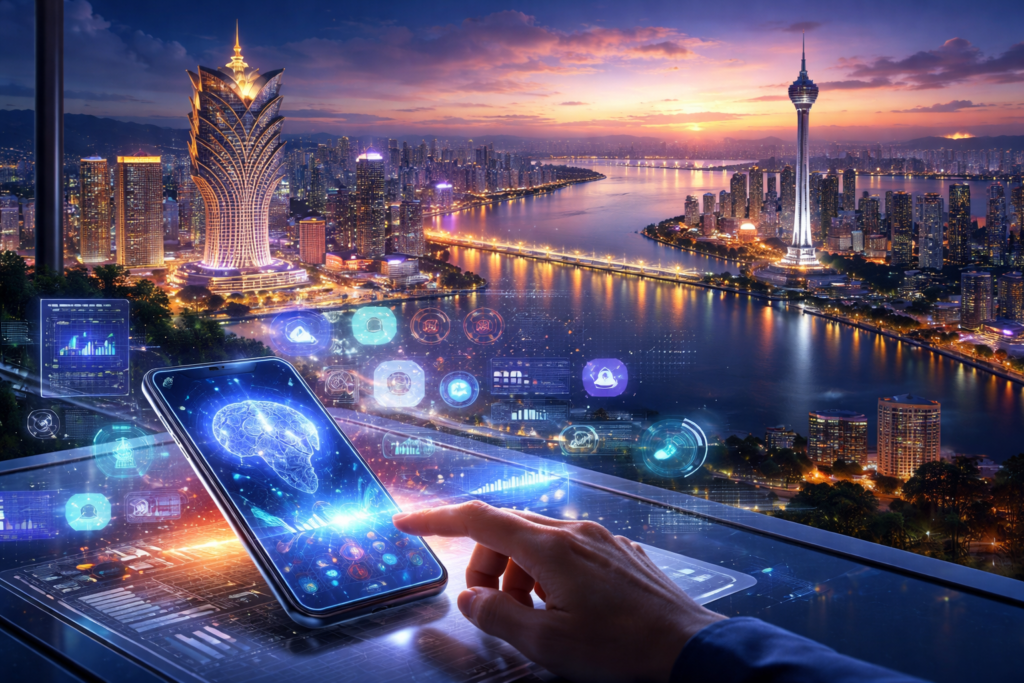
Macau presents a particularly fascinating case study for AI search adoption. With internet penetration reaching approximately 93 percent in 2025 and mobile internet adoption at around 91 percent, the city ranks among the most digitally connected societies in Asia. Nearly every reachable consumer in Macau is online, and the vast majority access the internet primarily through smartphones. This mobile-first environment means information discovery is increasingly happening through quick conversational queries, voice search, and AI-driven responses rather than traditional link-based browsing.
The territory’s digital infrastructure also supports an always-connected population. Macau recorded around 1.58 million cellular mobile connections in 2025, equivalent to roughly 218 percent of the total population. In practical terms, this reflects a multi-device ecosystem where users frequently interact with digital services across smartphones, tablets, and other connected devices throughout the day. Crucially, 100 percent of these mobile connections are broadband-grade networks, including 3G, 4G, and 5G connectivity, eliminating connectivity barriers for AI-powered tools and real-time information access.
At the same time, the digital divide in Macau is extremely small. Internet access is widely distributed across age groups, education levels, and income brackets. Even among older residents, internet usage has grown dramatically, with adoption among citizens aged 60 and above rising from just 3 percent in 2001 to roughly 70 percent in 2025. This widespread connectivity ensures that the shift toward AI-powered search is not limited to younger demographics but is increasingly influencing information behaviour across the entire population.
The rapid rise of generative AI usage further illustrates how quickly this transformation is unfolding. Awareness of generative AI among Macau’s internet users increased from 50 percent in 2023 to 78 percent by 2025, representing a dramatic surge in public familiarity with AI-driven tools. More importantly, actual usage has grown even faster. The share of netizens actively using generative AI nearly tripled during the same period, jumping from 17 percent in 2023 to 49 percent in 2025.
This behavioural shift signals a fundamental change in how people seek information. For many users, AI platforms are already functioning as alternative search engines. Approximately 75 percent of generative AI users in Macau primarily use these tools to search for information and obtain answers to questions. Instead of browsing multiple websites, users increasingly rely on AI-generated summaries and recommendations that synthesize information instantly.
The implications for businesses and marketers are profound. When AI tools generate answers directly within the interface, users often receive the information they need without clicking through to external websites. Research suggests that a large proportion of AI-driven searches now end without traditional click-through behaviour. This means brands must focus not only on ranking in search engine results but also on being cited or referenced within AI-generated answers themselves.
Generative Engine Optimisation (GEO) has emerged as the strategy designed to address this new reality. GEO focuses on structuring digital content so that it can be easily understood, referenced, and cited by AI models. Instead of optimizing purely for search engine algorithms, businesses now need to optimize for how AI systems interpret knowledge, summarise sources, and generate recommendations. In a market like Macau, where digital adoption is extremely high and AI usage is growing rapidly, GEO is quickly becoming an essential extension of traditional search engine optimisation.
Macau’s AI ecosystem is also unique because of its strong connection to the Chinese digital environment. Among AI users in the territory, DeepSeek currently holds a leading usage rate of around 67 percent, surpassing ChatGPT’s 47 percent adoption among local users. This reflects the deep influence of China’s technology ecosystem on Macau’s digital behaviour. At the same time, international AI platforms still play a significant role, particularly among global travellers and international businesses interacting with the city.
This dual-platform environment means that brands targeting Macau audiences must understand both Chinese and global AI ecosystems. Optimising only for Western platforms such as ChatGPT or Google AI Overviews may leave significant visibility gaps within Chinese AI search systems. Conversely, focusing exclusively on Chinese platforms may overlook international audiences researching Macau from overseas.
Social media also plays an increasingly important role in the AI discovery process. Nearly 99 percent of internet users in Macau actively use social media platforms, creating a vast ecosystem of user-generated content and digital conversations. Platforms such as WeChat, YouTube, Xiaohongshu, and TikTok are not only important marketing channels but also valuable sources of data that AI models use when generating responses.
WeChat alone is used by approximately 95 percent of Macau netizens, making it the dominant communication and discovery platform in the region. Meanwhile, YouTube reaches around 80 percent of internet users in Macau, positioning video content as one of the most influential formats for digital discovery. Lifestyle-focused platforms such as Xiaohongshu and TikTok are also becoming major discovery tools, particularly for travel inspiration, product reviews, and local recommendations.
The importance of AI-driven discovery becomes even more evident when considering Macau’s tourism economy. The city recorded a remarkable 40.06 million visitor arrivals in 2025, surpassing its pre-pandemic peak and reaffirming its status as one of Asia’s most visited destinations. For hotels, casinos, restaurants, and tourism operators, even small improvements in digital visibility can translate into substantial commercial gains.
Increasingly, travellers use AI tools to research destinations, plan itineraries, and compare experiences before arriving. AI-powered travel assistants can suggest attractions, recommend hotels, and summarise destination highlights within seconds. When AI platforms recommend specific brands or locations, those suggestions can influence millions of travel decisions at scale.
Macau’s government has also begun integrating artificial intelligence into its digital infrastructure. Initiatives such as AI-powered smart tourism platforms and smart city programmes demonstrate that AI adoption is not limited to the private sector. Government investment in AI-driven public services reinforces the broader digital ecosystem that businesses operate within and signals long-term institutional support for advanced digital technologies.
Globally, the growth of AI-powered search is accelerating at a remarkable pace. Generative AI tools now reach hundreds of millions of users worldwide, and billions of queries are processed through AI systems every day. At the same time, traditional search behaviour is evolving. AI-generated answers are appearing more frequently within search interfaces, and a growing proportion of users are interacting directly with conversational AI systems instead of traditional search engines.
These global trends are reflected in Macau’s digital landscape. As AI adoption continues to rise and AI-generated answers become more influential, businesses that rely on digital visibility must rethink how they approach search strategy. The goal is no longer simply to rank for keywords but to ensure that authoritative information about a brand can be accurately interpreted and cited by AI systems.
This comprehensive collection of 58 AI search and GEO statistics explores the key data points shaping Macau’s evolving digital ecosystem in 2026. From internet penetration and mobile connectivity to generative AI adoption, social media usage, tourism behaviour, and global AI search trends, these insights provide a data-driven overview of how AI is transforming online discovery in one of Asia’s most digitally connected markets.
For marketers, entrepreneurs, tourism operators, and digital strategists, understanding these trends is essential for staying competitive in a rapidly changing search environment. As AI search continues to grow in influence, the businesses that adapt early will be best positioned to maintain visibility, capture attention, and connect with both local residents and the millions of international visitors who explore Macau every year.
But, before we venture further, we like to share who we are and what we do.
About AppLabx
From developing a solid marketing plan to creating compelling content, optimizing for search engines, leveraging social media, and utilizing paid advertising, AppLabx offers a comprehensive suite of digital marketing services designed to drive growth and profitability for your business.
At AppLabx, we understand that no two businesses are alike. That’s why we take a personalized approach to every project, working closely with our clients to understand their unique needs and goals, and developing customized strategies to help them achieve success.
If you need a digital consultation, then send in an inquiry here.
Or, send an email to [email protected] to get started.
58 AI Search and GEO in Macau Statistics, Data & Trends in 2026
SECTION 1: MACAU DIGITAL FOUNDATION
1. Macau’s internet adoption rate of 93% in 2025 significantly outpaces the global average of 68%, establishing the SAR as one of Asia’s most digitally connected societies and a high-value market for any brand with an online presence. Exposure Ninja
2. Internet adoption among 18–40 year-olds in Macau has reached effective 100% saturation, meaning digital channels — including AI-powered search — are the primary and near-exclusive way this demographic discovers products, services, and destinations. Exposure Ninja
3. With mobile internet adoption at 91% and overall internet penetration at 93%, Macau residents are overwhelmingly smartphone-first internet users, making mobile-optimised, AI-discoverable content a baseline requirement rather than an optional enhancement for brands in the market. Exposure Ninja
4. Macau’s 646,000 internet users represent an 89.4% online penetration rate of its total population — a remarkably high figure for a city of its size, signalling that virtually every reachable consumer in Macau is accessible through digital and AI-driven search channels.
5. With 1.58 million active cellular mobile connections equating to 218% of Macau’s total population, the territory’s hyper-connected mobile environment reflects a multi-device, always-online consumer base that interacts with AI tools and search platforms throughout the day.
6. The fact that 100% of mobile connections in Macau are broadband-grade (3G, 4G, or 5G) eliminates connectivity as a barrier to AI search adoption, meaning the speed and accessibility of tools like DeepSeek and ChatGPT are fully supported by Macau’s existing mobile infrastructure.
7. Macau’s mobile connections grew by 137,000 (+9.5%) in a single year between 2024 and 2025, demonstrating that despite already high penetration, the territory’s connected population continues to expand — broadening the potential audience for AI search-optimised content.
8. Macau had 335,000 social media user identities representing 46.4% of its total population in late 2025 — a figure that underscores the critical role social platforms play as both discovery channels and as data sources that AI models draw upon when generating search responses. Exposure Ninja
9. The near-zero Digital Divide Index (DDI) in Macau in 2025 indicates that access to the internet — and by extension, AI search tools — is equitably distributed across age, education, and income groups, making AI optimisation relevant for brands targeting any demographic in the market. Exposure Ninja
10. Internet usage among Macau residents aged 60 and above has grown from just 3% in 2001 to approximately 70% in 2025, demonstrating that AI search adoption is not confined to younger generations and that GEO strategies must account for the needs and search behaviours of older users as well. Exposure Ninja
SECTION 2: GENERATIVE AI USAGE IN MACAU
11. Awareness of Generative AI among Macau netizens surged from 50% in 2023 to 78% in 2025, a 28-percentage-point rise in just two years that reflects how rapidly AI tools have entered mainstream public consciousness in the territory — and how quickly brands must adapt their visibility strategies accordingly. Exposure Ninja
12. The near-tripling of Generative AI usage among Macau netizens — from 17% in 2023 to 49% in 2025 — is one of the most significant digital behavioural shifts recorded in the territory, signalling that almost half the online population is now actively using AI as part of their daily information-seeking routine. Exposure Ninja
13. With 58% of Macau netizens willing to use Generative AI in the future (up from 33% in 2023), the trajectory of AI search adoption in the territory points firmly upward, suggesting that brands investing in GEO now are positioning themselves ahead of a market that has not yet reached its growth ceiling. Exposure Ninja
14. DeepSeek’s 67% usage rate among Macau’s AI users — outranking ChatGPT’s 47% — reflects the deep influence of China’s AI ecosystem on Macau’s digital behaviour, and presents a clear challenge for brands that focus exclusively on Western AI platforms when optimising for local AI search visibility. Exposure Ninja
15. The fact that 75% of Macau’s Generative AI users employ it primarily to search for information and get answers to questions confirms that AI tools have already become search engines in their own right for a large portion of the local population — making brands that are not cited in AI responses effectively invisible to nearly half of Macau’s online market. Exposure Ninja
16. While information search dominates AI use in Macau, 28% of AI users also use it for text creation and editing, and 10% for translation — use cases that suggest AI is becoming embedded across the content lifecycle, from research through to production, creating new opportunities for content-led GEO strategies. Exposure Ninja
17. A 3.7 out of 5 helpfulness rating for Generative AI from Macau netizens indicates broadly positive but not yet enthusiastic sentiment — suggesting there is still room for AI tools to improve and for user trust to deepen, which in turn means the competitive window for establishing AI search authority is still open. Exposure Ninja
18. The sharp divergence in future AI usage willingness between prior users (75%) and non-users (30%) in Macau highlights a classic experience-driven adoption curve: the most effective way to grow an AI-literate audience is through quality, trustworthy AI interactions — the same principle that underlies effective GEO content. Exposure Ninja
19. The most common frequency of Generative AI use among Macau netizens — once or several times a week (37%) — positions AI search as a habitual rather than occasional activity for the majority of adopters, indicating that AI-cited brands benefit from recurring, not just one-off, exposure. Exposure Ninja
20. With only 15% of Macau AI users engaging with tools daily, regular normalised AI search behaviour is still in its formative stages in the territory — meaning the market is at an early-adoption inflection point where foundational GEO investments made today are likely to yield compounding returns as daily usage grows. Exposure Ninja
SECTION 3: SOCIAL MEDIA, SEARCH & E-COMMERCE IN MACAU
21. Near-universal social media usage (99% of netizens) in Macau means that the content ecosystem on platforms like WeChat, Xiaohongshu, and YouTube is extraordinarily rich — and since AI models are increasingly trained on and citing social content, a strong social media presence is now a direct input into AI search visibility. Exposure Ninja
22. WeChat’s 95% usage rate among Macau netizens makes it the de facto primary communication and discovery platform in the territory — and given WeChat’s integration with Tencent’s AI ecosystem, brands with well-optimised WeChat presence are better positioned to benefit from AI-driven recommendations within China’s digital environment. Exposure Ninja
23. YouTube’s position as the second most-used platform in Macau (80% of netizens), combined with global data showing it is the most frequently cited domain in Google AI Overviews, makes video content on YouTube one of the highest-leverage GEO assets a Macau-facing brand can produce.
24. Xiaohongshu’s 51% and TikTok’s 43% netizen usage rates in Macau signal that short-form video and lifestyle content platforms are becoming mainstream discovery tools — relevant to GEO because AI models are increasingly drawing on these platforms’ structured, user-generated content when formulating recommendations. Exposure Ninja
25. E-government satisfaction scores of 7.3 out of 10, combined with an 81% usage rate among adult netizens, reflect a Macau population that is highly comfortable interacting with AI-powered digital interfaces for high-stakes transactions — a behavioural norm that reduces friction for AI search adoption in commercial contexts. Exposure Ninja
26. Online shopping’s rise to 81% among adult Macau netizens (from 63% in 2019) and average monthly spend of MOP 1,385 per shopper confirm that e-commerce is a mainstream consumer behaviour in Macau — and that AI-powered product discovery tools, which are increasingly integrated into shopping platforms, will shape purchasing decisions for a growing majority of residents. Exposure Ninja
27. Taobao/Tmall’s dominance as the preferred platform for 82% of Macau’s online shoppers places product discovery firmly within Alibaba’s ecosystem — which is increasingly powered by AI search tools like Quark and Alibaba’s own large language models — underscoring why brands must optimise for Chinese AI platforms, not just Western ones. Exposure Ninja
28. Mobile payment adoption of approximately 89% among Macau adult netizens — with 94% willingness to use it in future — reflects a territory where frictionless digital transactions are the norm, making AI-driven purchase recommendations and conversational commerce a natural next step in Macau’s consumer journey. Exposure Ninja
SECTION 4: MACAU TOURISM, SMART CITY & AI POLICY
29. Macau’s record 40.06 million visitors in 2025 — surpassing its own pre-pandemic peak — makes the tourism sector the highest-stakes arena for AI search visibility in the territory, as even a marginal improvement in AI-cited discoverability can translate to meaningful visitor acquisition at scale.
30. October 2025’s 3.47 million visitor arrivals — including a 12% year-on-year rise in Chinese visitors — reinforces the primacy of Chinese AI search platforms like DeepSeek, Baidu AI, and Doubao as the tools most likely to influence inbound tourism discovery and itinerary planning for Macau’s largest visitor segment.
31. The Macau Government Tourism Office’s partnership with Gaode Maps to deploy an AI-powered smart tour platform is a landmark example of government-led GEO in action — demonstrating that even public institutions in Macau recognise that AI-driven discovery is now central to how visitors plan and navigate their experience.
32. Macau’s gaming sector generating MOP 247.4 billion in gross gaming revenue in 2025 — a 9.1% year-on-year increase — creates substantial commercial incentive for casino and hospitality operators to invest in AI search optimisation, as the financial upside from improved AI visibility in high-intent travel searches is enormous.
33. Macau’s incorporation of smart city and digital technology into two consecutive five-year government plans signals a long-term institutional commitment to AI infrastructure — providing a stable policy environment in which businesses can confidently invest in AI-aligned digital strategies, including GEO.
34. Macau’s 2019 partnership with Alibaba — covering smart government, transportation, tourism, and healthcare — means the territory’s foundational digital architecture is built on the same ecosystem that powers China’s dominant AI tools, creating natural integration points for brands seeking visibility within Chinese AI search platforms.
35. The UNU Macau AI Conference 2025’s theme of ‘AI for Humanity: Building an Equitable Digital Future’ and its 500 global participants reflect Macau’s growing stature as a regional AI policy forum — a signal that local regulatory and ethical frameworks around AI search are actively being shaped, with implications for how brands engage with AI-driven channels.
36. The deployment of DeepSeek-powered AI tools across Greater Bay Area public services — including 70 AI public servants in neighbouring Shenzhen — establishes the immediate regional context within which Macau’s AI search environment operates, and underscores why GEO strategies for the Macau market must be China AI-ecosystem-first.
SECTION 5: APAC & GLOBAL GEO BENCHMARKS
37. Asia Pacific’s position as second only to North America in Generative AI adoption (BCG, 2025) places Macau within the world’s most AI-active region — meaning competitive pressure to optimise for AI search is higher for Macau businesses than for counterparts in most other parts of the world.
38. China’s world-leading 83% AI trust rate is directly relevant to Macau, where the majority of residents and visitors originate from the Chinese mainland — suggesting that Macau’s market is culturally predisposed to trust and act on AI-generated recommendations, raising the stakes for brands that appear (or fail to appear) in those results.
39. APAC companies investing between $400,000 and $500,000 annually in Generative AI at a higher rate than North American counterparts reflects a region-wide business conviction that AI investment delivers competitive returns — contextualising why Macau brands should view GEO not as an experimental spend but as a market-standard capability.
40. The Asia-Pacific Generative AI market’s projected trajectory to USD 94 billion by 2030 at an 89.21% CAGR makes it the fastest-growing AI market globally — a macroeconomic tide that will lift AI search adoption in Macau regardless of local initiatives, making early GEO positioning a durable strategic asset.
41. The global milestone of 1 billion monthly Generative AI tool users alongside a measurable decline in conventional search engine use confirms that AI search is not a future scenario but a present reality — one that Macau businesses must account for in their digital strategy today, not in future planning cycles.
42. ChatGPT’s 883 million monthly users and 810 million daily users as of January 2026 establish it as a mainstream information platform comparable in scale to major search engines — and while DeepSeek leads in Macau, ChatGPT remains the dominant AI tool for international visitors, making dual-platform GEO a practical necessity for Macau’s tourism brands.
43. ChatGPT’s 2 billion daily queries globally positions AI-powered search as operating at a scale that rivals Google — meaning brands optimised exclusively for traditional search are now effectively absent from a search channel that handles query volumes comparable to the world’s largest search engine.
44. AI search traffic’s 14.2% conversion rate versus Google’s 2.8% organic conversion rate means that visitors who arrive via AI-generated recommendations are approximately five times more commercially valuable — a compelling financial argument for Macau’s hospitality and gaming brands to prioritise GEO investment.
45. Google AI Overviews appearing in over 25% of searches (up from 13% earlier in 2025) means that for one in four queries, the traditional blue-link results are now preceded or replaced by AI-generated answers — directly reducing organic visibility for Macau brands that rely on conventional SEO without a complementary GEO strategy.
46. Gartner’s prediction of a 25% drop in traditional search volume by 2026 and 50% of searches involving AI by 2028 provides an authoritative timeline for the AI search transition — giving Macau businesses a narrow window to build GEO authority before the shift becomes structurally irreversible.
47. The fact that 93% of searches in Google’s AI Mode end without a click underlines how fundamentally AI search changes the visibility equation: brands can no longer rely on earning a clickthrough to be seen, and must instead focus on being cited within the AI-generated answer itself — the core objective of GEO.
48. The 527% surge in AI-referred web sessions globally between January and May 2025 demonstrates that AI search is already delivering measurable referral traffic at scale — and that Macau brands with GEO-optimised content are actively receiving this traffic, while those without are ceding it to competitors.
49. The GEO market’s growth from $848 million in 2025 to a projected $33.7 billion by 2034 at a 50.5% CAGR signals that the discipline of optimising for AI search is on an exceptional growth trajectory — and that the agencies, tools, and expertise available to Macau brands for GEO implementation will expand significantly in coming years.
50. Research showing that high-traffic, high-authority domains earn three times more AI citations than low-traffic sites confirms that traditional domain authority remains a relevant signal in the AI search era — meaning Macau brands that have invested in long-term SEO are not starting from zero when transitioning to GEO, but those that have neglected it face a compounded disadvantage.
51. With 54% of US marketers planning GEO implementation within three to six months, the global marketing industry has reached an inflection point where GEO is transitioning from early-adopter territory to standard practice — a signal that Macau-based digital agencies and brands that move now will have a narrowing window of first-mover advantage.
52. AI search visitors spending 68% more time on websites than traditional search visitors suggests that when AI tools recommend a brand, the resulting audience is more engaged, more intentional, and more likely to convert — making GEO-driven traffic qualitatively superior, not just quantitatively different, for Macau’s high-consideration tourism and hospitality purchases.
53. The 84% of global marketers who report measurable traffic changes tied to AI search adoption confirms that the impact of AI on search visibility is not theoretical — it is already showing up in analytics dashboards, making a compelling case for Macau businesses to audit their current AI search presence as a first step toward GEO investment.
54. Adobe’s reported 693% surge in AI referral traffic during the 2025 holiday season is particularly instructive for Macau’s context, where Chinese New Year and Golden Week represent peak inbound tourism search periods — suggesting that AI-driven travel discovery spikes sharply during high-intent seasonal windows, precisely when GEO visibility matters most.
55. The projected growth of AI search advertising from $1 billion in 2025 to $26 billion by 2029 indicates that paid visibility within AI-generated results will become a significant channel in its own right — one that Macau’s well-resourced casino and hotel operators, accustomed to large media budgets, are well-placed to leverage as these formats mature.
56. The finding that 43% of travel and hospitality businesses have already experienced organic traffic drops since the rollout of AI Overviews — among the highest of any sector — serves as a direct and urgent warning for Macau’s tourism industry that the cost of inaction on GEO is already being paid by peers and competitors globally.
57. Blog content being the most frequently cited page type in Google AI Overviews highlights a practical and accessible GEO entry point for Macau tourism boards, hotel brands, and destination marketers: well-structured, factually rich, regularly updated editorial content remains one of the most effective ways to earn inclusion in AI-generated search answers.
58. The fact that only 25.7% of marketers globally are developing content specifically designed for AI citation — despite widespread awareness of AI search’s growth — reveals a substantial execution gap that represents a genuine competitive opportunity: Macau brands that build structured GEO programmes now will be cited in AI answers while the majority of their competitors remain absent from this emerging search channel.
Conclusion
The 58 statistics presented in this report collectively illustrate a powerful transformation underway in Macau’s digital ecosystem. The convergence of near-universal internet access, widespread smartphone usage, rapidly growing generative AI adoption, and a tourism-driven economy has created one of the most dynamic environments for AI-powered search in Asia. For businesses, marketers, and policymakers, the implications are clear: the era of AI-driven discovery is no longer emerging—it is already reshaping how information, products, and destinations are found.
Macau’s digital foundation is exceptionally strong. With internet penetration exceeding 93 percent and mobile broadband available across the entire cellular network, the territory has effectively eliminated the infrastructure barriers that slow digital innovation in many other markets. The presence of more than twice as many mobile connections as people reflects a highly connected population that interacts with digital services constantly throughout the day. In such an environment, search behaviour naturally evolves toward faster, more conversational, and more integrated information tools. Generative AI platforms are ideally positioned to fulfil that role.
The statistics also highlight how quickly generative AI is entering everyday digital routines in Macau. Awareness of generative AI tools has surged dramatically in just a few years, and active usage has nearly tripled since 2023. Nearly half of the territory’s internet users now engage with AI-powered platforms, and the majority of those users rely on them primarily to search for information. This behaviour marks a fundamental shift away from traditional search patterns where users manually browse through lists of links. Instead, people increasingly expect direct answers, summaries, and recommendations delivered instantly through conversational interfaces.
For businesses operating in Macau, this behavioural change has major consequences. Traditional search engine optimisation remains important, but it is no longer sufficient on its own. When AI systems generate answers directly within their interface, users may never click through to websites. Visibility is therefore determined not only by ranking positions but also by whether a brand, location, or product is cited within AI-generated responses. This is precisely the challenge that Generative Engine Optimisation aims to address.
GEO represents the next stage of digital visibility strategy. Instead of focusing solely on search engine algorithms, it focuses on how artificial intelligence models interpret knowledge, understand context, and select sources when generating answers. Structured, authoritative, and well-organised information becomes increasingly important because it allows AI systems to recognise credible sources and reference them accurately. In a market like Macau, where digital adoption is extremely high and AI usage is accelerating rapidly, GEO is quickly becoming an essential component of any forward-looking digital strategy.
Another critical insight revealed by these statistics is the influence of China’s technology ecosystem on Macau’s AI landscape. Platforms such as DeepSeek have achieved widespread adoption among local AI users, reflecting Macau’s close integration with the broader digital environment of the Greater Bay Area. At the same time, global platforms like ChatGPT remain highly relevant, particularly for international audiences and travellers researching Macau from abroad. As a result, businesses must navigate a dual AI ecosystem that includes both Chinese and international technologies.
This dual-platform reality has important implications for search visibility. A brand that optimises exclusively for Western AI platforms may struggle to appear in Chinese AI-driven results, while a strategy focused solely on Chinese platforms may overlook global travellers planning trips to Macau. Effective AI search strategies in Macau therefore require a balanced approach that considers both ecosystems, ensuring that brands remain visible regardless of which AI tools users choose.
Social media also plays a critical role in shaping the information environment that AI systems draw upon. Macau’s near-universal social media usage creates a vast volume of digital content across platforms such as WeChat, YouTube, Xiaohongshu, and TikTok. These platforms are not just marketing channels; they are part of the data landscape that AI models learn from when generating answers and recommendations. Strong, authoritative content across social platforms therefore contributes indirectly to AI search visibility.
The importance of AI-driven discovery becomes even more pronounced when viewed through the lens of Macau’s tourism economy. With more than 40 million visitors arriving annually, the territory depends heavily on travellers researching destinations, comparing experiences, and planning itineraries online before arrival. Increasingly, these decisions are influenced by AI-powered tools that summarise travel options, recommend hotels and attractions, and answer planning questions instantly.
When AI systems recommend a specific hotel, casino, restaurant, or entertainment venue, that recommendation can influence millions of travel decisions at scale. In such a high-volume tourism market, even small improvements in AI visibility can translate into substantial commercial impact. This makes the hospitality, travel, and entertainment sectors particularly sensitive to the rise of AI search.
The data also demonstrates that Macau is entering a critical adoption phase for AI-driven discovery. While many users are already interacting with AI platforms weekly, daily usage is still developing. This suggests that the market is approaching a tipping point where AI-powered search could become a routine daily behaviour for a large share of the population. Businesses that establish strong AI visibility during this early phase may gain long-term advantages as adoption continues to grow.
Global trends reinforce this trajectory. Across the world, generative AI tools are processing billions of queries each day and rapidly integrating into search experiences. AI-generated summaries and conversational answers are appearing in an increasing share of search results, reducing reliance on traditional link-based browsing. As these changes accelerate, the way brands compete for visibility online is fundamentally evolving.
For Macau businesses, the message from these 58 statistics is clear. Digital discovery is entering a new phase where artificial intelligence sits at the centre of the search journey. Companies that continue relying solely on traditional SEO strategies may find their visibility gradually declining as AI systems become the primary interface for information access. In contrast, organisations that proactively adapt to AI-driven discovery will be better positioned to remain visible, authoritative, and competitive.
The transition toward AI search also presents a major opportunity. Despite growing awareness of generative AI, relatively few organisations are currently developing content specifically designed for AI citation. This gap creates a window for forward-thinking brands to establish authority within AI-generated answers before competition intensifies. By investing in structured, informative, and high-quality content today, businesses can increase the likelihood that AI platforms will reference them as trusted sources.
Macau’s unique combination of digital maturity, strong Chinese AI ecosystem influence, global tourism relevance, and rapidly expanding generative AI adoption makes it one of the most compelling markets to watch in the evolution of AI-powered search. The trends highlighted in this report demonstrate that the foundations for AI-driven discovery are already firmly in place. What remains is how quickly businesses adapt to this new landscape.
Ultimately, the future of search in Macau will not be defined solely by traditional search engines or social media feeds. It will be shaped by conversational AI systems that interpret user intent, synthesize vast amounts of information, and deliver curated answers in real time. For brands, destinations, and organisations hoping to remain visible in this environment, the shift toward Generative Engine Optimisation is not simply a marketing trend—it is a structural transformation in how digital discovery works.
Understanding the statistics behind this transformation is the first step. Acting on them will determine which brands thrive in the AI-powered search landscape that is rapidly taking shape across Macau and the wider Asia-Pacific region.
If you are looking for a top-class digital marketer, then book a free consultation slot here.
If you find this article useful, why not share it with your friends and business partners, and also leave a nice comment below?
We, at the AppLabx Research Team, strive to bring the latest and most meaningful data, guides, and statistics to your doorstep.
To get access to top-quality guides, click over to the AppLabx Blog.
People also ask
What is AI search and why is it important in Macau in 2026?
AI search uses generative AI tools to answer questions directly instead of showing links. In Macau, rising AI adoption and high internet penetration mean AI search is becoming a major way people discover information, businesses, and travel destinations.
What is Generative Engine Optimisation (GEO)?
Generative Engine Optimisation is the process of structuring content so AI tools like ChatGPT or DeepSeek can understand and cite it when generating answers, helping brands remain visible in AI-powered search results.
Why are AI search statistics important for Macau businesses?
AI search statistics reveal how people discover information online. In Macau, where digital connectivity is extremely high, these insights help businesses understand how to adapt marketing strategies for AI-driven search behaviour.
How popular is generative AI in Macau in 2026?
Generative AI adoption in Macau has grown rapidly, with nearly half of internet users now engaging with AI tools for information searches, content creation, and daily digital tasks.
Which AI platforms are most used in Macau?
DeepSeek and ChatGPT are among the most widely used AI platforms in Macau. DeepSeek is particularly influential due to the strong presence of Chinese technology ecosystems in the region.
How does AI search differ from traditional search engines?
Traditional search engines show lists of website links, while AI search tools generate direct answers using multiple sources, often summarising information without requiring users to visit websites.
Why should companies optimise for AI search in Macau?
As more users rely on AI tools to find information, businesses must ensure their content can be cited by AI systems. This improves visibility and helps brands appear in AI-generated recommendations.
How does Macau’s internet penetration influence AI search adoption?
With internet penetration above 90 percent, nearly the entire population has access to online services. This high connectivity accelerates the adoption of AI-powered search tools across the region.
What role does mobile usage play in AI search trends in Macau?
Macau is a mobile-first market with widespread smartphone usage. Mobile connectivity encourages quick conversational searches through AI assistants and apps.
Why is Macau considered a strong market for GEO strategies?
Macau combines high digital adoption, rapid AI growth, strong tourism demand, and integration with Chinese technology ecosystems, making it an ideal environment for GEO-driven marketing strategies.
How does tourism influence AI search trends in Macau?
Millions of visitors research Macau online before travelling. AI tools increasingly help travellers discover hotels, attractions, and entertainment options, making AI visibility critical for tourism brands.
What industries benefit most from AI search optimisation in Macau?
Tourism, hospitality, casinos, retail, and entertainment sectors benefit greatly from AI search optimisation because travellers often rely on digital tools to plan experiences and purchases.
How does social media affect AI search visibility in Macau?
Social media platforms generate large volumes of digital content that AI models analyse when producing answers, making strong social media presence beneficial for AI search visibility.
What is the relationship between SEO and GEO?
SEO focuses on ranking in traditional search engines, while GEO focuses on being cited in AI-generated answers. Both strategies now work together to improve digital visibility.
How does AI search impact website traffic?
AI search can reduce traditional click-through traffic because answers appear directly in AI interfaces. However, it can also deliver highly targeted visitors when AI tools recommend specific websites.
Why is DeepSeek important in Macau’s AI ecosystem?
DeepSeek reflects the influence of Chinese AI technology in the region. Its growing popularity makes it an important platform for brands targeting local and mainland Chinese audiences.
What role does ChatGPT play in Macau’s AI search landscape?
ChatGPT remains widely used internationally and by global travellers researching Macau, making it essential for brands targeting international audiences.
How is the Greater Bay Area influencing AI adoption in Macau?
Macau’s integration with the Greater Bay Area connects it to advanced Chinese technology ecosystems, accelerating AI innovation and adoption across industries.
What types of content perform well in AI search results?
Structured, factual, and informative content performs best because AI systems prefer reliable sources that clearly answer questions and provide useful context.
Why are statistics important for AI search marketing strategies?
Statistics provide measurable insights into user behaviour, helping businesses identify trends and adjust digital strategies to match evolving search patterns.
How does AI search affect digital marketing strategies?
AI search shifts marketing focus toward authoritative content, structured data, and informative resources that AI models can easily analyse and reference.
What role does data accuracy play in GEO strategies?
Accurate data improves credibility and increases the likelihood that AI systems will trust and cite a source when generating answers.
How are travel decisions influenced by AI search tools?
Travellers increasingly rely on AI tools to compare destinations, plan itineraries, and discover attractions, making AI recommendations highly influential in travel planning.
Why are AI search trends growing quickly worldwide?
Advancements in machine learning, natural language processing, and digital infrastructure have made AI tools faster and more accurate, encouraging widespread adoption.
What is the future of AI search in Macau?
AI search is expected to become a dominant discovery channel as more users adopt generative AI tools for everyday information searches.
How does AI search impact local businesses in Macau?
Local businesses that appear in AI-generated recommendations can gain increased visibility, while those without optimised content may become less discoverable.
Why is structured content important for GEO?
Structured content helps AI systems understand key information clearly, improving the chances that the content will be referenced in generated answers.
What role do digital statistics play in content marketing?
Statistics strengthen credibility and provide valuable insights that both readers and AI systems recognise as authoritative information.
How can brands prepare for the rise of AI search?
Brands can prepare by creating high-quality content, maintaining strong digital authority, and ensuring their information is structured for both search engines and AI models.
Why are AI search trends important for the future of marketing?
AI search trends reveal how digital discovery is evolving. Understanding these trends helps businesses stay competitive as technology reshapes how consumers find information online.
Sources
Macao Association for Internet Research
DataReportal
World Casino Directory
Travel And Tour World
Macao News
Emerald Publishing
United Nations University Macau
Boston Consulting Group
Index.dev
Forrester
Second Talent
Macau Business
Superlines
Exposure Ninja
AllAboutAI
Frase
SE Ranking