
























Key Takeaways
- AI-powered search adoption in Indonesia is accelerating, with generative AI transforming how users discover information, ask questions, and interact with search engines.
- Generative Engine Optimization (GEO) is becoming essential as businesses adapt content strategies to appear in AI-generated answers and conversational search results.
- Indonesia’s mobile-first digital ecosystem is driving rapid growth in AI search usage, reshaping SEO, content visibility, and online discovery in 2026.
Artificial intelligence has rapidly transformed the global search landscape, redefining how people access information, discover products, and interact with digital platforms. In Indonesia—one of the world’s fastest-growing digital economies—the rise of AI-powered search and Generative Engine Optimization (GEO) is reshaping online behavior, digital marketing strategies, and the broader information ecosystem. With more than 280 million people and a highly mobile-first internet population, Indonesia represents one of the most dynamic environments for the adoption of AI-driven search technologies. As search engines, generative AI platforms, and conversational assistants become increasingly integrated into everyday digital experiences, businesses, marketers, and policymakers must understand the scale and implications of this shift.
Also, check out the list of top GEO Agencies in Indonesia.

Over the past few years, the search industry has undergone a profound transition from traditional keyword-based search engines to AI-enhanced systems capable of understanding context, intent, and natural language queries. Platforms powered by large language models now generate summarized answers, recommendations, and conversational responses directly within search results. This shift is not only changing how users search but also how content is created, optimized, and discovered online. In Indonesia, where digital adoption continues to expand rapidly across urban and rural regions alike, AI-powered search is accelerating new patterns of information consumption.
Generative Engine Optimization (GEO) has emerged as a critical strategy within this evolving ecosystem. Unlike traditional Search Engine Optimization (SEO), which focuses primarily on ranking web pages in search engine results pages (SERPs), GEO emphasizes optimizing content for AI-driven answer engines, generative search experiences, and conversational interfaces. As generative AI tools increasingly synthesize information from multiple sources to produce direct answers, businesses must adapt their content strategies to ensure visibility within these AI-generated responses. This transformation is particularly significant in markets like Indonesia, where digital competition is intensifying across industries such as e-commerce, fintech, travel, and online education.
Indonesia’s digital landscape offers a unique context for the expansion of AI search technologies. The country has one of the largest internet user bases in Southeast Asia, driven by widespread smartphone adoption, affordable mobile data, and the rapid growth of social media platforms. Indonesian consumers are highly active online, using search engines, social platforms, and messaging apps as primary tools for research, shopping, entertainment, and communication. As AI-driven search tools become embedded within these digital platforms, the boundary between traditional search engines and conversational AI interfaces continues to blur.
Major technology companies are actively investing in AI-powered search capabilities tailored to Southeast Asian markets. From generative AI features integrated into global search engines to regional platforms developing localized AI tools, the competition to dominate the next generation of search experiences is intensifying. Indonesian language support, local knowledge integration, and cultural context awareness have become essential components in the development of AI search systems. As a result, the country is quickly becoming an important testing ground for AI-driven information retrieval and generative search technologies.
At the same time, Indonesian businesses are rapidly adapting to these changes. Digital marketers are shifting their focus toward AI visibility, structured content, and authority signals that influence generative models. Brands are experimenting with new content formats designed to be easily interpreted and referenced by AI systems. Meanwhile, publishers and content creators are exploring strategies to maintain traffic and brand recognition in an environment where AI-generated answers may reduce the need for users to click through to external websites.
The evolution of AI search also raises important questions about the future of online discovery. As generative AI systems aggregate information from across the web, issues such as content attribution, data reliability, and algorithmic transparency become increasingly relevant. Governments and regulatory bodies in Indonesia are beginning to examine the implications of AI-driven information systems, particularly in areas such as misinformation, digital sovereignty, and the ethical use of artificial intelligence.
Understanding the data behind these developments is essential for businesses, researchers, and digital professionals operating in Indonesia’s rapidly evolving digital ecosystem. Statistics on AI search adoption, generative AI usage, search behavior trends, digital marketing performance, and generative engine optimization strategies provide valuable insights into how the industry is transforming. These insights not only highlight the scale of change but also reveal the opportunities and challenges facing organizations seeking to remain competitive in an AI-first search environment.
This comprehensive report presents 165 AI Search and GEO statistics, data points, and trends shaping Indonesia in 2026. The data spans multiple areas, including AI search adoption rates, generative AI usage patterns, mobile search behavior, digital marketing performance, AI-driven content discovery, and the growing influence of generative engine optimization. By examining these statistics, readers will gain a deeper understanding of how AI is reshaping the search ecosystem across Indonesia’s digital economy.
Whether you are a digital marketer, SEO specialist, business leader, researcher, or technology enthusiast, these insights offer a detailed view of the emerging AI-powered search landscape in one of Asia’s most important digital markets. As artificial intelligence continues to redefine how information is accessed and distributed online, understanding the trends behind AI search and GEO will be essential for navigating the future of digital visibility and online discovery in Indonesia.
But, before we venture further, we like to share who we are and what we do.
About AppLabx
From developing a solid marketing plan to creating compelling content, optimizing for search engines, leveraging social media, and utilizing paid advertising, AppLabx offers a comprehensive suite of digital marketing services designed to drive growth and profitability for your business.
At AppLabx, we understand that no two businesses are alike. That’s why we take a personalized approach to every project, working closely with our clients to understand their unique needs and goals, and developing customized strategies to help them achieve success.
If you need a digital consultation, then send in an inquiry here.
Or, send an email to [email protected] to get started.
165 AI Search and GEO in Indonesia Statistics, Data & Trends in 2026
1. Indonesia’s Internet & Digital Landscape
1. With 230 million internet users representing 80.5% of its population, Indonesia’s digital penetration has reached a critical mass that makes it one of the most strategically important markets for AI search platforms expanding across Southeast Asia.
2. The 26% year-on-year surge in social media user identities to 180 million in 2026 reflects not only Indonesia’s growing connectivity, but also the increasingly blurred boundary between social discovery and AI-powered search behaviour.
3. The fact that 95% of Indonesians access the internet primarily via smartphone explains why mobile-optimised AI search experiences — rather than desktop-first platforms — are most likely to win dominant market share in Indonesia.
4. Indonesians spending an average of 21 hours and 50 minutes per week across 7.7 social platforms signals a highly fragmented attention landscape, where AI search tools that aggregate and synthesise information hold a distinct competitive advantage over single-platform browsing.
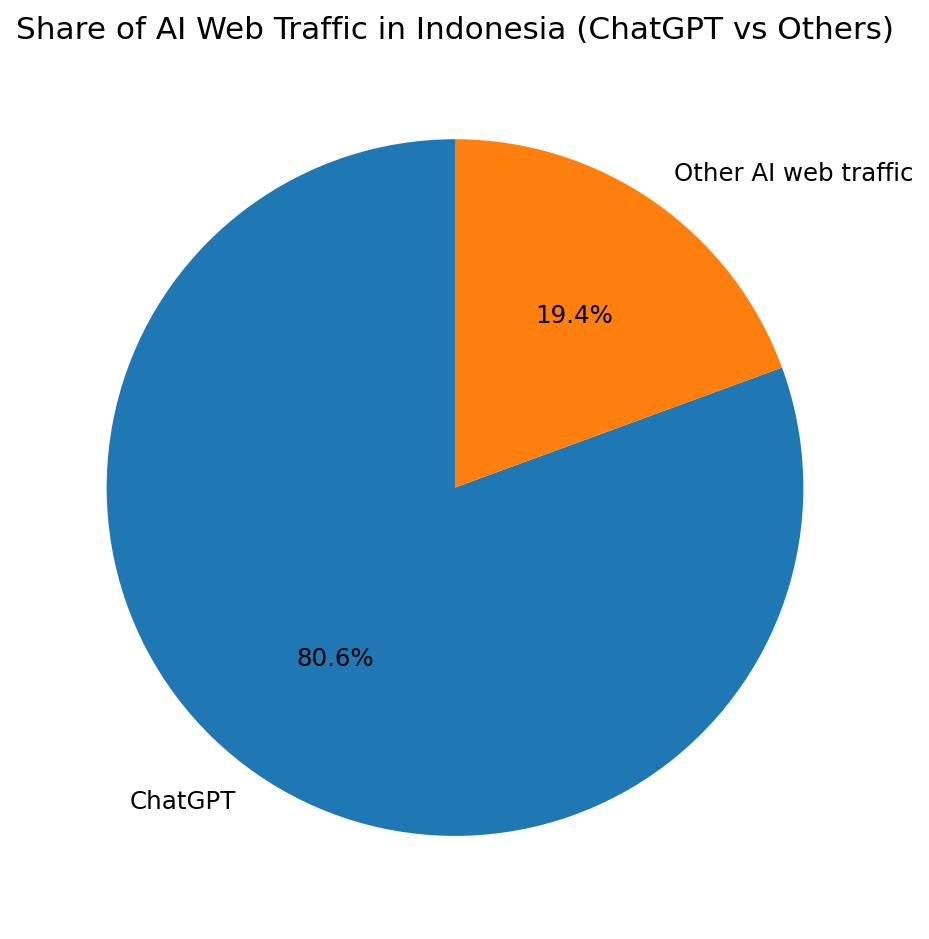
5. ChatGPT’s position as the 4th most visited website in Indonesia — capturing 80.6% of all AI web traffic — indicates that the country has effectively leapfrogged the early-adoption phase and entered a stage of mainstream generative AI search dependency.
6. When more than one-third of Indonesians use ChatGPT monthly, it is no longer accurate to describe generative AI search as a niche behaviour — it has become a routine information-seeking habit on par with traditional search engine use.
7. Google’s 1.7% year-on-year decline in search referral share in Indonesia is an early but measurable signal that AI-native search platforms are beginning to structurally erode the dominance of traditional search engines in one of Southeast Asia’s largest digital markets.
8. Indonesia’s digital economy exceeding $130 billion and controlling roughly 40% of Southeast Asia’s digital market share means that shifts in how consumers discover and evaluate products — driven by AI search — carry outsized regional commercial consequences.
9. The approaching $100 billion GMV milestone for Indonesia’s digital economy, as documented in the Google/Temasek/Bain e-Conomy SEA 2025 report, underscores the scale at which AI-influenced discovery and purchasing decisions are operating in the country.
10. An 80.5% internet penetration rate positions Indonesia not as an emerging digital market still building its user base, but as a mature, high-volume digital economy where the next competitive frontier is AI-powered user experience — including search.
11. The combination of 180 million smartphone users and a 92.53% mobile access rate for Perplexity AI confirms that any AI search or GEO strategy targeting Indonesia must be architected around mobile-first content delivery, fast load times, and conversational query formats.
12. Indonesia’s e-commerce GMV trajectory from $75 billion in 2024 toward a projected $100 billion by 2026 means that the commercial stakes of AI search optimisation — which directly influences product discovery at scale — are growing rapidly in tandem with overall market size.
2. AI Market Size & Economic Impact
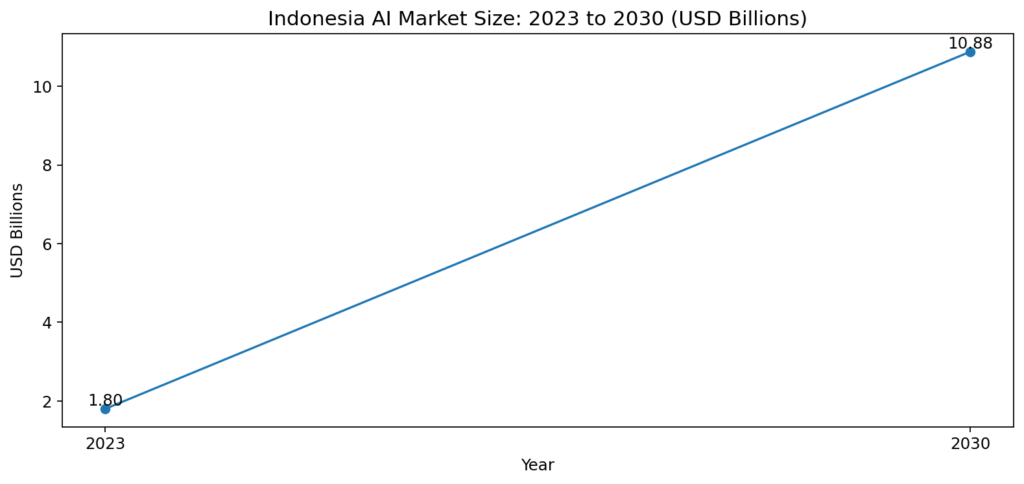
13. Indonesia’s AI market growing from $1.8 billion in 2023 to a projected $10.88 billion by 2030 represents a sixfold expansion that places AI at the centre of the country’s long-term economic growth strategy, not merely as a technology trend but as a structural economic driver.
14. A projected AI market size of $10.88 billion by 2030 makes Indonesia one of the fastest-scaling AI economies in Southeast Asia, creating significant commercial opportunities for companies that invest early in AI-native marketing strategies such as generative search optimisation.
15. An 18.73% CAGR for Indonesia’s Generative AI market through 2033 — reaching nearly $976 million — reflects sustained institutional and commercial demand for generative AI tools, including the AI-powered search and content generation capabilities central to GEO strategies.
16. Indonesia’s 127% year-on-year growth in AI-enabled app revenue — the highest in all of Southeast Asia — demonstrates that Indonesian users are not simply experimenting with AI but actively spending on and integrating AI-powered services into their daily and professional lives.
17. A digital transformation market valued at $24.37 billion in 2025 and growing at nearly 20% annually signals that Indonesian businesses across sectors are making sustained, large-scale investments in the technology infrastructure that underpins AI search adoption and digital discoverability.
18. The rapid growth of Indonesia’s AI-optimised data center market from $660 million in 2025 to a projected $1.44 billion by 2030 reflects the physical infrastructure buildout required to support the country’s ambitions as a leading AI economy in Southeast Asia.
19. Microsoft’s projection that its Indonesia Central Cloud Region will generate $2.5 billion in new economic value — as part of a $15.2 billion total impact through 2028 — illustrates how hyperscaler infrastructure investment is directly enabling the AI capabilities that underpin search transformation and enterprise GEO adoption.
20. Indonesia’s fintech sector reaching $8.6 billion in revenues by 2025, powered substantially by AI-driven fraud detection, credit scoring, and personalisation, demonstrates that AI is already generating measurable financial returns in one of the country’s most competitive and high-stakes industries.
21. Indonesia housing 20% of all ASEAN fintech companies makes it the regional fintech capital, and the deep AI integration across these firms signals that AI-driven customer acquisition — including AI search optimisation — is becoming a baseline competitive requirement rather than an optional enhancement.
22. Indonesia capturing 4% of ASEAN’s AI investment within a $2.3 billion regional pool reflects both the country’s growing investor confidence and its relative underpenetration compared to its population and digital market size — suggesting significant room for further AI investment growth.
23. Attracting $4.6 billion in AI startup investment between 2020–2024 to rank first in Southeast Asia demonstrates that Indonesia has built a credible AI startup ecosystem, though translating that investment into globally competitive AI search products and GEO-ready content infrastructure remains an ongoing challenge.
24. AI-powered claims management generating 10–15% cost savings for Indonesian insurance companies is a concrete, sector-specific validation that AI delivers measurable operational ROI, strengthening the business case for broader AI adoption — including in customer-facing AI search and content strategies.
25. A 10–15% improvement in loan underwriting accuracy for Indonesian banks using machine learning models illustrates that AI’s value in the country extends well beyond marketing and search — though these productivity gains are increasingly motivating organisations to apply the same AI-first mindset to their digital visibility strategies.
26. Indonesia’s 5.10% GDP growth rate provides one of the most stable and supportive macroeconomic environments in Southeast Asia for sustained AI and digital investment, reducing the financial risk for businesses committing to long-term AI search and GEO strategies.
3. AI Adoption — Consumers & Workers
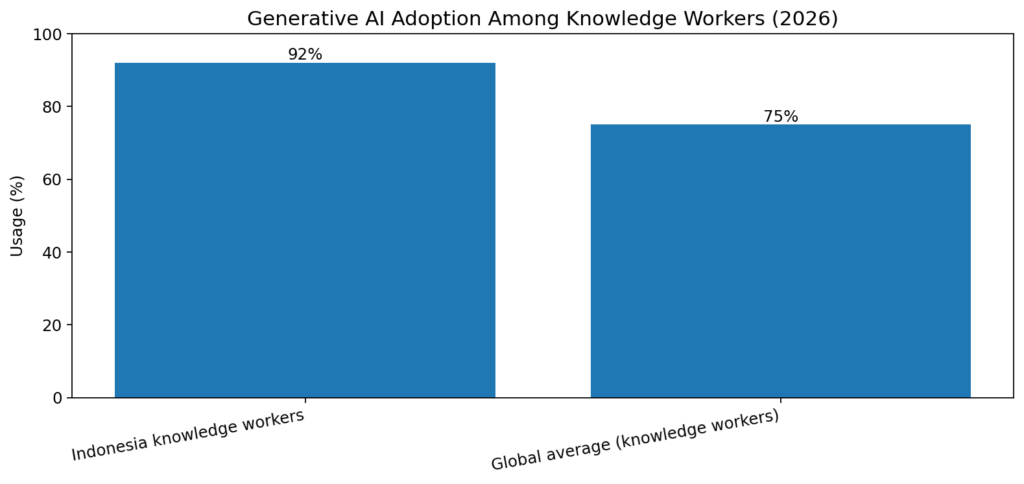
27. Indonesia’s position as the global leader in generative AI adoption among knowledge workers — with 92% usage versus a 75% global average — is perhaps the single most important statistic for understanding why AI search has moved from a peripheral novelty to the dominant mode of professional information retrieval in the country.
28. The fact that 92% of Indonesian business leaders consider AI essential for competitiveness — outpacing both global and Asia-Pacific averages — means that AI search strategy, including GEO, is increasingly viewed as a boardroom-level commercial imperative rather than a specialist marketing tactic.
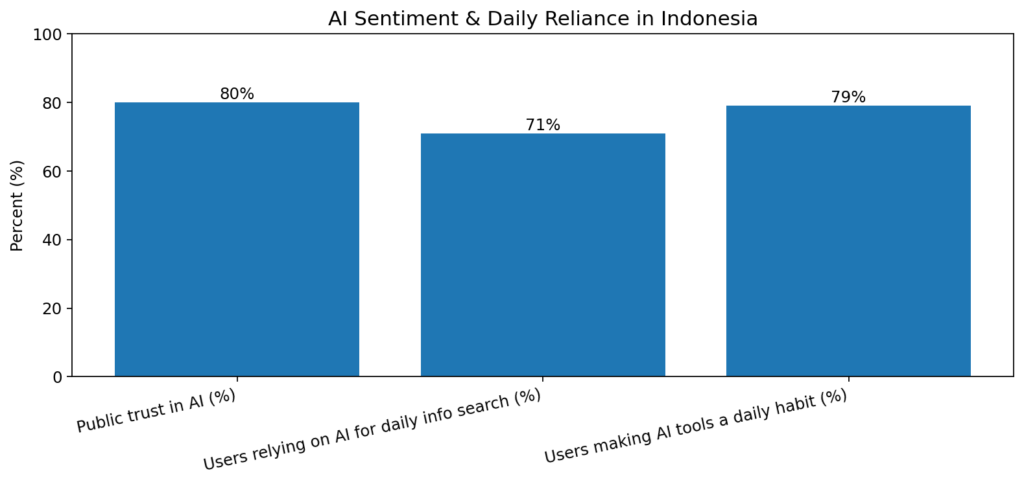
29. Indonesia’s 80% public trust score for AI — second only to China — removes one of the most significant adoption barriers seen in Western markets, creating a socially permissive environment where AI search tools can scale rapidly without facing the regulatory headwinds or consumer scepticism common elsewhere.
30. Jakpat’s survey finding that 71% of Indonesian internet users now rely on AI for daily information search is arguably the most operationally significant data point for digital marketers, as it directly quantifies the scale at which AI is displacing traditional search engines as the primary information-access channel.
31. The e-Conomy SEA 2025 report’s finding that 79% of Indonesian users have made AI tools a daily habit — not merely a periodic experiment — signals that the window for early-mover advantage in AI search optimisation is narrowing, making GEO investment increasingly time-sensitive.
32. ChatGPT’s 85% year-on-year usage growth in Indonesia — the fastest in Southeast Asia — is driven by the country’s young demographic profile, high smartphone penetration, and culturally embedded curiosity around technology, creating conditions for continued exponential adoption.
33. With 50% of Indonesian employees using AI tools weekly and 21% using them daily, AI-assisted work has crossed the threshold from early-adopter behaviour to mainstream professional practice — with direct implications for how employees conduct research, make decisions, and seek information.
34. The 45% rate of AI tool usage among Indonesian workers and employers, with ChatGPT as the preferred platform for 52% of those users, confirms that ChatGPT is not merely the most visited AI website but the most actively used AI productivity tool across the Indonesian workforce.
35. The finding that 96% of daily GenAI users in Indonesia report improved productivity — surpassing even the global average for daily users — challenges any remaining scepticism about AI’s practical value in Indonesian workplaces and strengthens the case for deeper AI integration across business operations.
36. Daily GenAI users in Indonesia feeling more secure in their jobs (82%) at a rate far exceeding the global average (58%) suggests that, unlike in many Western markets where AI is associated with job displacement anxiety, Indonesian workers largely experience AI as an empowering career tool.
37. The 72% salary increase rate among daily GenAI users in Indonesia — 20 percentage points above the global average — provides compelling evidence that AI competency is already functioning as a labour market differentiator in Indonesia, rewarding early adopters with tangible economic benefits.
38. The breakdown of Indonesian AI users into 50% “AI Aspirants” and 29% “AI Adepts” reveals a market that is progressing rapidly but unevenly, with significant untapped potential for platforms, agencies, and brands that can help the aspirant majority bridge the gap to more sophisticated AI integration.
39. Approximately half of Indonesian students using AI tools for academic tasks multiple times per month indicates that the next generation of Indonesian consumers and professionals is being trained on AI-first information retrieval habits — making GEO optimisation critical for any brand seeking long-term relevance with this cohort.
40. Perplexity AI’s 92.53% mobile access rate in Indonesia — the highest globally — is a stark reminder that AI search in Indonesia is fundamentally a mobile experience, and that GEO strategies must prioritise mobile page performance, structured data, and conversational content formats above all else.
41. The rising expectation of technological transformation among daily GenAI users in Indonesia (74%) reflects a workforce actively anticipating disruption and positioning for it — creating fertile ground for AI search tools, GEO services, and AI literacy programmes to find receptive, motivated audiences.
42. Indonesia ranking 3rd globally for visits to AI services — ahead of many wealthier, more technologically advanced nations — challenges the assumption that AI adoption is primarily a high-income country phenomenon and positions Indonesia as a globally significant case study in AI democratisation.
4. AI Adoption — Businesses & Enterprises
43. IBM’s finding that 85% of Indonesian businesses report significant operational AI gains — while 93% express confidence in their ability to deploy AI — paints a picture of an enterprise landscape that is both optimistic about and actively invested in AI transformation, even as skill and governance gaps remain.
44. The 93% of Indonesian CEOs who have already reshaped their business models for AI represent a rare consensus among senior leadership that is driving top-down AI mandate across organisations — accelerating the pace at which AI search and GEO considerations filter into marketing and digital strategy.
45. Indonesian CEOs’ expectations that generative AI will enhance both stakeholder trust (57%) and product quality (56%) suggest a leadership mindset that views AI not merely as a cost-efficiency tool but as a means of improving brand credibility — an attitude directly relevant to the E-E-A-T signals central to GEO optimisation.
46. With 70% of Indonesian CEOs expecting AI to reshape competitive dynamics, business models, and skills requirements within three years, businesses that delay investment in AI-native strategies — including generative search optimisation — risk being structurally disadvantaged by peers who moved earlier.
47. Indonesia’s 42% AI adoption rate among online sellers — matching Vietnam and outpacing Singapore and Thailand — suggests that AI-driven e-commerce experiences are becoming a regional competitive standard, with implications for how products are discovered and ranked in AI-powered search environments.
48. The fact that only 24% of Indonesian businesses have clear AI governance processes despite 93% deploying AI is a significant risk gap — one that could expose companies to regulatory, reputational, and ethical liabilities as Indonesia’s AI regulations mature and enforcement intensifies.
49. Indonesian businesses citing infrastructure (84%), cybersecurity (55%), and talent shortages (45%) as the top barriers to AI adoption reveals that the country’s AI ambitions are constrained not by lack of will but by foundational capability gaps — gaps that government and private sector investment are actively working to close.
50. The gap between small businesses (63% with clear AI strategies) and medium and large organisations (80% and 71% respectively) highlights a structural inequality in Indonesian AI readiness that could widen competitive disparities between large enterprises and SMEs if left unaddressed.
51. The fact that MSMEs — contributing 60% of Indonesia’s GDP and employing 97% of its workforce — remain uneven in their AI adoption is arguably the most consequential AI readiness gap in the country, as their digital discoverability through AI search directly affects national economic productivity and inclusion.
52. GoTo Group engineers saving 7 hours of coding time per week through GitHub Copilot represents a concrete, productivity-validated AI use case from Indonesia’s most prominent tech conglomerate — lending credibility to AI investment and setting a benchmark for what measurable AI productivity gains can look like.
53. Telkomsel’s customer self-service rate rising from 19% to 45% after deploying an Azure OpenAI-powered assistant is one of the most compelling enterprise AI ROI case studies from Indonesia — demonstrating that generative AI can double operational efficiency metrics while reducing the cost of customer interactions at scale.
54. The near-unanimous (94%) intention among Indonesian businesses to increase sustainability investments — with 89% already doing so — suggests that AI applications targeting energy efficiency, supply chain optimisation, and ESG reporting will find a commercially ready market in Indonesia’s enterprise sector.
55. The stark gap between the 92% of Indonesian companies that have deployed AI operationally and the 28% effectively using it for marketing illustrates that AI adoption in Indonesia is largely happening inside the enterprise rather than at the customer-facing digital frontier — creating a significant first-mover opportunity for AI-forward marketers.
56. Indonesia’s 3.1 million-strong GitHub developer community — the 3rd largest in APAC — and the 213% growth in public generative AI projects in 2023 alone signals that the country possesses both the talent pipeline and the open-source culture to build homegrown AI search and GEO tools in the coming years.
57. A projected 30% increase in AI adoption rates by 2025 reinforces the broader narrative that Indonesia’s AI trajectory is not plateauing but accelerating — making the current period a critical window for brands and agencies to establish AI search credibility before the market becomes more crowded and competitive.
5. ChatGPT & AI Search Tools in Indonesia
58. Indonesia contributing 3.72–3.95% of global ChatGPT web traffic — placing it in the global top 5 — is a remarkable achievement for a middle-income economy, and reflects the degree to which Indonesian users have adopted AI chat as a primary rather than supplementary search modality.
59. ChatGPT’s 80.6% share of Indonesia’s AI web traffic means it currently functions as a near-monopolistic gateway to AI-driven information discovery in the country — a position that creates both opportunity for brands that earn citations there and risk for those whose content is absent from its training and retrieval systems.
60. Asia-Pacific accounting for 28.6% of global ChatGPT traffic — the largest regional share — with Indonesia as a key contributor, positions the region as the world’s most commercially significant generative AI search market, demanding locally-adapted GEO strategies rather than generic global content approaches.
61. ChatGPT’s rise to the 5th most visited website globally with 5.5 billion monthly visits in January 2026 — surpassing Reddit, Wikipedia, and X — marks a definitive inflection point at which AI search has transitioned from challenger to mainstream, with Indonesia playing a significant role in driving that traffic volume.
62. ChatGPT reaching 800 million weekly active users globally — doubling in just four months — indicates a pace of adoption that is historically unprecedented for a software product, and Indonesia’s high per-capita usage rate suggests the country will continue punching above its weight in driving this global growth.
63. The 5.72 billion monthly visits to ChatGPT in January 2026 — growing 3.73% month-on-month — reflect sustained and compounding usage momentum rather than a one-time spike, making ChatGPT’s dominance in Indonesia’s information discovery landscape increasingly durable and harder for competing platforms to displace.
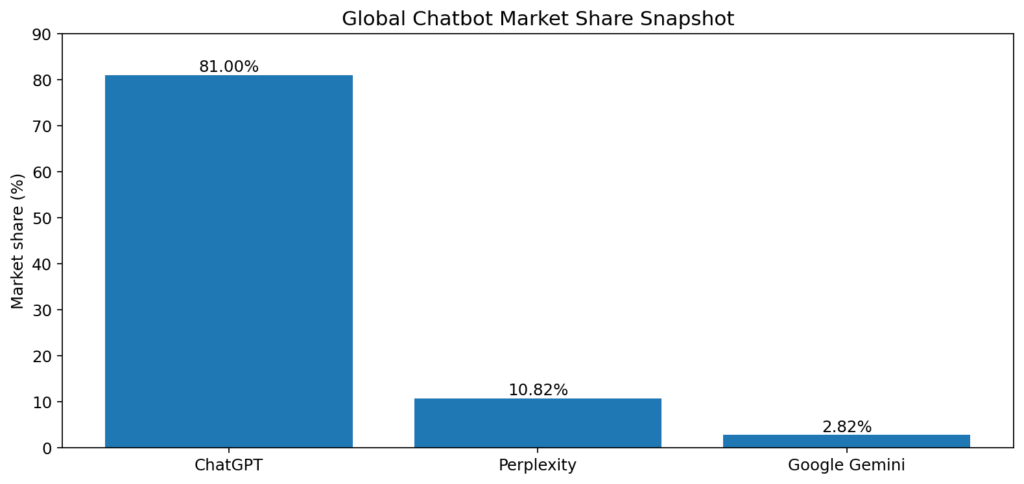
64. ChatGPT’s 81% global chatbot market share, dwarfing Perplexity (10.82%) and Google Gemini (2.82%), means that for most Indonesian brands and SEO professionals, optimising for ChatGPT citation is the highest-priority GEO objective — though Perplexity’s Telkomsel-backed growth warrants close monitoring as a secondary target.
65. OpenAI’s strategic launch of ChatGPT Go at $4.50/month specifically for the Indonesian market demonstrates a deliberate effort to lower the price barrier in a large, price-sensitive, mobile-first economy — a move that, if successful, could meaningfully accelerate the already-rapid shift from traditional to AI-powered search.
66. ChatGPT processing 2 billion+ daily queries globally — with Asia-Pacific contributing 28.6% — places the region, including Indonesia, at the centre of the world’s most active AI search ecosystem, meaning that content optimised for AI retrieval now has genuine mass-market reach in the country.
67. Indonesia and the Philippines jointly accounting for 6.7% of global ChatGPT traffic — making Southeast Asia a top-3 regional market — signals that the region is not simply adopting Western AI tools but actively shaping global usage patterns in ways that should inform platform localisation priorities.
68. Indonesia’s presence in the global top 5 for ChatGPT traffic as early as March 2024 — alongside the US, India, Brazil, and the Philippines — is evidence that the country was not a late follower in generative AI adoption but an early protagonist, providing a longer runway of user behaviour data for GEO practitioners to study.
69. Indonesia’s 90%+ reported generative AI usage rate — among the highest globally alongside India, Thailand, and China — challenges the common narrative that AI adoption is concentrated in wealthy, technology-advanced nations, and suggests that economic development stage is a poor predictor of AI enthusiasm.
70. Perplexity AI tripling its monthly query volume from 230 million to 780 million between mid-2024 and May 2025 — with Indonesia accelerating as a growth market through the Telkomsel partnership — indicates that the AI search market in Indonesia is not winner-take-all, and that multi-platform GEO strategies will be necessary to maintain comprehensive visibility.
71. Perplexity AI’s support for all 46 languages including Bahasa Indonesia is a meaningful differentiator in a market where language accessibility can determine mass adoption — and it signals that AI search tools that invest in localisation will have a structural advantage over those that treat English as the default.
72. Indonesia ranking as Southeast Asia’s #1 destination for AI startup investment between 2020–2024 creates a self-reinforcing ecosystem where capital, talent, and infrastructure converge — building the domestic AI foundation necessary to support not just AI adoption but homegrown AI search innovation.
73. DeepSeek’s 75 million downloads by January 2026 and its rapid penetration across Asia-Pacific — including Indonesia — is an important reminder that the AI search landscape is still contestable, and that GEO strategies must account for a diversifying portfolio of AI platforms rather than a single dominant player.
74. The 23-minute average session duration on Perplexity AI — far exceeding that of traditional search engines — reflects a fundamentally different user intent: rather than seeking a quick answer and bouncing, AI search users are engaging in deeper, multi-step research sessions that reward authoritative, comprehensive content.
75. The shift from ~4-word traditional Google queries to ~23-word generative AI queries is perhaps the most practically significant change in search behaviour for content strategists, as it demands a complete rethinking of keyword targeting toward natural language, intent-driven, and topic-cluster content architectures.
76. ChatGPT’s $10 billion ARR and 591.6% revenue growth in the 12 months to March 2025 validate OpenAI’s commercial viability at scale — and signal that the company has the financial resources to continue aggressive international expansion, including deeper market penetration strategies targeting Indonesia.
77. The 213% growth in public generative AI projects on GitHub Indonesia in 2023 reveals a developer community that is not merely consuming AI tools but actively building with them — a supply-side dynamic that will accelerate the development of Indonesia-specific AI search applications and GEO tooling.
78. The concentration of 80% of global ChatGPT interactions around Practical Guidance, Information Seeking, and Writing — use patterns directly applicable to professional information discovery — confirms that AI search is competing most intensely with exactly the query types that previously drove the most valuable organic search traffic.
79. ChatGPT’s 4.14 pages per session and 30.07% bounce rate — indicating deep, multi-step user journeys — suggests that when users arrive at a brand’s content via AI referral, they tend to be highly engaged and research-motivated, making AI-referred traffic qualitatively superior even when quantitatively smaller than organic search volume.
6. Perplexity AI & Telkomsel Partnership
80. Telkomsel’s 178 million subscribers providing the distribution channel for Perplexity Pro represents the largest AI search access initiative in Indonesian history — effectively bypassing the need for individual app discovery and embedding AI search directly into the country’s dominant telecommunications infrastructure.
81. The IDR 35,000 (~$2.30) entry point for Perplexity Pro access through Telkomsel is a potential inflection point for AI search democratisation in Indonesia, removing the premium pricing barrier that has historically confined sophisticated AI search tools to higher-income urban users.
82. Offering a full year of Perplexity Pro for IDR 100,000 per month through Telkomsel — roughly one-third of the global $20 rate — is a localised pricing strategy that acknowledges Indonesia’s purchasing power realities while still generating sustainable subscription economics at the scale of a 178-million-subscriber base.
83. The context that Perplexity was already answering 150 million+ questions weekly globally at the time of the Telkomsel launch underscores that Indonesia is not gaining access to an unproven product but to a mature, high-traffic AI answer engine — one that immediately brings a sophisticated search experience to Indonesian mobile users.
84. Perplexity Pro subscribers in Indonesia accessing 300+ daily searches across GPT-4o, Claude 3.5, Grok-2, Gemini 2.0, and DeepSeek R1 creates a multi-model AI search experience that is arguably more powerful than any single AI platform — raising the bar for what “AI search” means for Indonesian users and the content that serves them.
85. The May 2025 launch of the Telkomsel × Perplexity bundle — as the first AI + connectivity deal in Indonesia and Southeast Asia — marks a structural milestone in the regional AI search market, analogous to when mobile operators first bundled social media data packages and dramatically accelerated smartphone-driven internet adoption.
86. Bundling up to 12 months of Perplexity Pro with smartphone purchases in Indonesia is a habit-formation strategy that mirrors the playbook used to normalise streaming services — suggesting that AI search could follow a similar trajectory from novelty to utility to default information behaviour within a consumer’s digital life.
87. The Telkomsel-Perplexity bundle’s dual B2B and B2C positioning is strategically significant because it creates AI search demand from both enterprise users conducting business research and individual consumers making personal decisions — broadening the base of Indonesians whose information journey is now influenced by AI-powered retrieval.
88. Perplexity’s full support for Bahasa Indonesia is not simply a localisation feature — it is a prerequisite for mass adoption in a country where Bahasa Indonesia is the national language of education, government, and commerce, and where English-only AI tools face a meaningful accessibility ceiling.
89. The Telkomsel-Perplexity deal being Perplexity’s first telecom partnership in all of Southeast Asia confirms Indonesia’s role as the regional testbed for AI search commercialisation strategies, with implications for how competing platforms — including ChatGPT and Google Gemini — approach their own telco partnership strategies in the region.
90. The doubling of ChatGPT users in India following the affordable ChatGPT Go launch — a directly comparable price-sensitive, mobile-first market — is a data-backed precedent suggesting that Perplexity’s Telkomsel bundle could similarly catalyse a rapid, large-scale adoption surge in Indonesia.
7. Google AI Overviews & Zero-Click Search
91. Indonesia’s inclusion in Google’s international AI Overviews rollout — alongside major economies like the UK, India, and Japan — confirms that the zero-click paradigm reshaping search behaviour in Western markets is not a future concern for Indonesian digital marketers but a present reality already affecting traffic patterns.
92. Google’s December 2025 rollout of ads within AI Overviews in Indonesia represents the commercialisation of AI search at scale, and signals that AI-generated answers are no longer just a user experience feature but a new advertising surface — one that will require brands to rethink both their paid and organic search investment strategies simultaneously.
93. The doubling of AI Overview trigger rates — from 6.49% to 13.14% of all Google queries in just two months — illustrates an acceleration that has caught many SEO professionals off guard, and suggests that the majority of high-traffic informational queries in Indonesia will be accompanied by AI summaries well before the end of 2026.
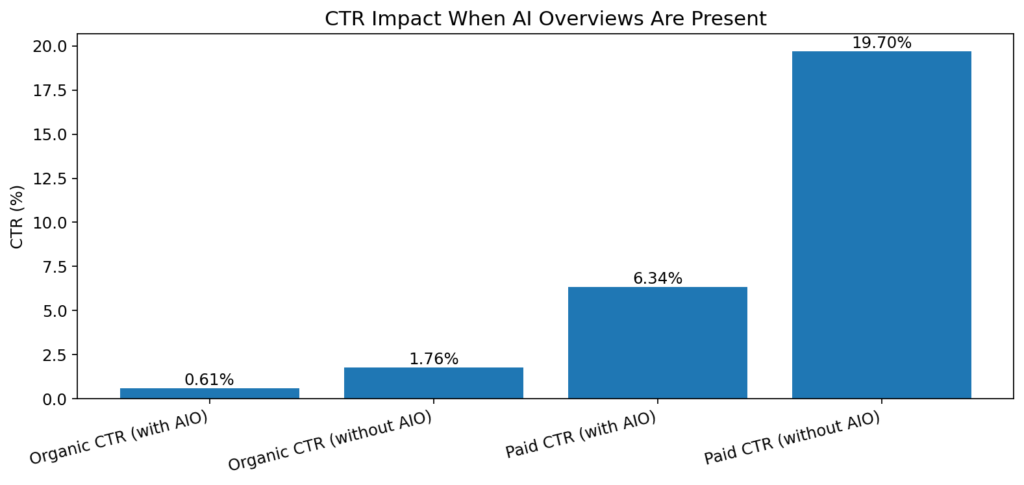
94. The 61% decline in organic CTR for queries with AI Overviews — from 1.76% to 0.61% — is a stark commercial reality that quantifies the revenue-per-click erosion facing Indonesian publishers, e-commerce brands, and content-led businesses that have not yet adapted their content strategy to the AI search era.
95. A 68% collapse in paid search CTR when AI Overviews are present — from 19.7% to 6.34% — challenges the conventional wisdom that paid search provides a reliable traffic floor, and forces Indonesian performance marketers to evaluate whether their current paid search investments are being partially cannibalised by AI-generated content above them.
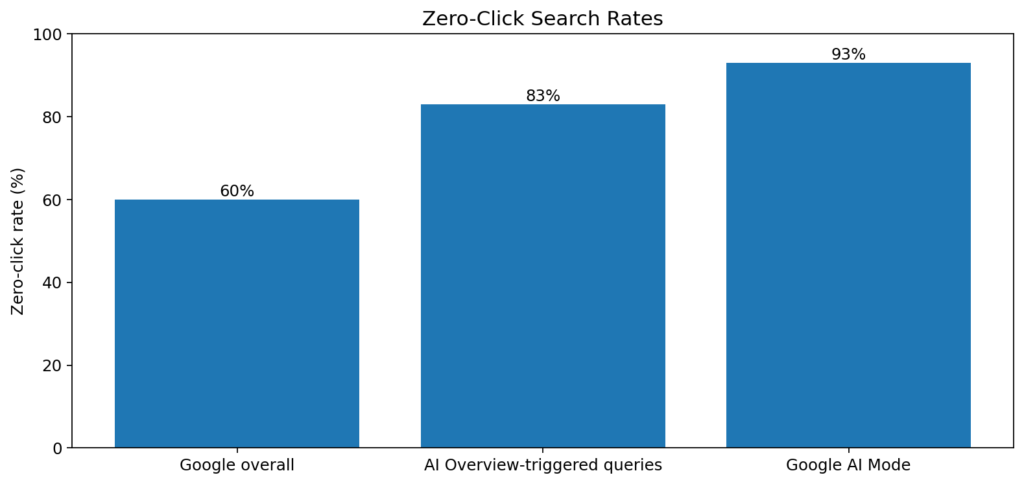
96. The 60% zero-click search rate on Google — rising from 58% in 2024 — means that the majority of Indonesian Google searches are now providing value to users without delivering any traffic to the websites whose content informs those AI answers, creating an urgent case for GEO strategies that prioritise brand citation over click generation.
97. An 83% zero-click rate specifically for AI Overview-triggered queries demonstrates that when Google’s AI generates an answer, user behaviour overwhelmingly confirms that the answer was sufficient — reinforcing that content quality and authority, rather than keyword ranking, will determine whether brands receive citation credit in this new paradigm.
98. The 79% CTR drop for the top organic result when an AI Overview appears — combined with desktop and mobile traffic declines of 56.1% and 48.2% respectively — suggests that traditional SEO’s most prized real estate (the #1 organic position) has been substantially devalued by the AI Overviews layer above it.
99. Brands cited in AI Overviews earning 35% higher organic CTR than uncited brands creates a compelling commercial argument for investing in GEO: not just to maintain visibility in a zero-click world, but to actively generate more qualified traffic than traditional ranking-based organic strategies can deliver.
100. The 91% higher paid CTR for AI Overview-cited brands versus uncited competitors suggests a reinforcing flywheel effect — where AI citation boosts brand credibility, which in turn improves paid ad performance — making GEO not just an SEO consideration but a full-funnel digital marketing priority.
101. The concentration of AI Overview triggers in informational queries (88.1%) directly threatens the content-led acquisition strategies that many Indonesian B2B companies, media publishers, and educational platforms have built over the past decade — demanding a fundamental rethink of how informational content is structured and attributed.
102. The 41% YoY CTR decline even for queries without AI Overviews reveals that AI is reshaping user behaviour at a deeper level than feature-by-feature rollout suggests — users are spending more time within search interfaces and demanding more from them before clicking, making engagement-first content strategies more important than ever.
103. Pew Research’s finding that only 8% of users who see an AI Overview click a traditional result — versus 15% without one — is a controlled, empirically robust measurement of AI’s click-suppression effect, and one that Indonesian digital marketers should use as a conservative baseline when modelling the traffic impact of AI Overviews on their own properties.
104. The finding that only 1% of users click on links within the AI Overview itself reframes the value proposition of GEO: the primary return on AI citation is not direct traffic but brand visibility, authority signalling, and top-of-funnel awareness — benefits that are real but require different measurement frameworks than traditional CTR-based SEO metrics.
105. Google’s AI Mode delivering a 93% no-click rate — more than double the AI Overviews rate — indicates that as Google’s AI search products mature and deepen, the click-suppression effect will intensify, making early investment in GEO citation strategies progressively more valuable relative to click-based SEO tactics.
106. The projected 25% decline in traditional search volume by 2026 — with a potential 50% drop by 2028 — represents a structural market shift that Indonesian SEO agencies are already pricing into their client strategies, and that any brand with significant organic search dependency should be actively scenario-planning around today.
107. Generative AI traffic growing 165 times faster than traditional organic search traffic is a rate differential so extreme that it effectively signals the direction of where digital marketing investment should be flowing — not necessarily at the expense of SEO, but as a parallel and increasingly critical channel for discovery.
108. While AI referrals currently represent only 0.1% of total web traffic, their 9.7% growth rate since 2024 — with ChatGPT overtaking Reddit and LinkedIn as a referral source — suggests a compounding trajectory that will make AI-driven traffic a material portion of digital acquisition budgets within two to three years.
109. The fact that 28.3% of ChatGPT’s most-cited web pages have zero organic Google visibility is one of the most disruptive findings in the GEO research landscape: it directly decouples AI citation authority from traditional SEO authority, and signals that AI search engines are building their own knowledge hierarchies independent of Google’s index.
110. The 10% overlap between ChatGPT’s short-tail results and Google SERPs is not merely a technical curiosity but a strategic business reality — brands that rely exclusively on Google rankings for digital discovery are now effectively invisible to a growing population of users who begin their information journeys in AI-native environments.
8. Generative Search Optimisation (GEO) — Global Context
111. The Princeton and Georgia Tech finding that GEO methods can increase content visibility in AI search by 30–40% is the closest thing the field currently has to a peer-reviewed evidence base, providing GEO practitioners with both scientific legitimacy and a practical performance benchmark against which to measure their optimisation efforts.
112. Statistics Addition delivering up to a 41% improvement in AI visibility on Bing — the highest single-method GEO lift in the research — carries a clear content strategy implication: Indonesian brands that enrich their content with verifiable data points, industry figures, and quantified claims are more likely to be cited by AI search engines than those relying on qualitative narrative alone.
113. The 22% visibility improvement from Statistics Addition and 37% Subjective Impression boost from Quotation Addition on Perplexity.ai provide platform-specific GEO benchmarks that Indonesian content strategists can use to prioritise which optimisation tactics to deploy first when targeting Perplexity’s growing Indonesian user base via the Telkomsel partnership.
114. The GEO Services Market growing from $886 million in 2024 to a projected $7.318 billion by 2031 at a 34% CAGR is the clearest commercial signal that GEO has transitioned from experimental practice to established industry — and that Indonesian agencies, brands, and platforms that delay building GEO capabilities risk entering a more competitive and expensive market later.
115. The 4.4x higher conversion rate for AI-search users versus traditional organic visitors fundamentally changes the unit economics of digital acquisition: even if AI search delivers lower absolute traffic volumes than Google, the higher intent and qualification of AI-referred visitors can produce superior revenue outcomes per session.
116. A 23x conversion rate differential between AI-referred and traditional organic visitors — while requiring independent validation — suggests that AI search citation functions less like traditional top-of-funnel traffic and more like a referral from a trusted source, dramatically compressing the consideration stage of the buyer journey.
117. The 86% of enterprise SEO teams globally now integrating AI into their search strategies signals that GEO is no longer a forward-looking capability but a current competitive table-stake — with the 14% of enterprises that have not yet adapted likely to face accelerating visibility and traffic disadvantages as AI Overviews expand globally.
118. CMO optimism about generative AI rising from 74% in 2023 to 83% in 2025 reflects a shift from cautious curiosity to confident strategic commitment — a sentiment shift that is accelerating GEO budget allocations and repositioning AI search optimisation from an experimental line item to a core component of annual marketing planning.
119. The 35% of Gen Z globally using AI as their first research stop — versus only 7% of Gen X — creates a generational information access divide that has profound long-term brand implications: companies optimised for AI search citation will be structurally more visible to the youngest and most digitally native consumer segment in Indonesia’s rapidly growing economy.
120. The Wall Street Journal’s finding that 40% of searches complete without a click — cited in OJK Institute GEO educational materials — carries particular weight when featured in government-sponsored financial sector training, as it signals that Indonesian policymakers and regulators are beginning to understand and incorporate AI search dynamics into their institutional awareness frameworks.
121. The 33% overlap between first-page organic results and AI Overviews suggests that traditional SEO is neither obsolete nor sufficient on its own — it remains a meaningful input signal for AI citation but must be complemented by GEO-specific strategies targeting the authoritative content signals that AI engines weight most heavily.
122. The additional 5.5% improvement from combining Fluency Optimisation and Statistics Addition illustrates the compounding nature of GEO optimisation — where multiple well-executed strategies reinforce each other — and supports a multi-tactic GEO approach rather than the single-tactic optimisations that many Indonesian brands are currently experimenting with.
123. The projected 200–300% ROI from GEO in Indonesia — combined with a 1–3 month results timeline versus SEO’s 6–12 months — creates a compelling commercial argument for Indonesian marketing budgets to allocate a meaningful share toward GEO experimentation, particularly for brands in competitive sectors where AI search prominence determines first-mover advantages in customer acquisition.
124. The finding that traditional SEO tactics like keyword stuffing actively harm GEO performance is a critical warning for Indonesian digital agencies still applying legacy optimisation practices, as it means that a mechanically SEO-optimised content library could be systematically disadvantaged in AI retrieval contexts relative to naturally written, authoritative content.
125. The 73% of B2B websites globally experiencing significant traffic loss between 2024 and 2025 is a sector-specific alarm that should resonate strongly with Indonesian B2B marketers, as it quantifies the scale at which AI search disruption is translating into real, measurable traffic and lead generation declines for businesses dependent on informational organic content.
126. The finding that users spend 49 seconds in Google AI Mode versus 21 seconds with standard AI Overviews reveals a meaningful intensity-of-engagement gradient across AI search formats — with deeper AI Mode interactions suggesting that users seeking more complex answers are spending more time in AI environments, further reducing the probability of clicking through to external websites.
9. GEO in Indonesia — Emerging Landscape
127. GEO emerging as a dominant search marketing strategy in Indonesia in 2026 — rather than in more developed digital markets first — reflects the country’s distinctive combination of extreme AI adoption rates, mobile-first search behaviour, and a commercial culture that tends to embrace new digital channels rapidly and with relatively low institutional resistance.
128. Doxadigital’s launch of Indonesia’s first formal AI-Search Optimisation Service in late 2025 — from a position within the top 3% of Google marketing providers — demonstrates that GEO is being led in Indonesia by established, credentialed digital agencies rather than unproven startups, lending the practice commercial legitimacy from the outset.
129. Indonesian GEO agencies targeting sub-0.8-second page load speeds as a technical benchmark reflects an understanding that AI crawlers and search bots evaluate content accessibility and technical performance as proxies for content quality — and that Indonesian brands cannot compete for AI citation if their underlying technical infrastructure is slow or poorly structured.
130. Jakpat’s finding that 71% of Indonesian users rely on AI for daily information search — cited as the primary driver of GEO’s strategic importance — functions as both an industry insight and a client-education data point for GEO agencies making the case to brands that their audience has already migrated to AI-first information access.
131. The 60% of Indonesian buyers using live shopping features in 2025 illustrates that Indonesia’s path to purchase is increasingly social and interactive — and that GEO strategies must eventually account for AI-powered discovery within social commerce environments, not just traditional AI search platforms like ChatGPT and Perplexity.
132. Indonesian GEO agencies explicitly targeting the zero-click paradigm — where brand value is delivered within AI interfaces rather than through website traffic — represents a mature and commercially sophisticated understanding of AI search mechanics, distinguishing the leading Indonesian GEO practitioners from those still applying traffic-centric SEO frameworks.
133. E-E-A-T signals — Experience, Expertise, Authoritativeness, Trustworthiness — ranking as the #1 GEO priority for Indonesian brands in 2026 aligns with global best practices and reflects a recognition that AI search engines, like human readers, most reliably cite sources that can demonstrate genuine domain expertise and verifiable credibility signals.
134. Only 28% of AI-adopting Indonesian companies effectively using AI for marketing — against a 92% operational adoption rate — reveals that the marketing function is the last to benefit from AI transformation within most Indonesian organisations, creating a structural first-mover advantage for the minority of brands that are actively investing in AI search visibility now.
135. The OJK Institute’s decision to host a formal GEO webinar featuring Google Indonesia’s Country Director is a landmark signal that Indonesia’s regulatory and financial services establishment has moved beyond passive awareness of AI search disruption to actively educating its institutional audience about the strategic and competitive implications of GEO.
136. GEO delivering results in 1–3 months versus traditional SEO’s 6–12 month timeline is not simply a speed advantage — it represents a fundamentally different risk profile for marketing investment, allowing Indonesian brands to test, iterate, and optimise AI search strategies at a pace that better aligns with the rapidly evolving AI search landscape.
137. PT CMLABS INDONESIA DIGITAL’s university curriculum partnerships for AI search education signal an emerging institutional infrastructure around GEO in Indonesia, where academic programmes are beginning to codify AI search optimisation as a formal discipline — creating a future talent pipeline of GEO-trained marketing professionals.
138. Doxadigital’s top-3% Google provider status combined with its early formalisation of a GEO service offering illustrates a market dynamic common to technology adoption cycles: the most credentialed and resourced incumbents in adjacent fields (traditional SEO) are often the ones with the strongest competitive position to capture emerging categories (GEO) before specialist newcomers arrive.
10. AI Infrastructure & Investment
139. Microsoft’s $1.7 billion investment — the largest in its 29-year presence in Indonesia — is not merely a business development milestone but a structural commitment that validates Indonesia as a Tier 1 AI economy, providing the cloud and AI compute infrastructure that makes large-scale AI search services and GEO-optimised content delivery technically feasible at national scale.
140. The projection of 106,295 new jobs created by Microsoft’s Indonesia Central Cloud Region is a consequential argument for AI infrastructure investment as an economic development tool — and signals that Indonesia’s AI ambitions carry tangible employment outcomes that strengthen the political and social case for continued public and private AI investment.
141. Tencent’s $500 million infrastructure pledge and Alibaba Cloud’s commitment to train 800,000 Indonesians in cloud and AI by 2033 illustrate that Chinese technology firms are mounting a parallel — and in some respects more localised — AI infrastructure strategy in Indonesia that competes directly with Western hyperscalers for market positioning and partner ecosystems.
142. Indonesia’s 4 GW of planned data center capacity, anchored by Microsoft, AWS, and Google regional facilities, addresses one of the core infrastructure constraints — data sovereignty and processing latency — that has historically limited the deployment of localised AI search capabilities tailored to Indonesian language, culture, and regulatory requirements.
143. The 18.08% CAGR for colocation data centers in Indonesia — the fastest-growing segment — reflects the hybrid infrastructure strategy being adopted by Indonesian enterprises: owning some workloads on-premise while leveraging shared facilities for AI-intensive applications, including those that power AI search and generative content retrieval systems.
144. Cloud Service Providers holding 55.82% of Indonesia’s AI data center market — with internet and digital media workloads growing at 17.56% CAGR — confirms that the infrastructure underpinning AI search in Indonesia is predominantly cloud-native, aligning with global patterns where AI services are deployed and scaled via hyperscaler platforms rather than on-premise hardware.
145. The Q2 2025 launch of Microsoft’s Indonesia Central Cloud Region — after four years of construction — removes a significant technical and regulatory barrier by enabling domestic data processing and storage, reducing latency for Indonesian AI search applications and providing a compliant foundation for the data localisation requirements embedded in Indonesia’s Personal Data Protection Law.
146. The $6.7 billion in MoUs signed between Axiata Group and Sinar Mas in January 2025 — spanning 5G, enterprise services, and fintech — represents the telecommunications layer of Indonesia’s AI infrastructure buildout, providing the connectivity backbone without which AI search tools, real-time data retrieval, and GEO-driven content delivery cannot reach Indonesia’s 230 million internet users reliably.
147. Indonesia’s AI data center market growing at 16.91% CAGR through 2030 — one of Southeast Asia’s highest rates — creates a compounding infrastructure advantage: as local data center capacity grows, the cost, latency, and compliance barriers to deploying sophisticated AI search services in Indonesia progressively decrease, further accelerating adoption.
148. Nvidia’s $200 million venture investment in Solo — a secondary city beyond Jakarta — is a meaningful signal that AI infrastructure investment in Indonesia is beginning to decentralise, suggesting that AI-driven digital opportunities, including AI search adoption and GEO-relevant content creation, will increasingly emerge from regional centres rather than being confined to the capital.
11. AI Skills, Talent & Policy
149. Microsoft’s elevAIte Indonesia initiative targeting 1 million AI-skilled individuals in collaboration with the Ministry of Communication represents the largest coordinated AI upskilling programme in Indonesian history — and reflects a recognition that supply-side talent development is as critical to AI search adoption as demand-side platform growth.
150. The 704,342 Indonesians already skilled in digital and AI competencies through Microsoft’s programmes prior to the elevAIte launch demonstrates that this is not aspirational target-setting but the continuation of a demonstrably productive training infrastructure — providing a credible foundation for reaching the million-person milestone.
151. Google’s Bangkit program training 15,000 Indonesian students — with over half from rural areas and a third women — is a significant equity-oriented AI development achievement, expanding the talent pipeline for AI search, GEO, and digital marketing professionals beyond the urban, elite demographics that typically lead technology adoption in developing economies.
152. Indonesia’s introduction of AI and coding as elementary school elective subjects from 2025–2026 is a long-term investment that will not yield immediate talent dividends but will, over a decade, produce a generation of Indonesian workers with a foundational AI literacy that no other Southeast Asian country has yet embedded at the same age level.
153. The August 2025 release of Indonesia’s AI Roadmap whitepaper — outlining a national AI vision through 2045 — provides the long-term policy signal that businesses need to make confident, multi-year AI investments, including in AI search infrastructure and GEO capability building, without fear that the regulatory landscape will shift unpredictably.
154. Indonesia’s January 2026 AI regulations — covering safety, ethics, sector-specific application rules, and legal liability for AI-caused harm — bring regulatory clarity that, while adding compliance requirements, also provides the legal certainty that enterprises need to expand their AI deployments, including those involving AI-generated content and automated search optimisation.
155. Indonesia’s Golden Indonesia 2045 vision explicitly designating AI as a key enabler of its ambition to become the world’s 4th-largest economy by GDP PPP is the highest-level government endorsement possible for AI investment — and positions AI search, digital commerce, and GEO as strategically aligned with national economic ambitions rather than purely private sector pursuits.
156. ITB’s 32 research centres — with 9 rated as excellent — represent the academic engine of Indonesia’s AI research ecosystem, and while the country has not yet broken into the global top 50 for AI research output, institutions like ITB are building the scholarly foundation from which homegrown AI search and GEO research contributions can eventually emerge.
157. The potential to expand Indonesia’s eligible AI talent pool by 9x through skills-based hiring — replacing credential-centric recruitment with competency-centric assessment — is a structural workforce reform that could dramatically accelerate the availability of AI search specialists and GEO practitioners who currently remain invisible to traditional hiring pipelines.
12. Sentiment, Trust & Public Attitudes
158. Indonesia’s 80% public trust in AI — the world’s second highest — is not merely an attitudinal statistic but a market-enabling condition: high trust reduces friction in AI adoption, accelerates normalisation of AI-assisted decision-making, and creates a commercially receptive environment for AI search tools to become default discovery mechanisms for both consumers and businesses.
159. The 92% AI optimism rate among Indonesian AI adopters — among the most positive globally — creates a virtuous adoption cycle where positive sentiment drives experimentation, which generates positive productivity outcomes, which in turn deepens commitment to AI tools including AI search platforms, further reinforcing adoption momentum.
160. The 75% year-on-year increase in Indonesian sellers using live shopping (to 800,000) and 90% growth in AI-assisted transactions illustrates that Indonesia’s AI-driven commerce is not confined to a single channel or customer segment — it is a multi-platform, multi-format phenomenon that demands AI discoverability strategies spanning search, social, and live commerce environments.
161. Non-manager Indonesian workers’ 64% access rate to learning and development resources — 13 percentage points above the global average — suggests that AI upskilling in Indonesia is not limited to senior employees, but is being distributed across organisational hierarchies in a way that accelerates enterprise-wide AI capability building.
162. Indonesia’s 3rd-largest APAC developer community on GitHub — over 3.1 million strong — is a human capital asset that makes the country a credible builder of AI search tools and GEO platforms, not just a consumer market for those created elsewhere, and that positions Indonesia as a future contributor to the global AI search technology ecosystem.
163. Indonesia’s 70% working-age population ratio — the demographic dividend of a young, economically active society — means that the country’s AI adoption momentum is structurally self-sustaining: as more young Indonesians enter the workforce with AI-native habits, the demand for AI-optimised content and AI search citation will grow organically without requiring continued external stimulus.
164. The 70% of organisations globally recognising AI’s significant privacy risks — combined with Indonesia’s evolving Personal Data Protection Law — creates a compliance-aware operating environment in which Indonesian businesses must balance AI search adoption with data governance obligations, making privacy-respecting GEO strategies a reputational and legal prerequisite rather than a nice-to-have.
165. Indonesia’s Payment System Blueprint 2025–2030 institutionalising AI-integrated financial infrastructure is the clearest example of AI moving from corporate initiative to national economic architecture — a development that ensures the country’s AI capabilities, including the AI-powered discovery and content ecosystems that GEO practitioners optimise for, are built on a durable, state-supported foundation.
Conclusion
The rapid expansion of artificial intelligence in search technologies is fundamentally transforming how information is discovered, interpreted, and delivered across Indonesia’s digital landscape. As the data throughout this report demonstrates, AI-powered search and Generative Engine Optimization (GEO) are no longer emerging concepts—they are quickly becoming central components of Indonesia’s online ecosystem. With millions of users increasingly relying on AI-driven search assistants, conversational interfaces, and generative answer engines, the way people interact with search engines is shifting toward faster, more contextual, and more personalized experiences.
Indonesia’s digital economy is uniquely positioned to accelerate this transformation. As one of Southeast Asia’s largest internet markets with a young, mobile-first population, the country continues to experience rapid growth in internet connectivity, e-commerce adoption, and digital services. This environment creates ideal conditions for the widespread adoption of AI-powered search platforms. As generative AI becomes embedded into search engines, productivity tools, messaging platforms, and digital marketplaces, Indonesian users are gradually transitioning from traditional keyword-based queries toward conversational and intent-driven search behavior.
The statistics highlighted in this report reveal several clear trends shaping AI search and GEO in Indonesia in 2026. First, the adoption of AI-powered search features is accelerating across both global search platforms and regional digital ecosystems. Search engines are integrating generative AI capabilities that provide summarized answers, recommendations, and contextual insights directly within search results. This shift significantly alters how users consume information and how websites gain visibility online.
Second, generative engine optimization is emerging as a critical strategy for digital marketers and businesses operating in Indonesia. Traditional SEO techniques—such as keyword targeting and link building—remain important, but they are no longer sufficient on their own. GEO focuses on optimizing content so that it can be effectively understood, referenced, and cited by AI-powered answer engines and generative search models. As AI systems increasingly synthesize information from multiple sources to generate responses, structured content, semantic relevance, and topical authority have become key factors influencing visibility in AI-generated search results.
Another key trend revealed through the data is the growing importance of high-quality, trustworthy content. Generative AI systems rely heavily on authoritative sources when generating answers and recommendations. Websites that demonstrate expertise, credibility, and consistent publishing standards are more likely to be referenced by AI-driven search platforms. For businesses and publishers in Indonesia, this means that content strategy must prioritize accuracy, depth, and informational value rather than focusing solely on keyword optimization.
Mobile usage continues to play a significant role in shaping AI search adoption across Indonesia. With the majority of Indonesian internet users accessing the web through smartphones, AI-powered search experiences are increasingly optimized for mobile-first environments. Voice search, AI chat assistants, and conversational search interfaces are becoming more common across mobile apps and platforms. These developments further reinforce the importance of natural language content and user-focused information architecture in modern SEO and GEO strategies.
The data also highlights the increasing convergence between search engines, generative AI tools, and digital platforms. Search is no longer limited to traditional search engines alone. AI-driven discovery is now integrated across messaging apps, productivity tools, social media platforms, and e-commerce marketplaces. Indonesian users can access AI-generated answers and recommendations through multiple channels, making online discovery more seamless but also more complex for businesses seeking visibility.
For companies operating in Indonesia’s competitive digital economy, adapting to this evolving search landscape will be essential for long-term growth. Brands must rethink how they approach content creation, digital marketing, and information architecture in an AI-first search environment. Structured data, authoritative content clusters, conversational content formats, and strong domain credibility will play increasingly important roles in ensuring that businesses remain discoverable within AI-generated responses.
At the same time, organizations must remain aware of the broader implications of AI-powered search technologies. Issues related to information reliability, algorithm transparency, and content attribution will continue to shape discussions among regulators, technology companies, and digital stakeholders in Indonesia. As generative AI systems influence how information is distributed online, maintaining trust and accuracy within the digital information ecosystem will become a shared responsibility across industries.
Looking ahead, AI search and generative engine optimization are expected to evolve rapidly over the coming years. Advances in large language models, multimodal AI systems, and real-time data processing will further enhance the capabilities of generative search platforms. As these technologies mature, the distinction between search engines, AI assistants, and digital discovery tools will likely continue to blur. Businesses that proactively adapt to these changes will be better positioned to capture emerging opportunities in Indonesia’s growing digital economy.
Ultimately, the 165 statistics and insights presented in this report provide a comprehensive snapshot of how AI search and GEO are shaping Indonesia’s digital future in 2026. They highlight the scale of transformation currently underway and underscore the importance of data-driven strategies in navigating this rapidly evolving environment. For marketers, entrepreneurs, researchers, and technology leaders, understanding these trends is essential for staying competitive in a world where artificial intelligence increasingly defines how people search, learn, and make decisions online.
As Indonesia continues to embrace AI-driven innovation, the search landscape will remain one of the most dynamic areas of digital transformation. Organizations that invest in AI-aware content strategies, prioritize information quality, and align with the evolving principles of generative engine optimization will be best prepared to succeed in the next era of intelligent search.
If you are looking for a top-class digital marketer, then book a free consultation slot here.
If you find this article useful, why not share it with your friends and business partners, and also leave a nice comment below?
We, at the AppLabx Research Team, strive to bring the latest and most meaningful data, guides, and statistics to your doorstep.
To get access to top-quality guides, click over to the AppLabx Blog.
People also ask
What is AI search and how is it changing the digital landscape in Indonesia?
AI search uses artificial intelligence to understand user intent and generate direct answers. In Indonesia, it is transforming how people discover information, shifting search behavior from simple keywords to conversational queries and AI-powered recommendations.
What does Generative Engine Optimization (GEO) mean?
Generative Engine Optimization refers to optimizing content so it appears in AI-generated answers and summaries. Unlike traditional SEO, GEO focuses on structured, authoritative content that AI search engines can easily interpret and reference.
Why are AI search statistics important for Indonesia in 2026?
AI search statistics reveal how users interact with generative search platforms, helping businesses understand digital behavior, plan SEO strategies, and adapt to AI-driven search technologies shaping Indonesia’s online ecosystem.
How is AI transforming SEO strategies in Indonesia?
AI is changing SEO by prioritizing context, authority, and natural language content. Indonesian businesses must now optimize for conversational queries, structured data, and authoritative information to appear in AI-powered search results.
What role does generative AI play in modern search engines?
Generative AI allows search engines to summarize information and deliver direct answers instead of simple link lists. This changes how users access information and how websites compete for visibility.
How popular is AI-powered search in Indonesia?
AI-powered search is growing rapidly in Indonesia due to widespread smartphone usage and increasing adoption of AI tools integrated into search engines, apps, and digital platforms.
What industries in Indonesia benefit most from AI search growth?
E-commerce, fintech, travel, education, and digital media benefit significantly from AI search because users increasingly rely on AI tools to research products, services, and information before making decisions.
How does AI search affect website traffic in Indonesia?
AI-generated answers can reduce clicks to websites, but high-quality authoritative content can still gain visibility when AI systems reference reliable sources.
What is the difference between SEO and GEO?
SEO focuses on ranking webpages in search engine results pages, while GEO focuses on making content discoverable and usable by generative AI systems that produce direct answers.
Why should businesses in Indonesia focus on GEO in 2026?
As generative AI becomes central to search experiences, businesses must optimize content for AI-driven platforms to maintain visibility and reach audiences searching through AI tools.
How is mobile usage influencing AI search adoption in Indonesia?
Indonesia’s mobile-first internet culture drives rapid adoption of AI-powered search features such as voice assistants, AI chatbots, and conversational search interfaces on smartphones.
What types of content perform well in AI search results?
Detailed, structured, and authoritative content performs best. AI systems prefer content that clearly explains topics, answers questions, and provides accurate, well-organized information.
How does AI understand user search intent?
AI uses natural language processing and machine learning to analyze context, user behavior, and query patterns to deliver more relevant and personalized search results.
What are generative search engines?
Generative search engines use AI models to create summarized answers from multiple sources, offering users conversational responses instead of traditional lists of links.
How are Indonesian businesses adapting to AI search trends?
Many businesses are investing in content marketing, structured data, AI-friendly website design, and authoritative information to increase visibility in generative search results.
What role do statistics play in understanding AI search growth?
Statistics provide insights into user behavior, adoption rates, and market trends, helping businesses and marketers understand how AI search is evolving.
How does AI search influence digital marketing strategies?
AI search encourages marketers to focus on expertise, topic authority, and user intent rather than relying solely on keywords and traditional ranking techniques.
What challenges does AI search create for publishers in Indonesia?
AI-generated summaries may reduce website visits, forcing publishers to adapt content strategies to maintain brand visibility and authority in AI-driven ecosystems.
How important is authoritative content for GEO?
Authoritative content is critical because AI systems prioritize credible sources when generating answers, increasing the likelihood of being cited in AI search responses.
What role does natural language play in AI search optimization?
Natural language helps AI systems understand content better. Writing conversational and informative content improves the chances of appearing in generative search answers.
How is voice search connected to AI search trends?
Voice search relies heavily on AI to interpret spoken queries and generate responses, making conversational search increasingly important in Indonesia’s mobile-first market.
Why is Indonesia an important market for AI search growth?
Indonesia has one of the largest internet populations in Southeast Asia, with high smartphone usage and rapid digital adoption, making it a key market for AI search expansion.
How can websites prepare for AI-powered search engines?
Websites should focus on high-quality content, structured data, clear information architecture, and authoritative expertise to improve visibility in AI-generated results.
What role do data and trends play in AI search research?
Data and trends help analysts identify patterns in search behavior, technology adoption, and market growth, providing insights for businesses and digital strategists.
How does generative AI impact online discovery in Indonesia?
Generative AI allows users to discover information faster through summarized responses, reducing reliance on traditional search result pages.
Are conversational AI assistants affecting search behavior?
Yes, conversational AI assistants encourage users to ask complex questions and receive detailed responses, changing how people search for information online.
What future trends are expected for AI search in Indonesia?
Future trends include deeper integration of generative AI in search engines, increased use of conversational search, and stronger demand for authoritative content.
How does structured data help with GEO?
Structured data helps AI systems understand website content more easily, improving the chances of being referenced in AI-generated answers.
What impact will AI search have on SEO professionals?
SEO professionals will need to expand their strategies to include GEO, focusing on content quality, AI visibility, and user intent rather than only traditional rankings.
Why is it important to follow AI search trends in 2026?
Understanding AI search trends helps businesses stay competitive, adapt digital strategies, and maintain visibility as artificial intelligence continues to reshape online search.
Sources
We Are Social
Meltwater
Temasek
Bain & Company
PwC Indonesia
IBM
Mordor Intelligence
IMARC Group
Statista
IDC
Microsoft
Introl
Similarweb
DemandSage
PageTraffic
DesignRush
Superlines
Siana Marketing Research
Visual Capitalist
Index.dev
Telkomsel
Gizmologi
The Fast Mode
Marketing Interactive
Developing Telecoms
Seer Interactive
The Digital Bloom
Okoone
PPC Land
Click Vision
Dataslayer
Pew Research Center
Position Digital
Onely
WebFX
Ahrefs
Growth Memo
Writesonic
Aggarwal et al.
Princeton University
Georgia Institute of Technology
WordStream
Gartner
Wall Street Journal
AppLabx
Bloomberg Technoz
OJK Institute
SEOpolitan
cmlabs
Jakpat
Business Indonesia
Kompas
U.S. Department of Commerce
HSF Kramer
AI Asia Pacific Institute
ScienceDirect
World Bank
Medium
SmartDev