





















Key Takeaways
- AI search adoption in France is accelerating, with nearly half the workforce using generative AI—making GEO a critical complement to traditional SEO strategies.
- France’s delay in Google AI Overviews creates a short-term SEO advantage but a long-term risk for brands unprepared for AI-driven SERPs.
- Zero-click search and AI-generated answers are reshaping visibility, requiring brands to prioritise authority, structured content, and AI citation readiness.
Artificial intelligence is no longer an emerging layer of search — it is rapidly becoming the interface through which users discover, evaluate, and trust information. In 2026, France sits at a uniquely complex intersection of this transformation: a country with strong AI adoption, world-class research and start-up ecosystems, and millions of active generative AI users — yet one that remains structurally behind in the rollout of Google’s most important AI search features.

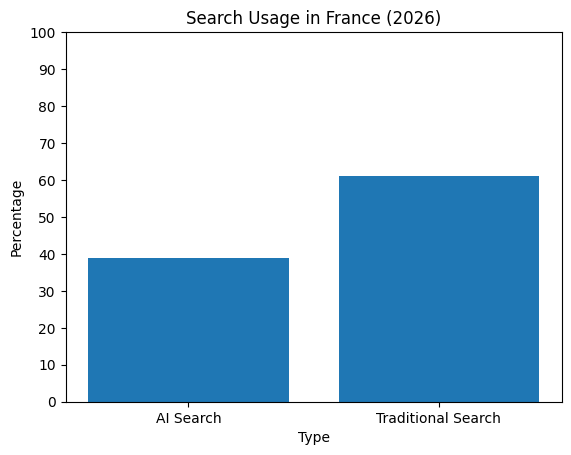
This tension defines the French search landscape today. On one hand, behaviour is already shifting at scale. Around 39% of French internet users now rely on AI-powered search tools, signalling a meaningful change in how information is accessed and consumed. At the same time, 61% still depend on traditional search engines, reinforcing that France is not experiencing a full replacement of SEO by AI, but rather a dual-system environment where both coexist. This hybrid reality is critical: it means French brands, marketers, and publishers must optimise simultaneously for traditional Google rankings and for visibility within AI-generated answers.
That challenge is intensified by the scale and speed of global AI adoption. AI platforms now process billions of prompts daily, with hundreds of millions of active users engaging with tools like ChatGPT every week. AI-driven search interactions have already reached more than half the volume of traditional search sessions globally, while total search activity continues to grow — proving that AI is expanding the search ecosystem, not cannibalising it. For French businesses competing internationally, this shift is not theoretical. AI visibility is already influencing brand discovery, product research, and purchasing decisions across borders.
Within France itself, adoption signals are equally strong. The country ranks among the leading nations globally for AI usage, with roughly 44%–47% of the working population using generative AI tools. Combined with a domestic ecosystem of over 1,000 AI start-ups and thousands of researchers, France has the technical capability and market readiness to lead in AI search innovation. However, adoption remains uneven across demographics and company sizes, with small and medium-sized businesses and older user groups still underrepresented — creating both a gap and an opportunity for forward-looking organisations.
What truly sets France apart, however, is not adoption — it is regulation.
As of March 2026, Google AI Overviews — the AI-generated summaries now appearing in a large share of search results globally — remain unavailable in France. While neighbouring markets such as Germany, Italy, Spain, Belgium, and Switzerland have already integrated these features into their search ecosystems, France stands as the only major European market still excluded. This absence is not accidental. It is rooted in the country’s 2019 neighbouring rights law and reinforced by regulatory actions, including a €250 million fine against Google in 2024 for failing to comply with commitments related to publisher content.
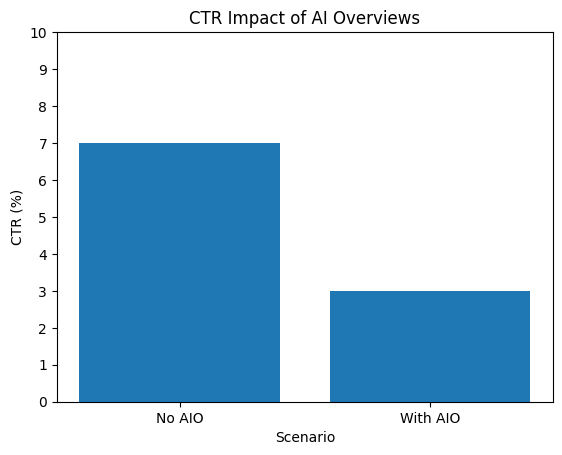
The result is a rare and paradoxical position. French websites are currently insulated from the dramatic click-through rate declines seen in markets where AI Overviews are active — in some cases reducing organic CTR by more than 50% and pushing zero-click search rates above 60%. Yet at the same time, French SEO professionals and digital teams are operating without direct exposure to the very systems that are reshaping search behaviour elsewhere. This creates a strategic blind spot: while competitors in other countries are already adapting to AI-driven search experiences, many French organisations remain underprepared for the inevitable moment when these features arrive.
And that moment will come — though its timing and form remain uncertain. Whether through a full rollout, a limited deployment excluding press publishers, or a prolonged regulatory delay, all current signals point toward eventual integration. When it happens, the impact is expected to be significant. French SEO practitioners already anticipate organic traffic declines of 20%–40% in AI Overview-heavy query categories, based on data observed in other markets. More importantly, the shift will not just affect traffic volumes — it will redefine what visibility means in search.
This is where Generative Engine Optimization (GEO) emerges as a critical discipline.
Unlike traditional SEO, which focuses on ranking pages in search engine results, GEO is about earning inclusion in AI-generated answers. It prioritises authority, clarity, structured information, and brand presence across the wider web — not just within a single domain. In an environment where AI systems frequently generate responses without requiring a click, visibility becomes less about traffic and more about influence: being cited, summarised, and trusted by the models shaping user decisions.
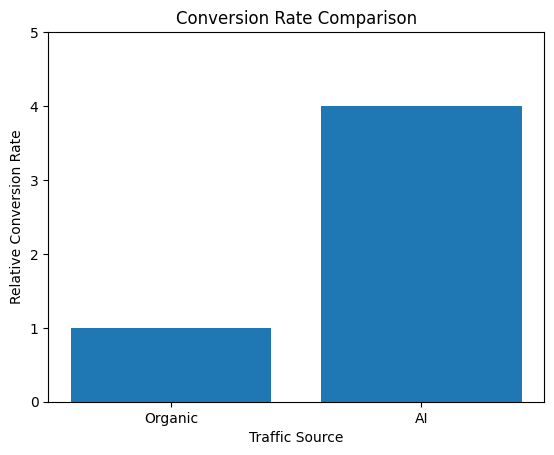
The economic and strategic implications are substantial. AI-driven traffic, while still a small percentage of total web visits, is growing at an unprecedented rate and delivers significantly higher conversion rates than traditional search. At the same time, zero-click behaviour is becoming the default outcome for a majority of queries, particularly on mobile devices. This means that even when brands lose clicks, they can still gain value — through brand exposure, authority signals, and downstream conversions driven by AI-mediated discovery.
For French businesses, the stakes are therefore twofold. First, they must continue to invest in traditional SEO, which still accounts for the majority of web traffic and remains the foundation for visibility in both search engines and AI systems. Second, they must actively build GEO capabilities — not as a future hedge, but as an immediate strategic priority. The organisations that succeed will be those that treat AI search as a parallel channel, develop content specifically optimised for AI citation, and establish strong brand signals across both owned and external platforms.
This guide brings together 160 of the most important statistics, data points, and trends shaping AI search and GEO in France in 2026. It covers everything from adoption rates and regulatory constraints to platform dynamics, zero-click behaviour, traffic impact, and conversion performance. More importantly, it translates these numbers into a clear strategic narrative: France is not behind in AI — it is simply operating under different constraints. And for those who understand this nuance, the current moment represents not a disadvantage, but a window of opportunity.
Because when AI search fully arrives in France, it will not arrive gradually. It will arrive at scale. And the brands that have already adapted — quietly, in advance — will be the ones that define visibility in the next era of search.
But, before we venture further, we like to share who we are and what we do.
About AppLabx
From developing a solid marketing plan to creating compelling content, optimizing for search engines, leveraging social media, and utilizing paid advertising, AppLabx offers a comprehensive suite of digital marketing services designed to drive growth and profitability for your business.
At AppLabx, we understand that no two businesses are alike. That’s why we take a personalized approach to every project, working closely with our clients to understand their unique needs and goals, and developing customized strategies to help them achieve success.
If you need a digital consultation, then send in an inquiry here.
Or, send an email to [email protected] to get started.
160 AI Search & GEO in France Statistics, Data & Trends in 2026
Section 1 — France-Specific AI Search & Adoption
- 39% of French internet users now rely on AI-powered search engines, marking a significant behavioural shift that SEO professionals in France can no longer afford to ignore — yet it also means 61% still use traditional search, underscoring the need for a dual-channel strategy.
- France’s 18.3 million ChatGPT users place it among the top European ChatGPT markets, reflecting strong consumer appetite for generative AI — though adoption is uneven across age groups and industries, with older demographics and SMBs still largely under-served.
- France ranks 5th globally in AI adoption, with 44% of its working population using generative AI tools, a competitive position that signals both opportunity and urgency for French businesses looking to integrate AI into their digital marketing and search strategies.
- France’s AI adoption rate of 44%–47% puts it on par with Norway and Ireland, suggesting French enterprises are tracking ahead of the European average — though adoption rates alone do not reflect the quality, consistency, or strategic depth of AI tool usage.
- Google AI Overviews (AIO) remain unavailable in France as of March 2026, making France the only major European market still excluded — a unique situation that paradoxically insulates French organic traffic from AIO-driven CTR losses, while leaving French SEOs unprepared for the eventual launch.
- Google AI Mode has been deployed in 200+ countries and 35+ languages, but France remains explicitly excluded, creating a growing visibility gap between French brands and their European counterparts who are already adapting to AI-generated SERP experiences.
- Google was fined €250 million by France’s Competition Authority in March 2024 for failing to honour its commitments on neighbouring rights — a landmark ruling that set a firm legal precedent and directly explains why Google has been cautious about deploying AI-generated content features in France.
- France’s 2019 neighbouring rights law is the primary legal barrier blocking AI Overviews in France, highlighting how domestic media policy and EU intellectual property directives can have far-reaching, unintended consequences for digital search innovation.
- Google’s SVP Nick Fox confirmed in October 2025 that the timeline for resolving France’s regulatory uncertainty remains unclear, suggesting that French SEOs should plan for an extended period without AI Overviews rather than banking on an imminent launch.
- In January 2026, Google began exploring an opt-out mechanism that could allow French publishers to exclude their content from AI features while remaining indexed, representing a potential compromise path — though its effectiveness in satisfying press publishers and regulators remains to be seen.
- France’s AI ecosystem includes over 1,000 AI start-ups, 4,000 researchers, and is Europe’s top AI investment destination, demonstrating that France has the underlying talent and infrastructure to lead in AI search — even as regulatory friction slows deployment of some AI features.
- French AI companies like Mistral AI, Dataiku, Alan, and Aircall span healthcare, finance, and tech, indicating that France’s AI innovation is broad-based and not siloed — providing fertile ground for sector-specific AI search applications and GEO strategies.
- The EU AI Act’s GPAI obligations began applying to LLM providers in France from August 2025, meaning any AI search product deployed in France — including ChatGPT, Gemini, and Perplexity — now operates under formal regulatory oversight, with implications for transparency and content attribution.
- France must transpose the EU Product Liability Directive into national law by December 2026, which will extend legal liability to AI-generated content and software — a development that will likely make brands more cautious about fully automating content for AI search.
- France’s government has committed €40 million to AI infrastructure and backed a €10 billion GPU partnership, signalling that state-level support for AI is substantial — though public investment in compute infrastructure will only translate to search dominance if complemented by private-sector adoption.
- Germany, Italy, Spain, Belgium, and Switzerland all launched Google AI Overviews in March 2025, while France remains excluded, creating a rare competitive asymmetry where French digital marketers are both shielded from AIO traffic loss and disadvantaged in understanding its full strategic implications.
- French SEO professionals estimate a 20%–40% organic traffic decline once AI Overviews launch in France, based on observed impacts elsewhere — making proactive GEO investment now, before the launch, a strategically sound hedge rather than premature spending.
- France’s APIG press alliance is actively monitoring the AI Overview situation and has filed complaints against Meta for neighbouring rights violations, demonstrating that the droits voisins issue extends well beyond Google and will continue to shape France’s AI search regulatory environment for years.
- 81% of consumers believe businesses should disclose AI-generated content, yet 66% admit to trusting AI outputs without verification, revealing a trust paradox that French brands and publishers should address proactively through transparent content labelling and E-E-A-T signals.
- French SEO practitioners face a ‘dual strategy’ imperative in 2026: maintaining traditional Google SEO while preparing GEO readiness, and the brands that invest in both simultaneously — rather than waiting for the regulatory situation to resolve — will be best positioned when AI Overviews eventually launch.
Section 2 — AI Search Usage & Adoption (Global)
- ChatGPT processes 2.5 billion prompts per day from over 190 million daily active users globally, making it the dominant AI search interface by a significant margin — and the single most important platform for French brands targeting international audiences through generative search.
- ChatGPT’s weekly active user base doubled from 400 million to 800–900 million in under 12 months, a growth trajectory that dwarfs most consumer internet products in history and underscores why AI search literacy has become a non-negotiable marketing competency.
- Monthly AI sessions now represent 56% the size of global search sessions, meaning AI platforms have captured more than half the engagement volume of traditional search in just a few years — a disruption pace that should recalibrate how brands allocate content and visibility budgets.
- Search-related AI usage is now 28% the size of global search, confirming that AI is not yet replacing search but functioning as a powerful parallel information retrieval layer that brands must optimise for independently.
- ChatGPT accounts for 20% of all search-related traffic worldwide, an extraordinary figure for a product less than three years old — and a strong signal that optimising for ChatGPT citations is no longer optional for brands with global search visibility goals.
- Total search volume (engines + LLMs combined) increased 26% worldwide, disproving the narrative that AI is cannibalising search — in reality, it is expanding the total addressable market for information retrieval, creating new optimisation opportunities alongside traditional SEO.
- Around 3 in 4 American respondents use AI for search weekly, with top use cases being quick facts, shopping research, and health information — categories that map directly to the content types French brands should be optimising for GEO citation.
- 40.46% of US users trust both traditional and AI search results equally, suggesting that neither format has a decisive trust advantage — and that brands should focus on authority signals that work across both environments rather than optimising for just one.
- 50% of consumers now use AI search intentionally as their primary insight source, a tipping point that signals AI search has moved from novelty to habitual behaviour — demanding that content strategies treat AI visibility as a first-class objective, not an afterthought.
- AI search and chatbot platforms saw over 721% average monthly traffic increase in the past year, capturing nearly 8% of the combined search market — a velocity of disruption that gives even well-resourced digital teams limited runway to adapt before market positions shift.
- The ratio of Google users to AI search users shrank from 10:1 to 4.7:1 in just 12 months, a compression rate that, if sustained, would put AI search traffic on par with Google within three to four years — reinforcing the urgency of GEO investment today.
- Combined traffic to ChatGPT and Perplexity surged 225% from 2024 to 2025, confirming that the AI search market is not a single-platform story — and that brands should monitor and optimise for multiple AI engines simultaneously.
- Over 1 billion people actively use AI tools as of early 2026, marking a milestone that puts generative AI in the same adoption league as social media and smartphones — signalling that AI search literacy is now a mass-market behaviour, not just a tech-enthusiast trend.
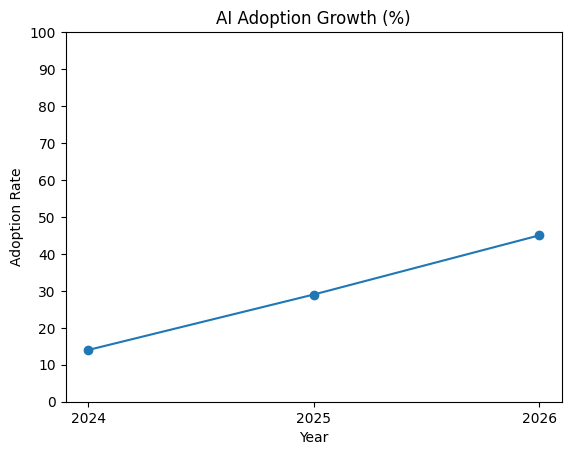
- AI adoption rate doubled from 14% in February 2025 to 29.2% by August 2025 in just six months, demonstrating that AI search adoption is accelerating, not plateauing — making this a critical window for French brands to establish AI visibility before the market becomes crowded.
- Gen Z and Millennials drive AI search adoption, with over 70% using ChatGPT or Perplexity, meaning brands targeting younger demographics must treat GEO as a primary channel — not a supplementary one — to remain relevant in their information journeys.
- 13 million people used generative AI as their primary search tool in 2023, projected to reach 90 million by 2027, a nearly seven-fold increase that validates long-term GEO investment while reminding brands that current AI search volumes, though large, represent only the early innings.
- ChatGPT recorded 5.72 billion website visits in January 2026 alone, making it one of the most-visited destinations on the internet — and a distribution channel that content strategists should treat with the same rigour as Google.com.
- ChatGPT holds over 80% market share in the AI chatbot space, meaning that while multi-platform GEO strategies are valuable, ChatGPT optimisation should remain the primary focus for most brands given its dominant share of AI-driven information retrieval.
- AI search is projected to ship on 89% of new devices by 2026 through OS-level integration, indicating that AI-first information retrieval will soon be the default experience for new device users — a structural shift that will reshape how brands think about discoverability.
- 95% of Americans continue using traditional search engines even after adopting AI tools, confirming that AI search adoption is additive, not substitutional — brands should pursue both SEO and GEO strategies rather than abandoning one in favour of the other.
Section 3 — Google AI Overviews: Deployment & Impact
- Google AI Overviews now reach 1.5–2 billion monthly users globally, making AIO the largest single AI-generated search experience on the planet — and the most critical GEO target for brands that depend on Google’s search ecosystem.
- AI Overview presence in US SERPs grew six-fold in under 12 months, reaching 42.51% of queries by end of 2025, a rate of expansion with few historical precedents in Google’s SERP history — and a strong indicator that France should expect rapid AIO saturation upon launch.
- AI Overviews appear in approximately 30% of all keywords across SE Ranking’s analysis, though the figure varies significantly by query type and vertical — informational and educational queries face the highest exposure, while transactional terms remain relatively insulated.
- AI Overviews appear in roughly 47% of Google search results for informational and how-to queries, meaning that for content-heavy industries like healthcare, legal, and education, the majority of Google result pages now feature AI-generated answers above the organic links.
- In France’s neighbouring markets (Belgium, Switzerland), AI Overviews triggered 66% of informational queries by May 2025, giving French SEOs a near-perfect preview of what to expect post-launch and a concrete benchmark for GEO readiness planning.
- AI Overviews have expanded from informational to commercial queries, growing from 8% to 18% commercial coverage, suggesting that e-commerce and product-focused brands — which previously had relative protection — must now begin building AIO visibility strategies.
- Queries of 8 words or longer have a 57% probability of triggering an AI Overview, confirming that long-tail, conversational search queries — the kind users naturally ask in AI chat interfaces — are the most important area for GEO-optimised content development.
- Health and education AIO coverage approaches 90%, while tech B2B has grown from 36% to 70%, revealing that regulated, high-stakes content verticals face the steepest AI-generated answer saturation — and the most complex compliance considerations for content strategy.
- YMYL sectors show the highest AI Overview convergence: health (75.3%), education (72.6%), and insurance (68.6%), while e-commerce sits at just 22.9% — a data point that should directly inform where GEO investment is prioritised by industry.
- Entertainment queries saw a 528% increase in AI Overview presence in just two weeks in March 2025, demonstrating that AIO expansion can be rapid and sector-wide — leaving brands in any vertical with little warning time to adapt.
- AI Overview content changes approximately 70% of the time for the same query, with nearly half the citations replaced on each update — a volatility rate that demands continuous AI visibility monitoring, not a set-and-forget GEO strategy.
- Only about 30% of brands maintain consistent visibility across back-to-back AI responses, highlighting that AI search presence is inherently dynamic and that branded mentions and topical authority matter more than any single page optimisation.
- The top citation sources in AI Overviews include YouTube (23%), Wikipedia (18%), and Google.com (16%), reinforcing that multimedia content, factual depth, and domain authority are the three pillars of AIO citation eligibility.
- Over 43% of AI Overview responses contain links to Google.com, with 4–6 links per response on average, suggesting that Google is directing AI-generated answers back to its own ecosystem — a dynamic French publishers and SEOs should factor into their off-site content strategies.
- Only 13.7% of citations overlap between Google AI Overviews and AI Mode, meaning brands must treat these as two distinct visibility channels requiring separate optimisation approaches — not a single Google AI surface.
- AI Overviews cite content from the organic top 10 in 99% of cases, confirming that traditional SEO ranking remains the foundational prerequisite for GEO citation eligibility — without strong organic visibility, AI citation is statistically near-impossible.
- Sites with structured data and FAQ blocks saw a 44% increase in AI search citations, making structured markup one of the highest-ROI technical optimisations available to French brands preparing for the AI Overview era.
- Websites with author schema are 3x more likely to appear in AI answers, underlining the importance of E-E-A-T signals — particularly named authorship and credentials — in building the trustworthiness that AI systems use to select citation sources.
- Pages updated within 60 days are 1.9x more likely to appear in AI answers, making content freshness a critical GEO ranking factor — and a strong argument for regular content audits and update cycles as part of AI visibility programmes.
- An H1–H2–H3 heading hierarchy multiplies AI citation likelihood by 2.8x, and 80% of cited pages use lists, confirming that well-structured, scannable content is not just a UX best practice but a core technical requirement for AI search visibility.
Section 4 — Zero-Click Search & CTR Impact
- 60% of searches now end without a click, with users satisfying their information needs directly from AI-generated summaries — a fundamental shift that forces brands to rethink success metrics beyond organic CTR and towards branded awareness and share of AI voice.
- On mobile, 77% of searches end without visiting another website, making zero-click the dominant mobile search outcome and underscoring why mobile-first brands must invest in entity-based visibility and AI-cited authority rather than relying on click-through as a primary traffic mechanism.
- In Europe, the zero-click rate rose from 23.6% to 26.1% in just 12 months, providing a clear forward signal for French brands: when AI Overviews eventually launch in France, a rapid acceleration in zero-click rates should be expected and planned for.
- Position 1 CTR can drop to 2.6% when an AI Overview is present, down from 7.3%, a 64% decline in click-through potential that fundamentally alters the ROI calculation for high-investment keyword rankings in AI Overview-covered categories.
- Ahrefs found a 34.5% lower CTR for position #1 results when AI Overviews are present, based on 300,000 keywords — the scale of this study makes it one of the most statistically robust pieces of evidence for the commercial impact of AI Overviews on organic search performance.
- Seer Interactive found organic CTR drop over 50% from 1.41% to 0.64% in just one year, a decline steep enough to materially impact traffic-dependent revenue models, particularly for publishers and content-led businesses that rely on organic search as their primary acquisition channel.
- AI Mode searches end without a click 93% of the time — more than double the rate of AI Overviews (43%), making AI Mode an even more aggressive zero-click environment, and a warning sign for brands that assume Google AI Mode will funnel meaningful referral traffic.
- Only 1% of searches result in a click within an AI Overview, suggesting that while AI Overview citations carry significant brand visibility value, businesses should not expect them to replace organic traffic volume — they require a fundamentally different value proposition.
- 26% of users leave Google entirely after reading an AI Overview, compared to 16% without one — a dynamic that benefits alternative platforms (including ChatGPT and Perplexity) and that Google must balance against advertiser expectations.
- Similarweb reports already 20% fewer clicks on search results where AI Overviews are active, a concrete, platform-level measurement that gives credibility to individual site-level traffic reports, and confirms the structural nature of the traffic shift.
- MailOnline reported a 48%–56% drop in CTR for articles exposed to AI Overviews, a stark data point from a major publisher that demonstrates the disproportionate impact on news and editorial content — the very sector protected by France’s droits voisins law.
- Business Insider reportedly lost 55% of its organic traffic in April 2025 compared to the prior year, a cautionary figure for media organisations globally — and a specific reason why French press publishers are fighting so hard to exclude their content from AI Overview summarisation.
- The New York Times lost 36% of its traffic following AI Overview expansion, according to September 2025 data — a loss of this magnitude for one of the world’s most trafficked news sites underscores that no publisher is immune to AI-driven organic traffic erosion.
- Traffic drops of up to 79% have been reported for sites previously ranking #1 when appearing after an AI Overview, representing a near-total displacement of organic value in some query categories — and the most extreme evidence of the financial stakes involved in GEO readiness.
- Forbes ranked for thousands of keywords yet lost 50% of its traffic; Wikipedia experienced an 8% visitor decline despite leading all citation counts, illustrating that even being cited heavily within AI answers does not fully compensate for the loss of direct organic traffic.
- AI chatbot traffic to retailers exploded by +520% between 2024 and 2025, making e-commerce the sector with the most dramatic AI referral traffic upside — and a clear signal that French online retailers should be actively optimising for AI search visibility and product discoverability.
- 50.33% of all Google searches globally now end without a single click to a website, crossing the symbolic majority threshold for the first time — a watershed moment that redefines the relationship between search visibility and website traffic for all digital businesses.
- For news queries, zero-click rates rose from 56% to 69% in the year after AI Overviews launched, and monthly visits from Google to leading news sites fell from 2.3 billion to under 1.7 billion, providing the most compelling quantitative argument for why French press publishers are determined to resist AI Overview deployment without adequate compensation.
- Organic traffic experienced a 5.92% overall decline between 2024 and 2025 globally, a significant structural drop that accelerated the shift of digital investment from pure SEO towards blended GEO and AI visibility strategies at most major brands.
- Users spend double the time in AI Mode compared to AI Overviews (49 seconds vs. 21 seconds), suggesting that AI Mode creates deeper engagement but fewer exit clicks — making it a brand awareness and recall channel rather than a direct traffic driver.
Section 5 — Generative Engine Optimization (GEO): Market & Strategy
- The global GEO market is projected to grow from ~$886 million in 2024 to $33.7 billion by 2034 at a 50.5% CAGR, making it one of the fastest-growing digital marketing disciplines — and an early investment opportunity for French agencies and in-house teams to build proprietary expertise before the market matures.
- 54% of US marketers plan to implement GEO within the next 3–6 months, signalling that GEO is transitioning from experimental practice to mainstream marketing function — a trend that will reach French marketing teams with a 12–18 month lag, creating a window for first-movers.
- 63% of marketers prioritise generative search in their strategy, yet only 34% have trained their teams in GEO, revealing a significant execution gap — organisations that close this gap through training and process development will have a structural advantage over competitors still relying on traditional SEO alone.
- 25% of traditional Google searches are projected to disappear by end of 2026, with 50% of searches becoming generative by 2028, figures that should directly inform the pace of GEO investment — not as a future hedge, but as an immediate strategic priority.
- Content with citations, statistics, and quotations achieves 30–40% higher visibility in AI responses, confirming that data-rich, evidence-backed content is not just good editorial practice — it is a quantifiable GEO optimisation technique with measurable impact on AI citation rates.
- Domain authority is the #1 predictor of AI citations, with high-traffic sites earning 3x more citations, a finding that reinforces the value of long-term SEO investment — the link-building, content, and authority signals built through traditional SEO directly translate to GEO citation eligibility.
- Sites with over 32,000 referring domains are 3.5x more likely to be cited by ChatGPT, providing a concrete backlink benchmark that GEO strategists can use to assess their citation readiness and prioritise off-page authority building.
- Domains with millions of brand mentions on Quora and Reddit have roughly 4x higher AI citation chances, making community-driven content and forum presence essential off-site GEO tactics — a significant shift from the link-centric focus of traditional SEO.
- Branded web mentions correlate 3x stronger with AI visibility than backlinks (0.664 vs. 0.218 correlation), the most striking evidence yet that Share of Voice — the total volume of brand mentions across the web — has become the dominant GEO authority signal.
- 86% of enterprise SEO teams integrated AI into their workflows in 2025, reflecting a rapid professionalisation of AI-assisted SEO that will soon become the industry standard — teams still operating without AI tooling risk falling behind on both efficiency and strategic insight.
- GEO delivers up to 4.4x higher conversion rates and a $3.71 ROI per $1 spent, figures that, if validated across multiple industries, make GEO one of the highest-return digital marketing investments available — though small-sample studies should be interpreted with caution.
- AI-referred visitors are 4.4x more qualified than traditional search visitors, a quality premium that justifies prioritising AI visibility even at lower traffic volumes — and that reframes the value of GEO investment in revenue terms rather than traffic terms.
- Only 22% of marketers are actively tracking AI visibility and traffic, meaning 78% of businesses have a significant blind spot in their analytics — a gap that will become increasingly costly as AI-referred traffic grows as a share of total acquisition.
- Only 25.7% of marketers develop content specifically for AI citations, suggesting that despite high strategic intent, most brands have yet to make the practical content adaptations necessary to earn AI search visibility — a gap that represents both a risk and an opportunity.
- Only 28% of marketers are trained in GEO prompt engineering despite 57% requiring AI training, highlighting that the skills gap is not primarily a tool issue but a knowledge issue — and that GEO training investment should be treated with the same urgency as AI tool procurement.
- 44.2% of all LLM citations come from the first 30% of text, making “answer first” content structure the single most actionable GEO writing technique — and a departure from traditional SEO content formats that often bury key answers deep in lengthy articles.
- 31.1% of citations come from the middle third of articles and 24.7% from the final third, confirming that while introductions are most valuable, every section of a well-structured article contributes to citation potential — making comprehensive coverage the optimal GEO content strategy.
- 76% of AI citations come from Google’s top 10, yet 40% come from pages ranking below position 10, revealing an important nuance: AI systems can surface non-ranking pages, so content with strong topical authority can earn AI citations even without competitive organic rankings.
- 28.3% of ChatGPT’s most-cited pages have zero organic visibility on Google, the most important finding for separating SEO and GEO strategies — proving that AI search has its own ranking logic and that traditional SEO metrics are an incomplete proxy for AI citation potential.
- 60% of citations in AI Overviews come from URLs not in the traditional organic top 20, further confirming that GEO requires a distinct approach from SEO, and that brands must build content strategies specifically designed for AI discoverability rather than relying solely on ranking signals.
Section 6 — AI Traffic Quality, Conversions & ROI
- AI search traffic grew by 527% in a single year, a growth rate that exceeds almost any other digital marketing channel in the same period — though the absolute volume base remains small, meaning percentage growth figures should be contextualised against absolute traffic numbers.
- Generative AI traffic is growing 165x faster than organic search traffic, a comparison that, while striking, reflects the low base of AI traffic rather than an imminent displacement — both channels will coexist, but resource allocation should begin shifting in AI’s favour.
- AI traffic has grown to approximately 0.1% of total web traffic, a figure that sounds modest but represents billions of page visits — and is growing fast enough that brands who build AI visibility infrastructure today will benefit from compounding first-mover advantages.
- ChatGPT is now the biggest AI traffic referrer, sending more referral traffic than Reddit and LinkedIn, a benchmark comparison that contextualises ChatGPT’s referral scale in terms digital marketers already understand — and confirms its priority as a GEO optimisation target.
- AI traffic drove 12.1% more signups for Ahrefs despite making up only 0.5% of total visitors, one of the most compelling real-world case studies for AI traffic quality — demonstrating that the value per visit from AI referrals can be dramatically higher than traditional search.
- ChatGPT converts at 15.9%, Perplexity at 10.5%, Claude at 5%, and Gemini at 3%, providing platform-specific conversion benchmarks that brands can use to prioritise their AI visibility investments based on where their audiences are most purchase-ready.
- AI-referred visitors convert at 23x the rate of traditional organic search visitors, a figure that, if broadly replicable, would make AI search visibility the highest-converting digital acquisition channel available — justifying significant reallocation of content and SEO budgets.
- B2B SaaS companies report 6x to 27x higher conversion rates from AI traffic, a range wide enough to suggest significant variance by brand maturity and query intent — but directionally consistent enough to make AI visibility a priority for any SaaS business with a strong organic growth model.
- AI platforms generated 1.13 billion referral visits in June 2025, a 357% increase from June 2024, a volume figure that moves AI referral traffic from a niche signal to a mainstream acquisition channel — and one that Google, Meta, and other platform owners are watching closely.
- ChatGPT accounts for 50% of all AI referral traffic, making it the most important single platform for AI-driven website visits — and reinforcing the case for prioritising ChatGPT-specific GEO optimisation over more generalised multi-platform approaches.
- AI referral visits have 27% lower bounce rates and longer session durations, suggesting that AI-referred users arrive with clearer intent and higher topic familiarity — making them not just higher-converting but also more valuable content consumers and prospective brand advocates.
- Businesses using AI for SEO report up to 45% more organic traffic and 38% higher conversion rates, figures that reflect the compounding benefits of AI-assisted content creation, keyword research, and optimisation — though results vary significantly by industry and implementation quality.
- Businesses investing in AI see revenue increases of 3–15% and sales ROI uplift of 10–20%, a McKinsey-attributed range that provides a credible enterprise-level benchmark for the financial case for AI investment — including AI search visibility programmes.
- GEO implementation delivers a +22% positive ROI according to industry benchmarks, a figure that compares favourably to many traditional digital marketing channels — though ROI measurement in GEO remains immature and methodologies should be scrutinised carefully.
- 12.3% of shoppers who engage with AI chat make a purchase, compared to just 3.1% who don’t, a 4x conversion premium that makes AI-integrated customer journeys — from search to purchase — one of the most commercially significant applications of AI in digital marketing.
Section 7 — AI Search Platform Landscape
- Perplexity AI now has 45 million monthly active users and 170 million global visitors per month, making it a material AI search platform that brands cannot ignore — particularly for technical, research-oriented, and professional audiences who value its citation-heavy response format.
- Perplexity processed 780 million search queries in May 2025, nearly tripling from 230 million in mid-2024, a trajectory that, if sustained, would put Perplexity in the same conversation as traditional search engines — and make it a primary GEO target for knowledge-intensive industries.
- Perplexity is estimated to process 1.2–1.5 billion monthly search queries by mid-2026, a projection that would make it the second-largest AI search platform globally and a non-negotiable channel for brands serious about AI search visibility.
- Perplexity has shown 800% year-over-year usage growth, an exceptional rate that reflects strong product-market fit in the AI search category — and a signal that users are actively choosing it over both Google and ChatGPT for certain query types, particularly research and fact-checking.
- Perplexity is valued at approximately $20 billion with $148–150 million in annual recurring revenue, a valuation that reflects investor confidence in AI search as a durable market — and suggests Perplexity will have the capital to compete aggressively for market share against Google and OpenAI.
- Perplexity’s 2026 targets include $656 million ARR and 15–20% AI chatbot market share, ambitious goals that, if achieved, would represent a fundamental restructuring of the search advertising market — with significant implications for brands that currently rely on Google for the majority of their paid and organic search traffic.
- Grok has a 27.01% citation rate while Claude has a 0.17% citation rate — a 615x gap, a finding that reveals extreme variance in AI citation behaviour across platforms and reinforces the importance of platform-specific GEO audits rather than assuming uniform visibility across all AI engines.
- ChatGPT leads global AI traffic, accounting for over 77% of all AI-driven website visits, confirming its dominant position not just in chatbot usage but in actual referral traffic generation — making ChatGPT the de facto primary platform for GEO strategy.
- Perplexity drives nearly 15% of AI visitors while Gemini drives only 6.4% despite Google’s search dominance, a surprising disparity that suggests Google has not yet leveraged its search distribution advantage to make Gemini a dominant referral source.
- DeepSeek holds 0.37% and Claude holds 0.17% of AI traffic share, negligible traffic shares that nonetheless reflect important market presence — both platforms have unique audience profiles that may yield high-value niche visibility for brands in specific sectors.
- Only 12% of URLs cited by AI platforms like ChatGPT, Perplexity, and Copilot rank in Google’s top 10, meaning the majority of AI citations come from outside the traditionally coveted top organic positions — a paradigm shift that requires expanding content strategies beyond competitive keyword targeting.
- ChatGPT answers average 1,686 characters vs. 997 for Google, and 22 sentences vs. 10 on Google, reflecting fundamentally different response formats that demand different content structures — GEO-optimised content must be more comprehensive and explanatory than traditional SERP snippet content.
- There is less than a 1-in-100 chance that ChatGPT or Google AI will give the same brand list in two consecutive responses, a volatility finding that makes static GEO reporting meaningless and demands continuous, real-time AI visibility monitoring systems.
- LinkedIn is the most-cited domain across AI Overviews, AI Mode, ChatGPT, Copilot, and Perplexity simultaneously, making it the single most important platform for professional brand authority across all AI search environments — and a priority channel for B2B content distribution.
- Wikipedia, YouTube, Google’s blog, and Reddit are the most cited domains in Google’s AI Mode, revealing that authoritative reference content, video, first-party brand publishing, and community validation are the four primary trust signals AI Mode uses to select citation sources.
Section 8 — Google Search Market Share & Traditional SEO Context
- Google’s global search market share was 91.4% in Q1 2026 despite AI competition, demonstrating remarkable resilience — and confirming that traditional Google SEO remains the bedrock of organic search strategy, even as AI platforms take an increasing share of information queries.
- Google’s average global market share fell 1.75 percentage points from 2024 to 2025, a historically significant decline for a company that has maintained over 90% global market share for nearly two decades — though the pace of decline remains gradual rather than catastrophic.
- Microsoft Bing gained 1.10 percentage points of global search market share from 2024 to 2025, its largest market share gain in over a decade — driven almost entirely by Copilot integration and AI-powered search features that have made Bing more competitive for certain query types.
- Google’s search advertising revenue is projected to reach $198.4 billion in 2026, a 23.9% increase over 2025, suggesting that despite zero-click growth and AI competition, Google’s monetisation model remains robust — partly because AI Overviews are increasingly integrated with ads.
- Google processes an estimated 5.9 trillion searches annually, a scale that ensures it will remain the world’s dominant search platform for the foreseeable future — even as AI platforms grow, the absolute volume of Google searches continues to increase.
- Organic search still accounts for 53% of all website traffic, confirming that despite AI disruption, traditional SEO remains the single largest traffic acquisition channel — and that abandoning SEO investment in favour of GEO alone would be a significant strategic error.
- Gartner predicts a 25% drop in traditional search volume by 2026 as users shift to AI chatbots, a forecast that, if accurate, would represent the most significant structural change to the search industry since the mobile revolution — making multi-channel AI visibility a board-level strategic priority.
- 36% of US adults will use generative AI for search by 2028, and 50% of searches will involve an AI assistant, a forecast that provides a clear strategic planning horizon — brands have roughly 24 months to build the AI visibility infrastructure that will define their digital competitiveness through the end of the decade.
- AI search engine usage is projected to reach over 28% of total global search traffic by 2027, a near-term milestone that contextualises current GEO investment as preparation for a quickly approaching majority-AI search environment rather than a speculative future.
- The AI search engine market is projected to capture 62.2% of total search volume by 2030, a forecast suggesting that within this decade, AI-driven search will overtake traditional keyword-based search — making today’s GEO investments the equivalent of early-2000s SEO investments in terms of long-term competitive value.
Section 9 — AI SEO & GEO Practitioner Adoption
- 91% of marketers now actively use AI in their work, up from 63% the previous year, confirming that AI adoption in marketing has crossed a critical threshold from early-adopter curiosity to mainstream operational practice — making AI proficiency a baseline hiring requirement.
- Only 41% of marketers can prove AI ROI, down from 49%, a decline that reflects the growing complexity of AI marketing stacks and the lag between AI investment and measurable business outcomes — underscoring the urgent need for better AI attribution frameworks.
- 65% of marketing teams now have designated AI roles and governance responsibilities, marking a professionalisation of AI in marketing that will increasingly separate strategically mature organisations from those still treating AI as a collection of ad-hoc tools.
- 75% of SEO practitioners use AI to reduce time on manual tasks like keyword research, reflecting widespread adoption of AI as a productivity tool — though the competitive advantage lies not in using AI for efficiency alone, but in using it to generate deeper strategic insight.
- 82% of enterprise SEO specialists plan to increase AI investment, a near-unanimous commitment that will drive significant AI tooling and capability development across large organisations — and intensify competitive pressure on smaller teams that cannot match enterprise AI spending.
- 65% of businesses report improved SEO results after implementing AI tools, a majority-positive outcome that justifies AI SEO investment for most organisations — though the remaining 35% underscore that tool adoption alone, without strategic implementation, does not guarantee results.
- 86% of marketers review and edit AI-generated content before publishing, a reassuring finding that suggests most organisations maintain human editorial oversight — and that AI content is functioning as a production accelerator rather than a replacement for human judgement.
- 51% of marketers optimise content with AI tools, and 75.7% use AI in day-to-day work, figures that represent a majority-AI marketing workforce — and a signal that AI fluency is now a standard professional expectation rather than a specialist skill.
- Generative AI could increase marketing productivity by $463 billion annually, a macro-economic estimate that, even partially realised, would represent one of the most significant productivity unlocks in the history of digital marketing.
- Schema markup adoption rose 35% from 2023 to 2026, driven by the need to appear in AI-generated answers — a trend that demonstrates how AI search is actively reshaping front-end and technical web development priorities across the industry.
Section 10 — AI Search Forecasts & Future Outlook
- Over 1.1 billion people are expected to use AI tools by 2031, a milestone that would put AI tool usage on par with current social media adoption levels — and cement AI search as a foundational layer of how the world’s population accesses and processes information.
- AI is projected to contribute $15.7 trillion to the global economy by 2030, a macroeconomic impact that will reshape every industry — with search, content, and digital marketing among the sectors most directly and immediately transformed.
- AI search visitors are predicted to surpass traditional search visitors by 2028, a tipping point that gives digital marketers a concrete planning horizon — brands that achieve AI visibility leadership before 2028 will be structurally advantaged going into the next decade.
- 66% of consumers believe AI will replace traditional search within five years, a perception that, regardless of whether it proves accurate, will drive consumer behaviour in that direction — accelerating the self-fulfilling shift towards AI search usage that brands must anticipate.
- The global AI market reached $244 billion in 2025 and is set to pass $1 trillion by 2031, a scale of investment that guarantees continued rapid innovation in AI search capabilities — making today’s GEO best practices a baseline that will require continuous evolution.
- Global AI investment reached $202.3 billion in 2025, representing 50% of all global venture capital deployed, a capital concentration that signals investor consensus that AI is the defining technology of this decade — with AI search as one of its most commercially important applications.
- Enterprise AI adoption is approaching 78% globally, with 88% of organisations using AI in at least one function, confirming that AI is no longer an experimental investment but an operational reality — and that AI search visibility is increasingly a corporate-level strategic concern.
- AI chatbots and zero-click search could cut organic search traffic by approximately 25% by 2026, a near-term forecast that makes the case for accelerating GEO investment urgent rather than prudent — the traffic at risk is real and approaching quickly.
- 75% of SEO professionals believe AI-powered search will increase total search volume rather than decrease it, a balanced perspective that challenges the narrative of AI as purely disruptive — the evidence increasingly supports a model of AI and traditional search as mutually reinforcing growth channels.
- France’s AI Overview deployment is anticipated in three possible 2026 scenarios: full launch (optimistic), degraded mode excluding press (realistic), or continued legal impasse (pessimistic), a tripartite forecast that encapsulates the genuine regulatory uncertainty French SEOs face — and underscores the value of preparing for all three scenarios simultaneously rather than betting on one outcome.
Conclusion
The data across these 160 statistics points to one clear reality: France is not lagging behind in artificial intelligence — it is operating under a different set of constraints that temporarily delay, but do not diminish, the scale of transformation already underway in search.
AI-powered discovery is no longer a niche behaviour. With a significant share of French users already relying on AI search tools, and nearly half of the workforce engaging with generative AI in some capacity, the foundations of a new search paradigm are firmly in place. At the same time, traditional search remains dominant, accounting for the majority of user journeys and web traffic. This duality defines the French market in 2026: a hybrid ecosystem where SEO and GEO must coexist, complement, and reinforce each other.
Globally, the direction of travel is unmistakable. AI platforms are capturing an increasing share of search activity, expanding total search volume, and reshaping how users interact with information. The rise of zero-click search, the growing influence of AI-generated answers, and the shift from links to summaries are not temporary trends — they are structural changes. In this environment, visibility is no longer determined solely by rankings, but by whether a brand is present within the answers themselves.
France’s regulatory landscape has, for now, delayed the full impact of these changes within Google’s ecosystem. The absence of AI Overviews creates a rare buffer, protecting organic click-through rates and preserving traditional search performance. However, this insulation is temporary. The same legal frameworks that have slowed deployment are also evolving, and Google is actively exploring solutions that could enable AI features to launch in France under new conditions.
For French SEO professionals, this creates a critical strategic window.
Unlike markets where AI Overviews have already disrupted traffic patterns, France offers a period of relative stability — a chance to prepare before the full impact arrives. But this window should not be mistaken for a reason to wait. The evidence from other countries is clear: when AI-generated search features scale, they do so rapidly, and the resulting shifts in visibility, traffic, and user behaviour are immediate and difficult to reverse.
This is why Generative Engine Optimization (GEO) is no longer optional.
GEO represents a fundamental evolution of search strategy. It requires brands to move beyond keyword rankings and focus on becoming authoritative, citable, and contextually relevant across a wide range of information environments. It prioritises structured, data-rich content, strong E-E-A-T signals, and a consistent presence across platforms that AI systems rely on for training and retrieval. It also demands a shift in measurement, from tracking clicks and positions to tracking citations, mentions, and share of AI voice.
At the same time, the continued dominance of Google — with over 90% market share and trillions of annual searches — reinforces that traditional SEO remains indispensable. The relationship between SEO and GEO is not competitive, but complementary. Strong organic rankings increase the likelihood of AI citation, while authoritative brand presence enhances performance across both channels. The most effective strategies in 2026 are not those that choose between SEO and GEO, but those that integrate both into a unified approach to search visibility.
The commercial implications are equally significant. AI-driven traffic, while still a smaller share of total visits, is growing at an extraordinary rate and consistently demonstrates higher intent, lower bounce rates, and stronger conversion performance. In parallel, zero-click behaviour is redefining the value of visibility itself, shifting the focus from traffic acquisition to brand influence and decision-stage presence. Businesses that adapt to this shift will not only protect their existing performance, but unlock new sources of growth.
Looking ahead, the trajectory is clear. AI search is projected to capture an increasingly large share of global search activity over the next few years, with forecasts suggesting that generative interfaces could account for a majority of search interactions before the end of the decade. Device-level integration, continued investment in AI infrastructure, and evolving consumer expectations will accelerate this transition further. France, despite its current regulatory delays, will not be exempt from these global forces.
For brands operating in France, the question is no longer whether AI will reshape search — it is when, and how prepared they will be when it does.
The organisations that succeed will be those that act early. They will invest in content that answers questions clearly and authoritatively. They will build brand presence beyond their own websites, ensuring visibility across platforms that influence AI outputs. They will implement structured data, maintain content freshness, and prioritise credibility through authorship and expertise. And critically, they will develop the internal capabilities — tools, processes, and skills — required to operate effectively in an AI-driven search environment.
In contrast, those who delay risk facing a sudden and significant loss of visibility when AI features fully arrive. The experience of other markets shows that recovery is far more difficult than preparation. Once AI systems establish patterns of citation and authority, those patterns tend to reinforce themselves over time, making early positioning a decisive advantage.
Ultimately, the French market in 2026 is defined by opportunity disguised as delay.
The absence of AI Overviews is not a sign that France is behind — it is a rare moment of strategic lead time. A chance to build GEO readiness before it becomes a competitive necessity. A chance to align SEO and AI strategies before the two fully converge. And a chance to define visibility on your own terms, rather than reacting to disruption after it has already occurred.
The transition to AI-driven search is not a distant future scenario. It is already happening, globally and locally, across platforms and industries. The brands that recognise this — and act on it now — will not just adapt to the future of search in France. They will shape it.
If you are looking for a top-class digital marketer, then book a free consultation slot here.
If you find this article useful, why not share it with your friends and business partners, and also leave a nice comment below?
We, at the AppLabx Research Team, strive to bring the latest and most meaningful data, guides, and statistics to your doorstep.
To get access to top-quality guides, click over to the AppLabx Blog.
People also ask
What is AI search and how is it changing search behaviour in France?
AI search uses generative models to answer queries directly instead of listing links. In France, it is reshaping discovery by prioritising summaries, reducing clicks, and shifting focus toward visibility within AI-generated answers.
What does GEO mean in SEO and why is it important in France?
GEO stands for Generative Engine Optimization. It focuses on getting content cited in AI responses. In France, it is essential due to growing AI usage and the upcoming impact of AI-driven search features.
How many people in France use AI search tools in 2026?
Around 39% of French internet users rely on AI-powered search tools, showing a major behavioural shift while traditional search still dominates with the remaining majority.
Is traditional SEO still relevant in France in 2026?
Yes, traditional SEO remains critical as most users still rely on search engines. It also supports GEO since strong rankings increase the chances of being cited in AI-generated responses.
Why are Google AI Overviews not available in France yet?
AI Overviews are delayed due to France’s neighbouring rights laws and regulatory pressure on how publishers’ content is used in AI-generated summaries.
When will AI Overviews launch in France?
There is no confirmed timeline. It may launch in different forms depending on regulatory outcomes, so businesses should prepare rather than wait.
How will AI Overviews impact organic traffic in France?
Based on other markets, organic traffic could drop by 20%–40% for some queries, especially informational searches dominated by AI-generated summaries.
What is zero-click search and why does it matter?
Zero-click search occurs when users get answers without visiting a website. It is growing rapidly and changes how success is measured, shifting focus from traffic to visibility.
How does AI search affect click-through rates?
AI-generated answers can significantly reduce CTR by placing summaries above organic results, making fewer users click through to websites.
What types of content perform best in AI search results?
Clear, structured, data-rich content with direct answers performs best. Lists, FAQs, and authoritative information increase chances of being cited.
How important is E-E-A-T for AI search visibility?
E-E-A-T is crucial as AI systems prioritise trustworthy content with clear authorship, expertise, and credibility signals when selecting sources.
Do backlinks still matter for GEO?
Yes, backlinks remain important for authority. However, brand mentions and overall online presence are becoming even stronger signals for AI visibility.
How can French businesses prepare for AI search growth?
They should optimise content for both SEO and GEO, focus on authority, structure content clearly, and build strong brand visibility across platforms.
What role does structured data play in AI search?
Structured data helps AI systems understand content better, increasing the likelihood of being selected and cited in AI-generated answers.
Are long-tail keywords more important in AI search?
Yes, conversational and long-tail queries are more likely to trigger AI-generated responses, making them key targets for optimisation.
How fast is AI search adoption growing globally?
AI search adoption is growing rapidly, with usage and engagement expanding significantly year over year, making it a major shift in digital behaviour.
Is AI replacing traditional search engines?
No, AI is currently complementing search engines. Both systems coexist, and users often switch between them depending on their needs.
What industries are most impacted by AI search?
Industries like healthcare, education, finance, and technology are heavily impacted due to high volumes of informational queries.
How does AI search affect e-commerce brands?
AI search influences product discovery and research. Brands must optimise product content to appear in AI-generated recommendations.
What is the difference between SEO and GEO?
SEO focuses on ranking in search engines, while GEO focuses on being cited in AI-generated responses. Both are needed for full visibility.
Can small businesses benefit from GEO in France?
Yes, smaller businesses can gain visibility by creating high-quality, niche content that AI systems may cite even without top search rankings.
How often should content be updated for AI visibility?
Regular updates are important, as fresh content is more likely to be selected by AI systems and remain relevant in search results.
What platforms influence AI search citations?
Platforms like Wikipedia, YouTube, forums, and authoritative websites play a major role in influencing what AI systems cite.
How does AI search impact brand visibility?
AI search increases the importance of brand mentions and authority, as visibility often comes from being referenced within answers rather than clicked links.
What is the role of content structure in GEO?
Well-structured content with headings, lists, and clear answers improves readability and increases the likelihood of AI citation.
Are AI search results consistent over time?
No, AI responses are dynamic and can change frequently, meaning brands need ongoing optimisation rather than one-time efforts.
How can brands track AI search performance?
Brands can track mentions, citations, and referral traffic from AI platforms, although measurement tools are still evolving.
What is the future of AI search in France?
AI search is expected to expand significantly once regulatory barriers are resolved, bringing rapid changes to visibility and traffic.
Should businesses invest in GEO now or wait?
Investing now is recommended, as early adopters will gain a competitive advantage when AI search features fully roll out in France.
What is the biggest opportunity for SEO in France in 2026?
The biggest opportunity is combining SEO and GEO strategies to build authority, gain AI visibility, and prepare for the future of search.
Sources
Incremys, Natural Net, Infonet, Custplace, ID Interactive, Adimeo, WeBurst, Promatec Digital, Lefebvre Dalloz, Autorité de la concurrence, Chambers and Partners, Vie Publique, Direction générale des Entreprises, Microsoft, Tortoise Global AI Index, IPSOS, Reboot Online, Semrush, Ahrefs, SE Ranking, BrightEdge, Graphite, Position Digital, SparkToro, Growth Memo, Mango Thrive, Superlines, Serps, Exposure Ninja, SEOmator, SeoProfy, All About AI, SociallyIn, Infront, Bloola, The Digital Bloom, Click Vision, Digitaloft, DemandSage, DataReportal, Index, Profound, AirOps, Statcounter, Amra and Elma, Electroiq, SQ Magazine, Rep AI, Gartner, Statista, eMarketer, Dimension Market Research, McKinsey, France Épargne Research, National University, Princeton GEO Research, HubSpot, Jasper, The SEO Works, Search Engine Land, WebFX, Enrich Labs, Relato, ALM Corp, HigherVisibility, We Are Tenet, Squid Impact, Foxglove, Authoritas