























Key Takeaways
- Spain’s AI market is rapidly expanding, with strong adoption, investment, and digital infrastructure driving a major shift toward AI-powered search and GEO strategies.
- AI search platforms and Google AI Overviews are reducing organic CTRs and increasing zero-click searches, making traditional SEO alone no longer sufficient.
- Businesses in Spain must combine SEO with GEO by focusing on authority, structured data, fresh content, and AI citation visibility to stay competitive in 2026.
The rapid evolution of artificial intelligence is no longer a distant technological narrative in Spain—it is a present-day economic force that is fundamentally reshaping how businesses operate, how consumers search, and how digital value is created. As Spain moves deeper into 2026, the convergence of AI adoption, digital infrastructure maturity, and changing search behaviour is giving rise to a new competitive landscape where traditional SEO is no longer sufficient on its own. Instead, a more advanced discipline—Generative Engine Optimisation (GEO)—is emerging as a critical capability for brands seeking visibility across AI-powered platforms such as Google AI Overviews, ChatGPT, Perplexity, and other large language model-driven interfaces.
Also, read our list of the Top 10 Best GEO Agencies in Spain.

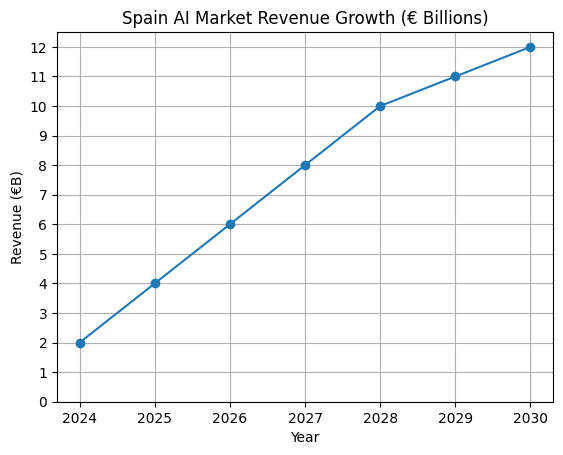
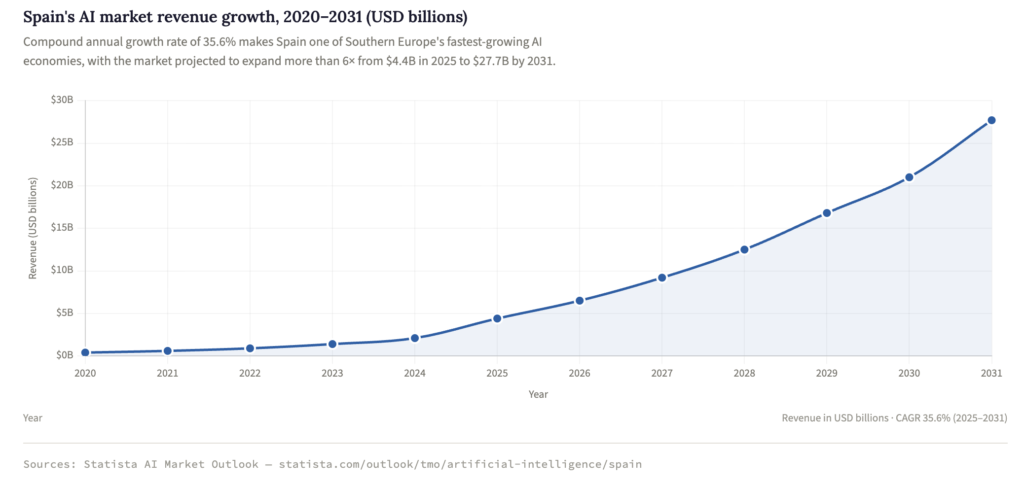
Spain’s AI market trajectory alone underscores the scale of this transformation. With projections placing the market at US$4.44 billion in 2025 and expanding at a remarkable 35.65% compound annual growth rate through 2031, AI is not merely a fast-growing sector—it is becoming a structural pillar of the Spanish economy. This growth is reinforced by strong public investment, including hundreds of millions of euros allocated under national AI strategies and a broader €33.8 billion digital roadmap. These initiatives signal long-term government commitment to building AI capability, digital infrastructure, and innovation ecosystems that will sustain growth well beyond the current decade.
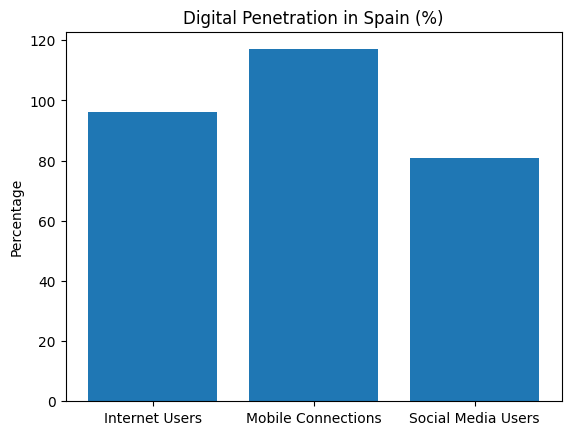
At the same time, Spain’s digital economy has reached a level of maturity that makes it uniquely positioned to capitalise on AI-driven change. With digital activities contributing approximately 26% of GDP, near-universal internet penetration exceeding 96%, and one of the highest fibre and 5G coverage rates in Europe, Spain offers an environment where AI-powered search experiences can scale rapidly across both urban and regional markets. The country’s 56 million mobile connections and highly engaged social media population further reinforce its status as a mobile-first, digitally sophisticated economy—one where AI search behaviour is quickly becoming mainstream rather than experimental.
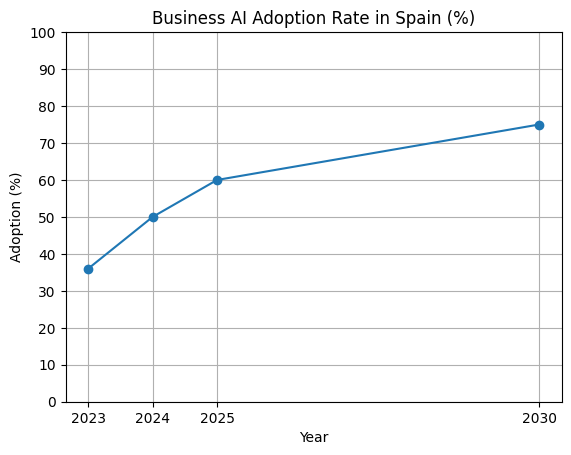
This widespread infrastructure readiness is mirrored by equally strong adoption trends among both businesses and consumers. In recent years, Spain has seen a sharp rise in AI usage, with business adoption rates jumping from 36% to 50% in just one year, and consumer adoption approaching nearly half of the population by 2025. Millions of new users are integrating AI tools into their daily routines, while hundreds of thousands of businesses are adopting AI capabilities at an unprecedented pace. These shifts are not incremental—they represent a fundamental change in how information is accessed, how decisions are made, and how digital interactions are structured.
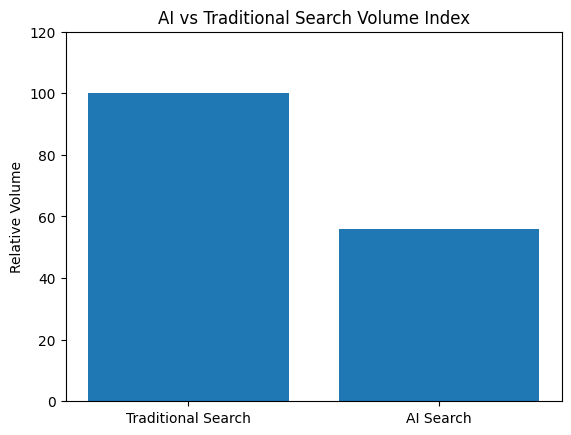
Crucially, this transformation is most visible in the domain of search. For over two decades, search engine optimisation has revolved around ranking web pages within Google’s results. However, the rise of AI-generated answers, conversational interfaces, and zero-click experiences is redefining the rules of visibility. Google continues to dominate Spain’s traditional search market with over 94% share, but its own AI Overviews now reach more than a billion users globally and are increasingly displacing organic clicks. At the same time, platforms like ChatGPT—serving billions of queries and attracting hundreds of millions of users—are emerging as powerful alternative discovery engines, capturing a growing share of informational and commercial intent.
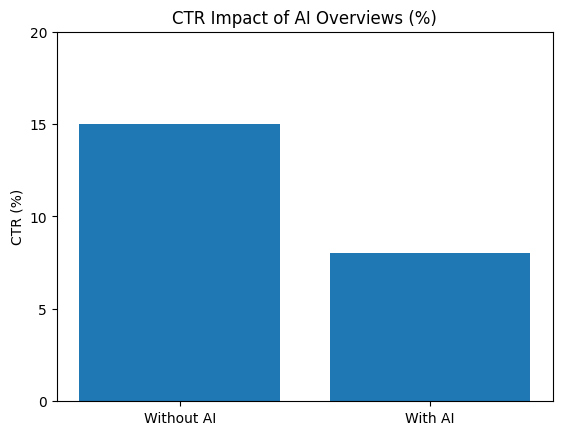
This shift has profound implications for Spanish businesses. More than half of searches now end without a click, and click-through rates for top-ranking pages can drop dramatically when AI-generated summaries are present. In this new environment, visibility is no longer determined solely by where a page ranks, but by whether a brand is cited, summarised, or recommended within AI-generated responses. As a result, GEO is rapidly becoming a strategic necessity, requiring organisations to optimise not just for search engines, but for the underlying models that generate answers.
The data further reveals that success in AI search is driven by a combination of traditional authority signals and new optimisation factors. High domain authority, structured data, content freshness, and clear heading structures remain essential foundations, but they must now be complemented by evidence-based writing, authoritative citations, and strong off-site credibility across platforms such as Reddit, YouTube, and third-party publications. AI systems increasingly prioritise content that is well-structured, frequently updated, and demonstrably trustworthy—making content strategy more rigorous and multidisciplinary than ever before.
Spain’s unique market characteristics add additional layers of complexity and opportunity. The country’s multilingual environment—spanning Castilian Spanish, Catalan, Galician, Basque, and Valencian—requires more nuanced AI optimisation strategies. Key sectors such as tourism, finance, healthcare, and e-commerce are particularly exposed to AI-driven search disruption, as users increasingly rely on conversational queries for travel planning, product discovery, financial comparison, and medical information. With Spain’s e-commerce market exceeding US$56 billion and continuing to grow steadily, the stakes for AI search visibility are both immediate and substantial.
At the same time, the regulatory landscape is evolving rapidly. Spain’s leadership in establishing a national AI supervisory body and the upcoming enforcement of the EU AI Act introduce new compliance requirements that intersect directly with AI usage, content generation, and data governance. For businesses operating in Spain, this means that AI strategy must be aligned not only with performance goals but also with transparency, privacy, and regulatory compliance standards.
Taken together, these 155 statistics, data points, and trends paint a clear and compelling picture: Spain is entering a new era where AI is not only transforming technology and productivity but also redefining how people search, discover, and engage with information online. The transition from traditional SEO to a combined SEO and GEO approach is already underway, and the pace of change suggests that early adopters will gain a significant competitive advantage.
This comprehensive guide to AI Search and Generative Engine Optimisation in Spain for 2026 brings together the most important data, insights, and market signals to help businesses, marketers, and digital leaders understand where the opportunities lie—and how to act on them. Whether the goal is to protect organic traffic, enhance brand visibility, or capture new demand through AI-driven discovery, the evidence is clear: the future of search in Spain has already begun, and it is being shaped by AI.
But, before we venture further, we like to share who we are and what we do.
About AppLabx
From developing a solid marketing plan to creating compelling content, optimizing for search engines, leveraging social media, and utilizing paid advertising, AppLabx offers a comprehensive suite of digital marketing services designed to drive growth and profitability for your business.
At AppLabx, we understand that no two businesses are alike. That’s why we take a personalized approach to every project, working closely with our clients to understand their unique needs and goals, and developing customized strategies to help them achieve success.
If you need a digital consultation, then send in an inquiry here.
Or, send an email to [email protected] to get started.
155 AI Search & GEO in Spain Statistics, Data & Trends in 2026
SECTION 1: SPAIN’S AI MARKET SIZE & INVESTMENT
1. AI Market Size in Spain 2025 Spain’s AI market is projected to reach US$4.44 billion in 2025, positioning the country as one of Southern Europe’s fastest-growing AI economies and a significant destination for technology investment.
2. AI Market CAGR 2025–2031 With a projected CAGR of 35.65% through 2031, Spain’s AI market is growing at roughly triple the rate of the overall economy, signalling a structural shift rather than a temporary technology trend.
3. AI Revenue Growth Forecast Spain’s AI revenue is forecast to grow fourfold from €2.5 billion in 2024 to over €11.5 billion by 2030, making early investment in AI capability — including AI search readiness — a measurable competitive advantage for Spanish businesses.
4. Public AI Investment (ENIA) Spain’s €600 million initial public AI investment under the ENIA strategy demonstrates strong government commitment to AI infrastructure, providing a stable policy foundation on which private digital marketing and search innovation can build.
5. Total AI Investment Mobilised (2024) The mobilisation of €600 million in AI investment by 2024 reflects a coordinated public-private effort to scale AI across Spanish industry, cities, and digital services — directly accelerating AI search adoption at the enterprise level.
6. 2024 AI Strategy Budget Spain’s updated 2024 AI Strategy, with approximately €350 million in annual implementation budget, is one of the most well-funded national AI programmes in the EU relative to GDP, providing sustainable momentum for AI-driven search transformation.
7. Digital Roadmap Budget Spain’s €33.8 billion Digital Decade roadmap — representing 1.68% of GDP — underlines the government’s recognition that digital infrastructure, including AI search capability, is as strategically important as traditional physical infrastructure.
8. Digital Economy Share of GDP The digital economy now representing 26% of Spain’s GDP is a landmark figure, confirming that digital channels — including AI-powered search — are no longer peripheral to Spain’s economic story but central to it.
9. ICT Industry Professionals The 7.8% annual growth in Spain’s ICT workforce to 722,990 professionals by 2024 shows that talent supply, while still lagging demand, is expanding — a prerequisite for sustained AI and GEO capability development.
10. ICT Companies in Spain The 2.8% growth in ICT companies to 36,737 reflects a healthy and competitive digital ecosystem, increasing the range of agencies and technology providers available to help Spanish brands navigate AI search optimisation.
11. ICT Exports Spain’s ICT export growth to €23.646 billion in 2024 signals that the country is not merely a consumer of AI and digital technology but an increasingly capable producer and exporter — strengthening its position in global AI search value chains.
12. Data Centre IT Power Spain’s projected data centre capacity growth from 160 MW today to over 600 MW by 2026, fuelled by hyperscalers like Google, AWS, and Microsoft, will provide the physical infrastructure needed to serve AI search queries at scale.
13. Digital Value Added Spain’s €279 billion in total digital value added in 2025, concentrated in Madrid and Catalonia, suggests that AI search strategies targeting these regions will deliver the highest commercial returns in the near term.
14. Digital Specialist Employment Growth The 23% growth in Spain’s digital employment between 2011 and 2023 — double the overall jobs market — confirms that the Spanish economy is rewarding digital skills at a structural level, making AI literacy an increasingly valuable professional competency.
15. Digital Specialist Salary Premium The 43% wage premium enjoyed by digital specialists in Spain offers a clear economic signal that AI and search expertise commands real market value, even as the premium gradually narrows with rising supply.
SECTION 2: AI USER ADOPTION IN SPAIN
16. AI Users in Spain 2024 Spain’s near-doubling of AI users from 5 million in 2024 to a projected 12 million by 2030 reflects a genuine mass-market transition, not just early-adopter enthusiasm — meaning AI search behaviour will increasingly define the mainstream consumer journey.
17. Business AI Adoption Rate The jump from 36% to 50% business AI adoption in a single year — a 39% growth rate — is one of the most striking adoption curves in Europe, signalling that AI tools, including AI-enhanced search, are rapidly becoming table stakes for Spanish businesses.
18. New AI Adopters in 12 Months 450,000 new AI-adopting businesses in Spain over 12 months means roughly 1,200 companies per day made the transition — a pace that will continue to reshape expectations around search, discovery, and digital presence.
19. AI Adoption Rate by 2030 (Companies) The forecast leap from 10% to 75% corporate AI adoption by 2030 is remarkable and, if accurate, means Spain’s business landscape will look fundamentally different in terms of how companies research, purchase, and compete — all mediated by AI search.
20. Consumer AI Adoption 2025 Spain’s consumer AI adoption rate reaching 45% in 2025 — up 80% year-on-year — confirms that AI search tools are crossing the chasm from early adopters to the early majority, a tipping point with profound implications for organic search traffic.
21. AI App Downloads Spain 2025 The near-sixfold increase in AI app downloads from 3.9 million in 2023 to 22 million in 2025 provides concrete evidence that Spanish consumers are actively integrating AI into their daily digital routines, including information-seeking and product discovery.
22. Spain’s European AI Ranking Spain’s position as the 3rd most AI-adopted large EU economy (behind France and the Netherlands) is a creditable performance, though it also signals room for growth relative to the most advanced European markets.
23. Spain’s Global AI Ranking (Microsoft) Microsoft’s ranking of Spain 6th globally in AI adoption is a significant endorsement, placing Spain alongside economies far wealthier on a per capita basis — suggesting Spanish organisations are punching above their weight in AI integration.
24. AI Investment Growth in Businesses Spain’s 24% growth in business AI investment — slightly above the 22% EU average — reflects a broadly healthy AI spending environment, though the gap over EU peers is modest enough to warrant continuous monitoring.
25. AI’s Role in Business Revenue The finding that 96% of AI-adopting Spanish businesses report revenue increases — averaging 34% uplift — should be treated as directionally positive but viewed alongside selection bias: companies that adopted AI successfully are more likely to report results than those that struggled.
26. Productivity Gains from AI The 79% of Spanish AI adopters reporting transformative or significant productivity gains is consistent with international research, though productivity measurement in AI contexts remains methodologically complex and figures should be interpreted with appropriate nuance.
27. Hours Saved per Week An average saving of 23 hours per week per business through AI is a compelling headline number, but the figure will vary enormously by sector, company size, and the depth of AI integration — generic averages mask wide variance.
28. AI for Customer Experience With 48% of AI-adopting Spanish businesses citing improved customer experience and 47% citing enhanced automation, the data suggests AI is delivering value across both external-facing and internal operations — a broad-based rather than narrow productivity story.
29. AI Skills Barrier The fact that 60% of Spanish businesses cite AI skills gaps as their primary innovation barrier is both a challenge and an opportunity: it underlines the value of AI literacy investment and positions well-trained teams as a genuine competitive differentiator.
30. AI Budgets Growing The prediction that AI will account for 17% of IT budgets in three years reflects a significant reallocation of technology spending, and CMOs and SEO teams should expect AI search tools to absorb an increasing share of digital marketing investment.
31. Startup AI Adoption The higher AI adoption rate among Spanish startups (63%) versus large enterprises reflects the structural agility of younger companies — and suggests that disruptive, AI-native competitors are more likely to emerge from Spain’s startup ecosystem than from incumbent corporations.
32. AI Healthcare Practitioners With only 11% current adoption but 42% planning to adopt, Spain’s healthcare sector represents one of the largest near-term AI growth opportunities — with AI-powered search for medical information and clinical decision support likely to be high-impact use cases.
33. Generative AI Use by Spanish Companies The dominance of chatbots, virtual assistants, and content generation as the top Spanish enterprise generative AI use cases is consistent with global trends and reflects the natural starting point for businesses entering the AI journey before more complex applications.
34. EU Generative AI Usage With nearly 1 in 3 EU individuals using generative AI tools in 2025, and Spain above the EU average, the normalisation of AI-assisted information-seeking is accelerating — making GEO an increasingly urgent priority for any brand that relies on organic search visibility.
SECTION 3: SPAIN’S DIGITAL & INTERNET INFRASTRUCTURE
35. Internet Users in Spain Spain’s 96.4% internet penetration rate — covering 46.1 million users — creates one of Europe’s most comprehensively digitised consumer populations, meaning AI search strategies have an exceptionally broad potential addressable audience.
36. Spain Internet Access Rate (Eurostat) Spain’s 97.43% internet access rate as of late 2025 places it firmly in the top tier of EU connectivity, providing the infrastructure baseline required for widespread adoption of AI-powered search and conversational interfaces.
37. Mobile Connections With 117% mobile connection penetration (56.1 million connections for 47.9 million people), Spain is a multi-SIM, deeply mobile-first market — a fact with direct implications for how AI search experiences need to be designed and optimised.
38. Mobile Broadband Coverage Spain’s 99.4% mobile broadband coverage means that virtually every mobile user has access to the connection speeds required to run AI search applications, removing bandwidth as a barrier to AI search adoption.
39. Social Media Users With 81.4% social media penetration (39 million users), Spain’s social platforms are a critical complement to AI search — particularly given that community-generated content on platforms like Reddit and YouTube is heavily cited by AI engines.
40. Fiber-to-the-Premises Coverage Spain’s 95.2% FTTP coverage — nearly double the EU average of 56% — provides a fixed broadband infrastructure that comfortably supports the high-bandwidth demands of AI-powered applications and real-time search interactions.
41. 5G Coverage With 92.3% 5G population coverage and 98% of bands already allocated, Spain is among Europe’s most advanced 5G markets, enabling the low-latency, high-throughput conditions under which mobile AI search can deliver seamless experiences.
42. Smartphone Internet Access The 95% rate of smartphone-based internet access in Spain aligns it with the EU’s most mobile-advanced nations, reinforcing that AI search optimisation strategies must be mobile-first in design rather than desktop-first with mobile as an afterthought.
43. E-Commerce Market Size Spain 2025 Spain’s US$56.37 billion e-commerce market in 2025 represents both a massive commercial opportunity and a highly competitive environment where AI search visibility — through Google AI Overviews, ChatGPT product recommendations, and Perplexity — is increasingly tied to purchase outcomes.
44. E-Commerce CAGR Spain The 8.21% projected e-commerce CAGR through 2029 is solid and sustainable, suggesting that AI search optimisation for commercial queries will become a growing revenue lever for Spanish retailers over the medium term.
45. Digital Citizens Positive about Digitalisation The 72% of Spanish citizens who view digitalisation positively provides a cultural tailwind for AI adoption — a meaningful contrast to more sceptical populations in some other EU countries — and suggests consumer openness to AI search interfaces.
46. Digital Public Services Spain’s above-EU-average scores for digital public services (84/100 for citizens, 91/100 for businesses) indicate a mature digital government ecosystem that will help normalise AI-assisted service interactions and raise citizen expectations for AI responsiveness in both public and private contexts.
47. Digital Unicorns Spain’s 13 digital unicorns and 301 edge nodes reflect a maturing startup and digital infrastructure ecosystem — providing the innovation layer from which homegrown AI search applications and GEO tools are likely to emerge.
SECTION 4: SEARCH ENGINE MARKET SHARE IN SPAIN
48. Google’s Dominant Market Share in Spain Google’s ~94.26% search market share in Spain means that, for the foreseeable future, any AI search strategy must be built around Google’s AI Overviews and Gemini-powered features — making traditional SEO fundamentals the essential foundation for GEO success.
49. Google Desktop Search Share Google’s 96.32% share of all Spanish web traffic in March 2024 underlines a near-monopoly position that, while gradually facing AI-driven disruption, remains the single most important channel for search visibility in Spain.
50. Google Desktop Search (Computer Only) The 87% desktop Google search share confirms that even on computers — where alternative search engines historically perform better — Google’s dominance in Spain is overwhelming and unlikely to shift dramatically in the short term.
51. Bing’s Market Share in Spain Bing’s 3.59% market share in Spain is noteworthy primarily because Bing powers Microsoft Copilot’s search capabilities — making it a more strategically relevant player in AI search than its raw market share figures suggest.
52. Yahoo! Market Share in Spain Yahoo!’s 1.19% share confirms it as a minimal factor in Spain’s search landscape, though its partnership with Bing means activity on Yahoo! can contribute indirectly to Microsoft’s AI search data pool.
53. DuckDuckGo in Spain DuckDuckGo’s 0.51% share is small in absolute terms, but its privacy-first positioning is resonating with a growing segment of privacy-conscious Spanish users — a trend worth monitoring in the context of EU data protection sentiment.
54. Continental Europe Google Dominance The combined ~95% Google dominance across mainland Europe reinforces that Spain is not an outlier but part of a broadly Google-first search culture, even as privacy-oriented alternatives like Ecosia gradually build niche audiences.
55. Google’s Global Market Share Decline Google’s global share dipping below 90% for the first time in a decade is a historically significant signal — not a crisis for Google, but evidence that AI-native platforms are genuinely redirecting a portion of search intent for the first time since the early 2000s.
56. ChatGPT as a Search Engine ChatGPT appearing in Google’s global top-10 most searched terms captures a profound irony: users are Googling how to use a tool that may progressively replace Google for certain query types — reflecting genuine consumer curiosity and behavioural shift.
SECTION 5: AI SEARCH PLATFORM USAGE
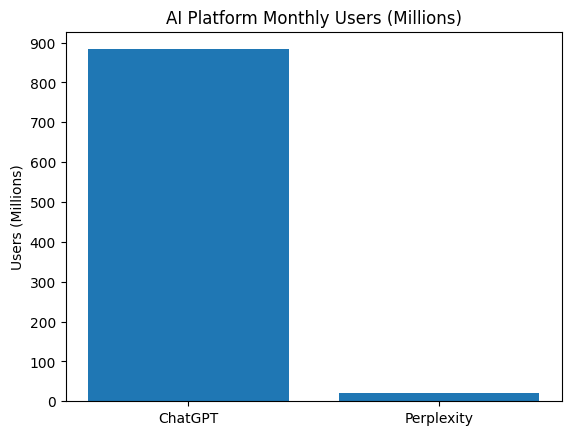
57. ChatGPT Monthly Users Jan 2026 ChatGPT’s 883 million monthly users as of January 2026 — making it the 5th most visited website globally — confirms that it has achieved genuine platform scale, not just novelty, representing a real and growing search alternative for Spanish and global users.
58. ChatGPT Global Monthly Visits ChatGPT’s 5.4 billion monthly visits surpassing Bing’s 1.9 billion is a landmark comparison: the world’s leading AI chat interface now attracts nearly three times more traffic than the second-largest traditional search engine — a structural shift in information-seeking behaviour.
59. ChatGPT Daily Queries Processing 2 billion queries daily, ChatGPT has achieved search-engine-scale usage — and brands not optimising their content and digital presence for LLM citation are now measurably absent from a significant portion of consumer research journeys.
60. ChatGPT AI Chatbot Market Share ChatGPT’s 80.49% AI chatbot market share creates a near-monopoly dynamic within the AI chat space — meaning GEO strategies that achieve ChatGPT visibility will capture the vast majority of AI chatbot-driven discovery.
61. Spain’s Share of ChatGPT Traffic Spain’s 3.7% of ChatGPT’s global web traffic — on par with the UK and behind only France among major European nations — confirms that Spanish users are engaging with AI search at a meaningful scale, not just as an academic curiosity.
62. ChatGPT Weekly Active Users The doubling of ChatGPT weekly active users from 400 million to 800 million between February and March 2025 is one of the fastest user growth stories in technology history, and signals that the window for early-mover GEO advantage may be closing rapidly.
63. ChatGPT User Queries Per Day With 2.5 billion daily prompts, ChatGPT is processing a volume of queries that rivals mid-tier traditional search engines — and within that volume, a growing proportion are product, brand, and service discovery queries where GEO visibility translates directly to commercial outcomes.
64. Perplexity Monthly Users Perplexity’s 22 million monthly users are disproportionately influential: with 30% in senior leadership and 65% in high-income professional roles, this is an audience that makes B2B purchasing decisions and influences enterprise technology choices — making Perplexity optimisation strategically important for B2B brands.
65. Perplexity Monthly Queries Perplexity’s 239% growth in monthly queries (from 230 million to 780 million in under a year) is among the fastest organic growth curves in AI search, and suggests it is establishing itself as the primary AI-native search tool for research-oriented users.
66. Google AI Overviews Monthly Reach Reaching 1.5 billion users monthly, Google AI Overviews are now the single largest AI search feature in the world — dwarfing all standalone AI platforms combined — and for Spanish businesses, this is the most immediate and high-impact GEO battleground.
67. AI vs Traditional Search Volume AI sessions now reaching 56% the volume of traditional search worldwide — despite AI search being a fraction of the age of Google — is a compelling indicator of velocity: the share of attention captured by AI search is growing several times faster than traditional search ever did.
68. ChatGPT’s Share of Search-Related Traffic ChatGPT capturing 20% of search-related traffic worldwide is a threshold moment — it is no longer a complement to search but a genuine partial substitute, particularly for research, comparison, and recommendation queries.
69. Total Search Pie is Growing The 26% worldwide increase in total combined search (engines + LLMs) is an important corrective to purely zero-sum narratives: AI search is not simply cannibalising traditional search but expanding the total volume of query-based information-seeking behaviour.
70. AI Search Weekly Usage The finding that 3 in 4 Americans search with AI weekly — used as a directional proxy for Spain given its comparable AI adoption metrics — suggests that AI search is already a habitual, not occasional, behaviour for a majority of digitally active adults.
71. GEO Market Valuation The GEO market’s projected growth from $848 million in 2025 to $33.7 billion by 2034 at a 50.5% CAGR positions it as one of the fastest-growing digital marketing disciplines in history — and Spanish agencies that build GEO capability now will be positioned to capture a disproportionate share of this growing spend.
72. AI Search Traffic Growth A 527% year-over-year growth in AI search traffic between 2024 and 2025 is not gradual evolution but an industry disruption event — comparable in velocity to the early years of social media’s impact on web traffic distribution.
73. GEO Marketer Adoption Plans The 54% of US marketers planning GEO implementation within 3–6 months signals an imminent rush of professional adoption that will rapidly raise the competitive baseline, making early-mover investment in GEO in Spain increasingly valuable with each passing quarter.
SECTION 6: GOOGLE AI OVERVIEWS — IMPACT ON ORGANIC SEARCH IN SPAIN
74. AI Overviews Rollout in Spain The full rollout of Google AI Overviews across Spanish-speaking markets since May 2024 — now live in 200+ countries — means Spain’s organic search landscape has already been permanently altered, and strategies built purely on traditional SERP optimisation are structurally incomplete.
75. AI Overview Prevalence (US, Sep 2025) AI Overviews appearing for 30% of US desktop keywords as of September 2025 represents a near-tripling from earlier in the year, and establishes the US trajectory as a reliable leading indicator for Spanish market evolution given Google’s consistent international rollout patterns.
76. AI Overviews Mobile Growth A 474.9% year-over-year increase in mobile AI Overview frequency is extraordinary — and, given Spain’s mobile-first internet culture, suggests the impact of AI Overviews on Spanish mobile search CTRs is at least as severe as, and likely greater than, desktop data implies.
77. AI Overview Frequency (Dec 2024) The finding that only 4.5% of overall queries trigger an AI Overview, rising to 67.5% in health and 23% in technology, illustrates the highly vertical nature of AI Overview deployment — making sector-specific monitoring essential rather than relying on average headline figures.
78. AI Overview Growth by Mid-2025 The 116% growth in AI Overview placements since March 2025, with 13% of all Google queries now triggering one, represents a pace of deployment that has outstripped most industry forecasts and demands urgent strategic response from brand and SEO teams in Spain.
79. Percentage of AI-Enhanced Search Features With 47% of all global searches now featuring some AI-enhanced element, it is no longer accurate to describe AI as an emerging layer in search — it is already a present-tense majority feature of the search experience across most mainstream query categories.
80. AI Overview Informational Query Dominance The 84% skew of AI Overviews toward informational queries means that top-of-funnel content — brand awareness articles, explainers, category education — faces the most immediate disruption, while transactional and commercial queries remain more navigable through traditional SEO for now.
81. Commercial Query AI Overviews Growth The expansion of AI Overviews into commercial queries (growing from 8% to 18% presence) is a direct threat to product-category SEO strategies, signalling that the protective distance between informational and transactional queries is narrowing faster than many brands anticipated.
82. AI Overview Content Lengths Shrinking The 70% reduction in AI Overview text length — from ~5,300 to ~1,600 characters — suggests Google is refining AI Overviews toward concision over comprehensiveness, which will compress the number of sources cited and intensify competition for inclusion.
83. Entertainment Sector AI Overview Surge The 528% increase in Entertainment sector AI Overview frequency is a warning to Spanish media and entertainment brands that no vertical is permanently immune to AI Overview disruption — the rollout is category-agnostic and accelerating.
SECTION 7: ZERO-CLICK SEARCH & CTR IMPACT
84. Zero-Click Search Rate (Global) With over 50% of global Google searches ending without a click — rising to ~59.7% in EU/UK contexts — the foundational commercial logic of SEO (rank high → drive traffic) is under serious structural pressure, requiring a rethink of how search visibility is valued and measured.
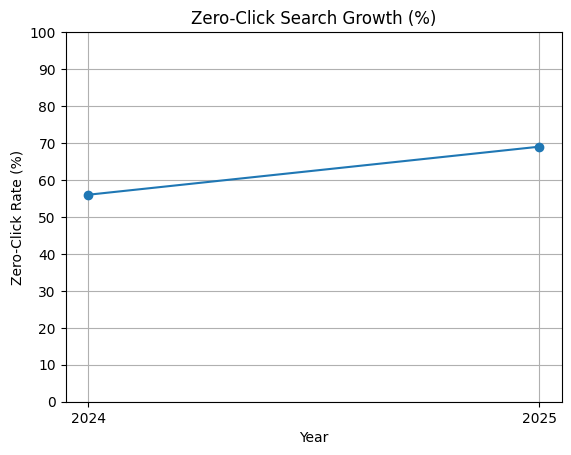
85. Zero-Click Rate Increase The rise of zero-click searches from 56% in 2024 to 69% by May 2025 tracks almost perfectly with AI Overview deployment milestones, confirming a causal rather than merely correlational relationship between AI-generated answers and declining click-through behaviour.
86. AI Mode Zero-Click Rate A 93% zero-click rate for AI Mode searches — compared to 43% for standard AI Overviews — is a striking preview of the traffic implications if AI Mode becomes the default Google experience for Spanish users, which Google has signalled as a medium-term product direction.
87. CTR Drop with AI Overviews (Pew Research) The Pew Research finding of an 8% click rate with AI summaries versus 15% without — a 46.7% relative reduction — is one of the most methodologically rigorous data points in this field and should be weighted accordingly in strategic planning.
88. CTR Drop (Seer Interactive, Sep 2025) Seer Interactive’s documented 61% organic CTR drop and 68% paid CTR drop in the presence of AI Overviews should not be dismissed as outlier data — it aligns with multiple independent studies and represents a plausible central scenario for Spanish market trajectory.
89. Average Organic Traffic Loss The average 24% organic traffic loss attributed to AI Overviews — with some sites losing up to 45% — creates an urgent business case for GEO and AI citation strategies: brands that appear in AI Overviews partially offset this loss, while those absent absorb it in full.
90. BrightEdge CTR Drop (May 2025) BrightEdge’s 30% average CTR reduction following the Q1 2025 AI Overviews rollout is consistent with other major research findings, and Spanish digital marketing teams should incorporate a 25–35% CTR haircut into traffic forecasting models for AI Overview-affected queries.
91. Position 1 CTR Decline The 34.5–60% CTR decline for top organic positions when AI Overviews are present fundamentally changes the ROI calculus of top-ranking — achieving Position 1 in a query with an AI Overview is now worth significantly less in traffic terms than it was 18 months ago.
92. Top Organic Result Pushed Down The first organic result appearing ~1,674 pixels below the fold when an AI Overview is active is a user experience finding with profound implications: even perfectly-optimised content may be invisible to users who don’t scroll, making AI Overview inclusion a higher-priority target than organic rank for many queries.
93. AI Overview Link Correlation with Rankings The strong correlation between top-20 organic rankings and AI Overview citations — 97% of citations come from the top-20 results — confirms that traditional SEO remains the essential prerequisite for GEO, not an alternative to it.
94. Time Spent in AI Mode Users spending an average of 49 seconds in AI Mode — compared to far shorter traditional search sessions — suggests a shift toward deeper, research-style engagement with AI search results, with implications for the depth and authority of content that earns AI citations.
95. News Publisher Traffic Collapse The 26% collapse in aggregate news website traffic between mid-2024 and May 2025 is one of the most significant structural disruptions to the Spanish and global media industry in a decade, driven directly by AI Overviews summarising news content without requiring a click.
96. Mail Online CTR Drop The near-90% CTR decline reported by DMG Media for certain searches is an extreme data point but a credible one — news and reference content is the content category most directly substituted by AI-generated summaries, and Spanish publishers face the same structural challenge.
97. AI Overview Benefit to Cited Brands The 35% organic click premium and 91% paid click premium enjoyed by brands cited in AI Overviews is perhaps the single most commercially actionable data point in this report — GEO is not just about brand awareness but about a measurable and substantial traffic advantage.
SECTION 8: GEO — CONTENT & TECHNICAL SIGNALS
98. GEO Visibility Uplift The Princeton University finding that specific content optimisation techniques can boost generative engine visibility by up to 40% provides academic validation for GEO as a discipline — moving it from practitioner theory to peer-reviewed evidence.
99. Citations, Stats, and Quotes Boost AI Visibility The 30–40% visibility improvement from content that includes citations, statistics, and quotations reinforces what the best journalists and academics have always known: evidenced, sourced, authoritative writing is rewarded — now by AI models as well as human readers.
100. Domain Authority as #1 Predictor Domain authority being the single strongest predictor of AI citation — with high-traffic sites earning 3x more citations — confirms that GEO is not a shortcut to visibility but an amplifier of existing brand credibility; the fundamentals of SEO still matter profoundly.
101. Schema Markup Adoption Growth The 35% global growth in schema markup adoption, combined with a 44% increase in AI citations for structured-data-enabled pages, makes schema implementation one of the highest-ROI technical SEO actions available to Spanish brands targeting AI visibility.
102. Author Schema and AI Visibility Websites with author schema being 3x more likely to appear in AI answers directly reflects AI models’ weighting of E-E-A-T (Experience, Expertise, Authoritativeness, Trustworthiness) — a Google concept that now applies equally to third-party AI citation logic.
103. Content Freshness Impact Pages updated within 60 days being 1.9x more likely to appear in AI answers introduces a new and demanding content governance requirement: AI search optimisation is not a set-and-forget activity but an ongoing editorial operation.
104. More Than 70% of Cited Pages Updated Within 12 Months The finding that over 70% of AI-cited pages were updated within the past year sets a clear content staleness threshold — content that has not been reviewed and refreshed annually is at meaningful risk of losing AI citations to fresher, competing sources.
105. 50% of Cited Pages Updated Within 6 Months The more demanding insight — that over 50% of cited pages were updated within just six months — suggests that for competitive query categories, a quarterly content refresh cycle may be necessary to maintain AI citation rates.
106. AI Brand Visibility Volatility The finding that only 30% of brands remain visible across consecutive AI answers, and only 20% across five runs, is a sobering counterweight to GEO success metrics: AI citation is probabilistic and volatile, not a stable SEO-style ranking that compounds reliably over time.
107. AI Overview Content Changes Frequently AI Overview content changing 70% of the time between queries, with half of citations replaced on each update, means that tracking AI visibility requires continuous monitoring rather than point-in-time audits — a significant operational implication for Spanish brands.
108. Heading Structure and Citation Rates The 2.8x higher citation rate for content with sequential headings and rich schema is a directly actionable technical finding: well-structured HTML with logical heading hierarchies is not just good UX but a meaningful GEO signal.
109. Off-Site Credibility Signals The finding that 85% of AI brand mentions originate from third-party pages — and 48% of citations from community platforms like Reddit and YouTube — fundamentally reframes GEO as a PR and community engagement discipline as much as an on-site content optimisation one.
110. Dual Visibility Stability Brands earning both citations and mentions in AI responses showing 40% higher reappearance rates reinforces the value of an integrated GEO strategy: on-site optimisation and off-site brand presence are complementary, not alternative, approaches.
111. Where AI Cites from in Articles The concentration of 44.2% of LLM citations in the first 30% of text means that front-loading key facts, statistics, and brand positioning into article introductions is not just good writing practice but a measurable GEO optimisation technique.
112. ChatGPT Content Preferences ChatGPT’s preference for definite language, question marks, high entity density, and simple structure provides a useful content brief for GEO-focused writers — though these signals should be treated as probabilistic tendencies, not deterministic rules.
113. AI Recommendations Are Inconsistent The less-than-1-in-100 probability of two identical brand lists from ChatGPT or Google AI is a crucial finding for anyone measuring GEO effectiveness: single-point measurements are misleading, and meaningful GEO tracking requires statistically robust, repeated sampling.
114. Platform Citation Variation The 615x difference in citation rates between Grok and Claude for the same brand — and Grok’s 27% citation rate compared to Google AI Mode’s 9% — confirms that multi-platform GEO optimisation is not optional for brands targeting comprehensive AI search visibility.
115. AI-Written Pages in Top Results AI-generated content appearing in over 17% of top search results — and often ranking within two months — changes the competitive dynamics of content production: human-written, expert-evidenced content must now justify its premium by achieving quality and citation signals that AI-generated content cannot.
116. Web Searches Triggered by ChatGPT Prompts The fact that 31% of ChatGPT prompts trigger a web search — rising to 59% for local intent queries — has important implications for Spanish local businesses: their web presence directly influences how ChatGPT responds to locally-framed AI prompts.
SECTION 9: GEO & AI SEO IN SPAIN — LOCAL INDUSTRY
117. Spain’s SEO Landscape Transformation Spain’s digital economy representing 26% of GDP means that organic search visibility is no longer a marketing nice-to-have but a direct driver of national economic activity — making AI-readiness in search a board-level strategic concern, not just a marketing department priority.
118. Google AI Overviews in Spanish Markets The permanent deployment of Google AI Overviews in Spanish-speaking markets since May 2024 means that Spanish brands operating across Spain, Latin America, and the US Hispanic market face a consistent and compounding AI search challenge across all their most important geographies.
119. GEO Now Core to Spanish SEO Agencies The integration of GEO into the core service packages of Spain’s leading SEO agencies reflects professional market maturity: GEO is no longer an experimental add-on but an expected competency — and brands should evaluate agency partners on GEO capability as a standard criterion.
120. GEO Uplift in Practice (Spanish Agencies) Spanish agencies implementing Princeton and Georgia Tech-validated GEO techniques — achieving up to 40% visibility improvements — confirm that the academic research translates to real-world outcomes in the Spanish market, not just in English-language contexts.
121. Spanish Local AI Search Behaviour The shift of specific, conversational local queries toward ChatGPT, Perplexity, and Gemini — rather than Google — is most pronounced in Spain’s expat and tourism economies where natural-language searches like “English-speaking plumber in Marbella” are common, and local businesses must optimise accordingly.
122. Spanish Language AI SEO Complexity Spain’s linguistic complexity — requiring AI-optimised content for Castilian Spanish, Catalan, Galician, Basque, and Valencian — adds meaningful operational complexity to GEO, and the existence of national NLP initiatives (LEIA, GAITU, NÓS, VIVES) reflects how seriously Spain’s government takes multilingual AI representation.
123. Spain AI Skills Gap With two-thirds of Spain’s AI workforce having less than two years’ experience, and significant shortfalls in NLP and computer vision engineering, the skills gap creates both a talent acquisition challenge and a market opportunity for training providers and technology-led agencies.
124. Gender Gap in AI Workforce Spain’s 70% male AI workforce is not merely a social equity issue but an economic efficiency concern: research consistently shows that more diverse AI teams build more effective and representative AI systems — a gap that Spain’s ENIA strategy explicitly aims to address.
125. Spain SME AI Adoption The low current AI adoption among Spanish small (9%) and medium (21%) enterprises — against a backdrop where SMEs represent 99% of Spain’s business landscape — represents the largest untapped AI productivity opportunity in the Spanish economy, with AI search visibility being one of the most accessible starting points.
126. Financial Sector AI Leadership Spain’s financial sector leading digitalisation at 45% adoption and contributing 15% of digital value-added confirms that AI-driven search and content strategies for financial services are among the most competitive in Spain — and the most consequential to get right from both a commercial and compliance perspective.
127. Spain AI in Tourism Spain’s specific prioritisation of AI in its national tourism strategy reflects the sector’s economic weight (~12% of GDP) and the particular relevance of AI search to travel — where conversational queries like “best places to visit in Spain in spring” are exactly the type of query AI Overviews are designed to answer.
128. Spain Open Data for AI Spain’s ~80,000 publicly available datasets through the Aporta ecosystem provide a competitive advantage for Spanish AI developers building search and discovery applications — particularly in sectors like transport, health, and geospatial intelligence where data quality is a critical foundation.
129. MareNostrum 5 Supercomputer Spain’s MareNostrum 5 delivering 314 petaflops in Barcelona places the country within the small group of European nations capable of hosting frontier AI model training at scale — a strategic asset that supports both national AI sovereignty and the development of Spanish-language AI applications.
SECTION 10: EU AI ACT & REGULATION
130. Spain’s AESIA Supervisory Agency Spain’s establishment of AESIA as the EU’s first national AI supervisory body is a bold regulatory leadership move that creates both compliance overhead and competitive advantage: Spanish companies that build AI governance into their digital and search strategies early will face less disruption when the full EU AI Act regime activates.
131. EU AI Act Timeline for Spain The August 2026 full high-risk AI compliance deadline is the single most important regulatory milestone for Spanish digital businesses — and brands using AI in high-risk contexts (HR, healthcare, finance, education) should already be auditing their AI supply chains and content processes.
132. EU AI Act Penalties The prospect of fines up to €35 million or 7% of global annual turnover for AI Act non-compliance is a scale of financial risk that demands AI governance be treated as a risk management imperative, not just a legal formality, by Spanish digital businesses of all sizes.
133. Spain VET Programme for AI Royal Decree 69/2025’s creation of AI-focused VET pathways, backed by €6.5 billion and 376,000 new training places, represents one of the most ambitious national AI reskilling investments in the EU — and will materially increase Spain’s domestic supply of GEO and AI search professionals over the next three to five years.
134. EU Recovery Funds for Digital Skills Spain’s €5.7 billion in EU Recovery Fund allocations for digital skills (€3.6B) and reskilling (€2.1B) provides a publicly-funded foundation for AI competency building that businesses and agencies can leverage — both by hiring publicly-trained talent and by participating in co-funded training programmes.
SECTION 11: AI SEARCH BEHAVIOUR & USER TRENDS
135. 36% US Adults Using GenAI for Search by 2028 The Statista forecast that 36% of US adults will use generative AI for search by 2028 — applied to Spain with its above-average AI adoption rate — suggests Spanish market equivalent penetration could exceed this figure, given Spain’s demonstrated propensity to adopt digital technologies at pace.
136. Gartner: 50% of Searches via AI by 2028 Gartner’s prediction of a 25% drop in traditional search volume by 2026 has proven directionally accurate and should be treated as a central planning scenario rather than a worst case — Spanish brands that have not begun GEO investment are already playing catch-up.
137. AI Platforms to Drive More Traffic Than Search in 3 Years The Semrush forecast that AI platforms will surpass traditional search engines as traffic drivers within three years should be understood as a probability range, not a certainty — but the directional signal is clear enough to justify material investment in AI search visibility now.
138. Gen Z & AI Search With 35% of US Gen Z already using AI chatbots for search, and Spain having a similarly tech-early Gen Z cohort, brands targeting under-30 Spanish consumers must assume that a significant and growing fraction of their audience is discovering products and brands through AI — not Google.
139. Millennial AI Search Willingness The 40% of Millennials willing to use AI-powered search is particularly relevant for Spanish consumer brands, given that Millennials (25–40 year olds) represent Spain’s largest and most economically active demographic — combining purchasing power with AI search readiness.
140. AI Search Trust Gap The finding that only 27% of users trust AI search to be unbiased, while 89% rate privacy as a vital search feature, has direct implications for Spain where GDPR consciousness is high: brands that demonstrate transparent, privacy-respecting AI practices have a genuine opportunity to differentiate on trust.
141. Trust in Search Results Equally Split The near-equal distribution of trust between traditional and AI search results among US users — increasingly applicable to Spanish audiences — confirms a transition period where neither channel can be deprioritised; an integrated search strategy spanning both remains essential.
142. AI Responses Are Longer Than Google ChatGPT’s 1,686 character average response versus Google’s 997 character average — across 22 versus 10 sentences — reflects ChatGPT’s design for comprehensive explanation rather than direct answer, meaning it is better suited to complex, research-oriented queries where Spanish users want depth over brevity.
143. ChatGPT Cites More Sources ChatGPT’s marginally higher citation count (10.42 links vs. Google’s 9.26) but significantly higher domain duplication rate (71% vs. 58%) suggests that being among the small group of reliably cited domains is more important than simply being in the citation pool — consistent with the domain authority data in Section 8.
144. Perplexity Citation Sources Perplexity’s heavy reliance on Reddit (6.6%) and YouTube (2%) as citation sources reinforces the strategic importance of community platform presence for Spanish brands — particularly for B2C categories where Reddit communities and YouTube review channels carry significant AI citation weight.
145. AI Mode Time on Site The 77 seconds users spend in AI Mode for brand comparisons — nearly four times the average traditional search session — signals a shift toward more deliberate, research-style AI search behaviour, where comprehensive, well-structured brand content can earn significant engagement time before a purchase decision.
SECTION 12: ADDITIONAL AI SEARCH & CONTENT TRENDS
146. Product Description AI Adoption The 47% of online sellers using AI for product descriptions creates a content homogenisation risk: when AI-generated product copy becomes the norm, brands that invest in genuinely distinctive, human-expert-authored product content will have a quality differentiation advantage — both for traditional SEO and AI citation.
147. AI-Generated Images ChatGPT generating 700 million images since March 2025 reflects the explosion of AI-generated visual content online — raising questions about image authenticity, originality, and brand differentiation that Spanish visual-first brands in fashion, tourism, and food should be actively addressing.
148. AI Power Consumption A ChatGPT query consuming 10x the energy of a Google search is an environmental consideration that is beginning to feature in corporate sustainability reporting and consumer awareness — Spanish brands with strong sustainability positioning should be monitoring AI’s carbon footprint implications for their marketing technology stack.
149. Content Indistinguishability The finding that 50% of readers cannot distinguish AI from human content raises fundamental questions about content authenticity and trust that go beyond SEO — Spanish brands should develop clear policies on AI content disclosure, both for regulatory compliance and consumer trust.
150. Paid Advertising Entering AI Results The arrival of paid advertising in both Google AI Overviews and Perplexity’s AI-generated responses signals the commercialisation of AI search — creating a new paid media channel that Spanish performance marketers should begin testing, as early adoption of new ad formats historically yields the highest ROI.
151. AI Business Integration Milestone The integration of ChatGPT into 92% of Fortune 500 companies’ operations — and over 1.5 million businesses globally — confirms that AI is no longer a competitive advantage in itself but rapidly becoming a competitive necessity, with the strategic differentiator shifting to the quality and depth of AI integration.
152. Wikipedia’s AI-Traffic Paradox Wikipedia being the most cited source in AI Overviews (1.1 million+ mentions) yet experiencing an 8% decline in human pageviews is a cautionary tale for all publishers: AI citation does not equal human traffic, and brands should not mistake AI model training data presence for real-world audience engagement.
153. Top-of-Article Citations in LLMs The concentration of 44.2% of LLM citations in article introductions is a directly actionable editorial insight: Spanish brands should ensure that their most important facts, differentiating claims, and brand positioning appear in the first two to three paragraphs of any content targeting AI citation.
154. 90% of Organic-Ranked Pages in AI Overviews The 92.36% overlap between top-10 organic rankings and AI Overview citations is perhaps the single most reassuring data point for Spanish SEO practitioners: the foundational investment in organic search ranking is not wasted — it is the primary pathway to GEO visibility.
155. AI in the Global Economy AI’s projected $15.7 trillion contribution to the global economy by 2030 — and Spain’s above-average positioning on both AI adoption and digital infrastructure metrics — suggests that Spanish businesses and digital professionals who build deep AI search competency now are not merely keeping pace with technology change but investing in one of the defining economic opportunities of the decade.
Conclusion
The evidence presented across these 155 statistics and trends leads to a decisive conclusion: Spain is not merely participating in the global AI revolution—it is actively accelerating into a new phase where artificial intelligence is redefining the very mechanics of search, visibility, and digital competition. What was once a stable, ranking-driven SEO ecosystem is rapidly evolving into a dynamic, AI-mediated discovery environment where answers are generated, not just indexed, and where brand presence is determined as much by machine interpretation as by human intent.
Spain’s position in this transformation is particularly significant. With a fast-expanding AI market, strong public investment through national strategies, and one of Europe’s most advanced digital infrastructures, the country has established the foundational conditions for large-scale AI adoption. The combination of near-universal internet access, high mobile penetration, extensive fibre coverage, and a digitally engaged population means that AI-powered search is not constrained by infrastructure limitations. Instead, it is scaling quickly across consumer, enterprise, and public-sector use cases.
At the same time, adoption trends across businesses and consumers confirm that AI is no longer an experimental technology in Spain. It is becoming embedded in daily workflows, decision-making processes, and digital interactions. The rapid increase in enterprise AI adoption, the surge in AI tool usage among consumers, and the measurable productivity and revenue gains reported by early adopters all point to a structural shift rather than a cyclical trend. As AI becomes integrated into core business operations, the way organisations approach search, content, and customer acquisition must evolve accordingly.
Nowhere is this shift more visible than in the transformation of search itself. Traditional search engines, while still dominant, are being augmented—and in some cases partially displaced—by AI-generated answers, conversational interfaces, and multi-platform discovery journeys. Google’s AI Overviews, with their growing reach and increasing prevalence across query types, are fundamentally altering the click-based economics of search. Simultaneously, platforms such as ChatGPT and Perplexity are capturing a meaningful share of informational and research-driven queries, introducing new pathways through which users discover brands, products, and services.
This evolution has profound implications for traffic, visibility, and competitive strategy. The rise of zero-click searches, declining click-through rates, and the compression of organic real estate on search engine results pages signal that the traditional SEO model—optimise, rank, and capture clicks—is no longer sufficient on its own. Visibility is increasingly determined by whether a brand is included within AI-generated responses, cited as a trusted source, or recommended within conversational outputs. In this context, Generative Engine Optimisation emerges not as an optional enhancement, but as a core extension of modern search strategy.
Importantly, the data makes clear that GEO does not replace SEO—it builds upon it. Strong organic rankings, domain authority, and technical optimisation remain essential prerequisites for AI visibility. However, they must now be complemented by additional layers of optimisation, including structured data implementation, content freshness, authoritative sourcing, and clear semantic structuring. Content must be designed not only to rank, but to be understood, summarised, and cited by AI systems. This requires a shift toward more evidence-based, well-structured, and continuously updated content strategies.
Equally critical is the growing importance of off-site signals and brand presence beyond owned media. AI systems frequently draw from third-party platforms, community discussions, and user-generated content, meaning that visibility is increasingly influenced by a brand’s broader digital footprint. For Spanish businesses, this expands the scope of search optimisation into areas traditionally associated with PR, community engagement, and content distribution. The brands that succeed will be those that build authority not only on their own websites, but across the wider digital ecosystem.
Spain’s unique characteristics further amplify both the opportunities and challenges of this transition. The country’s multilingual landscape requires more sophisticated content strategies to ensure visibility across different linguistic contexts. Key industries such as tourism, e-commerce, finance, and healthcare—each highly reliant on search-driven discovery—are particularly exposed to AI-driven disruption. In these sectors, conversational queries and AI-generated recommendations are already influencing consumer behaviour, making early adoption of GEO strategies a clear competitive advantage.
At the same time, the regulatory environment introduces an additional layer of complexity that cannot be ignored. Spain’s proactive role in AI governance and the impending enforcement of the EU AI Act mean that businesses must integrate compliance, transparency, and ethical considerations into their AI strategies from the outset. The organisations that succeed will be those that balance innovation with responsible implementation, ensuring that their use of AI aligns with both regulatory requirements and user expectations around privacy and trust.
Looking ahead, the trajectory is unmistakable. AI is set to capture an increasingly large share of global search activity, with projections indicating that a substantial proportion of queries will be mediated by AI systems within the next few years. At the same time, the total volume of search behaviour is expanding, creating new opportunities for brands that can position themselves effectively within both traditional and AI-driven channels. In Spain, where digital adoption is high and AI integration is accelerating, this shift is likely to occur at an even faster pace than in many other markets.
For businesses, marketers, and digital leaders, the strategic implications are clear. The transition from SEO to SEO plus GEO is not a future consideration—it is an immediate priority. Organisations must invest in building AI-ready content, strengthening domain authority, implementing structured data, and expanding their presence across platforms that influence AI citation. They must also develop the operational capabilities to monitor AI visibility, adapt to rapidly changing outputs, and continuously refine their strategies in response to new data.
Ultimately, the transformation of search in Spain represents both a disruption and an opportunity. While the decline of traditional click-based models introduces new challenges, the rise of AI-driven discovery opens up entirely new pathways for brand exposure, engagement, and growth. Those who act early, experiment intelligently, and build integrated search strategies that encompass both human and machine audiences will be best positioned to thrive in this new environment.
As Spain moves further into the AI-driven digital era, one conclusion stands above all others: search is no longer just about being found—it is about being understood, trusted, and selected by intelligent systems that increasingly shape how the world accesses information. In this context, Generative Engine Optimisation is not simply a new marketing technique. It is a fundamental evolution in how visibility is earned, and it will define the next generation of digital success in Spain and beyond.
If you are looking for a top-class digital marketer, then book a free consultation slot here.
If you find this article useful, why not share it with your friends and business partners, and also leave a nice comment below?
We, at the AppLabx Research Team, strive to bring the latest and most meaningful data, guides, and statistics to your doorstep.
To get access to top-quality guides, click over to the AppLabx Blog.
People also ask
What is AI search and how is it evolving in Spain in 2026?
AI search uses machine learning models to generate direct answers instead of listing links. In Spain, it is rapidly growing due to high adoption, strong infrastructure, and widespread use of tools like ChatGPT and Google AI Overviews.
What is Generative Engine Optimisation (GEO)?
GEO is the process of optimising content to be cited and recommended by AI systems like ChatGPT and Google AI. It extends traditional SEO by focusing on visibility within AI-generated responses rather than just rankings.
How big is the AI market in Spain in 2026?
Spain’s AI market is projected to reach billions in value, growing rapidly with a high CAGR. This growth reflects strong investment, digital transformation, and increasing demand for AI-powered solutions across industries.
Why is AI search important for Spanish businesses?
AI search is reshaping how users discover information. Businesses that optimise for AI visibility can gain exposure in AI-generated answers, while those that rely only on traditional SEO risk losing traffic.
Is traditional SEO still relevant in Spain?
Yes, traditional SEO remains essential. Strong rankings, authority, and technical optimisation are still key foundations for being cited in AI-generated responses and achieving GEO success.
How does AI search impact organic traffic?
AI search reduces clicks by providing direct answers. This leads to higher zero-click rates and lower CTRs, especially for informational queries, making traffic less dependent on rankings alone.
What are zero-click searches and why do they matter?
Zero-click searches occur when users get answers without clicking a link. In Spain, these are increasing due to AI Overviews, reducing website traffic and changing how visibility is measured.
What platforms dominate AI search in Spain?
Google AI Overviews, ChatGPT, and Perplexity are leading platforms. Google still dominates traditional search, but AI tools are gaining influence in research and discovery journeys.
How many people in Spain are using AI tools?
AI usage in Spain is growing quickly, with millions of users adopting AI apps and tools. Both consumers and businesses are integrating AI into daily workflows and decision-making.
What industries in Spain benefit most from AI search?
Tourism, e-commerce, finance, and healthcare benefit the most. These sectors rely heavily on search and are seeing increased impact from conversational queries and AI recommendations.
How does AI search affect e-commerce in Spain?
AI search influences product discovery and comparisons. Brands that appear in AI recommendations can gain a competitive advantage in Spain’s growing e-commerce market.
What is Google AI Overviews and its impact in Spain?
Google AI Overviews generate summaries directly in search results. In Spain, they reduce clicks to websites while increasing competition for being cited in AI-generated answers.
How fast is AI adoption growing among Spanish businesses?
AI adoption among Spanish businesses is rising quickly, with significant year-on-year growth. Many companies are integrating AI to improve productivity, automation, and customer experience.
What role does content play in GEO?
Content is central to GEO. High-quality, structured, and authoritative content is more likely to be cited by AI systems, increasing visibility across AI search platforms.
What type of content performs best in AI search?
Content with clear structure, strong headings, statistics, and credible sources performs best. AI systems prioritise content that is easy to summarise and factually reliable.
Does domain authority affect AI visibility?
Yes, domain authority is a major factor. High-authority websites are more likely to be cited by AI models, making brand credibility crucial for GEO success.
How important is content freshness for AI SEO?
Very important. Recently updated content is more likely to be cited by AI systems, making regular updates essential for maintaining visibility in AI search results.
What is the role of structured data in GEO?
Structured data helps AI systems understand content better. Websites with schema markup are more likely to be included in AI-generated answers and citations.
How does Spain’s digital infrastructure support AI search?
Spain has high internet penetration, strong fibre coverage, and widespread 5G. This enables seamless AI search experiences and supports rapid adoption across the population.
What is the impact of AI on click-through rates?
AI reduces CTRs by providing direct answers. Even top-ranking pages can see significant traffic drops if they are not included in AI-generated summaries.
How can businesses optimise for AI search in Spain?
Businesses should focus on high-quality content, strong SEO foundations, structured data, and building authority across multiple platforms to increase AI citation chances.
What is the difference between SEO and GEO?
SEO focuses on ranking in search engines, while GEO focuses on being cited in AI-generated answers. Both are essential and work together in modern search strategies.
Are AI search results consistent across platforms?
No, AI results vary across platforms like ChatGPT and Google AI. Brands must optimise across multiple channels to ensure consistent visibility.
How does AI search affect local businesses in Spain?
Local queries are increasingly handled by AI tools. Businesses need strong local SEO, accurate data, and relevant content to appear in AI-generated local recommendations.
What is the role of user trust in AI search?
Trust is critical. Many users are still cautious about AI bias and privacy. Brands that provide transparent and reliable content can gain a trust advantage.
How does AI impact content creation strategies?
AI increases content volume but also competition. Businesses must focus on originality, expertise, and quality to stand out and be cited by AI systems.
What are the biggest challenges of GEO in Spain?
Challenges include AI visibility volatility, content competition, skills gaps, and adapting to multilingual requirements across Spain’s diverse language landscape.
How is Spain’s government supporting AI growth?
Spain is investing heavily in AI through national strategies, funding programmes, and digital initiatives, supporting innovation and adoption across industries.
What is the future of AI search in Spain?
AI search is expected to grow rapidly, capturing a larger share of queries. Businesses that adopt GEO early will have a strong advantage in future search ecosystems.
Why should businesses invest in GEO in 2026?
GEO is becoming essential for digital visibility. Investing early helps businesses stay competitive, capture AI-driven traffic, and adapt to the evolving search landscape.
Sources
Statista La Moncloa Nucamp European Commission Digital Strategy Gedeth Invest in Spain Arab Digital Economy Unlocking Europe’s AI Potential Cybernews Microsoft Eurostat DataReportal Trading Economics Trade.gov ECDB GeoTargetly SociallyIn Interamplify Exposure Ninja Master of Code DemandSage SEOPROFY Superlines Position Digital Gen Optima Search Engine Journal SEOClarity Evergreen Media BMG360 The Digital Bloom DataSlayer ServerSpace Whistler Billboards AIROPS Semrush Seeders Algenio Simple English Designs OECD Incremys DesignRush