
























Key Takeaways
- AI-powered search adoption in Thailand is accelerating in 2026, reshaping how users discover information and forcing businesses to rethink traditional SEO strategies.
- Generative Engine Optimization (GEO) is becoming essential as AI-generated answers increasingly influence search visibility, content discovery, and digital marketing performance.
- Data from 153 AI search and GEO statistics reveals major shifts in user behavior, mobile search trends, and AI-driven content optimization across Thailand’s digital economy.
The global search landscape is undergoing one of the most profound transformations since the birth of modern search engines. Artificial intelligence is no longer a peripheral technology shaping search results behind the scenes; it is now fundamentally redefining how users discover, interpret, and interact with information online. In Thailand, this shift is happening rapidly as businesses, marketers, and consumers increasingly rely on AI-driven search systems and Generative Engine Optimization (GEO) strategies to navigate a digital ecosystem that is more complex, competitive, and data-driven than ever before.

By 2026, Thailand’s digital economy has matured into one of Southeast Asia’s most dynamic online markets. With high mobile penetration, growing internet accessibility, and a digitally savvy population, Thai users are adopting new search behaviors powered by artificial intelligence, conversational interfaces, and personalized recommendation systems.
Search engines are evolving beyond simple keyword matching into intelligent systems capable of understanding intent, context, and user behavior patterns. As a result, traditional SEO strategies are no longer sufficient on their own. Organizations must now understand the interplay between AI search technologies and GEO practices to remain visible in the modern search environment.
AI search refers to the integration of machine learning, natural language processing, and large language models into search technologies. These systems interpret queries more intelligently, generate direct answers, summarize complex information, and even engage users in conversational search experiences. From AI-powered assistants to generative search interfaces, the way people access information is shifting away from static lists of links toward dynamic, context-aware responses. This transformation has major implications for content creators, businesses, and marketers operating in Thailand’s rapidly evolving digital landscape.
At the same time, Generative Engine Optimization is emerging as a critical discipline for ensuring visibility within AI-generated search environments. GEO focuses on optimizing digital content so that it can be accurately understood, cited, and surfaced by AI systems that generate responses rather than simply ranking web pages. Unlike traditional SEO, which centers on ranking in search engine results pages, GEO prioritizes semantic clarity, structured information, authoritative data sources, and contextual relevance so that AI models can reference and synthesize content effectively.
Thailand presents a particularly interesting case study for the intersection of AI search and GEO. The country has experienced remarkable growth in internet usage, mobile commerce, and digital services over the past decade. According to multiple industry reports, Thailand consistently ranks among the most digitally engaged countries in Southeast Asia, with millions of users relying on online platforms for everything from shopping and education to financial services and entertainment. As AI-powered search tools become more integrated into everyday platforms, Thai users are rapidly adapting to new ways of finding information.
Businesses in Thailand are also investing heavily in artificial intelligence technologies to improve customer experience, automate processes, and gain insights from data. These investments are accelerating the adoption of AI-enhanced search capabilities across e-commerce platforms, social media networks, marketplaces, and enterprise tools. As generative AI continues to reshape search experiences globally, Thai companies are increasingly exploring GEO strategies to ensure that their content remains visible within AI-generated answers and recommendations.
Another important factor driving AI search adoption in Thailand is the country’s mobile-first digital behavior. A large proportion of Thai users access the internet primarily through smartphones, which has influenced the design and evolution of search interfaces. Voice search, conversational queries, and AI assistants are becoming more prevalent as users seek faster and more intuitive ways to obtain information. These behaviors are closely aligned with the capabilities of generative AI systems that can interpret natural language queries and provide conversational responses.
The rise of AI search is also transforming how digital marketing strategies are developed in Thailand. Traditional keyword-focused SEO tactics are being supplemented by approaches that prioritize topic authority, structured data, and content designed for machine comprehension. Marketers must now consider how AI systems parse information, how generative models summarize sources, and how content credibility affects whether a brand is referenced in AI-generated responses.
In this environment, data-driven insights are essential. Understanding the scale, growth, and adoption patterns of AI search and GEO in Thailand allows businesses and marketers to make informed strategic decisions. Statistics provide a clear picture of how quickly these technologies are evolving, which industries are adopting them most aggressively, and how user behavior is changing as generative search becomes more mainstream.
This comprehensive report compiles 153 AI search and GEO statistics, data points, and trends in Thailand for 2026, offering a detailed overview of the country’s evolving search ecosystem. The data highlights key developments across several critical areas, including AI search adoption rates, generative search usage, digital behavior patterns among Thai users, business investment in AI-driven marketing technologies, and the growing importance of GEO strategies for online visibility.
The statistics presented in this guide reveal how Thai consumers interact with AI-powered search tools, how companies are adapting their digital strategies, and how the broader search ecosystem is shifting toward generative experiences. They also shed light on emerging opportunities and challenges that organizations must navigate as artificial intelligence becomes deeply embedded in search technologies.
For marketers, SEO professionals, entrepreneurs, and digital strategists, understanding these trends is crucial. The shift toward AI-powered search and generative answer engines is not a distant future scenario; it is already shaping how information is discovered and consumed today. Businesses that adapt early by leveraging AI-friendly content structures, semantic optimization, and authoritative data sources will be better positioned to maintain visibility in a world where search engines increasingly act as intelligent intermediaries between users and information.
Thailand’s digital transformation makes it a compelling environment for studying the impact of AI search and GEO. The country’s combination of high internet engagement, rapid technology adoption, and vibrant e-commerce ecosystem provides valuable insights into how AI-driven search experiences are reshaping online behavior. As generative technologies continue to evolve, the Thai market is likely to play an increasingly important role in demonstrating how businesses can successfully adapt to this new paradigm.
This article explores the most important statistics and data points shaping the AI search and GEO landscape in Thailand in 2026. By analyzing these trends, readers can gain a clearer understanding of how artificial intelligence is redefining search, how generative engines are influencing content discovery, and what the future of digital visibility may look like in one of Southeast Asia’s fastest-growing online economies.
But, before we venture further, we like to share who we are and what we do.
About AppLabx
From developing a solid marketing plan to creating compelling content, optimizing for search engines, leveraging social media, and utilizing paid advertising, AppLabx offers a comprehensive suite of digital marketing services designed to drive growth and profitability for your business.
At AppLabx, we understand that no two businesses are alike. That’s why we take a personalized approach to every project, working closely with our clients to understand their unique needs and goals, and developing customized strategies to help them achieve success.
If you need a digital consultation, then send in an inquiry here.
Or, send an email to [email protected] to get started.
153 AI Search and GEO in Thailand Statistics, Data & Trends in 2026
Section 1: Thailand’s Digital Landscape & Internet Penetration
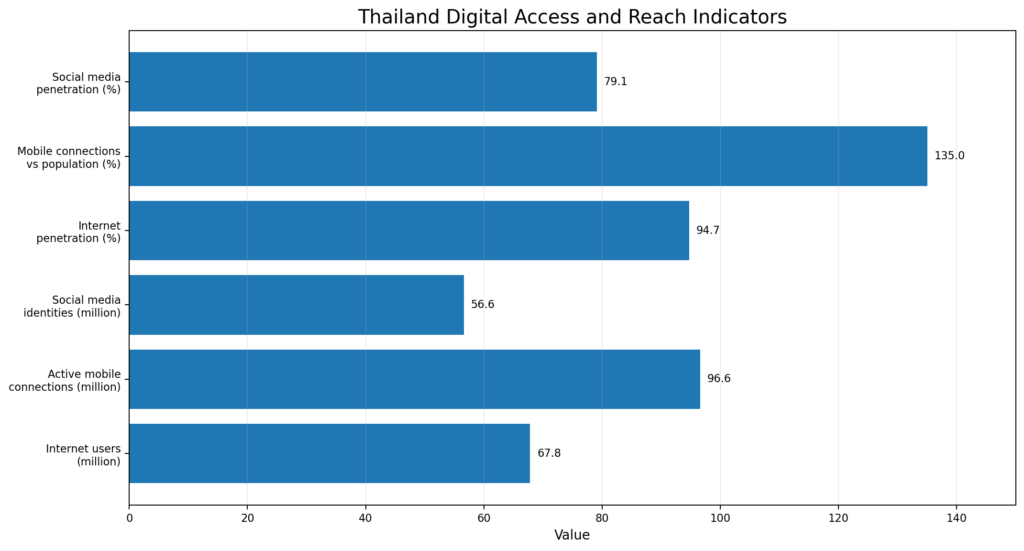
1. With 67.8 million internet users and a 94.7% online penetration rate, Thailand is one of Southeast Asia’s most digitally connected societies, creating a large and receptive audience for AI-powered search experiences.
2. Thailand’s 96.6 million active mobile connections — equivalent to 135% of its population — reflect widespread multi-SIM usage and signal that mobile-first AI search optimisation is not optional but essential for any brand operating in the country.
3. The fact that 100% of Thai mobile connections are now broadband-grade (3G, 4G, or 5G) means that bandwidth is no longer a barrier to AI-generated search responses, voice queries, or rich multimodal content delivery.
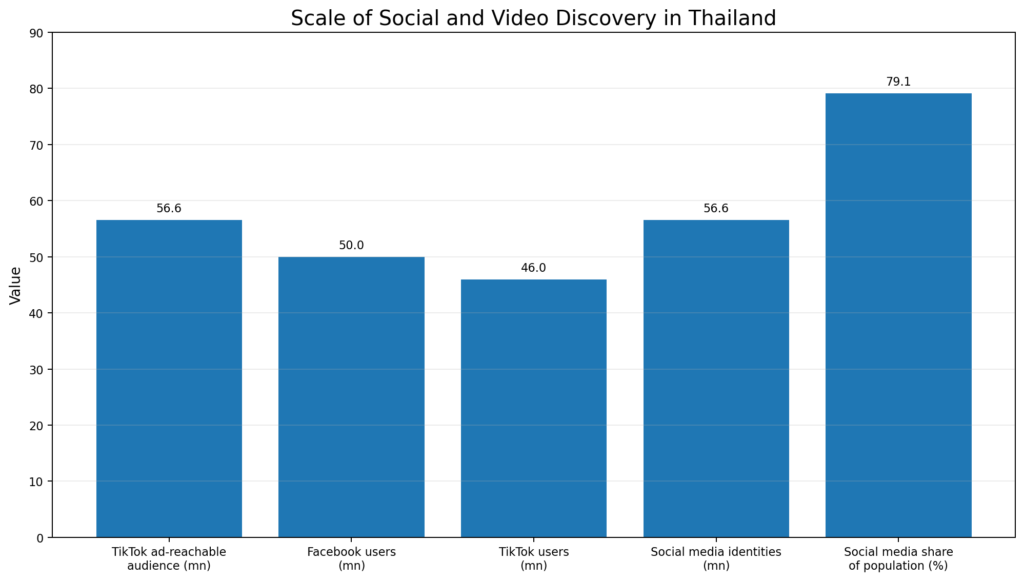
4. With 56.6 million social media identities — 79.1% of the population, up 15% year-on-year — Thailand’s social graph is expanding rapidly, amplifying the role of social signals and user-generated content in AI search ranking algorithms.
5. The typical Thai internet user juggles 7.3 social platforms per month and spends over 20 hours online weekly, underscoring a highly fragmented attention landscape where AI-driven content discovery across multiple channels is becoming the norm.
6. Thai internet users averaging more than 8 hours of daily screen time represent one of the world’s most digitally engaged populations, making Thailand a high-priority market for brands investing in always-on AI content and search visibility strategies.
7. At nearly 9 hours of daily online time, Thai users rank among the world’s heaviest internet consumers, meaning the window for AI-powered brand discovery is exceptionally wide compared to most other markets.
8. Thai users spending nearly 3 hours per day on social media alone signals that social search — increasingly powered by AI recommendation engines on TikTok, YouTube, and Facebook — is a parallel discovery channel that complements traditional Google search.
9. Thailand’s near-universal 5G coverage, achieved by end of 2023, has laid the physical infrastructure for latency-sensitive AI applications, real-time generative search responses, and immersive multimodal query experiences.
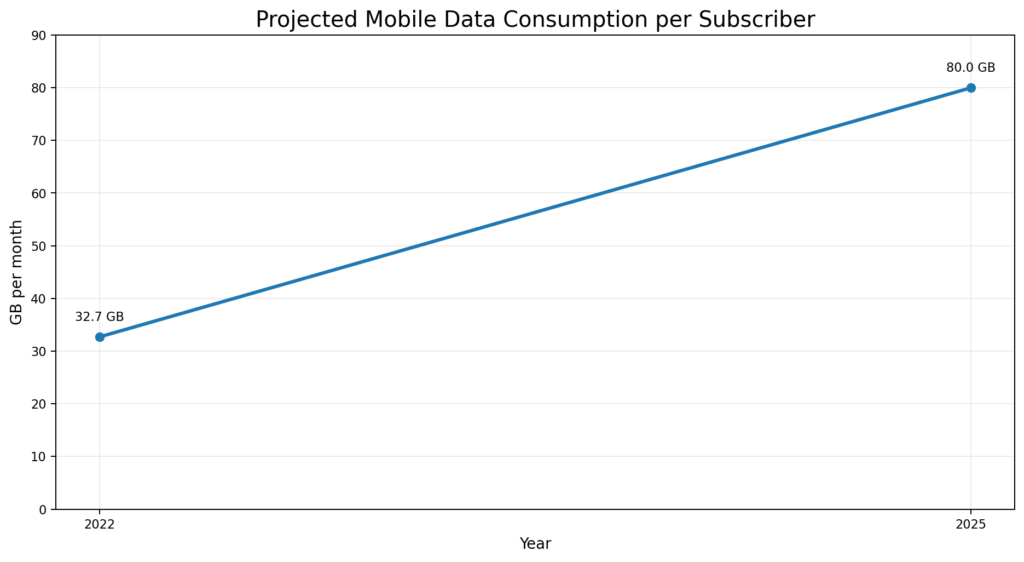
10. Projected mobile data consumption of nearly 80 GB per subscriber per month by 2025 — up from 32.7 GB in 2022 — reflects surging demand for data-heavy AI content formats, including video summaries, AI image results, and voice-generated answers.
Section 2: AI Adoption Among Thai Consumers
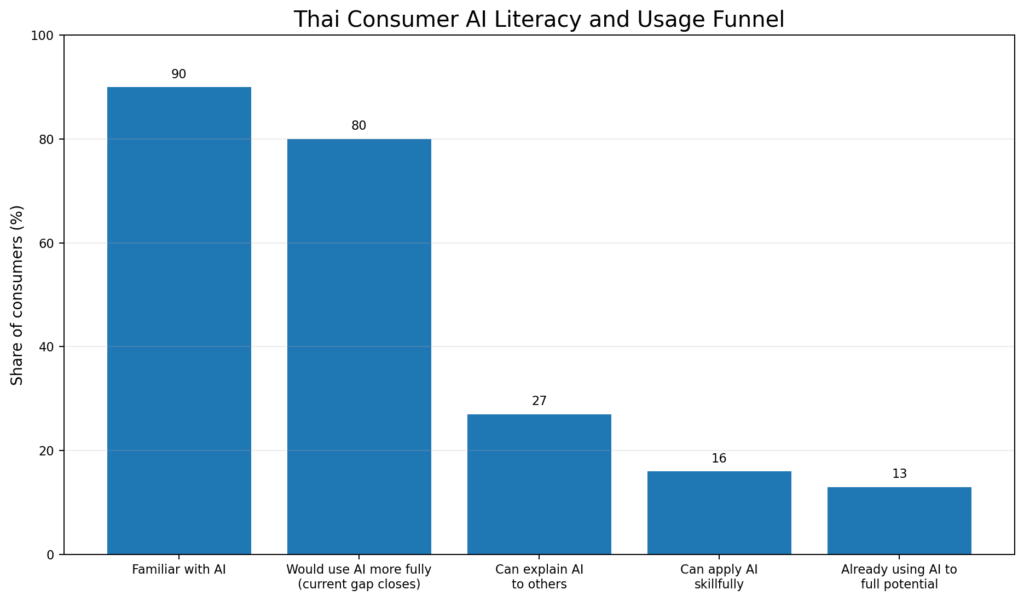
11. While 80% of Thai consumers already interact with AI passively — through recommendation engines, translation tools, and fraud detection — the fact that only 13% use it to its full potential reveals a significant awareness and education gap that businesses and content creators can address through helpful, AI-forward communication.
12. Over 90% of Thais are familiar with AI as a term, yet the majority cannot explain how it works — a nuance that suggests content demystifying AI concepts in plain Thai will perform strongly in generative search environments that reward clarity and educational value.
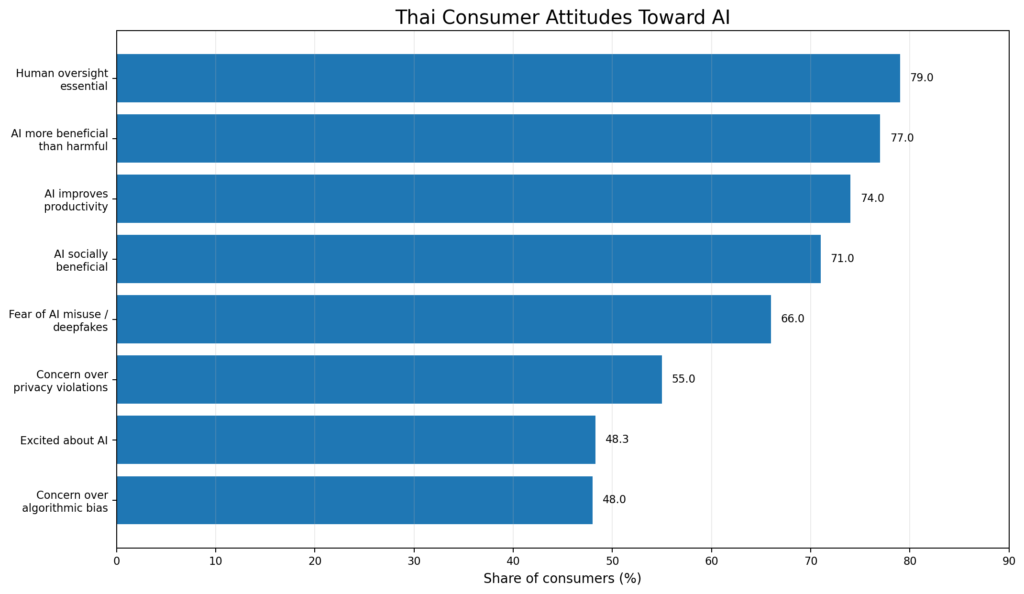
13. Thailand’s AI excitement rate of 48.3% — nearly matching the global average of 48.7% — suggests Thai consumers are as open to AI-powered products and services as their global peers, making Thailand a viable testing ground for AI-first digital experiences.
14. The finding that 77% of Thais view AI as more beneficial than harmful — one of the highest rates globally — positions Thailand as a market where AI adoption faces relatively low cultural resistance, though trust-building through transparency remains critical.
15. With 74% of Thai consumers believing AI improves their productivity, the value proposition of AI tools is already widely accepted, meaning brands that frame their AI-assisted services around time-saving and efficiency are likely to resonate well with the majority.
16. The 71% of Thai consumers who see AI as socially beneficial provide a favourable base sentiment for public-sector and enterprise AI deployments, suggesting that societal AI initiatives — including AI-powered government services and healthcare search — will find a receptive audience.
17. The fact that 79% of Thai consumers consider human oversight essential when reviewing AI results is a design mandate, not a limitation — it tells brands and developers that AI-generated search answers need clear attribution, editorialisation, and accessible human fallback options.
18. With 66% of Thais fearing AI misuse for deepfakes and misinformation, content authenticity signals — such as verified authorship, publication dates, and transparent sourcing — are becoming increasingly important ranking and trust factors in generative search environments.
19. The 55% of Thai consumers worried about AI-related privacy violations points directly to the competitive advantage that PDPA-compliant, privacy-forward AI deployments can offer, particularly in sectors like healthcare, finance, and e-commerce personalisation.
20. Nearly half (48%) of Thai consumers expressing concern over algorithmic bias indicates that diverse, inclusive, and locally contextualised AI content will outperform generic, globally-templated responses in building long-term Thai consumer trust.
21. The dominance of “Smart Minimalists” (36%) and “Skeptical Practitioners” (34%) — who together make up 70% of Thai AI users — reveals a market where practical, verifiable, and low-friction AI experiences will outperform technically complex or opaque ones.
22. With only 16% of Thai consumers confident they can apply AI skillfully and 27% able to explain it to others, the majority of the market is still in an exploratory phase — a window of opportunity for brands that invest in consumer AI education as part of their content strategy.
23. The finding that 4 in 5 Thai consumers would abandon brands that hide their AI use sends a clear commercial signal: transparent AI disclosure is not merely an ethical obligation but a measurable business driver in the Thai market.
Section 3: AI Tool & Chatbot Usage in Thailand
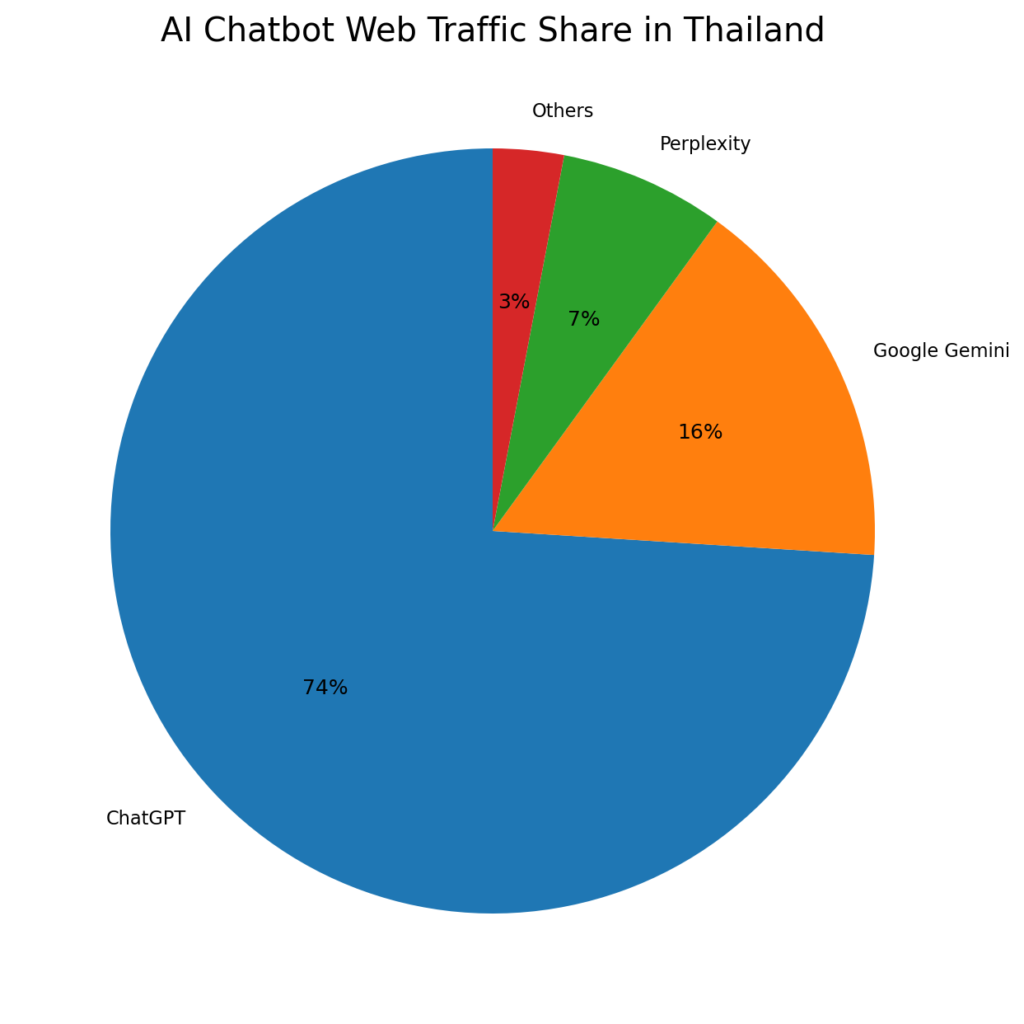
24. ChatGPT’s 74% share of AI chatbot web traffic in Thailand — exceeding its global average — establishes it as the de facto AI search interface for Thai users, meaning OpenAI’s evolving citation and source-referencing behaviour has an outsized impact on Thai content visibility.
25. Google Gemini’s 16% share of Thai AI chatbot traffic reflects the strength of Google’s existing ecosystem in Thailand, and as Gemini becomes more deeply integrated into Google Search, its source selection criteria will become directly relevant to Thai SEO strategy.
26. Perplexity’s above-average 7% share in Thailand suggests a meaningful research-oriented user segment that prefers cited, multi-source AI answers — making it a priority platform for Thai brands aiming to be quoted as authoritative sources in AI-generated responses.
27. The combined sub-3% share held by Copilot and Claude in Thailand reflects their relatively niche positioning in this market, though as enterprise AI adoption grows, their influence on B2B search discovery may increase.
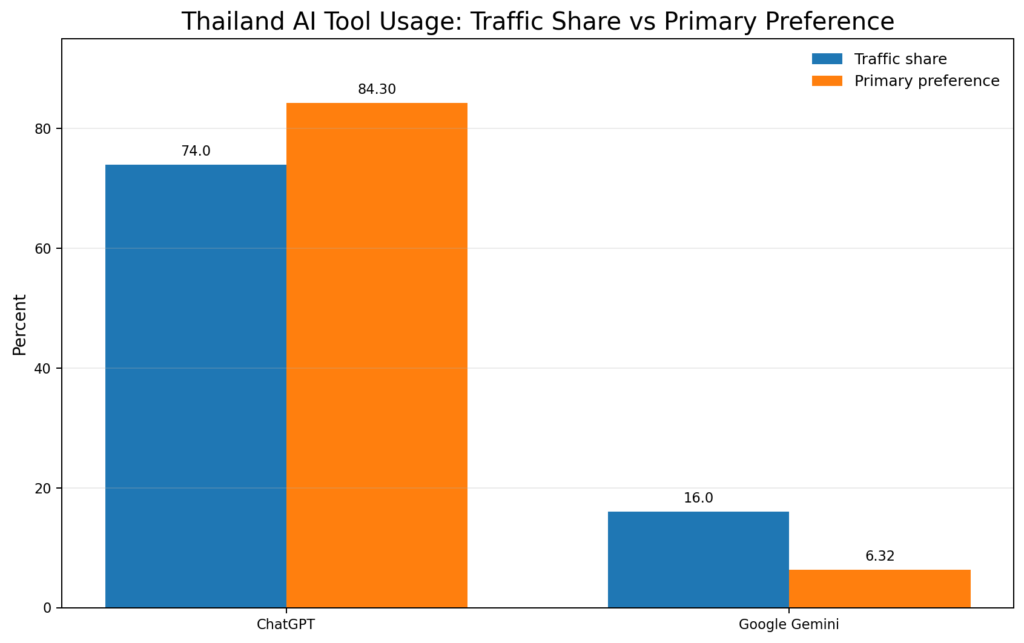
28. The stark gap between ChatGPT (84.3% primary tool preference) and Google Gemini (6.32%) among Thai AI users reveals a brand loyalty dynamic that Google — despite its near-total search engine monopoly — has not yet translated into AI tool dominance.
29. Gen Z men aged 16–24 being the heaviest AI users in Thailand (43.4%) suggests that AI-native search behaviour will become the mainstream norm within a decade, making early investment in GEO strategy a long-term competitive advantage.
30. Thailand’s media sector achieving 100% AI integration into workflows by 2025–2026 represents a full-scale professional adoption milestone, indicating that AI-generated content — whether editorial or promotional — will increasingly define the information landscape that search engines crawl and cite.
31. The wide variation in Thai media organisations’ AI tool preferences — ChatGPT at 100%, Gemini at 75%, Claude at 45% — highlights that multi-platform AI optimisation, rather than single-tool focus, is the more practical approach for brands seeking broad generative search visibility.
32. Thailand ranking 2nd in ASEAN for enterprise AI adoption at 17.1% — ahead of Singapore and Malaysia — challenges the assumption that smaller or less-affluent markets lag in AI integration, and suggests Thai enterprise content strategies may be more sophisticated than external observers expect.
33. Thai e-commerce merchants achieving 39% AI adoption — on par with Singapore — confirms that AI-powered personalisation, recommendation engines, and chatbot-assisted search are already shaping Thai online retail, raising the bar for organic and generative search competitiveness.
34. IBM’s estimate of only 5–6% GenAI adoption among Thai organisations in 2024, with aspirations to reach 15–20% by 2025, reflects the typical gap between AI investment announcements and meaningful deployment — suggesting that real-world Thai AI search impact is still in early acceleration.
35. The under-representation of Thai language in global AI training data (less than 0.5% of corpora) is a structural challenge that may cause AI search systems to underperform for Thai-language queries, giving locally-trained models like Typhoon and OpenThaiGPT a contextual accuracy advantage.
Section 4: Thailand AI Market Size & Economic Impact
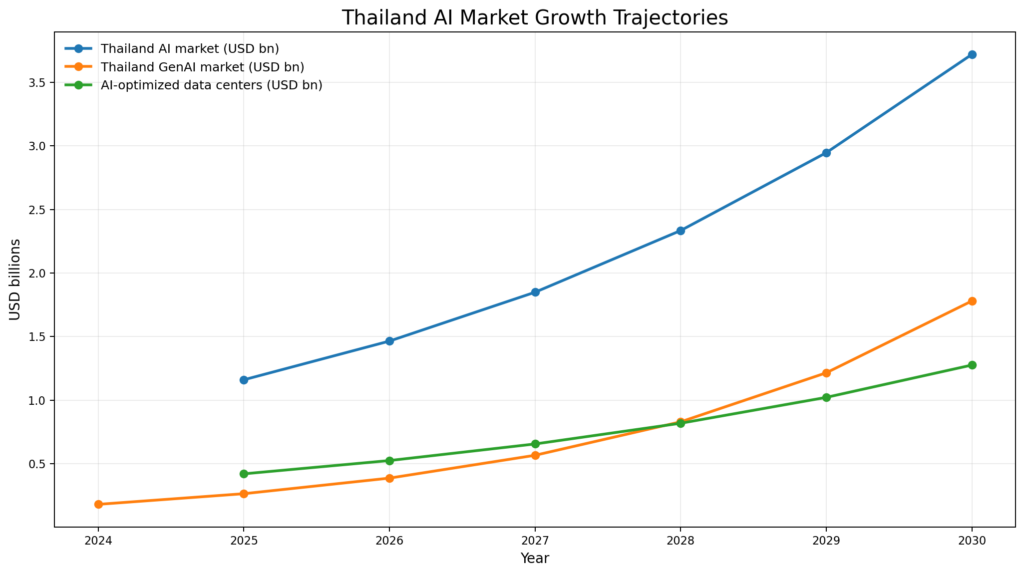
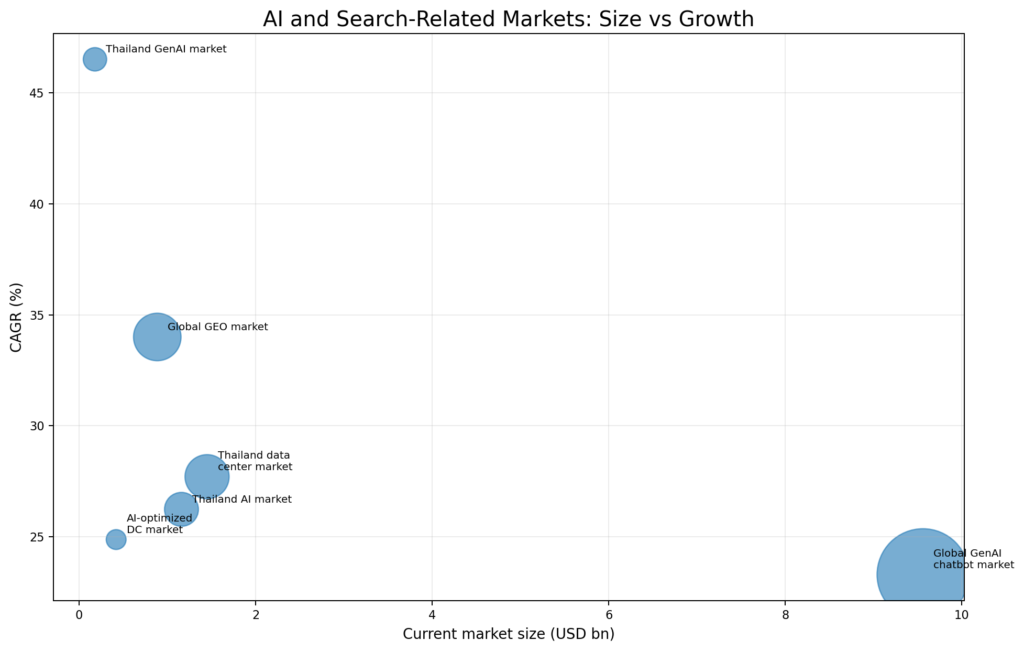
36. Thailand’s AI market reaching an estimated US$1.16 billion in 2025 — growing at 26.24% annually — establishes it as one of the fastest-growing AI markets in Southeast Asia, with compounding implications for the volume and sophistication of AI-influenced search interactions.
37. The GenAI market’s projected trajectory from US$180 million in 2024 to US$1.77 billion by 2030 at 46.5% annual growth confirms that generative AI is not a passing trend in Thailand but a structural economic shift that will redefine how consumers and businesses discover, evaluate, and engage with information.
38. DEPA’s projection of a 114-billion-baht AI market in Thailand by 2030 provides government-backed validation of the sector’s strategic importance, signalling that regulatory frameworks, funding programmes, and talent pipelines will increasingly support AI-driven business models.
39. Thailand’s digital economy surpassing 2.496 trillion baht in 2024 — a 23.35% annual increase — reflects an ecosystem in which AI-powered commerce, content, and communications are becoming embedded at scale rather than operating at the margins.
40. Hardware accounting for 1.85 trillion baht of Thailand’s 2024 digital economy figure highlights that the country’s AI growth is underpinned by physical infrastructure exports as much as software adoption — a dual dynamic that supports long-term investment sustainability.
41. A projected AI market annual growth rate of 28.55% reaching 114 billion baht by 2030 indicates that Thailand’s AI opportunity is compounding rapidly, with the most significant search and content disruption likely occurring in the 2025–2028 window.
42. Thailand’s AI-optimised data center market growing from USD 0.42 billion in 2025 to USD 1.27 billion by 2030 at a 24.88% CAGR reflects the physical computing backbone being built to support AI search, inference, and generation at national scale.
43. The broader Thai data center market expanding at a 27.71% CAGR — from USD 1.45 billion in 2025 to USD 6.29 billion by 2031 — confirms that Thailand is investing at a scale consistent with its ambition to become Southeast Asia’s primary AI infrastructure hub.
44. Thailand’s influencer marketing industry projected to reach USD 180.23 million by 2030, with micro- and nano-influencers holding 71.5% combined share, signals that AI-assisted content discovery will increasingly elevate peer voices over brand-owned channels in Thai search environments.
45. The projection that 56% of Thailand’s workforce will require significant AI reskilling by 2026 underscores both the disruption and the opportunity — workers equipped with AI and GEO skills will command a meaningful professional advantage in the evolving Thai digital economy.
Section 5: AI Infrastructure & Foreign Investment in Thailand
46. BOI approval of 322 billion baht in tech investment in the first half of 2025 alone — predominantly for data centers — signals that Thailand’s AI infrastructure buildout is proceeding at a pace that few Southeast Asian nations can match, creating a stable compute environment for domestic AI search applications.
47. The approval of three data center projects worth USD 2.7 billion, including a 300 MW facility in Rayong, demonstrates that global hyperscalers view Thailand as a strategic compute hub, which will reduce latency for AI search inference and improve response quality for Thai users.
48. ByteDance’s USD 8.8 billion five-year data center commitment in Thailand is the largest single AI infrastructure investment in the country’s history, and as TikTok deepens its role as a search and discovery platform, this investment directly shapes how Thai content is surfaced and ranked.
49. AWS’s USD 15 billion, five-year commitment to Thailand — combined with its first in-country infrastructure region opened in early 2025 — means that cloud-native Thai businesses now have access to low-latency AI compute at enterprise scale, accelerating AI-powered search and content capabilities.
50. Google’s USD 1 billion data center investment in Chonburi Province reinforces the alignment between its cloud infrastructure and Search product strategy, as on-the-ground computing capacity in Thailand will directly improve AI Overview latency and quality for Thai-language queries.
51. Microsoft’s launch of Thailand’s first cloud region signals a deepening enterprise AI ecosystem in the country, with Azure’s AI and Copilot services becoming more accessible to Thai businesses pursuing AI-assisted search, content, and productivity workflows.
52. China’s Galaxy Data Center committing USD 2 billion to Thai infrastructure reflects the geopolitical diversification of global AI investment and may introduce alternative AI platforms — with different content policies and ranking methodologies — into the Thai search landscape.
53. Bangkok’s planned USD 6.5 billion data center investment at approximately USD 10 million per megawatt illustrates the premium cost of AI-grade infrastructure, but also the strategic conviction that AI compute capacity is essential national and commercial infrastructure.
54. Thailand’s ambition to triple data center capacity to 1 GW by 2027 — from 350 MW in 2024 — represents one of the most aggressive digital infrastructure targets in Southeast Asia, providing the raw compute power necessary for real-time AI search, multimodal queries, and agentic AI agents.
55. AI workloads already consuming 28% of Thai data center capacity in early 2025 — up from 20% the prior year — shows that AI inference demand is growing faster than the infrastructure itself, creating supply pressure that drives further investment.
56. Cloud computing representing 38% of Thai data center capacity as of Q1 2025 confirms that the majority of Thailand’s AI workloads run on major cloud platforms, making cloud-integrated AI search tools — from Google Vertex AI to AWS Bedrock — the primary engines of Thai digital discovery.
57. Thailand’s data center pipeline of 2.87 GW — 3.7 times greater than Indonesia’s — positions the country as the undisputed leader in committed AI infrastructure among ASEAN nations, with tangible implications for hosting latency, AI model performance, and search quality.
58. The November 2025 BOI approval of four data center projects totalling 376 MW — including a 200 MW Zenith facility — demonstrates that Thailand’s infrastructure pipeline is not just planned but actively materialising, creating a compounding effect on AI compute availability.
59. AWS’s commitment to train 100,000 Thais in AI skills by 2026 directly addresses the talent bottleneck identified by the National AI Strategy, and a more AI-literate workforce will accelerate both the supply of quality Thai AI content and the sophistication of enterprise GEO strategies.
Section 6: Thailand’s National AI Strategy & Government Policy
60. Thailand’s National AI Strategy targeting 30,000 trained AI professionals, 100 R&D prototypes, and 48 billion baht in AI impact by 2027 provides a structured policy framework that increases the likelihood of sustained, coordinated AI ecosystem development — a favourable environment for AI search businesses to scale.
61. The embeddedness of AI strategy within the broader Thailand 4.0 economic vision means AI adoption is not treated as a standalone tech initiative but as a pillar of national economic transformation, lending it political and budgetary durability beyond election cycles.
62. BOI’s eight-year corporate income tax exemptions and import duty waivers for qualifying AI and data center projects make Thailand one of the most financially attractive markets for AI infrastructure investment in Asia — an incentive structure that will continue to attract the compute and talent ecosystems that support AI search growth.
63. The Eastern Economic Corridor’s emergence as the focal point for hyperscale data center development highlights that Thailand’s AI geography is concentrating in the east — a zone where power, land, and connectivity advantages align for long-term AI infrastructure stability.
64. PM Paetongtarn Shinawatra’s explicit vision of Thailand as a global data hub — articulated in her 2025 New Year message — signals rare alignment between political leadership and commercial AI strategy, reducing policy uncertainty for long-term digital investment.
65. Thailand’s strategy to become ASEAN’s AI hub through complementary public and private investment reflects a sophisticated understanding that infrastructure alone is insufficient — ecosystem coordination between government, academia, and enterprise is what differentiates leading AI economies.
66. A 42% surge in investment pledges to 722.5 billion baht in the first nine months of 2024 — driven by data centers and circuit manufacturing — demonstrates that Thailand’s AI economy is attracting capital at a velocity that justifies positioning Bangkok as a regional AI search and infrastructure benchmark.
67. The commercial imperative that 4 in 5 Thai consumers will abandon brands hiding their AI use reinforces that government transparency requirements and commercial trust imperatives are converging — making ethical AI disclosure not only good policy but good business strategy.
Section 7: Google Search & SEO in Thailand
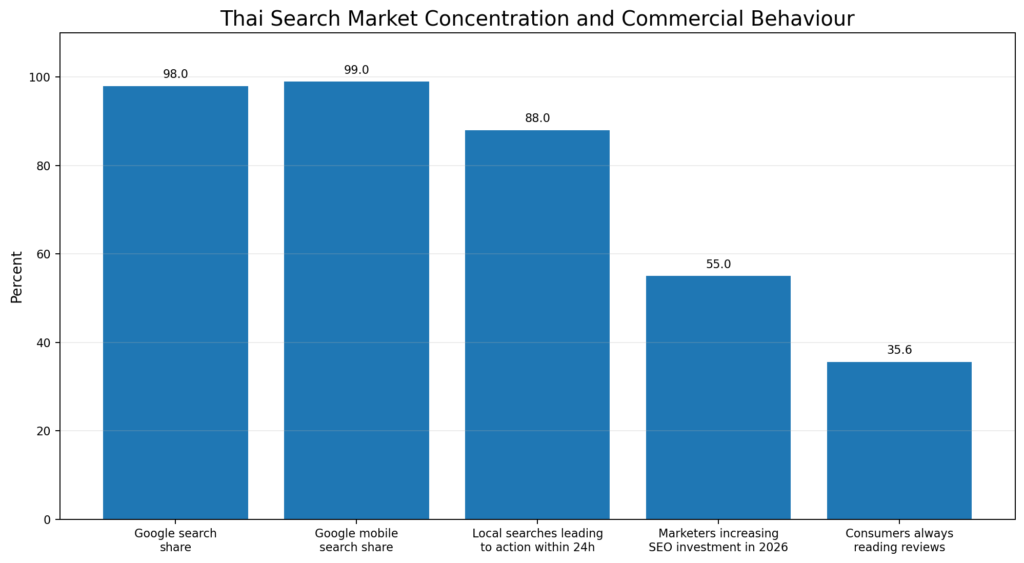
68. Google’s 97–99% search market dominance in Thailand means that all SEO and GEO strategy in Thailand effectively means Google strategy — there is no meaningful diversification opportunity in traditional search, making performance within Google’s evolving AI ecosystem the single most important organic visibility lever.
69. Google’s near-98% search market share in Thailand in 2024 is among the highest concentration of any major market globally, meaning Google’s algorithmic decisions — including the rollout of AI Overviews — have an almost singular impact on how Thai web content is discovered.
70. Google commanding over 99% of Thai mobile search traffic establishes mobile-first SEO as the only rational organic strategy — desktop-optimised or content that ignores mobile UX signals is statistically invisible to the Thai search audience.
71. The fact that over 70% of Thai searches are conducted in the Thai language, yet many businesses only target English keywords, reveals a significant content gap — Thai-language content optimised for AI answer engines remains broadly underdeveloped relative to demand.
72. With 88% of Thai consumers who conduct local searches visiting or contacting a business within 24 hours, local SEO and AI-enhanced local pack visibility are among the highest-conversion digital channels available to Thai brick-and-mortar businesses.
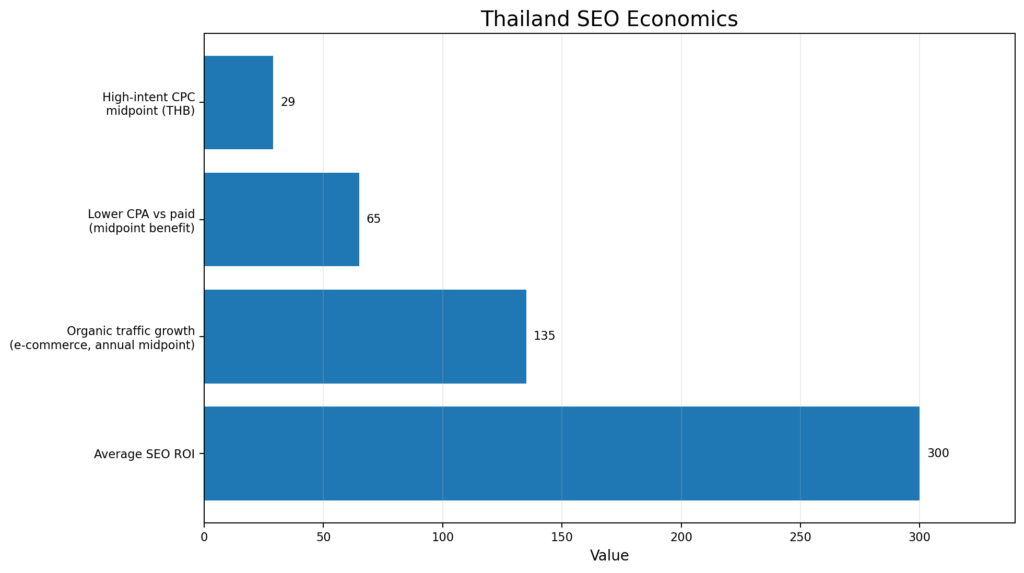
73. Average SEO ROIs exceeding 300% and organic traffic growth of 120–150% annually for Thai e-commerce brands confirm that organic search — particularly when enhanced by AI content strategies — delivers compounding returns that paid channels struggle to replicate at scale.
74. A 60–70% lower CPA through organic SEO compared to paid advertising in Thailand provides a compelling financial case for investing in AI-optimised content and GEO, especially as pay-per-click costs rise with increasing competition.
75. With 55% of Thai marketers planning to increase SEO investment in 2026, the field is becoming more competitive — which means brands that wait to adopt AI-integrated search strategies risk falling behind peers who are already compounding their organic authority.
76. CPCs for high-intent Thai keywords rising to ฿18–฿40 per click in competitive sectors like real estate and B2B SaaS makes organic AI search visibility increasingly cost-effective by comparison, accelerating the business case for GEO and content-led discovery.
77. Thai e-commerce email marketing’s above-average open rates (23.4%) and CTRs (~3.2%) suggest that Thai digital audiences are relatively responsive to well-targeted digital outreach — a behaviour pattern that AI-personalised content can amplify further.
78. The Thai advertising industry’s 1.63% contraction in 2025, despite digital SEO investment holding firm, illustrates the bifurcation of marketing budgets — measurable, performance-oriented digital channels are being ring-fenced even as broad-reach spend is cut.
79. Thailand’s e-commerce market projected at ฿700 billion in 2025 represents an enormous pool of commercial intent that AI search — by surfacing the most relevant products to the most relevant queries — is increasingly mediating, raising the stakes for product discovery optimisation.
80. The fact that 35.6% of Thai consumers always read reviews before purchasing underscores that user-generated content, review schema markup, and AI-cited customer sentiment are powerful ranking and visibility signals in Thailand’s generative search environment.
Section 8: AI-Powered Search Impact on Thai Media & Publishing
81. Declining news website CTRs in Thailand as a direct consequence of AI-powered search and Google AI Overviews represents a structural challenge for Thai publishers — editorial teams that fail to pivot their content strategy toward AI-cited authority will see continued traffic erosion.
82. The emergence of AI citation as a new form of reputational capital in Thailand’s media landscape signals a fundamental shift: being mentioned in an AI-generated answer is becoming as commercially valuable as a front-page placement or a high organic ranking was in the previous era of search.
83. The fact that nearly two-thirds of Thais aged 18–34 use social media as their primary news source means AI-driven social recommendation algorithms — not editorial curation — are the dominant gatekeepers of information for Thailand’s most commercially active demographic.
84. Thailand’s preference for watching online news (43%) over reading it (32%) — one of the few countries with this dynamic — means that video content optimised for AI-powered search (YouTube, TikTok, Google Video) is not a supplementary strategy but a primary discovery vehicle for Thai audiences.
85. Television advertising in Thailand declining from THB 31 billion in 2025 to a projected THB 29 billion in 2026, while AI-driven digital channels absorb that budget shift, confirms that AI search is a direct beneficiary of the ongoing structural decline of traditional media advertising.
86. With 77.9% of Thai internet users playing video games and averaging nearly 9 hours of gaming per week, the intersection of AI-powered in-game discovery, gaming content search, and esports-related queries represents a largely untapped vertical for generative search optimisation in Thailand.
Section 9: Google AI Overviews — Global Impact Relevant to Thai SEO
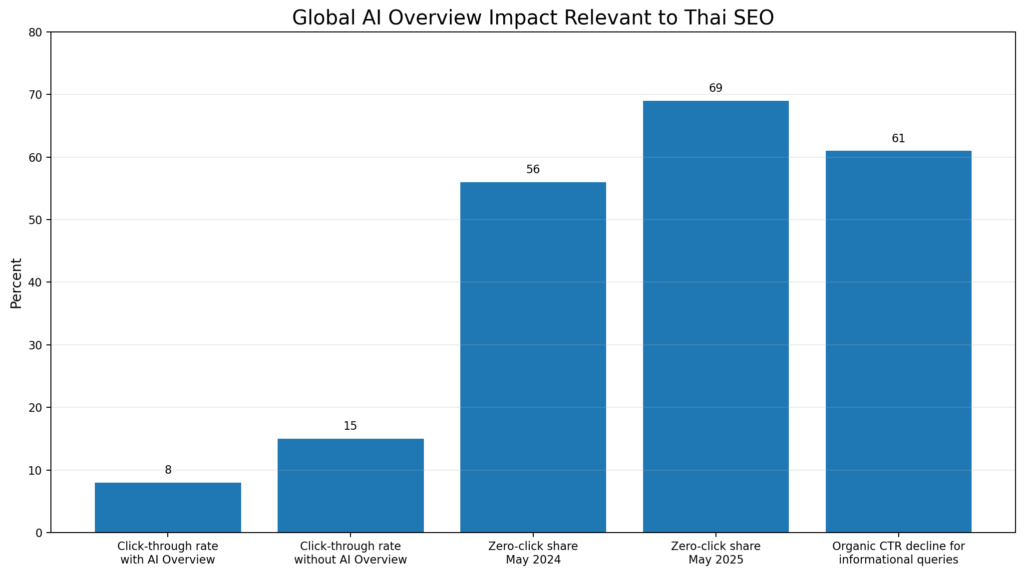
87. Google AI Overviews expanding to over 200 countries and 40 languages — including Thailand — by May 2025 means the zero-click search phenomenon is now a definitive reality for Thai digital marketers, not a trend to monitor from a distance.
88. AI Overviews reaching 1.5 billion users monthly globally is the largest-scale change to search result pages in internet history, and for Thai brands, being cited within those overviews is now as strategically important as ranking on page one of traditional search results.
89. AI Overviews appearing in an estimated 50%+ of all Google searches by Q1 2026 — concentrated in informational, how-to, and comparison query types — means the majority of Thai users’ most common search intents are now mediated by AI-generated summaries before any organic result is seen.
90. The Pew Research finding that users clicked through only 8% of the time when AI Overviews were present, versus 15% without them, quantifies the CTR impact most clearly: AI Overviews effectively halve the click opportunity for any given query, demanding a fundamental rethink of traffic-dependent content ROI models.
91. CTR reductions of 34–46% when AI summaries appear on Thai-relevant search result pages signal that content strategies purely focused on ranking position need to be reframed around being cited within the AI summary itself — a different, more authoritative form of visibility.
92. Zero-click searches rising from 56% to 69% between May 2024 and May 2025 represents one of the most dramatic behavioural shifts in search history within a single year, confirming that the era of traffic-driven content ROI is giving way to an era of influence-driven content authority.
93. AI Overviews averaging 169 words and seven links — with the first organic result appearing 1,674 pixels down the page — means that for the majority of Thai search queries, the decision about whether to visit a website is now made before the user even sees traditional search results.
94. Google’s reported 10% increase in overall query volume attributable to AI Overviews shows that while individual page CTRs may fall, the total addressable search demand is growing — meaning brands that are cited in AI answers can reach users who would never have searched for them using traditional queries.
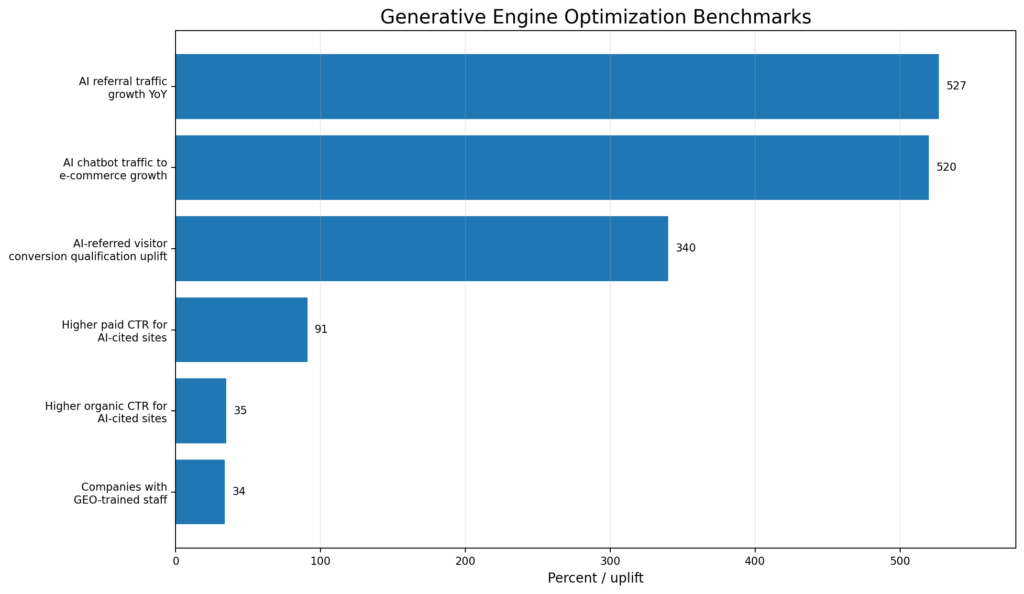
95. Websites cited in AI Overviews seeing up to 35% higher organic CTR and 91% higher paid CTR is a compelling commercial case for GEO investment — being referenced by AI is not just a vanity metric but a measurable driver of both organic and paid channel performance.
96. A 61% decline in organic CTR for informational queries where AI Overviews are present is arguably the single most significant SEO metric shift of 2025–2026, and Thai content teams that haven’t audited their informational content for AI citation eligibility are operating with an outdated traffic model.
97. The March 2025 core update’s dramatic expansion of AI Overviews into entertainment (+528%), restaurants (+387%), and travel (+381%) is particularly relevant to Thailand’s tourism and hospitality sectors, where search visibility for travel, dining, and experience queries has been radically disrupted.
98. The 20–60% traffic loss experienced by some sites correlating with increased AI Overview appearances reflects both risk and opportunity — sites that proactively optimise for AI citation can capture the authoritative source positions that displaced competitors vacate.
99. Chegg’s 49% decline in non-subscriber traffic as AI Overviews directly answered educational queries serves as a cautionary tale for Thai educational content publishers — any domain that provides reference-style information without unique depth or proprietary data is vulnerable to AI substitution.
100. Google’s referral traffic to news sites falling from 2.3 billion to under 1.7 billion visits between mid-2024 and May 2025 represents a 26%+ reduction in news traffic from search — a trend that Thai news organisations, digital publishers, and content-driven brands must treat as a permanent structural shift.
Section 10: Generative Engine Optimization (GEO) — Global Benchmarks for Thai Marketers
101. AI-sourced referral traffic growing 527% year-over-year between January and May 2025 — from 17,076 to 107,100 sessions — is the clearest quantitative proof that generative AI is transitioning from a novelty to a primary traffic source, and Thai brands that haven’t implemented GEO strategies are missing one of the fastest-growing acquisition channels.
102. Gartner’s prediction of a 25% decline in traditional search engine volume by 2026 may seem dramatic but is directionally consistent with the zero-click trend — Thai SEO strategies built entirely on Google organic rankings are exposed to this volume contraction without GEO as a complement.
103. The forecast that organic search traffic could decline by over 50% as AI alternatives gain adoption is a structural warning signal, not a precise prediction — even at half that magnitude, the impact on Thai content-driven businesses would require a fundamental reorientation of their digital acquisition mix.
104. 65% of Google searches in 2025 ending without a click to any website means that for the majority of Thai users’ queries, a brand’s website is never visited — making the AI-cited answer the effective end point of the user journey, and brand presence within that answer the new form of search real estate.
105. The convergence of 60% zero-click searches and 58% information-seeking queries ending in SERP-level AI insights paints a clear picture: the web is increasingly a data source for AI systems rather than a destination for users, and content strategy must evolve accordingly.
106. The global GEO market growing from USD 886 million in 2024 to a projected USD 7.3 billion by 2031 at a 34% CAGR signals that generative search optimisation is rapidly professionalising — Thai agencies and brands that build GEO capabilities now will have a significant first-mover advantage.
107. A 520% explosion in AI chatbot traffic to e-commerce retailers between 2024 and 2025 is the most commercially relevant GEO statistic for Thai online retailers — AI-driven product discovery is not approaching but already reshaping how Thai consumers find and choose products.
108. The 4.4x higher conversion qualification of AI-referred visitors versus traditional search visitors is arguably the most important GEO metric for Thai marketers: the ROI case for being cited in AI answers is not just about traffic volume but about the disproportionate commercial quality of that traffic.
109. The collapse of overlap between Google’s top organic results and AI-cited sources — from 70% to below 20% — fundamentally decouples traditional SEO ranking from AI search visibility, meaning a brand can rank #1 on Google and still be absent from AI-generated answers about its category.
110. AI search query length averaging 23 words versus traditional search’s 4 words reflects a shift from keyword-based searching to conversational problem-solving — Thai content that answers specific, nuanced questions in natural language will outperform keyword-stuffed content in AI-mediated discovery.
111. AI platform search sessions averaging 6 minutes — significantly longer than traditional search — indicates higher user engagement and deeper intent, meaning brands cited in AI answers benefit not only from a click but from a more informed, committed user who has already received context about them.
112. With 79.7% of AI-assisted shoppers relying on AI for at least half of their purchase decisions, the implication for Thai e-commerce brands is clear: AI platforms are no longer just discovery tools but are active participants in the consumer decision-making process.
113. The 30–40% improvement in AI Overview visibility from citing authoritative sources within content — validated by Princeton and Georgia Tech research — provides a concrete, actionable GEO tactic: Thai content that references credible external data and research is measurably more likely to be cited by AI systems.
114. With 86% of enterprise SEO teams globally having integrated AI into workflows and 63% explicitly prioritising GEO, the professional bar has risen — Thai in-house teams and agencies that haven’t formalised GEO within their SEO process are falling behind a fast-moving global standard.
115. Only 34% of companies globally having trained staff in GEO represents a meaningful skills gap, and for Thailand — where AI literacy is still developing — early investment in GEO training and capability building offers a disproportionate competitive advantage relative to the modest cost of that investment.
116. The 49% increase in impressions following AI Overview launches — even as traffic fell — suggests that AI search is expanding brand exposure at the top of the funnel while compressing the middle of the funnel, requiring Thai marketers to rethink how they measure and attribute awareness-to-conversion journeys.
117. Perplexity AI processing 780 million queries in May 2025 alone — a 239% increase in under a year — establishes it as a material AI search platform that Thai brands in research-heavy sectors (travel, finance, tech, healthcare) should treat as a distinct GEO optimisation target alongside ChatGPT and Google.
Section 11: ChatGPT & Global AI Search — Context for Thai Digital Strategy
118. ChatGPT’s doubling to 800 million weekly active users by early 2026 confirms that the platform has crossed from early-adopter phenomenon into mainstream global behaviour — and given Thailand’s 84.3% ChatGPT preference among AI users, this global growth directly translates into Thai market relevance.
119. ChatGPT processing 2.5 billion prompts per day and attracting 5.72 billion monthly website visits positions it as one of the most influential information intermediaries in human history, and Thai brands that are cited within its outputs gain exposure at a scale that few traditional media placements can match.
120. ChatGPT’s 80.49% global AI chatbot market share as of January 2026 reflects a degree of platform concentration that, while potentially vulnerable to disruption, currently makes OpenAI’s content sourcing and citation methodology the most commercially consequential AI search variable for Thai content strategy.
121. 55% of US and UK consumers using ChatGPT or Gemini for tasks previously handled by Google Search — a trend mirrored in Thailand’s own usage data — confirms that AI chatbots are not supplementing search but actively substituting it for a growing proportion of queries.
122. AI-driven traffic growing 165 times faster than traditional search, with 13 million US adults having made AI their primary discovery tool, provides directional evidence for where Thai consumer behaviour is heading — particularly among the Gen Z and Millennial demographics that disproportionately drive AI adoption in Thailand.
123. Gemini’s 157% growth to 1.1 billion monthly visits between April and September 2025 signals that Google’s AI integration strategy is gaining real traction — and as Gemini and Google AI Overviews converge, Google’s position as Thailand’s dominant search platform is likely to extend into AI search as well.
124. APAC leading global AI chatbot traffic at 28.6% share — driven by India, Japan, Indonesia, and the Philippines — confirms that Asia is not a lagging AI search market but a growth engine, with Thailand’s own high AI engagement rates consistent with this regional pattern.
125. ChatGPT’s mobile app reaching 73.4 million downloads in December 2025 alone reflects the acceleration of mobile AI adoption, which aligns with Thailand’s mobile-dominant internet behaviour and means AI search is increasingly a smartphone-first experience for Thai users.
126. OpenAI reaching USD 10 billion ARR in June 2025 confirms that AI search is not only growing in usage but is becoming highly commercially sustainable — a financial stability that supports continued product investment, Thai-language improvements, and deeper integration with global content ecosystems.
127. The finding that three-quarters of all ChatGPT conversations focus on practical guidance, information-seeking, and writing confirms that AI has become a primary research and information tool — directly competing with Google Search for the query types that Thai businesses most commonly optimise their content for.
Section 12: Social Commerce, AI Content Discovery & TikTok Search in Thailand
128. TikTok’s position as the platform with the highest ad-reachable audience in Thailand (56.6 million), combined with Thai users’ dominant YouTube consumption on Android, establishes video search and AI-powered video recommendation as the most reach-intensive discovery channels in the Thai market.
129. Facebook’s 50 million and TikTok’s 46 million Thai users represent two massive AI-algorithmically governed environments where content discovery is already entirely AI-mediated — brands that understand the ranking logic of these platforms’ AI recommendation systems are effectively practising social GEO.
130. TikTok’s emergence as a search engine in Thailand — driven by its AI recommendation algorithm and natural-language search bar — means that short-form video content optimised for search intent is now part of a comprehensive Thai GEO strategy, not just a brand awareness tactic.
131. Social commerce through TikTok Shop, Shopee Live, and Lazada Live being a primary discovery-and-purchase channel for Thai consumers confirms that AI-governed social search is not siloed from commercial outcomes but is directly driving transactions — product content visibility on these platforms carries direct revenue implications.
132. Local payment methods integrated into 90% of Thai online stores reflects a frictionless commerce infrastructure that amplifies the commercial impact of AI-driven product discovery — the moment an AI search surfaces a product to a Thai user, the path to purchase is shorter and faster than in most other markets.
133. Only 40% of Thai SMEs investing in automated email flows reveals a significant underleveraging of AI-assisted marketing automation — the 60% who lack this capability are leaving a proven retention and nurture channel largely untapped in an increasingly AI-competitive market.
Section 13: Thai Language AI & Localisation Challenges
134. The reality that only 20 million of Thailand’s 69 million Thai speakers use Central Thai as their first language means that AI models trained predominantly on Central Thai text will underperform for regional audiences — creating content and GEO opportunities for brands that invest in dialectally inclusive Thai-language content.
135. Thai language representing less than 0.5% of global AI training data is a structural disadvantage that produces measurable accuracy gaps in Thai-language AI search responses, but it is also a competitive opportunity — brands that produce high-quality, authoritative Thai content become disproportionately valuable reference sources for AI systems hungry for reliable Thai data.
136. Thailand’s homegrown AI models — Typhoon, OpenThaiGPT, and Pathumma — represent a growing alternative to global models for Thai-language tasks, and content optimised for these models may provide early-mover GEO advantages as their adoption scales in domestic enterprise and government contexts.
137. The structural complexity of the Thai language — tonal variation, absence of word spacing, and dialect diversity — means that AI-generated search responses for Thai queries carry a higher error rate than for English, creating both user trust challenges and opportunities for brands that publish clear, unambiguous, AI-parsable Thai content.
138. The prevalence of bilingual Thai-English search queries (e.g., “คาเฟ่ Bangkok”) reflects natural Thai consumer search behaviour and means that effective GEO for Thailand requires content and metadata strategies that address mixed-language intent — optimising for one language alone will result in incomplete coverage of actual search demand.
Section 14: Enterprise AI, Workforce & Broader ASEAN AI Context
139. Thailand’s national target of 30,000 trained AI professionals underscores the talent constraint that is the primary bottleneck to AI adoption — a bottleneck that, if addressed effectively, could rapidly accelerate the sophistication of Thai AI search content, GEO implementation, and enterprise AI deployment.
140. AWS’s finding that AI tools help developers complete tasks 57% faster provides a concrete productivity benchmark for Thai enterprises evaluating AI investment, and for content and SEO teams specifically, it suggests that AI-assisted content production can dramatically increase publishing velocity without proportional cost increases.
141. Worker access to AI rising 50% globally in 2025, with companies in production AI deployment set to double, reflects an enterprise AI adoption curve that Thailand — given its strong infrastructure foundations — is well-positioned to ride, with implications for how Thai employees use AI-powered search in professional decision-making.
142. Two-thirds of organisations globally citing productivity and efficiency as the primary AI benefit validates the Thai government’s and enterprises’ AI investment rationale, and for SEO and content teams specifically, AI-driven efficiency gains are reshaping how quickly and affordably high-quality AI-optimised content can be produced.
143. Thailand’s 3.2 million SMEs representing 90% of enterprises and 50% of the workforce makes SME AI adoption — including AI-assisted search visibility — a national economic priority, and the brands, platforms, and agencies that help Thai SMEs access GEO will serve an outsized share of the country’s business community.
144. BCG’s identification of Thailand and Singapore as ASEAN’s AI frontrunners — nations with clear strategies and rising tech investment — suggests that Thai brands operating in regional markets should benchmark their AI and GEO capabilities against Singapore’s more mature market, not just domestic competitors.
145. The AI skills gap being the single biggest barrier to enterprise AI integration globally — identified by 3,235 business leaders in Deloitte’s survey — resonates strongly in Thailand’s context, where the gap between AI infrastructure ambition and AI-literate talent is the most cited constraint on actualising the National AI Strategy’s targets.
Section 15: Future of AI Search, Agentic AI & 2026 Trends
146. The global generative AI chatbot market growing from USD 9.56 billion in 2025 to USD 27.29 billion by 2030 at a 23.3% CAGR confirms that AI-powered conversational search is a durable commercial phenomenon, not a hype cycle — and Thailand’s early engagement with these platforms positions it well to scale alongside global growth.
147. Over 1 billion people globally using AI chatbots monthly means AI-mediated information discovery has achieved a scale previously only reached by television and the web — for Thai marketers, this signals that GEO is no longer a niche consideration but a mainstream channel requirement.
148. The shift from Generative AI to Agentic AI — systems that plan, decide, and act autonomously — is the most consequential near-term AI development for Thai businesses, as agentic systems will increasingly conduct searches, compare vendors, and make procurement decisions on behalf of users, making AI-parsable structured content an urgent business necessity.
149. Google running AI Overview ads across 12 countries while direct placement targeting remains unavailable means that organic citation authority is currently the only reliable mechanism for AI Overview visibility in Thailand — a situation that rewards consistent content quality and E-E-A-T (Experience, Expertise, Authoritativeness, Trustworthiness) investment.
150. The forecast that 79% of consumers globally will use AI-enhanced search by 2026, with 70% already trusting AI search results, makes the Thai market trajectory clear: AI-mediated search behaviour is becoming the majority norm, and brands that haven’t adapted their content and discovery strategies to this reality are operating in a shrinking addressable audience.
151. Only 1 in 5 companies globally having a mature governance model for autonomous AI agents highlights the governance gap that Thailand’s organisations will need to close as agentic AI proliferates — unmanaged AI agents operating on behalf of employees or customers could introduce search, compliance, and reputational risks that early-movers are already designing safeguards against.
152. The global AI market’s projected trajectory toward USD 1.81 trillion — potentially adding USD 15.7 trillion to world GDP — contextualises Thailand’s AI ambitions within a global economic transformation of historic magnitude, where the countries and companies that invest in AI discovery infrastructure today will disproportionately capture tomorrow’s economic value.
153. Thailand’s accelerating smartphone AI adoption — with over 65% of new shipments being 5G-capable in 2026 — combined with its near-universal mobile internet penetration, means that AI-native on-device features (real-time translation, AI-assisted search, contextual suggestions) will increasingly shape how Thai consumers initiate and complete information and purchase journeys, making device-level AI behaviour an emerging frontier for GEO strategy.
Conclusion
The rise of artificial intelligence in search technology is no longer a theoretical trend or a distant possibility. It is actively reshaping how information is discovered, interpreted, and delivered across digital platforms worldwide. In Thailand, this transformation is particularly significant as the country continues to strengthen its position as one of Southeast Asia’s most digitally engaged markets. The 153 AI search and Generative Engine Optimization (GEO) statistics, data points, and trends presented throughout this report provide a comprehensive view of how search behavior, marketing strategies, and technological adoption are evolving in Thailand in 2026.
The data clearly demonstrates that AI-powered search is redefining the traditional search experience. Instead of relying solely on lists of ranked web pages, users are increasingly interacting with intelligent systems capable of understanding natural language queries, generating contextual answers, summarizing complex information, and providing personalized recommendations. These capabilities are fundamentally altering the relationship between users, search engines, and digital content.
For Thai consumers, the shift toward AI-driven search is closely tied to broader digital behavior patterns. Thailand’s mobile-first population, high social media engagement, and rapidly expanding e-commerce ecosystem have created an environment where intelligent search tools can thrive. As AI-powered assistants, conversational search interfaces, and generative responses become more integrated into everyday digital platforms, Thai users are naturally adopting new methods of accessing information that prioritize speed, convenience, and contextual understanding.
From a business perspective, these changes carry profound implications. Traditional SEO practices that focus solely on keyword optimization and search engine rankings are no longer enough to ensure long-term visibility. Instead, companies must now adapt to an ecosystem where Generative Engine Optimization (GEO) plays an increasingly critical role. GEO emphasizes structured information, semantic clarity, topical authority, and trustworthy data sources that can be easily interpreted and referenced by AI systems.
The statistics in this report reveal that Thai businesses are gradually recognizing this shift. Organizations across industries are investing more heavily in artificial intelligence technologies, data analytics, and advanced digital marketing strategies to remain competitive in an AI-driven search landscape. Companies that understand how generative search engines process and synthesize information are beginning to optimize their content in ways that allow AI models to reference their data more effectively.
Another key takeaway from the data is the growing importance of content credibility and authority. AI systems rely heavily on trusted sources when generating answers, meaning that brands with strong domain expertise, well-structured information, and reliable data are more likely to be cited or surfaced in AI-generated responses. In Thailand’s increasingly competitive digital market, establishing this level of authority will become a defining factor in long-term search visibility.
The emergence of generative search experiences also highlights the importance of high-quality, context-rich content. As AI models generate summaries and answers directly within search environments, businesses must ensure that their content provides clear, accurate, and well-organized information that can be easily interpreted by machine learning systems. This shift places greater emphasis on expertise-driven content strategies rather than purely keyword-driven tactics.
Thailand’s unique digital environment further amplifies the impact of AI search technologies. With millions of users engaging with mobile apps, online marketplaces, and digital platforms daily, the country provides a dynamic testing ground for the evolution of AI-powered search experiences. The combination of strong consumer adoption, rapid technological development, and increasing investment in digital infrastructure suggests that Thailand will continue to play a key role in shaping the future of AI-driven search across Southeast Asia.
The data presented throughout this report also underscores the growing integration between AI search and other digital ecosystems, including e-commerce, social platforms, voice assistants, and recommendation engines. Search is no longer confined to traditional search engines; it now exists across a network of AI-enabled systems that guide users through complex digital journeys. As a result, businesses must adopt a more holistic approach to digital visibility that considers how AI interacts with content across multiple platforms.
Looking ahead, the evolution of AI search and GEO in Thailand will likely accelerate as generative technologies become more sophisticated and widely adopted. Improvements in natural language processing, multimodal AI capabilities, and contextual understanding will further transform how users interact with digital information. These advancements will create new opportunities for businesses that are prepared to adapt their strategies to align with AI-driven discovery mechanisms.
For marketers, entrepreneurs, and digital strategists, the insights provided by these 153 AI search and GEO statistics for Thailand in 2026 serve as a valuable roadmap for navigating the next phase of digital transformation. The trends highlighted throughout this report reveal not only how the search landscape is changing today but also how it may continue to evolve in the coming years.
Organizations that prioritize data-driven decision-making, invest in AI-friendly content strategies, and focus on building authoritative digital ecosystems will be better positioned to thrive in this new environment. By understanding how AI interprets information and how generative engines deliver responses, businesses can create content that remains discoverable even as traditional search interfaces evolve.
Ultimately, the transformation of search in Thailand reflects a broader global shift toward intelligent, conversational, and generative information systems. As AI continues to redefine how knowledge is accessed and distributed, the importance of strategic content optimization will only grow. Businesses that embrace this shift and align their digital strategies with AI search and GEO principles will gain a significant competitive advantage in the rapidly evolving digital economy.
The future of search is no longer just about rankings. It is about relevance, context, authority, and adaptability within an AI-driven ecosystem. By leveraging the insights from the data and trends outlined in this report, organizations can better understand how to position themselves within Thailand’s emerging AI-powered search landscape and prepare for the next generation of digital discovery.
If you are looking for a top-class digital marketer, then book a free consultation slot here.
If you find this article useful, why not share it with your friends and business partners, and also leave a nice comment below?
We, at the AppLabx Research Team, strive to bring the latest and most meaningful data, guides, and statistics to your doorstep.
To get access to top-quality guides, click over to the AppLabx Blog.
People also ask
What is AI search and how is it changing search in Thailand in 2026?
AI search uses machine learning and natural language processing to understand user intent and generate direct answers. In Thailand, it is transforming search behavior by delivering conversational responses instead of traditional lists of links.
What does Generative Engine Optimization (GEO) mean in 2026?
Generative Engine Optimization focuses on optimizing content so AI systems can understand, summarize, and cite it in generated answers. GEO helps businesses appear in AI-powered search results and conversational responses.
Why are AI search statistics important for Thailand’s digital market?
AI search statistics reveal how users interact with generative search tools, how businesses adapt their SEO strategies, and how the digital economy in Thailand is evolving in response to artificial intelligence.
How many Thai users rely on AI-powered search tools in 2026?
AI-powered search adoption is growing rapidly in Thailand as users interact with conversational assistants, smart search platforms, and generative answer engines across mobile apps and web platforms.
How is AI search affecting traditional SEO in Thailand?
Traditional SEO focused on keywords and rankings, while AI search prioritizes intent, context, and authoritative content. Businesses in Thailand now combine SEO with GEO strategies to remain visible.
What industries in Thailand are adopting AI search the fastest?
E-commerce, digital marketing, finance, education, and travel industries in Thailand are rapidly adopting AI search technologies to improve customer experiences and provide faster access to information.
What role does mobile search play in AI search trends in Thailand?
Thailand has a strong mobile-first internet culture. AI search tools integrated into mobile apps and voice assistants are accelerating the adoption of conversational and generative search experiences.
How does generative search impact content visibility in Thailand?
Generative search summarizes and synthesizes information from trusted sources. Content that is well structured, authoritative, and easy for AI systems to understand is more likely to appear in generated responses.
Why are GEO strategies becoming important for Thai businesses?
GEO strategies help businesses optimize content for AI-generated answers. As generative search tools grow in popularity, companies must ensure their information is easily interpreted and referenced by AI systems.
What are the main AI search trends in Thailand for 2026?
Major trends include conversational search, voice search growth, AI-generated answers, personalized search experiences, and the increasing integration of generative AI into search engines and platforms.
How is user search behavior changing in Thailand due to AI?
Users are asking longer, conversational questions and expecting instant summarized answers. AI search tools allow people to interact with search engines more naturally than traditional keyword queries.
What types of content perform best in AI search results?
Content that is well structured, fact-based, and authoritative performs best. Articles with clear explanations, data, statistics, and topical expertise are more likely to be referenced by AI systems.
How do AI search engines understand user intent better?
AI search engines analyze natural language queries using machine learning models and contextual signals. This allows them to understand meaning, context, and user intent more accurately than traditional algorithms.
What are the benefits of AI search for Thai consumers?
AI search delivers faster answers, personalized recommendations, and conversational interactions. Thai users can quickly access summarized information without needing to browse multiple websites.
How can businesses optimize content for AI search in Thailand?
Businesses should focus on clear content structure, topic authority, factual accuracy, and semantic relevance. Providing helpful, trustworthy information increases the chances of being cited in AI-generated responses.
Is voice search growing in Thailand alongside AI search?
Yes, voice search is growing as AI assistants become more integrated into smartphones and smart devices. Many Thai users now use conversational queries to find information quickly.
What challenges do marketers face with AI search in Thailand?
Marketers must adapt to changing ranking systems, AI-generated summaries, and new visibility metrics. Traditional SEO tactics alone may not guarantee exposure in generative search environments.
How does AI search influence digital marketing strategies in Thailand?
Digital marketing strategies are shifting toward authoritative content, topic clusters, and structured information that AI systems can easily analyze and reference in generated answers.
What data insights do AI search statistics reveal in Thailand?
AI search statistics show growth in generative search adoption, mobile search behavior, voice query usage, and the increasing importance of AI-driven content discovery across digital platforms.
How are Thai companies investing in AI search technologies?
Many companies are investing in AI tools for customer support, search optimization, personalization, and content generation to improve digital experiences and remain competitive online.
What role does natural language processing play in AI search?
Natural language processing enables AI systems to understand conversational queries and complex questions. This technology allows search engines to interpret meaning rather than just matching keywords.
Why is content authority important for GEO strategies?
AI systems prioritize reliable and authoritative sources when generating answers. Websites with strong expertise and credible data are more likely to be referenced in AI search responses.
How does AI search affect website traffic in Thailand?
AI-generated answers can reduce clicks to traditional websites but increase brand visibility if content is cited. Businesses must optimize for both traffic and AI citation visibility.
What types of AI-powered search platforms are popular in Thailand?
AI chat assistants, generative search engines, voice assistants, and AI-enhanced search features within apps and marketplaces are becoming increasingly popular among Thai users.
How can marketers measure success in AI search environments?
Success metrics include AI citations, brand mentions in generated responses, topic authority, engagement rates, and overall visibility across AI-powered discovery platforms.
What role does structured data play in GEO optimization?
Structured data helps AI systems understand website content more clearly. Proper data formatting improves the chances of information being extracted and used in AI-generated answers.
Will AI search replace traditional search engines in Thailand?
AI search is unlikely to fully replace traditional search engines but will significantly transform how results are delivered by adding conversational and generative capabilities.
How does AI search impact local SEO in Thailand?
AI search improves local discovery by understanding context and location-based intent. Businesses with accurate local data and strong digital presence benefit from improved visibility.
What future trends will shape AI search in Thailand beyond 2026?
Future trends include multimodal search, deeper AI personalization, advanced voice interactions, and stronger integration of AI assistants across digital platforms and devices.
Why should businesses monitor AI search statistics and trends?
Monitoring AI search data helps businesses understand changing user behavior, identify optimization opportunities, and stay competitive in an evolving AI-driven digital search ecosystem.
Sources
DataReportal
SCBX
Iconic Research
Nation Thailand
Sellercraft
Inspira Digital Agency
Minimice Group
Northern Kites
Fortune International Thailand
Statista
Statcounter
Bangkok Post
Beacon VC
STT GDC
Mordor Intelligence
Globe Newswire
AInvest
Cryptopolitan
AI Magazine
CCN
Yahoo Finance
Bloomberg
Dataxet
ThaiPR
SmartDev
US Department of Commerce
Stanford HAI
Chiang Rai Times
Search Engine Journal
Dataslayer
Amsive
InovaUp
SEO
Search Engine Land
The Conversation
Incremys
Presence AI
Previsible
GEOptie
ALM Corp
SoftMarketSolution
LLMrefs
DemandSage
Similarweb
DesignRush
OpenAI
Elfsight
We Are Social
Deloitte
AllAboutAI