























Key Takeaways
- AI-powered search adoption in Singapore is rapidly growing in 2026, transforming how users discover information and forcing businesses to adapt beyond traditional SEO strategies.
- Generative Engine Optimization (GEO) is becoming essential as AI assistants and generative search engines increasingly deliver direct answers instead of traditional search results.
- Data from 153 statistics highlights key trends in AI search usage, digital marketing shifts, and how Singapore businesses are optimizing content for AI-driven discovery.
Artificial intelligence has rapidly transformed the way people search for information online, and Singapore stands at the forefront of this digital shift. As one of Asia’s most technologically advanced economies, the city-state has embraced AI-powered search systems and Generative Engine Optimization (GEO) at a remarkable pace. Businesses, marketers, and policymakers are increasingly adapting their strategies to align with AI-driven search ecosystems that are redefining how information is discovered, ranked, and consumed. In 2026, understanding the evolving landscape of AI search and GEO in Singapore is no longer optional for organizations seeking digital visibility—it is a strategic necessity.

Over the past decade, Singapore has consistently ranked among the world’s leading digital economies. With high internet penetration, advanced digital infrastructure, and strong government support for innovation, the country has become an ideal testing ground for emerging technologies such as generative AI, conversational search engines, and AI-powered recommendation systems. As AI search continues to evolve beyond traditional keyword-based models, the mechanisms that determine online visibility are also shifting. This transformation has given rise to Generative Engine Optimization (GEO), a new discipline that focuses on optimizing content for AI-generated answers, conversational interfaces, and intelligent search assistants.
Traditional search engine optimization (SEO) has long revolved around ranking webpages in search engine results pages through keyword relevance, backlinks, and technical performance. However, AI search platforms increasingly generate direct answers rather than simply listing links. Large language models, AI copilots, and conversational search tools now synthesize information from multiple sources to produce comprehensive responses. As a result, businesses must rethink how they structure content, build authority, and provide trustworthy information that AI systems can interpret and reference. In Singapore’s highly competitive digital environment, this shift is driving rapid adoption of GEO strategies across industries.
The growing influence of AI search is supported by a surge in data points, usage metrics, and market indicators. Singaporean consumers are increasingly turning to AI-powered tools for product research, local recommendations, educational queries, and professional insights. From generative AI assistants embedded in browsers to enterprise AI search platforms used within organizations, the scope of AI-powered information retrieval continues to expand. This shift has profound implications for digital marketing, e-commerce, media publishing, and knowledge management across the country.
At the same time, Singapore’s government has actively encouraged responsible AI development through national initiatives and regulatory frameworks. Programs such as the National AI Strategy have accelerated investment in AI research, digital infrastructure, and talent development. These efforts have helped position Singapore as a regional hub for artificial intelligence innovation. As AI adoption grows, the search ecosystem is becoming more intelligent, more conversational, and more personalized, creating new opportunities and challenges for businesses seeking to reach their audiences online.
The emergence of GEO as a specialized discipline reflects this changing environment. Instead of optimizing solely for search engine crawlers, organizations must now consider how AI models interpret language, assess credibility, and extract relevant insights from digital content. Structured data, semantic clarity, authoritative sources, and contextual relevance are becoming increasingly important signals in AI-driven search systems. Companies that understand these dynamics can improve their chances of being cited, summarized, or referenced in AI-generated responses.
Singapore’s digital marketplace further amplifies the importance of these developments. With a population that is highly connected and digitally savvy, consumer expectations for fast, accurate, and personalized information are exceptionally high. AI-powered search tools meet these expectations by delivering immediate answers and context-rich insights. However, this convenience also changes how users interact with information online. Instead of navigating through multiple web pages, users increasingly rely on AI summaries and conversational interactions to obtain the knowledge they need.
This behavioral shift has triggered new trends in content strategy, digital marketing, and online discovery. Publishers are experimenting with AI-friendly content structures, businesses are investing in knowledge graph optimization, and marketers are developing new measurement frameworks to track visibility within generative search environments. The metrics that once defined success in traditional SEO—such as click-through rates and keyword rankings—are now complemented by emerging indicators such as AI citation frequency, knowledge inclusion, and answer visibility.
For organizations operating in Singapore, staying informed about these developments requires access to reliable data. Statistics, market insights, and usage trends provide valuable guidance for understanding how AI search adoption is evolving, which industries are leading the shift, and how digital behavior is changing among Singaporean users. These insights also reveal the scale of opportunity for businesses that embrace GEO early and strategically.
This comprehensive report on “153 AI Search and GEO in Singapore Statistics, Data & Trends in 2026” aims to provide a detailed overview of the current landscape. By compiling the latest statistics, market data, and industry insights, it offers a clear picture of how AI-powered search is transforming digital discovery within Singapore. The collection of statistics highlights key developments across technology adoption, user behavior, business investment, search engine innovation, and the expanding role of generative AI in online information ecosystems.
Whether you are a digital marketer, technology strategist, business leader, or researcher, these statistics will help you understand the magnitude of the AI search revolution unfolding in Singapore. They illustrate how generative technologies are reshaping the rules of digital visibility, influencing how organizations create content, and redefining the pathways through which information flows across the internet.
As we move deeper into the AI-driven era of search, the intersection of AI, SEO, and GEO will continue to evolve rapidly. Singapore’s dynamic digital environment offers a valuable lens through which to observe these changes, providing insights that are relevant not only within the country but also across the broader Asia-Pacific region and global digital economy. The following 153 statistics and trends capture this transformation in detail, offering a data-driven perspective on where AI search stands today—and where it is heading next.
But, before we venture further, we like to share who we are and what we do.
About AppLabx
From developing a solid marketing plan to creating compelling content, optimizing for search engines, leveraging social media, and utilizing paid advertising, AppLabx offers a comprehensive suite of digital marketing services designed to drive growth and profitability for your business.
At AppLabx, we understand that no two businesses are alike. That’s why we take a personalized approach to every project, working closely with our clients to understand their unique needs and goals, and developing customized strategies to help them achieve success.
If you need a digital consultation, then send in an inquiry here.
Or, send an email to [email protected] to get started.
153 AI Search and GEO in Singapore Statistics, Data & Trends in 2026
SECTION 1: Singapore’s AI Adoption & Global Rankings
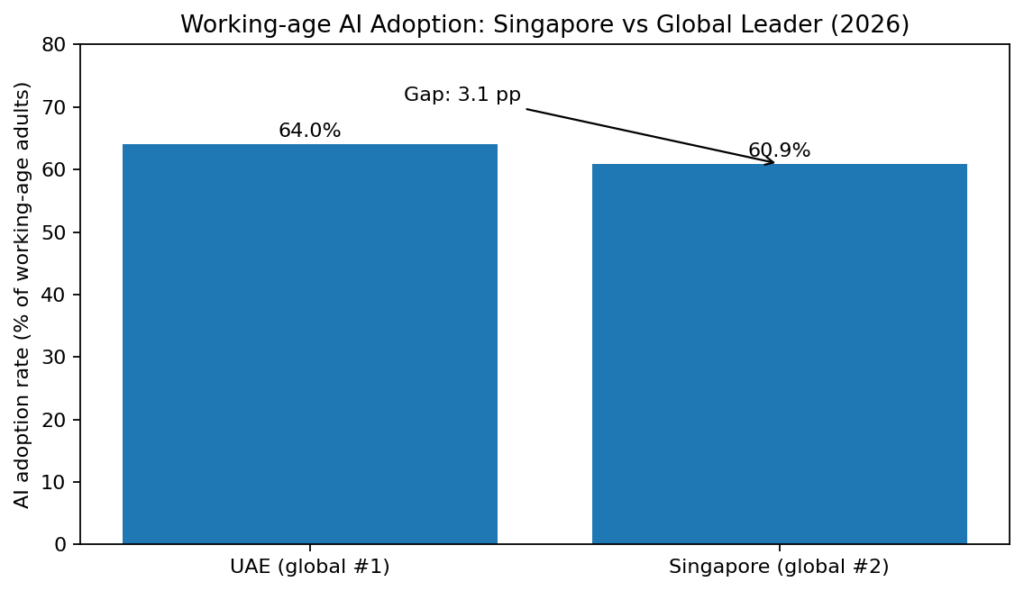
1. Singapore’s AI adoption rate of 60.9% among working-age adults places it second only to the UAE globally, signalling that Singapore has become one of the world’s most AI-integrated economies and a benchmark destination for businesses evaluating AI-ready markets.
2. With only a 3.1 percentage point gap separating Singapore from the global leader, Singapore’s AI adoption trajectory suggests it is well-positioned to close the gap or maintain its status as Asia’s top AI-adopting economy through 2026 and beyond.
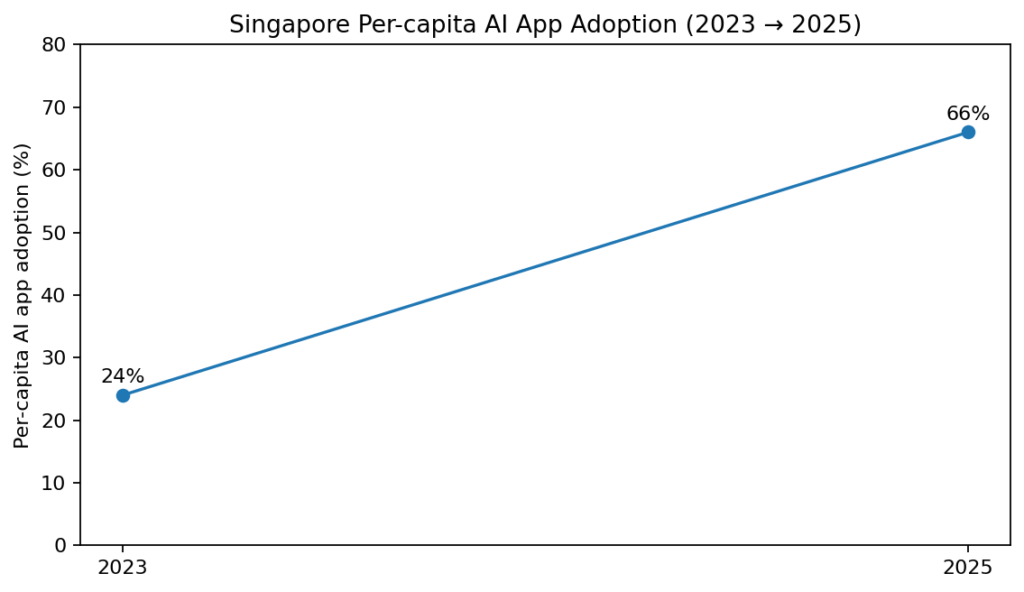
3. Singapore’s per-capita AI app adoption more than doubled in just two years — from 24% in 2023 to 66% in 2025 — reflecting an accelerating grassroots embrace of AI tools that extends well beyond enterprise use into everyday consumer behaviour.
4. Singapore’s government AI readiness score of 84.25 places it ahead of every European and Asian nation, demonstrating that its regulatory frameworks, talent pipelines, and public infrastructure make it a credible and stable environment for AI investment and deployment.
5. Scoring 0.80 out of 1.0 on Oxford Insights’ AI readiness scale, Singapore outranks all Asia-Pacific peers — including Japan, South Korea, and Australia — establishing it as the region’s definitive hub for AI governance, talent, and technology deployment.
6. While raw download volumes favour larger economies, Singapore’s six-times-higher per-capita AI adoption rate underscores that depth of usage, not just scale, determines which markets AI businesses should prioritise for product-market fit and early adopter feedback.
7. Singapore’s consistent year-on-year growth in AI app downloads — reaching 4 million in 2025 — indicates sustained consumer demand rather than a short-lived trend, providing a reliable foundation for AI product launches and digital marketing strategies targeting Singapore audiences.
8. By launching Southeast Asia’s first National AI Strategy in 2019, Singapore created an early-mover advantage in AI governance and talent development that continues to attract multinationals seeking a regulated, structured AI base in the region.
9. The structural foresight shown by Singapore and the UAE in building national AI strategies pre-ChatGPT explains their sustained leadership at the top of global AI adoption rankings, as government-led investment created compounding advantages in infrastructure, talent, and enterprise readiness.
10. Singapore’s slide from 1st to 2nd in global AI readiness rankings between 2023 and 2024 is not a sign of regression but of an increasingly competitive global landscape — Singapore’s policies and budget commitments suggest it remains firmly in the top tier through 2026.
SECTION 2: Singapore AI Market Size & Investment
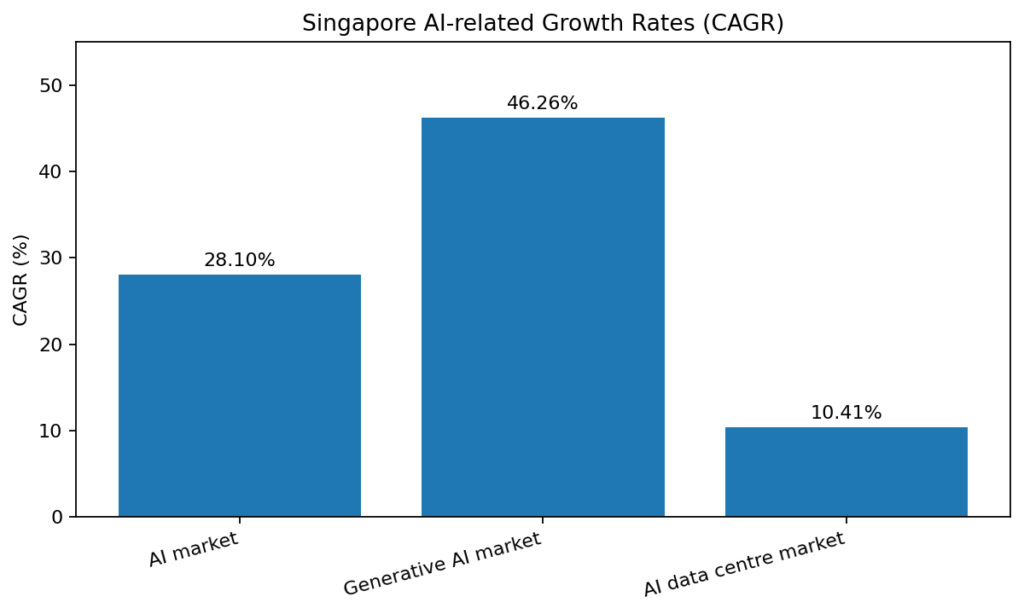
11. Singapore’s AI market is on track to grow at a 28.10% compound annual rate — nearly four times the global average for the broader tech sector — making it one of the most commercially compelling AI markets in the Asia-Pacific region for investors and technology vendors.
12. Singapore’s generative AI market is growing at a 46.26% CAGR, outpacing even the overall AI market, which signals that generative AI applications — including AI search, content generation, and conversational tools — represent the single fastest-growing commercial opportunity in Singapore’s tech landscape.
13. Singapore’s AI data centre market, growing at a 10.41% CAGR toward US$1.47 billion by 2031, reflects the physical infrastructure commitment underpinning its AI ambitions — and signals sustained demand for compute capacity that will continue to attract hyperscale operators to the city-state.
14. The dominance of Cloud Service Providers — commanding over half of Singapore’s AI data centre market — confirms that cloud-first AI deployment is the prevailing architecture for Singapore enterprises, making cloud platform proficiency a non-negotiable competency for local AI and digital marketing teams.
15. Singapore’s data centre market, projected to reach US$5.60 billion by 2030, provides the physical backbone for its AI economy, ensuring that latency-sensitive AI applications — including real-time search, personalisation engines, and language models — can operate at enterprise scale.
16. With over US$27 billion in combined public and private AI investment, Singapore has assembled one of the most heavily capitalised AI ecosystems per capita in the world, creating a reinforcing cycle where infrastructure investment attracts talent, which in turn attracts more capital.
17. Google’s US$5 billion infrastructure commitment to Singapore — its single largest data centre investment in the Asia-Pacific region — further cements Singapore’s role as the AI compute hub for Southeast Asia and strengthens Google’s ability to deliver AI-powered search products, including AI Overviews, to regional audiences with low latency.
18. Microsoft’s inclusion of Singapore in its US$80 billion global AI infrastructure programme reflects the city-state’s strategic value as a gateway to Southeast Asia and positions Singapore-based businesses to access cutting-edge Azure AI capabilities, including Copilot integrations, closer to home.
19. Singapore’s commitment of over SGD 1 billion to its National AI Research and Innovation Plan over five years is one of the most proportionally large public AI investments globally, directly funding the research, compute access, and talent pipelines that help local businesses develop competitive AI capabilities.
20. The 2026 Budget’s ‘Champions of AI’ programme and AI-specific tax incentives create a materially more attractive operating environment for AI adoption in Singapore, reducing the cost of entry for SMEs and startups that may otherwise have been priced out of enterprise-grade AI tooling.
21. Singapore’s AI R&D investment as a share of GDP is approximately 18 times larger than the equivalent US commitment — a striking figure that illustrates how seriously Singapore treats AI as a matter of national economic competitiveness rather than simply a technology trend.
22. IMDA’s S$70 million investment in SEA-LION — Southeast Asia’s first home-grown LLM — represents a strategic attempt to reduce regional dependence on US and Chinese AI models, and provides Singapore businesses with a culturally and linguistically localised AI option for serving Southeast Asian consumers.
23. Even before the generative AI boom, Singapore’s AI investment of US$1.87 billion in 2022 placed it alongside countries with populations many times its size, underscoring that capital density and strategic policy — rather than market size alone — determine AI investment leadership.
24. Singapore’s ability to attract US$4.27 billion in tech venture funding in just four months reflects its reputation as the region’s most sophisticated startup ecosystem, providing a funding environment that supports the AI-native companies driving innovation in search, content, and customer experience.
25. The US$660 billion global wave of AI infrastructure investment planned for 2026 creates a significant downstream windfall for Singapore, whose semiconductor and electronics export industries are direct beneficiaries — reinforcing why Singapore’s GDP growth forecast was raised for 2026.
SECTION 3: Singapore’s Economy & AI-Driven Growth
26. Singapore’s 5.0% GDP growth in 2025 — its strongest annual performance since 2021 — was materially powered by AI-driven demand for semiconductors and electronics, demonstrating that AI is no longer a future-looking investment theme in Singapore but an active contributor to current economic output.
27. Singapore’s Q4 2025 GDP growth of 6.9% — exceeding official forecasts by 1.2 percentage points — confirms that AI-related activity is accelerating beyond even government projections, adding urgency for businesses across all sectors to deepen their AI capabilities ahead of intensifying competition.
28. Singapore’s upward revision of its 2026 GDP forecast to 2%–4%, explicitly citing global AI investment momentum, signals that policymakers view AI not as a cyclical boost but as a structural driver of sustained economic growth — giving businesses a credible long-term signal to commit to AI transformation.
29. Singapore’s digital economy now accounts for 18.6% of GDP — up nearly four percentage points in five years — a trajectory that, if sustained, would make digital and AI-driven sectors the largest single contributor to Singapore’s economy within a decade.
30. The fact that two-thirds of Singapore’s S$12 billion digital economy growth in 2024 came from non-ICT sectors demonstrates that AI-driven digitalisation is a cross-industry phenomenon, and that AI search and marketing tools are equally relevant to traditional businesses as to tech companies.
31. Singapore’s contribution of roughly 15% of NVIDIA’s global revenues illustrates just how deeply embedded Singapore is in the infrastructure layer of the AI economy, and the leverage this gives it in shaping regional AI access and pricing.
32. A projected 18% AI-driven GDP contribution by 2030 puts Singapore at the forefront of AI economic transformation in Southeast Asia, underscoring why businesses operating in or targeting Singapore have a narrowing window to build AI-first capabilities before competitive parity shifts decisively.
33. Accenture’s projection that AI could add US$215 billion in gross value across 11 Singapore industries by 2035 serves as a reminder that the economic stakes of AI adoption extend far beyond productivity gains — they represent competitive survival for firms in sectors from finance to healthcare to professional services.
34. Singapore’s SGD 8.5 billion fiscal surplus forecast for 2026 reflects the tax revenue windfall generated by AI-driven corporate growth, providing the government with the fiscal headroom to continue funding AI programmes and infrastructure that benefit businesses operating in the city-state.
35. The steady growth of Singapore’s tech workforce to 214,000 in 2024 — with AI and data roles growing fastest — suggests the talent supply is responding to demand signals; however, the gap between AI job openings and qualified candidates remains a material risk for companies planning large-scale AI deployments.
SECTION 4: Enterprise AI Adoption in Singapore
36. The tripling of AI adoption among Singapore SMEs to 14.5% in 2024 marks a clear inflection point in the democratisation of AI tools, but it also means that the 85.5% of non-adopting SMEs risk falling behind competitors who are already compounding AI-driven efficiency gains.
37. The gap between SMEs (3 functions) and larger enterprises (5 functions) in AI deployment breadth indicates that SMEs are still applying AI more narrowly — often to a single workflow — whereas enterprise-level AI strategy increasingly spans the entire value chain.
38. With 81% of Singapore businesses planning to ramp up AI training investment in the near term, there is a clear consensus that the primary bottleneck to AI value creation is not technology access but workforce capability — a finding with direct implications for HR, L&D, and hiring strategies.
39. Strong satisfaction rates among Singapore AI adopters — with 67% content with ROI and 63% reporting tangible problem-solving impact — suggest that fears of AI overhyping are being tempered by real-world results, and should encourage still-cautious businesses to move from pilot to production AI deployments.
40. An average AI ROI of 16% — expected to nearly double to 29% within two years — positions AI investment among the highest-returning capital allocations available to Singapore enterprises, though the S$18.9 million average annual spend highlights that meaningful AI transformation requires significant up-front financial commitment.
41. A planned 38% increase in AI investment across Singapore businesses over the next two years signals that the current AI adoption wave is still building momentum — and companies that delay risk entering an already-saturated competitive landscape where early movers have locked in structural advantages.
42. The fact that just 6% of Singapore businesses are fully ready to deploy AI agents reveals a significant execution gap between AI aspiration and operational readiness, suggesting that most organisations still need to invest in data infrastructure, integration, and change management before autonomous AI workflows can deliver value.
43. Broad recognition of AI agents’ transformative potential among 70% of Singapore businesses indicates that agentic AI is moving from a niche concept to a mainstream strategic priority, with implications for how businesses will structure search, customer service, and content workflows over the next two to three years.
44. DBS Bank’s deployment of over 800 AI models generating S$750 million in economic value sets a compelling benchmark for enterprise AI ROI in Singapore’s financial sector, demonstrating that at scale, AI is not a cost centre but a material revenue and efficiency driver.
45. DBS’s delivery of 45 million monthly personalised AI interactions illustrates the scale at which AI-powered customer engagement now operates in Singapore’s banking sector — setting new consumer expectations across all industries for relevance, timing, and contextual accuracy.
46. OCBC’s deployment of an internal GPT model to all 30,000 global employees reflects a workforce-wide AI integration strategy that is rare globally and positions Singapore’s banking sector as a benchmark for enterprise AI adoption.
47. Singapore’s inclusion among the four nations with the world’s highest company-level AI adoption confirms that AI is being deeply embedded into Singapore’s commercial operations rather than remaining confined to research labs or pilot programmes, raising the competitive baseline for all market entrants.
48. The 20% improvement in job placement outcomes achieved by Singapore’s government AI platform demonstrates that public-sector AI applications are delivering measurable social and economic returns, reinforcing the government’s role as a credible AI early adopter.
SECTION 5: Singapore’s AI Workforce & Skills
49. With 73.8% of Singapore workers actively using AI tools — one of the highest workplace AI adoption rates in the world — AI literacy has become a baseline professional competency, with implications for hiring standards, performance expectations, and team structures.
50. The near-universal satisfaction rate among Singapore’s AI-using workforce — with 85% reporting measurable productivity gains — provides strong evidence that AI tool adoption translates into tangible output improvements, making the business case for broader AI rollout within organisations compelling.
51. The most popular AI use cases among Singapore workers — brainstorming, writing, and administration — are precisely the tasks most relevant to content marketing, SEO, and digital strategy teams, indicating that AI-assisted content creation and optimisation are already standard practice rather than emerging experiments.
52. The fact that nearly half of Singapore’s AI users cite creativity enhancement as a key use case — not merely automation — suggests AI is being embraced as a collaborative ideation tool, which has significant implications for how creative agencies, content teams, and marketers in Singapore approach their workflows.
53. Employer-supported AI adoption — through training, subsidised tools, and usage guidelines — appears to correlate strongly with high AI utilisation rates, suggesting that businesses that invest in structured AI enablement see materially higher adoption rates than those leaving employees to self-direct their AI learning.
54. The widespread intention to prioritise AI upskilling among Singapore firms reflects an industry-wide recognition that technology alone does not deliver AI value — people capability is the critical differentiator, and organisations investing in AI training today will compound that advantage over competitors who defer.
55. With nearly two-thirds of Singapore AI adopters planning to redesign roles around AI capabilities, the traditional job description is becoming a moving target — and businesses that proactively restructure workflows to leverage AI’s strengths will outperform those attempting to retrofit AI onto unchanged legacy operating models.
56. IMDA’s TeSA programme having upskilled over 340,000 individuals in AI-related competencies represents one of the most extensive public-funded tech reskilling efforts in the world relative to Singapore’s population size, providing a significant labour market foundation for the AI economy.
57. The steady growth of AI-specific requirements in Singapore tech job postings — from 11% to 14% over five years — likely understates actual demand, as many non-technical roles now implicitly require AI tool proficiency without formally listing it.
58. Singapore’s tech workers earning a median monthly wage of S$7,950 — 63% above the national median — reflects the sustained premium the market places on AI and digital skills, which should serve as a clear signal to professionals and employers about where to direct career development and compensation strategy.
59. AWS’s commitment to training 5,000 Singapore individuals annually is part of a broader pattern of hyperscalers investing in local talent pipelines — a self-reinforcing dynamic where cloud platform providers upskill potential enterprise clients, expanding the addressable market for their own AI services.
60. Oracle’s pledge to train 10,000 Singapore professionals by 2027 reflects the private sector’s recognition that talent scarcity is a market constraint for the entire AI ecosystem — and that vendor-led education programmes create both brand equity and a more capable customer base.
61. The stark confidence gap among Singapore business leaders — with 43% fearing talent shortages while only 30% feel their current workforce is adequately skilled — highlights that AI ambition in Singapore is substantially ahead of its execution capability, creating both a risk and an opportunity for organisations that invest deliberately in talent development.
62. The finding that fewer than half of Singapore business leaders have accurate visibility into their own organisation’s skill inventory is a fundamental barrier to effective AI workforce planning — organisations cannot deploy AI to close capability gaps they have not yet identified.
63. Singapore’s workers being recognised as the world’s fastest AI skill adopters reflects a cultural and institutional openness to technology-driven change that gives Singapore businesses a structural workforce advantage difficult to replicate quickly in markets where attitudes toward AI automation are more resistant.
SECTION 6: Generative AI Usage in Singapore
64. With 86% of students and 67% of employees having used generative AI, Singapore has achieved near-saturated awareness among its most productive demographic cohorts, meaning the competitive frontier has shifted from initial adoption to strategic depth — how well, how consistently, and how effectively people are using these tools.
65. A projected 203% increase in daily generative AI users over five years implies a near-tripling of intensive, habitual AI usage in Singapore — which will fundamentally reshape how consumers discover products, services, and information online, accelerating the transition from keyword-based search to conversational AI-driven discovery.
66. Saving over four hours per week per user, generative AI in Singapore is delivering time savings equivalent to more than one additional working day per person per week — a productivity impact that at scale translates to billions of dollars in economic value.
67. The majority of Singapore workers anticipating task automation or augmentation within five years reflects a forward-looking pragmatism — and it creates pressure on employers to communicate clearly about how AI will reshape roles before uncertainty hardens into disengagement or talent attrition.
68. The finding that barely half of Singapore employees believe their employer is making full use of generative AI reveals an implementation gap that is likely larger than leadership perception suggests — employees closest to day-to-day workflows often have the clearest view of where AI could add value but is not yet being applied.
69. Singapore’s broadly optimistic public attitude toward generative AI’s societal and economic benefits — with 64% anticipating positive social impact — is a meaningful social licence advantage that enables bolder AI policy and faster enterprise adoption compared to markets where public AI scepticism creates regulatory and reputational friction.
70. The top three barriers to generative AI adoption in Singapore — talent, risk, and understanding — are all fundamentally human and organisational rather than technological, confirming that the bottleneck to AI value realisation is change management and capability building, not the availability of sufficiently capable AI tools.
71. While the majority of Singapore workers have formed views about AI’s impact on their roles, the 19% who remain uncertain represent a significant portion of the workforce not yet adequately informed by their employers — a gap that risks translating into resistance, disengagement, or poor AI tool utilisation.
72. The relatively modest proportion of Singapore workers fearing full job displacement (11%) compared to those expecting positive impacts (16%) reflects a broadly measured, evidence-informed assessment of AI’s effects in a market where workers have enough real-world exposure to form grounded views.
73. The significantly higher uncertainty among Singapore’s knowledge workers about AI’s career impact — compared to task-based workers — likely reflects their greater awareness of how sophisticated AI tools are advancing into professional domains previously considered AI-resistant.
74. Singapore’s 200%+ year-on-year growth in AI search adoption is a clear signal that generative search tools are moving from niche to mainstream in one of Asia’s most digitally sophisticated markets — and Singapore businesses that have not yet adapted their content and SEO strategies to account for AI-generated answers risk rapid, significant visibility erosion.
75. The majority of Singapore’s Gen Z and nearly half of Millennials turning to AI assistants to guide purchasing decisions marks a structural shift in the consumer journey — one that means brand visibility in AI-generated recommendations has become as commercially important as visibility in traditional search engine results pages.
SECTION 7: Singapore AI Infrastructure & Data Centres
76. Singapore’s combination of 1.4 gigawatts of data centre capacity and a near-zero 1.4% vacancy rate reflects extraordinary demand pressure — a constrained supply that reinforces Singapore’s position as a premium AI infrastructure destination while also signalling a potential compute bottleneck that may affect cost and availability for AI-dependent businesses.
77. The government’s allocation of an additional 300 megawatts of data centre capacity — with the first 80MW arriving in 2026–2028 — provides a degree of forward capacity assurance for enterprises planning long-horizon AI deployments in Singapore.
78. The IT sector’s dominant share of Singapore’s AI data centre revenue is expected to be increasingly challenged by Internet & Digital Media players growing at an 11.02% CAGR — reflecting how generative AI applications in content, advertising, and search are becoming significant compute consumers in their own right.
79. Equinix’s US$260 million SG6 investment — featuring advanced liquid cooling technology — not only adds scarce capacity to Singapore’s constrained data centre market but signals that hyperscale operators are designing next-generation AI infrastructure specifically for Singapore’s climate and sustainability requirements.
80. The Equinix-NUS Co-Innovation Facility at SG6 exemplifies Singapore’s approach to AI infrastructure challenges: addressing energy and cooling constraints through publicly funded innovation partnerships rather than regulatory exemptions — a model that may produce globally replicable sustainability breakthroughs.
81. Singapore’s regulatory requirements for data centre energy and water efficiency — among the strictest in Asia — raise the bar for AI infrastructure operators and reflect the government’s intent to grow AI compute capacity without disproportionate environmental cost.
82. SEA-LION’s training across 11 Southeast Asian languages gives it a structural multilingual advantage over US-built LLMs for regional applications, and businesses targeting Singapore’s multilingual consumer base may find SEA-LION offers better contextual accuracy for local language content generation and search optimisation.
83. Singapore’s roadmap to expand SEA-LION into a multimodal AI ecosystem covering image, speech, and video signals its ambition to build a full-stack regional AI platform — which could reduce Southeast Asian businesses’ dependency on US providers for AI-powered content, customer service, and search applications.
84. With a planned scale of 30–50 billion parameters, SEA-LION would represent a significant technical achievement and a genuine regional AI capability, though it remains substantially smaller than frontier models like GPT-4o — a reality check for expectations about its competitiveness in complex reasoning tasks.
85. Singapore’s selection to host one of the world’s first international AI safety institutes validates its standing as a trusted, neutral AI governance actor and provides a platform to shape global AI safety norms in ways that protect and benefit Singapore’s own AI-dependent industries.
SECTION 8: AI Search Platforms — Global Context Relevant to Singapore
86. ChatGPT’s 800 million weekly active users make it one of the fastest-growing platforms in technology history, and its dominance in AI search means that any Singapore brand serious about AI search visibility must optimise specifically for ChatGPT’s citation and recommendation patterns — which differ significantly from Google’s ranking algorithm.
87. ChatGPT’s monthly visit volume already exceeds Bing’s by a factor of 2.6x, and while Google still commands far greater search volume, ChatGPT’s trajectory signals that AI-native search is not a supplementary channel but an increasingly primary discovery platform that demands dedicated optimisation investment from Singapore businesses.
88. ChatGPT’s 81% share of the global AI chatbot market and 2 billion daily queries indicate a winner-takes-most dynamic in AI search — suggesting ChatGPT’s current position may be durable and warrants treating it as the primary AI search channel for optimisation alongside Google.
89. ChatGPT’s rise to the 4th most visited website globally in less than three years since its public launch is an unprecedented adoption trajectory, and its position among sites like Google, YouTube, and Facebook serves as a stark reminder that AI-generated answers are now a primary touchpoint in the consumer research journey.
90. ChatGPT’s near-70% growth in monthly prompt volume in just six months of 2025 demonstrates that usage depth — not just user numbers — is accelerating, meaning AI platforms are capturing an increasing share of query volume that was previously directed to traditional search engines.
91. Google AI Overviews reaching 1.5 billion monthly users across 200+ countries confirms that Google has successfully integrated generative AI into mainstream search at a scale no other AI platform approaches — and for Singapore businesses, this means AI Overviews are the single most impactful AI search feature to optimise for in terms of total audience reach.
92. Google AI Overviews’ expansion from appearing in 6.49% to over 30% of search queries within six months is one of the most rapid changes to the Google SERP in its history — meaning nearly one in three search queries in Singapore now returns an AI-generated answer before any traditional organic result.
93. Perplexity’s 780 million monthly queries and search-native design — with inline citations and verified sources — make it disproportionately influential among researchers, journalists, and B2B decision-makers: a high-value audience segment for Singapore professional services, finance, and technology brands.
94. The AI chatbot market’s three-player dynamic means Singapore businesses need multi-platform GEO strategies: optimising for ChatGPT alone leaves significant visibility gaps on platforms increasingly embedded in Microsoft Office and Google Workspace environments used daily by Singapore professionals.
95. AI-generated referral traffic growing 357% year-on-year to 1.13 billion monthly visits represents one of the fastest channel growth rates in the history of digital marketing — and the growth trajectory demands that Singapore marketers begin developing AI referral optimisation strategies today rather than waiting for the channel to mature further.
96. ChatGPT’s 50% share of all AI referral traffic makes it the dominant AI acquisition channel for websites today, and for Singapore businesses seeking to convert AI-driven brand discovery into measurable website visits and leads, ChatGPT citation optimisation offers the highest near-term referral traffic opportunity of any AI platform.
97. Generative AI’s dominance of the AI search market at over 54% share signals that the era of purely algorithmic search is giving way to AI-synthesised answers — a shift that requires Singapore marketers to move beyond traditional link-building and keyword strategies toward authority-building approaches that earn citations from AI language models.
98. Asia-Pacific’s 19.3% share of the global AI search market combined with its fastest-growing status makes it the most commercially dynamic region for AI search right now — and Singapore, as the region’s AI readiness leader, is uniquely positioned to be both a beneficiary of and a key contributor to this regional AI search expansion.
SECTION 9: AI Search Behaviour & Zero-Click Trends
99. The fact that 69% of Google searches produce no click to any website represents an existential challenge to traditional SEO strategies built around driving organic traffic, and forces Singapore businesses to rethink how they measure search visibility and brand exposure beyond click-through rates.
100. The staggering 93% zero-click rate in Google’s AI Mode — compared to 34% for standard search — makes a compelling case for investing in AI citation strategies that ensure brand mention without relying on click-through as the primary measure of success.
101. With three in four mobile Google searches ending without a click, Singapore’s mobile-first consumers are increasingly receiving answers directly in the search interface — meaning that for mobile-targeted marketing in Singapore, AI Overview visibility may now be more valuable than the first organic position.
102. Widespread consumer reliance on zero-click results is not a passive behaviour but an active preference — users are choosing to trust AI-synthesised answers over navigating to individual websites, which means Singapore brands optimising only for click-through traffic are failing to account for the largest portion of the total search audience.
103. A 58% average reduction in website clicks when an AI Overview is present quantifies the traffic impact that Singapore digital marketers have been debating since AI Overviews launched — making adapting to AI search not optional but a commercial imperative for any Singapore business that depends on organic search traffic.
104. The dual finding that AI Overviews reduce overall organic CTR by 61% while cited brands see a 35% boost reveals that AI search creates a highly uneven playing field — one where being cited in an AI Overview is a major competitive advantage rather than simply a nice-to-have.
105. The CTR impact of AI Overviews on position-1 rankings — ranging from 15.5% to 34.5% depending on the study — marks the end of the era where achieving the top organic ranking provided reliable click-through dominance; Singapore businesses that have built growth models around owning first-position rankings need to reassess their traffic assumptions.
106. BrightEdge’s finding that search impressions grew 49% while CTR fell 30% paints a nuanced picture: total search activity is rising — good for brand awareness — but the conversion from awareness to website visit is becoming harder, requiring Singapore businesses to optimise for AI mentions as a distinct funnel stage.
107. Pew Research’s analysis of nearly 69,000 real search sessions showing that AI Overviews halve click-through rates to traditional results provides some of the most methodologically rigorous evidence yet that AI-generated answers are a structural substitute for website visits — not merely a supplementary feature.
108. The 1,500-pixel displacement of organic results by Google AI Overviews on desktop — equivalent to two to three full page scrolls — means that even top-ranked content has effectively been relegated below the fold, with implications for Singapore brands in competitive search categories where position-one rankings were previously considered premium real estate.
109. The more than doubling of user engagement time in Google’s AI Mode compared to standard AI Overviews suggests that as AI search experiences become richer, users are spending more of their total search session within Google’s own interface — further compressing the opportunity for Singapore brands to capture attention on their own websites.
110. The finding that 75% of Google AI Mode sessions are fully self-contained provides strategic guidance for Singapore brands: informational and research-stage content must be optimised for AI citation and in-search visibility, while commercial landing pages remain relevant for capturing intent-rich transactional clicks.
111. The current 1.08% share of website traffic from AI referrals — compared to 25% from organic search — puts AI search’s traffic impact in perspective: traditional SEO still drives significantly more traffic, but given AI referral traffic’s 357% YoY growth rate, Singapore marketers are likely seeing a very different balance within two to three years.
112. ChatGPT’s near-monopoly on AI referral traffic at 87.4% creates a clear prioritisation directive for Singapore businesses: while building a multi-platform AI presence is strategically sound, the overwhelming majority of immediate AI referral traffic opportunity resides in a single platform, and ChatGPT citation optimisation should be the first and most resourced AI search investment.
SECTION 10: Generative Engine Optimisation (GEO) & AI Citations
113. The projected 25% decline in traditional search volume by 2026 and potential 50%+ organic traffic loss for certain categories is not a distant hypothetical — Singapore businesses in information-rich sectors like finance, healthcare, and legal services may already be experiencing the early stages of this transition and need to act now to diversify their digital discovery strategies.
114. A 7.9% drop in Google’s total traffic from 2023 to 2024 represents the first sustained, statistically meaningful decline in Google’s search dominance in two decades — an empirical signal that the channel mix for search-driven customer acquisition is shifting in ways that require active strategic adaptation.
115. Singapore’s 200%+ year-on-year growth in AI search adoption creates compounding urgency for local businesses: each month of delayed GEO investment is a month of competitive ground lost to early-mover brands already securing AI citation positions in Singapore-relevant queries.
116. The strong overlap between Google AI Overview citations and traditional top-10 rankings — 76.1% — confirms that a high-quality traditional SEO foundation remains the most reliable pathway to AI Overview citation eligibility, and Singapore businesses should prioritise earning top-10 rankings before layering dedicated GEO optimisation tactics on top.
117. The near-total concentration of AI Overview citations among top-10 ranked domains establishes a clear authority prerequisite for AI citation eligibility — but the many top-10 pages not cited shows that ranking alone is insufficient; structure, format, and content authority are the differentiating factors.
118. The remarkable finding that more than a quarter of ChatGPT’s most frequently cited pages are invisible in Google’s organic results reveals that ChatGPT uses a fundamentally different source selection model — and means Singapore businesses should develop ChatGPT-specific strategies including participation in forums, wikis, and third-party platforms.
119. The near-complete divergence between ChatGPT and Google search results — with less than 7% overlap — is the most compelling quantitative argument for treating GEO as a discipline distinct from SEO; Singapore businesses that assume Google optimisation automatically delivers ChatGPT visibility are operating on a dangerously flawed assumption.
120. AI systems being 6.5 times more likely to cite third-party sources referencing a brand than the brand’s own website fundamentally inverts the traditional SEO playbook — for Singapore businesses, earned media, review platforms, industry publications, and social community mentions are not supplementary to GEO strategy but its primary engine.
121. The extreme volatility of AI Overview content — changing 70% of the time and replacing nearly half of citations with each regeneration — means that AI citation is better understood as a probabilistic share-of-voice metric rather than a stable ranking position, requiring Singapore businesses to monitor AI visibility continuously.
122. The vanishingly small probability of AI platforms returning identical brand lists in consecutive responses to the same query underscores why AI search visibility cannot be measured with traditional rank-tracking tools — Singapore businesses need share-of-voice metrics across hundreds of query variations to meaningfully assess their AI search presence.
123. The finding that nearly half of all LLM citations derive from the opening third of content is the single most actionable GEO insight for Singapore content teams: leading articles, web pages, and product descriptions with the most authoritative, fact-dense, and directly relevant information is one of the highest-leverage content changes a business can make to improve AI citation rates.
124. AI platforms’ preference for content that is 25.7% more recently updated than traditional search results adds content freshness to the growing list of factors that differ between SEO and GEO — giving Singapore businesses that publish regularly updated content a material advantage over competitors with static, evergreen-only content strategies.
125. ChatGPT’s exceptional recency bias — with over three-quarters of its top-cited pages updated within 30 days — creates a clear content publication imperative for Singapore businesses: regular content refreshes and timely commentary on current industry developments are likely as important as long-form cornerstone content for earning ChatGPT citations.
126. The near-quadrupling of the AI SEO tools market from US$1.2 to US$4.5 billion over nine years reflects the commercial sector’s confidence that AI-integrated search optimisation is a permanent feature of the digital marketing landscape — and Singapore businesses should expect AI-native SEO tools to become standard in marketing technology stacks within two to three years.
127. The combination of majority marketer adoption and reported gains of 45% in organic traffic and 38% in eCommerce conversions from AI-assisted SEO workflows provides Singapore businesses with both a competitive benchmark and a commercial incentive — peers already using AI in SEO are compounding performance advantages that will become increasingly difficult to close for late adopters.
128. Only 25.7% of global marketers currently plan to create content specifically designed to earn AI citations — and for Singapore businesses, this relatively uncrowded field represents a meaningful first-mover opportunity to establish AI citation authority before competitor brands invest at scale.
129. With 38% of global decision-makers already budgeting for GEO and AEO, the practice has crossed the threshold from early adopter experiment to mainstream business investment — and Singapore businesses that have not yet established a budget line for AI search optimisation risk being structurally disadvantaged as AI citation landscapes become increasingly contested.
130. AI search traffic’s 14.2% conversion rate — five times higher than Google’s organic 2.8% — is perhaps the most commercially compelling statistic for Singapore digital marketers: AI-referred visitors arrive with significantly higher purchase intent, making every AI citation worth multiple times its equivalent in traditional organic traffic.
131. The tripling of AI Overview presence in Singapore-relevant Google queries from 6.49% to approximately 20% during 2025 marks a critical threshold: at one in five searches now returning an AI Overview, AI-generated results have moved from exception to commonplace in the Singapore search experience.
132. The above-average AI Overview presence in Singapore’s technology (+22%) and healthcare (+20%) sectors means businesses in these industries face the most urgent GEO investment imperative, as AI citations carry significant influence over professional and consumer decisions in high-stakes, information-intensive categories.
133. The 60–90 day timeline to initial AI citation results following GEO implementation, with consistent performance expected at 6–12 months, positions AI search optimisation on a similar investment horizon to traditional SEO — meaning Singapore businesses that begin now can realistically expect measurable AI visibility improvements by the end of 2026.
134. The diversification of search behaviour among Singapore’s most tech-forward users — splitting queries across Google, ChatGPT, Perplexity, and other AI tools — is a leading indicator of where the broader population will be in two to three years, justifying a platform-agnostic AI search presence that does not bet exclusively on Google’s continued dominance.
135. The explosive growth of Microsoft Copilot (25.2x) and Claude (12.8x) as AI search platforms signals that AI search discovery is rapidly embedding itself into the workplace tools Singapore professionals use daily — meaning B2B brands face a particularly urgent need to build AI visibility beyond consumer-facing ChatGPT and Google Overviews.
SECTION 11: AI Citation Patterns & Content Authority
136. Reddit’s disproportionate AI citation rate — being cited more frequently than its organic search traffic share would predict — is a clear signal for Singapore brands to engage authentically with relevant Reddit communities, as AI systems appear to weight Reddit content highly as a proxy for authentic, community-validated information.
137. Wikipedia’s near-50% share of ChatGPT’s most cited sources provides a concrete, high-priority GEO action for Singapore brands: ensuring accurate, comprehensive, and regularly updated Wikipedia presence for the brand, key executives, and core product categories significantly improves the probability of ChatGPT citation.
138. YouTube’s dominance of Perplexity’s citation profile at 16.1% reveals a platform-specific citation dynamic that many GEO guides overlook: Singapore businesses optimising for Perplexity visibility should invest in YouTube content strategy, as well-titled, transcribed, and described videos can earn Perplexity citations that text-only websites cannot.
139. The remarkably low overlap between Google’s own AI Overviews and AI Mode citation sets — despite both being Google products — confirms that different AI search environments apply distinct source selection criteria, and Singapore businesses must optimise for multiple AI surfaces rather than assuming AI Overview citations transfer automatically to AI Mode visibility.
140. The highly concentrated citation structure of Google AI Overviews — where just 20 domains capture two-thirds of all citations — makes the strategic imperative clear for Singapore brands: building genuine domain authority is the prerequisite to competing for AI citation share rather than remaining in the long tail.
141. Google’s tendency to cite its own properties — controlling 23% of AI Overview citations directly — reinforces the value of earning YouTube presence and Google Business Profile completeness as part of a holistic AI visibility strategy for Singapore businesses.
142. The near-total inconsistency of Google AI Mode results — overlapping with themselves just 9.2% of the time across identical queries — means Singapore marketers need statistical sampling methods and share-of-voice frameworks to meaningfully measure AI Mode brand visibility rather than relying on point-in-time rank checks.
143. The near-total divergence of citations between ChatGPT and Perplexity for identical queries confirms that no single-platform GEO strategy provides adequate AI search coverage — and brands who invest in multi-platform optimisation gain visibility advantages that competitors focused on a single platform entirely miss.
144. The striking finding that AI Overview citations lift paid search CTR by 91% — not just organic CTR — reveals that AI citation creates a halo effect extending beyond organic channels, making AI Overview presence valuable to Singapore businesses running paid search campaigns as a combined brand authority signal.
145. ChatGPT’s 2.38% rate of citing non-existent URLs — nearly three times the link error rate of traditional Google Search — underlines the importance for Singapore businesses of maintaining stable URL structures and canonical content to reduce the likelihood of being cited with an incorrect or broken link.
146. Ahrefs’ research identifying YouTube mentions and branded web mentions as the top predictors of AI brand visibility across multiple platforms consolidates the GEO strategy for Singapore businesses into two actionable priorities: building an active YouTube presence and generating consistent third-party brand mentions across credible online sources — both of which compound over time.
147. Ahrefs’ internal data showing AI-referred visitors converting to signups at a rate 24 times higher than their traffic share reframes AI search visibility not as a traffic volume play but as a quality of intent advantage — and presents Singapore businesses with one of the strongest commercial cases for GEO investment that can be taken to a CFO.
148. ChatGPT’s reduction from 6–7 to just 3–4 brand mentions per response following its October 2025 update is a significant competitive narrowing of the AI citation landscape — raising the stakes for AI search optimisation considerably, as the field of brands capable of earning a ChatGPT mention for any given query has effectively shrunk by half.
149. The outsized growth of AI search referral traffic in Legal (11.9x), Finance (2.9x), and Health (2.9x) sectors is highly relevant for Singapore, given the city-state’s prominence as a financial and professional services hub — firms in these industries face both the greatest urgency and the greatest opportunity to capture AI search visibility before the channel becomes as competitive as traditional organic search.
150. The prediction that AI search will generate more website referrals than traditional search within just two to three years implies that the window for building AI search authority before it becomes as competitive as Google SEO is measured in months, not years — and that 2026 is a pivotal year for Singapore businesses to establish position.
151. The counterintuitive finding that Google search usage increased rather than decreased among ChatGPT adopters should reassure Singapore SEO practitioners that AI search does not obsolete traditional search investment — rather, AI tools appear to stimulate more overall search behaviour, which means both SEO and GEO deserve sustained investment rather than one substituting for the other.
152. Google’s processing of over 5 trillion searches per year contextualises the current AI search disruption: while AI platforms are growing rapidly, the raw scale of Google’s query volume means traditional SEO still reaches vastly larger audiences than all AI search platforms combined — and Singapore businesses should maintain SEO excellence while building complementary AI visibility strategies.
153. Generative AI tools now reaching 16.3% of the global population — growing at more than 1 percentage point per half-year — indicates that AI search is still in its early mass-market phase, meaning Singapore businesses entering the AI search optimisation arena in 2026 are doing so at a stage where meaningful first-mover advantages are still available to claim.
Conclusion
The rapid evolution of artificial intelligence has fundamentally reshaped how information is discovered, interpreted, and delivered across digital platforms, and Singapore represents one of the most advanced environments where this transformation is unfolding. The 153 statistics, data points, and trends explored throughout this report highlight a clear reality: AI-powered search and Generative Engine Optimization are no longer emerging concepts but core components of the modern digital ecosystem. As Singapore continues to strengthen its position as a global technology hub, the influence of AI search technologies is becoming increasingly visible across industries, consumer behavior, and business strategies.
The data presented reveals that AI-driven search adoption in Singapore is accelerating across multiple sectors. From consumers using conversational AI assistants to research products and services, to enterprises integrating AI-powered knowledge retrieval systems, the shift toward intelligent search experiences is reshaping how information flows across the internet. Singapore’s highly connected population, combined with strong digital infrastructure and progressive innovation policies, creates an environment where AI-powered discovery tools can thrive and evolve quickly.
One of the most important takeaways from these statistics is the growing importance of Generative Engine Optimization. As AI platforms increasingly provide direct answers rather than lists of links, businesses must adapt their content strategies to ensure their information can be accurately interpreted, referenced, and summarized by generative AI systems. Traditional search engine optimization remains relevant, but it is now complemented by GEO practices that focus on semantic clarity, authoritative sources, structured data, and context-rich information. Organizations that understand how AI models retrieve and synthesize content will be better positioned to maintain digital visibility in this evolving landscape.
The Singapore market also demonstrates how AI search is changing user behavior. Consumers are increasingly relying on conversational interfaces, voice search tools, and AI-generated summaries to obtain quick, reliable insights. This shift reduces the number of traditional search clicks and encourages more interactive and personalized search experiences. As a result, businesses must rethink how they present information online, ensuring that content is designed not only for human readers but also for AI systems that analyze, interpret, and generate responses from it.
Another critical trend highlighted by the data is the expansion of AI search across multiple industries. E-commerce platforms are leveraging AI to improve product discovery, financial institutions are deploying intelligent assistants for customer queries, healthcare providers are using AI-driven research tools, and educational institutions are adopting generative AI to support learning and knowledge retrieval. These developments demonstrate that AI search is no longer confined to technology companies; it is becoming a foundational capability across the broader digital economy.
Singapore’s proactive approach to artificial intelligence governance and innovation has also played a significant role in shaping these developments. National strategies supporting AI research, talent development, and responsible deployment have encouraged businesses and startups to experiment with generative technologies while maintaining trust and transparency. This policy environment ensures that AI search technologies can grow responsibly while delivering measurable benefits to both organizations and consumers.
For marketers, publishers, and digital strategists, the implications are substantial. The traditional digital marketing playbook must evolve to account for AI-powered discovery channels. Content strategies must prioritize expertise, authority, and contextual relevance so that AI systems recognize the credibility of sources. Structured content frameworks, knowledge graphs, and entity-based optimization will likely become increasingly important as generative models continue to refine how they identify and synthesize reliable information.
The statistics presented throughout this report also highlight a growing competitive advantage for organizations that embrace GEO early. Companies that invest in AI-friendly content structures, authoritative digital assets, and semantic optimization will have greater opportunities to appear in AI-generated responses and knowledge summaries. In contrast, businesses that rely solely on traditional SEO tactics may find it more difficult to maintain visibility as AI-driven search experiences become the dominant interface for information discovery.
Looking ahead, the trajectory of AI search in Singapore suggests that generative technologies will continue to redefine the boundaries of digital interaction. As AI models become more sophisticated and capable of delivering richer contextual answers, the line between search engines, digital assistants, and content platforms will become increasingly blurred. Users will expect faster, more accurate, and more personalized responses, while businesses will need to adapt their digital strategies to meet these expectations.
The 153 statistics compiled in this report provide a comprehensive snapshot of this transformation at a pivotal moment. They illustrate the scale of AI search adoption, the momentum behind GEO strategies, and the growing importance of data-driven decision-making in the age of generative technology. More importantly, they reveal how Singapore’s digital ecosystem is evolving in response to these innovations, offering insights that are relevant not only locally but also globally.
As the digital landscape continues to shift, organizations that remain informed, adaptable, and strategically aligned with AI search developments will be best positioned for long-term success. Monitoring emerging trends, analyzing market data, and refining optimization strategies will be essential for maintaining visibility in an environment where AI systems increasingly act as the primary gateway to information.
Ultimately, AI search and Generative Engine Optimization represent more than just technological advancements; they signal a fundamental change in how knowledge is accessed and shared across the internet. Singapore’s leadership in digital transformation makes it an important case study for understanding these shifts. By examining the data, trends, and insights presented in this report, businesses, researchers, and digital professionals can better prepare for a future in which AI-driven discovery becomes the standard for navigating the world’s information.
If you are looking for a top-class digital marketer, then book a free consultation slot here.
If you find this article useful, why not share it with your friends and business partners, and also leave a nice comment below?
We, at the AppLabx Research Team, strive to bring the latest and most meaningful data, guides, and statistics to your doorstep.
To get access to top-quality guides, click over to the AppLabx Blog.
People also ask
What is AI search and how is it changing search behavior in Singapore?
AI search uses artificial intelligence to generate direct answers, summaries, and recommendations. In Singapore, it is changing how users find information by prioritizing conversational queries, faster responses, and AI-generated insights instead of traditional search result pages.
What does Generative Engine Optimization (GEO) mean in digital marketing?
Generative Engine Optimization focuses on optimizing content so AI systems can understand, summarize, and reference it in generated answers. GEO helps businesses increase visibility within AI-powered search tools and conversational interfaces.
Why are AI search statistics important for Singapore businesses in 2026?
AI search statistics help businesses understand user behavior, market adoption, and digital trends. These insights guide companies in adapting marketing strategies and optimizing content for AI-driven discovery platforms.
How popular is AI-powered search in Singapore in 2026?
AI-powered search adoption is growing rapidly in Singapore due to high internet penetration and digital readiness. Many users now rely on AI assistants and generative tools for quick answers, research, and product discovery.
How is AI search different from traditional search engines?
Traditional search engines show lists of web links based on keywords. AI search systems generate direct responses by analyzing multiple sources and delivering summarized information through conversational interfaces.
Why is Generative Engine Optimization becoming important in Singapore?
As AI search tools become more widely used, businesses must ensure their content is easily interpreted by AI models. GEO helps brands remain visible in AI-generated answers and intelligent search experiences.
What industries in Singapore are adopting AI search the fastest?
Industries such as e-commerce, finance, technology, education, and healthcare are leading AI search adoption in Singapore. These sectors use AI tools to improve customer support, research capabilities, and digital engagement.
How do AI assistants influence online search trends in Singapore?
AI assistants allow users to ask natural language questions and receive direct responses. This changes search behavior by reducing the need to click multiple links and encouraging conversational information discovery.
What role does data play in AI search optimization?
Data helps AI systems understand context, relevance, and credibility. High-quality, structured, and authoritative data improves the chances of content being referenced or summarized by AI search platforms.
How does GEO affect content marketing strategies in Singapore?
GEO encourages businesses to create informative, structured, and authoritative content that AI models can easily interpret. This approach improves the chances of being cited in AI-generated search results.
Are AI-generated search results replacing traditional SEO?
AI search is not replacing SEO but expanding it. Traditional SEO still matters for rankings, while GEO focuses on ensuring content appears in AI-generated answers and summaries.
What are the key AI search trends in Singapore for 2026?
Major trends include increased use of conversational AI, AI-powered recommendations, generative search results, voice-based queries, and the integration of AI assistants into everyday digital platforms.
How can businesses prepare for AI search optimization?
Businesses can prepare by producing high-quality content, improving semantic structure, adding structured data, and focusing on expertise and credibility to help AI systems understand and reference their content.
Why are statistics important for understanding AI search growth?
Statistics reveal adoption rates, user behavior patterns, and market trends. These insights help businesses evaluate opportunities and adjust strategies for AI-powered search environments.
How does Singapore’s digital infrastructure support AI search adoption?
Singapore has strong internet connectivity, advanced technology ecosystems, and supportive government initiatives. These factors encourage rapid adoption of AI technologies, including intelligent search platforms.
What types of content perform best in AI search results?
Content that is clear, well-structured, factual, and authoritative performs best. Informative articles, research reports, guides, and expert insights are more likely to be referenced by AI systems.
How does AI search impact digital marketing in Singapore?
AI search changes digital marketing by shifting focus from keyword rankings to authoritative content and semantic relevance. Marketers must optimize content for both users and AI-generated answers.
What role do conversational queries play in AI search?
Conversational queries allow users to ask questions in natural language. AI systems interpret these queries and provide context-rich responses rather than simple lists of links.
Why are businesses tracking AI search data and trends?
Tracking AI search data helps companies understand how digital discovery is evolving. This knowledge allows them to improve marketing strategies and maintain visibility in AI-powered platforms.
How is generative AI shaping the future of search in Singapore?
Generative AI is transforming search by producing summaries, insights, and personalized responses. This creates faster and more intuitive ways for users to access information online.
What is the connection between GEO and AI-generated answers?
GEO ensures that content is structured and credible so AI systems can extract and reference it. This increases the likelihood of appearing in AI-generated responses.
How do AI search tools affect website traffic patterns?
AI search tools may reduce traditional clicks because users receive answers directly in AI interfaces. However, high-quality sources can still gain visibility and credibility through AI references.
Why is authoritative content important for AI search?
AI systems prioritize trustworthy sources when generating responses. Authoritative content with reliable data and expertise increases the chances of being included in AI-generated answers.
How do Singapore consumers use AI search tools?
Consumers use AI search for research, product comparisons, recommendations, educational queries, and quick answers. AI assistants make these tasks faster and more convenient.
What metrics indicate success in AI search optimization?
Metrics include AI citation frequency, visibility in AI-generated responses, content authority signals, and engagement levels across AI-powered search platforms.
How does structured data improve AI search visibility?
Structured data helps AI systems understand the context and meaning of content. This improves the chances of information being accurately extracted and used in generated answers.
What role does Singapore play in the global AI search landscape?
Singapore is a leading technology hub in Asia, making it a key market for AI innovation. Its digital ecosystem supports rapid adoption and experimentation with AI-powered search technologies.
How can marketers benefit from AI search insights and statistics?
Marketers can use AI search statistics to understand user behavior, optimize content strategies, and identify emerging trends that influence digital visibility and engagement.
What challenges come with the rise of AI-powered search?
Challenges include reduced traditional traffic, increased competition for authoritative content, and the need for businesses to adapt quickly to new optimization strategies like GEO.
What does the future of AI search in Singapore look like?
The future will likely include more personalized AI assistants, deeper integration of generative AI into search platforms, and greater reliance on conversational interfaces for information discovery.
Sources
Microsoft AI Economy Institute
Cybernews AI Adoption Index
Index.dev
Statista
Introl
Mordor Intelligence
CNBC
Reuters
Investing
British Chamber of Commerce Singapore
Georgetown CSET
SMF CCL
IMDA
SAP
Oxford Economics
Deloitte Southeast Asia
Workday
ADP Research
Georgetown CSIS
Makebot
CRN Asia
Exposure Ninja
Visual Capitalist
Bain & Company
Omnius
Coherent Market Insights
Dataslayer
BrightEdge
Position Digital
The Digital Bloom
Passionfruit
SE Ranking
Pew Research
Ahrefs
Amsive
OOm Singapore
MediaPlus Digital
ABuzz Singapore
IMPACT Brand Communications Singapore
ContentGrip
SparkToro
Conductor
Profound
Previsible
Graphite
GenesysGrowth
Marketing Interactive