























Key Takeaways
- Egypt’s rapidly growing internet penetration, mobile-first population, and expanding AI infrastructure are accelerating the adoption of AI-powered search and generative technologies.
- The rise of tools like ChatGPT and Google AI search features is reshaping digital discovery, making Generative Engine Optimization (GEO) essential for visibility in Egypt’s evolving search landscape.
- Strong government AI strategies, increasing digital investment, and growing Arabic content opportunities position Egypt as a key emerging market for AI search, GEO, and digital innovation.
Artificial intelligence is rapidly transforming how people search for information, discover brands, and interact with digital content. Across the world, traditional search engines are evolving into AI-powered discovery systems that generate answers rather than simply listing links. In this new environment, businesses must rethink how they create, structure, and distribute online content. Egypt stands at the centre of this shift in the Middle East and North Africa region, emerging as one of the fastest-growing digital markets where AI search, generative tools, and Generative Engine Optimization (GEO) are beginning to reshape the rules of online visibility.

With a population exceeding 119 million and one of the youngest demographics in the world, Egypt represents a powerful intersection of digital growth, mobile connectivity, and increasing AI adoption. Internet penetration has surged in recent years, placing tens of millions of Egyptians online and creating an enormous addressable audience for AI-driven search platforms. At the same time, the country’s mobile-first internet culture means that most online interactions occur through smartphones, voice assistants, and social platforms. This environment is ideally suited to the rise of conversational search tools such as ChatGPT, Google AI Overviews, and other generative AI interfaces that deliver direct answers rather than traditional search results.
The shift toward AI-powered search experiences is not merely a technological change; it is fundamentally altering the economics of digital marketing, content strategy, and brand discovery. For decades, search engine optimization focused on ranking webpages for keywords and attracting clicks from search engine results pages. Today, generative AI systems increasingly synthesize information directly within the search interface. Instead of sending users to a list of websites, AI models extract information from across the web and generate concise answers, summaries, and recommendations. As a result, being cited by AI systems is becoming just as important as ranking in traditional search results.
This transformation has given rise to Generative Engine Optimization, commonly referred to as GEO. GEO focuses on structuring content in ways that make it understandable, trustworthy, and citable by AI models. While traditional SEO emphasized backlinks, keyword density, and page rankings, GEO emphasizes authority, factual accuracy, structured data, entity recognition, and clear informational formatting. Businesses that adapt their digital strategies to this new paradigm can significantly increase their visibility within AI-generated answers, while those that rely solely on legacy SEO tactics risk becoming invisible in emerging search ecosystems.
Egypt provides a particularly fascinating case study for this transition. The country combines a rapidly expanding internet user base with strong government support for artificial intelligence development. National initiatives aimed at strengthening AI infrastructure, training thousands of specialists, and expanding the digital economy are accelerating the adoption of AI technologies across sectors. At the same time, increasing investments in data centers, mobile networks, and cloud computing are improving the technological foundation required for advanced AI applications.
These structural developments are creating a digital landscape where AI-powered discovery tools can scale quickly. As mobile broadband speeds improve and new connectivity technologies roll out, Egyptian users are gaining faster access to sophisticated AI services. This includes conversational chatbots, AI-powered search assistants, visual search tools, and generative content platforms. The result is a rapidly evolving information ecosystem where search behavior is shifting away from simple keyword queries toward natural language questions, voice interactions, and multimodal search experiences.
Another key factor driving the importance of AI search in Egypt is the country’s demographic profile. With a median age in the mid-twenties and a large population of digitally native young adults, Egypt has one of the most technology-engaged user bases in the region. Younger internet users tend to adopt new digital tools quickly, experiment with emerging platforms, and rely heavily on mobile devices for information, learning, and commerce. This demographic dynamic accelerates the adoption of AI assistants, generative chatbots, and conversational search interfaces.
At the same time, Egypt’s role within the broader Middle East and North Africa digital economy is expanding. The country is increasingly positioning itself as a regional hub for technology services, digital outsourcing, and AI development. Government-backed programs aimed at strengthening the technology sector are attracting investment from multinational companies and fostering a growing ecosystem of startups, research centers, and AI-focused initiatives. These developments are contributing to a rapidly expanding AI market that is expected to grow significantly over the coming decade.
Within this environment, AI search technologies are becoming deeply embedded in everyday digital behavior. Tools like ChatGPT and Google’s AI-driven search features are increasingly used for education, translation, research, and decision-making. Students rely on AI systems for tutoring and study assistance. Entrepreneurs and startups use generative tools for writing, coding, and business planning. Consumers use conversational AI to research products, compare services, and learn about new destinations or experiences. Each of these interactions represents a shift in how information flows across the internet.
For businesses operating in Egypt, the implications are profound. Visibility in AI-generated answers can influence brand perception, customer trust, and purchasing decisions. When AI systems cite certain sources repeatedly, those brands and publishers gain authority in the eyes of users. Conversely, companies whose content is poorly structured or difficult for AI models to interpret may find themselves excluded from these new discovery channels. As generative search becomes more widespread, the ability to produce AI-readable content is becoming a competitive advantage.
Content strategy is also evolving alongside these technological changes. AI search systems tend to favor content that provides clear explanations, structured answers, and comprehensive context. Long-form informational content, detailed guides, educational resources, and well-organized knowledge articles are more likely to be cited within AI-generated responses. This means publishers and businesses must invest in authoritative, high-quality content rather than relying solely on short keyword-focused pages.
Language dynamics also play a crucial role in Egypt’s AI search landscape. Arabic is one of the most widely spoken languages globally, yet it remains significantly underrepresented in online content compared to English. This imbalance creates a major opportunity for businesses and publishers that produce high-quality Arabic content. As AI models improve their ability to understand and generate Arabic language responses, locally relevant content written for Egyptian audiences becomes increasingly valuable within generative search environments.
Voice search and visual search are further expanding the scope of AI-powered discovery. Smartphones, smart speakers, and voice assistants allow users to interact with search systems using natural conversation. At the same time, visual search tools enable users to search using images instead of text. These multimodal search experiences require brands to think beyond traditional written content and consider how images, videos, and structured product data contribute to their discoverability.
The rise of AI search is also reshaping the relationship between search engines and websites. In many cases, AI-generated summaries answer user questions directly without requiring users to visit a webpage. This phenomenon, often described as the “zero-click search” trend, challenges traditional digital marketing strategies that rely heavily on website traffic. Businesses must therefore measure success not only through clicks but also through visibility, citations, and brand recognition within AI-generated content.
Despite these changes, traditional search optimization remains important. Ranking highly in search results still increases the likelihood that AI systems will reference and cite a website’s content. The future of digital visibility lies in integrating both SEO and GEO strategies, ensuring that content performs well in traditional search results while also being optimized for generative AI systems.
Egypt’s rapidly evolving digital ecosystem makes it one of the most compelling markets to watch in this transformation. Expanding internet connectivity, increasing AI adoption, government-backed digital strategies, and a young technology-savvy population are combining to create a fertile environment for AI-driven search innovation. Businesses that understand these trends and adapt their content strategies accordingly will be well positioned to capture visibility in the next generation of search experiences.
This comprehensive guide brings together 122 statistics, data points, and trends that define AI search and Generative Engine Optimization in Egypt in 2026. The data covers multiple dimensions of the emerging AI search ecosystem, including internet infrastructure, AI market growth, chatbot adoption, search behavior, digital marketing trends, e-commerce developments, and the broader technology landscape shaping Egypt’s digital future.
Whether you are a marketer, startup founder, researcher, or business leader, these statistics provide a clear view of how AI-powered discovery is reshaping Egypt’s digital economy. Understanding these trends is essential for anyone seeking to build visibility, authority, and long-term growth in an era where artificial intelligence is becoming the primary gateway to information online.
But, before we venture further, we like to share who we are and what we do.
About AppLabx
From developing a solid marketing plan to creating compelling content, optimizing for search engines, leveraging social media, and utilizing paid advertising, AppLabx offers a comprehensive suite of digital marketing services designed to drive growth and profitability for your business.
At AppLabx, we understand that no two businesses are alike. That’s why we take a personalized approach to every project, working closely with our clients to understand their unique needs and goals, and developing customized strategies to help them achieve success.
If you need a digital consultation, then send in an inquiry here.
Or, send an email to [email protected] to get started.
122 AI Search & GEO in Egypt Statistics, Data & Trends in 2026
SECTION 1: Egypt’s Digital & Internet Foundation
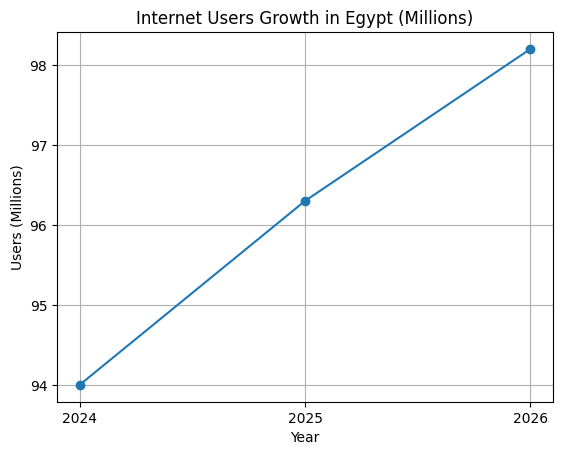
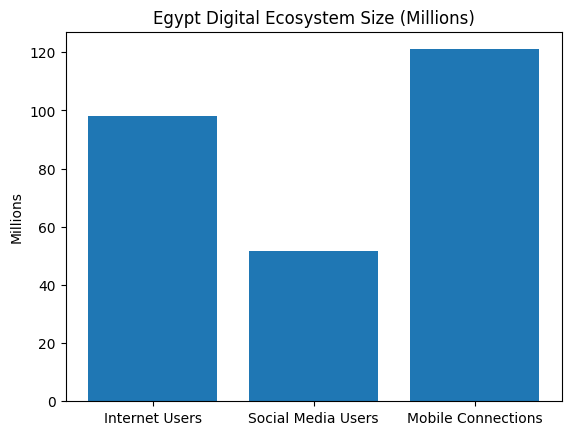
1. Egypt’s internet user base of 98.2 million — representing 82.7% of its population — positions it as one of Africa’s most digitally connected nations, creating fertile ground for AI-powered search tools and generative content platforms to scale rapidly.
2. The addition of 2.3 million new internet users in Egypt within a single year signals sustained digital growth momentum, meaning the addressable audience for AI search experiences and GEO-optimised content will continue to expand through 2026 and beyond.
3. With 121 million mobile connections — exceeding Egypt’s total population — the country’s multi-SIM culture underscores that mobile-first AI search optimisation is not optional but foundational for any brand targeting Egyptian consumers.
4. A 6.7% year-on-year increase in mobile connections in Egypt reflects a population that is deepening its digital engagement, reinforcing the need for responsive, AI-discoverable content that performs across mobile interfaces.
5. The fact that 95.4% of Egyptian mobile connections are broadband-capable means the technical barrier to accessing AI-powered search tools like Google AI Overviews and ChatGPT is rapidly diminishing for the majority of the population.
6. With 51.6 million social media identities in Egypt — 43.4% of the population — social platforms are becoming a parallel “search layer” that brands must integrate into their broader GEO and AI visibility strategies alongside traditional search engines.
7. Egypt’s internet penetration jumping to 81.9% with 96.3 million users by early 2025 confirms a structural shift: the majority of Egyptians are now reachable through digital and AI-driven search channels, making digital presence a baseline business requirement.
8. A 42% year-on-year surge in cellular data consumption in Egypt — driven by 5G’s June 2025 launch — directly enables richer, faster AI search interactions, including multimodal queries through tools like Google Lens and voice-based AI assistants.
9. The 9.3% improvement in Egypt’s median mobile internet download speed (from 22.11 to 24.17 Mbps) translates to faster loading of AI-generated search responses and richer content experiences, reducing friction in AI-assisted discovery journeys.
10. Fixed internet download speeds improving from 64.53 to 76.67 Mbps in Egypt strengthens the case for desktop-side GEO content — including long-form, structured, AI-citable articles — as home broadband becomes increasingly capable of handling AI search interfaces.
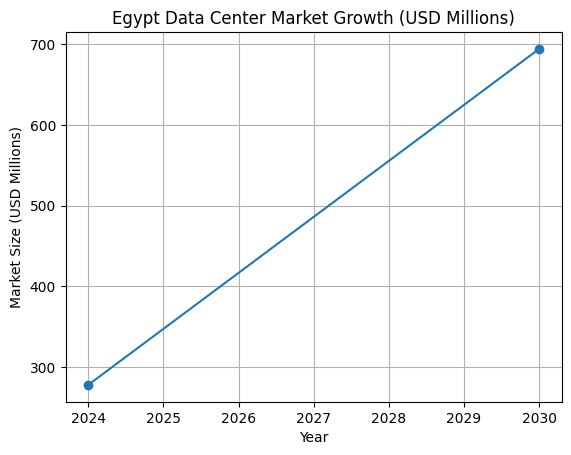
11. Egypt’s $278 million data center market in 2024 signals growing cloud and AI infrastructure investment that will reduce latency for AI search tools, improve local content indexing speeds, and support the development of Arabic-language AI models.
12. A projected jump from $278 million to $694 million in data center value by 2030 confirms that Egypt is building the physical AI infrastructure needed to support advanced generative search at scale — making it a long-term AI search growth market in Africa.
13. Egypt’s $2.7 billion investment in 5G spectrum and infrastructure since 2019, culminating in a June 2025 launch, creates the connectivity backbone required for real-time AI search, voice queries, and generative AI experiences at a national scale.
14. The 17.3% of Egyptians (20.6 million people) still offline represents both a current limitation for AI search market size and a significant near-term growth opportunity as connectivity programmes expand, particularly in rural areas.
15. Egypt’s fixed broadband penetration of 9.94 per 100 inhabitants — well below the OECD average of 34.9 — highlights a structural gap that, if addressed, could dramatically accelerate AI search adoption and GEO content consumption on desktop devices.
16. Universal 4G access covering 99% of Egyptians provides an unprecedented baseline for AI search adoption, meaning tools like Google AI Overviews, ChatGPT mobile apps, and voice-activated AI assistants are technically within reach of virtually the entire population.
17. Egypt’s six active data centers and three Internet Exchange Points reflect a maturing — though not yet advanced — digital infrastructure, and the finding that only 13% of top websites are served locally highlights a performance gap that affects AI search load times and user retention.
18. E& Egypt’s planned EGP 18 billion infrastructure investment signals private-sector confidence in Egypt’s digital future, which will directly support faster, more reliable access to AI search tools and lower the technical barriers for AI-driven content delivery.
19. The fact that only 13% of Egypt’s top 1,000 websites are served locally — compared to an Africa average of 34% — suggests significant room to improve content localisation and server proximity, both of which influence AI crawlability and search indexing performance.
20. Egypt’s median age of 24.5 and nearly 12% of the population aged 18–24 makes it one of the world’s youngest major digital markets, a demographic profile that strongly correlates with higher AI tool adoption, experimental search behaviour, and openness to GEO-optimised experiences.
SECTION 2: Egypt AI Market Size, Growth & Government Strategy
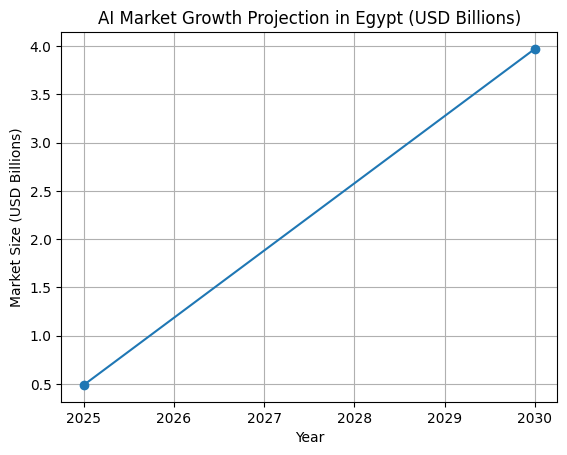
21. Egypt’s AI market reaching an estimated US$491 million in 2025 marks a milestone in the country’s transition from AI consumer to AI economy — a shift that creates direct demand for AI search tools, generative content platforms, and GEO-specialised talent.
22. A CAGR of 13.4% projected to grow Egypt’s AI market to nearly $3 billion by 2029 reflects durable, long-term investor confidence, making now the optimal window for businesses to build AI search strategies before the market matures and competition intensifies.
23. Egypt’s AI market growing at a CAGR of 28.63% through 2030 represents one of the fastest AI market expansions in the African continent, positioning early movers in GEO and AI content strategy to capture disproportionate visibility as the landscape evolves.
24. A projected AI market size of $3.97 billion by 2030 places Egypt among Africa’s premier AI economies, and brands that establish AI-citable authority and structured data practices today are best placed to benefit from this expanding ecosystem.
25. Egypt’s Generative AI market reaching US$1.17 billion by 2030 at a 46.47% CAGR is one of the most compelling growth trajectories in the region — representing accelerating demand for generative search tools, AI content creation, and Arabic-language LLM applications.
26. Egypt’s #1 ranking in Africa on the 2025 Oxford Insights Government AI Readiness Index, scoring 57.5 and ranking 51st globally, confirms that the country’s policy environment is genuinely supportive of AI innovation — reducing regulatory risk for AI search and GEO investments.
27. Climbing 14 places in the global Oxford AI Readiness Index in a single year demonstrates Egypt’s government is actively accelerating its AI infrastructure and governance — a pace of progress that should directly benefit the country’s AI search ecosystem.
28. Egypt’s perfect score of 100 in the Policy Capacity pillar — shared only with the UK, Serbia, and Australia globally — signals that the regulatory and strategic frameworks for AI are among the world’s most advanced, creating a stable environment for AI search and GEO practices.
29. Ranking first in the Arab region for AI Resilience with a score of 62.81 indicates that Egypt has built robust, recoverable AI systems and governance — a necessary foundation for trusted AI search infrastructure and privacy-respecting generative tools.
30. A 46-position climb in the Global AI Readiness Index between 2019 and 2024 is not a lucky spike but a sustained, deliberate ascent — reflecting years of policy investment that are now materialising as a competitive AI environment where search and GEO strategies can thrive.
31. The National AI Strategy’s target of raising ICT’s contribution to Egypt’s GDP from ~5% to 7.7% by 2030 means AI search, e-commerce, and digital marketing services will be structurally embedded in the national economy — not peripheral activities.
32. Training over 30,000 AI specialists through the National AI Strategy creates a growing domestic workforce capable of implementing advanced GEO strategies, building Arabic AI models, and staffing the content operations needed to compete in AI search environments.
33. The plan to support 250+ AI-driven startups and launch 10 university research centres signals a deliberate pipeline of homegrown AI innovation — some of which will directly address Arabic natural language processing, AI content tools, and Egypt-specific search optimisation needs.
34. An annual target of 30,000 individuals trained in AI skills suggests Egypt recognises that AI literacy — not just infrastructure — is the bottleneck to AI adoption, and building this talent base will accelerate demand for GEO-aware content and AI search services.
35. Over 5,000 individuals completing AI training programmes by early 2025 shows meaningful early-stage execution on the National AI Strategy — but also highlights that the country is still in the talent-building phase, creating opportunity for experienced GEO and AI search practitioners.
36. Egypt’s target of $9 billion in digital offshoring export revenue by 2026 under its Digital Egypt Strategy highlights ambitions to compete globally in AI and tech services — positioning Egyptian agencies and content teams as potential GEO and AI search service providers for international markets.
37. ICT sector growth of 15.2% and GDP contribution of 5.1% in fiscal 2022/23 demonstrates that Egypt’s digital economy is already delivering at a macro level — the upcoming AI-search layer will amplify this further as AI drives efficiencies in content, commerce, and services.
38. A 20% year-on-year increase in ICT investment to $4.2 billion in fiscal 2022/23 reflects strong private and public confidence in Egypt’s digital economy — capital that is increasingly being directed toward AI, cloud, and the generative technologies reshaping search.
39. Public R&D spending at 0.9% of GDP — above the Arab states average but below the UAE’s 1.5% — signals that Egypt invests meaningfully in innovation but has room to grow, particularly in AI research areas like Arabic NLP that would directly improve AI search quality.
40. The projection that AI will contribute $1.5 trillion to Africa’s economy by 2030, cited at Cairo’s Ai Everything MEA summit, gives context to why Egypt’s AI strategy prioritises speed: the continent-wide opportunity is enormous, and Egypt’s government is positioning Cairo as the gateway to capturing it.
SECTION 3: AI Chatbot & ChatGPT Adoption in Egypt
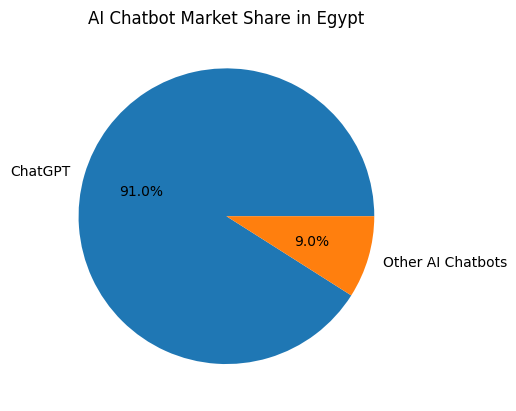
41. ChatGPT holding nearly 91% AI chatbot market share in Egypt — significantly above its global 82% average — confirms it as the dominant AI search and conversational interface in the country, making ChatGPT GEO optimisation the highest-priority AI search investment for Egyptian brands.
42. Egypt’s 12.5% AI adoption rate among its working-age population, while well below the UAE’s 59.4%, indicates the market is at an early-to-mid adoption stage — a window where foundational GEO and AI search strategies can be built before competition intensifies.
43. AI tool adoption growing more than 4x faster in lower-middle-income countries like Egypt compared to high-income nations suggests a catch-up dynamic in progress — Egyptian businesses that build AI search fluency now are likely to find themselves ahead of peers in comparable markets.
44. The global shift to 73% non-work-related ChatGPT usage reflects how deeply AI chatbots have penetrated everyday information-seeking behaviour — meaning Egyptian consumers are increasingly using AI tools to answer questions that previously drove search engine traffic.
45. Egyptian students and startups using ChatGPT for tutoring, translation, and business drafting represent a high-frequency, needs-driven use pattern — one that creates organic demand for AI-citable Egyptian educational and business content that performs well in generative search environments.
46. ChatGPT’s global monthly visits reaching 5.72 billion in January 2026 makes it among the highest-trafficked digital destinations in the world — a platform Egyptian brands cannot afford to ignore as a search and discovery channel distinct from Google.
47. ChatGPT’s user base doubling from 400 million to 800 million weekly active users in just four months signals near-exponential growth in AI search demand — a growth rate that outpaces almost any historical digital platform and demands urgent GEO attention from Egyptian marketers.
48. Processing over 2 billion queries daily with an 81% global market share, ChatGPT is no longer an emerging technology but an established search infrastructure — Egyptian businesses without a ChatGPT GEO strategy are effectively invisible in the world’s fastest-growing search channel.
49. The MENA region accounting for approximately 7% of global ChatGPT traffic — a region of some 400 million people — suggests strong per-capita AI chatbot usage comparable to or exceeding many global averages, reinforcing Egypt’s position within a highly AI-engaged regional market.
50. Google Gemini and ChatGPT topping MENA search trends in 2025 confirms that awareness and interest in AI tools is not limited to tech-savvy early adopters in Egypt — these tools have become mainstream search topics in their own right.
51. Microsoft Copilot’s ~5% market share in Egypt as ChatGPT’s only meaningful challenger confirms a near-duopoly in AI search, meaning GEO strategies can be concentrated on ChatGPT optimisation without spreading thin across a fragmented AI chatbot landscape.
52. ChatGPT’s most active user cohort globally (28.69%) being aged 25–34 aligns closely with Egypt’s large working-age demographic, suggesting above-average engagement potential and reinforcing the need for GEO-optimised professional, career, and business content targeting this segment.
53. ChatGPT’s mobile apps reaching 557 million combined monthly active users globally confirms that AI search is predominantly a mobile activity — matching Egypt’s own mobile-first internet behaviour and making mobile-optimised, AI-citable content a non-negotiable GEO requirement.
SECTION 4: Google Search, AI Overviews & Search Behaviour in Egypt
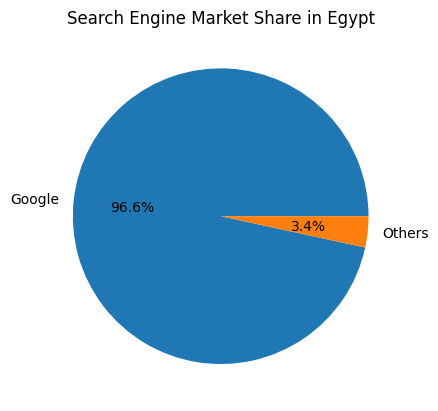
54. Google’s 96.6% search market share in Egypt as of December 2025 makes it the undisputed primary search channel in the country — and since Google AI Overviews now appear on Google results pages globally, mastering Google GEO is effectively the same as mastering AI search in Egypt.
55. Google AI Overviews being available in 40+ languages including Arabic and English confirms that Egyptian users — whether searching in their native language or in English — are now encountering AI-generated answers directly within their search results, fundamentally changing content discovery.
56. AI Overviews appearing in approximately 60% of U.S. searches — with the feature rolled out globally including Egypt — signals that zero-click AI summaries are becoming the norm rather than the exception, requiring Egyptian publishers to rethink traffic expectations and content authority.
57. AI Overviews peaking at 25% of all global Google queries in July 2025 before falling back to 16% shows Google is refining when AI summaries appear — but the long-term trajectory is clear, and Egyptian SEO strategies must account for an expanding AI Overview footprint.
58. The fact that 96% of Egyptians access the internet primarily via mobile means Google’s mobile AI Overview experience — not the desktop version — is the primary AI search interface for the vast majority of Egyptian users, demanding mobile-first GEO content architecture.
59. Chrome commanding 81.8% of Egypt’s web traffic means Google’s ecosystem — including AI Overviews, Search Labs, and AI Mode — is the operating environment for most Egyptian internet browsing, giving Google enormous leverage to shape how AI search behaves locally.
60. With 56.8% of Egyptian internet users turning to the internet for news and information, this informational intent is the primary use case for AI Overview triggers — meaning Egyptian news publishers, encyclopaedic websites, and educational platforms are most directly exposed to AI-driven traffic disruption.
61. The finding that 88.1% of AI Overview-triggering queries are informational confirms that fact-based, educational, and how-to content on Egyptian websites faces the highest zero-click risk — and requires structured content, proper schema markup, and E-E-A-T signals to remain competitive.
62. AI Overviews expanding from 8% to 18% of commercial queries by late 2025 means Egyptian e-commerce brands can no longer treat AI search as a purely informational phenomenon — product discovery, pricing queries, and brand comparisons are increasingly being answered by AI before a user ever reaches a website.
63. A 35% higher organic CTR and 91% higher paid CTR for brands cited within AI Overviews quantifies the business value of earning AI citations — Egyptian brands that invest in becoming authoritative, structured, and AI-citable sources can gain measurable competitive advantages in both organic and paid search.
64. Organic CTR dropping 61% and paid CTR falling 68% for queries with AI Overviews compared to those without is among the starkest data points in modern SEO — Egyptian marketers must urgently diversify their traffic strategies beyond click-dependent content models.
65. The concept of “The Great Decoupling” — where search impressions rise while clicks fall — directly threatens Egyptian media, publishing, and content businesses whose revenue models depend on page visits, and represents the core commercial risk of AI Overviews at scale.
66. AI Overviews appearing for nearly 26% of Science queries and 18% of Computers & Electronics queries globally makes these categories — central to Egypt’s growing tech and education sectors — particularly vulnerable to zero-click displacement, and particularly rewarding for brands that earn citations.
67. AI Overviews doubling from 6.49% to 13.14% of all Google queries in just two months in early 2025 represents one of the fastest documented changes in search behaviour in recent history — Egyptian digital marketers who treat this as a slow-moving trend are likely already behind.
68. A 206% increase in retail keyword AI Overview appearances and a 381% increase for travel queries in early 2025 means Egypt’s tourism industry — one of its largest economic sectors — faces acute GEO urgency, as AI summaries are now intercepting queries about Egyptian destinations, hotels, and experiences.
69. Navigational AI Overviews growing from under 1% to over 10% in 2025 signals a concerning development for Egyptian brands: AI is beginning to answer queries that include brand or destination names, potentially intercepting traffic that brands previously considered “guaranteed.”
70. Ads appearing alongside AI Overviews rising from 3% to 40% in 2025 reveals a commercial opportunity within the AI search experience — Egyptian performance marketers should explore AI Overview ad placements as an emerging paid channel with strong early adoption rates.
71. Zero-click searches projected to reach 70% of all queries by early 2026 does not mean SEO is dead — it means the metric for success is shifting from clicks to citations, brand impressions, and direct traffic driven by AI-mediated brand discovery.
72. The #1 Google organic result retaining a 39.8% CTR for non-AI Overview searches confirms that top rankings still deliver significant traffic — Egyptian brands should pursue both traditional ranking and AI citation strategies simultaneously rather than abandoning either.
73. Sites cited in AI Overviews experiencing up to 2.3x branded traffic growth quantifies the halo effect of AI visibility — Egyptian brands that appear in AI-generated answers are not just getting impressions, they are driving measurable downstream discovery and brand recall.
SECTION 5: Generative Engine Optimization (GEO) & AI Search Strategy
74. Nearly 70% of 10-word informational queries in the US now triggering an AI Overview — with 30% overall — signals that longer, nuanced queries are the most AI-affected search type, meaning Egyptian long-form content and FAQ-style pages face the greatest zero-click exposure.
75. ChatGPT referral traffic to websites growing 52% year-on-year confirms that AI chatbots are evolving from query endpoints into genuine traffic-generating discovery channels — Egyptian brands with structured, authoritative, and AI-citable web content are now capable of earning a meaningful new traffic stream.
76. ChatGPT accounting for 87.4% of all AI referral traffic across industries globally makes it the single most important AI referral source to optimise for — Egyptian marketers should treat ChatGPT GEO as a distinct channel within their broader digital acquisition strategy.
77. Users encountering an AI summary clicking through to a traditional result only 8% of the time — versus 15% without — quantifies the click suppression effect of AI answers, reinforcing the need for Egyptian content creators to focus on being the source AI cites, not just the result below it.
78. More than 50% of all searches globally now resulting in no click, accelerated by AI summaries, marks a fundamental change in the economics of content creation in Egypt — businesses dependent on page-visit-based revenue need to adapt their content models or develop AI-citation-first strategies.
79. 35% of businesses globally using AI tools to create SEO-focused content strategies suggests early competitive parity is forming — Egyptian agencies and in-house teams that have not yet integrated AI into their content workflows risk falling behind peers who are producing GEO-optimised content at greater scale and speed.
80. 50% of marketers now using AI to create content and 51% using it for optimisation signals that AI-assisted content production is becoming the professional standard, not an exception — Egyptian content teams that resist this shift may find themselves resource-disadvantaged against AI-augmented competitors.
81. AI-written content appearing in over 17% of top global search results and indexing within two months confirms that AI-assisted GEO content production is not only accepted by search engines but actively competitive — Egyptian brands can leverage this to build topical authority faster than previously possible.
82. Nearly half of online sellers globally using AI to write product descriptions signals an operational transformation in e-commerce content — Egyptian online retailers that adopt AI-assisted product content can improve search visibility, localisation quality, and content throughput simultaneously.
83. AI platforms projected to drive more website visits than traditional search engines within three years is a directional signal that should shift Egyptian digital marketing resource allocation today — GEO investment made now will compound in value as AI traffic surpasses traditional search traffic.
84. Perplexity’s 22 million monthly active users — 30% of whom are in senior leadership — represents a highly influential B2B audience that Egyptian brands targeting decision-makers should not overlook as a GEO channel, particularly for thought leadership and professional service content.
85. Only 3% of online content being in Arabic, despite Arabic being among the world’s most spoken languages, represents a structural GEO opportunity: Egyptian brands that produce high-quality, structured Arabic content are competing in a far less crowded AI-citable content environment.
86. Arabic content generating 3x higher engagement than English in Egypt, UAE, and Saudi Arabia provides a compelling ROI case for Arabic-first GEO content strategies — engagement signals positively influence AI content selection, making authoritative Arabic content a dual advantage.
87. Modern AI’s improved ability to understand Egyptian Arabic dialect nuances compared to legacy algorithms is a significant development — Egyptian brands that produce natural, dialect-aware Arabic content may achieve better AI search comprehension and citation rates than those using formal Modern Standard Arabic alone.
88. The rapid growth of voice search in MENA due to mobile assistants and smart speakers signals that Egyptian GEO strategies should extend beyond text to include conversational, question-and-answer content formats optimised for how people speak queries rather than type them.
89. ChatGPT’s average response length of 1,686 characters versus Google’s 997 characters reveals that AI search engines reward more detailed, contextually rich content — Egyptian content creators should write with depth and completeness, not brevity, to improve their chances of earning AI citations.
SECTION 6: Egypt E-Commerce, AI Shopping & Consumer Search Behaviour
90. Egypt’s e-commerce market reaching USD 101.6 million in 2025 and projected to double to $202 million by 2034 represents steady structural growth — and as AI-powered product discovery reshapes how Egyptian consumers find and evaluate products, GEO-optimised e-commerce content will become a critical growth lever.
91. 53% of MENA shoppers already using AI-powered visual search tools and 37% trusting the technology signals that product-level AI search optimisation — including high-quality product imagery, structured data markup, and AI-readable descriptions — is now a commercial necessity for Egyptian e-commerce brands.
92. The MENA e-commerce market projected to reach $50 billion by 2025, driven by AI personalisation and voice commerce, places Egypt within one of the world’s fastest-growing digitally-mediated retail environments — and brands with AI-visible product content will capture disproportionate share.
93. Egyptian e-commerce platforms like Jumia deploying AI chatbots for 24/7 multilingual Arabic support demonstrates that AI is not just shaping how consumers discover products, but how they transact — creating new expectations for conversational, AI-mediated customer journeys that require consistent AI-citable brand information.
94. The expectation that 60% of MENA e-commerce will integrate metaverse shopping by 2026 and Arabic content production will triple represents an accelerating convergence of AI, search, and immersive commerce — Egyptian brands that build structured, AI-ready content foundations now will be better positioned to extend them into emerging channels.
95. The fact that 44.5% of Egyptian internet users research how-to content online confirms that tutorial, guide, and educational content are high-traffic, high-intent categories in Egypt — and exactly the content types most likely to be cited in AI Overviews and ChatGPT responses.
96. 39.1% of Egyptian internet users going online for educational purposes makes Egypt’s digital audience significantly learning-oriented — educational content producers in Egypt have an outsize GEO opportunity, as AI search tools preferentially surface clear, expert, and citable educational material.
97. 85% of Egyptian internet users engaging with social media with 2.1% annual growth reinforces the “search everywhere” paradigm — where Instagram, TikTok, and YouTube function as search engines — meaning Egyptian brands need AI-optimised content that works across platforms, not just on Google.
98. 32% of ChatGPT interactions globally being informational and 9% commercial shows that AI chatbots are increasingly used in the consideration and comparison stages of the purchase journey — Egyptian brands that appear in AI-generated product comparisons, recommendations, or how-to answers gain visibility at high-intent moments.
99. 40% of Gen Z globally beginning to use social platforms as primary search tools represents a generational realignment of search behaviour that directly applies to Egypt’s young population — GEO strategies must extend beyond Google and ChatGPT to encompass TikTok SEO, Instagram hashtag discoverability, and YouTube optimisation.
SECTION 7: Egypt’s AI Ecosystem, Events & Talent Development
100. Egypt hosting the region’s first dedicated AI global summit — Ai Everything MEA 2026 — in Cairo in February 2026 is more than a symbolic milestone; it signals Cairo’s emergence as a genuine centre of gravity for Middle East and Africa AI commerce, investment, and knowledge transfer.
101. Bringing together 350+ global enterprises and investors from 30+ countries at the Ai Everything MEA summit demonstrates that Egypt is being positioned — and accepted — as a strategic AI hub, which will attract international AI tools, partnerships, and talent pipelines that deepen the local AI search ecosystem.
102. The presence of 200+ VCs managing over $1 trillion in assets at the Cairo AI summit reveals that global capital is paying close attention to Egypt’s AI opportunity — a development that will accelerate the funding and scaling of Egyptian AI search tools, content platforms, and GEO service providers.
103. Capgemini opening an AI Centre of Excellence in Cairo signals that multinational technology firms view Egypt not merely as a consumer market but as a talent and innovation hub — a development that raises the sophistication of local AI capabilities and expands the available GEO and AI search expertise in market.
104. Egypt, Nigeria, Kenya, and South Africa capturing 83% of AI startup investment in Africa confirms a tier-one cluster of AI activity in which Egypt plays a leading role — and within which competitive AI search and GEO practices are more advanced than in other African markets.
105. Africa’s AI market growing from $4.5 billion to $16.5 billion by 2030 — potentially creating 230 million digital jobs — provides the macro context for Egypt’s AI strategy: it is not competing against global AI giants alone, but positioning itself to lead the continent’s AI economy, with AI search and content services forming a core pillar.
106. Egypt’s top-12 global ranking in the ITU Cybersecurity Index reinforces that the country’s digital infrastructure meets international trust standards — an important signal for AI search tools, data privacy compliance, and the responsible use of generative AI in content strategies.
107. The National AI Strategy’s commitment to training 30,000 people annually in AI skills means Egypt will have a growing domestic pool of professionals capable of executing GEO campaigns, building Arabic AI tools, and developing AI-native content strategies at scale.
108. Egypt’s AI strategy explicitly targeting GPU access, AI-ready data centres, and shared open datasets signals that the government understands the compute and data prerequisites for competitive AI — investments that will lower barriers for Egyptian companies building AI search tools and Arabic-language generative models.
109. WideBot AI choosing the Cairo Ai Everything summit to debut Arabic AI solutions reflects Egypt’s role as the primary proving ground for Arabic-language AI — a development with direct implications for Arabic GEO, as improved Arabic NLP models will better comprehend and cite locally produced Arabic content.
110. The National AI Strategy’s six pillars — Governance, Technology, Data, Infrastructure, Ecosystem, and Talent — collectively represent a comprehensive national architecture for AI adoption, reducing the systemic risks that typically deter investment in emerging AI markets and creating a stable long-term environment for GEO practitioners.
SECTION 8: Global AI Search & GEO Trends Directly Impacting Egypt
111. ChatGPT’s 80.49% global AI chatbot market share — ahead of Perplexity, Copilot, Gemini, Claude, and DeepSeek combined — means Egyptian GEO strategists can concentrate resources on a relatively clear target: optimising for ChatGPT citations delivers the highest reach in the AI search channel.
112. ChatGPT processing 2 billion queries daily while ranking as the 5th most visited website globally has permanently elevated it to the status of critical search infrastructure — Egyptian brands treating it as a novelty rather than a primary discovery channel are making a strategic miscalculation.
113. ChatGPT’s monthly visits of 5.4 billion exceeding Bing’s 1.9 billion confirms a structural power shift in the search landscape — AI chatbots are no longer chasing traditional search engines; in terms of direct user engagement, ChatGPT has already surpassed one of the world’s largest search platforms.
114. Google AI Mode being available in over 200 countries and territories including Egypt means that conversational AI search is now the default for eligible queries, not an experimental feature — Egyptian brands must optimise for this conversational format alongside traditional keyword-based search.
115. 35% of Gen Z in the U.S. using AI chatbots as their primary search tool — a behavioural pattern mirroring Egypt’s large youth population — indicates that AI-first search behaviour is not a future possibility but a present reality for the demographics that Egyptian brands most need to reach.
116. Google’s global search market share declining to 89.57% from over 92% as AI chatbots capture search intent reflects a genuine — if gradual — erosion of Google’s search monopoly, meaning Egyptian digital strategies built solely on Google search visibility carry increasing concentration risk.
117. The projection that ChatGPT could overtake Google’s search volume by 2027 is a bold but credible signal that Egyptian brands should not wait for the transition to happen before building GEO strategies — the brands cited consistently by AI in 2026 are likely to retain those citations as AI search scales further.
118. Organic search accounting for 53.3% of all website traffic globally and delivering 5x the cost-effectiveness of paid advertising validates continued investment in content and GEO — the rise of AI search does not eliminate the value of organic visibility, but it does change how that visibility is earned.
119. Organic traffic conversion rates of 2.7%–3.75% consistently outperforming paid search reinforces that high-quality, AI-citable organic content delivers lasting commercial value — Egyptian businesses that compound GEO investments over time will build more durable and cost-efficient acquisition channels than those relying on paid search alone.
120. AI-driven search personalisation projected to increase result tailoring by 50% by 2025 means that Egyptian brands with strong entity associations, consistent structured data, and well-defined brand signals across the web will receive preferential treatment in personalised AI search results — making brand coherence a GEO factor, not just a marketing one.
121. Google Lens processing over 8 billion visual searches monthly globally makes visual search one of the fastest-growing query types — Egyptian product brands, tourism operators, and cultural institutions that invest in properly tagged, high-quality visual content are positioned to capture AI-mediated visual discovery at scale.
122. The prediction that 70% of search queries will incorporate a visual component by 2025 signals that text-only GEO strategies will become increasingly incomplete — Egyptian brands must develop multimodal content strategies that optimise images, videos, and infographics for AI visual search comprehension and citation.
Conclusion
The 122 statistics presented in this report collectively paint a clear and compelling picture: Egypt is rapidly evolving into one of the most important AI-driven digital markets in the Middle East and Africa. From expanding internet access and accelerating AI investment to shifting search behaviors and the emergence of generative search tools, the country’s digital ecosystem is entering a new phase where artificial intelligence is becoming a central gateway to information, discovery, and commerce.
Over the past decade, Egypt’s digital transformation has been driven by a combination of demographic momentum, infrastructure investment, and increasing technological adoption. The country now has tens of millions of internet users, widespread mobile connectivity, and one of the youngest populations among major emerging markets. These structural factors create ideal conditions for the rapid adoption of AI-powered search tools such as conversational chatbots, generative search engines, and multimodal AI assistants.
At the same time, Egypt’s digital infrastructure is steadily strengthening. The rollout of advanced mobile networks, improvements in broadband connectivity, and growing investment in data centers and cloud services are expanding the technological foundation required for sophisticated AI applications. As connectivity becomes faster and more reliable, AI-powered services can operate at scale, enabling millions of users to access conversational search interfaces, real-time translation tools, and generative content platforms.
The statistics also highlight the growing importance of artificial intelligence within Egypt’s broader economic strategy. Government initiatives aimed at developing AI talent, supporting technology startups, and expanding the digital economy demonstrate a clear commitment to positioning the country as a regional hub for innovation. As these policies take effect, Egypt is likely to see a surge in AI-related research, startups, and commercial applications that further accelerate the adoption of AI-driven search technologies.
One of the most significant insights from these trends is the transformation of online search itself. Traditional keyword-based search engines are gradually evolving into AI-powered information systems that generate answers rather than simply directing users to websites. Tools like conversational AI assistants, generative search features, and voice-enabled platforms are redefining how users access knowledge and evaluate information. Instead of scrolling through lists of links, users increasingly expect direct responses, contextual summaries, and personalized recommendations.
This shift has profound implications for businesses, marketers, and content creators operating in Egypt’s digital landscape. Visibility in AI-generated responses is becoming just as important as ranking highly in traditional search results. As generative search interfaces become more widespread, brands that provide authoritative, structured, and well-organized information are far more likely to be cited by AI systems. Conversely, businesses that fail to adapt their content strategies may struggle to appear in AI-generated answers, even if they previously performed well in conventional search rankings.
These developments have given rise to Generative Engine Optimization, a new discipline that focuses on optimizing content for AI-powered discovery systems. GEO emphasizes clarity, credibility, and contextual depth, ensuring that information can be easily understood and referenced by AI models. Instead of focusing solely on keyword placement, GEO strategies prioritize structured data, factual accuracy, topic authority, and content formats that answer user questions clearly and comprehensively.
In Egypt’s rapidly expanding digital environment, GEO is likely to become a critical component of modern marketing strategies. Businesses that invest in high-quality informational content, detailed guides, and expert insights will have a greater chance of appearing in AI-generated summaries and recommendations. Educational resources, how-to content, and industry analysis are particularly valuable because generative AI systems often rely on such materials when constructing answers to complex user queries.
Language dynamics also play a crucial role in shaping Egypt’s AI search landscape. Arabic remains significantly underrepresented in global online content compared to its number of speakers. This imbalance creates a major opportunity for organizations that produce well-structured Arabic content tailored to local audiences. As AI models improve their ability to understand regional dialects and context, high-quality Arabic content will become increasingly valuable within generative search ecosystems.
Egypt’s strong mobile-first culture further amplifies the impact of AI search technologies. Most Egyptian users access the internet primarily through smartphones, meaning conversational search tools, voice assistants, and visual search features are likely to play an increasingly central role in everyday information discovery. Mobile optimization is therefore no longer just a technical requirement; it is a fundamental aspect of ensuring content is accessible within modern AI-driven search environments.
The statistics in this report also reveal a broader shift in how consumers research products, services, and ideas. AI-powered tools are increasingly being used not only for general knowledge but also for decision-making processes such as product comparisons, travel planning, education, and professional research. As AI assistants become more integrated into daily workflows, the sources they reference gain substantial influence over consumer perceptions and purchasing decisions.
For companies operating in Egypt’s e-commerce and service sectors, this means that appearing within AI-generated recommendations can significantly influence customer acquisition. Product descriptions, structured product data, expert reviews, and detailed informational content all contribute to whether a brand is recognized and cited by AI systems. Businesses that proactively optimize their digital presence for these systems will be better positioned to capture demand as AI-driven discovery becomes more widespread.
Another important trend highlighted by the data is the increasing integration of search across multiple digital platforms. Search behavior is no longer confined to traditional search engines. Social media platforms, video platforms, AI chatbots, and visual search tools are all becoming part of the broader search ecosystem. Younger users in particular often discover information through a combination of these channels, switching fluidly between conversational AI, video content, and social feeds.
This multi-platform search environment requires a holistic digital strategy. Brands must ensure their information is consistent, authoritative, and discoverable across websites, social platforms, knowledge databases, and AI-accessible sources. Strong entity recognition, structured metadata, and consistent brand signals across the web can help AI systems understand and reference a brand more accurately.
Despite the rapid rise of AI-powered search technologies, traditional search optimization remains highly relevant. Ranking well in conventional search engines still increases a website’s credibility and visibility, which in turn influences whether AI models treat the content as a reliable source. The most successful digital strategies in the coming years will therefore combine both SEO and GEO, ensuring that content performs well in both traditional and generative search environments.
Looking ahead, the trajectory of Egypt’s digital economy suggests that AI-powered search will continue to expand in influence. Improvements in natural language processing, the growth of Arabic-language AI models, and increasing investments in computing infrastructure will all contribute to more sophisticated generative search experiences. As these technologies mature, they will further reshape how information is produced, distributed, and consumed across the Egyptian internet.
For marketers, entrepreneurs, and organizations seeking to build a strong digital presence in Egypt, the message from these 122 statistics is unmistakable. The search landscape is undergoing a structural transformation, and generative AI is at the center of that change. Businesses that adapt early by producing authoritative content, optimizing for AI discovery, and investing in Arabic-language digital resources will gain a significant advantage as AI search becomes the dominant method of online information retrieval.
Ultimately, Egypt’s combination of technological momentum, demographic strength, and growing AI capabilities positions it as one of the most promising markets for the future of generative search. As artificial intelligence continues to redefine the way people access information, Egypt’s digital ecosystem is likely to become an increasingly important testing ground for AI-driven discovery, content strategy, and the next generation of search technologies.
The insights gathered in this report provide a valuable foundation for understanding these changes. By studying the statistics, trends, and structural developments shaping Egypt’s AI search landscape, businesses and researchers can better prepare for a future where visibility is determined not just by search rankings, but by how effectively information is understood, synthesized, and delivered by intelligent systems.
If you are looking for a top-class digital marketer, then book a free consultation slot here.
If you find this article useful, why not share it with your friends and business partners, and also leave a nice comment below?
We, at the AppLabx Research Team, strive to bring the latest and most meaningful data, guides, and statistics to your doorstep.
To get access to top-quality guides, click over to the AppLabx Blog.
People also ask
What is AI search and how is it changing the internet in Egypt?
AI search uses artificial intelligence to generate direct answers instead of just listing links. In Egypt, tools like AI chatbots and AI-powered search engines are changing how users discover information, brands, and services online.
What is Generative Engine Optimization (GEO)?
Generative Engine Optimization focuses on structuring content so AI tools can understand and cite it in generated answers. GEO helps websites appear in AI summaries, chatbot responses, and conversational search results.
Why is AI search important for Egypt’s digital market in 2026?
Egypt’s growing internet population and mobile-first users make it an ideal environment for AI search adoption. Businesses must optimize for AI discovery to stay visible as generative search tools become mainstream.
How many internet users are there in Egypt?
Egypt has more than 96 million internet users, representing over 80 percent of the population. This large connected audience creates strong demand for AI-powered search tools and digital content.
Why is Egypt considered a mobile-first digital market?
Most Egyptians access the internet primarily through smartphones. Mobile usage shapes how people search, making voice search, AI chatbots, and mobile-optimized content critical for online visibility.
How does ChatGPT influence search behavior in Egypt?
ChatGPT allows users to ask questions conversationally and receive instant answers. Many Egyptians now use AI chatbots for research, learning, and product comparisons instead of traditional search engines.
What role does Google AI search play in Egypt?
Google remains the dominant search engine in Egypt. AI-powered features such as AI-generated summaries are changing how results appear and how users interact with search results.
How does AI search affect traditional SEO strategies?
AI search shifts focus from keyword rankings to content authority and clarity. Websites must create structured, factual, and well-organized content that AI models can easily interpret and cite.
What types of content perform well in AI search results?
Educational content, detailed guides, FAQs, and expert explanations often perform well. AI systems prefer content that clearly answers questions and provides useful context.
Why is Arabic content important for AI search in Egypt?
Arabic content is underrepresented online despite a large Arabic-speaking audience. High-quality Arabic content has less competition and can gain stronger visibility in AI-generated responses.
How does voice search influence AI search trends in Egypt?
Voice assistants allow users to ask questions naturally. As voice search grows, content written in conversational formats becomes more important for appearing in AI search answers.
What industries benefit most from AI search in Egypt?
Education, tourism, e-commerce, finance, and technology sectors benefit the most. These industries rely heavily on online research and informational queries.
How is Egypt investing in artificial intelligence?
Egypt is investing in AI education, research centers, digital infrastructure, and startup ecosystems to strengthen its position as a regional AI hub.
What is Egypt’s National AI Strategy?
Egypt’s National AI Strategy aims to expand AI adoption across industries, train AI professionals, and increase the contribution of technology to the national economy.
How is AI affecting digital marketing in Egypt?
AI tools help marketers create content, analyze data, personalize campaigns, and optimize search visibility. This improves efficiency and helps brands reach audiences more effectively.
What is zero-click search and why does it matter?
Zero-click search occurs when AI provides answers directly in the search interface. Users get information without visiting websites, making AI citation and brand visibility more important than clicks.
How can businesses optimize for Generative Engine Optimization?
Businesses should create structured content, provide clear answers, build topical authority, and ensure information is factual and well-organized so AI systems can reference it easily.
What role does mobile connectivity play in AI adoption?
Faster mobile networks allow users to access advanced AI tools, voice assistants, and generative platforms seamlessly from smartphones.
How does Egypt’s young population influence AI adoption?
Egypt has a young, tech-savvy population that quickly adopts new digital tools. Younger users often experiment with AI platforms for learning, work, and everyday tasks.
How does AI search impact online businesses in Egypt?
AI search changes how consumers find products and services. Businesses that appear in AI-generated answers gain greater visibility and trust.
Why is structured data important for GEO?
Structured data helps AI systems understand website content more clearly. It improves the chances of content being cited in AI summaries and search responses.
How is AI transforming e-commerce in Egypt?
AI helps shoppers compare products, read recommendations, and search visually. It also powers chatbots and personalized product suggestions.
What are AI chatbots used for in Egypt?
AI chatbots assist with customer service, education, translation, research, and online shopping support.
How does AI influence consumer decision-making?
Consumers often rely on AI-generated summaries and recommendations when evaluating products or services, making AI visibility important for brands.
What role does visual search play in Egypt’s digital market?
Visual search allows users to search using images instead of text. It is becoming increasingly important in e-commerce, travel, and retail.
How can companies build authority for AI search?
Companies should publish high-quality content, maintain consistent brand information, and provide trustworthy data that AI systems can recognize and cite.
Why is Egypt becoming a regional AI hub?
Government initiatives, growing digital infrastructure, and strong investment in technology talent are positioning Egypt as a leading AI market in the region.
How does AI search impact content creators in Egypt?
Content creators must focus on informative, well-structured articles and expert insights that AI systems can reference in generated responses.
What future trends will shape AI search in Egypt?
Growth in conversational search, voice assistants, visual search, and Arabic-language AI models will shape the future of digital discovery.
Why should businesses follow AI search trends in Egypt?
Understanding AI search trends helps businesses adapt their digital strategies, improve visibility, and stay competitive in a rapidly evolving online landscape.
Sources
DataReportal
NAOS Solutions
U.S. Commercial Service
Internet Society
OECD
Statista
Data Bridge Market Research
Rasmal
Oxford Insights
Egypt Today
Middle East AI News
Scoop Empire
SAMENA Council
Ta3Heed
Nucamp
Daily News Egypt
Statcounter Global Stats
Wikipedia
Xponent21
Search Engine Land
Semrush
Dataslayer
The Digital Bloom
Rankrealm
Mike Khorev
Digiday
TheeDigital
eLearning Industry
Exposure Ninja
DemandSage
DesignRush
Siana Marketing
Arabian Gulf Business Insight
Google Blog
EgyptInnovate
IMARC Group
OpenPR
Consultancy Middle East
Accio
Lumrah Media
Creatives
AI Reports Africa
ITWeb Africa
Sci-Tech Today