
























Key Takeaways
- AI-powered search adoption is rapidly growing in New Zealand, transforming how users discover information through conversational queries, generative AI platforms, and intelligent assistants.
- Generative Engine Optimization (GEO) is becoming essential for businesses to maintain visibility as AI search engines increasingly deliver direct answers instead of traditional search results.
- Data trends show that brands investing in authoritative content, structured data, and AI-friendly SEO strategies are better positioned to succeed in New Zealand’s evolving search landscape in 2026.
Artificial intelligence is rapidly reshaping how people discover, consume, and interact with information online. In recent years, traditional search engines have evolved into intelligent answer engines powered by large language models, conversational interfaces, and generative AI systems. At the same time, Generative Engine Optimization (GEO) has emerged as a new discipline focused on ensuring that brands, publishers, and organizations remain visible in AI-driven search environments. As we move deeper into 2026, New Zealand is experiencing many of these shifts, with AI-powered search tools, voice assistants, and generative platforms becoming a mainstream part of how individuals and businesses access information.

The global search landscape has already begun transitioning from keyword-based discovery toward context-driven, conversational interactions. Instead of typing short queries into traditional search engines, users are increasingly asking complex questions through AI assistants, chat-based search tools, and voice-enabled devices. Platforms powered by generative AI can now synthesize information, summarize sources, and provide direct answers, significantly altering user expectations and search behavior. For businesses operating in New Zealand, this shift has important implications for digital visibility, marketing strategies, and content creation.
New Zealand’s digital ecosystem has long been characterized by high internet penetration, strong mobile usage, and a population that rapidly adopts new technologies. These conditions make the country a particularly interesting environment for observing the adoption of AI-powered search. As generative AI tools become integrated into browsers, productivity software, and search engines, Kiwi consumers and businesses are beginning to rely on them for research, recommendations, customer support, and decision-making. The result is a transformation in how online information is surfaced, evaluated, and trusted.
Another major development shaping the digital landscape is the rise of Generative Engine Optimization (GEO). While traditional search engine optimization focuses on ranking web pages within search engine results pages, GEO addresses how content is discovered and referenced by AI systems that generate answers directly. AI-driven search experiences frequently pull information from multiple sources and present it as a synthesized response rather than a list of links. As a result, organizations must rethink how they structure content, demonstrate expertise, and build authority in order to remain visible within AI-generated responses.
In New Zealand, businesses across sectors—including e-commerce, tourism, finance, education, and technology—are beginning to recognize the strategic importance of AI search visibility. Tourism operators, for example, increasingly rely on AI-assisted travel planning tools that generate itineraries, recommendations, and destination insights. Retailers are experimenting with AI-powered product discovery and personalized search experiences. Meanwhile, professional service firms are exploring how generative AI platforms can influence research behavior among potential clients. These changes illustrate how AI-driven discovery is no longer confined to technology companies but is becoming relevant across the entire economy.
At the same time, the adoption of AI-powered search technologies raises new questions about trust, transparency, and information accuracy. As generative systems synthesize information from numerous sources, the way data is attributed, verified, and presented becomes increasingly important. Businesses and publishers must ensure their content is authoritative, structured, and easily interpreted by AI models. In a smaller but highly connected market like New Zealand, maintaining credible digital information is especially important for both local consumers and international audiences researching the country.
The growing influence of AI search is also changing how marketers measure digital success. Traditional metrics such as keyword rankings and click-through rates remain relevant, but they are no longer sufficient on their own. Marketers must now consider whether their brand is referenced in AI-generated answers, how frequently their data is cited by generative platforms, and whether their content contributes to the training signals that inform AI responses. This shift requires new analytics frameworks, new optimization strategies, and a deeper understanding of how AI systems interpret web content.
Government institutions, universities, and technology organizations in New Zealand are also contributing to the broader AI ecosystem. Public sector initiatives supporting digital transformation, research programs in artificial intelligence, and startup innovation hubs are helping accelerate experimentation with generative technologies. These developments are influencing how AI tools are integrated into business operations, educational environments, and consumer applications across the country.
For digital marketers, content strategists, SEO professionals, and technology leaders, understanding the statistical trends behind AI search adoption is essential. Data reveals how quickly users are embracing AI-powered tools, which platforms are gaining traction, and how search behaviors are evolving across different demographics. It also highlights emerging opportunities and risks, from changes in website traffic patterns to the growing role of AI intermediaries in shaping online discovery.
This comprehensive collection of 120 AI Search and GEO statistics, data points, and trends focuses specifically on New Zealand’s evolving digital landscape in 2026. The data presented throughout this article explores key areas such as AI search adoption rates, generative engine usage, shifts in search behavior, business adoption of AI tools, and the growing importance of GEO strategies for maintaining online visibility.
By examining these insights, readers will gain a clearer understanding of how artificial intelligence is redefining search in New Zealand. Whether you are a business owner, marketer, researcher, or technology professional, these statistics provide valuable context for navigating a rapidly changing digital environment. They also highlight why organizations must begin adapting their search strategies now, as the boundary between traditional search engines and generative AI platforms continues to blur.
As AI continues to transform how information is discovered and delivered, the ability to understand and respond to these trends will become a key competitive advantage. The statistics and insights presented in this report aim to provide a detailed snapshot of where AI search and generative engine optimization stand in New Zealand today—and where they are likely to go next.
But, before we venture further, we like to share who we are and what we do.
About AppLabx
From developing a solid marketing plan to creating compelling content, optimizing for search engines, leveraging social media, and utilizing paid advertising, AppLabx offers a comprehensive suite of digital marketing services designed to drive growth and profitability for your business.
At AppLabx, we understand that no two businesses are alike. That’s why we take a personalized approach to every project, working closely with our clients to understand their unique needs and goals, and developing customized strategies to help them achieve success.
If you need a digital consultation, then send in an inquiry here.
Or, send an email to [email protected] to get started.
120 AI Search and GEO Statistics, Data & Trends in New Zealand in 2026
🇳🇿 SECTION 1: NEW ZEALAND AI ADOPTION & USAGE
1. New Zealand ranks #1 globally in generative AI adoption at 40.5% of the population. New Zealand’s position as the world’s leading adopter of generative AI signals a technologically progressive population, though adoption rate alone does not guarantee productive or ethical use of these tools.
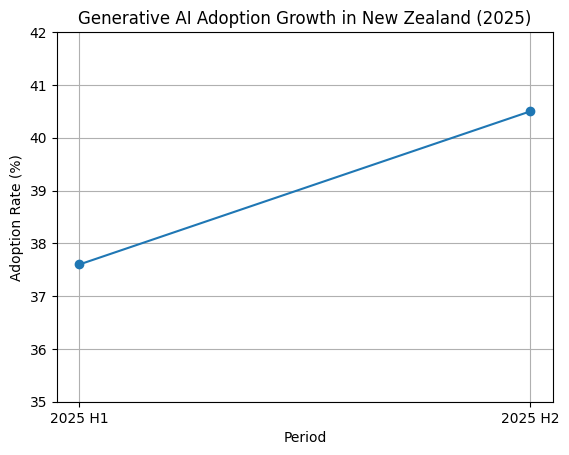
2. NZ’s generative AI adoption grew from 37.6% to 40.5% — a 2.9 percentage point increase in H2 2025 alone. The accelerating rate of generative AI adoption in New Zealand suggests the technology has moved well beyond early-adopter circles, making it increasingly important for businesses to have an AI strategy in place.
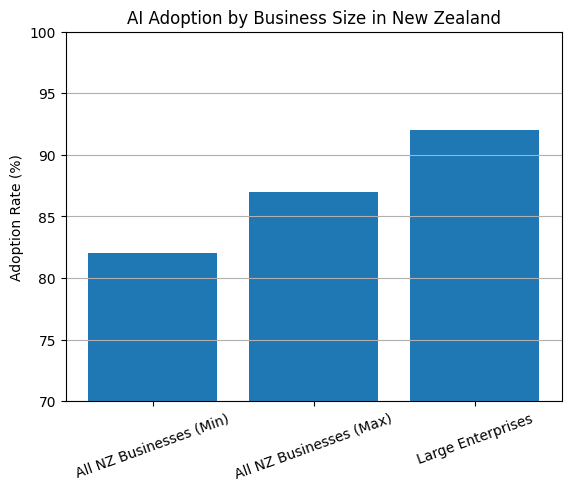
3. 82–87% of New Zealand businesses now use AI in some capacity — up from 48% in 2023. The near-doubling of AI adoption among NZ businesses in just two years reflects rapid normalisation of the technology, though the quality and depth of that adoption varies considerably across sectors.
4. 92% of large NZ enterprises (200+ employees) have adopted AI, compared to 82–87% across all business sizes. Large enterprises are leading AI adoption in New Zealand, likely due to greater access to resources and technical expertise, but this gap also highlights the risk of smaller businesses being left behind in an increasingly AI-competitive marketplace.
5. 53% of New Zealand professionals are actively using or experimenting with generative AI at work — up from 36% in 2023. With more than half of NZ professionals now engaged with generative AI at work, organisations that lack clear AI usage policies or training programs may face both productivity gaps and governance risks.
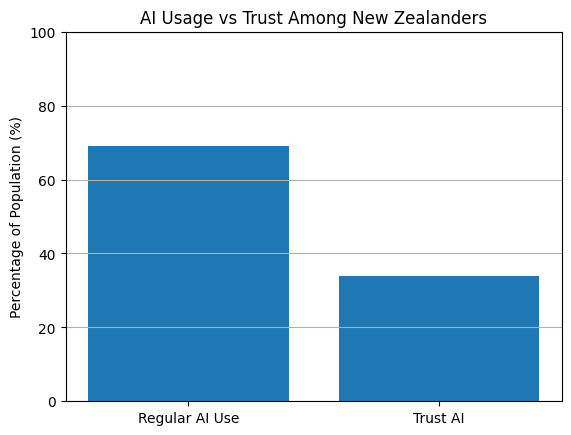
6. 69% of New Zealanders use AI regularly, yet only 34% trust the technology. The stark gap between AI usage and trust in New Zealand suggests many Kiwis are adopting AI tools out of necessity or curiosity rather than confidence — a dynamic that underscores the need for transparent, explainable AI systems.
7. NZ knowledge workers have one of the highest generative AI adoption rates in the world at 84%. An 84% generative AI adoption rate among NZ knowledge workers places the country ahead of most global peers, positioning New Zealand businesses to gain a competitive productivity edge — provided that adoption is paired with adequate training and oversight.
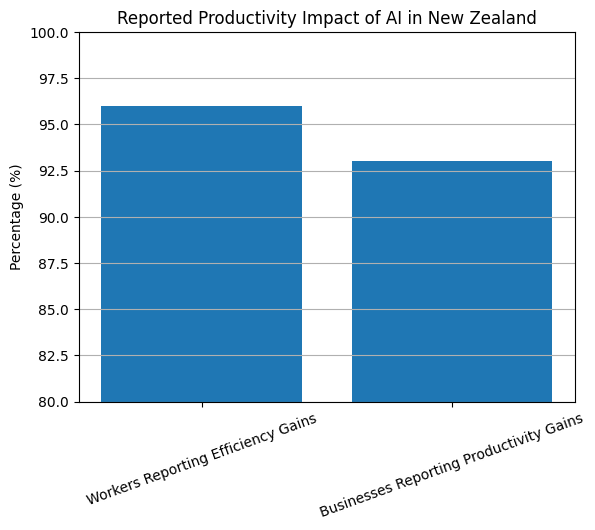
8. 96% of NZ workers report that AI has made them more efficient. While near-universal reports of improved efficiency are encouraging, self-reported productivity gains should be interpreted cautiously, as they may reflect perceived rather than objectively measured improvements in output quality or business outcomes.
9. 93% of NZ businesses report AI has made their workers more productive. The near-consensus among NZ businesses on AI-driven productivity gains is a compelling endorsement of the technology, though sustained gains will depend on how well organisations integrate AI into their workflows rather than treating it as a standalone tool.
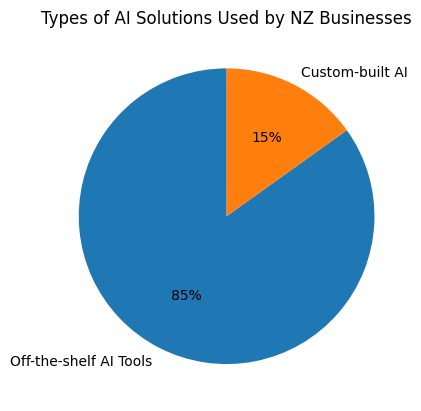
10. 72–73% of NZ businesses use off-the-shelf AI tools like ChatGPT, Microsoft Copilot, and Google Gemini, while only 13% have invested in custom-built solutions. The heavy reliance on off-the-shelf AI products is an accessible and cost-effective starting point for most NZ businesses, but the low investment in custom AI solutions may limit long-term competitive differentiation for organisations with unique data or operational requirements.
11. 58% of New Zealand students are already using generative AI tools. Widespread generative AI adoption among NZ students reflects a generational shift in how information is accessed and synthesised, creating both opportunities for personalised learning and challenges for educators in maintaining academic integrity.
12. Only 7% of NZ organisations report AI directly replacing workers. The low reported rate of AI-driven job displacement in New Zealand challenges the most alarmist narratives around automation, though workforce restructuring often unfolds gradually and may not yet be fully visible in survey data.
13. 62% of NZ businesses report AI is generating new career opportunities — a 13 percentage point increase from previous surveys. Growing confidence that AI creates jobs rather than simply eliminating them is encouraging for workforce planning, though the new roles emerging tend to require digital and AI literacy skills that many current workers have not yet developed.
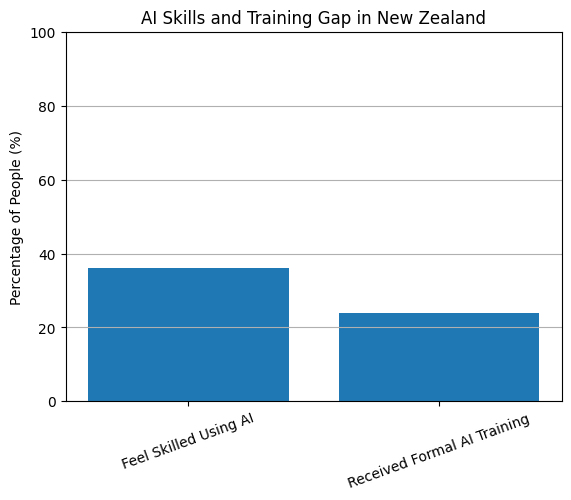
14. Only 36% of New Zealanders feel they have the skills to use AI appropriately, and just 24% have received formal AI training. A significant skills-confidence gap exists in New Zealand’s AI landscape — with adoption rates far outpacing formal training — suggesting that many Kiwis are using powerful AI tools without the foundational knowledge to do so safely or effectively.
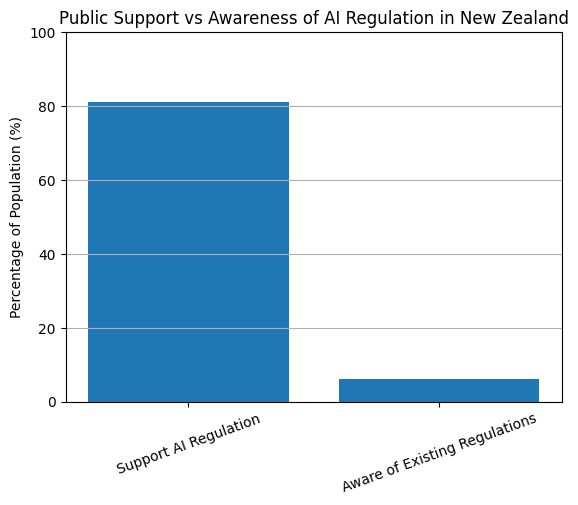
15. 81% of New Zealanders believe AI regulation is required, though only 6% are aware of current AI regulations. Broad public support for AI regulation in New Zealand is not matched by awareness of existing frameworks, highlighting a critical communication gap between policymakers and the public that could undermine trust if not addressed.
16. 85% of New Zealanders say they would be more willing to trust AI systems if there is assurance about accountability. Accountability mechanisms — including clear disclosure of AI use, explainable outputs, and human oversight — are essential trust-building levers for any New Zealand organisation deploying AI in customer-facing or decision-making contexts.
17. 75% of New Zealanders are unsure if online content can be trusted as it may be AI-generated. Widespread scepticism about the authenticity of online content in New Zealand reinforces the importance of transparent authorship, credible sourcing, and human-verified expertise to maintain brand authority in an AI-saturated digital environment.
18. 83% of NZ employees have told their employers they use generative AI tools at work. High levels of AI transparency among NZ employees are a positive sign for governance, and organisations should build on this openness by establishing clear policies that guide responsible and consistent AI use across teams.
19. 42% of NZ employees who haven’t used AI at work don’t see it as relevant to their job. The perception that AI is irrelevant to certain roles may reflect a lack of tailored onboarding and role-specific use-case examples, suggesting that generic AI training programmes alone are unlikely to drive adoption across all functions.
20. Only 52% of NZ employees state their company has established AI usage policies. With nearly half of NZ organisations operating without formal AI policies, there is a meaningful risk of inconsistent, ungoverned AI use — including potential data privacy breaches, unverified outputs, and intellectual property concerns.
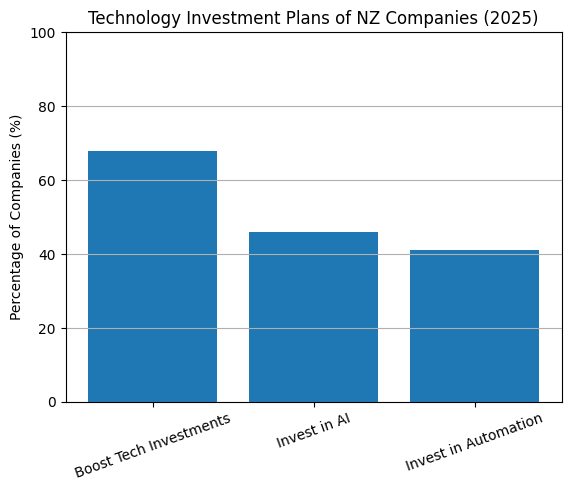
21. 29% of NZ businesses set productivity as a top priority for 2025, with 46% planning to boost AI investments. The alignment of productivity goals with planned AI investment among NZ businesses suggests a maturing understanding that technology alone is insufficient — implementation strategy, change management, and workforce upskilling are equally critical to realising gains.
22. 68% of NZ companies planned to boost tech investments in 2025, with AI cited by 46% and automation by 41%. The strong intent to invest in AI and automation among NZ companies signals a competitive market for technology talent and solutions, with businesses that move decisively likely to outpace peers still in the evaluation phase.
23. New Zealand launched its first national AI strategy in July 2025, making it the last OECD country to do so. While New Zealand’s late entry into national AI strategy development is notable given its world-leading private sector adoption, the strategy’s launch provides a long-overdue framework for coordinating public sector AI governance and investment.
🔍 SECTION 2: KIWI SEARCH BEHAVIOUR & AI SEARCH ADOPTION
24. 82.4% of New Zealanders use a search engine several times a day. Search engines remain deeply embedded in the daily digital lives of New Zealanders, making search visibility — whether through traditional SEO or emerging generative engine optimisation — one of the highest-value digital marketing channels available to NZ businesses.
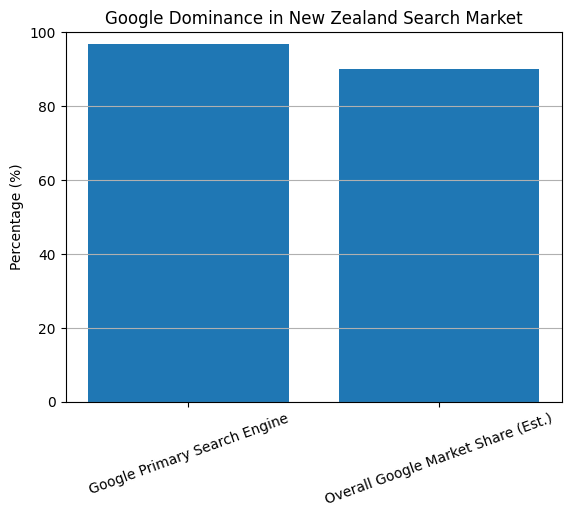
25. 96.8% of NZ respondents nominate Google as their primary search engine. Google’s near-total dominance of the NZ search market means that optimising for Google’s evolving AI features — including AI Overviews and AI Mode — remains the single most important priority for any New Zealand SEO or GEO strategy.
26. Google’s market share in New Zealand remains comfortably above 90%. Despite the rapid growth of ChatGPT and other AI search tools, Google’s commanding position in New Zealand means traditional SEO fundamentals remain relevant — with the added requirement of adapting content to perform well within Google’s generative AI features.
27. 48.4% of New Zealanders have used ChatGPT. Nearly half of all New Zealanders have experimented with ChatGPT, reflecting its rapid mainstream penetration and signalling that AI-powered search is no longer a fringe behaviour but a mainstream consumer habit that brands need to actively account for.
28. 39.2% of New Zealanders have used an AI chatbot instead of a traditional search engine at least once. With two in five New Zealanders having bypassed Google in favour of an AI chatbot for at least one search session, the competitive threat to traditional search traffic is real and growing — making GEO an increasingly essential complement to conventional SEO.
29. 42.4% of NZ consumers sometimes ask a chatbot first before making a purchase, even though 69.2% still visit search engines often or always before buying. The rise of AI chatbots in NZ purchase journeys does not yet signal a wholesale abandonment of traditional search, but it does suggest a dual-channel research behaviour that brands must optimise for — being visible and credible across both Google and AI assistants.
30. 79.6% of NZ respondents trust search results moderately or completely, and 36.4% extend the same trust to chatbots. While search engines still hold a clear trust advantage over AI chatbots among New Zealanders, the fact that more than a third already trust chatbot responses to a similar degree suggests AI tools are rapidly closing the credibility gap — particularly among younger demographics.
31. Nearly half (48.4%) of New Zealanders already use voice search, and a third (33.2%) have tried visual search. The significant uptake of voice and visual search among New Zealanders reinforces the need for multimodal search optimisation strategies — including structured data, image optimisation, and conversational content formats that align with how people naturally speak and query.
32. Almost 30% of queries bringing top/middle-funnel traffic to NZ websites are now being answered by Google AI Overviews or LLMs — producing zero-click results. The increasing proportion of zero-click AI answers eating into NZ website traffic is a structural shift that demands a revised content and measurement strategy — one that values brand authority and AI citation frequency, not just traditional click-through rates.
33. Traffic from ChatGPT to Rocketspark (NZ) more than tripled in 2025. Rocketspark’s tripling of ChatGPT referral traffic demonstrates that AI-driven search can generate meaningful website visits for NZ businesses — though the absolute volumes remain modest, making this a high-growth but still-developing traffic channel.
34. In September 2025, AI tools sent more than 3,000 visitors to the MoneyHub NZ site — about 1% of total traffic. MoneyHub’s experience illustrates the current reality for many NZ publishers: AI referral traffic is growing quickly in percentage terms but still represents a small fraction of overall visits — making it a channel to invest in now before competition intensifies.
35. Google AI Mode launched in New Zealand in mid-2025. The arrival of Google AI Mode in New Zealand marks a significant turning point in local search behaviour, as users can now conduct deeply conversational, multi-step research sessions directly within Google — further eroding the need to click through to individual websites.
36. AI Overviews have been live in NZ for several months as of late 2025, with AI Mode expected to roll out globally in 2026. New Zealand marketers are already operating in a market shaped by AI Overviews, and the global expansion of AI Mode in 2026 will further accelerate the urgency of GEO adoption — organisations that delay risk falling out of AI-generated responses entirely.
37. NZ businesses like Datacom have reported a significant drop-off in website traffic as AI Overviews absorb user queries. The traffic decline experienced by major NZ businesses like Datacom is a concrete local indicator that AI Overviews are reshaping the search funnel — making a compelling case for organisations to diversify their content strategy beyond click-dependent traffic models.
38. Brands with top web mentions earn up to 10x more AI Overview mentions. The strong correlation between brand mention volume and AI Overview citation frequency means that digital PR, earned media, and thought leadership are now directly linked to AI search visibility — rewarding brands that invest consistently in building their online footprint.
💰 SECTION 3: NZ AI ECONOMIC IMPACT
39. Generative AI could contribute NZD $39–102 billion in value to NZ’s economy by 2038 — an 8–21% uplift to projected GDP. The broad range of projected economic benefit reflects genuine uncertainty about how widely and effectively AI will be adopted across all sectors of the NZ economy, not just in the technology and professional services industries where uptake is currently concentrated.
40. The central case estimate projects generative AI will contribute $76–108 billion annually to NZ’s economy by 2038. Realising the upper end of these productivity projections will require not just technology adoption but sustained investment in workforce reskilling, supportive regulation, and infrastructure — and New Zealand’s current skills gap represents one of the most significant risks to achieving these outcomes.
41. Generative AI technologies could add up to NZD $115 billion annually to the NZ economy by 2030. Projections of $115 billion in annual AI-driven economic value by 2030 represent an optimistic but achievable scenario — one that depends heavily on small and medium-sized businesses gaining equitable access to AI tools and the skills to deploy them effectively.
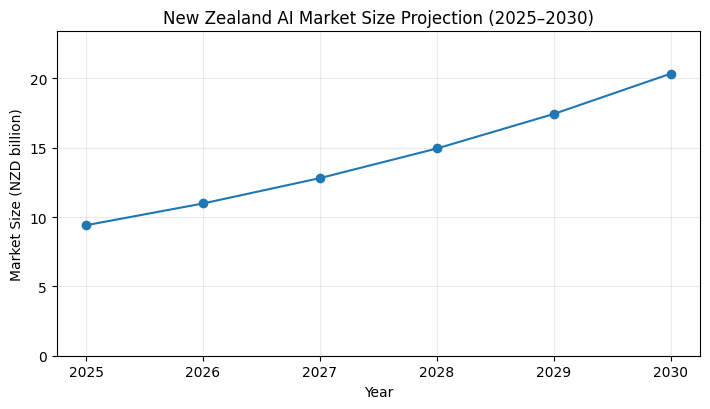
42. The NZ AI market is projected to reach NZD $9.41 billion by end of 2025, growing at 28.55% annually to NZD $20.34 billion by 2030. A compounding annual growth rate of nearly 29% in New Zealand’s AI market points to strong commercial momentum, making AI-related sectors — from SaaS providers to consultancies — among the most attractive investment and talent markets in the country.
43. Digital technologies including AI are estimated to be worth NZD $441 billion to the NZ economy by 2028. The aggregate economic value attributed to digital technologies in New Zealand by 2028 underscores that AI is not a standalone force but part of a broader digital transformation — one where interconnected investments in cloud, data infrastructure, and connectivity amplify overall impact.
44. AI integration and automation could add an additional NZD $238–840 billion annually to NZ’s GDP by 2030. The extremely wide range of this GDP projection — spanning more than $600 billion — honestly reflects the deep uncertainty in AI economic forecasting and should be treated as a scenario range rather than a reliable point estimate for policy or investment planning.
45. AI is expected to boost NZ’s productivity by around 1.5% per year on average. A sustained 1.5% annual productivity uplift from AI would be historically significant for New Zealand, which has long struggled with productivity growth relative to other OECD nations — making effective AI adoption a genuine macroeconomic opportunity for the country.
46. AI applications are expected to generate NZD $2.1 billion in new revenue by 2035, driven by healthtech, agritech, and fintech. The projected $2.1 billion in sector-specific AI revenues highlights that the greatest commercial opportunities for New Zealand lie in applying AI to its existing strengths — particularly in agriculture, healthcare, and financial services — rather than competing globally in foundational AI model development.
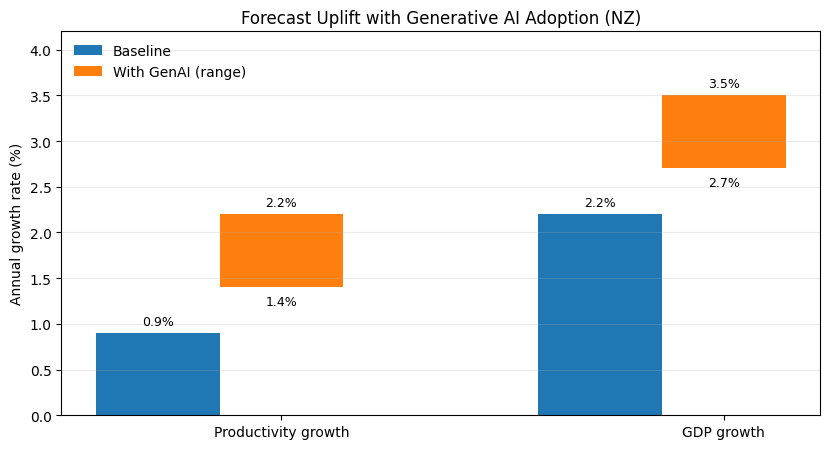
47. NZ productivity growth is forecast to rise from 0.9% to 1.4–2.2%, and GDP growth from 2.2% to 2.7–3.5%, with generative AI adoption. Even the conservative end of these projections represents a meaningful improvement for an economy historically challenged by low productivity growth, though achieving these figures will require coordinated action across government, education, and industry.
48. New Zealand’s data centre market is projected to expand over 300% from 2020 to 2030, with 80+ centres currently in operation. The rapid expansion of data centre infrastructure in New Zealand is both an enabling condition for AI growth and a growing concern from an energy and environmental perspective — with the country’s renewable energy mix offering an opportunity for relatively sustainable AI infrastructure compared to global peers.
49. Microsoft committed to upskilling 100,000 New Zealanders in digital and AI skills by 2027. While Microsoft’s commitment to upskilling 100,000 New Zealanders is a welcome and sizeable initiative, it represents a fraction of the broader workforce and underscores the need for complementary government and tertiary sector programmes to address the full scale of NZ’s AI skills gap.
50. The NZ Institute for Advanced Technology (NZIAT) committed $70 million over seven years for AI research and commercialisation. The $70 million NZIAT commitment to AI research and commercialisation is a positive signal for New Zealand’s innovation ecosystem, though sustained public and private co-investment will be needed to translate research outcomes into globally competitive products and services.
51. New Zealand falls at 40th place in the Oxford Government AI Readiness Index. A 40th-place ranking in government AI readiness starkly contrasts with New Zealand’s top position in private sector AI adoption, revealing a two-speed AI economy where citizens and businesses are ahead of the institutions meant to govern and support them.
52. 67% of NZ government systems are still not hosted in the cloud, with on-premises infrastructure costing up to 10x more. The persistence of expensive, on-premises infrastructure across two-thirds of NZ government systems represents both a fiscal inefficiency and a meaningful barrier to deploying AI at scale in public services — an area where modernisation investment would generate compounding returns.
53. Moving NZ government to the cloud could save $121 million in costs related to cyberattacks over the next decade. Beyond direct cost savings, a cloud-first approach to NZ government infrastructure would create the data accessibility and processing foundations needed to deploy AI-driven public services — making cybersecurity savings just one component of a much larger modernisation dividend.
54. New Zealand fell from 9th to 16th in global digital government rankings due to complex procurement and cultural resistance to cloud adoption. Slipping seven places in global digital government rankings is a meaningful warning signal that procurement complexity and institutional inertia pose real competitive risks — particularly at a time when governments globally are racing to leverage AI for public service efficiency.
55. Air New Zealand deployed ChatGPT Enterprise to 3,500 employees — NZ’s largest enterprise AI implementation in 2025. Air New Zealand’s large-scale ChatGPT Enterprise deployment demonstrates that traditional industries — not just tech companies — can implement generative AI at meaningful scale, and provides a visible benchmark for other large NZ organisations considering enterprise-wide AI rollouts.
🤖 SECTION 4: GLOBAL AI SEARCH LANDSCAPE (CONTEXT FOR NZ)
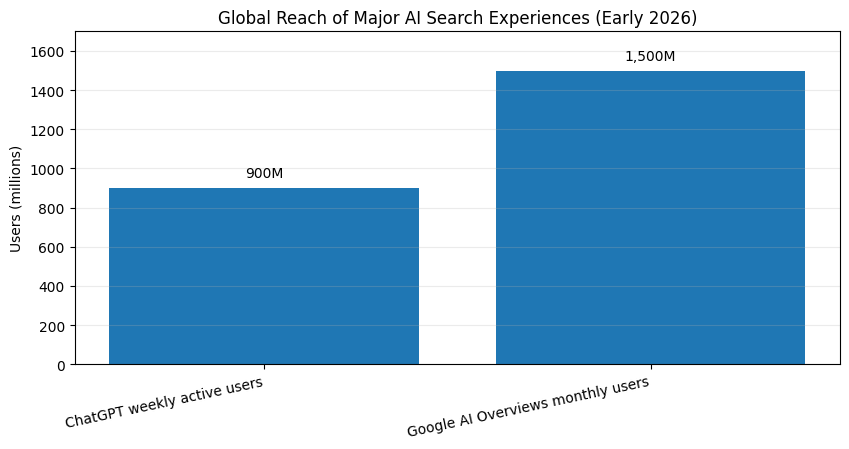
56. ChatGPT has over 900 million weekly active users globally as of early 2026. ChatGPT’s user base of nearly 1 billion weekly active users confirms that AI-powered search and assistance has reached mass-market scale globally — making optimisation for AI platforms a mainstream marketing consideration, not a niche technical experiment.
57. Google AI Overviews reach 1.5 billion monthly users globally. With 1.5 billion monthly users, Google AI Overviews represent one of the largest single audiences in digital history — and being cited within them offers a scale of organic brand exposure that rivals any paid media channel at zero incremental cost.
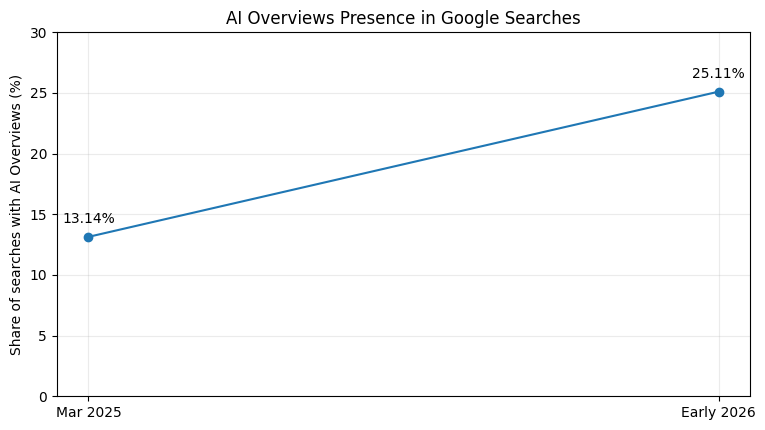
58. AI Overviews now appear in 25.11% of Google searches, up from 13.14% in March 2025. The near-doubling of AI Overview frequency within a single year demonstrates how rapidly Google is shifting its search product toward generative responses — and signals that the proportion of searches served without a direct click to websites will continue to grow.
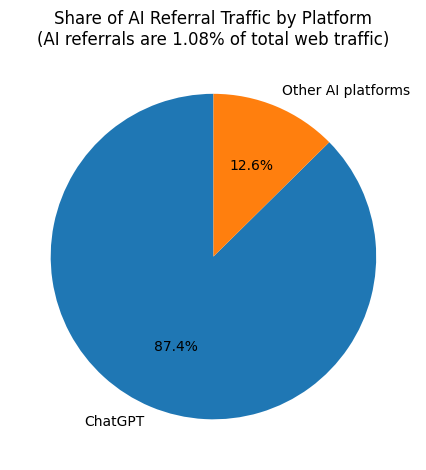
59. AI referral traffic accounts for 1.08% of all website traffic, growing roughly 1% month over month, with ChatGPT driving 87.4% of that traffic. While AI referral traffic currently represents just over 1% of global website traffic, its month-on-month growth trajectory means it could rival significant organic search segments within two to three years — making now the optimal time for NZ businesses to begin building AI-search visibility.
60. Gartner predicts traditional search engine volume will drop 25% by 2026 as users turn to generative AI assistants. Gartner’s 25% search volume decline prediction is among the more aggressive forecasts in the market, and while the actual outcome may be more gradual, it provides a useful planning scenario for NZ organisations that are heavily reliant on organic search traffic for customer acquisition.
61. Gartner also predicts that by 2028, 50% of all online searches will involve an AI assistant. If Gartner’s prediction holds, within three years AI-assisted search will be the dominant mode of information discovery online — a shift that would place brands not optimised for AI citation at a serious structural disadvantage compared to AI-visible competitors.
62. 60% of searches are now completed without users clicking through to websites (Bain & Company, 2025). A 60% zero-click rate fundamentally undermines click-through rate as the primary measure of search success, pushing marketers to reframe their KPIs around brand impression frequency, AI citation share, and direct traffic rather than organic click volume alone.
63. Around 93% of AI search sessions in Google AI Mode end without a visit to a website. A 93% session-end rate without a website visit in AI Mode is a stark reminder that being cited in AI responses is not guaranteed to drive direct traffic — making brand visibility, credibility, and authority within AI outputs the new primary objectives for digital marketers.
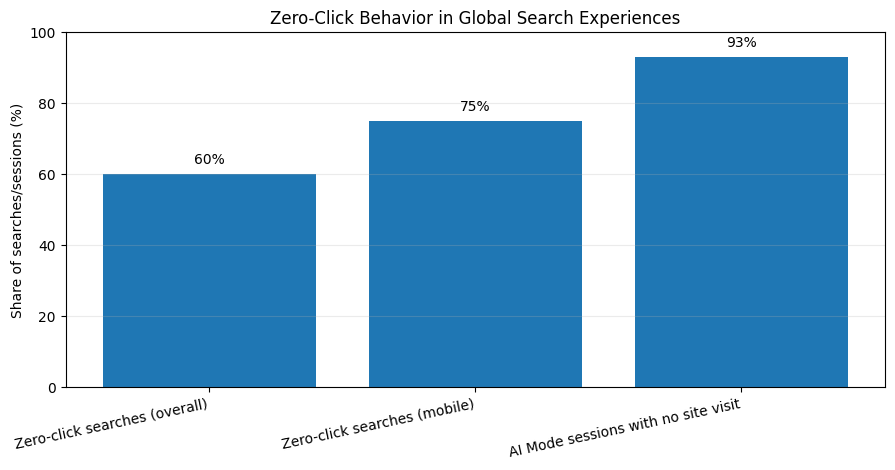
64. Zero-click searches on mobile sit at 75% globally. With three-quarters of mobile searches ending without a click, NZ brands targeting mobile users must prioritise being surfaced in AI summaries, featured snippets, and knowledge panels — not just ranking on page one of traditional search results.
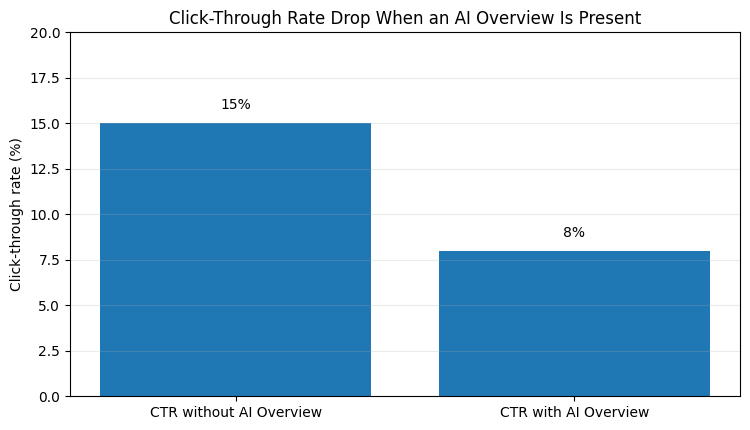
65. Click-through rates drop from 15% to 8% when a Google AI Overview is present. The near-halving of click-through rates in the presence of AI Overviews is a concrete revenue-relevant signal for NZ businesses — particularly those in sectors like finance, health, and travel where informational queries drive significant top-of-funnel website traffic.
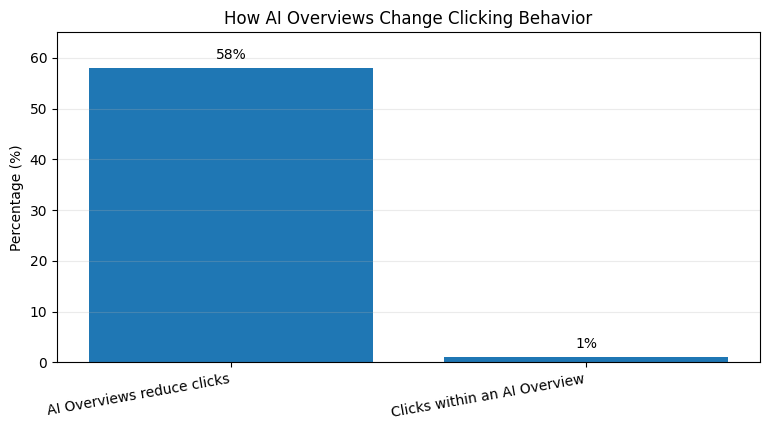
66. AI Overviews now reduce clicks by 58% (Ahrefs, February 2026). A 58% reduction in clicks driven by AI Overviews is one of the most impactful single data points for NZ SEO practitioners, suggesting that content strategies built primarily around high-traffic informational keywords are most at risk and require the most urgent rethinking.
67. Only 1% of searches lead to users clicking a link within an AI Overview. The near-zero in-Overview click rate confirms that being cited within an AI Overview provides brand exposure and authority signalling rather than direct referral traffic — a valuable outcome, but one that requires different measurement frameworks than traditional SEO click attribution.
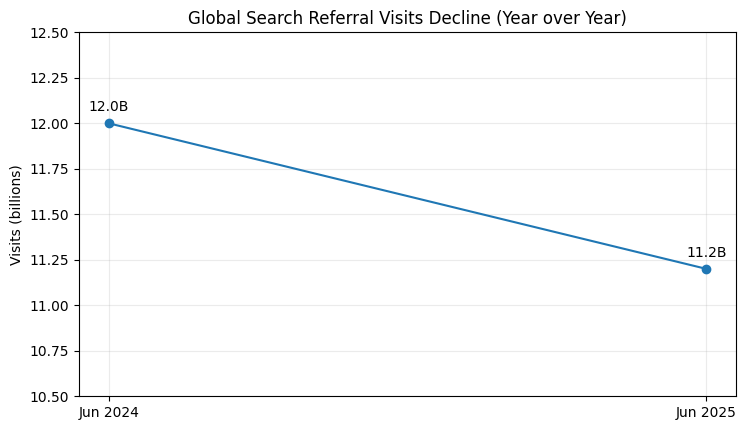
68. General search referral traffic dropped ~6.7% year-over-year — from 12 billion global visits in June 2024 to 11.2 billion in June 2025. A 6.7% year-on-year decline in global search referral traffic is a meaningful structural shift affecting publishers, e-commerce sites, and content marketers worldwide — including in New Zealand — and is likely to accelerate as AI search features continue to expand.
69. AI platforms generated 1.13 billion referral visits in June 2025 — a 357% increase from June 2024. A 357% annual increase in AI referral traffic is extraordinary growth by any measure, and while the absolute volume is still well below traditional search referral levels, the trajectory strongly favours early investment in AI search optimisation before market competition intensifies.
70. Generative AI traffic is growing 165x faster than organic search traffic. The 165x growth differential between AI-driven and organic search traffic is less a signal to abandon SEO and more a clear indicator that GEO should be elevated from an experimental to a core channel in any forward-looking digital marketing strategy.
71. ChatGPT is the 4th most visited website globally, receiving 5.7 billion global monthly visits. ChatGPT’s place among the world’s four most visited websites confirms that it has transcended its tech-early-adopter origins to become a primary information utility for mainstream internet users — including a rapidly growing share of New Zealanders.
72. ChatGPT processes 2 billion queries daily globally. Processing 2 billion daily queries places ChatGPT firmly in the same league as the world’s major search engines — making brand visibility within ChatGPT responses a genuinely strategic consideration for organisations with international or digitally active customer bases.
73. ChatGPT holds an 81% AI chatbot market share, dominating Perplexity, Copilot, Gemini, Claude, and DeepSeek. While ChatGPT’s dominant market share makes it the priority platform for AI search optimisation today, the presence of fast-growing competitors like Perplexity and Google Gemini argues for a multi-platform GEO approach rather than a single-platform strategy.
74. Perplexity has over 22 million monthly active users globally, with 30% in senior leadership roles. Perplexity’s disproportionate skew toward senior decision-makers makes it a high-value but often overlooked AI search platform for B2B brands — where being cited in Perplexity responses could carry an outsized influence on enterprise purchase decisions.
75. 75% of people say they’re using AI search tools more than a year ago, and 43% use them daily. Daily AI search usage by 43% of users — and growing — confirms that AI tools are quickly becoming habitual rather than occasional, which means the competitive window for NZ brands to establish early AI search visibility is narrowing.
76. 82% of Gen Z users prefer AI tools that provide direct answers over traditional web search. Gen Z’s overwhelming preference for direct AI answers over traditional search results has significant implications for NZ brands targeting younger audiences — particularly in retail, entertainment, education, and lifestyle categories where Gen Z is a primary consumer segment.
77. 28% of Gen Z launch searches via AI chatbot. The fact that more than one in four Gen Z users now begin their information journey through an AI chatbot rather than a search engine is a generational inflection point — one that NZ youth-facing brands and educational institutions can no longer afford to ignore.
78. 51% of US adults have used AI to look up the answer to a question. With majority adoption of AI-powered information lookup among US adults — and New Zealand tracking closely — the assumption that search always begins with Google is now empirically outdated, particularly for research-intensive queries in health, finance, and travel.
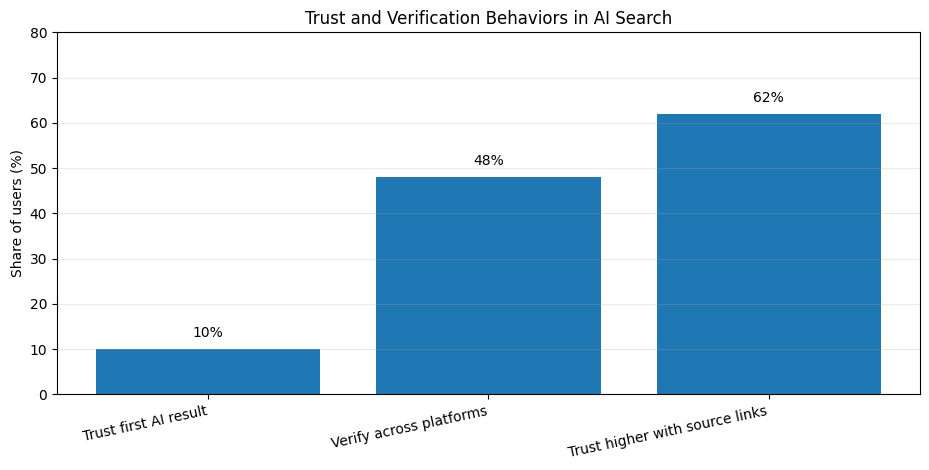
79. 62% of consumers trust AI recommendations more when brand citations include source links. The trust premium attached to source-linked AI citations reinforces the value of building credible, well-referenced content that AI models are likely to draw from — with transparent sourcing not only improving AI citation rates but also the downstream trust users place in those citations.
80. Only 10% trust the first AI result, while 48% verify answers across multiple platforms. The multi-platform verification behaviour of nearly half of AI search users underscores why NZ brands must build consistent visibility across Google, ChatGPT, Perplexity, and Bing AI — as presence in just one AI platform is insufficient to capture the full scope of a modern research journey.
81. AI search traffic converts at 14.2% compared to Google’s 2.8%. The five-fold conversion rate advantage of AI-referred traffic over Google organic traffic is perhaps the single most compelling commercial argument for investing in GEO — suggesting that when AI platforms do send users to websites, those users arrive with significantly higher purchase intent.
82. Claude (Anthropic) has the highest AI search conversion rate at 16.8%, followed by ChatGPT at 14.2%. Claude’s category-leading conversion rate among AI search platforms is a noteworthy signal for B2B and high-consideration purchase brands — though the relatively smaller user base compared to ChatGPT means absolute traffic volumes from Claude remain lower despite superior conversion performance.
83. 38% of business decision-makers have already allocated a budget to AI Search Optimisation. With more than a third of global business decision-makers already funding AI search optimisation, New Zealand companies that have not yet budgeted for GEO risk ceding ground to international competitors who are actively building AI search visibility in markets that NZ brands also serve.
84. Only 22% of marketers are actively tracking AI visibility and traffic. The significant gap between those investing in AI search optimisation and those actually measuring its performance highlights a widespread accountability gap in digital marketing — one that makes it difficult to optimise strategies or justify AI search budgets with confidence.
📊 SECTION 5: GEO, AI CITATION BEHAVIOUR & TECHNICAL SIGNALS
85. Domain traffic is the #1 predictor of AI citations — high-traffic sites earn 3x more AI citations than low-traffic ones. The primacy of domain traffic as an AI citation predictor reinforces that there is no shortcut to AI search visibility — brands must invest in building genuine audience and authority over time, as AI models broadly reward the same credibility signals that traditional SEO has always valued.
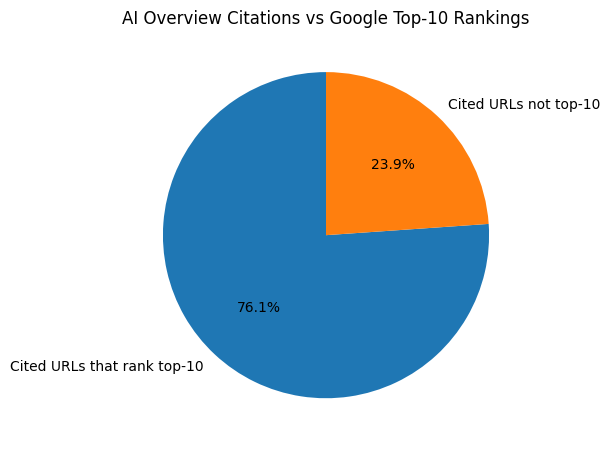
86. 76.1% of URLs cited in AI Overviews also rank in the top 10 of Google search results. The strong overlap between AI Overview citations and top-10 Google rankings confirms that strong traditional SEO remains the most reliable foundation for GEO success — making integrated search strategies far more effective than treating SEO and GEO as separate disciplines.
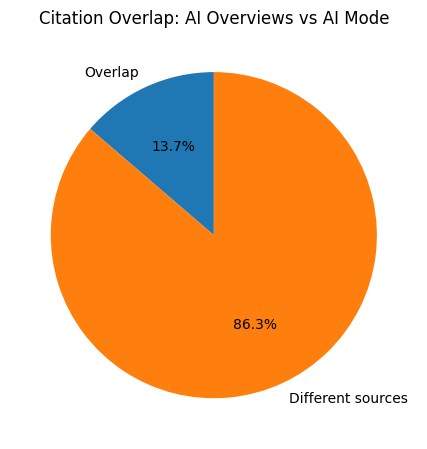
87. AI Overviews and AI Mode cite different sources — only 13.7% of citations overlap between the two. The near-total divergence in citation sources between AI Overviews and AI Mode reveals that these are meaningfully distinct search experiences requiring separate optimisation approaches — and that appearing in one does not automatically guarantee visibility in the other.
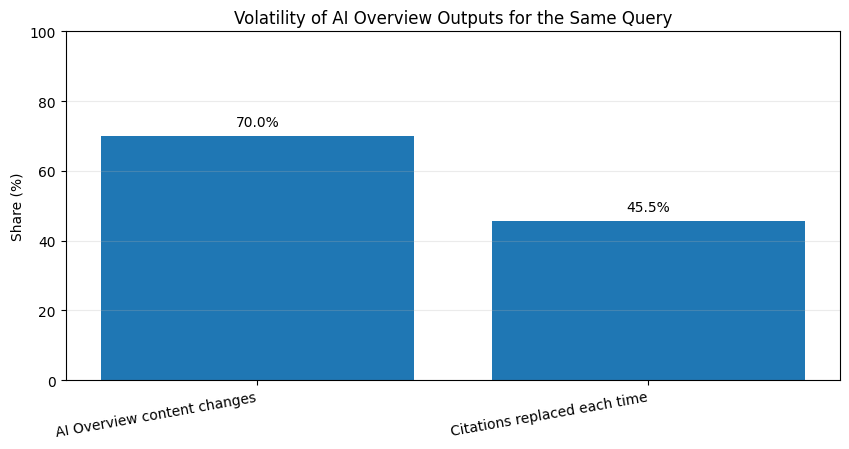
88. AI Overview content changes 70% of the time for the same query, with 45.5% of citations replaced each time. The high volatility of AI Overview content and citations underscores the importance of consistently strong content fundamentals over chasing short-term citation wins — brands that maintain authoritative, frequently updated content are best positioned to remain cited despite the inherent instability of AI-generated results.
89. There is less than a 1-in-100 chance that ChatGPT or Google AI will give the same list of brands in any two responses. The near-total unpredictability of brand-specific AI responses argues strongly for measuring AI search performance across hundreds of query variations and multiple time periods, rather than drawing conclusions from any single AI search result.
90. 44.2% of all LLM citations come from the first 30% of text (the intro). The disproportionate weight LLMs give to introductory content makes front-loading key facts, entity mentions, and authoritative claims in the first section of any web page a high-value GEO tactic for NZ content creators and SEO practitioners.
91. 28.3% of ChatGPT’s most-cited pages have zero organic visibility on Google. The fact that more than a quarter of frequently cited ChatGPT sources are essentially invisible in Google search confirms that GEO and SEO are genuinely distinct disciplines — and that publishing high-quality, factual content on well-trafficked domains can earn AI visibility regardless of traditional search ranking.
92. YouTube mentions and branded web mentions are the top factors correlating with AI brand visibility in ChatGPT, AI Mode, and AI Overviews. For NZ brands seeking to improve their AI search visibility, a consistent presence on YouTube and investment in earned media coverage represent practical, high-impact tactics — reinforcing that AI search optimisation is as much a brand-building exercise as a technical content strategy.
93. Content translation can boost AI Overview visibility by 327%. The dramatic AI visibility gains achievable through content translation are particularly relevant to NZ businesses with multilingual audiences or global ambitions — and suggest that localisation investment has search benefits well beyond traditional international SEO.
94. Only 7.9% of local searches trigger an AI Overview. The relatively low rate of AI Overview activation for local search queries is a meaningful insight for NZ SMEs — suggesting that local SEO fundamentals such as Google Business Profile optimisation, local citations, and review management remain critical and less disrupted by AI than informational search.
95. ChatGPT is more likely to reference older content — 29% of its citations date to 2022 or earlier. ChatGPT’s tendency to cite older content reflects the static nature of its training data, which means NZ brands with well-established, authoritative content assets may enjoy a legacy advantage — while also highlighting the importance of publishing timely, well-cited content that AI models will eventually incorporate through future training cycles.
96. The same brand can see citation rates range from 0.59% on ChatGPT to 27% on Grok — a 46x gap across platforms. The extraordinary variation in brand citation rates across AI platforms reinforces the need for NZ marketers to track AI visibility across multiple tools — and to understand that strong performance on one AI platform provides no guarantee of equivalent visibility on others.
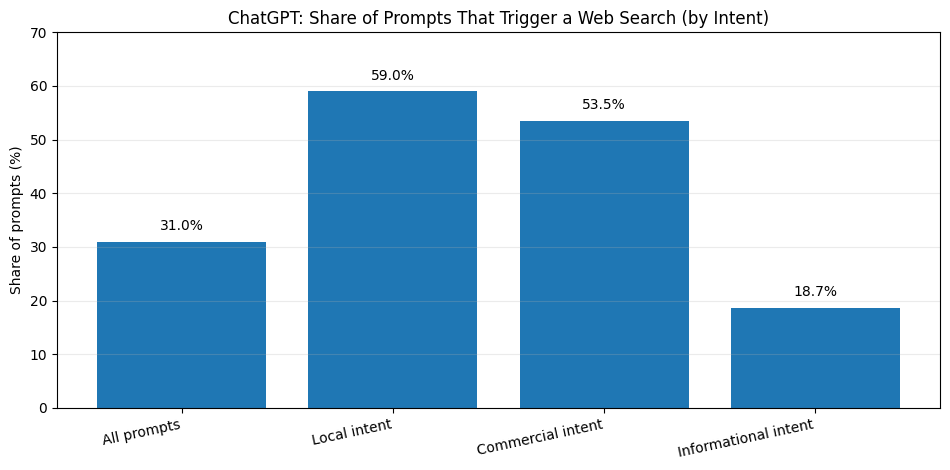
97. 31% of ChatGPT prompts trigger a web search; local intent triggers web search in 59% of instances. The significantly higher web search trigger rate for local intent queries means that ChatGPT is actively consulting live web content when users ask locally-oriented questions — making real-time web presence, Google Business Profile, and local directory listings directly relevant to ChatGPT citation outcomes.
98. Commercial intent prompts trigger ChatGPT web search in 53.5% of cases, vs. 18.7% for informational queries. The much higher web search activation for commercial queries confirms that ChatGPT is actively seeking current, verifiable information when users are in buying mode — making up-to-date product pages, pricing, and review content directly relevant to commercial AI search outcomes.
99. ChatGPT users click external websites about twice as often as Google users — 1.4 links per visit vs. 0.6 from Google. ChatGPT’s superior per-visit click rate compared to Google confirms that AI referral traffic — when generated — is meaningfully more engaged than traditional organic traffic, lending further weight to the argument that high-quality AI citation can deliver tangible bottom-line benefit.
100. Business and service sites account for 50% of all sources ChatGPT cites; news accounts for 9.5%; blogs/content 8.3%. ChatGPT’s strong preference for citing business and service websites over news or blog content is good news for NZ companies with authoritative, well-structured service pages — and reinforces the value of investing in comprehensive, factually accurate product and service content rather than purely editorial content.
🏢 SECTION 6: GEO MARKET & NZ DIGITAL MARKETING ADAPTATION
101. The GEO market is valued at $848 million in 2025 and projected to reach $33.7 billion by 2034 at a 50.5% CAGR. A projected 40x expansion of the GEO market in under a decade reflects the scale of commercial opportunity for agencies, platforms, and tools built around AI search visibility — and signals that NZ businesses that develop GEO capability now are positioning themselves ahead of a significant market curve.
102. 54% of US marketers plan to implement GEO within 3–6 months (eMarketer, January 2026). With more than half of US marketers planning to implement GEO in the near term, NZ businesses competing in international markets — particularly SaaS, tourism, and education — face rapidly growing AI search competition from offshore brands and should prioritise GEO accordingly.
103. Only 25.7% of marketers plan to develop content specifically for AI citations. The fact that fewer than one in four marketers globally are actively developing AI citation-specific content represents a genuine first-mover opportunity for NZ businesses willing to invest in structured, authoritative, and citation-optimised content now — before the market matures and competition intensifies.
104. 74% of NZ marketing professionals said generative AI results could improve the search experience if done right. The broad conditional optimism among NZ marketing professionals about generative AI in search suggests the industry acknowledges both the opportunity and the execution risk — with quality, accuracy, and relevance of AI-generated results seen as the determining factors.
105. 44% of sites globally reported flat or declining traffic after Google launched AI Overviews. The near-even split between winners and losers in the wake of AI Overviews highlights that the impact is highly content-type and intent dependent — NZ sites with heavily informational content are most exposed, while transactional and locally-focused sites may see comparatively less disruption.
106. 43% of marketers changed their content approach in response to generative AI results on Google in 2025. The fact that nearly half of marketers have already adapted their content strategies in response to AI search features indicates that GEO is not a future consideration but a present reality — and the remaining 57% who have not yet adapted are increasingly at risk of a widening visibility gap.
107. By late 2025, GEO became a mainstream priority for brands globally, including NZ agencies like Net Branding, The Optimisers, Conversion Marketing, and HornTech. The emergence of dedicated GEO practices within New Zealand’s digital marketing industry is a clear signal that the market has moved beyond theoretical discussion — with specialist local expertise now available to NZ businesses ready to invest in AI search visibility.
108. Auckland law firm Smith and Partners is actively optimising to be cited in Google AI Overviews for legal questions. The adoption of GEO by a traditional professional services firm like Smith and Partners illustrates that AI search optimisation is relevant well beyond the technology sector — particularly for knowledge-intensive industries where consumers commonly begin their decision journey with an information search.
109. AI Overviews appear for nearly 58% of question-based queries. The majority presence of AI Overviews for question-format queries — the most common way people search for information, advice, and recommendations — makes optimising content to answer specific questions clearly and factually one of the most direct paths to AI search visibility.
110. Position #1 Google results see a 34.5% lower CTR when AI Overviews are present. A 34.5% CTR reduction for the coveted top position on Google is a significant devaluation of one of digital marketing’s most prized rankings — and reinforces the case for NZ businesses to invest in GEO alongside SEO, rather than relying solely on traditional rank-based traffic models.
111. NZ agencies are investing millions into LLM and search research on behalf of large NZ businesses, SaaS, and public companies. The emergence of significant LLM research investment among NZ agencies serving enterprise clients confirms that AI search is now a board-level commercial concern — with meaningful budgets being allocated to understanding and influencing how AI platforms represent New Zealand brands.
112. The autonomous AI agent market is projected to reach $8.5 billion by 2026 and $35 billion by 2030 at a ~55% CAGR. The rapid growth of the AI agent market has direct implications for NZ digital marketing, as autonomous agents increasingly execute search, research, and purchase tasks on behalf of users — creating a new class of “machine customer” that brands must ensure they are discoverable and recommendable to.
113. 36% of US adults will use generative AI for online search by 2028 (Insider Intelligence). Given New Zealand’s consistently higher-than-US AI adoption rates, a figure of 36% US AI search users by 2028 implies New Zealand could exceed that benchmark considerably earlier — making a 2026 investment in GEO infrastructure a strategically well-timed decision.
114. Case studies and pricing pages are the best content types for driving traffic in the AI era; top-funnel “what is” content has seen massive drops. The shift in content performance toward bottom-funnel assets like case studies and pricing pages has significant implications for NZ content strategies, suggesting that resources should be reallocated toward demonstrating specific, verifiable value rather than broad-topic awareness content.
115. Users spend double the time in AI Mode compared to AI Overviews — 49 seconds vs. 21 seconds on average. The deeper engagement of AI Mode users compared to AI Overview users suggests that AI Mode citations carry greater influence over user decisions — making brand citation within AI Mode a premium visibility objective worth prioritising in NZ GEO strategies as AI Mode expands globally.
📋 SECTION 7: ADDITIONAL GLOBAL BENCHMARKS (RELEVANT TO NZ STRATEGY)
116. By 2031, more than 1.1 billion people are expected to use AI tools globally. A global AI user base of 1.1 billion by 2031 implies that AI-mediated information discovery will reshape buyer journeys across virtually every industry in every market — making long-term GEO capability a foundational digital competency rather than a specialist niche.
117. AI is projected to contribute $15.7 trillion to the global economy by 2030. The projected $15.7 trillion global AI economic contribution underscores that while NZ is an adoption leader, the country’s ability to capture a disproportionate share of global AI value creation depends on developing uniquely competitive AI capabilities — not just deploying tools built elsewhere.
118. LLM traffic to 19 tracked GA4 properties rose from ~17,000 to 107,000 sessions comparing Jan–May 2024 to the same period in 2025. The six-fold increase in LLM-referred sessions across tracked properties in just one year provides concrete evidence that AI search referral traffic is a material and measurable channel — and one that NZ businesses should now be tracking in their own analytics as a standard reporting dimension.
119. AI referral traffic dropped 42.6% since July 2025 despite earlier growth. The significant mid-year pullback in AI referral traffic is a timely reminder that AI search is still a volatile, maturing channel — and that NZ businesses should avoid over-indexing on AI traffic in the short term while still building the long-term content and authority foundations that will sustain AI visibility.
120. Google AI Mode queries average 7.22 words in length — significantly longer than traditional search queries. The markedly longer query length in AI Mode signals a shift toward nuanced, conversational, and contextually complex search behaviour — meaning NZ content that addresses specific scenarios, comparisons, and detailed use-cases will outperform generic, short-tail keyword-optimised content in AI-driven search environments.
Conclusion
The data and insights presented in this report highlight a clear reality: AI-powered search and Generative Engine Optimization (GEO) are no longer emerging concepts but fundamental components of the digital landscape in New Zealand in 2026. The way people discover information online is changing rapidly, driven by generative AI platforms, conversational search interfaces, voice assistants, and intelligent recommendation systems. For businesses, marketers, and content creators across the country, adapting to these changes is no longer optional. It is a necessary step toward maintaining digital visibility, credibility, and long-term competitiveness.
Across the 120 AI search and GEO statistics explored in this article, several consistent trends stand out. First, the adoption of AI-powered search tools is accelerating among both consumers and businesses in New Zealand. Users are increasingly turning to AI assistants and generative platforms to ask complex questions, receive summarized answers, and obtain recommendations in a more conversational format. This shift is gradually moving search behavior away from traditional keyword-based queries toward intent-driven interactions, where users expect fast, contextual, and highly relevant responses.
Second, the role of content in search visibility is evolving. Traditional search engine optimization has focused primarily on ranking webpages in search engine results pages. However, AI-driven search environments often bypass the traditional list of links by generating direct answers synthesized from multiple sources. This means that businesses must now focus not only on ranking but also on being referenced, cited, and trusted by generative AI systems. Generative Engine Optimization addresses this challenge by emphasizing structured content, authoritative information, and clear signals of expertise that AI models can recognize and incorporate into their responses.
Another important takeaway from the data is that New Zealand’s digital ecosystem is particularly well-positioned for rapid AI adoption. With high internet penetration, strong mobile usage, and a population that embraces technological innovation, the country provides fertile ground for the expansion of AI-powered services. From e-commerce and tourism to finance, education, and healthcare, organizations across industries are experimenting with generative AI tools to enhance search experiences, streamline information delivery, and support decision-making processes.
For marketers and digital strategists, the statistics in this report highlight the need to rethink how success is measured in the age of AI search. Traditional metrics such as page rankings, impressions, and click-through rates remain relevant, but they are no longer sufficient on their own. Businesses must now consider how frequently their content appears in AI-generated answers, how their expertise is recognized by generative systems, and whether their digital presence contributes to the information ecosystem that AI platforms rely on.
Trust and credibility are also becoming increasingly important in AI-driven search environments. Generative AI systems prioritize authoritative sources when constructing responses, which means organizations must focus on producing high-quality, reliable, and well-structured content. Demonstrating expertise, maintaining up-to-date information, and building strong digital authority are critical factors in ensuring that brands and publishers remain visible within AI-generated outputs.
Another trend reflected in the data is the growing intersection between AI search and local market dynamics. For New Zealand businesses, local relevance remains a powerful advantage. Tourism providers, retailers, and service-based companies that provide clear, location-specific information are more likely to appear in AI-generated recommendations and travel planning tools. As AI systems increasingly integrate geographic and contextual signals, businesses that maintain accurate and detailed local information will have stronger opportunities to be discovered by both domestic and international audiences.
At the same time, the rise of AI-powered discovery introduces new challenges. Website traffic patterns may change as users receive answers directly within AI interfaces. Brands may need to compete not only with traditional search results but also with synthesized responses generated from a wide range of sources. This evolving landscape requires businesses to adopt more comprehensive digital strategies that combine SEO, GEO, structured data, authoritative content, and strong brand signals.
Looking ahead, AI search and generative engines are expected to continue evolving rapidly. Advances in large language models, multimodal search capabilities, and real-time knowledge integration will further transform how information is delivered to users. For New Zealand’s digital economy, this evolution will create both opportunities and competitive pressures. Organizations that invest early in understanding AI-driven search dynamics will be better positioned to capture attention, influence decision-making, and build long-term digital authority.
Ultimately, the statistics and trends explored throughout this article serve as a roadmap for navigating the future of search in New Zealand. They illustrate how user behavior is changing, how technology platforms are evolving, and how businesses must adapt their digital strategies to remain visible in an AI-powered world.
The transition from traditional search engines to generative AI discovery is still unfolding, but its direction is clear. Search is becoming more conversational, more contextual, and more integrated into everyday digital experiences. As AI assistants become trusted intermediaries between users and information, the organizations that succeed will be those that prioritize accuracy, expertise, and strategic visibility across both traditional and generative search ecosystems.
For marketers, entrepreneurs, and digital leaders across New Zealand, the message is straightforward: understanding AI search and Generative Engine Optimization today will define competitive advantage tomorrow. The insights provided by these 120 statistics offer not only a snapshot of the current landscape but also a foundation for building smarter, more resilient digital strategies in the years ahead.
If you are looking for a top-class digital marketer, then book a free consultation slot here.
If you find this article useful, why not share it with your friends and business partners, and also leave a nice comment below?
We, at the AppLabx Research Team, strive to bring the latest and most meaningful data, guides, and statistics to your doorstep.
To get access to top-quality guides, click over to the AppLabx Blog.
People also ask
What are AI search statistics in New Zealand for 2026?
AI search statistics in New Zealand for 2026 reveal how users interact with generative AI tools, search engines, and conversational platforms. They highlight adoption rates, user behavior, market growth, and how businesses adapt their digital strategies.
What is Generative Engine Optimization (GEO)?
Generative Engine Optimization is the practice of optimizing content so it can be discovered, cited, and used by AI-powered search engines and generative platforms that provide direct answers instead of traditional search results.
Why are AI search statistics important for businesses in New Zealand?
AI search statistics help businesses understand changing user behavior, adoption of generative search tools, and how AI platforms influence online visibility, marketing strategies, and digital customer journeys.
How is AI changing search behavior in New Zealand?
AI is shifting search from simple keyword queries to conversational questions. Users increasingly rely on AI assistants and generative tools that provide summarized answers, recommendations, and insights.
What industries in New Zealand benefit most from AI search?
Industries such as tourism, e-commerce, finance, education, and technology benefit greatly from AI search, as consumers use generative AI tools to research services, compare products, and plan travel.
What role does GEO play in modern SEO strategies?
GEO complements traditional SEO by ensuring content is optimized for AI-generated answers. It focuses on structured information, authority signals, and clear content that generative systems can reference.
How popular are AI search tools in New Zealand in 2026?
AI search tools are becoming widely used in New Zealand as consumers adopt AI assistants, conversational search interfaces, and generative platforms integrated into browsers and applications.
What trends are shaping AI search in New Zealand?
Major trends include conversational search, AI-generated answers, voice search growth, integration of AI in search engines, and increasing reliance on generative platforms for research.
How does AI search affect website traffic?
AI search can reduce direct clicks to websites because users often receive summarized answers directly from AI platforms. However, authoritative sources cited by AI can still gain visibility and trust.
What is the difference between SEO and GEO?
SEO focuses on ranking web pages in search engine results, while GEO focuses on optimizing content so it appears in AI-generated responses and conversational search environments.
Why should marketers track AI search statistics?
Tracking AI search statistics helps marketers understand how AI tools influence discovery, customer journeys, and content visibility, enabling them to adjust digital marketing strategies accordingly.
How does AI search influence content strategy?
Content must be clear, authoritative, structured, and informative so AI systems can understand and reference it. Long-form informative content often performs well in AI-driven search environments.
Are voice assistants contributing to AI search growth?
Yes, voice assistants and smart devices contribute significantly to AI search growth by encouraging conversational queries and natural language interactions.
How are New Zealand consumers using AI search tools?
Consumers use AI search tools to research products, compare services, plan trips, find local recommendations, and quickly receive summarized information.
What types of data are included in AI search statistics?
AI search statistics include adoption rates, user engagement trends, search behavior patterns, industry usage, and the impact of generative AI on online discovery.
How can businesses prepare for AI-driven search?
Businesses should create authoritative content, use structured data, focus on expertise and credibility, and optimize information so AI systems can easily understand and reference it.
Is AI search replacing traditional search engines?
AI search is not fully replacing traditional search engines yet, but it is transforming them by adding generative answers, conversational interfaces, and intelligent summaries.
What role does structured data play in GEO?
Structured data helps AI systems understand the context of content, making it easier for generative platforms to extract and reference accurate information.
How do AI search trends impact digital marketing in New Zealand?
AI search trends require marketers to focus on high-quality information, authority, and visibility across both traditional search engines and generative AI platforms.
Are small businesses in New Zealand affected by AI search?
Yes, small businesses can benefit from AI search if they maintain accurate local information, strong online authority, and informative content that AI systems can reference.
What are the biggest challenges of AI search adoption?
Challenges include reduced website traffic, competition for AI citations, ensuring content accuracy, and adapting traditional SEO strategies to generative search environments.
How does AI search impact local businesses in New Zealand?
AI search tools often provide location-based recommendations, making accurate local listings, reviews, and business information essential for visibility.
What is the future of AI search in New Zealand?
The future includes deeper integration of generative AI in search engines, personalized recommendations, multimodal search, and increased reliance on conversational interfaces.
Why is authority important in AI-generated search results?
AI systems prioritize credible sources when generating answers. Websites with strong expertise, trust signals, and accurate information are more likely to be referenced.
How do AI search platforms gather information?
AI platforms gather information from publicly available online sources, structured data, trusted publications, and content that demonstrates authority and clarity.
What role does content quality play in GEO?
High-quality content improves the chances of being referenced by AI platforms. Accurate, well-structured, and informative content is more likely to be included in AI-generated responses.
How can tourism businesses in New Zealand benefit from AI search?
Tourism businesses can benefit by providing detailed travel information, destination guides, and structured content that AI travel planning tools can reference.
What metrics should businesses track for AI search performance?
Businesses should track AI citations, brand mentions in AI-generated answers, organic visibility, authority signals, and engagement with AI-driven platforms.
How is AI search influencing online research habits?
Users increasingly rely on AI-generated summaries and recommendations rather than browsing multiple websites, making direct answers a key part of the search experience.
Why should businesses follow AI search trends in 2026?
Understanding AI search trends helps businesses adapt their digital strategies, maintain visibility in generative search environments, and stay competitive in an evolving online landscape.
Sources
Microsoft Research
NewZealand AI
AllAboutAI NZ
Kinetics
IAB New Zealand
Zib Digital
The Optimisers
Marketing Association New Zealand
RNZ News
Search Republic
Microsoft
Accenture
US International Trade Administration
Mandala
Funds for NGOs
Superlines
TTMS
Exposure Ninja
Position Digital
Digiday
Semrush
IT Brief New Zealand
Conversion Marketing
Digitaloft
IDNZ