

























Key Takeaways
- Bangladesh’s AI search ecosystem is expanding rapidly, with rising internet users, growing smartphone adoption, and increasing use of generative AI tools reshaping how people discover information online.
- Generative Engine Optimisation (GEO) is becoming critical as AI platforms like ChatGPT and Gemini change search behaviour, prioritising authoritative, data-rich, and well-structured content over traditional keyword-focused SEO.
- With a young digital workforce, expanding AI market projections, and strong freelance and IT sectors, Bangladesh has significant potential to become a competitive hub for AI-driven search, digital services, and GEO expertise.
Artificial intelligence is no longer a future concept in Bangladesh. It is already reshaping how people search for information, discover brands, compare products, learn new skills, build businesses, and participate in the digital economy. In 2026, the conversation has moved well beyond whether AI matters. The real question now is how fast Bangladesh is adapting to a world where search is becoming generative, visibility is becoming citation-driven, and digital authority is increasingly decided by AI systems rather than traditional search engines alone. That is exactly why this guide to 110 AI Search & GEO in Bangladesh statistics, data and trends in 2026 matters.

Bangladesh is entering this new era from a uniquely important position. It is one of the world’s most dynamic mobile-first markets, home to a young population, a fast-growing digital economy, a globally significant freelance workforce, and an expanding base of internet and smartphone users. At the same time, it remains a country defined by deep contrasts: strong network coverage but slow average internet speeds, rising smartphone adoption but low rural device access, growing AI excitement but weak digital literacy, and ambitious national technology goals alongside persistent structural inequalities. These tensions are what make Bangladesh one of the most fascinating markets to study in the global shift toward AI-powered search.
The rise of AI search is changing the foundations of online visibility. For years, businesses in Bangladesh focused primarily on traditional SEO: keyword targeting, backlinks, technical optimisation, and ranking on Google’s search engine results pages. Those tactics still matter, but they are no longer enough on their own. Today, users increasingly ask full questions in natural language, expect direct answers from chatbots and AI assistants, and rely on platforms like ChatGPT, Gemini, Perplexity, and Copilot to summarise the web for them. In this new environment, success is not only about ranking first on a search engine. It is also about being cited, referenced, trusted, and surfaced inside generative AI responses. This is where Generative Engine Optimisation, or GEO, becomes central.
GEO is rapidly emerging as one of the most important digital marketing disciplines of the AI era. Unlike traditional SEO, which was largely built around ranking web pages for specific keywords, GEO focuses on helping content become discoverable, understandable, and citable by AI systems. That means businesses need to think more carefully about authority signals, structured information, brand mentions, expert quotations, statistical evidence, topical depth, content clarity, and entity consistency. In other words, the future of visibility is not just indexed content. It is trusted content that AI models choose to include in their answers.
For Bangladesh, this shift is especially significant because of how people access the internet. The country’s digital growth is overwhelmingly mobile-led. For millions of users, a smartphone is the first screen, the primary screen, and often the only screen. Search behaviour in such markets tends to evolve differently from desktop-heavy economies. Queries become more conversational. Voice search becomes more relevant. Local language search becomes more important. Speed, usability, and simplicity matter more. AI tools that offer instant answers in a chat format can fit naturally into these usage patterns, especially in an environment where typing long search strings is less convenient than asking a direct question. As AI interfaces become easier to use, they may accelerate search adoption for many users while also changing how brands need to publish and structure content online.
That said, Bangladesh’s AI opportunity cannot be understood only through growth narratives. The country also faces major barriers that will directly shape how AI search develops over the next few years. A large share of the population remains offline. Rural smartphone access is still limited. Digital literacy remains alarmingly low. Women continue to face a measurable disadvantage in internet access and participation. Device affordability is constrained by one of the heaviest mobile tax burdens in the world. These factors matter because AI adoption is not just about whether tools exist. It is about whether people can access them, trust them, understand them, and benefit from them in everyday life. In practical terms, this means the AI search revolution in Bangladesh will not be evenly distributed. It will likely be led first by urban users, students, freelancers, knowledge workers, technology professionals, and digitally active SMEs before diffusing more broadly.
This unevenness is precisely why data is so important. Broad claims about AI can be misleading unless they are grounded in country-specific evidence. Bangladesh is often discussed either as a rising digital economy with enormous potential or as a developing market constrained by infrastructure and skills gaps. Both views contain truth, but neither is complete on its own. What matters is the full picture. How many people are online? How many are still offline? How fast is smartphone adoption rising? How strong is household internet growth? How big is the digital economy? How quickly is the AI market expanding? Which sectors are already benefiting from AI? How prepared is the workforce? How are students using generative AI? How is policy evolving? And perhaps most importantly for publishers, marketers, founders, and agencies: how is AI changing the way information is found, trusted, and acted upon in Bangladesh?
This article answers those questions through 110 carefully selected statistics, data points, and trends that together map the state of AI search and Generative Engine Optimisation in Bangladesh in 2026. It brings together internet and mobile infrastructure indicators, AI market projections, student usage trends, workforce data, policy signals, digital inclusion realities, industry case studies, and the global search transformation now influencing how Bangladeshi businesses need to think about content strategy. The goal is not simply to present numbers, but to make sense of what those numbers mean. A statistic on smartphone penetration is not just a device metric; it is a clue about future AI interface adoption. A number on digital literacy is not just an education metric; it is a constraint on trust and usage. A figure on global AI chatbot traffic is not just an international trend; it is a warning that search behaviour is changing faster than many local businesses realise.
The timing of this topic could hardly be more important. Around the world, AI-powered search has moved from novelty to mainstream behaviour. Consumers are no longer using AI only for experimentation. They are using it to research products, compare vendors, understand complex topics, summarise information, make purchase decisions, and discover brands without ever conducting a traditional search in the old sense. That shift has enormous implications for traffic, content performance, and online discovery. Many businesses still assume that ranking in Google’s top positions guarantees digital visibility. Increasingly, that assumption is no longer safe. AI systems often cite a very small number of sources per answer, and those sources do not always match the pages ranking highest in organic search. This creates an entirely new competitive landscape. In an AI-first environment, visibility is concentrated, authority-driven, and harder to win with legacy SEO tactics alone.
Bangladesh’s businesses, publishers, SaaS firms, startups, agencies, consultants, and export-oriented service providers need to pay particular attention to this change. The country already has a strong base in freelancing, outsourcing, software services, and digital marketing. That gives it a real opportunity not only to adopt GEO internally, but also to offer AI search optimisation services to international clients. As more companies around the world seek help being cited in AI responses and adapting their content for generative search environments, there is a clear opening for Bangladeshi talent to move up the value chain. But that opportunity will not automatically convert into advantage. It requires awareness, experimentation, skills development, stronger editorial standards, and a shift away from outdated SEO habits such as thin content, keyword stuffing, and mechanically generated pages with little authority value.
One of the most compelling reasons to study AI search in Bangladesh right now is that the country sits at the intersection of scale and transition. It is large enough for digital shifts to matter economically, but still early enough that first movers can gain disproportionate advantages. Brands that build authority early, publish expert-led content, cite strong evidence, earn mentions from credible third-party sources, and structure their websites for AI readability may create a durable edge before their competitors fully understand the rules of this new environment. Likewise, publishers that adapt their editorial approach for AI citation may protect and extend their relevance. Agencies that learn GEO now may define the service category locally. Startups that design for conversational discovery may outperform those still assuming a purely search-engine-driven customer journey.
At the same time, this topic is not just about marketing. AI search in Bangladesh also intersects with education, labour markets, governance, media, agriculture, healthcare, manufacturing, fintech, and climate resilience. In education, it affects how students learn, research, and complete academic work. In freelancing and outsourcing, it affects what skills remain competitive and what work becomes commoditised. In media, it affects whether publishers are surfaced or summarised away. In agriculture and health, it affects how knowledge reaches underserved communities. In public policy, it affects digital inclusion, data governance, and national competitiveness. The story of AI search in Bangladesh is therefore much bigger than traffic strategy. It is part of the broader story of how AI is being woven into the country’s economic and social fabric.
Another reason this subject deserves close attention is language. Bangladesh’s digital future will not be shaped only in English. Bengali language search, Bengali NLP, voice interfaces, and locally relevant content will play a major role in determining who benefits from AI and who remains excluded from it. If generative search systems become a dominant way to access information, then the quality of Bengali-language data, the strength of local knowledge sources, and the ability of AI systems to interpret regional context will become major competitive and developmental issues. For businesses, this means bilingual or multilingual content strategy may become more important. For policymakers and researchers, it means AI readiness is not just about infrastructure or capital, but also about language inclusion and knowledge accessibility.
This collection of Bangladesh AI search statistics and GEO trends is designed for a wide audience. It will be valuable for marketers trying to understand where SEO is heading, agency leaders building new service lines, startup founders planning growth in an AI-shaped discovery environment, journalists tracking digital transformation, investors studying the trajectory of Bangladesh’s AI economy, policymakers thinking about national competitiveness, researchers looking for consolidated market evidence, and freelancers deciding which skills to learn next. Whether you are interested in AI adoption, search trends, generative engine optimisation, digital infrastructure, content strategy, online visibility, or economic transformation, the data in this report helps connect those themes into one coherent picture.
What becomes clear from the numbers is that Bangladesh is not on the sidelines of the AI search transition. It is already inside it. The signals are visible across multiple layers at once: rising digital adoption, expanding internet households, growing AI usage among students, stronger startup funding, increasing market projections, measurable gains in agriculture and manufacturing, a maturing policy environment, and a global search ecosystem that is rapidly moving toward conversational, generative interfaces. Yet the data also makes clear that Bangladesh’s path will not be automatic. Adoption can stall. Inclusion can fail. Skills gaps can widen. Policy decisions can slow momentum. The benefits of AI search can remain concentrated among the already connected unless deliberate action is taken.
That is why the statistics in this article should be read not only as indicators of progress, but also as signals of urgency. They show where the opportunities are, where the bottlenecks remain, and where the biggest strategic decisions now need to be made. For businesses, the message is that AI search visibility is becoming a serious competitive issue. For content teams, the message is that credibility, evidence, and authority are becoming more valuable than old keyword-era tactics. For educators and policymakers, the message is that AI literacy may soon matter as much as basic digital literacy. For Bangladesh as a whole, the message is that the next phase of digital growth may be defined less by who gets online and more by who knows how to operate effectively in an AI-mediated internet.
In the sections that follow, we break down 110 of the most important AI search, GEO, internet, market, workforce, policy, and adoption statistics shaping Bangladesh in 2026. Together, they reveal a country at a pivotal moment: digitally ambitious, structurally uneven, economically promising, and increasingly influenced by the rise of generative AI. For anyone trying to understand the future of SEO in Bangladesh, the rise of AI search optimisation, or the broader digital transformation of one of South Asia’s most important markets, this data provides the foundation.
But, before we venture further, we like to share who we are and what we do.
About AppLabx
From developing a solid marketing plan to creating compelling content, optimizing for search engines, leveraging social media, and utilizing paid advertising, AppLabx offers a comprehensive suite of digital marketing services designed to drive growth and profitability for your business.
At AppLabx, we understand that no two businesses are alike. That’s why we take a personalized approach to every project, working closely with our clients to understand their unique needs and goals, and developing customized strategies to help them achieve success.
If you need a digital consultation, then send in an inquiry here.
Or, send an email to [email protected] to get started.
110 AI Search & GEO in Bangladesh Statistics, Data & Trends in 2026
Section A: Internet & Digital Infrastructure in Bangladesh (2025–2026)
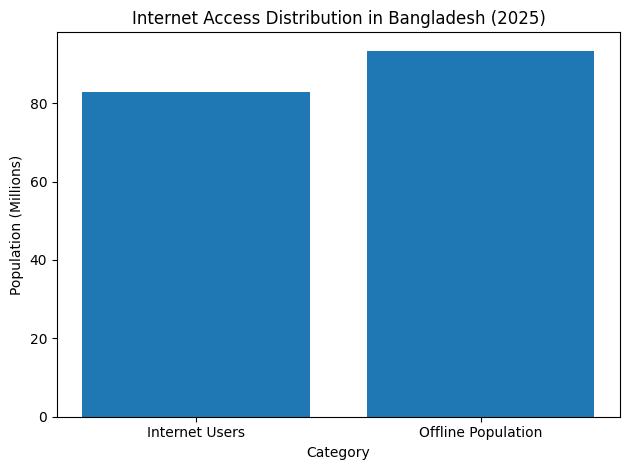
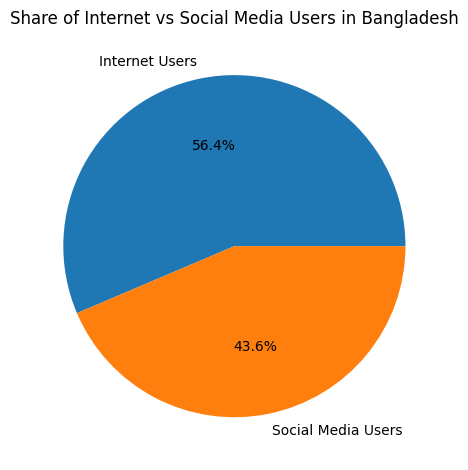
- 82.8 million internet users (47% penetration, 2025): Bangladesh’s internet user base of 82.8 million — nearly half the population — signals a rapidly digitising nation where AI-powered tools and search platforms are becoming mainstream, yet half the country remains unreached.
- 93.4 million offline (53% of population): With over 93 million Bangladeshis still offline in 2025, the country faces one of South Asia’s most significant digital inclusion gaps, directly limiting the scale at which AI search tools and generative platforms can achieve mass adoption.
- 186 million mobile connections (105% of population): Bangladesh’s mobile connection count exceeding its total population reflects widespread SIM ownership and dual-SIM usage, establishing mobile as the primary — and often only — gateway through which AI search experiences will be delivered.
- 64 million social media users (36.3% of population): With 64 million active social media identities, Bangladesh has a substantial base of digitally engaged citizens whose online behaviour increasingly shapes how AI systems learn, index, and surface local content.
- 73.2% of mobile connections are broadband (3G/4G/5G): Nearly three-quarters of Bangladesh’s mobile connections are broadband-capable, providing the minimum connectivity threshold needed to access AI-powered search engines, chatbots, and generative tools on mobile devices.
- 133.61 million internet subscribers by June 2025: Crossing 133 million internet subscribers — with 119 million on mobile — confirms that Bangladesh’s internet economy is overwhelmingly mobile-first, making mobile-optimised, AI-compatible content a non-negotiable baseline for digital visibility.
- Household internet penetration rose from 43.6% to 54.8% (2023–2025): A 25.7% jump in household internet penetration in just two years reflects accelerating infrastructure investment, creating a growing in-home audience for AI search and voice-based generative queries in Bangladesh.
- 4G coverage at 100% of population; 3G at 99.8%: Universal 4G coverage means every Bangladeshi theoretically has the network infrastructure to access AI search tools, removing connectivity as a geographic barrier and shifting the bottleneck to device affordability and digital literacy.
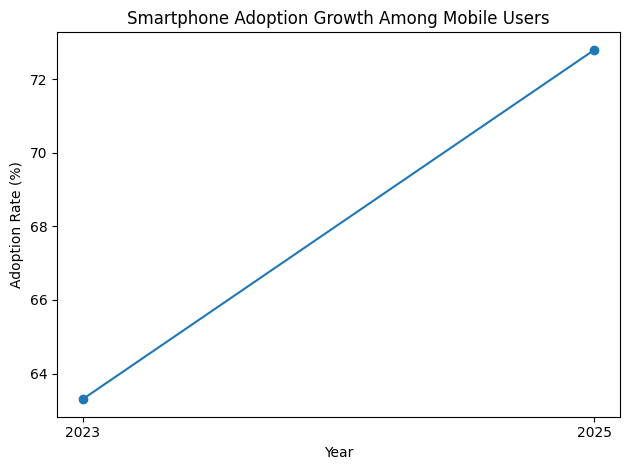
- Smartphone adoption grew from 63.3% to 72.8% of mobile users (2023–2025): Rising smartphone penetration is a leading indicator of AI search adoption in Bangladesh, as smartphones are the primary device through which users access ChatGPT, Google’s AI Overviews, and voice search assistants.
- Average mobile internet speed: 9.2 Mbps vs. global average of 64.2 Mbps: Bangladesh’s mobile internet speed — running at just 14% of the global average — creates latency constraints that may slow adoption of bandwidth-intensive AI search interfaces, favouring leaner, text-based generative tools.
- Digital economy contributed 4.2% to GDP in 2025: Outpacing earlier projections by 1.6 percentage points, the digital economy’s 4.2% GDP contribution in 2025 underscores how foundational digital infrastructure — and by extension AI search — has become to Bangladesh’s economic growth story.
- Digital economy created ~350,000 new jobs by 2025: The 350,000 jobs created by Bangladesh’s digital economy by 2025 demonstrate that AI-adjacent industries — from e-commerce to IT-enabled services — are becoming a meaningful employment engine, not merely a technological experiment.
- Gender gap persists: 48% female vs. 52% male internet users (2025): While narrowing, the gender gap in Bangladesh’s internet access means AI search tools are disproportionately experienced, shaped, and benefited from by male users, raising equity concerns that policymakers and platform designers must address.
- Only 26% of rural mobile users have smartphones: With three-quarters of rural mobile users relying on feature phones, AI-powered search experiences remain largely urban phenomena in Bangladesh — a structural barrier that challenges the country’s inclusive AI ambitions.
- Digital literacy rate stands at just 8%: Bangladesh’s critically low 8% digital literacy rate is arguably the single greatest bottleneck to AI search adoption — without the foundational skills to evaluate, prompt, or trust AI-generated results, even connected users remain effectively excluded.
Section B: AI Market Size & Economic Projections
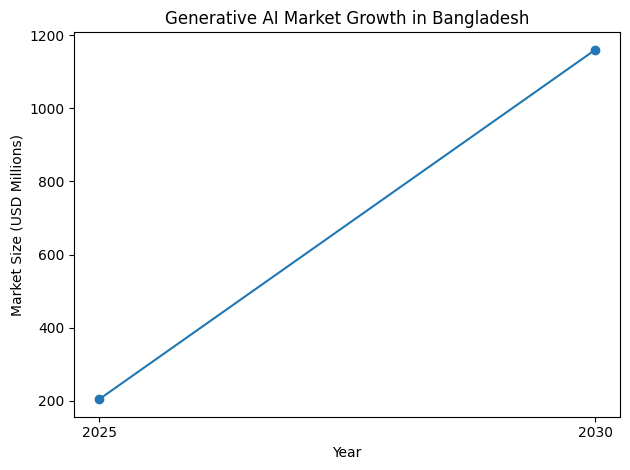
- Generative AI market projected at US$204.2 million in 2025: Bangladesh’s Generative AI market crossing the $200 million threshold in 2025 marks its transition from an emerging curiosity to a commercially significant sector attracting serious investment, product development, and policy attention.
- Generative AI CAGR of 41.52% (2025–2030), reaching $1.16 billion: A projected 41.52% compound annual growth rate positions Bangladesh’s Generative AI market among the fastest-growing in South Asia, signalling an extraordinary window for businesses, content creators, and marketers to establish early AI search authority.
- Overall AI market CAGR of 27.82%, reaching $3.9 billion by 2030: Bangladesh’s total AI market surpassing $3.9 billion by 2030 reflects a structural economic shift — one that will reshape hiring, investment, digital content strategy, and the mechanics of how businesses get found online.
- AI could add US$15.7 billion to Bangladesh’s GDP by 2030: The government’s estimate that AI could contribute $15.7 billion to GDP by 2030 frames artificial intelligence not as a technology choice but as a macroeconomic imperative for Bangladesh’s development trajectory.
- AI could boost Bangladesh’s GDP by up to 45%: A potential 45% GDP uplift from AI adoption places Bangladesh in the company of nations where AI is a generational economic transformation — provided the literacy, infrastructure, and governance gaps are closed at pace.
- Bangladesh ICT market worth USD 9.44 billion in 2026, growing to $12.79 billion by 2031: The ICT market’s steady 6.26% CAGR growth provides the commercial bedrock on which AI search tools, cloud infrastructure, and data services are being built and monetised in Bangladesh.
- AI could create 2.3 million tech jobs and $50 billion in IT exports by 2041: Bangladesh’s Smart 2041 vision targeting $50 billion in IT exports represents one of the developing world’s most ambitious AI-driven economic roadmaps — and one whose success hinges on GEO-ready, globally competitive digital content.
- AI robotics segment projected at US$53.46 million (2025), 15.2% CAGR through 2031: The robotics segment’s 15.2% CAGR signals that AI is expanding beyond software and search into physical automation in Bangladesh — particularly relevant for the manufacturing and logistics sectors seeking productivity gains.
- AI infrastructure investment requires 0.26–0.41% of GDP annually: Benchmarked against comparable economies, Bangladesh’s estimated AI infrastructure investment need of under half a percent of GDP is financially achievable — making the allocation of political will, not money, the primary constraint.
- South Asia’s AI market at $4.3 billion in 2025; Bangladesh is an emerging contender: As India dominates South Asia’s AI market with a 40% share, Bangladesh’s emergence as a regional contender reflects its growing developer community, competitive labour costs, and expanding digital service exports.
- Bangladesh’s digital economy currently valued at USD 3.5 billion: At $3.5 billion, Bangladesh’s digital economy is large enough to attract global technology investment but still early enough that first-mover advantages in AI search optimisation and generative content remain very much available.
- $194 million in startup funding for AI ventures in 2024; 1,000+ new entities: The surge of $194 million into Bangladesh’s AI startup ecosystem in 2024 confirms that private capital is beginning to match government rhetoric — creating a growing market for AI tools, platforms, and search-adjacent services.
- EdTech market to grow from $358 million to $2.56 billion by 2033 (24.42% CAGR): Bangladesh’s EdTech market growing seven-fold by 2033 makes AI-powered learning platforms one of the highest-growth digital sectors — and a key vertical where generative search optimisation can directly influence student and institutional discovery.
Section C: Generative AI Usage & Awareness
- 95% of Bangladeshi computing students use GenAI assistants: The near-universal GenAI adoption rate among Bangladeshi computing students — reportedly higher than their US counterparts — reveals a highly motivated, digitally engaged youth cohort that is already shaping future AI search behaviour and expectations.
- ~98% of both Bangladeshi and US computing students have regular internet access: Near-identical internet access rates between Bangladeshi and US computing students challenge assumptions about a digital divide at the university level, suggesting that skills gaps — not connectivity — are the primary differentiator in AI adoption quality.
- Internet connectivity issues associated with GenAI use frequency (Cramér’s V = 0.217): Even among university students with internet access, connection instability meaningfully reduces how often Bangladeshi students use AI tools — highlighting that consistent, quality connectivity matters as much as mere access for AI search engagement.
- Limited tech access associated with GenAI use frequency (Cramér’s V = 0.213): The statistically significant link between limited access to essential technology and lower GenAI usage frequency confirms that device availability, not just internet connectivity, is a dual barrier constraining Bangladesh’s AI search participation.
- Top GenAI challenges: cost and lack of knowledge about reliable AI tools: The fact that cost and navigational confusion — not technical incapability — are the primary barriers to GenAI use among Bangladeshi students points to an actionable policy window: subsidised access and structured AI literacy programs could unlock rapid adoption.
- Study of 729 students: perceived usefulness, ease of use, and risk drive ChatGPT adoption: A validated academic study confirms that Bangladeshi university users adopt ChatGPT based on rational evaluation of value and risk — meaning AI platforms and search tools that clearly communicate benefits and data privacy protections will see faster uptake.
- UNDP study: 240 participants across 32 focus groups reveal awareness gaps: The UNDP’s qualitative research exposing deep awareness gaps between tech-savvy and marginalised groups is a critical reminder that Bangladesh’s AI search landscape is bifurcating — creating two parallel digital experiences within the same country.
- Younger Bangladeshis use AI for productivity; older groups experience exclusion: The generational divide in AI usage — with youth leveraging tools for income and creation while older groups face exclusion — will define Bangladesh’s AI search inequality unless bridging programs are designed with both demographics in mind.
- 65% of Bangladeshis under 30 have some AI skills exposure vs. 50% regionally: Bangladeshi youth outpacing the South Asian regional average in AI skills exposure is an encouraging leading indicator — a trained, young, tech-inclined population is the most valuable raw material for an AI-powered economy.
- ~34% of Bangladeshi youth are technology-driven: With roughly a third of Bangladesh’s youth identifying as technology-driven, the country has a credible foundation for building an AI-literate workforce — though this still leaves two-thirds who will require active outreach and skills investment.
- ~2,000 AI scholarly publications in Bangladesh in 2021: Bangladesh’s growing academic AI output — approaching 2,000 papers in 2021 alone — signals an emerging research ecosystem that, if channelled into applied AI and NLP for Bengali, could meaningfully improve the quality and reach of local AI search tools.
Section D: AI Search Landscape – Global Context
- ChatGPT holds 80.49% of global GenAI chatbot market share (January 2026): ChatGPT’s dominant 80.49% market share makes it the de facto primary AI search interface globally — and the single most important platform for Bangladeshi brands, content creators, and marketers seeking AI search visibility.
- ChatGPT reached 800 million weekly active users by early 2026: Doubling its weekly active user base in under a year, ChatGPT’s trajectory from 400 million to 800 million users represents a structural shift in how the world finds information — one that Bangladeshi digital strategies can no longer afford to ignore.
- ChatGPT recorded 5.72 billion monthly visits in January 2026: Five-and-a-half billion monthly visits to a single AI platform in January 2026 confirms that AI-powered search is no longer a trend to watch — it is the mainstream search behaviour for a rapidly growing share of global users.
- AI platform visits grew +28.6% year-on-year (January 2025–2026): Nearly 30% annual growth in AI platform visits — outpacing traditional search traffic growth — signals that the AI search economy is compounding quickly, rewarding early adopters of Generative Engine Optimisation strategies.
- Gemini grew 157% in five months (April–September 2025), reaching 1.1 billion monthly visits: Google Gemini’s explosive 157% growth in under six months demonstrates that AI search is not a winner-takes-all market — multiple platforms are scaling simultaneously, requiring GEO strategies that span ChatGPT, Gemini, Perplexity, and Copilot.
- Perplexity at 170 million and Claude at 157 million monthly visits (September 2025): The emergence of Perplexity and Claude as significant AI search platforms with hundreds of millions of monthly visits confirms a multi-platform AI search ecosystem — brands must optimise for citation and authority across all major models, not just ChatGPT.
- ChatGPT referrals: 15 min avg. on-site vs. 8 min from Google; 7% vs. 5% conversion: Users arriving via AI-generated citations spend nearly twice as long on site and convert at a higher rate than Google-referred visitors — making GEO-driven visibility not just a traffic strategy but a demonstrably superior quality-of-traffic play.
- AI outperforms search at every purchase journey stage; beats search at ‘where to buy’ (24.3% vs. 22.1%): AI’s edge over traditional search across the entire buying journey — including the critical “where to buy” stage — means that businesses failing to secure AI search citations risk losing customers not just at discovery but at the moment of commercial intent.
- Gartner: traditional search volume to drop 25% by 2026 due to AI chatbots: Gartner’s prediction of a 25% decline in traditional search volume by 2026 is perhaps the most commercially urgent data point in this report — for Bangladeshi businesses still investing exclusively in keyword-based SEO, the returns on that investment are already compressing.
- McKinsey (Oct 2025): 50% of consumers intentionally use AI-powered search as their primary research method: When half of global consumers are deliberately choosing AI search over traditional engines for research, the question for Bangladeshi brands is no longer “should we optimise for AI?” but “how far behind are we already?”
- Only 10% of ChatGPT citations appear in Google’s top 10 organic results: The near-total disconnect between Google’s top-ranked pages and ChatGPT’s cited sources is arguably the most disruptive finding in modern search — traditional SEO rankings and AI search visibility are essentially two separate competitions requiring separate strategies.
- AI referral traffic stayed flat despite 28.6% AI platform growth (2025–2026): The counterintuitive reality that AI platforms are growing rapidly while sending less proportional referral traffic signals a fundamental change in information consumption — users are getting answers from AI without clicking through, making brand mentions and citations the new currency of AI-era visibility.
- AI search systems cite only 2–7 domains per response: The extreme concentration of AI citations — with most responses drawing from just two to seven sources — creates a hyper-competitive visibility landscape where only brands with strong authority signals, structured data, and AI-ready content earn consistent inclusion.
- Generative AI queries average ~23 words vs. ~4 in traditional search; sessions ~6 minutes: The shift from four-word keyword queries to 23-word conversational prompts represents a fundamental change in search intent and language — Bangladeshi content creators must write for natural, contextual, question-answering formats rather than short-tail keyword density.
- 47% of B2B buyers use AI for vendor research; AI-referred visitors convert at 23x organic search rate: A 23-fold conversion advantage for AI-referred B2B visitors makes GEO the highest-ROI acquisition channel in the modern digital marketing stack — a compelling case for Bangladesh’s growing B2B IT and outsourcing sectors to prioritise AI search authority.
- 35% of Gen Z use AI first for research vs. 19% of millennials and 7% of Gen X: The generational adoption gradient in AI-first research behaviour means that as Gen Z increases its purchasing power globally, AI search citations will become progressively more valuable — making now the optimal window for Bangladeshi brands to build that authority.
Section E: Generative Engine Optimisation (GEO) & AI Search in Bangladesh
- Bangladeshi digital marketers using Jasper, Writesonic, and ChatGPT for AI-assisted SEO: The active adoption of AI content tools by Bangladeshi digital marketers signals a local SEO industry in transition — moving from manual keyword strategies toward AI-augmented content pipelines optimised for both traditional and generative search visibility.
- Local SEO services in Bangladesh range from BDT 20,000–100,000+/month: The commercialisation of SEO services across a wide price band in Bangladesh reflects a maturing digital marketing industry — one that must now extend its service offering to include GEO, AI citation optimisation, and structured data management.
- International SEO services from Bangladeshi consultants: $300–$1,500/month for SMBs: Bangladesh’s competitive international SEO pricing positions its digital agencies favourably against Western counterparts — a commercial advantage that could extend to GEO services if local practitioners upskill quickly in AI search optimisation.
- Bangladeshi SEO practitioners optimising for ChatGPT, Gemini, Perplexity, and Bing Chat: The shift by Bangladeshi SEO professionals toward multi-platform AI search optimisation reflects a pragmatic acknowledgement that visibility in 2026 means being cited by AI models — not just ranked by Google’s algorithm.
- Organic traffic grew +93% in one month through focused AI-driven SEO (case study): A documented 93% monthly organic traffic increase from AI-assisted on-page SEO demonstrates that the combination of traditional optimisation discipline and AI-powered execution can deliver accelerated results even in competitive Bangladeshi digital markets.
- Bengali NLP and voice search critical for Bangladesh’s mobile-first, multilingual AI landscape: In a country where voice is often the first digital touchpoint and Bengali is the primary language, optimising content for Bengali NLP models and voice-based AI queries is not a niche strategy — it is a foundational requirement for local search relevance.
- SMEs exploring AI for keyword research, audits, voice optimisation, and content generation: Bangladesh’s small and medium enterprises are beginning to deploy AI across the full SEO value chain — a democratisation of search optimisation capability that could significantly narrow the visibility gap between large enterprises and smaller local businesses.
- 2026 marks a shift: trust, entities, and authority now determine AI-era rankings in Bangladesh: The structural transition from keyword density to entity authority and credibility signals in Bangladesh’s AI search landscape means that brands investing in thought leadership, expert citations, and consistent entity signals will accumulate compounding long-term visibility advantages.
- Statistics Addition improves AI visibility by 41%; Quotation method improves it by 28% (GEO-Bench): Peer-reviewed GEO research confirms that incorporating verifiable statistics and expert citations into content is the single most effective technique for improving how often AI search engines surface a given source — directly applicable to Bangladeshi content strategies.
- Traditional keyword stuffing consistently underperforms all GEO methods in AI search environments: Academic benchmarking across both ChatGPT and Perplexity confirms what practitioners are observing anecdotally — keyword-stuffed content is systematically deprioritised by AI models, making the shift to authority-driven, cited content a competitive necessity.
- Combined GEO strategy (Fluency + Statistics Addition) outperforms any single tactic by 5.5%+: The compounding effect of combining multiple GEO techniques — fluency optimisation alongside statistical enrichment — outperforms any single approach, suggesting that Bangladesh’s most effective AI search strategies will be multi-dimensional rather than tactic-specific.
- 85% of news organisations globally using or experimenting with GenAI tools in newsrooms (2025): With the majority of global news organisations already integrating generative AI, Bangladeshi media outlets that fail to optimise their editorial content for AI search citation risk losing authority and discoverability in the AI-driven information environment.
- Gartner: 50% drop in traditional organic traffic predicted by 2028: Gartner’s forecast of a 50% decline in traditional organic traffic within two years is a critical commercial warning for Bangladesh’s digital content industry — businesses that delay GEO adoption face not incremental but potentially catastrophic visibility losses.
- AI search shows overwhelming bias toward earned media over brand-owned content: AI models’ systematic preference for third-party authoritative sources over brand-generated content challenges Bangladesh’s direct-to-consumer digital brands, requiring a fundamental rethink of content strategy toward earning citations from credible external publishers.
- LinkedIn has ~9.9 million users in Bangladesh (early 2025): Bangladesh’s 9.9 million LinkedIn users represent a significant professional content ecosystem — and a powerful channel for building the individual and organisational authority signals that AI search engines use to determine whose content gets cited.
Section F: AI Adoption Across Industry Sectors
- Azim Group’s AI-driven production planning delivered 15% efficiency improvements in RMG: Bangladesh’s RMG sector — the backbone of an economy employing 4 million workers and generating 80% of export revenue — is discovering that AI production planning can deliver measurable efficiency gains, making sector-wide AI adoption an economic rather than merely technological imperative.
- AI precision farming pilots reduced crop losses by 40% in Bangladesh agriculture: A 40% reduction in crop losses through AI-driven precision farming, in a sector employing 40% of the workforce, represents one of the most impactful and equitable applications of artificial intelligence Bangladesh can pursue for broad-based poverty reduction.
- AI applications in agriculture and manufacturing delivered 14% and 13% productivity gains: Documented double-digit productivity improvements from AI in Bangladesh’s two largest employment sectors provide the hard evidence base policymakers and investors need to justify scaling AI adoption beyond pilots and into sector-wide deployment.
- bKash’s 70 million customers represent 22% of adult Bangladesh — foundation for AI-based fintech: bKash’s extraordinary reach — encompassing nearly a quarter of Bangladesh’s adult population — makes its transaction data a uniquely valuable foundation for next-generation AI credit scoring, fraud detection, and personalised financial services at national scale.
- Defaulted loans hit a historic high of 11.10% (BDT 1.82 trillion) — ML-based credit scoring now addressing this: The historic peak in Bangladesh’s non-performing loan ratio underscores the urgent commercial case for AI-powered credit risk assessment — tools like Rini AI’s ML scoring engine could prevent billions in future defaults while extending credit to underserved populations.
- Digital transactions rose from 366.7 million to 478.7 million in six months (Dec 2023–June 2024): A 30% rise in digital transactions in just six months confirms the velocity of Bangladesh’s cashless transition — generating the high-volume behavioural data on which AI-powered fraud detection, personalisation, and financial search tools depend.
- BFSI sector retained 21.56% of Bangladesh’s 2025 ICT outlays: Financial services’ commanding share of ICT spending confirms it as Bangladesh’s most AI-ready commercial sector — a leader whose investments in cloud analytics and AI are setting the technological standard for other industries to follow.
- Healthcare AI faces a 3–5 year regulatory timeline; Digital Health Strategy 2026–2032 funds EHR and AI imaging: The long regulatory runway for healthcare AI in Bangladesh is both a caution and an opportunity — organisations investing now in compliant, evidence-based AI diagnostic tools will be best positioned when the regulatory environment matures.
- AI assists with chest X-ray analysis and mobile diagnostics for TB screening in rural Bangladesh: The deployment of AI chest X-ray analysis for tuberculosis screening in rural Bangladesh is a powerful demonstration that AI can extend specialist medical expertise to geographically underserved populations — arguably AI’s most socially valuable application in the country.
- Only 8% of AI spend goes to climate applications despite 70% of GDP being climate-vulnerable: The stark mismatch between Bangladesh’s climate vulnerability — where 70% of GDP is exposed to climate risk — and the mere 8% of AI spend directed at climate applications represents one of the most consequential misallocations in the country’s AI investment landscape.
- AI weather tools could save Bangladesh $500 million annually in flood damages: Half a billion dollars in annual savings from AI-powered flood prediction and early warning systems represents an extraordinary return on a relatively modest investment — making climate AI one of the highest-impact, most commercially justifiable priorities for Bangladesh.
- SME cloud spending growing at 7.18% CAGR; Bangladesh Bank mandate drove 200,000 shops onto analytics platforms: Bangladesh Bank’s digital payment mandate, which compelled 200,000 businesses to adopt digital systems, has inadvertently created the largest-ever single deployment of SME analytics infrastructure in the country — laying the data foundation for AI-powered business intelligence.
Section G: AI Workforce, Freelancing & IT Exports
- ~650,000 active freelancers contributing $500 million+ annually in foreign exchange: Bangladesh’s 650,000-strong freelance workforce generating over half a billion dollars annually in digital exports is a remarkable economic achievement — and a community whose income security is directly tied to how quickly they upskill in AI search and generative content tools.
- Bangladesh is the world’s #2 supplier of online labour (~16% of global freelance workers): Holding the second-largest share of the global online labour market gives Bangladesh an outsized economic stake in the AI transition — because as generative AI automates entry-level digital tasks, the country must rapidly move its workforce up the value chain.
- BPO outsourcing earnings surged to $900 million in H1 2025 alone, exceeding all of 2024: Bangladesh’s outsourcing sector exceeding its entire 2024 revenue in just six months of 2025 is a watershed commercial milestone — and compelling evidence that AI-augmented BPO delivery is driving a step-change in productivity and client acquisition.
- ~450 BPO companies in Bangladesh employing ~90,000 people: A 450-company BPO ecosystem employing 90,000 Bangladeshis represents a sector of sufficient scale to become a meaningful global AI services hub — if it successfully transitions from low-cost labour arbitrage to AI-augmented, knowledge-intensive service delivery.
- IT exports projected at US$2.6 billion in 2025; Smart Bangladesh 2041 targets $50 billion: The 19-fold gap between Bangladesh’s current $2.6 billion IT export base and its 2041 target of $50 billion is a measure not of the ambition’s implausibility but of the transformational scale of AI adoption required to close it.
- Bangladesh has 2,500+ active startups with ~$1 billion in cumulative funding: A startup ecosystem with $1 billion in cumulative funding is large enough to incubate meaningful AI search products and platforms — yet the concentration of capital among a few winners highlights the need for broader, stage-appropriate funding instruments.
- 65% of Bangladesh’s population is under 35: Bangladesh’s extraordinary demographic dividend — with nearly two-thirds of its 170 million people under 35 — is its single greatest competitive advantage in the AI era, providing a vast, trainable workforce that can be equipped for AI-augmented roles over the next decade.
- 83% of Bangladesh’s freelance workforce is under 35 — youngest globally: The world’s youngest freelance workforce in Bangladesh is both an asset and a vulnerability in the AI transition — young enough to adapt rapidly, but also most at risk from AI automation of the entry-level tasks that currently dominate their income streams.
- 57% of female gig workers in Bangladesh report increased financial autonomy through online work: The financial empowerment that online gig work has delivered to over half of Bangladesh’s female digital workers is a powerful equity argument for ensuring that AI tools — including AI search optimisation skills — are made accessible to women equally.
- Bangladesh dropped to 29th in CEO Magazine’s global freelancing ranking due to AI skills gaps: Bangladesh’s decline in global freelancing competitiveness is a direct reflection of the skills gap in higher-value AI and data work — a trend that will accelerate unless training infrastructure for AI-adjacent skills is scaled urgently.
- AI/ML specialists in Bangladesh earn $25,000–$40,000/year vs. $12,000–$18,000 for mid-level engineers: The significant wage premium for AI/ML specialists over general software engineers in Bangladesh creates a powerful market signal — one that should accelerate voluntary upskilling toward AI-adjacent roles among the country’s large developer community.
- Bangladesh has 4,500+ software/IT organisations employing 300,000+ IT experts (BASIS): A 300,000-strong IT workforce organised across 4,500+ companies gives Bangladesh the institutional infrastructure to deploy AI search optimisation services at scale — making it a credible GEO services export destination, not just a consumer of AI tools.
- Government’s Learning and Earning program trained 57,683 individuals at BDT 3.19 billion targeting 2 million IT jobs: The government’s multi-billion-taka investment in digital workforce development establishes a precedent for public-sector AI skills funding — the critical next step is directing this infrastructure toward AI-specific, higher-value competencies rather than commoditised digital tasks.
Section H: AI Policy, Governance & National Readiness
- Bangladesh’s National AI Policy 2026–2030 (Draft v1.1) is under review: The existence of a National AI Policy under active government review signals that Bangladesh has moved past the awareness stage of AI governance into the regulatory design phase — a prerequisite for the institutional clarity that attracts enterprise AI investment.
- Bangladesh jumped from 119th to 100th in global e-government rankings in four years, becoming #1 among LDCs: A 19-place leap in global e-government rankings — achieving top status among Least Developed Countries — demonstrates that Bangladesh’s public sector has a proven track record of executing ambitious digital transformation, providing a credible foundation for AI-driven government services.
- Bangladesh scores above the global average in the Online Service Index: Bangladesh’s above-average performance in the UN’s Online Service Index, which measures government digital service quality, reflects a public sector that has successfully digitised citizen-facing services — an enabling environment for AI-powered public service delivery.
- Bangladesh enacted a Personal Data Protection Ordinance (2025) and a Cyber Security Ordinance (May 2025): The simultaneous enactment of data protection and cybersecurity ordinances in 2025 provides Bangladesh with the foundational legal framework required to govern AI data use responsibly — though enforcement capacity and alignment with international standards will determine their real-world effectiveness.
- Bangladesh deployed Oracle Sovereign Cloud (2024) and attracted ~$1 billion in startup funding: The deployment of sovereign cloud infrastructure combined with $1 billion in startup investment signals that Bangladesh is building the institutional and commercial AI stack simultaneously — creating the conditions for domestic AI development rather than pure dependency on foreign platforms.
- Bangladesh has 16 Hi-Tech Parks, 7 Technology Parks, 12 IT Training & Incubation Centers, and a Tier-IV Data Center: Bangladesh’s physical AI and tech infrastructure — spanning Hi-Tech Parks, incubation centres, and enterprise-grade data centre capacity — provides the geographic distribution and institutional density required to build a nationally inclusive AI economy rather than a Dhaka-centric one.
- ICT export earnings grew from $26 million in 2008 to ~$1 billion — a 38x increase: Bangladesh’s 38-fold growth in ICT exports over roughly 15 years is one of the developing world’s most impressive digital economy stories — and a proven demonstration that with sustained investment and policy commitment, exponential growth trajectories are achievable.
- A deficit of 15,000 cybersecurity specialists in 2025; only 15% of enterprises have 24/7 SOCs: Bangladesh’s 15,000-person cybersecurity skills shortage is a compounding risk in the AI era, where AI systems expand the attack surface and require specialised security oversight — without addressing this gap, AI adoption could outpace the country’s ability to secure it.
- Over 75% of secondary schools have computers but only ~50% have internet access: The disconnect between computer hardware availability and internet connectivity in Bangladesh’s secondary schools — reaching roughly 25% of schools with computers but no internet — creates an urgent equity gap in foundational digital and AI literacy at the most formative educational stage.
- AI integration in Bangladesh’s education system is nascent; structured AI curricula are largely missing: The absence of structured AI curricula in Bangladesh’s formal education system is a systemic vulnerability — without intentional AI literacy programmes embedded in national education standards, the country risks producing graduates who are AI users but not AI-capable professionals.
- Male internet users significantly outnumber female users; no policies currently address this: The persistence of a gender-based digital access gap in Bangladesh, in the absence of targeted policy intervention, means that AI search tools and the economic opportunities they create are being systematically distributed along gender lines — a structural inequality that will compound over time.
- Bangladesh’s mobile phone tax burden exceeds 54% — the highest in the world: The world’s highest mobile phone tax burden is a self-inflicted constraint on AI adoption — when the device needed to access AI search, generative tools, and digital services is disproportionately expensive relative to income, connectivity becomes an economic privilege rather than a universal right.
- Internet subscribers fell from 135.99 million to 131.49 million (July–October 2025) — first pullback in years: The first reversal in Bangladesh’s internet subscriber growth in half a decade, partly attributable to tax increases, is an early warning signal that policy decisions can actively reverse digital inclusion progress — and that AI adoption curves are not inevitably upward.
- AI applications in agriculture and manufacturing have produced 14% and 13% productivity gains respectively: The replication of double-digit productivity gains from AI across Bangladesh’s two most employment-intensive sectors suggests that sector-specific AI deployment — not general-purpose AI access — is the most effective near-term strategy for economic impact.
- Bangladesh’s National AI Strategy identifies 7 priority sectors for AI deployment: By formally identifying seven priority sectors — from public services to healthcare — Bangladesh’s AI strategy provides a nationally endorsed framework for resource allocation, avoiding the diffusion of investment across too many use cases and enabling measurable progress against clearly defined priorities.
Conclusion
The 110 AI Search and Generative Engine Optimisation statistics presented in this report reveal a clear and powerful conclusion: Bangladesh is entering a decisive phase in its digital evolution, where artificial intelligence is no longer an emerging concept but an increasingly central force shaping how information is discovered, businesses are found, services are delivered, and economic opportunities are created. The transition from traditional search engines to AI-driven discovery systems is already underway globally, and Bangladesh is positioned at a unique intersection of opportunity, challenge, and rapid transformation.
For more than two decades, the rules of digital visibility were largely defined by search engine optimisation. Businesses focused on ranking web pages, targeting keywords, building backlinks, and improving technical website performance in order to appear at the top of search engine results pages. That model is now undergoing a profound shift. AI-powered search platforms, conversational interfaces, and generative assistants are changing how people interact with information. Instead of typing short keyword phrases into a search engine, users increasingly ask complete questions, seek summarised answers, and rely on AI systems to curate knowledge from across the web.
This change is reshaping the structure of online visibility itself. AI systems typically reference only a small number of sources when generating responses, meaning that the competition for citation and authority is far more concentrated than traditional search rankings ever were. In this new environment, the question for brands and publishers is no longer simply whether they rank in search results. It is whether their content is recognised by AI models as credible enough to be included in the answer itself. This is the foundation of Generative Engine Optimisation, a discipline that is rapidly becoming as important as traditional SEO.
For Bangladesh, the rise of AI search arrives at a moment of significant digital momentum. Internet adoption continues to grow, smartphone usage is expanding, and mobile broadband networks now reach virtually the entire population. The country’s digital economy is steadily increasing its contribution to national GDP, while sectors such as e-commerce, fintech, outsourcing, and IT services are becoming more deeply integrated into global markets. These structural developments create the infrastructure required for AI tools and generative search platforms to reach a large and growing user base.
However, the statistics also highlight that infrastructure alone does not guarantee transformation. Bangladesh still faces substantial barriers that will shape how quickly and equitably AI search adoption spreads across society. A large share of the population remains offline, smartphone access in rural areas is still limited, and digital literacy remains one of the lowest among major emerging digital economies. These realities mean that the country’s AI transition will likely unfold unevenly, led first by urban populations, students, freelancers, digital professionals, and technology-oriented businesses before expanding more broadly.
At the same time, Bangladesh possesses several advantages that could allow it to adapt quickly if the right investments are made. The country’s demographic profile is one of its strongest assets. With a large majority of the population under the age of thirty-five, Bangladesh has one of the youngest workforces in the world. Younger populations tend to adopt new digital tools more quickly, experiment more freely with emerging technologies, and integrate AI into education, work, and entrepreneurship faster than older demographics. Early evidence from universities and computing programs already shows that Bangladeshi students are actively using generative AI tools for research, coding, and productivity tasks.
This youth-driven adoption trend is closely connected to another key pillar of Bangladesh’s digital economy: its massive freelance and outsourcing workforce. Hundreds of thousands of freelancers and tens of thousands of outsourcing professionals already contribute significantly to the country’s foreign exchange earnings through digital work. As AI reshapes global labour markets, this community will face both risk and opportunity. Entry-level digital tasks such as basic content creation, translation, data entry, and simple design are increasingly vulnerable to automation by generative AI systems. At the same time, entirely new categories of work are emerging, including AI-assisted content strategy, data analysis, prompt engineering, AI integration services, and generative search optimisation.
The freelancers, agencies, and IT companies that learn how to operate effectively in an AI-driven discovery ecosystem will be positioned to capture higher-value work and maintain Bangladesh’s strong position in the global online labour market. Those who fail to adapt may find that many of the services that once drove freelance income are becoming automated or commoditised. The statistics in this report therefore serve not only as indicators of technological change but also as signals for workforce transformation.
Another important takeaway from the data is that AI adoption in Bangladesh is not limited to the digital sector alone. Artificial intelligence is already producing measurable productivity gains in industries that form the backbone of the national economy. Manufacturing, agriculture, finance, and logistics are beginning to integrate machine learning, predictive analytics, and automation into their operations. From precision farming that reduces crop losses to AI-driven production planning in the garment industry, these technologies are demonstrating tangible economic benefits.
These sector-level developments illustrate that AI is gradually becoming embedded in the country’s broader economic infrastructure. As this trend accelerates, the demand for data, connectivity, cloud infrastructure, and AI-ready digital services will continue to expand. In parallel, the importance of reliable digital information sources will grow as AI systems increasingly rely on web content to train models, generate responses, and inform decision-making tools.
Within this evolving ecosystem, content quality and authority will become more important than ever. The research highlighted in the GEO benchmarking data shows that AI models strongly prefer content that demonstrates credibility through verifiable statistics, expert quotations, clear structure, and topical expertise. Traditional tactics such as keyword stuffing or thin content generation consistently perform poorly in generative search environments. This means that organisations in Bangladesh must begin to rethink how they create and publish information online.
Instead of producing large volumes of low-depth content aimed purely at search engines, the future of discoverability lies in authoritative, well-researched, and clearly structured resources that AI systems can easily interpret and trust. Thought leadership, industry research, statistical reports, educational content, and expert-driven articles are far more likely to be cited by generative search platforms than generic marketing pages.
For media organisations, this shift has major implications as well. News publishers and information platforms have historically relied on search engines and social media traffic to reach audiences. As AI search interfaces become more prominent, publishers must ensure that their content remains visible within AI-generated responses. Failure to adapt could lead to a situation where information from newsrooms is summarised by AI tools without users ever visiting the original publication.
The policy environment will also play a crucial role in determining how successfully Bangladesh navigates the AI era. The development of national AI strategies, data protection regulations, and cybersecurity frameworks represents an important step toward creating a responsible AI ecosystem. Clear governance structures help build trust among businesses, investors, and users while ensuring that technological innovation does not come at the expense of privacy, security, or ethical standards.
Nevertheless, policy alone cannot guarantee readiness. One of the most pressing challenges revealed by the statistics is the gap between digital infrastructure and digital capability. Although a large proportion of schools now have access to computers, many still lack reliable internet connections. Structured AI education programs remain limited, and the country faces a shortage of cybersecurity and advanced technology specialists. Without targeted investment in digital education and AI training, Bangladesh risks creating a workforce that can use AI tools but lacks the deeper skills required to build, manage, and innovate with them.
Addressing these gaps will be essential if Bangladesh hopes to realise the full economic potential of artificial intelligence. The projected growth of the AI market and the broader ICT sector suggests that demand for skilled professionals will rise sharply over the coming decade. Governments, universities, private training programs, and industry partnerships must therefore work together to develop comprehensive AI literacy initiatives that prepare students and professionals for the next phase of technological change.
Another theme that emerges from the data is the importance of inclusion. AI technologies can amplify opportunity, but they can also deepen existing inequalities if access remains uneven. The gender gap in internet usage, the urban-rural divide in smartphone ownership, and the broader disparities in digital skills all risk shaping who benefits from AI and who is left behind. Ensuring that women, rural populations, and underserved communities can access both digital infrastructure and AI education will be critical to building a truly inclusive digital economy.
Language accessibility is another important factor. Bengali remains the dominant language for the majority of the population, yet much of the global AI ecosystem is still heavily oriented toward English. Improving Bengali natural language processing, voice search capabilities, and locally relevant datasets will be essential to making AI search systems genuinely useful for a wider population in Bangladesh. Content creators and technology developers who prioritise high-quality Bengali digital resources may play an important role in closing this gap.
When viewed together, the statistics in this report paint a picture of a country standing at a pivotal technological moment. Bangladesh has already demonstrated that it can achieve rapid digital progress. Over the past fifteen years, the country has expanded internet access dramatically, built a thriving freelance economy, increased ICT exports, and developed an increasingly sophisticated technology sector. The rise of AI search and generative technologies represents the next stage of this journey.
The coming years will determine whether Bangladesh can convert its demographic advantages, entrepreneurial energy, and growing digital infrastructure into sustained leadership in the AI-driven global economy. Businesses that invest early in Generative Engine Optimisation, authoritative content strategies, and AI-friendly digital architectures will be better positioned to remain visible in an environment where search behaviour continues to evolve. Agencies and freelancers that develop expertise in AI-driven marketing, data analysis, and automation will gain a competitive edge in international markets. Policymakers who prioritise education, infrastructure, and responsible governance will help ensure that the benefits of AI are distributed broadly across society.
Ultimately, the transition to AI-powered search is not simply a technical shift. It represents a fundamental change in how knowledge flows through the internet and how value is created in digital ecosystems. For Bangladesh, understanding this transformation early and responding strategically could unlock significant economic and social benefits. The statistics outlined throughout this article are more than isolated data points. Together, they form a roadmap for understanding where Bangladesh stands today and where it may be heading as artificial intelligence becomes a defining force in the global information landscape.
As AI search platforms continue to grow and Generative Engine Optimisation becomes a core component of digital strategy, organisations that focus on credibility, expertise, structured knowledge, and long-term authority will be the ones most likely to thrive. Bangladesh’s digital future will not be determined solely by how many people are connected to the internet, but by how effectively those connections are used to create, share, and discover knowledge in an AI-driven world.
If you are looking for a top-class digital marketer, then book a free consultation slot here.
If you find this article useful, why not share it with your friends and business partners, and also leave a nice comment below?
We, at the AppLabx Research Team, strive to bring the latest and most meaningful data, guides, and statistics to your doorstep.
To get access to top-quality guides, click over to the AppLabx Blog.
People also ask
What is AI search and how is it changing online search in Bangladesh?
AI search uses artificial intelligence to generate direct answers instead of listing links. In Bangladesh, tools like ChatGPT and Gemini are changing how users find information by providing conversational responses, summaries, and recommendations instantly.
What is Generative Engine Optimisation (GEO)?
Generative Engine Optimisation is the process of optimising content so that AI platforms such as ChatGPT, Gemini, and Perplexity cite or reference it in their generated responses. GEO focuses on authority, structured information, and credible data.
Why is GEO important for businesses in Bangladesh in 2026?
As AI search grows, users increasingly rely on AI-generated answers rather than traditional search results. Businesses that optimise for GEO increase their chances of being cited in AI responses, improving brand visibility and authority online.
How many internet users are there in Bangladesh in 2026?
Bangladesh has tens of millions of internet users and continues to grow rapidly as smartphone adoption increases and mobile broadband expands. Internet access is becoming the foundation for AI search adoption across the country.
How is AI changing SEO strategies in Bangladesh?
AI is shifting SEO from keyword-focused optimisation to authority-based content strategies. Businesses must publish well-researched, structured, and credible information that AI systems can easily interpret and cite.
Why are statistics important for AI search optimisation?
AI models prefer content supported by verifiable statistics and research. Data-driven content increases credibility, making it more likely that AI platforms will reference a source in generated answers.
How does AI search differ from traditional Google search?
Traditional search shows a list of links, while AI search generates a direct answer by summarising information from multiple sources. This reduces the number of clicks and changes how websites gain visibility.
What role does mobile internet play in AI search adoption in Bangladesh?
Bangladesh is a mobile-first market, meaning most people access the internet through smartphones. AI search tools that work well on mobile devices and voice interfaces will likely grow faster in this environment.
How is generative AI influencing digital marketing in Bangladesh?
Generative AI is helping marketers create content, analyse data, and optimise strategies faster. It also changes how audiences discover brands, making AI visibility and GEO increasingly important for marketing success.
What are the biggest challenges for AI adoption in Bangladesh?
Key challenges include low digital literacy, limited smartphone access in rural areas, high device costs, and gaps in AI education. These barriers can slow the spread of AI technologies across the population.
How large is the AI market in Bangladesh expected to become?
The AI market in Bangladesh is projected to grow significantly over the next decade, with increasing investments in generative AI, data analytics, and automation technologies across multiple industries.
Why is Bangladesh considered a promising AI market?
Bangladesh has a young population, expanding digital infrastructure, a strong freelance workforce, and growing startup activity. These factors create strong potential for rapid AI adoption and innovation.
How are Bangladeshi students using generative AI tools?
Many university students use generative AI for coding assistance, research, learning support, and productivity. These tools are becoming part of everyday academic workflows.
How does AI search affect website traffic?
AI search can reduce direct clicks because users often receive answers immediately. However, websites cited in AI responses gain strong authority and high-quality traffic.
What industries in Bangladesh are benefiting from AI technology?
Industries such as agriculture, finance, manufacturing, healthcare, and e-commerce are beginning to adopt AI solutions to improve productivity, decision-making, and operational efficiency.
What is the connection between AI search and content authority?
AI platforms prioritise trusted sources when generating answers. Websites that demonstrate expertise, research depth, and consistent authority are more likely to be cited.
How can businesses optimise their content for AI search?
Businesses should focus on publishing expert insights, structured articles, original data, clear explanations, and credible sources. These elements help AI models recognise the content as trustworthy.
Why is Bangladesh’s freelance workforce important for the AI economy?
Bangladesh has one of the world’s largest freelance workforces. With proper AI skills, freelancers can offer higher-value services such as AI consulting, data analysis, and GEO optimisation.
How does AI influence online buying behaviour?
Consumers increasingly use AI tools to research products, compare options, and get recommendations before purchasing. This makes AI visibility an important part of the customer journey.
What is the role of Bengali language in AI search development?
Bengali language processing is crucial for making AI tools accessible to a wider population in Bangladesh. Better language support improves search accuracy and usability.
How is AI changing the global search landscape?
AI is transforming search from keyword queries to conversational questions. Users now expect fast, summarised answers generated by intelligent systems rather than browsing multiple websites.
What opportunities does GEO create for Bangladeshi digital agencies?
Digital agencies can offer AI search optimisation services to both local and international clients. As demand for GEO expertise grows, agencies that develop early expertise may gain competitive advantages.
How does AI affect content creation strategies?
Content strategies are shifting toward deeper, more informative articles supported by research and expert knowledge. High-quality content performs better in both traditional search and AI-generated responses.
What role does data play in AI search visibility?
Structured and reliable data helps AI models understand and reference information accurately. Websites that provide clear data points often gain higher credibility.
How can startups in Bangladesh benefit from AI search trends?
Startups can gain visibility by publishing authoritative content, building strong brand signals, and optimising their digital presence for AI-powered discovery platforms.
Why is digital literacy important for AI adoption?
Digital literacy helps users understand how to interact with AI tools, evaluate information, and use technology effectively. Without it, many people remain excluded from AI-driven benefits.
How will AI search evolve in the next few years?
AI search is expected to become more conversational, personalised, and integrated across devices. Voice assistants and AI chat interfaces will likely play a larger role in information discovery.
What impact does AI have on Bangladesh’s digital economy?
AI technologies can improve productivity, create new digital services, and strengthen global competitiveness. They are expected to contribute significantly to economic growth in the coming years.
How can content creators stay relevant in the AI search era?
Creators should focus on expertise, credibility, original insights, and structured information. These factors increase the likelihood of their work being recognised by AI systems.
Why should businesses track AI search statistics and trends?
Tracking AI search data helps businesses understand evolving user behaviour, adapt digital strategies, and remain competitive in a rapidly changing online environment.
Sources
DataReportal – Digital 2026: Bangladesh
Wikipedia – Internet in Bangladesh
National AI Policy Bangladesh 2026–2030
Atomic Technium – Bangladesh AI/ML Infrastructure 2026
FICCI Bangladesh – The Connectivity Dividend
The Daily Star – The Digital Evolution
Statista – Generative AI Bangladesh
Statista – Artificial Intelligence Bangladesh
Thoughtonic – CES 2025 Insights for Bangladesh
Mordor Intelligence – Bangladesh ICT Market
ACM ICER 2025 – GenAI Access in Bangladesh vs US
Taylor & Francis – ChatGPT Acceptance in Bangladesh Higher Education
fundsforNGOs – AI Impact on Human Development in Bangladesh
ResearchGate – AI Applications in Bangladesh Sectors
UNESCO UNDP – Bangladesh AI Readiness Assessment Report
DemandSage – ChatGPT Statistics March 2026
Similarweb – Generative AI Statistics 2026
GunnerJnr – GEO for 2026 AI Search
Medium – The Emergence of GEO in the Age of AI
WordStream – Generative Engine Optimization
NotionHive – AI Impact on Search Visibility Bangladesh
Md Faruk Khan – SEO Expert Bangladesh
Tanveer Evan Rahat – AI Driven SEO in Bangladesh 2026
arXiv – GEO Generative Engine Optimization
ePublishing – SEO vs GEO in 2025
The Business Standard – Bangladeshi Freelancers Building Agencies
Academia.edu – Role of Artificial Intelligence in Bangladesh
The Daily Star – Navigating the AI Revolution in Bangladesh
CompleteAI Training – AI in Bangladesh Government Strategies
Jobbers – Freelancing in Bangladesh Guide 2025
ResearchGate – Global AI Disruption Local Impact Bangladesh Freelancers
The Business Standard – AI Propels Bangladesh BPO Export
The Confluence – Freelancing in Bangladesh Initiatives and Challenges
The Financial Express – Impact of Artificial Intelligence in Bangladesh IT Sector
National Strategy for Artificial Intelligence Bangladesh