






















Key Takeaways
- Turkey is emerging as a global hotspot for AI search adoption, with high internet penetration, mobile-first usage, and strong ChatGPT engagement reshaping how users discover information and brands.
- Generative Engine Optimization (GEO) is becoming essential for visibility as AI-powered search tools increasingly summarize, recommend, and cite sources instead of relying only on traditional search rankings.
- Businesses that combine strong SEO foundations with AI-ready content, structured data, and authoritative sources will gain a competitive advantage in Turkey’s rapidly evolving AI-driven search ecosystem.
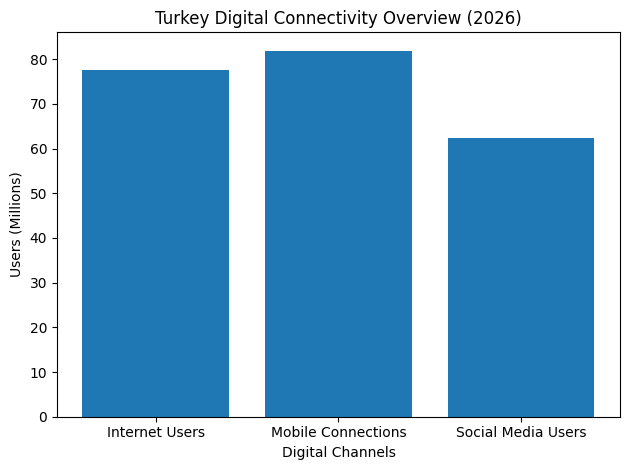
Turkey has become one of the most important markets in the world for understanding the future of AI search, generative engine optimization, and next-generation digital discovery. In 2026, any serious discussion about SEO, GEO, AI visibility, and search behaviour can no longer focus only on the US, UK, or Western Europe. Turkey now deserves a central place in that conversation. With 77.5 million internet users, 81.9 million mobile connections, 62.3 million social media users, and an internet penetration rate of 88.3%, Turkey combines scale, connectivity, mobile-first behaviour, and high digital engagement in a way that makes it unusually valuable for marketers, brands, publishers, agencies, and technology platforms trying to understand how search is changing. When those conditions are combined with rapid AI adoption, rising e-commerce spend, strong consumer openness to new digital tools, and extraordinary ChatGPT usage, Turkey stops being just another emerging market and starts looking like one of the clearest real-world case studies for how AI-powered search is reshaping the internet.

That is why this guide to 105 AI Search & GEO in Turkey statistics, data, and trends in 2026 matters. The changes taking place in Turkey are not minor shifts around the edges of digital marketing. They point to a more fundamental transformation in how consumers find information, how brands earn visibility, how publishers structure content, and how search engines and AI assistants decide which sources deserve to be cited, summarized, or recommended. For years, SEO was primarily about ranking on traditional search engine results pages. That world is now being redefined by AI Overviews, AI-generated summaries, conversational search, answer engines, and chat-based discovery journeys. Generative Engine Optimization, often referred to as GEO, has emerged as a new strategic discipline within this environment. It focuses on helping brands, websites, and publishers become visible not only in classic search rankings but also in the AI-generated answers that increasingly sit between users and websites.
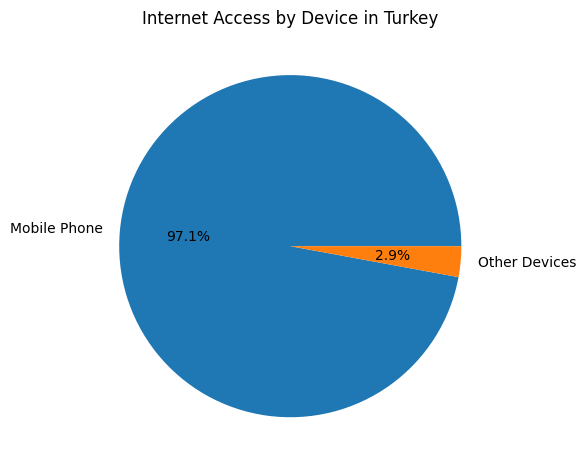
Turkey is especially important in this transition because the market brings together all the ingredients needed for AI search to accelerate quickly. It has a large and digitally connected population. It has a strong urban base, with 78.4% of people living in cities where infrastructure, education, device access, and data connectivity are strongest. It has a highly mobile internet culture, with 97.1% of internet users accessing the web via mobile phones and over 97% of mobile connections classified as broadband-capable. It has a browser and operating system environment that strongly reinforces mainstream AI search adoption, with Chrome dominating browser usage and Android accounting for the majority of mobile web traffic. And it has a young demographic structure, with the largest age cohort in the 25 to 34 range and especially high AI adoption among 16 to 24 year olds. In practical terms, that means Turkey is not just technically ready for AI search. It is socially and behaviourally ready for it as well.
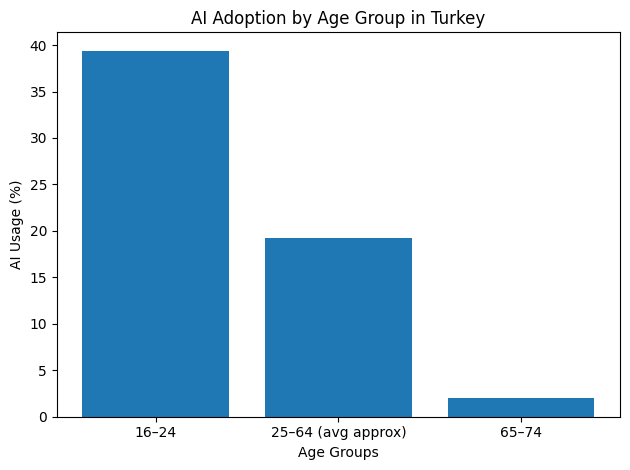
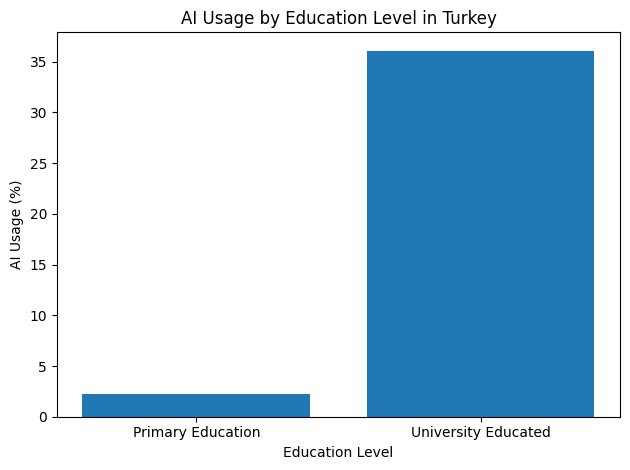
This matters because AI search is no longer a fringe behaviour. It is becoming part of mainstream digital life. Consumers are increasingly moving from typing isolated keywords into a search bar toward asking full questions, comparing products conversationally, requesting recommendations, and expecting direct answers instead of long lists of links. In Turkey, these changes appear to be happening at exceptional speed. Official TurkStat data shows that 19.2% of individuals used generative AI in 2025, establishing a clear baseline for mass-market adoption rather than niche experimentation. Among younger users, adoption is far higher, with 39.4% of 16 to 24 year olds already using AI tools. Among university-educated users, AI usage reaches 36.1%, while usage remains very low among those with only primary education, highlighting a major skills and access divide that will shape the future of search, work, and digital competition. These figures do more than describe tool usage. They reveal the speed at which AI-mediated discovery is embedding itself into everyday life.
For marketers, this is where the conversation becomes urgent. Search is no longer just about being found on Google. It is about being represented accurately, cited prominently, and recommended persuasively across a widening ecosystem of AI interfaces. Traditional SEO still matters, and in many ways it matters more than ever, but it is no longer enough on its own. AI systems pull signals from web content, structured data, authority markers, brand mentions, citations, topical depth, freshness, reviews, off-site discussions, and trusted third-party references. They synthesize rather than merely rank. That changes the competitive landscape. A brand may still rank well organically yet fail to appear in AI-generated answers. Another may receive fewer clicks from traditional search but gain disproportionate visibility through AI summaries, recommendation lists, and chat-based comparisons. In a market like Turkey, where AI enthusiasm is high and ChatGPT usage is exceptionally strong, that shift has major commercial consequences.
The Turkey search landscape itself also makes this topic particularly compelling. Google remains the dominant player and the essential foundation of any visibility strategy, but the environment is no longer purely Google-centric. Referral patterns, platform fragmentation, and the rise of AI-native discovery are forcing brands to think in more diversified ways. Marketers increasingly need to account not only for Google Search, but also for ChatGPT, Bing through Microsoft Copilot integrations, AI Overviews, answer engines, marketplace search environments, social discovery channels, and even the role of user-generated discussions on platforms like Reddit, Quora, YouTube, Instagram, and LinkedIn. Search is becoming distributed. Discovery is becoming multi-interface. And visibility is becoming a compound outcome shaped by technical SEO, editorial quality, public authority, and machine-readable trust signals.
Turkey’s position in this wider transition is unusually striking because of its relationship with ChatGPT. Multiple recent data points indicate that Turkey has become one of the most active AI-search markets in the world, with remarkably high levels of ChatGPT-driven referral activity and unusually high monthly usage rates relative to global norms. That makes Turkey one of the clearest markets in which to observe the practical rise of generative discovery. When a population uses AI assistants not just for novelty but for research, recommendations, learning, problem-solving, and product discovery, brands can no longer treat AI visibility as experimental. It becomes a core part of digital strategy. A company that is absent from AI answers is increasingly absent from real buying journeys. A publisher that is not cited by AI systems is increasingly invisible at the moment users seek synthesis. An agency that still treats GEO as optional is already behind the market.
This is also why the Turkish market matters beyond Turkey itself. What happens in Turkey may offer an early signal of what becomes normal elsewhere. Markets often do not evolve at the same pace, but the structural conditions in Turkey create a useful preview of where AI-assisted search may be heading globally. The country has a large connected population, intense smartphone usage, substantial social-media engagement, growing e-commerce maturity, strong receptiveness to AI, and increasing pressure on businesses to digitize faster. Those factors make Turkey an advanced live environment for observing how AI search competes with traditional search, how user expectations shift, how content formats need to adapt, and how brands can earn mention, citation, and trust inside AI-generated responses.

Another reason this topic deserves detailed analysis is that GEO is still widely misunderstood. Many businesses hear the term Generative Engine Optimization and assume it is just a rebranding of SEO. It is not. GEO builds on SEO foundations, but it expands the strategic objective. Traditional SEO has usually focused on crawlability, indexing, rankings, links, topical relevance, and click-through performance. GEO focuses on how content is interpreted, extracted, summarized, trusted, and surfaced by AI systems that may produce an answer without sending a click at all. That creates new priorities. Statistics, quotations, concise definitions, expert attribution, FAQ formatting, schema markup, source transparency, freshness signals, and clear article structure all become more important when the goal is citation and inclusion in AI answers. In other words, the question is no longer only, “Can this page rank?” It is also, “Can this page be understood, trusted, and reused by an AI model when generating a response?”
That shift is especially significant in Turkey because the country’s digital economy is reaching a scale where search and commerce are deeply intertwined. Digital payment volumes are rising rapidly. E-commerce continues to expand. Mobile purchasing is mainstream. Social platforms play a major role in discovery. Consumers move fluidly across search, chat, video, marketplaces, reviews, and social proof before making decisions. In that kind of environment, AI search does not sit in isolation. It influences product research, local intent, service selection, employer research, travel planning, education queries, health information seeking, financial comparison, and B2B vendor discovery. When a user asks an AI assistant which HR software to consider, which legal service is trustworthy, which clinic has strong reviews, which hotel area is best, or which product offers best value, that answer can shape the entire downstream journey. In Turkey, where smartphone-led discovery and cross-platform behaviour are already deeply ingrained, this kind of AI-mediated decision support can scale very quickly.
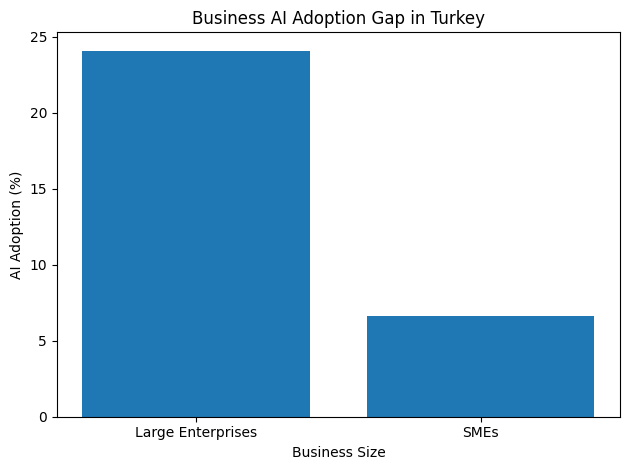
The business implications are substantial. Official data shows that Turkish business adoption of AI is still relatively low at 7.5%, despite rapid year-on-year growth. Large enterprises are much further ahead than SMEs, creating an uneven competitive field in which bigger players can move faster on AI-assisted content creation, workflow automation, customer targeting, and visibility optimization. This gap matters because AI search rewards organizations that can publish authoritative content consistently, update pages regularly, implement structured data properly, measure performance across platforms, and respond quickly to changing user needs and search formats. Larger companies often have the budget, teams, and technical support to do this. Smaller businesses often do not. Yet SMEs arguably have as much or more to gain from AI discovery if they can become visible in niche, local, and high-intent queries where trust, specificity, and relevance matter more than sheer brand size.
This is one reason why a long-form statistics-driven article on AI search and GEO in Turkey is so valuable. It does not simply collect numbers for their own sake. It provides a strategic map. Good data helps brands understand where the market is now, what structural shifts are underway, which user groups are adopting AI fastest, what barriers still remain, which platforms matter most, where commercial opportunities are emerging, and what content and optimization priorities deserve immediate attention. In a landscape changing this fast, isolated headlines are not enough. Businesses need context. Agencies need benchmarks. Founders need evidence to justify investment. Publishers need proof that editorial formats are evolving. SEO teams need to understand why ranking first may no longer guarantee visibility. And executives need to see that AI search is not a peripheral trend but a redefinition of the digital competitive environment.
The title of this article, 105 AI Search & GEO in Turkey Statistics, Data & Trends in 2026, reflects that need for breadth and depth. Turkey’s AI search story is not contained in a single metric. It sits at the intersection of internet access, mobile behaviour, operating system usage, browser dominance, social-media penetration, demographic change, search-engine competition, official AI adoption rates, ChatGPT behaviour, digital advertising investment, e-commerce growth, content strategy shifts, and the emergence of a new optimization discipline designed for answer engines rather than just result pages. Each of these layers matters. Together they reveal a market undergoing a meaningful transition from web search as navigation toward AI search as mediation.
That transition also changes what success looks like. In the traditional SEO era, marketers were trained to optimize for rankings, traffic, and clicks. Those metrics still matter, but AI search introduces a new layer: representation. If an AI Overview summarizes your category without mentioning your brand, that is a visibility problem. If ChatGPT recommends your competitors and ignores you, that is a discovery problem. If an AI assistant cites outdated, incomplete, or third-party information about your business, that is a brand control problem. If users increasingly rely on conversational tools for product discovery, vendor research, and category education, then your digital strategy must account for how machines describe you, not only how humans search for you. Turkey’s market makes this especially important because AI-mediated journeys appear to be accelerating quickly across consumer and business contexts.
The content strategies that succeed in this environment are likely to look different from those that succeeded even a few years ago. Thin pages built for keywords rather than usefulness are less likely to be surfaced by AI systems. Generic content with no data, no authorship, no cited evidence, no expertise signals, and no structural clarity is easier for both users and machines to ignore. By contrast, pages that answer specific questions clearly, provide reliable statistics, explain concepts in plain but authoritative language, include contextual examples, and establish why the source should be trusted have a much better chance of being cited in generative search. This is where GEO intersects with content quality at a deeper level. It is not just about gaming a system. It is about producing information that machines can parse and humans can trust.
Turkey is fertile ground for this kind of evolution because the local market already combines strong digital demand with rapid behavioural change. A large share of the population is online. Mobile access is nearly universal among connected users. Social platforms influence perceptions and discovery. AI curiosity is high. Young users are especially active. Businesses are under pressure to modernize. Government policy is increasingly focused on AI capacity and governance. The advertising market continues shifting toward digital channels. E-commerce growth makes visibility more commercially valuable. All of these forces reinforce one another. The result is a digital environment where AI search is not an abstract future possibility but a present and growing layer of market competition.
For publishers, analysts, consultants, and in-house teams, Turkey also offers something else: measurable contrast. It is a market where the gap between leaders and laggards may widen quickly. Brands that understand GEO early can build compounding advantages through better content architecture, stronger schema implementation, broader citation footprints, fresher editorial practices, and more authoritative public presence. Brands that delay may still rank in traditional search for a time, but lose ground in the AI interfaces that increasingly shape first impressions and shortlist formation. This matters especially in trust-sensitive sectors such as healthcare, finance, law, education, travel, real estate, professional services, and B2B software, where being cited by an AI assistant can strongly influence perceived authority.
The stakes are not limited to traffic. They include conversion quality, brand preference, market visibility, and long-term competitive defensibility. AI-referred visitors often arrive with stronger intent because they have already received synthesized information, comparisons, or recommendations before clicking through. That means AI visibility can have an outsized business impact even when total referral volumes are lower than classic search. For Turkish businesses, especially those operating in fast-growing digital categories, the economic value of being included in AI answers may prove much higher than older performance models assumed. This is one reason the GEO conversation is rapidly moving from experimental SEO circles into mainstream marketing, growth, and executive strategy discussions.
This article is designed to help make sense of all of that. It brings together 105 AI search, SEO, GEO, ChatGPT, digital adoption, and online commerce statistics that help explain where Turkey stands in 2026 and where the market appears to be heading next. Some of these statistics reveal the scale of Turkey’s digital infrastructure. Some show how quickly AI adoption is spreading among individuals and businesses. Some highlight the dominance of mobile behaviour and the importance of Android and Chrome in shaping everyday user journeys. Others show how search competition is evolving, how digital advertising is shifting, how e-commerce creates commercial pressure for better AI discovery, and why content strategy now needs to be designed for both algorithms and language models.
For anyone asking whether GEO is worth taking seriously in Turkey, the answer is yes. For anyone wondering whether AI search is still too early to matter commercially, Turkey suggests otherwise. For anyone still planning digital strategy around rankings alone, the market data increasingly points to a broader reality: the future of visibility is hybrid. It lives across search engines, AI assistants, social discovery, marketplace search, recommendation systems, and machine-generated summaries that shape user perception before a click ever happens. Turkey is one of the clearest places in the world to watch that future taking shape.
So whether you are a Turkish brand, an international company targeting Turkish consumers, an SEO specialist, a content strategist, a GEO consultant, an e-commerce operator, a publisher, or a founder trying to understand where search is heading next, these 105 statistics will give you a grounded starting point. They show why Turkey matters, why AI search matters, why GEO matters, and why 2026 may prove to be a defining year in the evolution of digital visibility.
But, before we venture further, we like to share who we are and what we do.
About AppLabx
From developing a solid marketing plan to creating compelling content, optimizing for search engines, leveraging social media, and utilizing paid advertising, AppLabx offers a comprehensive suite of digital marketing services designed to drive growth and profitability for your business.
At AppLabx, we understand that no two businesses are alike. That’s why we take a personalized approach to every project, working closely with our clients to understand their unique needs and goals, and developing customized strategies to help them achieve success.
If you need a digital consultation, then send in an inquiry here.
Or, send an email to [email protected] to get started.
105 AI Search & GEO in Turkey Statistics, Data & Trends in 2026
SECTION A: Turkey’s Digital Infrastructure & Internet Landscape
1. With 77.5 million internet users representing 88.3% of its 87.7 million population, Turkey ranks among the most digitally connected nations in Europe and the Middle East, providing a massive addressable audience for AI-powered search experiences.
2. The 10.3 million Turks still offline — representing 11.7% of the population — highlight a persistent digital divide that limits the full reach of AI search tools, particularly in rural and lower-income demographics.
3. Turkey’s 81.9 million mobile connections (93.3% of population) underscore a mobile-first digital culture where AI search tools accessed via smartphone dominate user behaviour and content discovery patterns.
4. With 97.8% of mobile connections in Turkey classified as broadband-capable (3G/4G/5G), the technical infrastructure for real-time AI search and generative AI interactions is effectively universal among connected users.
5. The net addition of 836,000 new mobile connections (+1.0%) between 2024 and 2025 signals steady, sustained growth in Turkey’s connected user base — expanding the potential audience for AI search platforms year on year.
6. Turkey’s 62.3 million social media users (70.9% of population) represent a highly engaged digital audience whose cross-platform behaviour — from social discovery to AI search — is reshaping how brands need to establish online visibility.
7. The fact that 97.1% of Turkish internet users access the web via mobile phones makes mobile-optimised, fast-loading content an absolute prerequisite for any brand seeking visibility in Turkey’s AI-driven search ecosystem.
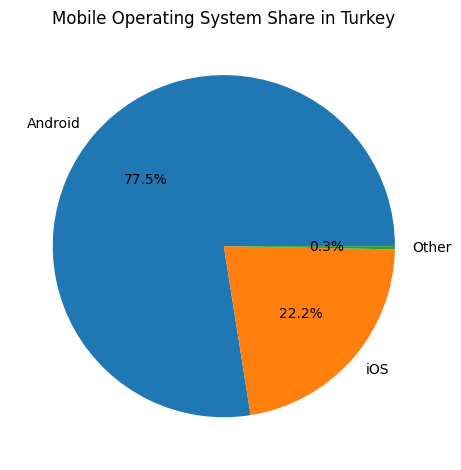
8. Android’s 77.5% share of Turkish mobile web traffic versus iOS’s 22.2% means that AI search experiences, app integrations, and content rendering must be rigorously tested and optimised for Android-first user journeys.
9. Chrome’s 75.8% browser dominance in Turkey means Google’s AI-native features — including AI Overviews and Search Generative Experience — are the default AI search interface for the vast majority of Turkish users.
10. With 78.4% of Turks living in urban centres, AI search adoption is concentrated in high-connectivity cities like Istanbul, Ankara, and Izmir, where infrastructure, education, and smartphone penetration are highest.
11. Turkey’s largest demographic cohort — 15.4% aged 25–34 — sits at the peak intersection of digital nativity and purchasing power, making them the primary driver of AI search growth and the most valuable audience for GEO-optimised content.
12. Turkey’s digital payment volume surging to $72.8 billion (+30.9%) in 2025 reflects a rapidly maturing digital commerce ecosystem where AI-assisted product discovery and purchase decisions are increasingly embedded into the consumer journey.
SECTION B: Turkey’s Search Engine Landscape
13. Google’s approximately 85.3% search market share in Turkey confirms it remains the essential starting point for any SEO or GEO strategy, though this dominance is increasingly challenged by AI-native alternatives like ChatGPT.
14. Yandex’s historic overtaking of Google in web traffic referrals in Turkey (50.5% vs 44%) in August 2025 represents a seismic shift in the Turkish search landscape — one that demands marketers diversify beyond Google-centric optimisation strategies.
15. The reversal from Google holding 96%+ of Turkish web referrals a decade ago to Yandex leading in 2025 illustrates how rapidly search power dynamics can shift — a pattern likely to repeat as AI tools further fragment the discovery landscape.
16. Yandex’s 7.2% search market share in Turkey, while modest, reflects the platform’s cultural and linguistic relevance for specific segments and signals the importance of a multi-platform search presence for brands targeting diverse Turkish audiences.
17. Bing’s 3.1% Turkish market share — concentrated among professional and Windows users — should not be dismissed by B2B brands, especially given Bing’s deep integration with Microsoft Copilot and its role as ChatGPT’s default web search backbone.
18. DuckDuckGo’s growth to 0.9% market share in Turkey, driven by privacy awareness, reflects a niche but growing user segment that rejects personalised AI recommendations — a challenge for brands relying on behavioural data to optimise AI visibility.
19. Turkey’s position as the 4th largest issuer of Google content removal requests globally (667 requests) reveals a complex relationship between Turkish authorities and search platforms — with regulatory pressure potentially influencing how certain content is indexed and surfaced in AI responses.
20. Search advertising accounting for 39.1% of total brand information sources in Turkey confirms that paid search visibility — and by extension, AI search presence — remains the single most important channel for brand discovery among Turkish consumers.
SECTION C: Turkey’s AI Adoption — Official TurkStat Data
21. The TurkStat finding that nearly one in five Turks (19.2%) used generative AI in 2025 — Turkey’s first official AI statistics — establishes a credible baseline showing that AI tool adoption has moved well beyond early adopters into mainstream consumer behaviour.
22. Turkish business AI adoption at 7.5% — despite exceeding 50% growth year-on-year — remaining less than half the EU average of 20% reveals a significant competitiveness gap that Turkish enterprises must urgently close to remain viable in an AI-accelerated global economy.
23. The steady rise of Turkish business AI adoption from 2.7% in 2021 to 7.5% in 2025 demonstrates consistent, compounding momentum rather than a short-lived hype cycle — suggesting structural, long-term integration of AI into Turkish business operations.
24. The stark contrast between 24.1% AI adoption among large Turkish enterprises and just 6.6% among SMEs highlights a technology inequality that risks entrenching competitive disadvantages for Turkey’s small business sector if not addressed through targeted policy support.
25. AI usage reaching 39.4% among Turkish 16–24 year olds versus less than 2% in the 65–74 age group illustrates a generational adoption chasm — one that has profound implications for how AI search tools will reshape consumer behaviour over the next decade.
26. With 36.1% of university-educated Turks using AI compared to just 2.2% of those with only primary education, closing Turkey’s AI skills gap through education reform and digital literacy programmes is not merely a social imperative — it is an economic necessity.
27. The near-equal AI usage rates between Turkish men (19.4%) and women (18.8%) is a notably positive finding compared to global trends, suggesting that AI tool design and accessibility in Turkey has not yet produced the gender usage gaps seen in many other markets.
28. The finding that roughly 80% of Turkish AI users engage with tools for personal purposes — and approximately a third for professional tasks — indicates that the professional value proposition of AI remains undercommunicated to Turkish workers and businesses.
29. The fact that 63.3% of Turkish non-users say they simply don’t feel the need for AI — rather than citing cost or access barriers — points to an awareness and relevance gap that AI providers and digital educators must bridge through localised use-case demonstration.
30. Turkish businesses identifying lack of expertise (74.2%), high costs (67.4%), and legal uncertainty (62.4%) as the top three AI barriers reveals a three-pronged policy challenge: skills investment, cost reduction mechanisms, and clear AI regulatory frameworks are all simultaneously required.
31. The 9% of non-adopting Turkish businesses planning to adopt AI soon suggests that the next wave of business AI uptake is imminent — creating a short window for AI solution providers, consultants, and digital agencies to capture first-mover market share.
32. TurkStat’s commitment to annual AI adoption reporting, with the next release scheduled for October 2026, means Turkey will have increasingly granular longitudinal data to track the impact of AI search adoption on businesses and individuals — a valuable resource for digital strategists.
SECTION D: Turkey & ChatGPT — World #1 in AI Web Traffic
33. Turkey’s position as the world’s #1 nation for ChatGPT-driven web traffic — with 94.49% of AI-based referrals from ChatGPT alone — is not merely a statistical curiosity; it means ChatGPT has effectively become Turkey’s secondary search engine, demanding that every brand with a Turkish audience have an explicit ChatGPT visibility strategy.
34. With 39.7% of Turkish internet users using ChatGPT monthly — nearly double the global average of 22.3% — Turkey represents the single most advanced real-world laboratory for AI search behaviour, and findings from this market are likely to preview how other nations’ search habits will evolve.
35. The claim by Turkish digital marketing experts that 95 out of 100 Turkish AI users rely on ChatGPT recommendations for product and service discovery underscores that AI-driven brand discovery has reached a scale in Turkey where ignoring GEO optimisation is commercially reckless.
36. Turkey’s ChatGPT adoption surpassing mature digital markets like the US, UK, and Germany challenges the assumption that Western markets lead AI adoption — and positions Turkish digital professionals as globally relevant practitioners of frontier AI search strategies.
37. With over 80% of Turks now familiar with artificial intelligence, Turkey has crossed the threshold from AI curiosity to AI literacy — a prerequisite for the kind of mainstream AI search adoption that is now reshaping how Turkish consumers find brands, products, and services.
38. The Turkish Artificial Intelligence Policy Association’s finding that nearly 60% of Turks actively use AI tools (ChatGPT, Gemini, Grok) makes Turkey one of the highest per-capita AI tool usage countries globally — a strategic commercial opportunity for brands that achieve strong AI visibility.
39. Turkey’s 74.4% AI enthusiasm rate — one of the highest in the world and far above the global average of ~48.5% — signals a culturally receptive population where AI-powered products, services, and search experiences face minimal adoption friction compared to more sceptical markets.
40. The convergence of a young population, near-universal mobile access, and early business-media AI integration identified as drivers of Turkey’s ChatGPT dominance confirms that the conditions sustaining Turkey’s #1 AI search status are structural, not temporary — making GEO investment a long-term strategic priority rather than a short-term trend.
SECTION E: Turkey’s AI & Generative AI Market Size & Growth
41. Turkey’s AI market growing at 28.72% CAGR to reach USD 7.37 billion by 2030 signals a sustained, multi-year expansion that will progressively embed AI into search, commerce, media, and public services — making today’s AI search optimisation investments compound significantly over time.
42. Turkey’s Cloud AI market reaching USD 9.19 billion by 2033 at a 33.65% CAGR reflects growing enterprise and government demand for scalable AI infrastructure — the same cloud backbone that powers AI search experiences and real-time generative responses for Turkish users.
43. Turkey’s e-commerce spending hitting $31.3 billion (+8.6%) in 2025, with AI-driven personalisation increasingly influencing purchases, makes Turkey one of the most commercially significant markets in which AI search optimisation directly translates to measurable revenue impact.
44. The average Turkish e-commerce customer spending $976 annually — with over half of transactions on smartphones — confirms that AI-optimised mobile product discovery is a direct revenue driver, not an abstract future capability.
45. Turkish Airlines’ deployment of Red Hat OpenShift AI — doubling deployment speed and unlocking organisation-wide data access — demonstrates that Turkey’s largest enterprises are already extracting competitive advantage from AI, raising the benchmark that all Turkish businesses must now meet.
46. Turkey’s National AI Strategy 2021–2025 action plan encompassing 70+ measures — including AI expert training, a Central Public Data Space, and regulatory alignment — shows that AI capacity-building in Turkey is government-coordinated and systemic, creating the conditions for accelerated AI search adoption.
47. The 2026 Presidential Annual Program embedding AI across healthcare, customs, agriculture, fiscal administration, and public communications elevates Turkey’s AI ambitions to a state-infrastructure level — signalling to international AI providers that Turkey is a serious long-term market.
48. Turkey’s draft AI Regulation Bill mandating harmful content removal within 6 hours and fines up to 10 million lira signals that while Turkey welcomes AI adoption, it is simultaneously developing the governance framework to hold AI platforms accountable — a balance that will shape how AI search results are curated for Turkish users.
49. The 129 active AI/ML job listings in Turkey in March 2026, concentrated in Istanbul, Ankara, and Izmir, reflect a growing domestic AI talent market — with implications for how quickly Turkish brands can build in-house GEO and AI search optimisation capabilities.
50. The AI adoption divide between Turkey’s large enterprises (24.1%) and SMEs (6.6%) creates an uneven competitive playing field — large companies already using AI for content creation, customer targeting, and search visibility will compound their advantages unless SMEs close the gap urgently.
SECTION F: Turkey’s Digital Advertising & Content Landscape
51. Turkey’s total advertising market reaching USD 3.11 billion in 2025, with TV & Video as the largest segment, reflects a market in transition — one where budgets are increasingly being redirected toward AI-compatible channels as generative search reshapes content discovery.
52. The projection that 66.7% of Turkish ad spending will come from digital sources by 2030 confirms the structural shift toward digital-first marketing — and within that, AI search and generative engine visibility will increasingly determine whether digital ad budgets produce returns.
53. Turkey’s digital advertising and retail media market valued at approximately USD 1.5 billion — driven by internet penetration, mobile usage, and e-commerce growth — represents the commercial prize that AI search visibility is increasingly gatekeeping.
54. Mobile advertising expenditure projected to surpass $1.5 billion in Turkey, against a backdrop of 95% smartphone penetration, confirms that AI search strategies in Turkey must be designed mobile-first from the ground up — desktop optimisation alone is insufficient.
55. More than 53.2% of Turkish digital advertising spend directed at mobile devices signals where brand visibility battles are being fought — and with AI search primarily accessed via smartphone, mobile-optimised AI-visible content is the new front line of digital competition.
56. Programmatic advertising accounting for 75.4% of Turkish digital ad spend — the highest rate in the region — reflects a sophisticated, data-driven market where AI-powered audience targeting and content delivery are already deeply embedded in marketing infrastructure.
57. Instagram’s 58.5 million Turkish users (81.4% of eligible population) create a powerful social proof ecosystem where brand mentions, user-generated content, and influencer endorsements feed into the off-site signals that AI search systems increasingly factor into brand citation decisions.
58. YouTube’s 57.5 million advertising-accessible users in Turkey represent both a massive content discovery channel and a growing AI search touchpoint — as Google’s AI systems increasingly surface video content in generative responses.
59. LinkedIn’s 19 million Turkish members (29.1% of adults 18+) create significant B2B AI search implications — with professional authority, thought leadership content, and company page credibility on LinkedIn increasingly influencing how AI tools represent brands in business-relevant queries.
60. Turks spending over 15 hours per week watching online videos — the highest media consumption category — suggests that video content optimised for AI discovery (via transcripts, structured metadata, and YouTube SEO) represents a high-value but under-exploited GEO opportunity in the Turkish market.
SECTION G: Generative Engine Optimization (GEO) — Global Context for Turkey
61. The global GEO market growing from $848 million in 2025 to $33.7 billion by 2034 at a 50.5% CAGR is not a niche forecast — it reflects the wholesale restructuring of how online visibility is earned, with Turkey’s #1 ChatGPT adoption placing it at the epicentre of this global transformation.
62. With 54% of US marketers planning GEO implementation within 3–6 months, international brands competing for Turkish consumers will rapidly build AI-visible content advantages — making delay by Turkish-native brands a direct competitive risk.
63. Turkish digital marketing experts identifying AIO (Artificial Intelligence Optimization) as the new dominant strategy in 2026 marks a professional consensus moment — signalling that the Turkish SEO industry has officially pivoted toward AI-first optimisation frameworks.
64. Peak Web Digital being ranked Turkey’s #1 SEO agency in 2026 for its AI-integrated workflows and AI-resilient content architecture illustrates that the agencies gaining ground in Turkey are those that have most thoroughly embraced GEO as a core service offering.
65. The recognition that agencies transitioning from traditional backlink strategies to data-driven AI-resilient content architectures gained the largest market share in Turkey in 2026 provides a clear strategic signal: GEO capability is now the primary competitive differentiator in Turkey’s digital marketing industry.
66. The shift in Turkey where ChatGPT visibility is now considered as commercially critical as a Google Page 1 ranking represents a fundamental rebalancing of digital marketing investment — brands that optimise for one but not the other are systematically leaving revenue on the table.
67. Content incorporating citations, statistics, and quotations achieving 30–40% higher AI visibility is particularly relevant for Turkish brands in high-expertise sectors — healthcare, finance, legal, and education — where authoritative, evidence-backed content is both a user trust signal and an AI citation accelerator.
68. Pages updated within 60 days being 1.9x more likely to appear in AI answers places a premium on editorial freshness — Turkish brands running static, infrequently-updated websites face a systematic AI visibility disadvantage that no amount of historical backlink authority can fully compensate for.
69. The 44% increase in AI search citations for sites implementing structured data and FAQ blocks provides Turkish web developers and content strategists with a concrete, high-ROI technical optimisation action — one of the highest-leverage GEO improvements achievable with relatively low implementation cost.
70. Websites with author schema being 3x more likely to appear in AI answers makes content authorship transparency — who wrote it, what their credentials are, and whether that expertise is machine-readable — a critical but widely overlooked GEO ranking factor for Turkish publishers.
71. The finding that 44.2% of all LLM citations come from the first 30% of an article’s text confirms that strong, keyword-rich, evidence-dense article introductions are not just a UX best practice — they are a primary determinant of whether Turkish content gets cited in AI-generated answers at all.
72. Sites with 32,000+ referring domains being 3.5x more likely to be cited by ChatGPT reinforces that domain authority built through ethical link-earning remains the foundation of AI search visibility — Turkish brands that have neglected link building will find their GEO performance ceiling is set by their SEO foundations.
73. Domain traffic emerging as the strongest single predictor of AI citation likelihood (SHAP value: 0.63 in a 2.3 million page study) underscores that AI search visibility is not a separate game from traditional SEO — it is an amplification of it, rewarding the same core investments in audience building and content quality.
74. The approximately 4x AI citation advantage for domains with strong Quora and Reddit brand mentions reveals that Turkish brands participating authentically in global Q&A communities — not just Turkish-language forums — are building AI visibility assets that directly influence ChatGPT’s brand representation decisions.
SECTION H: Global AI Search Trends Directly Relevant to Turkey
75. The finding that 93% of AI Mode search sessions end without a website click is the most commercially urgent statistic in this report for Turkish digital marketers — it signals that AI search is rapidly shifting from a traffic-generation channel to a brand representation channel, where the goal is not the click but the citation.
76. AI Overviews appearing in approximately 25.11% of Google searches — nearly double their prevalence from March 2025 — means that for one in four queries, the traditional “10 blue links” have been partially or fully displaced by AI-generated summaries on the same Google interface Turkish users already trust.
77. The 34.5% click-through rate reduction caused by AI Overviews (Ahrefs 2025) translates directly to revenue impact for Turkish businesses dependent on organic search traffic — making the business case for proactive GEO investment increasingly urgent with each percentage point of CTR decline.
78. Google AI Overviews now reaching 1.5 billion monthly users across 200+ countries confirms these are not experimental features — they are the new default Google experience that Turkish users encounter daily, regardless of whether Turkish brands have optimised for them.
79. Gartner’s prediction of a 25% decline in traditional search engine volume by 2026 as users shift to AI assistants is particularly relevant in Turkey, where the transition appears to be happening faster than in any other country — reinforcing that Turkish brands must treat AI search as an immediate priority, not a future consideration.
80. ChatGPT’s 900 million weekly active users processing 2–2.5 billion daily queries makes it, by query volume, a more significant discovery platform than most national search engines — and Turkey’s outsized share of that traffic makes it a market where ChatGPT visibility may soon equal or exceed Google visibility in commercial importance.
81. ChatGPT triggering a web search for 59% of local intent queries confirms that “near me” and location-specific searches — critical for Turkish hospitality, retail, real estate, and service businesses — are being actively researched by ChatGPT rather than answered from training data alone, making local GEO a high-value optimisation target.
82. ChatGPT’s 80.49% global AI chatbot market share means that for Turkish brands building an AI search presence, ChatGPT optimisation is not one of many platforms to consider — it is the primary platform, with all others currently secondary.
83. AI referral traffic growing at ~1% month-over-month globally, with ChatGPT driving 87.4% of it, means that brands gaining ChatGPT citation today are capturing a compounding traffic source at its early-growth inflection point — the Turkish market’s #1 ChatGPT share amplifies this opportunity significantly.
84. AI platforms generating 1.13 billion referral visits in June 2025 — a 357% increase from June 2024 — illustrates exponential rather than linear growth, making current AI search investments disproportionately valuable compared to equivalent investments made just 12 months earlier.
85. AI search visitors converting at 4.4x higher rates than traditional search visitors reframes AI visibility from a branding exercise to a direct revenue driver — for Turkish e-commerce businesses in particular, a citation in a ChatGPT product recommendation carries quantifiably greater commercial value than an equivalent organic search click.
86. Europe’s 59.7% zero-click search rate — comparable to Turkey’s experience — confirms that the erosion of organic click traffic is a pan-European challenge, not an American one; Turkish brands cannot assume their market is insulated from the structural traffic changes already reshaping Western digital economies.
87. The less than 1-in-100 probability that ChatGPT gives the same brand list twice for the same query is a counterintuitive but critical insight for Turkish marketers: AI brand visibility cannot be “achieved” and then maintained passively — it requires continuous monitoring, content refreshment, and multi-signal reinforcement to remain consistent.
88. Citation rates varying by up to 615x across different AI platforms (Grok vs. Claude) highlights the need for Turkish brands to conduct cross-platform AI visibility auditing — a brand highly visible on ChatGPT may be virtually absent on other AI search tools used by niche but high-value Turkish consumer segments.
SECTION I: Turkey E-Commerce & AI-Driven Commerce
89. Turkey’s e-commerce revenue reaching USD 31.28 billion with 41.7% user penetration — projected to reach 48.2% by 2030 — makes AI-driven product discovery optimisation one of the highest-return digital investments available to Turkish retailers today.
90. Turkey’s online shopper base reaching 45 million by 2026 — representing more than half of the addressable population — means the majority of Turkish purchasing decisions will involve at least one digital discovery touchpoint, with AI search increasingly mediating that first moment of brand contact.
91. Turkey’s e-commerce market approaching 400–450 billion TRY with 22%+ retail penetration by 2026 confirms that e-commerce is no longer a niche channel in Turkey — it is mainstream retail, and AI-optimised product content is the new merchandising standard for competing within it.
92. Turkey’s e-export value growing from $2.2 billion (2022) to a projected $8 billion (2025) illustrates how Turkish sellers on international platforms like Amazon, Etsy, and eBay are increasingly dependent on AI-powered product search algorithms for cross-border discoverability — making English-language GEO as important as Turkish-language SEO.
93. 60% of Turkish e-commerce transactions occurring via mobile devices confirms that AI-optimised product listings must be designed for the mobile-first browsing and purchasing experience — page speed, visual hierarchy, and concise AI-readable product descriptions are non-negotiable for Turkish mobile commerce.
94. Trendyol’s approximately 34% share of Turkey’s e-commerce marketplace means that AI-optimised product listings, reviews, and Q&A content on Trendyol specifically represent the single highest-impact AI commerce optimisation opportunity for Turkish sellers by volume and traffic.
95. Amazon Turkey’s 45,000+ SME sellers seeing 60% cross-border sales growth in 2024 underlines that Turkish SMEs are already competing globally — and their ability to be surfaced by AI product discovery engines on international platforms will increasingly determine whether that growth continues.
SECTION J: 2026 Outlook, Predictions & Strategic Implications
96. Gartner’s prediction that 50% of all online searches will involve an AI assistant by 2028 — combined with Turkey’s already-exceptional AI search adoption — suggests Turkey may hit this tipping point as early as 2026 or 2027, compressing the strategic timeline for Turkish businesses to build AI search readiness.
97. The projection that AI search visitors will surpass traditional search visitors globally by 2028 takes on heightened urgency in Turkey — the world’s #1 ChatGPT traffic market — where the crossover point may arrive years ahead of schedule, and brands without GEO strategies will face disproportionate visibility erosion.
98. Schema markup adoption rising 35% across the web from 2023 to 2026 reflects growing awareness of structured data’s role in AI visibility — but also intensifying competition for AI citations, meaning Turkish brands that have not yet implemented comprehensive schema are falling behind rather than simply missing an opportunity.
99. Only 30% brand consistency across consecutive AI search responses for the same query is a wake-up call for Turkish brand managers who may assume that one positive ChatGPT mention equates to sustained visibility — it does not, and continuous AI presence monitoring is a new operational necessity.
100. AI Overview content changing approximately 70% of the time for the same repeated query — with almost half of citations replaced on each update — means Turkish brands must treat AI search visibility as a dynamic, ongoing operational challenge rather than a one-time optimisation exercise.
101. The structural risk that Turkish businesses relying solely on traditional SEO face “invisibility” in AI-driven discovery — at a moment when 39.7% of Turkish internet users are already using ChatGPT monthly — makes the strategic cost of inaction on GEO increasingly quantifiable and commercially unjustifiable.
102. GEO delivering up to 4.4x higher conversions and an estimated $3.71 ROI per $1 spent globally represents perhaps the most compelling commercial argument for Turkish businesses still weighing whether to invest in AI search optimisation — the ROI case is not speculative; it is empirically demonstrated.
103. 82% of Gen Z globally preferring AI tools that provide direct answers over traditional web search — mirrored by Turkey’s highly digitally active youth demographic — confirms that the next decade of Turkish consumer behaviour will be defined by AI-mediated discovery, and brands that aren’t AI-visible will be invisible to an entire generation.
104. 28% of Gen Z globally beginning searches via AI chatbot — likely significantly higher among Turkish youth given their 39.4% ChatGPT usage rate — signals that the search funnel is being permanently rewired for younger Turkish consumers, with profound long-term implications for brand awareness, content strategy, and digital marketing measurement.
105. The Turkish digital marketing sector’s “seismic shift” toward AI-resilient content architectures — with the agencies gaining the most market share being those that have successfully moved from traditional backlink strategies to data-driven GEO frameworks — confirms that the Turkish industry has reached a professional consensus point: in 2026, AI search optimisation is not a trend to watch but a discipline to master.
Conclusion
The data presented in these 105 statistics makes one conclusion unmistakably clear: Turkey is rapidly emerging as one of the most important markets in the world for understanding the future of AI-powered search and Generative Engine Optimization. The combination of high internet penetration, a mobile-first population, strong social media engagement, rising e-commerce activity, and accelerating AI adoption creates a digital environment where the shift from traditional search to AI-mediated discovery is already well underway. In many respects, Turkey is not simply following global trends. It is experiencing them earlier and at greater intensity, making it a valuable preview of how the search ecosystem may evolve in other regions over the coming years.
For businesses, marketers, publishers, and technology platforms, the implications are profound. Traditional SEO strategies that focus exclusively on rankings and traffic are no longer sufficient on their own. AI search systems are transforming how information is summarized, interpreted, and delivered to users. Instead of presenting a list of links that require users to navigate multiple websites, AI interfaces increasingly generate direct answers, curated recommendations, and summarized insights. In this environment, the central question is no longer only whether a page can rank highly in search results, but whether its information can be trusted, understood, and cited by AI systems that synthesize knowledge across the web.
Turkey’s digital landscape makes this transition particularly visible. With tens of millions of connected users accessing the internet primarily through smartphones, and with Chrome and Android dominating the browsing environment, Turkish users are naturally positioned to encounter and adopt AI-enhanced search experiences quickly. At the same time, a young and digitally active population is accelerating the cultural shift toward conversational search, AI assistants, and generative interfaces. Younger demographics, especially those between 16 and 34 years old, are already integrating AI tools into everyday tasks ranging from research and learning to product discovery and decision-making.
These behavioural changes are reshaping how visibility is earned online. Instead of relying solely on keyword optimization and link-building strategies, brands increasingly need to think about how their information is structured, how their expertise is communicated, and how their authority is recognized across the wider digital ecosystem. Structured data, clear authorship, credible citations, regularly updated content, and strong topical expertise are becoming essential components of AI-ready websites. Content that answers real user questions with clarity and evidence is far more likely to be referenced by AI systems than pages built purely for search-engine ranking signals.
Another major insight from the data is the growing role of AI platforms such as ChatGPT in shaping discovery behaviour. Turkey’s exceptionally high levels of engagement with AI assistants suggest that conversational interfaces are already influencing how people explore information and evaluate brands. When users ask AI tools for recommendations, comparisons, or explanations, those responses can guide their entire research journey before they ever visit a website. This makes AI visibility a crucial extension of brand reputation. If a business is absent from AI-generated answers, it risks becoming invisible at the very moment users are forming their first impressions.
The implications extend beyond marketing. The statistics also highlight a broader transformation taking place across Turkey’s digital economy. E-commerce continues to expand, mobile payments are rising, digital advertising is shifting toward online channels, and businesses are increasingly experimenting with AI-powered tools to improve productivity and customer engagement. At the same time, the data reveals important challenges that must be addressed. The gap in AI adoption between large enterprises and small businesses remains significant, and the skills divide between different educational groups underscores the need for stronger digital literacy and AI training initiatives.
Closing these gaps will be essential if Turkey wants to fully capitalize on the opportunities created by AI-driven search and automation. Government initiatives such as the National Artificial Intelligence Strategy have already laid important groundwork, but sustained investment in talent development, infrastructure, and regulatory clarity will play a crucial role in determining how quickly the country can build a competitive AI ecosystem. For companies operating in Turkey, this means that the next few years may represent a critical window for experimentation, capability building, and strategic adaptation.
The statistics also show that AI search is not replacing traditional search overnight. Instead, the two systems are increasingly intertwined. Google’s introduction of AI Overviews, the integration of generative tools into search interfaces, and the growing influence of AI assistants illustrate how search engines are evolving rather than disappearing. This means that SEO and GEO should not be treated as separate disciplines competing for attention. Instead, they should be understood as complementary strategies within a broader visibility framework. Strong SEO foundations remain essential, but they must now be combined with content structures and authority signals designed to perform well in generative environments.
For brands and publishers, this shift offers both opportunity and risk. Organizations that adapt early can gain a meaningful advantage by producing authoritative, data-rich content that AI systems are more likely to reference. They can strengthen their credibility, increase brand recognition in AI-generated responses, and build long-term trust with audiences who increasingly rely on AI tools for guidance. On the other hand, businesses that continue relying solely on outdated SEO practices may gradually lose visibility as AI summaries and conversational interfaces become a larger part of the search experience.
This is why a statistics-driven overview like this one is so valuable. Data provides clarity in a rapidly changing environment. By examining the numbers behind internet adoption, AI usage, digital advertising, search behaviour, and e-commerce growth, it becomes easier to understand where the market stands today and where it is likely to move next. The 105 statistics in this article collectively reveal a digital ecosystem in transition—one where the boundaries between search engines, AI assistants, social platforms, and online marketplaces are becoming increasingly blurred.
Looking ahead, the role of AI in search is expected to expand even further. As generative models become more capable, they will continue to integrate deeper contextual understanding, real-time data access, and personalized insights. Users will increasingly expect immediate, conversational answers rather than fragmented information scattered across multiple web pages. Businesses that want to remain competitive will need to think beyond traditional traffic metrics and focus on how their information contributes to the broader knowledge ecosystem that AI models rely upon.
In Turkey, these developments may unfold faster than in many other markets because the underlying conditions are already in place: widespread connectivity, a digitally active population, strong enthusiasm for new technologies, and a rapidly evolving digital economy. The country’s position as one of the most active AI search markets today could make it an important indicator of global trends tomorrow.
Ultimately, the rise of AI search and Generative Engine Optimization represents not just a technical change but a strategic transformation in how information flows across the internet. Visibility will increasingly depend on credibility, relevance, and clarity rather than purely mechanical ranking factors. Organizations that understand this shift and align their digital strategies accordingly will be far better positioned to thrive in the next phase of the online economy.
The 105 statistics explored throughout this article provide a detailed snapshot of that transition. Together, they highlight why Turkey has become such an important environment for studying AI search behaviour and why businesses operating in the region must start preparing for a future in which generative AI plays a central role in discovery, recommendation, and decision-making. As the digital landscape continues to evolve, one thing is certain: the intersection of AI, search, and content strategy will define the next era of online visibility, and Turkey is already at the forefront of that transformation.
If you are looking for a top-class digital marketer, then book a free consultation slot here.
If you find this article useful, why not share it with your friends and business partners, and also leave a nice comment below?
We, at the AppLabx Research Team, strive to bring the latest and most meaningful data, guides, and statistics to your doorstep.
To get access to top-quality guides, click over to the AppLabx Blog.
People also ask
What is AI search and how is it changing the internet in Turkey?
AI search uses artificial intelligence to generate direct answers, summaries, and recommendations instead of only listing links. In Turkey, rising AI adoption and high mobile usage are accelerating this shift toward conversational and AI-assisted discovery.
What does Generative Engine Optimization (GEO) mean?
Generative Engine Optimization is the practice of optimizing content so it can be cited, summarized, or recommended by AI tools like ChatGPT, AI search assistants, and generative search results.
Why is Turkey important for studying AI search trends?
Turkey has high internet penetration, strong smartphone usage, and rapidly growing AI adoption. These factors make it one of the most dynamic markets for observing how AI-powered search and digital discovery are evolving.
How many internet users are there in Turkey in 2026?
Turkey has around 77.5 million internet users, representing more than 88 percent of the population. This large connected audience creates a significant environment for AI search adoption and digital innovation.
Is Turkey a mobile-first digital market?
Yes. The vast majority of Turkish internet users access the web through smartphones. Mobile browsing dominates online behavior, meaning AI search experiences are often accessed through mobile devices.
How does ChatGPT influence search behavior in Turkey?
ChatGPT and similar AI assistants are increasingly used for research, recommendations, and problem solving. Many Turkish users consult AI tools before visiting websites, making AI visibility critical for brands.
What role does SEO play in the age of AI search?
SEO remains essential because AI systems rely on web content for training and citations. Strong SEO foundations, high-quality content, and authoritative sources increase the chances of being referenced in AI answers.
How is GEO different from traditional SEO?
SEO focuses on ranking web pages in search results. GEO focuses on making content understandable and trustworthy for AI models so it can be cited in generative responses and AI-generated summaries.
How does AI search affect website traffic?
AI search can reduce traditional clicks because users often receive direct answers. However, when AI tools recommend a website, the visitors tend to arrive with higher intent and stronger interest.
What industries in Turkey benefit most from AI search optimization?
Sectors such as e-commerce, travel, education, finance, healthcare, and software benefit greatly because users frequently ask AI assistants for recommendations and comparisons in these areas.
How popular are AI tools among young people in Turkey?
AI adoption is particularly high among younger users. Many people aged 16 to 24 actively use AI tools for learning, research, and online discovery.
What factors make content more visible to AI search engines?
Clear structure, reliable data, credible citations, author expertise, structured data, and frequently updated information increase the chances that AI systems will reference or summarize the content.
Why are statistics important for AI-optimized content?
AI models often prioritize factual, data-driven information. Articles containing statistics, research findings, and credible sources are more likely to be cited in AI-generated answers.
How does mobile usage affect AI search in Turkey?
Because most users browse on smartphones, AI search tools are frequently used on mobile devices. This makes mobile-optimized websites and fast-loading pages essential for visibility.
Does Google still dominate search in Turkey?
Yes, Google remains the leading search engine in Turkey. However, AI tools, conversational assistants, and alternative search platforms are gradually expanding the discovery ecosystem.
What is the role of AI Overviews in search results?
AI Overviews summarize information directly in search results, giving users quick answers. This changes how websites gain visibility because content must be clear enough to be included in these summaries.
How can businesses improve their GEO strategy?
Businesses should create authoritative content, use structured data, answer common questions, publish original research, and update articles regularly to improve their chances of appearing in AI answers.
Why is content authority important for AI search?
AI systems rely on trusted sources when generating answers. Websites with strong credibility, expert authorship, and reliable references are more likely to be cited.
How does social media influence AI search visibility?
Brand mentions, user discussions, and content shared across platforms can signal relevance and authority. These signals may influence how AI systems evaluate a brand’s credibility.
What is the relationship between AI search and e-commerce?
AI tools increasingly help users compare products, find recommendations, and evaluate reviews. This makes AI search optimization crucial for online retailers.
How quickly is AI adoption growing in Turkey?
AI adoption is rising rapidly among both individuals and businesses. The increasing use of generative AI tools is reshaping how information is searched and consumed online.
Can small businesses benefit from GEO?
Yes. Small businesses can gain visibility by publishing expert content, answering niche questions, and optimizing their websites for AI readability and credibility.
Why is structured data important for AI search?
Structured data helps search engines and AI systems understand the meaning and context of web content. This improves the chances of being featured in AI answers.
How does AI search impact content marketing strategies?
Content marketing must focus more on clarity, expertise, and usefulness. Informational articles that directly answer user questions are more likely to be surfaced by AI systems.
What role does trust play in AI search results?
Trust signals such as expert authorship, reliable sources, and transparent information help AI systems determine which content should be recommended to users.
How often should content be updated for AI visibility?
Regular updates help keep information accurate and relevant. Fresh content signals reliability and increases the chances of being cited by AI search systems.
What types of content perform best in AI search?
Educational guides, data-driven reports, FAQ pages, and expert insights perform well because they provide clear answers and credible information that AI systems can easily summarize.
Will AI search replace traditional search engines?
AI search is more likely to complement traditional search rather than replace it. Both systems will continue to evolve and integrate with each other.
Why should marketers track AI search trends in Turkey?
Turkey’s strong digital engagement and rapid AI adoption make it an important market for observing how AI search behavior develops.
What is the future of AI search in Turkey?
AI search will continue expanding as AI tools become more integrated into daily life. Businesses that adapt early to GEO and AI-optimized content will gain a long-term advantage.
Sources
DataReportal
Türkiye Today
StateGlobe
BYYD
99firms
Turkish Minute
AGBI
Hurriyet Daily News
TribeTechie
RestProperty
Statista
IMARC Group
Daily Sabah
Glassdoor
Ken Research
Superlines
Financial Content
OpenPR
Position Digital
Basis
Exposure Ninja
AllAboutAI
Strategy&
PwC
Consultancy-me
Mordor Intelligence
Barchart