

























Key Takeaways
- AI search is rapidly transforming Taiwan’s digital landscape, with platforms like ChatGPT and AI-powered results from Google reshaping how users discover information and reducing traditional SEO traffic.
- Taiwan’s advanced digital infrastructure, high internet penetration, and strong technology ecosystem led by TSMC position the country at the centre of the global AI search and infrastructure revolution.
- Generative Engine Optimisation (GEO) is emerging as a critical strategy for Taiwanese businesses to maintain visibility in AI-generated answers, conversational search, and zero-click search environments.
Artificial intelligence is rapidly reshaping how information is discovered, consumed, and monetised online. In 2026, search is no longer defined solely by traditional engines delivering a list of links. Instead, AI-driven platforms increasingly generate direct answers, summaries, and recommendations that influence user behaviour before a single website click occurs. This transformation has given rise to a new discipline known as Generative Engine Optimisation (GEO), a strategic approach focused on ensuring that brands, businesses, and organisations are visible within AI-generated responses across conversational search engines and intelligent assistants.

Taiwan occupies a particularly unique position in this evolving landscape. The island is not only one of the most technologically advanced economies in Asia but also the global centre of the semiconductor industry that powers modern artificial intelligence infrastructure. Companies such as TSMC manufacture the advanced chips used by hyperscalers, cloud providers, and AI model developers around the world. At the same time, Taiwan has one of the most digitally connected populations globally, with internet penetration exceeding 90 percent, widespread mobile usage, and deep engagement with social platforms and messaging ecosystems.

These structural advantages mean Taiwan sits at the intersection of two major technological revolutions: the hardware expansion that powers AI systems and the behavioural shift in how users search for information online. As conversational interfaces become mainstream and AI assistants begin to mediate discovery, the strategies that once defined search engine optimisation are evolving rapidly. Businesses that previously competed for rankings on traditional search results must now also compete for citations inside AI-generated answers, summaries, and recommendation engines.
The emergence of AI search platforms such as ChatGPT, Microsoft Copilot, and Google Gemini has significantly accelerated this transformation. These systems allow users to ask longer, more complex questions and receive synthesised responses that draw information from multiple sources. In many cases, users no longer need to click through to individual websites to obtain answers. Instead, AI models act as an intermediary layer that interprets intent, aggregates knowledge, and delivers concise responses directly within the interface.
At the same time, traditional search engines are integrating generative capabilities into their own results pages. Google has introduced AI-generated overviews that summarise information above organic listings, fundamentally altering how search traffic flows across the web. As these features expand across more query categories, a growing percentage of searches are resolved without users clicking through to external websites. This phenomenon, often referred to as “zero-click search,” is forcing businesses to rethink their entire approach to visibility, authority, and digital marketing.
For Taiwan’s digital economy, these changes carry significant implications. The country already operates in one of the most competitive and technologically mature online markets in Asia. With more than 90 percent of the population connected to the internet and extremely high mobile adoption rates, the Taiwanese digital ecosystem is effectively saturated in terms of user reach. Growth therefore depends less on acquiring new users and more on deepening engagement through intelligent systems, personalised recommendations, and AI-powered discovery channels.
Taiwan’s platform ecosystem also presents distinctive characteristics compared with many Western markets. Messaging application LINE dominates communication across the island, while video consumption is heavily concentrated on YouTube. Social platforms such as Facebook and Instagram maintain strong influence over content distribution and consumer discovery. These channels increasingly intersect with AI-driven recommendation systems that shape what information users encounter online.
For marketers, publishers, and businesses operating in Taiwan, the convergence of AI search and social discovery is creating an entirely new competitive environment. Traditional SEO tactics built around keyword rankings and backlink acquisition remain important, but they are no longer sufficient on their own. Visibility within AI-generated answers now depends on a broader set of signals, including brand authority, structured knowledge sources, multimedia content, and cross-platform credibility.
Generative Engine Optimisation addresses this shift by focusing on how AI systems retrieve, interpret, and cite information when generating responses. Rather than optimising only for human readers or search engine crawlers, GEO strategies aim to ensure that AI models recognise content as authoritative, relevant, and trustworthy. This requires understanding how large language models process queries, evaluate sources, and construct answers across multiple information channels.
The rise of AI-mediated discovery is already producing measurable changes in web traffic patterns. Industry studies show that AI-generated results can significantly reduce click-through rates for traditional organic listings when they appear on search pages. At the same time, traffic originating from AI systems often exhibits higher engagement and conversion rates because users arriving from conversational queries typically have clearer intent and deeper informational needs.
For Taiwanese businesses, this presents both a challenge and a strategic opportunity. On one hand, the growing influence of AI answers means that brands risk losing visibility if they fail to appear within generative responses. On the other hand, organisations that establish strong authority across AI citation sources may gain disproportionate influence over how information is presented to users. Early adoption of GEO strategies can therefore provide a meaningful competitive advantage as AI search continues to expand.
Another factor that distinguishes Taiwan in the global AI search landscape is language. The Taiwanese market relies on Traditional Chinese characters rather than the Simplified Chinese used in mainland China. This linguistic distinction affects how AI models interpret queries, retrieve content, and generate responses. Content optimised specifically for Traditional Chinese audiences can therefore have an advantage in local AI search visibility, particularly as models continue improving their multilingual capabilities.
Beyond marketing implications, Taiwan’s role in the AI ecosystem also has broader economic significance. The island’s semiconductor industry has become one of the most critical pillars of the global technology supply chain, supplying advanced chips used for data centres, AI accelerators, and high-performance computing systems. As demand for AI infrastructure continues to expand, Taiwan’s manufacturing capacity directly influences the pace of global AI development.
At the same time, Taiwan’s domestic businesses are still in the early stages of adopting artificial intelligence within their own operations. While the country leads the world in producing AI hardware, many enterprises are only beginning to integrate AI tools into business workflows, analytics systems, and customer experiences. As adoption accelerates, the intersection between AI infrastructure, AI applications, and AI-driven discovery will become increasingly important for Taiwan’s economic growth.
Understanding these trends requires a comprehensive view of the data shaping Taiwan’s digital and technological landscape. Statistics on search behaviour, AI platform usage, enterprise adoption, social media penetration, and government investment provide valuable insight into how the market is evolving. Together, these metrics reveal the scale of transformation taking place across both the technology sector and the broader online ecosystem.
This guide compiles 104 of the most important statistics, data points, and trends related to AI search and Generative Engine Optimisation in Taiwan for 2026. It brings together insights from economic indicators, digital infrastructure metrics, platform adoption figures, and emerging AI marketing research to provide a clear picture of how the Taiwanese market is changing.
The data highlights not only the technological forces reshaping search but also the strategic decisions businesses must consider in response. From the rise of conversational AI platforms to the growing influence of video content, social discovery, and AI citations, the rules governing online visibility are evolving rapidly.
For marketers, entrepreneurs, researchers, and technology professionals, these statistics offer a detailed snapshot of Taiwan’s position in the global AI search revolution. More importantly, they illustrate why understanding GEO is becoming essential for anyone seeking to build authority, reach audiences, and compete effectively in the next generation of the internet.
The following sections break down the most significant numbers shaping Taiwan’s AI search landscape in 2026, covering everything from the country’s AI-driven economic growth to the behavioural changes redefining digital discovery.
But, before we venture further, we like to share who we are and what we do.
About AppLabx
From developing a solid marketing plan to creating compelling content, optimizing for search engines, leveraging social media, and utilizing paid advertising, AppLabx offers a comprehensive suite of digital marketing services designed to drive growth and profitability for your business.
At AppLabx, we understand that no two businesses are alike. That’s why we take a personalized approach to every project, working closely with our clients to understand their unique needs and goals, and developing customized strategies to help them achieve success.
If you need a digital consultation, then send in an inquiry here.
Or, send an email to [email protected] to get started.
104 AI Search & GEO in Taiwan Statistics, Data & Trends in 2026
A. Taiwan’s AI Economy & Macro Statistics
1. Taiwan’s GDP growth forecast for 2026 was dramatically revised upward to 7.71% — nearly double its prior estimate — reflecting how deeply AI-related semiconductor and server demand has become the primary engine of the island’s economic expansion.
2. Taiwan’s economy grew at its fastest pace in 15 years in 2025 (8.68%), a milestone that underscores how the global AI infrastructure buildout has disproportionately benefited nations positioned at the hardware layer of the AI supply chain.
3. A near-35% surge in Taiwan’s 2025 exports — with U.S.-bound shipments rising 78% — reveals the extent to which American AI hyperscaler investment is flowing directly through Taiwan’s manufacturing ecosystem.
4. Taiwan’s trade surplus nearly doubling to US$157 billion in 2025 is a remarkable economic shift, though it also raises questions about over-concentration in a single technology cycle that could be vulnerable to demand slowdowns.
5. Holding US$602.6 billion in foreign exchange reserves places Taiwan in genuinely elite company globally, providing significant economic resilience even as its export base remains highly concentrated in AI-adjacent hardware.
6. Taiwan’s AI software and services market is projected at US$3.73 billion in 2025 — substantial, but notably smaller than its hardware contribution, highlighting a strategic gap between Taiwan’s manufacturing dominance and its AI application development maturity.
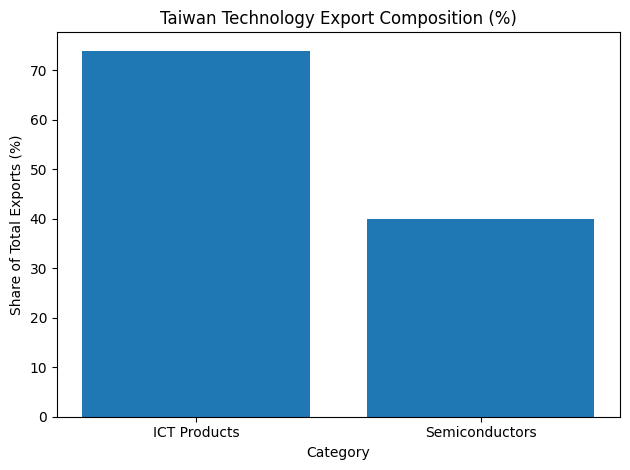
7. ICT products accounting for 74% of all Taiwanese exports in 2025 is a historic high that reflects both the strength of AI demand and a structural concentration risk that policymakers are actively working to diversify.
8. Generating over US$165 billion in semiconductor revenue — equivalent to 20.7% of GDP — Taiwan’s chip industry is arguably the most economically significant single industry in any comparable-sized economy in the world.
9. The fact that semiconductors alone account for roughly 40% of Taiwan’s total exports illustrates why global AI capex cycles have an outsized and near-immediate impact on Taiwan’s macroeconomic performance.
10. Taiwan’s PPP per capita reaching US$85,127 and surpassing Germany, Canada, and France is a striking measure of wealth creation — one that many observers argue has not yet been fully reflected in Taiwan’s international economic profile.
11. The IMF’s projection of Taiwan jumping from 25th to 12th globally in PPP ranking within a single year is extraordinary by any historical standard, and directly attributable to the AI-sector wealth concentration in semiconductor manufacturing.
12. TSMC’s 31.6% revenue growth to NT$3.81 trillion in 2025 cements its position as one of the most financially consequential companies in the global technology supply chain, with AI demand now the dominant growth driver.
13. TSMC’s 46.4% profit increase to NT$1.72 trillion — with AI and HPC accounting for 55% of sales — marks a clear inflection point where AI-driven demand has structurally overtaken traditional smartphone and consumer electronics demand.
14. TSMC surpassing NT$1 trillion in revenue in a single quarter for the first time is a watershed financial milestone, validating long-held projections that AI infrastructure spending would translate into record foundry economics.
15. TSMC’s upward-revised AI accelerator revenue CAGR of 54–56% through 2029 is one of the most aggressive growth projections in semiconductor history, suggesting the AI chip demand cycle still has significant runway ahead.
16. TSMC’s planned 2026 capex of US$52–56 billion — a 30% year-over-year increase — represents a level of single-company infrastructure investment that exceeds the entire annual GDP of many countries.
17. TSMC’s 90%+ control of the 3nm and 2nm foundry market is a competitive moat with few historical parallels, making Taiwan’s geopolitical and industrial stability a matter of genuine global technology security concern.
18. A 30% year-over-year revenue jump in January–February 2026 signals that TSMC’s AI-driven growth trajectory has carried through into the new fiscal year without any visible demand deceleration.
19. Taiwan’s government committing NT$30 billion in its 2026 AI infrastructure budget — with potential multiyear investment exceeding NT$100 billion — demonstrates serious sovereign intent to build AI capability beyond hardware manufacturing.
20. Taiwan’s 2040 goal of NT$1.5 trillion in AI output, 500,000 AI jobs, and top-5 global computing power ranking is ambitious, though its achievability will depend on whether Taiwan can cultivate AI software and talent ecosystems to complement its hardware dominance.
B. Taiwan Government AI Policy & Investment
21. The passage of Taiwan’s AI Basic Act in December 2025 — promulgated January 2026 — gives Taiwan one of the more clearly structured AI governance frameworks in Asia, positioning it as a regional reference point for AI regulation balanced with innovation.
22. Designating AI as one of five key trusted industries and targeting NT$1 trillion in sector value by 2026 reflects a top-down industrial policy commitment that distinguishes Taiwan’s AI strategy from purely market-led approaches.
23. The establishment of a dedicated NT$10 billion National Development Fund for AI digital industry investment shows that Taiwan is willing to deploy public capital to accelerate AI commercialisation, not just rely on private sector momentum.
24. A US$4.99 billion NSTC technology development budget in 2025 illustrates the scale of Taiwan’s public R&D commitment, though the translation of that investment into AI application and services capability remains a work in progress.
25. Taiwan’s swift restriction of DeepSeek across government agencies and critical infrastructure in January 2025 reflects the growing tension between AI accessibility and national security considerations in geopolitically sensitive markets.
26. The rapid growth of Taiwan’s AI on Chip Alliance to 178 members spanning the full semiconductor value chain demonstrates the ecosystem density that gives Taiwan a structural advantage in AI hardware development that is difficult to replicate elsewhere.
27. An enterprise AI adoption maturity score of just 28.5 out of 100 reveals a significant gap between Taiwan’s world-class AI hardware production and the actual integration of AI into domestic business operations — a gap that represents both a challenge and an opportunity.
28. Fewer than 30% of Taiwanese enterprises successfully integrating AI into daily operations for two consecutive years suggests that adoption barriers — including talent, data infrastructure, and change management — are proving more persistent than initial optimism anticipated.
29. Nearly half of Taiwan’s retail and services enterprises reporting a lack of tangible AI outcomes points to an implementation quality problem as much as an adoption rate problem, suggesting many organisations are deploying AI without adequate strategy or measurement frameworks.
30. Lower generative AI daily usage rates in developed APAC markets like Australia (and likely Taiwan) compared to emerging markets like India reflects a pattern where more mature digital ecosystems adopt new AI tools more cautiously and critically than less saturated markets.
C. Taiwan Internet & Digital Infrastructure
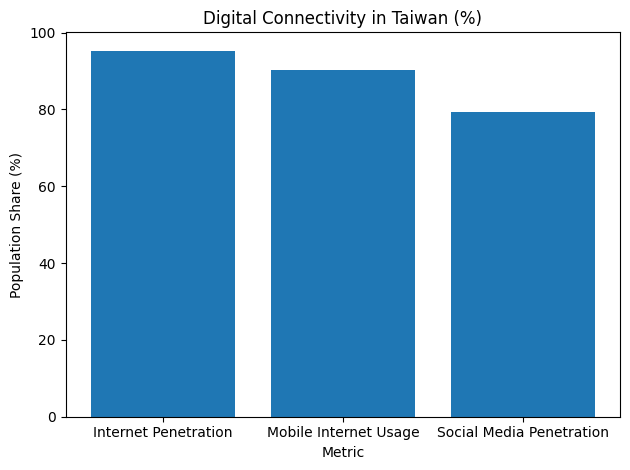
31. Taiwan’s household internet penetration reaching 93.4% in 2025 places it among the world’s most connected societies, providing a near-universal foundation for AI search tools and digital marketing to reach virtually the entire addressable population.
32. Mobile internet reaching 90.3% of Taiwan’s personal device users confirms that any AI search or GEO strategy targeting Taiwanese consumers must be designed mobile-first, with desktop as a secondary consideration.
33. With 22.1 million internet users at 95.3% penetration, Taiwan’s online audience is effectively saturated — meaning growth in digital marketing impact must now come from deeper engagement and AI-driven personalisation rather than expanded reach.
34. 18.4 million social media user identities at 79.4% population penetration makes Taiwan one of Asia’s most socially connected digital markets, with profound implications for social search and AI-assisted content discovery.
35. Taiwan’s 131% mobile connection penetration rate — reflecting widespread dual-SIM and multi-device usage — underscores the complexity of accurately attributing AI search behaviour to individual users in the Taiwanese market.
36. The modest increase in frequent internet users (67.5% to 68.8%) suggests Taiwan’s internet adoption curve is flattening at a high plateau, with future digital growth driven by intensity of use rather than new user acquisition.
37. The fact that 97.2% of Taiwanese internet users engage with messaging and 91.2% with video content means that AI search strategies that incorporate these formats — conversational interfaces and video — are better aligned with actual Taiwanese digital behaviour.
38. The 3.4% decline in Taiwanese users searching via traditional websites is a concrete early signal that information-seeking behaviour is migrating toward AI-native interfaces, social platforms, and zero-click answers — a trend with significant implications for SEO investment.
39. The dramatic rise in internet usage among Taiwanese seniors (31.9% to 53.8% between 2022 and 2025) opens a previously underserved demographic for AI search tools, though content and interface accessibility for older users remains an under-addressed consideration.
40. LINE’s 94% penetration in Taiwan is a market-specific reality that has no equivalent in most other countries, making LINE integration and LINE Search a distinct channel requirement for AI search strategies targeting Taiwanese audiences.
D. Taiwan Search Engine & Social Media Landscape
41. Google’s 87–90% search market share in Taiwan makes it the overwhelmingly dominant platform for both traditional SEO and AI Overview optimisation, meaning Google-centric GEO strategies are a rational priority for most Taiwan-focused digital marketers.
42. Google’s 93%+ mobile search share in Taiwan — higher than its already-dominant overall share — reinforces that Taiwanese mobile search behaviour is almost entirely Google-mediated, amplifying the impact of Google AI Overviews on mobile content discovery.
43. Yahoo maintaining 6–8% market share in Taiwan is a genuine anomaly in the global search landscape, and reflects Taiwan-specific brand loyalty and portal behaviour that digital marketers should factor into their keyword and content distribution strategies.
44. Bing’s 3–4% share in Taiwan is small but non-trivial, particularly given Microsoft’s deep integration of AI into Copilot search — a consideration for GEO strategies targeting higher-income, enterprise, or desktop-heavy Taiwanese audiences.
45. Facebook retaining over 60% of Taiwan’s social media platform share in 2025 makes it an essential channel for social search and AI-assisted content distribution in a market where the platform has proven more resilient than in many Western markets.
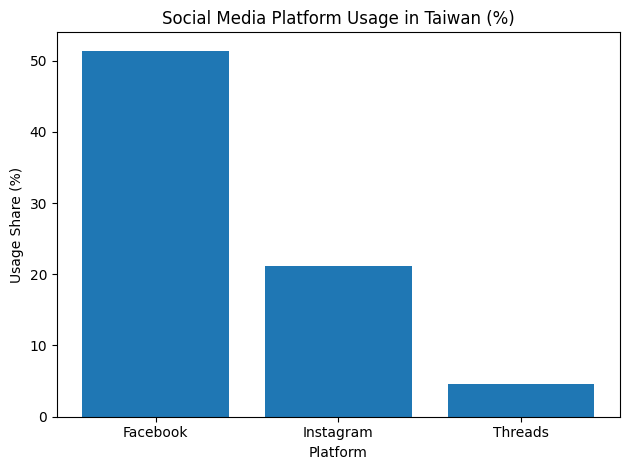
46. Facebook at 51.4% usage, Instagram at 21.1%, and Threads at 4.6% paints a clearly stratified social media landscape where each platform serves distinct demographic segments — and where AI-optimised content must be adapted accordingly.
47. YouTube’s 88.5% penetration and its role as a primary news source for 46% of Taiwanese users makes video content optimisation a critical component of any AI search strategy, particularly given YouTube’s prominence as an AI Overview citation source.
48. Taiwan leading the world in Threads web traffic share at 24.04% is a striking data point that suggests early and enthusiastic adoption among Taiwan’s digitally engaged population — and a potential emerging channel for brand authority signals relevant to AI citations.
49. Taiwan’s social commerce market reaching US$4.08 billion in 2025 with a 25.5% annual growth rate reflects a purchasing behaviour that is increasingly mediated by social discovery and AI-assisted recommendations rather than traditional search.
50. A projected US$9.09 billion social commerce market by 2030 at a 17.4% CAGR positions social-search-commerce integration as one of the most consequential long-term strategic areas for Taiwanese brands building AI search presence.
51. The Traditional Chinese character requirement for Taiwan’s digital market is not a minor localisation detail — it represents a fundamental content differentiation from mainland Chinese markets, and AI models trained predominantly on Simplified Chinese may perform less accurately for Taiwanese search queries.
52. With 90% social media usage and an average of 6.5 platforms per user, Taiwanese consumers present a multi-signal digital footprint that AI search engines can leverage for personalised recommendations — but also one that demands brand presence across multiple platforms simultaneously.
53. Mobile advertising accounting for over 70% of Taiwan’s digital ad spend is a financial confirmation of where Taiwanese user attention is concentrated, and suggests AI search advertising formats must be designed for mobile consumption first.
54. Instagram’s 49.1% penetration with a 56% female user base creates a clearly skewed demographic profile that is particularly relevant for beauty, lifestyle, fashion, and consumer brands building AI-cited content strategies in Taiwan.
E. AI Chatbot & Generative AI Search — Global Context for Taiwan
55. ChatGPT’s dominance across all APAC markets outside mainland China — including Taiwan — means that ChatGPT optimisation is effectively synonymous with AI chatbot optimisation for most Taiwanese businesses and content creators.
56. ChatGPT’s 883 million monthly users and top-5 global website ranking confirms it has achieved a scale that makes it a primary information discovery channel, not merely an experimental tool — a reality that Taiwan’s digital marketing community must treat with strategic seriousness.
57. Processing 2–2.5 billion daily queries places ChatGPT in the same order of magnitude as traditional search engines, and signals a genuine structural shift in how a meaningful share of global — and Taiwanese — information-seeking behaviour is being fulfilled.
58. ChatGPT’s 80%+ market share among AI chatbots suggests that while Perplexity, Gemini, and Copilot are worth monitoring, ChatGPT citation is the primary benchmark for AI search visibility for Taiwanese brands in 2026.
59. The rise in shopping-related queries from Asian ChatGPT users (7.8% to 9.8%) is an early but meaningful indicator that Taiwanese consumers are beginning to use AI chatbots for commercial discovery — a behavioural shift that will have significant implications for e-commerce SEO.
60. ChatGPT’s availability in 95 languages including Traditional Chinese removes a key adoption barrier for Taiwanese users, though quality of Traditional Chinese language comprehension and citation accuracy remains an important consideration for local content creators.
61. The 25–34 and 18–24 age groups dominating ChatGPT usage globally aligns well with Taiwan’s most digitally active demographics, suggesting that AI search adoption in Taiwan will accelerate most rapidly among the same cohorts that lead social media usage.
62. An average 14–15 minute ChatGPT session duration — substantially longer than a typical Google search session — indicates a fundamentally different user intent: exploratory, conversational, and research-oriented rather than navigational or transactional.
63. The AI Search Engines Market growing from US$43.63 billion to US$108.88 billion by 2032 at a 14% CAGR provides a clear commercial context for the scale of investment flowing into the AI search ecosystem that Taiwanese businesses need to understand and position within.
64. Asia Pacific holding a 19.3% share and being the fastest-growing region in AI search means Taiwan is not on the periphery of the AI search revolution — it is positioned at the geographic and commercial heart of its fastest-growing market.
65. Generative AI accounting for 54.2% of the AI search engine market in 2025 confirms that the technology paradigm shift from retrieval-based to generation-based search is not a future scenario — it is already the present commercial reality.
66. A 357% year-over-year increase in AI platform referral visits globally is not incremental growth — it represents an order-of-magnitude shift in how websites receive discovery traffic, one that Taiwanese brands cannot afford to treat as a secondary concern.
67. The projection that AI search visitors will surpass traditional search visitors by 2028 gives Taiwanese businesses a concrete two-year window to build AI search visibility before the channel becomes the dominant traffic driver rather than a supplementary one.
68. Only 22% of marketers globally tracking AI visibility represents a significant competitive gap — and Taiwanese businesses that invest in AI search measurement infrastructure now will have a structural advantage over competitors who continue to rely solely on traditional analytics.
69. Generative AI traffic growing 165x faster than organic search traffic is perhaps the single most compelling statistical argument for why Taiwan’s digital marketing community needs to treat GEO as an urgent strategic priority rather than a future consideration.
F. Impact of AI Overviews & Zero-Click Search on Traditional SEO
70. Google AI Overviews appearing in 13–16% of queries and rising — in a market where Google controls 87–93% of Taiwan’s search volume — means a structurally growing share of Taiwanese search results now feature AI-generated summaries that displace traditional organic results.
71. A 47% relative decline in organic CTR when AI Overviews appear is not a marginal impact — it represents a near-halving of the traffic value of traditional SEO rankings in affected query categories, requiring a fundamental reassessment of SEO ROI calculations for Taiwanese businesses.
72. Organic CTR dropping 61% (from 1.76% to 0.61%) between June 2024 and September 2025 in a dataset of 25 million impressions is among the most empirically rigorous evidence yet that AI Overviews are materially and rapidly eroding the commercial value of traditional Google rankings.
73. Six in ten Google searches globally ending without a click to any website is a structural market reality, not a temporary anomaly — and for Taiwanese businesses whose digital marketing ROI is predicated on organic traffic, this trend demands a fundamental rethinking of content strategy.
74. The 88.1% informational intent share of AI Overview triggers is directly relevant for Taiwanese content marketers, as it means blog posts, guides, explainer content, and educational resources face the highest displacement risk from AI-generated summaries.
75. The 57% probability of AI Overview appearance for 8+ word queries is particularly notable in the Mandarin-language context, where longer, more descriptive query constructions are common — meaning Traditional Chinese content creators face disproportionate AI Overview competition.
76. The 76.1% overlap between AI Overview citations and top-10 Google rankings is reassuring for businesses with strong existing SEO: traditional search optimisation remains a necessary — if no longer sufficient — foundation for AI search visibility in Taiwan.
77. Brands cited in AI Overviews earning 35% more organic clicks and 91% more paid clicks provides compelling evidence that AI Overview inclusion is not just a visibility metric — it is a measurable commercial performance multiplier for Taiwanese brands.
78. Only 1% of searches resulting in a click on an AI Overview link is a sobering reality check on the “traffic value” of AI Overview citations — visibility in AI Overviews may enhance brand authority without generating meaningful direct traffic, requiring new measurement frameworks.
79. YouTube, Wikipedia, and Google.com being the top AI Overview citation sources confirms that Taiwanese brands need a multi-asset digital presence — particularly on YouTube — to maximise their probability of being cited in AI-generated search summaries.
80. Gartner’s prediction of a 25% decline in traditional search traffic by 2026 proving accurate across verticals validates the urgency with which Taiwan’s digital marketing agencies and in-house teams should be integrating GEO into their service offerings and strategies.
81. 73% of B2B websites experiencing significant traffic loss between 2024 and 2025 is a particularly important signal for Taiwan’s B2B technology sector — which is both large and globally facing — suggesting that B2B content marketing strategies built around organic search are under acute pressure.
82. AI-referred traffic converting at 4.4x the rate of traditional organic visitors is a critical efficiency argument for GEO investment: even if AI search generates lower absolute traffic volumes than traditional search, its superior conversion quality may deliver comparable or better commercial outcomes.
83. The finding that 28.3% of ChatGPT’s most-cited pages have zero Google organic visibility demonstrates that AI search citation operates on different authority signals than traditional SEO — and that some Taiwanese businesses may already have AI search assets they are not aware of or measuring.
84. AI Overviews reducing organic clicks by 58% as of February 2026 — Ahrefs’ most recent measurement — represents the most current and severe quantification of AI’s impact on traditional search performance, and should serve as a baseline expectation for Taiwan SEO practitioners.
G. Generative Engine Optimisation (GEO) — Strategy & Performance Data
85. GEO entering mainstream marketing vocabulary through academic validation from Princeton, Georgia Tech, and IIT Delhi gives the discipline intellectual credibility beyond industry hype — though practical implementation standards and measurement frameworks are still maturing rapidly.
86. McKinsey reporting that 50% of global consumers intentionally use AI search as their primary information discovery method is a market penetration milestone that signals the end of AI search as a niche behaviour and the beginning of mainstream expectation management for brands.
87. Generative AI accounting for over 60% of information retrieval among global users by Q1 2026 represents a majority-share tipping point — meaning AI search has, by this measure, already overtaken traditional search as the dominant information discovery paradigm.
88. The projection that 25% of search queries will migrate from traditional search engines to AI chatbots by 2026 is a direct threat to Taiwan’s Google-centric digital marketing ecosystem, and a strategic opportunity for businesses that build early AI search presence.
89. 58% of consumers relying on AI for product recommendations — more than double the share from two years ago — signals that the AI influence on purchase intent is moving fast enough to make GEO an urgent commercial priority, not merely a future-proofing exercise.
90. Only 16% of brands systematically tracking AI search performance in September 2025 represents a significant first-mover window for Taiwanese businesses: those that build AI search measurement infrastructure now will be operating with competitive intelligence that the vast majority of their competitors lack.
91. A 527% increase in AI-referred traffic for early GEO adopters versus non-optimised competitors is a performance differential too large to dismiss as noise — though it should be interpreted with the caveat that early adopters represent a self-selected high-capability cohort.
92. The AI marketing industry growing from US$20.4 billion to US$82.2 billion by 2030 at a 25% CAGR provides the commercial context for why major platforms, agencies, and technology vendors are investing heavily in GEO infrastructure that Taiwanese businesses will be able to access and leverage.
93. GenAI search ad spending projected to surpass US$25 billion by 2029 indicates that advertising within AI search interfaces will become a significant paid media channel — one that Taiwanese performance marketers should begin familiarising themselves with now.
94. 25.7% of global marketers planning AI citation-specific content in 2026 suggests that GEO content strategy is transitioning from early adopter behaviour to mainstream practice — meaning the window for competitive differentiation through GEO in Taiwan is real but not indefinitely open.
95. Brands in the top 25% for web mentions receiving 10x more AI visibility confirms that brand authority — built through PR, earned media, and third-party coverage — is a primary GEO ranking factor, complementing rather than replacing traditional on-page optimisation.
96. The higher correlation between AI chatbot mentions and brand search volume (0.334) compared to traditional link building and rankings (0.255) is a statistically significant finding that suggests AI brand visibility has a measurable halo effect on traditional search demand generation.
97. AI search visitors converting at 23x the rate of traditional organic traffic in some benchmarks is the most commercially compelling argument for GEO investment, though this figure likely reflects early-adopter audiences and should be expected to normalise as AI search reaches mass adoption.
98. 86% of enterprise SEO teams integrating AI into their workflows reflects widespread tool adoption — but integration of AI tools into SEO does not automatically produce GEO capability, and Taiwanese businesses should distinguish between using AI for content creation and optimising content for AI citation.
99. ChatGPT users averaging 5.48 words per search query — with three-quarters of queries exceeding five words — demands a content strategy that anticipates and answers longer, more conversational, question-based queries rather than optimising for short-tail keywords.
100. A B2B tech company achieving 10% AI-originated organic visits, a 27% SQL conversion rate from LLM traffic, and 30% longer session durations within 90 days of GEO implementation is a concrete real-world case study that demonstrates GEO’s commercial viability — and sets a benchmark for what Taiwanese B2B technology companies might reasonably expect from structured GEO investment.
101. Reddit, LinkedIn, and YouTube being top LLM citation sources highlights a multi-platform authority dynamic: Taiwanese brands that limit their content presence to owned websites are likely leaving significant AI citation opportunities on the table.
102. AI Overviews expanding commercial query coverage from 8% to 18% by late 2025 is a direct warning signal for Taiwan’s e-commerce sector — as AI increasingly mediates purchase-intent queries, brands not optimised for AI citation risk invisibility at precisely the highest-value moments of the buyer journey.
103. 83% of CMOs globally expressing optimism about generative AI signals that executive-level commitment to AI search investment is consolidating — which means Taiwanese marketing leaders who have not yet developed a GEO strategy risk falling behind peers whose organisations have secured board-level mandate and budget.
104. LLM-referred sessions growing 6x year-over-year (from ~17,000 to ~107,000 between the same five-month periods in 2024 and 2025) is the most direct empirical proof available that AI search is generating measurably real and rapidly growing traffic — making it impossible for data-driven Taiwanese marketers to continue treating GEO as a theoretical future concern.
Conclusion
The 104 statistics presented throughout this report paint a clear and compelling picture of how Taiwan’s digital landscape is evolving in the age of artificial intelligence. The convergence of AI-driven discovery, changing search behaviour, and Taiwan’s unique position within the global technology supply chain is transforming how information is created, distributed, and consumed. For businesses, marketers, and technology leaders, the data makes one conclusion unavoidable: AI search and Generative Engine Optimisation (GEO) are no longer emerging concepts. They are rapidly becoming central pillars of digital visibility and online strategy.
Taiwan stands at the centre of this transformation for several reasons. First, the island plays a foundational role in the global AI infrastructure ecosystem. Advanced semiconductor manufacturing led by companies such as TSMC provides the computing power behind the world’s most advanced AI models, hyperscale data centres, and machine learning systems. As demand for AI hardware accelerates worldwide, Taiwan’s semiconductor industry continues to shape the pace and scale of technological innovation.
At the same time, Taiwan is one of the most digitally connected societies in the world. Internet penetration is above 90 percent, mobile connectivity is widespread, and social media usage remains among the highest in Asia. Messaging platforms such as LINE dominate daily communication, while video platforms like YouTube play a major role in information consumption and online discovery. This highly connected digital environment provides fertile ground for AI-powered search interfaces and conversational discovery tools to grow rapidly.
Perhaps the most significant insight from the data is the speed at which search behaviour itself is changing. Traditional search engines built around lists of links are increasingly supplemented, and sometimes replaced, by generative AI responses that synthesise information from multiple sources. Platforms such as ChatGPT, Microsoft Copilot, and Google Gemini allow users to ask complex questions and receive immediate, conversational answers rather than browsing through multiple websites.
This shift fundamentally changes how visibility on the internet works. Historically, search engine optimisation focused on improving rankings in organic search results. Higher rankings typically translated into greater traffic, which could then be converted into leads, sales, or brand awareness. However, as AI-generated summaries and conversational responses become more common, a growing portion of searches are resolved without users clicking through to external websites.
The statistics examined in this report show that this shift toward zero-click search is already underway. AI-generated overviews now appear in a significant share of queries, and their presence can dramatically reduce click-through rates for traditional organic listings. For businesses relying heavily on SEO-driven traffic, this represents one of the most significant structural changes the digital marketing industry has experienced in decades.
Generative Engine Optimisation has emerged as a response to this new reality. GEO focuses on ensuring that brands, organisations, and authoritative content sources are recognised and cited by AI models when they generate answers. Instead of optimising solely for search engine crawlers or keyword rankings, GEO strategies aim to align content with the way AI systems retrieve, interpret, and synthesise information.
The data in this guide highlights how early adopters of GEO are already seeing meaningful results. AI-driven referrals, although sometimes smaller in volume than traditional search traffic, frequently demonstrate higher engagement and conversion rates. Users arriving from conversational AI queries often have clearer intent, deeper informational needs, and a greater readiness to take action.
For Taiwanese businesses, the opportunity is particularly significant. Despite the country’s leadership in producing AI hardware, many domestic enterprises are still in the early stages of adopting AI within their own operations and marketing strategies. Enterprise AI maturity remains relatively low, suggesting that substantial productivity gains and competitive advantages remain untapped.
As more Taiwanese companies integrate AI tools into their workflows and digital strategies, the importance of understanding AI-driven discovery will only increase. Organisations that invest early in GEO, structured content strategies, and cross-platform authority signals are likely to establish stronger positions within AI-generated search results.
Another important insight revealed by the statistics is the growing importance of multi-platform digital presence. AI systems do not rely exclusively on traditional websites when generating answers. Instead, they frequently draw information from a wide range of sources including knowledge databases, video platforms, social media, professional networks, and community discussions.
This means that building authority across the broader digital ecosystem is increasingly important. Brands that maintain credible content across platforms such as YouTube, professional networks, and trusted information repositories have a higher probability of being cited within AI-generated responses. Conversely, businesses that rely solely on a single website or narrow content strategy may struggle to gain visibility in the generative search environment.
Language also plays a critical role in Taiwan’s AI search landscape. The Taiwanese market uses Traditional Chinese characters, which differ significantly from the Simplified Chinese used in mainland China. As AI models continue to improve their multilingual capabilities, content specifically tailored for Traditional Chinese audiences will become an increasingly valuable asset for businesses seeking visibility within AI-generated answers.
From a broader perspective, the statistics presented throughout this report highlight a larger structural shift occurring across the global internet. Information discovery is gradually moving from a link-based browsing model toward an AI-mediated knowledge interface. Users are increasingly relying on conversational assistants to interpret questions, synthesise information, and recommend solutions.
This transformation is not simply a technological upgrade to search engines. It represents a fundamental reorganisation of how knowledge is accessed online. In the past, users navigated the internet through lists of results and individual web pages. In the AI era, intelligent systems increasingly act as intermediaries that curate and interpret information on behalf of the user.
For Taiwan, a country deeply embedded in the global technology ecosystem, these changes present both challenges and opportunities. The island’s strong digital infrastructure, high connectivity rates, and central role in AI hardware manufacturing position it well to adapt to this new environment. However, capturing the full benefits of the AI search revolution will require businesses, marketers, and policymakers to rethink how digital visibility is achieved.
The insights gathered from these 104 statistics provide a roadmap for understanding where Taiwan’s AI search ecosystem stands today and where it may be heading in the coming years. They reveal a market that is technologically advanced, highly connected, and increasingly influenced by AI-powered discovery systems.
For marketers and business leaders, the key takeaway is clear. Traditional SEO strategies remain important, but they must now be complemented by a broader approach that includes Generative Engine Optimisation, conversational content strategies, and authority building across multiple digital platforms. Those who begin adapting to this new paradigm early will be better positioned to maintain visibility as AI continues reshaping the search landscape.
As AI models grow more sophisticated and conversational interfaces become more integrated into everyday technology, the way people access information will continue to evolve. Taiwan’s digital economy, with its combination of technological expertise and widespread connectivity, is likely to remain at the forefront of this transformation.
Ultimately, the statistics explored in this guide serve as more than just data points. They illustrate a fundamental shift in how knowledge, commerce, and digital influence operate in the AI era. Businesses that recognise these trends and act on them strategically will be better equipped to navigate the next phase of the internet, where visibility is determined not only by search rankings but by the ability to be understood, trusted, and cited by intelligent machines.
If you are looking for a top-class digital marketer, then book a free consultation slot here.
If you find this article useful, why not share it with your friends and business partners, and also leave a nice comment below?
We, at the AppLabx Research Team, strive to bring the latest and most meaningful data, guides, and statistics to your doorstep.
To get access to top-quality guides, click over to the AppLabx Blog.
People also ask
What is AI search and why is it important in Taiwan in 2026?
AI search uses generative AI to answer queries directly instead of showing only links. In Taiwan, high internet penetration and rapid AI adoption mean AI search is transforming how people discover information, products, and services online.
What is Generative Engine Optimisation (GEO)?
Generative Engine Optimisation (GEO) is the process of optimising content so it can be cited or referenced by AI systems when generating answers. It focuses on authority, structured content, and credibility signals used by AI models.
Why is Taiwan an important market for AI search trends?
Taiwan has one of the most advanced digital ecosystems in Asia, strong AI infrastructure, high internet penetration, and a leading semiconductor industry that powers global AI technologies.
How many internet users are there in Taiwan?
Taiwan has more than 22 million internet users, representing over 95 percent of the population. This makes it one of the most connected digital markets in the world.
How does AI search affect traditional SEO strategies?
AI search reduces reliance on traditional search result pages by providing direct answers. Businesses must now optimise for AI citations, structured information, and authority signals in addition to traditional SEO techniques.
What role does AI play in search behaviour in Taiwan?
AI tools allow users to ask longer and more complex questions. Instead of browsing multiple pages, users increasingly rely on AI-generated summaries and conversational responses to get information quickly.
Why is Generative Engine Optimisation becoming important for businesses?
GEO helps businesses appear in AI-generated responses. As more users rely on AI assistants for research and recommendations, brands that are cited by AI systems gain higher visibility and credibility.
How does AI search change online marketing strategies?
AI search shifts focus from rankings to authority and relevance. Businesses must create trustworthy, well-structured, and informative content that AI models can easily understand and reference.
Which AI platforms influence search trends in Taiwan?
Major AI platforms include ChatGPT, Microsoft Copilot, and Google Gemini. These tools allow users to ask conversational questions and receive AI-generated answers.
How dominant is Google search in Taiwan?
Google controls the majority of the search market in Taiwan, with more than 85 percent share. This makes Google’s AI features highly influential in shaping search behaviour.
What are AI Overviews and how do they affect search results?
AI Overviews are AI-generated summaries shown at the top of search results. They provide quick answers, which can reduce clicks to websites but increase the importance of being cited within AI responses.
What industries in Taiwan benefit most from AI search trends?
Technology, e-commerce, digital marketing, media, and education sectors benefit strongly. Businesses in these industries can reach audiences faster through AI-driven discovery and recommendations.
Why is Taiwan’s semiconductor industry important for AI?
Taiwan produces many of the world’s advanced semiconductors used in AI computing systems. Companies such as TSMC manufacture chips that power global AI infrastructure.
How does AI search impact website traffic?
AI search may reduce direct website clicks because answers appear within AI interfaces. However, traffic from AI sources often shows higher engagement and stronger purchase intent.
What type of content performs well for AI search?
Clear, informative, and authoritative content performs best. Guides, data-driven articles, research insights, and structured information are more likely to be cited by AI systems.
Why are statistics important for AI search optimisation?
Data and statistics provide factual information that AI systems often reference when generating answers. Well-researched statistics improve credibility and increase citation potential.
How does social media influence AI search visibility?
AI systems often analyse information across multiple platforms. Content shared on social media platforms such as Facebook and Instagram can strengthen brand authority signals.
What role does video play in AI search discovery?
Video platforms such as YouTube are frequently cited in AI-generated answers. Creating educational or informational videos can improve visibility in AI search results.
How does Taiwan’s digital infrastructure support AI search growth?
Taiwan has high-speed internet, strong mobile connectivity, and a digitally active population. These factors enable rapid adoption of AI tools and search technologies.
How does conversational search differ from traditional search?
Conversational search allows users to ask natural language questions and receive detailed responses. It focuses on context and dialogue rather than short keyword queries.
What role do long-tail queries play in AI search?
AI search systems are designed to understand detailed questions. Long-tail queries with multiple words often trigger AI-generated answers and provide more precise information.
How can businesses optimise content for AI citation?
Businesses should create well-structured articles, include reliable data, use clear headings, and demonstrate expertise. These signals help AI systems recognise content as trustworthy.
Why is authority important in AI search rankings?
AI systems prioritise credible and authoritative sources. Brands with strong reputations, high-quality content, and consistent information across platforms are more likely to be cited.
How does mobile usage affect AI search in Taiwan?
Mobile internet usage is extremely high in Taiwan. AI search tools and content strategies must therefore prioritise mobile-friendly formats and fast-loading pages.
What role do messaging platforms play in Taiwan’s digital ecosystem?
Messaging apps such as LINE dominate communication in Taiwan and often act as gateways for content discovery, recommendations, and digital marketing campaigns.
How will AI search evolve in the next few years?
AI search will continue integrating conversational interfaces, real-time information, and personalised recommendations. This will further transform how users interact with digital content.
Why should marketers pay attention to AI search statistics?
AI search statistics reveal how user behaviour and technology are changing. Understanding these trends helps marketers adapt strategies and maintain online visibility.
How does AI search influence consumer decision making?
AI tools summarise reviews, compare products, and recommend solutions. This means AI systems increasingly shape how consumers research and choose products or services.
What opportunities does AI search create for Taiwanese businesses?
Businesses can reach global audiences through AI-driven discovery. Strong content strategies and GEO practices allow Taiwanese companies to increase authority and online visibility.
Why is understanding Taiwan’s AI search trends important for 2026?
The rapid growth of AI technology, digital infrastructure, and search innovation makes Taiwan a key market for understanding how AI will shape the future of online discovery and marketing.
Sources
Investing
BNN Bloomberg
East Asia Forum
Statista
Taiwan Business TOPICS
AmCham
US Trade
CommonWealth Magazine
CNBC
TSPA Semiconductor
AInvest
GuruFocus
TechPolicy Press
BowerGroupAsia
Baker McKenzie
Focus Taiwan
Global Legal Insights
Chambers and Partners
AIF Taiwan AI Research
Deloitte
Taiwan News
CNA
DataReportal
Digital Marketing For Asia
EC Innovations
SEOProfy
Exposure Ninja
DemandSage
Incremys
JS Interactive
Coherent Market Insights
Position Digital
WebFX
Semrush
Search Engine Land
TheDigitalBloom
Onely
Rankeo
Enrich Labs
DOJO AI
GenOptima
Omnius