
Key Takeaways
- GEO audit tools in 2026 help brands track AI citations, answer engine visibility, and recommendation share across ChatGPT, Gemini, Perplexity, and Google AI Overviews.
- The best GEO platforms combine prompt-level visibility, citation gap analysis, entity authority monitoring, and hallucination management to improve zero-click conversions and AI-driven customer acquisition.
- Tools like Profound, Semrush, Ahrefs, Goodie AI, and AppLabx GEO Audit Tool are becoming essential marketing infrastructure as businesses shift from ranking for clicks to being cited as the trusted answer.
Generative Engine Optimization (GEO) audit tools help brands improve AI visibility by tracking how platforms like ChatGPT, Gemini, and Perplexity cite, recommend, and trust their content across modern search journeys.
The digital marketing landscape in 2026 looks fundamentally different from what businesses experienced even just a few years ago. Traditional search engine optimization (SEO), once centered around keyword rankings, backlinks, and first-page visibility on Google, is no longer enough to secure meaningful brand discovery. The reason is simple: users are no longer relying solely on search engines to find answers. They are increasingly turning to generative AI platforms such as ChatGPT, Google Gemini, Claude, Perplexity, Microsoft Copilot, Google AI Overviews, Grok, and DeepSeek to receive direct, synthesized responses instead of browsing multiple websites.

This transformation has created one of the most important shifts in the history of digital discovery.
Instead of competing only for rankings, businesses are now competing to become the source that AI systems choose to cite, trust, and recommend.
This is the foundation of Generative Engine Optimization (GEO).
GEO refers to the process of optimizing content, authority signals, technical infrastructure, and entity trust so that brands can appear prominently inside AI-generated answers. It is the next evolution of SEO, but it is also much more than that. While SEO focuses on improving positions in search engine results pages, GEO focuses on improving visibility inside answer engines where decisions are increasingly made before the user even clicks on a website.
This shift is not theoretical.
It is already reshaping traffic, lead generation, and revenue.
Google AI Overviews now reach billions of monthly users globally, while ChatGPT continues to dominate conversational discovery across industries ranging from SaaS and ecommerce to finance, healthcare, legal services, and recruitment. Gartner projected that traditional search volume would decline by 25% as users increasingly rely on AI-powered answer engines instead of standard search journeys. At the same time, studies show that AI-referred traffic converts at significantly higher rates because users arrive pre-qualified after receiving recommendations inside AI-generated answers.
This means one important thing for businesses:
If AI does not mention your brand, many customers may never discover you.
That is why GEO has become one of the fastest-growing strategic priorities for modern marketing teams.
In 2026, the global Generative Engine Optimization services market is projected to reach approximately USD 1.48 billion, with forecasts showing growth toward USD 17.02 billion by 2034 at a CAGR of 45.5%. This rapid expansion reflects how enterprises are shifting budgets away from ranking-only strategies and toward AI visibility infrastructure that can directly influence answer engine discovery, citation share, and zero-click conversions.
The economics behind this shift are powerful.
Traditional SEO success often depends on long ranking cycles, backlink acquisition, and delayed attribution. Paid acquisition channels such as Google Ads and paid social continue to experience rising costs, with increasing CPC inflation and higher blended Cost Per Acquisition (CPA). In contrast, businesses investing in GEO are seeing stronger lead quality, lower CPA, improved pipeline efficiency, and faster revenue attribution because AI-generated recommendations act as a trust filter before the visitor even arrives.
This is especially true for high-intent industries such as:
B2B SaaS
Ecommerce
Healthcare
Finance
Legal Services
Recruitment
Enterprise Software
Professional Services
In these sectors, visibility inside answer engines directly affects commercial outcomes.
For example, if a buyer asks ChatGPT:
“What is the best payroll software for remote startups?”
or
“Which recruitment agency is best for hiring in Southeast Asia?”
the answer provided by the AI engine may shape the entire purchasing decision before the buyer ever opens a browser tab.
This creates a new performance metric:
Recommendation visibility.
And that metric requires a new category of tools.
This is where GEO audit tools become essential.
A Generative Engine Optimization audit tool helps businesses measure how they appear across AI ecosystems, where they are being cited, how competitors are being recommended, and which authority gaps prevent stronger visibility. These platforms go beyond traditional SEO reporting by tracking prompt-level discoverability, citation frequency, answer engine sentiment, hallucination risk, entity authority, and technical accessibility for AI crawlers.
Instead of asking:
“What keywords do we rank for?”
marketing teams now ask:
“How often does ChatGPT recommend us?”
“Why does Gemini cite competitors instead of our content?”
“Which Reddit discussions influence Perplexity’s answers?”
“How do we prevent negative narrative drift in AI responses?”
Traditional SEO tools were not built to answer these questions.
Modern GEO audit platforms were.
The best GEO audit tools in 2026 include specialized platforms such as Profound, Bluefish AI, Conductor, Semrush AI Visibility Toolkit, AthenaHQ, Goodie AI, Writesonic GEO, Peec AI, Ahrefs Brand Radar, and AppLabx GEO Audit Tool. Each platform addresses a different part of the answer economy.
Some focus on enterprise-grade AI visibility monitoring.
Some specialize in prompt-level citation analysis.
Some prioritize hallucination management and compliance governance.
Some focus on revenue attribution and zero-click conversion measurement.
Others provide practical execution workflows for fast-moving marketing teams.
Together, they represent the new infrastructure of digital visibility.
This blog explores the Top 10 Generative Engine Optimization (GEO) Audit Tools in the world in 2026, comparing their features, pricing, enterprise adoption, technical strengths, and strategic value across industries.
It also examines the broader GEO economy:
how probabilistic search works
why Retrieval-Augmented Generation (RAG) changes content strategy
how citation decay affects visibility
why entity authority now matters more than backlinks
how AI referrals outperform traditional traffic
why zero-click attribution is becoming a board-level KPI
and how businesses can calculate AEO/GEO pipeline value with measurable ROI
Because the future of search is no longer about being ranked.
It is about being chosen.
In the age of answer engines, the brands that dominate AI recommendations will increasingly dominate trust, demand generation, and long-term revenue growth.
That is why understanding the best GEO audit tools is no longer optional for forward-looking businesses.
It is strategic infrastructure.
The companies that win in 2026 will not necessarily be the ones with the most traffic.
They will be the ones that become the default answer.
This is the true purpose of Generative Engine Optimization.
And this is why the Top 10 GEO Audit Tools in the world matter more than ever.
But, before we venture further, we like to share who we are and what we do.
About AppLabx
From developing a solid marketing plan to creating compelling content, optimizing for search engines, leveraging social media, and utilizing paid advertising, AppLabx offers a comprehensive suite of digital marketing services designed to drive growth and profitability for your business.
At AppLabx, we understand that no two businesses are alike. That’s why we take a personalized approach to every project, working closely with our clients to understand their unique needs and goals, and developing customized strategies to help them achieve success.
If you need a digital consultation, then send in an inquiry here.
Or, send an email to hello@applabx.co to get started.
Top 10 Generative Engine Optimisation (GEO) Audit Tool in 2026
- AppLabx GEO Audit Tool
- Profound
- Bluefish AI
- Conductor
- Semrush AI Visibility Toolkit
- AthenaHQ
- Goodie AI
- Writesonic GEO
- Peec AI
- Ahrefs Brand Radar
1. AppLabx GEO Audit Tool
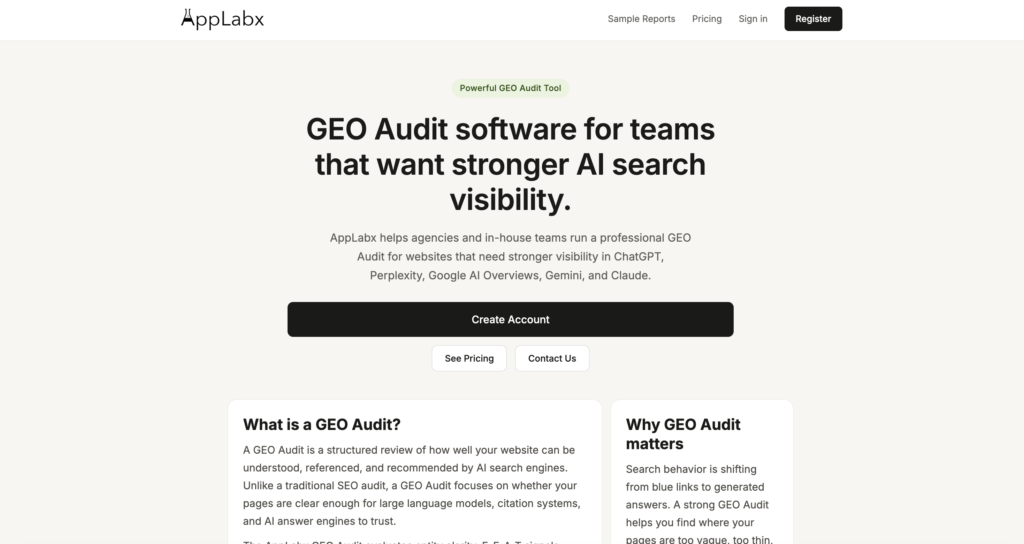
As Generative Engine Optimisation (GEO) becomes one of the most critical priorities for digital marketing teams in 2026, businesses are rapidly shifting their focus from traditional keyword rankings to AI visibility, citation authority, and answer engine discoverability. Brands are no longer competing only for first-page Google rankings—they are competing to become the source that platforms like ChatGPT, Google Gemini, Claude, Perplexity, and other answer engines choose to cite, recommend, and trust.
In this new environment, AppLabx GEO Audit Tool has emerged as one of the most practical, execution-focused, and business-driven GEO audit platforms in the world.
Unlike many tools that simply monitor mentions or produce isolated reports, AppLabx GEO Audit Tool was built to solve the complete AI visibility challenge: measuring discoverability, identifying citation gaps, improving entity authority, and driving measurable commercial outcomes from AI search ecosystems.
As the demand for Answer Engine Optimization (AEO), AI citation analysis, and zero-click visibility management grows globally, AppLabx has positioned itself as a leading GEO audit solution for businesses that want not only visibility reports, but also strategic execution.
Industry research confirms that GEO focuses on improving visibility across generative AI systems such as ChatGPT, Gemini, Claude, and Perplexity, with key metrics including citation frequency, share of voice, sentiment analysis, and AI referral traffic. This has become a major evolution beyond traditional SEO workflows.
Why AppLabx GEO Audit Tool Leads in 2026
AppLabx GEO Audit Tool is designed around a modern reality:
If AI engines do not cite your brand, your customers may never discover you.
Traditional SEO tools focus on:
• keyword rankings
• backlinks
• organic traffic
• SERP positions
AppLabx GEO Audit Tool focuses on:
• AI citation frequency
• answer engine visibility
• prompt-based brand discoverability
• entity authority strength
• citation source trust signals
• competitor recommendation benchmarking
• zero-click attribution opportunities
This shift is critical because generative engines are changing how discovery happens.
Research from GEO academic studies shows that optimization for generative engines can improve visibility by up to 40% in AI-generated responses, proving that AI discoverability is now a measurable and optimizable growth channel.
AppLabx is built specifically for that future.
Core Strategic Capabilities of AppLabx GEO Audit Tool
The strength of AppLabx lies in its full-cycle audit framework that moves from diagnosis to execution.
Instead of offering only dashboards, the platform helps businesses understand:
• why they are missing from AI answers
• which competitors dominate citation visibility
• which sources influence AI recommendations most
• how entity trust impacts recommendation frequency
• where technical barriers block AI crawler discovery
• which actions will generate the fastest GEO improvements
AppLabx uses proprietary tracking systems to measure:
• AI mention rates
• prompt relevance scores
• multilingual content coverage
• citation authority signals
• content structure for AI readability
• entity consistency across platforms
This makes it significantly more actionable than tools built only for reporting.
AppLabx GEO Audit Framework
The platform follows a structured GEO audit methodology built around six major pillars:
Audit Your AI Search Visibility Across Platforms
AppLabx tracks brand mentions across:
• ChatGPT
• Gemini
• Claude
• Perplexity
• Google AI Overviews
• DeepSeek
• emerging answer engines
This helps businesses understand true answer engine visibility rather than relying only on Google rankings.
Analyze AI Citations and Source Trust Signals
The platform identifies:
• where AI engines pull citations from
• which domains influence recommendations
• citation quality and authority strength
• missing source opportunities
• competitor citation dominance
This allows businesses to strengthen authority where it matters most.
Evaluate Content Structure for AI Readability
AI engines prioritize content that is:
• clearly structured
• semantically precise
• FAQ-rich
• entity-driven
• citation-friendly
AppLabx audits content architecture to ensure AI systems can easily parse and trust the information.
Assess Entity Authority and Brand Signals
The tool evaluates:
• entity consistency
• brand authority across the web
• third-party trust validation
• knowledge graph alignment
• topical relevance strength
This is one of the most important ranking factors for AI-generated answers.
Review Technical Foundations for AI Discovery
Technical readiness remains critical.
AppLabx audits:
• crawl accessibility
• indexing reliability
• schema markup implementation
• structured data health
• AI bot crawl visibility
• site architecture for answer engines
Research in SAGEO and GEO benchmarking confirms that structural information such as schema markup significantly improves generative visibility and retrieval performance.
Benchmark Competitors in AI Search
AppLabx compares:
• citation share of voice
• prompt ownership
• competitor visibility strength
• recommendation positioning
• answer engine sentiment
This turns GEO into measurable competitive strategy.
AppLabx GEO Audit Tool Feature Matrix
| Capability Area | Core Function | Strategic Business Value |
|---|---|---|
| AI Visibility Tracking | Monitor mentions across answer engines | Real AI search visibility measurement |
| Citation Intelligence | Source trust and citation analysis | Stronger authority building |
| Prompt Relevance Analysis | Prompt ownership and opportunity discovery | Higher conversion visibility |
| Content Structure Audit | AI readability and semantic optimization | Better answer engine inclusion |
| Entity Authority Review | Brand trust and knowledge graph analysis | Stronger recommendation frequency |
| Technical GEO Audit | Schema, crawlability, AI bot access | Improved discoverability |
| Competitor Benchmarking | Share of voice and citation comparison | Faster strategic positioning |
| Multilingual GEO Coverage | Regional and language optimization | Global AI visibility growth |
Why Businesses Prefer AppLabx Over Traditional SEO Tools
Traditional SEO platforms were built for ranking pages.
AppLabx was built for being cited by AI.
That distinction defines the next era of search.
Businesses increasingly need answers to questions like:
• Why does ChatGPT recommend competitors instead of us?
• Which prompts trigger our brand visibility?
• Which third-party domains should mention us next?
• How do we improve citation trust signals?
• Why are we invisible in Perplexity but strong in Google?
Traditional SEO tools rarely answer these questions.
AppLabx does.
This is why it is becoming a preferred solution for modern AI-first marketing teams.
AppLabx vs Traditional GEO Tools
| Evaluation Factor | Traditional SEO Platforms | AppLabx GEO Audit Tool |
|---|---|---|
| Focus Area | Rankings and traffic | AI citations and answer visibility |
| Core Metric | Keyword positions | AI share of voice |
| Visibility Layer | Google SERPs | ChatGPT, Gemini, Claude, Perplexity |
| Optimization Target | Search rankings | Answer engine recommendations |
| Technical Audit | SEO crawlability | AI crawler accessibility |
| Authority Measurement | Backlinks | Entity authority + citation trust |
| Commercial Value | Organic sessions | AI-driven discoverability and conversions |
Why AppLabx Is Ideal for 2026 Marketing Teams
AppLabx wins because it combines:
• strategic depth
• actionable recommendations
• strong GEO methodology
• AI citation measurement
• execution-first workflows
• business-focused attribution
It is not simply a reporting tool.
It is a growth system for AI visibility.
This makes it especially valuable for:
• enterprise brands
• ecommerce companies
• SaaS businesses
• recruitment agencies
• digital marketing teams
• global multi-market brands
Any business competing for trust inside AI-generated answers needs this infrastructure.
Final Strategic Position
AppLabx GEO Audit Tool is not just another GEO platform.
It is a practical operating system for AI search visibility in 2026.
Its combination of:
• AI citation analysis
• answer engine benchmarking
• technical GEO audits
• entity authority evaluation
• multilingual optimization
• zero-click visibility strategy
makes it one of the strongest GEO audit tools in the world.
As traditional search continues evolving into AI-mediated discovery, the brands that dominate answer engines will increasingly dominate customer acquisition.
AppLabx helps businesses become those brands.
For organizations serious about AI visibility, AI citations, and long-term discoverability across the answer economy, AppLabx GEO Audit Tool stands as one of the top GEO audit tools for 2026.
2. Profound
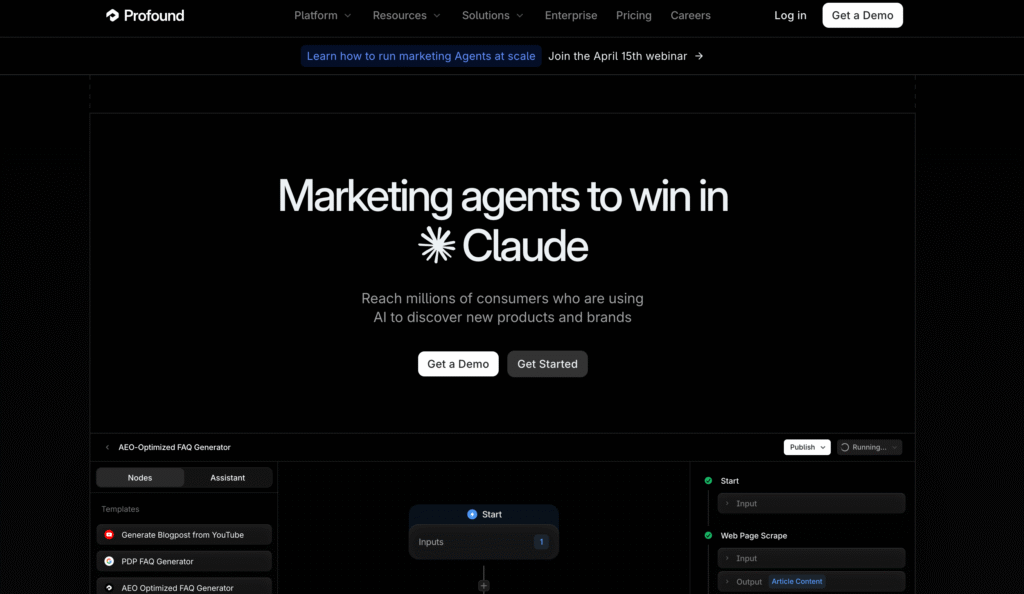
Profound has established itself as one of the most dominant enterprise-grade Generative Engine Optimisation (GEO) and Answer Engine Optimisation (AEO) audit platforms in the world in 2026. As businesses increasingly shift their digital marketing priorities from traditional search engine rankings toward AI-generated answer visibility, Profound has positioned itself at the center of this transformation.
The platform is widely recognized for helping large enterprises monitor, measure, and improve how their brands appear across major generative AI ecosystems such as OpenAI ChatGPT, Google Gemini, Anthropic Claude, Perplexity AI Perplexity, and DeepSeek DeepSeek.
In February 2026, Profound announced a USD 96 million Series C funding round at a USD 1 billion valuation, led by Lightspeed Venture Partners, with participation from Sequoia Capital and Kleiner Perkins. This brought the company’s total funding to more than USD 155 million within just 18 months of operation, highlighting the explosive market demand for enterprise-level GEO intelligence platforms.
This rapid growth reflects a broader industry shift: organizations are no longer optimizing solely for Google rankings—they are now optimizing for AI recommendations, citations, and machine-driven brand trust.
Why Profound Leads the GEO Audit Market in 2026
Profound’s competitive strength lies in its ability to provide real-world, high-fidelity AI visibility intelligence rather than relying on simulated prompt testing.
At the center of the platform is its proprietary “Conversation Explorer,” a system built on a dataset of more than 400 million real-user prompts and conversational queries. This enables enterprises to understand exactly how AI systems interpret, recommend, and position their brands across more than 10 major answer engines.
Unlike conventional SEO tools that primarily analyze SERP rankings and backlinks, Profound evaluates:
• Brand mention frequency in AI-generated responses
• Citation source quality and trust signals
• Competitor recommendation patterns
• Sentiment and narrative framing across answer engines
• Prompt-based visibility shifts over time
• Model drift and reasoning pattern changes
This approach allows enterprises to optimize not only for discoverability, but also for recommendation quality and citation authority.
Profound’s Proprietary AEO Score
One of the platform’s most valuable enterprise features is its proprietary AEO Score (Answer Engine Optimization Score).
This score quantifies:
• AI visibility across platforms
• Brand sentiment in generated answers
• Citation authority strength
• Recommendation frequency versus competitors
• Prompt share of voice
• Long-term narrative consistency
This provides CMOs, SEO leaders, and enterprise marketing teams with a measurable benchmark for AI discoverability performance.
Instead of asking “Do we rank on Google?”
Businesses now ask:
“How often does AI recommend us?”
Profound was built specifically to answer that question.
Enterprise Adoption and Market Validation
Profound has become the default GEO audit platform for enterprises where brand narrative, trust, and recommendation influence directly impact revenue.
The platform is currently used by more than 700 enterprises and supports over 10% of Fortune 500 companies, including:
• Target
• Figma
• Walmart
• U.S. Bank
• MongoDB
• Ramp
These organizations use Profound to manage how AI engines present their products, services, and authority in high-intent customer journeys.
For enterprise brands, this is no longer a marketing experiment—it is revenue infrastructure.
Profound Agents: Autonomous Workers for GEO Execution
In 2026, Profound introduced one of its most important innovations: Profound Agents.
These are autonomous AI workers built to bridge the gap between analytics and execution.
Instead of simply reporting problems, these agents actively help teams:
• Monitor AI model drift
• Detect shifts in answer engine logic
• Identify emerging citation opportunities
• Adjust content strategies automatically
• Improve entity authority signals
• Accelerate content deployment across teams
This transforms GEO from a passive reporting function into an active optimization engine.
Profound describes this as moving from visibility to autonomous execution—a major strategic shift that differentiates it from traditional analytics tools.
This is one of the strongest reasons Profound dominates the enterprise GEO market.
Profound Feature Set Overview
| Feature Category | Technical Specification | Strategic Value |
|---|---|---|
| Engine Coverage | 10+ major AI engines including ChatGPT, Claude, Gemini, Grok, DeepSeek | Cross-platform AI visibility management |
| Prompt Database | 400 Million+ real conversational queries | Real-world accuracy and high-fidelity insights |
| Core Metric | Proprietary AEO Score | Competitive benchmarking and executive reporting |
| Autonomous Layer | Profound Agents | Execution beyond reporting |
| Compliance Standards | SOC 2 Type II, HIPAA, RBAC | Enterprise security and governance |
| Enterprise Adoption | 700+ companies | Proven market validation |
| Fortune 500 Penetration | 10%+ coverage | Large-scale enterprise trust |
| Pricing Model | Tiered ($99 / $399 / Custom Enterprise) | Scalable for both teams and enterprise deployment |
AI Ecosystem Visibility Matrix
| AI Ecosystem | Enterprise Role in GEO (2026) | Optimization Focus Area |
|---|---|---|
| ChatGPT | Dominant conversational AI engine | Prompt visibility and recommendation authority |
| Gemini | Google’s AI search ecosystem | Entity trust and semantic relevance |
| Claude | Enterprise reasoning assistant | Long-form credibility and factual depth |
| Perplexity | Citation-first answer engine | Source visibility and citation dominance |
| DeepSeek | Emerging research-heavy model | Knowledge authority and factual precision |
| Grok | Real-time conversational assistant | Freshness and narrative adaptability |
Why Enterprises Choose Profound Over Traditional SEO Platforms
Traditional SEO platforms were built for search engines.
Profound was built for answer engines.
That distinction defines the future of digital visibility.
Profound solves problems that legacy SEO tools cannot:
• AI-generated answer tracking
• Citation visibility benchmarking
• Recommendation sentiment analysis
• Cross-model prompt intelligence
• Autonomous optimization workflows
• Real-time answer engine monitoring
For enterprises competing in an AI-first discovery environment, these are mission-critical capabilities.
This is why Profound is consistently ranked among the top GEO audit tools globally in 2026.
Final Strategic Position
Profound is not simply another SEO platform.
It represents a new category of enterprise marketing infrastructure designed for the era of AI-mediated discovery.
As consumer behavior shifts from search engines to answer engines, the brands that dominate AI recommendations will increasingly dominate customer acquisition.
Profound provides the system of record for that future.
Its combination of:
• enterprise-grade security
• massive real-user prompt intelligence
• autonomous optimization agents
• cross-platform answer engine monitoring
• measurable AEO benchmarking
makes it one of the strongest and most influential GEO audit platforms in the world in 2026.
For enterprises serious about AI visibility, citation dominance, and recommendation authority, Profound is no longer optional—it is strategic infrastructure.
3. Bluefish AI
Bluefish AI has rapidly emerged as one of the most influential enterprise-grade Generative Engine Optimisation (GEO) platforms in the world in 2026, establishing itself as a leader in what it defines as Agentic Marketing. As traditional SEO continues evolving into AI visibility management, Bluefish has positioned itself as the preferred platform for Fortune 500 enterprises seeking direct control over how their brands appear, perform, and convert across generative AI ecosystems.
Rather than focusing only on rankings, Bluefish addresses a far more valuable enterprise challenge: how brands are interpreted, recommended, cited, and trusted by answer engines such as OpenAI ChatGPT, Google Gemini, Anthropic Claude, Perplexity AI, Google AI Mode, and Amazon Rufus.
In April 2026, Bluefish closed a USD 43 million Series B funding round co-led by Threshold Ventures and NEA, bringing its total funding to USD 68 million in just two years. Additional participation came from major strategic investors including American Express Ventures, Salesforce Ventures, and TIAA Ventures. This financing significantly strengthened Bluefish’s position as one of the fastest-growing enterprise GEO platforms in the global market.
This growth is not simply a funding story—it reflects the rapid emergence of AI visibility as a budgeted marketing infrastructure category for large enterprises.
Why Bluefish AI Leads the Enterprise GEO Market in 2026
Bluefish’s core strength lies in its architectural focus on what it calls the “Agent-to-Agent” economy.
This concept reflects the reality that modern commerce increasingly happens between enterprise brand agents and consumer-facing AI assistants. Instead of customers directly discovering products through search engines, AI assistants now mediate product discovery, recommendations, comparisons, and purchase decisions.
Bluefish helps enterprises optimize for that environment.
Its platform is built specifically to manage:
• AI-generated brand visibility
• Recommendation quality across LLMs
• Prompt-driven purchase influence
• AI-assisted commerce pathways
• Cross-engine brand consistency
• Revenue attribution from AI discovery channels
This makes Bluefish far more than a monitoring tool—it functions as a full enterprise control system for AI-mediated customer acquisition.
Fortune 500 Market Penetration and Enterprise Adoption
Bluefish currently engages approximately 10% of the Fortune 500 across more than 12 verticals, including industries such as:
• Financial services
• Luxury retail
• Pharmaceuticals
• Consumer packaged goods
• Beauty and cosmetics
• Enterprise commerce
• Media and publishing
Its client portfolio includes some of the world’s most valuable brands:
• Adidas
• American Express
• Hearst
• LVMH
• Ulta Beauty
The platform processes millions of AI prompts and responses per day across all major AI providers, giving enterprise teams visibility into billions of monthly active users interacting with answer engines.
This scale gives Bluefish one of the strongest proprietary data advantages in the GEO industry.
The AI Brand Vault: Enterprise Metadata Governance
One of Bluefish’s most distinctive features is its AI Brand Vault.
This system acts as a centralized metadata governance engine designed to ensure consistent brand representation across answer engines.
In a probabilistic AI environment where hallucinations and misinformation can significantly damage brand trust, consistency becomes a competitive asset.
Bluefish reports a 97% cross-engine consistency rate in brand representation through this system.
The AI Brand Vault helps enterprises control:
• Brand messaging consistency
• Product descriptions across AI platforms
• Entity authority signals
• First-party and third-party source alignment
• Citation trust validation
• Brand reputation protection
For regulated industries and high-stakes brands, this is one of the most important strategic differentiators.
Diagnostic Superiority and Source Intelligence
Bluefish has also become known for its strong diagnostic intelligence.
Its platform identifies:
• Source influence patterns
• Domain authority relationships
• Citation hierarchy signals
• Semantic relevance drivers
• Competitor recommendation triggers
• AI-generated trust pathways
Internal testing shows that Bluefish identifies these influence patterns in more than 90% of evaluations, outperforming the category median by 3.4x.
This diagnostic layer allows marketing leaders to understand not just what AI says—but why AI says it.
That distinction separates enterprise GEO platforms from traditional analytics tools.
Collections: Revenue Attribution for the AI Channel
Perhaps one of Bluefish’s most commercially important innovations is its Collections feature.
Collections allows enterprises to directly connect AI visibility performance to revenue outcomes.
This solves one of the largest problems in GEO:
“How does AI visibility translate into revenue?”
Bluefish enables brands to measure:
• AI-driven campaign performance
• Conversion lift from generative visibility
• Recommendation impact on commerce
• Purchase influence across AI journeys
• Incremental revenue from answer engines
• ROI from GEO investments
This transforms GEO from a visibility experiment into a measurable performance channel.
For CMOs and CFOs, this creates the financial justification required for large-scale enterprise adoption.
Bluefish AI Operational Data
| Operational Metric | Value | Strategic Importance |
|---|---|---|
| Series B Funding (April 2026) | USD 43 Million | Growth acceleration and market validation |
| Total Funding | USD 68 Million | Strong investor confidence |
| Fortune 500 Penetration | 10% | Enterprise trust and adoption |
| Industry Coverage | 12+ Vertical Markets | Cross-sector scalability |
| Brand Consistency Rate | 97% | AI reputation protection |
| Diagnostic Accuracy | 90%+ Evaluations | High-fidelity optimization |
| Diagnostic Performance | 3.4x Category Median | Competitive technical superiority |
| Engine Fidelity Variance | Less than 50% of Category Median | High-quality output stability |
AI Ecosystem Coverage Matrix
| AI Ecosystem | Enterprise Role in Global GEO (2026) | Optimization Focus Area |
|---|---|---|
| ChatGPT | Dominant conversational commerce assistant | Recommendation authority and prompt visibility |
| Gemini | Google’s generative search ecosystem | Entity trust and semantic relevance |
| Perplexity | Citation-first answer engine | Source visibility and citation dominance |
| Google AI Mode | AI-powered search assistant | High-intent transactional visibility |
| Amazon Rufus | AI commerce assistant | Product discovery and conversion optimization |
| Claude | Enterprise reasoning engine | Long-form authority and factual trust |
Why Bluefish Wins in Regulated and High-Stakes Industries
Bluefish has become especially dominant in industries where brand errors carry financial or legal consequences.
This includes:
• Financial services
• Healthcare and pharmaceuticals
• Luxury and premium retail
• Enterprise SaaS
• Insurance
• Consumer trust-driven sectors
Its low variance engine performance—less than half the variance of category median platforms—makes it highly reliable for enterprise governance and executive decision-making.
In these sectors, accuracy matters more than experimentation.
Bluefish’s “high-fidelity” output model gives enterprises the confidence required for AI-era brand management.
Why Bluefish Outperforms Traditional SEO Platforms
Traditional SEO platforms were designed for search engines.
Bluefish was designed for answer engines.
That difference defines the next era of digital marketing.
Bluefish solves enterprise challenges that legacy SEO tools cannot:
• AI answer visibility tracking
• Cross-platform recommendation analysis
• Agentic commerce optimization
• Revenue attribution for generative channels
• Enterprise metadata governance
• AI recommendation consistency management
This makes Bluefish one of the most strategically valuable GEO audit tools globally in 2026.
Final Strategic Position
Bluefish AI is not simply a GEO audit platform.
It represents a new category of enterprise marketing infrastructure where AI visibility becomes a controllable, measurable, and revenue-generating asset.
Its combination of:
• Fortune 500 adoption
• enterprise-grade AI visibility measurement
• metadata governance through AI Brand Vault
• revenue attribution via Collections
• cross-engine consistency management
• agent-to-agent commerce architecture
makes it one of the strongest GEO platforms in the world in 2026.
As discovery shifts from search engines to answer engines, the brands that control AI recommendations will increasingly control customer acquisition.
Bluefish gives enterprises the operational system to win that future.
For brands competing in the age of agentic commerce, Bluefish is no longer optional—it is strategic infrastructure.
4. Conductor
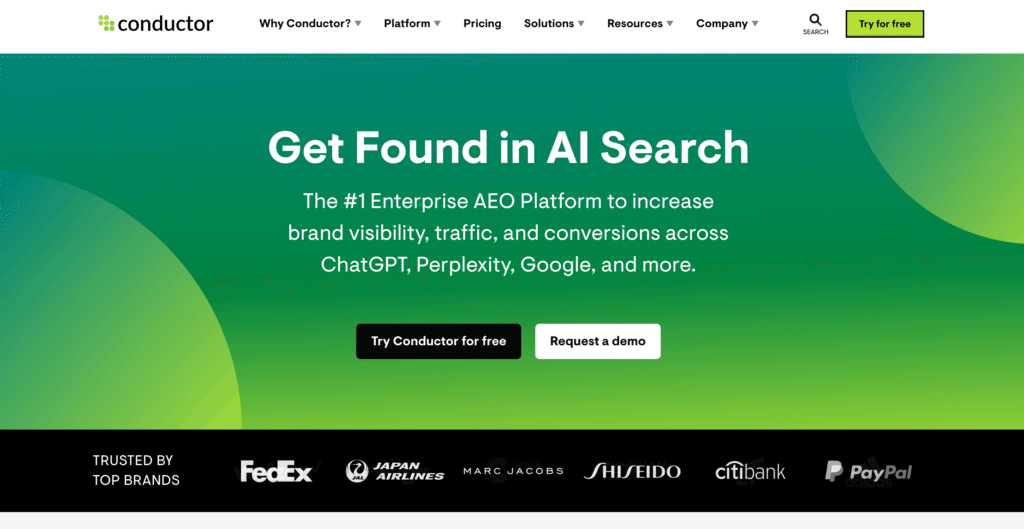
Conductor has successfully transformed itself from a traditional enterprise SEO platform into one of the most important Answer Engine Optimisation (AEO) and Generative Engine Optimisation (GEO) platforms in the world in 2026. Unlike newer GEO-native startups built exclusively for AI visibility, Conductor’s strategic advantage lies in its ability to bridge two critical worlds: legacy search engine optimization and the rapidly expanding ecosystem of AI-driven discovery.
For large enterprises already relying on Conductor for organic search visibility, content intelligence, and technical SEO operations, the platform offers a seamless pathway into AI search optimization without requiring additional software fragmentation or operational complexity.
As answer engines such as OpenAI ChatGPT, Google Gemini, Perplexity AI, and Google AI Overviews continue reshaping how customers discover brands, Conductor has positioned itself as the enterprise platform that connects keyword rankings with answer engine visibility.
This “SEO-to-GEO bridge” strategy has made Conductor one of the most trusted AEO platforms for enterprise marketing teams globally.
Why Conductor Matters in the GEO Market in 2026
Most GEO platforms were born from the rise of generative AI.
Conductor came from enterprise SEO.
That difference is significant.
With more than a decade of proprietary website intelligence, enterprise workflow integrations, and technical SEO infrastructure, Conductor already had the trust of major global brands long before AI visibility became a strategic priority.
Its evolution into AEO and GEO has been built on:
• enterprise SEO intelligence
• proprietary content performance datasets
• technical health monitoring
• AI-powered writing systems
• AI search visibility benchmarking
• structured content optimization for answer engines
This makes Conductor especially attractive for large organizations that want AI search visibility without replacing their entire digital operations stack.
The platform is frequently described as an end-to-end enterprise AEO platform rather than simply an SEO tool. Gartner also positions Conductor as an enterprise AEO platform built for AI and traditional search optimization.
Verified Model Context Protocol (MCP) Integration
One of Conductor’s most important technical innovations in 2026 is its verified Model Context Protocol (MCP) server.
This allows enterprises to securely connect their proprietary website data directly to large language models.
Instead of relying only on dashboards, brands can ask LLMs highly specific strategic questions such as:
• How visible are we in AI-generated answers?
• Which competitors dominate recommendation prompts?
• Where are our entity authority gaps?
• Which content assets influence citations most?
• How does sentiment vary across answer engines?
• What changes improve answer engine recommendability?
This creates a much deeper operational relationship between enterprise data and AI systems.
Rather than simply measuring rankings, brands can directly interrogate their visibility across the answer economy.
This is one of the strongest reasons Conductor remains highly relevant in the GEO era.
Conductor’s Writing Assistant for AI Citation Optimization
Another major strength is Conductor’s AI Writing Assistant.
Unlike generic AI content tools, this system is specifically designed for enterprise-grade content optimization that supports both traditional search and AI citations.
The Writing Assistant helps teams create:
• structured factual summaries
• schema-ready content blocks
• FAQ-rich content architecture
• semantic entity optimization
• authoritative citation-friendly copy
• AI crawler-readable page structures
This is particularly important because AI engines increasingly prioritize content that is:
• factually grounded
• semantically clear
• structurally accessible
• consistently updated
• supported by trusted entities
Conductor’s Writing Assistant is built around these requirements, helping brands create content that performs inside both Google and answer engines.
This directly supports AEO and GEO performance rather than only keyword rankings.
Real-Time Site Monitoring and Technical Health
Generative visibility depends heavily on technical accessibility.
If AI crawlers cannot reliably access, parse, or trust content, citation opportunities decline rapidly.
Conductor solves this with integrated real-time monitoring and technical health alerts.
The platform continuously tracks:
• crawl accessibility
• indexing reliability
• structured data health
• content freshness signals
• page performance issues
• technical blockers for AI discovery
This ensures that AI engines can consistently discover and process high-value enterprise content.
Traditional SEO teams already depend on these capabilities, which makes GEO adoption significantly easier inside existing Conductor workflows.
This operational continuity is a major strategic advantage over standalone GEO startups.
Enterprise Pricing and Procurement Reality
Conductor’s pricing structure reflects its position as a highly customized enterprise platform.
Unlike self-serve GEO tools, Conductor operates through modular enterprise contracts designed around domain scale, feature access, support requirements, and implementation complexity.
According to procurement intelligence from Vendr, typical annual investments range from approximately USD 30,000 to USD 150,000+, depending on organizational scale and deployment scope. Entry contracts often begin around USD 26,800 to USD 45,000, while enterprise deployments for global organizations can exceed USD 500,000 annually. Vendr reports strong pricing variation based on domain volume and enterprise scope.
This usually includes:
• domain coverage
• AI Writing Assistant usage
• technical monitoring
• advanced reporting
• implementation services
• priority support
• dedicated customer success management
For enterprise brands managing multiple regions and multiple domains, this pricing model aligns with broader digital transformation budgets rather than standalone SEO software budgets.
Conductor Tiered Investment (2026)
| Annual Cost Range | Core Capability | Enterprise Use Case |
|---|---|---|
| USD 26,800 – USD 45,000 | Single domain, unlimited keywords | Entry-level AEO and SEO deployment |
| USD 48,000 – USD 85,000 | 2–5 domains, AI Writing Assistant | Mid-market GEO expansion |
| USD 150,000 – USD 500,000+ | 10+ domains, Dedicated CSM | Global enterprise AEO infrastructure |
| USD 20,000 – USD 150,000 | Implementation Services | Training, onboarding, and complex deployment |
Conductor’s 2026 AEO/GEO Benchmark Leadership
Conductor strengthened its authority in 2026 through its AEO/GEO Benchmarks Report, one of the industry’s largest enterprise studies on AI visibility.
The report analyzed:
• 3.3 billion sessions
• 13,770 enterprise domains
• 10 industries
• 22 sub-industries
This benchmark separated traditional organic search performance from AI-driven visibility sources such as:
• AI referrals
• Google AI Overviews
• AI-generated answer citations
• answer engine recommendation presence
The report concluded that AI referrals currently represent only about 1% of traffic, but their influence on customer decision-making is disproportionately high because discovery increasingly begins inside AI-generated answers.
This reinforces Conductor’s strategic message:
“If you are not in the answer, you are not in the market.”
That philosophy defines enterprise GEO strategy in 2026.
AI Ecosystem Visibility Matrix
| AI Ecosystem | Enterprise Role in Global GEO (2026) | Optimization Focus Area |
|---|---|---|
| Google AI Overviews | Search-integrated answer layer | Featured authority and answer inclusion |
| ChatGPT | Conversational discovery engine | Prompt visibility and recommendation authority |
| Gemini | Google’s AI assistant ecosystem | Semantic trust and entity clarity |
| Perplexity | Citation-first answer engine | Source visibility and factual authority |
| Claude | Enterprise reasoning platform | Long-form trust and content precision |
| Internal LLM Systems | Proprietary enterprise assistants | Verified first-party data governance |
Why Enterprises Choose Conductor for GEO
Conductor wins because it reduces friction.
Instead of asking enterprises to buy another standalone GEO platform, it extends an existing SEO system into the answer engine economy.
This solves:
• tool sprawl
• workflow duplication
• reporting fragmentation
• technical disconnects
• cross-team adoption barriers
For organizations already invested in enterprise SEO, Conductor becomes the lowest-friction path to GEO maturity.
This is one of the strongest competitive advantages in the market.
Why Conductor Outperforms Pure GEO Startups
Pure GEO platforms often provide stronger experimental visibility dashboards.
Conductor provides operational integration.
That matters more for enterprise adoption.
Its advantages include:
• enterprise SEO legacy trust
• technical monitoring infrastructure
• workflow continuity
• integrated AI Writing Assistant
• executive procurement familiarity
• scalable multi-domain deployment
This makes Conductor one of the safest and most scalable AEO/GEO investments for large organizations.
Final Strategic Position
Conductor is not simply adapting to GEO.
It is redefining how enterprises transition from SEO to AI visibility management.
Its combination of:
• verified MCP server architecture
• enterprise AI Writing Assistant
• real-time technical monitoring
• large-scale benchmark intelligence
• modular enterprise deployment
• seamless SEO-to-GEO integration
makes it one of the strongest AEO platforms in the world in 2026.
As customer discovery increasingly begins inside AI-generated answers rather than traditional search results, the organizations that control answer visibility will increasingly control market visibility.
Conductor gives enterprises the infrastructure to compete in both worlds.
For brands seeking a practical, scalable, and secure transition from SEO to GEO, Conductor remains one of the most strategic platforms available in 2026.
5. Semrush AI Visibility Toolkit
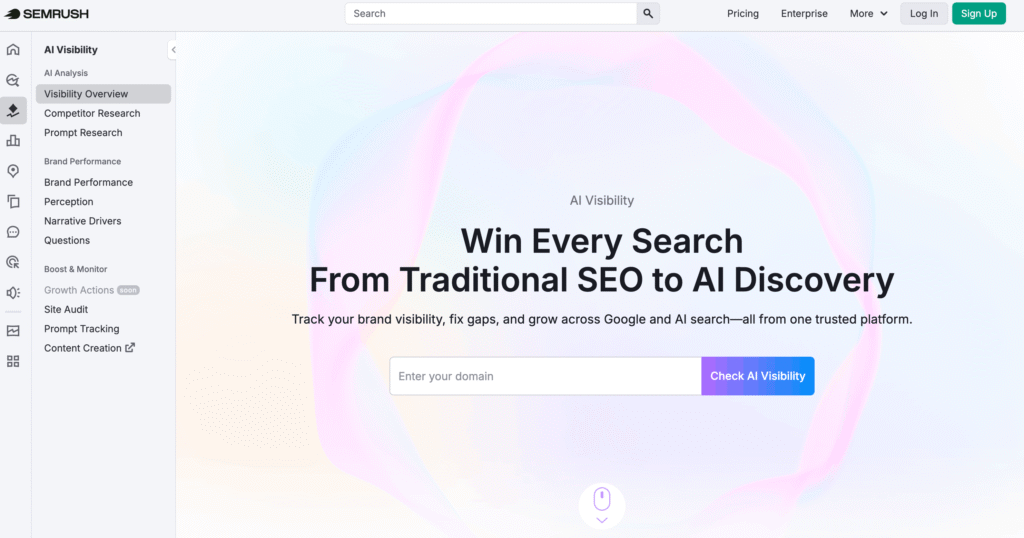
Semrush continues to hold one of the strongest positions in the global Generative Engine Optimisation (GEO) and Answer Engine Optimisation (AEO) software market in 2026. Unlike many GEO-native startups that entered the industry recently, Semrush benefits from an enormous legacy advantage: it already serves millions of marketers worldwide through its established SEO ecosystem.
This existing market dominance has allowed Semrush to become one of the largest revenue leaders in the GEO services category, with industry estimates placing its market share at approximately 18% globally in 2026. Its strength comes from a strategic advantage few competitors can replicate—the seamless integration of traditional SEO infrastructure with AI visibility tracking inside one commercial platform.
For businesses already using Semrush for rankings, backlinks, technical audits, and competitive intelligence, adding GEO capabilities becomes a natural extension rather than a separate procurement decision.
This is why Semrush remains one of the most commercially dominant GEO audit tools in the world.
Why Semrush Leads the Mid-Market GEO Category
Semrush’s success is largely driven by its “Semrush One” ecosystem, a bundled platform that combines traditional SEO workflows with AI visibility intelligence.
Rather than treating GEO as a separate product category, Semrush positioned AI visibility as a natural evolution of SEO.
This strategy reduces friction for marketers because they can manage:
• traditional search rankings
• AI-generated brand mentions
• citation visibility
• AI Overviews performance
• answer engine sentiment
• technical readiness for AI crawlers
inside the same operational environment.
This is particularly valuable for mid-market businesses and growth-stage brands that need enterprise-grade visibility intelligence without enterprise-level software complexity.
Semrush itself positions Semrush One as “the leading platform that unifies SEO authority and AI visibility,” reinforcing this hybrid strategic model.
Semrush One: Bundling SEO and GEO Together
The flagship product driving this growth is Semrush One.
This suite combines:
• full SEO toolkit access
• AI Visibility Toolkit
• ContentShake AI
• Semrush Copilot
• AI search health diagnostics
• AI competitor visibility analysis
• AI prompt tracking
• citation monitoring across answer engines
This bundled structure makes Semrush especially attractive for organizations transitioning from traditional SEO to full GEO maturity.
Instead of replacing legacy systems, Semrush extends them.
This reduces:
• operational friction
• procurement delays
• reporting fragmentation
• training complexity
• team adoption barriers
This strategic simplicity is one of Semrush’s strongest competitive advantages in 2026.
According to Semrush’s official pricing structure, the Semrush One plans are:
• Starter: USD 199/month
• Pro+: USD 299/month
• Advanced: USD 549/month
Annual billing reduces the effective monthly cost significantly.
Standalone AI Visibility Toolkit
For businesses that do not require the full Semrush ecosystem, the AI Visibility Toolkit is also available as a standalone product.
This standalone option is priced at USD 99 per month per domain and focuses specifically on answer engine visibility tracking.
It provides analysis across major AI surfaces including:
• OpenAI ChatGPT
• Google AI Overviews
• Google AI Mode
• Google Gemini
• Perplexity AI
The toolkit includes:
• Brand Performance reporting
• Prompt Research
• Prompt Tracking
• AI competitor analysis
• citation visibility tracking
• AI sentiment benchmarking
• AI Search Checks inside Site Audit
Semrush confirms the standalone AI Visibility Toolkit pricing at USD 99/month, with additional domains also available for USD 99 each.
This pricing model makes Semrush one of the most accessible GEO platforms for small and mid-sized teams.
The Power of the 239 Million Prompt Database
One of the strongest strategic assets inside the Semrush GEO ecosystem is its massive prompt intelligence database.
Semrush leverages hundreds of millions of prompt interactions to help brands identify:
• citation gaps
• missed recommendation opportunities
• competitor mention patterns
• prompt-specific brand visibility weaknesses
• high-intent AI discovery opportunities
This enables marketers to move beyond guesswork and optimize specifically for how users ask AI systems questions.
Instead of only asking:
“What keywords should we rank for?”
Marketers now ask:
“What prompts trigger AI recommendations?”
This shift defines modern GEO strategy.
Semrush’s ability to combine keyword intelligence with prompt intelligence makes it uniquely powerful compared to traditional SEO-only platforms.
ContentShake AI and Semrush Copilot
Semrush also strengthened its GEO leadership through two important AI optimization systems:
• ContentShake AI
• Semrush Copilot
These tools help marketers create content that performs across both search engines and answer engines.
They provide recommendations for:
• structured factual content
• FAQ-rich content architecture
• semantic entity optimization
• citation-friendly summaries
• authority reinforcement
• AI crawler readability improvements
This is important because AI systems increasingly reward:
• factual clarity
• entity consistency
• source authority
• content accessibility
• structured knowledge delivery
Semrush transforms these principles into actionable workflows rather than abstract GEO theory.
This is one reason why it remains so widely adopted.
Site Audits for AI Readiness
Technical readiness remains a major GEO ranking factor.
If AI crawlers cannot access or trust a site, visibility drops quickly.
Semrush addresses this through AI Search Checks inside Site Audit, helping businesses detect:
• crawlability problems
• indexing limitations
• outdated factual content
• schema issues
• technical blockers for AI discovery
• citation loss risks
This bridges traditional technical SEO and answer engine optimization.
Rather than treating GEO as purely content-driven, Semrush reinforces that technical accessibility remains foundational.
This practical approach makes it highly valuable for operational marketing teams.
Semrush One Subscription Ladder
| Monthly Price | Annual Price (Effective Monthly) | Core Capability |
|---|---|---|
| Starter Plan | USD 199 | USD 165.17 |
| Pro+ Plan | USD 299 | USD 248.17 |
| Advanced Plan | USD 549 | USD 455.67 |
| AI Visibility Toolkit (Standalone) | USD 99/domain | N/A |
AI Ecosystem Coverage Matrix
| AI Ecosystem | Enterprise Role in Global GEO (2026) | Optimization Focus Area |
|---|---|---|
| ChatGPT | Dominant conversational discovery engine | Prompt visibility and recommendation authority |
| Google AI Overviews | Search-integrated answer layer | Featured inclusion and entity trust |
| Gemini | Google’s AI assistant ecosystem | Semantic clarity and authority reinforcement |
| Perplexity | Citation-first answer engine | Source visibility and citation dominance |
| Google AI Mode | Transactional answer assistant | Commercial recommendation visibility |
| Semrush Internal AI Layer | Optimization engine | Workflow automation and execution |
Where Semrush Faces Criticism
Despite its market strength, Semrush is not without criticism.
Some users point to a fragmented experience where AI visibility data is sometimes separated from traditional SEO reports rather than fully unified.
This can create friction when teams want one fully integrated executive dashboard.
Common criticisms include:
• split reporting interfaces
• separate AI reporting modules
• limited cross-platform workflow visibility
• extra costs for additional domains and users
This is often where GEO-native platforms such as Profound or Bluefish position themselves more aggressively.
However, for most mid-market teams, Semrush’s affordability and breadth still outweigh these limitations.
Why Mid-Market Teams Choose Semrush
Semrush wins because it offers:
• affordability
• operational familiarity
• strong legacy SEO infrastructure
• scalable AI visibility reporting
• practical technical audit systems
• content optimization workflows
For many organizations, it is the easiest first step into GEO maturity.
Instead of buying an entirely new platform, they can evolve inside an existing one.
This creates strong retention and ecosystem dominance.
Why Semrush Remains a Global GEO Leader
Semrush does not dominate because it is the most specialized GEO platform.
It dominates because it is the most accessible.
Its combination of:
• large market share
• strong pricing flexibility
• existing customer ecosystem
• hybrid SEO + GEO workflows
• prompt intelligence infrastructure
• scalable technical audits
makes it one of the most commercially important GEO platforms globally.
Final Strategic Position
Semrush AI Visibility Toolkit is not trying to replace enterprise GEO specialists like Profound or Bluefish.
Instead, it wins by owning the largest middle ground between SEO and GEO.
For businesses seeking practical, scalable, and cost-efficient entry into AI visibility management, Semrush remains one of the strongest platforms in the world in 2026.
Its strategy is simple but powerful:
Make GEO an extension of SEO.
That is why Semrush continues to define market share leadership in the global GEO services category.
6. AthenaHQ
AthenaHQ has emerged as one of the most specialized and strategically valuable Generative Engine Optimisation (GEO) platforms in the world in 2026, particularly for brands that require deep analytical visibility into how they are represented across AI-generated answers.
Unlike broader enterprise platforms that focus primarily on rankings or citation counts, AthenaHQ concentrates on something far more difficult to measure: narrative perception, answer framing, and zero-click attribution.
As AI search increasingly replaces traditional click-based discovery, understanding how a brand is described by large language models has become just as important as understanding whether it is mentioned at all.
This is where AthenaHQ has built its competitive advantage.
Founded by former Google Search and DeepMind professionals and supported by the Y Combinator ecosystem, AthenaHQ was created specifically to help businesses become the answer AI gives—not just another search result.
The company raised USD 2.2 million in seed funding backed by Y Combinator, FCVC, Red Bike Capital, Amino Capital, and several senior SEO and AI investors. The company is positioned as a fast-growing GEO specialist focused on AI-first brand discovery.
Why AthenaHQ Stands Out in the GEO Market
Most GEO platforms answer a simple question:
“Is your brand visible?”
AthenaHQ goes much deeper and asks:
“How does AI describe your brand?”
This distinction is critical.
Visibility without narrative control can be dangerous.
A brand may be frequently mentioned but framed negatively, inaccurately, or with weak competitive positioning. AthenaHQ focuses on helping enterprises understand and actively shape that narrative.
Its platform specializes in:
• brand perception analysis
• answer tone monitoring
• competitive recommendation framing
• zero-click attribution mapping
• geographic representation analysis
• service-line specific answer performance
This makes AthenaHQ especially valuable for companies operating in competitive, regulated, or trust-sensitive industries.
Founders from Google Search and DeepMind
AthenaHQ’s credibility begins with its founding team.
The company was built by professionals with direct experience inside Google Search and DeepMind, giving the platform strong strategic alignment with how answer engines process authority, trust, and semantic relationships.
Its Y Combinator profile highlights that the founding team includes former product leadership from Google Search’s information acquisition team and experience from DeepMind’s generative media group. This gives AthenaHQ unusually strong product intuition around AI search behavior.
This technical DNA is reflected in how the platform approaches GEO:
not as a content publishing problem, but as a systems-level brand perception problem.
The Narrative Tone Monitor
One of AthenaHQ’s most powerful differentiators is its Narrative Tone Monitor.
This feature tracks how AI engines describe a brand across:
• OpenAI ChatGPT
• Anthropic Claude
• Google Gemini
• Google AI Overviews
• Perplexity AI
Instead of simply counting mentions, the system evaluates:
• tone of recommendation
• trust framing
• authority perception
• comparison positioning
• negative or positive contextual associations
• consistency of brand messaging
For enterprise brands, this is critical because AI-generated recommendations increasingly influence high-intent purchasing decisions before users ever visit a website.
This is the true zero-click economy.
If the recommendation happens inside the answer, the click may never happen—but the purchase decision still does.
AthenaHQ helps organizations measure that invisible influence.
Solving the Zero-Click Attribution Problem
One of the platform’s strongest strategic positions is its focus on solving what marketers now call the “Zero-Click Attribution Problem.”
Traditional analytics rely heavily on clicks.
AI discovery breaks that model.
Customers increasingly ask ChatGPT, Gemini, or Perplexity questions, receive recommendations, and make decisions without ever visiting a website.
This creates a major blind spot for traditional SEO reporting.
AthenaHQ solves this by tracking:
• prompts where the brand performs well
• prompts where competitors dominate
• missing citation opportunities
• regional narrative gaps
• category-specific authority weaknesses
• recommendation frequency without referral traffic
Its own platform describes this as providing a “360-degree view” of how customers discover brands across generative engines, supported by a centralized Action Center for recommendations.
This transforms invisible AI discovery into measurable strategic intelligence.
The Centralized Action Center
AthenaHQ also includes a centralized Action Center that converts diagnostics into operational action.
Rather than forcing teams to manually interpret visibility gaps, the system generates AI-powered recommendations to improve:
• citation coverage
• content structure
• factual authority
• answer engine recommendability
• competitive positioning
• entity trust signals
Its internal copilot, Athena, generates first-draft actions to improve AI engine posture and help brands respond faster to visibility changes.
This significantly reduces operational friction for marketing teams managing GEO across multiple departments.
It turns GEO from analysis into execution.
Enterprise Precision for Geographic and Service-Line Visibility
AthenaHQ is particularly strong in localized and service-line-specific reputation management.
This matters because AI visibility is often not universal.
A brand may perform well nationally but poorly in certain cities, verticals, or service categories.
AthenaHQ helps teams track:
• city-level answer visibility
• regional competitive gaps
• service-specific citation weaknesses
• local brand authority signals
• market-by-market narrative inconsistencies
This precision makes it especially useful for:
• fintech companies
• legal services
• healthcare providers
• enterprise SaaS
• multi-location service brands
• high-trust B2B businesses
This level of segmentation is often missing from broader GEO platforms.
AthenaHQ Platform Profile
| Platform Detail | Value | Strategic Importance |
|---|---|---|
| Founders | Former Google Search & DeepMind professionals | Deep technical credibility |
| Accelerator | Y Combinator | Startup ecosystem validation |
| Total Funding | USD 2.2 Million Seed Round | Early-stage market confidence |
| Monthly Growth Plan | Starts at USD 900/month | Mid-to-high market positioning |
| Core Focus | Narrative Tone + Attribution | Beyond ranking visibility |
| AI Coverage | ChatGPT, Claude, Gemini, Perplexity, Google AI Overviews | Cross-platform insight |
| Core Engine | Narrative Tone Monitor | Brand framing intelligence |
| Key Clients | Ollie, Coupons.com, Checkr, Plaid | Proven market adoption |
Athena reports usage across more than 80–100+ companies including Coupons.com, Checkr, Ollie, and other commercial brands.
Pricing and Mid-to-High Market Positioning
AthenaHQ targets the mid-to-high market rather than low-cost self-serve users.
Its Growth plan begins at approximately USD 900 per month, supported by a credit-based pricing model.
This structure allows usage to scale based on analytical depth and prompt volume rather than fixed reporting limitations.
Some smaller teams consider the pricing structure more complex than flat subscription models, but for enterprise buyers, the model aligns more closely with measurable business outcomes.
Y Combinator also highlights that Athena uses a credit-based model designed to scale with customer success rather than locking users into static plans.
This makes it attractive for performance-driven marketing organizations.
AI Ecosystem Narrative Matrix
| AI Ecosystem | Role in Brand Discovery (2026) | Optimization Focus Area |
|---|---|---|
| ChatGPT | Conversational recommendation engine | Trust framing and prompt visibility |
| Gemini | Google’s semantic assistant | Entity authority and brand precision |
| Claude | Long-form reasoning assistant | Narrative depth and credibility |
| Perplexity | Citation-first answer engine | Source trust and recommendation authority |
| Google AI Overviews | Search-integrated AI layer | Featured narrative visibility |
| Internal Brand Copilot | Executive reporting system | Strategic GEO decision-making |
Why AthenaHQ Wins Against Broader GEO Platforms
Many GEO platforms are strong at reporting volume.
AthenaHQ wins by measuring meaning.
Its advantages include:
• deeper perception analysis
• zero-click attribution intelligence
• brand tone monitoring
• geographic narrative precision
• service-line segmentation
• recommendation framing insights
This makes AthenaHQ especially valuable for organizations where perception matters more than raw traffic.
In industries where trust drives revenue, this distinction is critical.
Final Strategic Position
AthenaHQ is not trying to be the biggest GEO platform.
It is trying to be the most precise.
Its combination of:
• former Google Search and DeepMind expertise
• narrative tone intelligence
• zero-click attribution tracking
• Action Center execution workflows
• localized brand visibility analysis
• enterprise-grade reputation management
makes it one of the most strategically important GEO audit tools in the world in 2026.
As search shifts from clicks to conversations, the brands that control narrative framing will increasingly control market trust.
AthenaHQ gives enterprises the infrastructure to manage that future.
For organizations serious about AI reputation, recommendation quality, and zero-click discovery, AthenaHQ has become one of the most valuable GEO platforms available.
7. Goodie AI
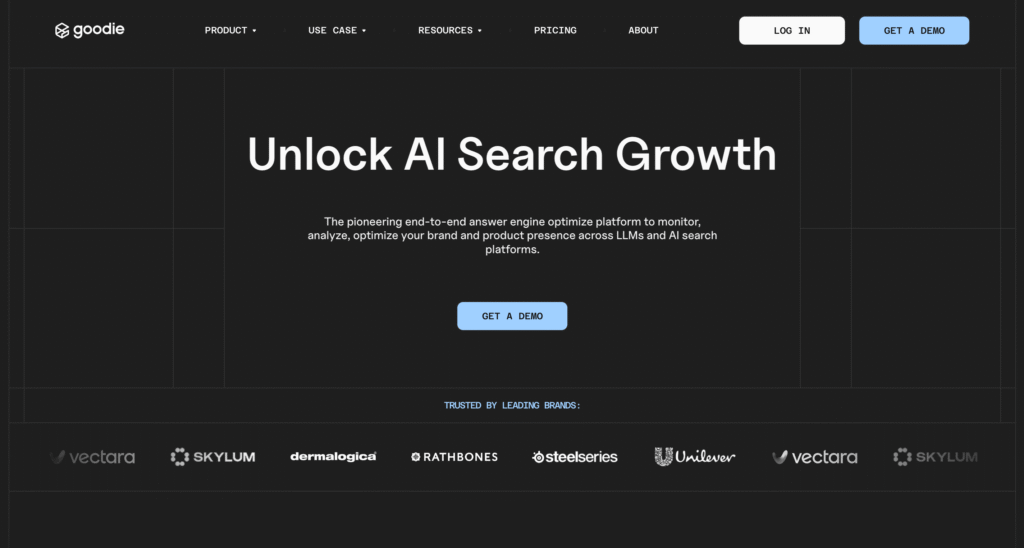
Goodie AI has rapidly positioned itself as one of the most complete and enterprise-ready Generative Engine Optimisation (GEO) platforms in the world in 2026. Unlike traditional SEO platforms that later added AI visibility modules as secondary features, Goodie AI was built from the ground up specifically for the answer engine era.
Its core philosophy is simple but strategically powerful: brands should not merely monitor AI visibility—they should actively control it, optimize it, attribute revenue to it, and protect it from misinformation.
This native GEO-first architecture has made Goodie AI one of the strongest platforms for enterprises operating in high-stakes, multilingual, and compliance-sensitive environments.
As AI discovery increasingly shifts from traditional search results to answer engines such as OpenAI ChatGPT, Anthropic Claude, Google Gemini, Perplexity AI, Amazon Rufus, Grok, DeepSeek, and Meta AI, Goodie AI has become a preferred platform for organizations that require both strategic visibility and operational governance.
The company positions itself as a full end-to-end Answer Engine Optimization (AEO) platform built to monitor, analyze, optimize, and measure brand performance across major LLM ecosystems.
Why Goodie AI Leads as a GEO-Native Platform
Most traditional SEO tools approach GEO by extending old ranking systems into AI surfaces.
Goodie AI approaches GEO differently.
It was designed specifically for AI-generated answers from day one.
This allows the platform to integrate four major enterprise needs inside one system:
• visibility monitoring
• optimization execution
• attribution and revenue tracking
• hallucination and brand safety management
Rather than forcing businesses to combine multiple tools, Goodie creates a closed-loop operating system for AI visibility.
Its platform architecture is built around four stages:
• Research
• Monitor
• Action
• Measure
This enables marketing teams to move from identifying prompt opportunities to proving business outcomes without leaving the platform. Goodie publicly describes this as its “closed loop” AEO platform model.
This is one of the strongest reasons why Goodie is increasingly chosen by enterprise content teams.
Coverage Across 11+ Major AI Models
One of Goodie AI’s strongest competitive advantages is its broad model coverage.
The platform tracks visibility across more than 11 major AI systems, including:
• ChatGPT
• Claude
• Gemini
• Perplexity
• Google AI Overviews
• Grok
• DeepSeek
• Amazon Rufus
• Meta AI
• Microsoft Copilot
• emerging AI answer engines
Goodie highlights its “model-agnostic” architecture as one of its core differentiators, ensuring brands can adapt quickly as new AI discovery channels emerge.
This broad engine coverage is especially valuable for global brands where customer discovery happens across multiple AI ecosystems rather than one dominant search platform.
The AEO Periodic Table of Ranking Factors
One of Goodie AI’s most distinctive strategic assets is its Answer Engine Optimization (AEO) Periodic Table of Ranking Factors.
This framework helps enterprise teams understand exactly what influences visibility inside AI-generated answers.
Rather than treating GEO as guesswork, Goodie organizes optimization into measurable ranking factors across technical, semantic, and authority dimensions.
Key optimization categories include:
• schema markup and knowledge graph structure
• entity clarity and brand consistency
• semantic content precision
• direct answer blocks and FAQ structure
• citation-friendly factual summaries
• authority reinforcement across trusted sources
• technical crawl accessibility for AI agents
• multilingual content clarity
This framework helps content teams operationalize AEO instead of treating it as an abstract theory.
The broader AEO market increasingly recognizes these factors—especially schema, entity clarity, and direct-answer structure—as core ranking signals for AI visibility.
For enterprises, this turns GEO strategy into a repeatable system.
The Optimize Module: Closing Topical Gaps
Goodie AI’s Optimize module is specifically designed to help writers and content strategists close the topical gaps that prevent content from being cited inside generative answers.
This module identifies:
• missing semantic coverage
• weak answer structure
• insufficient citation authority
• schema implementation gaps
• poor prompt alignment
• weak competitive topical ownership
It then provides prioritized recommendations for what should be improved first.
This includes support through:
• AEO Writer
• optimization actions
• prompt prioritization
• structured content improvements
• authority-building recommendations
Goodie’s platform specifically states that it helps brands identify “what to fix, where to optimize, and which actions will move the needle most.”
This bridges the gap between reporting and execution, which is where many legacy platforms fail.
Compliance, Hallucination Management, and Enterprise Governance
Another major reason enterprises choose Goodie AI is its focus on compliance and hallucination control.
In AI search, inaccurate recommendations can damage:
• revenue
• legal exposure
• consumer trust
• investor confidence
• healthcare and financial compliance
Goodie addresses this through:
• brand mention monitoring
• hallucination detection
• sentiment analysis
• citation quality monitoring
• multilingual consistency controls
• enterprise security governance
Its infrastructure supports:
• SOC 2 compliance
• GDPR readiness
• multilingual operations
• enterprise-scale access controls
Goodie explicitly highlights its SOC 2-compliant infrastructure and enterprise scalability for regulated industries such as fintech, healthcare, SaaS, and commerce.
This makes it particularly strong for global enterprise operations.
Analytics and Attribution for Revenue Visibility
Visibility alone is not enough.
Executives want revenue attribution.
Goodie solves this through its Analytics & Attribution module, which connects AI visibility directly to commercial outcomes.
The platform helps brands measure:
• AI-generated conversions
• traffic from AI sources
• citation-driven lead generation
• prompt-to-conversion journeys
• revenue impact from AI visibility
• comparative performance across answer engines
Goodie publishes case studies showing:
• 127% increase in AI conversions for Dermalogica
• 335% increase in traffic from AI sources for NoGood
• 3.2x AI search conversion increase for SteelSeries
• 106% increase in total AI citations for Rathbones
This makes Goodie one of the strongest attribution-focused GEO platforms globally.
Goodie AI Technical Specifications
| Capability Area | Technical Specification | Strategic Importance |
|---|---|---|
| Engine Coverage | 11+ AI models including Claude, Grok, DeepSeek, Rufus, Meta AI | Broad cross-platform visibility |
| Core Features | Monitoring, Optimization, Attribution, Safety | Full closed-loop GEO system |
| Optimization Framework | AEO Periodic Table of Ranking Factors | Structured strategic execution |
| Compliance Layer | SOC 2, GDPR, multilingual support | Enterprise governance and trust |
| AEO Writer | AI-optimized content creation | Citation-ready publishing |
| Attribution System | Revenue and AI conversion measurement | Executive ROI visibility |
| Pricing Level | Starting at USD 495/month | Mid-market to enterprise positioning |
| Ideal User | Enterprise Content Teams | Large-scale operational fit |
Independent platform comparisons also place Goodie’s entry pricing around USD 495–499/month, reinforcing its enterprise-focused positioning.
AI Ecosystem Visibility Matrix
| AI Ecosystem | Enterprise Role in Global GEO (2026) | Optimization Focus Area |
|---|---|---|
| ChatGPT | Dominant conversational discovery engine | Prompt visibility and recommendation authority |
| Claude | Enterprise reasoning engine | Long-form trust and authority depth |
| Gemini | Google’s semantic assistant | Entity precision and factual clarity |
| Perplexity | Citation-first answer engine | Source trust and citation dominance |
| Amazon Rufus | AI shopping assistant | Product visibility and agentic commerce |
| Meta AI | Emerging social AI discovery layer | Cross-platform narrative consistency |
| Grok | Real-time conversational assistant | Freshness and answer adaptability |
Why Goodie Wins for Global Enterprise Teams
Goodie wins because it does not separate visibility from control.
Its advantages include:
• native GEO-first architecture
• compliance-driven governance
• strong attribution systems
• multilingual segmentation
• enterprise hallucination management
• broad AI engine coverage
For global brands, these capabilities are often more valuable than low-cost visibility dashboards.
This is why Goodie has become one of the strongest enterprise GEO platforms in 2026.
Final Strategic Position
Goodie AI is not simply another GEO audit tool.
It is a full enterprise operating system for AI visibility management.
Its combination of:
• GEO-native architecture
• broad model coverage
• AEO Periodic Table framework
• compliance-first governance
• attribution-driven reporting
• optimization workflows built for execution
makes it one of the most comprehensive GEO platforms in the world in 2026.
As AI systems increasingly decide what customers discover, trust, and buy, the brands that control answer visibility will increasingly control market growth.
Goodie AI gives enterprises the infrastructure to own that future.
For organizations serious about narrative authority, compliance protection, and measurable AI-driven growth, Goodie AI has become one of the most strategic GEO platforms available.
8. Writesonic GEO
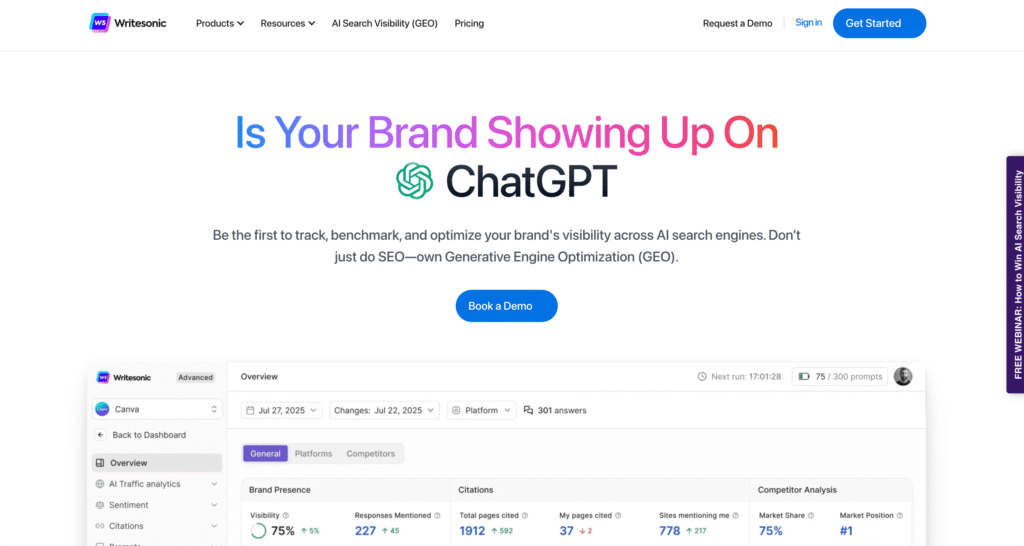
Writesonic has successfully evolved from being widely known as an AI content generation platform into one of the most execution-focused Generative Engine Optimisation (GEO) platforms in the world in 2026. While many platforms specialize in monitoring visibility or reporting AI citations, Writesonic’s competitive advantage lies in transforming those insights into direct, prioritized actions that marketing teams can execute immediately.
Its GEO platform is built around a simple but highly valuable operational question:
“If your brand is missing from AI answers, exactly what should you do next?”
This action-first philosophy has made Writesonic one of the most practical GEO tools for agile marketing teams, growth-stage companies, and mid-market brands that need execution speed rather than enterprise complexity.
Instead of separating visibility tracking from content optimization, Writesonic integrates both into one continuous workflow.
This makes it one of the strongest full-cycle GEO platforms available in 2026.
Why Writesonic Stands Out in the GEO Market
Most GEO platforms stop at diagnosis.
Writesonic focuses on repair.
Its platform is designed to identify:
• why a brand is missing from AI-generated answers
• where competitors are gaining citations
• which external sources influence answer engines
• what content needs to be created or improved
• how technical barriers affect AI crawling
• which actions produce the fastest visibility gains
Writesonic publicly positions itself as a full-stack GEO platform that closes the loop between visibility tracking, citation analysis, content optimization, and execution. Its own GEO product guide describes this as the Track → Diagnose → Fix → Monitor workflow.
This practical execution layer is what separates Writesonic from many analytics-heavy GEO tools.
The Citation Opportunities Page
One of Writesonic’s most powerful GEO features is the Citation Opportunities page.
This feature identifies specific third-party domains and content pages that are already being cited by AI engines like ChatGPT, Perplexity, and Google AI Overviews—but do not currently mention the user’s brand.
This is strategically important because many AI answers are heavily influenced by trusted third-party sources rather than first-party brand websites.
Writesonic helps marketers discover:
• which publishers influence answer engines most
• where competitor mentions exist but theirs do not
• which high-authority pages should include their brand
• what outreach opportunities have the highest citation value
• where external authority gaps are hurting visibility
This transforms GEO from passive monitoring into active authority building.
Instead of asking “Why are we invisible?”
Teams can ask:
“Which source should mention us next?”
This is one of Writesonic’s strongest competitive advantages.
The Action Center: Prioritized Execution Framework
Another major strength is Writesonic’s GEO Action Center.
This feature provides a centralized operational dashboard that prioritizes GEO tasks based on two core variables:
• Impact Level
• Effort Required
The platform organizes recommendations into strategic categories such as:
• Technical issue resolution
• External mention acquisition
• Content visibility boosting
Each recommendation includes clear prioritization signals so teams can focus on the highest-value opportunities first. Writesonic’s own documentation highlights impact scoring, effort visibility, and “Address now” execution workflows for immediate action.
This dramatically improves workflow efficiency.
Instead of reviewing dozens of disconnected reports, marketers receive a direct operational roadmap.
This is especially valuable for lean teams managing multiple campaigns with limited resources.
Automated Outreach Workflow
Writesonic goes further than simply identifying citation opportunities.
It also supports execution through automated outreach workflows.
The platform helps generate personalized outreach drafts for contacting authors, editors, and site owners of high-authority cited content where brand inclusion opportunities exist.
This supports:
• digital PR workflows
• third-party citation acquisition
• authority reinforcement
• competitor displacement strategies
• high-value source relationship building
This is a rare feature in GEO platforms because it directly connects AI visibility analysis to off-page authority building.
In practical terms, Writesonic helps brands move from discovery to citation acquisition faster than most competitors.
AI Bot Traffic Monitoring and GPTBot Tracking
Technical visibility is another major component of GEO performance.
Writesonic includes AI crawler monitoring that tracks when AI bots such as OpenAI’s GPTBot access a user’s website.
This helps businesses understand:
• which pages are being crawled by AI systems
• crawl frequency patterns
• ingestion timing across answer engines
• technical barriers affecting visibility
• robots.txt issues preventing citations
• AI crawler accessibility health
Writesonic specifically highlights AI Bot Traffic Monitoring as part of its GEO product suite, including GPTBot and other AI crawler tracking.
This gives marketing and technical teams direct insight into how AI engines consume their content.
For modern GEO, crawl visibility is often as important as content quality.
Weekly Citation Share Benchmarking
Writesonic also provides weekly benchmarking through metrics such as:
• My Citation Share
• Your Cited Pages
• External Mentions
• Prompt Volume
• Intent Detection
These allow teams to measure:
• comparative share-of-voice across AI answers
• authority footprint of owned content
• third-party advocacy strength
• demand volume for generative queries
• prompt intent classification
This benchmarking layer helps organizations track whether GEO improvements are actually increasing recommendation visibility over time.
This transforms GEO from isolated fixes into measurable performance management.
Writesonic GEO Pricing and Accessibility
One of Writesonic’s strongest advantages is pricing accessibility.
Unlike enterprise GEO platforms that often start at several hundred or thousands of dollars per month, Writesonic offers scalable entry points for both growth teams and larger organizations.
Official pricing confirms:
• GEO functionality is available from Starter plans upward
• Full GEO and AI Search Visibility workflows are available in paid plans
• Entry plans start far below enterprise platforms, while advanced GEO suites commonly scale toward USD 199–249/month+ depending on plan depth and usage
This makes Writesonic especially attractive for:
• growth-stage startups
• performance marketing teams
• agencies
• lean content operations
• mid-market brands transitioning into GEO
The affordability-to-execution ratio is one of its strongest competitive strengths.
Writesonic GEO Performance Metrics
| Utility | Strategic Purpose | Business Value |
|---|---|---|
| My Citation Share | Measures comparative share-of-voice in AI citations | Competitive benchmarking |
| Your Cited Pages | Measures authority footprint of owned content | On-site citation strength |
| External Mentions | Tracks third-party brand advocacy | Off-site authority growth |
| Prompt Volume (ChatGPT) | Estimates search demand for generative queries | Opportunity prioritization |
| Intent Detection | Labels prompts by user intent | Better content alignment |
| AI Bot Traffic Monitoring | Tracks GPTBot and AI crawler visits | Technical visibility control |
| Action Center | Prioritized execution dashboard | Faster optimization workflows |
| Citation Opportunities | Identifies uncited authority sources | High-value citation acquisition |
AI Ecosystem Coverage Matrix
| AI Ecosystem | Role in Global GEO (2026) | Optimization Focus Area |
|---|---|---|
| ChatGPT | Dominant conversational discovery engine | Prompt visibility and recommendation authority |
| Perplexity | Citation-first answer engine | Source trust and citation dominance |
| Google AI Overviews | Search-integrated AI answer layer | Featured answer inclusion |
| Google AI Mode | AI-powered transactional assistant | Commercial recommendation visibility |
| Claude | Long-form reasoning engine | Trust depth and authority framing |
| Gemini | Semantic AI assistant | Entity precision and factual clarity |
Why Writesonic Wins for Agile Marketing Teams
Writesonic wins because it removes operational delay.
Its advantages include:
• actionable prioritization instead of passive reporting
• citation acquisition workflows
• AI bot crawl visibility
• integrated content optimization
• affordable entry pricing
• strong competitive benchmarking
For many marketing teams, speed of execution matters more than enterprise complexity.
Writesonic is designed for that reality.
It helps teams fix visibility problems quickly instead of simply measuring them.
This makes it one of the strongest workflow-driven GEO tools globally.
Final Strategic Position
Writesonic GEO is not simply a reporting platform.
It is an execution engine for AI visibility growth.
Its combination of:
• Citation Opportunities discovery
• Action Center prioritization
• automated outreach workflows
• AI crawler monitoring
• content optimization integration
• weekly citation benchmarking
makes it one of the most practical and action-oriented GEO platforms in the world in 2026.
As answer engines increasingly replace traditional search journeys, the brands that act fastest on visibility gaps will gain the strongest advantage.
Writesonic gives marketing teams the operational speed to win that race.
For businesses that need GEO results—not just GEO dashboards—Writesonic remains one of the most valuable platforms available in 2026.
9. Peec AI
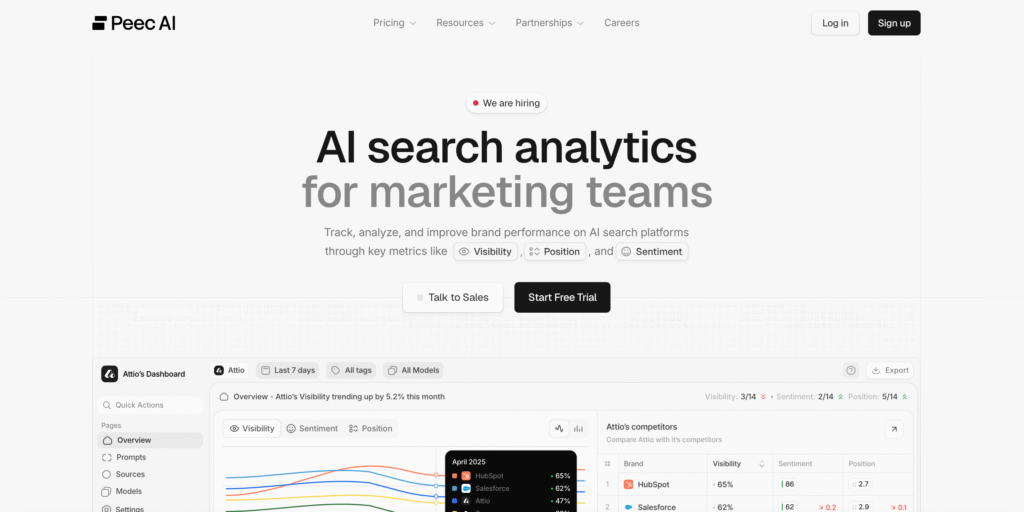
Peec AI has rapidly become one of the fastest-growing and most commercially attractive Generative Engine Optimisation (GEO) platforms in the world in 2026. Unlike enterprise-heavy platforms built primarily for Fortune 500 organizations, Peec AI has successfully positioned itself as the leading mid-market visibility analytics platform—offering deep AI search intelligence without the operational complexity or pricing barriers of traditional enterprise GEO suites.
Headquartered in Berlin, Peec AI has become widely recognized for solving one of the most important modern marketing challenges: understanding exactly how brands appear inside AI-generated answers across multiple answer engines.
As customers increasingly shift discovery behavior from traditional search engines toward platforms such as OpenAI ChatGPT, Google Gemini, Anthropic Claude, and Perplexity AI, brands need more than rankings—they need prompt-level visibility.
This is where Peec AI dominates.
Its combination of real-time prompt analytics, sentiment monitoring, multilingual tracking, and highly accessible pricing has made it one of the strongest GEO audit tools for growth-stage brands, agencies, and mid-market companies globally.
In November 2025, Peec AI raised a USD 21 million Series A round led by Singular, bringing total funding to USD 29 million. Since launching in February 2025, the company has onboarded more than 1,300 brands and agencies and scaled from zero to more than USD 4 million ARR in just 10 months.
This growth made it one of the largest Series A rounds in the AI search category.
Why Peec AI Stands Out in the GEO Market
Most GEO platforms focus on enterprise reporting.
Peec AI focuses on usable precision.
Its platform is designed to help marketing teams answer:
• Which exact prompts trigger our brand mentions?
• Which prompts trigger competitor recommendations instead?
• Which sources shape those AI answers?
• How is our sentiment changing across answer engines?
• Where are our geographic visibility gaps?
• Which actions improve recommendation quality fastest?
Peec AI publicly describes itself as a platform that helps brands “track source influence, visibility, and sentiment across major AI engines in real time.”
This focus on clarity without unnecessary complexity is one of its strongest differentiators.
It is designed for teams that want deep analytics without enterprise overload.
Prompt-Level Visibility: The Core Competitive Advantage
One of Peec AI’s most powerful features is Prompt-Level Visibility.
Rather than simply showing whether a brand is mentioned somewhere in AI search, Peec identifies the exact user prompts that trigger those mentions.
This creates enormous strategic value.
Instead of optimizing broadly for visibility, marketing teams can optimize specifically for:
• high-conversion prompts
• competitor displacement prompts
• transactional recommendation prompts
• branded comparison prompts
• regional service queries
• category-defining commercial prompts
This transforms GEO from broad reporting into highly precise performance optimization.
For example, instead of asking:
“Are we visible in ChatGPT?”
Teams can ask:
“Which prompts drive our best AI recommendations?”
This is far more valuable for revenue generation.
Real-Time Visibility Alerts
Peec AI also excels at real-time visibility monitoring.
The platform sends alerts when visibility changes occur across answer engines, allowing marketing teams to react immediately to:
• competitor gains
• citation losses
• negative sentiment shifts
• seasonal demand changes
• emerging prompt opportunities
• source authority disruptions
This responsiveness is especially important in AI search because visibility can change much faster than traditional organic rankings.
Prompt behavior evolves quickly.
Recommendation patterns shift constantly.
Brands that react fastest often gain the strongest advantage.
Peec’s real-time monitoring system helps teams protect market share before losses become expensive.
Sentiment Tracking Beyond Mention Counts
Many platforms stop at mention counts.
Peec goes further by measuring sentiment.
This matters because visibility alone is not enough.
A brand can be frequently mentioned but framed poorly, inaccurately, or with weak recommendation strength.
Peec tracks:
• positive recommendation framing
• neutral informational mentions
• negative brand associations
• authority strength in comparative answers
• recommendation confidence signals
• source trust relationships
TechCrunch specifically noted that Peec tracks not only visibility and ranking, but also sentiment and the sources shaping those answers.
This provides a much more complete understanding of AI brand reputation.
Global Footprint: 10+ Models and 115+ Languages
Another major advantage is Peec AI’s international scalability.
The platform supports tracking across:
• 10+ major AI models
• 115+ languages
• multiple regional AI ecosystems
• localized prompt monitoring
• multilingual competitive visibility
This makes it particularly valuable for:
• global consumer brands
• multinational SaaS companies
• agencies managing multiple markets
• international ecommerce operations
• multilingual enterprise content teams
Brands such as Chanel, ElevenLabs, Axel Springer, TUI, and Attio already use the platform to manage AI visibility across multiple markets.
This global capability significantly strengthens its enterprise relevance despite its mid-market positioning.
Mid-Market Mass Product Strategy
Peec AI openly positions itself as a “mid-market mass product.”
Unlike platforms built only for massive enterprise contracts, Peec aims to be accessible to a much broader market.
Sifted quoted CEO Marius Meiners stating:
“We want to be the product that everybody can use and not just the JP Morgans and Apples of the world.”
This strategy has helped Peec win strong adoption among:
• agencies
• startup growth teams
• scaleups
• mid-sized SaaS brands
• high-growth ecommerce companies
• modern content marketing teams
This commercial positioning is one of the strongest reasons behind its explosive growth.
Peec AI Pricing Structure
Peec AI’s pricing is highly competitive compared to enterprise GEO platforms.
Its structure allows smaller teams to begin with meaningful prompt visibility while giving larger teams room to scale.
Peec AI Tiers (2026)
| Price (Monthly) | Prompt Capacity | Project Support | Ideal User |
|---|---|---|---|
| Starter Tier | USD 95 (Approx. €89) | 50 prompts | 1 Project |
| Pro Tier | USD 245 | 150 prompts | 2 Projects |
| Advanced Tier | USD 495 | 350 prompts | 5 Projects |
| Enterprise Tier | Custom Pricing | Unlimited | Unlimited |
This pricing structure makes Peec one of the strongest value-for-money GEO platforms available.
Compared to enterprise platforms starting at USD 900–2,000+ monthly, Peec offers significantly faster adoption for leaner teams.
Peec AI Platform Profile
| Platform Detail | Value | Strategic Importance |
|---|---|---|
| Headquarters | Berlin, Germany | European AI search leader |
| Series A Funding | USD 21 Million | Strong investor validation |
| Total Funding | USD 29 Million | Large-category confidence |
| ARR Growth | USD 4M+ in 10 months | Exceptional commercial traction |
| Customer Base | 1,300+ brands and agencies | Strong market adoption |
| Core Focus | Prompt-Level Visibility + Sentiment | Precision GEO optimization |
| Language Support | 115+ languages | Global scalability |
| AI Coverage | 10+ answer engines | Cross-platform visibility |
| Market Position | Mid-market mass product | Accessible enterprise-grade analytics |
AI Ecosystem Visibility Matrix
| AI Ecosystem | Market Role in Global GEO (2026) | Optimization Focus Area |
|---|---|---|
| ChatGPT | Dominant conversational discovery engine | Prompt visibility and recommendation authority |
| Gemini | Google’s semantic assistant | Entity trust and semantic precision |
| Claude | Long-form reasoning assistant | Authority framing and trust depth |
| Perplexity | Citation-first answer engine | Source visibility and citation dominance |
| Grok | Real-time conversational assistant | Freshness and competitive responsiveness |
| DeepSeek | Research-heavy answer engine | Factual precision and knowledge authority |
Why Peec AI Wins Against Enterprise-Heavy Platforms
Peec wins because it balances depth and usability.
Its advantages include:
• affordable pricing
• real-time prompt visibility
• strong sentiment analysis
• multilingual international coverage
• fast onboarding
• low operational complexity
• high-quality competitive benchmarking
It delivers enterprise-grade visibility without enterprise friction.
That is a powerful market position.
Final Strategic Position
Peec AI is not trying to be the most complex GEO platform.
It is trying to be the most usable.
Its combination of:
• prompt-level precision
• real-time visibility alerts
• sentiment intelligence
• multilingual global tracking
• accessible pricing
• rapid operational workflows
makes it one of the strongest GEO audit tools in the world in 2026.
As AI-generated answers increasingly replace traditional search journeys, the brands that understand prompt-level visibility will control future discovery.
Peec AI gives companies the operational clarity to compete in that new environment.
For mid-market brands seeking speed, accuracy, and scalable GEO performance without enterprise complexity, Peec AI has become one of the most valuable platforms available.
10. Ahrefs Brand Radar
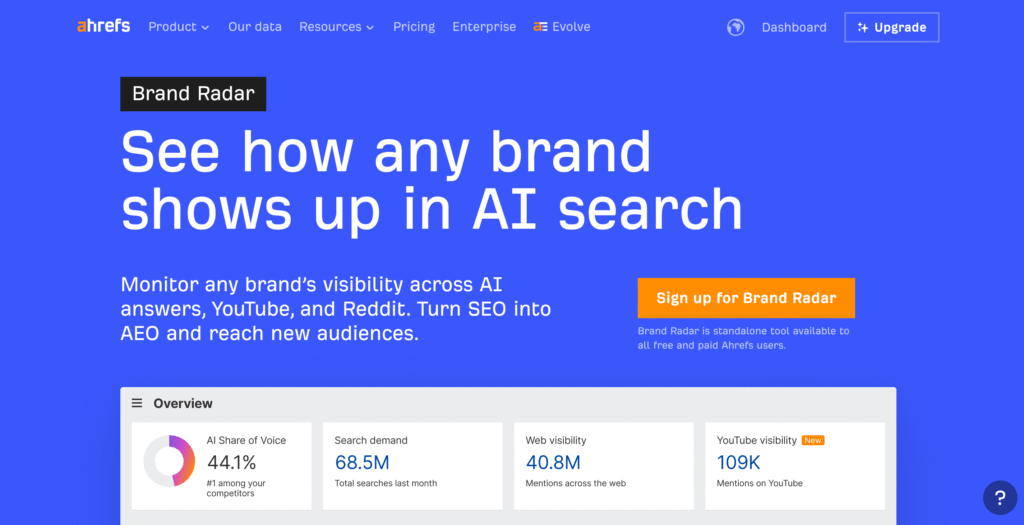
Ahrefs Brand Radar has become one of the most ambitious and data-intensive entries in the Generative Engine Optimisation (GEO) market in 2026. Unlike GEO-native startups that primarily focus on operational workflows or enterprise dashboards, Ahrefs approaches AI visibility from a fundamentally different angle: research infrastructure at massive scale.
Its core strength is not workflow automation—it is data depth.
Built on Ahrefs’ long-established search intelligence ecosystem, Brand Radar functions as a searchable AI visibility database powered by hundreds of millions of real, search-backed prompts rather than synthetic or manually simulated queries. This makes it one of the most trusted platforms for large-scale brand research, directional visibility analysis, and enterprise AI discovery benchmarking.
For brands that want to understand not just whether they appear in AI-generated answers—but how entire categories behave inside answer engines—Ahrefs Brand Radar has become one of the strongest GEO tools in the world.
Ahrefs publicly positions Brand Radar as “the largest AI visibility database,” covering ChatGPT, Google AI Overviews, Google AI Mode, Gemini, Microsoft Copilot, and Perplexity, while also expanding visibility analysis into YouTube, Reddit, and TikTok.
Why Ahrefs Brand Radar Stands Out in the GEO Market
Most GEO tools are designed to monitor a limited number of tracked prompts.
Ahrefs Brand Radar was designed to research the entire answer ecosystem.
This distinction is critical.
Instead of asking:
“Does AI mention our brand?”
Brand Radar helps marketers ask:
• Which brands dominate this category in AI answers?
• Which prompts trigger competitor recommendations?
• Which third-party sources influence citations most?
• Which platforms shape discovery beyond Google?
• Where are the largest authority gaps in the market?
• How does AI connect our brand to specific entities?
This transforms GEO from brand monitoring into market intelligence.
It is one of the few platforms that treats AI discovery as a research problem rather than simply a reporting problem.
The Largest Search-Backed Prompt Database
The foundation of Ahrefs Brand Radar is its massive prompt index.
Unlike many competitors that rely on synthetic prompt simulations, Brand Radar uses real search-backed prompts derived from actual search behavior and People Also Ask patterns.
Ahrefs reports more than 357 million total monthly prompts across major AI systems, including:
• Google AI Overviews: 262M+
• Google AI Mode: 38M+
• ChatGPT: 14M+
• Gemini: 14M+
• Perplexity: 14M+
• Microsoft Copilot: 14M+
Ahrefs explicitly emphasizes that these prompts are derived from real search behavior rather than made-up test queries, making the visibility data far more representative of real audience demand.
This is one of the strongest reasons researchers and enterprise strategists prefer Brand Radar for large-scale analysis.
It provides directional intelligence at category scale.
Prompt Scale and Index Coverage
Ahrefs Brand Radar Prompt Scale
| Prompt Count | AI Discovery Index |
|---|---|
| 262,090,259+ | Google AI Overviews |
| 38,207,570+ | Google AI Mode |
| 14,295,028+ | Perplexity |
| 14,065,589+ | ChatGPT |
| 14,116,023+ | Gemini |
| 14,044,070+ | Microsoft Copilot |
This scale is significantly larger than most GEO competitors and gives Ahrefs one of the strongest proprietary data moats in the market.
Unlinked Mention Tracking and Entity Graphing
One of Brand Radar’s most valuable capabilities is its integration of unlinked mention tracking and entity graphing.
Traditional SEO focused heavily on backlinks.
Modern GEO requires understanding entity relationships.
Brand Radar helps marketers identify:
• where brands are mentioned without direct citations
• how AI models connect brands to topics
• semantic proximity between entities
• topical authority strength
• missing authority relationships
• competitor entity dominance
This helps teams understand how answer engines interpret not just websites—but meaning.
Rather than asking:
“Do we have links?”
Brands now ask:
“How closely does AI associate us with this category?”
That is a much more important GEO question.
This semantic visibility layer makes Ahrefs especially valuable for strategic brand positioning.
Visibility Beyond AI Engines
Another major differentiator is that Brand Radar extends beyond LLM interfaces.
It also tracks discovery signals across:
• YouTube
• TikTok
• Reddit
• web mentions
• branded search demand
• publication visibility
Ahrefs explicitly states that Brand Radar monitors YouTube, Reddit, and video visibility because AI models increasingly use these sources to shape recommendations and citations.
This broader ecosystem view is extremely important.
Modern AI discovery is not limited to ChatGPT.
Many recommendation systems are shaped by:
• Reddit discussions
• YouTube authority signals
• TikTok visibility
• web publication mentions
This gives Ahrefs one of the most complete discovery datasets in the GEO market.
Researchers and Enterprise Adoption
Ahrefs Brand Radar is particularly favored by researchers, consultants, agencies, and enterprise strategy teams because of its scale-first architecture.
It is often used for:
• category intelligence
• market share analysis
• AI citation source discovery
• competitor visibility benchmarking
• new market entry research
• executive GEO strategy planning
Its strong adoption among enterprise organizations is driven by Ahrefs’ broader trust as a mature SEO infrastructure provider.
The platform’s established enterprise credibility makes Brand Radar a natural extension for organizations already invested in Ahrefs.
This is why it is often preferred by research teams over workflow-driven GEO startups.
Premium Pricing Reflecting Data Scale
Ahrefs has positioned Brand Radar as a premium AI visibility add-on.
Its pricing reflects the scale of its infrastructure rather than simple prompt monitoring.
Official Ahrefs materials show custom prompt plans starting from USD 50/month, while broader Brand Radar AI platform indexes are offered as separate purchases. Ahrefs states that AI platform indexes are standalone purchases and do not require a base subscription.
Market pricing analysis commonly places:
• USD 199/month per AI index
• USD 699/month for the 6-platform AI bundle
These tiers are frequently referenced across 2026 pricing reviews and platform comparisons.
This makes Brand Radar one of the more premium GEO products in the market.
However, for organizations prioritizing research depth over workflow simplicity, the investment is often justified.
Ahrefs Brand Radar Investment Structure
| Pricing Layer | Monthly Cost | Strategic Purpose |
|---|---|---|
| Custom Prompt Basic | USD 50 | Track specific prompts daily |
| Custom Prompt Growth | USD 100 | Higher-volume prompt tracking |
| Custom Prompt Scale | USD 250 | Large-scale custom monitoring |
| Single AI Index Add-On | USD 199 | One-platform AI visibility research |
| 6-Platform AI Bundle | USD 699 | Full answer engine ecosystem coverage |
This pricing structure positions Ahrefs as a premium research platform rather than a low-cost operational tool.
AI Ecosystem Visibility Matrix
| AI Ecosystem | Market Role in Global GEO (2026) | Optimization Focus Area |
|---|---|---|
| Google AI Overviews | Search-integrated answer layer | Featured authority and answer inclusion |
| Google AI Mode | Conversational search assistant | Prompt visibility and semantic trust |
| ChatGPT | Dominant conversational discovery engine | Recommendation authority and prompt share |
| Gemini | Google’s semantic AI assistant | Entity trust and contextual precision |
| Perplexity | Citation-first answer engine | Source visibility and citation dominance |
| Microsoft Copilot | Productivity-integrated AI assistant | Enterprise recommendation influence |
| YouTube + Reddit | UGC trust ecosystem | Community authority and social validation |
Why Ahrefs Wins for Researchers
Ahrefs wins because it prioritizes understanding before execution.
Its advantages include:
• massive search-backed prompt infrastructure
• real user behavior data instead of synthetic prompts
• semantic entity analysis
• cross-platform discovery intelligence
• unlinked mention visibility
• enterprise-grade research depth
For strategy teams, these capabilities are often more valuable than automation workflows.
It helps organizations understand markets before they attempt to optimize them.
That is a major strategic advantage.
Final Strategic Position
Ahrefs Brand Radar is not simply another GEO dashboard.
It is one of the largest AI discovery research databases in the world.
Its combination of:
• 357M+ search-backed prompts
• multi-platform AI visibility coverage
• entity graphing intelligence
• unlinked mention tracking
• YouTube, TikTok, and Reddit visibility
• enterprise-scale research depth
makes it one of the strongest GEO platforms globally in 2026.
As answer engines increasingly shape how customers discover products, services, and brands, the organizations with the best visibility intelligence will make the best strategic decisions.
Ahrefs Brand Radar provides that intelligence.
For researchers, enterprise strategists, and brands that want to understand the full answer ecosystem—not just monitor one dashboard—Ahrefs remains one of the most powerful GEO platforms available.
The 2026 Global State of Generative Engine Optimization (GEO): A Comprehensive Audit of the Top 10 Specialized Platforms and the Probabilistic Search Economy
The global search economy in 2026 has undergone its most dramatic transformation since the birth of modern search engines. The era of deterministic indexing—where users typed keywords and clicked ranked blue links—has been rapidly replaced by probabilistic generative synthesis, where answer engines generate complete responses instead of directing users to websites.
This shift represents far more than a technological upgrade. It is a structural redefinition of digital discovery itself.
Today, platforms such as ChatGPT, Google Gemini, Claude, Perplexity, Google AI Overviews, Microsoft Copilot, Grok, and DeepSeek are no longer acting solely as retrieval systems. They have become synthesis engines, combining multiple sources into a single authoritative response. As a result, visibility is no longer measured by rankings alone—it is measured by citation frequency, recommendation quality, semantic authority, and answer inclusion.
This new environment has created an entirely new marketing discipline: Generative Engine Optimization (GEO).
GEO focuses on ensuring that brands are not simply indexed—but cited, trusted, and recommended by generative AI systems.
Industry research shows the global Generative Engine Optimization (GEO) services market is projected to grow from USD 1.48 billion in 2026 to USD 17.02 billion by 2034, representing a CAGR of 45.5%, highlighting how rapidly enterprises are reallocating budgets from traditional SEO toward AI visibility infrastructure.
This is not a temporary trend.
It is the foundation of the next decade of digital marketing.
Why Traditional SEO Is No Longer Enough
For more than twenty years, SEO success meant ranking high on Google.
That model is now breaking.
Google AI Overviews now appear across a significant share of searches, while users increasingly rely on answer-first interfaces instead of browsing multiple pages. Search Engine Land notes that Google AI Overviews now reach more than 2 billion monthly users, while Gartner projected traditional search volume would decline by 25% as users shift toward AI-powered answer engines.
This creates a severe visibility problem for brands.
Even when a company ranks first organically, that visibility may no longer translate into clicks if the answer is already generated on-screen.
Traditional SEO optimizes for:
• ranking position
• backlinks
• keyword volume
• organic sessions
• click-through rate
GEO optimizes for:
• AI-generated citations
• answer engine inclusion
• recommendation frequency
• semantic entity authority
• zero-click influence
• prompt-based brand discoverability
The question has changed from:
“How do we rank?”
to
“How do we become the answer?”
This is the defining challenge of 2026.
The Economics of the Zero-Click Web
The rise of generative AI has accelerated the zero-click economy.
Users increasingly receive:
• product recommendations
• service comparisons
• hiring advice
• legal explanations
• financial guidance
• software evaluations
without ever leaving the answer engine.
This creates both risk and opportunity.
Risk:
Brands invisible inside AI answers lose discovery before the click even begins.
Opportunity:
Brands cited inside AI responses gain significantly higher-intent traffic.
Research across GEO adoption shows AI-referred traffic is dramatically more qualified than standard organic sessions because users arrive with stronger decision intent and higher trust.
This explains why 63% of marketers now prioritize GEO as a strategic growth channel, and why enterprises are investing heavily in answer engine visibility rather than traditional ranking improvements.
The New Search Economy Matrix
| Search Environment | Traditional SEO Economy | GEO Economy (2026) |
|---|---|---|
| User Journey | Click → Browse → Convert | Ask → Answer → Decide |
| Core Asset | Rankings | Citations |
| Visibility Metric | SERP Position | Share of Voice in AI |
| Trust Signal | Backlinks | Entity Authority |
| Content Goal | Rank pages | Become the answer |
| Discovery Model | Deterministic retrieval | Probabilistic synthesis |
| Revenue Attribution | Organic traffic | Zero-click influence |
This table explains why GEO is not simply “SEO with AI.”
It is a fundamentally different operating model.
Global GEO Market Indicators (2026)
| Market Indicator | Value | Strategic Meaning |
|---|---|---|
| Global GEO Market Size | USD 1.48 Billion | Major enterprise software category |
| Projected Market Size (2034) | USD 17.02 Billion | Long-term infrastructure growth |
| Market CAGR (2026–2034) | 45.5% | Exceptional investment acceleration |
| Monthly AI Discovery Users | 1.8 Billion+ | Massive discovery migration |
| Traditional Search Decline Forecast | -25% | Reduced value of legacy SEO-only strategies |
| Share of Marketers Prioritizing GEO | 63% | Widespread strategic adoption |
| Google AI Overview Reach | 2B+ monthly users | Massive zero-click ecosystem |
| ChatGPT Weekly Active Users | 800M+ | Conversational discovery dominance |
Sources confirm both the market size projection and the AI discovery shift, reinforcing GEO as one of the fastest-growing categories in digital marketing.
The Rise of Specialized GEO Platforms
As the answer economy expanded, a new class of software platforms emerged.
These platforms are not traditional SEO tools.
They are purpose-built systems for:
• AI visibility tracking
• prompt-level discovery analysis
• citation attribution
• entity authority measurement
• recommendation sentiment monitoring
• zero-click revenue attribution
• AI crawler accessibility monitoring
The top 10 platforms dominating this category in 2026 include:
• Profound
• Bluefish AI
• Conductor
• Semrush AI Visibility Toolkit
• AthenaHQ
• Goodie AI
• Writesonic GEO
• Peec AI
• Ahrefs Brand Radar
• AppLabx GEO Audit Tool
Each platform addresses a different layer of the answer economy.
Some dominate enterprise infrastructure.
Some specialize in attribution.
Some focus on prompt-level visibility.
Some solve compliance and hallucination control.
Together, they define the operational architecture of GEO in 2026.
The Probabilistic Search Economy
The most important conceptual shift in GEO is understanding that LLMs are non-deterministic.
There is no permanent “position #1” inside ChatGPT.
The same question asked five times may produce five different responses.
This is why GEO is fundamentally probabilistic.
Success is not based on ranking.
It is based on frequency.
How often does AI choose your brand?
How often does it recommend you?
How often are you cited versus competitors?
This creates a new optimization framework:
Traditional SEO asks:
“How do I rank first?”
GEO asks:
“How do I maximize recommendation probability?”
This is a much more complex challenge involving:
• semantic trust
• answer completeness
• entity authority
• third-party validation
• source credibility
• structured data clarity
• prompt relevance
Winning GEO requires understanding how AI reasons—not just how search indexes.
The Enterprise GEO Imperative
For enterprise brands, GEO is no longer optional.
It is infrastructure.
Companies that ignore answer engines risk losing:
• demand generation
• category authority
• brand trust
• purchase influence
• executive visibility
• market leadership
This is why platforms like Profound, Bluefish, Conductor, and AppLabx are increasingly treated as strategic operating systems rather than marketing tools.
The market is moving from:
SEO budgets
to
AI visibility budgets.
This shift will define digital leadership for the next decade.
Final Strategic Reality
The global state of GEO in 2026 reveals one unavoidable truth:
Discovery no longer belongs to the best-ranked page.
It belongs to the most trusted answer.
The businesses that dominate answer engines will increasingly dominate customer acquisition, category authority, and long-term revenue growth.
This is why the GEO market is growing faster than nearly every adjacent MarTech category.
It is not a tactical upgrade.
It is a strategic realignment of how the internet works.
In the probabilistic search economy, brands do not compete for clicks.
They compete for trust inside the machine.
And that is the defining marketing battle of 2026.
The Mechanics of Probabilistic Discovery and the Audit Paradigm
The auditing of generative visibility in 2026 requires a complete departure from the logic of traditional SEO. In the past, search optimization focused primarily on deterministic ranking systems: fixed keyword positions, backlinks, domain authority, and click-through rates. Today, answer engines operate on a fundamentally different architecture—one built on Retrieval-Augmented Generation (RAG), semantic trust, and probabilistic recommendation.
This means brands are no longer competing for page-one rankings.
They are competing for citation eligibility.
In a generative environment, visibility is determined by whether an AI system chooses a brand as a trusted source during response synthesis. This is a far more complex and volatile mechanism than legacy search ranking.
The result is a new audit discipline: Generative Engine Optimization (GEO) auditing.
It is no longer enough to ask:
“Where do we rank?”
The modern question is:
“How often does AI decide to trust us?”
This distinction defines the mechanics of probabilistic discovery.
Retrieval-Augmented Generation (RAG): The Core Discovery Engine
Most modern answer engines—including OpenAI ChatGPT, Google Gemini, Perplexity, Claude, and Microsoft Copilot—rely on Retrieval-Augmented Generation (RAG) systems.
Rather than relying only on pre-trained knowledge, these systems retrieve relevant external information from trusted sources before generating a final answer.
The process typically follows four stages:
• Query interpretation
• Live retrieval of relevant sources
• Source evaluation and prioritization
• Synthesized answer generation with citations
This architecture changes everything.
The AI model is not ranking pages.
It is selecting evidence.
That means content must be optimized not only for discoverability, but also for extractability and trustworthiness.
Academic GEO research confirms that structured content changes citation performance significantly. Studies show that adding citations, quotations, statistics, and highly scannable structures can improve visibility in AI-generated responses by up to 40%.
This is why modern GEO audits prioritize:
• semantic clarity
• structured information architecture
• direct answer blocks
• factual density
• entity consistency
• citation trust signals
rather than simply ranking signals.
The Source Stack: The New Hierarchy of Trust
One of the most important concepts in GEO auditing is the “Source Stack.”
Not all sources are treated equally by answer engines.
AI systems prioritize information through a hierarchy of credibility, where trust and verification determine recommendation probability.
In practical GEO analysis, the Source Stack typically follows three major tiers:
Tier 1: Verified Knowledge Infrastructure
These include:
• Wikidata
• Wikipedia
• government databases
• official standards bodies
• institutional research repositories
• verified regulatory sources
These sources serve as foundational truth anchors for entity validation.
Tier 2: High-Trust Community and User-Generated Content
These include:
• Reddit
• Quora
• LinkedIn
• YouTube
• expert forums
• professional communities
These platforms provide behavioral trust signals and real-world validation.
Reddit, in particular, has become a major citation source because AI systems interpret authentic user discussion as trust reinforcement.
Tier 3: Brand-Owned Assets
These include:
• company websites
• blogs
• help centers
• product pages
• landing pages
• whitepapers
These sources provide first-party authority but often require Tier 1 and Tier 2 validation before AI systems trust them fully.
This explains why many brands with strong websites still fail to appear in AI answers.
Authority is no longer self-declared.
It must be externally validated.
The Source Stack Matrix
| Source Tier | Primary Examples | AI Trust Function |
|---|---|---|
| Tier 1 | Wikidata, Wikipedia, Government Databases | Foundational truth verification |
| Tier 2 | Reddit, Quora, LinkedIn, YouTube | Social proof and trust reinforcement |
| Tier 3 | Brand Website, Blog, Help Center | First-party expertise and conversion assets |
This hierarchy is one of the most important frameworks in GEO auditing.
Citation Decay: The Velocity Problem of AI Visibility
One of the most important discoveries in 2026 is the phenomenon known as Citation Decay.
Traditional SEO rankings can remain stable for months or even years.
AI citations do not.
Research consistently shows that approximately 50% of content cited in AI-generated answers is less than 13 weeks old, creating a highly volatile and recency-biased visibility environment. Multiple GEO studies and industry analyses confirm this 13-week freshness window as one of the strongest operational realities of AI search.
This means:
today’s citation winner
can become next quarter’s invisible source.
Citation decay happens because:
• answer engines prefer freshness
• live retrieval favors recent updates
• search indexes reward recency
• prompt relevance changes quickly
• new sources displace old authority
This creates a new operational rule:
Content is no longer published.
It is continuously maintained.
GEO requires refresh systems, not publishing calendars.
This is why elite GEO teams now run:
• quarterly authority refreshes
• rolling statistic updates
• entity reinforcement cycles
• citation decay monitoring dashboards
• prompt freshness analysis
Without these systems, visibility collapses rapidly.
Citation Decay Operating Model
| Legacy SEO Model | GEO Model (2026) |
|---|---|
| Publish and rank | Publish and continuously refresh |
| Rankings persist for years | Citations decay within weeks |
| Evergreen content remains stable | Freshness is mandatory |
| Traffic measured in clicks | Influence measured in citations |
| Update when traffic drops | Update before citation loss happens |
This is one of the largest strategic differences between SEO and GEO.
Data Density as a Citation Multiplier
Another major discovery in modern GEO is that specificity wins.
AI systems strongly prefer content containing:
• statistics
• research findings
• named entities
• comparative tables
• precise numerical claims
• attributed expert insights
Generic content performs poorly.
Fact-rich content performs exceptionally well.
Research shows that the inclusion of specific data points and verifiable claims can improve visibility within generative responses by as much as 40%, especially when those facts are clearly attributed and structurally extractable.
This is why GEO content increasingly includes:
• benchmark tables
• comparison matrices
• answer-first summaries
• FAQ blocks
• structured fact sections
• source-backed recommendations
The machine rewards precision.
Vague content gets ignored.
Probabilistic Discovery Variables GEO Tools Must Audit
Modern GEO audit tools must evaluate variables that traditional SEO software was never designed to measure.
These include:
• citation frequency
• recommendation probability
• semantic sentiment
• answer framing tone
• source trust hierarchy
• citation freshness
• prompt-level discoverability
• entity authority distance
• AI crawler accessibility
• zero-click attribution influence
This is why specialized GEO platforms like Profound, Bluefish, AthenaHQ, Goodie AI, Peec AI, and AppLabx GEO Audit Tool have emerged.
They audit trust, not just traffic.
They audit recommendation logic, not just rankings.
Core GEO Audit Variables
| Audit Variable | Why It Matters |
|---|---|
| Citation Frequency | Measures actual AI inclusion |
| Prompt-Level Visibility | Identifies exact recommendation triggers |
| Entity Authority | Determines trust and semantic relevance |
| Citation Freshness | Prevents visibility decay |
| Narrative Sentiment | Controls recommendation quality |
| Source Stack Strength | Improves trust probability |
| Technical Accessibility | Enables AI crawler ingestion |
| Zero-Click Attribution | Measures invisible conversion influence |
This is the new performance dashboard of digital visibility.
The Audit Paradigm Shift
The most important strategic change in 2026 is this:
Search is no longer about indexing.
It is about inference.
AI systems do not simply retrieve content.
They infer which sources deserve trust.
That means optimization is no longer about ranking higher.
It is about becoming the most credible answer candidate.
This requires a completely different audit paradigm:
from traffic analysis
to trust analysis
from keyword reports
to recommendation probability modeling
from ranking dashboards
to citation intelligence systems
This is the foundation of GEO.
Final Strategic Reality
The mechanics of probabilistic discovery reveal a simple truth:
Visibility is no longer earned by being found.
It is earned by being chosen.
RAG systems, citation decay, semantic trust, and the Source Stack have fundamentally changed how digital discovery works.
The brands that win in 2026 are not the ones with the most pages.
They are the ones with the strongest probability of recommendation.
This is why GEO audits are becoming strategic infrastructure rather than marketing diagnostics.
In the age of probabilistic search, trust is the ranking factor.
And the audit exists to measure it.
Strategic Industry Analysis: ROI, CPA, and the Economics of AI Discovery
The justification for investing in Generative Engine Optimization (GEO) audit tools in 2026 is no longer theoretical. It is financial, measurable, and increasingly urgent.
As digital advertising costs continue rising across paid search, paid social, and performance acquisition channels, brands are facing a structural profitability problem: the cost of buying attention is increasing faster than the value of that attention.
At the same time, generative AI discovery is creating a new acquisition channel where users arrive with significantly stronger intent, higher trust, and lower blended acquisition costs.
This has fundamentally changed the economics of modern customer acquisition.
The question for marketing leaders is no longer:
“Should we invest in GEO?”
It is now:
“How much revenue are we losing by not doing it?”
The answer lies in ROI, CPA efficiency, and the quality of AI-driven traffic.
The Rising Cost of Traditional Acquisition
Traditional digital acquisition channels are becoming significantly more expensive.
Across industries such as finance, legal services, healthcare, and B2B SaaS, paid search competition has intensified due to:
• market saturation
• aggressive bidding wars
• shrinking organic visibility
• reduced click-through rates from AI Overviews
• declining SEO traffic quality
• increasing dependence on paid channels
Google CPC inflation remains one of the strongest pressure points for modern marketing teams. Industry reporting shows average CPCs increased significantly year-over-year, particularly in high-intent commercial categories where competition for leads is strongest.
This has caused Cost Per Acquisition (CPA) inflation across major verticals.
For example:
• legal lead generation
• insurance acquisition
• wealth management
• fintech customer acquisition
• B2B software demand generation
have all seen sharp increases in paid acquisition costs.
As Google AI Overviews increasingly intercept user clicks before they reach websites, businesses are paying more for fewer qualified visitors.
This creates a dangerous profitability gap.
Traditional Acquisition Cost Matrix
| Channel Type | Core Risk in 2026 | Financial Impact |
|---|---|---|
| Paid Search | Rising CPC inflation | Higher CPA and lower margin |
| Organic SEO | AI Overview click suppression | Reduced traffic volume |
| Paid Social | Audience fatigue and attribution loss | Lower efficiency |
| Affiliate | Increasing commission dependency | Margin compression |
| GEO / AI Discovery | Early adoption investment required | Lower blended CPA over time |
This is why enterprises are reallocating budget toward AI visibility rather than simply increasing ad spend.
The Qualified Traffic Hypothesis
One of the most important discoveries in 2026 is what many marketers now call the Qualified Traffic Hypothesis.
It states:
AI-referred traffic is lower in volume, but dramatically higher in conversion quality.
This is one of the strongest economic arguments for GEO.
Webflow reported that ChatGPT traffic converts at approximately 24%, which is six times higher than traditional Google traffic. As of 2025–2026, AI platforms were also driving around 8–10% of total new signups for the business, despite representing a much smaller traffic share.
Semrush and broader GEO studies also indicate that AI search visitors convert at roughly 4.4x the rate of traditional organic visitors because users arrive pre-qualified after receiving recommendations inside answer engines.
This happens because generative engines function as pre-filtering systems.
Before the click occurs, the user has already received:
• product comparisons
• trust validation
• use-case recommendations
• competitor differentiation
• pricing context
• solution confidence
The visitor arrives “pre-sold.”
This dramatically improves downstream efficiency.
The result is lower blended CPA and stronger revenue quality.
Traffic Quality Comparison Matrix
| Traffic Source | Typical Conversion Rate | Intent Quality | Strategic Value |
|---|---|---|---|
| Traditional Organic Search | 2–4% | Medium | Volume-driven |
| Paid Search | 1–3% | Medium-High | Expensive acquisition |
| Paid Social | 0.5–2% | Low-Medium | Awareness-focused |
| AI-Referred Traffic | 18–27% | Very High | Revenue-efficient |
| ChatGPT Traffic (Webflow Benchmark) | 24% | Extremely High | Premium discovery channel |
This is why leading brands now track AI visibility as a performance channel—not just a branding exercise.
The CPA Compression Effect
When GEO is implemented successfully, brands often report what can be called CPA compression.
This means:
higher lead quality + stronger conversion intent = lower effective acquisition cost
Instead of chasing more traffic, businesses improve profitability by increasing recommendation quality.
This is particularly important in high-CPA industries such as:
• legal services
• wealth management
• B2B SaaS
• healthcare
• insurance
• recruitment and executive hiring
In these sectors, even small CPA reductions create massive profitability gains.
If a law firm reduces acquisition cost from USD 250 per lead to USD 180 per lead while maintaining close rates, the revenue impact becomes substantial.
GEO does not replace paid search.
It reduces dependency on it.
That distinction matters.
Sector-Specific GEO Adoption Patterns
Different industries are adopting GEO at different speeds based on economics, regulation, and customer behavior.
E-commerce
E-commerce leads practical GEO implementation.
Retailers focus on:
• SKU-level entity optimization
• product feed trust signals
• AI shopping assistant visibility
• chatbot-driven conversion attribution
Retail brands have reported up to 520% year-over-year growth in chatbot-driven traffic as AI shopping assistants like Amazon Rufus and ChatGPT increasingly influence purchase decisions.
B2B SaaS
B2B buyers increasingly use answer engines before demo requests.
Studies show approximately 40% of B2B buyers now use AI assistants for solution research before vendor engagement.
Early GEO adopters report that as much as 32% of sales-qualified leads (SQLs) now originate from generative discovery rather than traditional inbound channels.
This makes GEO a major pipeline strategy rather than simply a content initiative.
Healthcare and Finance
These sectors show some of the fastest projected enterprise adoption because trust and compliance matter more than traffic volume.
Healthcare and finance prioritize:
• hallucination management
• citation trust validation
• compliance-safe recommendations
• entity authority protection
Projected GEO adoption rates in regulated sectors are expected to exceed 45% by 2029 due to risk management requirements.
Vertical Economics Matrix
| Vertical | Average CPA (Traditional) | Average Conversion Rate | Typical GEO ROI |
|---|---|---|---|
| Finance | USD 60 – USD 250 | 0.8 – 2.5% | High (CPA Reduction) |
| E-commerce | USD 12 – USD 40 | 1.0 – 4.0% | High (High Volume) |
| B2B SaaS | USD 150 – USD 300 | 1.5 – 3.5% | Moderate-High |
| iGaming | USD 45 – USD 120 | 1.5 – 3.2% | High (Regulation Focus) |
| Legal Services | USD 80 – USD 400+ | 0.5 – 2.0% | Very High |
| Healthcare | USD 70 – USD 250+ | 1.0 – 2.8% | High (Trust + Compliance) |
The ROI Logic of GEO Audit Tools
This is where GEO audit platforms become financially critical.
Tools such as:
• Profound
• Bluefish AI
• AthenaHQ
• Goodie AI
• Peec AI
• AppLabx GEO Audit Tool
allow brands to measure:
• citation share of voice
• answer engine visibility
• competitor recommendation dominance
• AI conversion attribution
• source trust signals
• prompt-level opportunity gaps
Without these systems, GEO becomes guesswork.
With them, it becomes measurable revenue infrastructure.
The ROI is not simply “more traffic.”
The ROI is:
• lower blended CPA
• higher lead qualification
• stronger conversion velocity
• improved pipeline efficiency
• reduced paid channel dependency
This is why enterprises increasingly treat GEO tools as financial infrastructure rather than marketing software.
Final Strategic Reality
The economics of AI discovery reveal a fundamental truth:
Traffic volume is no longer the best growth metric.
Qualified discovery is.
Brands that dominate answer engines do not necessarily get the most visits.
They get the best buyers.
This is why GEO is becoming one of the highest-ROI investments in digital marketing.
It compresses CPA.
It improves lead quality.
It stabilizes demand generation.
It protects long-term profitability.
In 2026, the smartest marketing teams are no longer asking:
“How do we buy more traffic?”
They are asking:
“How do we become the recommendation before the click happens?”
That is the true economics of AI discovery.
And that is why GEO has become one of the most strategically valuable growth channels in the modern search economy.
The Calculation of AEO/GEO Pipeline Value
For modern Chief Marketing Officers in 2026, Generative Engine Optimization (GEO) and Answer Engine Optimization (AEO) can no longer be funded through intuition alone. Budget approval increasingly depends on a single question:
“What measurable pipeline value will AI visibility generate?”
This is where the financial modeling of GEO becomes essential.
Unlike traditional SEO, which often struggles with delayed attribution and long payback periods, GEO offers a more direct revenue forecasting framework because answer engines influence buyer decisions earlier in the research process. Since users arriving from AI-generated recommendations are significantly more qualified, CMOs can model pipeline contribution with far greater confidence.
This has led to the standardization of the AEO/GEO Pipeline Value Formula in 2026.
It gives executive teams a structured way to forecast how citation visibility converts into sales-qualified pipeline and long-term revenue.
The Standard AEO/GEO Pipeline Value Formula
Pipeline Value=(Total Query Volume×AI Prevalence Rate)×Citation Rate×CTR×SQL Conversion Rate×LTV
This formula allows businesses to estimate the commercial impact of appearing inside AI-generated answers rather than relying only on organic traffic assumptions.
Each variable reflects a key stage in the AI discovery funnel.
Breaking Down the Formula
Total Query Volume
This represents the total number of relevant high-intent searches occurring across the target market.
These include:
• product comparison prompts
• solution research questions
• pricing and vendor evaluation prompts
• transactional discovery queries
• category definition searches
For B2B SaaS, this often includes:
• “best CRM for enterprise sales teams”
• “top payroll software for remote teams”
• “best applicant tracking system for startups”
This is the total addressable discovery layer.
AI Prevalence Rate
This measures how often users rely on AI systems rather than traditional search engines during research.
Examples include:
• ChatGPT
• Gemini
• Perplexity
• Claude
• Google AI Overviews
• Microsoft Copilot
Recent 2026 studies show ChatGPT reached 800 million weekly active users, while Google AI Overviews reach more than 2 billion monthly users. AI referral traffic also converts at approximately 4.4x the rate of traditional organic traffic.
This percentage determines how much of the total query market is now influenced by answer engines.
Citation Rate
This is one of the most important GEO metrics.
It measures how often the brand is cited, recommended, or mentioned when relevant prompts are asked.
Discovered Labs reports that conservative AEO projections often begin at 8–15% citation rate by week 3–4, grow to 22–35% by month 2, and can reach 40–50% by month 3–4 for well-executed programs.
This is the core visibility multiplier.
CTR (Click-Through Rate or Read-to-Action Rate)
Even in zero-click environments, many users still continue toward:
• demo requests
• direct website visits
• branded searches
• sales conversations
• purchase journeys
CTR reflects how often AI visibility converts into action.
Because users are pre-qualified by AI recommendations, this CTR is often stronger than traditional organic traffic.
SQL Conversion Rate
This measures how many AI-influenced visitors become Sales Qualified Leads (SQLs).
This is where AEO/GEO becomes financially powerful.
Instead of measuring visits, businesses measure pipeline.
This aligns GEO directly with revenue operations.
LTV (Customer Lifetime Value)
This represents the long-term commercial value of each converted customer.
For B2B SaaS, this is often substantial because:
• retention periods are longer
• expansion revenue exists
• enterprise deal sizes are larger
• account growth compounds over time
This final multiplier turns visibility into board-level revenue forecasting.
Pipeline Value Calculation Framework
| Variable | Meaning | Strategic Importance |
|---|---|---|
| Total Query Volume | Monthly high-intent discovery demand | Defines total opportunity size |
| AI Prevalence Rate | % of buyers using AI discovery | Measures answer engine dependency |
| Citation Rate | % of prompts where brand is recommended | Core GEO visibility benchmark |
| CTR | % of recommendations creating action | Measures AI-driven engagement |
| SQL Conversion Rate | % of visitors becoming qualified leads | Connects visibility to pipeline |
| LTV | Revenue value per customer | Converts SQLs into forecasted revenue |
Moderate B2B SaaS Scenario Example
A mid-market B2B SaaS company may use the following assumptions:
• Total Query Volume: 120,000 monthly relevant queries
• AI Prevalence Rate: 20%
• Citation Rate by Month 3: 30%
• CTR: 1.5%
• SQL Conversion Rate: 18%
• LTV: USD 18,000
Discovered Labs provides a similar example using 120,000 monthly queries, 20% AI usage, and a 35% projected month-3 citation rate as a conservative B2B SaaS planning model.
Applying the formula:
120,000 × 20% = 24,000 AI-influenced opportunities
24,000 × 30% = 7,200 brand citations
7,200 × 1.5% = 108 engaged prospects
108 × 18% = 19.44 SQLs
19.44 × USD 18,000 = USD 349,920 projected pipeline value
This creates a very strong financial case for GEO investment.
ROI and Payback Period
In many moderate execution scenarios, businesses project:
• 30% citation rate by Month 3
• 415% ROI
• 3-month payback period
This compares extremely favorably against traditional SEO.
Traditional SEO often requires:
• 9–12+ months for authority compounding
• significant backlink dependency
• slower attribution visibility
• delayed revenue realization
AEO/GEO compresses this timeline because recommendation authority can generate qualified leads before rankings fully mature.
Discovered Labs also documents a B2B SaaS case where citation rates increased from 8% to 24% in 90 days, producing 288% ROI and measurable closed revenue, reinforcing the financial viability of GEO programs.
ROI Comparison Matrix
| Channel | Typical Payback Period | ROI Visibility | Revenue Attribution |
|---|---|---|---|
| Traditional SEO | 9–12+ months | Slow | Often delayed |
| Paid Search | Immediate but expensive | High cost dependency | Clear but costly |
| Paid Social | Fast but volatile | Attribution difficult | Moderate |
| GEO / AEO | 2–4 months | High | Strong SQL linkage |
| AI Referral Programs | 1–3 months | Very High | Highly qualified pipeline |
Why CFOs Approve GEO Faster
CFOs do not fund rankings.
They fund predictable pipeline.
This formula helps CMOs shift the conversation from:
“We need more visibility”
to
“This visibility creates USD 350,000 in projected pipeline with a 3-month payback.”
That changes budget conversations immediately.
It reframes GEO as:
• revenue infrastructure
• CPA compression strategy
• SQL generation system
• pipeline acceleration engine
rather than a content initiative.
This is why the strongest GEO programs are increasingly funded through revenue teams—not just marketing teams.
The Strategic Advantage Over Traditional SEO
Traditional SEO asks:
“How much traffic can we generate?”
AEO/GEO asks:
“How much pipeline can recommendation visibility create?”
That is a better executive question.
Because AI users are pre-qualified before the click, the value per visitor is often dramatically higher.
This makes AEO/GEO financially stronger even when traffic volume is smaller.
Quality replaces quantity.
This is the defining economics of the answer economy.
Final Strategic Reality
The AEO/GEO Pipeline Value Formula is not simply a forecasting tool.
It is the financial language of modern search strategy.
It allows enterprises to:
• justify GEO investment
• defend budget allocation
• model pipeline impact
• compare against paid acquisition
• forecast payback periods
• align marketing with revenue operations
In 2026, the most valuable marketing programs are not the ones generating the most traffic.
They are the ones generating the most qualified pipeline.
GEO wins because it turns recommendation visibility into measurable revenue.
And once CMOs can prove that math, budget approval becomes much easier.
Technical Governance and Hallucination Management
As generative search matures in 2026, AI visibility is no longer only a growth opportunity—it has become a governance issue and, in many industries, a material business risk.
The risk is no longer simply poor rankings.
The risk is AI invisibility, inaccurate representation, hallucinated claims, compliance failures, and uncontrolled narrative drift across answer engines.
When platforms like OpenAI ChatGPT, Google Gemini, Claude, Perplexity, and Microsoft Copilot become the first touchpoint for customer discovery, the way these systems describe a brand directly influences:
• revenue
• trust
• legal exposure
• investor confidence
• compliance posture
• customer acquisition costs
This means a single incorrect AI-generated answer can create operational consequences far beyond marketing.
This is why technical governance and hallucination management have become core pillars of enterprise GEO strategy.
The Rise of AI Invisibility as a Business Risk
Traditional SEO failure meant lost traffic.
Generative search failure means lost trust before discovery even begins.
This phenomenon is increasingly referred to as AI Invisibility:
when a brand is either absent from AI-generated answers or represented inaccurately by answer engines.
This can manifest as:
• missing brand recommendations
• outdated company descriptions
• incorrect pricing information
• false competitive comparisons
• compliance-sensitive misinformation
• negative narrative framing
• fabricated product claims
• hallucinated operational risks
In regulated sectors such as finance, healthcare, legal services, and enterprise SaaS, these errors can become financially significant.
A single hallucinated compliance issue or inaccurate recommendation can affect conversion rates, procurement decisions, or even legal exposure.
This is why GEO has become part of enterprise risk management—not just digital marketing.
Hallucination Management: The New Brand Safety Layer
One of the most important capabilities in modern GEO platforms is Hallucination Management.
This refers to the detection, monitoring, and correction of inaccurate AI-generated descriptions of a brand.
Platforms such as Goodie AI and Profound have become leaders in this category by introducing features specifically designed to detect:
• narrative misalignment
• negative drift
• citation inconsistency
• sentiment deterioration
• factual hallucinations
• competitive displacement inside AI answers
Instead of only tracking mentions, these systems monitor how answer engines are describing a brand over time.
This matters because AI systems are probabilistic.
The same prompt asked repeatedly may produce different answers.
Without monitoring, incorrect narratives can compound silently.
This creates a governance problem.
Narrative Drift and Negative Drift
One of the most dangerous operational patterns is negative drift.
This occurs when an AI engine gradually begins to describe a brand with:
• weaker trust framing
• negative comparative positioning
• inaccurate product associations
• reduced authority signals
• compliance-sensitive misinformation
For example:
A fintech platform may be described as “high risk” without regulatory basis.
A healthcare provider may be framed with outdated treatment claims.
A SaaS platform may be incorrectly associated with security weaknesses.
These narrative shifts directly impact:
• lead quality
• enterprise procurement decisions
• investor due diligence
• customer confidence
• conversion velocity
This is why advanced GEO platforms now include alert systems for narrative drift.
Goodie AI and Profound specifically position hallucination detection and negative drift monitoring as part of enterprise answer engine optimization workflows, helping brands respond before misinformation scales.
Hallucination Management Matrix
| Governance Risk | Business Impact | GEO Response Layer |
|---|---|---|
| AI Invisibility | Lost discovery and reduced pipeline | Citation monitoring |
| Hallucinated Claims | Legal and trust exposure | Narrative correction workflows |
| Negative Drift | Reduced recommendation quality | Sentiment alerts |
| Entity Confusion | Brand authority dilution | Entity governance |
| Outdated Information | Revenue leakage and lost trust | Freshness monitoring |
| Compliance Misrepresentation | Regulatory and contractual risk | Governance escalation |
This is no longer optional monitoring.
It is enterprise reputation infrastructure.
SOC 2 Compliance and Enterprise Data Governance
As GEO tools increasingly handle sensitive operational intelligence, enterprise procurement now demands strong compliance frameworks.
SOC 2 compliance has become a baseline requirement for enterprise-grade GEO platforms.
This is particularly important because these systems often process:
• prompt-level customer intent
• competitive intelligence
• proprietary content analysis
• internal performance attribution
• strategic marketing decisions
• regulated customer-facing outputs
Without strong governance, the tool itself becomes a risk.
This is why platforms such as Profound, Goodie AI, Bluefish AI, and Conductor emphasize:
• SOC 2 Type II compliance
• RBAC access control
• audit logging
• enterprise privacy controls
• secure API governance
• permissioned data layers
These are no longer “nice-to-have” features.
They are procurement requirements.
The EU AI Act and Regulatory Pressure
The rise of governance requirements has accelerated significantly due to the EU AI Act.
The European Union officially positions the AI Act as the first comprehensive legal framework for AI, using a risk-based model for providers and deployers of AI systems. It focuses on safety, transparency, and trustworthy AI across the EU.
For enterprises using generative AI systems, this creates direct obligations around:
• transparency
• documentation
• risk assessments
• monitoring obligations
• accountability for outputs
• provider and deployer responsibilities
General-purpose AI obligations became enforceable from August 2, 2025, while high-risk systems move into major enforcement phases by August 2, 2026.
This means organizations cannot treat hallucination risk as a theoretical issue.
It is now a compliance issue.
Non-compliance can trigger significant penalties.
Some analyses highlight that serious violations under the EU AI Act can reach up to 7% of annual global turnover or €35 million, whichever is higher.
For enterprise buyers, this changes how GEO tools are evaluated.
Governance becomes a purchasing requirement.
The Sovereign Data Layer Strategy
One of the most important enterprise responses in 2026 is the rise of Sovereign Data Layers.
These are first-party infrastructure systems designed to ensure that the signals reaching AI crawlers and Retrieval-Augmented Generation (RAG) systems are:
• accurate
• verified
• current
• permission-controlled
• compliance-safe
• brand-governed
Rather than relying entirely on public web interpretation, enterprises are building internal control layers for AI visibility.
These often include:
• verified schema markup systems
• controlled entity databases
• first-party knowledge repositories
• approved FAQ infrastructures
• structured content governance
• regulated source publishing pipelines
This ensures the brand’s truth layer is not outsourced to third-party randomness.
It creates controlled answer eligibility.
This is especially critical for:
• healthcare
• finance
• legal services
• insurance
• enterprise software
• government contractors
In these industries, uncontrolled AI interpretation is unacceptable.
Sovereign Data Layer Framework
| Governance Layer | Operational Purpose |
|---|---|
| Schema Governance | Controls machine-readable truth |
| Entity Database | Maintains brand consistency |
| Approved FAQ Layer | Standardizes answer surfaces |
| Knowledge Repository | Supports RAG retrieval reliability |
| Source Validation System | Prevents citation contamination |
| Compliance Review Layer | Ensures regulatory safety |
This is the infrastructure layer of modern GEO.
Why Governance Determines GEO Winners
The strongest GEO platforms in 2026 are not simply the best visibility tools.
They are the safest operational systems.
Enterprises increasingly prioritize tools that offer:
• hallucination detection
• narrative drift alerts
• compliance documentation
• secure data architecture
• audit-ready reporting
• sovereign governance workflows
This is why Goodie AI and Profound lead strongly in high-regulation enterprise markets.
Visibility without governance creates risk.
Visibility with governance creates trust.
That is the difference.
Final Strategic Reality
The future of GEO is not just discoverability.
It is controllability.
Brands must ensure that AI systems not only mention them—but describe them accurately, safely, and competitively.
This is the true role of technical governance.
In 2026, AI hallucinations are not just product flaws.
They are board-level business risks.
The companies that win will be the ones that control:
• their narrative
• their data layer
• their entity authority
• their compliance posture
• their answer engine trust signals
Because in the answer economy, reputation is no longer what brands say about themselves.
It is what the machine says first.
Conclusion
The rise of Generative Engine Optimization (GEO) marks one of the most important shifts in the history of digital marketing. What began as a gradual evolution from traditional search engine optimization has now become a full structural transformation of how users discover brands, products, services, and expertise online.
In 2026, businesses are no longer competing only for rankings on Google.
They are competing for recommendation, trust, and citation inside AI-generated answers.
Platforms such as ChatGPT, Google Gemini, Claude, Perplexity, Microsoft Copilot, Google AI Overviews, Grok, and DeepSeek have fundamentally changed the discovery journey. Instead of users clicking through ten blue links, they now receive synthesized answers that shape decisions before a website visit ever happens.
This has created the new commercial battleground:
Answer visibility.
The organizations that control answer visibility increasingly control customer acquisition.
This is precisely why the market for GEO services and GEO audit tools has accelerated so rapidly. Industry estimates show the global GEO services market is projected to grow from USD 1.48 billion in 2026 to USD 17.02 billion by 2034, with a CAGR of 45.5%, confirming that AI visibility is becoming a major enterprise infrastructure category rather than a niche marketing trend.
This growth is not driven by hype.
It is driven by economics.
Traditional SEO alone is no longer enough because visibility without inclusion inside AI-generated answers is incomplete visibility. Even strong rankings can fail to generate meaningful traffic when answer engines satisfy intent before the click happens.
At the same time, AI-referred traffic has proven to be significantly more valuable.
Brands are seeing stronger lead quality, better conversion intent, lower blended CPA, and faster pipeline acceleration from AI-generated discovery channels. This is why CMOs, revenue leaders, and enterprise buyers are increasingly moving budget from pure ranking strategies toward citation visibility and answer engine optimization.
This is where GEO audit tools become mission-critical.
They provide the operational intelligence required to answer the most important strategic questions in 2026:
Why does ChatGPT recommend competitors instead of us?
Why are we visible in Perplexity but missing in Gemini?
Which third-party sources shape AI recommendations?
How often does our brand appear across major answer engines?
Where are citation gaps damaging our authority?
How do we protect our brand from AI hallucinations and narrative drift?
Traditional SEO platforms were not built to answer these questions.
Modern GEO platforms were.
The Top 10 GEO Audit Tools highlighted in this analysis—Profound, Bluefish AI, Conductor, Semrush AI Visibility Toolkit, AthenaHQ, Goodie AI, Writesonic GEO, Peec AI, Ahrefs Brand Radar, and AppLabx GEO Audit Tool—represent the new infrastructure layer of digital visibility.
Each platform solves a different part of the answer economy:
Profound dominates enterprise answer engine monitoring and autonomous optimization.
Bluefish AI leads in agentic commerce and Fortune 500 brand governance.
Conductor bridges traditional SEO and enterprise GEO operations.
Semrush offers the strongest mid-market ecosystem integration.
AthenaHQ specializes in zero-click attribution and narrative perception.
Goodie AI provides full compliance, attribution, and hallucination management.
Writesonic GEO focuses on execution workflows and citation acquisition.
Peec AI delivers prompt-level visibility for high-growth brands.
Ahrefs Brand Radar provides the deepest AI discovery research database.
AppLabx GEO Audit Tool stands out as one of the strongest practical GEO execution platforms for businesses seeking measurable commercial outcomes.
The reality is simple:
There is no single “best” GEO tool for every business.
The right platform depends on:
company size
industry risk profile
compliance requirements
international expansion
content velocity
competitive intensity
revenue attribution needs
Enterprise healthcare and finance companies may prioritize hallucination management and sovereign data layers.
E-commerce brands may focus on AI shopping assistant visibility and SKU-level entity governance.
B2B SaaS companies may prioritize prompt-level visibility and SQL pipeline attribution.
Agencies may prefer fast execution tools with strong workflow automation.
The best GEO investment is the one aligned with how revenue is created.
This is the most important strategic principle.
Another major lesson from 2026 is that GEO is not replacing SEO.
It is expanding it.
Strong SEO fundamentals still matter:
technical accessibility
content quality
crawlability
authority
schema markup
structured data
These remain foundational because answer engines still rely heavily on Retrieval-Augmented Generation (RAG), live retrieval, and source trust evaluation.
However, GEO introduces a new layer:
probabilistic recommendation.
Success is no longer based on permanent ranking positions.
It is based on frequency of recommendation.
How often does AI choose your brand?
How often does it trust your content?
How often are you cited instead of your competitors?
This is the true measurement framework of the answer economy.
That is why GEO is not just another SEO trend.
It is a new operational model.
It is also why technical governance matters more than ever.
AI hallucinations, narrative drift, incorrect citations, and compliance-sensitive misinformation have become board-level risks.
The brands that win in 2026 will not simply be the most visible.
They will be the most governable.
They will control:
their entity authority
their first-party knowledge layers
their structured data systems
their answer engine trust signals
their citation freshness
their narrative consistency
their compliance posture
This is the future of brand management.
The future of search belongs to businesses that can control not only what users see—but what AI says first.
That is the defining challenge of modern marketing.
For forward-looking companies, the question is no longer whether GEO should be part of the strategy.
The question is how fast they can build the infrastructure before competitors dominate the answer layer.
Because in the age of probabilistic search, rankings are temporary, but recommendation authority compounds.
The winners of 2026 will not be the brands with the most traffic.
They will be the brands that become the default answer.
That is the true purpose of GEO.
And that is why the Top 10 Generative Engine Optimization (GEO) Audit Tools in the world in 2026 are no longer optional software purchases.
They are strategic systems for revenue growth, market trust, and long-term digital leadership.
If you are looking for a top-class digital marketer, then book a free consultation slot here.
If you find this article useful, why not share it with your friends and business partners, and also leave a nice comment below?
We, at the AppLabx Research Team, strive to bring the latest and most meaningful data, guides, and statistics to your doorstep.
To get access to top-quality guides, click over to the AppLabx Blog.
People also ask
What is a Generative Engine Optimization (GEO) audit tool?
A GEO audit tool helps brands track how AI platforms like ChatGPT, Gemini, and Perplexity mention, cite, and recommend their content. It measures AI visibility, citation quality, and answer engine performance beyond traditional SEO rankings.
Why are GEO audit tools important in 2026?
GEO audit tools are important because users now rely on AI-generated answers instead of clicking search results. Brands need to know if AI engines recommend them, trust their content, and show them in high-intent buying journeys.
How is GEO different from traditional SEO?
SEO focuses on improving rankings in search engines like Google. GEO focuses on improving visibility inside AI-generated answers from ChatGPT, Gemini, Claude, and Perplexity where recommendations happen before the click.
Which platforms do GEO audit tools usually track?
Most GEO tools track ChatGPT, Google Gemini, Perplexity, Claude, Google AI Overviews, Microsoft Copilot, Grok, DeepSeek, and sometimes Amazon Rufus depending on the platform’s enterprise coverage.
What is AI visibility in GEO?
AI visibility refers to how often a brand appears, gets cited, or is recommended inside AI-generated responses. It measures whether answer engines trust your content enough to include it in their final answers.
What is citation tracking in GEO tools?
Citation tracking shows where AI engines pull information from and how often your brand gets referenced. It helps identify trusted sources, authority gaps, and opportunities to improve answer engine visibility.
What is prompt-level visibility?
Prompt-level visibility shows which exact user queries trigger your brand mentions in AI answers. This helps businesses optimize for high-intent prompts instead of relying only on broad keyword rankings.
Which is the best GEO audit tool in 2026?
The best GEO tool depends on business needs. Profound leads enterprise AEO, Semrush supports mid-market teams, Ahrefs offers research depth, and AppLabx GEO Audit Tool is strong for practical execution and AI visibility growth.
Is Semrush good for GEO audits?
Yes, Semrush offers an AI Visibility Toolkit that tracks brand mentions, citations, and AI Overviews. It is ideal for teams already using Semrush for SEO and wanting an easier transition into GEO workflows.
How does Ahrefs Brand Radar help with GEO?
Ahrefs Brand Radar tracks over 357 million search-backed prompts across AI engines. It helps brands understand visibility, entity relationships, unlinked mentions, and discovery patterns across the full AI search ecosystem.
What is zero-click attribution in GEO?
Zero-click attribution measures influence when users make decisions from AI answers without visiting a website. It helps brands understand hidden conversions and buyer decisions happening before any click occurs.
Can GEO audit tools reduce customer acquisition costs?
Yes, GEO tools help improve recommendation visibility and AI referrals, which often convert better than traditional traffic. This can reduce blended CPA and improve overall marketing efficiency.
How do AI citations improve conversions?
AI citations build trust before users visit a website. When a platform like ChatGPT recommends a brand, users arrive pre-qualified, leading to stronger conversion rates and better lead quality.
What is hallucination management in GEO?
Hallucination management helps detect when AI engines describe a brand incorrectly. It monitors false claims, negative drift, and inaccurate recommendations to protect trust, compliance, and brand reputation.
Which GEO tools offer hallucination monitoring?
Goodie AI and Profound are strong in hallucination management. They provide alerts for narrative drift, sentiment changes, and incorrect brand representation across major answer engines.
Why is entity authority important for GEO?
Entity authority helps AI systems trust a brand. Strong entity signals across websites, directories, Wikipedia, Wikidata, Reddit, and other sources improve the chance of being recommended in AI-generated answers.
What is the Source Stack in GEO?
The Source Stack is the trust hierarchy AI engines use. Tier 1 includes verified sources like Wikidata, Tier 2 includes trusted communities like Reddit, and Tier 3 includes brand-owned websites and content.
What is citation decay in GEO?
Citation decay happens when AI engines stop using older content in answers. Since many citations come from content less than 13 weeks old, brands must update content regularly to stay visible.
How often should GEO content be updated?
High-value content should be reviewed every quarter. Frequent updates to statistics, facts, schema, and entity references help prevent citation decay and improve answer engine trust.
Do GEO tools help with Google AI Overviews?
Yes, many GEO tools track visibility in Google AI Overviews by measuring brand citations, answer inclusion, and featured recommendation opportunities inside Google’s generative search experience.
Can small businesses use GEO audit tools?
Yes, tools like Writesonic GEO, Peec AI, and Semrush offer affordable plans for startups and small businesses. They help smaller teams improve AI visibility without enterprise-level budgets.
What industries benefit most from GEO tools?
E-commerce, B2B SaaS, healthcare, finance, legal services, and recruitment benefit heavily because AI recommendations strongly influence trust, lead quality, and customer acquisition in these industries.
How does GEO help ecommerce brands?
GEO helps ecommerce brands improve product visibility inside AI shopping assistants like ChatGPT and Amazon Rufus. It supports product discovery, citation authority, and AI-driven purchase decisions.
How does GEO support B2B SaaS growth?
GEO helps B2B SaaS brands appear in buyer research prompts like software comparisons and solution recommendations. This improves SQL generation and pipeline quality from answer engine visibility.
What is the ROI of GEO in 2026?
Many businesses report faster payback from GEO than traditional SEO because AI traffic converts better. Strong GEO programs can produce high ROI, lower CPA, and a shorter path to sales-qualified leads.
What is an AEO Score?
An AEO Score measures Answer Engine Optimization performance. It tracks visibility, citation quality, sentiment, and recommendation strength across AI platforms to benchmark brand authority and discoverability.
Can GEO replace SEO completely?
No, GEO does not replace SEO. Strong SEO foundations like crawlability, schema markup, and content quality still matter because AI systems rely on trusted, accessible, and structured content sources.
What should businesses look for in a GEO tool?
Businesses should look for citation tracking, prompt analysis, entity monitoring, technical audits, hallucination management, competitor benchmarking, and strong reporting for AI visibility and conversions.
Why is AppLabx GEO Audit Tool recommended in 2026?
AppLabx GEO Audit Tool helps businesses audit AI visibility, citation gaps, entity authority, and answer engine trust signals. It is practical, execution-focused, and designed for measurable commercial outcomes.
What is the future of GEO after 2026?
GEO will become core marketing infrastructure as AI search grows. Brands will invest more in answer visibility, citation trust, and zero-click conversions because recommendation authority will drive future customer acquisition.
Sources
Intel Market Research Gupta Deepak Contently Discovered Labs Incremys Frase Yotpo Geoptie The SaaS News Tech Funding News GlobeNewswire EWR Digital Reddit xSeek Bluefish AI Devenup OG Tool GetMint Gracker AI PR Newswire AlleyWatch VC News Daily Conductor CheckThat AI Vendr Brainz Digital DemandSage AthenaHQ eesel AI Trakkr Semrush Tracxn Founder Lodge PitchBook Birdeye StartupTalky SE Visible Prerender Airefs Writesonic Rankability Sifted ScribeHow Ahrefs TechnologyChecker Improvado WISE Digital Partners Bring Digital Performance PropellerAds Sandy Riev Data Intelligence Joist AI